Showing posts with label online solicitation. Show all posts
Monday, May 18, 2020
Blakinger scores big victory for hungry TDCJ inmates, visitation denied, why people convicted of unconstitutional statutes are innocent, and other stories
Here are a few odds and ends that merit Grits readers' attention:
TDCJ to improve lockdown food
The Marshall Project's Keri Blakinger hit another home run recently with her story on what Texas prisoners are being fed during lockdown. It was sprinkled with stomach-churning contraband cell-phone pics from prisoners that corroborated years of allegations about how awful food could be when prison units are locked down. On Friday, she reported on Twitter that TDCJ has told inmate families they will begin providing raw vegetables, cartoned milk instead of powdered, and are considering how to source fruit, pizza and hot pockets. Good for TDCJ, even if it took being shamed to improve things. And thank God for Keri Blakinger!
Many prisoners denied visits, phone calls before the lockdowns
Prisoners' families have been upset during the COVID crisis that so many inmates were forbidden access to phones to call them. Recently, some on lockdown have been allowed 5 minute calls, but that's still not much. Michael Barajas at the Texas Observer reminds us that a significant portion of Texas inmates couldn't call their families and had been banned from visitation even before the coronavirus, but TDCJ doesn't track how many are banned or why. Great job, Michael! Grits readers may recall that, earlier this year, TDCJ made visitation and mail policies even more restrictive, punitive and arbitrary. It's great to see some journalistic light shed on the subject.
Texas women inmates cope with COVID
At the Waco Tribune Herald, reporter Brooke Crum provided a window into how women inmates in Gatesville and their families are coping with coronavirus restrictions.
COVID testing rates vary widely at county jails
There are wide disparities in how frequently county jails are testing inmates and staff for the COVID virus, reported the Dallas News. Harris County is testing more broadly; Dallas County, not so much. Travis County, by contrast, is testing far less frequently than either of them. The thinking appears to be that, if you do not test, you won't have to report that anyone is sick. As of yesterday, 1,314 Texas jail inmates and 234 jail staff had been reported as testing positive to the Texas Commission on Jail Standards. But because some jails are testing so few people, those numbers are surely an undercount.
Ex-prosecutor could be disciplined for withholding exculpatory evidence
Daniel Rizzo, a former Harris County prosecutor, faces an attorney discipline lawsuit for withholding exculpatory evidence in Alfred Dewayne Brown's murder case, Texas Lawyer reported. Rizzo claims he never saw the phone records which later led Mr. Brown to be declared actually innocent, though they were available in his files.
People convicted of unconstitutional online solicitation statute were actually innocent
The Texas Supreme Court has ruled that people convicted of online solicitation of a minor after the statute was deemed unconstitutional by the Texas Court of Criminal Appeals qualify for innocence compensation under Texas statutes. (The Legislature enacted a new online-solicitation statute in 2015, but not nearly as stringent as the original.) Grits has wondered for years about how innocence claims from these cases would be handled. Now we know.
Thursday, April 16, 2015
Revenge porn, online solicitation bills clear Senate despite First Amendment problems
The Texas Legislature seems intent on keeping Houston attorney Mark Bennett busy beating down unconstitutional statutes in an ongoing game of whack-a-mole. A pair of bills have passed the Texas Senate and been sent to the House which, if passed, will likely immediately fall within Bennett's crosshairs (or some other attorney challenging on First Amendment grounds).
Sen. Joan Huffman's SB 344 attempts to reinstate Texas' online solicitation of a minor statute, which the Court of Criminal Appeals unanimously struck down in 2013. But Huffman didn't adopt all the changes Bennett insists are necessary to prevent it from being attacked again on First Amendment grounds. Bennett has praised Huffman's bill for being "much closer to constitutional than the statute as it exists now." But he also laid out in the same post exactly how he'll challenge the statute as proposed and what changes would be necessary to make it constitutional, so if the House doesn't revise it they'll have nobody but themselves to blame. The companion bill, HB 861 by Tony Dale, has cleared committee and is waiting for the Calendars Committee to set it for a floor vote, at which time Huffman's bill will be substituted in and finally passed.
Meanwhile, Sen. Sylvia Garcia's "revenge porn" bill, SB 1135, also cleared the Senate this week, though its companions are not so far along. The Dallas Morning News coverage referenced none of the constitutional concerns, but the bill in its present form almost certainly won't pass First Amendment muster. Analyzing the bill earlier this week, Bennett explained that:
Observing the Lege pass laws one can already tell are unconstitutional is like watching a slow moving train wreck. You can see a crash is coming well in advance but it seemingly can't be stopped. They pass these laws now then a couple of years later the courts declare them unconstitutional and the state has to figure out what to do with everybody who was convicted under invalid statutes. (Rep. Alonzo's bill on appointment of habeas counsel aims to address that topic.) We've already seen this movie and Denzel Washington doesn't show up at the end to save the train from derailment. It just flies off the tracks.
Sen. Joan Huffman's SB 344 attempts to reinstate Texas' online solicitation of a minor statute, which the Court of Criminal Appeals unanimously struck down in 2013. But Huffman didn't adopt all the changes Bennett insists are necessary to prevent it from being attacked again on First Amendment grounds. Bennett has praised Huffman's bill for being "much closer to constitutional than the statute as it exists now." But he also laid out in the same post exactly how he'll challenge the statute as proposed and what changes would be necessary to make it constitutional, so if the House doesn't revise it they'll have nobody but themselves to blame. The companion bill, HB 861 by Tony Dale, has cleared committee and is waiting for the Calendars Committee to set it for a floor vote, at which time Huffman's bill will be substituted in and finally passed.
Meanwhile, Sen. Sylvia Garcia's "revenge porn" bill, SB 1135, also cleared the Senate this week, though its companions are not so far along. The Dallas Morning News coverage referenced none of the constitutional concerns, but the bill in its present form almost certainly won't pass First Amendment muster. Analyzing the bill earlier this week, Bennett explained that:
Since the speech restricted does not fall into a recognized category of unprotected speech, under current Supreme Court (and Court of Criminal Appeals) jurisprudence this statute does not pass First Amendment muster. Proponents of this law would have to convince the Supreme Court to recognize a new category of historically unprotected speech that covers most of the speech forbidden by the statute. That’s long odds.The bills to reinstate the improper photography statute, by contrast, don't appear to be moving.
Observing the Lege pass laws one can already tell are unconstitutional is like watching a slow moving train wreck. You can see a crash is coming well in advance but it seemingly can't be stopped. They pass these laws now then a couple of years later the courts declare them unconstitutional and the state has to figure out what to do with everybody who was convicted under invalid statutes. (Rep. Alonzo's bill on appointment of habeas counsel aims to address that topic.) We've already seen this movie and Denzel Washington doesn't show up at the end to save the train from derailment. It just flies off the tracks.
Monday, March 16, 2015
Can/will Lege write a constitution-friendly ban on online solicitation of a minor?
After the Texas Court of Criminal Appeals ruled the existing "online solicitation of a minor statute" unconstitutional in 2013, quite a few legislators would like to revive the statute. The first bill to be heard this session addressing the topic will be HB 861 by Tony Dale, which is on Wednesday's House Criminal Jurisprudence Committee agenda.
I mention it because Mark Bennett, who litigated the case overturning the statute as unconstitutional, authored a blog post in February offering his analysis of companion legislation to Dale's, praising its restraint in several areas and describing a handful of remaining, arguably unconstitutional provisions which he says would still subject it to First Amendment attack if the bill is not amended.
Bennett's is not an idle claim. The (not exactly liberal, namby-pamby) Texas Court of Criminal Appeals ruled unanimously that "everything that Section 33.021(b) prohibits and punishes is speech and is either already prohibited by other statutes (such as obscenity, distributing harmful material to minors, solicitation of a minor, or child pornography) or is constitutionally protected" (emphasis in original). So if everything that can be illegal has already been made illegal, it's hard to see room for this statute to afford additional protections to victims of sex crimes, good intentions notwithstanding.
Bennett showed up last week to testify before the same committee regarding proposed "revenge porn" statutes, making related First Amendment arguments. Some members of the panel - most prominently Rep. Jeff Leach - strongly disagreed with Bennett's analysis, but from Grits' perspective it was an odd conversation. Bennett was describing the state of the law as articulated in a 9-0 vote by the CCA, while his critics made normative claims about what the law should be. That's a recipe for having your new statute struck down just like Texas' online solicitation and improper photography laws.
In the case of online solicitation of a minor, Bennett has told legislators already exactly what it would take to write a constitutional statute. If they want any law they write to have an effect in the real world - as opposed to merely affording an opportunity for politicized grandstanding - it would behoove them to accept his advice.
I mention it because Mark Bennett, who litigated the case overturning the statute as unconstitutional, authored a blog post in February offering his analysis of companion legislation to Dale's, praising its restraint in several areas and describing a handful of remaining, arguably unconstitutional provisions which he says would still subject it to First Amendment attack if the bill is not amended.
Bennett's is not an idle claim. The (not exactly liberal, namby-pamby) Texas Court of Criminal Appeals ruled unanimously that "everything that Section 33.021(b) prohibits and punishes is speech and is either already prohibited by other statutes (such as obscenity, distributing harmful material to minors, solicitation of a minor, or child pornography) or is constitutionally protected" (emphasis in original). So if everything that can be illegal has already been made illegal, it's hard to see room for this statute to afford additional protections to victims of sex crimes, good intentions notwithstanding.
Bennett showed up last week to testify before the same committee regarding proposed "revenge porn" statutes, making related First Amendment arguments. Some members of the panel - most prominently Rep. Jeff Leach - strongly disagreed with Bennett's analysis, but from Grits' perspective it was an odd conversation. Bennett was describing the state of the law as articulated in a 9-0 vote by the CCA, while his critics made normative claims about what the law should be. That's a recipe for having your new statute struck down just like Texas' online solicitation and improper photography laws.
In the case of online solicitation of a minor, Bennett has told legislators already exactly what it would take to write a constitutional statute. If they want any law they write to have an effect in the real world - as opposed to merely affording an opportunity for politicized grandstanding - it would behoove them to accept his advice.
Labels:
First Amendment,
online solicitation
Wednesday, February 04, 2015
Bennett: How Texas can constitutionally reboot online solicitation statute
One of the sleeper issues confronting the 84th Texas Legislature are proposed revamps of the state's online solicitation of a minor statute, deemed unconstitutional last year by the Court of Criminal Appeals. Legislation to reboot the statute has been filed by Rep. Tony Dale in the House and Sen. Joan Huffman in the Senate, reported Chuck Lindell at the Austin Statesman (Feb. 3). See the text of their proposal and a press release from Dale.
Grits forwarded the legislation to Mark Bennett - the Houston attorney whose aggressive appellate work invalidated the statute and arguably the state's leading, practicing expert on the intersection between First Amendment and criminal law - and he offered up this post on his blog Defending People analyzing the Dale/Huffman proposal from a constitutionality perspective.
Bottom line, says Bennett, the language is "not quite right, but is much closer to constitutional than the statute as it exists now." He suggested a few "small changes" which would bring "the statute ... almost in line with First Amendment incitement law."
Indeed, the barrister opined, "The only element of incitement that isn’t in the statute is imminence: for incitement to be unprotected speech the defendant must intend that a crime be imminent. There is, as you might imagine, not a lot of case law on imminence. If you stuck 'the imminent' in between 'commence' and 'commission' [in his edited text], you’d have a statute that I’d have difficulty attacking (which is not to say that I won’t come up with something)."
A few observations. First, this was a 9-0 ruling by the Court of Criminal Appeals so the replacement of three judges in November likely won't change it. That means the case law Bennett helped establish on this issue will govern whatever the Lege does this session. Second, let's be clear, Bennett understands First Amendment law and the prosecutors don't. Moreover, he's been licking his chops for a chance to challenge any replacement statute. So if Mark Bennett is offering drafting advice, it would behoove the bill authors to take it and run. That's especially true since the changes he's suggested are truly not major; they've already narrowed the bill most of the way.
RELATED: Is it possible for Lege to resuscitate online solicitation statute?
Grits forwarded the legislation to Mark Bennett - the Houston attorney whose aggressive appellate work invalidated the statute and arguably the state's leading, practicing expert on the intersection between First Amendment and criminal law - and he offered up this post on his blog Defending People analyzing the Dale/Huffman proposal from a constitutionality perspective.
Bottom line, says Bennett, the language is "not quite right, but is much closer to constitutional than the statute as it exists now." He suggested a few "small changes" which would bring "the statute ... almost in line with First Amendment incitement law."
Indeed, the barrister opined, "The only element of incitement that isn’t in the statute is imminence: for incitement to be unprotected speech the defendant must intend that a crime be imminent. There is, as you might imagine, not a lot of case law on imminence. If you stuck 'the imminent' in between 'commence' and 'commission' [in his edited text], you’d have a statute that I’d have difficulty attacking (which is not to say that I won’t come up with something)."
A few observations. First, this was a 9-0 ruling by the Court of Criminal Appeals so the replacement of three judges in November likely won't change it. That means the case law Bennett helped establish on this issue will govern whatever the Lege does this session. Second, let's be clear, Bennett understands First Amendment law and the prosecutors don't. Moreover, he's been licking his chops for a chance to challenge any replacement statute. So if Mark Bennett is offering drafting advice, it would behoove the bill authors to take it and run. That's especially true since the changes he's suggested are truly not major; they've already narrowed the bill most of the way.
RELATED: Is it possible for Lege to resuscitate online solicitation statute?
Labels:
CCA,
First Amendment,
online solicitation
Wednesday, September 03, 2014
Tracking First Amendment challenges to Texas criminal statutes
Mark Bennett has a nice post up at Defending People detailing the ongoing First Amendment challenges to various Texas criminal statutes. Check it out.
After Mark's victory challenging the constitutionality of Texas' online solicitation of a minor statute on First Amendment grounds, I think a lot of folks - though regrettably, not yet legislators - are taking his arguments on these questions more seriously than not too long ago. If he's right, several more Texas statutes limiting sexual-themed speech may ultimate fall, probably starting with improper photography.
Wednesday, March 19, 2014
CCA to Greg Abbott: Shut up and go away
After Attorney General Greg Abbott asked the Court of Criminal Appeals to grant re-hearing on their 9-0 decision to invalidate Texas online solicitation of a minor statute as unconstitutional, the CCA today in another unanimous ruling not only told him "no" but expressly limited his authority, striking down a 2011 statute on which he based his post hoc intervention. Rather than reinvent the wheel, here's how Chuck Lindell at the Austin Statesman described this latest development:
Ouch! That's gonna leave a mark.
Rubbing salt in the wound, Presiding Judge Sharon Keller offered a concurrence pointing out that the AG's office has web access and should have known about the case as it was happening just like every other attorney in the state. Wrote Keller, "the notification statute applies not just to this Court, but to all courts. I do not know what burden the statute would place on trial courts and courts of appeals, but, during the last fiscal year, this Court disposed of well over nine thousand matters. Many of the pleadings before our Court claim that a statute violates the constitution. I agree with the Court that subsection (a), which requires courts to serve the Attorney General with notice and a copy of the relevant pleadings in all of these cases, also violates the Texas Constitution because it imposes a duty that falls outside of any judicial function of this Court."
MORE: From Mark Bennett, who argued the case before the CCA. In the comments to Mark's post, Alex Bunin from the Harris County Public Defender's Office noted wryly, "The State needs to stop filing stuff before something else they like gets struck down."
See related Grits posts:
The state’s highest criminal court Wednesday declined Attorney General Greg Abbott’s request to reconsider an October ruling that invalidated a law banning sexually explicit cyberchats between adults and minors — and acted instead to limit the power of Abbott’s office.The 2011 law insisted that the AG be provided notice whenever the constitutionality of a law was challenged. A footnote to the main opinion striking down the notification provision held that the "directive to notify the attorney general of every constitutional challenge to a state statute made by a party imposes a duty that is wholly unrelated to the Court's judicial powers and functions. Pursuant to this unusual provision, the legislature would have this Court exercise a function that is not only non-judicial but would operate solely for the apparent benefit of the attorney general. And to what extent the attorney general would benefit from receiving such a notice is elusive, given that the attorney general has no authority to appear in criminal cases before this Court."
Abbott had argued that the court’s ruling on the “sexting law” was invalid because his office hadn’t been notified, as required by state law, that the statute had been challenged as unconstitutional. The oversight deprived his office of an opportunity to defend the sexting law, Abbott argued.
But in a unanimous, unsigned opinion released Wednesday, the court threw out the notification law, saying it violated the separation of powers between the legislative and judicial branches of government as required by the Texas Constitution.
The Legislature exerted “undue interference” on courts when it enacted the law in 2011, the opinion said.
According to the notification law, when a court finds a statute unconstitutional, it cannot enter a final judgment until the attorney general is notified and 45 days have passed.
Entering final judgments, however, is a core judicial function that “falls within that realm of judicial proceedings so vital to the efficient functioning of a court as to be beyond legislative power,” the Court of Criminal Appeals ruled.
Ouch! That's gonna leave a mark.
Rubbing salt in the wound, Presiding Judge Sharon Keller offered a concurrence pointing out that the AG's office has web access and should have known about the case as it was happening just like every other attorney in the state. Wrote Keller, "the notification statute applies not just to this Court, but to all courts. I do not know what burden the statute would place on trial courts and courts of appeals, but, during the last fiscal year, this Court disposed of well over nine thousand matters. Many of the pleadings before our Court claim that a statute violates the constitution. I agree with the Court that subsection (a), which requires courts to serve the Attorney General with notice and a copy of the relevant pleadings in all of these cases, also violates the Texas Constitution because it imposes a duty that falls outside of any judicial function of this Court."
MORE: From Mark Bennett, who argued the case before the CCA. In the comments to Mark's post, Alex Bunin from the Harris County Public Defender's Office noted wryly, "The State needs to stop filing stuff before something else they like gets struck down."
See related Grits posts:
- Is it possible for Lege to rescusitate online solicitation of a minor statute?
- State prosecuting attorney to Greg Abbott: Butt out
- First Amendment fouling prosecutors' efforts to criminalize online sexual content
- What happens to people already convicted under now unconstitutional online solicitation statute?
- Taking judicial notice of Miley Cyrus' twerking: Texas online solicitation of a minor statute ruled unconstitutional
Labels:
Attorney General,
CCA,
First Amendment,
online solicitation,
sex crimes
Thursday, March 13, 2014
Is it possible for Lege to resuscitate unconstitutional online solicitation statute?
The Fort Worth Star-Telegram recently reported ("A teacher, sexting, and the right to free speech," Feb. 25) on a case of a teacher sexting with a student in which prosecutors dropped charges, claiming the episode shows why the Legislature needs to reinstate Texas' recently-declared-unconstitutional online solicitation of a minor statute. The story opened:
Here's the problem with the argument that legislators should rewrite the law: the unanimous ruling by the all-Republican court found that "everything that Section 33.021(b) prohibits and punishes is speech and is either already prohibited by other statutes (such as obscenity, distributing harmful material to minors, solicitation of a minor, or child pornography) or is constitutionally protected" (emphasis in original).
The court's opinion elaborated in detail the statutes forbidding all manner of communications that could be prosecuted under other statutes. For example, the CCA noted that "section 42.07 of the Penal Code, the harassment law, already prohibits and punishes an electronic communication that 'makes a comment, request, suggestion, or proposal that is obscene.' Or, if the repeated emails or text messages are not obscene, but they are 'reasonably likely to harass, annoy, alarm, abuse, torment, embarrass, or offend' the child, the sender may be prosecuted under Section 42.07(a)(7)." And the court left intact the portion of the online solicitation statute that outlaws adults actually soliciting sex with a minor.
So if, as all nine members of the Texas Court of Criminal Appeals agreed, "everything" covered by the statute in question was "either already prohibited by other statutes ... or is constitutionally protected," I fail to see how the Lege can rewrite the law in a constitutional fashion. As the CCA noted, longstanding US Supreme Court precedents have held that "Sexual expression which is indecent but not obscene is protected by the First Amendment."
The school can and should terminate the teacher and the state IMO would be justified in taking away his teacher's license, but that doesn't mean a crime has been committed if he didn't solicit a meeting or distribute obscene materials.
Here's the text of the online solicitation statute (only subsection [b] was held unconstitutional) and here's the unanimous opinion (pdf) from the Court of Criminal Appeals, which closely tracks federal First Amendment rulings. Maybe some of you legal eagles out there can suggest how the unconstitutional statute might be modified to criminalize such behavior in a way that comports with the First Amendment. I'm not a lawyer, but personally, I can't see it.
See related Grits posts:
He was 30 and she was 13 — a teacher and his student — but their relationship went far beyond the classroom, authorities say.In consequence, reported the Startlegram, "Chad Ruback, an appellate attorney who worked at the Fort Worth [Court of] Appeals, said the court’s message is directed to state lawmakers, saying they need to rewrite the law so that it achieves its stated purpose of protecting minors against sexting." Rob Kepple, the executive director of the Texas District and County Attorneys Association who helped draft the statute, has also suggested the Lege should revive and revise the statute.
In six days in October 2012, they sent 688 text messages to each other, and the conversation became sexual, according to an arrest warrant affidavit.
The messages — known as “sexting” — included descriptions of sexual preferences and fantasies and discussions of dreams about each other, the affidavit says.
Sean Arlis Williams, now 31, who was a junior high school teacher in the Everman district, was eventually arrested on a charge of online solicitation of a minor, which was later changed to improper relationship between an educator and student.
But this month, based on a recent appeals court ruling dealing with a similar case in Harris County, Tarrant County prosecutors dismissed his case.
Here's the problem with the argument that legislators should rewrite the law: the unanimous ruling by the all-Republican court found that "everything that Section 33.021(b) prohibits and punishes is speech and is either already prohibited by other statutes (such as obscenity, distributing harmful material to minors, solicitation of a minor, or child pornography) or is constitutionally protected" (emphasis in original).
The court's opinion elaborated in detail the statutes forbidding all manner of communications that could be prosecuted under other statutes. For example, the CCA noted that "section 42.07 of the Penal Code, the harassment law, already prohibits and punishes an electronic communication that 'makes a comment, request, suggestion, or proposal that is obscene.' Or, if the repeated emails or text messages are not obscene, but they are 'reasonably likely to harass, annoy, alarm, abuse, torment, embarrass, or offend' the child, the sender may be prosecuted under Section 42.07(a)(7)." And the court left intact the portion of the online solicitation statute that outlaws adults actually soliciting sex with a minor.
So if, as all nine members of the Texas Court of Criminal Appeals agreed, "everything" covered by the statute in question was "either already prohibited by other statutes ... or is constitutionally protected," I fail to see how the Lege can rewrite the law in a constitutional fashion. As the CCA noted, longstanding US Supreme Court precedents have held that "Sexual expression which is indecent but not obscene is protected by the First Amendment."
The school can and should terminate the teacher and the state IMO would be justified in taking away his teacher's license, but that doesn't mean a crime has been committed if he didn't solicit a meeting or distribute obscene materials.
Here's the text of the online solicitation statute (only subsection [b] was held unconstitutional) and here's the unanimous opinion (pdf) from the Court of Criminal Appeals, which closely tracks federal First Amendment rulings. Maybe some of you legal eagles out there can suggest how the unconstitutional statute might be modified to criminalize such behavior in a way that comports with the First Amendment. I'm not a lawyer, but personally, I can't see it.
See related Grits posts:
- Taking judicial notice of Miley Cyrus' twerking: Texas online solicitation of a minor statute ruled unconstitutional
- What happens to people already convicted under now unconstitutional online solicitation statute?
- First Amendment fouling prosecutors' efforts to criminalize online sexual content
- State prosecuting attorney to Greg Abbott: Butt out
Labels:
CCA,
First Amendment,
online solicitation,
sex crimes
Monday, February 10, 2014
State Prosecuting Attorney to Greg Abbott: Butt out
Regular readers will recall that last year the Texas Court of Criminal Appeals declared Texas' online solicitation of a minor statute unconstitutional. Strangely, given that he has no role in criminal cases except when he's invited in by local prosecutors (unless you consider his motives political, in which case it's not strange at all), Attorney General and gubernatorial candidate Greg Abbott sought to have the CCA re-hear the case. Mark Bennett earlier published his arguments why the AG had no authority to request rehearing, and it turns out the State Prosecuting Attorney agrees. Reported the Austin Statesman last week (Feb. 4):
Lisa McMinn, the state prosecuting attorney, asked the Court of Criminal Appeals to disregard Abbott’s request, arguing that there was no obligation to notify Abbott about a case he was powerless to join.
McMinn told the court that only local prosecutors and her office, created in 1923 to handle criminal appellate matters for Texas, may represent the state in appeals involving criminal cases. Abbott, who represents Texas in civil court matters, cannot intervene in an ongoing criminal case unless invited by a local prosecutor — and Abbott received no such offer in the case, she said.
Labels:
Attorney General,
CCA,
online solicitation
Sunday, November 03, 2013
First Amendment fouling Texas prosecutors' efforts to criminalize sexual content
Following up on the Court of Criminal Appeals' 9-0 decision to overturn part of Texas' law on online solicitation of a minor as facially unconstitutional, the executive director of the Texas District and County Attorney's Association, Rob Kepple, admitted on their user forum that he helped draft the language nullified unanimously by the high court:
Bottom line: Now that Bennett has busted this First Amendment nut open at the CCA, a number of similarly themed statutes criminalizing possession or transmission of sexual content could well fall like pecans in autumn. And our friends at the prosecutors' association may have more fessing up to do.
OK, I fess up to being involved in the drafting of this statute. Seemed like a good idea at the time. The thought was that the "intent to gratify" element would take it into constitutional territory. I agree that a teacher sending a kid a book or discussing it could be protected speech, but if the teacher is sending certain passages of 50 Shades of Gray along with other inappropriate messages, seemed like grooming conduct which would support a constitutional prosecution.If Mark Bennett has his way, Kepple will be issuing more such mea culpas in his future. Still glowing in the wake of his victory at the CCA overturning Sec. 33.021(b) of the Texas Penal Code, he offered up this post arguing that "Sections 33.021(c) and (d) combined explicitly criminalize fantasy, forbidding speech—fantasy speech—that is protected by the First Amendment." "You read it here first," he wrote, "Section 33.021(c), combined with Section 33.021(d), is unconstitutional." Bennett concluded with this admonition for his fellow criminal defense lawyers:
I hate to sound unnecessarily arrogant, but there are very few lawyers in Texas whom I would trust to handle these challenges. This is a very specialized area of the law, at the intersection of the First Amendment and criminal law. Most lawyers thought I was crazy to say that 33.021(b) was unconstitutional; they kept pleading those cases even after they knew about the pending appeal in the Texas Court of Criminal Appeals.Probably good advice. And speaking of advice on the intersection of criminal and First Amendment law, on the Texas prosecutors' user forum this week Brazos County prosecutor John Brick solicited some regarding another statute Bennett has argued is unconstitutional - Texas' improper photography statute. He wrote:
If you’re a lawyer, please don’t try this at home. Call me and we’ll do it together.
I need help with this scenario – i.e., is this an Improper Photography (21.15 TPC) case or not:Kleberg County DA John Hubert replied:
Girl 1 has child with guy. Guy starts dating Girl 2. Girl 1 finds a pic of Girl 2 topless on guy’s phone. Girl 1 posts the topless pic on Facebook & Instagram and calls victim bad names. The elements read that a person commits a crime if the person: photographs or by videotape or electronic means, records, broadcasts, or transmits a visual image of another at a location that is a bathroom (it is in this case) A) without the other person’s consent, and B) with intent to invade the privacy of the other person.
Suspect can also be charged if: knowing the character and content of the pic, they promote it.
Q1: do you think the defendant has to be the one who actually photographs or records, or do you think the statute reads that they can simply transmit a visual image?
Q2: do you think Girl 2 waived her privacy claim by sending it to someone in the first place?
Q3: what the heck does “knowing the character and content” mean? Do we have to prove the same elements as the underlying (lack of consent and intent to invade privacy)?
OK, I'll attempt this one..Certainly Mark Bennett does. Indeed, a prosecutor from Groesbeck warned Brick that Bennett's First Amendment tonic may sour Hubert's optimistic argument: "Just keep in mind that the Fourth Court has ruled this statute facially unconstitutional. Coupled with the CCA ruling ... striking down a portion of the online solicitation statue on nearly identical reasoning, I would be cautious here." (See Grits' post from September on the Fourth Court of Appeals' opinion.) The improper photography statute now appears ripe for consideration by the Court of Criminal Appeals since the First Court of Appeals earlier upheld its constitutionality, meaning the law is being interpreted differently in different Texas jurisdictions.
Q1. simply transmitting is enough.
Q2. No. Girl 2 sent this to Guy 1. If Guy 1 shared it, there might be an issue of whether G2 waived or not. However, if Girl 1 is getting the pics from the guy without his knowledge, I think there is a privacy issue. Also, you have to look at the intent...it is with intent to invade another's privacy...
Q3. OK, "knowing character and content" may be a little more squishy, but I think that a picture of a person in a bathroom with clothes on but doesn't see a person in the bathtub in the background who is showing some skin might be an example of NOT knowing character and content...... but that would be a question for the jury.
Anyone disagree?
Bottom line: Now that Bennett has busted this First Amendment nut open at the CCA, a number of similarly themed statutes criminalizing possession or transmission of sexual content could well fall like pecans in autumn. And our friends at the prosecutors' association may have more fessing up to do.
Thursday, October 31, 2013
What happens to people convicted under now-unconstitutional online solicitation statute?
In the wake of the Court of Criminal Appeals' ruling yesterday that portions of Texas' online solicitation of a minor statute are unconstitutional, the question arises, what happens to people who've already been convicted under that now-nullified criminal law? In a blog post on that topic, Mark Bennett, who argued the case before the high court, noted that:
Alan Curry, Chief of the Harris County District Attorney’s Office’s Appellate Division, “said pending cases would likely be dismissed and the office will have to review what to do about anyone convicted under the voided law.” (Chron.)There could be instances, he pointed out, where defendants may not seek relief:
I don’t know what the DA’s Office will wind up doing, but it doesn’t seem like a difficult call: the right thing to do (once the decision is final) is to give everyone convicted or placed on deferred-adjudication probation for violating Section 33.021(b) the option of reopening their cases.
Why give [defendants] the option, instead of just reopening the cases? Because some of them may have pled more serious charges (with longer maximum sentences or lifetime sex-offender registration requirements) down to 33.021(b) violations, and they should have the benefit of their bargain if they still want it.
But most would likely not choose to remain in prison or on probation, and register as sex offenders for ten years after they have done their time, for something that is not a crime.Grits followed up in the comments to ask, "procedurally what would 'reopening the case' look like? Do you envision the DA dismissing old charges on their own (and potentially refiling under some other statute)? Would the [defendants] have to file habeas writs? What would that look like on the ground?" Mark helpfully responded:
The DA’s Office should notify convicted defendants and their trial lawyers, and be willing to agree to relief. But I think defendants are going to have to do something to get relief—file a motion for new trial, or file a writ of habeas corpus.My takeaway from this exchange is that District Attorneys around the state now should be obligated to go back and re-examine their old cases to identify all defendants who've been convicted of this non-crime and notify them. Perhaps it should even be incumbent on judges to appoint counsel for indigents among them to represent them in habeas proceedings or in seeking a new trial. There are more than a few folks locked up today based on this statute, which has been in place since 2005 - how many, who can tell? But the high court's ruling isn't the end of the process. For folks already convicted of this non-offense, it's only the beginning.
How they best get the appropriate relief is something I’m working on—there are procedural hurdles, but procedural hurdles can be overcome by agreement; there may be substantive hurdles (was each lawyer who forewent a First-Amendment challenge to 33.021(b) without getting her client something in return ineffective? My opinion is that she was) as well.
If a defendant chooses to reopen a case, the State may refile under some other statute for which the statute of limitations has not passed (though the pendency of a prosecution under an invalid statute doesn’t toll the running of limitations), but if they could file more serious charges now, they probably could have (and probably did) back then. That’s something that the defendant and his lawyer ought to carefully consider before deciding whether there’s a fire waiting outside the frying pan.
Wednesday, October 30, 2013
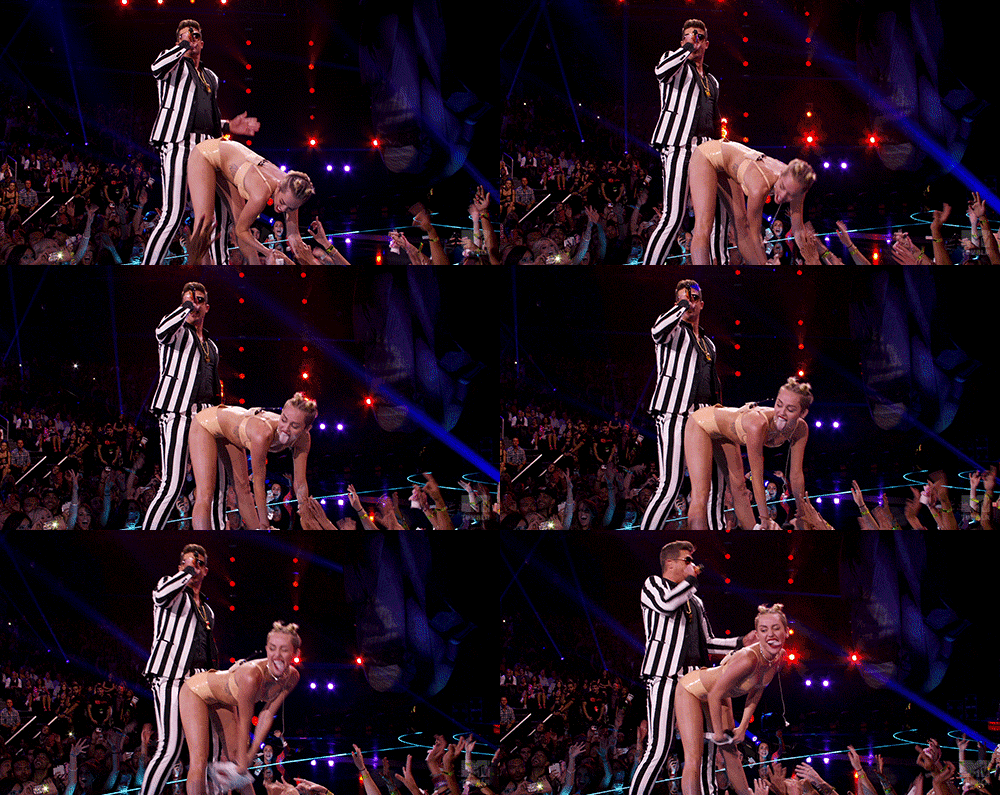
Taking judicial notice of Miley Cyrus' twerking: Texas online solicitation statute ruled unconstitutional
Paging Mark Bennett: You were right; the prosecutors were wrong.
In a surprising decision - both for its unanimous outcome and the unlikely reference to Miley Cyrus "twerking" in a Texas judicial opinion - the Court of Criminal Appeals today declared Texas Penal Code §33.021(b), criminalizing online solicitation of a minor, "facially unconstitutional" in a habeas corpus writ styled Ex Parte John Christopher Lo. See their unanimous opinion (pdf) written by Judge Cathy Cochran which ruled that the statute is "overbroad because it prohibits a wide array of constitutionally protected speech and is not narrowly drawn to achieve only the legitimate objective of protecting children from sexual abuse." Bennett had earlier opined:
The court opined that the overbroad statute would criminalize many common, even historically important artistic works, not to mention ubiquitous images of Miley Cyrus "twerking":
Strong stuff. For once, instead of bucking US Supreme Court opinions, the CCA simply applied them and reached a conclusion that closely tracks federal First Amendment case law. Kudos to the court for not dodging the issue.
MORE: See coverage from the Austin Statesman, the Houston Chronicle, and the Volokh Conspiracy.
AND MORE: Mark Bennett, the attorney who argued the case before the CCA, now has two blog posts up about it:
FOLLOWUP: What happens to people convicted under now-unconstitutional online solicitation statute?
In a surprising decision - both for its unanimous outcome and the unlikely reference to Miley Cyrus "twerking" in a Texas judicial opinion - the Court of Criminal Appeals today declared Texas Penal Code §33.021(b), criminalizing online solicitation of a minor, "facially unconstitutional" in a habeas corpus writ styled Ex Parte John Christopher Lo. See their unanimous opinion (pdf) written by Judge Cathy Cochran which ruled that the statute is "overbroad because it prohibits a wide array of constitutionally protected speech and is not narrowly drawn to achieve only the legitimate objective of protecting children from sexual abuse." Bennett had earlier opined:
it is my opinion that this statute violates the First Amendment by criminalizing protected communications between adults.The CCA unanimously agreed, finding that, unlike statutes in other states, Texas' law "prohibits and punishes speech based on its content." The legislation was supposedly crafted to cover those who "engage in conversations over the Internet with the intent of meeting a minor for sexual activities." But the court found that the statute as written "punishes, as a third-degree felony, salacious speech over the internet (but not "dirty talk" spoken face-to-face) and the distribution of sexually explicit materials over the internet (but not the distribution of those same materials hand-to-hand) to a minor as long as the actor has the intent to arounse or gratify anyone's sexual desires. It does not require that the actor ever have any intent to meet the minor for any reason."
There is no requirement that the person on the other end of the line be a child, or even that the actor believe the person on the other end of the line to be a child. So the statute criminalizes dirty talk between adults if one of them is pretending to be a child — even if the other one knows that the other is just pretending.
Because it reaches constitutionally protected speech (for example, sexually explicit communication between two grown-ups playing “naughty teenager” on the internet — both could be prosecuted), the Online Solicitation of a Minor statute is overbroad and unconstitutional.
The court opined that the overbroad statute would criminalize many common, even historically important artistic works, not to mention ubiquitous images of Miley Cyrus "twerking":
The Court did find that there is a "compelling state interest" in prohibiting online solicitation of minors but that the law as written is "not narrowly drawn." Bottom line, said the court, "everything that Section 33.021(b) prohibits and punishes is speech and is either already prohibited by other statutes (such as obscenity, distributing harmful material to minors, solicitation of a minor, or child pornography) or is constitutionally protected." (Emphasis in original.)Subsection (b) covers a whole cornucopia of "titillating talk" or "dirty talk." but it also includes sexually explicit literature such as "Lolita," "50 Shades of Grey," "Lady Chatterly's Lover," and Shakespeare's "Troilus and Cressida." It includes sexually explicit television shows, movies, and performances such as "The Tudors," "Rome," "Eyes Wide Shut," "Basic Instinct," Janet Jackson's "Wardrobe Malfunction" during the 2004 Super Bowl, and Miley Cyrus' "twerking" during the 2013 MTV Video Music Awards." It includes sexually explicit art such as "The Rape of the Sabine Women," "Venus De Milo," "the Naked Maja," or Japaneses Shunga. Communications and materials that, in some manner, "relate to" sexual conduct comprise much of the art, literature and entertainment of the world from the time of the Greek myths extolling Zeus's sexual prowess, through the ribald plays of the Renaissance, to today's Hollywood movies and cable TV shows.
Strong stuff. For once, instead of bucking US Supreme Court opinions, the CCA simply applied them and reached a conclusion that closely tracks federal First Amendment case law. Kudos to the court for not dodging the issue.
MORE: See coverage from the Austin Statesman, the Houston Chronicle, and the Volokh Conspiracy.
AND MORE: Mark Bennett, the attorney who argued the case before the CCA, now has two blog posts up about it:
FOLLOWUP: What happens to people convicted under now-unconstitutional online solicitation statute?
Labels:
internet crime,
online solicitation,
sex crimes
Subscribe to:
Posts (Atom)