Showing posts with label First Amendment. Show all posts

Monday, April 23, 2018

Lessons for Texas legislators from an unconstitutional revenge-porn statute

As soon as it passed, Houston criminal defense attorney Mark Bennett opined that Texas' "revenge porn" law passed in 2015 was an unconstitutional restriction on free speech. Now, he's backed it up and the 12th Court of Appeals out of Tyler agreed. See coverage from:
Here's the opinion. I am not a lawyer but, given its basis, Grits will go on the record right now to declare there's zero chance the Texas Court of Criminal Appeals as currently constituted will fail to back Bennett and uphold the 12th Court's ruling - even if the case is not decided until after Michelle Slaughter replaces Elsa Alcala.

These are issues the CCA has visited repeatedly, usually unanimously, as Texas prosecutors foisted a series of unconstitutional statutes on the state related to regulating online speech. Whether it's "revenge porn" or "improper photography" or "online solicitation of a minor," Texas legislators and their tuff-on-crime abettors keep tripping over the same thinking errors regarding the state's power to regulate online speech. (See oral arguments in one of Bennett's cases involving the same constitutionality issues before the First Court of Appeals earlier this year.)

Bennett told legislators in 2015 the bill was unconstitutional before it passed, and Grits warned legislators at the time:
Mark's the attorney who successfully convinced the Texas Court of Criminal Appeals - hardly a bunch of libertines - to vote 9-0 to invalidate Texas' online solicitation of a minor statute. So it'd be wise for legislators to consider Bennett's counsel. If they don't, he may well be the guy knocking the law down on the back end.
Now, here we are three years later and that's exactly what happened.

Bennett has tapped into a vein of First Amendment law which will remain an obstacle to expanding government power to criminalize online speech in the ways legislators and our prosecutor friends might like. The things they can criminalize are already criminalized, and the fact of a new medium doesn't change the same First Amendment rights that let Larry Flynt publish Hustler. They don't get to make up new rules and these statutes all ignore the old ones. The next time Bennett tells legislators one of their bills is unconstitutional, regardless of what the DA's association tells them, maybe they ought to listen.

Monday, June 26, 2017

TDCAA: Some Texas probation, parole orders may violate new SCOTUS ruling on sex-offender access to the internet

How will the new Supreme Court ruling in Packingham v. North Carolina - which forbade blanket bans on use of the internet for sex offenders - affect Texas cases? The Texas District and County Attorneys Association offered this preliminary analysis:
Texas does not have a statute that criminalizes a sex offender’s access to social media websites, but Texas does have statutes that permit orders prohibiting a sex offenders’ access to social networking sites, both as a condition of parole (§508.1861(b)(1)(B) of the Government Code) and as a condition of probation (Art. 42A.454(b)(2) of the Code of Criminal Procedure). Based upon the broad language of this decision, it seems likely that a wholesale prohibition of access to Facebook or Twitter or Instagram would be unconstitutional. A more directed condition, prohibiting communication with minors or prohibiting access to chat rooms or dating websites, would seem to be permissible, even under this decision. But it is certainly going to create new litigation.

Tuesday, June 30, 2015

On forensic oversight, backlogs, and prospects for revenge-porn statute's constitutionality

As I head out of town again for a couple of days, here are a few items which merit Grits readers attention:
  • Anthony Graves' appointment to the Houston crime lab board has been making headlines. Perhaps just as significant, his attorney Nicole Casaraz who secured his exoneration will replace Scott Hochberg as the board chair. That's an unusual profile for a crime lab, particularly one whose management was recently made independent of the police department. Congrats to both of them!
  • The 5th Circuit Court of Appeals reinstated a lawsuit by two former Houston crime lab employees (from when it was run by the police department) who alleged that "Harris County prosecutors retaliated against them after they exposed problems with the city's breath-alcohol testing vans, or 'BAT vans.'"
  • In San Antonio, somehow I'd missed news this spring that hundreds of DWI blood tests were mishandled in a contracted lab and the new DA couldn't use the evidence in cases. Oops.
  • Dallas is beefing up staff in its sex crimes unit in anticipation of performing DNA testing on more than 4,000 backlogged DNA tests.
  • Texas' much-lauded revenge porn statute appears on a collision course with recent First Amendment jurisprudence, as Mark Bennett tried to explain to legislators during session. For my part, I wish the debate weren't as facile as it has become, where valid legal criticisms are dismissed as detritus and the Lege just passes laws which poll well but cannot withstand constitutional scrutiny. We've done this a bunch in Texas now, with online solicitation, improper photography ... now we appear poised to go through the same rigmarole on revenge porn. Grits has nothing good to say about anyone who would engage in this activity, but acknowledging the legal complexity of the situation does not condone the behavior. In fact, it's how serious people go about actually solving a problem. We'll see how the courts receive the new statute; I'm not sanguine it has much chance of withstanding scrutiny, good intentions and high-toned rhetoric notwithstanding.

Thursday, April 16, 2015

Revenge porn, online solicitation bills clear Senate despite First Amendment problems

The Texas Legislature seems intent on keeping Houston attorney Mark Bennett busy beating down unconstitutional statutes in an ongoing game of whack-a-mole. A pair of bills have passed the Texas Senate and been sent to the House which, if passed, will likely immediately fall within Bennett's crosshairs (or some other attorney challenging on First Amendment grounds).

Sen. Joan Huffman's SB 344 attempts to reinstate Texas' online solicitation of a minor statute, which the Court of Criminal Appeals unanimously struck down in 2013. But Huffman didn't adopt all the changes Bennett insists are necessary to prevent it from being attacked again on First Amendment grounds. Bennett has praised Huffman's bill for being "much closer to constitutional than the statute as it exists now." But he also laid out in the same post exactly how he'll challenge the statute as proposed and what changes would be necessary to make it constitutional, so if the House doesn't revise it they'll have nobody but themselves to blame. The companion bill, HB 861 by Tony Dale, has cleared committee and is waiting for the Calendars Committee to set it for a floor vote, at which time Huffman's bill will be substituted in and finally passed.

Meanwhile, Sen. Sylvia Garcia's "revenge porn" bill, SB 1135, also cleared the Senate this week, though its companions are not so far along. The Dallas Morning News coverage referenced none of the constitutional concerns, but the bill in its present form almost certainly won't pass First Amendment muster. Analyzing the bill earlier this week, Bennett explained that:
Since the speech restricted does not fall into a recognized category of unprotected speech, under current Supreme Court (and Court of Criminal Appeals) jurisprudence this statute does not pass First Amendment muster. Proponents of this law would have to convince the Supreme Court to recognize a new category of historically unprotected speech that covers most of the speech forbidden by the statute. That’s long odds.
The bills to reinstate the improper photography statute, by contrast, don't appear to be moving.

Observing the Lege pass laws one can already tell are unconstitutional is like watching a slow moving train wreck. You can see a crash is coming well in advance but it seemingly can't be stopped. They pass these laws now then a couple of years later the courts declare them unconstitutional and the state has to figure out what to do with everybody who was convicted under invalid statutes. (Rep. Alonzo's bill on appointment of habeas counsel aims to address that topic.) We've already seen this movie and Denzel Washington doesn't show up at the end to save the train from derailment. It just flies off the tracks.

Friday, March 27, 2015

Bill to criminalize filming police pulled down before hearing

State Rep. Jason Villaba's controversial bill criminalizing filming police officers within 25 feet - and forcing concealed handgun licensees with cameras to stay 100 feet back (astonishingly) - was scheduled to be heard yesterday in the House Select Committee on Emerging Law Enforcement Issues. Hours before the meeting, though, he pulled the bill down.

It's hard to blame him. As it turned out, they announced on the House floor, yesterday was Villaba's birthday. Who wants to show up in committee on your birthday to have people hate on you for two hours on a bill that's already DOA? What's the point, really?

There were a few grumpy people who'd come in from out of town to castigate Villaba and his bill. Some left frustrated that they didn't get their say. But they got the outcome they wanted, which is all that matters in this stage of the legislative process.

Wednesday, March 25, 2015

Get rid of specialty license plate program regardless of court case outcome

The state of Texas won't approve a specialty license plate emblazoned with the Confederate battle flag and has taken its case all the way to the US Supreme Court, which heard oral arguments this week. As a proud son of the South who grew up with that flag hanging on my bedroom wall, Grits hopes the state loses ... but maybe not for the same reasons as the Sons of Confederate Veterans.

To be sure, seeing the word "Texas" emblazoned above the stars and bars on official license plates would be ugly and dispiriting. But more to the point, I'm sick to death of the specialty license plate program, a purely symbolic diversion which seemingly takes up more legislative attention than quite a few real-world problems like, for example, the 1.4 million godforsaken drivers who've lost their licenses thanks to the Driver Responsibility surcharge. It drives me crazy when legislators waste precious time on this sort of fluff then never get around to the things that affect real people.

An attorney for the Sons of Confederate Veterans told the court that, if their side won, there would be no justification for banning "a swastika," an "outright racial slur," or even the word "jihad" from Texas license plates. Wouldn't that be special?! Most people agree that, if that were the case, the state would likely eliminate the program altogether. To which I'd reply, "Please, and thank you!"

That's in fact why I hope the state loses. Not only do I think it's the right outcome on First Amendment grounds (along with letting Nazis march in Skokie, etc.), if it happens, then the Texas Lege could get rid of the damn specialty license plate program and be done with it. Let those longing to turn their vehicle into a canvas for self expression - both drivers and legislators - purchase bumper stickers and leave state government out of it.

Monday, March 16, 2015

Can/will Lege write a constitution-friendly ban on online solicitation of a minor?

After the Texas Court of Criminal Appeals ruled the existing "online solicitation of a minor statute" unconstitutional in 2013, quite a few legislators would like to revive the statute. The first bill to be heard this session addressing the topic will be HB 861 by Tony Dale, which is on Wednesday's House Criminal Jurisprudence Committee agenda.

I mention it because Mark Bennett, who litigated the case overturning the statute as unconstitutional, authored a blog post in February offering his analysis of companion legislation to Dale's, praising its restraint in several areas and describing a handful of remaining, arguably unconstitutional provisions which he says would still subject it to First Amendment attack if the bill is not amended.

Bennett's is not an idle claim. The (not exactly liberal, namby-pamby) Texas Court of Criminal Appeals ruled unanimously that "everything that Section 33.021(b) prohibits and punishes is speech and is either already prohibited by other statutes (such as obscenity, distributing harmful material to minors, solicitation of a minor, or child pornography) or is constitutionally protected" (emphasis in original). So if everything that can be illegal has already been made illegal, it's hard to see room for this statute to afford additional protections to victims of sex crimes, good intentions notwithstanding.

Bennett showed up last week to testify before the same committee regarding proposed "revenge porn" statutes, making related First Amendment arguments. Some members of the panel - most prominently Rep. Jeff Leach - strongly disagreed with Bennett's analysis, but from Grits' perspective it was an odd conversation. Bennett was describing the state of the law as articulated in a 9-0 vote by the CCA, while his critics made normative claims about what the law should be. That's a recipe for having your new statute struck down just like Texas' online solicitation and improper photography laws.

In the case of online solicitation of a minor, Bennett has told legislators already exactly what it would take to write a constitutional statute. If they want any law they write to have an effect in the real world - as opposed to merely affording an opportunity for politicized grandstanding - it would behoove them to accept his advice.

Tuesday, March 10, 2015

Bennett: Revenge porn bills face insurmountable First Amendment hurdles

There are three bills up on Wednesday's Texas House Criminal Jurisprudence agenda which would criminalize revenge porn. But Houston attorney Mark Bennett, arguably Texas' premier expert at the moment on the intersection between the First Amendment and criminal law, made the case this morning that all three bills are unconstitutional on First Amendment grounds. (See here for more background.)

Bennett argues that the bills propose a "content-based" restriction on speech which is "presumptively unconstitutional under the First Amendment" unless it falls within "nine recognized categories of unprotected speech." "For this or any other revenge-porn statute to pass constitutional muster, the Supreme Court would have to recognize another category of historically unprotected speech," he pointed out. "In Arizona, enforcement of the nonconsensual-pornography criminalization statute was almost immediately stayed on First Amendment grounds by a U.S. District Court."

Mark's the attorney who successfully convinced the Texas Court of Criminal Appeals - hardly a bunch of libertines - to vote 9-0 to invalidate Texas' online solicitation of a minor statute. So it'd be wise for legislators to consider Bennett's counsel. If they don't, he may well be the guy knocking the law down on the back end.

With statutes regarding online solicitation of a minor and improper photography recently struck down by Texas courts over First Amendment problems, it's clear there's a tension over legislators' desire to limit lewd pictures and dirty talk to a greater extent than the Constitution allows. If Bennett's right - and his recent track record on these subjects has been excellent - these bills are unlikely to survive First Amendment scrutiny by the courts.

This is an ounce of prevention vs a pound of cure situation. It'd be a lot simpler to kill the legislation in committee than to make Bennett or some other criminal defense lawyer fight in court for years post hoc to reach the same result.

MORE: Check out a recent academic article on the constitutionality of anti-revenge porn laws.

Wednesday, February 04, 2015

Bennett: How Texas can constitutionally reboot online solicitation statute

One of the sleeper issues confronting the 84th Texas Legislature are proposed revamps of the state's online solicitation of a minor statute, deemed unconstitutional last year by the Court of Criminal Appeals. Legislation to reboot the statute has been filed by Rep. Tony Dale in the House and Sen. Joan Huffman in the Senate, reported Chuck Lindell at the Austin Statesman (Feb. 3). See the text of their proposal and a press release from Dale.

Grits forwarded the legislation to Mark Bennett - the Houston attorney whose aggressive appellate work invalidated the statute and arguably the state's leading, practicing expert on the intersection between First Amendment and criminal law - and he offered up this post on his blog Defending People analyzing the Dale/Huffman proposal from a constitutionality perspective.

Bottom line, says Bennett, the language is "not quite right, but is much closer to constitutional than the statute as it exists now." He suggested a few "small changes" which would bring "the statute ... almost in line with First Amendment incitement law."

Indeed, the barrister opined, "The only element of incitement that isn’t in the statute is imminence: for incitement to be unprotected speech the defendant must intend that a crime be imminent. There is, as you might imagine, not a lot of case law on imminence. If you stuck 'the imminent' in between 'commence' and 'commission' [in his edited text], you’d have a statute that I’d have difficulty attacking (which is not to say that I won’t come up with something)."

A few observations. First, this was a 9-0 ruling by the Court of Criminal Appeals so the replacement of three judges in November likely won't change it. That means the case law Bennett helped establish on this issue will govern whatever the Lege does this session. Second, let's be clear, Bennett understands First Amendment law and the prosecutors don't. Moreover, he's been licking his chops for a chance to challenge any replacement statute. So if Mark Bennett is offering drafting advice, it would behoove the bill authors to take it and run. That's especially true since the changes he's suggested are truly not major; they've already narrowed the bill most of the way.

RELATED: Is it possible for Lege to resuscitate online solicitation statute?

Thursday, September 18, 2014

CCA: Texas' improper photography statute unconstitutional, Hannah Overton salt poisoning conviction overturned

Yesterday, the Texas Court of Criminal Appeals threw out Hannah Overton's capital murder conviction based on ineffective assistance of counsel and ordered a new trial. See coverage from Texas Monthly and the San Antonio Express-News.

Also on yesterday's hand-down list, the court invalidated Texas' improper photography statute as unconstitutional on First Amendment grounds. See Chuck Lindell's coverage at the Austin Statesman. Last year the court struck down Texas' online solicitation of a minor statute on First Amendment grounds as well, readers may recall, and Houston attorney Mark Bennett thinks there's more to come.

Friday, September 05, 2014

San Antonio may criminalize giving to panhandlers

According to AP: Unable to dissuade panhandlers from asking people for money, the San Antonio police chief now wants authority for his officers to write Class C tickets to passersby who give people spare change! Problem is, asking for money is speech and, after Citizens United ruling, we all know money is speech. So First Amendment red flags abound.

Here's Texas Civil Rights Project legal director Wayne Krause's money quote in the AP story, "The idea of criminalizing people giving is both unkind and legally unsound. ... The First Amendment protects the right to ask for help. It certainly protects the right to choose to whom we give assistance."

It's great TCRP is fighting this, but it's too bad there wasn't any clergy in the room. Somebody could have quoted to the council from Matthew 25:36-47. Perhaps some of them will have time to review those passages before the ordinance comes before them next month.

Wednesday, September 03, 2014

Tracking First Amendment challenges to Texas criminal statutes

Mark Bennett has a nice post up at Defending People detailing the ongoing First Amendment challenges to various Texas criminal statutes. Check it out.

After Mark's victory challenging the constitutionality of Texas' online solicitation of a minor statute on First Amendment grounds, I think a lot of folks - though regrettably, not yet legislators - are taking his arguments on these questions more seriously than not too long ago. If he's right, several more Texas statutes limiting sexual-themed speech may ultimate fall, probably starting with improper photography.

Friday, May 09, 2014

CCA to decide if Texas' improper photography law unconstitutional

The Texas Court of Criminal Appeals on Wednesday held oral arguments regarding the constitutionality of Texas' "improper photography" statute in a case styled Ex Parte Thompson. There's a post on the case from Eugene Volokh, who along with Don Flanary III of San Antonio argued the case on behalf of the defense, and one from Mark  Bennett, who has long held that this statute violates the First Amendment. See also prior Grits coverage, and here's the state’s brief, defendant’s brief, and an amicus curiae brief from the Reporters Committee for Freedom of the Press, whom Volokh represented.

Mark Bennett argued that:
The San Antonio Court got the question of whether 21.15 is content-based or content-neutral wrong. (It matters because a content-based statute has to pass stricter scrutiny than a content-neutral one; the San Antonio Court found that 21.15 did not even pass the lesser scrutiny.) ...

For the convenience of courts of appeals for whom this concept might be too complex, I offer the Grumpy Cat Rule: If the statute favors images of grumpy cats over other images, its regulation of speech is content-based.
Following the Court of Criminal Appeals unanimously overturning the online solicitation of a minor statute on First Amendment grounds, this may be one to watch. Prosecutors are worried that, since the online solicitation statute was struck down on essentially similar grounds to the Fourth Court of Appeals ruling in this case, the improper photography law might also be deemed unconstitutional. I wouldn't be surprised. Time will tell.

Wednesday, March 19, 2014

CCA to Greg Abbott: Shut up and go away

After Attorney General Greg Abbott asked the Court of Criminal Appeals to grant re-hearing on their 9-0 decision to invalidate Texas online solicitation of a minor statute as unconstitutional, the CCA today in another unanimous ruling not only told him "no" but expressly limited his authority, striking down a 2011 statute on which he based his post hoc intervention. Rather than reinvent the wheel, here's how Chuck Lindell at the Austin Statesman described this latest development:
The state’s highest criminal court Wednesday declined Attorney General Greg Abbott’s request to reconsider an October ruling that invalidated a law banning sexually explicit cyberchats between adults and minors — and acted instead to limit the power of Abbott’s office.

Abbott had argued that the court’s ruling on the “sexting law” was invalid because his office hadn’t been notified, as required by state law, that the statute had been challenged as unconstitutional. The oversight deprived his office of an opportunity to defend the sexting law, Abbott argued.

But in a unanimous, unsigned opinion released Wednesday, the court threw out the notification law, saying it violated the separation of powers between the legislative and judicial branches of government as required by the Texas Constitution.

The Legislature exerted “undue interference” on courts when it enacted the law in 2011, the opinion said.

According to the notification law, when a court finds a statute unconstitutional, it cannot enter a final judgment until the attorney general is notified and 45 days have passed.

Entering final judgments, however, is a core judicial function that “falls within that realm of judicial proceedings so vital to the efficient functioning of a court as to be beyond legislative power,” the Court of Criminal Appeals ruled.
The 2011 law insisted that the AG be provided notice whenever the constitutionality of a law was challenged. A footnote to the main opinion striking down the notification provision held that the "directive to notify the attorney general of every constitutional challenge to a state statute made by a party imposes a duty that is wholly unrelated to the Court's judicial powers and functions. Pursuant to this unusual provision, the legislature would have this Court exercise a function that is not only non-judicial but would operate solely for the apparent benefit of the attorney general. And to what extent the attorney general would benefit from receiving such a notice is elusive, given that the attorney general has no authority to appear in criminal cases before this Court."

Ouch! That's gonna leave a mark.

Rubbing salt in the wound, Presiding Judge Sharon Keller offered a concurrence pointing out that the AG's office has web access and should have known about the case as it was happening just like every other attorney in the state. Wrote Keller, "the notification statute applies not just to this Court, but to all courts. I do not know what burden the statute would place on trial courts and courts of appeals, but, during the last fiscal year, this Court disposed of well over nine thousand matters. Many of the pleadings before our Court claim that a statute violates the constitution. I agree with the Court that subsection (a), which requires courts to serve the Attorney General with notice and a copy of the relevant pleadings in all of these cases, also violates the Texas Constitution because it imposes a duty that falls outside of any judicial function of this Court."

MORE: From Mark Bennett, who argued the case before the CCA. In the comments to Mark's post, Alex Bunin from the Harris County Public Defender's Office noted wryly, "The State needs to stop filing stuff before something else they like gets struck down."

See related Grits posts:

Thursday, March 13, 2014

Is it possible for Lege to resuscitate unconstitutional online solicitation statute?

The Fort Worth Star-Telegram recently reported ("A teacher, sexting, and the right to free speech," Feb. 25) on a case of a teacher sexting with a student in which prosecutors dropped charges, claiming the episode shows why the Legislature needs to reinstate Texas' recently-declared-unconstitutional online solicitation of a minor statute. The story opened:
He was 30 and she was 13 — a teacher and his student — but their relationship went far beyond the classroom, authorities say.

In six days in October 2012, they sent 688 text messages to each other, and the conversation became sexual, according to an arrest warrant affidavit.

The messages — known as “sexting” — included descriptions of sexual preferences and fantasies and discussions of dreams about each other, the affidavit says.

Sean Arlis Williams, now 31, who was a junior high school teacher in the Everman district, was eventually arrested on a charge of online solicitation of a minor, which was later changed to improper relationship between an educator and student.

But this month, based on a recent appeals court ruling dealing with a similar case in Harris County, Tarrant County prosecutors dismissed his case.
In consequence, reported the Startlegram, "Chad Ruback, an appellate attorney who worked at the Fort Worth [Court of] Appeals, said the court’s message is directed to state lawmakers, saying they need to rewrite the law so that it achieves its stated purpose of protecting minors against sexting." Rob Kepple, the executive director of the Texas District and County Attorneys Association who helped draft the statute, has also suggested the Lege should revive and revise the statute.

Here's the problem with the argument that legislators should rewrite the law: the unanimous ruling by the all-Republican court found that "everything that Section 33.021(b) prohibits and punishes is speech and is either already prohibited by other statutes (such as obscenity, distributing harmful material to minors, solicitation of a minor, or child pornography) or is constitutionally protected" (emphasis in original).

The court's opinion elaborated in detail the statutes forbidding all manner of communications that could be prosecuted under other statutes. For example, the CCA noted that "section 42.07 of the Penal Code, the harassment law, already prohibits and punishes an electronic communication that 'makes a comment, request, suggestion, or proposal that is obscene.' Or, if the repeated emails or text messages are not obscene, but they are 'reasonably likely to harass, annoy, alarm, abuse, torment, embarrass, or offend' the child, the sender may be prosecuted under Section 42.07(a)(7)." And the court left intact the portion of the online solicitation statute that outlaws adults actually soliciting sex with a minor.

So if, as all nine members of the Texas Court of Criminal Appeals agreed, "everything" covered by the statute in question was "either already prohibited by other statutes ... or is constitutionally protected," I fail to see how the Lege can rewrite the law in a constitutional fashion. As the CCA noted, longstanding US Supreme Court precedents have held that "Sexual expression which is indecent but not obscene is protected by the First Amendment."

The school can and should terminate the teacher and the state IMO would be justified in taking away his teacher's license, but that doesn't mean a crime has been committed if he didn't solicit a meeting or distribute obscene materials.

Here's the text of the online solicitation statute (only subsection [b] was held unconstitutional) and here's the unanimous opinion (pdf) from the Court of Criminal Appeals, which closely tracks federal First Amendment rulings. Maybe some of you legal eagles out there can suggest how the unconstitutional statute might be modified to criminalize such behavior in a way that comports with the First Amendment. I'm not a lawyer, but personally, I can't see it.

See related Grits posts:

Sunday, November 03, 2013

First Amendment fouling Texas prosecutors' efforts to criminalize sexual content

Following up on the Court of Criminal Appeals' 9-0 decision to overturn part of Texas' law on online solicitation of a minor as facially unconstitutional, the executive director of the Texas District and County Attorney's Association, Rob Kepple, admitted on their user forum that he helped draft the language nullified unanimously by the high court:
OK, I fess up to being involved in the drafting of this statute. Seemed like a good idea at the time. The thought was that the "intent to gratify" element would take it into constitutional territory. I agree that a teacher sending a kid a book or discussing it could be protected speech, but if the teacher is sending certain passages of 50 Shades of Gray along with other inappropriate messages, seemed like grooming conduct which would support a constitutional prosecution.
If Mark Bennett has his way, Kepple will be issuing more such mea culpas in his future. Still glowing in the wake of his victory at the CCA overturning Sec. 33.021(b) of the Texas Penal Code, he offered up this post arguing that "Sections 33.021(c) and (d) com­bined explic­itly crim­i­nal­ize fan­tasy, for­bid­ding speech—fantasy speech—that is pro­tected by the First Amendment." "You read it here first," he wrote, "Sec­tion 33.021(c), com­bined with Sec­tion 33.021(d), is unconstitutional." Bennett concluded with this admonition for his fellow criminal defense lawyers:
I hate to sound unnec­es­sar­ily arro­gant, but there are very few lawyers in Texas whom I would trust to han­dle these chal­lenges. This is a very spe­cial­ized area of the law, at the inter­sec­tion of the First Amend­ment and crim­i­nal law. Most lawyers thought I was crazy to say that 33.021(b) was uncon­sti­tu­tional; they kept plead­ing those cases even after they knew about the pend­ing appeal in the Texas Court of Crim­i­nal Appeals.

If you’re a lawyer, please don’t try this at home. Call me and we’ll do it together.
Probably good advice. And speaking of advice on the intersection of criminal and First Amendment law, on the Texas prosecutors' user forum this week Brazos County prosecutor John Brick solicited some regarding another statute Bennett has argued is unconstitutional - Texas' improper photography statute. He wrote:
I need help with this scenario – i.e., is this an Improper Photography (21.15 TPC) case or not:

Girl 1 has child with guy. Guy starts dating Girl 2. Girl 1 finds a pic of Girl 2 topless on guy’s phone. Girl 1 posts the topless pic on Facebook & Instagram and calls victim bad names. The elements read that a person commits a crime if the person: photographs or by videotape or electronic means, records, broadcasts, or transmits a visual image of another at a location that is a bathroom (it is in this case) A) without the other person’s consent, and B) with intent to invade the privacy of the other person.

Suspect can also be charged if: knowing the character and content of the pic, they promote it.

Q1: do you think the defendant has to be the one who actually photographs or records, or do you think the statute reads that they can simply transmit a visual image?

Q2: do you think Girl 2 waived her privacy claim by sending it to someone in the first place?

Q3: what the heck does “knowing the character and content” mean? Do we have to prove the same elements as the underlying (lack of consent and intent to invade privacy)?
Kleberg County DA John Hubert replied:
OK, I'll attempt this one..

Q1. simply transmitting is enough.

Q2. No. Girl 2 sent this to Guy 1. If Guy 1 shared it, there might be an issue of whether G2 waived or not. However, if Girl 1 is getting the pics from the guy without his knowledge, I think there is a privacy issue. Also, you have to look at the intent...it is with intent to invade another's privacy...

Q3. OK, "knowing character and content" may be a little more squishy, but I think that a picture of a person in a bathroom with clothes on but doesn't see a person in the bathtub in the background who is showing some skin might be an example of NOT knowing character and content...... but that would be a question for the jury.

Anyone disagree?
Certainly Mark Bennett does. Indeed, a prosecutor from Groesbeck warned Brick that Bennett's First Amendment tonic may sour Hubert's optimistic argument: "Just keep in mind that the Fourth Court has ruled this statute facially unconstitutional. Coupled with the CCA ruling ... striking down a portion of the online solicitation statue on nearly identical reasoning, I would be cautious here." (See Grits' post from September on the Fourth Court of Appeals' opinion.) The improper photography statute now appears ripe for consideration by the Court of Criminal Appeals since the First Court of Appeals earlier upheld its constitutionality, meaning the law is being interpreted differently in different Texas jurisdictions.

Bottom line: Now that Bennett has busted this First Amendment nut open at the CCA, a number of similarly themed statutes criminalizing possession or transmission of sexual content could well fall like pecans in autumn. And our friends at the prosecutors' association may have more fessing up to do.

Sunday, September 01, 2013

Is Texas' 'improper photography' statute unconstitutional?

Somewhere, Mark Bennett must be smiling after the Fourth Court of Appeals declared Texas' "improper photography" law unconstitutional. Now the Court of Criminal Appeals will be asked to resolve differing opinions among Texas appellate courts, reported KSAT out of San Antonio (Aug. 30):
The Fourth Court of Appeals declared the Texas Improper Photography Statute unconstitutional on Friday.

District attorneys say Section 21.15 of the Penal Code, known as the Improper Photography statute, makes it a state jail felony to visually record or photograph another person without their consent to arouse or gratify the sexual desire of another person.

"I was very surprised this has proven to be an important statue in what I could call the digital age this is the kind of statue that prevents someone from photographing under a woman’s skirt,” said First Assistant District Criminal Attorney Clifford Herberg Jr.
The defendant in the case was arrested for taking pictures of children in their swimsuits at Sea World. He filed a pretrial habeas corpus writ challenging the constitutionality of the statute. "Thompson argues innocent photographers run the risk of being charged with violating the statute because the government is attempting to regulate thought, a freedom protected by the First Amendment," said the appellate ruling. The court found that the "location identifier" in the statute — "at a location that is not a bathroom or private dressing room — is so broad the statute seems to criminalize conduct in areas where individuals have no expectation of privacy," including public spaces like an amusement park.

See the Fourth Court's opinion (pdf). H/T: PetaPixil.

MORE: From Eugene Volokh.

Sunday, August 18, 2013

Drones, federalism and the First Amendment

If you've got a spare 18 minutes to spend on the subject, Margot Kaminski has an excellent podcast up at DroneU.org on "Drone Federalism." She succinctly lays out the First Amendment implications of private drone regulation, as opposed to regulating their use by the government, as well as anyone I've seen. She describes five axes of drone use around which lawmakers must craft drone regulation, only one of which (use by law enforcement to monitor the public) lends itself to a clean, obvious solution (a warrant requirement).

Around the 11:30 mark she points out that Texas' new drone law as written would likely criminalize the drone photographer who captured pig blood being dumped into the Trinity River by a meat packing plant in Dallas which has since faced a crackdown from the EPA. Margot, who your correspondent was privileged to meet at a conference on electronic privacy at the Yale Law School earlier this year, is perhaps the sharpest thinker I've run across on the subject of drone regulation. I still wish our friends at the Texas Lege had consulted her and the other experts at DroneU.org before passing Texas' ill-considered "drone bill," HB 912. Given Texas' mess of a statute, I couldn't agree more with Kaminski's point about drone federalism. Prosecutors have said our homegrown bill is unenforceable and the Texas Lege would definitely benefit from allochthonous approaches.

See related Grits posts:

Tuesday, May 14, 2013

Top Five Things Wrong With Texas' Drone Bill

The road to hell, they say, is paved with good intentions, but apparently airspace will also get you there.

Friday, March 29, 2013

A path forward for state-level drone regulation

I listened today to the Texas House Criminal Jurisprudence Committee's surprisingly lively hearing in the middle of the night sometime Wednesday morning. That's when HB 912 by Lance Gooden criminalizing photography by drones finally came up. I'd already gone to bed after the debate on the cell-phone location tracking bill ended around 1:35 a.m., so thank heavens they webcast and archive these things. Go here to watch the hearing (it begins at the 6:46:18 mark) which started sometime just shy of three a.m. before an increasingly groggy but still engaged committee. I've also obtained a copy of the committee substitute language. It's not yet available on the capitol website so I uploaded a version here.

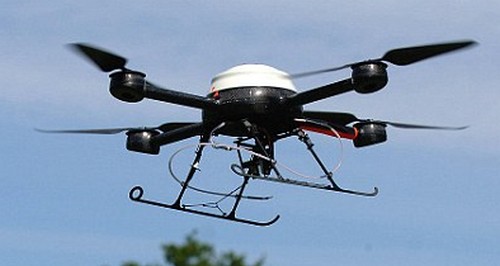
Sophisticated surveillance drone.
There's a civil section to the bill, explained Rep. Gooden, saying you can't take photos from a drone over someone's private property, with a penalty of up to $1,000 per picture. That's the piece which brought professional photographers out of the woodwork. For videographers, that per picture liability may be multiplied by 24 frames per second. Similarly, news photographers may take hundreds of photos on a shoot. The bill also creates criminal penalties, Class Cs and Bs, for drone photography of private property. Police officers who've obtained warrants are one exception to the criminal prohibition, including for pursuits, border security, when someone's life is in danger. Gooden said the Legislature had an obligation to regulate new technology, adding that, "If Bryan Hughes would have told you five years ago he'd be filing his GPS bill you'd have thought he was crazy. Some people think I am."

Grits increasingly likes Rep. Matt Schaefer the more I see of him - not just because he says things I agree with and asks good questions, but also because he's a home-town boy, representing the district I grew up in and where my father still resides in Tyler. He laid out parameters that also reflect my preferences: Stay out of the criminal statutes and cap damages on the civil side until we really understand all the stakeholders and everything that's going on.

Rep. Burnam interjected to say that Gooden had worked diligently with committee members and stakeholders, but that didn't mitigate the wave of often legitimate criticism that dominated most of the rest of the hearing. There was a consensus among speakers that a warrant standard for police was a good thing but there needed to be protections for filmmakers, hobbyists and press.

Alicia Calzada, an attorney with the National Press Photographers Association, nervously spoke against the bill. Her group opposes bills in general that criminalize or impose civil penalties on press photography, she said, and this bill does both. Drones are cheaper than helicopters and safer for operaters, she said. Aerial photography is powerful media tool. She complained the bill is content based, with the crime or civil penalty based on what's in the picture. Regulating content, she said, "requires a compelling state interest" that's not present as the bill's currently drafted.

There was a poignant moment when Rep. Schaefer asked a fellow from Texans for Lawsuit Reform, "do you agree we have some privacy issues?" Yes, the TLR lobbyist muttered. "Would you prefer we deal with those in civil court or criminal court?" "Criminal court," was the reply, as the audience twittered with laughter. Said Schaefer: "Why is that not surprising?" If you ever wonder why Texas too often uses criminal law in lieu of regulation or civil courts, that legislative moment sums it up. TLR has been and is a powerful voice under the pink dome.

Rep. Steve Toth from Montgomery County, where the local Sheriff bought a drone with grant funds and promptly crashed it into a SWAT vehicle, asked, "Should you be able to fly over my property and see my wife sunbathing?" Calzada meekly replied that it depends.  Toth asked, "Should you be able to fly over a wedding to see who is there?' Calzada answered only with a long silence, followed by mumbling. Toth continued, "How about a little kids' camp?" Taking a deep breath and regaining her composure, Calzada responded, "Well, can you see it from a helicopter? Can you see it from a 20-story building?"

She continued to point out that "This bill doesn't differentiate between when you do and don't have a reasonable expectation of privacy." Content based restrictions require a compelling state interest, she said, and  more narrowly crafted exemptions than were in the committee substitute. The bill needed to contain explicit exceptions for "serious literary, artistic, political or scientific expression," she said. Grits would have gone so far as to add that not just serious but "light-hearted, silly or fanciful" expression also deserved protection.

Brent Byler, of drone maker DGI Innovations described more positive uses of the technology: "Movie and television filming, agriculture, disaster management, thermal and infrared powerline surveys, aerial imaging and mapping, news coverage, environmental monitoring, oil and gas exploration, and real estate." He added, "Drones don't spy on people, people spy on people. He cited F1 races and SXSW as examples where drones were used because they're safer to use these than helicopters. But in a large crowd setting like that you can't get permission from everybody. Drones make high-quality media cheaper, he said, costing little to operate compared to helicopters which cost $15,000 per day. It's "not in the spirit of Texas to run off businesses," said Byler. Rep. Moody asked, if there is a way to "carve out  incidental image capture"? Byler replied probably.

Documentary film producer John Downer testified against the bill. Something must be done to protect privacy, he agreed, but under the bill as drafted he can't do the shots he needs so they would probably just go to California or shoot somewhere else. When a filmmaker flies a camera-laden drone down the street then pauses, hovering on a house where they're shooting, right now they get permission and pay for use of the one house. But it's not economically feasible, he said, also to pay every homeowner and bystander captured as they fly down the street. Directors who wanted such shots would have to  film somewhere else. At 24 images per second, at $1,000 per image the penaltie would quickly get out of hand. Mark Easterbrook, National Press Photography Association, called the legislation "just dumb," imploring the committee, "Don't be that state."

Other media reps tried to make clear that there are nearly unlimited uses for drones - which are much cheaper than photography from a helicopter at $300 per hour - for everything from sports and traffic coverage to an array of other uses that have traditionally been held to be constitutionally protected. A hobbyist came down from Fort Worth and, testifying at about four in the morning, told the committee he didn't want them to make something illegal that didn't hurt anybody and that he really loved to do. "I just want to fly my planes," he told the committee. A couple of speakers suggested there should be some sort of mens rea, or "ill intent" required before criminal or civil penalties kicked in.

Anyway, you get the gist. Quite an animated discussion considering how late it occurred.

A Path Forward
To me, the drone debate is the culmination of an increasingly bad policy trend that's infected the Texas penal code for at least two decades - using criminal laws as commentary on social trends and a substitute for meaningful civil-side regulations, which is how you get seven, or 11, or 16 oyster-related felonies, depending on who's counting. With all due respect to Rep. Gooden, trying to engage in aircraft regulation primarily through the use of misdemeanor criminal penalties is just a wrong-headed approach.

Here's my preferred solution: The FAA won't begin to license private sector use of drones until 2015, meaning for now the main users that need regulation are all in the government. So implement a warrant requirement for law enforcement to use drones on a particular investigative target (perhaps with exemptions for traffic monitoring and emergency response), and limit regulatory uses, but for now, leave private-sector use alone. The model language I took Rep. Gooden's staff from the ACLU's national model drone privacy bill included a warrant requirement for police and the following restriction on non-police UAVs (ignore, if you can, the annoying double negative in the first sentence):
Exception for non-law enforcement operations - It shall not be unlawful under this chapter for an agent of the state or any political subdivision thereof to operate an unmanned aerial vehicle and for information from such operation to be disclosed if no part of any information and no evidence derived from such operation may be received in evidence in any trial, hearing, or other proceeding in or before any court, grand jury, department, officer, agency, regulatory body, legislative committee, or other authority of the [State] or a political subdivision thereof, or for any intelligence purpose.
Under that language, the government could use drones for constructive purposes but not for "gotcha" type investigations. A pipeline company or one supposes, the state, might use drones to monitor for leaks, for example, but TCEQ couldn't use a drone for regulatory enforcement. Moreover, even with a warrant or under other exceptions, according to that model language, "Neither facial recognition nor other biometric matching technology may be used on non-target data collected by an unmanned aerial vehicle." We know that much is legal. The state can limit the activity of state and local law enforcement, state agencies, and their agents. Let's start there.

Grits would rather Texas actually pass a meaningful drone privacy bill limited to restricting government instead of one that's overbroad, violates First Amendment precedents, and is destined to get thrown out in federal court. Regrettably, I'm not sure this bill is fixable without rethinking its approach from first principles. In part because of its inappropriate use of criminal law to address a regulatory question, Gooden's current language governing legitimate government uses IMO both goes too far and not far enough. Limiting its scope to government - and getting rid of the criminal penalties entirely - would avoid First Amendment court challenges and allow some version of the above language to address the main non-law enforcement uses of unmanned aircraft.

As for private drones, the Texas Legislature will meet again in 2015 before the first private drones are licensed by the FAA that September. By that time, other states will have taken a stab at these thorny issues and the federal government will likely have passed more legislation on the topic. In the meantime, why not restrict drone use by the government, which is already being licensed to use this technology?

See prior, related Grits posts: