Showing posts with label slave patrols. Show all posts

Friday, September 25, 2020

Slave patrols as apartheid enforcers in addition to chasing runaways

When your correspondent began researching the history of Texas slave patrols, I considered them mainly a way the government collaborated with slave owners to control black people and punish them for violating rules. But it turns out, slave patrols were as much about enforcing apartheid as protecting property rights, and they were empowered to arrest white folks for various co-mingling considered inappropriate.

Grits' slave-patrol research homed in on Guadalupe County, in large part because records there have been preserved. I'm not the only one to take advantage of that serendipity. In Mark Gretchen's remarkable 2009 genealogical volume, "Slave Transactions of Guadalupe County, Texas," he included a comprehensive list of slavery-related criminal charges from Guadalupe County criminal court records. Almost all (20 out of 28) involved white defendants, not black ones.

To an extent, this should come as no surprise. Slave patrols were empowered to punish black people without judicial oversight. State law authorized them to give slaves up to 25 lashes for violations, and in some places like San Antonio or Indianola, the law authorized slave patrollers to give up to 39 lashes. Indeed, noted Gretchen, "by 1860, the only two sentences provided for convicted slaves in the Texas penal code were death and whipping." White folks, however, had to be taken before a judge.

Most of the slavery-related indictments against white folks in Guadalupe County were eventually dismissed or resulted in an acquittal. Even so, then, as today, you might beat the rap but you couldn't beat the ride. Those folks were still arrested by the patrol and conveyed to authorities, even if formal punishment seldom followed.

For example, Joel E. White was indicted in 1850 for purchasing a horse for $20 from a slave named Lawrence without receiving permission from his owner, Manuel Flores, who fought in the Battle of San Jacinto and was a brother-in-law of the town's namesake, Juan Seguin. The case was dismissed. 

Ernst Schram was indicted for purchasing a cowhide from a slave without written consent of his owner, Samuel Millet, one of the larger slave owners in town who would later perish in the Civil War. 

Otto Wupperman was indicted for purchasing a bushel of potatoes for a dollar from a "copper colored" negro named Henry who belonged to Andew Herron, a wealthy Presbyterian minister and one of the town's larger slaveholders. Herron owned 22 slaves at the time of the incident. 

Gustav Thiessen and Louis Hipp were both indicted for selling spirits to slaves, with charges later dismissed.

Thomas Wilson stood trial for allegedly harboring a runaway slave named Maria, the only slave owned by a local named William A. Farris. The jury returned a Not Guilty verdict in May 1856.

A couple of cases against white folks resulted in convictions and a $50 fine: James W. Fennell was indicted in 1863 for "Placing Slaves in Charge of a Farm or Stocke Ranch," while Thomas J. Perryman that same year was indicted for "Keeping Slaves on a Farm Detached From His House." In both cases, the slaveholder failed to keep a free white man on the premises to govern them. Ironically, the law forbidding slaves from living in a detached dwelling was passed in 1858 by H.E. McCullough, the state senator from Guadalupe County.

That these are the only two cases against white people resulting in a final conviction and punishment tells us that allowing black people to live and work independently was taken especially seriously by authorities.

However, the most common charges against white folks were things like "Permitting Slave To Hire Time" and "Hiring Slaves To Slaves." The law allowed slaves to work for wages only in a limited way. Grits was unaware of this limited proletarianism afforded slaves in Texas and have never seen it discussed before. Turns out, after 1846, slaves could hire out their own time one day per week or a full week during the Christmas holidays. Beyond that, their owners could theoretically be prosecuted for letting them earn their own money.

The year 1856 saw seven such cases. In the only instance resulting in a conviction, John M. Anderson was convicted and fined one cent: He appealed and the Texas Supreme Court overturned the conviction and dismissed the case. Apparently, prosecutors took this as a sign that all such cases were doomed. No more charges for "Permitting Slave To Hire Time" were recorded  in Guadalupe County after that episode.

Only one case in the records involved a white man accused of abusing a slave. Clinton DeWitt was the son of Green DeWitt, empressario of the famous DeWitt Colony, and a well-known sadist. In 1847 he was indicted for "Unreasonably Abusing a Slave," though charges were eventually dismissed. Dewitt was later killed by his brother in law, shot to death while he was beating his wife with a bullwhip. 

The brother-in-law, Tom Frazier, escaped but was later brought to trial for the murder in 1886. An unnamed former slave testified he was not the killer: "No, this man is not Tom Frazier. The Tom Frazier I knew is much younger and if the Tom Frazier I knew had not killed Clinton E. DeWitt, I was going to kill him." The jury acquitted Mr. Frazier.

All of the slaves indicted were for either assault or murder, including a slave named Dina indicted for throwing a rock at a white woman. If she'd been convicted, it would have resulted in a death sentence, but a jury found her "Not Guilty" in December 1859.

A slave named Jack was convicted of murder for killing his pregnant wife with an axe because she had informed on Jack to his master regarding some transgression, for which the master intended to beat him. Jack was considered a well-liked, gentle person known for making wooden toys for children in exchange for food, and his crime produced quite the local scandal. Some 1,500 people attended his hanging on the banks of the Guadalupe River and his owner was paid a portion of his $1,200 value to compensate for his lost property.

Except for these few criminal charges involving violence, the record remains silent on punishments issued to black folks, most of which were almost certainly imposed by the patrols without judicial oversight. Across the street from the courthouse in Seguin stands an old tree dubbed "The Whipping Oak" with a metal ring embedded in the wood for attaching the shackles of the person to be lashed. After the Texas Legislature ended corporal punishment for white people in 1848, only black folks would have been beaten there. We can only guess at the volume and intensity of those events: The historical record remains silent on the matter.

These records expand our understanding of Texas slave patrols by emphasizing their authority over white people as well as slaves. Maintaining racial separation and preventing black people from living independently were as much goals of the patrol as preventing runaways.

See prior, related Grits posts:

Sunday, September 20, 2020

Can police patrol function be separated from racist slaver legacy? Maybe not

Did early policing begin with slave patrols?

In Texas, slave patrols were established (just) after the creation of more traditional law enforcement offices like Sheriffs, Constables, and City Marshals (the early Texan name for what would become municipal police chiefs). But slavery began late here and lasted less than 50 years. In other states, particularly in the Carolinas, patrols preceded those forms. That's why you hear people say American policing originated with slave patrols. Some places, it did.

Here, though, the two systems were originally separate: parallel but intertwined. Patrols captured slaves and arrested white folks who interacted with them (they were authorized by state law to give the slaves up to 25 lashes; white folks were taken before a magistrate). Patrols took people they arrested, black or white, to the Sheriff to be held and either returned to their owner or made to stand trial. Runaways might even find themselves sold at auction in a "foreign market," though I haven't yet figured out exactly what that means. Sheriffs were in charge of that process.

After the Civil War, municipal police departments (then called City Marshals) began undertaking their own patrols, starting in Austin and Houston. It was at this point that historians attribute those cities with first adopting the practices of a "modern" police department, by which they appear to mean the combination of patrols, distinctive uniforms, and a military-style hierarchy (e.g., sergeants, lieutenants, captains, etc.).

Before then, Sheriffs and City Marshals operated more under what I've dubbed a "customer service" model: Waiting for victims to complain about crimes then investigating rather than combing the streets proactively. So adopting patrol practices was the biggest change in what officers actually did with their time day to day, leaving aside what they wore or how management was organized.

This is the next element Grits needs to research and it's turning out to be more difficult than one might expect. I've found a formula for researching Texas slave patrols: At least for counties with intact, early commissioners court minutes, it's possible to identify the number of districts and the names of patrolmen appointed, then research those individuals for more detail. But I've yet to find a similarly simple, one-stop approach for early police departments, which leaves one with reading early newspaper accounts.

My central hypothesis bubbling up from this research (with a bit more evidence, it will graduate to "theory"): Patrol practices grafted onto policing after the Civil War are a holdover of slave patrol methods and both were aimed at suppressing black people and enforcing apartheid. The discriminatory parts of policing mostly stem from this patrol function, with traffic and drug enforcement being the most glaring, modern examples.

In Grits' experience, black folks' biggest complaint with police isn't that, when they report crime, cops investigate. In fact, the opposite is true. Murders and rapes are too often downplayed in black neighborhoods by police departments seeking to avoid a reputation for crime. (The TV show The Wire offered exceptional portrayals of this sort of stat manipulation.)

IRL, black communities in America are both over-policed and under-policed: Over-policed on petty stuff, on traffic violations, stop and frisk, unpaid fines, vagrancy, etc., but also abandoned by police when more serious crimes arise. That's particularly true for crimes of murder, where clearance rates have plummeted over the decades and cases linger for years, not to mention sexual assault, which historically have been under-enforced everywhere.

To me, this dynamic is the legacy of law enforcement's historical reliance on patrols, which in Texas date back to an 1846 statute passed during the first legislative session after becoming a state. Under the patrol model, policing on behalf of victims gave way to an institutional agenda of enforcing petty statutes, limiting freedom, and projecting an implicit message reinforcing central state power over the individual. That led to abuses then and arguably still does today.

So, abolish police? Grits isn't quite there yet. But abolishing patrol? (Or even deploying short-term patrols tactically as opposed to making them the central, organizing principle underlying police departments?) That might be an idea whose time has come.

See prior, related Grits posts:

Saturday, September 19, 2020

A Texan Huck Finn, Proletarian Slaves, Dreaming of Mexico, and the Habeas Revelation: Lessons from runaway slave stories

One of the items on my research checklist regarding slave patrols and early Texas policing was to examine newspaper items on runaway slaves from Guadalupe County (and perhaps others going forward) in order to identify anecdotes that a) humanize the history I'm reading in old commissioners court records and b) clarify the role and functions of slave patrols in Texas vis a vis the more traditional law enforcement apparatus, like Sheriffs or City Marshals (Texas' precursors to modern police departments). Luckily, some of this legwork has been done by Kyle Ainsworth and his students at the Runaway Slave Project at Stephen F. Austin University in Nacogdoches. Let's go through the notices they've compiled from Guadalupe County both to record the stories and see if they provide further research avenues. You're basically just seeing my raw notes here, but it's as good a place to put them as any.

A Texan Huck Finn

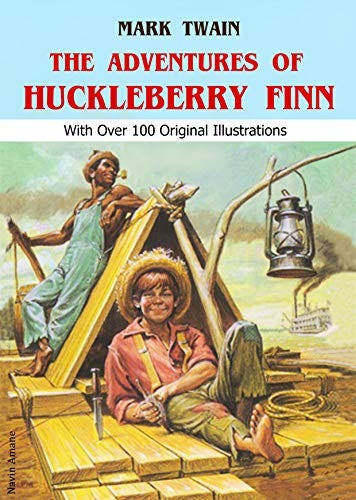
My favorite of these stories I think of as Texas' Huck Finn. According to The Texan Mercury, a paper out of Seguin, in 1853 a young German boy stole a horse and apparently helped a runaway slave to escape. They were captured, likely by the slave patrol, and brought to the Sheriff to be held. But they broke free and fled again, possibly together headed to Mexico. The short article was published on 10/8/1853 and used the incident to editorialize in favor of the county constructing a proper jail less prone to escapes. Research followups: Check district court for "German boy's" horse thieving case. Also: Find out when the first Guadalupe County Jail was constructed and look at public debate surrounding it. 

Dreams of Mexico: The Destination

According to the 9/9/1854 Texas State Gazette, one runaway slave from Guadalupe County drowned and three more were captured trying to cross the Rio Grande. The Austin paper blamed the existence of Mexicans living in white people's midst: "It is daily becoming more difficult for the slaves to get into Mexico, and by a little timely exertion in clearing our country of rascally peons, we think the planter in Texas will be more secure in his slave property than most other Southern states." Research angle: Perhaps border sheriff records on captured slaves could be fruitful? Were there patrols in border counties? Was there pressure from slave holding counties to enforce south-bound border and what was local law enforcement's enthusiasm level? Idk. For that matter, I want to know more about free, black communities in Mexico. Hoping this item on the reading list will fill in some of the gaps.

Anti-Mexican sentiment among slavers

The same issue of the Texas State Gazette reported on a public meeting in which locals agreed to collectively offer $250 reward for capture of escaped slaves. Slave owners were so obsessed with the idea that their property might flee to Mexico, the group voted to recommend banning "peons," by which they mean vagrant or unemployed Mexicans, from Guadalupe County outright. Presumably they believed black people couldn't walk south without a guide, though there is evidence that Mexicans near the border helped runaway slaves survive the desert and get across the river, typically for a fee. Sometimes passage across the river was exchanged for indentured servitude with Mexican hacendados. Finally, and most ominously, the group in Guadalupe County "provide[d] for a standing committee of twenty discreet men to enforce the resolution." To me, that sounds like people planning for vigilante violence against Mexicans. Reported the Gazette:

The peons, to which this meeting refers, have no reference to the permanent Mexican citizens, many of whom are worthy men and generally esteemed, but to a vagrant class--a lazy, thievish horde of lazaroni (editors note: OMG!! most original homeless slur I've heard in months!), who in many instances are fugitives from justice in Mexico, highway robbers, horse and cattle thieves, and idle vagabonds, who prowl about our western country with but little visible occupation or pursuit. Indeed, many of the robberies and murders attributed to Indians have been the work of this class of men. A new trade has been opened up to them, in aiding the escape of slaves. They scruple at nothing, and a few dollars from a negro is sufficient to secure their services. If a summary punishment is visited upon them, it is certainly what they may well expect from our incensed countrymen; and in the absence of a prompt and efficient remedy through the laws, this abuse will be corrected by the citizens themselves as a matter of self-preservation. 

Guadalupe County's resolutions inspired similar ones in Bexar County, and a statewide slaveholder convention was announced for Oct. 2, 1854 in Gonzales to discuss the matter. Runaway slaves were treated like they required quarantine: "All slaves brought back from Mexico are to be sent off to a foreign market and disposed of, and up to that time, they are to be closely guarded and not permitted to associate or converse with other negroes."  Research notes: Need to find out more about this slaveholder gathering: Check newsclips, secondary sources. Also, are there records of runaways disposed of in "foreign markets"? How would one research this? Idk. 

Proletarian slaves in Texas

On 7/1/1854, the Texan Mercury mocked the notion that a slave named Alfred belonging to a local "mercantile firm," was caught in public in possession of hundreds of dollars and his employer said it was his. As an aside, Alfred may have been an example of black folks working in an economic scenario I'd never considered before launching this research: Slaves who hired themselves out for pay and gave master a cut, but lived independently like a proletarian. Newspapers complained of this practice in every large Texas town (see, e.g., this Austin case study), so it was as widespread as it was scorned by white supremacist absolutists. They thought  it would give other black folks ideas and foster an inappropriate sense of equality and independence among them. In 1856, the Texas Supreme Court ruled in a Guadalupe County case that slave owners could not be prosecuted for allowing their slaves to accept employment. In my estimation, this practice arose because slavery as a business model didn't work as well in the cities as on the plantations. The economic incentives to let slaves hire themselves out probably drove the decision more than some urban libertarianism. More money with less hassle and responsibility? I'm guessing some urban slaveowners said "Sign me up!"

More runaway examples

On July 11, 1859, a slave named Oben belonging to Guadalupe County slave owner James George was reported captured in Bexar County, likely by the patrol, and taken to the Sheriff to be held. Followup: Check George in GC Slave Transactions book.

On January 25, 1862, a slave named George, reportedly belonging to a slave owner who'd left town the prior year, was captured by the patrol and incarcerated in the Guadalupe County Jail.

Habeas! Of course!

As Bexar County is next on the list, I was interested to discover this habeas corpus case which may be instructive: A dark-skinned Mexican woman was captured by a slave patrol and accused of being a runaway without evidence, though witnesses supported her story. Research notes: How hadn't I considered habeas corpus cases as a source for anecdotes? I love 19th century habeas cases! Will have to consider how to identify those. Maybe a start is this database of black Texans with cases before the Texas Supreme Court in that era. Another tedious but potentially fruitful research path.

Charity Ashley: Free but for (a terrible, horrific) choice

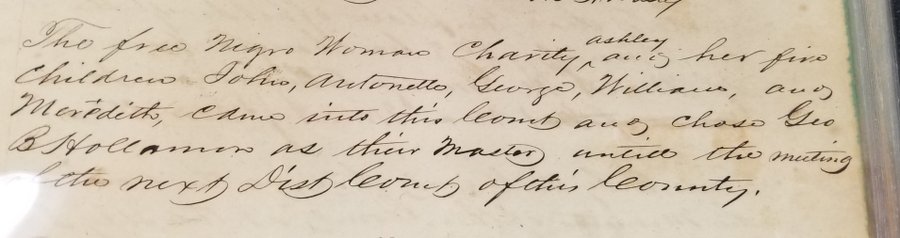
Finally, a bit more detail on the story of Charity Ashley, the free black woman with five children who chose to re-enter slavery and take on a new master in the late 1850s. (Texas banned free blacks during the Republic and as a state passed coercive legislation aimed at forcing them back into slavery.) I found a brief mention of her decision in the commissioners court minutes, which referenced a District Court hearing I still need to research. Anyway, according to the 1850 census, Ms. Ashley was born in South Carolina and at that time was 36 years old, making her roughly 44 when she reportedly sought out a local patroller as her new master for her and her five kids. Though it doesn't mention her or her family, the Seguin Gazette-Enterprise in 1996 ran an historical profile of George Holloman, the slaver and patrolman who became her new master. 

Ashley and her children were listed in 1850 as living at the same dwelling as the families of John A.M. Boyd and William King, but separately under their own name, not as property. I wondered on Twitter, "What arrangement led her to be staying there? How did she make a living? How did she come to be free and why was she living in Texas w/o a husband? When the state decided to coerce free blacks back into slavery, why didn't she choose Boyd or King as masters?" If she was already in Seguin with five kids by 1850, Ms. Ashley was a relatively long-time resident by the time she chose a master, and probably one of the few free, black people in town. So many questions! I can't wait to see the district court file in her case, assuming it still exists 170+ years later.

A Forgotten Precursor to Secession

Professor Ainsworth from SFA tells me slave patrols ramped up following the little-known "Texas Troubles" in 1860. Certainly, in 1862, the Legislature expanded the patrol requirement to mandate weekly rather than monthly outings, according to Randolph Campbell's "Empire for Slavery." But  some Texas cities may also have created patrols, if sometimes short-term. Occasionally, antebellum Texas witnessed the activation of informal, pre-Klan vigilante networks. There's no way to know the overlap, if any, between those mobs/posses and patrol membership. But things could erupt quickly. 

The all-but-forgotten episode referenced by Prof. Ainsworth involved white Texans misinterpreting a series of fires caused by a faulty batch of matches as evidence of Negro insurrection and arson. This was false, but up to 100 or more black folks and several white (alleged) abolitionists were lynched or otherwise murdered in the aftermath. Dubbed the "Texas Troubles," the incident with the faulty matches was a more important, proximate cause of Southern insurrection fears when they seceded than Nat Turner's rebellion decades prior. But today they're mostly forgotten.

Slaves foraged for food during Civil War shortages

I haven't yet found Texas slave narratives that mentioned patrols. But I did see a passage that presented the hardships facing slaves in Texas during the Civil War period.
During the Civil War time were very hard. I have known slaves to pull up tobacco stalks and smoke chip them and use okra seed for coffee; [to] build pens in the woods and catch turkeys. [They would] lay poles on top, dig a hole under the bottom of the pen, and drop corn fifty steps leading up to the pen. The turkeys would go in. After they eat they would never look down. Deer would have a regular place to jump in the filed. Slaves would set a stob and sharpening [the] upper end and sometimes catch a deer. Father did the weaving during the Civil War. I imagine seeing him dashing the sickle right and left, the women carding and spinning.

See prior, related Grits posts:

Friday, September 18, 2020

Slave Patrol Research Update and Request for Research Advice

Just a quick update on my Guadalupe County slave-patrol research. Many thanks to Kyle Ainsworth of the Runaway Slave Project at Stephen F. Austin University for the tip. This is the first time I've been able to see primary source material regarding IRL slave patrols in Texas.

Grits found in commissioners court minutes that slave patrol members were being appointed at least twice per year with individual appointees' names listed (albeit in hard-to-read, handwritten script). At first there were three districts covering Guadalupe County, each with a "captain" and four privates. Eventually, there were as many as 13 districts and 65 patrolmen. I went through and copied all references I could find for patrol appointments from 1847 through 1865.

I also discovered an amazing book on Slave Transactions in Guadalupe County, Texas by Mark Gretchen which identifies all the slaveholders from Guadalupe County, includes short bios for some of them, and vetted court records from all of them. I took phone pics of entries for about three dozen patrollers while I was there. When I got home, I found the book online and ordered it, overpaying for a very out of print and unavailable volume. (Still cheaper than traveling out of town and paying courthouse rates for copies.)

So here are my next research steps: 1) Transcribe data from slaver charts from my phone photos, 2) Make a comprehensive list of Guadalupe-County slave-patrol participants from handwritten commissioners court minutes, 3) Cross reference slave patrol list with Slave Transactions book for leads and spell checks for names, 4) Review runaway slave notices related to Guadalupe County, 5) Search slave-patrol name list on Google, Confederate soldier databases, and early Texas newspapers, and 6) make one more trip to Seguin to research people on the slave-patrol list in other county records, and to perform more informed library work.

All this may take a country minute.

It looks like Bexar County has similar records, so I'll head down there as soon as they let me and we'll try to repeat the process. Montgomery County is another place where a) I have reason to believe patrols existed and b) they appear to have extant and available commissioners court records. So that could be the next stop if this continues. Pam Colloff wants me to make a book of it; we'll see if I take the project that far.

Regardless, my working theory behind this research is that finding data and facts, while important, aren't as useful as identifying stories that resonate.

It's one thing to say the Guadalupe County patrol increased in size from three districts of five men each in 1847 to 13 such districts in 1857. It's another to consider the story of Charity Ashley, a free black woman with five children, and the coercive state legislation that caused her to choose 32-year-old George B. Hollamon - a patrolman and himself already owner of three slaves who would later become conscript officer for the Confederate Army - as master of her and her five children. What caused her to make that decision rather than, say, heading down to Mexico and living free with thousands of other black expats?

I don't know the answer to that question. But it's a more interesting one than how many patrolmen were there, how much and how often were they paid, etc.. 

Similarly, consider the story of a German boy who, like Huck Finn in Mark Twain's fiction two decades later, helped a runaway slave steal a horse and escape. They were captured, possibly by the county patrol, but then escaped the Guadalupe County Sheriff's custody and were last seen on their way toward the Rio Grande. I'm dying to know what happened to them. (Following up on court records for this case, Charity Ashley, and maybe others is the reason I'll probably need one, final research trip to Seguin before wrapping up.)

Individual, stories will always be a more reliable source of human interest than just analyzing pay slips. So finding lists of names gives the opportunity to tap into individual stories that help bring the research to life. That's the hope, anyway. The process can feel like searching for needles in haystacks.

Regardless, that's where I'm at with this project, gentle readers. I tell you in this much detail because I'm asking y'all for advice: Based on the records described, do folks have advice for sources that might help flesh out anecdotes about people involved? Except for rare instances like Charity Ashley (who had a district court case I still need to review), stories from black folks' perspective are incredibly rare. So is detail about exactly what happened out in the field when the slave patrols rode. How can I find more?

Help me think about how to research this. All of the slave narratives from Texas I've seen involved people who were slaves as children, usually interviewed by the Works Project Administration decades later in the 1930s or '40s. Not much detail about patrols from that perspective.

I haven't completely run into dead ends yet, but am starting to do so based mainly on the paucity of available records. Step up, Grits readers, and help me craft a path to tell these stories!

Until then, here's a Twitter feed encapsulating research so far on slave patrols and early Texas policing. And here are links to everything else I've written on this topic so far:

Wednesday, September 02, 2020

Early Texans couldn't get enough slave patrols, but didn't want to pay for them.

A bit more on slave patrols, which county commissioners courts were authorized to enact in the 1st Texas Legislature in 1846, the year after Texas became a state. We've discussed these antebellum slave-catcher patrol operations briefly: Created by county commissioners courts, comprised of local districts, sometimes many of them, with 4-6 officers in each. But I wanted to know more about them. Here are some related anecdotes from early Texas newspapers in the 1840s and '50s, found online at the University of North Texas' excellent "Portal to Texas History" site.

In 1858, during a legislative debate, state Representative Powell from Montgomery County implied some Texans felt the slave patrollers weren't doing much on the job. He attributed this to slave catchers for whom the work was just a paycheck but who had no connection to slave-owner culture and values: "Heretofore patrols have been appointed by the County Courts, and they have frequently been men who felt no responsibility resting on them, who rode when it suited their convenience and who, when it did not, did not know their duties or if they ever knew, did not perform them." He thought volunteers from slave owning families would be better connected to the slave systems and thus more effective at their duties. (State Gazette, May 1, 1858)

At the same time, and somewhat contradictory to his earlier holding, Mr. Powell argued against giving slave patrollers minimum work requirements: "[W]hen there is no occasion, why force a man to serve 12 hours in the week? Why compel a man who lives in the beat on which he serves, and who knows every plantation and negro in it, to take an oath to perform certain duties when he is satisfied that there is no necessity in it?" Why shouldn't the cop hang out all morning in the donut shop? He knows his beat best! ¯\_(ツ)_/¯

The concern that layabouts and loafers might draw a paycheck was a whitewashed version of the bigger fear over staffing slave patrols: their brutality and cruelty. One of the main arguments against them in the first place had been the caliber of men drawn to the profession.
Mr. Jones of Galveston hoped the bill would not pass. He had lived in slave-holding country, and had seen the evil of such a law. he said that persons who made application to act as patrols under the law, who availed themselves of the powers granted to them to maraud about the country and commit such outrages as would make him blush to name in the House. He said that owners of negroes could take care of themselves and if they were required to be answerable for the damages committed by them, there would be little need of patrols under such a law as this. (Austin Daily Bulletin, January 17, 1842)
Debates over creating slave patrols sometimes mirrored modern crime debates: in particular, the issues of runaway slaves and crime were openly conflated when there was no logical link, using fear of crime to gin up fear of black people and vice versa. For instance, on April 9, 1856, the Houston Weekly Telegraph editorialized on behalf of local patrols, blaming a supposed rise in burglaries on unsupervised black people:

It has become a notorious and patent fact that burglaries are becoming more and more frequent  in our city, and as it is almost next to impossible to detect the guilty parties after the commission of the offence, we propose to call attention to such portions of our statute law as seem best calculated to serve as preventives.

The first thing that strikes an attentive observer on his arrival in Houston is the immense latitude allowed to the negroes. No matter what time of night you pass through the streets, you are sure to meet parties of negroes who go where they please, unquestioned and irresponsible. Such a thing as a "pass" is unheard of and we doubt if they are even furnished. In certain quarters of the city there are large congregations of negroes, who hire their own time, and who live entirely free from the supervision of any white man. Speaking candidly and impartially, there is more insolence among the negroes of Houston and more careless conduct than in any other city or town South of Mason and Dixon's line.

Of course, this state of affairs, this immunity from all question, affords the negroes great opportunities for theft, and in many instances, familiar to our citizens,they have not been backward in taking advantage of it. If the negroes are made sure of, if we are certain that it is not our slaves who are engaged in these burglarious practices, it then greatly reduces the number of persons liable to suspicion, and affords greater opportunity for detecting the robber.

We have laws enough on this subject but they have become a dead letter. It is a mockery of legislation to enact and re-enact but to do nothing towards enforcing. The law is sufficiently stringent and efficient - the 2653 article of Hartley's Digest, under the 'act to provide for the appointment of patrol,' says 'that whenever a detachment, or part of one, may find any slave or slaves off the plantation or other premises of his, her, or their master, mistress, or employer, strolling about without written permission from some person authorized to give the same, said detachment or part thereof may give to every slave so offending any number of lashes not exceeding twenty five.' The first section of the act provides for the appointment of the patrol by the County Court 'upon application.'

Something must be done in this matter. Our property is not safe and it naturally suggests itself: are not our persons in danger? We trust the matter of allowing negroes to be about the streets without permission will receive the serious attention of our citizens.

While I'm loving the use of the word "burglarious," Grits cannot endorse the totalitarian calculus being performed here. The assumption is that "We suspect all black people and some white people of being thieves. If we suppress all black people and keep them off the streets, then if thefts continue, we'll know it's white people doing it and our list of suspects will get smaller." Such thinking cannot survive any thoughtful moral assessment, much less cost-benefit analysis, but the logic seemed inescapable to the writer, and no doubt many of his readers.

Slave patrols were designed to enforce apartheid and thwart the Underground Railroad to Mexico, not for general crime prevention. Using tools created for the one problem to apply to the other lies at the root of many 21st century criminal-justice conundrums

For most white Texans, patrols were controversial not because of their brutality but because they were expensive. In 1851, Bexar County employed 108 people covering 18 districts across the county. Grits has yet to find records of slave patrol districts from other counties, so I have no idea to estimate a statewide count, much less how much they were paid. But if Bexar County's numbers are indicative, these were easily the largest local law enforcement outfits in the state during the 1840s and '50s. No Sheriff or Constable had that many staff.

Sometimes people wanted cities to create their own patrols, expanding capacity beyond the county system. However, paying so many people became a political barrier to patrol deployment. Many thought the work should be left to professionals. Others considered the expense an excuse for not doing it and called for volunteer-driven patrols, though these seemed to have often been short-term projects, for a month or two. The May 1, 1856 edition of The San Antonio Texan described a meeting debating creation of a volunteer city patrol in addition to the county patrol

The ordinance concerning the organization of a city patrol was passed near a month ago and thus far it has had a charming effect; for since its passages, but two thefts, during the night, have come to our knowledge, and in both instances the malefactors were apprehended and the property recovered. 

Some are opposed to the system and express a desire for the city to tax the citizens and hire a patrol; but most of these persons have little or no taxable property. 

The intention of the city council was, to try this plan for a month, and if it seemed not to answer the purpose intended, or if there should be need for it no longer, to stop it for the present. 

We believe at the end of the month it will not be needed longer, for the present - such has already been its effect in removing rowdies and quieting our city.

Some jurisdictions gave the City Marshal's office the slave patrol job. But they don't appear to have staffed them as liberally, relying instead on volunteers and the cooperation of the public. The Indianola City Council in 1859 created a 9 o'clock curfew for any negro or slave, requiring a written permit from a master, owner or employer to be off their premises, reported the August 13, 1859 Indianola Courier. Instead of patrol officers, though, the City Marshal was charged with apprehending and jailing "any negro or slave offending against" this ordinance, although "it shall also be lawful for any free white person so take up or apprehend any such negro or slave so offending, and to deliver any such negro or slave into the custody of the marshal."

Black folks caught by the patrol in Indianola received between 10 and 39 lashes, for which the master had to pay the City Marshal a fee of $2. The same 39-lash/$2 punishment would be applied to "each and every negro and slave caught playing cards or any gambling game" in Indianola.

It would be too strong to say Texas law enforcement originated with slave patrols. County Sheriffs were around during the Republic and mandated in the new 1845 state constitution one year before patrols were authorized. Plus, both Sheriffs and early City Marshals had broader duties (often related to fee collection) than patrol officers, which was generally a part-time job.

But I think it's fair to say that 1) slave patrols were the largest law enforcement systems in antebellum Texas, bigger than Sheriffs or any local police force, 2) prior to the Civil War, slave patrols were the only law-enforcement officers reported to perform patrol functions in any jurisdiction, and 3) antebellum law enforcement was deeply intertwined with the slave-patrol apparatus, with contemporary media commonly conflating crime prevention and suppression of black people.

This post is part of an ongoing series, see related Grits coverage:

Monday, August 31, 2020

Houston's early police chiefs: The Thief, the Chief Who Wouldn't Be Fired (sound familiar?), and the Mysterious Disappearance of John Proudfoot

Here's an update on my search for the history of early Texas police chiefs. As it turns out, there is a book-length history of the Houston Police Department, a high-end vanity piece commissioned by the Houston Police Officers Union, written by Mitchel Roth and Tom Kennedy. On the questions I've been asking - what is the relationship between slave catching and antebellum policing or Jim Crow enforcement after the war? - it's of scarce little use. But it gives us a few more details about these early characters.

Houston's first "police chief": The head of the entity that became today's Houston police department was originally called the City Marshal. The first one was Daniel Busby, twice elected to the position beginning in 1841. But in 1843, he was investigated by city officials and found to have stolen fee money ($317.52) he was charged with collecting. Busby "acceded to the request for his resignation" but was not prosecuted. As a nod to their union patrons, Roth and Kennedy observed that "this was the first official evidence of a disciplinary action in HPD history."

Also as a result of this disgraceful launch, and in light of the complexities of the fee-gathering functions inherent in law-enforcement's mid-19th century role, later City Marshals were required to post a $2,500 bond when assuming the job to indemnify the city.

Stay Icy: I'd wanted to know more about Isaac C. Lord (or possibly Irvin Capers Lord), who went by his awesome initials, I.C. Lord (I love this name. Can he see the Lord? Is the Lord cold? Is the Lord unruffled during high pressure situations? You can take it so many ways!). Lord is the person credited with turning HPD into a "proper" police force patrolling the streets in recognizable uniforms. Reportedly, "it was Lord’s proudest boast that he never carried a gun while acting as a peace officer."

The Mysterious Disappearance of John Proudfoot: But in the process I should mention another early Houston law enforcement stalwart with an amazingly great name who's going on my research list: John Proudfoot. He was elected City Marshal in 1860 and left in 1863 to go fight for the Confederate army, leaving I.C. Lord with the job. After the war, Proudfoot did not challenge his protege, who'd been reelected already as City Marshal in his own right. Proudfoot instead ran for Sheriff and won in 1866. Then, I.C. Lord was appointed interim Sheriff after Proudfoot "mysteriously disappeared, most probably as a result of foul play." Other online sources I could find gave no additional information beyond saying he disappeared. A 154-year old Unsolved Mystery! I knew nothing about John Proudfoot before the last week, and now I want to know everything about him.

Making Friends: Anyway, Lord returned to his City Marshal's post in 1867, and here's where things get interesting. He had already, for reasons unknown, pissed off the local black population. The authors tell us Lord was shot in the head during a "racial disturbance" which "reflected the hostility and confusion that existed between newly freed slaves and the populace." Whatever that means.

Showdown with the Union military: Then, Brevet Major General J.J. Reynolds became military commander of Texas and ordered I.C. Lord, along with a half dozen aldermen and several other officials, to leave their jobs so he could appoint their replacements. This wasn't happening just in Houston, but also to Confederate loyalists across the South who remained in pivotal public posts.

Lord at first declined to go. Finally, Reynolds named A.K. Taylor City Marshal and formally relieved Lord of his duties. Lord's refusal to abide by this order caused a near-race war! Roth and Kennedy report that "'the loyal League Negroes' openly threatened to attack, sack, and burn the city" if he did not step down, "But this threat was turned back after a mob of armed whites came forward to protect the city." This inspired Lord to tell newspaper reporters of his "determination not to give up until the Board of Aldermen ordered him."

The authors don't tell us who the "League Negroes" were (I'm going to assume bowling league), nor reference them any other time throughout the book, so for the moment we'll have to leave that intriguing episode there. But it sounds like the town nearly erupted over Lord's refusal to leave.

Awkward! A local newspaper observed that this left police "in a quandary. They have two police chiefs." He eventually relented, but his temporary standoff with the Union military commander earned Lord, who as far as I can tell did not serve in the Confederate Army, the admiration and approbation of Reconstruction opponents and Lost-Cause revanchists for the rest of his lengthy political career. In 1875, the first local election after Richard Coke's disputed ascension to governor signaled the end of Reconstruction in Texas, I.C. Lord was elected Houston Mayor, capping a long career during which he also found time to sire 16 children!

Regardless, these events tell us that the man credited with turning HPD into a "proper" police force suffered an incredibly hostile, occasionally violent relationship with the black community in Houston in the years following the Civil War. Keep in mind, we're talking about a very small town, roughly the size of Dalhart, today. Houston had fewer than 10,000 people in the 1870 census, up from just under 5,000 in 1860. So this was an up-close-and-personal sort of dislike.

I'm sure there are more to these stories but I'm writing them up bit by bit as I run across sources. More soon on the next installment of "Early Texas Police Chiefs."

Saturday, August 29, 2020

Slave catching the dominant, early Texas law enforcement apparatus

Upon learning of Austin PD's racist, early history, Grits has been digging in a little to Texas' early law-enforcement agencies to discover if others have similar roots. This is a first installment, merely an initial inquiry, on a topic I want to delve into more deeply over time. So if it seems incomplete, it is. Please bear with me. If you're not satisfied in the end, you can have a full refund.

Rangers not Texas' earliest law enforcement. Some might think the Texas Rangers were the state's earliest police officers, and certainly it's true Stephen F. Austin first commissioned the group in 1823. But that was done as a private landowner; he paid the men out of pocket. And for decades the Rangers were financed largely by real-estate interests, with the Legislature chipping in to get them to fight Indians. Texas Rangers weren't funded by the Legislature as a permanent force until 1874.

Slave catching dominated early Texas security apparatus. In antebellum Texas, the big security problem about which officials were most concerned was slaves escaping to Mexico. In 1846, almost immediately after we were granted statehood, the Texas Legislature directed county courts to form local slave patrols covering specific districts. This appears to be the earliest instance of security personnel using "patrol" tactics, though their scope of authority was limited to capturing human chattel. Here's a copy of the 1846 statute authorizing Texas' first slave patrols.

The statute required, "the county court of every county and five men shall upon application, when necessary, appoint a patrol detachment to consist of one captain and not more than five privates nor less than three, for each or any district or company division in the county, whose term of service shall be three months from the time of their appointment: Provided, that one half of the patrol appointed shall be owners of slaves, or their substitutes." So slave owners had to be half of the five-person patrol. Got it.

Patrols were required at least once a month to visit "the negro quarters and all other places in said district, where it may be suspected that slaves are improperly or unlawfully assembled." In 1862, when many adult men were away fighting and fears of black flight to Mexico grew to their zenith, the Legislature expanded the patrol requirement to weekly, according to Randolph Campbell's "Empire for Slavery".

Further, these slave  patrols were empowered to impose summary punishment on black folks when they caught them: "whenever a detachment, or part of one, may find any slave or slaves off the plantation or other premises of his, her or their master, mistress, or employer, strolling about (!) without a pass or other written permission from some person authorized to give the same, said detachment, or part thereof, may give to every slave so offending, any number of lashes not exceeding twenty-five. May search." 

An amendment to lower the maximum number of lashes from 25 to 15 failed. Because, you know, unauthorized "strolling" can be a dangerous thing.

White men could be ordered into service of the slave catchers to pursue runaways or else be "fined a sum not less than five nor more than twenty dollars, for each and every failure or refusal." But that's small potatoes compared to the punishment for engaging in an interracial relationship: one to five years hard labor in the penitentiary:

Beyond the 25 lashes for unauthorized "strolling while black" in state law, local policies could be even harsher.
Bexar County created 'Slave Patrols' and San Antonio passed slave laws that regulated 'the conduct of slaves, free people of color and whites according to the wishes of the planters.' In the City’s ordinance, Section 16 said, 'That it shall be the duty of the Marshal or assistant Marshal upon written request of the owner, or person having legal charge and control of any slave, to whip such slave, not to exceed thirty-nine lashes, upon the bare back, for which he shall be entitled to receive from such owner or person having such charge and control, the sum of one, dollar, to be paid upon the presentation of such request.
I can't tell if a person in San Antonio who'd already received 25 lashes under the police officer's discretion might also receive 39 lashes at the behest of their owner, for which the police officer receives a dollar. But even raising the question shows what a bizarre and twisted law-enforcement culture we're dealing with here.

In some states, slave patrols were also about broader security concerns: "The patrols were sometimes linked with compulsory local militia units intended to protect white settlers from Native Americans, foreign invasion, and other hostile threats. The militia model was used, for example, in South Carolina and Virginia." But not in Texas: "In other places, such as North Carolina and Texas, county courts were charged with forming local committees that were responsible for creating slave patrols to cover their territory."

That's not to say slave catchers targeted only black people; they also were empowered to act against white folks who abetted runaways:
In 1848 laws were passed by the state legislature aimed at punishing those who might help escaping slaves. Anyone helping slaves plan a rebellion would be punished with death. Ship captains assisting runaways would receive from two to ten years in the penitentiary. Anyone who would steal or entice away a slave from his or her owner would receive three to fifteen years of hard labor. Free persons of color who aided a slave in escaping would receive from three to five years in the penitentiary
In larger towns, the slave-catcher apparatus could be quite extensive, especially compared to the meager resources allotted to City Marshals. "San Antonio had slave catchers and patrols in the 1840s, 1850s and beyond, and were given official status as a result of the Texas legislature authorizing slave catchers on May 9, 1846. There were at least 18 official [slave] catcher districts ... in the Bexar County area, and an untold number of racist vigilante slave catchers." According to the statute, each of these districts must contain 4-6 officers, but initially, all 18 in Bexar included six. So that's a sizable security force patrolling black neighborhoods in the Alamo City.

Like some totalitarian dystopia, "a bell that rang at 9:00 pm [in San Antonio which] meant that all blacks had to be off the street at that time or face lashings and jail time." So SA's 108 officers in 18 slave-catcher districts needed only wait until after 9 p.m. then they could arrest every black person in sight.

Grits wants to learn more about these early slave patrols in the Republic of Texas and early-statehood era. If readers know of any sources, please advise. I'm also interested in exploring more deeply the origin stories of the earliest Texas law enforcement agencies. By contrast, they appeared to be relatively small.

Earliest Texas police departments. While Grits cannot claim to have performed a comprehensive search, among local departments (excluding Sheriffs, who have a separate history) the Nacogdoches Police Department, established in 1837, was the oldest police force in Texas your correspondent can identify. I don't know much about their origins, but this description of NPD vice enforcement 1870-1915 provides a window into the racialized nature of 19th century policing in Texas' oldest town.

The city of Galveston was chartered in 1838, and that same year the city established a police department and named a local saloon owner city marshal. According to the GPD 2012 annual report, by 1867, they had 30 officers. This may be overstated, though, as a Twitter commenter provided evidence tha GPD force was still all volunteer and quite small as late as 1861. Grits has yet to identify either the relationship between Galveston PD and early slave catching duties mandated by the Legislature in 1846, nor how GPD's description of the department jibes with the newspaper account of a volunteer force. 

Next, in 1841, the city of Houston hired Daniel Busley as "City Marshal" to run the agency that would become the Houston police department. According to the Houston Police Retired Officers Association, " the Houston Police Department has operated continuously under the governing body of Houston’s elected city official since January 9, 1841." I want to know more about Mr. Busley; he's a mystery so far.

According to that same source, "The office of City Marshal became an elected position in 1843, and the police salaries were paid from town revenues. Records of police duties are vary sparse and the city secretary’s minutes of alderman meetings with the elected mayors are missing from 1846 to October 1865. So, there are no official police records surviving until after the Civil War. Records from 1867 show there were 18 Houston police officers including the elected city marshal."

Beginning in 1866, Isaac C. Lord was credited with turning the Houston City Marshal's office into a "proper" police department. Lord designed their first uniforms and possibly their first badges. Admired locally for his revanchist, pro-Confederate stances, "Lord established a code of conduct and bravely resisted the Union's military control by refusing to give way to an appointed marshal as a replacement." After he was City Marshal, Lord became Houston Mayor in 1875. Similar to Mr. Busley, the internet is virtually bereft of information about Isaac Lord. We'll need to seek out other sources to know what he was about.  

Houston officially transformed the City Marshal's office into a "police department" in 1910, along with many promises of professionalization and reform. They ran though a number of police chiefs over the next few years before, in 1917, the Camp Logan Mutiny erupted. In this amazing and little-discussed episode, black, American soldiers stationed in Houston during World War I mutinied and marched on the Houston Police Department downtown in reaction to incidents of discrimination and police brutality. These were mostly northern black men who had never before had to submit to the indignities and abuses of Jim-Crow apartheid. Several were killed in the fighting and 19 soldiers were hanged after the fact.

This established Houston's reputation as a dangerous place for black folks. A few years later, sitting one county over in the Central Unit in Sugar Land Texas, Leadbelly would pen the words to Midnight Special, "If you're ever in Houston, you better walk right. You better not gamble and you better not fight. 'Cause the Sheriff will arrest you and his boys will bring you down. And you can bet your bottom dollar, you're penitentiary bound."

We've already discussed how the Austin PD was created in 1865 to sweep free black people from the streets after the Civil War freed them. That's what got me thinking about these questions. In Austin:
The Town Marshal system ended in 1924 and was officially replaced by the Austin Police Department. Moreover, the position of head of police also changed from an elected office to one appointed by the mayor. After spending a year in the basement of the county courthouse, the police department moved from City Hall into new quarters at the recently built municipal building in 1938 (its original location being the corner of Bois d’Arc [7th] and Colorado streets)"

It should be mentioned, for quite a while, not a ton of policing was needed. Here's a view of the capitol from the north taken in 1892. 

Other Texas police agencies weren't founded until a little later. In San Antonio, the Union military provided street-level policing for several years after the Civil War ended, then the Texas Rangers took over before John Dobbins became City Marshal in 1873 and created what was then considered a modern police department. I have so far found virtually nothing about John Dobbins, but will keep looking.

In 1917, SAPD formally became a "police department," began using 8 hour shifts, and in general attempted to professionalize operations. Part of me would love to see case studies of them and Houston, which supposedly transformed its PD in 1910 but couldn't escape a disastrous incident in 1917.

Fort Worth offers us Texas' earliest recorded example of "defunding the police." They created a marshal's office with four employees in 1873 led by E.M. Terrell, but defunded and disbanded it after just one month in operation. Terrell hung on a little longer by himself, then quit. A couple of other men held the job, then the department was re-established in 1876 with "Longhair" John Courtright at the lead, though he only had two employees. I know virtually nothing about these people. Need more research.

Dallas didn't get a police chief (J.C. Arnold) until 1881, in part because it wasn't much of a town before then. It's easy to forget that, as big as Big D is today, back then just a few thousand people lived there. I have found no indication whether there were racial motivations behind the creation of Dallas PD, but we'll dig into it further and see.

El Paso PD may have begun in 1884, but early records including newspaper accounts  were lost in a fire. Much cannot be known about the early days of Sun City law enforcement.

I'm writing this as much or more for me than y'all: I'll be adding to this outline as research continues on the earliest days of Texas law enforcement. I find it fascinating, and hope you do, too.

MORE: On Early Houston Police Chiefs.