Monday, November 07, 2005

Grits' best practices to reduce county jail overcrowding

UPDATE: See also Part Two.

What can be done to reduce overcrowding at county jails? Quite a lot, if counties are willing to get as smart on crime as they have been tough.

Regular readers know that Texas faces a statewide overincarceration crisis, both in our prisons and in the county jails. Crime is down, but we're incarcerating more people than ever -- indeed, about one in twenty Texans is now under control of the criminal justice system, either in prison, on probation, or parole. Since the Legislature is out of session and the Governor vetoed the most important state-level reforms, I've been looking more closely this fall at what counties can do to lessen pressures on local jails, many of which are bursting at the seams.

Requests for ever-more money for jails always portray the need as self-evident, almost an inevitability -- "our population has grown," they'll say, or, "if you dont' spend the money this terrible thing (fill in with details from the latest heinous crime) will happen more often." But that's not the whole story -- many counties presently incarcerate a lot of people when there's really no need, especially while they're awaiting trial. Texas' criminal justice system is one of the largest, most lumbering, slow-to-change bureaucracies in all of state government, and upon close examination, there are a lot of things counties could do to counter the trend, if they want to. This column offers just a sampling.

I wish I were smart enough to have come up with these ideas myself, but that's not the case. Instead, these "best practices" were gleaned from my informal survey of counties in recent Grits blog posts (check out the links below) - in other words, these are the most promising ideas being kicked around by county governments across the state to reduce overincarceration pressures.

  1. Use pretrial screening of defendants to increase personal bond use. Right now, to my knowledge, only Harris, Travis, El Paso, Webb, and recently, Montgomery and Erath counties use such a pretrial screening service, but if judges follow screeners' recommendations, they can significantly reduce local incarceration costs.
  2. Use progressive sanctions instead of revocations for technical violations. A well-attended statewide conference recently schooled DAs, judges, and probation officials on the latest tools being used in this area. With luck, the state funds offered for counties that adopt progressive sanctions will entice most of the larger ones to try their hand at more innovative court models. It won't work, though, if counties don't also commit new funding for programming that makes new sanctions meaningful. (It's still cheaper than building more jail beds.)
  3. Increase use of early probation release to create incentives for good behavior and lower the number of people incarcerated not for new crimes, but for technical violations. In Travis County, for example, more than 63% of probationers have succeeded on probation past the minimum early release date. Getting off probation is a powerful incentive for good behavior that should be utilized to improve public safety -- instead, probation departments want probationers to stay on their rolls the full ten years to maximize income from probation fees. It doesn't have to be that way. Criminal defense attorneys and local probation departments should start recommending this option more often -- it would be up to local judges whether to grant it.
  4. More efficient use of forensic lab services. Texas counties tend to use forensic lab services very inefficiently in two key areas: testing drug seized from defendants, and drug testing defendants who are out on bond. In both cases, simple changes could result in big savings without reducing public safety.
    • Counties that use DPS to test seized drugs should begin using private labs. They're more costly, but DPS' backlog can mean defendants will spend up to two extra months incarcerated awaiting trial. That's a lot more expensive than paying a private lab.
    • Judges should stop ordering drug tests except as part of a court-ordered treatment program for bonded defendants and even probationers. If you're not treating the addiction, the only point of drug testing is increased incarceration, and when prisons are full we need to save the space for more dangerous offenders, not mere drug users.
  5. Create more public defenders offices, especially for misdemeanor defendants. These offices save money on indigent defense costs and help process defendants through the system more quickly, saving incarceration costs as well.
  6. Change outcome measures for probation officers. Make reducing the number of revocations and improving probationers' education outcomes the primary performance measures by which probation officers are evaluated on the job.
  7. Use probation kiosks for proven probationers. Most probationers who violate do so in the first few years. Some probation visits for nonviolent offenders could be avoided after 2-3 years using probation kiosks where probationers check in at an ATM type machine. Probation departments could still monitor the data, require some in-person check-ins, perform home visits, and use other tools to supplement the kiosks.
  8. Stop short-sighted rent-a-bed policies. Many Texas counties apparently fancy themselves incarceration entrepeneurs, short-sightedly renting out extra jail beds to house federal prisoners, mostly immigration-related detainees. Now, long-term contracts are forcing some counties to rent extra beds, or stop accepting non-violent arrestees.
  9. Harris County should quit jailing drug abusers for first possession offense. Two years ago the Texas Legislature passed HB 2668 requiring judges to order treatment and probation instead of incarceration for first-time possession offenders. Of all Texas counties, though, Harris County has extensively utilized a loophole allowing them to incarcerate state jail felons in the county jail as a condition of probation. That's entirely judges' decision, and the policy accounts for a great deal of that county's overincarceration crisis.
In fact, much of Texas' jail overcrowding crisis may be laid at the feet of local judges, and most of these fixes would require their involvement, or at least acquiescence. They set bail, set many sentences, and control the local probation departments. They're elected officials, too, after all, and along with county commissioners courts they should be held accountable. In any event, until these approaches have been tried, it'd be throwing good taxpayer money after bad to continue Texas' jail building spree.

Sunday, November 06, 2005

New Hidalgo public defender office spurred by jail overcrowding

In South Texas, Hidalgo County (Edinburg) officials last month created a new public defender's office led by Jaime Gonzalez, a 28-year old former prosecutor, in an effort to reduce pre-trial detention and jail overcrowding. According to the McAllen Monitor ("Hidalgo County gets its first public defender's office," Nov. 6):

They started representing clients in misdemeanor cases Oct. 21 and have so far tried 60 and disposed of 32. Handling cases through his office reduces the two-week processing time about 10 days, Gonzalez said, predicting his office probably will handle 25 percent of Hidalgo County’s misdemeanor cases every year.

"Public defenders are seen as a mechanism for larger counties," Gonzalez said. "But that’s what we are now."

That's true. Hidalgo County's 1,150+ beds makes their jail one of the dozen or so largest in the state. I'd commented previously that Hidalgo officials appeared to want to blame others for jail overcrowding problems. It's good to see local officials also plan to take responsibility for the large number of low-level defendants languishing in jail awaiting trial.

The new public defender's office was made possible by a state grant that will subsidize its first four years. (The same pot of money is available for other Texas counties that want to reduce overcrowding by creating a public defender's office.) Reported the Monitor:

In 2005, Hidalgo County received a four-year grant from the Texas Task Force on Indigent Defense. For the first grant period, which runs from March 2005 to February 2006, the state funded about $396,000 for the public defender’s office. The county matched that with about $94,000. As the office becomes more established, the state funding decreases and the county’s contribution increases.

However, Gonzalez said by the time the county would have the higher percentage, the office would be self-sufficient.

"Our budget would be a drop in the bucket," he said.

Friday, November 04, 2005

The surprising economics of unsanctioned immigration

When, on the cartoon South Park, unwanted immigrants from the year 4035 began using a time machine to come work for low wages (with interest-bearing accounts, the practice made them wealthy in their own time), the hysterical rallying cry from verklempt locals was, "They took our jobs." If a new study is correct, though, they could have added, "And gave us better paying ones."

It turns out, not only do more Americans have friends who are immigrants, those friends may be making them better off. A new, more sophisticated model of the economic effects of immigration shows that, counterintuitively, it may actually lift wages, reports the New York Times ("Yes, Immigration May Lift Wages," Nov. 3). Here's the argument:

In "Rethinking the Gains From Immigration: Theory and Evidence From the U.S.," Gianmarco I. P. Ottaviano of the University of Bologna and Giovanni Peri of the University of California, Davis estimate that immigration in the 1990's increased the average wage of American-born workers by 2.7 percent. (The paper is available at www.econ.ucdavis.edu/faculty/gperi.)

Although it still relies on a highly stylized model of the economy, their paper adds two complexities that bring it closer to reality.

First, the two economists assume that businesses can make additional capital investments to take advantage of the expanded supply of workers. Companies may open new restaurants or stores, add new factory lines or build more houses.

In their model, as in the real world, "investment adjusts not to keep fixed the amount of capital but to keep fixed the return to capital," Professor Peri said. As long as businesses can profitably add new production, they hire more workers, and wages do not necessarily go down. Instead, he said, "more workers means more business."

As businesses expand, hiring foreign-born workers to do one job may also require hiring more native-born workers with complementary skills. Immigrant engineers, for instance, may create demand for native-born patent lawyers and marketing executives.

That is the paper's second refinement. It assumes that immigrants do not always compete for the same jobs as American-born workers. The two groups are not "perfect substitutes," even when they have similar education and the same occupation. A Chinese cook is not the same as a Texas barbecue chef.

Immigrants often bring different skills to the American labor force, and concentrate on different occupations from natives. Among high school dropouts, the paper notes, the "foreign-born are highly overrepresented in professions like tailors (54 percent were foreign-born in 2000) and plaster-stucco masons (44 percent were foreign-born in 2000)." By contrast, American-born workers make up more than 99 percent of all crane operators and sewer-pipe cleaners.

The same is true at the highest educational levels, where foreign-born college graduates make up 44 percent of all medical scientists but only 4 percent of lawyers. (Immigrants tend to be concentrated at the highest and lowest levels of income and education.)

If that's right, then it's hard to justify the polticized anti-immigrant bashing that the New Republic says has become a "marquee political issue in the South" ("Immigration migrates: Going South," Nov. 3). The immigrants picking up jobs at day labor sites aren't taking jobs from Americans -- they're creating small businesses for the guys in pickup trucks hiring them. Once again I find myself wondering, exactly what's the big deal?

Texas leads parade toward 1,000th execution

Says Fort Worth Weekly ("Not So Easy to Kill," Nov. 2). Also see the blog, 1,000 executions, chronicling the nation's march toward that macabre landmark. I'd lay odds that thousandth man will be a Texan.

Thursday, November 03, 2005

Biometrics slope got slippery awfully quick ...

Just two months after HB 2337 took effect allowing the Texas Department of Public Safety to gather drivers' biometric information and removing judicial oversight of its use, Governor Perry let the other shoe drop. The Dallas News reported yesterday (Exclusive: State homeland plan links data," Nov. 2):
The Texas Fusion Center is one facet of an ambitious new homeland security strategy to be unveiled by Gov. Rick Perry's office today.

The five-year plan, described as a "high-level road map for our homeland security efforts," is designed to bring together 34 state agencies and 24 regional councils to focus on preventing terrorism, protecting critical infrastructure and recovering from man-made and natural disasters.

Among the plan's elements:

•The use of driver's licenses and identification cards with biometric identifiers, in this case an embedded fingerprint. Applicants will also have their fingerprints checked against federal criminal and terrorism lists. The Texas standard goes beyond what Congress required for enhancing driver's license security in the controversial REAL ID Act this year.

So Texas has not only removed restrictions on police using drivers' fingerprints, now the state will routinely vet them through federal databases nobody ever mentioned before. That's almost the definition of a slippery slope. (Before HB 2337 passed, drivers' fingerprints in Texas were considered private, personal data only accessible with a court order.)

The Houston Chronicle's Polly Hughes followed up today ("
Worries mount about system to ID drivers," Nov. 3) with more on the risks of Texas' new biometrics database, many of which will be familiar to Grits readers. For starters (as I warned before the bill passed), "A company the state hired to gather computerized facial imaging and thumbprints on all Texas driver's licenses failed to protect the identities of 7,500 Nevada drivers last spring," Hughes reported.
"Yes, indeedy. They stole everything you needed to make digitized driver's licenses," [a Nevada official] said. He added that the heist netted Social Security numbers, names, ages, dates of birth and photographs of drivers.
Ironically, a system touted as a tool to catch people with fake IDs could have the opposite effect if personal information of drivers gets out. "This new system is an identity thief's dream come true," said Ann del Llano of the American Civil Liberties Union of Texas. "Now any good identity thief in the world has a new database that's going to be one of the largest databases that exists."

That's exactly right, as Grits argued
here and here during the 79th Legislature. What's more, reported Hughes, Rep. Frank "Corte's House Bill 2337 not only authorizes the new method for recognizing thumb and facial images, it also gives law enforcement agencies the power to access the high-tech images without first obtaining a search warrant as required in the past." (Don't forget, you heard it here first!)

Rep. Corte summed up the matter with his closing comments in Hughes' article: "Really, I guess it depends on, who are you going to trust? If you don't trust government, you don't trust any of that stuff," he said.


Trust us, we're the government. When did that become the slogan of the Republican Party? What happened to the party of small government, one wonders? Ronald Reagan must be spinning in his grave.


When Texas passed HB 2337 I asked, "
Where are the small government conservatives?" I still want to know. For whatever reason, very few of them seem to make it through the GOP primary process into state government. Instead we get Big Brother's handmaidens, like Rick Perry and Frank Corte.

Wednesday, November 02, 2005

Pretrial diversion = Erath County's overincarceration solution

West of Fort Worth in Erath County (county seat is Stephenville), officials are hiring a new "pretrial release officer" to resolve their local jail overcrowding problems (Stephenville Empire-Tribune, "County addresses jail overcrowding," Nov. 1).
In an effort to address the growing jail population, county officials developed the new position, which is primarily responsible for processing non-violent inmates who can’t afford bond, out of the county jail at a faster rate.

[Newly hired pretrial release officer Weldon] Wilson said the program is designed to reduce jail overcrowding and save the county money on indigent inmates.

“The way the program is set up, I will interview new arrestees within the first 48 hours of their arrest to assess their status and discuss bonding with them,” Wilson said. “It’s important to get these people back to work as fast as we can — instead of just allowing them to sit in jail at taxpayer’s expense.”
I've argued previously that excessive pretrial detention is perhaps the primary driver of Texas' statewide overincarceration crisis in its county jails, see also here, here, here, and here. Maybe the bigger counties want to keep endlessly building new jails, but some of the smaller ones may prefer to get smarter instead of tougher, especially if tougher means raising taxes.

Grits commenters take on task forces and jail overcrowding

I wanted to point out some terrific discussion in the comments to recent Grits posts that merit readers' attention.

First, in response to
this item on the demise of the Waco-based Agriplex regional drug task force, a number of drug enforcement officers -- two from Agriplex and a couple from other agencies, one of them arguing for task forces' cessation -- went back in forth with me a bit in the comments. Give it a read.

Next, commenters rolling in via search engines to
this post, and this one, about Harris County (Houston) jail overcrowding offered up terrible reports regarding jail conditions. Here's a sample:
My son has been in the county jail for 5 1/2 months. Why? He violated his drug probation by smoking marijuana. He signed for RSAT (a "drug treatment" program) but he's waiting for a space! Apparently, there's no limit to how long a person must wait. If there's no space, then why are they assigning people to this program?

Harris County is indeed a very corrupt jail system. He has been thrown out of the shower naked because two other guys were talking over the wall in the restroom. He has had his head slammed against the wall for asking why. He witnessed numerous abuses, deputies punching and hitting other inmates. Why, why is nothing done? My son is not violent. He graduated from high school with excellent grades. He was working full time when he got the violation. I realize he needs some punishment, but how long does he have to stay there? He's in JAIL, yet every day he goes to work in and around the jail. He is permitted to go outside to work also. Something is very wrong with this jail system.
I'll bet a lot of people statewide are waiting in county jails for drug treatment beds to open up, just as many more are there waiting for lab tests to return from the Department of Public Safety. As a commenter to another Grits post pointed out, another source of extra jail inmates are post-conviction felons waiting to be taken to prison, a problem exacerbated in the aftermath of Hurricane Rita.

Meanwhile, in response to
this item about overcrowding in the Hidalgo County jail, Shaine Mata left a note in the comments suggesting practical, border-related dilemmas may contribute, and elaborated further at RGV Life.

Finally, a local attorney chimed in to disagree with
Grits' recommendation against Travis County's proposed jail construction bonds, and in the process offered this horror story:
Do you know about Travis County's "Jail Reduction Docket"? Distressing stuff, all about processing people out for misdemeanors, making sausage. Folks get to court within about a week of arrest, and are usually offered low sentences, which, combined with the standard 2-for-1 jail credit, gets lots out that day. Lots of people plead guilty to stuff they either didn't do or which could be defended. But trials are two to three weeks away, and people want out today.

This happens at 1:30 every day, in one of the County Courts at Law. 20 to 80 inmates are brought from the jails. Many meet their lawyers for the first time in this setting. Often the lawyer has already worked out the case before the meeting the guy. Lawyers recieve the appointments two or three days ahead of the setting. Lots of lawyers attend, even without a client, because of the prospect of bench appointments.

And one last gem. Travis County pays court appointed lawyers according to a fee schedule. The schedule provides that a misdemeanor resolved with a plea pays $175. Cases resolved by dismissal pay $150. It takes alot more work to get a case dismissed than to fill out plea paperwork. Lawyers don't complain because the expected response involves paying less for pleas.
Surely anyone so low-risk they could plea out that day without harming public safety could also be released on personal bond? Instead, perversely, Travis County has created a financial incentive for lawyers to advise clients to accept plea bargains instead of try for a dismissal. The whole jail reduction docket the writer describes sounds like a tremendous abuse of the plea bargain system.

Excellent and welcome comments, all -- especially from those who respectfully or not-so-respectfully disagree with me.
I'm thinking through a lot of these topics, myself, as I go, and feedback from others keeps me honest, helps me learn, and rounds out the discussion. Thanks, Grits readers, for making this a truly interactive format. Keep those comments coming!

Tuesday, November 01, 2005

Texas ignores breathalyzer standards

Steve McVicker reports in the Houston Chronicle. Via DUI Blog.

Rocha case shows Austin police oversight toothless

I've got a confession: I was one of the folks who pushed for years to install Austin's police oversight system -- consisting of a "Police Monitor" and a civilian review board that recommends punishments to the chief -- but at this point I'm embarassed by my involvement. We did our best, but the case of Daniel Rocha shows that the compromised system Austin wound up with is a severe disservice to complainants against police -- a pointless insult tacked on to often extreme injury.

Current Police Monitor Ashton Cumberbatch has turned Austin's system into a big-league joke. Already toothless regarding its ability to impose discipline (the panel can only make recommendations), Cumberbatch could still use it as a bully pulpit -- instead, he's been bullied right off his pulpit, failing to communicate with the public even in the ways formally mandated by his job description. Not only has he never produced the semi-annual reports on police misconduct his office is charged with publishing, he has made virtually no recommendations for policy changes or other improvements. To judge by Cumberbatch's public pronouncements, there's almost nothing he would suggest changing about Austin PD's disciplinary system, though it's riddled with obvious loopholes and flaws.


Last night's civilian review board hearing on the killing of 18-year old Daniel Rocha in June made it clear: Austin's police oversight system simply offers complainants zero means for pursuing justice in their case (See the Austin Statesman, "
Residents complain that Austin police 'above the law,'" Nov. 1). The hearing was the only opportunity for public input on the matter, and about 40 people signed up to speak to the panel.

Rocha family attorney Bobby Taylor opened up the public testimony by posing the obvious query: given the panel's lack of authority, "Why are we here?" There's no question from the record, he noted, that Rocha was shot point blank in the back and killed, that officers ignored standard operating procedures including those regarding escalation of force, and that three or four police cars conveniently had video malfunctions or tapes show up missing. Finally, he said, there's no question from the public record that Officer Julie Schroeder lied when she said Rocha was fighting when she shot him -- the medical examiner's report and other police officer witnesses confirm that he was running away.


Taylor suggested that the panel recommend termination for Officer Schroeder, and that the Travis County District Attorney should examine whether to file perjury charges for falsehoods told to a grand jury. He also called for a federal investigation, opining that the community has lost faith in the city's ability to discipline its officers.


"How would you want this case handled if this was your child?" Taylor asked.


(Perhaps if Officer Schroeder were a Republican congressional leader, Travis County District Attorney Ronnie Earle would be more interested in pursuing the case?)

Outgoing state senator Gonzalo Barrientos raised the hearing's profile by showing up to comment "as a citizen." "These things happen," he said," but they shouldn't happen this often and it shouldn't happen only to minorities."

St. David Chapel's Rev. Joseph Parker and former Austin Mayor Gus Garcia both said the Rocha case posed the question, "What does it mean to be an American?" Both men said officers treated minority youths as though they didn't deserve the constitutional rights the police are sworn to uphold. After the shooting of Jessie Lee Owens last year, Parker said, he went to the home of the grieving parents to find "a house full of black and Hispanic young people ready to take to the streets." He calmed them down, he said, temporarily averting violence, but he lamented that Rocha's and Owen's families "will never know the real truth."


Former Mayor Garcia described a recent visit to Mendez middle school in Austin, where he said students asked him directly about the Rocha case and said they feared the police. "So many young minority men and women don't trust the system at all," he said.


The Central Texas Chapter of the ACLU came forward with three proposals that were also endorsed by several other groups and the Austin Human Rights Commission: 1) New protocols to prevent officer tampering with in-car cameras and microphones, plus requiring them to run all the time, 2) pairing experienced veterans with rookie officers, and 3) creating a "uniform disciplinary matrix" to ensure that fired officers aren't reinstated through arbitration because of varying punishments.


All of those ideas could be implemented immediately, without renegotiating the city's labor contract. Other proposals for reform -- giving the oversight panel subpoena power and a stronger role in discipline -- must wait until the contract ends in several years before the city could act.

Rocha's family and friends deserve to see something positive come from the young man's pointless death, and surely Officer Schroeder should have been terminated long ago. But nothing will bring Daniel back. Nothing will assuage their loss. Nothing. One youth, whose testimony called for Schroeder and Chief Stan Knee's firing, wore a t-shirt bearing Rocha' likeness on the front. On the backside it announced, "I'll Mourn U Till I Join U." One hopes he won't have to wait that long to see justice done.

Monday, October 31, 2005

Texas Book Festival Does Criminal Justice

It seemed to be criminal justice day yesterday at the Texas Book Festival, a terrific annual literary event held in Austin in and around the state capitol building, so I wandered downtown to hear several authors talk about their new criminal justice-related books out this fall.

Nate Blakeslee is a friend, and I'm about halfway through his book,
Tulia: Race, Cocaine and Corruption in a Small Texas Town, but it's getting great buzz already, including reviews last week in the New York Times and the Austin Statesman. Nate spoke to a standing room only crowd in a legislative hearing room in the capitol, interviewed by NPR's Wade Goodwyn. Without having finished his book yet, I can already tell you that it's extremely well-written -- almost novelistic, save for it's rigorous sourcing. I can also say that, as somebody on the inside of Texas' political movement surrounding drug task forces and the Tulia scandals, I'm learning a LOT about what happened I didn't already know, so I can pretty much assure you that if I'm learning new stuff on this subject, just about everyone who reads it will.

Another fascinating and well-attended panel I was privileged to see
(as with Nate's event, the room was jam packed) featured three authors with new books about different pieces of the Texas justice system.
  • Steve Liss, author of No Place for Children: Voices from Juvenile Detention, spent two years taking photos and interviewing kids, parents and detention officers in the Webb County Juvenile Detention Facility in Laredo. He showed a few dramatic pictures depicting kids warehoused in conditions he accurately described as similar to "dungeons." Most of the kids he photographed were there for minor offenses like shoplifting, but those were housed with more dangerous ones, including gangbangers charged with capital murder. Dramatic, moving, stuff. The book is oversized with beautiful photo plates sprinkled throughout.
  • John Hubner, author of Last Chance in Texas: The Redemption of Criminal Youth, has written an account of a program at the Texas youth detention facility in Giddings that uses treatment models to combat antisocial behavior among Texas' most violent youth. Many of the kids Hubner described actually killed someone -- all had histories of serious violence. Yet many were transformed, he said, through a system that forced them to confront what they did, even role-playing the part of their victims in murder re-enactments, which Hubner said, as a theater fan, were some of the most moving dramatic performances he's ever seen. He commended the Texas Youth Commission as a national leader, basing its approach on a "treatment" model rather than a punitive approach. Comparing it to California, where he's from, he thought Texas was doing a pretty good job, though that message was muted, if not mooted, by Liss' dramatic presentation. Still, Hubner's out there looking for good programs that work, and thinks he's found one in Giddings.
  • Finally, former Huntsville prison warden Jim Willett, the eponymous author of "Warden: Prison Life and Death from the Inside Out," spoke about his role as the warden in charge of the Walls Unit, which houses Texas' death chamber. He personally oversaw 87 Texas executions, a process that must be absolutely grueling on those forced to participate as part of their jobs. Willett, who speaks with a soft, East Texas drawl, said he spent time "listening" to each one of those doomed inmates, "as long as they wanted to talk," on the afternoon before their deaths. He teared up when telling the story of standing over a dying inmate who cracked good-natured gallows humor at his own expense while the poison began to flow through his veins. Willett's book described the blow-by-blow details of what the execution process is like, as well as a taste of prison life as viewed by a lifelong corrections officer who, as warden, actually lived with his family in a residence connected to the prison grounds.
I'm glad to see the Texas Book Festival highlighting criminal justice subjects so prominently, and there was more going on than I was able to see. Another interesting-sounding panel I couldn't attend because it conflicted with the other two was titled, "River of Violence: Death and Drugs on the Border."

All of these books seem like worthy reads. If
Grits readers decide to pick one or more of them up, I hope you'll let me know what you thought about them, and what you learned.

Attend Tulia Book Signing Events

Former Texas Observer editor Nate Blakeslee has a speaking and book-signing tour scheduled around the state to promote his account of Texas' most infamous drug task force scandal, Tulia: Race, Cocaine and Corruption in a Small Texas Town. Nate's the journalist who first broke the Tulia story, and his book represents the definitive account. Go hear him speak and purchase a copy of his excellent new book. (If you're a blogger in one of these cities, I'd encourage you to promote your local event, attend, then write about it.) You can find him at these times and locations:

Tuesday, November 1 / DALLAS, TX
7:00pm @ Borders Books and Music
5500 Greenville Avenue
Dallas, TX 75206

Thursday, November 3 / AUSTIN, TX
7:00pm @ Book People with Karen Olsson
603 N. Lamar
Austin, TX 78703

Monday, November 7 / LUBBOCK, TX
7:00pm @ Hastings
8209 Slide Road
Lubbock, TX 79424

Tuesday, November 8 AMARILLO, TX
7:00pm @ Hastings - Wolflin Village
2001 S. Georgia
Amarillo, TX 79109

Wednesday, November 9 / SAN ANTONIO, TX
6:00pm @ The Twig Bookshop
5005 Broadway
San Antonio, TX 78209

Saturday, November 12 / HOUSTON, TX
7:30pm @ Borders Books and Music
570 Meyerland Plaza
Houston, TX 77096

Sunday, October 30, 2005

Blogging and the death penalty

On Saturday, I spoke at a couple of workshops on the subject of blogging and web activism at the annual conference of the National Coalition to Abolish the Death Penalty here in Austin. A lot of what I had to say about political blogging was included in a couple of pieces I wrote this summer:
But for this particular audience, I felt some additional suggestions were in order. Of all the criminal justice issues out there, opposition to the death penalty perhaps remains the one topic most in need of re-thinking or "re-framing," as the currently faddish rhetoric would have it. In Texas, depending on how you ask the question, around 70 percent of the public supports capital punishment. Bottom line: That means that activists haven't yet found the messages that, if it ever comes to pass, will ultimately will cause the death penalty to be abolished in this country.

To me, that's where blogging by individuals could be really helpful reformulating a rhetorical approach toward this complex topic. We need lots of folks blogging about the death penalty, I told them, from lots of different perspectives -- libertarian, pro-life, progressive, legal, you name it -- because right now the winning arguments that will convince the public simply don't exist, yet.


In professional politics, pollsters take "messages," essentially themes and arguments for and against a proposal, and test them using opinion research to identify the most persuasive ones. But one can only test messages that one knows about, and on the death penalty the arguments being made out in the world today just aren't persuasive to the majority of the public. Abolitionists need new arguments to be developed, new messages that appeal to widely held values, "wedge" messages that cut across ideological and party lines.


Bloggers could be a big help developing those new messages, particularly individual bloggers not affiliated with organizations who are free to try innovative rhetorical approaches, make mistakes, and experiment with message in a way that organizations realistically can't.

Blogging is a media strategy, for the most part, not a vehicle for activism -- email is much better than blogs at driving people to act. But blogging could play an important role in political message development, especially on issues like the death penalty where the terms of debate are caught in deep, seemingly intractable ruts.

I hope we see lots of new abolitionist blogs cropping up in the future -- the movment's message makers need the help.

Saturday, October 29, 2005

Saturday criminal justice roundup

Before heading off to speak at a couple of workshops on blogging and web organizing today at the annual conference of the National Coalition to Abolish the Death Penalty, I wanted to share a few quick hits that were piling up throughout this busy week:

Texas prisons expanding without Lege approval?
The Texas Department of Criminal Justice has proposed a rule change to allow adding up to 3,000 beds to Texas' existing 106 prison and state jail units without approval from the Legislature, reports the Statesman's Mike Ward. (New rules proposed for filling prisons, Oct. 28) "[P]rison officials would have the authority to approve a small increase of up to 2 percent at each unit, so long as the change doesn't increase the gross payroll of that prison by more than $500,000." So under the new rule, they couldn't add more than $53 million to the state budget without legislative authorization?! In Texas, my friends, that's what we call budget discipline.

Task force's demise won't STOP drug enforcement.
The multi-county, Byrne-grant funded STOP ('Stop The Offenders Program') drug task force based in Johnson City dissolved October 1, and has been replaced by a county-level task force ("Johnson County drug crime unit organized," Oct. 28). "The Oct. 24 agreement created a board of directors consisting of the police chief of each participating city, the county sheriff, the county attorney and the district attorney. The program may trade officers with other counties and cities in mutual-aid agreements, [Cleburne officer Adam] King said." I'm not too sure about trading officers with other counties -- that kind of cross-county work by officers, under HB 1239 passed this year by the Texas Legislature, comes under control of the Texas Department of Public Safety.

Not just liberals want drug task forces gone
. Slingshot.org debunks the notion that criticisms of Byrne-grant funded drug task forces only come from liberals and the ACLU. The program's supporters include John Kerry and Russ Feingold, notes Slingshot, while:

opposition to the Byrne Grants spans the political spectrum. The ACLU, the Open Society Institute, the National Taxpayers Union, American Conservative Union, Citizens Against Government Waste, the Heritage Foundation – even Grover Norquist of Americans for Tax Reform — oppose the program. President Bush’s budget proposes eliminating the grants. Texas has already seen its Byrne Grant funding cut from $31.6 million in 2004 to $22.7 million in 2005. In a sense, the “Soros funded” ACLU and other liberal organizations – which are working to increase oversight and accountability of the Byrne Grants – are to the right of President Bush. Strange bedfellows, eh?"
Corpus cops seizing vehicles. Asset forfeiture laws were first sold to the public as a way to go after "kingpins" in the drug trade. In practice, though, seizing lots of vehicles from individuals accused of lower-level crimes generates more revenue. That's what they've figured out in Corpus Christi, where police are seizing vehicles when they are deemed to have been used in a crime ("Police: Vehicles used in crimes may be seized," Oct. 25). And who cares about culpability? Corpus police chief Peter Alvarez, "warned people not to lend their vehicles to others, because the vehicle could be confiscated if it was used in a crime." How arrogant. This policy stinks to high heaven.

Sheriff setting bail bonds?
The El Paso Sheriff just learned that his department, not local judges, has been responsible for setting bail bonds in El Paso County for the last decade, and he's told officials he'll quit accepting new jail inmates if someone else doesn't start doing it ("Sheriff wants new jailing procedure," Oct. 26). The county's lawyers say it's legal, but I've never heard of such a thing. Giving the sheriff control over bonding would place the decision more squarely in the hands of those concerned about conserving jail space, but surely judges should decide whether defendants should be incarcerated, not the agency that arrested them.

NY mayoral candidate liked his Grits.
Rochester, NY Mayoral candidate Chris Maj linked on his campaign blog to a couple of Grits posts on snitches discussing the trend of "Stop Snitching" t-shirts. Maj, a 26-year-old political rookie who helped found Students for Sensible Drug Policy in college, wrote that "
When we've got this many people breaking the law, witnesses being killed, more drugs on our streets, and more people in our prisons, we need to stop doing what we keep doing. It's just not working. We need a rational discussion about alternatives, including opening up debate about the specifics around ending Prohibition."

Tasering ambulance patient okay.
The Baytown police officer who tasered a man strapped to a gurney in an ambulance has been cleared by a federal judge, reported the Baytown Sun ("City cleared in taser case," Oct. 27) The taser subject wasn't a suspect, but a medical patient whose wife had called because he was having seizures. The judge, however, said the officer's actions were justified as part of his "community caretaking function."

Brutality victim didn't complain, officer prosecuted anyway.
Here's something you don't see every day, but if you did it would go a long way toward repairing sometimes strained police-community relations. In Montgomery County, a Shenandoah police officer beat the crap out of a motorist, who declined to file a complaint. The beating was captured by the in-car camera, though, and his supervisors at the police department forwarded the case to prosecutors who have indicted him on charges of aggraated assault and official oppression ("Officer facing excessive force complaint resigns," Oct. 26). People often don't file complaints with the police because they rightfully believe that departments don't take misconduct seriously -- if they were to start, this is what that looks like.

Statesman: Police union "21st Century colonials."
The Austin Statesman editorial board opined this week against the main obstacle to combating police abuse in the Texas capital -- the Austin Police Association ("Austin's police force should listen to the community," Oct. 27). "Most of the police union officers don't live in Austin. Through the union, however, each of the 14 officers who live in San Antonio commands more influence over the Austin City Council than does the average Austin voter. They're Austin's 21st-century colonials." Ouch! The editorial accused the city of ignoring police abuse in order to pander to the politically powerful police union. "These are issues the council should stop avoiding. Since 1998, 14 citizens died during encounters with police, including the June shooting death of 18-year-old Daniel Rocha. All but one of those was minority. In some of those incidents, police used deadly force appropriately — to safeguard their lives or the lives of others. But several episodes involving shootings or excessive force raised serious questions about the officers' judgments."

The beauty of the grand jury.
Injustice Anywhere explains why she likes grand juries even if prosecutors supposedly can "indict a ham sandwich."

Crime is down, fear of crime is up
: Reports Mark Godsey at CrimProf blog.

Of lawyers and web browsers.
I enjoyed Mike's essay on why lawyers and webmasters must judge their products by others' points of view.

Friday, October 28, 2005

Vote 'No' on Travis County Jail Bonds

The Travis County jail shouldn't be expanded until other methods have been tried for combating the current overincarceration crisis. For that reason, I'd encourage Grits readers living in Travis County, for what it's worth, to vote "No" on Bond Proposition 3 on the ballot Tuesday week.

The Austin Chronicle this week
endorsed the measure, arguing "As long as we're jailing them, we should at least try to do it right." That's a faulty assumption, though -- there's no need for Travis to be jailing many of these inmates. The Chron worried that inmates presently are being housed, on contract, at the troubled privately run jail in Frio County at significant expense. That's a real concern, but not a reason to approve new bonds.

Travis officials don't deserve new jail bond authority because they haven't taken available steps to reduce overincarceration pressures short of new building. In particular, more than 60 percent of Travis jail inmates are incarcerated awaiting trial. Other counties have addressed this problem by
boosting their use of personal bonds. That's also what Travis County should do -- it'd be a lot cheaper than building more jail space.

Right now, Travis does not comprehensively screen defendants during the pre-trial phase to identify those who are low flight risks, but if they did it would significantly affect the jail population numbers. Harris County has a fine pre-trial screening program that interviews most defendants. Though its utility is limited because some of their judges won't use the system, Harris County's pretrial detention rate is lower than Travis' -- 42.4 percent of jail inmates as compared with Travis' 60.7 percent. (See current statewide jail population report.)


If Travis County started screening inmates and releasing petty defendants on personal bond as often as in Harris (and nobody ever accused Harris County law enforcement of being soft on crime), it would lower the jail population by more than 500 inmates; since about 100 inmates are presently housed in Frio County, that simple reform could completely resolve the immediate crisis.


A decade ago, only 30 percent of inmates in county jails statewide were defendants awaiting trial, but the number shot up since then, contributing significantly to the statewide jail overcrowding mess. If Travis could reduce pretrial detention to those levels, it would free up more than 800 jail beds and solve the problem for the foreseeable future.


What's more, there's a real question whether Travis County can be counted on to fix the problem, even if voters authorize new bond money, since past jail-bonds were supposed to have already solved the capacity problem.
Reported the Statesman in 2001:
Travis County voters approved $67.7 million in bonds to boost the jails' capacity to 3,600 by 2003. But much of that money was diverted to pay for large budget overruns on the new downtown Criminal Justice Center.

The county scrapped most of the proposed Del Valle beds, at the advice of a project manager it later sued, to make way for other jail services such as a health center. Fewer than half of the extra beds materialized. At other facilities, some beds wait empty because of a lack of guards.

"The issues we're talking about now are the same issues we were talking about in 1972," [Austin attorney Bobby] Taylor said. "There's a history of these problems."
With about 2,800 inmates currently in the Travis County jail, that earlier bond issue should have already fixed Travis' overcrowding problems. But here we are. So why would anyone think additional debt will be spent well? The timing, too could contribute to predictable cost overruns thanks to higher costs for building materials caused by the rebuilding of New Orleans after Hurricane Katrina. There's just no guarantee Travis taxpayers, in the end, will get what we pay for.

Travis County could have fixed this problem the last time voters authorized jail bonds. Or it could spend money to improve pretrial screening of defendants to manage its jail population better. But it's premature to issue $23 million in new debt when other options exist to reduce the jail population.

Thanks to Bob for reminding me to write this.

Thursday, October 27, 2005

Governor getting one-sided advice from appointees

Yesterday I attended a meeting of Governor Rick Perry's new Crimnal Justice Advisory Council, or part of it, but it was hard not to be disappointed in the one-sided approach the Governor's appointees are taking. The group was created to identify flaws in Texas' criminal justice system and suggest possible reforms "from the initial stage of investigation into a crime to appellate and post-conviction proceedings." After seeing them in action, though, cliches about foxes and henhouses come to mind.

Most of the group's work is happening in subcommittees, not the full meetings, so I attended a subcommittee headed by Wichita Falls District Attorney Barry Macha that addressed the subjects of consent searches at traffic stops and in-car police cameras. (Regular readers
will recall that the Governor vetoed legislation that would have required consent to search at traffic stops to be written or recorded.) The other two subcommittee members were lobbyists for the police chiefs association and CLEAT, the state's largest police union. Not surprisingly, a district attorney and two full-time lobbyists for law enforcement interests just didn't see any need for new consent search restrictions. (I know, gentle readers, you're as shocked at that as I am.)

My presence there was an anomaly -- for some, even cause for mirth. At one point a Governor's representative laughingly suggested they beat me up and take my notes. But this group was appointed to "assess our system of justice and make improvements," a much-needed function, so the fact that they're only soliciting the opinions of law enforcement interests to evaluate these topics isn't a laughing matter.


Anybody who wonders why Texas can't break away from it's short-sighted, budget busting, crime creating, lock-em up approaches that are disrespectful of human rights and civil liberties, this process exemplifies the reason: All the parties in my subcommittee were there with their hands out. The unions wanted money for training, the chiefs wanted grants for in-car cameras, DA Macha wanted centralized crime-scene analysis -- so the special interests only could identify problems that could be solved by giving THEM more money.


None of the discussion, though, centered on the rights of drivers, and possible abuses were only raised (by the police union rep), for the purpose of claiming they never occurred, or if they did could only be solved by more training.


When Governor Perry first appointed this panel, I
suggested he was "passing the buck." Now it's clear who he was passing it to: the same special interests who created this mess in the first place.

Tuesday, October 25, 2005

Very Cool Hand Luke

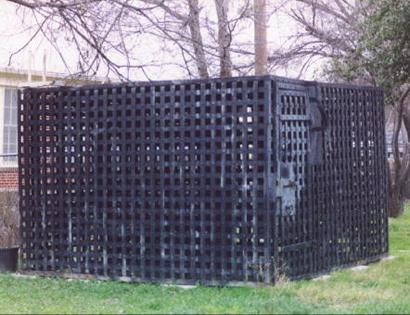
For you nostalgia buffs, check out these links to neat pictures of 19th century Texas jails, plus some grim photos of old-school "strap-iron" jails/cages (left).

Very Cool Hand Luke.

Blame game misses point on Hidalgo jail overcrowding

Commissioners in Hidalgo County say they can't find an answer to the overincarceration crisis at the county jail, but they're ignoring the most obvious solutions, instead looking for someone else to blame.

The McAllen Monitor's Victoria Hirschberg yesterday quoted officials
blaming the failure of the state prison system to pick up 37 inmates for the overstuffed status of the 1,150+ bed Hidalgo County Adult Detention Center ("Procedural kinks keep county jail packed," Oct. 24). Another 200 inmates have been convicted of felonies requiring prison time, but the county hasn't processed the necessary paperwork to send them to the state prison system.

So, inmates who are actually overdue to be transferred -- the 37 -- make up just 3 percent of those in the county jail, hardly a drop in the bucket. Even if you include the 200 inmates who aren't ready -- and it's hard to blame the state prison system for the county's failure to process cases -- the inmates Hirschberg describes make up about 20 percent of jail inmates, a sizable number but not the bulk of prisoners.


Like a
recent Grits commenter who similarly blamed rising jail healthcare costs on prison-bound inmates awaiting transfer, officials told Hirschberg that

Once an inmate is "paper-ready" — the file is completed, sent to the state and approved there — Texas law requires state criminal justice officials to pick up that inmate within 45 days.

But it’s not so simple.

In some cases, 45 days have turned into months, and as inmates sit in county jail, exacerbating an already overcrowded system, local taxpayers are picking up the tab.

Right now, there are 37 inmates who remain in the Hidalgo County Adult Detention Center past their 45 days. More than 200 inmates are "paper-ready," but might not be ready for transfer into the state system. Many inmates face multiple charges and remain in Hidalgo County until their court date. Sometimes, little details like a missing signature in the packet or a mail delay can halt the process.

The state usually tends to pick up prisoners in 25 days, seldom taking the full 45, reported Hirschberg, but Hurricane Rita has temporarily clogged up the pipeline until two prison units near Beaumont come back on line.

Focusing only on those few inmates, though, ignores the most statistically significant source of Hidalgo jail overcrowding: large numbers of inmates sitting in jail pending trial. That's something the county, working with local judges, could actually do something about. With Hurricane Rita leaving prison bed space at a premium, there's no guarantee the state can pick up those 37 inmates anytime soon. But Hidalgo County can change its policies to supervise more inmates awating trial in the community instead of in jail, especially misdemenants and certain non-violent, low-level drug offenders.


If Hidalgo officials were serious about reducing jail overcrowding, they wouldn't be pointing fingers at state government. Three out of five Hidalgo jail inmates -- 61.2 percent, as of October 1 -- are there awaiting trial, not serving a sentence, compared to the statewide average of 46.6 percent, according to the monthly jail population report from the Texas Commission on Jail Standards. (See
current month's report.) With budget-busting jail space at a premium, that policy benefits no one but the bail bonding companies.

Officials should look to create a pre-trial screening program to advise judges setting bail when it would be appropriate to release defendants on personal bond, meaning a promise to appear rather than a "cash bond" where defendants must post bail. Such assessments can reduce county jail populations without harming public safety. In Harris County, for example, "likelihood of misconduct"
(defined as "nonappearance or pretrial crime") by defendants whom Pretrial Services identified as "lowest risk" was just three (3) percent, according to a recent consultant's report.

Indeed, nobody's accused the Harris County justice system of being soft on crime lately, but there just 42.5 percent of jail inmates are awaiting trial. Simply reducing the ratio of jail inmates awaiting trial to Harris County levels (keeping in mind the consultant told Harris judges they could safely reduce that number even more) would lower the Hidalgo jail population by more than 200 inmates, saving the county hundreds of thousands of dollars.

In the past, Hidalgo County judges have been sensitive about anyone examining their bail assignments, but across the state the practice is in need of serious reform. Perhaps, if local officials can stop pointing fingers at others for problems of their own making, Hidalgo County could take this opportunity to re-examine its policies regarding bail and personal bonds to make the system both cheaper and more fair.


For an overview of pretrial services programs around the country, see
this 2001 federal report (pdf), and this FAQ from the Pretrial Resource Center.

Monday, October 24, 2005

Hurdles to stronger probation face new Travis chief

This is the third in a Grits for Breakfast series analyzing the Travis County probation system based on a report (pdf) by consultants at the JFA Institute. See the first two installments here and here.

Travis County's new probation department director, Dr. Geraldine Nagy, wants to change the way probation operates in the Texas state capital. To that end, she hired consultants from the JFA Institute earlier this year to "assess the department's strengths and weaknesses," "assist her in developing management strategies for the department, and "to identify the organizational challenges of implementing an Evidence Based Practices (EBP) organization and supervision model" for probationers. (See their
full report here [pdf]).

That directive anticipated handily
provisions attached to new probation funding, approved this year by the Texas Legislature, requiring probation departments who want the money to strengthen their supervision using such an EBP model -- in other words, the Lege wanted probation departments to use intermediate sanctions short of incarceration to handle minor violations by probationers. Departments hoping to receive the new funds must commit to a goal of reducing revocations by 10 percent.

It's important that Nagy wants change, because her department desperately needs an overhaul. Right now, the "main focus of the probation officer is to 'push paper around' and make sure all the paper work is done. As one person put it, 'we supervise paperwork instead of people.' The main task of managers is to make sure that probation officers do the paperwork. Their personnel evaluations, and that of the officers, are driven by that requirement." How grim!
Shifting to "Evidence Based Practices," consultants said, "requires a methodical and strategic shift in the organizational culture," where "officers are encouraged to motivate offenders to seek change; they must play a function and purpose that is more than just surveillance and information gathering."

Probation officers no longer do home visits for regular probationers and provide little meaningful oversight outside monthly meetings and urinalyses. Said JFA, the employment atmosphere "was usually described as a 'culture of fear' and 'culture obsessed with process taks,' and a culture that 'did not empower managers' and 'when you spoke [sic] your mind, it will backfire.' " That's sure an ugly description -- indeed, it's hard to imagine P.O.'s doing much good for anybody working under such oppressive job environs.


So it's welcome news that Dr. Nagy seems committed to the kind of organizational change needed to improve the system: "Managers and staff are seeking empowerment and are excited about the new director and direction for the department," JFA reported. With luck, the new focus on motivating offenders for change will improve the department's morale problem, benefitting both P.O.'s and their clients.


The EBP model adopted by Travis County views probationers as members of one of three classes -- low risk offenders, "social problem" offenders, and high risk offenders. Low risk offenders "are mainly pro-social citizens" who "need minimum supervision." By contrast, "social problem" offenders are "mainly pro-social people that have gotten in trouble with the law because of a substance abuse or mental health problem. These offenders require a supervision strategy oriented at changing their behavior with the use of programs and progressive sanctions." Finally, "high risk" or "last chance" offenders "need a controlled environment in which non-compliance with rules of supervision leads to a revocation."


That all sounds logical, but it can't happen without a dramatic shift in approach. Before now, Travis County's probation department treated everyone basically like high risk probationers, where "non-compliance with rules of supervision leads to a revocation." As a result, revocations skyrocketed in recent years, as paper-pushing probation officers utilized the only tool then available to them.


The number of people whose probation was revoked shot up more than 40% in Travis County from 2002 to 2004, JFA reported, for both felony and misdemeanor probationers: the department witnessed a 41.3 percent increase in felony revocations, and 43.5 percent for misdemeanants during that period. A majority of those were for "administrative" violations, not because a probationer committed a new crime.


Basing decisions on risk assessments
creates its own problems because "the risk assessment is not used properly and the population is oversupervised in Travis." JFA explained that departmental policy actually required misuse of the instrument: "probation officers mentioned that they routinely override the risk assessment to move offenders to a higher level of supervision, usually medium level. According to officers that have been with the department for a long time, a policy was instituted by the prior administration because they felt that probation officers did not have enough information to properly assess a new probationer until the probationer was at least six months into his supervision." JFA found such probationers don't typically have their risk levels reduced after six months, though, or even reviewed, resulting in a systematic misallocation of supervision resources toward low-risk offenders.

Thank heavens folks like Dr. Nagy are rethinking how probation services work, because the system is broken. The new focus on EBP and use of progressive sanctions will be a welcome
mitzvah for probationers, for probation officers, for public safety and for the taxpayers.

For more informaton on Evidence Based Practices models, see reports here and here from the National Institute of Corrections.

Saturday, October 22, 2005

As task forces fade, the "next Tulia"?

A few brief items of interest as I leave town for a pleasant time in Dallas tomorrow watching the pig races and the sheepdog trials at the state fair:

Texas House releases interim charges
: Texas House Speaker Tom Craddick has released the interim charges for committees in the Texas House of Representatives, which means he's announced the topics House standing committees will study in the interim, between now and the next regular session in 2007. See summaries of interesting criminal justice items compiled by the ACLU of Texas and the District Attorney's Association.

Drug Task Forces Seen As Expendable Pork
: Read the ACLU of Texas' Liberty Blog on why hurricanes and scandals might doom Texas drug task forces. While you're there, check out this cool, 20-minute video on the history of the drug task force scandal in Hearne, TX, which resulted in ACLU litigaton settled this spring.

The "Next Tulia"?
: Be sure to check out this terrific story by the Austin Chronicle's Jordan Smith detailing the story of 29 defendants accused by a single confidential informant, and the black folks in Edna, TX, who are fighting back against an imperious DA. The estimable Jeff Blackburn, lead attorney in the Tulia cases, is heading the defense.

After Innocence, Before the Next Wrongful Conviction
: For my commenters who enjoy reciting alleged details of horrific crimes as though it were prima facie evidence of a defendants' guilt, I'd urge you all to check out the movie reviewed yesterday in the New York Times, After Innocence, telling the story of seven wrongfully convicted men cleared by DNA evidence, collectively losing decades of their lives to false charges. This growing phenomenon, to me, should generate a little humility among the tuff-on-crime set, but it hasn't seemed to have had any such effect so far.

Friday, October 21, 2005

Defending defense lawyers defending the Fourth Amendment

If you spend much time in public talking to folks about the topics covered on this blog, before long someone will ask, "Why would a criminal defense attorney want to make their living defending criminals?"

From the Brownwood Bulletin's crime beat reporter Steve Nash comes this interesting column about local defense attorney Rudy Taylor, whose family and friends criticized him after he successfully got the results of an unlawful search thrown out in a drug case where his client would otherwise
have been found guilty. Wrote Nash:
Taylor said the questioning from his family made it a “soul-searching kind of issue” for him, but then he rephrased it as forcing him to validate the philosophy he developed in law school.

“My response is, that this is bigger than any one case,” he said. “It’s about protecting all of our rights in the long run. We’re the checks and balances to law enforcement.”

If defendants’ constitutional protections are violated, he said, “what would be the consequences to my law-abiding family?”

“If you don’t find your voice, your philosophical voice, where your heart really is ... how do you explain yourself?” Taylor asked. “How do you feel good about your job?”
That's necessary for every defense attorney, I'd imagine. But in a day and age when judges are mostly politicians and too often favor draconian, counterproductive tuff-on-crime policies over the Bill of Rights, I think it also behooves defense attorneys, once they find that voice, to use it more often in the public square, so I'm glad to see Mr. Taylor talking to the press on these subjects. As he explained to Nash:
“My job as a criminal defense attorney is to make sure that the checks and balances set forth in the U.S. Constitution and the Texas Constitution are applied to every case. Without that, we would revert back to the days of Nazi Germany and storm troopers who could go and kick in doors of innocent people.

“Power corrupts, and absolute power corrupts absolutely. Without checks and balances, police could decide they don’t like you or me and manufacture evidence.”

Perhaps a month has elapsed since Taylor’s court victory in the suppression of evidence hearing. He said he has no regrets.

“I’m really not soft on crime. Generally speaking, we have fair laws in this country. I am a strict law advocate. On the other hand, I am a strict constitutional rights advocate. They counterbalance each other.”
The demonization of criminals in a society that's managed to label nearly 2,000 separate acts "felonies" (in TX, anyway) and countless more misdemeanors has proven to be a nearly endless pastime for many in the public. But the reason to protect criminals' rights is that, some day, your own rights might need protecting.
I think Ken Lammers put the idea as well as anyone in this memorable post from last year:

If I choose to defend only the Righteous,
When the Rigtheous are accused,
What tools shall I have to defend them?

Thursday, October 20, 2005

Don't Kill Luis Ramirez

Barring intervention from the courts, Governor Perry, or God, Luis Ramirez will die tonight for the murder-for-hire of his ex-wife's lover. Many consider that justice. They're entitled.

As I
wrote here recently, though, none of us are as good as our best act or as bad as our worst one. If you don't think that's true, read this essay by Luis Ramirez about his first day on Texas death row, "What's in the brown paper bag?" Can you guess what he found there? I couldn't have. "I found caring, kindness, love, humanity, and compassion of a scale that I've never seen the 'good people' in the free world show towards one another," he wrote.

You may think killing Luis Ramirez is justice. And you're entitled. But for me, I'm embarassed to live in a society where the only time in his life Luis Ramirez was shown simple compassion was when he was gathered together with other doomed men aboard the Texas executioner's assembly line.


Christ forgave the thief on the cross after he repented, but Texans can't seem to muster the same impulse for mercy. I certanly urge you to
contact Governor Perry to ask him to stay the execution. But knowing our courts and our Governor, at this point one imagines Luis Ramirez can only look to God, not the Texas justice system, for his salvation.

Via
1000 Executions and the National Coalition to Abolish the Death Penalty.

UPDATE: Ramirez was put to death.

Minuteman switches teams

Via the Immigration Law Blog (which I've much enjoyed since it launched in September), I found an oddly hilarious article from the El Paso Times' indefatiguable Louie Gilot ("Minuteman sent home for aiding immigrant," Oct. 18), who reported that "a Minuteman has been dismissed from the volunteer border patrol group for giving a ride, food and water to two undocumented immigrants."

Didn't see that coming, did ya? :-)

Meanwhile, ACLU of Texas' Liberty Blog has a write up of a great editorial from the Marshall New-Messenger criticizing Kay Bailey Hutchison's plan to make local government foot the bill for immigration enforcement.

UPDATE: The New York Times reports on President Bush's just-proposed immigration plan.

Wednesday, October 19, 2005

New Jersey to require taping confession

Blonde Justice reports that interrogations must now be recorded in New Jersey, from the Miranda warning afterward. BJ's commenters noted that Massachussetts, Minnesota and Alaska already require taping defendants' confessions. That's an absolutely critical reform which would prevent a lot of police misconduct. Read more on the need for taping interrogations here.