Instead of 156,500 prisoners behind bars in Texas' 111 state prisons a year ago, the lockups now hold just over 154,000 — a drop of about 2,500, according to state statistics. Texas, which historically has had one of the highest incarceration rates per capita of the 50 states, is now in fourth place, down from second two years ago.Ward attributed the decline to alternatives to incarceration enacted by the Legislature in 2007, as well as "A decrease in crime rates, changes in demographics and an aging state population [which] also have a role in emptying Texas' prison beds." I agree all those front-end causes are factors in mitigating the growth rate in prisoner numbers: Back in 2007, Texas' Legislative Budget Board predicted TDCJ would house about 17,000 more prisoners in 2012 than actually turned out to be the case. However, there's another big reason for the shift that's less frequently discussed, but which was the subject of a Houston Chronicle story by Cindy Horswell published August 15 ("Texas says rise in paroles gives states bragging rights"): Changes in back-end parole policies to release more prisoners and to reduce the number of parolees who're revoked back to prison. Wrote Horswell:
Whether the declining prison population is the start of a long-term decrease or a short-lived dip is a matter of debate that will be settled only by time. Still, experts say, prison population declines are occurring in other states, too.
"It's real. It's happening, not only in Texas, but around the country," said Tony Fabelo, an Austin-based criminal justice consultant who coached Texas officials during the 1990s as the state tripled the size of its prison system and is now advising other states on how to decrease their prison populations.
"The challenge is to sustain the outcomes to see how far you can go in downsizing prisons. I have my doubts, but it's an interesting time for criminal justice," Fabelo said.
The [parole] board's report this week boasts 24,342 offenders were approved for parole from Sept. 1, 2010, to Aug. 31, 2011. This represents 31 percent of all who applied and an approval rate that is six percentage points higher than 10 years ago.This trend has been going on for a while, but these latest data provide encouragement that it will continue, and that parole board members (all Governor's appointees) are less fearful than in the past of a political backlash. Check out this telling infographic accompaying the story portraying this remarkable shift:
At the same time, the number carted back to prison this past fiscal year after their parole was revoked plummeted by 44 percent from a high of 11,374 in 2004.
Instead of fearing accusations of appearing too lenient, state authorities are smiling.
"We are pleased with our continuing increase in granting parole," said Rissie Owens, chairwoman of the state's pardons and parole board. "The use of our parole guidelines to assess the likelihood of a successful parole outcome has been cited as a national model for its positive impact on returning more offenders to productive lives."
The Association of Paroling Authorities International has praised Texas' system which many other states are copying, said board spokesman Harry Battson.
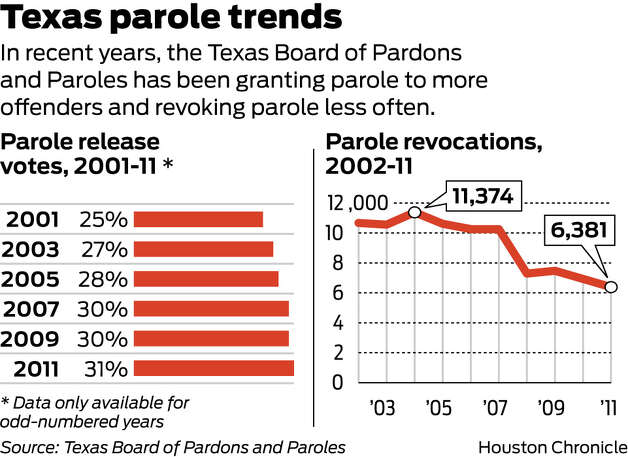
Some of the rise in parole rates may be attributed to a relatively minor uptick in paroles for serious violent felons who are nearing the end of their prison terms, a development which even victim rights advocates quoted in the story supported. In years past, the parole board frequently kept such offenders in prison until their (often long) sentences were 100% complete, at which point they would be dumped out on the street with $100 in their pocket, little or no reentry assistance, and no community-based supervision by a parole officer. More recently, the parole board has been releasing such offenders a year or two before the end of their term so they'll be under supervision during the period when they're most likely to re-offend. As somebody who hasn't hesitated to criticize parole board chair Rissie Owens and her colleagues for policies Grits considers ill-conceived, I have to give them their props: That's truly a "smart on crime" tactic, using parole powers to improve public safety significantly. In a followup editorial, the Chronicle called this a "belt-and-suspenders approach."
That said, IMO the trend toward reduced incarceration levels cannot and will not be sustained long-term without further legislative action, particularly as it regards sentencing for low-level offenses and funding for community supervision. One big element contributing to prison population declines which wasn't mentioned in Ward's story was 2003 legislation mandating probation on the first offense for low-level (less than a gram) drug possession. That bill diverted roughly 3,000 people per year from so-called "state jails" (which are really not jails in the traditional sense but a euphemism for state prisons housing the equivalent of fourth-degree felons). Grits believes prison population declines won't be sustained in the long run unless the Lege further moderates sentencing, particularly for drug and property offenses.
Still, these data offer hope that Texas may further embrace a rational, conservative corrections policy as opposed to the money-is-no-object, Big Government approach which has dominated since the Ann Richards era.


.jpg)

