Showing posts with label Texas Rangers. Show all posts

Friday, March 12, 2021

Forensic hypnosis largely dead in Texas but junk evidence still travels like zombies through the court system thanks to the CCA

Exciting news: Texas DPS has ended the use of forensic hypnosis among the Texas Rangers, the Forensic Science Commission's Lynn Garcia told the Texas Homeland Security and Public Safety Committee yesterday. Your correspondent broke the news on Twitter; see Dallas News coverage here

The Dallas News had previously reported that the Texas Rangers and the Harris County Sheriff's Office were the last agencies in the state with peace officers carrying hypnosis certifications. Those must be renewed every two years. But Harris County Sheriff Ed Gonzalez said on Twitter his agency doesn't use it anymore, either, so it's possible the last practitioners of forensic hypnosis in the state are all now offline. Certainly the most prolific among them at the Texas Rangers have been permanently benched.

There was a time not long ago when this practice was more widespread; today, it's largely a source of derision and few if any agencies practice it any longer. It was the junkiest of junk sciences I've ever encountered, and Grits has seen some.*

Still, discredited though it was, Texas officials weren't about to ban this junk science technique from the courtroom. The Forensic Science Commission determined they had no jurisdiction to consider hypnosis. Legislation was filed in the Texas Senate in 2019  to banish the practice from courtrooms, but, the committee chair wouldn't give it a hearing. Then the technique was challenged under Texas' junk-science writ, which should have been the end of it. But it was a death penalty case and the Government Always Wins faction on the Court of Criminal Appeals flexed their muscle, declining to apply the writ without giving an explanation.

After the US Supreme Court declined to take up the issue - unsurprising, since the junk-science writ is a state law with no explicit federal skin in the game - efforts to banish forensic hypnosis appeared to be stymied.

The decision by DPS to end the practice came like a bolt from the blue; most folks thought they wouldn't end it unless they were forced to do so. Apparently, someone internally simply decided the technique could no longer be justified. I'd love to know the backstory (off the record tips welcome!). The hypnosis program apparently ended in January but the agency never announced it.

Your correspondent takes some pride at raising the profile of this issue. In the Texas political realm, the topic was first raised in a 2017 Reasonably Suspicious podcast segment brought forward by my co-host Amanda Marzullo on the Charles Don Flores case, the one that SCOTUS later declined to review.
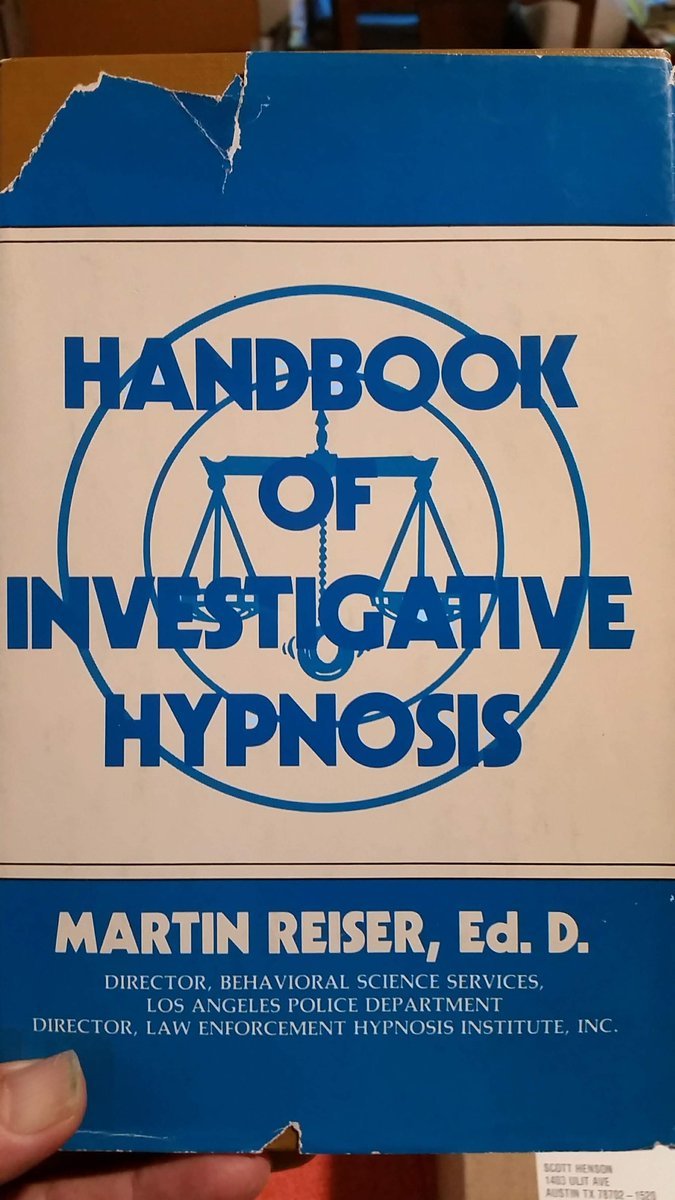
This piqued my interest and Grits followed up with a research primer on the subject that exposed the charlatanism underlying the practice. I purchased a copy of the book used to train forensic hypnotists under TCOLE's training curriculum. It included favorable references to occult practices like "automatic writing," portrayed memory as the equivalent of a videotape that hypnotists could simply play back, and encouraged "age regression" to recall long-ago events. Mandy and I began to follow the Flores case on the podcast.

I pitched the story to Lauren McGaughy at the Dallas News who ably picked up the ball, first publishing a preliminary assessment in 2018. This raised the profile of the topic in state government - helping me convince state Sen. Juan "Chuy" Hinojosa to file his roundly ignored legislation in 2019. Meanwhile, the courts were mimicking the iconic monkeys who see, hear, and speak no evil. 

Then, last year, the Dallas News published a major two-part feature McGaughy co-reported with Dave Boucher called "The Memory Room." They spent months pursuing open records requests and dove deep into DPS practices and TCOLE records, revealing details no one outside those agencies knew. It was hard to imagine how responsible decision makers, after reading this damning assessment, could continue to let cops hypnotize witnesses.

Still, Grits wasn't sanguine the Legislature would even take up the topic; the same chairman who wouldn't give the bill a hearing still runs the committee, and the Court of Criminal Appeals' failure to take up the cause seemed to have shunted the issue to the back burner for state government. 

DPS ending its hypnosis program changes the landscape, surprising all observers and opening up new opportunities. If neither they nor HCSO any longer use hypnosis, Texas can now shut down the practice entirely. Reported McGaughy, "Texas remains the only state known to have an active certification program for law enforcement officers to learn hypnosis and is also the home to likely the nation’s only extant police organization for investigative hypnotists."

There's no need for that certification program now and the Legislature should eliminate it as part of the TCOLE Sunset bill. This is EXACTLY the sort of thing the Sunset process was created to do: Extinguish outdated, anachronistic, and unnecessary programs.

Here's the rub: Even if the Legislature ends the certification, there are still numerous cases - nobody knows how many, but including Mr. Flores' death-penalty case - marching forward through the system like zombies based on past convictions secured using this practice, and more people locked up in TDCJ or on parole whose convictions were tainted by the same junk science.

I'm not a lawyer but Grits doesn't know if there's any way to help those folks if the CCA won't apply the junk-science writ. I suppose the Forensic Science Commission's jurisdiction could be expanded to evaluate this now-mostly-dead forensic method so that courts would have a basis to revisit it. But that's an open-ended, speculative process that could take years. It seems like waste of time when the CCA could already have done the right thing, and still could.

Grits' takeaways: The Texas Legislature should both abolish the hypnosis-certification program (TCOLE's Sunset review is remarkably well-timed for this purpose) and expand FSC jurisdiction to evaluate forensic hypnosis. The Texas Rangers may have stopped using this particular junk-science technique, but the topic won't finally go away until the courts do.

* I was Policy Director at the Innocence Project of Texas for 8 years and conceived of and negotiated with prosecutors to pass Texas' junk-science writ. The only bogus "science" I've seen that's arguably as junky as forensic hypnosis was dog-scent lineups, and the CCA got rid of that abomination.

Sunday, December 17, 2017

Executing non-killers, imagining life without plea bargaining, no oversight for forensic hypnosis, and other stories

Here's a brief, browser-tab clearing roundup of items about which I haven't had time to blog, but of which Grits readers should be aware:

Forensic commission can't address 'forensic hypnosis'
First, updating an earlier Grits report, I communicated with Lynn Garcia, General Counsel for the Texas Forensic Science Commission, who informs me that forensic hypnosis does not fall under their jurisdiction, even as a general area they're authorized to study, because it does not involve "physical evidence," which is defined in the statute as something tangible. She said they've received complaints about the practice in the past, including one recently, and agrees it's problematic, but doesn't believe it falls within their jurisdiction. While I understand her legal interpretation, that leads to an unfortunate situation where government-sanctioned junk science (the Texas Commission on Law Enforcement gives out certifications in forensic hypnosis) cannot be evaluated by the state Forensic Science Commission. That should change in 2019.

Maybe they'll listen if they Rangers tell 'em
Governor Abbott has asked the Texas Rangers to investigate sexual abuse at the Gainesville State School. But we've had an Ombudsman complaining about these problems and recommending solutions for years, and for the most part those recommendations have been ignored. Most of the details in the disturbing press reports out of Gainesville came from Debbie Unruh, the TJJD independent ombudsman, and had been included in her prior reports. Why would we imagine state leaders will listen to the Texas Rangers when they haven't implemented the recommendations from Unruh who's been sounding the alarm all this time? The state already knows the solutions here, they just haven't heretofore been willing to pay for them.

Did TDCJ understaffing allow rape of prison teacher?
A teacher at a TDCJ prison blames chronic understaffing for the circumstances that led to her rape. Grits readers know this is a longstanding problem. The solution here is to reduce incarceration levels and close understaffed units. There just aren't enough people in some of these rural areas to consistently staff the prison units there. And the problem will be much-exacerbated at certain South and West Texas units if and when oil prices go back up.

Coverup at TDCJ?
The Texas Department of Criminal Justice allegedly shredded documents they were obligated to turn over as discovery in a federal lawsuit alleging the summer heat in un-air conditioned prisons constitutes cruel and unusual punishment. The warden who approved the shredding allegedly already knew about the litigation. Hard to interpret it otherwise: This smacks of a coverup.

Executing non-killers
Something about executing a person for a murder they didn't themselves commit feels inherently unjust. Even the prosecutor from Jeff Wood's capital conviction, who had 13 months experience as an attorney at the time she was designated shot-caller in the case, has asked the Governor to commute his sentence. Wood's example reinforces Grits' belief that the law-of-parties doctrine is ripe for revision: the concept stems from British common law, but Parliament abolished it in 1957, followed soon thereafter by all of Europe, India, and in 1990, Canada. This is a holdover from a less evolved time.

Paying for public defenders would reduce incarceration costs
Long-time Grits readers are aware that defendants represented by public defenders have better outcomes than those with appointed attorneys. We've seen this both in national data and Texas examples. But a new national analysis suggests that public defenders do such a better job that using them reduces incarceration costs: Using "public defenders reduce[s] the probability of any prison sentence by 22%, as well as the length of prison by 10%."

When your 'tiny house' means a tiny privacy footprint
Here's an unintended consequence to the "tiny house" movement: If your tiny house is on a trailer, your Fourth Amendment rights are likely diminished and the automobile exception will apply to searches of your residence, according to academic from Texas State.

Life without plea bargaining?
For the reading pile: India's court system doesn't do plea bargains. They've tried to implement them in the last decade and it's been a flop. I want to read this new academic article to learn more about the situation.

Tuesday, August 30, 2016

Not the Texas Rangers' proudest day

Grits receives the Texas State Historical Association's relentless daily email and today's missive told the story of a particularly unsavory, if successful, use of the Texas Rangers to enforce Jim Crow in defiance of federal courts.
On this day in 1956, an angry mob surrounded Mansfield High School to prevent the enrollment of three African-American students in what became known as the Mansfield School Desegregation Incident. The National Association for the Advancement of Colored People had sued the Mansfield school district over its segregation of black schoolchildren. When a federal court ordered the district to desegregate--the first time a Texas school district received such an order--many white citizens resisted. Vigilantes barred integration sympathizers from entering town, whites hanged three blacks in effigy, and downtown businesses closed in support of the demonstrations. Governor Allan Shivers authorized the Mansfield school board to transfer black students to Fort Worth, seventeen miles away, and dispatched Texas Rangers to uphold the district's policy of segregation. The successful defiance of the federal court order helped inspire the passage of state segregation laws in 1957, delaying integration for several years. The Mansfield school district finally desegregated in 1965.
Grits was raised on stories of Texas Ranger heroism, but somehow that one never made it into the canon.