Showing posts with label Class C violations. Show all posts

Saturday, April 17, 2021

#txlege bill eliminating Class-C arrests for traffic offenses moving forward with bipartisan support

The death of Daunte Wright traffic enforcement by police back in the spotlight, raising the profile of the issue just as HB 830 (Thompson) passed out of committee at the Texas Legislature this week. Next week will be dominated by debate over the budget, but HB 830 could hit the House floor as early as the week after.

The committee substitute to the bill would ban arrests for Class C traffic violations in Texas, but not other Class Cs. Looking at recent cases, the bill would affect Dillon Puente in Keller but not Rodney Reese in Plano. There are a variety of reasons for that and I'd prefer all Class C arrests were banned. But in 2020, traffic violations accounted for 95% of arrests for Class Cs at traffic stops, so the bill as it stands would have a large impact.

These low level arrests take up a huge proportion of law enforcement's time and resources. In Texas in 2019, police arrested some ~45,000 people for marijuana, plus another ~137,000 at traffic stops alone for Class C misdemeanors (64K), and warrants for debt (73K). Those low-level categories made up more than a quarter of all arrests statewide that year (total arrests was 689,109, says DPS).

Every such arrest risks the bad outcomes witnessed in cases ranging from Daunte Wright to Philando Castile to Sandra Bland. Eliminating tens of thousands such arrests could definitely save lives.

We're kind of headed in that direction, anyway. Notably, Texas has radically reduced traffic enforcement over the last decade with no notable change in road-death rates. So we're already trending in the direction of fewer traffic stops. Eliminating Class C traffic arrests further minimizes the risk of harm at traffic stops, making it more likely driver and officer alike will end encounters safely and go on their way.

Make me Philosopher King and I'd probably take traffic enforcement completely out of law enforcement's hands except for a tiny handful of exceptional circumstances. The reason cops do it in the first place is the supposed risks, but those are far overstated, as Jordan Blair Woods, who analyzed detailed data of police violence at traffic stops in Florida, articulated in this interview:

the danger narrative about traffic stops that is commonly perpetuated in courts and law enforcement circles isn’t supported by empirical research. What I found is that overall, violence against officers during traffic stops was fairly infrequent and the incidents that did happen were generally low-risk and didn’t involve weapons.

Using my most conservative estimates, I found that the rate for felonious killing of an officer during routine traffic stops was 1 in every 6.5 million stops. The rate for an assault resulting in serious injury to an officer was 1 in every 361,111 stops. The rate for assault against an officer, whether it results in injury or not, was 1 in every 6,959 stops. The least conservative estimates suggest that the rates are much less: 1 in every 27.6 million stops for a killing, 1 in every 1.53 million stops involving an assault that results in serious injury to an officer, and 1 in every 29,550 stops for an assault against an officer, whether it resulted in officer injury or not.

The bottom line is the idea that routine traffic stops are these exceptionally dangerous events for police didn’t pan out with my results.

Moreover, many of the risks at traffic stops arise from the nature of American policing and its routine overreaction to the mildest resistance and focus on arrests for warrants. If unarmed civilian bureaucrats performed that role, maybe it could be done with less risk to everyone.

Grits recognizes, though, that's not happening anytime soon. As my father likes to say, "If wishes were horses, beggars would ride."

In the meantime, limiting arrests limits the number of times police forcibly detain someone and should reduce resulting police violence. If more than a quarter of 2019 arrests in Texas were for marijuana, Class C misdemeanors, and outstanding debt (warrants), those arrests conceivably could be eliminated. And many "small government" conservatives would be on board with the idea, just as HB 830 has both Republican and Democratic authors.

Finally, readers may recall that eliminating Class C arrests was one of the areas of agreement between the Democratic and Republican Party platforms in Texas on criminal-justice reform, a recollection that gives me the opportunity to bring back this short video with one of my favorite jingles: 

Saturday, April 03, 2021

Texas radically reduced traffic enforcement with no noticeable impact on road safety

What's the relationship between traffic enforcement by police and roadway safety? Arguably not much. Over the last decade, the number of traffic cases brought by Texas cops has plummeted, according to the Office of Court Administration's 2020 Annual Statistical Report:

Over the same period, though, roadway deaths per hundred-million miles first rose and then declined to pre-2010 levels, despite major population increases over this period coupled with radical reductions in police enforcement. From TXDOT's annual crash statistics:

Whatever drove that up-and-down trend, it doesn't seem to correlate with the trend in traffic enforcement. 

Question: If radically less traffic enforcement seems to have no noticeable impact on traffic fatalities, what precisely were we doing it for?

How to square these seemingly contradictory notions? Grits has long believed the disconnect can be explained because road safety has little to do with anything police do. Instead, it's largely a function of consumer habits, anachronistic road rules, and most importantly, traffic-engineering decisions. CityLab featured an essay this week making that point. It blamed a national spike in pedestrian deaths last year on "laws that lock in dangerous street designs and allow vehicles known to be more deadly to non-drivers."

CityLab suggested street-design issues had outsized influence. In particular, with fewer cars on the road in 2020, people drove much faster on wide, American streets. With more people working from home, thus more likely to be out walking, this structural defect caused pedestrian deaths to spike even as miles-driven declined.

That makes much more sense to me than looking for local causes to explain national phenomenon. Same goes for murder rates: Don't look for local issues like homelessness in Austin or bail in Houston to explain a murder spike that also occurred in Lubbock, New York, Los Angeles, and dozens of other US cities.

In Austin, partisans want to blame increased pedestrian deaths on the city's homeless policies. Somewhat more plausibly, others blame the problem on speeding. But in the bigger picture, it's that Texas cities where most people live are designed for cars, not people. For these and related reasons, Grits favors turning many of Austin's downtown streets into pedestrian-only thoroughfares and building out pedestrian infrastructure across the highway into East Austin.

Indeed, there are pedestrian-friendly capital projects all over the city that would improve quality of life and boost safety much more than comparable sums spent on cops.

I'm not surprised to see pedestrian deaths creeping up even as overall deaths-per-mile-driven declines. To me that likely reflects the changing nature of Texans' land use, as most people use their vehicles for shorter drives in urban settings and urbanization spurs a boom in pedestrians that challenges the state's car-centric urban planning culture.

These are predictable problems. And surmountable ones. And most of the solutions don't involve police.

Monday, March 15, 2021

Data: When Texas ↓ pot prosecutions, the system focused more on violent crime

Grits has been tracking what I've called "The Great Texas Hemp Hiatus," referring to the Texas Legislature's legalization of industrial "hemp," requiring a THC test to prosecute for marijuana possession. It was ostensibly a legislative accident, but it appears the change is going to stick: No legislation was filed to remove the testing requirement when the bill filing deadline passed on Friday.

From the Office of Court Administration's 2020 annual statistical report, here's how that impacted marijuana prosecution in Texas:

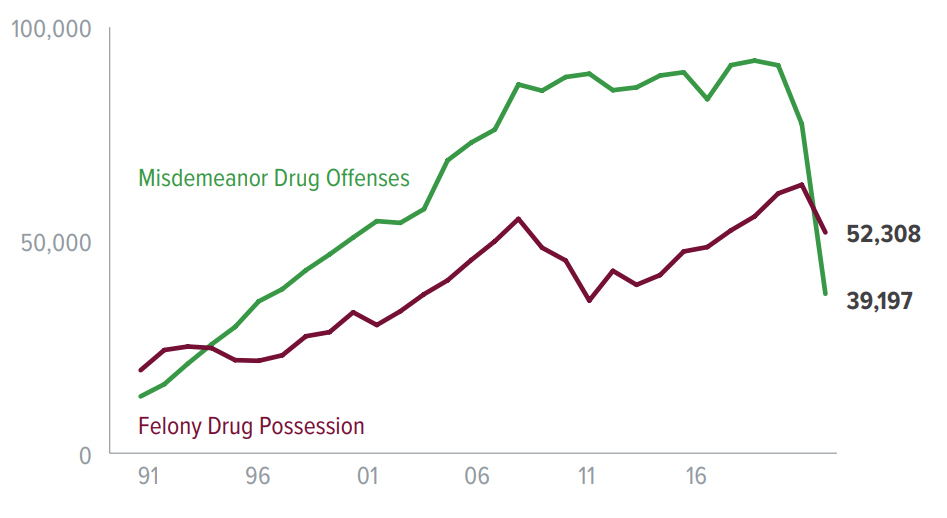
In 2018, by contrast, there were 87,618 misdemeanor drug cases in 2018. That's a 55% drop from before the new testing requirement was implemented.

Marijuana has been one of the most common charges Texans are arrested for in recent years. In 2020, though, more people were arrested for Class C misdemeanors at traffic stops (41,731) than were prosecuted for marijuana possession.

Polling consistently shows most Texans favor full-blown legalization of marijuana for recreational use, and an even greater number endorse more widespread legalization of medical cannabis. So for the average Texan, it's a big yawn. They wouldn't care if that 39,000 number dropped to zero.

For the system, though, it's a big deal. Drug arrests gave 80,000 cops across Texas at more than 2,000 agencies something to do when crime declined but cities kept hiring more of them. From the 2018 OCA Statistical Report:

In 2020, by contrast, drug cases' contribution to misdemeanor caseloads had dropped from first to third in the prosecutorial pecking order on the misdemeanor side, replaced after DWI by "assault."

So when police and prosecutors reduced emphasis on marijuana prosecution, the result was an increased focus on violent crime as a proportion of how they spend their time. This seems like an outcome most Texans would support.

Make Grits Philosopher King and Texas would legalize pot for recreational use, just as 14 other states have done, or at least decriminalize, as have another 16. In the scheme of things, marijuana is safer than alcohol by a country mile, and research on the substitution effects for everything from booze to opioids makes me wonder if its role as an agonist might reduce overdose and/or DWI deaths. But Greg Abbott and Dan Patrick have declared that option off the table. Until then, Grits supports narrowing the funnel facilitating criminal prosecutions for pot at every level. Texans are less safe, not more, when the government criminalizes markets this large with no public-safety imperative driving it.

Friday, March 12, 2021

For journalists: How to read a Texas racial profiling report, or, a case study demonstrating discrimination through police search patterns in Amarillo

Grits has started to see local reports on law enforcement racial profiling data from Texas traffic stops, but it's evident most local reporters don't understand what they're looking at. So they ask the department what it means, the chief soft pedals it, reporter files the story, bada bing, bada boom. That's how a local Amarillo TV station covered the report. Reporters seem to have gotten into a habit of doing the same simplistic story every year, even as the data has improved and much more can be gleaned. 

So Grits decided to perform a brief case study on what reporters can learn from a single department's racial profiling report. Grits has already examined the data at the macro level; now let's look at the micro, using Amarillo PD's report as an example. 

Black folks are slightly overrepresented among drivers stopped by police compared to the Amarillo population. A bit over 6% of Amarilloans are black while 11.1% of drivers stopped in 2020 were black. But because Amarillo PD patrols highways that cut through town and people who don't live in the jurisdiction drive on their streets, it's impossible to say with statistical certainty if the number of stops is disproportionate. To be clear, I believe it is, but I've been round this block for 20 years and there's no denominator to be had which doesn't pose some significant statistical problem.

This is what the Amarillo chief meant when he said it's impossible to tell if racial profiling occurred without a "better way of establishing the demographics of the driving public." He's right. Sort of.

But he's not revealing the full picture, and the reporter didn't know enough to demand he do so. If you're trying to identify racial disparities, look at search data, not overall stop rates. That's because for searches and arrests we have an incontestable baseline or denominator: the overall pool of people stopped.

In Amarillo, we do see disparity on this metric. Black folks represented 11.1% of people stopped but 18.3% of people searched. Black folks were also subjected to "consent" searches more frequently than their share of stops, making up 18.6% of all such searches. So Amarillo cops are both seeking and performing searches on black drivers more often than white ones.

The chief's concern about demographics of drivers vanishes once you drill down to this level of detail.

The number of people searched at traffic stops in Amarillo dropped by nearly half in 2020 compared to 2019. Interestingly, searches dropped more than stops, which declined but not nearly that much. Is this because of officers social distancing at stops, a change in policy, or some other reason? I can see dredging up a story on that topic on a slow news day. ;)

The majority of times Amarillo cops searched vehicles at traffic stops, they found nothing (56% of the time). That's pretty typical statewide.

Some data is easier to read on the TCOLE spreadsheet than in tables in a pdf file, particularly regarding contraband results from searches, where there are columns on the spreadsheet breaking out when contraband was found but no arrest was made that aren't in Amarillo PD's prose report.

Notably, though black people were more likely to be searched, Amarillo cops were more likely to find contraband when searching white drivers. Contraband was discovered 43% of the time white drivers were searched but just 38% of the time they went through black people's cars.

This is a key racial profiling indicator. If cops are searching black folks half again as often as their proportion among drivers but disproportionately finding contraband more often on white folks, that signals a discriminatory pattern.

This is one of the key, new calculations made possible by the 2017 Sandra Bland Act, but Texas journalists haven't figured out how to use the new resources available to them.

Searches of black people in Amarillo found contraband 35 times, which would not be too far out of line compared to the proportion of times they were searched (even though it's FAR greater than their proportion of Amarillo's population). Even so, 31 of the 35 times contraband supposedly was found in a black person's car, it was so minor they weren't arrested and were sent on their way. Couple that with the majority of arrests that found nothing, and that's a LOT of drivers subjected to pointless fishing expeditions.

By comparison, contraband was found on white folks in 105 searches, and the driver was arrested in 10 of those episodes.

From a journalistic perspective, I'd consider this a big story. Sure, the racial disparities in arrest rates aren't big. But if 90%-ish times when contraband is found, the driver is let go, what's the point of searching to begin with? Either the definition of "contraband" being employed is so broad as to include things that aren't illegal, or Amarillo cops are being awfully lenient when they find evidence of crimes. IRL, Grits suspects it's the former; this data pattern is a bit of an outlier but most agencies release the majority of drivers on whom contraband is found.

Statewide, black folks were slightly more likely to be arrested than white folks when contraband was found (38% compared to 33%), but the percentage for Hispanic folks was even higher (40%). Big gaps in those categories could mean one group is receiving lenient treatment and might be an avenue for local journalists to pursue.

Another important story from these reports: Amarillo PD arrested 115 drivers for a Class C misdemeanor traffic violations in 2020. With 215 total arrests at traffic stops, more than half of arrests at traffic stops were completely avoidable and likely represent pretext stops where the officer is fishing for some other crime. Those would cease if the Texas George Floyd Act became law. Statewide, Class C arrests were only 21% of the total, so this is happening more in Amarillo than elsewhere. What reporter wouldn't want a local news story linked to pending state legislation heard in the next few weeks? Well, it's available to you, if you know what you're looking at.

Notably, black folks made up just 11 of 115 people arrested for traffic violations at Amarillo traffic stops in 2020, so the Class C arrest ban in the Texas George Floyd Act isn't particularly a racial issue in Amarillo. Or black folks in Amarillo simply "consent" to searches before facing arrest, as noted above. Regardless, I'm pretty sure white Amarilloans don't appreciate being arrested for petty BS any more than black folks do. 

The maximum penalty for Class C misdemeanors is only a fine, not jail time. By arresting someone for a Class C and taking them to jail, police are inflicting a punishment more severe than a judge or jury could do.

Amarillo PD reported using force resulting in serious bodily injury at only two 2020 traffic stops. If local reporters don't know those cases are, maybe someone should look them up? Could be a story there.

There are many reasons for justice-beat reporters to examine Texas racial profiling data now that it's been enhanced via Rep. Garnet Coleman's 2017 Sandra Bland Act. In some instances, yes, reporters may find notable racial disparities: In Amarillo, for example, it appears black drivers are disproportionately searched compared to how often they're pulled over, are asked for consent to search more often than other drivers, and have contraband discovered less frequently than do their white counterparts.

But there are also news stories buried in these data beyond racial discrimination: Most immediately in relation to the Texas George Floyd Act, Class C misdemeanor arrests (both traffic and municipal ordinances), and use of force. It also might be informative to compare data from nearby jurisdictions. Often, as demonstrated in this example, differences in search practices from department to department are more significant or telling than the statistical differences among the races.

Not everything important or interesting in this data is about race. Indeed, the report answers basic questions few reporters ever consider: how many stops are made overall? How many of those people are searched? How many are arrested? How often is contraband found? Turns out, even overall traffic-stop numbers change significantly year by year. 

The decline between 2019 and 2020 stop levels is understandable, but what explains the near doubling from 2017-2018? Traffic stops were declining during this period statewide. If I were a local reporter in Amarillo, I'd be looking into that story, which is interesting irrespective of racial breakdowns. 

In a town of fewer than 200,000 people, both the doubling of traffic stops to the 2018 apex and the less-than-might-be-expected decline in 2020 could be significant. Digging around in the whys of it, combined with poking around TCOLE's statewide spreadsheet and a little traditional legwork, could generate many different types of local stories. This information isn't available from any other source.

Monday, March 08, 2021

On Class C arrests and a "duty to intervene," James White on "colonizing" Austin PD, and Anthony Graves on how bad prison food ruins prisoners' health: Part One of Special Podcast on #TexasGeorgeFloydAct

The Reasonably Suspicious podcast is back after a largely health-driven hiatus. Mandy and I are diving back in with Part One of a special, two-part episode on the Texas George Floyd Act, HB 88 by state Rep. Senfronia Thompson. The episode features new, original music created for radio ads and online promotion of the George Floyd Act, as well as interviews with Rep. Thompson, Homeland Security and Public Safety Committee Chair James White, and exoneree Anthony Graves, who came on to talk to us about the TDCJ prison budget. We also discuss the existence of "Schrodinger's Defendant," comparable to "Schrodinger's Cat": A concept I think may evolve into a more robust critique going forward. 


The first half hour of the show takes a deep dive into the issue of Class C misdemeanor arrests, using the case of Dillon Puente out of Keller, Texas to spotlight the problem. Dillon was arrested for a wide right turn, but really so police could search his car. (Spoiler: The search found nothing, but before they were finished they'd arrested him and pepper sprayed his Dad.) We also spoke to James White about a case out of Plano where a young black man on his way home from Walmart was arrested during the recent Snowpocalypse. 

Chairman White, whose committee oversees the Texas Department of Public Safety, also took a moment to discuss Gov. Greg Abbott's suggestion that DPS "colonize" the Austin Police Department, in his words. Austin folks will want to hear this.(35:58)

Finally, exoneree Anthony Graves, who spent 18 years incarcerated in Texas prisons before being proven actually innocent, spoke with us about the need for the Legislature to boost funding for prison food and treatment that helps prisoners reenter society. (41:55)

Find a transcript below the jump. Enjoy!

Monday, February 22, 2021

Plano police do best 'Cartman' impersonation arresting black kid for walking home in the snow

If you needed another example why the Texas Legislature should forbid police from arresting people for Class C misdemeanors, here's yet another poster-child case for the history books.

Rodney Reese, an 18-year old black man living in Plano, was walking home from his job at the Walmart during the Snowpocalypse when police officers stopped him ostensibly for a "wellness check." Carrying a plastic bag, underdressed for the cold in a short-sleeve shirt, he told them he didn't want their help and was on his way home. But the cops wouldn't take "no" for an answer and soon told him he was under investigation and being formally detained, eventually arresting him for "pedestrian in a roadway." To their credit, the Plano PD quickly posted the dashcam video. You can watch the video here.

A couple of things stand out. First, despite the police chief saying he didn't believe race was a factor, it's virtually impossible to imagine Plano cops treating a white 18-year old boy in a similar fashion, or for that matter that any Plano resident would have called the cops in the first place if the boy were white. That's just the truth. The chief said he can't know what's in officers' hearts, but their actions revealed more than words could convey short of calling him the N-word. They weren't treating him like a citizen whose wellbeing they cared about - the ostensible purpose of a "wellness check." He was there to play a role, in their minds, and was punished for refusing to go along with the charade.

Second, there was no public-safety justification for what happened. Reese told them he was going home and was under no obligation to talk to police. (One has a "right to remain silent," after all.) He'd done nothing wrong and his incentive to keep moving and not stop in his under-dressed state was obvious; there was nothing suspicious about his behavior. He was arrested because he chose to exercise his rights.

That element reminded me of the episode in Keller, TX with Dillon Puente and his father. There, the cop got upset because Puente said he was afraid of him, citing images of police brutality on television. Rather than try to understand where the kid was coming from, the cop considered his reticence to interact suspicious and ended up arresting him for making a wide right turn. (In that case, officers also pepper sprayed and arrested Puente's father who was shooting video of the episode.)

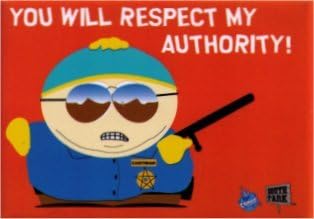
Watching the video from Plano, the male cop escalated the situation unnecessarily. The woman initially approached Reese used a lighter touch, but should have taken "no" for an answer. The male cop, however, exhibited what can only be described as a bout of toxic masculinity, tinged with racial animus. This black boy challenged his authority by ignoring him, and that the cop couldn't abide. It was like watching the character Cartman from Southpark insisting "You will respect my authority!" Same energy, as the kids say.

There likely was nothing this kid could have done to avoid this outcome. The cops weren't sent there to investigate a crime, but invoked their investigative powers the moment he failed to show maximal deference and detained him for no good reason. He was 100% right not to want to engage with them.

Mr. Reese was charged with being a pedestrian in the roadway - a Class C misdemeanor - and hauled off to jail. The maximum penalty for that offense is only a $500 fine, so the arrest punished him to a greater extent than the maximum a jury could have imposed following a guilty verdict.

On Facebook we're told, "The arresting Officer noted in the arrest report that although the subject committed the Class B misdemeanor offense of Interference with Public Duties by resisting Officers efforts to detain and handcuff him, the Officers elected to only charge him with Pedestrian in the Roadway, a Class C misdemeanor." This tells you all you need to know about the officer's mentality, framing it as though he was doing the guy a favor. What "duty" was he performing that Mr. Reese interfered with? Checking on the boy's wellbeing. But the kid already told him he was fine and on his way home. In truth, the officer was violating his duty to respect the lad's rights.

Finally, I should add that the Plano Police Chief, who himself is black, to his credit, immediately ordered charges dropped against the kid and said the arrest should never have been made. And he deserves a lot of credit for releasing bodycam video footage so quickly, that's exemplary police management behavior rarely seen in Texas' larger jurisdictions. But his comments absolving the officers of racial motivations rang hollow: It's not credible to imagine white kids in Plano get treated that way. If they were, likely arrests for Class C misdemeanors would have been forbidden a long time ago.

Thanks to data collected under the 2017 Sandra Bland Act, we now know that 64,100 people were arrested for Class C misdemeanors at Texas traffic stops in 2019, and untold more were arrested on the street for Class Cs, like Mr. Reese. Every one of those arrests was an abuse of police power just as much as this was. It has to stop.

Wednesday, December 30, 2020

Keller PD arrest puts a family face on 64k Class C arrests at Texas traffic stops

Out of Keller, TX comes the Lone Star State's latest police misconduct case with bystander video gone viral. Cops used a Class C arrest over a "wide right turn" to search Dillon Puente's vehicle when he refused consent, then used excessive force against his father, Marco, in retaliation for recording the incident. They arrested Dad on a phony obstructing the roadway charge. See WFAA-TV's coverage. and a New York Times story about the family's lawsuit.

The Texas Legislature bears as much responsibility for this episode as the officer. The US Supreme Court ruled 20 years ago in Atwater v. City of Lago Vista (a seat belt violation case) that whether officers could arrest for Class Cs is a legislative decision, and that state lawmakers would need to change the statute to forbid it. State Rep. Senfronia Thompson has filed legislation to restrict such arrests in HB 830 and as part of a larger omnibus "George Floyd Act," which is HB 88. 

Legislation to restrict the practice passed in 2001 (immediately after Atwater) but was vetoed by Gov. Rick Perry at the behest of police unions. In 2003, Perry vetoed another bill which would have required law enforcement agencies to have written policies stating when their officers could arrest for Class C misdemeanors. Since then, it's become common for police to arrest for Class Cs when drivers refuse consent to search. It's considered one of the "tools in the toolbox," as the practice was described after Sandra Bland's high-profile arrest (over her alleged failure to signal a lane change) and death.

At one time, police claimed these were rare occurrences and officers were only arresting dangerous people. Now, thanks to the Sandra Bland Act passed in 2017, we know that's not true. Today, law enforcement annually reports data on how many people are arrested for Class C misdemeanors to the Texas Commission on Law Enforcement. (See here.) 

It's a big number. Police officers arrested people at traffic stops for Class C misdemeanors - either traffic violations or local, municipal ordinances - 64,100 times in calendar year 2019. And to be clear, if the person was arrested for more a serious offense, it's reported in a separate category. (The 64,100 number comes from adding together columns GS and GY.) 

When Texas Appleseed analyzed jail bookings at eleven large counties in 2019, they similarly found many more Class C arrests than anyone expected. This problem has been hidden in plain sight, but no one could document it until data began to be collected under the Sandra Bland Act.

This use of Class C arrests to get around the Fourth Amendment results in millions in jail expenses, hundreds of thousands of wasted officer hours, and tens of thousands of Texans being taken to jail over petty bullshit.

The Keller case puts a face to the Class-C arrest issue in the same way Sandra Bland's did, but this isn't so much about individual drivers' personalities as it is the government's policies.

The officer who arrested Dillon Puente and used unnecessary force against his father deserved the demotion he received, but mainly for how he treated Dad while he was filming. The reality is, the son's arrest, as unfair and inappropriate as it may seem, for the most part comports with state law and represents the system working as it was designed. Now that those design flaws have become apparent, and have been documented both via anecdotes like this one as well as statewide data, it's time for the system to change.

MORE: Your correspondent was quoted in this WFAA story about the case.

Monday, November 02, 2020

House committee considering Class C misdemeanor debt, arrests

In lieu of a public hearing (with the capitol still closed off from COVID), the Texas House Criminal Jurisprudence Committee announced it would accept written testimony regarding its Interim Charge #2 regarding Class C misdemeanor arrests, debt, and the use of citations in lieu of arrest for certain low-level Class Bs. I prepared testimony for the committee on behalf Just Liberty, check it out here. Here's a notable excerpt framing the situation through data (endnotes in original):

Class C misdemeanors as a whole have declined significantly in recent years, according to the Office of Court Administration’s Annual Statistical Report. Traffic and parking violations declined from 9.1 million in calendar-year 2006 to 5.3 million in 2019 – a 42% reduction. Another 1.1 million people received Class C citations last year. 

Cities vary widely in their reliance on traffic fines for revenue. An item in Forbes a few years ago calculated 2013 per-capita ticket revenue for US cities with more than 250,000 population: In El Paso, the city received $6.16 per capita from these sources; in Houston the per-capita figure was $17.89; Dallas, $32.58; Plano, by contrast, received $43.36 per capita. 
To what extent are Class C misdemeanors driving debtors-prison practices? In 2018, according to an Office of Court Administration data query, 524,628 people satisfied Class C misdemeanor fines and fees through jail credit.
By contrast, despite legislation passed in 2017 to make it easier for judges to waive fines and provide community service options, only 53,773 people had their fines waived for indigency in 2018, and 97,260 avoided fines with partial or full credit for community service.

So more than three times as many people in 2018 sat out their fines in jail compared to those who received indigency-based relief. Not all jail credit is problematic. Many defendants have traffic tickets cleared when they’re jailed for other charges, and this practice should continue.

But annual “warrant roundups” and the practice of arresting drivers with warrants at traffic stops can also snatch people out of their daily lives and incarcerate them until they are able to pay, or accumulate enough jail credit to be released. These practices are abusive toward the poor and should immediately cease.

Among the recommendations:

  • Eliminate or reform the Omnibase program suspending driver's licenses for nonpayment of fines and fees.
  • Increase the amount of jail credit received to pay off Class C fines from $100 per day to $500 per day.
  • Finally pass Sandra Bland legislation limiting arrests for Class C misdemeanors.
  • Require citations in lieu of arrests for the seven categories of Class B misdemeanors (including marijuana possession and driving with an invalid license) for which arrests were made optional in 2007.

Saturday, January 25, 2020

What do Greg Abbott, Croatia, the Roman Emperor Hadrian, ancient Hebrews, 6th century Greeks, Hammurabi, Elizabeth Warren, and Bernie Sanders all have in common?

"Forgive us our debts, as we forgive our debtors."
- Jesus Christ, The Lord's Prayer

What do Governor Greg Abbott and the GOP-controlled Texas Legislature have in common with Croatia, Rome's openly gay emperor Hadrian, an ancient Hebrew religious celebration, 6th century BC Athenian Greeks, Hammurabi, as well as Elizabeth Warren and Bernie Sanders?

They all implemented (or in the case of the Democratic presidential candidates, want to implement) large debt forgiveness programs that boosted their popularity and helped resolve problems deriving from intractable income inequality.

Starting in Texas, last year the Governor signed legislation to abolish Texas' Driver Responsibility surcharge, eliminating a whopping $2.5 billion in debt for around 1.4 million people, overriding past concerns that doing so would be unfair to those who'd already paid. Governor Abbott has also signed legislation to ban red-light cameras that eliminated penalties for nonpayment of old tickets, not to mention bills to eliminate $1.3 billion in outstanding toll road fines and fees and to pay student loans of peace officers.

But there are all sorts of historical examples of government-funded debt forgiveness programs dating back to the beginnings of government. Hammurabi canceled public debts four times in response to civil unrest, and when he "died in 1749 BC after a reign of 42 years, his successor, Samsuiluna, cancelled all debts to the State, and decreed that all tablets should be destroyed except those concerning traders’ debts."

Famously, in the Bible, "Jubilee" was the term for an ancient, once-every-50-year Jewish tradition celebrated during the first millennium BC in which public debts were forgiven and prisoners and slaves were freed.

In the 6th century BC in Athens, the lawmaker Solon implemented the "Seisachtheia" laws (try saying that three times fast!) which "cancelled all outstanding debts, retroactively emancipated all previously enslaved debtors, reinstated all confiscated serf property ... and forbade the use of personal freedom as collateral in all future debts."

Here are a couple more I heard recently on The History of Rome podcast that Grits began to plow through during my recent surgery recuperation: After defeating Marc Antony in 27 B.C., Octavian (aka, Augustus) burned all debt records from before the battle of Actium, thus wiping out debts prior to the civil war that ended with his ascension to power.

And upon assuming authority after Trajan's death, the Roman emperor Hadrian earned the goodwill of the people by forgiving all public debts, to the amazement and scorn of a disdainful Senate. Despite these spendthrift policies, which also extended to earning the allegiance of the legions through large pay increases, Gibbon recorded that Hadrian's reign constituted "the period in the history of the world during which the condition of the human race was most happy and prosperous."

And of course, there are modern examples besides in Texas. In 2015, Croatia engineered debt forgiveness including debt to banks, telecom and utility operators for its 60,000 poorest citizens in an effort to give them a fresh start.

Now we can add Sanders and Warren's plans to forgive student-loan debts to the list. Although that was the newshook that made me dig up these historical analogies, Grits doesn't want to get too bogged down in the pros and cons of that proposal. I probably agree with it; maybe you don't; this isn't the place to debate why. Obviously, this blog has been far more concerned with eliminating criminal-justice debt, which is something I think about quite a lot.

These massive debt forgiveness campaigns were all, in a sense, unfair to those whose debts weren't forgiven. Certainly, in the examples from ancient Judea and Athens, slave owners surely were unhappy to watch their property walk free. But in the larger scheme of things, these programs were also a) economic boons and b) incredibly popular, generating excitement and loyalty among their beneficiaries and boosting the images of their proponents. Indeed, a cynic might contend these policies were undertaken by politicians simply aiming to ingratiate themselves with the public. (OTOH, if you're someone whose debt was forgiven, who cares?)

Leaving politics aside, though, one could also argue that all these examples were necessary correctives to oppressive government debt policies which were also unfair and ultimately, untenable.

Perhaps student-loan debts should only be the first step toward a long overdue 21st century Jubilee.

Thursday, September 19, 2019

Initial thoughts on the Great Austin Homelessness Debate

Yesterday, more than 150 people spoke to the Austin City Council on proposed revisions to their homeless decriminalization ordinance passed in June. (See initial MSM coverage here and here.) They won't finally vote until tomorrow, but here are a few initial thoughts:
  • Despite the local media clambering onto the bandwagon of NIMBY opposition and the local GOP calling for re-criminalization, Austinites supporting decriminalization made up the majority of speakers. Those voices hadn't been portrayed much in local press coverage, but there were quite a few more of them than critics.
  • Numerous local organizations - almost none of whose positions had been covered in the intensive press buildup to the hearing - formally supported the city council's decrim position. Here's a list Just Liberty compiled of those groups and presented to the council.
  • Most of the opposition to the June decrim ordinance came from white folks over 50. With few exceptions, they pretty much all made the same argument: we don't want to see homeless people or their stuff in public, don't want to pay for services for them, and we fear for the safety of our women-folk. A few critics did say they supported work by charity organizations like Mobile Loaves and Fishes, but ignored that the groups they praised disagree with their position on the decrim ordinance. 
  • About 30-40 decrim opponents arrived wearing blue shirts that said "Take Back Austin." A representative of that organization declared that they'd formed three weeks ago and already had 3,000 members. Apparently, this bunch want to take Austin back from the city's majority, since decrim supporters outnumbered critics and only about 1% of their alleged membership showed up.
  • Notably, despite the local GOP's ill-advised entry into the fray, Take Back Austin doesn't even represent the views of all conservatives. I was there  recently when a representative from that group came and pitched their petition at a meeting of Texans for Accountable Government, a liberty-minded conservative activist group. His comments alienated most of the room and he left without an endorsement.
  • Many decrim critics were incredibly angry and rude - especially for the first hour or so, people would holler out and interrupt speakers from the other side, or talk loudly among themselves when someone was speaking with whom they disagreed. I thought their behavior discredited them nearly as much as their lack of sound arguments. The mayor demonstrated extreme patience in not kicking out the worst offenders.
  • A UT-Austin group called SafeHorns has been one of the most oft-quoted critics of the city council during this debate, claiming to speak for UT students. But this week Student Government at UT-Austin voted to support the city council's decrim measures. And nearly all of the young people who spoke were against rolling back the council's June ordinance. So it's now clear those few voices given an out-sized platform by local media don't necessarily speak for the whole student body.
  • By contrast, decrim supporters included folks across the age spectrum, but skewed younger, much more diverse, were more solutions-oriented, and endorsed a greater variety of more nuanced perspectives.
  • Chas Moore from the Austin Justice Coalition read city council the riot act, emphasizing that only seven percent of Austin's population is black but around 40% of homeless people are. He suggested (and IMO it's almost certainly true) that that's a big, underlying cause of the opposition.
  • Grits also appreciated that several white women addressed the "protect our women" trope, describing how that meme had been used to justify racial discrimination and even lynchings throughout American history. I was grateful someone confronted that head on, it was a necessary antidote to some of the Jim-Crow-esque rhetoric being casually thrown around.
  • The role of Class C misdemeanor enforcement came up a lot. When homeless folks were ticketed for sitting or lying under the old regime, they couldn't pay so the tickets would turn into warrants. Then later, they'd be arrested and, when they got out of jail, all their belongings had been stolen or confiscated by police. A woman described the agony of losing every family photo she owned that way. (That was the only time I genuinely teared up. My family photos are among my most precious belongings.)
  • Testimony from homeless people was generally excellent. A consistent story from the pre-decrim days involved being rousted while sleeping, told to move from where they were, but having no place to go. People described being robbed or having belongings confiscated because they couldn't leave their stuff even to apply for a job. Others emphasized the inability to find a place to shower, to find transportation even to apply for services. A theme from decrim supporters that resonated throughout the day was that, if council wanted to know what homeless people need to improve their lot, somebody should ask them instead of just listening to the angriest voices in the room.
  • One of the few things nearly everyone agreed on was that the rising cost of living in Austin was driving much of the homelessness problem. Republicans in the room wanted to attribute that to taxes, but in truth, most of it is driven by the market. Californians sell their Bay-Area two-bedroom for $1.2 million then show up in Austin and drive up local prices. (E.g., I live in a house that my wife and I rented for $190 a month in the 1990s, before buying it from the landlord in '96 for $40k at the nadir of the Savings and Loan bust. Today, it's on the tax rolls for more than $450k. Sure, our taxes are higher, but that's not the main thing making Austin un-affordable.) Calls for emergency rent subsidies and grant subsidies to promote home ownership were some of the more interesting suggestions that cropped up on this score.
As a white homeowner over 50 who's now lived in Austin for 34 years, Grits couldn't really understand the over-the-top animosity coming from others who share my subject position. I spend a fair amount of time downtown and there are homeless folks in my neighborhood. I simply don't see the wave of new problems described by the loud, angry "Take Back" crowd throughout the day. I see a few more homeless people now - mostly camping under overpasses more openly - but I haven't witnessed any new issues that public restrooms, showers and trash-pickup services wouldn't resolve.

Moreover, most of the things critics say drive their concerns with homeless people - trespassing on private property, physically attacking or intimidating people, urinating or masturbating in public - are still illegal. Nothing about the ordinance legalizing sitting and lying down in public changed that, so many of the complaints frankly seem disingenuous.

Comments from councilmembers seemed to indicate that there are sufficient votes to resist the more draconian rollbacks of the decrim ordinance being suggested, but there's no way to tell for sure until the City Council votes tomorrow. Here's hoping they stick to their guns and do the right thing.

UPDATE: For now, the city council rejected reinstatement of the no-sit/no-lie ordinance. Four backed expanding the ordinance even further than it went before the law was changed in June. Five including the mayor endorsed less expansive changes that would reinstate it only around homeless shelters, aiming to address people congregating outside the downtown homeless shelter and a new one being built in South Austin. And two - who in the end, won the day - said the council was being reactive and should give the city's new homeless coordinator who was just hired time to assess the situation and make a recommendation. The council agreed to hold a work session in October to discuss matters further. (Ugh. :/)

Wednesday, July 31, 2019

Policy solutions for Denton County's understaffed jail

The Denton County Jail is suffering an "extreme staffing shortage," reported the Record Chronicle, although their 13 percent vacancy rate is far lower than at the Texas Department of Criminal Justice.

Even so, it's worth reiterating the quickest, easiest ways for Denton County to reduce its jail population to levels they can safely staff:

Reduce arrests for Class C misdemeanors by the Sheriff, Denton PD, and other local law-enforcement agencies by implementing policies similar to Austin PD's "Freedom City" initiative.

Use discretion to stop arresting/charging people for low-level marijuana possession until the state either changes the hemp law or crime labs are able to distinguish legal from illegal THC levels in pot.

The District Attorney could use his discretion to dismiss Class B driving-with-invalid license cases, which mostly stem from about-to-go-away Driver Responsibility surcharges. (These have become increasingly common.) Arresting people for what amounts to a poverty crime - essentially an administrative violation, at that - contributes nothing to public safety.

These are all categories of misdemeanor defendants who would likely plead out to time served, anyway. Why not change policies on the front end to keep them out of jail and avoid having to hire guards to manage them?

Denton County may not be the first jurisdiction that leaps to mind when it comes to criminal-justice reform, but Necessity is the Mother of Invention. If they don't want to pay jailers competitive salaries compared to median local incomes, the other option is to jail fewer people. Reducing incarceration among these discrete, nonviolent categories would be a smart place to start.

Wednesday, July 03, 2019

Homes and services, not criminal prosecution, are the best (read: only) solution to homelessness. Keep the cops out of it!

We've all heard the refrain: Police are overworked because they've been asked to solve society's social problems.

So why do our police-union friends get so upset whenever government tries to handle those problems by other means?

The brouhaha over Austin's homeless-ordinance revisions - which eliminated the no-sit/no-lie ordinance and modified the panhandling ordinance to make it constitutional - really is much ado about nothing. In fact, it may even be cause for cautious optimism. At the same meeting, the Austin City Council also voted to create a new homeless shelter to provide expanded services, on top of voters approving housing bonds in 2018 to expand affordable housing options.

Giving tickets to homeless people who could never pay them wasn't solving any problems, so it's not like Austin eliminated tools that were working. All the law did was set people up to have an arrest warrant later, at which point county taxpayers would host them in the jail for a while. But that doesn't help anything, and in the long run, created additional problems.

Austin spent years ramping up punitive responses to homelessness that never worked. Maybe this won't either, but it's got a better chance than continuing with the failed status quo.

The question of "What works?" brings us to an excellent and timely Texas Tribune article by Juan Pablo Garnham, "Why homelessness is going down in Houston and up in Dallas." The short answer: An influx of funds, mainly from the federal Department of Housing and Urban Development (HUD), to provide homes and services to homeless people. As a result, Houston has reduced its homeless population by 53 percent, according to an annual census, while the problem in Dallas is getting worse, surpassing H-Town in the latest count. What's their secret?
“If you have a homeless person and you put them in houses, and simultaneously give them social, behavioral and health support services, 92% of them will be stable in that facility,” [Houston Coalition for the Homeless executive director Mike] Nichols said. 
But there’s a hidden secret in Houston’s formula: coordination. 
The scenario from 20 years ago when different organizations would serve food, give clothes or offer shelter — all done separately — has changed. There’s now constant communication between these institutions and a digital database called the Homeless Management Information System (or HMIS) that allows people at several organizations to understand each case. 
Most cities today have HMIS in place, but Houston was quick to adopt it, and that helped organizations strategize, analyze, share information and find personalized solutions.
Giving homeless people tickets won't get them off the streets, but providing them homes, services, and opportunities to get back on their feet will. Austin has finally chosen to shift resources toward confronting homelessness with policies that at least have a chance at working instead of doubling down on ineffective, send-in-the-cops strategies.

Let's do mental health next.

Tuesday, May 14, 2019

How confused Texas Democrats killed #SandraBland legislation, twice; or, how police kill a civil-rights bill when legislators overwhelmingly support it

The death of HB 2754 (White) limiting arrests for Class C misdemeanors was the strangest bill ride in which Grits has ever participated. Readers will recall that this provision was stripped out of the Sandra Bland Act in 2017, so reformers came back this year for another bite at the apple. The bill has overwhelming support in the Texas House, but now it's dead.

Let's try to unpack what happened:

In essence, Democrats killed the bill twice: first because they didn't understand the legislation (or why current law allowed Sandra Bland to be pulled from her car), and then because a bunch of them left work before the big vote on Friday, so the rules couldn't be suspended to reverse the error.

For bill author James White, a Republican, it's evidence that no good deed goes unpunished. His HB 2754 was narrowed in committee to the Sandra-Bland language because Rep. Senfronia Thompson's HB 482 couldn't get out of the Homeland Security and Public Safety committee. Advocates believed they could count to a majority, but Democratic Homeland Chairman Poncho Nevarez wouldn't give Thompson's bill a vote. So, essentially similar language was substituted into White's HB 2754, which had been referred to Chairwoman Nicole Collier's Criminal Jurisprudence committee. Again, the bill had the votes, so she brought it up and voted it out. The bill found sufficient support to make it through Calendars and landed on the House floor with plenty of time to pass.

First Kill
Before the second reading vote on the House floor, Chairman Nevarez brought White an amendment from the police unions to let officers arrest if the offender failed to present identification. White declined to add it, and Nevarez did not press the matter. On the morning of third reading, however, the police unions brought the amendment to White directly. He added it under his own name on 3rd reading, and the bill passed the House 126-20, with Nevarez "absent."

Because it did not change current practice (officers currently ask for identification at traffic stops in order to write you a ticket and HB 2754 would not have changed that), the amendment was not clearly substantive. Instead, it was a "poison pill" designed by the police unions to change the conversation from overreaching police power to verification of identity at traffic stops - an issue covered by different laws not altered by HB 2754, poorly understood by most of the membership, and likely to gin up dissension. It worked.

After the bill passed, Democrat Shawn Thierry complained to White about the amendment, and in a rare move, he agreed to bring the bill back up and strip it off, even though HB 2754 had already passed on to the senate. Advocates had no idea he was planning to do this. And thus the bill came back up late Wednesday night after it had already passed in the lower chamber.

However, once the bill was brought back up and the amendment was off, Thierry began nitpicking at the rest of the bill in ways that fundamentally failed to comprehend either current law or the effects of the legislation. Currently, police can arrest absolutely anyone for any Class C charge and no other reason; the bill limited this power. But Thierry appeared to believe the bill expanded police authority rather than limiting it. 

Thierry dug in on an open-ended clause in the new limitations that would let police arrest if they had probable cause to believe someone wouldn't show up in court. This was compromise language demanded by law enforcement; certainly it was broader than Grits would prefer, and was the most open-ended exception. But requiring cops to have "probable cause" to believe someone won't show up is an improvement over giving them wholesale authority to arrest without any such justification. Taken as a whole, the measure limited arrest authority compared to current law. Thierry mistakenly believed it gave police new arrest powers.

Then, Nevarez, along with his roommate, Terry Canales, a criminal-defense attorney, stridently doubled down on Thierry's confused interpretation. Another Democrat even accused White of promoting racial profiling! In reality, the opposite is true: when policies compliant with HB 2754 were installed at Austin PD, Class-C arrests declined by nearly two thirds and racial disparities lessened.

House Criminal Jurisprudence Committee Chairwoman Nicole Collier, one of a handful of Democrats who stuck with the bill, tried to help White out with questions that clarified the language. But he became frustrated and called for a vote. Confused Democrats sided with the bill critics en masse, including some who were coauthors!

And with that, a black Democrat pursuing a misguided argument killed Texas legislation which, had it been law, would have prevented Sandra Bland's arrest. Ironically, on her Twitter page, Thierry includes the following quote from Martin Luther King, Jr. in her bio: "Shallow understanding from people of good will is more frustrating than absolute misunderstanding from people of ill will." I think, at this point, we can all agree on that!

As an aside, I bet Chairman White has learned his lesson about doing Democrats favors. The Republican committee chairman tried to accommodate them - first adding the police-union change that Nevarez had requested, then pulling it off when Thierry complained. As a result, a bill Democrats should all support was killed for his trouble.

Within about 15 minutes of the vote, the Democratic caucus understood they'd screwed up big time, with Nevarez, Garnet Coleman, Harold Dutton, Joe Moody, Nicole Collier, and others coming outside to tell supporters they were going to "fix this." By the next morning, the path was clear. Chairman White agreed to accept one amendment to repair the open-ended text related to failure to appear. Democrats agreed to come back en masse to vote "yes" because the concern had been addressed. Everyone had a path forward.

Second Kill
But it was not to be. Chairman White needed yet another vote, and could have tried to get it the following day when, under the rules, he needed a simple majority. The problem was the calendar: it was the last day that House bills could be heard on "second reading." Bringing a potentially contentious bill back up - one that had already had its day - would mean killing other legislation. With 20/20 hindsight, White should have bucked protocol and done it anyway. Instead, he waited.

So the motion to reconsider wasn't heard until the day after, when it required a 2/3 vote for suspension of the rules. Democrats asked for the bill to be brought back mid-afternoon. The speaker chose to wait until regular business was complete, which frankly Grits thought was reasonable considering we were asking for what amounted to an extremely rare 5th reading vote!

About 6 p.m. Friday - not a late hour for this time of session - the Speaker recognized Garnet Coleman for his motion to reconsider. Initially the rules suspension seemed to pass. But opponents called for vote verification, and 20 Democrats who voted FOR the bill the first time and should have been there to vote for it again had already left the building. (see listing of absent members; excused and unexcused is a procedural difference.) The bill failed to get the 2/3 needed to suspend the rules by just two votes.

One absent Dem that we know of had legitimate reason not to be there: Donna Howard's husband had a medical emergency. But why would Austin's Eddie Rodriguez not show up? Members from Houston, San Antonio, and other drive-able locales went home early for the weekend instead of staying to vote.

If just two of them had cared more about preventing what happened to Sandra Bland than leaving work early to start their weekend, this bill would be on its way to becoming law.

Honestly, why bother seeking election to the Legislature if you're not going to show up on big votes to do your job?

It's possible an amendment vehicle will be found and HB 2754's provisions can be revived. At this point, the bill is supported by a wide majority of House members and opposed by only a few. Just 26 people voted against the bill on third reading, and 37 voted against the motion to reconsider.  So the votes are there if a vehicle is found.

It's easy to blame all this on legislative incompetence. Thierry's failure to understand the bill was the pivotal error that caused everything to melt down. Even if the line she complained about had not been fixed, the bill would have radically limited existing police power to arrest for Class C violations. And blowing a vote so important to core Democratic constituencies because members wanted to get home for Mother's Day weekend is about the lamest outcome possible. All of those absent members should hear about the issue during the next primary.

But at the end of the day, the "poison pill" strategy was promoted by the police unions. They're the behind-the-scenes force ultimately responsible for the loss, however satisfying it may seem to blame confused or absent legislators. That's certainly who I blame.

And that, my friends, is an example of how powerful interests can kill a bill opposed by only 37 out of 150 House members through confusion and misdirection. I've got to hand it to them; their strategy worked.

See related MSM coverage:

Monday, May 13, 2019

Dems killed #SandraBland bill - details to come

This blog has closely covered efforts at the Texas Legislature to pass HB 2754 limiting arrests for Class C misdemeanors, but the bill died last week  thanks to Democratic incompetence. (See coverage here and here, plus Twitter commentary.) First, Democrat Shawn Thierry misunderstood the bill, driving her colleagues to vote against legislation that, had it been law at the time, would have prevented Sandra Bland's arrest, incarceration and death. Then, on a motion to reconsider after Dems recognized their mistake, the bill failed to earn a rules suspension by two votes because 20 Democratic supporters went home on Friday before their work day was finished.

Certainly, there were Democratic champions for this bipartisan legislation. Reps. Garnet Coleman, Nicole Collier, Joe Moody,  Ron Reynolds, and Senfronia Thompson all pushed hard for the measure. But they couldn't stop their colleagues from blowing the bill up.

Over the weekend, I wrote up the bizarre denouement of this process - in which legislation died that only 37 of 150 House members opposed - but have decided to withhold commentary for a few days to let my anger die down. More later.

Sunday, May 05, 2019

As jarring #SandraBland news arrives, Texas House will consider limiting arrests for fine-only traffic offenses

NUTHER UPDATE: This legislation was brought up on a motion to reconsider, and killed by Democrats who did not understand the bill! As of this writing, we're waiting on another motion to reconsider where the bill could be revived. If that doesn't happen by midnight tonight, the bill is dead and House Democrats will be responsible for killing legislation which, had it been law at the time, would have prevented Sandra Bland's arrest.

UPDATE: This bill passed the Texas House on second reading late Tuesday night on a voice vote. Congratulations to Chairmans James White, Senfronia Thompson, Garnet Coleman, and everyone else who helped make this happen. Now on to the Senate, where Dawn Buckingham had filed similar legislation on the eastern side of the building.

(Original post.) Against the odds, and the wishes of police unions, HB 2754 (White) limiting arrests for fine-only Class-C misdemeanor violations is scheduled for a floor vote in the Texas House tomorrow (though it's about 100 bills down on the calendar, and so could be pushed til Tuesday).

The legislation has its roots in the US Supreme Court case, Atwater v. Lago Vista, which was decided in 2001. And the issue came to a head in Texas after the death of Sandra Bland in the Waller County Jail following a traffic-stop notoriously gone bad. (More news on her case will be coming out this week, according to this teaser from WFAA-TV in Dallas, which discovered Bland was filming the trooper with her cell phone at the time she was arrested. Wow! How could that have been concealed?)

In response to her case, the Texas Legislature passed the Sandra Bland Act. The original version of that bill, filed by House County Affairs Committee Chairman Garnet Coleman, included a similar provision to HB 2754 limiting Class C arrests. But it also included an array of other, important reforms that got much less publicity. When the limit on arrests was pulled out of the bill in the senate, many activists behaved as though the legislation had been gutted. That was far from the case. It included new protections for the mentally ill, required an independent investigation of every death in custody at a Texas county jail, and most importantly in the context of HB 2754, expanded racial profiling reporting by law enforcement to include data on how often police arrest people on Class C misdemeanor violations.

In 2017, law-enforcement representatives told the Texas Legislature that Class-C arrests rarely happen. But really, they weren't tracked by anyone, so nobody knew.

Now, between the Sandra Bland Act data and an analysis of jail booking data from 11 counties performed by Texas Appleseed, in 2019 we have learned much more about how often people are arrested for Class C misdemeanors than was previously understood.

Appleseed counted more than 30,000 Class C arrests in 2017 from 11 Texas counties making up 39% of the state's population. If the same Class-C-arrest rate held for the rest of the state, that would mean more than 76,000 people were booked into county jails that year when a Class-C misdemeanor was the highest charge.

From the Sandra Bland Act data, we learned about the subset of Class C arrests that occur at traffic stops. Just Liberty analyzed data from police departments in cities with 50,000 population or more and sheriffs in counties with more than 100,000 population. Collectively, those agencies arrested one out of every 150 drivers pulled over at a traffic stop for a Class C misdemeanor (excluding arrests for outstanding warrants, which were broken out separately). Some jurisdictions, however, arrested much more often. Waco PD, for example, arrested one out of every 22 drivers they pulled over.

In the Appleseed report, Class C arrests made up between seven (7) and 16 percent of all bookings at the county jails studied. This corroborates other data points on the topic. A 2016 analysis of Harris County jail bookings found 11 percent were for Class C misdemeanors. The Austin Statesman last month reported that Class Cs made up 12.5 percent of jail bookings in Travis County in 2017.

If it's true that more than 76,000 people were arrested for Class Cs annually, that makes it one of the largest arrest categories. Texas DPS estimated that roughly 75,000 people per year are arrested in Texas for user-level marijuana possession, as a point of comparison. So it turns out, these arrests take up a significant chunk of police officers' time.

How much savings are we talking about? Austin PD recently changed its local policies to restrict Class C arrests in a way that conforms with the requirements of HB 2754. They saw an immediate 57% decrease in Class C arrests after the new policy was implemented, with no associated harms to public safety.

In a year when the Legislature wants to cap growth in property tax revenues, it would behoove them to also reduce local expenses. Eliminating tens out thousands of jail stays for Class-C misdemeanors would be a boon to local budgets that helps counter growing caseloads and costs. (Ditto for reducing marijuana penalties, btw.)

Here's hoping the Texas House passes HB 2754 without incident, and that it's well-received in the senate.

Grits has been thinking and writing about Class C misdemeanors for a while now, so rather than revisit all the arguments for this legislation, here are the main items I've published on the topic.

Monday, April 22, 2019

Class-C arrests by Austin PD plummet after policy restrictions implemented

As bills are considered at the Texas Legislature to restrict Class-C misdemeanor arrests, Austin PD revealed that new policies limiting such warrantless detentions have radically reduced their number. "In the first three months of the year," the Statesman reported, there was a 57% decline over 2018 arrest numbers."

The new changes eliminated the majority of allowable reasons officers could make an arrest for Class-C misdemeanor violations, for which the maximum punishment is only a fine, not jail time. From the Statesman:
“If an officer came across an individual that was committing a violation that was eligible for cite and release, we used to have a long list,” Manley said. “I believe it was 11 disqualifiers, or reasons that the officer could state for making the arrest otherwise.” Police now have only four criteria that could be used to make the arrest versus issuing the citation, he said. 
Officers are still allowed a bit of nuance in their decisions on making arrests. Before police can cut a person loose with a citation:
  • The officer must be satisfied that the person has fully identified themselves.
  • The officer has to believe that the safety of the person or property would not be endangered.
  • The person must not ask to be immediately taken before a magistrate judge, which is allowed under state law, Manley said.
  • The offense also must not involve exposure with sexual intent, for which police will always make an arrest.
Offenders suspected of driving with an invalid license won’t be released if they were involved a serious crash and deemed to be at fault, or if their license was suspended or invalid because of a drunken driving offense.
Maybe the most controversial reason that no longer justifies arrests in Austin: an officer's desire to search a vehicle to investigate potential crimes beyond the traffic offense for which a driver was pulled over. Austin PD policy no longer condones Class C arrests as an investigative tool on the roadside.

We know a lot more now about these arrests for petty offenses than we did in the aftermath of Sandra Bland's death nearly four years ago, much less 20 years ago when Gail Atwater was pulled over in Lago Vista, presaging a legal battle that took the issue of Class-C arrests all the way to the US Supreme Court, where she lost 5-4.

The SCOTUS majority in Atwater's case consoled itself that there was no evidence Class-C misdemeanor arrests in Texas were at "epidemic" levels. Now, we have solid evidence that they are.

Texas Appleseed analyzed jail bookings for 11 of Texas' 254 counties and discovered more than 30,000 Class C arrests in a single year, ranging from seven (7) to 16 percent of jail bookings in counties studied. 

Meanwhile the Sandra Bland Act, passed in 2017 by the Texas Legislature, required new reporting by law enforcement on Class C arrests at traffic stops, separating them out from arrests for warrants or more serious Penal Code violations. When Just Liberty analyzed data from the largest cities and counties (PDs in towns bigger than 50,000; sheriffs in counties bigger than 100,000), there were nearly 23,000 Class-C-only arrests in 2018, with nearly 5,000 more made by Texas DPS troopers. Overall, Texans were arrested at about one out of every 150 traffic stops. But in some jurisdictions, the proportion was much higher: Waco PD reported arresting 4.5 percent of drivers its police officers pulled over, or roughly one out of every 22 drivers.

These two datasets corroborate that tens of thousands of these arrests are being made annually. (To be clear, they're measuring slightly different things: The Sandra-Bland data only documents Class-C arrests made at traffic stops, while the Texas Appleseed analysis includes Class-C arrests made under any circumstance by all agencies in those 11 counties.)

Overall, recent findings seem pretty consistent with past estimates. In 2016, an analysis of Harris County jail bookings by the Texas Criminal Justice Coalition found Class C arrests accounted for 11 percent of jail bookings in Texas' largest county. In Travis County, the Statesman reported, Class-C misdemeanors accounted for 12.5 percent of jail bookings in 2017. Those numbers fall squarely in the middle of the range Appleseed discovered.

Further, we know Texas municipal judges and Justices of the Peace issued more than 2 million warrants and capias pro fines for Class C misdemeanors in 2018, down from nearly 3 million just a few years ago. And we know that 524,628 people in 2018 satisfied their Class-C-ticket debts with "jail credit." Indeed, that figure is down significantly: In 2012, according to the Office of Court Administration, 820,231 people sat out their Class C fines in jail (combining totals for muni courts and JPs - select "Additional Activity" under "Section" to query on jail-credit data).

So we can say with confidence that Class C misdemeanor arrests are common, accounting for a significant portion of Texas jail bookings. Further, we know that they're not just happening at traffic stops, but that a large number of Class-C arrests occur in other settings (because the jail bookings numbers are so much higher than the traffic-stop numbers). Finally, we know that Class-C warrants have become ubiquitous, and hundreds of thousands of Texans end up in jail over them every year. Texas muni judges and JPs issue millions of such warrants annually and they never expire.

Austin PD's experience tells us that Class-C arrests can be radically reduced without harming public safety. And the data tell us they're not the only Texas jurisdiction that would benefit from such a policy.

Monday, April 15, 2019

'Thousands of Sandra Blands': Just Liberty analyzes new arrest data from Texas traffic stops

As the House Criminal Jurisprudence Committee today prepares to hear HB 2754 (White), the committee substitute to which would limit most Class C misdemeanor arrests (with certain public safety exceptions), Just Liberty put out a new analysis of data titled, "Thousands of Sandra Blands: Analyzing Class-C-misdemeanor arrests and use-of-force at Texas traffic stops." 

The analysis relies on the new racial profiling reports which came out March 1st, analyzing information for Texas police departments in cities with more than 50,000 people, and sheriffs in counties with more than 100,000. Here's the table from Appendix One of the report with the underlying data.

Readers will recall that new detail about Class-C arrests, use of force, and outcomes of searches were added to the report as part of the Sandra Bland Act passed in 2017. But the provision to restrict Class C arrests was removed before the law was passed. So HB 2754 amounts to unfinished business for those concerned about what happened to Sandra Bland.

Our findings: The practice of arresting drivers for Class C misdemeanors - not warrants, and not more serious offenses - is more widespread than portrayed by law enforcement. The 96 police and sheriffs in our sample arrested people nearly 23,000 times for Class-C misdemeanors last year, with the Texas Department of Public Safety accounting for nearly 5,000 more.

While the average arrest rate at traffic stops is low - a mere 66.7 per 10,000 stops - that's about one arrest out of every 150 traffic stops. And some agencies arrest people much more often. Waco PD stood out the most, arresting people at 451.4 times per 10,000 stops, or at just more than 4.5 percent of all traffic stops in 2018.

The new reporting also included data on how often police use injury-causing force at traffic stops. After Austin PD corrected its misreported data, Houston PD stood out with the highest rate of injury-causing force among the jurisdictions in our sample, at 53.2 incidents per 10,000 stops. That's about one out of every 188 drivers pulled over by HPD.

These data represent fewer than 100 law enforcement agencies, but more than 2,000 agencies must submit racial profiling reports because they perform traffic stops in come capacity. Agencies in our dataset represent the largest jurisdictions, but not all by a longshot. If we assume that these departments plus DPS represent 60 percent of traffic stops in the state, and that the average arrest rate for the other 40 percent is the same as in this sample, then Texas law enforcement agencies arrested more than 45,000 people at traffic stops statewide last year, the report estimated.

These higher-than-previously-understood estimates are corroborated by Texas Appleseed's recent analysis of jail bookings. Examining data from eleven (11) counties, they found more than 30,000 jail bookings where Class C misdemeanors (not warrants) were the highest charge. The difference between analyzing jail bookings and racial-profiling data is that jail bookings include Class C arrests which happened anywhere. The racial profiling reports Just Liberty analyzed only consider arrests made during traffic stops. 

Taken together, these analyses demonstrate that the overall number of Class C arrests is much higher than anyone ever imagined when this topic has been discussed in the past.

Saturday, April 13, 2019

Austin PD misreported use of force data at traffic stops

After The Atlantic and the Austin Chronicle picked up on the data Grits first crunched in this blog post regarding use of force and Class C arrests at Texas traffic stops, the Austin Police Department issued a correction regarding its use-of-force data in the department's most recent, annual racial profiling report.

New reporting on use of force was mandated by the Legislature as part of the 2017 Sandra Bland Act, which required departments to include much more data about traffic stops than anyone had ever seen from local agencies. So police were reporting much of this information for the first time (though presumably it's all recorded somewhere in internal records).

According to Chief Bryan Manley, APD statisticians included the number of ALL use of force incidents resulting in bodily injury, rather than only those that occurred at traffic stops. That reduced their 2018 number from 921 - which put them at the highest statewide rate among larger agencies - to 80, which shifts the agency toward the back of the pack when it comes to the rate of use of force.

With APD's correction, Houston PD takes the prize for using force at traffic stops at higher rates than any large agency. More on this Monday when Just Liberty releases a new report analyzing these data.

Tuesday, April 02, 2019

Vetting police arguments against limiting Class-C misdemeanor arrests

In preparation for tomorrow's hearing on HB 482 (Thompson) limiting Class C misdemeanor arrests Texas House Homeland Security and Public Safety Committee, I just watched last session's hearing on Chairwoman Senfronia Thompson's similar bill, which passed out of that committee on a 7-1 vote.

A few thoughts:

First, on defining the problem: the ship has sailed on the idea that Class C misdemeanor arrests are rare or only used in extraordinary circumstances. They happen tens of thousands of times around the state every year. and are a significant contributor to local county jail costs. No need for that debate again. The problem is much bigger than even the most vocal critics estimated.

Second, nobody has "Spidey Sense": Almost all the police testimony involved war stories of times when an officer had no evidence of a crime but sensed something was wrong and arrested a serious criminal on a hunch. The problem is, nobody knows how many times officers guess wrong, and the likelihood is, it's a lot. After all, every time a defendant is booked on Class C charges, it means the officer was unsuccessful at finding evidence of anything more serious. And that happens tens of thousands of times per year.

In the comic books, Peter Parker may have a "Spidey Sense" that lets him detect danger. But police officers aren't superheroes who've been bitten by radioactive spiders. And they are constrained by legal doctrines like "probable cause" and "reasonable suspicion" that do not concern masked comic-book vigilantes.

Third, a police officer opposing the bill outlined a scenario where a suspect left a drug buy and police wanted to arrest them with the evidence, but chose to arrest them for a Class C misdemeanor traffic violation because they didn't want to "burn" their confidential informant.

Grits had so many questions on this one! So you're not going to mention the confidential  informant or the undercover drug operation in the arrest report, even though you're going to charge the person with drug possession? I am not a lawyer, but wasn't this officer in essence admitting to using Class C misdemeanor arrests to get around the Michael Morton Act and Brady v. Maryland? Nobody asked, but the whole scenario didn't sound kosher.

Fourth, nearly everything specific that police named as a problem, like public intoxication or Class-C assault, are excepted in the committee substitute, which allows police to arrest for Class Cs if failing to do so would result in a continued breach of the peace.

Finally, the lobbyist for CLEAT repeated a phony re-imagining of the Timothy McVeigh story to argue against the bill. Grits has written about this before. McVeigh was arrested because he informed the Oklahoma state trooper who pulled him over that he was carrying an illegal handgun. That's what he was arrested for, not a fine-only traffic offense. The trooper has said so publicly many times.

None of that sounded too convincing, frankly, which I suppose is why the bill passed out of committee two years ago by a 7-1 margin, dying on the General State Calendar on the final day awaiting a House floor vote. Now that the legislation has returned with new life, having been endorsed by both state political party platforms after being stripped out of the Sandra Bland Act in 2017, here's hoping the committee looks favorably on Rep. Thompson's bill once again. It's time is now.