Showing posts with label Driver licenses. Show all posts

Friday, January 31, 2020

Confronting racism at Austin PD, ↓ TX solitary numbers may be an illusion, driver license suspensions not enhancing collections, Big-D bail reform collapses into confusion, and other stories

Here are a few odd and ends that merit Grits readers' attention:

Racial bias and disparities at Austin PD
A new report from the Austin Police Monitor's office demonstrated that black Austinites are disproportionately affected by police stops, searches, and arrests. The disparities are quite large, but Austin PD doesn't provide the data needed to drill down and discover particular officers engaging in discriminatory practices. The report comes in the wake of an assistant chief stepping down in December after a whistleblower revealed racist texts and emails sent to other departmental brass over many years. The city council ordered a review of internal officer communications in response that may reveal more racist officer communication, which has the police union mad as a wet hen. The Police Monitor's report provides a less personal, more systemic assessment of racism in the department, looking beyond individuals' points of view to the impact of departmental practices. Good for the Austin city council for taking this on.

Austin police chief orders arrests for crimes cops can't prove
In other Austin PD news, Grits finds bizarre Chief Bryan Manley's position that the department will continue to arrest and cite people for marijuana possession after the City Council forbade them from doing the lab testing to prove THC levels were above .3% and the substance could be distinguished from hemp. Isn't this the police chief openly saying he has ordered his officers to arrest people when they cannot prove the elements of the crime? To my attorney readers: What legal mechanisms exist to restrain police who openly choose to make wrongful arrests that prosecutors universally dismiss? IANAL, but it seems to me police don't have authority to arrest when there's no probable cause to believe a crime was committed. And since marijuana and hemp come from the same plant, they're indistinguishable without the test.

It's also worth mentioning, bringing the subject back around to the prior item, that marijuana enforcement generates even higher racial disparities than other Austin PD activities, reported the Austin Chronicle:
Data from APD shows that in 2019, a total of 432 citations were issued for marijuana offenses. Of those, 364 went to Black or Latinx Austinites, while just 64 went to white residents – despite similar levels of marijuana use among all three populations. So stopping enforcement of low-level cannabis offenses (see "Council Unani­mous­ly Votes to End Low-Level Pot Enforcement," Jan. 24) could reduce the disproportionate impact arrests and citations have on Austin's Black and brown residents. 
"It's outrageous for APD to be pointlessly writing these worthless pieces of paper," Emily Gerrick, an attorney with the Texas Fair Defense Project and an architect of the POM resolution, told us on Monday, Jan. 27. "Resources could be much better spent trying to address those types of racial disparities in the first place, such as with anti-implicit-bias training."
Competitive DA primaries in Texas
The Appeal compiled a list of competitive DA primaries in Texas. Harris, Travis, and El Paso counties are the big prizes. See a related spreadsheet.

Revenue collection not enhanced through driver license suspensions
The suspension of drivers licenses for nonpayment of traffic fines through the OmniBase program does not correlate with higher payment rates, found an analysis by Texas Appleseed and the Texas Fair Defense Project. The program "has a profound negative impact on people already struggling financially, driving them into a cycle of debt and poverty by taking away their ability to legally drive." The groups encouraged cities and counties to stop using OmniBase altogether, suggesting payment rates may be unaffected.

↓ Texas ad seg numbers may be an illusion
The Texas Observer's Michael Barajas took a deep dive into solitary confinement issues. Texas' numbers of prisoners in solitary, dubbed "ad seg" in TDCJ parlance, has declined by more than half, according to official figures. But Barajas' reporting raises the possibility that some of that reduction stems from reclassifying prisoners, not changing the conditions they live under:
as the Texas Tribune reported last year, some of TDCJ’s new programs may actually mask the extent to which the state has reformed its solitary confinement practices. Inmates moved out of solitary and into a mental health diversion program still live in conditions that seem indistinguishable from solitary; prisoners continue to be confined in small spaces and have limited time outside their cells. Regardless of these similarities, Texas doesn’t count its participants as being in isolated housing.
Dallas bail reform collapses into confusion
In Dallas, D Magazine has the story of how bail-reform their has collapsed into confusion. Was glad to see the article critique the same, ill-conceived op eds from the Dallas News at which Grits lashed out in this post. Here's  how the author, Shawn Shinneman, summarized the flaws in the DMN editorial board's analysis:
That editorial is inaccurate. It suggests we have true bail reform in Dallas County. We don’t. It insinuates Creuzot’s wish-list reforms are in place. For the most part, they aren’t. It also conflates a violent offender with the type of defendant bail reform is targeted at: poor people who are accused of a nonviolent offense, whose lives are upended because they don’t have money to post bond.
Long-time ex-San-Angelo police chief indicted for bribery
Timothy Ray Vasquez, who was police chief in San Angelo from 2004-2016, has been indicted in federal court for allegedly taking bribes related to the purchase of an $11 million radio system. Most of the alleged bribes were funneled through a wedding band called "Funky Munky" the chief played in on the side.

Reentry travails in Tyler
In The Tyler Loop, Jennifer Toon has an excellent essay on the travails of reentry given limited treatment resources and lack of halfway houses outside of the big population centers.

Economists economisting on crime
See the lineup for the Texas Economics of Crime Workship at Texas A&M, organized by Prof. Jennifer Doleac. As regular readers know, I consider economists' analyses of crime generally flawed and harmful. But thankfully, as in this workshop, most economists analyzing criminal-justice issues aren't utilizing economic principles, they're just doing applied math.

Flawed forensics chronicled
Recent coverage of flawed forensics deserves readers' attention:
1994 Crime Bill revisionism
Doug Berman says the 1994 Crime Bill wasn't as bad as you think and maybe even did some good, from the vantage point of 20/20 hindsight. But it still "fostered and reinforced tough-on-crime attitudes in Washington and among state and local criminal justice officials that contributed to historic growth in national prison populations." That's the most important takeaway, IMO. These revisionist analyses are fine, but here's the thing: Federal crimes are a small part of the system, so the biggest impact of the 1994 Crime Bill was political: It galvanized bipartisan support for mass incarceration that led to so-called liberal Democrats running political ads like this one:

Saturday, August 31, 2019

License center lines to get lenghier, the case for medical-led mental-health first response, and other stories

Here are a few odds and ends that merit Grits readers' attention:

License renewals from abolished driver surcharges may exacerbate lines at DPS license centers
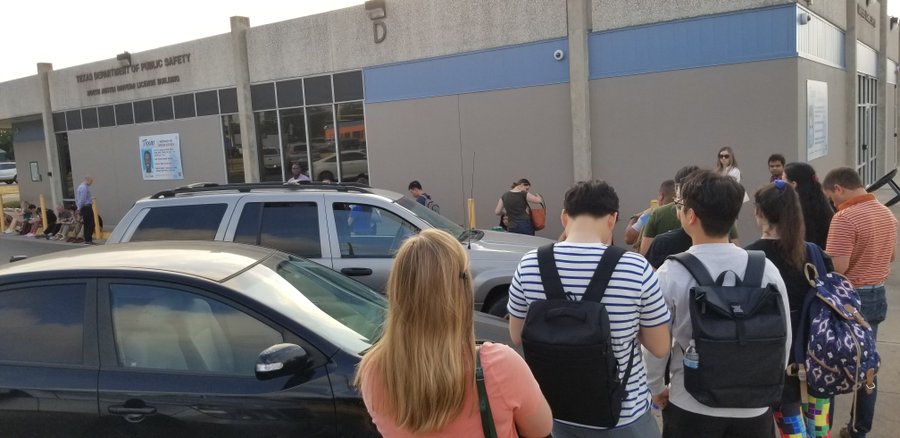
Line outside DPS license center on North Lamar
in Austin ~7:30 a.m. Friday morning
It's going to be a rough fall at the DPS license centers. The Texas Legislature gave them $200 million to staff up at some of its biggest facilities, but those new workers won't come online for several months. In the meantime, about one million people with suspended licenses on Monday will have had all their Driver Responsibility surcharges wiped clean and can finally renew their driver's licenses, likely significantly adding to lines.

Sheriff shot up wrong vehicle
Somebody took a shot at a state trooper in Kimble County, and he called it in. The sheriff heard the call, set up on the side of the highway with an assault rifle, and shot up a passing pickup in response, wounding the driver. It was the wrong vehicle; the trooper had called in a "gray" truck and the pickup the sheriff shot up was white. Good piece from Eric Dexheimer with the details.

The case for medical-led mental-health first response
Here's an excellent case study out of Austin showing why cops shouldn't spearhead first response to most mental health calls. The Austin City Council is presently considering whether to shift to a medical-led response in most instances, following the lead of a Dallas PD pilot program.

'Cooking them to death'
The Marshall Project and the Weather Channel teamed up to report on the effects of excessive heat in Texas prisons.

Coming soon: New Travis County public defender office
Great news: The Texas Indigent Defense Commission approved grant funding for a new public-defender office in Travis County.

'Arrest, release, repeat'
The Prison Policy Institute came out with a new analysis discussing "How police and jails are misused to respond to social problems."

Feds failing at collecting police use-of-force data
Since 1994, the Bureau of Justice Statistics has been charged with gathering data on police use of force. But most agencies' data is garbage and most of the information is suspect or unusable, reported Kenny Jacoby of Gatehouse News.

Wednesday, July 31, 2019

Policy solutions for Denton County's understaffed jail

The Denton County Jail is suffering an "extreme staffing shortage," reported the Record Chronicle, although their 13 percent vacancy rate is far lower than at the Texas Department of Criminal Justice.

Even so, it's worth reiterating the quickest, easiest ways for Denton County to reduce its jail population to levels they can safely staff:

Reduce arrests for Class C misdemeanors by the Sheriff, Denton PD, and other local law-enforcement agencies by implementing policies similar to Austin PD's "Freedom City" initiative.

Use discretion to stop arresting/charging people for low-level marijuana possession until the state either changes the hemp law or crime labs are able to distinguish legal from illegal THC levels in pot.

The District Attorney could use his discretion to dismiss Class B driving-with-invalid license cases, which mostly stem from about-to-go-away Driver Responsibility surcharges. (These have become increasingly common.) Arresting people for what amounts to a poverty crime - essentially an administrative violation, at that - contributes nothing to public safety.

These are all categories of misdemeanor defendants who would likely plead out to time served, anyway. Why not change policies on the front end to keep them out of jail and avoid having to hire guards to manage them?

Denton County may not be the first jurisdiction that leaps to mind when it comes to criminal-justice reform, but Necessity is the Mother of Invention. If they don't want to pay jailers competitive salaries compared to median local incomes, the other option is to jail fewer people. Reducing incarceration among these discrete, nonviolent categories would be a smart place to start.

Friday, June 28, 2019

Driver Responsibility surcharge abolition, by the numbers

The death of Texas' Driver Responsibility surcharge was the single, outstanding #cjreform highlight of the 86th Texas Legislature, outdistancing all other reforms in terms of impact by a country mile. Let's run through the numbers:

Nearly 1.4 million drivers currently have suspended licenses based on unpaid Driver Responsibility surcharges, or roughly half of all drivers who've ever received them. And on its website, the Department of Public Safety pledged to "reinstate all driver privileges that were previously suspended solely for having unpaid surcharges." But hold on just a second ...

While everyone will have their debt erased - the Texas Fair Defense Project estimated that the total amount of debt waived will approach $2.5 billion - a large number of people won't immediately get their licenses back.

Reported the Dallas Observer, 630,000 drivers will be immediately eligible to get their licenses back on Sept. 1st. Another 350,000 will be eligible to renew their license after paying a reinstatement fee, and 400,000 have other holds on their drivers licenses, mostly through the Omnibase program, through which the state suspends licenses for non-payment of fines and fees.

The reinstatement fees for the 350,000 people who owe them are $125 (Source), so that's just shy of $44 million dollars in fees those drivers must pay to get back on the road.

Bottom line, some portion of those folks will still have suspended licenses a year from now, plus the 400k people with licenses suspended under Omnibase also are still out of luck.

Thus, the new law stopped the generation of new surcharge debt, and waived past debts, but it only resolved license suspensions for a fraction of surcharge debtors - perhaps half of them or more.

Going forward, surcharges were abolished for points, no-insurance, and driving with an invalid license (DWLI), but retained and converted into criminal fines in DWI cases. Under the old program, DWIs only made up 12 percent of people who were assessed surcharges, so that eliminates them for 88 percent in the future. It remains to be seen how often judges waive those new DWI fines - they couldn't waive the surcharges at all.

There was an extent to which the Driver Responsiblity surcharge contributed to county-level incarceration by generating a huge pool of drivers with suspended licenses. When the surcharge program first rolled out, county jails were flooded and the Legislature in 2007 reduced first-offense DWLI penalties from a Class B to a Class C misdemeanor. But people are still arrested and jailed for second offense DWLI and higher.

In 2017, the Office of Court Administration documented 21,836 new Class B DWLI cases. We know that the overwhelming majority of people with suspended licenses lost them because of the Driver Responsibility surcharge - let's assume 75 percent, for the sake of the math. If those folks averaged just 2 days in jail each (the maximum penalty for a Class B misdemeanor is 6 months in jail and a $2,000 fine), then they collectively would have spent about 90 bed-years in jail!

So that's where we are, by the numbers. On September 1st, $2.5 billion in debts will be erased and hundreds of thousands of people will be eligible to get their licenses back.

For more background and/or details on license reinstatement, see FAQs from DPS and the Texas Fair Defense Project.

Thursday, May 30, 2019

Scaling back justice debt biggest #cjreform accomplishment of 2019 #txlege

Texas justice reformers will spend the next couple of years lamenting what the Texas Lege DIDN'T do in 2019 - e.g., reduce marijuana penalties, pass the Sandra Bland law, close the dead-suspect loophole to the Public Information Act - or else frustrated by new criminal penalties boosting sentences for petty offenses.

But it's worth giving legislators credit for what they DID do on #cjreform, and by far the most important measures relate to providing relief from justice-system debt:

Abolishing the Driver Responsibility Surcharge: The Texas Fair Defense Project estimates that $2.5 billion in justice-debt will be wiped off the books on September 1st when HB 2048 takes effect, and some 1.5 million people will be eligible to have their drivers licenses reinstated.

Eliminating red-light cameras: While a few cities have lengthy contracts which will keep red light cameras operating for years to come, the Legislature forbade new ones and eliminated the ability to deny vehicle registration or license renewal for nonpayment. These cameras affect on safety is dubious, at best, and are viewed by locals as revenue generators.

Limited automatic driver's license suspensions: HB 162 would end the practice of searching driver records to suspend licenses of people driving without them. Now, such administrative suspensions based on a government database search will be limited to people whose licenses are suspended for DWI, and those would be limited to 90 days. The Washington Post last year reported that Texas has more people with suspended licenses than any other state. This new law and abolition of the Driver Responsibility surcharge should go a long way toward knocking that number down.

Defined "undue hardship" in debtors prison cases: In 2017, the Texas Lege approved legislation to make it easier for municipal judges and justices of the peace to waive Class C fines and authorize community service. But many local judges had been defining the term "undue hardship" narrowly to avoid waiving fines. Amendments to SB 346 define that term so that more fines will be waived. This was a cleanup bill, but quite necessary: Although more than 50,000 people had fines waived in the 2018, for example, more than ten times that number sat out their Class C fines in jail.

Two of these - surcharge abolition and eliminating red-light cameras - were pushed by reformers for 12 years before finally passing.

Overall, Grits is disappointed with the 86th Texas Lege, and particularly the Texas Senate, which produced scarce little reform legislation of consequence and killed most of what came over from the House. These bills amount to a consolation prize. But as my father likes to say, that's better than a sharp stick in the eye.

Friday, May 24, 2019

Abolition of driver surcharges a rare #cjreform upside for 2019 #txlege

In a Texas legislative session where scarce little justice-reform legislation of any stripe made it through the process, the abolition of the hated Driver-Responsibility surcharge will be remembered as the signature accomplishment. The bill getting rid of the program has finally passed and HB 2048 is headed to the governor.

From advocates' perspective, there wasn't a ton left to do. In 2017, a proposal to replace trauma-center funding generated by the surcharges with a nearly identical system of new "fines" died in the Senate. At the time, advocates promoted a number of much more reasonable funding solutions, and once it became clear that the most-regressive-possible surcharge repeal did not have a path, legislative leaders resigned themselves to looking at those suggestions.

With Senate Finance Chair Jane Nelson's blessing, Sen. Joan Huffman filed legislation in the senate, with Appropriations Chairman Dr. John Zerwas filing a companion bill in the House, which dropped the traffic-fine increase to $20, tacked a new $2 fee on insurance policies, and jiggled the ratios around regarding who got what to make the hospitals whole.

The bill abolished surcharges for everyone but DWI offenders. They receive 12 percent of all surcharges, so 88 percent of surcharges will be eliminated going forward.

For everyone owing surcharges at the time the bill becomes law on September 1, 2019, the debt will be nullified along with the program. That will allow 1.5 million people whose licenses currently are suspended over nonpayment of surcharges to get their licenses back.

Some of these folks have gone without licenses for more than a decade because they couldn't pay, with surcharges compounding because they drove with revoked licenses. Since 2003, about 3 million people have racked up 16 million surcharges, with half of them losing their licenses permanently, until this bill.

For DWI offenders, the old "surcharges" were kept on the books and renamed criminal fines, tacked on in addition to other punishments already on the books for the offense. But in contrast to "civil" surcharges, judges can waive criminal fines for indigent people. Plus, Emily Gerrick of the Texas Fair Defense Project convinced the senate to add a provision creating a presumptive indigence provision for these fines similar to that for surcharges. And with those perfecting amendments, the bill passed the senate.

This is a moment your correspondent has been working toward for more than a decade. Long-time readers will recall Grits worked with Alison Brock at Rep. Sylvester Turner's office, to create amnesty/indigence provisions for the surcharge, and with Mandy Marzullo, now my podcast co-host at Reasonably Suspicious, to implement the rules at DPS. Hating on the program has been a pet project of mine nearly since the inception of this blog.

The surcharges were created in 2003, and by 2007, people driving with licenses suspended under the program had become a chronic problem. That year, the Legislature changed DWLI on the first offense from a Class B to a Class C misdemeanor because unlicensed surcharge-owing drivers were filling up local jails. They also added DWLI to a list of offenses, the most prominent of which was pot possession, for which police could give citations instead of arresting people. That temporarily stemmed jail overcrowding pressures, though today, in some counties, Class B DWLIs still account for large percentages of the misdemeanor docket.

Indeed, during the worst of it, before indigence provisions kicked in, judges told the Legislature they were sentencing DWI cases as reckless driving or obstruction of a roadway to avoid defendants racking up surcharges that everyone knew they couldn't pay.

So these surcharges have driven misdemeanor-justice policies in Texas in unexpected, weird, and mostly negative, regressive ways for many years now. It's an incredible relief that they're about to go away.

The Texas Legislature may not accomplish much in 2019 on justice reform. But this will help so many people, the one victory nearly outweighs the (heart breaking) losses.

Wednesday, April 24, 2019

Time to move NOW on Driver Responsibility surcharge abolition

The Texas Legislature has its best-ever chance to abolish the Driver Responsibility surcharge before it in HB 2048 (Zerwas). All the major interests have signed off. Early in the session, leadership appeared prepared to (finally) move on the issue, and the bill was voted out of committee in early April.

But the legislation remains stuck in the House Calendars Committee and has yet to be considered, much less set for a vote, on the House floor. Although, officially, the last House calendar is May 7, bills must be placed on a calendar several days before - probably by the 1st or the 2nd - to be heard before the deadline for the House to consider House bills.

Every legislator knows about problems with the Driver Responsibility surcharge because they all get constituent calls from people whose lives have been ruined by this ill-conceived government boondoggle. Nobody likes the program who's not receiving money from it. But those special interests were so powerful, the money had to be found for the program to go away.

HB 2048 solves that problem through several sources. It increases fees on traffic offenses by $20 and adds a $2 fee to auto insurance policies.

That latter is apparently the hold up: Insurance industry lobbyists are fighting the $2 fee. But legislators should ignore them. The problem with the Driver Responsibility program is precisely that it relied upon a small number of mostly impoverished people - folks caught driving with suspended licenses or without insurance - to pay for trauma-hospital care. But that's the sort of classic public good whose cost should be spread among everyone. After all, anyone may eventually wind up in a trauma hospital.

A few other, disparate critics object to the new, stiff criminal fines for DWI, which replicate high DWI surcharges under the Driver Responsibility program, re-labeling them a criminal fines instead of civil penalties. And to be clear, Grits isn't a fan of that part of the bill. We know 44% of drivers can't pay fines at that level (because that's how many DWI offenders didn't pay the identical surcharges), so there's a real sense in which they're setting people up to fail.

The flip side is, under the status quo, DWI offenders still owe the same amount, just as civil surcharges instead of criminal fines. The difference is, judges can waive criminal fines but cannot waive surcharges. So there's more prospect for relief under HB 2048 than those drivers would have otherwise.

To recap: There are 1.5 million people with licenses suspended because of the Driver Responsibility surcharge. Those surcharges will be voided and those folks can get their licenses back.

Moreover, while the DWI folks still get large fines, they only made up 12 percent of people with surcharges. So 88 percent of people who would have previously gotten a surcharge will avoid them going forward.

Helping 1.5 million people at a whack, plus eliminating 88 percent of the problem going forward, makes this a Very Good Bill. The DWI fines are an unfortunate compromise, but even for those folks, they're better off if judges can waive those fines.

Since this terrible statute first passed back in 2003, there has never been a better opportunity to eliminate this program than right now. Grits hopes the House Calendars Committee will set this legislation on the Major State calendar at the earliest possibility and leadership strongly supports it. Every day they dawdle risks Texas wasting two more years before this longstanding problem is addressed.

UPDATE: Hurray!! This bill was added to a House floor calendar for Monday, April 29, meaning it still has plenty of time to pass. Thank you, Calendars Committee!

Sunday, February 24, 2019

Bill limiting suspensions a start at untangling worst-in-nation driver-license mess

Texas revokes more drivers licenses, by far, than any other state, The Washington Post reported last year. But House Corrections Committee Chairman James White wants to change that. He has a bill up in the Homeland Security and Public Safety Committee on Wednesday that would rectify a small but unremittingly ill-conceived provision in the current law.

Presently, Texas law doubles down on license suspension as a punishment, even when it fails to keep drivers off the road. When the Transportation Code lists grounds for suspending licenses, the very first one is driving while one's "license was suspended, canceled, disqualified, or revoked, or without a license after an application for a license was denied."

So one of the punishments for driving with your license suspended is to suspend your license for a minimum of one extra year. Combined with the Driver Responsibility surcharge, which has left more than a million Texans with suspended licenses, this provision adds insult to injury, leaving drivers without a license even after delinquent surcharges are finally paid.

By contrast, people who engage in "habitually reckless" driving, "fraudulent use" of their license, or are responsible for an accident that results in serious personal injury or property damage, only get a 90-day suspension.

Driving with an invalid license is already its own crime, so it doesn't particularly need the extra administrative penaltyy. Chairman White's HB 162 would apply the extra suspension only for drivers whose licenses were suspended for DWI. And then, he would limit the suspension to 90 days, which is the amount of time for all other suspensions under the same provision.

It's a small change but it would help untangle a particularly difficult bureaucratic gnarl which can ensnare drivers for years after they've otherwise paid their debt to society. Grits is glad to see the bill getting an early hearing and hope it garners support in committee.

Friday, February 01, 2019

Considering long DPS license-center lines and ballooning prison-healthcare costs at House Appropriations

The Texas House Appropriations Committee on Tuesday will consider two items this blog has covered quite a bit heading into session: Long lines at DPS driver's license centers, and prison healthcare costs. For any staffers reviewing in preparation for the hearing, here's some background on those two topics:

Reducing DPS License-Center Lines
In the Texas Senate, the conversation centered almost entirely around how much money the Legislature should spend to expand license-center capacity. But they should also be considering ways to reduce the number of people in line, whose volume is exacerbated by hundreds of thousands of people with suspended licenses trying to get legal. Here are some suggestions for tackling that problem:
Texas ranks near the bottom among states in per-prisoner healthcare spending. The state has under-funded prison healthcare for years, with increases over the last couple of sessions never quite making up for draconian cuts in prior sessions. Texas can't reasonably cut further. The only reliable way to reduce healthcare costs is to reduce the number of people incarcerated to whom the TDCJ is providing medical care.

Monday, January 28, 2019

Senate Finance debate ignores policy solutions to excessive DPS license-center lines

The Texas Senate Finance Committee this morning had a quite-animated discussion over long lines at DPS driver license offices. But nobody yet has raised the topic Grits considers the most significant in this debate: state-driver's-license-revocation policies contributing hundreds of thousands of extra people annually to DPS license-center lines. I'd written about these issues last fall.
Sen. Kirk Watson bemoaned DPS asking the state to throw money at the problem without a plan to fix it. He's right.

To me, there are obvious policy solutions to reduce the number of people unnecessarily in line at driver-license centers. But first, the state must stop the myopic focus on solving the problem through staffing, and focus on measures to reduce the number of people in line.

It's not that more staffing wouldn't help, especially in the Customer Service Center where drivers' questions might be answered over the phone without waiting in line at the license center. But the biggest problem, by a country mile, is that Texas suspends more driver's licenses than any other state.

Most suspensions occur because of the Driver Responsibility surcharge. About 3 million drivers have incurred 16 million surcharges since its inception. Of those, 1.4 million  currently have suspended driver's licenses. Another 300K have suspended licenses because of unpaid traffic tickets. Adding all these people with complex license-restoration cases into the lines at DPS when they otherwise may not need to renew for years contributes greatly to long license-center lines. How could it not? A conservative estimate of the number of additional, unnecessary license-center visits generated annually because of driver-license suspensions runs into the high nine figures.

There are other, smaller contributors to license-center lines: E.g., 100,000 sex offenders are not only required to maintain registry requirements with the state, they must renew their driver's licenses annually. There's no added safety benefit to doing both, and it's making the lines for everyone else longer.

Similarly, everyone convicted of marijuana possession has their license suspended for six months, after which they must go back to the license center to get it renewed. There's no public-safety reason for these extra license renewals, and they also make the lines longer. The state Republican Party platform endorsed making pot possession a civil offense, in part to avoid these sorts of collateral consequences.

Here's an outline of budget and policy measures that would reduce license-center lines:
  • Eliminate the Driver Responsibility surcharge and give amnesty to the 1.4 million people whose licenses have been suspended over it.
  • Stop requiring sex offenders to renew their driver's licenses annually.
  • Punish low-level marijuana possession with a civil penalty instead of criminal charges to bypass federal license-suspension requirement.
  • Fully fund the DPS Customer Service Center and increase pay for call-center staffers to stop high turnover.
  • Consider renewing licenses every eight years instead of every seven years.
If and when the DRP is eliminated, there will be an initial surge as people with suspended licenses get them renewed. But after that, these measures would dramatically relieve pressure on license-center lines.

The only alternative to reducing pressure on license-center lines is throwing more money at a failing system. No matter which agency is in charge of licensure, there is no third path.

Tuesday, September 11, 2018

A flaw in Travis County's plan to ↓ DWLI

Chris Harris of Grassroots Leadership reported yesterday on Twitter that Travis County will institute a new program to reduce arrests for driving with an invalid license. Here's what he says that will mean for drivers with revoked licenses:
  • If cited (not arrested) by police, you will be charged with a Class C instead of B 
  • If you plead guilty and get your license and insurance renewed w/in 6 months the charge is dismissed
Earlier this summer, the Austin Statesman reported that, "The number of Class B misdemeanors filed last year in Travis County — 3,425 — was three times higher than the combined total in Bexar, Dallas and Tarrant counties and exceeded the number of filings in the more populous Harris County, according to data produced by the Office of Court Administration."

That article blamed Austin PD for filing the higher charge, but prosecutors have complete discretion over what charges to bring in these cases: Those were decisions by the County Attorney's office. Now that they've made a different one, clearly they expect APD to just comply.

Which brings us to the key problem: even now it's unclear to your correspondent that County Attorney David Escamilla has proposed a workable plan. Most people with suspended licenses in Texas had them revoked for nonpayment of driver-responsibility surcharges. So, how may we expect them to get their license renewed within six months?

Can't pay means can't pay; one can't squeeze blood from a stone.

This will be better. Charging people with Class Cs instead of Class Bs limits the bad outcomes. But it will still result in punishing people for being too poor to pay their Driver Responsibility surcharges, and in the end, punishment won't fix that problem.

Sunday, September 02, 2018

Texas DPS acknowledges short-staffed call center in budget request to reduce license-center lines

Grits has been critical of state officials who responded to long lines at Texas DPS driver-license facilities by blaming drivers who don't use online systems, in part because of dramatic understaffing of the Customer Service Center to the point that 80 percent of customer calls go unanswered and 83 percent of those answered wait on hold than 10 minutes before they talk to a person. Those folks can't be blamed for going to the license center if they can't get their questions answered on the phone.

So I was pleased to learn that a big portion of DPS exceptional items in their legislative appropriations request (LAR) for the next biennium would go toward beefing up the Customer Service Center, including increasing starting salaries. Reported the Dallas News:
Topping the list was a request for pay raises for the offices' customer service representatives. Each makes an average of $26,000 a year. The agency proposed to increase that to $35,000. Doing so would cost $51.3 million in the 2020-2021 budget cycle.

Amanda Arriaga, director of the driver license division, said the move would "honor" the professional work the customer service representatives do and help stanch high turnover. Staff exits contribute to intermittent office closures and frustratingly long lines, she said.

"We have a pretty significant turnover rate at that ... entry level," she said. "We thought this was a great step in the right direction, that the No. 1 thing we should do is give props to our people who are doing this job every day."

She said the department currently has about 200 vacancies in the division.  
By the time the Lege has a) raised salaries and b) filled 200 vacancies (!), the Customer Service Center will become a much more costly line item.

In addition, DPS wants to increase staff at the license centers:
To increase staffing at the driver's license offices, the department will ask for 962 more full-time employees at a two-year cost of $178.6 million. DPS also will look to expand the number of offices in the 15 highest-growing areas in the state, which include Fort Worth, Plano/McKinney and Denton. That would require 952 additional employees at a cost of $190.1 million.
These investments would be a start, but they won't be enough to resolve the problem unless the Legislature addresses the policies which cause more people than necessary to need to renew their licenses at any given time.

The biggest of these self-inflicted wounds is the Driver Responsibility surcharge, which causes hundreds of thousands of Texans to have their licenses revoked every year. Hard to predict the Lege will eliminate it, since they've failed to so many times before, but if they do it will solve a lot of different problems simultaneously. Compared to how much the Lege will need to spend on license-center staffing and Customer Service Center salaries, the $75 million or so per year generated by driver surcharges for trauma hospitals is a relative drop in the bucket.

It's also time to stop requiring sex offenders to renew their driver-licenses annually. They're already subject to registration requirements and the annual DL-renewal adds almost 100,000 people to license-center lines every year who mostly don't need to be there.

Grits has yet to hear any legislator take responsibility for the Lege-driven policies that are causing long license-center lines - neither regarding chintzy budget decisions on the Customer Service Center nor the extra renewals caused by surcharges, nor needlessly punitive annual renewals for sex-offenders, not to mention the use of license revocations for punishment.

Most of these things aren't even part of the conversation. It's taken weeks of discussion for the MSM or state pols to even mention the Customer Service Center's understaffing, even though its dysfunctional nature is a primary source of the problem.

The Sunset Commission, inexplicably, has suggested addressing the situation by moving authority over driver-license management from Texas DPS to the Department of Motor Vehicles. That's completely pointless! The problems stem from bad budget and policy decisions, not which government bureaucracy oversees the licensing function.

Perhaps, by the time session rolls around, debates over DPS license-center lines will have shifted from the initial finger pointing to actually confronting problems with pragmatic solutions. If they do, then the 86th Legislature will focus on: 1) funding the call center, 2) ending the requirement for sex offenders to renew driver licenses annually, 3) abolition of the Driver Responsibility surcharge, granting amnesty to those who've lost their licenses, and 4) ending use of driver-license revocations to punish non-payment of criminal-justice debt. Those are the underlying pathologies and Texas won't resolve them just by throwing money at the symptoms (i.e., long lines).

See related Grits posts:

Tuesday, August 28, 2018

Podcast: Colloff on blood spatter, causes of long lines at DPS license centers, understaffing at rural prisons, and other stories

If you can get past a few bad puns in the intro, I think we've got a good show for you this time on the better-late-than-never August 2018 edition of the Reasonably Suspicious podcast, Just Liberty's monthly discussion of Texas criminal-justice politics and policy.


The segment I've been most looking forward to, of course, was the interview with Pamela Colloff, long-form journalist extraordinaire, who left Texas Monthly last year to write for ProPublica. We discussed her latest New York Times Magazine cover story about an apparent false conviction based on more-than-dubious blood-spatter evidence. (I'll publish my full interview with Colloff over the weekend.) But I was happy with the rest of the show, too. Here's what my co-host Mandy Marzullo, executive director of the Texas Defender Service, are discussing this month:
Top Stories
Death and Texas
Interview:
  • Scott Henson interviews Pam Colloff of ProPublica/New York Times Magazine on her latest feature on blood-spatter evidence and more.
The Last Hurrah
One minor error I noticed when I was editing this together: I'd said during the Death and Texas segment that DPS licenses forensic hypnotists, when in fact it's the Texas Commission on Law Enforcement.

Find a transcript of the podcast below the jump.

Saturday, August 25, 2018

Texas DPS getting a bum rap over proposed driver-license center closures

The press and politicians around the state are blaming the Texas Department of Public Safety for creating a list of 87 under-utilized rural driver-license centers for possible closure. Many of those centers have just one staff member and/or minuscule traffic.

Lt. Governor Dan Patrick was the latest to weigh in, declaring in a written statement, "I do not support the closing of these DPS offices." "I believe the Senators on the Sunset Committee will also make their voice clear on this next week."

Here's the problem with that statement: DPS only created the list because they were DIRECTED to do so by the Sunset Commission. In its April report (p. 3/p. 11 of the pdf) regarding the agency, one of the Commission's "Key Recommendations" for reducing lines at the license centers was to "Require DPS to develop and implement a plan to close inefficient driver license offices."

The Lt. Governor blamed the problem on drivers who don't renew their licenses online:
Patrick said the biggest problem for DPS license offices is that a majority of people visit them to renew their driver's licenses when they could do so online. He said the department needs to develop a more aggressive plan for educating drivers about renewing online. 
"I will be working in the next legislative session to ensure that DPS has the personnel and equipment needed so drivers can renew their license as quickly and easily as possible," he said. "However, the fastest and best way to significantly cut wait times now is simply to let the thousands of Texans who show up everyday, and don't need to be there, know that they can renew their license online."
But as Grits argued the other day, that critique amounts to blaming drivers for the government's failed systems and the Legislature's chintzy funding decisions. The Customer Service Center which takes phone calls from drivers with license issues is so understaffed that only 20 percent of calls are even answered, and 83 percent of those must wait on hold for 10 minutes or longer before they can speak to a person.

Although Sunset staff didn't address the underlying budgetary question, it's dire, and a huge aspect of drivers' confusion about where and how to renew licenses. According to the most recent DPS Strategic Plan, currently the agency's customer service center (CSC):
receives approximately 24,400 calls per day, but because of limited staff and technology it is only able to answer approximately 4,880 of those calls, 20% of the demand. The CSC is currently only able to answer about 17% of these 4,880 calls within 10 minutes, far below an acceptable customer service level. Customers are forced to call the CSC multiple times to enter the queue to speak with a Customer Service Representative (CSR). Once in the queue, customers must wait an average of 15 minutes before their call is answered.
That's a budget problem created by the Legislature, not a problem with DPS management. Fund the call center and confused drivers would have a way to know how best to engage with the DPS bureaucracy. As things stand, they show up at the driver-license center because there's no other way for them to engage with the agency to understand how to navigate the process.

Even that, though, won't fix the structural problems Grits identified earlier in the week. DPS revokes driver licenses for non-payment of debt about a half a million times per year, and all told 1.7 million people currently have their licenses revoked. That significantly increases the number of people showing up to renew their licenses every year. (California last year had to address the same issue, ceasing use of driver-license suspensions to punish non-payment.)

In the comments to that earlier Grits post, Mary Sue Molnar from Texas Voices added that the insensible requirement for nearly 100,000 sex offenders to renew their licenses annually (separate and apart from existing sex-offender registration requirements) also doesn't help the problem.

In essence, these structural problems with the licensing system mostly stem from driver-license "mission creep" - using them as a form of virtue signalling or debt collection as opposed to a mechanism for ensuring drivers have minimum driving skills and providing valid identification.

The biggest reason DPS isn't doing a better job of "educating drivers" is the legislative decision not to adequately fund the DPS Customer Service Center. But there are also policy changes that would reduce pressure on lines at the DL centers, in addition to public-education campaigns. And I've yet to hear a Texas politician talking about any of them, at least in the context of this debate. (Some of these conversations did begin in the 2017 legislative session, but more in the context of equity, not license-center lines.)

If lawmakers want to make sure the state can afford to give rural people a local driver-license facility, regardless of how infrequently they use it in sparsely populated areas, and also improve customer service for most Texans, then they must: 1) abolish the Driver Responsibility Program, 2) stop debt-related driver-license suspensions and collect debt using private-market best practices, 3) eliminate unnecessary annual renewals for sex offenders (thanks Mary Sue!,) and 4) give DPS the resources it needs to pick up the phone when Texans call their Customer Service Center.

Your correspondent, perhaps unexpectedly, has a lot of sympathy for DPS in this debate. In all of this they're reacting to legislative mandates: from the license suspensions to requiring sex offenders to renew annually to understaffing the Customer Service Centers to compiling a list of license centers for possible closure. They have done exactly what the Legislature asked them to do in each and every instance, and now they are being blamed for following orders.

Friday, August 24, 2018

Harris Sheriff's captain providing cover for Balch Springs shooter, the TX bail-reform roller coaster, and other stories

Here are a few odds and ends for Grits readers to chew on headed into the weekend:

Harris Sheriff's captain providing cover for Balch Springs shooter
A Harris County Sheriff's captain testified as an expert witness for the defense in the trial of Roy Oliver, the Balch Springs police officer who shot a fleeing, unarmed 9th grader to death in a nationally publicized episode that got Oliver fired and indicted. One wonders, does this mean we may expect the Harris County Sheriff's office to take a less strict view on when its officers may shoot at fleeing, unarmed suspects? The Dallas News reported that the Harris County Sheriff's captain, Jay Oliver Coons, "reviews use-of-force cases at the sheriff's department." Does Sheriff Ed Gonzalez agree that the shooting of Jordan Edwards was justified and it would be okay if his deputies did the same thing, or has his captain's testimony gone off the reservation? Inquiring minds want to know ...

Bail-reform roller coaster
August saw bail reform efforts take a gut-wrenching roller coaster ride. First, Gov. Greg Abbott joined legislative and judicial reformers in supporting bail reform, suggesting the bill be named after a murdered state trooper.  But then the Fifth Circuit Court of Appeals unexpectedly gutted the order governing Harris County bail policies, reneging on critiques of detention policies that discriminated based on defendants' wealth. Instead, they insisted that such discrimination is okay as long as defendants receive individualized hearings. That relieves some pressure on the Texas Legislature to pass bail reform, but does so just at the moment state leaders appeared to be reaching consensus on what bipartisan reforms might look like. Who knows where the issue goes from here?

Felony record not a bar to council candidacy
The Austin city clerk this week agreed that Lewis Conway, Jr., is eligible to run for office because, despite a quarter-century-old manslaughter conviction for stabbing to death a man who allegedly stole his drug stash. Conway is  now "off paper," having completed his parole requirements and regained his right to vote. The Texas Tribune reported that, "Conway's success Tuesday is unique for one big reason: He's a convicted felon." But "unique" is not the right word because in 2014, Bexar County elected a former drug dealer with a felony conviction as its District Attorney, so the precedent was already set. As with Conway, local officials and opposing candidates declined to challenge Nico Lahood's candidacy in a much higher-stakes race. Grits congratulates Conway on affirming that precedent, and I'm plesased he'll be on the ballot.

Management inattention to crime lab at Austin PD backfiring
Austin PD crime lab's DNA section may remain shuttered for many more years, judging by a report that the city may continue using an outside DNA lab through 2022. Although public debates and the local media have downplayed the culpability of APD managers, the unfortunate truth is that under the previous chief, Art Acevedo, the department largely ignored its civilian functions like crime-scene techs, victim services, and the crime lab. Instead, they focused every extra dollar on expanding the number of and pay going to officers on patrol. Just weeks after Acevedo left to take the reins at Houston PD, the crime lab debacle blew up under his successor's watch. Current Chief Brian Manley was one of Acevedo's commanders and has similarly prioritized budgets for sworn staff over improving the agency's civilian functions. Despite that, the city council could locate no other candidates to even consider; apparently Manley was the only qualified guy they could find. (There's no "Rooney Rule" for police chiefs; after Dallas hired a black woman as chief, for example, there clearly were no other minority candidates anywhere who might be worthy of consideration, hence Austin considered none [/sarcasm].) So I'm not surprised that officials expect the situation to linger on. APD hasn't prioritized its civilian functions in many years and it's hard to view Manley's hiring as anything more or less than an affirmation of the status quo.

DPS suggests closing license centers as long lines loom
As headlines continue about long lines at DPS driver license centers, the agency has suggested closing 87 smaller offices - many of which have only one employee and/or low customer volumes - in order to consolidate resources at the centers with long lines. That could be the right management move, but politically, Grits predicts it will be a non-starter. A few may be closed, but I'd be surprised if the number of closures reached double digits, much less 87. And anyway, closing small facilities won't solve the bigger problems exacerbating long lines at the DPS megacenters, which have more to do with legislative policy than agency-level logistics.

Junk science challenges proliferating
Many so-called "forensic sciences" are really non-scientific, subjective comparisons made by cops, not scientists, argued an editorial at The Legal Intelligencer. That was the reason Texas created a new form of habeas corpus writ - discussed recently in the Texas Tribune in the context of shaken-baby cases - to allow redress when the legal system bases convictions on junk science. The writ is also currently being used to challenge the validity of bite mark evidence as well as blood spatters, a topic Grits delved into in an interview with ProPublica reporter Pam Colloff (read her latest) for the podcast that will be out next week.  RELATED: Top ten junk forensic sciences challenged in Texas.

Cohen doesn't cotton to FIRST-STEP opposition
Check out Right on Crime Director Derek Cohen's rebuttal to U.S. Senator Tom Cotton regarding the latter man's opposition to the FIRST-STEP Act and sentencing reform. Wrote Cohen, "We started Right on Crime in 2010 to advance policies that protect both the taxpayer and their pocketbook, and the outcomes of no government program is above scrutiny. Prisons are a vital contributor to our public safety, but are only one of many tools is our toolbox." In recent days, we've seen President Trump first embrace the bill and then reportedly back off until after the election. From this remove, Grits can't tell who in D.C. is serious about reform or what chances it has in the current political environment. Whatever is the case now could change with the next presidential tweet. But I do know that reformers' opposition to the bill was ill-considered and based on partisan considerations, not #cjreform principles. Passing moderate bipartisan reform is clearly better than doing nothing, which is the alternative.

Thursday, August 23, 2018

How the Driver Responsibility surcharge contributes to long lines at DPS license centers

One of our legislator friends reached out this week to ask about a comment Grits made in this roundup related to long lines at Texas driver-license megacenters around the state. Your correspondent believes that unnecessary driver-license revocations and understaffing of civilian DPS customer-service functions are the main causes of long lines at DPS license centers.

This legislator wanted to know, could Grits quantify how much extra pressure people with revoked licenses put on the system? Not precisely. But let's attempt a ballpark, back-of-the-napkin estimate, and also elaborate on the call-center problem.

Phone-center flaws force unnecessary visits to DL centers
First, how many people are headed to the DPS for license renewals anyway? And how many are required to be there? There are roughly 16 million licensed drivers in Texas. Those drivers must renew their licenses every seven years, so each year ~2-2/7 million annually must renew their licenses. Half of those can do so online, so the baseline minimum number of people coming in for this service is around 1-1/7 million, or ~1.14 million people.

The Dallas News reported that, "According to the Department of Public Safety, more than 3.6 million people who visited DPS offices in 2017 didn't need to do so." But framing the issue that way amounts to DPS blaming drivers for its own failed systems. In fact, a large number of these unnecessary visits occur because people cannot get help on the phone. According to the most recent DPS Strategic Plan, currently the DPS customer service center (CSC):
receives approximately 24,400 calls per day, but because of limited staff and technology it is only able to answer approximately 4,880 of those calls, 20% of the demand. The CSC is currently only able to answer about 17% of these 4,880 calls within 10 minutes, far below an acceptable customer service level. Customers are forced to call the CSC multiple times to enter the queue to speak with a Customer Service Representative (CSR). Once in the queue, customers must wait an average of 15 minutes before their call is answered. 
Unfortunately, DPS has so far focused on beefing up staffing at the driver-license centers instead of the Customer Service Center.

Increasing call-center staffing - Grits would suggest by six-to-eight-fold, if you truly want to keep up with demand - would significantly reduce lines at the driver-license center. But even that wouldn't solve the whole problem.

The contribution of license revocations to long lines
DPS issues more than 5 million licenses per year, according to its latest biennial report (p.12). Renewals make up ~2.3 million, another 650,000 or so are first-time licensees, and about a half-million commercial drivers licenses are issued annually. So those categories account for ~3.45 of slightly more than 5 million licenses issued.

The next biggest category of licenses issued - although DPS doesn't quantify it in their public documentation - are people with revoked licenses trying to get them back. How many people are we talking about?

DPS suspends roughly half a million licenses per year, they told the Sunset Commission last year (p. 419-420): "In FY 2016, there were 432,847 driver improvement suspensions and 77,611 safety responsibility suspensions."

Over time, these suspensions add up. As of November 2016, DPS told the Sunset Commission, a total of 3,082,627 drivers had been assessed 16,505,923 DRP surcharges since the program's inception. Of those 3 million, "Approximately 1.4 million drivers are currently suspended for non-payment."

On top of that, another ~300,000 have lost their licenses solely for non-payment of traffic fines. All told, about 1.7 million Texans - more than 10 percent of licensed drivers - have had their licenses suspended for nonpayment of either traffic tickets or the Driver Responsibility surcharge, the Washington Post reported earlier this year, noting that, "Texas, by far, suspends the most driver’s licenses for failure to pay fines."

So, there are ~3.45 million licenses issued for renewals, first timers, and CDLs, but 1.7 million people who also need to have their licence reinstated because of a suspension. They don't all try every year, but hundreds of thousands certainly do, with the number growing annually. And since these can be complicated situations, they may require multiple visits. When my daughter had her license suspended for an unpaid surcharge a few years back, she had to go to DPS several times before it was all resolved.

Moreover, it's possible for some of those 1.7 million to have licenses issued and suspended multiple times within the same year. Say, for example, a person has had their license suspended for failure to pay a Driver Responsibility surcharge. They approach DPS to get on a payment plan, their license is reinstated, but six months later they quit making payments and their license is revoked again. Then, say that three months after that, the person resumes payments and seeks to have their license reinstated. That would account for two licenses issued - to someone who otherwise likely wouldn't need it renewed at all that year - in just a few months time.

I can't quantify it precisely, but that's a big chunk of the problem.

Other trends and caveats
Grits would also caveat DPS' claim that population growth is driving licensing waits. Yes, Texas' population is growing, but a lower proportion of young people are getting driver licenses. According to a 2016 study, "For 16- through 44-year-olds, there was a continuous decrease in the percentage of persons with a driver’s license for the years examined. For example, the percentages for 20- to 24-year-olds in 1983, 2008, 2011, and 2014 were 91.8%, 82.0%, 79.7%, and 76.7%, respectively." Similarly, the number of people aged 45-69 with a driver license has been decreasing for the last decade, said the same study. People over 70 were the only category where the proportion of people with licenses increased until 2011, when it began to slightly decline.

This trend substantially mitigates population growth. If young people were getting licenses at the same proportion as in 1983, when your correspondent got his learner's permit, imagine how much more overwhelmed the license centers would be!!

DPS faces a big job managing Texas' driver licenses. But the job is made more complicated and the volume is increased substantially by the use of driver licenses for debt collection (and, more broadly, virtue signalling) as opposed to simply ensuring drivers are qualified and providing reliable identification. California last year addressed the same issue by ceasing use of driver-license suspensions to punish non-payment. 

Texas leaders have responded to long lines at driver-license centers by throwing more money at the problem to build mega-centers and beef up license-center staffing. More staff is certainly needed in the short term (although if Grits ran the show, I'd focus more on staffing the Customer Service Centers). But even additional staff investments won't fix underlying structural issues regarding revoked licenses. That's a function of the failed Driver Responsibility surcharge and using driver-license revocations for punishment. Like the DPS staffing budget, those polices can only be addressed by the Texas Legislature.

Tuesday, July 04, 2017

Two questions and a comment as CA ends driver-license suspensions for nonpayment of traffic tickets

In California, a reader alerts me, the Legislature ended driver license suspensions as punishment for unpaid traffic fines because a government analysis convinced the governor and lawmakers that, “There does not appear to be a strong connection” between the license suspensions and collection rates.

That's certainly appeared to be the case in Texas with driver licenses suspended for unpaid Driver Responsibility surcharges and/or unpaid traffic fines. At this point, suspensions represent around 10 percent of drivers, mitigated only slightly in recent years by a one-time DRP amnesty and a stingy-but-at-least-existent indigence program (which this blog helped secure along with our allies at the Texas Fair Defense Project back in the day).

To this news, Grits has two questions and a comment:

Question One: Grits would love to know precisely what analysis was performed to convince revenue-hungry legislators that suspensions weren't successful at coercing payment from drivers. I think it's true, based on the huge number of drivers in Texas whose suspensions have lasted for many years, sometimes more than a decade. But my supposition is an inference from the data, not a proof. If someone concocted a proof, I want to know what it was so we replicate it for Texas.

Question Two: Among the arguments that convinced legislators to support this bill, one of the most persuasive was that "losing the ability to drive to work can prevent people from earning money and actually make low-income drivers less likely to pay fines." Was this quantified? Can it be quantified? If that dynamic could be demonstrated from the data, and particularly Texas-specific data, I think it would be persuasive for legislators who are currently on the fence regarding license suspensions and the Driver Responsibility program.

The closest I've seen was a 2006 study out of New Jersey, which has the only other DRP similar to Texas'. As Grits pointed out in this 2010 post, 
According to that survey, of persons with suspended licenses whose annual income was under $30,000: (1) 64% were unable to maintain their prior employment following a license suspension; (2) only 51% of persons who lost their job following a license suspension were able to find a new employment; (3) 66% reported that their license suspension negatively affected their job performance; and (4) 90% of persons whose license was suspended within this income bracket indicated that they were unable to pay costs that were related to their suspended driving privileges. In addition, of those who were able to find a new job following a license suspension-related dismissal, 88% reported a reduction in income.
Regrettably, I've never seen that study replicated elsewhere and certainly nobody in Texas has tried to perform anything like it.

We've got a year-and-a-half until the Texas Legislature meets again, so now's the time for this research to be performed before the DRP-abolition effort ramps up again in 2019. Maybe it exists and Grits just hasn't seen it, in which case, shame on me. But if these are things done specifically from California's data, I'd like to know how they were done and if they were replicable.

And now the comment:

In California, according to the above-linked AP article, as of March, "488,000 people had suspended driver's licenses for unpaid traffic tickets or missing court appearances." And Golden-State legislators considered this a big problem they needed to confront.

In Texas, more than 2 million people have had their licenses suspended for nonpayment of Driver Responsibility Program surcharges, with 2/3 of them unable to get them back. Some of these debtors have now gone without licenses for more than a decade, most of them continuing to drive. Even more people's licenses have been suspended for nonpayment of traditional traffic fines. (Hard to estimate because there is crossover between these groups: Emily Gerrick of the Texas Fair Defense Project estimated that, if DRP surcharge debts were eliminated, roughly half of those folks would still have suspended licenses because of unpaid traffic tickets, while others had their licenses suspended for tickets but never incurred surcharges.)

Texas has about 60 percent of California's population, but by comparison our driver-license suspensions are through the roof. Their lawmakers felt the need to nip the problem in the bud long before it got remotely as bad as the situation is here. By contrast, Texas state leaders have allowed this mess to fester for more than a decade! However you want to look at it, Texas' massive volume of suspended licenses speaks far more to the failures of government than its former licensees.

We're approaching a point where such a large critical mass of Texas drivers do not have official credentials because of criminal-justice debt that not having a driver's license becomes a norm for average working people. I hear Americans critique Mexico for tolerating large black markets and unofficial transactions, but that's exactly what happens when Americans can't get the official ID one needs to participate in public life in the 21st century. (E.g., every transaction shifts to cash because credit card companies won't issue credit and no one will take a check without ID.) Grits can't understand why this isn't being treated like the self-inflicted public-safety crisis that it truly is.

The Golden State's experiment will show us whether revenue drops because this extra, administrative punishment is removed. My bet is it won't. Hell, revenue in Texas from traffic tickets barely dropped when the number of tickets issued plunged! ("The number of [new] Class C arrest warrants dropped 42 percent from 2011 to 2013, for example, rising slightly thereafter. Revenue from municipal courts, however, only dropped 3.1 percent from 2011 to 2013.") I'm betting those collections stay pretty consistent. Most people whose licenses are suspended would keep it from happening if they possibly could, they just can't afford to pay their debts to the government.

Grits won't hold my breath, but this issue would look great as a last-minute addition to the special session call. In California, the problem got fixed because the Governor showed leadership. In Texas, a lack of gubernatorial leadership is precisely one of the reasons we haven't come close to solving the same problem.

RELATED: Time for 'Jubilee' on criminal-justice debt.

Tuesday, June 13, 2017

Debtors-prison policies decried, DPS cuts license center hours, and other stories

Here are a few odds and ends that merit Grits readers' attention while mine is focused on preparing for a much-need break next week.

SCOTUS to consider warrants for cell-phone location data
The US Supreme Court will finally consider the constitutionality of accessing cell-phone location data from service providers without a Fourth Amendment search warrant. See a press release from the ACLU, a report from Ars Technica, NY Times coverage, and commentary from Mother Jones. This makes me wish Texas had succeeded in enacting a statutory warrant requirement - an effort with which your correspondent was involved for several years. Doing so would bolster the case for the courts requiring a warrant and provide belt-and-suspenders protection if SCOTUS rules the wrong way.

Budget cuts shorten DPS driver license center hours, but border security fully funded
Border security funding for DPS remained at pre-Trump levels in Texas' new state budget, despite the President's commitment to having the feds step up on border security. In the meantime, though, legislators cut DPS' budget resulting in shortening hours at state drivers license centers. Legislators say they didn't know that would be the result of the cuts, but it's hard to see how anyone believed that cutting the DPS budget while making border security spending sacrosanct could possibly result in anything else but reduced services. MORE: Following a predictable uproar, the governor ordered DPS to reinstate the old hours. Of course, he' can't reinstate the money to pay for it, which was cut in the budget he just signed, so DPS will have to cut services in other areas.

Discussing future dangerousness
A New York Times feature last week featured a discussion of Texas' Duane Buck case and the notion of proving "future dangerousness." The article brought to mind an old Texas Defender Service report from 2004 which found most predictions of future dangerousness by then-commonly used experts turned out to be demonstrably wrong. See also Judge Elsa Alcala's dissent from the Buck case, which was received more favorably by justices on SCOTUS than by her colleagues on the Court of Criminal Appeals. FWIW, Texas executions are down, the Dallas News reported recently, though Grits would expect them to rise again by the end of the year. The main reasons for the decline were a new 2015 law requiring prosecutors to give notice to the defense when they seek to have execution dates set, and Texas' new junk science writ, which has resulted in consideration of additional issues in several cases. Over time, though, most of those cases will end up with execution dates. Executions are slowing, but not by as much as last year's numbers would indicate.

What a screwup
Never convicted, he still spent 35 years locked up in TDCJ: Jerry Hartfield was released this week.

Documenting Texas forensic reforms
Nicole Casarez and Sandra Guerra Thompson have a new academic paper out posted on SSRN last month discussing Texas forensic reforms. Not all of those efforts have worked as well as one might like, but Texas has done more than most states on this front.

Debtors prison policies decried
See testimony from Texas A&M law prof Neil Sobol to the US Commission on Civil Rights related to debtors prison practices, and a pair of academic articles he wrote suggesting consumer credit protections be applied to nonpayment by criminal defendants. This year, the Texas Legislature passed important reforms to limit arrests for criminal-justice debt. See coverage from the San Francisco Chronicle. Then go here to ask Gov. Abbott to sign HB 351 limiting debtors-prison practices.

Sunday, May 21, 2017

Replacing 'Driver Responsibility' fee with Phillips-Miles Tariff replicates worst features of a flawed system

Let's crunch a few numbers regarding the proposed "repeal" legislation for the Driver Responsibility Program (DRP), which Grits earlier suggested is barely an improvement, if at all.

The bill adds $20 to every traffic ticket, creates a new $3,000 fine for DWI on top of existing penalties (which already include a fine of up to $2,000 on a first offense), and adds $750 to tickets for no insurance. Under the DRP, these costs were spread out over three years, but now they're criminal fines due upon conviction.

This additional levy is particularly counterproductive since, for most people, a no-insurance ticket amounts to a poverty crime. If the offender had $750 to pay, public safety would benefit more if she were required to buy insurance than to pay that much in a fine. But if they can't pay for insurance, how can they be expected to pay that big a fine? None of it makes sense.

As a practical matter, the no-insurance tariffs are essentially similar to the penalties under Obamacare for people who don't buy health insurance. Except Texas law provides no subsidies for low-income people to pay for insurance like the federal health care statute.

So, will people be able to pay these massive new levies, which all parties agree are being created for the purpose of revenue generation, not public safety or good government? Even bill proponents don't think so!

The fiscal note for HB 2068 estimates that the new fines will be applied to 82,000 DWI cases and 444,000 no-insurance cases in the first year of implementation. At $3,000 per DWI and $750 per no-insurance ticket, that generates a gross annual debt obligation of $825 million.

However, the Legislative Budget Board estimates that the "new fines and their proposed allocation would generate an estimated $266.2 million in revenue in the 2018-19 Biennium, which would be equally divided between Account No. 5111 and the General Revenue Fund." That's a two-year number. So taking $133.1 million in revenue per year and dividing by $825 million, the state is estimating only 16.1 percent of these fines will be paid!

To repeat, this legislation is being pushed with foreknowledge that most people (83.9 percent) hit with these fines cannot pay them and may end up with warrants issued for their arrest, their driver licenses revoked, etc.. That's more than 440,000 people per year statewide being knowingly condemned to a debtors-prison cycle by this legislation.

Even with such high levels of nonpayment,  the bill ultimately produces more money for trauma centers than the DRP, so arguably the hospitals will be even more reliant on debtors-prison funding than they are now.

That such an outcome could possibly be considered an improvement over the DRP only shows how absurdly flawed the program is now. The good part of this bill is that it eliminates past surcharges, so hundreds of thousands of people will get their licenses back and finally shake off manacles of debt which may be more than a decade old. That's the bill's big selling point - really its only selling point - and it's a tempting benefit. This writer has been calling for DRP repeal and amnesty for many sessions now.

But hundreds of thousands of Texans will rack up new debts almost immediately under what will be known at the "Phillips-Miles Tariff" (for the House and Senate authors of the bill). The situation would be ameliorated somewhat if the bill authors would allow amendments to add an indigence waiver, like the DRP had, and if the bill limited driver-license suspensions to two years, as proposed under HB 74.

Indeed, because the Phillips-Miles Tariff replicates the DRP's structure as new criminal fines, these suggestions are even more important. Otherwise this is quickly going to become a huge source of unnecessary, extra arrests, with all the associated police and jail time wasted on people we already know can't pay. (This expectation of widespread nonpayment is already worked into the fiscal note assumptions.)

With accommodation for indigence and a limit on the length of driver-license suspensions, one could probably make the case that HB 2068 is a marginal improvement over current law, though it's still a fatally flawed system. Without those fixes, Texas and Texas' hospitals are committing to a debtors-prison model as our best and only solution for funding trauma centers, and that's no solution at all.