Showing posts with label traffic deaths. Show all posts

Sunday, January 23, 2022

In 1950s, Austin removed lights and sirens from police cars: Result was award winning traffic safety record

Speeding with light and sirens is among the most dangerous things police officers do on the job, and about as likely to get officers or civilians killed as gunplay. Over the last couple of decades, this blog has documented efforts to reduce those deaths via policy tweaks and new technology.

But in the 1950s, Austin police took an even more drastic step to reduce police-vehicle accidents: Grits was today years old when I learned that, in the 1950s, the Austin Police Department removed lights and sirens from its police cars to encourage better driving by its officers. 

It worked. Accidents involving officers plummeted and the city won a national safety award for its vehicle fleet.

In an Austin Statesman article dated December 27, 1955 titled, "Siren, light removal makes police unhappy," the paper reported that "removal of the sirens and red lights has materially reduced accidents involving police cars rushing to other smashups or speeding to the scene of a crime."

Police Captain George Rogers, head of the department's traffic bureau, said "it was a very important factor" in Austin's winning of the 1955 fleet traffic safety award.

The award - presented by the National Association of Chiefs of Police and the National Safety Council - recognizes the Austin police department's fleet safety record as the best in the nation.

They began removing lights and sirens as they replaced old patrol cars starting in 1953. According to Captain Rogers, "Some of the boys got it in their heads that because they had sirens everyone would get out of their way, but of course that's not true. We figured we could save equipment by removing them, and we have."

Rogers noted that since July only two police cars have been involved in accidents - a substantial better showing than in the past.

[City Manager Terrell] Blodgett put it this way: "We did it to reduce accidents. We felt that the few seconds saved (because of sirens) were not worth the chances of accident and injuries.

"Rank and file" grumbled about the change, but for at least a few years, it stuck. 

I can't tell precisely when lights and sirens made it back onto Austin police cars. But in 1971, the Legislature passed a state law mandating that "an emergency vehicle on an emergency call must use red lights and a siren." Not long thereafter, two Austin police cars were totaled when they hit each other driving with lights and sirens to a non-emergency call. One of the officers was seriously injured. Reported the Statesman at the time:

At one time, the Austin police force did not have plainly marked patrol cars and only had a small red light which an officer placed on the dashboard of the unit when stopping another car.

No car was equipped with sirens at that time. ("New police Code 3 policy requires sirens, red lights," Austin American Statesman, Dec. 28, 1971)

This is a shockingly forward thinking policy prescription for the 1950s and I'm amazed police brass were willing to stand up to the rank and file to enact it. Less surprising are the facts that a) it undeniably reduced accidents and saved lives and b) eventually the city succumbed to pressure from the "rank and file" to change it back.

Wednesday, September 22, 2021

More police won't help with Austin's biggest public-safety threats

Let's talk for a moment about public safety in Austin.

The argument for Prop A - the GOP-backed initiative to force the city of Austin to hire 500+ more police officers - is premised on the notion that Texas' capital has become uniquely dangerous as a result of the city council's anti-law enforcement policies. Local media have doubled down on this meme, touting Austin's "record" number of homicides while downplaying the fact that we're now a city of a million people and the record was set 40 years ago. 

How journalists present this information tells us more about them than whether Austin is a safe town. You can run with the scary headline, "Austin hits all-time murder record," or the equally accurate, "Austin has slightly more murders than when it was a much smaller town 40 years ago." The former may work better as clickbait (which is why they do it - hi, Tony Plohetski!) but the latter, contextualized account gives a more accurate sense of the threat.

Though you wouldn't know it from the local media's framing, the murder spike in Austin last year tracked nationwide trends and other Texas cities - including Republican-led communities like Fort Worth and Lubbock - saw even greater increases. So the notion that the murder spike resulted from Austin-specific policies or local attitudes toward police are dubious at best: Nobody thinks Lubbock's city council is anti-police, and they saw a 105% increase in homicides last year.

Even if you think crime is a problem, there's strong evidence hiring more police won't help. The question of whether hiring more police reduces crime has been intensively studied for decades with consistent findings, according to a 2013 metastudy analyzing hundreds of research findings over 40 years. Those researchers concluded, "This line of research has exhausted its utility. Changing policing strategy is likely to have a greater impact on crime than adding more police."

Prof. Bill Spelman, a criminologist and former Austin city council member, now retired from UT's LBJ School, made similar assertions on local Fox news this week. He pointed to the lack of correlation between police staffing size and homicide increases last year, noting that departments of all sizes saw murder spikes, including agencies with high and low staffing ratios alike.

Indeed, Prop A arises from a fundamental misunderstanding of the safety risks faced by the public. Murders are a scary way to die, but in Austin they're an incredibly uncommon one. By comparison, more than one thousand Austinites have died from COVID in the past year and a half. Prof. Spelman analyzed the various death risks in Austin and compared them to national averages. Here's what he found:

Austinites are far less likely to die from murders than other Americans, but we're not doing nearly so well on drug overdoses and suicide. In fact, former Austin Police Chief Brian Manley refused to allow police officers to carry donated Narcan to prevent overdose deaths, declaring that providing medical care was EMS's job. His successor, Joe Chacon, reversed that policy earlier this year, but police in Austin have not until VERY recently considered drug overdoses their problem.

Austin PD has also resisted efforts to send mental-health workers to suicide calls. The city funded a pilot to have teams led by medical professionals handle most of these cases, but after the first year, few real-world calls had been diverted.

Suicides and drug overdoses aren't areas where police play a meaningful role and increasing their number won't prevent deaths by those causes.

Similarly, there's little evidence increased policing will reduce traffic deaths. Statewide in Texas, traffic enforcement decreased by more than half since 2008, during a period when the population and miles driven boomed. And yet, accidents-per-mile driven fluctuated over this period then declined: There's been no apparent public-safety detriment from most traffic tickets going away.

Indeed, in Austin, in particular, the biggest sources of traffic deaths stem from flaws in traffic engineering. This city has until recently prioritized automobile traffic over bikes and pedestrians, so when those groups interact with cars, it often doesn't end well. Public-works improvement like segregated bike lanes and pedestrian tunnels will do more to prevent these deaths than hiring extra cops. But ironically, Prop A would prevent such spending by forcing the city to prioritize hiring police.

For that reason, on traffic, Prop A arguably makes Austin less safe.

Spelman's research re-frames the public-safety question more broadly to include ALL the threats people face, not just scary murderers. And as soon as one considers that broader question, the murders don't seem so scary. They're terrible events happening to small numbers of folks, but their existence shouldn't cause us to de-prioritize responses to threats that pose equally grave danger to far more people.

Saturday, April 03, 2021

Texas radically reduced traffic enforcement with no noticeable impact on road safety

What's the relationship between traffic enforcement by police and roadway safety? Arguably not much. Over the last decade, the number of traffic cases brought by Texas cops has plummeted, according to the Office of Court Administration's 2020 Annual Statistical Report:

Over the same period, though, roadway deaths per hundred-million miles first rose and then declined to pre-2010 levels, despite major population increases over this period coupled with radical reductions in police enforcement. From TXDOT's annual crash statistics:

Whatever drove that up-and-down trend, it doesn't seem to correlate with the trend in traffic enforcement. 

Question: If radically less traffic enforcement seems to have no noticeable impact on traffic fatalities, what precisely were we doing it for?

How to square these seemingly contradictory notions? Grits has long believed the disconnect can be explained because road safety has little to do with anything police do. Instead, it's largely a function of consumer habits, anachronistic road rules, and most importantly, traffic-engineering decisions. CityLab featured an essay this week making that point. It blamed a national spike in pedestrian deaths last year on "laws that lock in dangerous street designs and allow vehicles known to be more deadly to non-drivers."

CityLab suggested street-design issues had outsized influence. In particular, with fewer cars on the road in 2020, people drove much faster on wide, American streets. With more people working from home, thus more likely to be out walking, this structural defect caused pedestrian deaths to spike even as miles-driven declined.

That makes much more sense to me than looking for local causes to explain national phenomenon. Same goes for murder rates: Don't look for local issues like homelessness in Austin or bail in Houston to explain a murder spike that also occurred in Lubbock, New York, Los Angeles, and dozens of other US cities.

In Austin, partisans want to blame increased pedestrian deaths on the city's homeless policies. Somewhat more plausibly, others blame the problem on speeding. But in the bigger picture, it's that Texas cities where most people live are designed for cars, not people. For these and related reasons, Grits favors turning many of Austin's downtown streets into pedestrian-only thoroughfares and building out pedestrian infrastructure across the highway into East Austin.

Indeed, there are pedestrian-friendly capital projects all over the city that would improve quality of life and boost safety much more than comparable sums spent on cops.

I'm not surprised to see pedestrian deaths creeping up even as overall deaths-per-mile-driven declines. To me that likely reflects the changing nature of Texans' land use, as most people use their vehicles for shorter drives in urban settings and urbanization spurs a boom in pedestrians that challenges the state's car-centric urban planning culture.

These are predictable problems. And surmountable ones. And most of the solutions don't involve police.

Saturday, November 24, 2018

Two Dirty Little Secrets About the 'Distracted Driving' Debate

The Houston Chronicle has published a series on traffic deaths which, from Grits' observation, mostly has repeated tropes from self-interested secondary sources rather than investigate causes and solutions.  Only one article in the series - on traffic engineering - advocated for solutions Grits believes would significantly contribute to traffic-death reductions. The rest gave platforms for elites to promote their own, self-interested agendas.

Readers will recall the Chron's extended advocacy piece masquerading as news advocating for an increase in patrol officers to make DWI arrests. Having covered the vagaries of DWI arrest-and-death data for several years, Grits responded to point out that, in fact, there appeared to be little relation. DWI enforcement has plummeted in recent years, along with traffic enforcement, as police shifted to other priorities and the Department of Public Safety increasingly sent its traffic-patrol force to the border. But per-capita DWI death rates declined, despite the radical drop in enforcement. The Chronicle ignored that data to advocate for more arrests.

Their latest offering promotes the fake-news media bugaboo of distracted driving, calling for a criminal ban on talking or texting on the phone while driving and stiffer enforcement of current prohibitions.

I say "fake news" because the press have chosen to hone in on banning cell-phone use despite evidence that a criminalize-it approach doesn't work and may do more harm than good. That's what happened here, and in this case, I'd presented the reporters with contrary information that they either downplayed or didn't report.

The article significantly, and one must conclude, intentionally, overstates the extent to which cell-phone distractions contribute to deaths. But because they had seen the contrary information (I sent it to them), they phrase it in a way that acknowledges the counter-narrative then ignores the implications to pivot to a relatively minor cause of "distraction." Their commentary avoids ever making a declarative statement saying cell-phone use is a significant cause of traffic fatalities (since really, it is not), instead declaring experts are focusing on it, which apparently gives the authors license to never focus anywhere else. Here's their assessment of the problem:
The problem of distracted driving is as old as the automobile. Cellphones get the bulk of the blame of late, but safety experts say a range of features and pastimes — from stereos to food to the seemingly endless variety of gauges, indicators and dashboard displays — can present a danger. Sometimes the distraction is not even inside the vehicle; roadside vistas or startling scenes draw drivers' attention away from the lanes ahead. As long as people have passengers or the propensity to daydream, drivers will always have something else on their minds.

The issue has particular relevance in Houston and Texas, where cars are personal and sacred spaces, in part because of how much time drivers spend in them. The average one-way commute in the Houston area is nearly 30 minutes, and it is not uncommon for workers to spend an hour or more in the car each morning and evening.

So drivers pass the time as pleasantly or as usefully as they can. They listen to music or podcasts. They make work or personal phone calls. They eat and drink. During the morning commute, drivers can check their rear-view mirrors and see a man making last-minute hair fixes or a woman applying makeup. Many are doing multiple things at once, such as smoking a cigarette while holding their phone while reaching to turn down the radio or grab a sip of coffee. 
All of it adds up to distraction. Safety experts have zeroed in on cellphones, mostly because the devices have become ubiquitous in everyday life.
The rest of the article is an advocacy piece for criminalizing cell-phone use in the car, masquerading as a news article. Like the unnamed experts, the authors "zeroed in on cellphones" while ignoring much more significant distractions.

Conflating "distracted driving" with cell-phone use and focusing on the latter is like trying to reduce one's carbon footprint by installing a single, energy-efficient light bulb in the utility room while driving a gas-guzzling SUV.

Here's Dirty Little Secret #1 about this debate: People who are prone to distraction will find something to distract them. Take away one distraction and they will find another. Mainly we're talking about young people, whose accident rates were higher than adults long before smart-phones showed up on the scene.

Daydreaming is a bigger distraction, by far, than talking and texting on the phone combined. Should we criminalize that? In my own experience, trying to manage or discipline kids in the back seat while driving can be a bigger distraction than any phone call, in part because it can require looking back and taking one's eyes off the road. Number two for me would be fiddling with the radio (at least, before the radio was replaced by my phone). But I've never heard any of the distracted driving whiners suggest bans on those common behaviors.

Ditto for eating in the car; reporters do that routinely so THAT'S not going to be the low-impact behavior they choose to castigate. And while, because of gender-subject position, I cannot speak with first-hand knowledge, I've wondered with amazement as I've seen women in traffic putting on their make up in the rear-view mirror. It's hard to imagine a greater distraction than that, short of just opening up a broadsheet newspaper and reading a bullshit article about distracted driving.

In reality, only 1.2 percent of fatal traffic crashes involve distracting cell phone use. And indeed, late in the article, after laying out their advocacy argument for increased criminalization, they acknowledge the data don't justify their suggestions under a subhed labeled "Irregular reporting." "From 2010 through 2017, there were 4,997 roadway fatalities in the region, and crash reports listed a cellphone being in use in only 60 of them," they inform us, which would seem to be a de minumus source, in the scheme of things.

Rather than accept the implications of the data in front of them, they quote someone paid to "advocat[e] nationally for tougher phone laws" declaring "We're quite certain it's underreported." The rest of the article goes on in detail about how few people are ticketed for texting while driving and implicitly chastising agencies that don't share the reporters' priorities.

Given that per-capita traffic-death rates have been declining in Texas, it's hard to see where this supposed epidemic is causing some new raft of problems.

Indeed, nowhere in the article do we see mention of a study by an insurance-industry institute, which I told them about, which found that states enacting texting bans had higher texting-related-death rates as a result. The insurance-industry folks behind the study hypothesized that criminalizing the behavior made people hold their phones in their laps instead of up by the wheel where they could keep half an eye on the road.

Whatever the reason, shouldn't that counter-intuitive result  at least be part of the calculus? Shouldn't Texas learn from the mistakes of other states and not pass laws that may increase traffic deaths? For that matter, should Houston Chronicle readers be made aware of real-world results that contradict the thrust of reporters' advocacy for criminalizing widespread behaviors?

Which brings us to Dirty Little Secret #2: Cell-phone bans are a blame-the-victim coverup by politicians to shift attention from their own failures to invest in road safety. That includes both public transportation in and in between major Texas cities, and the sorts of traffic-engineering investments described in their one, useful article in this series.

Because roads are expensive and Texas politicians for two decades have been falling over themselves to outdo one another on who is the most anti-tax, Texas has failed to invest in its road systems, in its bridges and overpasses, in accommodations for cyclists and pedestrians (and now, scooters), much less in engineering improvements that would increase traffic safety. And this failure to invest is costing lives, as Grits wrote back in 2014:
By contrast, few politicians want to talk about the much more significant cause of fatal accidents in Texas: Under-investment in transportation infrastructure, particularly in the oil patch where the Eagle Ford shale region has seen a 40 percent increase in fatal crashes, but really throughout the state. Those parsimonious budget decisions at the Legislature are contributing more to the traffic fatality total than drivers talking on cell phones. But it's not as much fun to hold a press conference demagoguing against oneself. So it's better from a pol's perspective to find some group to blame and criminalize, like cell-phone users, even if in the scheme of things that's not the most common cause of driving fatalities, by a long shot, and bans may even make the problem worse.
And lo and behold, which Texas legislator is the state's most vocal proponent of texting-while-driving bans? Why, it's state Rep. Tom Craddick, a former House Speaker who represents the Permian-Basin-oil-patch, but whose leadership did not coincide with investments that might have prevented the spike in deaths described above.

As it turns out, the majority of Texas traffic deaths are in rural areas; by contrast, about 15% of the state's population lives in rural areas. That means a lot of the urban, commuter-oriented critiques on which the Chronicle focused miss the big-picture patterns driving traffic deaths.

This focus on "distracted driving," in Grits' view, is at root a self-interested distraction for the public aimed at diverting attention from the much more significant causes of traffic deaths - mainly failure to invest in various types of infrastructure. Those stem from politicians' direct decisions, for which they could and should be held accountable. By name. During elections.

Instead, the newspaper quotes those same politicians blaming the public for using their phones while they're stuck on the dysfunctional transportation system their government has provided them, in the Houston area, sometimes for hours at a time. And they do so even though they know (because data they reported show it) that cell-phone use is at most a minor contributor to traffic deaths.

This is lazy reporting. Not only does it ignore data in the authors' possession and fail to follow up on its implications, the narrative it presents told us nothing that hasn't already been reported a hundred times. More, even, than promoting misinformation in service of an elite agenda, un-originality may be these reporters' most serious offense.

Monday, September 24, 2018

On the Houston Chronicle's 'misplaced pride' and flawed reporting on DWI deaths

In an unsigned staff editorial, the Houston Chronicle complained that, "misplaced pride needlessly costs the lives of hundreds of people every year" because of DWI. But their own pride caused the Opinion section of the paper to double down on flawed reporting from the news side on DWI deaths.

The editorial board joined the news section's call for a regressive tuff-on-crime response to DWI, flying in the face of recent evidence about factors impacting DWI fatalities.

And they continued to manipulate data on the topic, focusing on aggregated numbers over a sixteen year period without parsing annual trends. This obfuscation leads them to disingenuously pretend that DWI-related fatalities might go down "if local law enforcement agencies assigned more officers to the task" of arresting people.

But we know that's not true. As demonstrated in this Grits post, the paper's assertion of a link between police deployments, DWI arrests, and alcohol-related fatalities simply isn't backed up by the evidence.

Texas has just witnessed a natural experiment regarding the relationship between DWI enforcement and alcohol-related-traffic fatalities, and something unexpected happened: DWI enforcement declined significantly in the past few years, Texas' overall population increased, and per capita traffic fatalities declined.

That's the opposite of what would have occurred if the relationship between police staffing and fatalities posited by the Chronicle were true.

Chronicle writers are able to keep up this pretension by relying on 16 years of data, aggregated altogether, but ignoring points where recent trends belie law-enforcement assertions in the story. The approach masks clear flaws in their recommendations, which for the most part are recycled wish-list items from the local police chief (hire more officers, authorize traffic checkpoints, etc.).

If more staffing assigned to DWI enforcement would reduce deaths, then traffic deaths in 2010 would have been lower than they are today. After all, Texas cops were making tens of thousands more annual DWI arrests at the time.

But clearly, from the annualized data trends, police enforcement levels weren't a decisive factor. What might be? ¿Quien sabe? My guess is that public-service advertising, changing cultural norms, and the rise of Lyft and Uber had something to do with edging per-capita death rates down. But one certainly couldn't tell from the Chronicle's reporting.

Other commentary was just weird. For example, the staff editorial opined that, "Texas has some of the most lenient license suspension laws in the country." But in reality, as The Washington Post reported earlier this year, Texas has suspended more drivers' licenses than any other state: 1.7 million, all told. It's like the editorial board didn't even Google the topic before writing this stuff.

It was disappointing that, instead of parsing facts to discover what works and what doesn't, the Chronicle recycled a bunch of tired, tuff-on-crime memes that fly in the face of the data. It all feels depressingly familiar, like throwback coverage from the 1990s.

RELATED: Check out this Reasonably Suspicious podcast segment from May hypothesizing causes for the decline in DWI and drunkenness arrests across Texas.

Wednesday, September 19, 2018

Are DWI fatalities "out of control" or "curiously constrained"?

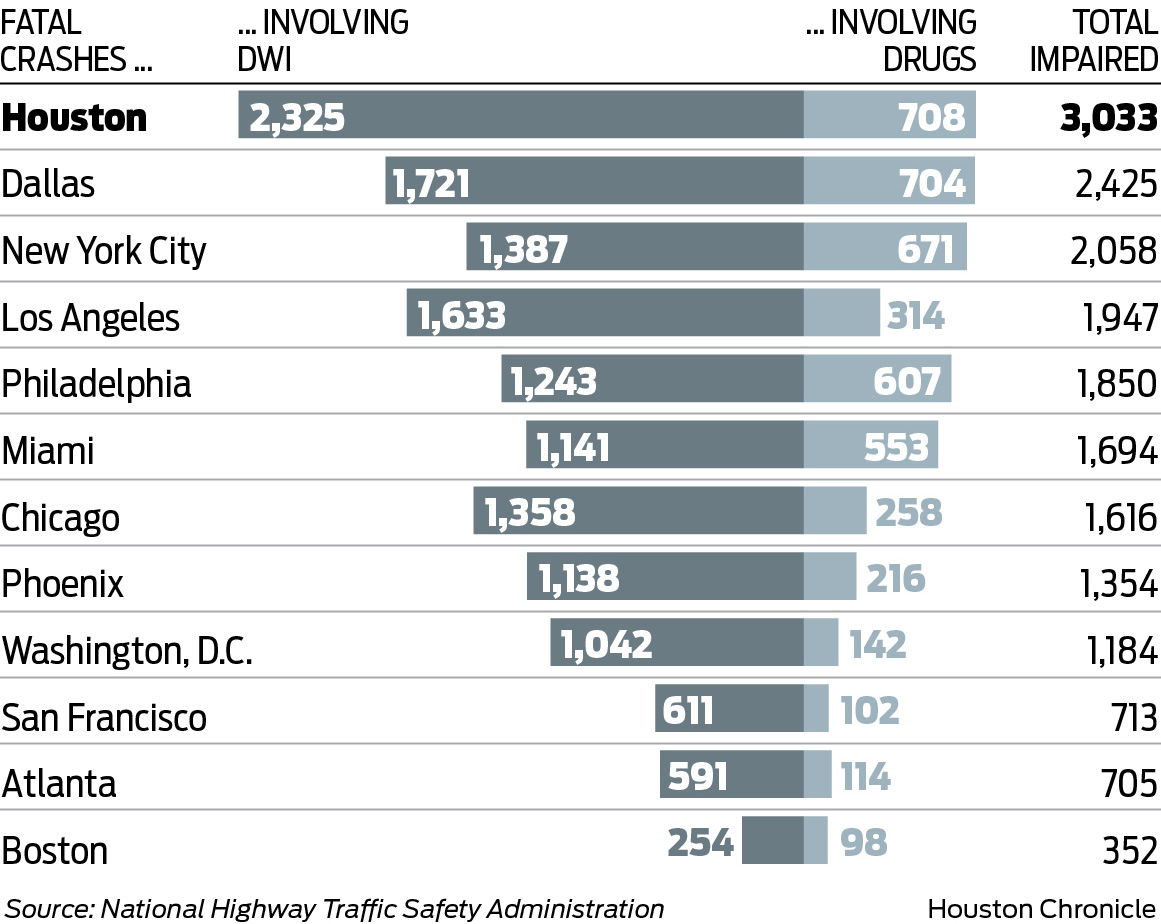
At the Houston Chronicle, St. John Barned-Smith and Dug Begley have an extensive feature on DWI in the Houston metro area, noting that the Houston and Dallas metro areas have the most DWI fatalities of any in the country since the turn of the century.

This is less reporting than an advocacy piece, making the argument that, in the authors' words, "Texas is not doing enough to stop impaired drivers."

Grits doesn't mind a good advocacy article; after all, that's precisely what I do here. But I mention it to emphasize that their premise that Texas isn't doing "enough" is a normative declaration, a value judgment rather than a data-based observation. These authors have declared themselves the arbiters of what is sufficient.

Moreover, since this is an advocacy piece, it doesn't necessarily provide facts that might dispute its thesis, and frames data (e.g., as a 16 year aggregate rather than annualized trends) in ways that support their argument, while omitting frames that might not. In Grits view, the situation is more complicated than portrayed.

For example, while the graphic above is intended to lead to alarm that Dallas and Houston have more deaths over this 16-year period than the New York City MSA, drivers in Texas spend much more time on the road than New Yorkers. E.g., this source announces that in 2011, licensed drivers in Texas averaged 16,347 miles driven each, compared to 11,871 for each New Yorker. Might that have something to do with the difference in alcohol-related traffic-death totals?

Also, the authors, having established themselves as the Arbiters of Enough, suggest that law enforcement is failing to deploy sufficient officers to combat DWI. "Law-enforcement leaders deploy inadequate numbers of officers to drunken-driving enforcement," they opine. And depending on what you think is "enough," the data on DWI arrests may even, on the surface, seem to corroborate that suggestion.

The chart at left is from the Office of Court Administration's Annual Statistical Report for 2017. It shows that DWI enforcement has declined significantly in recent years, with felony DWI cases dropping 24 percent over the last five years and regular DWI cases dropping 13 percent. Overall, police are making half as many DWI arrests than they were thirty years ago, when the state's population was much smaller.

So cops are arresting fewer people for DWI, and indeed traffic enforcement overall has plummeted, as evidenced by this OCA graphic at right:

FWIW, since traffic enforcement has declined even more than DWI enforcement, that tells us that police departments have continued to prioritize DWI, even as traffic enforcement declined, perhaps to a greater degree than the authors gave credit. These data indicate to me that DWI enforcement is not just something that's incidental to regular traffic enforcement, in other words, but has continued to be prioritized, even as traffic enforcement overall was de-prioritized.

But the data that most make me question the assumptions behind the writers' "more enforcement" recommendation is that, during this period of declining enforcement, which coincided with a massive population boom and more cars on the road than ever, Texas DWI deaths remained roughly steady, appearing to be unaffected by either the influx of drivers or the radical decline in enforcement. In fact, they even declined slightly.

Using data from the Texas Department of Transportation, Grits created this chart showing the annual breakout of DWI-related deaths since 2010:

When you consider that Texas' overall population grew by 12 percent over the same period, the trend, to this writer, doesn't seem quite so alarming.

To be sure, one DWI fatality is too many and the state has a big interest in preventing them. The point here is that the evidence in these charts doesn't indicate that DWI enforcement on the roadways plays a big role in reducing fatalities. After all, with more people on the roads and much less enforcement, per capita DWI deaths remained relatively steady, even declining a bit over this period. So if we're looking at the most effective means of reducing DWIs, it's not obvious that devoting more personnel to patrolling the streets would help. When departments took those officers off of traffic patrol, there was no resulting climb in the number of traffic fatalities.

Grits would also ardently dispute the authors' contention that the state should suspend more drivers licenses. They inform us that:
A Chronicle survey of state laws pertaining to license suspensions and interlock use found Texas' were among the most lenient. Lawmakers in 36 states have established longer license revocations, suspensions or more lengthy interlock use than Texas. 
For repeat offenders, Florida can impose permanent suspensions. Florida does not allow suspension time to run while the offender is in prison.
But as regular Grits readers know, Texas has more drivers with suspended licenses than any other state in the country, so many, in fact, that the situation has contributed to massive lines at DPS license centers that can take as long as eight hours to navigate. The last thing we need to do is suspend more drivers' licenses for longer periods.

Anyway, as Clay Abbott, a prosecutors' DWI expert, told the authors, "Texas' sprawl means drunken drivers will get behind the wheel even if their license is suspended — they'll just do it illegally." That's what we've seen with the 1.4 million drivers - about 12 percent of them DWI offenders - whose licenses have been suspended for Driver Responsibility surcharges.

So, while there was some useful data and commentary in this feature story, I think the authors got a lot wrong. By aggregating data over 16 years instead of looking at annual trends, they failed to convey the cognitive dissonance over the fact that a decline in enforcement left DWI fatality numbers essentially unaffected. That blows big holes in their advocacy for deploying more police officers to make DWI arrests. We've just witnessed a natural experiment over the past few years showing the two things don't necessarily correlate.

And the authors' inchoate advocacy that Texas should suspend more driver licenses for longer strikes me as remarkably tone deaf to the political realities created by lines of drivers - many of them with suspended licenses - stretching around DPS license centers around the state. Texas needs to find ways to reduce license suspensions if they want to shorten license-center lines, not lard on more suspensions and worsen the problem.

The authors are also hot to trot over the creation of DWI traffic checkpoints, which are unconstitutional in Texas unless the Legislature explicitly authorizes them. While they do quote outgoing state Rep. Jason Villaba explaining why those measures haven't passed - "The kinds of things that can be done are the kinds of things that usually interfere with the rights of the people who are not engaging in the behavior" - the authors proceed to blow past those objections, giving the police chief the last word on the topic to insist, "Eventually we're going to get them."

None of this is to say DWI fatalities are not a major societal problem. But this Chron article was titled, "Out of Control." To me, that headline overstates things in a period when more drivers than ever were on the road, police enforced DWI laws less often, but per-capita DWI fatalities stayed the same or went down.

Not only does that not seem "out of control," given the counter-intuitive result where less enforcement had no discernible, upward effect on fatality numbers, Grits would instead characterize the dynamic as "curiously constrained."

Saturday, May 12, 2018

Did Texas DPS 'border surge' cause DWI enforcement reduction?

A Grits commenter suggested a fascinating and viable theory regarding the source of radical reductions in DWI arrests across Texas in recent years:
a local judge that I know who oversees a DWI Court he has opined that DWI placements are way down in his jurisdiction and that he felt there was a correlation between the redeployment of local DPS troopers to the border. He said DPS made up the majority of their local DWI arrest. It would be interesting to see if there was any actual link between the border surge and decreases in local DWI arrest.
What do we think about this?

Grits was immediately reminded of a bout of reporting in 2015 detailing how DPS coverage in the rest of the state went down when the border surge began. As R.G. Ratcliffe wrote for Texas Monthly:
The [El Paso] Times' Marty Schladen reports that DPS warning tickets have increased since 2012 by 14.5 percent in border counties, which also saw a 13.5 percent decline in fatal accidents. During the same period, warning tickets elsewhere in Texas declined by 29.3 percent, while the number of fatal accidents increased by 6 percent. 
If the number of warning tickets in non-border-surge areas of the state declined 29% from 2012 to 2015, the idea that the same trend caused a statewide decline in DWI arrests (34% reduction from 2010-2016) doesn't seem far-fetched.

Grits doesn't immediately have enough information to confirm this hypothesis, but it fits more of the data points, not to mention the timeline, than most other possible explanations.

Monday, October 12, 2015

Focus on suicide, traffic accidents to reduce police officer deaths

The Texas Tribune reported that Lt. Gov. Dan Patrick has "asked the Criminal Justice Committee to make recommendations to 'reduce the number of injuries and deaths to or by law enforcement officers,' by reviewing police efforts to engage their local communities as well as assess the dangers to law enforcement officers."

Patrick's suggestion responded to the murder of Deputy Darren Goforth in Houston. But when it comes to police officer injuries and deaths, that episode is an outlier. The two areas where a greater opportunity exists to minimize police deaths are to reduce a) traffic accidents and b) suicides. And methods to reduce traffic deaths among cops could have a salutary benefit of reducing bystander deaths as well.

This same senate committee had an interim charge on the same topic which resulted in a report (see interim charge 5, p. 58 of pdf) in 2009. That report pinned the largest risk to police officers on the fact that they spend so much time in cars: "Policing remains a dangerous profession and our delivery method of this public service by automobile is the largest contributor to accidental deaths in Texas and across the nation."

Grits expects the next senate review to result in similar findings as the underlying causes and rates of police deaths haven't changed much in the intervening years. It's possible the Legislature could act to reduce peace officer deaths, but not if they focus on the spectacular cases rather than the typical ones.

RELATED: Speaking of Deputy Goforth's murder, demagoguery by the Sheriff in its aftermath appears even more off base now that it's been revealed that a) Goforth was at the gas station to meet a paramour not his wife, and b) the woman with whom he allegedly engaged in an affair allegedly also engaged in "consensual sexual conduct" with the Sheriff's department investigator assigned to the case! The mind reels at such poor judgment, at least before it begins wondering whether the investigator has engaged in similar behavior in other cases.

Reported Lisa Falkenberg at the Chronicle, "From the beginning, officials at the scene told reporters that Goforth was pumping gas when he was killed. Now we find out that he may have not been pumping gas, or even on duty." Then the bit about the investigator allegedly sleeping with Goforth's mistress transforms this into a truly bizarre and disgraceful episode. Deputy Goforth's murder was a tragedy but the opportunistic way the Sheriff's Department handled the aftermath exacerbated harm instead of mitigating it.

Wednesday, September 30, 2015

Bystander deaths from police pursuits significantly undercounted

High-speed chases by police are more common and more deadly than previously thought, reported USA Today in a story which opened (Sept. 29):
The U.S. government has drastically understated the number of people killed in high-speed police car chases, potentially by thousands of fatalities over several decades, a USA TODAY investigation shows.

The National Highway Traffic Safety Administration overlooked at least 101 motor-vehicle deaths in 2013 that were related to a police chase, according to a USA TODAY review of police reports and internal documents, court records, police-car videos and news accounts based on police statements.

NHTSA's count of 322 chase-related deaths in 2013 — the most recent year for which its records are publicly available — understates the total by at least 31%, the investigation shows.

NHTSA's undercount suggests that the actual number of people killed in police chases since 1979 could be more than 15,000 — far more than the 11,506 chase-related deaths found in the agency's public records — and that chases result in a death much more frequently than studies have stated.

The findings expose potentially major flaws in how the federal government tracks motor-vehicle fatalities and, to a lesser extent, how police document high-speed chases, which often result in innocent people being killed and have been sharply restricted in some cities.
An earlier report from USA Today in July was titled "High speed police chases have killed thousands of innocent bystanders."

Tuesday, December 30, 2014

Cell phones responsible for tiny fraction of distracted driving, traffic deaths

Just a quick data-backed reminder, as San Antonio prepares for that city's ban on cell-phone use while driving to take effect next month, that the near-hysteria over drivers using cell phones often overstates the dangers this common behavior poses, which perhaps explains why laws banning phone use while driving haven't significantly reduced accidents. Reported the SA Express-News (Dec. 20):
“Since many things distract drivers, cellphone use may be replacing distractions that drivers would engage in absent phones,” [Insurance Institute for Highway Safety Vice President Russ] Rader said. “So the overall level of distraction may not be going down, even though phone use is.”

Crash statistics similarly show that for as much attention as cellphones get by policymakers and the media, they contribute to a small percentage of crashes.

There were 30,800 fatal crashes nationwide in 2012, a report this year from the National Highway Traffic Safety Administration states. Of those, 3,050 involved a distracted driver — 378 of whom were on cellphones, the federal data indicate.

That means cellphone use contributed to 1.2 percent of fatal crashes nationwide in 2012.

Federal data from 2010 to 2012 demonstrate that crashes involving cellphones account for about 5 percent to 7 percent of crashes caused by distraction, which in turn make up only about 16 percent of all crashes.
From all the "hang up and drive" hype, you'd think we'd be talking about more than 1.2 percent of fatal accidents. That figure seems low even to someone like me who's a skeptic of criminalizing common behaviors like cell-phone use. While every death is tragic, I'd have expected more fatalities than that to have been on the phone just as a matter of Bayesian probability since, from my own observation, at any given time more than 1.2 percent of drivers seem to be on the phone.

By contrast, few politicians want to talk about the much more significant cause of fatal accidents in Texas: Underinvestment in transportation infrastructure, particularly in the oil patch where the Eagle Ford shale region has seen a 40 percent increase in fatal crashes, but really throughout the state. Those parsimonious budget decisions at the Legislature are contributing more to the traffic fatality total than drivers talking on cell phones. But it's not as much fun to hold a press conference demagoguing against oneself. So it's better from a pol's perspective to find some group to blame and criminalize, like cell-phone users, even if in the scheme of things that's not the most common cause of driving fatalities, by a long shot, and bans may even make the problem worse.

Tuesday, September 02, 2014

Nanny-State Alert: Austin bans hand-held phone use while driving

The Austin City Council banned talking on a hand-held cell phone driving, not just texting, despite evidence from states which have enacted similar bans that such laws don't reduce accidents. Reported KEYE-TV (8/29):
California may be a good example. The state put a similar ban in place in 2008. While observational surveys show handheld use of cells phones dropped, studies showed no significant decrease in the number of accidents. One reason may be because there are a lot of other things that distract drivers, like the radio, personal grooming, and eating and drinking. Another issue is drivers' willingness to break the law if they think they won't get caught. We see evidence of that when drivers speed, or drink and drive. Despite knowing it's illegal they take a chance. This was brought up at the public safety commission meeting when this ordinance was still in the draft phase. Shupe summed up the problem, saying, "The bottom line is personal responsibility comes into play and drivers need to keep their eyes on the road, and their mind on what they're doing."

Read More at: http://www.keyetv.com/news/features/top-stories/stories/cell-phone-ban-may-not-reduce-crashes-20441.shtml
California may be a good example. The state put a similar ban in place in 2008. While observational surveys show handheld use of cells phones dropped, studies showed no significant decrease in the number of accidents.

One reason may be because there are a lot of other things that distract drivers, like the radio, personal grooming, and eating and drinking.

Another issue is drivers' willingness to break the law if they think they won't get caught. We see evidence of that when drivers speed, or drink and drive. Despite knowing it's illegal they take a chance. This was brought up at the public safety commission meeting when this ordinance was still in the draft phase.

Shupe summed up the problem, saying, "The bottom line is personal responsibility comes into play and drivers need to keep their eyes on the road, and their mind on what they're doing."
The new offense is a Class C misdemeanor. and only bans phone use while the car is in motion; you can still punch in numbers at a stoplight or while stuck in traffic and put the phone on speaker.

My personal belief is that careless drivers are careless in more aspects of their behavior than just cell-phone use, so this nanny-state tactic likely won't be any more effective than in the Golden State. Indeed, some states which banned texting while driving found accident rates increased because people held their phones in their laps to thwart police detection. Other studies have found that hands-free phone use while driving is as dangerous as holding a phone to your ear; it's the conversation that distracts you from the road, not the act of holding the phone.

For these reasons, Grits sincerely doubts this new law will contribute one iota to reduced traffic deaths, but it may contribute to the city's coffers when ticket revenue starts to roll in. Though no one will say so, that's the most important functional result from this new law. It probably won't make us safer but it may turn out to be a helluva revenue generator. If so, expect to see it replicated in other cities.
California may be a good example. The state put a similar ban in place in 2008. While observational surveys show handheld use of cells phones dropped, studies showed no significant decrease in the number of accidents. One reason may be because there are a lot of other things that distract drivers, like the radio, personal grooming, and eating and drinking. Another issue is drivers' willingness to break the law if they think they won't get caught. We see evidence of that when drivers speed, or drink and drive. Despite knowing it's illegal they take a chance. This was brought up at the public safety commission meeting when this ordinance was still in the draft phase. Shupe summed up the problem, saying, "The bottom line is personal responsibility comes into play and drivers need to keep their eyes on the road, and their mind on what they're doing."

Read More at: http://www.keyetv.com/news/features/top-stories/stories/cell-phone-ban-may-not-reduce-crashes-20441.shtml
California may be a good example. The state put a similar ban in place in 2008. While observational surveys show handheld use of cells phones dropped, studies showed no significant decrease in the number of accidents. One reason may be because there are a lot of other things that distract drivers, like the radio, personal grooming, and eating and drinking. Another issue is drivers' willingness to break the law if they think they won't get caught. We see evidence of that when drivers speed, or drink and drive. Despite knowing it's illegal they take a chance. This was brought up at the public safety commission meeting when this ordinance was still in the draft phase. Shupe summed up the problem, saying, "The bottom line is personal responsibility comes into play and drivers need to keep their eyes on the road, and their mind on what they're doing."

Read More at: http://www.keyetv.com/news/features/top-stories/stories/cell-phone-ban-may-not-reduce-crashes-20441.shtml

Thursday, August 14, 2014

Driverless cars would transform the legal profession, law enforcement

At the blog Above the Law, attorney Mark Hermann speculates on the future of the legal profession if and when driverless cars like the one being prototyped by Google ever become a large-scale reality. "Do you do DWI defense work?," he wrote. "Your practice area may not exist in ten years. Do you participate in automotive accident or product liability cases? The world may be about to shift under your feet."

Moreover, "Law enforcement (and the converse — criminality) may be transformed. Can driverless cars be hacked to make kidnapping much simpler? Or packed with explosives to be turned into self-guided bombs? Or simply used as high-speed getaways cars, which will permit the bad guys to shoot at the police while the car navigates its high-speed escape? (To avoid these problems, will we relinquish our right to privacy, permitting our cars to be monitored and our locations always known?)"

Then there's the revolution in liability law brought on by driverless cars:
Needless to say, driverless cars will transport product liability law into a brave new world. Let’s assume that driverless cars are remarkably safe: Instead of the 30,000+ people who now die annually in car accidents in the United States, suppose driverless cars result in a mere 10,000 deaths every year. And assume that the public accepts — as logic dictates, but emotion may not — that saving 20,000 lives per year is an improvement, so driverless cars should be endorsed. Who would bear the cost of those 10,000 fatal accidents? Vehicle owners? Or users? Or manufacturers?

Can we blame the mechanic who repaired a driverless car a few weeks before the crash? Or the hobbyist who got under the hood of his car and tinkered with it?
Grits had a pair of related posts last year wondering aloud how driverless cars might affect law enforcement and the criminal justice system generally. In particular, since most police interactions with the public occur at traffic stops, what will cops do with themselves once there are no more traffic scofflaws to pull over? The era of the pretext stop will have come to an end.

Already the key elements of driverless cars are being implemented in increments. I've seen TV ads for cars that parallel park themselves. According to the latest issue of Popular Mechanics presently sitting on my coffee table, "At speeds of up to 30 mph" the 2015 Subaru Legacy "automatically brakes if a collision is imminent." For the most part I think these changes will be positive, certainly as measured in driver safety. But there will be growing pains and, when the transformation takes place in earnest, it will be as disruptive as anything to law enforcement since the invention of the V-8 engine. You read it here first.

Tuesday, December 17, 2013

Driverless cars and the future of law enforcement

The Texas Tribune has a story out on a new report (pdf) from UT-Austin's Center for Transportation Research that opens thusly: "Self-driving cars once seemed the stuff of science fiction. But with such projects from companies like Google already being showcased in Texas, lawmakers and transportation officials see an opportunity to use new technology to relieve congestion and improve safety in the rapidly growing state."

Volvo has suggested they'll have cars on the market by 2020 that are "impossible to crash"; the Tribune estimates driverless cars will be marketed to the public by 2025. And of course, it'll take some time to transition to the new tech and/or retrofit older vehicles. But a couple of decades from now, when the technology has been well-established, one can foresee a day when insurance companies may charge more or even refuse to cover people driving without such high-tech crash prevention technology.

From a traffic safety perspective, self-driving cars can't come soon enough as far as I'm concerned. When it finally happens, though, it's going to change law enforcement forever. For starters, no more drunk drivers, roadside breathalyzers, DWI cases in court, or for that matter $1,000 per year surcharges . Ethan Couch could be as drunk as he wanted in Google's driverless car and get home safely every time. But the even bigger change could be redirecting law enforcement away from the traffic stop as their primary enforcement strategy, since presumably vehicles would be programmed to obey the traffic laws. In that case, what would become of law enforcement's much-beloved pretext stop? As pointed out in this Grits post from January:
In 2008, according to the Bureau of Justice Statistics (pdf), 59.2% of all citizen contacts with police were traffic related. That year, police conducted searches at about 5% of traffic stops nationally, discovering contraband in about one out of every10 searches. While most drivers (84.5%) thought they were pulled over for good cause, an overwhelming majority of drivers searched, said BJS, said the search was "perceived as not legitimate." Police arrested 2.6% of drivers they stopped that year.

When police no longer have traffic enforcement as a pretext for getting around the Fourth Amendment, law enforcement in this country will lose what's become a primary crime fighting strategy. In that sense, Grits views the focus on traffic enforcement and pretext stops as an example of short-term, numbers-driven myopia. Just as fishermen fish where the fish are, law enforcement focuses on traffic enforcement not just to prevent crashes but also because that's the most cost-effective way to maximize arrests for other offenses, allowing police to find contraband when they otherwise would have no cause to stop, much less search average citizens. For now that makes sense if their goal is to maximize arrests. But police seeking to maximize arrests in the future may have to rely on different tactics that today they tend to downplay, like investigating and solving reported crime.
Overall, I'd view such a shift in law enforcement tactics and culture as a good thing.

On the negative side, the privacy implications are fairly profound because GPS tracking is pivotal to the functioning of driverless cars. There would need to be some way to ensure anonymity before driverless cars are unleashed en masse. That's not an insurmountable problem, but if driverless cars rolled out in large numbers without some sort of anonymizing feature, it would be a privacy concern on the scale of the NSA mining cell-phone location data.

There will be pros and cons to change but make no mistake: In the words of Sam Cooke, "Change is gonna come."

MORE: Here's a piece from Forbes on the massive amounts of data accumulated by new cars and potential privacy implications. The author also articulates some of the limits of anonymizing vehicle data.

Sunday, January 13, 2013

'Are some cities built to encourage drunk driving?' I'm talking to you, Houston

The Atlantic's Cities blog posed the question this week, "Are some cities built to encourage drunk driving?" Then Unfair Park and the TM Daily Post followed up, noting that Dallas and Houston show up as among the cities with the most fatal crashes and the largest proportion of fatal accidents involving DWI. Other Texas towns weren't far behind in that latter category: "Houston ranked second, Dallas fifth, and Austin seventh, with Fort Worth close behind at number 13 in the study recently put out by software company IDV Solutions on their UXBlog." See the full infographic ranking large US cities here.

Though it doesn't explain all the data, IMO a big factor is the availability of public transportation, as Grits has argued in the past. The Atlantic nailed it: Some cities are built to encourage drunk driving, particularly here in Texas. As Eric Nicholson wrote at the Dallas Observer's Unfair Park
This should make intuitive sense to anyone who doesn't live in Uptown, Deep Ellum or Lower Greenville and has ever gone out for a few drinks. Assuming no one volunteered to be designated driver, you're basically left with two choices: pay an ungodly amount for a cab or drive drunk and hope for the best. In places like New York, where things are denser and more accessible by foot or by public transportation, there are more viable options.
Bingo! As Nicholson pointed out, "That's not to say that people in Dallas have an excuse to drive drunk, just that the data make sense." However, Grits would add that the data show urban planning and other public policy decisions play a big role in DWI death rates that the enforcement-only crowd generally fails to acknowledge. Grits doesn't believe there are fewer drunks in New York, Washington D.C., or Philadelphia than in Dallas, Houston, or Austin; I just think those cities' governments had the foresight to give people a way to get home without climbing behind the wheel of a car.

Friday, January 04, 2013

Orwellian framing on traffic accidents promotes pretext stops

Austin police are on message, as the politicos say, parroting a federal slogan, "Crashes Aren't Accidents," in a story in the Austin Statesman detailing traffic deaths since New Year's Day. “These are not accidents. They are crashes, because all of these incidents are preventable,” said senior Austin police officer Veneza Bremner. As it turns out, that framing is a PR slogan being promoted by the National Highway Traffic Safety Administration, which maintains that, "Referring to motor vehicle crashes as 'accidents' contributes to the perception that they cannot be prevented; when, in fact, very few crashes occur because of uncontrollable circumstances. Proactive traffic enforcement efforts that remove impaired drivers from the road and enforce speed limits and rules of the road can prevent many crashes from occurring."

This is a bit of a Humpty Dumpty moment, attempting to reframe language in an Orwellian way that justifies law enforcement solutions to a complex social problem. According to Dictionary.com, the first definition of "accident" is "an undesirable or unfortunate happening that occurs unintentionally and usually results in harm, injury, damage, or loss; casualty; mishap: automobile accidents" (emphasis in original). The point of redefining terms isn't to hew to more correct usage but to allow police to maximally assign blame to drivers, ignoring the contributions of public policy decisions, traffic engineering, unintentional distractions and pure, dumb luck. But accidents DO happen and most car crashes - even preventable ones - occur unintentionally.

Etymology aside, the NHTSA campaign views traffic enforcement in general as a vast pretext for investigating other crimes by drivers, suggesting that "Proactive enforcement of traffic violations results in numerous criminal apprehensions. More significantly, the traffic stop is perceived by the officer and the community as positive. Even though a criminal apprehension may not result during most traffic stops, the officers and the community should not only view traffic enforcement as a safety benefit, but as another tool to be used in the War on Crime." Several years ago, Grits suggested that Supreme Court decisions allowing "pretext stops" would mean that "traffic enforcement will, over time, have less and less to do with ensuring traffic safety and more with getting around the Fourth Amendment." At the NHTSA, that prediction has now become public policy.

The reference by the NHTSA to pretext stops made me think of Google's driverless car and the recent suggestion by Volvo that they will produce driverless vehicles for sale in the US by 2020. A recent New Yorker column remarked that:
Google’s driver-less cars are already street-legal in three states, California, Florida, and Nevada, and some day similar devices may not just be possible but mandatory. Eventually (though not yet) automated vehicles will be able to drive better, and more safely than you can; no drinking, no distraction, better reflexes, and better awareness (via networking) of other vehicles. Within two or three decades the difference between automated driving and human driving will be so great you may not be legally allowed to drive your own car, and even if you are allowed, it would be immoral of you to drive, because the risk of you hurting yourself or another person will be far greater than if you allowed a machine to do the work.
When that technological shift comes - and it's coming - how will that affect law enforcement agencies that have hinged their staffing and deployment decisions on the pretext stop strategy? In 2008, according to the Bureau of Justice Statistics (pdf), 59.2% of all citizen contacts with police were traffic related. That year, police conducted searches at about 5% of traffic stops nationally, discovering contraband in about one out of every 10 searches. While most drivers (84.5%) thought they were pulled over for good cause, an overwhelming majority of drivers searched, said BJS, said the search was "perceived as not legitimate." Police arrested 2.6% of drivers they stopped that year.

When police no longer have traffic enforcement as a pretext for getting around the Fourth Amendment, law enforcement in this country will lose what's become a primary crime fighting strategy. In that sense, Grits views the focus on traffic enforcement and pretext stops as an example of short-term, numbers-driven myopia. Just as fishermen fish where the fish are, law enforcement focuses on traffic enforcement not just to prevent "crashes," but also because that's the most cost-effective way to maximize arrests for other offenses, allowing police to find contraband when they otherwise would have no cause to stop, much less search average citizens. For now that makes sense if their goal is to maximize arrests. But police seeking to maximize arrests in the future may have to rely on different tactics that today they tend to downplay, like investigating and solving reported crime.

Until then, Orwellian wordplay won't change the fact that virtually all car crashes are accidents by any reasonable definition. And until the cars are driving themselves, that will continue to be the case.

NHTSA campaign logo

Wednesday, January 02, 2013

Don't be surprised: Number of Texas traffic tickets declining

The editorial board at the Austin Statesman opined yesterday that, "We were surprised to learn that the number of traffic tickets issued each fiscal year by Austin police officers has decreased sharply over the past three years, from 264,428 in 2009 to 133,852 in 2012, as reported by the American-Statesman’s Dave Harmon and Tony Plohetski." Their surprise is disappointing because the Statesman editors would have been fully informed of the trend had they been regular Grits for Breakfast readers, e.g.:
The news story accompanying the editorial ("Traffic citations plummet in Austin and other major Texas cities," Jan. 1) updated data from those missives, informing us that:
Nine of the state’s 10 most populous cities had fewer traffic cases filed in municipal court in 2011 than the previous year, according to statistics from the state Office of Court Administration. (San Antonio was the lone exception, with 16 percent more traffic cases.)
\
Even Texas Department of Public Safety troopers issued an average of 443 fewer tickets per day in 2011 than they did in 2008 on Texas highways — a 14 percent drop, although the number remained virtually the same from 2010 to 2011. The slowdown has come as the state’s population continues to grow.
The paper quoted Austin Police Chief Art Acevedo insisting that "there’s a direct correlation between traffic enforcement and bad outcomes," but at least for fatalities, that doesn't jibe with the data. The newshook for the story was that Austin traffic fatalities increased this year, but statewide traffic deaths have declined in recent years despite hundreds of thousands of fewer traffic tickets being written statewide. The Statesman reported in August that:
In 2010, ... the state saw 3,028 traffic deaths and about 234 billion miles of driving, the audit said.

That equates to 1.29 deaths per 100 million miles driven, the formulation used by the National Highway Traffic Safety Administration for evaluating road safety.
In 2006, by comparison, the death rate was 1.5 deaths per 100 million miles traveled in Texas. The rate fell every year between 2006 and 2010.
If Acevedo were right that there's a "direct correlation" between traffic enforcement and fatalities, then why have traffic deaths declined statewide even as police in Texas dramatically reduced the number of tickets written? That bit of conventional wisdom doesn't match the statewide data. Any correlation is at best indirect and much stronger correlations may be found, for example. between declining traffic deaths and improved medical techniques, expanded access to regional trauma centers at hospitals, and better safety equipment in the vehicles themselves.

Indeed, singular focus on traffic enforcement contributes to government ignoring other factors leading to reduced accidents, like improved traffic engineering and public transportation. My own view is that within a couple of decades, perhaps sooner, we'll see traffic deaths plunge even further thanks to technological advances that reduce or eliminate driver error. If and when that happens, it will fundamentally change the role and tactics of local police, who in Austin, despite recent declines, presently spend more time writing traffic tickets, according to a consultant's 2012 staffing analysis (pdf), than on any other activity.

Tuesday, August 28, 2012

Distracted driving by police an issue, but not as dangerous as high-speed chases

The greatest danger to police officers on the job isn't being shot by a criminal but dying in a car accident, so I was interested to see a  report from KXAN-TV declaring that "nine Austin police officers have been suspended for causing traffic accidents in 2012." Most recently, "An Austin police officer has been suspended for running a red light and causing a crash with another vehicle. It is the fourth time in the last year that an Austin police officer has run a red light and caused a crash."

KHOU-Houston recently reminded us that "Two years ago, an officer in Austin rammed into a motorcyclist in broad daylight. Later he admitted to being distracted," and supplied video of the incident. The officer was typing notes into his on-board laptop when slamming into the cyclist. After that episode, The city changed its policy to require officers using in-car computers to "pull over, complete what they need to do and then proceed," Assistant Chief Sean Mannix has told the press. The Tarrant County Sheriff has enacted a blanket policy against the practice, while the Plano Police Department requires officers to pull over if "extended use" of the in-car computer is expected. But most Texas agencies have left the practice utterly unregulated.

Of course, police running red lights or fiddling with their in-car computer while driving doesn't just endanger the public but the officers themselves. In 2010, Grits reported last year, "Eighteen officers were killed in Texas, more than any other state, and as usual 'fatal traffic incidents ... were the leading cause of officer deaths for the 13th straight year.'" Moreover, USA Today has reported that "At least 42% of police officers killed in vehicle crashes over the past three decades were not wearing seat belts or other safety restraints, according to a federal review."

A July 31 report from the Dallas NBC affiliate found police officers in Texas cause about three crashes per month related to distracted driving:
An NBC 5 investigation has found many Texas police departments don't follow their own advice when it comes to warnings about distracted driving. Crashes involving distractions inside police vehicles now frequently happen across the state.

The list of distractions for continues to grow. In many cities, they're often found operating two-way radios, smartphones, dashboard-mounted computers and on-board cameras while they drive.

A search of state accident reports reveals at least 70 crashes in just 24 months where some kind of distraction inside an emergency vehicle contributed to the wreck -- an average of almost three crashes per month. Those are just the crashes that involved enough property damage or injury that they had to be reported to the state.
In truth, three crashes for month is a fairly low rate compared to the number of accidents police are involved in and the amount of time officers spend on the road, so I'm not sure banning them from such activities is justiified. If Grits had to choose, enacting more regulations on high-speed chases would be a greater priority than disallowing police from texting or talking on the cell phone while driving. The need for communication outweighs the added risk (which IMO is also true for the general public). That said, using a radio, cell phone or even texting behind the wheel is one thing, but putting a laptop in the car takes the distraction to another level. Reading a few words in a text message is a lot different from combing through the amount of information that shows up on a laptop screen, which requires much greater focus. For that, I'd like to see a technical fix instead of a regulatory one: The devices should simply be automatically disabled when the car is moving.

Wednesday, March 21, 2012

Pedestrian deaths in Austin and the trouble with drawing conclusions from small numbers

One seldom-discussed drawback with data-driven policing - particularly when its used in mid-size and smaller cities - is that small statistical samples often make drawing valid inferences problematic, and here's a good example: Writes reporter Brenda Bell, "auto-pedestrian deaths are up in Austin, even as deaths from other vehicular collisions are falling. Last year marked an 83 percent increase in pedestrian-bicyclist fatalities; there were 22, compared with a dozen in 2010." Bell reported Sunday that "This year, eight people, including one walking his bike, have already died in collisions with motor vehicles. All but one happened after dark or at dusk. One-third were hit-and-runs."

While certainly it's accurate to say there was an 83% one-year increase, when the numbers are so small that means very little as far as identifying a statistical trend of increasing deaths, and the story didn't include prior years' data. On Sunday Bell did report that "Auto-bike fatalities have averaged one per year over the past seven years," but that means the year you have two it's a hundred percent increase. Is that meaningful data, or just random fluctuation? You see the same issues with murder trends and other infrequent events. Media will report a one-year increase with tremendous drama as a possible trend, even during periods like we're in now when long-term murder rates are declining. When numbers are so small, you need multiple years of data to perform a probative trend analysis, which of course doesn't make for the most attention-grabbing news story.

Perhaps the most obvious death-causing trend evidenced in the stories is that a significant proportion of pedestrian deaths in Austin happen along Interstate 35, which for significant stretches (especially north of 51st Street) is difficult to cross legally on foot and is flanked by extremely busy frontage roads. This datapoint reinforces my sense that jaywalking can be better addressed via traffic engineering solutions that make it safer for pedestrians to get where they're going. If you're walking any significant distance along the access road on I-35, it's likely because you have no other choice.

Another notable trend mentioned is bicyclists being hit after dark, which might argue for efforts narrowly aimed at improving safety equipment. (I see cyclists these days with flashing lights on their bikes instead of reflectors that make them MUCH easier to see after dark.) Cyclists' deficient equipment can be addressed with a variety of tactics from public education, warnings or tickets for equipment violations, improved lighting for dangerous intersections and popular bike routes, etc..

For the most part, though, the city should address these mainly as traffic engineering questions as opposed to law-enforcement concerns. For example, would auto-pedestrian/bike accidents downtown be reduced by creating the proposed Nueces Bike Boulevard? (See here [pdf] for more detail.) Quite possibly. A fascinating and telling map of recent auto-pedestrian/bike accidents accompanying the story shows a large number downtown, though some are concentrated on the east and west entry corridors. Those wouldn't be affected by a north-south route on Nueces, which more aims to reduce accidents on, say, Congress and Lamar.

Instead, Austin PD took a one-size-fits-all enforcement approach, employing a hammer in lieu of a scalpel. In a highly unpopular two-week crackdown last October:
Pedestrians got 1,336 citations and warnings, for offenses such as failure to observe traffic signals, panhandling or stepping into roadways midblock. Drivers got 174.

That lopsided scorecard is par for the course. Between 2008 and 2010, Austin police issued nearly 11,000 citations for violations of auto-pedestrian laws; only 7 percent went to drivers.
Ticketing cyclists may prompt them to get better equipment for biking at night - just handing out lights might even be better - but jaywalking will always be a function of convenience and opportunism. Focusing significant resources on ticketing them IMO is just silly. Meanwhile, as for Austin's much-ballyhooed "3 foot rule" that's supposed to protect "vulnerable" road users?
A city ordinance passed in 2009 requires vehicles to keep at least 3 feet away when passing a "vulnerable user" — a bicyclist, motorcyclist, pedestrian or runner. On four-lane roads, motorists are supposed to yield the lane entirely.

Austin police have issued just eight citations — four per year — under that law.
So that was a bust. Now they're going to try using police as pedestrian "decoys" to ticket motorists. But with 11,000 citations for auto-pedestiran laws over three years and a supposed increase in the problem just now, it doesn't seem like the enforcement-only approach gets to the heart of the problem. Assessing tickets and fines for petty offenses while telling the public it's for their own protection comes off as self serving as it is patronizing in an era when municipal tickets are viewed as a lucrative revenue source.

To be fair, the city does have $13.5 million in bond money available "for projects to enhance mobility and safety for pedestrians, bikers and disabled people," which should do a lot more to prevent deaths than giving pointless tickets to jaywalkers. Certainly it will do more than APD's various proposals for new city bonds at ten times the cost.

Police Chief Art Acevedo told the paper he thinks this trend - which nobody can really say is a trend yet - results from the declining moral character of the citizenry: "Drivers think (pedestrians) don't have the right to cross the street, and pedestrians think they can jump out at the last second," he said. "It used to be ... that when a pedestrian set foot in an intersection, that people stopped. I think it's a commentary on society that we've lost that respect," adding that we're all a bunch of drunks Austin is "one of the heaviest drinking cities in the country."

For Grits' part, I think it's a commentary on Austin PD that, although the chief and the union complain constantly they don't have enough uniformed officers, when they get them they want them deployed ticketing jaywalkers while the civilian APD crime-scene unit doesn't even investigate a majority of burglaries for lack of manpower. And it's perhaps a commentary on the local media that police pronouncements of an "increased rate of pedestrian fatalities on Austin streets" are accepted as valid based on such a limited dataset. (If earlier years' numbers of pedestrian deaths are higher than 12, it might almost seem like the data was cherrypicked.)

These two stories give us insight into Austin PDs traffic enforcement tactics but in many ways for Grits raise more questions than they answer. Once we've seen the number of pedestrian deaths by year, preferably per capita, over a longer period of time, perhaps it would be safer to draw conclusions about trends.