Showing posts with label ideology. Show all posts

Thursday, May 27, 2021

Fascism Unsheathed: Let's be very clear about what just happened at the #txlege

For many years, your correspondent has sought to work in a bipartisan fashion at the Texas Legislature on criminal-justice reform, and I've taken a lot of crap from folks on the left for working closely with Republicans who are sometimes, shall we say, less than ardently committed to the project. 

Beyond the simple math of needing Republican votes in a red state to pass bills, my response has been that more moderate, pro-social elements in the GOP needed to be affirmed and bolstered. The GOP base in Texas includes totalitarian, racist elements which lately have been swirling in a near-policy-free furor of anger and resentment. By engaging with libertarian factions and more compassionate elements in the religious wing of the party, I've argued in innumerable trainings and funder conversations, the criminal-justice reform movement in Texas was attempting to "blunt the spear tip of American fascism."

In 2021, the spear tip was unsheathed and thrust deep into the body politic: A combination of the pandemic, President Trump's defeat, and the January 6th insurrection seem to have finally awakened the beast. This was the year the far-right wing of the party finally got its wish list they'd been denied in the 20 years since Republicans took power in Texas: The entire legislative session was about abortion, guns, jingoism, and "backing the blue." Compassionate conservatism and non-gun-themed libertarianism were more or less banned from the building, or at least the eastern wing.

The Texas House, with a larger, more ideologically diverse membership, retains a broader array of Republicans that still includes some "small government" and/or "compassionate" types. They managed to pass several significant criminal justice reform bills, but virtually nothing of consequence made it through the senate. Reforms with overwhelmingly positive, bipartisan polling numbers like reducing marijuana penalties and ending arrest/jail for Class C non-jailable traffic offenses could never even get committee hearings on the eastern side of the building. Instead Sen. Joan Huffman wasted weeks on a failed effort to gerrymander appellate courts to rescind recent Democratic gains.

Some of this lurch toward totalitarianism was overt and ham-handed, perhaps most notably legislation to require sports teams to play the Star Spangled Banner. More insidious were attempts to control historical narratives about race and slavery in Texas schools and museums. These efforts were as shameful as they were transparently authoritarian. We're just a step or two away from parading historians through the streets in dunce caps. 

Perhaps the most subtly fascist influence radiating out of this session was HB 1900, ostensibly punishing cities that "defund police." Large cities and counties henceforth must prioritize spending on law enforcement, leaving roads, parks, social services, or any other traditional municipal functions to wither in a time of massive urban growth. 

Grits believes the purpose here is both political and dystopian: Texas' large cities are now almost all (but Fort Worth) run by Democrats. So the Governor and his allies aim to make cities un-manageable, then blame Democrats for mismanaging them. Given the state's largely lapdog political press, I understand why he thinks he'll be able to control that narrative and redirect blame. He's probably right.

It's a valid and effective political strategy, even if it's nonsensical bordering on asinine as public policy.*

If HB 1900 is enforced, it will be incredibly harmful: All large Texas cities have for years already prioritized police spending over other municipal functions which have languished and at this point require investment this bill will prevent. 

Now, new spending must go first to the cops, and with municipal revenue caps installed last session, that pretty much precludes spending on anything else. This exacerbates the problem of which police chiefs have complained for years: that they're being tasked to solve social problems for which they're ill equipped. Nowhere is that dynamic more clear than in the statewide homeless ban, which criminalizes cooking or sleeping outside under a blanket. Poor people evicted from their homes? Send police. Mental illness untreated? Send police. Veterans with addiction and/or PTSD who can't hold a job and end up on the streets? Send police. Elderly people forced to live in tents because inadequate social security checks won't cover escalating rents? Send police. I can't think of a clearer definition of authoritarianism. 

Not only does the legislation criminalize poverty and punish it with unreasonable penalties (fining homeless people is a fool's errand and jailing them for sleeping accomplishes nothing), it begins the process of de-linking law enforcement from civilian control. HB 1925 prevents cities from setting policies for police departments' enforcement priorities regarding homelessness, making them over time both ever-more extravagantly funded (thanks to HB 1900) and increasingly unaccountable to the cities paying their bills.

Who knows how far we'll head down that path? But history generally views with disapprobation those periods when the armed agents of the state are left free to abandon the public weal and act in their own interests. The Roman legions, for example, were prone to deposing emperors who asked them to pound swords into ploughshares. Law enforcement interests in Texas behave the same way, which is why Emperor Abbott panders to them so incessantly.

Grits see this as a camel's nose under the tent, mandating cities fund police departments to the exclusion of other priorities while eviscerating cities' policy-setting role and leaving the cops as independent actors. Well-funded, unaccountable law enforcement acting as independent agents outside of civilian control is the sort of situation that makes me use a harsh term like "fascist." The net sum of all these policies taken together aims Texas' largest jurisdictions squarely in that direction.

Indeed, this year it became evident that police reform of even the smallest sort cannot occur in Texas while Greg Abbott and Dan Patrick remain in office. Both of them defer almost completely to police-union interests on criminal-justice policy. Even the "Sunset" bill for the Texas Commission on Law Enforcement could not pass. Legislators wanted to create a "blue-ribbon commission" to study reforming the police licensing agency, but police unions don't want reforms proposed and so killed the bill outright. 

Of roughly eight different bills making up the Texas George Floyd Act package, only one (banning chokeholds) made it through in anything close to the original, filed version. Another, the "duties" to intervene and render aid, passed in a form that will almost certainly guarantee no interventions and very little aid. 

Two years ago, I wrote that 2019 was a "killing field" for criminal-justice reform bills; this year was worse. This time, law enforcement wasn't just killing off reform proposals, they were ascendant, insisting their interests be prioritized above all other public-policy goals or community values. And Texas state leadership all but fell over themselves giving them everything they wanted.

This blog and Just Liberty, the group I work for, focus a lot on wonky minutiae in order to identify narrow reforms both parties can support. But we can't wonk our way out of this political moment: What's at stake is nothing less than the soul of the state and arguably, given national implications of Texas' role in the GOP and the electoral college, the future of the American political experiment.

Texans of good will: Today, you're living through the American equivalent of the Weimar Republic and history has placed us at the epicenter of far-right-wing ascendance in American politics. Behave accordingly. We may not get another chance.

*More than asinine, to channel Stephen A. Smith, this is assi-ten, ass-eleven ...

Tuesday, March 23, 2021

If conservatives are liberals who've been mugged, maybe liberals are just conservatives who enjoy government power a bit too much

Grits must admit, I don't get it. For years, Republicans in Texas have complained about high taxes, which at the local government level are largely driven by public-safety budgets. Then, over the last couple of years, Texas Republicans including the Governor have become obsessed with homelessness in Austin after the city decriminalized their public existence.

So when the city of Austin ratcheted back the police department budget by 4.6 percent and spent the savings on EMS and services for mental illness and homelessness, on its face one would think that would fall into a policy realm Republicans could live with: Reduce government spending and address Austin's homelessness problem.

Maybe state leaders felt outdone by Austin's budget cutting: After all, when they faced a budget contraction in 2017 much less severe than last year's COVID-based revenue decline, the Governor signed a bill reducing the Texas Department of Public Safety's budget by 4 percent. But no one then raised concerns state leaders wanted to "defund police."


Now, though, reversing three-generations of small-government, anti-taxation rhetoric, the Texas GOP has entered a Bizarro World where it seeks to punish cities that reduce budgets for public employees they favor (in most cities the highest paid type of public employee). Ronald Reagan must be spinning in his grave.

Consider three bills up this Thursday in the House State Affairs Committee:

HB 1900 by Goldman lets the Governor determine if a city defunded its police. There's no metric or standard for that in the bill. Once that determination is made, previously annexed areas can seek de-annexation elections, so in Austin's case, the city council could lose a bunch of Republican voters on its western fringe who are the main support for what passes for conservative candidates in this city. That improves the viability of more liberal candidates, meaning you get a Mayor Casar instead of a Mayor Adler. Again, this benefits/punishes whom, exactly?

HB 1900 would further freeze property taxes and electric rates of cities that "defund" police. Ironically, grassroots conservative activists from around the state have been calling on the Legislature to aggressively freeze local property taxes for years and voters of all stripes hate electric rate hikes. Will this bill now give them the mechanism they need to achieve their dreams? Will we begin to see cities around the state cutting police budgets because their constituents support a property tax and electric rate freeze? It's not out of the realm of possibility.

HB 2362 by Harris similarly restricts government spending at agencies which "defund" in ways that conservatives around the state have called for for years. From a grassroot conservative's perspective, it's like Austinites are being rewarded for defunding police with lower taxes. Why wouldn't voters in Fort Worth or Midland look at their own local tax situation and think, "I'll take a little of that"?

HB 3151 by Leman appears to assess whether cities are defunding but does not punish it.

Your correspondent backed Ronald Reagan in my first presidential election back in 1984, so I feel competent to compare the ideology of "Reagan conservatives" to what's happening today. There's not much comparison. The idea that it's "conservative" for state government to pass a law mandating permanent local-government budget increases beggars belief.

Back in the day when I fancied myself a Reagan Republican, we had a word for that philosophy:

"Liberal."

Sunday, November 08, 2020

"Defund the police" is the new "Obamacare": The Texas #cjreform landscape post-election

Now that the most divisive presidential election in 50 years is over and, win, lose or (largely) draw, everybody can take a deep breath, it's time for criminal-justice reformers to peek our heads above the wreckage to see what remains of a state and local agenda after a tumultuous year and a grueling election season which, at the state level in Texas, resulted in a complete stalemate, from a partisan perspective.

Criminal-justice reform is the new Obamacare

It's been quite a year for criminal-justice reformers. And we've learned some things. Although the public doesn't like the phrase "defund the police," they tend to like all the policies that might allow police to be defunded. Grits sees this a bit like "Obamacare," which of course, really, was the "Affordable Care Act." Republicans branded it with a president who was unpopular with their base and then railed against it for years, passing dozens of weird, Pyrrhic votes to abolish it. For a while, "Obamacare" polled very badly.

But this election cycle, you saw bipartisan support in campaign commercials for most of the underlying policies "Obamacare" was about - particularly forcing insurance companies to accept customers with pre-existing conditions. That's because the policies being discussed had broad popular support. Opposition was largely based on a partisan strategy to misrepresent what the Affordable Care Act did in order to undermine Democrats and then-President Obama.

Similarly, the phrase "defund the police" polls badly (to the extent we should ever believe polls again - a topic for another day), but the policies of sending someone besides cops to respond to addiction, mental illness, and homelessness garner bipartisan support.

Austin's ballyhooed budget cuts

That makes Austin an important bellwether example, as the only city in Texas and one of the only cities nationwide to actually reduce its police budget (by 4.6%) and invest in alternative approaches.

Granted, in a year when COVID shrank local budgets everywhere, that's not much. It's in the ballpark of the 4% reduction approved by Greg Abbott and Dan Patrick in 2017 for the Texas Department of Public Safety, for example. But that didn't stop those two from parading around the state holding press conferences in police-union halls bashing Austin for being soft on crime.

Even as political theater, some of this was downright surreal: Like Abbott, Patrick, and damaged-goods House Speaker Dennis Bonnen holding a press conference in Fort Worth with the Mayor saying that city did it the "right way." But Austin still spends more per capita on police than Fort Worth, and their murder rate is much higher. Indeed, if Austinites were murdered at the same rate as the citizens of Cowtown, our annual murder tally would double!

Justice policy as political strategy

So why go to Fort Worth to hold a press conference telling Austin how to be more safe? Because of contested races in Tarrant County; no other reason. It was just a political tactic.

Did it work? Sort of. But it definitely cut both directions. According to an enormous national survey, about three quarters of all voters this year said the Black Lives Matter protests were a big factor in why they voted. The meme did inspire some Trump supporters, but Biden benefited more: "Among those who cited the protests as a factor, 53 percent voted for Mr. Biden, and 46 percent for Mr. Trump, according to the survey."

Houston police chief Art Acevedo blamed Austin's "defund" budget on Democrats' state House losses, but it didn't help local police-union bloviator Justin Berry, who ran on an anti-reform agenda and lost in a critical swing district Rs held a couple of cycles ago. In that race, the Democrat probably benefited from supporting police accountability.

Bashing Obamacare worked for a while, too, until it didn't. Ditto for bashing gay marriage before the Supreme Court took that issue off the table. Now it's criminal-justice reform's turn in the barrel. 

Look, there, over the horizon: It's hope!

And yet, Grits is largely more hopeful about criminal-justice reform than I was when 2020 began (at which time, admittedly, I was recuperating from throat surgery that left my granddaughter comparing me to "Nearly Headless Nick" from the Harry Potter series). 

After all, 2019 was the worst year for criminal-justice reformers at the Texas Legislature arguably in the 21st century. It was hard to see what if anything we had to lose; the system had stopped responding to those concerns. As I wrote in May at the height of the rioting, "I'm not sure burning a police car would accomplish more, but I'd be hard pressed to conclude it would accomplish less."

With reform paths at the Legislature appearing all closed when 2020 began, Grits would have told you that made local work even more important. But Texas is a big state with a lot of local jurisdictions. And even in the big cities, there was little local momentum for reform.

In Austin, it got so bad that in April, a month before George Floyd died, more than two dozen community groups banded together to call for the police chief's ouster because he opposed and stifled even the smallest reformist changes. The protests reversed that momentum and began a process of rethinking policing based on different priorities.

Even in Texas cities that didn't go so far as Austin, new reform currents were ignited over the summer that didn't exist before. In Houston, the Mayor's Task Force on police reform issued dozens of recommendations and sparked important discussions which may still yield fruit. In Dallas, the chief  left in response to criticisms of her department's handling of the protests, and a new civilian oversight board was conceived, though its early stages have been tumultuous. In San Antonio, advocates have launched a petition drive to remove SAPD from the state civil service code, and the city council has included police reform on its legislative agenda.

The remnants of Republican #cjreform

Meanwhile, to the surprise of #cjreform advocates and police-union leaders alike, the latest Texas Republican Party platform included provisions opposing police brutality, limiting "no-knock" raids, supporting "independent review" of police shootings, and most astonishingly, a suggestion the Legislature should "ban collective bargaining with police unions." When Allen West took over as party chair after a contentious election, he withdrew the platform developed through the convention process and substituted a new one a couple of weeks before the election. So much of what was in there was new even to people who participated deeply in the process.

The GOP platform once again endorsed legislation to limit arrests for Class-C misdemeanors, which in the House in 2019 was carried penultimately by Democrat Senfronia Thompson, then in the end by Republican Corrections Committee Chairman James White. It also recommended that bail be set "based only on a person's danger to society and risk of flight, not on the person's ability to pay."

So there remains a clutch of #cjreform issues that still have bipartisan support. That didn't change with this election cycle, but reform-minded legislators in both parties do seem more energized. And who knows? A few more may join their ranks.

Preparing to play defense

But the elephant in the room remains the Governor and Lt. Governor pledging to attack Austin for its local budget decisions. Presumed next Speaker Dade Phelan, a prominent member of the House Criminal Justice Reform Caucus, was notably silent on this debate during the election, so who knows if he's on board with the punish-Austin agenda? But even if he were, Grits doesn't necessarily expect the Lege to take over APD or even restrict Austin's property tax revenue. Those are complicated, ambitious legislative projects and there's many a slip twixt the cup and the lip. We'll see.

Grits feels like, once they get into the weeds, many of those ideas won't seem feasible. For example, Austin cops are paid significantly more than DPS troopers and most other cops in the state. Will the Lege reduce Austin cops' pay, increase troopers', or create a new class of state police who're better paid than the Texas Rangers? How will rural legislators justify paying Austin cops up to double what their local police get? Those are highly political decisions, but the politics aren't remotely partisan; they fall along different axes.

Similarly, the governor threatened to freeze Austin's property tax revenue because the city "defunded the police" (by which I mean cutting them about the same amount the Governor and Lite Guv cut DPS in 2017). But conservative activists have been fighting for years to have property taxes frozen statewide. How to explain to them that Austin benefits from a policy they covet, ostensibly as a punishment? It's hard to envision that idea going far; Grits views it largely as a campaign stunt.

There will surely be some effort to retaliate against Austin for daring to inject an element of fiscal conservatism into management of the city's largest agency, but the election results don't mean Austin cops will be state employees by the end of 2021. I highly doubt that.

Austin had better get this right

What's clear is that the public narrative in Texas over the efficacy of criminal-justice reform hinges on whether Austin remains a safe city relative to the rest of the state as it moves forward with its "reimagining" process.

Thankfully, the elections ousted Travis County prosecutors who opposed or slow-walked reform and installed a DA and County Attorney who say they want to cooperate with alternative approaches, not undermine them. And the new County Judge is a more enthusiastic reform supporter than his predecessor. Those are big, positive changes. So is the addition of a public defender to the mix, though COVID has slowed the process of that new agency getting off the ground.

The biggest fly in the ointment remains Austin's obstructionist police chief. But the political leadership seems largely on board and, at this point, committed.

Of the Austin city-council races up this cycle, two incumbents went into a runoff. Both are in swing districts that were held by Republicans in the past, and the local party here has been treating them as though they're partisan races. Both incumbents enter their runoffs with significant (but not insurmountable) leads, and Grits expects both to win. Either way, those races will be seen as a referendum on police reform, and not just among the city's most Republican voters. Losses by the incumbents would give an excuse for inaction to Democrat electeds around the state, many of whom spent their careers in the police unions' pocket and prefer not to be pried from it.

Locally, those runoff races arguably don't matter as much. Even if both incumbents lost, reformers would hold the council 10-2. And the base of those 10 overwhelmingly supports them continuing down the path they've started. The only way out is through. Austin electeds must spend the next two years demonstrating that a reform agenda can be implemented and the sky won't fall.

Honestly, I think that's a low bar they should clear easily. Crime in Austin has been portrayed in such apocalyptic terms, mere normalcy undermines critics' message. The only reason it's worked as well as it has is that COVID prevented Texans from visiting Austin for concerts, high-school basketball tournaments or UT football games, so they can't see for themselves that the town is largely safe. But that won't last forever.

Plus, with the passage of time, data will replace speculation about crime trends, putting the lie to the most outrageous claims. The reasons Austin is a fundamentally safe place have little to do with APD deployment patterns.

If, by 2022, armies of antifa-inspired homeless aren't swarming Congress Avenue burning cars and tagging buildings like a scene from Mad Max, then the governor's concerns will appear overstated. As with Obamacare, popular policies need time to kick in and prove themselves. The reforms just can't be a clusterf#@k.

Wednesday, February 12, 2020

What the jury didn't hear, against SWAT raids for routine search warrants, bail explainers, courthouse architecture, and other stories

Here are a few odds and ends that merit Grits readers' attention:

Margaret Moore, Rosa Jimenez, and what the jury didn't hear
Weird comments from Travis County DA Margaret Moore on the Rosa Jimenez case in The Appeal: “There is an ultimate fact question that was resolved by the 12 men and women who actually saw all the evidence and heard opinion testimony,” Moore told The Appeal. “Everything after that is opinion by people who were not in that courtroom.” But here's the thing: The reason four judges have now said Jimenez is likely innocent and should be released is that the jury heard false, un-rebutted expert testimony that biased their view. When judges looked at all the same evidence, and also evidence to which the jury wasn't privy rebutting junk science in the case, they said Rosa didn't do it. So jurors didn't consider all the evidence. That seems disingenuous. (See prior Grits coverage, and listen to a segment on the case on the latest Reasonably Suspicious podcast, plus coverage from a Travis DA Democratic candidates forum over the weekend.)

Use of SWAT raids for routine search warrants creates needless risk
The practice of using SWAT tactics to execute routine search warrants continues to result in unnecessary deaths. A Waller County man was killed in a SWAT raid by police who wanted to seize a computer (someone else's) over alleged possession of child pornography. Can it really require a no-knock raid to seize a computer? This was unnecessary; the man's death was much more a predictable policy failure than it was an accident.

Fewer inmates beaten up more often at TDCJ
Recent inmate deaths at the hands of guards in Texas prisons highlights that use of force by staff has increased dramatically in recent years, reported the Texas Tribune, even as the number of inmates supervised declined and eight prison units closed.

Whistleblower gaining momentum in Sheriff's race
Liz Donegan, the Austin PD whistleblower who was removed as head of that agency's Sex Crimes unit because she wouldn't improperly classify cases as "cleared," is now running for Travis County Sheriff and, remarkably, earned the Austin Statesman's endorsement. Although Donegan was removed from her Sex Crimes post during Chief Art Acevedo's tenure, current Chief Bryan Manley earned ownership of the topic by blaming data errors on victims when the story came out. Him having her as a Sheriff-to-Chief peer would be deliciously awkward.

Bail explainers
Egged on by police, the Dallas Morning News has been blaming Dallas County DA John Creuzot for failures in the legacy bail system. But when they tried to do that in front of the City Council, staff gave everyone a primer on who is in charge of setting bail in Texas: Judges, not prosecutors. In Harris County, a judge demanded an explanation from prosecutors on why they blamed her in the press for a violent criminal's release when they'd never informed her of the details. Meanwhile, at the Paris News (TX, not France), a local reporter offered better explanatory coverage of the bail system than the Dallas News has yet.

Travis County judges dip toes in bail-reform waters
Travis County judges are saying they want to implement bail reform, including requiring defense attorneys at magistration, despite opposition from Travis County DA Margaret Moore. But the Texas Fair Defense Project and their allies say there would still be too much delay before release under the new proposal, and called for changes to the draft. Still, judges taking leadership on this is heartening news. They'd mostly dug in their heels before now.

No extra prosecutors for you, Kim Ogg
For the Harris County Commissioners Court, turning down District Attorney Kim Ogg when she asks for more prosecutors has become habit forming.

Houston crime lab to use disputed DNA mixture software
The Houston Forensic Science Center has begun using STR-Mix software for analyzing DNA mixture evidence. But last fall, a federal district judge in Michigan excluded such software from evidence after a "Daubert" hearing. DNA mixture analyses have been fraught with error for many years. Under the Michigan judge's ruling, based on recommendations from President Obama's forensics commission, STR-Mix software may be used when a) there are no more than three contributors and b) when DNA from the target makes up at least 20 percent of the sample. No word if HFSC intends to abide by those limitations.

Cherry picking data for scary headlines
The Austin Statesman issued a story with the headline: "Violent crimes with homeless suspects, victims went up in 2019, data show." The big news was that reported violent-crime incidents in the city increased by one percent last year, with a small increase attributable to the city's homeless population. What they didn't say was that Austin's population has been growing by 2-3% annually, so the rate likely decreased! Austinites were less likely to be victimized by violent crime last year than the year before. Why wasn't that the headline?

Defending Austin's federal courthouse architecture
The Department of Justice wants all federal courthouses to look like Roman temples and specifically criticized Austin's federal courthouse as an example of what they don't want. But I really like the federal courthouse in Austin. I was there recently for a hearing in the Rosa Jimenez case, then later to retrieve audio from the clerk. It's incredibly well-designed, with much more natural light and customer-friendly arrangement than most of them. Here's more on the Austin courthouse's architectural approach.

Fines and fees
Two essays on fines and fees for you:
'Doing justice isn't left, it's right'
The Texas Public Policy Foundation's Marc Levin thinks progressive prosecutors are mis-labeled.

Thursday, September 19, 2019

Initial thoughts on the Great Austin Homelessness Debate

Yesterday, more than 150 people spoke to the Austin City Council on proposed revisions to their homeless decriminalization ordinance passed in June. (See initial MSM coverage here and here.) They won't finally vote until tomorrow, but here are a few initial thoughts:
  • Despite the local media clambering onto the bandwagon of NIMBY opposition and the local GOP calling for re-criminalization, Austinites supporting decriminalization made up the majority of speakers. Those voices hadn't been portrayed much in local press coverage, but there were quite a few more of them than critics.
  • Numerous local organizations - almost none of whose positions had been covered in the intensive press buildup to the hearing - formally supported the city council's decrim position. Here's a list Just Liberty compiled of those groups and presented to the council.
  • Most of the opposition to the June decrim ordinance came from white folks over 50. With few exceptions, they pretty much all made the same argument: we don't want to see homeless people or their stuff in public, don't want to pay for services for them, and we fear for the safety of our women-folk. A few critics did say they supported work by charity organizations like Mobile Loaves and Fishes, but ignored that the groups they praised disagree with their position on the decrim ordinance. 
  • About 30-40 decrim opponents arrived wearing blue shirts that said "Take Back Austin." A representative of that organization declared that they'd formed three weeks ago and already had 3,000 members. Apparently, this bunch want to take Austin back from the city's majority, since decrim supporters outnumbered critics and only about 1% of their alleged membership showed up.
  • Notably, despite the local GOP's ill-advised entry into the fray, Take Back Austin doesn't even represent the views of all conservatives. I was there  recently when a representative from that group came and pitched their petition at a meeting of Texans for Accountable Government, a liberty-minded conservative activist group. His comments alienated most of the room and he left without an endorsement.
  • Many decrim critics were incredibly angry and rude - especially for the first hour or so, people would holler out and interrupt speakers from the other side, or talk loudly among themselves when someone was speaking with whom they disagreed. I thought their behavior discredited them nearly as much as their lack of sound arguments. The mayor demonstrated extreme patience in not kicking out the worst offenders.
  • A UT-Austin group called SafeHorns has been one of the most oft-quoted critics of the city council during this debate, claiming to speak for UT students. But this week Student Government at UT-Austin voted to support the city council's decrim measures. And nearly all of the young people who spoke were against rolling back the council's June ordinance. So it's now clear those few voices given an out-sized platform by local media don't necessarily speak for the whole student body.
  • By contrast, decrim supporters included folks across the age spectrum, but skewed younger, much more diverse, were more solutions-oriented, and endorsed a greater variety of more nuanced perspectives.
  • Chas Moore from the Austin Justice Coalition read city council the riot act, emphasizing that only seven percent of Austin's population is black but around 40% of homeless people are. He suggested (and IMO it's almost certainly true) that that's a big, underlying cause of the opposition.
  • Grits also appreciated that several white women addressed the "protect our women" trope, describing how that meme had been used to justify racial discrimination and even lynchings throughout American history. I was grateful someone confronted that head on, it was a necessary antidote to some of the Jim-Crow-esque rhetoric being casually thrown around.
  • The role of Class C misdemeanor enforcement came up a lot. When homeless folks were ticketed for sitting or lying under the old regime, they couldn't pay so the tickets would turn into warrants. Then later, they'd be arrested and, when they got out of jail, all their belongings had been stolen or confiscated by police. A woman described the agony of losing every family photo she owned that way. (That was the only time I genuinely teared up. My family photos are among my most precious belongings.)
  • Testimony from homeless people was generally excellent. A consistent story from the pre-decrim days involved being rousted while sleeping, told to move from where they were, but having no place to go. People described being robbed or having belongings confiscated because they couldn't leave their stuff even to apply for a job. Others emphasized the inability to find a place to shower, to find transportation even to apply for services. A theme from decrim supporters that resonated throughout the day was that, if council wanted to know what homeless people need to improve their lot, somebody should ask them instead of just listening to the angriest voices in the room.
  • One of the few things nearly everyone agreed on was that the rising cost of living in Austin was driving much of the homelessness problem. Republicans in the room wanted to attribute that to taxes, but in truth, most of it is driven by the market. Californians sell their Bay-Area two-bedroom for $1.2 million then show up in Austin and drive up local prices. (E.g., I live in a house that my wife and I rented for $190 a month in the 1990s, before buying it from the landlord in '96 for $40k at the nadir of the Savings and Loan bust. Today, it's on the tax rolls for more than $450k. Sure, our taxes are higher, but that's not the main thing making Austin un-affordable.) Calls for emergency rent subsidies and grant subsidies to promote home ownership were some of the more interesting suggestions that cropped up on this score.
As a white homeowner over 50 who's now lived in Austin for 34 years, Grits couldn't really understand the over-the-top animosity coming from others who share my subject position. I spend a fair amount of time downtown and there are homeless folks in my neighborhood. I simply don't see the wave of new problems described by the loud, angry "Take Back" crowd throughout the day. I see a few more homeless people now - mostly camping under overpasses more openly - but I haven't witnessed any new issues that public restrooms, showers and trash-pickup services wouldn't resolve.

Moreover, most of the things critics say drive their concerns with homeless people - trespassing on private property, physically attacking or intimidating people, urinating or masturbating in public - are still illegal. Nothing about the ordinance legalizing sitting and lying down in public changed that, so many of the complaints frankly seem disingenuous.

Comments from councilmembers seemed to indicate that there are sufficient votes to resist the more draconian rollbacks of the decrim ordinance being suggested, but there's no way to tell for sure until the City Council votes tomorrow. Here's hoping they stick to their guns and do the right thing.

UPDATE: For now, the city council rejected reinstatement of the no-sit/no-lie ordinance. Four backed expanding the ordinance even further than it went before the law was changed in June. Five including the mayor endorsed less expansive changes that would reinstate it only around homeless shelters, aiming to address people congregating outside the downtown homeless shelter and a new one being built in South Austin. And two - who in the end, won the day - said the council was being reactive and should give the city's new homeless coordinator who was just hired time to assess the situation and make a recommendation. The council agreed to hold a work session in October to discuss matters further. (Ugh. :/)

Wednesday, November 07, 2018

Viewing the 2018 mid-terms through a Texas #cjreform lens

There are many lenses through which to view the 2018 mid-term elections. On this blog, your correspondent examines Texas politics and policy through the lens of a criminal-justice reformer, so let's think about the election in that vein for just a moment.

At the national level, the only viable criminal-justice reform proposal out there is the First-Step Act, with Sen. Chuck Grassley's sentencing-reform measures now amended onto it. Neither Dems taking the US House nor a few extra R senators should affect the ability of Majority Leader Mitch McConnell to muster 60 votes, given substantial Democratic support, so nothing should change on that front. It will pass, or not, during the lame-duck term. And there's no other significant federal #cjreform on the horizon, outside of whatever the President and Kim Kardashian may be cooking up.

At the Texas Legislature, changes were significant, but not seismic, and not entirely in reformers' favor. Two R senators lost their seats, including Republicans' most ardent criminal-justice reformer, Konni Burton. That's a blow. She's responsible for the most important if unheralded decarceration legislation (increasing property theft thresholds) that Texas ever passed.

The other R senator who lost, Don Huffines, supported abolishing the Driver Responsibility surcharge and eliminating red-light cameras, but otherwise shied away from criminal-justice reform issues and was never much help, though neither was he a hindrance. He was willing to be the fifth or sixth R vote in the Senate for a justice-reform measure; Konni was willing to be the first.

With Dan Patrick, John Whitmire, and Joan Huffman all returning, the senate will feel quite familiar on the #cjreform front. Those players' opinions and dynamics dominate all the major justice-related issues on the eastern side of the capitol and have not changed.

On the House side, Democrats picked up 12 seats. That exceeds (my) expectations and puts them within striking distance - nine seats - of taking control of the lower chamber in 2020 prior to redistricting. It also means that, if the Dems caucus together, any nine Republicans who want the lower chamber's top committee chairs could collaborate - as did Joe Straus and his lieutenants - and choose a Speaker of their own. That prospect was unthinkable when there were only 55 Democrats in the House. But I could imagine ten Republicans bailing on a Dennis-Bonnen speakership, for example, and deciding to place their own stamp on history. Time will tell.

Regardless, criminal-justice reform came out looking pretty good when one considers House elections. The Rs who were outspoken justice-reform supporters like James White or Matt Krause all came back. Indeed, Krause successfully fronted the topic as a wedge issue to blunt a challenger, Nancy Bean, who herself is a long-time justice-reform advocate, dating to the earliest days of the 21st century Texas reform movement.

Across the state, a number of Republicans in hot races turned to the Legislature's justice-reform record as evidence of bipartisanship and/or moderation, including Joan Huffman touting her support for correctional mental-health budgets. And R District Attorney candidates in both San Antonio and Dallas came off more sympathetic to reform than any Republican candidates for those offices in living memory.

Speaking of Dallas, even though national reformers opposed John Creuzot for DA in the primary, some of those same groups are now anointing him as America's next "progressive prosecutor." While that may be extreme - I don't expect Judge Creuzot suddenly to transform into Philadelphia's Larry Krasner - he did promise that within 90 days of taking office he would produce a plan for what the DA's office could do to reduce mass incarceration. Grits is very much looking forward to seeing that document.

Although no statewide elected officials were dethroned, judicial elections did reveal a chink in the Republicans' partisan armor: Democrats won 30 of 32 contested seats on the intermediate courts of appeal, including 19 previously held by Republicans. Reported the Texas Tribune, Democrats appeared to "flip four major appeals courts, taking back majorities in the judicial districts that serve Austin, Dallas and Houston. The 5th Court of Appeals, based in Dallas, has not elected a Democrat since 1992; on Tuesday, the 13-member court was set to elect eight Democrats, including a Democratic chief justice." As a result, seven of the fourteen intermediate courts of appeal in Texas now have Democratic majorities.

Further, Dems swept all 59 judicial seats at play in Harris County, including nineteen black women elected. All the misdemeanor court judges who opposed the civil-rights suit against the county over unconstitutional bail practices lost (as did one R who supported reform). And a new, 27-year old Democratic county judge was elected who wants to settle the bail suit, and boasts a legitimate #cjreform record (along with a poli-sci degree from Stanford and a law degree from Harvard). That may make the denouement of that complex drama unfold differently than it would have otherwise. The two sides will soon be briefing the 5th Circuit headed toward a final conclusion. At a minimum the contents of those briefs may now be quite different, and a settlement now seems more likely.

But outside of Harris County, from the perspective of criminal-justice reform in Texas, nothing major changed. Republicans still hold all the levers of control. Dems gained a little more influence in state government, but not yet real power. However, momentum for reform wasn't stifled, and on bail reform, in particular, a big  obstacle was removed.

We're in a transitional moment in national and state-level politics, and yesterday's elections had the feel of a violent maelstrom. But in the center of it, there was a calm surrounding prospects for bipartisan justice reform. Momentum for #cjreform didn't improve by leaps and bounds, but neither was it drastically harmed. In 2018, Texas candidates in both parties tended to view justice reform as a popular crossover issue with legs. That's a big change from just a few years ago, and the import of that transformation shouldn't be underestimated.

RELATED: For those interested, compare this item with Grits' pre-election analysis.

Tuesday, April 24, 2018

Levin: Rural counties need to get on justice-reform train

The Texas Public Policy Foundation's newsletter arrived in my Inbox this morning and their top story related to over-incarceration in rural counties, focusing on pretrial detention:
What to Know: Criminal justice reforms are decreasing jail populations and recidivism rates. 
“The American criminal justice system’s gradual realization that too many people are in jail needlessly just got a large, visible boost from the city of Philadelphia,” the Washington Post reports. “The city announced last week that it would close its notorious 91-year-old House of Correction jail because reforms begun two years ago have dropped the city’s jail population by 33 percent, without causing any increase in crime or chaos. 
Defense attorneys are working harder to get defendants released quickly with no bail or low bail, prosecutors typically don’t oppose that, and the city’s judges are releasing them. Philadelphia police are taking more defendants to treatment rather than jail. More petitions for early parole from longer sentences are being granted. More space is now available in the city’s six jails for rehabilitation programs, and less overtime pay is needed for jail guards.” 
The TPPF Take: Such reforms are making a real difference in many urban areas like Philadelphia, but some rural areas are lagging behind. 
“Rural jail populations are continuing to explode even while the last five years have seen sharp declines in urban areas and modest drops in suburban areas,” says TPPF’s Marc Levin, who heads the Right on Crime project. “The largest contributor to these jail populations are defendants awaiting trial. Fortunately, there is light at the end of the tunnel. As we highlight in a report to be released at the end of the month, many jurisdictions are stepping up to stem the tide of pretrial incarceration in rural areas.”
They then linked to a recent column in The Hill by TPPF's Marc Levin arguing that rural over-incarceration risks those areas being "left behind as the criminal justice reform train leaves the station."

Wrote Levin, "rural jail populations are continuing to explode even while the last five years have seen sharp declines in urban areas and modest drops in suburban areas. The largest contributor to these jail populations are defendants awaiting trial."

He could (and perhaps should) have also added, as the New York Times reported last fall, that rural counties are sending people for incarceration in state prisons at vastly greater rates than their urban counterparts. And of course, since people who can't make bail are sentenced to incarceration more often than those who are released pretrial, there's a strong correlation between excessive pretrial detention and over-incarceration at TDCJ.

These are choices being made by local officials in rural counties - it's not just them being left behind by the criminal-justice-reform train because they don't have the internet, or a ticket, or whatever. Not in 2018. 

The fact that the the tuff-on-crime ideology of rural over-incarcerators remains intractable has political consequences, explaining a great deal of the opposition to criminal-justice reform at the Texas Legislature.

The Texas Sheriff's Association, for example, is politically dominated by rural Sheriffs because they far outnumber their urban counterparts with the result that they're among the most regressive anti-reform advocates at the capitol. Same goes for the Texas District and County Attorneys Association. The big city DAs get more press, but as far as the Association's internal politics goes, they're outnumbered by their rural counterparts. That's why the group retains an essentially regressive agenda, even though the big-city DA offices who pay most of their bills are moving in a more moderate direction. (Related: From In Justice Today on state prosecutor associations: "Prosecutors aren't just enforcing the law, they're making it.")

Grits is glad to see TPPF focusing on rural over-incarceration; there's no other organization in Texas taking up the banner, and the conservative think tank is well-positioned to address the topic. 

At some point, reformers must also address rural law enforcement's regressive impact on both the state-prison population and its political culture. But journeys of a thousand miles begin with first steps.

Tuesday, November 28, 2017

Keep expectations realistic vis a vis 'reformer' DAs

In the world of criminal-justice reform, because there are so many different participants and levels of government involved in how the system operates, reformers must keep available a full tool chest of possible approaches, selecting each one to accomplish a particular task in a given situation.

Nueces County DA Mark Gonzalez
For example, if you want to eliminate money bail, maybe litigation is the only option. OTOH, if one wants to close prisons, that must be done through the Legislature, and in particular the House Appropriations and Senate Finance Committees.  Want to oppose local jail expansion? You'll need to lobby the county commissioners court. Or if one wants fewer people shot by police, the policies governing use of force are controlled by unelected administrators at local departments, with only indirect input from city managers or city councils. Each of these issues requires reformers to adopt a tailored approach if they hope to succeed; there's no one tactic which will transform the entire process.

Lately, it has become fashionable to claim that prosecutors are primarily or at least disproportionately to blame for mass incarceration, a view to which Grits only partially subscribes. But the principle champions of this critique have not developed viable visions for how prosecutors' offices might operate in the alternative. And so, the go-to move in the near term has been to run "reformer" DA candidates against incumbents, hoping a change at the top will trickle down throughout the agency.

However, using the electoral process to oust a DA is an expensive and difficult tool to employ among the array of possible options, and in many cases it may have limited practical utility. In some cases it can easily backfire. How can one tell if it's worth it?

Indeed, is it worth it at all? In a post responding to Josie Duffy Rice titled "'The Myth of the Progressive Prosecutor,'" Grits recently argued that, "Any differences between electeds play out at the margins of just a handful of individual cases. But the overarching structure and purpose of the institution inevitably remains undisturbed. Even when DAs take a progressive step, there are almost always pragmatic, internal reasons for it."

That flies in the face of expectations of reform supporters who back DA challenger candidates. Rice's colleague, Carimah Townes, recently examined the brief tenure of Nueces County DA Mark Gonzalez through the lens of a Disappointed Reformer, but it's unclear what exactly he was expected to do which would have pleased his critics.

Sure, Gonzalez could simply stop taking drug cases or use his discretion more radically to reduce local jail populations and prison commitments. But to expect him to do so is to expect things he never promised during his campaign.

Which brings us to what he did campaign on, and what reformers may reasonably expect from successful electoral strategies, particularly in the South. (Caveat: The new DA in Philadelphia appears to have a more visionary agenda, and I'm interested to see how he fares and exactly what he does differently from his predecessors. But none of our "reformer" Texas DAs promised anything close to his campaign platform.)

During the election, Gonzalez touted his own background as a proud defense attorney and Mexican-American motorcycle enthusiast. In addition, the remarkable "Not Guilty" tattoo across his chest gave voters an impression he would approach the job with a different sensibility. But the job is the job, as Grits argued in response to Ms. Rice's column. As long as decisions are being made within traditional frameworks - just by different lawyers - mostly the same outcomes will be reached, with a few differences at the margins whose importance will be magnified by the media beyond their real weight.

So why would one bother with an electoral strategy if that's the best outcome that can be expected? Generally, it's because the incumbent is so zealously "tough on crime" that it clouds their judgment and perspective. That was the case with Gonzalez's predecessor Mark Skurka. It was the case with the predecessors of Craig Watkins in Dallas and Nico Lahood in San Antonio (though both of those men later turned out to present their own problems). The ouster of John Bradley in Williamson County had important ripple effects throughout the state, even though his replacement turned out to be no great shakes and lost when she ran for re-election.

Kim Ogg in Houston is the exception to the only-a-bad-prosecutor trend. Her predecessor Devon Anderson was, relatively speaking, a reformer-Republican, though not as outspoken as Ogg. Her ouster resulted primarily from a partisan sweep that also saw all the judicial races flip and Hillary Clinton carry the county.

In Dallas, the Democratic primary race between John Creuzot and Elizabeth Frizell, who are competing for the right to take on Faith Johnson in November 2018, has taken on an establishment vs. reformer tone, with Creuzot (who switched parties to keep his judgeship, then switched back when Dallas turned blue) featured as an establishment foil, and Frizell as the ostensible resistance candidate. But Frizell's pitch, like Mark Gonzalez's, at the end of the day is incredibly general:
Frizell said her experience was different that that of Creuzot, who was a judge and prosecutor when Republicans controlled Dallas County politics.
"It's hard to do that when you came up in an era when prosecutors were not reform-minded," she said, adding that she would be a better choice to deal with bail reform and community concerns over police shootings.
That's a promise to have a subtle difference in perspective on the part of the agency's top decision maker, but it's not a promise for radical, progressive reform. She says she'll be "better" on these issues, but doesn't specifically say what she'd do differently.

Which brings me to why our friends at the Fair Punishment Project are inevitably disappointed when they see the elected DAs they supported in action: They've sometimes projected more reformist heft onto these candidates than their campaign rhetoric ever justified, which really isn't the candidates' fault.

Mass incarceration is not a partisan issue and replacing an R with a D, or vice versa, doesn't change much regarding how the justice system operates.

For most of these reformer DA campaigns, and certainly for Gonzalez's, the big pitch was "I'm less of an asshole than the guy who has the job now." IMO, only when that is reason enough - i.e., when the incumbent is so much more actively harmful than is typical that simply removing them from power would improve outcomes - is an electoral strategy justified. That's because such elections can send a political message to pols about voter preferences that other politicians, like state legislators, will notice and heed.

But with less egregious cases, unless one is very clear-eyed regarding the import of potential achievements (e.g., "getting rid of Mark Skurka is a good thing," which it is), electoral strategies targeting DAs will mostly result in disappointment in terms of reducing mass incarceration.

Don't say you weren't warned.

Wednesday, November 01, 2017

Massive 4-part study offers justice-reform suggestions

This four-volume behemoth - funded by the Charles Koch Foundation, produced by the Arizona State Law School, and authored by some of the most distinguished minds in the criminal-justice reform realm - has so much good stuff in it it nearly makes Grits' head spin.
There are a lot of familiar names here. In many cases, the editors chose some of the exact same authors Grits would have wanted to address these specific questions - they certainly didn't shy away from the system's core problems. I encourage readers to spend some time with these volumes, there's a mountain of high-quality material there. And let me know in the comments which articles stood out for you.

Wednesday, October 18, 2017

'The Myth of the Progressive Prosecutor'

Josie Duffy Rice has a solid piece in the NY Times on "the myth of the progressive prosecutor." Grits agrees with much of what she says, with one caveat: To me, the problem isn't the hypocrisy of a Cyrus Vance or a Kim Ogg but that the fundamental job of the prosecutor is based on regressive values, attitudes and approaches.

The day-to-day tasks of the prosecutor's job contribute to a myopic worldview that is emotionally victim-centric and economically regressive, regardless of the ideology-upon-entry of this or that District Attorney at the top of a local system. A victim-centric worldview isn't inherently bad, but the prosecutor's version too often fails to recognize that victims and criminals frequently turn out to be the same people, with the differences in characterization mostly temporal and situational. That's why, for example, defense attorneys present mitigation evidence to juries at capital murder trials that more often than not these days dissuade them from a death sentence: Human beings ultimately are defined by the totality of their experiences, not their single worst bad act. But in the prosecutor's world, that one bad act is everything - if they can make the case that the defendant's behavior fits the details from the statute describing a crime, their job is done.

That's the reason that, at DA offices, management changes, but the day-to-day operations remain much the same as they functioned when our grandparents ran much-smaller versions several decades ago. Any differences between electeds play out at the margins of just a handful of individual cases. But the overarching structure and purpose of the institution inevitably remains undisturbed. Even when DAs take a progressive step, there are almost always pragmatic, internal reasons for it.

That's not to say it wouldn't be possible for a DA to fundamentally redefine the job. They have enough discretion to where all sorts of interesting possibilities might present themselves if smart people put their minds to it - IMO, restorative justice approaches likely offer the best opportunity to re-imagine the position in a way that lets them retain their victim-centric approach.

But Josie's right that that's not the mentality of the so-called progressive prosecutors being elected so far. Instead, they have mostly stuck to rolling back the most over-the-top tuff-on-crime policies but haven't really challenged the assumptions underlying the day-to-day activities their employees perform at their jobs. The reason, though, IMO, is not a lack of nerve nor moral fortitude, but more fundamentally a failure of imagination.

RELATED: Here's a good, recent analysis out of Stanford on "The Problems with Prosecutors." SEE ALSO: Why are prosecutors putting innocent witnesses in jail?

Thursday, October 05, 2017

Turns out drug war did contribute significantly to mass incarceration

A new quantitative analysis with cool graphical representations, to me, puts the final nails in the coffin of some of the interesting-but-problematic theories being touted in the past couple of years by Fordham law professor John Pfaff.

When Pfaff began promoting his revisionist counter-narratives on the causes of mass incarceration, it took Grits a while to figure out what was wrong with his analysis. But by the time his book was published, I was able to articulate it in this review, rebutting the trends he claimed to spot using Texas data. Now, we have a national analysis showing the same problems with Pfaff's suppositions, exposing flaws with his recommendations for reform.

Pfaff basically staked out two claims that he believed debunked the approach most experienced reformers were taking toward reducing incarceration: He believed the drug war is an insignificant contributor to mass incarceration, mocking Michelle Alexander and other critics who had claimed the drug war was central to its rise. And he poo pooed the effects of increased sentence lengths, pointing out that average sentence lengths were going down.

These were obfuscations, in the end, and both wrong. It turned out, growth in very long sentences for one group in particular - murderers and other serious violent offenders - contributed significantly to mass incarceration. By looking at averages, pooling a small number of violent offenders with large numbers of nonviolent ones, most of whom had relatively short sentences, Pfaff's analysis masked variation by offense.

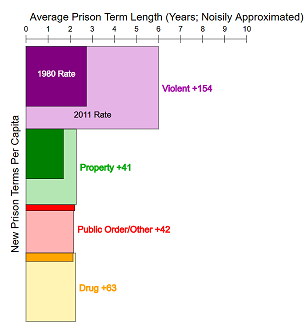
The above-linked analysis used a neat graphical trick to show Pfaff was wrong to belittle the drug war's contributions to mass incarceration. The author depicted incarceration with graphic rectangles, using the number of prison admissions as the height and length of stay in years as the width. Viewed thusly, it's easy to see that the drug war was a big (but not the only) contributor:


As the author describes it: "Most of the vertical growth — the growth in admissions — was in “public order/other” and “drug” offenses ... But those offenses apparently had short prison terms that didn’t get much longer, so they didn’t contribute as much to area growth — the growth in the incarceration rate."

That's exactly right. Corrections data are dynamic and dependent. You cannot look at any one trend in isolation, ever, which is why Chicken Little reactions to one or two years of increasing murder rates are generally misplaced. There are multiple causes of mass incarceration, and two of them are 1) increased nonviolent prison admissions and 2) increased sentence lengths for violent offenders, especially super-long sentences for murderers, which have contributed to the growth in prison units that look more like geriatric wards.

Certainly, there were portions of Pfaff's analysis Grits found useful. I've praised his suggestion for a cap and trade proposal. And his call for the feds to pick up costs for local indigent defense was spot on. (Texas counties complain rising indigent defense costs are an unfunded mandate from the state, but really they're an unfunded mandate from the Sixth Amendment to the US Constitution.)

Further, Pfaff's observations about prosecutors' contributions to mass incarceration - doubling the number of convictions per arrest as the number of crimes and arrests declined - hold true for Texas as well and is an important contribution to our understanding of mass incarceration. (This blog had revealed a similar pattern among Texas prosecutors back in 2013.) But it does not then follow, as Pfaff's book suggests, that the only viable reform approach must focus primarily on prosecutors. Because of the diffuse structure of the justice system, reformers don't have leverage points which can affect their discretion in that way.

That's why, as I'd said in Grits' review, "one can follow Prof. Pfaff's logic all the way to the end and, while much of it is thought provoking, still find it to be of little use to reformers seeking change on the front lines in the states, which is where he rightly insists the real action of criminal-justice reform takes place." Rather, "at the end of the day, he's just wrong about where the American criminal-justice reform movement should focus and why." We must confront the problem of too-long sentences. And we must roll back the drug war.

Tuesday, January 03, 2017

If tough-on-crime works so well, what's up with murder spikes in Texas cities?

So mass incarceration is working because crime is down, right?

Then what to make of the fact that Austin, San Antonio, Dallas, Houston, and Arlington all experienced significant increases in murders this year, as various media outlets have reported (although official data won't be available for a few months as the final cases of the year are categorized)?

These increases occurred despite Texas incarcerating more people - including more violent criminals - than any other state in the country. They occurred despite vast probation and parole systems monitoring hundreds of thousands of offenders in the community. They happened at a moment when more Texas cops are employed at more Texas law enforcement agencies than at any time in history, and in an era when Texas prosecutors have been granted nearly unfettered discretion. And it occurred even though the largest faction on the Court of Criminal Appeals essentially finds for the government in almost every case.

If big-government tough on crime policies failed to prevent murder spikes in Texas - which can hardly be accused of blue-state leniency when it comes to filling up courtrooms, jails, and prisons - then maybe it's not worth the expense?

That said, as is always the case when dealing with crime stats, one must place these increases in context. In Austin and San Antonio, headline writers emphasized that murder totals were the highest in two decades, which is certainly true. However, Austin had just one fewer murder in 2010, so the number isn't that much of an outlier from recent years. And besides, both Austin's and San Antonio's populations have grown monumentally since the mid-'90s (as has Arlington's, which saw an eyepopping increase in murder numbers this year). So, even after these recent spikes, murder rates remain low by comparison and residents of those cities are safer today, by a longshot, than 20 years ago. That's worth emphasizing more than press reports have done so far.

The press and public focus on murders because a) they're among the most egregious crimes b) they often come with the most compelling stories, and c) the numbers for murders are among the most solid in the crime-data realm because the dead are easy to count. Other crimes are less easy to categorize: Is it a burglary if later investigators come to suspect, but could never prove, that an adult child living with their parents was the real thief? How about if mom and dad decide not to press charges or later claim they were wrong and nothing was stolen? There are no such ambiguities when it comes to murder victims.

OTOH, murders are rare events, their numbers are generally small compared to other crimes, and totals can fluctuate quite a bit year to year for no apparent reason. Even with large, single-year spikes, one learns over time to look for long-term trends, not short-term fluctuations, to understand what's really happening. All of these cities have experienced one-year increases in murders before over the past couple of decades, even though the overall trajectory for each has been downward.

And what's happening may be different in different cities. After all, there's nothing connecting murderers but the outcome of their actions. They're solely responsible for what they do and police realistically have few means to prevent them from doing it. The cops' job is to clean up after them.

In San Antonio, the chief insisted that, “What we’re seeing now is a lot of spontaneous murders,” adding, “It’s really difficult to put a reason on it.” Dallas has also seen a spike, the majority of which the department attributed to home invasions of drug houses. But then, two years ago Dallas was crowing that its murder rates were the lowest since 1930. In Austin, the Statesman reported the murder total was "highest in nearly 20 years," but didn't mention that the per capta rates are now much lower because of the population boom. (Good for AP, which added that tidbit to their version.) Percentage increases look bigger when starting numbers are extremely small.*

Murders are terrible things but to act without understanding rarely achieves the desired results. And overreaction can also have its costs. As Chief McManus in San Antonio warned, attempts at “'arresting the problem away' or 'overpolicing' could just lead to distrust." When rare events like murders do happen, there needs to be a modicum of community trust for police to find and make use of leads, witnesses and other such indispensable assets.

I led off this column by joking about whether the murder spike means mass incarceration "works." The jibe is intended in part at my fellow Texans who've belittled other jurisdictions like Chicago or Los Angeles when they've suffered violent-crime woes. The truth is, crime has very little to do with government enforcement policies and is broadly more responsive to other societal trends and cues.

IMO, cops, prosecutors and prisons didn't have much to do with the bulk of the crime decline of the last two decades, so if they keep doing what they do and crime goes back up, that won't surprise me either. But it should surprise, and concern, anyone who has believed the tough-on-crime hype surrounding the benefits of mass incarceration. Even in red-state Texas, incarcerating more people than anywhere else, we're not immune to national trends and can't pretend being tougher has achieved any better outcomes. It hasn't.

*Pro tip for news consumers: When you see the words "fastest growing" in a headline or news article, substitute "smallest" to understand what the reporter is really describing. Things grow fast when they start small and their increases are relatively large compared to a tiny denominator. H/T to John Pfaff for harping on that observation.

Friday, November 11, 2016

Reality Check: In a fact-free era, what can we agree on?

As the whole world ponders the outcome of national elections (a subject which Grits has for the most part dutifully avoided, focusing on my own Texas criminal-justice turf), the big-picture question which disturbs me far more than the temporary resident of the White House is, "How did political discussions in America become so divorced from reality?"

I don't mean reality as in, "the way I see things." I mean reality as in a baseline respect for facts and math. The Pew Charitable Trusts recently published a remarkable poll describing whether or not Americans think progress has been made on different topics during Barack Obama's presidency. Here are the topline results:


I find most of these numbers unfathomable. To take the topic most closely associated with this blog, Crime: By any mathematical measure the nation is better off than in 2008. But only 15 percent think that's true while 57 percent think crime has gotten worse. This is delusional thinking that flies in the face of reality.

Certainly that impression has been exacerbated by the president-elect's stump speech in which he's been going around the country claiming crime is the highest it's been in 45 years, when in fact the exact opposite is true. But that's relatively recent. Long before that, the public believed crime was rising when it was actually falling. I've speculated before on the reasons, but it's a persistent, frustrating phenomenon.

Similarly, 55 percent think the immigration situation is worse than in 2008. But under President Obama, the feds ramped up deportation to highest-ever levels and illegal Latin American immigration precipitously declined.

On the Economy and Jobs, the idea that things are worse now, with unemployment below 5 percent, compared to 2008 at the apex of the Great Recession when the entire global financial system was threatened, beggars belief. Where could such a perception come from? It's utterly divorced from reality.

Of the others, US "standing in the world" and "security from terrorism" are subjective assessments and so those aren't opinions which can be refuted or supported. They're just a function of people's impressions. To me, the metrics say our standing hasn't declined - our military and economic might stand unparalleled and American-generated tech is transforming the globe. And I don't feel less safe from terrorism than when President Bush was prosecuting the Iraq War, which to me was a generator of those problems more than a solution. But because there's no hard metric on which to base an opinion, Grits will let those disagreements pass on the reality-check front.

Race relations is the only area where I can understand the public's view that things have gotten worse. For those judging purely from what one sees in the media from the comfort of one's living room, I'm not surprised most white Americans might think race relations have gotten worse. My own personal view is that recent debates over race and policing merely exposed longstanding problems rather than created them. But there's no doubt race relations remain strained, and those strains are hungrily aired in the media using click-maximizing strategies that gravitate toward the nastiest, most entrenched Culture War debates.

Regardless, that's four of the seven major areas identified by Pew where, objectively, the public's views directly contradict the facts. It's not just that there's countervailing evidence, the public objectively, demonstrably thinks things are true which are false.

I'm not saying this to defend Barack Obama's record. The election is what it is and I don't care a whit about protecting (or harming) the Dems' brand. But how did we get to this place where the majority of the public simply believes big, important things which are not true? And far more important than who is in the White House, how can we change THAT? That's the part of the last year which for me has been unbelievably dispiriting.

Thursday, September 01, 2016

Democratic Party hypocrisy on #cjreform

When Black Lives Matter activists approached Democratic congressional campaigns about criminal justice reform, the DCCC advised candidates and their staff to patronize them, "listen" to their concerns in small-as-possible groups, avoid committing to any specific policies, and portray themselves as sympathetic without actually promising to do anything, according to a memo leaked by a hacker.

In particular, the memo told candidates not to make any policy commitments regarding "Criminal Justice System reform" including "sentencing reform, ending prison industrial complex, police reform," changes in "hiring, training, and unfair policing tactics," as well as "Collect[ing] data on police shootings" and "Demilitarization of the police."  Thanks for nothing, Nancy Pelosi.

Even as President Obama has finally, significantly embraced criminal-justice reform in his last year of office (better late than never), the rest of the Democratic party remains as skittish on the topic as he was during his first 6.5 years. It's a standing Republican meme - one repeated recently by Donald Trump - that Democrats' interest in African Americans does not extend beyond getting them to the voting booth in support of white, Wall-Street approved elites like Hillary Clinton. And every once in a while, hard evidence arrives that supports and justifies those suspicions.

This memo exemplifies why Grits has resisted framing criminal-justice reform as a partisan issue over the years: these topics have never played a central role in a Democratic Party more concerned with winning District Attorney, Sheriff, and judicial races than promoting civil rights. One would like to reject cynicism, but to do so in the face of concrete evidence is to embrace a delusion.

Talk is cheap. Reform is hard. Going forward, we need to see quite a bit more reform coming from Democrats before we hear more talk about how much better they are than Republicans on this stuff.

Monday, August 29, 2016

'Body Camera Obscura': Videos of police violence and matters of perspective

Image from fatal police shooting in Palestine, TX, 2015.
Those thinking through the implications of police body-camera policies and procedures may find useful this academic article I read over the weekend from Georgia State law prof Caren Myers Morrison, titled "Body Camera Obscura: The Semiotics of Police Video." Her analysis takes a step back from legalistic controversies to think more deeply about how meaning is derived from video images of police violence, particularly in courtroom settings. "Using insights from semiotics, film criticism, cultural theory, and cognitive psychology, [the article attempts] to sketch out a more nuanced way of approaching video evidence in the context of these cases. The aim of this article is primarily descriptive and diagnostic: we are in danger of misunderstanding a new source of evidence in these hotly contested cases, and making an already permissive standard even more lax." As things stand, she wrote, "Courts seem remarkably unsophisticated and credulous when dealing with video evidence."

"A bit of a touchy-feely approach for my tastes," Grits thought upon seeing the title and abstract, but Morrison has produced a thoughtful and useful piece that systematically runs through various strains of bias which can infect those interpreting video and result in different types of errors. "Because video evidence is so emotionally compelling," she wrote, "it makes factfinders vulnerable to a host of biases, including naïve realism, or the belief that what one sees is the uncontroverted truth, the inability to recognize the role of subjectivity, the fragmentation of perspective, and identification bias." The article then discusses each of those in turn in the specific context of police body cameras - a valuable contribution.

One critique I don't agree with: The author writes that the "unquestionable usefulness of video recordings comes with a dark side; cases without video now tend to be devalued and overlooked by the public." Of course, that's true, but it's not necessarily problematic.

Grits' own criminal-justice reform work began in response to a string of bad police shootings and misconduct in Austin in the mid-1990s. In 1997 I launched a now-defunct site called the Austin Police Department Hall of Shame, which documented sustained misconduct and questionable use-of-force incidents by Austin police officers, expanding the work statewide in 2000 into a site called the Texas Police Reform Center. (That site shut down when Grits for Breakfast launched in 2004.)

So, having spent years trying to convince the public to care about police misconduct in the pre-cell phone era (I was director of the Police Accountability Project at ACLU of Texas for seven years, 2000-2006), Grits can say with confidence that, before cell-phone and dash cam video, those cases were devalued and overlooked anyway, going back many generations. Without video, even convincing people there was a problem was a difficult slog. It wasn't real to the white public until they could see it with their own eyes. And a glimpse of the truth is better than no access to it at all. With video, the public ignores cases without video; without video, they ignore these issues entirely.

Regardless, lots of other interesting stuff here. This discussion of the implications of Morrison's humanities-based approach gives a flavor:
Police video is video recorded by the police in the course of their official duties, either via dashboard-mounted cameras (“dash cams”) or body-worn cameras (“body cams”). Eyewitness video, often recorded on a cellphone, is taken by bystander-witnesses or victims, either spontaneously or as part of a Copwatching program. These two types of videos offer contrasting narratives. Police video tends to recirculate dominant narratives of violence and masculinity as heroic ideals that coexist easily with the legal standard of the reasonable officer. In contrast, the perspective in eyewitness videos typically challenges those narratives and offers the counter-narrative of an abusive state.

The malleability of video in the context of police use-of-force cases has been apparent since a primarily white state jury found four white Los Angeles police officers not guilty of unlawfully assaulting black motorist Rodney King in 1991, despite a video capturing the beating. Arguably, this was because video recordings don’t actually show the “truth” of any interaction— they are inherently indeterminate. Video will reflect a different reality depending not only on who is watching, but also on who is recording. Therefore, in the context of police violence cases, legal actors need to view images with greater skepticism, and be aware of the competing narratives they offer.

While images have evidentiary value, they also have cultural currency. There is a tension between the use of video as “both evidence and a call to action,” on the one hand, and as entertainment, recycling a historical spectacle of black victimhood, on the other.  Because the paradigmatic video is that of a black man shot by the police, these images reflect back to us our feelings about violence, race, masculinity, and the law, and how we believe they should interact.  But the salience of the videos that make news headlines tends to focus attention on the worst kinds of police violence, and their shock value may distract us from thinking more deeply about systemic questions that go beyond individual encounters.
Not sure I completely agree that bodycam footage always portrays officers as a hero, but it's inarguable that they only show one perspective, and not always a determinative one. I also agree that focusing on the most extreme cases discourages deeper systemic thinking, in much the same way that myopic focus on death-penalty cases overlooks problems in the far-more-vast non-capital parts of the system.

"Video evidence is at its most powerful and least ambiguous when it can contradict a false account given by the police," she noted - an effect entirely obviated by policies that allow officers to see the footage and other evidence against them before answering questions from police investigators. But in more ambiguous, workaday cases, "video evidence needs interpretation just as much, if not more than any other type of evidence."

The SCOTUS standard applied in police use of force cases "does not take into account the police officer’s actions in precipitating the confrontation," the author observed, leading to allegations that the standard "condones unnecessary violence" by ignoring the officer's role in getting to that point. The standard focuses only on the split second in which the officer makes the decision to fire, not "what went before."
For all of its benefits, video evidence encourages this atomization of facts, literally focusing the factfinder on the narrowest of moments in the encounter. When examining police video, particularly body cam video, the legal standard melds with the perspective of video, reducing a confrontation informed by many factors to a simple matter of whether the officer might plausibly have been in fear for his life at that one moment. This is where the “deceptive intensity” of video evidence can be problematic. If police video can heighten the sense of danger to the officer, it may place a thumb on the scale in favor of the officer in the eyes of many viewers.
The meat of the article examines case studies exemplifying various types of biases and showing how subjective interpretation colors every image, whether it's police, prosecutors, courts or the public doing the interpreting. Police body cams are new, but theoretical work regarding how people interpret moving images extends back a century. Grits learned a few things seeing the latter applied to the former.