A very serious disturbance took place in the city of Houston ... which it was at one time feared would result in much bloodshed and other riotous acts.
A colored man, named Geo. Noble, and another colored man, named Bob Henrick, were at a colored dance, or ball, on Saturday night, in the suburbs of the city, near the "Old Grave Yard," at a place kept by a colored man named Bias. An altercation ensued between Bob Henrick and another colored man, whose name we have not learned. George Noble interfered and endeavored to stop the difficulty in an amicable manner. Bob Henrick took offense at this, and resenting it, put his hand upon his pistol, drew it, and fired, missing his aim. George Noble drew his pistol at the moment he saw the action of the other, and also fired, hitting Henricks in the neck, the ball coming out at the back of the shoulder. Henrick, however, is not dangerously wounded.
From the statement of Marshall I.C. Lord and Deputy Marshall J.N. Lord, we glean the following particulars of the subsequent event. Geo. Nobles immediately after the above occurrence went to Deputy Marshall Lord and stated his difficulty and delivered himself up, and was placed in confinement at the Bell Tower on Market Square. About 4 o'clock the next (Sunday) morning a number of freedmen, armed with guns, came to the calaboose and said they wanted Nobles. Of course, he was not given up to them. The negroes insisted that he should be given up -- and they believed he was not in confinement but at liberty.
One freedman, Ned Lockhart, offered to lead his companion to the calaboose, take him out and hang him. Marshall Lord went up to Lockhart and attempted to arrest him, but he broke away, but Lord succeeded in getting to him and struck him with his cane when a general melee resulted in which Marshall Lord was bruised and shot in the back of the head, and Lockhart was shot in the thigh, another freedman, who had shot at Marshall Lord, was pursued and after being disabled by a shot was also arrested and sent to the lock up. Immediately after these occurrences the colored people began to pour into the Market Square from all parts of the city, a large number of them being armed. Vengeance on the prisoner Nobles, was the generally expressed object, and bitter hostility and threats toward the white people were generally manifested and uttered. The Telegraph adds:
At this time the city bell began to ring to call the citizens together and they came pouring in, a great many of them armed, and as the two races mingled together and expressed their feelings according by the temper of the occasion, a bloody collision seemed for a while unavoidable.
After a time, however, the negroes dispersed, and in a little while the news spread rapidly that over five hundred of them were assembled at the colored Methodist Church, and that they openly proposed to march down Main street, seize all the arms they could, arm the black population generally, attack the whites, and that the unarmed ones among them would assist by firing the city. This turned out to have been very nearly correct. But better counsels at length prevailed. Several of our prominent white citizens, who were either sent for or were of their own motion, together with the Mayor, made addresses to them, and they decided to abide by the decisions of the courts in all matters involved. At the same time, however, colored couriers were seen going in all directions, mounted and on foot, to summon their brethren from near and far.
While all this had been going on, the citizens had been rapidly organizing and arming both in independent companies and as a special police force. This work continued the whole day, and until after dark. The whole city was full of armed men and men arming. In addition to the large police force organized, the various fire companies were armed and ready to turn out at a moment's warning, besides the temporary organizations of citizens, each company being under the command of officers selected for the occasion. Signals were agreed upon to which every man was to respond instantly. Scouts and couriers were sent out, and the armed citizens not in the companies were generally agreed to turn out should a general fight ensue at any one place.
Thus was the evening and the night passed, until the next morning dawned on the city. The patrol went through every part of the city during the night, and strange to say hardly any colored men could be found. The women and children were all alone. The men had evacuated the city entirely. The most of them, however, returned in the morning.
The following was the arrangement agreed upon under the auspices of the Mayor:
"In the matter of the killing of a colored man by George Noble (colored) by which a serious public riot was imminent, His Honor, Mayor McGowan, appointed the following persons, to wit: C.S. Longcope, B. A. Shepherd, W.R. Baker, John Shearn, T.W. House, Elias Dibble, Charles Chatman, Sandy Parker, Dick Allen and John Sessums, a committee to concoct such measures as would tend to allay the excitement and prevent like occurrences in the future. And among other things, after appointing C.S. Longcope Chairman, and W.R. Baker Secretary, the committee unanimously adopted the following resolutions.
"Resolved, As the sense of this committee that while deploring the occurrences of this morning, that it is deemed proper that a thorough investigation should be had into the conduct of the persons who assumed the initiative in it, to ascertain if there was any partiality in the proceeding whereby the city was seriously endangered in its peace and in the preservation of property. If it be ascertained that there has been any wrongdoing on the part of any one, that steps be taken to appropriately punish any such party or parties.
"Also, Resolved, That the trouble in this community which was caused by the death of a fellow human being, and the wounding of several others, which threatened a general riot, grew out of the pernicious habit of carrying concealed weapons, and that the Mayor and Aldermen of this city be requested to pass an ordinance with sufficient penalties prohibiting the carrying on the person of all concealed weapons; and that the Council memorialize the State Convention to make a Constitutional provision of the sme import for the State at large."
C.S. Loncope, Chairman
Subsequently to the above the Mayor of the city issued the following proclamation.
Mayor's Office, Houston, June 16, 1868
Notice is hereby given, that, in order to allay all feeling and excitement occasioned by the unfortunate occurrences of Sunday last:
It is hereby ordered that all citizens disarm themselves and place their entire reliance upon the execution of the laws by the officers thereof.
All parties who have been called upon to act, and were sworn as special police, are required to leave their arms at home and are relieved of active duty until called upon to prevent disturbances, regardless of the quarter from whence they arise.
I call upon all good citizens to assist in carrying out the laws, for upon the execution of them alone can we rest safely.
And I earnestly request of all that they pursue their usual avocations, that all disquietude and feeling may be suppressed.
A. McGowan,
Mayor City of Houston
Tuesday, April 04, 2023
Near race war in 1868 Houston led to ban on carrying firearms for self-protection


Tuesday, July 26, 2022
Reimagining History at the Austin Police Academy
Sunday, January 23, 2022
In 1950s, Austin removed lights and sirens from police cars: Result was award winning traffic safety record
But in the 1950s, Austin police took an even more drastic step to reduce police-vehicle accidents: Grits was today years old when I learned that, in the 1950s, the Austin Police Department removed lights and sirens from its police cars to encourage better driving by its officers.
It worked. Accidents involving officers plummeted and the city won a national safety award for its vehicle fleet.
In an Austin Statesman article dated December 27, 1955 titled, "Siren, light removal makes police unhappy," the paper reported that "removal of the sirens and red lights has materially reduced accidents involving police cars rushing to other smashups or speeding to the scene of a crime."
Police Captain George Rogers, head of the department's traffic bureau, said "it was a very important factor" in Austin's winning of the 1955 fleet traffic safety award.
The award - presented by the National Association of Chiefs of Police and the National Safety Council - recognizes the Austin police department's fleet safety record as the best in the nation.
They began removing lights and sirens as they replaced old patrol cars starting in 1953. According to Captain Rogers, "Some of the boys got it in their heads that because they had sirens everyone would get out of their way, but of course that's not true. We figured we could save equipment by removing them, and we have."
Rogers noted that since July only two police cars have been involved in accidents - a substantial better showing than in the past.
[City Manager Terrell] Blodgett put it this way: "We did it to reduce accidents. We felt that the few seconds saved (because of sirens) were not worth the chances of accident and injuries.
"Rank and file" grumbled about the change, but for at least a few years, it stuck.
I can't tell precisely when lights and sirens made it back onto Austin police cars. But in 1971, the Legislature passed a state law mandating that "an emergency vehicle on an emergency call must use red lights and a siren." Not long thereafter, two Austin police cars were totaled when they hit each other driving with lights and sirens to a non-emergency call. One of the officers was seriously injured. Reported the Statesman at the time:
At one time, the Austin police force did not have plainly marked patrol cars and only had a small red light which an officer placed on the dashboard of the unit when stopping another car.
No car was equipped with sirens at that time. ("New police Code 3 policy requires sirens, red lights," Austin American Statesman, Dec. 28, 1971)
This is a shockingly forward thinking policy prescription for the 1950s and I'm amazed police brass were willing to stand up to the rank and file to enact it. Less surprising are the facts that a) it undeniably reduced accidents and saved lives and b) eventually the city succumbed to pressure from the "rank and file" to change it back.
Wednesday, September 22, 2021
More police won't help with Austin's biggest public-safety threats
The argument for Prop A - the GOP-backed initiative to force the city of Austin to hire 500+ more police officers - is premised on the notion that Texas' capital has become uniquely dangerous as a result of the city council's anti-law enforcement policies. Local media have doubled down on this meme, touting Austin's "record" number of homicides while downplaying the fact that we're now a city of a million people and the record was set 40 years ago.
How journalists present this information tells us more about them than whether Austin is a safe town. You can run with the scary headline, "Austin hits all-time murder record," or the equally accurate, "Austin has slightly more murders than when it was a much smaller town 40 years ago." The former may work better as clickbait (which is why they do it - hi, Tony Plohetski!) but the latter, contextualized account gives a more accurate sense of the threat.
Though you wouldn't know it from the local media's framing, the murder spike in Austin last year tracked nationwide trends and other Texas cities - including Republican-led communities like Fort Worth and Lubbock - saw even greater increases. So the notion that the murder spike resulted from Austin-specific policies or local attitudes toward police are dubious at best: Nobody thinks Lubbock's city council is anti-police, and they saw a 105% increase in homicides last year.
Even if you think crime is a problem, there's strong evidence hiring more police won't help. The question of whether hiring more police reduces crime has been intensively studied for decades with consistent findings, according to a 2013 metastudy analyzing hundreds of research findings over 40 years. Those researchers concluded, "This line of research has exhausted its utility. Changing policing strategy is likely to have a greater impact on crime than adding more police."
Prof. Bill Spelman, a criminologist and former Austin city council member, now retired from UT's LBJ School, made similar assertions on local Fox news this week. He pointed to the lack of correlation between police staffing size and homicide increases last year, noting that departments of all sizes saw murder spikes, including agencies with high and low staffing ratios alike.
Indeed, Prop A arises from a fundamental misunderstanding of the safety risks faced by the public. Murders are a scary way to die, but in Austin they're an incredibly uncommon one. By comparison, more than one thousand Austinites have died from COVID in the past year and a half. Prof. Spelman analyzed the various death risks in Austin and compared them to national averages. Here's what he found:

Spelman's research re-frames the public-safety question more broadly to include ALL the threats people face, not just scary murderers. And as soon as one considers that broader question, the murders don't seem so scary. They're terrible events happening to small numbers of folks, but their existence shouldn't cause us to de-prioritize responses to threats that pose equally grave danger to far more people.
Thursday, August 19, 2021
#SandraBland Act data used to identify Texas' most aggressive, small-town speed traps
Our pals Eric Dexheimer and St. John Barned-Smith at the Houston Chronicle have performed a great mitzvah by analyzing traffic stop data from Texas' Sandra Bland Act to identify the most prolific Texas speed traps.
They found 21 small town agencies giving out more than 500 tickets per officer per year, making up up to 40% of municipal budgets. Anti-speed-trap laws passed by the Legislature, they found, are riddled with loopholes and seldom enforced.
Remarkably, "It doesn’t take many officers to affect a small city’s bottom line. Wells didn’t have an active police force in 2017 and collected less than $10,000 in fines. When it reactivated the department a year later, fine collections rose to $592,865."
Another example: "In Riesel, Chief Danny Krumnow is adamant: When his two officers aren’t working other calls, they better be working traffic. State data show about 87 percent of motorists stopped last year drove away with a ticket. Municipal court fines last year made up more than half of the town’s general fund." Perhaps unsurprisingly:
Many of the state’s most aggressive traffic enforcers shared key characteristics: small towns situated on busy high-speed thoroughfares where the speed limit quickly drops from highway to local-street speeds — or even lower where school zones intersect roads. Virtually all of the departments had fewer than a dozen officers.
Your correspondent was quoted in the story, citing data first published in this blog post back in April. Because no MSM news outlet has covered it, most people even in law enforcement don't realize traffic enforcement in Texas has plummeted over the last decade, with the number of tickets given declining by more than half from 2008 to 2020. (Notably, non-traffic citations declined by a similar amount over the same period.)
The logic of traffic enforcement is that it improves safety by decreasing traffic violations. But Texas' experience doesn't reflect such a trend. Over the same period, traffic fatalities per mile driven in Texas fluctuated year by year, but ended up slightly lower overall and certainly evinced no large bump in fatalities.
As I asked at the time, "If radically less traffic enforcement seems to have no noticeable impact on traffic fatalities, what precisely were we doing it for?"
The Houston Chronicle story provides at least a partial answer, particularly for small towns: Revenue. Indeed, "In Wells, in East Texas, the chief’s report at every city council meeting consists of a tally of traffic stops and tickets written." That's apparently the only "public safety" metric they care about.
I'd made a comment to the reporters I figured would be controversial:
Others say departments whose officers can afford to spend so much time writing tickets signal a jurisdiction that is over-policed. “These are cops who don’t seem to have much police work to do,” said Henson
But the cops they interviewed corroborated that assessment:
In Gregory, a city of 2,000 across the bay from Corpus Christi whose officers are some of the state’s most prolific ticket-writers, Chief Tony Cano said there was some truth to that.
“Our number of call-outs is low, so I guess you could say they have more opportunity to work traffic,” he said. Although “officers are not encouraged to write tickets, that’s what they do. I’ve seen the numbers and I’m like, whoa, those are high.”
If only he were in a position to do something about it! (smdh)
Grits welcomes this new analysis, and not only because I dislike speed traps and cops who prioritize revenue generation over crime fighting. It also represents the first time data from Texas' Sandra Bland Act has been used in an analysis not focused on racial disparities.
The Sandra Bland data should be a gold mine for law-enforcement research providing extremely detailed information about what goes on at traffic stops at a granular level, allowing robust analyses that to my knowledge couldn't be performed in any other state. But no academic researchers have latched onto the dataset, and before now, MSM reporters who analyzed it were solely focused on racial disparities. That's an important aspect of the new data, but it's by no means the only analysis that can be done with it.
I'm hopeful this article opens the door to more such uses: You can't manage what you don't measure, the saying goes, but the flip side is measurements don't matter if managers don't use them to seek improvements. Identifying speed traps is only one of many useful analyses the Sandra Bland Act data newly allows. But it's a good start.
Thursday, August 12, 2021
Bring on Austin's police staffing debate: Proposal to hire 400-800 new cops would require budget tradeoffs the public won't support
Grits isn't so sure. I think they've overreached. And the biggest reason is the budget math, which has been called "irresponsible" but may be straight-up "impossible" without massive tax increases the Legislature has forbidden via municipal revenue caps.
Yesterday, the city council put the Save Austin Now initiative on the November ballot and the financial services department released an estimate of the proposal's cost. There's some fuzzy language in the measure using undefined terms, so it's a range: To meet the requirements of the initiative, Austin would need to hire somewhere between 400-800 more police officers than it employs today, at a cost of $54 million per year on the low end to $120 million on the high end.
The difference arises in part because the initiative calls for officers to have 35% "community engagement" time. Currently, they have about 1% "community engagement" time, based on definitions the city has used in the past. But the phrase is sometimes used interchangeably with "uncommitted time," which includes things like checking email or restroom breaks, not necessarily "community engagement." The low estimate assumes the latter definition; the high-end estimate assumes the former.
Courts may eventually decide which definition to use. But even on the low end, increasing the budget by $54 million per year - given legislative revenue caps - would force draconian cuts.
The other factors driving the cost estimates are wage increases and the size of Austin's population. The $54 million figure assumes lower population growth and police wage increases than we've witnessed in recent years. Grits believes that figure is probably too low and the real number will be closer to the high end of the range.
SAN suggests all this could be paid for by eliminating money spent on homelessness. But even if you closed all the shelters and eliminated every service to that group (which doesn't sound particularly wise), it wouldn't raise nearly enough money. Money for recent expenditures purchasing hotels to get folks off the street came from the feds as part of the COVID stimulus: That's one-time money, not an ongoing revenue stream from which the city can pay salaries.
The truth is, you can't get to $54 million per year without cutting things the public STRONGLY supports: The entire budget for the city's animal shelters is about $10 million, for example. You could eliminate them entirely and still not be 1/5 of the way there.
Thanks in large part to the 40% of the city budget already spent on police, the overwhelming part of the city budget arrives at city council every year fully baked in: The amount they have for discretionary budget choices is generally in the low seven figures: a few million dollars. $54 million in new spending can't be done without closing things most Austinites don't want to eliminate.
This is the police unions and the Republican party doubling down on their anti-homeless ballot initiative this spring, but Grits predicts they'll find this a much harder sell. For starters, they did the last one during the legislative session when most of the criminal-justice reform advocates in town were focused on fighting bad bills at the Legislature. SAN outspent their opposition by more than 15-1 and the opposition campaign was led by inexperienced folks with nonprofit backgrounds who'd never run a campaign before.
This time, they'll find groups like the Austin Justice Coalition and its allies more fully engaged in the fight. A new PAC was formed to oppose the measure and experienced campaign staff has been hired, so don't expect the fundraising gap to be nearly as significant. And whereas the Mayor and most city council members stayed out of the homeless fight, the outlandish budgetary issues ensure they'll be vocally opposed to this one.
Local TV news has been SAN's biggest ally, giving their leadership a platform to spread misinformation with impunity. (The local FOX station has the SAN leader on frequently to "debate" different folks but the supposed debate moderator never fact checks his lies: It's really pretty embarrassing.) That's the biggest risk of this thing passing; if they let SAN pretend Austin can hire hundreds of new police with no budget tradeoffs, people might be duped into backing something they otherwise wouldn't support.
But the upgraded opposition campaign means there will be somebody out there informing the public besides local TV news. It's not going down like Prop B, where the opposition didn't have resources to counter the message.
Indeed, Grits welcomes this debate and am near-giddy that SAN has framed it this way: The anti-homeless initiative passed because West Austin was mad about public camping and wanted homeless folks out of their sight line. Now, the policy discussion shifts to the real-world tradeoffs involved in spending so much new money: A very different debate.
Prop B passing left the impression that Austinites oppose criminal-justice reform. Defeating this measure will reverse that false meme and perhaps give local media a chance to reboot their sycophantic cop coverage.
Friday, July 30, 2021
Austin PD teaches cadets US Constitution using material from John-Birch-Society shill
Wednesday, July 28, 2021
What if any changes to police deployment patterns might reduce violent crime? Hotspot policing vs. ↑ resources for detectives
There are SO many studies on this topic, many of them very micro-focused and not particularly useful, let me give you a big-picture, 50-year overview of the research findings on this.One of the most robust findings in criminology is that patrol doesn't reduce crime overall or make people feel safer (going back to a major field study in Kansas City in the '70s), and police staffing levels appear to have no relationship either way to crime going up or down.However, this result didn't sit well with police or their advocates, and in the 1980s, criminologists began to revisit the question, this time shrinking both the geographic areas examined and the time periods considered. Finding a negative result wasn't considered a failure of the tactic, just evidence that the geographic and temporal constraints hadn't been sufficiently narrowed. Eventually, they were able to demonstrate that flooding a neighborhood with police to perform stop and frisks and/or pretext stops correlated to reduced reports of serious crime IN THAT GEOGRAPHIC AREA for whatever period of time they kept it up. There are a bunch of studies out there like that.However, few of the hotspot studies I've ever seen claim this is anything more than a short-term effect that goes away as soon as police leave. And most researchers will admit it's likely crime just bleeds into other geographic areas, the way air moves to the sides when you squeeze a balloon.N.b., generally, what you see when these studies are portrayed in the policy arena is a bait and switch. Cops say "hot spot policing works" then use that to call for increased staffing. But we KNOW increased staffing doesn't correlate to greater safety. The hotspot research is about deployment of EXISTING officers, not an argument for hiring more overall.Finally, if I were making public-safety recommendations for Houston based on the current data, I wouldn't be focused on patrol or hotspot policing, but beefing up the detective ranks, maybe even AT THE EXPENSE of patrol. Again: The real issues are how officers are deployed, not how many there are.
There are 200 Narcotics Division detectives at HPD - far more than in homicide. I've argued Narcotics should be entirely disbanded, and those detectives should be moved to investigate 1) homicides and 2) shootings that do NOT result in death. The latter are almost completely ignored but are essentially similar to the murder cases; whether the victim lives or dies has more to do with the EMTs and doctors than the intentions of the shooter. (I'm not generally a fan of the Manhattan Institute, but they recently published a report reaching the same conclusion.)
So that's the redeployment I think we should be pushing for if the goals are to reduce racial disparities (they're TERRIBLE in Narcotics) while reducing violent crime: Expansion of detective resources to investigate non-fatal shootings. That'd do FAR more to improve safety than anyone would ever claim for hotspot policing.
If you ask what police are actually DOING to reduce crime in hotspot areas, criminologists have no answer. It boils down to what I've dubbed the "Scarecrow Theory" of policing: Their mere, occasional presence wards off potential criminals. But cops aren't deployed theoretically, and as a practical matter, what they do while they're there (if they're deployed to a hotspot and not responding to IRL crime reports) are traffic stops and stop-and-frisks of pedestrians. And most of the people with whom they engage are not and never will be shooters; there's a disconnect between the strategy and the desired results.
I don't consider it some radical position to say homicides and non-fatal shootings should be better investigated: Clearance rates for murder in Houston have declined from 89% in 2011 to 49% last year. And "hotspot" policing would do nothing to change that dynamic.
If the problem you want to solve is violent crime, focus on violent crime. Don't engage in generalized harassment in black and brown neighborhoods then assume reduced murders will somehow be a secondary effect.
Tuesday, July 27, 2021
Austin PD's "early warning system" is a failed PR stunt, like pretty much all of them
It's been many years since I've been that deep in the weeds on the topic, but a new Austin city auditor report on their police department's "early intervention system" - known within the department as the "Guidance Advisory Program" (GAP) - confirms my sense that they're essentially worthless. Austin's, the auditor found, "does not effectively identify officers who may need assistance."
As is typical, there has been no local MSM coverage of the audit. (I know, gentle readers, you're shocked at the omission!)
APD's police early-warning system suffers both from over-identification and under-identification. It gathers only three, not-very-probative data points and ignores data used by systems in other cities. The thresholds to trigger review are set too low, so too many officers are identified for intervention and the system has little predictive value. At the same time, many officers meeting thresholds are not identified at all. On use of force (at APD, called "response to resistance), the department failed to identify about a third of officers who should have met the threshold for review. Moreover:
When officers are identified for assistance, the GAP does not connect these officers to existing APD support or wellness services. Also, APD does not track or analyze program trends to evaluate officer or program performance to ensure the GAP is fulfilling its mission. In addition, APD management has not generated true program buy-in and the GAP is not working as intended.
The auditor sampled 60 activations and found supervisors identified no issues 93% of the time, resolved the issue with a conversation 7% of the time, and NEVER created an action plan to correct officer behaviors, even though that's theoretically supposed to be triggered by the system. As a practical matter, they're just not doing anything with the information:
APD staff said there are no performance metrics reported in relation to the GAP and they have no way to measure the program’s success. In addition, the department is not analyzing results to identify trends or determine if certain officers, assignments, or supervisors need additional support services.
Even an officer triggering the system three times in three quarters based on 45 total use of force incidents was found to have displayed no "pattern" that caused concern. Intervention after 45 incidents wouldn't seem particularly "early" to this writer, but if they're not going to review outliers, anyway, IRL it hardly matters.
The reality is, as the auditors wrote, "APD is not creating an environment of trust and transparency" regarding its responses to officer misconduct, either with officers or the public, and failures of the early warning system are a symptom of that broader problem.
That said, none of the other early warning systems in Texas work well, either. There are no real best practices and as a result, their structures are all over the map. Here's a summary from the report of the information gathered in each one, which varies quite widely.

Dallas' last chief Renee Hall proposed spending nearly a million dollars to revamp their system, with no results so far. The one in Houston tracks 10 different metrics, compared to 3 in Austin, but the Mayor's task force on police reform last year found it ineffective and recommended an upgrade (without specifying details).
I suppose it's possible an "early warning" system could be devised that would fulfill the goal of reducing misconduct, but academic reviews have found little evidence for their effectiveness (if plenty of enthusiasm for giving it the ol' college try). Grits believes their popularity stems largely from their PR value: It's something police chiefs can say they're implementing, improving, etc., that will take the heat off them in the near term because they ostensibly need time to launch a new program. The program never seems to work, though, whether they monitor three data points or 10. Then another scandal happens and suddenly we're revamping the early-warning system again.
Austin doesn't need APD to waste time on this pointless paper shuffling and IMO they should scrap it. If managers want a list of officers who need retraining or intervention, they should ask Farah Muscadin, the head of the Office of Police Oversight, for a list. She knows perfectly well who the problem officers are at this point, even if APD brass isn't paying attention.
Sunday, June 20, 2021
Abbott vetoes demonstrate continued antipathy toward #cjreform, bootlicking toward police unions
By contrast, most of the big stuff never made it to the governor, and here's how Kathy described the reform bills Abbott vetoed:
The Governor's vetoes are a final punch in the nose for the bipartisan criminal justice reform movement, and a clear reminder (in case we forgot for a second) that the 87th from start to finish has been mainly about Abbott's re-election on a platform of "tuff" on the poorest and most desperate among us.Abbott vetoed SB 237, predictably, after announcing that he was clearing out a prison to hold migrants arrested for trespassing by his promised army of troopers. That bill would have added criminal trespass to the list of Class B offenses for which an officer could (discretion only) issue a citation instead of arresting.Abbott vetoed HB 686, juvenile "second look" after even Dan Patrick found a version he could live with. The final bill allowed a person who committed a violent offense as a kid to get a review and possible release (just the possibility, that's it) after serving at least 30 years. Hardly soft on crime, and a bill supported by the Catholic Conference of Bishops, TPPF, Goodwill, United Way and a host of others. Who opposed? Only Ray Hunt on behalf of the Houston Police Association. Hmmmm....Abbott vetoed HB 1240, a bill with no formal opposition at all. That bill would have authorized fire inspectors to issue citations over fire code violations the way health inspectors do. Apparently now, you have to be a sworn police officer. A bill that would have empowered other public safety agencies to make the public safer without having to use police....Hmmmmm....Abbott vetoed SB 281 that would have finally ended a police investigative technique from the 70s and 80s called forensic hypnosis. Which is pretty much what it sounds like. A "specially trained" police officer applies hypnosis to a witness or suspect and elicits, well mostly garbage. Because...hypnosis.Finally, and this is the one that, for me, shows Abbott's hand. He vetoed HB 787 that would have allowed formerly incarcerated people and people on probation to get together (without violating terms of probation against fraternizing with criminals) for purposes of "(1) working with community members to address criminal justice issues; (2) offering training and programs to assist formerly incarcerated persons; and (3) advocating for criminal justice reform, including by engaging with state and local policy makers."It appears that the voices of the formerly incarcerated were very effective this session, so we can't have any more of that.I could not find any veto messages for these bills posted yet, just the fact of the veto listed on the Capitol website. So if the Governor has anything useful to say for himself, I'll add more later. For now, these vetoes kind of speak for themselves.
Thursday, June 03, 2021
New TX homeless ban creates unfunded mandates for cities: Costs downplayed during #txlege process but cities must foot bill to store homeless belongings and can't limit arrests to ↓ costs
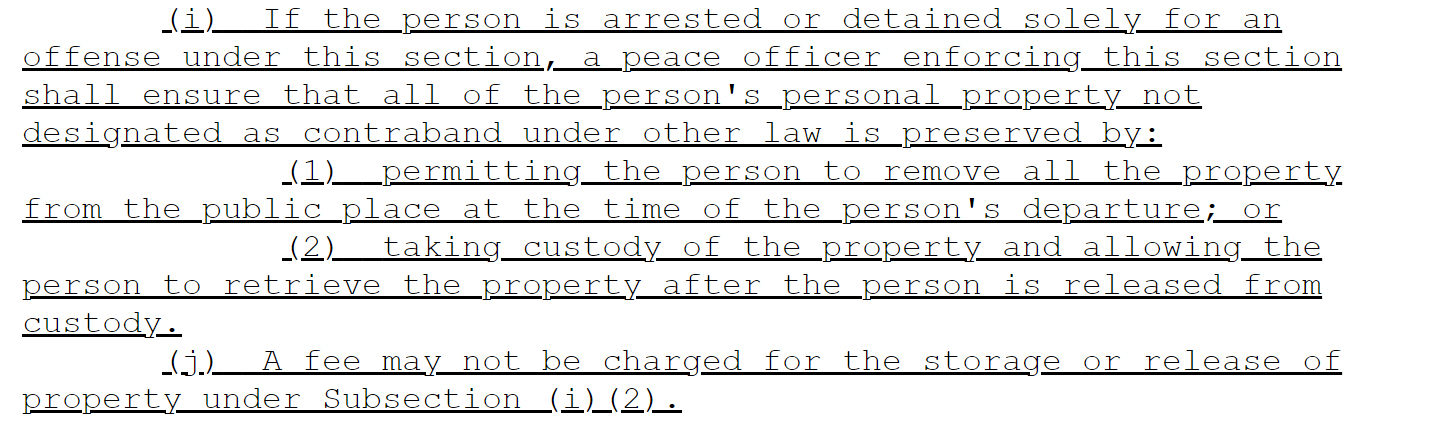
Regardless, the bill forbids cities from establishing policies that limit these arrests, so if and when costs start racking up, the Lege will have taken away their ability to limit this expense.
Thursday, May 27, 2021
Fascism Unsheathed: Let's be very clear about what just happened at the #txlege
In 2021, the spear tip was unsheathed and thrust deep into the body politic: A combination of the pandemic, President Trump's defeat, and the January 6th insurrection seem to have finally awakened the beast. This was the year the far-right wing of the party finally got its wish list they'd been denied in the 20 years since Republicans took power in Texas: The entire legislative session was about abortion, guns, jingoism, and "backing the blue." Compassionate conservatism and non-gun-themed libertarianism were more or less banned from the building, or at least the eastern wing.
The Texas House, with a larger, more ideologically diverse membership, retains a broader array of Republicans that still includes some "small government" and/or "compassionate" types. They managed to pass several significant criminal justice reform bills, but virtually nothing of consequence made it through the senate. Reforms with overwhelmingly positive, bipartisan polling numbers like reducing marijuana penalties and ending arrest/jail for Class C non-jailable traffic offenses could never even get committee hearings on the eastern side of the building. Instead Sen. Joan Huffman wasted weeks on a failed effort to gerrymander appellate courts to rescind recent Democratic gains.
Some of this lurch toward totalitarianism was overt and ham-handed, perhaps most notably legislation to require sports teams to play the Star Spangled Banner. More insidious were attempts to control historical narratives about race and slavery in Texas schools and museums. These efforts were as shameful as they were transparently authoritarian. We're just a step or two away from parading historians through the streets in dunce caps.
Perhaps the most subtly fascist influence radiating out of this session was HB 1900, ostensibly punishing cities that "defund police." Large cities and counties henceforth must prioritize spending on law enforcement, leaving roads, parks, social services, or any other traditional municipal functions to wither in a time of massive urban growth.
Grits believes the purpose here is both political and dystopian: Texas' large cities are now almost all (but Fort Worth) run by Democrats. So the Governor and his allies aim to make cities un-manageable, then blame Democrats for mismanaging them. Given the state's largely lapdog political press, I understand why he thinks he'll be able to control that narrative and redirect blame. He's probably right.
It's a valid and effective political strategy, even if it's nonsensical bordering on asinine as public policy.*
If HB 1900 is enforced, it will be incredibly harmful: All large Texas cities have for years already prioritized police spending over other municipal functions which have languished and at this point require investment this bill will prevent.
Now, new spending must go first to the cops, and with municipal revenue caps installed last session, that pretty much precludes spending on anything else. This exacerbates the problem of which police chiefs have complained for years: that they're being tasked to solve social problems for which they're ill equipped. Nowhere is that dynamic more clear than in the statewide homeless ban, which criminalizes cooking or sleeping outside under a blanket. Poor people evicted from their homes? Send police. Mental illness untreated? Send police. Veterans with addiction and/or PTSD who can't hold a job and end up on the streets? Send police. Elderly people forced to live in tents because inadequate social security checks won't cover escalating rents? Send police. I can't think of a clearer definition of authoritarianism.
Not only does the legislation criminalize poverty and punish it with unreasonable penalties (fining homeless people is a fool's errand and jailing them for sleeping accomplishes nothing), it begins the process of de-linking law enforcement from civilian control. HB 1925 prevents cities from setting policies for police departments' enforcement priorities regarding homelessness, making them over time both ever-more extravagantly funded (thanks to HB 1900) and increasingly unaccountable to the cities paying their bills.
Who knows how far we'll head down that path? But history generally views with disapprobation those periods when the armed agents of the state are left free to abandon the public weal and act in their own interests. The Roman legions, for example, were prone to deposing emperors who asked them to pound swords into ploughshares. Law enforcement interests in Texas behave the same way, which is why Emperor Abbott panders to them so incessantly.
Grits see this as a camel's nose under the tent, mandating cities fund police departments to the exclusion of other priorities while eviscerating cities' policy-setting role and leaving the cops as independent actors. Well-funded, unaccountable law enforcement acting as independent agents outside of civilian control is the sort of situation that makes me use a harsh term like "fascist." The net sum of all these policies taken together aims Texas' largest jurisdictions squarely in that direction.
Indeed, this year it became evident that police reform of even the smallest sort cannot occur in Texas while Greg Abbott and Dan Patrick remain in office. Both of them defer almost completely to police-union interests on criminal-justice policy. Even the "Sunset" bill for the Texas Commission on Law Enforcement could not pass. Legislators wanted to create a "blue-ribbon commission" to study reforming the police licensing agency, but police unions don't want reforms proposed and so killed the bill outright.
Of roughly eight different bills making up the Texas George Floyd Act package, only one (banning chokeholds) made it through in anything close to the original, filed version. Another, the "duties" to intervene and render aid, passed in a form that will almost certainly guarantee no interventions and very little aid.
Two years ago, I wrote that 2019 was a "killing field" for criminal-justice reform bills; this year was worse. This time, law enforcement wasn't just killing off reform proposals, they were ascendant, insisting their interests be prioritized above all other public-policy goals or community values. And Texas state leadership all but fell over themselves giving them everything they wanted.
This blog and Just Liberty, the group I work for, focus a lot on wonky minutiae in order to identify narrow reforms both parties can support. But we can't wonk our way out of this political moment: What's at stake is nothing less than the soul of the state and arguably, given national implications of Texas' role in the GOP and the electoral college, the future of the American political experiment.
Texans of good will: Today, you're living through the American equivalent of the Weimar Republic and history has placed us at the epicenter of far-right-wing ascendance in American politics. Behave accordingly. We may not get another chance.
*More than asinine, to channel Stephen A. Smith, this is assi-ten, ass-eleven ...
Monday, May 17, 2021
Might "anti-defund" legislation demilitarize and redefine 21st century policing? On the predictable if unintended consequences of micromanaging city budget decisions
On its face, this would bind Texas cities' hands and make them all but unmanageable. After all, the biggest problems they face stem from the fact that their predecessors over-invested in police, jails, and prisons to confront social problems instead of investing in other solutions (e.g., mass transit, mental-health-and-addiction services, transitional housing and services for the homeless).
I believe that's the goal: A feature, not a bug. Governor Abbott intends to make Texas cities unmanageable and then blame Democrats for mismanaging them. If Republicans ever regained control of these jurisdictions, his office would cease to enforce the "defund" strictures (it's 100% at his discretion), and I wouldn't expect these requirements to ever be imposed on Republican-led cities, even though several of them in recent years have reduced their police-department budgets.
But for large cities which for the foreseeable future are governed by Democrats, this creates a conundrum. Big-city police chiefs have been complaining for the past decade that their officers are being asked to impose criminal-justice solutions to what are essentially social and healthcare problems they're ill-equipped to handle. Now, though, the Legislature is poised to insist cities can only confront these problems with police: A full-blown Catch 22 from a management perspective. They're leaving cities with no good options to address urban problems, which again, Grits believes is the point.
That said, I also believe this ham-handed attempt to bludgeon city leaders underestimates the variety of tools at their disposal and the wide array of methods available for cities to get around any strictures.
I'm sure there are many options, but here's my first thought: If the anti-defund bill passes, cities should begin to deploy unarmed officer cohorts whose primary functions fulfill the needs they'd otherwise fund in other parts of the budget.
Anyone who's traveled to the UK has seen unarmed police officers ably enforcing the laws as surely as American cops do with guns, and when they're needed there are special armed squads which can be called out or beat officers can be armed in a pinch.
Here, though, Grits suspects squads of unarmed officers might be deployed much differently. For example, using money diverted from the police budget, Austin has begun having EMS respond to certain mental-health calls, with impressive early successes. If they're not allowed to expand that going forward because money must be spent on police, that won't obviate the need for non-carceral solutions to untreated mental illness.
So what should they do? No one but fools think Texas can arrest its way out of these problems. And once legislators go home (without having expanded Medicaid, I should add, which might pay for non-carceral mental-health treatment), cities will still have to confront these issues with whatever tools are left in their toolbox.
Consider the possibilities of unarmed social-or-health workers with a badge but no gun responding to homeless and mental health calls, possibly working closely with or even for the expanded EMS cohort recently created for mental-health first response and various city service providers. Whereas past protocols put officers in charge when they were on site with EMS, those roles could just as easily be reversed, particularly for the squad of unarmed officers whose primary role isn't arrest-and-incarcerate.
Such a program could include specialized recruitment and training to get people with relevant backgrounds in health care or social services who want to, say, work with the homeless or the mentally ill but don't want to carry a gun, enforce traffic laws, fire bean-bag rounds at protesters, etc..
These unarmed officers could always call their armed colleagues if needed but would primarily be deployed at tasks where it's not. Over time, cities could identify other activities where unarmed officers could fill roles that, in a more rationally governed state, might not normally be associated with law enforcement. But if cities are only allowed to fund cops, don't be surprised if the definition of "cop" inevitably expands.
The governor and his allies intend to box cities in, but I suspect they're making a strategic error. There's a bit of common military advice dating to Sun Tzu: Never completely surround an enemy's army; surround them on three sides and leave open the path you want them to take. The "defund" legislation does the opposite, attempting to surround cities completely and give them no path at all to move forward. Sun Tzu counseled that this could lead to either a) desperation and a bloodbath or b) creative tactics by the enemy that exploit one's army's overreach.
The latter is where I think this is headed: The Legislature meets only once every two years while city councils meet all the time and deploy vast bureaucracies to find ways to bypass legal barriers erected at the capitol. There will be several obvious workarounds, but here's a starting point: If the "punish defunders" legislation passes, Grits believes it will mark the beginning of a transformation of the definition of "police officer" as cities deploy services under the policing banner to confront problems they're not allowed to pay for in other parts of the budget.
If cities can only spend money on cops but the problems they must confront are only tangentially crime-related, inevitably they will begin to adjust what police do to deploy the only resources at their disposal at the biggest problems facing their constituents.
If I'm right, the "defund" legislation could have an unintended consequence of rapidly altering the definition of what it means to be a "police officer" in this state. How ironic would it be if this train wreck of a policy, promoted in the name of defending law enforcement, ends up being the trigger that launches its devolution into a less militarized, more service-focused 21st-century institution?
That outcome's not inevitable - the police unions would fight it, just as the Roman legions resisted pounding their swords into ploughshares - but Grits wouldn't be surprised: As the prophets foretold: The arc of history is long, but bends toward justice.
Monday, May 10, 2021
Austin PD failed to define 'resistance' that justifies use of force, made up 'unique' category of force vs. suspects who're 'fixing to' resist
But unlike other agencies that use a "response to resistance" model, the Austin Police Department's General Orders do not define "resistance," much less outline what force may be used by officers in response.
Instead, resistance is used as a catch all and defined as anything that would justify use of force by a "reasonable" officer. This is language from a US Supreme Court case, Graham v. Connor.
Grits should mention here: I've been reading technical, bureaucratic, legal, and academic writing on police use-of-force issues for about 25 years. Part One of this memo vis a vis response to resistance, providing both legal and conceptual frameworks for understanding the issue, may be the single most clear, cogent, well-written discussion of the topic I've ever seen. Good job, Farah Muscadin!
She outlines how American police department policies broadly regulate police use of force in one of two ways: the "just be reasonable" approach or the "continuum" approach. The DRRM purports to employ a continuum and APD touts the various resistance categories frequently in its rhetoric surrounding use of force. But Muscadin revealed that the actual APD General Orders do not employ a use-of-force continuum. Instead, they merely say officers' actions will be judged based on whether they're "reasonable," but give no guidance as to details.
Muscadin recommended defining "resistance" and detailing a use-of-force continuum similar to other departments which have adopted the DRRM.
Perhaps most remarkably, though, Muscadin revealed that Austin PD has created an additional type of "resistance" - "preparatory resistance" - which appears to be unique among US policing agencies.
Most agencies that use DRRM use four categories of resistance: Passive, Defensive, Active, and Aggressive. Some use different language, but the concept is the same: Passive resistance is being non-responsive; defensive is trying to get away; active is engaging in combat with the officer; aggressive are situations putting life and limb at risk.
The threshold between when it's acceptable to use force against a suspect more or less falls between "passive" and "defensive."
But Austin has inserted a fifth category between those two: "Preparatory resistance," defined as when the suspect is "preparing to" offer greater resistance but hasn't yet. (Think of it as "fixing-to" resistance, as in, "the suspect was fixing to resist, so I tazed him.") The OPO reviewed 15 other agencies' use of force policies, including nine that used DRRM, plus state of Texas standards and the original research on which the approach is based, and Austin's use of this "preparatory resistance" category appears to be both "unique" and unjustified. Muscadin recommended getting rid of it entirely.
This analysis raises two, immediate questions: First, will the City launch a community-driven process, as Muscadin suggested, to "finalize definitions" for various "resistance" categories and to debate the appropriate police responses and policies for each? It's been nearly a month since her report came out and we haven't heard a peep from city or police officials about it. They've all been too busy pushing to relaunch the police academy.
Which brings us to the second issue: If APD hasn't even defined "resistance" in their "response to resistance" policy, and it turns out the policy is a hodge podge that makes up terminology and conflates differing approaches to police use of force standards, is the agency really ready to begin training on it three weeks from now? What do they train on if they haven't even defined "resistance"? When do they tell officers to respond with force?
I don't know. I'm pretty sure they don't know. (Before Muscadin's report, nobody was raising these issues.) But it's another reason to think the city was premature to relaunch the police academy without finishing the publicly accountable makeover reformers were promised last year.
Friday, May 07, 2021
Five Observations and a Prediction: Why police budget hikes could become a thing of the past in Texas if HB 1900 becomes law
#1: Policy fights now head to the courts
Every policy fight can and frequently does play out in an array of venues and the legislative process is only one of them. Some of the legislative losses this week are on topics - more restrictive detention policies from bail reform, limiting prosecutor discretion on new anti-homeless laws and arrested protesters, dictating home-rule-cities' budget prerogatives, etc. - that Grits expects to be litigated as soon as they're implemented. Some of it will stand, some of it won't. ¿Quien sabe? E.g., Austin changed its homeless arrest policy after federal court rulings deemed similar laws in California unconstitutional. Once it's changed back, those precedents will now be litigated here. Hell, if it's extended statewide, litigants can cherry pick which judge they want to bring it before. Right now, debates at the Texas Legislature on everything from bail to homelessness to abortion have become rather unhinged from and not particularly cognizant of nor in any way aligned with federal court rulings governing the same topics. Sign of the times, I guess: Picking needless fights on every front. I can't always tell if it's intentional or they just don't know any better. Little of both, probably.
#2: Ex Post Facto: Know the term
The "defund the police" legislation which will likely pass the Texas House today is a rather blatant example of an "ex post facto law" banned in Art. 1, Sec. 16 of the Texas Constitution and Art. 1, Sections 9 and 10 of the US Constitution. House Parliamentarians don't rule on constitutional issues (with few exceptions, they stick to interpreting the House rules), but IRL, courts do. And the originalist history of the ban on "ex post facto laws" is well established: While more commonly used today in terms of criminal law, it was created so that governments couldn't arbitrarily invalidate budgeting and spending decisions.
Thursday, May 06, 2021
Academy relaunch premature until Austin PD eschews hazing culture
We've now seen numerous unflattering assessments of the academy, but none more damning than the report from Kroll and Associates. They found the academy uses a "predominantly paramilitary model," has been "reluctant to incorporate a lot of community/civilian input," and remains "distrustful of non-police personnel."
Notably, a majority of both APD brass and the Academy leadership told consultants they don't agree with critiques of paramilitary approaches to policing and don't intend to change: "APD leadership has expressed its belief to Kroll that a paramilitary structure is an essential component of police culture." wrote the consultants. They want to continue group punishments and "stress-based" techniques (this is a cop euphemism for screaming at cadets.)
So APD brass fundamentally disagrees with and is bucking the new direction City Council wants to go, but we're being told "trust us" and asked to move forward, anyway. Honestly, they must think we're suckers: Don't piss on my shoes and tell me it's raining.
The biggest concern with launching the academy now is that past pedagogical approaches were abusive toward cadets and drove out qualified candidates who chose not to endure these methods. Grits has written about the department's:
strange obsession with perpetuating a culture of hazing and brutality toward cadets, despite evidence this approach drives away women and black people.When these audits were commissioned, the Mayor and City Council promised there would be a collaborative, community process to develop a new curriculum. But on a Zoom call my wife attended last night, advocates invited to the first meeting of that process - the night before the vote to reopen - were given no curriculum to review and told the list of course topics hadn't yet been finalized. In other words, they're just getting started and have barely checked in with community folks, much less secured their buy in.
Perhaps most telling to this observer, Kroll criticized APD's use of a "Fight Day" at the beginning of the academy, in which martial-arts instructors beat up cadets in a boxing ring before they've received any self defense training. After public criticisms, "Fight Day" was relabeled "Will to Win," but it's still the same program. Exit interviews indicate this practice significantly harms retention rates in particular for women and black men.
The reason given for Fight Day is that if officers are assaulted on the job, they should have experienced being in a fight before to know what to expect. But when Kroll asked why it couldn't be done at the end of the academy, after cadets had been trained in self-defense techniques, "APD personnel were unable to provide a persuasive rationale."
Your correspondent believes it's because they prefer to fight defenseless cadets instead of trained ones. The purpose is hazing, not training. Kroll's questions exposed a culture of bullying and hazing that can't be defended on pedagogical grounds.


.jpg)

