Showing posts with label redistricting. Show all posts

Tuesday, December 03, 2013

Rural counties treat prisoners as political footballs when drawing electoral districts

The Austin Statesman's Jonathon Tilove had a story over the weekend ("Prisoners can't vote but they can subtly effect political power," Nov. 30) on the impact of urban convicts housed in rural prisons on state and local redistricting, a topic this blog has addressed numerous times over the years. The story hones in on the difference between how counties handle prisoners when drawing commissioners court precincts compared to they're counted for state legislative districts. Prisoners can't vote in Texas until they're "off paper" (i.e, when their sentence is finished, including any time on parole), but they're included in Census population counts that inform redistricting decisions.

Bottom line: There are many rural counties that exclude prisoners from their counts because most or all of some precincts (each county is divided into four) would be populated by inmates if they were included in the count. But state lawmakers have balked at changing where inmates are counted to reflect their home counties because, particularly for state rep districts, it artificially boosts representation for GOP-leaning rural districts, inflating their number and diminishing the number of voters making up "blue" districts in urban centers. Unfortunately, it's state lawmakers who decide where inmates should be counted and, with the present Republican majority, that makes this a partisan political hot potato at the capitol.

The issue has been raised most prominently over the years by a group called the Prison Policy Initiative, and it was a new analysis from them that spawned this article. Here's a notable excerpt describing their findings:
“We found that most of the areas that gain additional political clout from prison gerrymandering on the state level reject the prison counts when they draw local districts,” said Peter Wagner, executive director of the Prison Policy Initiative, which he founded as a student at Western New England College School of Law more than a decade ago. “Our research confirms that faced with the absurd prospect of drawing a city or county district that is mostly — or even entirely — incarcerated, local governments are leading the way in rejecting prison gerrymandering.”

At its most absurd, had Garza County, population 6,461, not excluded the 1,995 residents of the Giles W. Dalby Correctional Facility from its redistricting, an entire precinct would have been made up of “criminal aliens” awaiting deportation, with not a voter among them.

The Prison Policy Initiative’s inventory listed 64 Texas cities and counties with what the report calls the greatest “potential distortion” — a measure of how much of a potential district could be populated by prisoners. All but nine have chosen to exclude that population in redistricting.

Yet in drawing state legislative districts there remains a strong rural rooting interest in maintaining the census practice of counting prisoners — just like college students, barracked stateside military personnel, and migrant workers — where they find them to be mostly living and sleeping on Census Day, and then including them in that count when drawing state House, state Senate and U.S. House district lines.

Why? Because those prisoners pad the population of sparsely settled rural districts, sustaining a House or Senate seat with far fewer eligible voters than other districts, undermining the principle of one-man, one-vote, and potentially someday affecting the balance of power in the Legislature because, in Texas, seven of the nine House districts with the largest prison populations are represented by Republicans.
According to the Prison Policy Initiative's website, 40 Texas counties exclude prisoners when drawing local precincts, even though all of them benefit at the statehouse from extra representation because of inmates counted there. They are: Anderson, Bastrop, Bee, Bowie, Brazoria, Brown, Burnet, Cherokee, Childress, Concho, Coryell, Dawson, DeWitt, Dickens, Duval, Fannin, Freestone, Frio, Garza, Hale, Haskell, Houston, Howard, Jack, Jones, Karnes, Kinney, La Salle, Live Oak, Madison, Medina, Mitchell, Pecos, Potter, Reeves, Rusk, Terry, Walker, Wichita, Willacy. Prisoners in those counties are being treated as political footballs - counted when it benefits local pols and discounted whenever it serves their interests. Hard not to view the whole situation as an expression of political cynicism, but then, that's true of the redistricting process in general, isn't it?

The Statesman story notes that Rep. Harold Dutton for years has championed counting Texas prisoners at their last known home addresses for purposes of redistricting, but the partisan aspects of the issue have continually thwarted him. Two states - Maryland and New York - have already changed where they count prisoners. Two more - California and Delaware - will make the switch with the 2020 Census. Grits would like to see Texas rationalize this mess by 2020 as well, but as long as the topic is considered through the lens of state-level partisanship instead of county-level pragmatism, changing it in the near future would be an uphill climb.

Thursday, April 28, 2011

Houston loses state rep over prisoner census count

If prisoners were counted in their home counties instead of the counties where they're incarcerated, Houston would have 25 instead of 24 state represenatives, it was revealed during yesterday's House redistricting debate. Reported the Houston Chronicle:
More than 60,000 Houstonians are living in state prisons and were not counted as part of Houston's population, Rep. Harold Dutton, D-Houston, complained to House Redistricting Chair Burt Solomons, R-Carrollton.

Had they been counted, Houston would definitely get 25 state representatives - instead of the 24 as proposed under the current redistricting map.
The problem is, they're not getting representation in those other counties, either. A report (pdf) from the House Research Organization last fall revealed that:
Some Texas counties exclude inmates when establishing county commissioner precincts. Anderson, Bee, Brazos, Coryell, Childress, Concho, Dawson, Grimes, Karnes, Madison, Mitchell, Pecos, Walker, and Wood counties all have excluded inmate populations when establishing county commissioner, justice of the peace, and constable precincts, according to studies in March and June by Prisoners of the Census. In Anderson and Concho counties, excluding inmate populations prevented the creation of precincts that would have consisted entirely of inmates.
IMO counties shouldn't get to have it both ways. Counties that exclude inmates from their  commissioner precincts should not benefit from those same inmates for representation at the statehouse. Either they're your constituents or they're not.

Tuesday, October 19, 2010

'Where should inmates be counted for redistricting?

In August, the House Research Organization published a pro and con style article by Tom Howe titled "Where should inmates be counted for redistricting?" (pdf), from which I thought I'd excerpt a few choice tidbits:
The Maryland, Delaware, and New York legislatures recently approved laws that, for redistricting purposes, will count inmates at their most recent permanent home addresses before they were incarcerated, rather than at the institution where they are housed. Maryland’s law, the first to be enacted, will assign inmates to their previous addresses for both U.S. congressional and state legislative redistricting. The Delaware and New York laws will apply only to state legislative redistricting. Counting inmates at their addresses prior to incarceration differs from the U.S. Census Bureau’s practice of counting inmates as residents of the communities where they are incarcerated.

While Texas and most other states use the Census Bureau’s approach for redistricting, counting inmates where they are incarcerated, Connecticut, Florida, Illinois, Minnesota, Oregon, Rhode Island, and Wisconsin recently have considered or are considering measures similar to the ones adopted by Maryland, Delaware, and New York. ...

Some Texas counties exclude inmates when establishing county commissioner precincts. Anderson, Bee, Brazos, Coryell, Childress, Concho, Dawson, Grimes, Karnes, Madison, Mitchell, Pecos, Walker, and Wood counties all have excluded inmate populations when establishing county commissioner, justice of the peace, and constable precincts, according to studies in March and June by Prisoners of the Census. In Anderson and Concho counties, excluding inmate populations prevented the creation of precincts that would have consisted entirely of inmates.

When drawing new boundaries, these counties exclude the populations of felony-level prisons, as well as institutions that house illegal immigrants awaiting deportation hearings. Counties that engage in this practice say it helps protect the one-person, one-vote principle because incarcerated felons and illegal immigrants cannot vote. These counties include population from juvenile detention facilities, which house people up to age 21, because some still may be eligible to vote. This practice affects the drawing of boundaries for the election of other county level offices, such as justices of the peace and constables, as well as designating election precincts. ...

In two current Texas House districts, inmates make up 12 percent of the population. If the inmate population were removed from these districts’ population counts, they would have to expand geographically to be within the allowable equal population requirements.
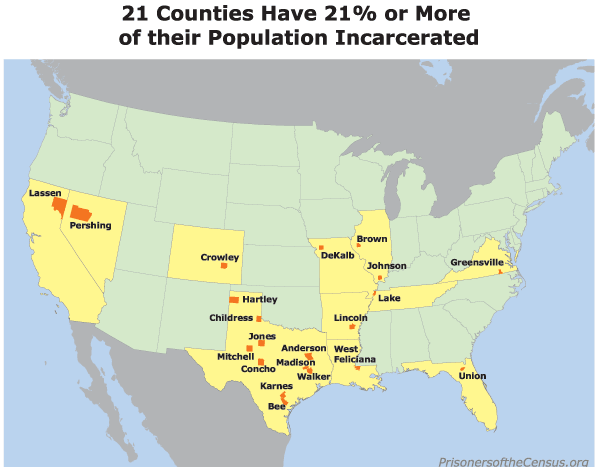
There aren't really any grants or other government appropriations tied to these population figures, so the main issue is redistricting. Nationally, there are 21 counties with more than 21% of their population made up of inmates, reports Prisoners of the Census; Texas has ten of them. Further, says PoC, as a result of growing incarceration totals, "A total of ten counties in Texas were reported in Census 2000 as growing during the previous decade when they actually shrank." The next census won't show the same level of growth, but there's little doubt prisons are artificially propping up many rural counties' population figures.

I don't expect Texas will follow Maryland, Delaware and New York's lead next year during redistricting, with one caveat: A case in which the US Supreme Court earlier this year requested briefs could dramatically alter the debate over where to count prisoners if the court decides that racial disparities from mass incarceration disproportionately deprive minorities of the vote. If that unlikely ruling came down (the Obama Administration recommended the court refuse to hear the case) and prisoners all of a sudden were empowered to vote, as they presently can only in Maine and Vermont, I'm guessing Texas would act rapidly to change the law so they voted in the district where they lived before they were imprisoned. They'd almost have to, if only to make prisoner voting power less concentrated and to keep Anderson and Walker Counties - DA, Sheriff, and all - from falling completely in thrall to prisoners' votes. (UPDATE: SCOTUS declined to hear the case.)

In that light, perhaps the best answer to "Where should inmates be counted for redistricting?" is "It depends on whether you let them vote or not." Or in other words, as in all redistricting debates, whose ox is being gored?

See related Grits posts:

Sunday, May 02, 2010

Counting prisoners skews precinct drawing in rural counties

The Victoria Advocate published a story this morning about the effect of prison populations on rural redistricting, a subject discussed recently on Grits after Maryland became the first state to require counting inmates in their home counties instead of the county in which their unit is housed. Reports the Advocate:

Inmate counts for counties such as Bee, DeWitt and Karnes counties could not only affect redistricting, but also state legislative seats.

Some people have raised concerns about prisoners accounting for a large percentage of a county's population.

An increase in population spurred by inmate numbers could mean new districts.

Prisoners in Anderson and Walker counties, for example, account for 12 percent of the respective populations, said Peter Wagner, executive director of the Prison Policy Initiative.

If inmates are counted toward a county's population, some areas might receive a disproportionate number of legislative seats, said D'Vera Cohn, senior writer of the Pew Research Center.

Maryland will be the first state to include prisoners only as part of the population, but ignore the numbers when it comes to redistricting, said Cohn.

"It becomes a political issue in those districts that have prisons and those that don't," said Cohn.

Even more interesting to me than the legislative implications of this topic - which might result in the Houston and DFW areas gaining a seat or two between them in the Texas House if inmates were all counted in their home counties - are the implications for drawing precincts defining county-level offices from commissioners to constables to justices of the peace.

According to Prisoners of the Census, inmates made up 21% or more of the total number of people counted in 10 Texas counties during the last census. When one is tasked with dividing the county into four voting precincts and one of them includes a massive prison (or three) full of people who can't vote, that creates an odd dilemma that clearly quite a few Texas counties face with every new redistricting.

Recently the Texas Tribune published an interactive map of all 112 Texas prison units operated or leased by the Department of Criminal Justice, while the blog Texas Prison Bidness has published a similarly useful interactive map of the more than 70 for-profit private prisons, jails, and detention centers operated around the state. There is some overlap, but between the two it's easy to see that many counties must accommodate prison inmates in their county-level district drawing. Some prisons even lie within city limits and possibly affect city council district drawing.

Until recently I'd never much considered the effects of prisons on districts beyond the statehouse level, but it's an interesting subplot to a debate that's always been treated at the Lege as purely a partisan concern.

Image via Prisoners of the Census

Thursday, April 15, 2010

Counting inmates in census skews legislative, county district drawing

Maryland this week took the remarkable step of requiring that inmates be counted at their home addresses instead of the county in which they're imprisoned for purposes of legislative redistricting after the 2010 census. Good for them.

Several Texas' legislative districts would look significantly different if prisoners were counted in the census as being from their home county instead of the one in which they're incarcerated. The problem most negatively impacts Houston, Dallas, and black communities, all of which disproportionately send inmates to TDCJ. According to Peter Wagner and Rose Heyer at Prisoners of the Census: "Harris County is 16.3% of the Texas population, but it supplies 21.5% of the state's prisoners. ... Dallas County is only 10.6% of the Texas population, but it supplies 15.4% of the state's prisoners. ...While Blacks are 11.5% of the Texas population, more than a third of the incarcerated people in the state are Black."

These inmates artificially prop up the population of rural counties. Again, from Prisoners of the Census:
In our national research, we found 21 counties where at least 21% of the population reported in the Census was incarcerated. Ten of these counties were in Texas. A full third of tiny Concho County (population 3,966) is behind bars, but the numerous large prisons near Huntsville can even put populous counties like Walker County on the list.
The ten Texas counties with 21% or more of their population incarcerated were:
Concho: 33%
Mitchell: 26%
Anderson: 25%
Hartley: 24%
Jones: 23%
Walker: 23%
Childress: 22%
Karnes: 22%
Bee: 22%
Madison: 21%
State Rep. Lois Kolkhorst's district has 11.97% prisoners, which according to Wagner is:
a higher figure than in any other state legislative district yet discovered in the United States. Prisoners can't vote in Texas, and on their release they will be returning to their home communities, but their presence at the prison town in the Census dilutes the votes of their family members back home. Says Wagner: "Every group of 88 residents in District 13 gets as much of a say over state affairs as 100 people in Houston or Dallas. The Supreme Court's 'One Person One Vote' rule was supposed to eliminate such large difference in voting power."
State Rep. Byron Cook's district was close behind at 11.73% prisoners. The state Senator with the highest prisoner to voter ratio was Democrat Judith Zaffirini in South Texas, 2.73% of whose district is incarcerated. One would expect this demographic shift to benefit Republicans, but looking at the district by district breakdowns, it often cuts both ways: There are quite a few Democratic districts like Zaffirini's that also are pumped up with prisoner numbers. Here are tables from 2007 with the number of prisoners in state House districts and state Senate districts.

Some of these counties want to count prisoners as residents when its beneficial to them but ignore them when it's not:
Bee, Brazos, Concho, Dawson, Grimes, Madison and Wood Counties excluded the prison populations when drawing County Commissioner districts, thereby avoiding giving extra representation to the district that contain the prisons at the expense of all other county districts. In Concho County, removing the prison population avoided drawing a district that was entirely incarcerated prisoners.
That's a remarkable level of cognitive dissonance, excluding prisoners for purposes of county and local elections, but benefiting from their presence when drawing legislative districts.

Redistricting is so nasty and partisan here I'd be amazed if an even-handed approach like this could be adopted next year. It's hard to see how the issue could be confronted during a redistricting session without an ugly meltdown, though I'd welcome being proven wrong. But the subject also comes up for commissioners court elections in counties with out of town prisoners. For those interested in the impact of prison populations on district drawing in your own county, see this "Democracy Toolkit" prepared by Prisoners of the Census to calculate the effects of prisoners on local district drawing.