Sunday, January 31, 2021

Lots of local Texas #cjreform action, even as the #txlege is slow as Christmas

Here are a few odds and ends that merit Grits readers' attention:

TX Senate Committees May Only Meet 2-3 Times: The Texas Legislature's ramp up remains slow as Christmas; a few things are happening, but "not much" appears to be the new normal. On its website, the state prosecutors' association told its members, "don’t be surprised if many Senate committees hold no more than two or three hearings on Senate bills for the entirety of this regular session." Yikes! Usually, you might see 8 or so.

Vanishing Excuses for Class C Arrests: The Texas Observer's Arya Sundaram has a feature on Dillon Puente's arrest in Keller, TX, and the issue of regulating Class C arrests, which carry a maximum punishment of only a fine, not jail time; give it a read. Puente's father, who was pepper sprayed for recording his son's arrest on his phone, sued and agreed to a $200,000 settlement last week. Notably, the police unions haven't particularly updated their messaging on this topic. Back in 2015, when Sandra Bland was arrested for failure to signal a lane change and died in jail, cops could get away with saying such episodes were rare because no one knew for sure. Now, thanks to data gathered in her name, we know that, in 2019, Texas law enforcement reported 64,100 arrests at traffic stops for either moving violations (mostly) or municipal ordinances. That's more folks than were arrested for marijuana (see below)! Regrettably, departments haven't generally made these assessments for themselves. But at a time when courts have slowed, jails are packed and COVID continues to rage, it makes little sense to complicate Sheriffs' already tough job by arresting people for fine-only offenses. The Texas Legislature should put an end to it. 

Investing in Police Reform: In San Antonio, the group Fix-SAPD has leveled up its fundraising, bringing in more than $300,000, mostly from the Texas Organizing Project, to support its petition drive aimed at repealing the police department's civil-service system. Local officials are increasingly nervous this effort may succeed, but not enough to be more aggressive at the negotiating table. Petition organizers already had enough signatures to challenge the department's meet-and-confer contract, this may give them enough resources to get the larger initiative on the ballot.

Fort Worth to Use 'Civilian Response Teams' for Welfare Checks, Minor Accidents: After their mayor participated in a press conference with the governor bashing Austin for similar policies, Fort Worth PD has created a 10-person "civilian response team" which will "handle calls like minor accidents and welfare checks" instead of police, diverting about 1,000 calls per month. “'We have so many tools on our tool belt than just arresting people and taking them to jail,' said Lt. Amy Ladd,” who leads the department's crisis-response teams.

You Can Still Get Busted For Pot in El Paso: Many large Texas jurisdictions have all but stopped enforcing low-level marijuana possession laws because of what Grits has called the "Great Texas Hemp Hiatus." Essentially, most agencies aren't willing to pay the expense of testing to differentiate user-grade marijuana from "hemp," which comes from the same plant. Statewide, marijuana cases declined from more than 80,000 in 2018 to around 45,000 in 2019, when the law changed halfway through the year; everyone expects 2020 figures to be even lower. But El Paso prosecutors have been an exception, insisting they'll plow forward with prosecutions as usual. This news story contains data on the "cite and release" program they implemented instead. Only about a quarter of cases see citations issued: The rest are being taken to jail just like before. No word on what's happening to contested cases taken to trial in El Paso, since, of course, few trials are happening anyway.

Austin Action: Travis County District Attorney Jose Garza announced a more detailed version of new policies under which he'll run the office. See a Twitter string where Grits discussed them and my earlier commentary on Garza's initial push out of the gate after taking office. Meanwhile, the new civilian review board in Austin has started up and it's next meeting is Monday. They're going to hear a briefing on the review of Austin PD training video performed by a select-community panel. For more background, see here.

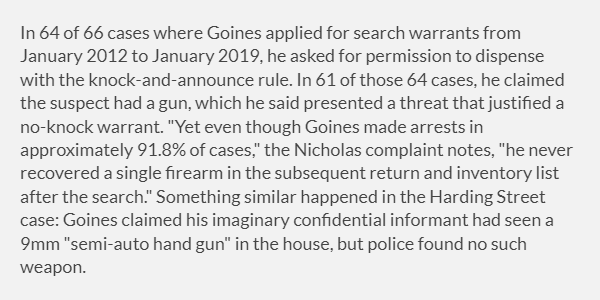
Goines Repeatedly Lied About Firearms to Get No-Knock Warrants: More charges have been filed against officers from Houston PD's Narcotics Unit, which your correspondent has argued should be shuttered. Reason has excellent coverage of just-filed litigation against Houston PD related to the killing of an innocent couple in the Harding St. raid. Here's a notable excerpt:

This basically amounts to getting SWAT-ed by the cops: Somebody (in this case, a narcotics detective) tells a lie about having a gun then, in the case of Dennis Tuttle and Rhogena Nicholas, cops break down the door and kill everyone inside.

Homeland Security Planning Process a Consultants' Bonanza: A remarkable graphic appeared in the Texas Homeland Security Statewide Strategic Plan related to just how much such planning goes on in this state:

That's incredible: A consultant's bonanza, one wag rightly observed online. Who has read them all for consistency of vision, implementation, etc.? If the answer is "no one," or perhaps some beleaguered bureaucrats no one listens to in the bowels of DPS, then those gaps will only be revealed in implementation, as so many were, for example, during Hurricane Harvey. To an extent, I understand it: Texas is a big place, diverse across many different vectors. But wow!

Injunction-Junction, What's Your Function? Some of the targets of Harris County's civil prostitution injunction were dismissed from the case because prosecutors determined they were sex trafficking victims instead of perpetrators. This episode shows how nebulous those distinctions often are. I'm not particularly a fan of using civil law to constrain people's liberty when you don't have probable cause to arrest them, which is how these injunctions work. Kudos to Harris County Attorney Christian Menefee for rethinking the approach.

34 Years Later, A Chance for Justice: In Dallas, DA John Creuzot agreed with most of Ben Spencer's habeas claims, the Dallas News reported, boosting his chances for relief. Spencer was convicted of a carjacking and murder in 1987 but has always maintained his innocence. The trial court had earlier supported his actual innocence claims, only to have the Government-Always-Wins faction on the Texas Court of Criminal Appeals reject them in 2011. This new habeas writ is based on three witnesses who've since recanted their testimony.

DNA Losing its Shine as 'Gold Standard' Evidence: Practices at Austin PD's DNA lab were so error-filled and misguided that it would be "shocking to the conscience" to uphold Areli Escobar's murder conviction based on its disputed findings, found a judge in findings of fact for a habeas writ. See the order from Judge David Wahlberg, it's a doozy. Austin is considering "decoupling" its crime lab from the police department: This case is Exhibit A why that's a good idea. For more background on problems with interpreting mixed DNA samples, see the links rounded up here.

Sensory Penalties: A new book is coming out on "Sensory Penalties," exploring how prison is perceived through the five senses - a topic which arises plenty in current and former prisoners' writing, if seldom in a systematic fashion. But they want a $100 for it (academics!) and your correspondent balked at the price. So I was pleased to discover this panel featuring one of the authors discussing highlights. That's a start.

For the Reading Pile: Maurice Chammah sent me a copy of his new book on the death penalty, Let the Lord Sort Them Out, which was recently reviewed in the NY Times and features a section on my college pal Danalynn Recer. Looking forward to that. Thanks, Maurice! Meanwhile, with Austin considering decoupling its 911 call center from police department (as Houston and many other jurisdictions have done), I was interested to see this academic article, "Calling the Police: Dispatchers as Important Interpreters and Manufactuers of Call for Service Data." Perhaps their analysis will contribute to thinking through that process, as surely will the Vera Institute's recent work on the topic. 

Thursday, January 28, 2021

Poll: Texans overwhelmingly support Senfronia Thompson's "George Floyd Act"

The University of Houston polled 1,329 Texans on numerous criminal-justice topics, including state Rep. Senfronia Thompson's George Floyd Act. Their poll question did a pretty good job of summarizing the legislation:

They polled both the act as a whole and each individual component. Opposition was incredibly low in every case:

Overall:


Politicized debates during the election season elided areas of broad bipartisan agreement and portrayed policing issues as a source of partisan contention. These results show there are important reform policies on the table that would receive overwhelming public support. Many of those are included in the George Floyd Act.

Why the #txlege should add point-and-report to statewide police shooting data

In a roundup a few weeks ago, Grits pointed to a new academic study analyzing Dallas police shootings which associated a "point and report" policy with a reduced number of people shot because the officer falsely thought they were armed. Now, the authors have written an op-ed in the Dallas Morning News about their findings. Here's a notable excerpt:
According to the Policing Project at NYU School of Law, police reform falls into two categories: front-end vs. back-end accountability measures. The former includes strong policies and practices to create a culture of organizational accountability before things go wrong, while the latter reflect after-the-fact, methods for holding individual officers responsible for their misdeeds.

Back-end accountability mechanisms are important and they deservedly receive much attention. Yet they are not enough to produce real change. Police reform requires more of the often-neglected front-end mechanisms that target institutional and organizational issues that lead to unnecessary and excessive use of force. A prime example of front-end accountability is implementing stricter departmental policies that limit the circumstances when officers can use force, coupled with documentation and review protocols. There is a rich history of more restrictive administrative policies effectively reducing officer-involved shootings and other types of less lethal force, such as the use of Tasers and pepper spray.

Starting in the 1970s and following the lead of the New York City Police Department, agencies began amending their deadly force policies to only allow officers to shoot in “defense of life” situations, when there is a risk of death or serious bodily injury to themselves or others. Additionally, departments began requiring officers to report when they discharged their firearms, and some departments created review boards to investigate such shootings. These policy changes not only led to significant declines in officer-involved shootings (especially of unarmed citizens), they also reduced racial disparities in police shootings.

Point-and-report policies are front-end accountability efforts that require officers to document all instances of pointing their guns at citizens. This kind of policy is not new. For example, the Charleston, S.C., and La Grange, Georgia, police departments incorporated such a policy in the 1990s. The Baltimore, Chicago, Cleveland, Dallas and New Orleans police departments have all adopted similar policies in recent years.

However, these departments are more the exception that the rule, as many police officers in the U.S. are not subject to point-and-report policies. Moreover, there’s been little research on the impact of a point-and-report policy. Does such a policy reduce police shootings? In a new article published in Injury Prevention, we tested the impact of the Dallas Police Department’s point-and-report policy on police shootings of citizens. It took effect on Jan. 1, 2013, and we used publicly available shooting data from DPD to investigate. We examined the total number of shootings as well as specific characteristics of those shootings before (2003 through 2012) and after (2013 through 2018) the policy change.

Before the policy, DPD averaged 15.3 shootings per year. That average dropped to 13.0 post-policy change (a 15% decline). Our statistical analysis showed that the policy was associated with a significant, gradual reduction in police shootings of citizens that began in late 2015 and continued through the end of 2018.

Perhaps more importantly, the policy was also associated with a decline in the shootings of unarmed citizens (that is, they had no weapon such as a gun or knife), especially citizens who the officers thought were armed when they were not — a “threat perception failure”). Such a failure occurs when officers mistake an item in a person’s hands, such as a cellphone, for a gun. The proportion of threat perception failure shootings declined by nearly 80% after DPD adopted the point-and-report policy (from 18% of all gun or perceived gun cases before the policy change to 4% after).

Last, we also found no increase in the proportion of these incidents in which an officer was injured. Officer injuries actually declined slightly.

These findings are very promising, though we can only speculate on the mechanisms driving those effects. Perhaps the policy adds another layer of organizational accountability. It might also limit the occasions when officers draw and point their weapons, prompting them to take more time to differentiate real threats from threat perception failures.

It may also reduce the potential for officers to escalate a situation unnecessarily, or it might lead them to consider more options for resolving the encounter peacefully (rather than painting themselves into a corner once the gun is drawn). Five decades of research tell us that administrative policy is an important front-end mechanism for controlling police officer use of force. Clear, detailed use of force policies that are enforced shape officer decisions to use their firearms. Our study suggests that a point-and-report policy can do the same.
In 2015, Texas passed legislation to require departments report police shootings - fatal or otherwise - to the Attorney General, giving us a dataset helpfully gathered and organized by our friends at the Texas Justice Initiative. It would be simple to add a provision requiring reports whenever officers point their weapon but don't fire, and if this study from Dallas is any indication, the measure could save lives.

Wednesday, January 27, 2021

Please prove me wrong: Jose Garza wants to make Grits eat my words

Travis County District Attorney Jose Garza is trying to change Grits' mind about "progressive prosecutors." He hasn't succeeded yet, but in the early days of his administration, he's giving it the ol' college try.

In the last week, Garza announced indictments of two officers who'd allegedly engaged in excessive force but weren't punished by police management, and said a grand jury would soon consider charges in the deaths of the police officers who killed Mike Ramos and Javier Ambler. Then yesterday, his office agreed Rosa Jimenez - the babysitter falsely convicted 18 years ago of murdering a child in her care - could be released on bail pending her appeal, and Judge Karen Sage agreed. 

These are major shifts in policy. In recent years, we've seen Texas prosecutors seek indictments for cops following publicity and public pressure - as in the Mike Ramos and Javier Ambler cases - but seldom in less high-profile situations, and never when the police department failed to discipline them. The indictments of officers cleared by APD Internal Affairs amounts to another "no confidence" vote for police Chief Brian Manley, this time from the sitting District Attorney. And it validates public concerns that the department's disciplinary process fails to hold certain officers accountable. 

An equally big shift involves the level of transparency Garza pledged to provide about such cases. He released the first of what he promised would be bimonthly reports on cases involving alleged law-enforcement misconduct. Under Margaret Moore, the DA's office amounted to a black hole from which no light emerged unless she imagined it would cast her in a flattering manner.

Indeed, Garza effectively countered complaints from police about the indictments by doubling down on his commitment to transparency:  "To the extent that Chief Manley and others have concern about the grand jury determination in this case," Garza told the Statesman, "they should immediately release all of the relevant video footage so that our community can see the conduct for themselves." By contrast, Moore's practice was to tell APD not to release video in such cases.

Meanwhile, Grits couldn't be happier that Rosa Jimenez was released pending appeal of her habeas writ. Six judges have now said Jimenez is innocent or at least deserves a new trial, but under state law, Attorney General Ken Paxton controls the appellate process in federal court and he has appealed all their rulings. Because of the innocence findings, under Texas law, Judge Sage can release Jimenez on bail pending the final outcome if the DA agrees. Former DA Margaret Moore chose instead to defer to AG Paxton, so this is evidence elections definitely matter.

Jimenez should have been released years ago. She was convicted based on junk science after the trial judge refused to pay for defense experts to counter misinformation presented by Travis County prosecutors. So this was an incredibly happy day. If it weren't for COVID, your correspondent would have gone to the courthouse for the event. When the news came, I literally shouted for joy. (Bilbo the Criminal-Justice-Reform Dog, I should add, was rather confused and taken aback at this outburst.) It's possible she may be released and reunited with her (now adult) children as soon as Friday.

So let me take this opportunity to say "thank you" to Jose Garza, and for that matter to Judge Sage. I'm proud of and grateful to both of them for this.

Even so, Grits has never been comfortable with the phrase "progressive prosecutor." I think of the prosecutorial function as inherently regressive: a one-trick pony whose "trick" is to punish people for violating state dicta. As I wrote five years ago, usually when a new District Attorney is elected:

management changes, but the day-to-day operations remain much the same as they functioned when our grandparents ran much-smaller versions several decades ago. Any differences between electeds play out at the margins of just a handful of individual cases. But the overarching structure and purpose of the institution inevitably remains undisturbed. Even when DAs take a progressive step, there are almost always pragmatic, internal reasons for it.
Grits added, however, that this wasn't an inevitability: "That's not to say it wouldn't be possible for a DA to fundamentally redefine the job. They have enough discretion to where all sorts of interesting possibilities might present themselves if smart people put their minds to it." But the first round of Texas DAs elected after campaigning as "progressive" - including in Houston, Dallas, San Antonio, and Corpus Christi - have fundamentally continued to perform the office's functions in the same way they've always operated.

That's an observation more than a criticism. Change is hard. And slow. Plus, there exist few models for alternative approaches that might truly merit a "progressive" label. The cases described above - indicted cops and an innocent person released - still boil down to decisions whether or not to use the stick. We've not yet seen a fundamental reimagining of the prosecutorial function in Texas, and arguably anywhere (although admittedly, I don't closely track what prosecutors are doing in other states).

Still, Jose Garza is showing how much discretion matters. So far, these fall into the category of cases that "play out at the margins." But they're welcome moves, and evidence that he really does intend to operate the office differently. To me, the real test will come when we see how more workaday, less-high-profile cases get handled, particularly on drug and sexual assault charges. At this point, I'm hopeful bordering on optimistic that Garza will prove me wrong about "progressive prosecutors."

Like Fox Mulder in the old X Files series, I want to believe.

MORE: See Garza's 3-page memo on new policy changes he's implementing at the Travis County DA's office.

Correction: An earlier version of this post said the officers who shot Javier Ambler and Mike Ramos had already been indicted. In fact, Garza has said he will take their cases before a grand jury in the current term. Grits regrets the error.

Wednesday, January 20, 2021

Review of Austin police training videos finds bias and selective deescalation tactics

Videos used to train Austin police officers in the cadet academy contribute to bias, stereotypes, and model disproportionate application of force and deescalation tactics, says a group created to review them. Will the mayor and city council plow forward with a new cadet class, anyway, or will this news finally cause them to take concerns about the academy's pedagogical shortcomings seriously?

A community panel charged with reviewing video materials used for teaching Austin police cadets at the academy has completed its work, and the results are damning. From the executive summary, here's the meat of their critique:
The overall library of videos selected perpetuated dangerous racial and class stereotypes that displayed working class people and communities of color as disproportionate recipients of violent and deadly responses from police. People of color seldom benefited from crisis intervention or deescalation strategies from officers in videos. Instead, a strong emphasis on gaining compliance and control over all else from communities of color often led to rapid escalation with often violent and even deadly results for minor infractions. In contrast, white community members were most often extended grace and understanding. Opportunities for story-telling and building empathy was almost exclusively given to white men.
Here's the full report, and initial coverage from KXAN. A companion document prepared by the panel's facilitators echoed similar concerns. These criticisms come on the heels of a review by the city's Equity Office finding Austin's police academy subjected cadets to unnecessary hazing and fostered a "culture of violence."


Mayor Steve Adler and the City Council's newest member, McKenzie Kelly, want to restart the police academy as soon as March. The analogy being used behind the scenes is that APD can repair the plane (i.e., the academy) while they're flying it. I wonder if aircraft mechanics are as enamored of that idea as politicians who want to restart cadet classes without addressing the underlying problems?

Among the flaws the community panel wants them to fix: "An emphasis on 'winning' interactions and a 'warrior mentality' in many videos created and repeatedly reinforced an 'us versus them' and 'good guy/bad guy' dynamic that pits officers against community members."

In addition, "Many videos emphasized a transactional approach to interacting with the community with a focus on liability and quid pro quo exchanges, rather than what is needed to develop genuine, authentic interactions with community members to sustain long-term trust and relationships."

Further, "Videos that showed officers antagonizing community members and using excessive force were attributed to aberrant individual behavior rather than acknowledging the cultural and systemic factors that permit or encourage such behavior."

None of this is new: Cadets themselves identified all these problems years ago and some of them sued the department over it. Now, though, two different independent reviews commissioned by the city itself - one performed by consultants, the other by a community panel - have corroborated and reinforced those criticisms.

This has been going on a long time now. City Manager Spencer Cronk was told in December 2019 to begin the review whose results we're seeing now. He blew off the city council and asked them to restart cadet classes over the summer without having fixed the curriculum. In August, though, the city council told him, "No, we're serious," and the city finally began the long-awaited review.

Between the equity audit and the video review, its' clear at this point that Austin's curriculum for cadets needs a soup-to-nuts overhaul. There's no emergency need for officers so pressing that an academy can't wait a few months to fix all the pedagogical problems. Indeed, after everything we've been through in Austin over the last year, it would be a tremendous betrayal of trust to ignore these recommendations and move forward as though the same ol' same ol' was still good enough.

Friday, January 15, 2021

When the jail is full, Sheriff, what you gonna do?

Grits noticed the bad news that the Harris County Jail population has ballooned back up near capacity, as reported by Gabby Banks at the Houston Chronicle. Rather than a detailed policy analysis, which I've been offering up on this blog for a decade-and-a-half when it comes to the Harris County Jail, let's change things up on a Friday afternoon and present a few lines of verse, instead:

When the jail is full, Oh Sheriff, what you gonna do?

The cops they keep on bringing them but the courts don't pass them through.

Crime is low, arrests are down, but the seams are bustin' through.

Say, when the jail is full, Sheriff, then what you gonna do?


My cousin the jailer says their numbers' sinking low. 

The state says 1 to 48, but it's harder than they know.

'Cause COVID stopped the jury trials so teeming multitudes

Now wait out the winter months behind those bars so rude.


Oh, when the jail is full Sheriff, hey, what you gonna do?

I hear dozens of jailers are now out. Is it the flu?

And all this so some lawyers can feign verisimilitude,

Instead of just releasing folks till their day in court is due.

Tuesday, January 12, 2021

Just the (fake) facts, ma'am: Police unions promote alternative reality on new anti-reform site

Several police unions have joined together to create a new website called Texas Police Facts aiming to convince the Texas Legislature there's no need for police reform in 2021. Regular readers won't be surprised to learn the site elides core issues and misrepresents key facts.

Take, for example, the "FACT" they cite to say "claims that minorities are substantially more likely to be contacted by the police are inaccurate." As evidence, they point to this research brief from the DOJ's Bureau of Justice Statistics, but even a cursory examination shows it doesn't back up their contention.

Check out Tbls 3 and 4 of the report: Turns out, black folks are overrepresented in police-initiated contacts; whites are over-represented in crime reporting. Further, "Blacks were more likely to be pulled over in traffic stops than whites and Hispanics." So the linked source directly contradicts their claim.

Another "FACT": "In Texas, law enforcement officers proven to be unfit for the job cannot jump from agency to agency," they declare, claiming TCOLE's F-5 report ensures agencies are "aware of previous misconduct."

In reality, according to the TX Sunset Commission, "the F-5 process has only resulted in nine license revocations in the last five fiscal years, despite TCOLE receiving notice of over 2,800 dishonorable discharges during the same time." The other 2,791+ officers could all get law enforcement jobs elsewhere in the state, and many did. A recent study of Florida police found 3% of officers previously had been fired from other law-enforcement jobs.

Here's another one: "FACT: In Texas, law enforcement agencies CAN get rid of bad cops." Somebody tell that to the San Antonio Police Department, where 70% of cops fired get reinstated through arbitration, including a guy who fed a sandwich made of feces to a homeless man as a "joke."

Another "FACT" presented was that "Police use force or threat of force in less than 2% of all interactions with civilians." But given that police have MILLIONS of interactions with the public per year, that's a lot of force being used!

On their "Resources" page, they point to a study claiming police exhibit no bias in shootings which was later retracted for inadequate methodology and overstated conclusions.

They include links to several data sources with which Grits readers will be familiar, but cherrypick information from them, including the Texas Justice Initiative on deaths in custody and racial profiling data from the Texas Commission on Law Enforcement.

In particular, racial profiling reports have documented much more widespread use of arrests for Class C misdemeanors than police have admitted in the past. Unions for years claimed such arrests were extremely rare and only used on dangerous people. But we now know police arrested 64,100 people for Class Cs at traffic stops in 2019, meaning more folks are arrested for fine-only offenses in Texas than for marijuana possession!

Indeed, according to said racial profiling data, Houston police officers use force at traffic stops far more than other, comparable agencies - e.g., 18x more than their counterparts at the San Antonio PD.

Grits could keep going, but you get the point.

On Twitter, your correspondent opined, "This website and the police unions who sponsored it are using cherry-picked evidence as drunks use lamp posts ... for support rather than illumination. I hope our friends at the #txlege see through it."

Thursday, January 07, 2021

Roundup: Texas police-reform news, bail update, jury trials during COVID, and other stories

Lets' clear a few browser tabs with a roundup of recent items that may have escaped Texans' attention while our Attorney General was in Washington D.C. inciting mayhem.

Dallas bail lawsuit to move forward. Bail litigation in Dallas can move forward to trial after a 5th Circuit decision, but the array of potential remedies has been narrowed. See Dallas News coverage. More on this soon. In related news, Tarrant County announced they'd begin using a new risk-assessment instrument when setting bail. Such mechanisms have been criticized for perpetuating past discriminatory patterns, but Tarrant insists the tool "won't be racially biased."

Cops who must document pointing their guns do so less often. Dallas PD has a policy requiring officers to document every time they unholster and point their gun, whether or not they fire it. An academic study of the program found that the policy reduces the likelihood suspects will be shot by mistake without increasing dangers to police officers.

Changing stories. A Lamarque police officer initially said Joshua Feast had pointed a gun at him before the officer shot and killed him last month. But bodycam footage was released showing Feast, while armed, did not point his gun at the officer and was shot in the back while running away. This is incredibly common. Even when shootings are legally justified, the details that come out later often don't match the initial stories. Over time, this pattern degrades trust in law enforcement. Thank heavens for bodycam and bystander video, or the false stories would go unchallenged.

Police oversight in Houston. See coverage of the push for improved civilian oversight at Houston PD from Community Impact, and more background from Grits coverage of Sylvester Turner's task force on police reform.

Chicano Squad. Speaking of Houston PD, our pal Eva Moravec helped report and produce a new podcast on the "Chicano Squad" created at HPD in the wake of the murder of Joe Campos Torres. Give it a listen.

SA Chief, union boss, collaborate to oppose reform. When it comes to opposing accountability reforms, the chief and the union at San Antonio PD are singing from the same hymnal. The chief and the union boss told straight-up lies about advocates, falsely claiming they were misrepresenting themselves as police officers while gathering signatures. There's little doubt if they had any evidence this were true, arrests would have already been made. (Noted the Express-News, "While impersonating a public servant is a felony under the Texas Penal Code, McManus said he is not aware of a criminal investigation into the allegations, nor has he directed his officers to look into it.") Also, Chief McManus's claim that problems can be solved at the bargaining table is completely disingenuous. If it were true, they'd already have been solved. The former San Antonio city manager has explained why the union boss standing next to the chief telling lies is the main reason that won't work. If you're looking for detail on what activists are ACTUALLY proposing in San Antonio, check out this recent podcast interview, starting around the 45:30 mark.

Officers speak up on colleague's misconduct. In Texas, police officers have no duty to intervene when their colleagues engage in misconduct. But a Duncanville police officer has been suspended after several of his fellow officers reported him. No details available about what was alleged, but I'm glad to hear about officers stepping up, even if it's not legally required. 

Lessons unlearned. A lawsuit has been filed in Fort Worth after police raided and ransacked the home of an elderly, black couple last year. Notably, a review of use of force policies last year at FWPD found that "Department policies emphasize the sanctity of human life, procedural justice, and de-escalation. Our review found that officers’ conduct in the community does not uniformly adhere to these policies." This episode seems to corroborate that finding.

Early warnings. Dallas has paid a consultant to set up an early warning system to identify problem officers who need additional training or discipline. Frankly, I've never seen a truly effective early warning system at a police department. All the systems I've seen set the thresholds for a warning so high that they aren't really effective. No word on what metrics this consultant will use; Grits would have to know that before assessing whether this is a meaningful reform, however well intended it may be.

3% of Florida cops previously fired. The phrase "wandering officers" refers to cops who're fired and get a job at another agency despite a history of misconduct. A new academic study of Florida police found about 3% of officers statewide had previously been fired. "[R]esults suggest that wandering officers may pose serious risks, particularly given how difficult it is to fire a police officer." Notably, Grits has written about this phenomenon in the past, but using the term common in law enforcement for these officers: "Gypsy cops." Over the years, I've come to realize that phrase's racist implications vis a vis the Roma people, so I'm glad to learn more neutral terminology. I wish I'd never used the other.

CO shows off new law TX should emulate. Grits has discussed how the Texas Commission on Law Enforcement lacks authority to decertify officers who engage in extreme misconduct unless they're convicted of a felony. Last year, Colorado changed their law to allow such decertifications, and the first officers recently lost their licenses. Texas should follow their lead.

COVID and jury trials. Brazos County officials knew a defendant had contracted COVID but didn't tell him until after conducting a jury trial in which others were exposed, reported the Texas Tribune. With defendants sitting endlessly in jail awaiting trial, it's not clear what the right solution is, but the backlog of cases is getting serious:

In 2019, about 186 Texas jury trials were held in civil and criminal cases in an average week, according to the state Office of Court Administration. From March until June of 2020, that number went to zero. ...

From June through September, a total of 25 criminal jury trials — ranging from traffic violations to murder cases — were fully conducted under this supervision, the court administration office reported. That’s less than one-fifth of the Texas criminal cases tried by a jury in an average week in 2019.

The changing face of auto theft. Auto thefts have increased during the pandemic, reported the New York Times, but with a new pattern: Most vehicles are taken for short distances and are eventually found and returned, whereas in years past they may have been stripped for parts. Police suggest theives are using stolen cars for short-term rides in lieu of Uber, etc.. Some of this is because people leave their cars running or leave their key fob in the cupholder, while in other cases, thieves use tech to amplify the key fob tech from a distance. Key fob tech has always been hack-able, but the methods for doing so appear to be disseminating more widely 

For the reading list: Here's an academic paper for Grits' reading list on the dynamic relationship between COVID and family-violence risk factors.

Saturday, January 02, 2021

Shocking allegations of hazing and a 'culture of violence' at Austin's police academy

Last month, Grits argued that Austin's police academy needs stem to stern revision and Mayor Steve Adler's push to re-open it in March is premature until the results of several, ongoing audit components are complete and the scope of needed revisions becomes clear.

Just before the New Year's holiday, the city released the first of these audits from its Equity Office, and it was a scathing and unabashed take down of the APD training process. The report "recommends that City leaders suspend all cadet classes until APD leadership and Equity Office officials can develop and implement an equity-driven action plan that reforms and rebuilds APD’s Training division, including the training academy."

Among the biggest complaints was a culture of violence and hazing within the academy. "Interviews with former cadets revealed an academy culture that prioritizes physical aggression  above all else. Multiple cadets stated that training staff subjected them to hours of grueling  physical and psychological stress drills, refusing water to dehydrated cadets and engaging in other dangerous practices."

Training isn't just grueling, but demeaning and regressive: “In multiple interviews, cadets confirmed the narrative that an APD trainer asked a new cadet why they wanted to be a police officer, interrupting the cadet’s response by saying 'If you tell me you want to help people, I will punch you in the face.'”

The Equity Office conducted an event to include community perspectives on training materials. "Community members raised additional concerns at the depiction of an increasingly hostile and aggressive public in APD training materials," expressing worry that "this message will only make officers more violent and aggressive when they interact with the community."

If the training materials risk making officers more "hostile and aggressive," how much more so does telling recruits they'll be punched in the face if they say they want to help people? In this case, the cadet interviews corroborated and bolstered community complaints. Later this month, the audit of all the  videos used in APD training will be released, and through the grapevine your correspondent has heard that these auditors will raise similar concerns.

The most severe portions of the training appear to have no relationship to preparing officers for any real-world tasks they will perform:

According to interview respondents, many of the academy’s trainers rely overwhelmingly on  “violent”, “brutal”, “traumatizing” practices designed to “manufacture soldiers” rather than  produce community-driven law enforcement professionals adept at de-escalation. Trainers place  cadets in dangerous, demoralizing, and inhumane exercises with “zero regard for the health and  safety of cadets.” Multiple cadets stated that they and their colleagues had been screamed at or  punished for checking on one another or drinking water during intense physical drills, which last for hours in sweltering summer heat. Multiple cadets confirmed that they were deprived of water  during extended physical drills in extreme heat. Data provided by APD confirms that a troubling  number of cadets were treated for heat exhaustion and dehydration during the academy. Multiple cadets expressed that even though they hydrated heavily at home, as advised by APD training  staff during orientation, it was impossible to avoid dehydration when training staff refused to  allow them water during these extended physical drills. Cadets could not identify a plausible  real-world scenario during which they would be deprived of access to water in extreme heat for  extended periods of time. Multiple cadets expressed that this deprivation was rooted in nothing more than cruelty and had no basis in the reality faced by police officers. Some narratives,  corroborated by multiple respondents, are simply too violent to understand how they were ever  allowed to occur, including many cadets being forced to resign or risk serious injury in the face  of seemingly endless “hazing” and “abuse.”

Interviews revealed that cadets were subjected to so-called "smoking sessions," which are:

unscripted, unscheduled physical and psychological  stress drills that instructors instigate without notice. According to multiple interviews, these  smoking sessions are often used as collective punishment for individual violations, though their  use is just as frequently unexplainable. Some respondents indicated that Training division staff  seemed to enjoy putting cadets through the stress drills, which often go on for hours during the  summer heat. Multiple respondents claimed that cadets are refused water during these stress  drills, that instructors punish cadets for looking at one another (even if checking the condition of  fellow cadets), and that medical staff are not posted close enough to the cadets to assess  symptoms of dehydration or heat stroke. Multiple respondents witnessed instructors refuse water  and fail to render aid to cadets who were visibly suffering symptoms of dehydration. It is well documented that these practices resulted in multiple serious injuries to cadets.

The report suggested APD trainers were harsher, even, than at military boot camps and prioritized "brutality and aggression":

The academy’s training staff employ dangerous training tactics that  have been described by cadets with military backgrounds as “worse than anything I went through  in [US military training].” Multiple former cadets allege that the academy is driven purely by  brutality and that physical aggression is the primary quality that trainers seek when promoting  cadets toward graduation. The Training division’s practices and culture are driving highly qualified candidates to leave the academy, depriving Austin of the diverse, community-driven police force that City leaders and residents envision.

Nationally, according to the Bureau of Justice Statistics, only 23 percent of training academies have curricula which is all or mostly stress-based, as is clearly the case in Austin. That means more than three quarters of training academies have eschewed that approach, but Austin PD clings to it.

The Equity Office highlighted the wastefulness of stress-based "teaching," separate and apart from the moral and ethical problems with it:

What benefit is it to eliminate brilliant candidates for the sake of maintaining  a battlefield mindset? How much money is spent recruiting these bright, capable, highly educated, successful and diverse candidates, bringing them through a months-long recruiting  process, vetting them intensely, dedicating an unknown number of personnel hours to interviews  and investigations -- only to have them driven out of the academy by a culture of brutality,  militarism and violence? What benefit is it to subject highly-qualified, diverse, committed cadets  to training that is more intense than some military training programs? 

That to me is the best argument for putting off a new academy until training can be revamped. With such high dropout rates and a terrible, regressive pedagogical approach, it makes no sense to hold another class until all the problems have been identified and fixed. 

The "culture of violence" identified at the academy wasn't the only regressive aspect of police training. Given the number of homeless people in this town, it's remarkable (and sad) to read that "Multiple former cadets in separate, individual interviews confirmed that training staff made negative comments  toward individuals experiencing homelessness and told cadets that if they are 'having a slow day,' they could seek out someone experiencing homelessness as an easy target for various citations." The city council has taken steps to limit those citations, but it's clear they're running up against a deeply engrained culture within the department.

Whether as a result of this violent culture or because of other factors, the department is failing at its diversity goals. In fact, "The Training division’s leadership failed to produce  any measurable standards for ensuring equitable practices. The division’s self-assessment  identified one Black employee out of 57."

Overall, black recruits were more likely to drop out of the academy. "Data provided by APD highlighted further disparities in  graduation rates, with 81.6% of white male cadets graduating the academy compared to 48.5% of  Black male cadets."

Black cadets were also more likely to be injured during training.

According to data provided by APD, at least 509 injuries occurred during the APD training academy between 2015 and 2020. Of the cadets who were injured and included in this data, 348 (68.37%) were white, 85 (16.7%) were Hispanic, 57 (11.2%) were Black, and 19 (3.73%) were Asian. While the percentage of injuries sustained by white cadets reflects the percentage of white candidates that graduate from the academy, the percentage of injuries sustained by Black cadets (11.2%) is more than twice the percentage of Black cadets that graduate (5.19%). APD’s data illustrates inequitable outcomes for Black cadets who enroll in the APD training academy. Black cadets in APD’s training academy are underrepresented when compared to the population of Austin, less likely than their peers to graduate from the academy, and more likely to be injured during APD’s training academy than any other race.

This reminds me of research showing white folks think young black people are older, more mature, and potentially more threatening than they are. Is violence used more harshly against black cadets because of these implicit biases, for explicitly biased reasons, or for some other cause? Regardless, the violence-centered pedagogical approach is clearly thwarting diversity goals.

Finally, the report corroborated complaints of APD leadership bucking and slow walking reforms, identifying the biggest barrier to fixing the identified problems as, "Lack of political will among APD leadership at many levels threatens meaningful change."

This report should put an end to discussions of restarting the police academy any time soon, and certainly by March, as Mayor Steve Adler had suggested. We're only just beginning to understand the depths of problems at the academy, which start with agency leadership. They won't be fixed overnight.

Wednesday, December 30, 2020

Keller PD arrest puts a family face on 64k Class C arrests at Texas traffic stops

Out of Keller, TX comes the Lone Star State's latest police misconduct case with bystander video gone viral. Cops used a Class C arrest over a "wide right turn" to search Dillon Puente's vehicle when he refused consent, then used excessive force against his father, Marco, in retaliation for recording the incident. They arrested Dad on a phony obstructing the roadway charge. See WFAA-TV's coverage. and a New York Times story about the family's lawsuit.

The Texas Legislature bears as much responsibility for this episode as the officer. The US Supreme Court ruled 20 years ago in Atwater v. City of Lago Vista (a seat belt violation case) that whether officers could arrest for Class Cs is a legislative decision, and that state lawmakers would need to change the statute to forbid it. State Rep. Senfronia Thompson has filed legislation to restrict such arrests in HB 830 and as part of a larger omnibus "George Floyd Act," which is HB 88. 

Legislation to restrict the practice passed in 2001 (immediately after Atwater) but was vetoed by Gov. Rick Perry at the behest of police unions. In 2003, Perry vetoed another bill which would have required law enforcement agencies to have written policies stating when their officers could arrest for Class C misdemeanors. Since then, it's become common for police to arrest for Class Cs when drivers refuse consent to search. It's considered one of the "tools in the toolbox," as the practice was described after Sandra Bland's high-profile arrest (over her alleged failure to signal a lane change) and death.

At one time, police claimed these were rare occurrences and officers were only arresting dangerous people. Now, thanks to the Sandra Bland Act passed in 2017, we know that's not true. Today, law enforcement annually reports data on how many people are arrested for Class C misdemeanors to the Texas Commission on Law Enforcement. (See here.) 

It's a big number. Police officers arrested people at traffic stops for Class C misdemeanors - either traffic violations or local, municipal ordinances - 64,100 times in calendar year 2019. And to be clear, if the person was arrested for more a serious offense, it's reported in a separate category. (The 64,100 number comes from adding together columns GS and GY.) 

When Texas Appleseed analyzed jail bookings at eleven large counties in 2019, they similarly found many more Class C arrests than anyone expected. This problem has been hidden in plain sight, but no one could document it until data began to be collected under the Sandra Bland Act.

This use of Class C arrests to get around the Fourth Amendment results in millions in jail expenses, hundreds of thousands of wasted officer hours, and tens of thousands of Texans being taken to jail over petty bullshit.

The Keller case puts a face to the Class-C arrest issue in the same way Sandra Bland's did, but this isn't so much about individual drivers' personalities as it is the government's policies.

The officer who arrested Dillon Puente and used unnecessary force against his father deserved the demotion he received, but mainly for how he treated Dad while he was filming. The reality is, the son's arrest, as unfair and inappropriate as it may seem, for the most part comports with state law and represents the system working as it was designed. Now that those design flaws have become apparent, and have been documented both via anecdotes like this one as well as statewide data, it's time for the system to change.

MORE: Your correspondent was quoted in this WFAA story about the case.

Sunday, December 27, 2020

What does a successful "Defund the Police" campaign actually look like? Reconsidering Texas' abolition of Tulia-style drug task forces in light of 2020's #DefundThePolice frame

In 2020, the phrase "defund the police" captured the public imagination, for good or ill, and became the centerpiece of conservative messaging against Democrats in the fall. But it wasn't that long ago that Texas defunded dozens of regional drug task forces without any of the #DefundThePolice backlash. At their height, those task forces collectively made around 12,000 arrests per year (see FN 26 in this report), but in 2006, Gov. Rick Perry eliminated their funding with the stroke of a pen, the culmination of a years-long campaign launched in the wake of the Tulia drug stings.

What lessons might be drawn from that experience to inform "defund" or other reform campaigns today?

Grits believes there are several, including 1) the target must cooperate by remaining recalcitrant and defiant when misconduct is exposed, and 2) such an outcome requires an all-hands-on-deck approach using every advocacy tool in the book, from litigation to lobbying to public education and every other strategy, tactic and method available. Before the task forces were abolished, many hundreds of people and dozens of organizations were involved in the campaign and played pivotal roles at various points.

This let-a-thousand-flowers-bloom approach made the movement extremely flexible. In politics, timing and framing are everything. This occurred to me this morning when I ran across this Grits post reviewing the drug-task force saga. Over and over, promising strategies would fail and unlikely approaches taken by others would fill the void.

At the apex of their influence in the late '90s, there were 51 such multi-county agencies in Texas employing more than 700 narcotics officers statewide, all funded through federal grant money. This they supplemented with asset-forfeiture revenue: task forces were encouraged to "eat what they kill."

Their defunding in 2006 was a mixed outcome. Grits was indifferent to modestly appreciative about the drug-court money, opposed to the border-security initiative, but pleased as punch that this network of 700 officers lost its funding (though there weren't nearly that many by the time Perry pulled the plug). Of officers whose positions were eliminated, Grits' recollection is that about 150 or so were repatriated to their old agencies. But many had been hired on contract and just lost their jobs. (A few of those guys were quite mad at me and others involved in the campaign for several years afterward.)

Still, in the wake of how the politics of police accountability has shifted in 2020, with emphasis migrating from oversight and training to "defunding," it's worth recalling this successful "defund" campaign from the past. What did defunding Texas drug-task forces look like in actual, messy, real-world politics?

In a nutshell: Extreme, persistent misconduct by a handful of agencies, coupled with examples of discriminatory enforcement by most of them, resulted first in expanded oversight, then in defunding and abolition when oversight proved ineffective.

The advocacy campaign began with legal observers attending court hearings of drug defendants from the Tulia drug stings in 1999 (shout out to Jeff Frazier and Will Harrell). Reform legislation was passed in 2001 and 2003, then the task forces were placed under DPS control in 2005. Gov. Perry defunded them in 2006, the year before he signed the state's landmark probation reforms. So start to finish, it was a seven-year campaign; defunding the task forces was an overt goal for roughly five of them.

The various stages of this process involved all three branches of government: Courts identified problems through civil litigation and criminal prosecutions of errant police officers, accompanied by a wave of media coverage, including national outlets like 60 Minutes. In 2005, the Legislature placed then-autonomous task forces under DPS in an attempt to reform their practices. The following year, Governor Perry pulled the plug, exercising his authority as distributor of that particular stream of federal grant funds under state and federal law. The actual deed was anti-climactic: Grant funds in the budget were shifted from one line item to a couple of others.

The Tulia legislation in its various iterations established a vote blueprint for passing bipartisan justice reforms at the Texas Legislature that, more or less, advocates still use to this day: Bills can pass if reformers can keep 75% of Dems from bailing while holding onto 40% of Republicans. Reaching that level of support doesn't guarantee success, but dip below either threshold and your bill will likely fail. In the Texas House, especially, those numbers hold up rather reliably; in the Senate, Dan Patrick can and does withhold even bills with popular, bipartisan support, so those formulas don't always apply the way they did under his predecessors. 

In the case of drug-task forces, there were baby steps before defunding finally happened. Agencies began to drop out to avoid civil liability and many of those jurisdictions requested the same funds for other purposes. At ACLUTX, one of our strategies was to distribute grant applications to potential grantees and walk them through the application process to generate competing demands to the governor from city and county officials.

The final outcome in many ways required the task forces' cooperation, at least in terms of their poor behavior. These were conclaves of cops stationed largely in rural areas and their hostile reactions to increased oversight, or even politicians asking questions about what they do, contributed to the perception that they couldn't be reformed. Task forces rebelled against DPS authority, refusing to abide by new rules that de-prioritized drug-possession busts and changed their performance metrics to focus on drug-trafficking organizations. There was a moment when they could have continued to operate if they were willing to professionalize their operations and stop myopically focusing on low-level drug-possession and asset forfeiture. They were not. 

Another big reason defunding happened was that Governor Perry identified political opportunities to use those funds in other ways - some of which reformers may (modestly) approve of, some of which they may not. The campaign against the task forces had generated alternative demands for funds, including for drug courts, which were being touted at the time as among Perry's flagship criminal-justice reforms. And it gave him ready access to funds for grandstanding "border security" operations with Bubba-friendly names like "Operation Linebacker."

It should also be mentioned that the campaign to defund Texas' drug task forces was unimpeachably bipartisan and the major House votes all enjoyed triple-digit majorities. Oddly, in retrospect, former Republican House Criminal Jurisprudence Committee Chairman and later House Parliamentarian Terry Keel was a key figure in forcing regulation of drug task forces and shifting them to DPS control. I say oddly because Keel has recently been promoting legislation to force the Austin Police Department under DPS, just as he did with the task forces.

As an aside: Grits finds it fascinating that moving agencies under DPS is Terry Keel's go to move: Apparently he thinks DPS should run a lot more local agencies than it does! Legislators might remember that when the Austin-bashing bills come up: He could come for your guys next.

Anyway, Texas' defund-the-task-forces campaign required many years of steady, persistent, opportunistic advocacy work, including years-long litigation that launched careers: The main civil case coming out of Tulia was steered by Innocence-Project-of-Texas founder Jeff Blackburn and Vanita Gupta, who went on to lead the Civil Rights Division in Obama's DOJ and now runs the Leadership Conference on Civil Rights. Nate Blakeslee's first book, Tulia, focuses almost exclusively on their legal effort.

But while litigation set the stage, from there the mechanisms which led to defunding involved a great deal of legislative lobbying, independent primary research to document problems the press was ignoring, and a large-scale, grassroots organizing campaign funded significantly by out-of-state foundations. 

No state official in Texas had seriously considered defunding task forces at the turn of the century, even after the Tulia drug stings made national headlines. State leaders including legislators and Rick Perry first had to get fed up: They only took bold action after they'd personally tried to "reform" task forces, only to watch them buck official direction in much the same way Austin PD Chief Brian Manley ignores his marching orders, slow walking City Council directives and/or naysaying their pronouncements publicly.

Grits' takeaway: Leaders won't take even modest "defund" steps if they think the agency will undertake a reform path. In both the case of drug-task forces and the Austin PD this summer, more radical action was taken in large part because agency officials had been unwilling to embrace less aggressive, earlier reforms. I'm not sure the movement gets to skip the years-long process that gets leaders to those conclusions. It's arguably a pre-requisite.

I've always suspected, though have never seen it mathematically documented, that task-force abolition contributed, perhaps as significantly as the 2007 probation reforms, to flattening what was then Texas' steadily upward incarceration curve. Even if local agencies picked up some of the slack, eliminating entities responsible for 12,000 drug arrests per year had to take pressure off the system.

It's hard to conceive today, at a time in history when criminal-justice reform is more popular, but 15 years ago among Texas advocates, nobody dared dream of "Cut 50." Sure, by that time there were academics in ivory towers debating "prison abolition." But our more immediate goal back then was just to make the upward curve level out, staving off the large, continuous increases in incarceration which began during the Ann Richards era and continued throughout George Bush's governorship and Rick Perry's first term. To the extent the Drug War contributed to rising incarceration rates, slashing even a large fraction of those 12K arrests per year must've had some effect.*

There were folks at the Drug Policy Alliance who hoped Texas' campaign to abolish Byrne-grant-funded drug task forces could be replicated nationally. Many (but not all) other states fund similar task force systems with their Byrne-grant money (or did at the time). But Texas is the only state to ever pull off a complete shut-down.

In retrospect, it's easy to see why: Too many things had to go right. The level of serendipity required to convince Republican state leaders to simply defund law enforcement and spend the money on something else - with litigation, lobbying, and public-education strategies working hand in hand - was never duplicated elsewhere. What's more, advocates failed here in Texas when it came to influencing how the money from defunded agencies was spent. To the extent investment is as or more important than divestment, that part of the project failed to live up to expectations.

When it comes to 2020's "defund" debate, Grits is not a full-blown abolitionist but believes the overall footprint of law enforcement and the justice system should be substantially reduced. That said, I was 100% for abolishing drug task forces, which may signal another significant difference between the two scenarios.

The campaign to abolish task forces wasn't about abolishing police, although it was a conscious effort by activists to scale back law enforcement's footprint. Still, one could criticize drug-task forces without implying one wanted to abolish police in general. In fact, because some agencies used them to offload bad cops they couldn't fire, and because many filled out their rosters with so-called gypsy cops, they'd developed a poor reputation among traditional law enforcement and, when it was their turn in the barrel, they turned out to have surprisingly few defenders. The same can't be said of local police departments, much less those with strong police unions. They've spent decades cultivating public support.

So there are ways drug-task-force abolition is useful as a defund-the-police case study and ways in which it just may not apply. Police abolitionists certainly face a more entrenched foe at local PDs than we did at the task forces. That said, I'm guessing that, if abolitionists ever succeed anywhere, the victors will have engaged in a similar, years-long process of a massive, multi-pronged movement attempting and failing at reform in the face of a recalcitrant agency. To that extent, the process may mirror what the task forces went through.

*Texas' prison population did level off in the years following task-force abolition, but there are a number of competing theories for why and it's hard to discern which factor was decisive. Probation/parole reforms passed in 2007 were also aimed in part at reducing incarceration pressures. Around 2012, the parole board began slightly increasing rates of offenders released on parole, which led to a decrease big enough to close several prison units in 2013. Then in 2015, the state adjusted property thresholds upward, making the minimum-felony-theft threshold $2,500, the highest in the nation. This reduced both sentences of incarceration and the number of people on felony probation eligible to be revoked to prison. The election of less regressive DAs in Texas' large cities could be contributing to lower incarceration numbers. Finally, although the state has seen a murder spike in 2020, crime declined significantly for much of the last 15 years and it's possible lower prison totals may be explained by that direct, simple fact. Nobody knows for sure. Regardless, Texas' prison population today has reached levels unseen since the mid-90s, with plenty of room left for even further reductions.

Wednesday, December 23, 2020

Limiting police pursuits would save lives but cops like them too much

Houston police Chief Art Acevedo says HPD won't change its policies after three high-speed chases in one night, all of them initially stemming from suspects who fled at traffic stops, resulted in two innocent bystanders killed. According to press reports, Houston cops on average undertake 2-3 high-speed pursuits per day. Similar issues arose when the chief was in Austin.

Indeed, overuse of police pursuits has been a hobbyhorse of this blog for many years: High-speed chases are among the most dangerous things police officers do and result in many preventable deaths. In 2015, USA Today reported:

More than 5,000 bystanders and passengers have been killed in police car chases since 1979, and tens of thousands of more were injured as officers repeatedly pursued drivers at high speeds and in hazardous conditions, often for minor infractions, a USA Today analysis shows.

On average, more than one person per day dies in a police pursuit nationwide, about a third of them bystanders. Moreover, there's good reason to believe that bystander deaths from police chases are significantly undercounted. For that matter, high-speed chases are dangerous for officers as well, more of whom die from traffic fatalities than gunshots.

To the extent traffic safety is public safety, the public is safer without high-speed pursuits: the best-available research shows that, "a suspect who does not know he or she is being pursued will drive in a reasonably safe manner, and suspects who know they are being pursued and drive dangerously will slow down after the police terminate their pursuit." So, especially when a suspect is being chased solely for a potential traffic violation (as was the case with the deaths in Houston), chasing them through the streets in a car makes the public less safe than simply taking down the license plate number, if possible, and following up later.

It's okay. Not every hooked fish ends up in the boat.

These are not new issues, it's just a topic where law enforcement has dug in their heels, whether they genuinely believe chases make people safer or just enjoy the thrill of the chase. Either way, it's a high-risk endeavor. In 2010, the SA Express News analyzed pursuits in that city. They found: 

In the past six years, officers chased vehicles nearly 1,200 times — an average of one chase every two days. Two of five chases reached speeds of 60 mph or more.

Forty percent of all chases — 480 incidents — damaged cars or property, in cases ranging from minor fender-benders to horrific wrecks.

Nearly one of five chases injured someone — usually the suspect.
The problem is, the Express News reported, when officers undertake a chase they initiate a series of high-risk actions they can't control:
In a nationwide study of police chases by the International Association of Chiefs of Police, the most frequent ways a pursuit ended was when a suspect gave up; there was a collision; or the suspect got away.

“What is telling about these statistics is that 72 percent of all pursuits end because of a reason that is almost completely out of the hands of the police,” wrote the study’s authors, Cynthia Lum and George Fachner.

Arguably the greatest car-chase scene in cinematic history, with apologies to the Furious franchise
Arguably the greatest car-chase scene in cinematic
history, with apologies to the Furious franchise
Desistance by police officers in most cases makes far more sense than careening through the streets like an extra from The Blues Brothers. Grits is a long-time Popular Mechanics subscriber and in 2013 they ran a somewhat optimistic and premature feature titled, "Why high speed chases are going away." The author, himself a police officer, had come to believe over his career that the juice simply wasn't worth the squeeze. Quoting one of his own trainers, he wrote:
About one-fifth of police departments allow pursuits only for felony offenses, while half require the pursuit to end when the suspect has been identified, according to the IACP study. "Ending the pursuit" often means the officer must switch off his lights and siren, stop, and turn around. Vaughan says departments commonly require the permission of a supervisor to allow or continue a pursuit. The new limited-pursuit policies mean that if an officer is chasing someone, the officer—and his supervisors—believes the suspect has done something really bad.

Still, not pursuing a suspect is hard for some cops to accept. "[It's] a difficult pill for some officers, especially the less experienced, to swallow," Vaughan says. "They perceive a fleeing suspect as something personal." The authors of The Criminal Law Handbook (Nolo Press) label running from the police "contempt of cop."

But times change, especially in a society prone to high-dollar litigation. "Chasing was far more prominent back in the day when there was not as much training and officers had more leeway," Vaughan says. "There's been evolution of the profession through better training and better policies. Also, departments that have experienced litigation are encouraged to change their policies by insurance-fund administrators."

Will limited-pursuit polices cause more drivers to flee, knowing police regulations restrict high-speed pursuits? An IACP study found no evidence to support that. Also, interviews with people who have fled from the police, conducted by the National Institute of Justice, revealed that the offenders returned to normal driving within about 90 seconds of the chase's being abandoned.
The rationality of such evidence-based commentary today seems almost quaint. With 20/20 hindsight, it's clear the author over-estimated the extent to which police departments are responsive to litigation costs, and underestimated the extent to which "but we've always done it that way" would become its own self-fulfilling justification for cops like Chief Acevedo who simply don't want to change. 

Monday, December 21, 2020

How should journalists cover blatantly false or misleading statements from self-interested pols?

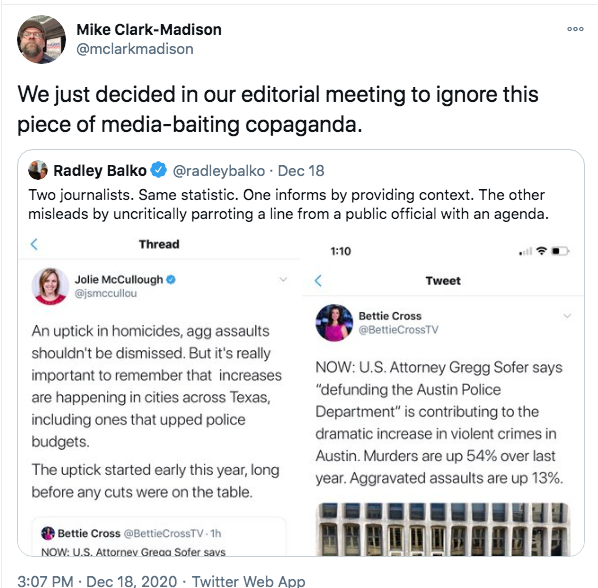
Last week, Grits considered responding to Austin-bashing press conference by the US Attorney for Texas' Western District, but the phony outrage was so tired and lame I couldn't muster the energy. Luckily, at least some in the Austin press corps - notably  Jolie McCullough at the Texas Tribune and Mike Clark Madison at the Austin Chronicle - chose either to debunk the falsehoods or just not to take the bait.

It's all been so silly. The murder increase in Fort Worth has been larger than in Austin, and they started with many more murders to begin with. But Austin gets special federal focus?

I don't blame Mike Clark Madison for choosing to ignore this piece of "copaganda" from a Trump Administration official who won't have a job in a month. But the Texas Tribune's McCullough took the opposite tack, aiming to debunk the misinformation instead:

“When you defund the police, relax enforcement of existing criminal law, and release repeat offenders and violent criminals into our streets, increased violence is exactly what you can expect,” Gregg Sofer, a newly appointed U.S attorney for the Western District of Texas, said in a statement after a press conference.

Austin police, like those in Fort Worth, recently stopped citing and arresting people for possessing small amounts of marijuana. The decisions arose from the state Legislature's legalization of hemp in 2019, which made it difficult for law enforcement officers to distinguish between legal and illegal cannabis. Recent decisions by several Texas counties to release more people from jail during the pandemic also brought backlash from the governor.

Last month, Austin Police Lt. Jeff Greenwalt addressed the rise in homicides at a press conference, but he said violent crimes detectives were still in the same shape under the new budget, “if not better.” He said given the city’s safe standing among other cities, he wasn’t yet concerned with the rise in some crimes. It’s hard to predict trends off of a small amount of data.

“We saw a rise in violent crime in the very early months of 2020, before the reimagining and the defunding conversations came up,” Greenwalt said. “I don’t think that we can say that the numbers in 2020 are reflective of that issue.”

Which is the right approach when public officials spread misinformation, ignore it or debunk it? I'd suggest both, in that order. Ignore it today, debunk it tomorrow.

Journalists should avoid reporting false statements from press events like the US Attorney's, even to debunk them, at least in the news cycle or two after they're released. The false information is being timed for a reason. As a journalist, don't be a tool for spreading it unless you fully understand what it is. Later, the information can and should be contextualized and debunked, with falsehoods a) clearly identified and b) the main point of the story.

In my imaginary world of journalism best practices, when Greg Abbott held a press conference in Fort Worth to say they were doing criminal justice right compared to Austin, pointing to the rising murder rate in the capital while ignoring that Fort Worth's was much higher, reporters would have taken note of the event but not immediately written about it. After all, it's a false statement; it has no news value.

What does have news value is the story, "Governor Makes False Statement." But that story takes research and context to write, and is more appropriate several days hence.

Live footage of reporter trying to decide how to cover Austin-bashing copaganda
Live footage of reporter trying to decide
how to cover Austin-bashing copaganda
Same goes for the US Attorney. Mike and Jolie both were right. It's not good to promote false memes, and it's also good to debunk them. It's not at all obvious which approach is right and puts the reporter in the position of a baserunner caught in a rundown between second and third: No great options.

While I realize many people believe all politicians lie, things are objectively different now. The dam has broken in the last four years, and especially in 2020. The Trump presidency demonstrated what a bind it puts journalists in when politicians are willing to openly flaunt facts. Now, state and local reporters face the same tactics and the same hard decisions about how to cover them. Ignore them? Debunk them? Report "both sides"? Should they characterize false representations as "lies"? "Mistakes"? "Spin"? "Wishful thinking"? "Blatant falsehoods"? If falsehoods further a political agenda, when should motives be impugned? These are not easy or obvious questions.

Eight years ago, Grits wrote a short essay titled "Ten Maxims for Making Journalism Relevant in the 21st Century." In retrospect it holds up well to the post-Trumpian era as a guide for how to approach these and related questions. Those interested should give it a read.