Showing posts with label District Attorneys. Show all posts

Thursday, March 07, 2024

Texas District Attorney, CCA races and the future of Texas criminal-justice reform

The ouster of Kim Ogg in Houston and the re-election of José Garza in Austin -- coupled with the ouster of 3 members of the Government Always Wins faction on the Texas Court of Criminal Appeals -- signal a sea change in criminal-justice reform politics in Texas compared to a decade ago.

Increasingly, Democrats in Texas' largest counties favor reform and in both Harris and Travis made decisive choices for progressive candidates. This is a big switch from just a few cycles ago (e.g., when Kim Ogg herself was puzzlingly touted as a "progressive").

Meanwhile, Ken Paxton's slate of candidates who ousted Sharon Keller, Barbara Hervey and Michelle Slaughter are united in their willingness to overturn 150+ years of constitutional precedent to let the AG usurp authority of local prosecutors. The legal position for which Keller et. al. are being punished has been nontroversial in living memory. Now, insanely, it's considered a right-wing apostasy.

In essence, 3 stalwarts from the court's Government Always Wins faction have been replaced with members of a newly formed Lawlessness Caucus. God help anyone who thought things couldn't get worse!

For 2 decades, through about 2019, criminal-justice reform in Texas was a bipartisan issue -- evidence in favor of the "horseshoe theory" of politics in which left and right bend toward another at the extremes, creating opportunities for alliances between them against the political middle. 

But the latter days of the Trump administration, pandemic-era protests, and ultimately, the J6 uprising broke up that coalition, elevating culture-war issues above pragmatism. "Small government" conservatives increasingly were ousted as a more radical, Big Government Conservatism came to characterize the right in the late Trumpist era.

These trends reinforce my sense that nearly all signficant opportunities in Texas on criminal-justice reform in the near term will come at the local level, with state-level politics nearly impenetrable at the moment given the characters and ideologies at the top of the GOP food chain.

The only issue I see on the horizon that could buck that trend may be transparency. Conservative leaders from several camps appear to be coalescing around the issue as a priority for 2025, even if criminl-justice topics may not be at the top of the to-do list. Still, after the Uvalde inquiry, there's more of an opening on this subject than any other. If we witness anything like bipartisan #cjreform legislation in 2025, I'd bet dollars to donuts that'll be the topic.

Otherwise, to everything there is a season, a time for every purpose unto heaven. Judging from the tea leaves, criminal-justice reformers should focus on local issues for now, and 2025 at the #txlege will be a season for stepping up on defense.

Monday, February 12, 2024

What was that guy's name again? Attacks on a progressive DA by a philistine

An old-school tough-on-crime campaign has been launched in the Travis County Democratic primary by Some Guy I've Never Heard Of named Jeremy Silverbelly, or Silverspoon, or something. To be honest. I never can remember his name. He's just the guy a bunch of Republican donors picked to try to oust José Garza. 

In the interest of full disclosure, I've been paid a small sum to help Garza's campaign with political messaging. But long-time Grits readers will be aware that my interest in supporting him goes beyond the financial, and José's campaign did not see nor approve of this blog post prior to publication. 

Polls mostly show Austinites feel safe and one only need go downtown on any weekend, day or night, to see that's true. The central business district hasn't fully recovered during the week from the effects of work-from-home, but that's because of economics, not fear of crime. Weekend foot traffic tells the story of a bustling town unafraid of its own shadow.

Mr. Silversuckle can only win if voters are hair-on-fire afraid and believe that "Soft on Crime" policies by the District Attorney are enabling the forces they fear. So we get stories like this doozy from KXAN, a local TV station which my wife refers to on Facebook, incidentally, as the "Mouthpiece for the Police State." They put out a deeply misleading attack piece on Garza that intentionally and somewhat blatantly avoided any and all apples-to-apples comparisons to focus exclusively on red herrings.

Their central claim, summed up in the headline, was that, "More felony convictions in Travis County end up in local jail than anywhere else in Texas," with the reporter placing blame for this supposed affront on José Garza's shoulders. Mr. Silversurfer and the presumptive Republican nominee (more on him in a minute) were the main people commenting on the data, placing their sights squarely on the incumbent DA.

The story, however, compares Garza's stats on who gets probation/jail/prison, etc. to other Texas counties, not to his predecessor. The exact same story could have been written about Margaret Moore, and Travis County DAs going back to Ronnie Earle (let's please all just agree to forget the ignominious Lehmberg era, though of course, that was also a legacy of the Ronnie Earle era).

Yes, Harris, Dallas, Bexar, etc., utilize prison much more than Travis County, but it has ever been thus. In 2019, for example, the last year before COVID skewed everyone's numbers, the Travis County DA under Margaret Moore sent 20% of felony defendants to prison; under José Garza it was 16%, according to KXAN. But comparing him to jurisdictions that incarcerate at closer to or above statewide rates, instead of his predecessor, for whom Mr. SillyPutty worked, is simply disingenuous to the point of spreading misinformation.

Nearly the entire difference between the number of people sent to local jail rather than prison under Margaret Moore compared to José Garza can be explained by how Garza's office is handling state-jail-felony drug cases, with almost all of those ending up on probation or serving county jail time compared to Margaret Moore's tenure. But that's about it. Otherwise, the patterns under Margaret were remarkably similar to how José's office runs. But supposedly, according to Mr. Silverhair, those were the halcyon tough-on-crime days and José is some radical.

In reality, as I predicted when he was elected, the scope of change that's possible to enact from that position has been signifant, even important, but modest. José has done what he can, but the position is limited by a myriad other actors in the system and the particular role that prosecutors play in it. He's showing us the limits of what can be accomplished as a "progressive prosecutor" under the existing system. And since José himself is a rather wonky, thoughtful, careful little dude, he's doing what he can within the system, not attempting to break it.

That's why, for example, he dropped charges against police officers for shooting protesters after the city belatedly reported that supervisors distributed faulty munitions, knowing what could happen. The city did not tell the DA this until AFTER the statute of limitations ran out on the supervisors' decisions, and it would have been against his charge to "seek justice" to hold officers accountable in cases for which their supervisors were more culpable. There are certainly factions of Democrats who wanted to see those cases go forward. But José did the right thing by dismissing them.

Yet another example comes from what to me is a particularly sad quarter. Daryl Slusher, a former journalist turned city councilmember turned career-city bureaucrat turned neocon curmudgeon, wrote up another KXAN story from last year trying to smear José, but omtting even the nod to honest reporting their reporter made in that story.

The story is about a sex offender who attacked several women in public settings. He ended up with a sentence of 10 years probation, a requirement to undergo sex-offender treatment, and was placed on the sex-offender registry. Reported KXAN at the time (though omitted in Slusher's version): 

Those who accused Rios do feel a sense of justice, though they wish he had received a tougher sentence than probation.

“It’s difficult to sit in the courtroom and listen to these difficult experiences that they went through,” Jorge Vela, Rios’ attorney, said. “We recognize that, this is not lost on us. This was a deal that was reached with the district attorney’s office after 16 months of negotiation. It took into account my client’s lack of criminal history…There are different purposes in the criminal justice system, and one of those is rehabilitation.”

Vela said Rios is receiving sex-offender treatment. Rios was on house arrest for six months prior to being on probation now, according to Vela.

“There will be no more survivors,” Judge Karen Sage of the 299th Criminal District Court said at the conclusion of Rios’ sentencing. “This is it. It ends here.”
Several things here stand out: First, being placed on the sex-offender registry is a serious punishment that will affect this man for the rest of his life. Characterizing that outcome as letting him "walk free," as Slusher did, is disigenuous in the extreme. Second, I think most people don't fully appreciate what's associated with sex-offender treatment in Texas. Until you've googled "penile plethysmograph," you probably don't fully grok how these ritual humiliations are anything but a slap on the wrist. 

After 16 months of evaluation -- including six months under house arrest -- Judge Karen Sage and the prosecutor on the case concluded this was the best way to hold the offender accountable, ensure he entered treatment, and end his victimizing behaviors. "It ends here" is, in fact, the outcome you want if the goal of punishment is to maximize public safety and change the behavior of offenders. If the goal is something else, Mr. Sillysack and his abettors should say what that is. Because, on its face, the only plausible one I can think of is to scare the public into voting against José.

In reality, Travis County saw a murder spike in 2020 and 2021 that mirrored national trends and caused all manner of overreaction and blaming of progressive politics. The police were never defunded but the murder spike was incessantly blamed by many of these same, disingenous voices on protesters calling for that outcome and the election of progressive prosecutors like José Garza, who took office in January 2021. Murders peaked that year, then declined, but equally interesting is the trend on "crimes against persons." These are the data from the Austin police chief's monthly report:

If we're going to blame Garza when crime increases, let's also give him credit when it goes down. Margaret Moore would have been amazed to see crimes against persons decline more than 10% on her watch, and the TV news folks would have eagerly touted her effectiveness had that occurred (it did not). But the crime decline took place under a self-avowed liberal, so we get weird, manufactured stories pretending the Texas state capitol has devolved into some dystopian hellscape.

I'm hopeful Travis County Democrats will see through these attacks and stick with José Garza, but H.L. Mencken wasn't wrong that no one ever went broke underestimating the intelligence of the American public. That's Mr. Sillysack's only hope of defeating Garza, which is why you're seeing these attacks being planted in the press, and will soon see them (or similar ones) replicated on television. 

Okay, fine, so his name is not Sillysack, or Silverbelly, or any of these other names that keep emerging in my head. It's not my fault I can't remember the name of this cipher of a candidate backed by Republican money who applied for a job on José's leadership team but quit when Garza promoted a more qualified woman over him. 

Mr. Sillyseason's name is difficult to remember, even though he's been endorsed by the GOP DA candidate (who is encouraging Republican voters to cross over to the Democratic primary to vote against Garza). I doubt the Republicans will remember his name, either. OTOH, it doesn't matter what his name is, no one is voting for Mr. Silverstreaker. They're voting for or against José Garza.

Still, there are too many silly/silver puns and wordplay options available; I need a mnemonic to remind me of this guy's name, and I'm betting you do, too. I got it! "Sylestine." Rhymes with "philistine." 

Don't vote for him.

UPDATE: Silverbell's first negative TV ad is now up. He accuses Garza of  lenient plea deals with "more than a thousand" violent criminals, ignoring that in every jurisdiction in every state in the country, virtually all cases, violent felonies or otherwise, result in plea bargains. This couldn't be more disingenous. It's not like he's going to end plea bargaining, after all, or would even want to. It's not even an attack, really, just pure fearmongering: Say some scary words, show a darkened image of the incumbent over tense, scary music, and hope the public jumps in your direction. We'll see soon if Democratic primary voters fall for it.

Saturday, March 26, 2022

Custodians of History: Old prosecutor files include marginalized voices usually excluded from public media and discourse

Conversations about crime data and police and prosecutor files most frequently pertain to the news of the moment: Did bail reform cause crime to increase? Was this or that police officer held accountable? Are black folks disproportionately stopped for traffic offenses?

But lately your correspondent has undertaken a research project reminding me that these records have much greater value than just informing policy debates of the moment. In many cases, they're the only records available involving important historical people and events. District Attorney and police agencies are among the earliest, continuously operating government departments, and case files are a rich source of detailed, local information.

This is especially important when mainstream information sources about marginalized people are scarce. For example, in New York City, prosecutor records were used to document the early 20th century exploits of an undercover policewoman investigating abortion doctors. Wrote one of the authors of that investigation:
These files record the lives of marginalized populations, often silenced in the historical record. Poor New Yorkers, women, immigrants, queer residents, and people of color, whose lives might have evaded contemporary published material but whose voices appear -- albeit refracted through the justice system -- in these archives.
We're finding that's true in the historical stories I'm researching centered in East Austin. Researching black history in Texas from the 1920s and '30s is a tremendous slog: only a few editions of the main black newspapers remain, and the white press largely ignored black news, sports, and culture. But many of these same people interacted all too frequently with the justice system. To the extent their voices can still be discovered at all, often it's only "refracted" through that ignominious but invaluable lens.

After 75 years, Texas state law eliminates most confidentiality restrictions and discretionary authority to withhold release on criminal records, making them technically public. But most DA's offices don't treat them that way. Here in Travis County, my wife and I recently filed an open records request for files from the early 1940s. The Travis County DAO initially replied that they intended to deny disclosure under all the "discretionary" exceptions they could identify. 

We appealed the matter, pointing out that the Public Information Act doesn't afford them any of those discretionary exceptions. The DA agreed, and supposedly we'll get those records soon. But what's really needed is for prosecutors to develop written policies about record retention and release, then to migrate files to local archivists better trained to handle and preserve them. 

What kind of records are we talking about? Certainly, it differs case by case. But we have lots of examples because, in 2009, then-Travis-County-District-Attorney Ronnie Earle transferred 35 boxes of records, mostly from the 1940s and 1970s, to the Travis County Archivist, which also retains old records for the constables offices, the probation department, and other county law enforcement agencies.

The transfer of these 35 boxes appears to have been a one off. The archivist said there was something in the database about concerns that the files were deteriorating wherever the DAO stored them before. Regardless, they're now all sitting on a shelf at the archivist's office on Airport Blvd.

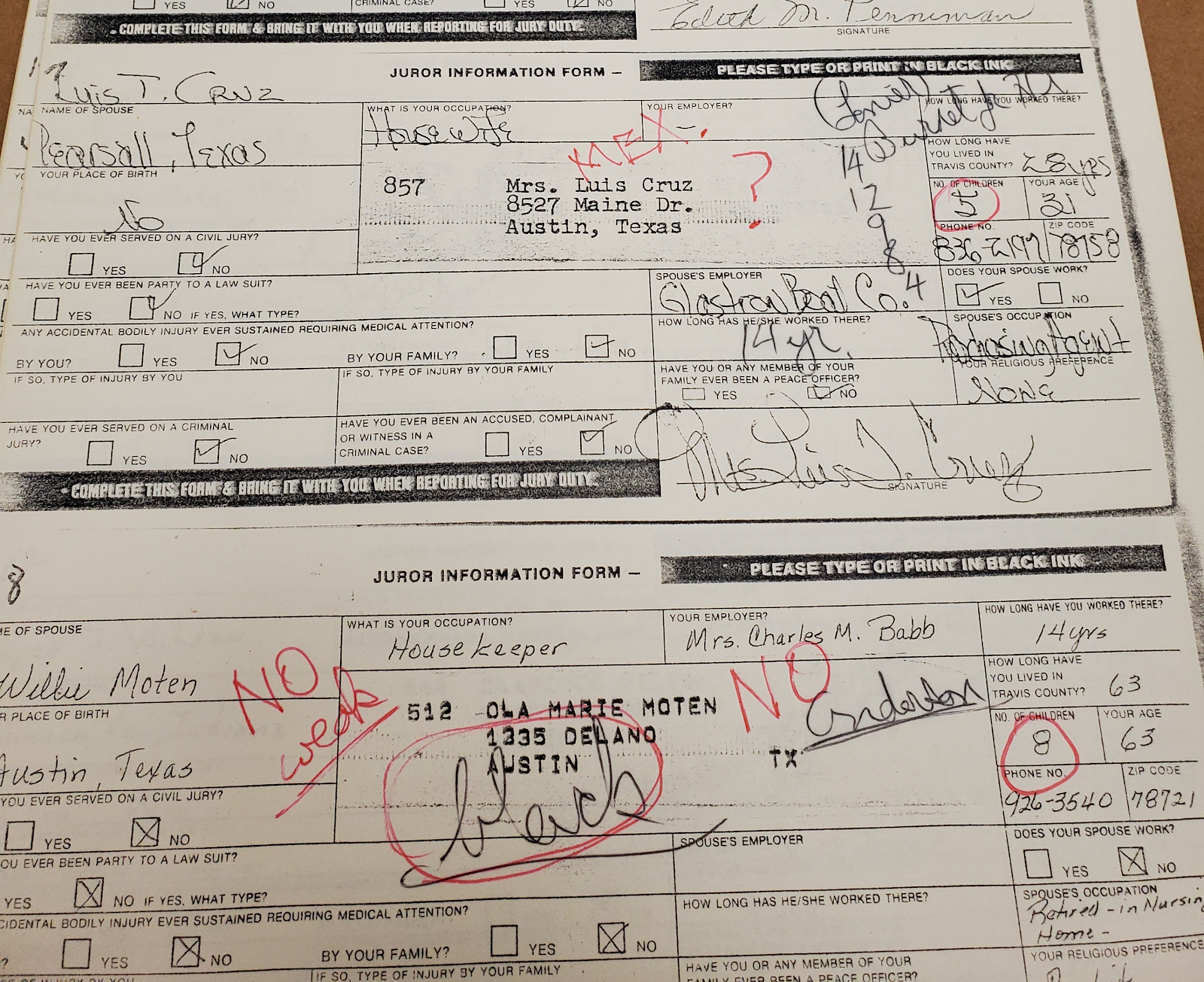
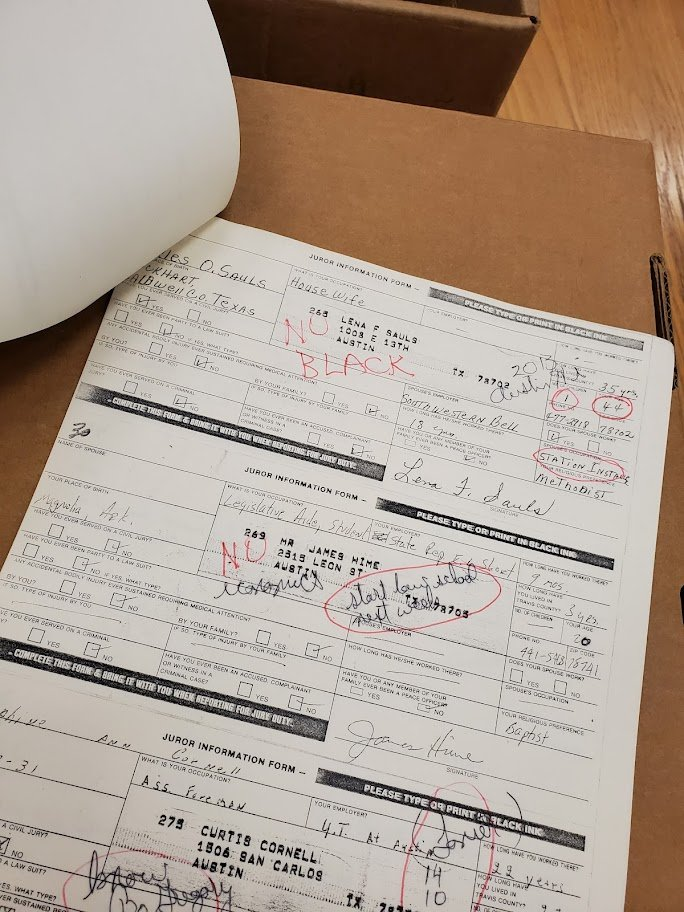
Kathy and I went to review several of these boxes to see if they contained files related to the now-long-deceased people I was researching. They did not. But Kathy noticed these documents in an unrelated case in which prosecutors adamantly struck black jurors in red pen:

Here's another example:


I'm not a lawyer, but I'm pretty sure these aren't Batson-approved jury-selection practices. After I posted these photos on Twitter, I got an email from the Travis County DA's first assistant saying she'd referred it to their Conviction Integrity Unit! Bully for them.

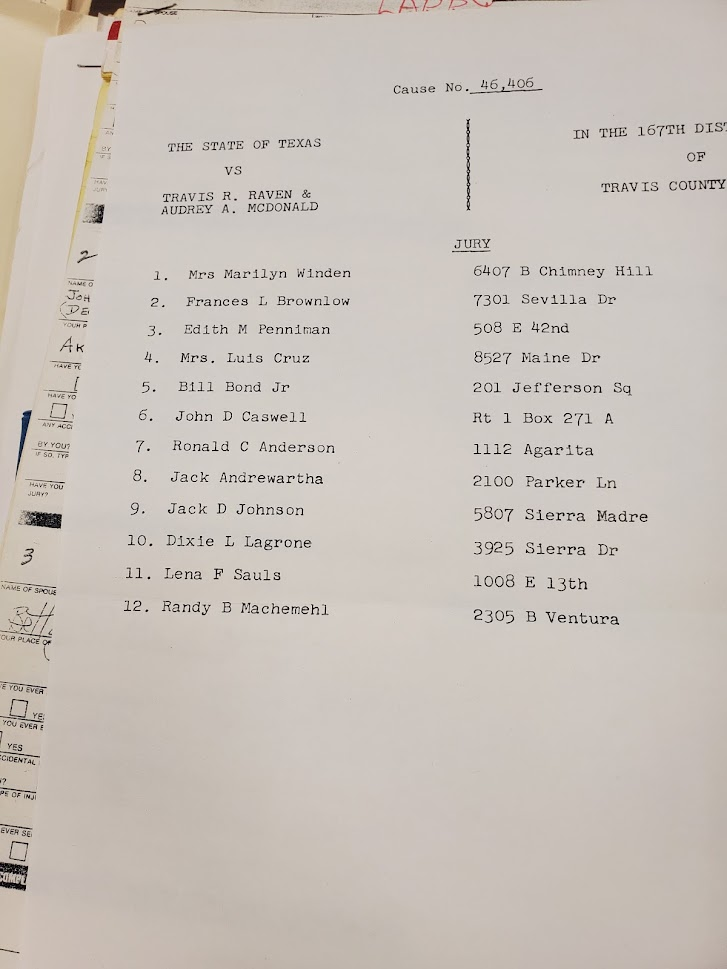
This naturally spurred my curiosity. This was a case I was neither looking for nor familiar with, but I'd snapped a photo of the caption and cause number:


It turned out to involve a man named Arthur Raven and a codefendant, Audrey McDonald, and would have been an extremely high-profile case. (Long-time readers will recognize a pattern: the higher-profile the case, the more likely somebody cuts corners to secure a conviction, as with this jury-selection process.)

Raven, a white man, was the first football coach at Reagan High School when it opened in 1965 and from the beginning was highly successful, winning three 4A state championships in 1967, '68, and '70. Reagan was a predominantly black high school, built to replace the old L.C. Anderson HS, which closed in 1971. After his third state title, Austin ISD elevated Raven to become athletic director district-wide.

His son, Arthur Jr., was a Texas Department of Public Safety trooper. In 1972, he  attempted to capitalize on name recognition from his father's success to run for Sheriff against 20-year incumbent T.O. Lang. Lang was a "Shivercrat," a conservative Democrat who'd spent World War II as Austin PD's liaison with the FBI hunting subversives. After the war in the late '40s, he was an APD homicide detective before running for office.

To this day, no one ever held that position longer and, after two decades, lots of people thought it was someone else's turn.

Also running against Lang in 1972 was Raymond Frank, a leftie reformer attempting to capitalize on the same momentum that ousted a wave of right-wing Texas Democrats at the Legislature following the Sharpstown banking scandal. Insiders blamed Raven, Jr., when he split the traditional law-enforcement vote, allowing Frank to push Lang into a runoff. Lang lost. And his allies were furious.

Once in office, District Attorney Robert O. Smith almost immediately turned his sights on Frank. A grand jury under his direction issued a report critical of the new Sheriff. Frank turned around and accused Smith of corruption and manipulating the grand jury.

Arthur Raven, Sr., was accused of coercing prostitution while all this was going on, but convicted of a lesser, misdemeanor charge while the jury acquitted his codefendant. We didn't read the whole prosecutor's file, just this portion concerning jury selection. But news accounts say Raven took the stand in his own defense, testifying most of the day as the defense's only witness. Your correspondent hasn't done enough research to form an independent opinion, but Raven certainly thought he was being railroaded.

Was Smith retaliating against the old ball coach because his son's campaign helped the DA's nemesis get into power? Grits has no first-hand knowledge. But I bet I'm not the first person to imagine so.

To be clear: I haven't read the file and just snapped a few photos and read a few news clips. I don't know who was in the right in these controversies, whether Arthur Raven, Sr., was guilty, or if his prosecution was politically motivated. But this glimpse into the historical record shows how important these old files can be to interpreting past events. Knowing prosecutors went to unethical lengths to exclude black people from Raven's jury is an important part of that story that would remain hidden if one relied only on news accounts.

In 2009, Ronnie Earle (God rest his soul) thought it was fine to make records from the 1970s public at the Travis County Archivist. That policy should be formalized. It's a waste of scarce resources at the District Attorney's office for lawyers to review every request. Better to pass that task along to library-science professionals employed precisely to perform these tasks.

I'm looking forward to receiving the records we requested, which I have no doubt will answer a long list of nagging questions surrounding the historical research Grits has been working on.

Once we get them, the next step is for the DA's office -- eventually, for every DA's office -- to develop written policies for retention and release of historical records. We hear a lot about police and prosecutors as custodians of public safety. They should also be recognized as custodians of history, and behave as such.

Friday, September 03, 2021

Politics explains oddities and strange bedfellows in Harris County bail debate

Harris County District Attorney Kim Ogg issued a 56-page report disputing the findings of federal bail monitors overseeing the settlement agreement between plaintiffs and the county.

Her arguments are so disingenuous, it's a bit tiresome to go through them for rebuttal. But since the Houston Chronicle editorial board recently anointed themselves the DA's PR agents, it's worth at least pointing out her most egregious misstatements. 

The biggest one is a common misrepresentation that you rarely see people claim in writing; it's always something whispered behind the scenes, until now. Ogg claimed: 
“Bail reform” has not been confined to misdemeanors, but has been implemented, in practice, for felony defendants at every level, even repeat violent offenders charged with some of Harris County's most notorious and deadly crimes, including, but not limited to murders and capital murders.
This is inarguably, factually, a lie. Not an overstatement. Not an alternative point of view. Not a difference of opinion. A bold-faced lie by someone who should know better. It's something opponents of bail reform say over and over, but when you dig into the stories, the person inevitably paid cash to get out. The Houston Chronicle looked at more than 200 murders committed by people out on bail since 2013. Less than 1% involved someone out on personal bond.

Regardless, over and over we see personal bonds blamed for crimes committed by people who paid to get out. On the floor of the Texas Senate this summer, Joan Huffman told her colleagues during the first special session that five people who were out on bond had been charged with murders in Houston since that body had adjourned. But it turned out, none of them were out on a personal bond. All of them had paid to be released and their cases wouldn't be affected by the bill. 

By contrast, misdemeanor bail reform involved the use of personal bonds, and misstatements like this are why the Legislature focused on banning them. But that won't affect "repeat violent offenders charged with some of Harris County's most notorious and deadly crimes." It's just not true, no matter how often it's repeated, including by Republicans I respect.

Ogg's central argument is that the number of crimes committed by people out on bail is increasing in Houston. Which is true -- and also far more people are currently awaiting trial than just a few years ago. She frames the discussion in a way that elides that key fact, knowledge of which might lead to different conclusions. Her key "findings" were presented as follows:
  • Re-offending by criminal defendants who have been released on bail is up.
  • Bond failures by criminal defendants are up.
  • Violent offenses committed by defendants free on bail is up.
As an improv comic might say, "Yes, and ..."

None of that is because Houston judges are hesitant to jail people. 

Here's what's really going on, and anybody who's not focused on these specific problems isn't shooting straight with you about wanting to reduce crimes by people out on bail: In the wake of Hurricane Harvey, flooded courthouses created a court backlog that increased the number of people out on bail three-fold, from a little over 30,000 people on bail to more than 90,000, reported the Houston Chronicle recently. COVID exacerbated these delays, while the latest COVID spike has heightened pressure to decarcerate local jails as a growing public health imperative

Harris County's criminal case backlogs could take years to work through unless, as Elizabeth Rossi and Amanda Woog suggested earlier this week on Grits,  the District Attorney begins using her discretion to dismiss broad classes of lower-level cases en masse.

Until then, one would expect the number of crimes committed by people on bail to increase as long as the number of people on bail is increasing.

That said, here's one more datapoint in defense of the federal monitors Ogg is ostensibly criticizing. By the data in her report, the number of crimes committed by this cohort (people out on bail) increased LESS than did the total number released pretrial. So she's complaining that the numerator in a fraction went up without telling you the denominator went up even more. I realize some people go to law school because they're not good at math, but even in that context, this is a little extreme. Her whole memo is based on such preconceptions.

In fact, there's evidence that, faced with a significant problem of the number of people out on bail tripling in a short period of time, judges did a pretty good job of vetting cases. Since the number of people out on bail tripled but the number of crimes committed by that cohort increased less than that, in aggregate, judges seem to have been making the best public-safety oriented decisions they could in response to a bad situation. 

In Texas politics, however, no good deed ever goes unpunished.

Grits believes the DA's complaints and indeed, the entire Texas bail-reform debate, can't be understood outside of a highly politicized context. Between County Judge Lina Hidalgo (who hasn't approved Ogg's open-ended budget requests) and recently elected Democratic Houston judges, some of whom supported her more progressive primary opponents last go round, Ogg and the governor find themselves, at least in the short term, with common enemies. I'm not saying it's planned; more like she's taking potshots, looks up, and all of a sudden she and the Governor are shooting at the same targets. The enemy of my enemy is my friend, etc..

Regardless, there's no way for Harris County to incarcerate its way out of court backlogs. It's a practical impossibility and from a perspective of responsible governance, absurd to demand it. But that's the simplistic vision of "justice" and "safety" that Ogg, Andy Kahan, and Governor Abbott would have you buy into.

If Ogg were working with other Harris County officials to problem solve by getting rid of the backlog, judges might give more credence to her requests for higher bail on actual "repeat violent offenders." And perhaps she'd get a more welcoming reception in her budget asks at the commissioners court. 

But some prosecutors believe it's never their place to negotiate. They see their role as either "I get my way or I'll fight you." That's what we're seeing with Kim Ogg, and it's a severe disappointment.

Thursday, September 02, 2021

Prosecuting crimes of poverty isn't the same as combating a "crime wave"

The following is a guest blog post co-authored by Elizabeth Rossi of Civil Rights Corps and Amanda Woog of the Texas Fair Defense Project. Their organizations are among the civil rights groups involved in bail litigation against Harris County. Related: this discussion of the District Attorney's claims to be fighting a "crime wave" in Houston harken to this analysis of media coverage of crime and jails from a century ago. Sometimes, the more things change, the more they stay the same.

The Chronicle’s recent editorial “How Harris County prosecutors are trying to stop Houston’s crime wave,” casts District Attorney Kim Ogg’s office as engaged in some heroic task of ferreting out the County’s most dangerous “criminals,” when in fact the DA is funneling millions of dollars toward the prosecution of poor people charged with crimes of poverty. Without a shred of evidence, the Chronicle adopted the DA’s party line, asserting that “more prosecutions means more justice and a safer community.”

Expert research -- including some paid for by the County -- shows that's not true.

The County hired national experts at the Justice Management Institute last summer to address exactly this question. JMI assessed the backlog and concluded that the safest and most fiscally responsible solution to the backlog would be “to dismiss all non-violent felony cases older than nine months,” with certain exceptions for cases like DWI, so that the DAO could devote its resources to prosecuting violent cases. The experts at JMI pointed out that only 42% of all felony cases (not just “violent” crimes) closed in 2019 resulted in a conviction. The other 58% resulted in dismissal, deferred adjudication, or acquittal. And even among the 42% of cases that resulted in conviction, the majority involved people who were released immediately into the community on probation. The idea that the DAO is rescuing Houston from a “crime wave” by prosecuting years-old theft-by-check cases and other poverty crimes is laughable.

But the Chronicle ignores this information.

The paper also ignores a recent academic study by researchers finding that non-prosecution of low-level offenses can lead to less crime without any negative effects on public safety. Ogg has offered no answer to these findings. And now she is asking for millions of dollars more to fund 22 additional prosecutors to conduct intakes -- which will bring even more people into the broken system, exacerbating a problem that Ogg created.

The DAO is to blame for this tragedy. Ogg has enormous discretion to decide whom to prosecute, and most of the cases that Ogg is now begging for resources to resolve shouldn’t even be in the system. Evidence and research show that expanding the wasteful punishment bureaucracy through initiatives like the DA’s “triage” program does nothing for public safety, but does a lot to expand the government’s control over and surveillance of poor people and Black and Brown people, exacerbating poverty, separating families, and making it more difficult for people to find jobs and housing - all conditions that tend to increase future crime, not decrease it.

Ultimately the Chronicle piece is hailing prosecutors as heroes for solving a problem that they created and that they can end without spending a single penny more. Ogg doesn’t need more money to do her job. Instead, Harris County needs to invest that money in proven solutions to public safety issues-- programs like violence interruption, mental health, youth programs, non-carceral crisis response, streetlights, and other interventions that prevent harm before it occurs -- and should stop spending millions of taxpayer dollars for the DAO to prosecute crimes of poverty from 2016.

Thursday, February 11, 2021

Texas oyster crimes are no joke and a symptom of broader problems

This blog has spent an inordinate amount of time over the years focused on Texas' array of oyster-related criminal offenses, to the point that Politifact once did a fact check on my claims. They found them "Mostly True," with the "mostly" caveat being that one source put the numbers even higher than I'd said!

Marc Levin, who recently left the Texas Public Policy Foundation to become general counsel at the new Council on Criminal Justice, first launched this meme as a way to critique overcriminalization, highlighting the fact that Texas has so many felony statutes on the books it's difficult even to count them.

Your correspondent played into the gag, wondering aloud how many crustacean-related crimes are sex offenses and counting the number of oyster-related felonies in "The Walrus and the Carpenter."

Over the years, however, Grits has come to realize Texas' "oyster crimes" aren't just a silly government foible to be mocked at conservative conferences. (TPPF for years held a panel at their biennial legislative conference highlighting "overcriminalization" and featuring this example.) Rather, they're illustrative of some of the core challenges involved in disentangling criminal law from regulating non-criminal behavior in a society organized around what Jonathan Simon has called "Governing through Crime."

Texas has so many oyster crimes on the books for two, fundamental reasons: Scorn for regulation and the environment. Harvesting native oysters is terrible for the latter and the Legislature prefers criminal law to the former.

Including misdemeanors, Texas has dozens of oyster-related crimes on the books, all because the state uses criminal law to regulate unwanted business practices that other states manage through non-criminal regulatory enforcement.

In most other coastal states, civil regulators enforce rules about oyster harvesting. In Texas, it's game wardens and prosecutors. This leads to a spotty patchwork of enforcement dependent on some random lawyer elected DA knowing and caring about the topic and/or being willing to ignore local donors who might object.

For years, the prosecutors' association scoffed at the oyster-crime depiction, insisting such cases were rarely prosecuted. An old college pal of mine who's written their law books for the last couple of decades said the same thing on Twitter when the oyster-crime meme arose this week. But if that was ever true, it's not any longer. 

Hurricane Harvey disrupted the unfettered harvesting of native oysters, requiring more robust state regulation for the industry to survive. Texas A&M Professor Joe Fox noted in 2019, “Due to overfishing, excessive freshwater inflow and loss of infrastructure mainly due to hurricanes, Texas oyster harvests have been trending downward and have experienced a 43% loss in the past three to four years.”

That's what's generating the push for greater enforcement. Without it, the industry could vanish. But prosecutors aren't regulators. Their job is to prosecute crimes, not regulate aquatic industries, even if the latter task de facto falls to them under Texas' absurdist system.

Even if you took these criminal laws off the books, state intervention would be needed for this industry to exist. Otherwise, overharvesting would wipe out the native oyster population in short order. In the 4-day sweep in December, game wardens restored 48,000 pounds of illegally harvested oysters to the bay. In a similar sweep in 2018 netting twice as many cases, "Some of the violators intercepted had cargo consisting of up to 35 percent undersized oysters."

So it's not that the criminal laws governing oyster harvesting are unnecessary. The government has a role to play here. But criminal statutes are a blunt instrument for regulating fishermen. That's the wrong tool for the job. 

To disentangle criminal law from shellfish regulation requires a big picture view that embraces property rights and responsibilities. Decriminalize, regulate, and let people who want to farm oysters grow their own in designated areas. Just letting rapacious private interests plunder a resource till it's gone makes no environmental, moral, nor economic sense.

Texas could wipe out most oyster-related criminal offenses if it 1) banned harvesting native oysters, 2) fostered a transition to (recently legalized) privately managed beds, then 3) regulated the industry under civil instead of criminal law. That'd be better for the environment and the industry long term, and take law enforcement mostly out of the equation.

Wednesday, January 27, 2021

Please prove me wrong: Jose Garza wants to make Grits eat my words

Travis County District Attorney Jose Garza is trying to change Grits' mind about "progressive prosecutors." He hasn't succeeded yet, but in the early days of his administration, he's giving it the ol' college try.

In the last week, Garza announced indictments of two officers who'd allegedly engaged in excessive force but weren't punished by police management, and said a grand jury would soon consider charges in the deaths of the police officers who killed Mike Ramos and Javier Ambler. Then yesterday, his office agreed Rosa Jimenez - the babysitter falsely convicted 18 years ago of murdering a child in her care - could be released on bail pending her appeal, and Judge Karen Sage agreed. 

These are major shifts in policy. In recent years, we've seen Texas prosecutors seek indictments for cops following publicity and public pressure - as in the Mike Ramos and Javier Ambler cases - but seldom in less high-profile situations, and never when the police department failed to discipline them. The indictments of officers cleared by APD Internal Affairs amounts to another "no confidence" vote for police Chief Brian Manley, this time from the sitting District Attorney. And it validates public concerns that the department's disciplinary process fails to hold certain officers accountable. 

An equally big shift involves the level of transparency Garza pledged to provide about such cases. He released the first of what he promised would be bimonthly reports on cases involving alleged law-enforcement misconduct. Under Margaret Moore, the DA's office amounted to a black hole from which no light emerged unless she imagined it would cast her in a flattering manner.

Indeed, Garza effectively countered complaints from police about the indictments by doubling down on his commitment to transparency:  "To the extent that Chief Manley and others have concern about the grand jury determination in this case," Garza told the Statesman, "they should immediately release all of the relevant video footage so that our community can see the conduct for themselves." By contrast, Moore's practice was to tell APD not to release video in such cases.

Meanwhile, Grits couldn't be happier that Rosa Jimenez was released pending appeal of her habeas writ. Six judges have now said Jimenez is innocent or at least deserves a new trial, but under state law, Attorney General Ken Paxton controls the appellate process in federal court and he has appealed all their rulings. Because of the innocence findings, under Texas law, Judge Sage can release Jimenez on bail pending the final outcome if the DA agrees. Former DA Margaret Moore chose instead to defer to AG Paxton, so this is evidence elections definitely matter.

Jimenez should have been released years ago. She was convicted based on junk science after the trial judge refused to pay for defense experts to counter misinformation presented by Travis County prosecutors. So this was an incredibly happy day. If it weren't for COVID, your correspondent would have gone to the courthouse for the event. When the news came, I literally shouted for joy. (Bilbo the Criminal-Justice-Reform Dog, I should add, was rather confused and taken aback at this outburst.) It's possible she may be released and reunited with her (now adult) children as soon as Friday.

So let me take this opportunity to say "thank you" to Jose Garza, and for that matter to Judge Sage. I'm proud of and grateful to both of them for this.

Even so, Grits has never been comfortable with the phrase "progressive prosecutor." I think of the prosecutorial function as inherently regressive: a one-trick pony whose "trick" is to punish people for violating state dicta. As I wrote five years ago, usually when a new District Attorney is elected:

management changes, but the day-to-day operations remain much the same as they functioned when our grandparents ran much-smaller versions several decades ago. Any differences between electeds play out at the margins of just a handful of individual cases. But the overarching structure and purpose of the institution inevitably remains undisturbed. Even when DAs take a progressive step, there are almost always pragmatic, internal reasons for it.
Grits added, however, that this wasn't an inevitability: "That's not to say it wouldn't be possible for a DA to fundamentally redefine the job. They have enough discretion to where all sorts of interesting possibilities might present themselves if smart people put their minds to it." But the first round of Texas DAs elected after campaigning as "progressive" - including in Houston, Dallas, San Antonio, and Corpus Christi - have fundamentally continued to perform the office's functions in the same way they've always operated.

That's an observation more than a criticism. Change is hard. And slow. Plus, there exist few models for alternative approaches that might truly merit a "progressive" label. The cases described above - indicted cops and an innocent person released - still boil down to decisions whether or not to use the stick. We've not yet seen a fundamental reimagining of the prosecutorial function in Texas, and arguably anywhere (although admittedly, I don't closely track what prosecutors are doing in other states).

Still, Jose Garza is showing how much discretion matters. So far, these fall into the category of cases that "play out at the margins." But they're welcome moves, and evidence that he really does intend to operate the office differently. To me, the real test will come when we see how more workaday, less-high-profile cases get handled, particularly on drug and sexual assault charges. At this point, I'm hopeful bordering on optimistic that Garza will prove me wrong about "progressive prosecutors."

Like Fox Mulder in the old X Files series, I want to believe.

MORE: See Garza's 3-page memo on new policy changes he's implementing at the Travis County DA's office.

Correction: An earlier version of this post said the officers who shot Javier Ambler and Mike Ramos had already been indicted. In fact, Garza has said he will take their cases before a grand jury in the current term. Grits regrets the error.

Monday, November 02, 2020

Presumptive Travis DA Jose Garza on death penalty, women's jail, and membership in TX state prosecutors association

The Marshall Project's prolific Keri Blakinger generates more copy than her employers will publish, so she's been sending Grits an occasional email featuring unpublished odds and ends. Today, we have a few tidbits from a recent interview Keri conducted with Jose Garza, Travis County's presumptive Democratic District Attorney pending tomorrow's election (he has an opponent, but the Democratic primary is the real race in Austin).

Keri spoke to Garza about the death penalty, building a new women's jail, and whether he intended to retain membership in the Texas District and County Attorneys Association. Enjoy!
Hey Grits,

A couple weeks ago I had a chance to Zoom chat with Travis County DA candidate Jose Garza. A lot of our talk was on background - but I just wanted to pass along some of the points that were not, and that might interest you and your readers. These are kind of off-beat questions because I was trying to ask about details I hadn’t seen discussed elsewhere - and the many prior interviews he’s done have covered a lot of the basics, plus his website is pretty detailed.

So at this point we already know that he’s pledged not to use civil asset forfeiture without a conviction, that he will stop prosecuting less than a gram drug cases, will put more resources toward serious crimes like sex assault, and various other things you have outlined previously.

Given how progressive his platform is, I was interested in whether he’d pull Travis County out of TDCAA. A few months ago on Twitter, he was pretty clear that he would: “TDCAA has been one of the largest impediments to progress at the TX state legislature,” he tweeted. “I’m running for DA to build a system that lifts up working people and people of color. When elected I will not be joining the association.”

And some elected prosecutors elsewhere - like Philadelphia and California - have cut ties with their respective DA associations because they were too regressive or “out of touch.” But as you pointed out to me, TDCAA provides training and other support that would have to be replaced so it’s not as simple as just walking out the door. When I asked TDCAA, they said that about 30 elected prosecutors in Texas are already not members. So it seems there is some precedent here for non-membership.

When I asked JG about all this a few weeks ago, initially he said that he would be evaluating existing relationships to figure out which are in line with the office’s goals before making any decisions. But when I circled back to ask if that was different than what he’d tweeted in January he clarified that he still hopes to exit TDCAA and basically is just figuring out what that looks like at this point: “It remains a goal to me,” he said. “It remains a goal to make that there is a better structure for truly representing the views of district attorneys and the people they are accountable to.”

I realize this is a lot of words I just spent on what is really a very niche thing to be interested in, but I hopefully Grits and Grits readers might share my niche interest.

In other, slightly-less-niche interests, I also asked him some about capital punishment. He’s talked before about opposing the death penalty, but I wanted to know if that meant that he would actually stop defending the existing death sentences that are in post-conviction litigation now - which is about half a dozen cases. When we spoke, he pledged to review those cases, but didn’t say whether he would defend death sentences if the convictions themselves seemed solid.

“We will be reviewing all of those cases to aggressively seek out innocence but not just innocence, constitutional defects in cases,” he said. “I presume that post conviction that there are probably challenges, there are probably actual innocence claims… as a matter of course no we are not just going to presume that all of these cases should continue to be defended.”

It’s not quite a clear answer to what I was getting at, but I’ll be interested to see how this develops.

The other thing we talked about the most on the record was the new women’s jail, which he’s previously said he opposes. As Grits readers probably know, Travis County has been working on building a new women’s jail for some time now. The proposal to replace it would create more beds, but the current one is shitty and doesn’t have good program space. As someone who has actually spent time in a jail, I always want to know exactly why when people oppose doing something that would improve shitty living conditions.

“I’m in favor of less shitty,” he said, “but for me this is about math and this is about resources. I think what the county is attempting to accomplish and what the sheriff is attempting to accomplish is admirable and is the right thing because there will continue to be people in our jail and we have a responsibility to make sure everyone there receives the best care.”

But not if it requires a bigger jail - which he believes will be even more unnecessary when he’s in office:

“There are a couple of hundred people in the jail right now and it’s about 500 short of capacity – it’s at something like 30 percent capacity, for women in particular,” he said. “And on top of that Travis County is going to have a new DA and new county attorney that have pledged significant steps that would reduce the jail’s population. I’m not convinced that when the trendline is decreasing jail populations… that the best way to care for the shrinking population of people in the jail is to build a brand new $98 million facility.”

Anyhoo, that’s a lot of words and I’ve droned on quite a bit about some obscure topics here so enjoy.
Grits here: Just to say so, since Keri didn't, Garza's answer on pulling out of the DA's Association was insensible, answering a yes-or-no question about a pretty-clear campaign promise with pure squish.

To be clear, I like Jose, while TDCAA has for two decades resided on Grits' frenemies list. It would tickle me to no end if DAs from the big counties started to walk away from the state prosecutors' association. At the same time, I marveled when Garza made that pledge in the first place. My immediate first thought was, "He hasn't considered everything that would entail." So Grits wouldn't blame him for not knee-jerk pulling out of TDCAA in January without a plan. After all, that's the organization that provides most of their training.

Plus, Garza will be arriving just as the legislative session gets underway: The biggest complaint about TDCAA from reformers is them thwarting reform bills behind the scenes. Once session begins, Garza can assess for himself whether it's possible to influence the organizational culture from within.

TDCAA has historically been a problem for the Texas #cjreform movement, and Garza along with other elected big-county prosecutors perhaps can help solve it, whether by working from within or leaving and doing their own thing. Their rural counterparts may outnumber them when it's time to vote for board members, but big counties' dues provide most of their funding.

RELATED: From the Texas Observer, "Jose Garza redefines 'progressive prosecutor'"

Thursday, October 01, 2020

Task Force on reforming Houston police: Empower oversight board, remove civil-service barriers to accountability at #txlege, and have someone besides the DA prosecute police misconduct (Grits has a suggestion)

"The loss of public trust and credibility makes it difficult, if not impossible, for the police to forge partnerships in local communities, let alone expect community cooperation in criminal investigations," declared the Houston Mayor's Task Force on Policing Reform (TFPR), which issued its recommendations this week. Even if your correspondent might have gone further, or may quibble with their suggestions (as indeed, I will, below), they're more significant than Grits had anticipated. Good for them!

The Houston Chronicle reported that the Mayor asked for "a few days" to digest the report and meet with the task force chairman, sub-committee chairs, and council members before formulating a response.

Grits, however, has no need to wait. Let's dig into this report and see what's there. Obviously at 104 recommendations, we don't have time to discuss all of them. And some of them are rather small-time, anyway. But let's run through the big stuff, describing their recommendations with Grits' own annotations. This is Part One of what I anticipate will be a three-part analysis: I read the 150-page report so you won't have to! :)

Community Policing (yawn)

So-called "community policing" has always been a hustle. No one can define it and in practice departments interpret it as officers spending time hanging out with whomever instead of responding to calls or performing police work. As fear of crime has declined as the go-to driver of more police spending, "community policing" offers departments a new metric -- percent of time available -- to demonstrate that we always need more officers no matter what is happening with local crime stats. At HPD, Chief Art Acevedo uses the term "relational policing," but, "The Task Force believes it is similar, if not mostly the same." In other words, it's a buzzword intended to confuse with results that can't be measured. None of the recommendations here seem destined to reinvigorate this tired and fruitless approach, from giving cadets community tours, making them sit through more lectures, or having officers document "out of car engagements with civilians and/or businesses."

Updating promotion matrices to give points for community policing might be helpful, once there is a consensus on what exactly officers should be doing, but the report failed to discuss taking points away for officers with misconduct records. That might help, too. In 2017 legislation, Houston state Rep. Senfronia Thompson recommended deducting points for officers found to have engaged in misconduct. Perhaps it's an idea worth reviving?

I liked the "mobile storefront" idea, which was the final recommendation (#16) in the community policing segment. Most of the rest in this section seemed pretty lightweight.

Independent Police Oversight Board

Grits has never been a great fan of civilian-review boards because most of them are as worthless as the one in Houston. Austin's oversight board, along with the Office of Police Oversight (essentially a Police Monitor-Board model), at least has become a window into policing problems we've never had before. (Local press don't cover the complaints, but they're out there from a credible source, and advocates discuss them.)

The Task Force agreed with city council members who recently said they have "no confidence in the current format" of the IPOB. Its powers are truncated and it fails to perform even the duties it's been assigned, they concluded. (These recall the complaints of an IPOB member who recently resigned over the group's inefficacy.) The Task Force laid out three broad models of police oversight:

  • Auditor/Monitor Model
  • Investigative Model
  • Review Focused Model

They recommended IPOB expand to 31 members and adopt an "investigative model," but Grits wonders, "to what end?" Their investigation results would not be part of the department's decision making process when it comes to disciplinary decisions. They have their own investigators for that in the Internal Affairs division. How will these investigations affect real-world outcomes, including policies and practices, much less in the individual cases they investigate?

Since it's been empowered to a) review previously confidential documents and b) publish sometimes de-identified results, Grits has found Austin's fusion of Monitor/Review models (to use the Task Force's nomenclature) gives advocates more empowering information than we had before. The oversight board here reviews cases with an eye toward recommending policy improvements, and the record they create was been a valuable tool for documenting problems in a way that city officials are able to hear. Requiring the Chief to respond in writing to civilian oversight recommendations has also helped.

The Task Force does recommend hiring dedicated, paid staff to support the civilian review board, including investigators who it hopes will have "subpoena power." (FWIW, I'm not sure what more they think they'll get with a subpoena beyond what they get by mandating access to the department's full file.) Regardless, having staff led by a dedicated Police Monitor's position, as Austin did, has the added benefit of creating a counterweight to the chief in the city bureaucracy on police-misconduct questions, where officials might not listen to part-time civilian volunteers. That's a big practical benefit and has been welcome change.

Legislative changes needed to civil service

The portion of the report which made your correspondent jump out of his chair and whoop with sheer delight addressed legal changes needed at the state or city level, but with particular focus on the state.

They want to change the much-derided 180-day rule in two ways - one significant, one not. For the uninitiated, state law and many union contracts say officers in civil service cities can't be punished more than 180 days after they commit a misconduct violation. The Task Force recommended changing this in two ways: 1) have the clock launch on the "date of discovery" of the misconduct instead of the date it occurred, and 2) change 180 days to 210.

The first change is significant; the second much less so, though the first change magnifies its impact. Together, they'd be an important reform. That said, make Grits Philosopher King and I'd say for police the rule should be a full year from the date of discovery.

The Task Force wants to fix another civil-service practice your correspondent has railed against for years: "Require officers involved in incidents in which their conduct is under scrutiny to make statements at the beginning of the investigation." As the Task Force noted on p. 34, "Current practice allows officers to defer making statements until after the investigation is complete and they can read the entire file," as well as review any body camera footage.

Imagine if in a regular murder investigation they waited to interrogate the suspect until s/he reviewed the investigation file with their lawyer: Unthinkable!

Who should prosecute police misconduct?

The Task Force believes the District Attorney has a "symbiotic relationship" with the police department, which results in an "inherent pro-police bias." Thus they think "an independent agency," unnamed in the report, should prosecute those cases instead.

This has been suggested many times before. Some iterations see special prosecutors appointed each time, though that gets expensive.

Speaking of which, Texas Attorney General Ken Paxton has said he'd take the job, but I don't think anybody would trust him.

Grits has a suggestion I believe would be popular with everyone but Alex Bunin, the Harris County Public Defender: I think the Harris County Public Defender Office should take over prosecuting cops instead of the District Attorney.

I've given this a lot of thought: Bunin and his shop are respected, and they already have an oppositional relationship with the Houston PD. I can't think of another outfit that would care less about pissing off the union. They've got the talent in the office to do the job. Plus the commissioners court just expanded their budget.

Now, they may not want to do it. Many of those folks are life-long defense lawyers who chose not to go into prosecution for a reason. But sometimes, the person who doesn't want the job is exactly the right person to handle it responsibly. (They know what's required; that's why they didn't want it!) It wouldn't be that many cases by comparison to their usual docket and I believe they're the right crew to handle the job.

Next time: Improving the complaint process, body-cam policies, use of force, and "rebuilding trust through transparency."

Thursday, May 28, 2020

Prosecutor-turned-TV-star cultivated ring of informants to give false testimony in cold cases, federal judge declares

Imagine prosecutors cultivating a "ring" of jailhouse snitches to give false testimony in cases where there otherwise was insufficient evidence to convict the defendant. Well guess what? You don't have to imagine.

A recent Houston Chronicle article by Julian Gill described remarkable allegations against former Harris County prosecutor turned TV star Kelly Siegler, with a federal district judge claiming that she concealed information about the recruitment of an informant from federal prison on Beaumont to convict Jeffrey Prible of capital murder in 2002. Judge Keith Ellison ordered a new trial for Prible, declaring he must be released in six months if the DA doesn't re-try him.

But reading the judge's 88-page order, the details are even more startling. The judge described a "ring of informants" in the federal prison - at least five or six, maybe as many as ten - who would essentially testify to whatever prosecutors needed them to say.

The leaders of this "ring" first tried to convince another man, Carl Walker, to testify against Prible before Mike Beckom agreed to do it.  Walker said the ring's leaders were “'always on the phone' with Siegler,” one of them “almost on a daily basis” regarding the case. Walker said the ringleaders “directed him to 'write a letter' to be sent to Siegler describing 'details about [Prible’s] case'” that the others had fed to him. Walker claimed that  “'common sense' told him that 'someone high on the food chain was feeding these guys the information because [Prible] wasn’t telling' Walker facts about the crime. '[T]he whole plot was made out before it was actually executed.'” 

"To Walker’s knowledge, however, Prible never actually confessed." Indeed, "Walker did not think that Prible had committed the murders."  "Overall," the judge observed, "Walker described a ring of 'five or six' informants who were trying to incriminate inmates like Prible."

That same ring, Walker explained, was “simultaneously involved in setting up another inmate, Hermilo Herrero, for another cold case murder. According to Walker, 'this is how you have [the] miraculous coincidence that the same group of guys . . . have been confessed to by two different people on two different murders, totally different murders.'”

Walker “said he came to a 'moral . . . crossroad' when he asked himself: '[Am I] going to openly lie about information I had no idea about and send this man to his death?' He added: 'I just know these guys is guilty of conspiring against him and working to recruit me and others or whomever that would listen to, actually, ah, get him on death row. I know that for a fact. I do know for a fact that Kelly Siegler was involved.'”

The informant who did testify, Mike Beckom, was recruited by his cellmate, Nathan Foreman. "Foreman testified that, after he became cellmates with Beckom in October 2001, they met Prible in the recreational yard.  By that point, however, Foreman already knew some facts about Prible’s case and had relayed them to Beckcom. Foreman had gotten his information from [another inmate, Jesse] Moreno and Siegler."

Siegler said she would not have relied on Foreman because she considered him a "liar." But she "conceded, however, that even though she similarly did not believe Foreman in Herrero’s case and accordingly did not use his testimony at trial, she nonetheless wrote a Rule 35 letter for him."

Beckom testified against Prible because he thought it would get him out of prison. Wrote Judge Ellison:
From the beginning, Beckcom testified that Siegler led him to believe that he would “get walked out . . . for [his] testimony” against Prible. Siegler told Beckcom, “[t]his probably will get you out of prison.” Beckcom thought that Siegler told him that she had talked to the federal prosecutors about his own case and they would “play ball.” He said that he had no other reason to develop evidence against Prible other than to receive a Rule 35 letter for a sentence reduction. Beckcom “knew [Siegler] had lied” because he only received one year off of his sentence for his testimony. 
The Court of Criminal Appeals said Prible had sufficient information to have claimed the informant conspiracy earlier. But, Judge Ellison concluded, "Although Prible may have suspected prosecutorial misconduct, including Brady violations, during the course of state court proceedings, Siegler’s efforts to suppress evidence of her contacts with Beckcom and the other informants left Prible with no concrete evidence to support such a claim during those proceedings, despite Prible and his counsel’s diligent efforts to discover such evidence."

To be sure, wrote Ellison:
In many ways, Beckcom was not a credible witness. From the Court’s review of the record and its observation of his live testimony, it is obvious that Beckcom was dishonest when it suited his needs. In other areas, however, Beckcom’s testimony corroborated other testimony and the timeline of events. While the Court finds that Beckcom was generally not a credible individual, certain areas of his testimony can be confirmed when compared to the record.
Kelly Siegler, it must be emphasized, denied any misconduct. But many of her answers to the most salient questions amounted to "I don't remember," while all the details that supported Prible's conviction she remembered vividly.

The judge noted that she'd received letters from several other people in the ring offering testimony against Prible but didn't follow up because she didn't believe them. "Curiously," wrote Ellison, "Siegler said that the letters were in the file open for Prible’s defense attorneys to read. This, of course, turned out to be untrue." Concluded Judge Ellison, "it is now undisputed that they were in her work product file and were not disclosed to defense counsel."

Further, Siegler "testified that she never saw Foreman after the August 2001 FDC meeting; yet, there is unrefuted evidence that she had a meeting with him in December 2001 at FCI Beaumont."

The only other evidence against Prible was DNA, but that wasn't enough to initially charge him because he freely admitted he'd been having an affair with the victim. Only the jailhouse snitch saying Prible confessed gave the state enough evidence to get a jury to convict. But even the DNA evidence was suspect. According to Judge Ellison, "The State did not disclose that it had developed evidence supporting the defense’s expert testimony on the DNA, but still presented testimony with directly opposite scientific conclusions."

Despite all this, Prible would normally be procedurally barred from making these claims because he did not include them in earlier habeas writs at the state level. But Ellison ruled that Siegler withholding critical evidence was sufficient to overcome that bar: After all, actions by the attorney representing the state itself was the reason Prible couldn't raise these claims before.

This was a remarkable ruling and the facts of the informant ring shopping testimony to prosecutors sounds like it came straight out of a movie. This isn't the first time Kelly Siegler has been accused of withholding evidence from defense counsel, but it may be the most sensational example.

Notes: Citations omitted from all quotes from the order. Also, Mr. Herrero's name was spelled two different ways in the judge's order. I looked him up in TDCJ's database and used the spelling corroborated there.

Wednesday, April 22, 2020

Defense pushback against Kim Ogg's contention that judges can't consider COVID

Last week, Grits wrote about a unusual motion to the Texas Court of Criminal Appeals from Harris County District Attorney Kim Ogg arguing for higher bail in the case of Timothy Singleton, in which the DA asked the court to rule that judges could not consider issues related to the coronavirus when setting bail. After initially turning her down, Singleton allegedly committed another offense, this time, domestic violence against his girlfriend and her grandmother, and fled. The DA again asked the CCA to intervene, and this time the court required the bond be set at $100,000, although they did not mention nor affirm the DA's contention the judges couldn't consider public health issues during bail decisions.

Now, though, Mr. Singleton has hired counsel, Brent Mayr and Stanley Schneider, who on 4/20 issued a motion for reconsideration to the CCA. The Houston Chronicle's St. John Barned-Smith provided coverage here. Their brief provides a great example why one doesn't get a full story in the courtroom unless both sides get to make arguments.

For example, the DA's brief had not informed the CCA that the pretrial risk assessment instrument magistrates use to guide release decisions scored Singleton at a level suggesting a "Personal Bond Recommendation referred to Magistrate." That would have been useful information to give them, don't you think? The DA recommended no bail, and the magistrate set bail at $500.

The Chronicle story mentioned a few other items from the defense brief that the DA had omitted, including the magistrate's specific reason for her decision:
Court records show the magistrate noted that police did not find any gun when they investigated the allegation against Singleton. His bond paperwork also shows police did not appear to have spoken to any other witnesses, and that Singleton had not missed any court appearances in the two years prior to the incident. 
Magistrate Jennifer Gaut also ordered him not to have contact with the man he was accused of threatening.
Gaut also conditioned his release on complying with curfew restrictions. So, while the DA's brief accused the magistrate of ignoring the state's recitation of Singleton's criminal history, and pretended her sole concern was a desire not to "fill up the jail," clearly she was looking more closely than they gave her credit for at the evidence being presented in the current case, and was following the recommendation of the pretrial risk assessment, which was never mentioned in the state's brief to the CCA.

Attorneys and others closely following bail debates will want to read and digest the analysis in the defense brief, which goes through the relevant statutes governing increasing bail much more thoroughly than did the state's. They claim "The state plays fast and loose with its citations to authority in its motion."

The alleged authority to have the CCA raise the bail amount relied on a statute that only applies to examining trials, argued the defense, while ignoring a more-on-point statute which declares that, once a defendant "has given bail for his appearance in answer to criminal charges, he shall not be required to give another bond in the course of the same criminal action" unless the judge or magistrate "in whose court such action is pending" finds the bond is defective, excessive, or insufficient, or the sureties provided are "not acceptable." Under that statute, the CCA plays no role.

They quoted back to the CCA its own holdings on statutory construction that when "a general statute and a more detailed enactment are in conflict, the latter will prevail." They contend that the statute the DA relied upon, Article 16.16 of the Code of Criminal Procedure, "is a general statute that applies when there is an examining trial and bail in that limited context is found to be insufficient. Article 17.09, however, is much more detailed and provides an explicit prohibition on a defendant having to give another bond. And it limits the authority to require a defendant to be rearrested and give another bond to the judge or magistrate who the matter is pending before."

The defense cited precedent in which Judge Michael Keasler, who is still on the CCA, disallowed judges besides those authorized in Article 17 from changing bail amounts, lamenting this would lead to a system where "all judges have jurisdiction over all things at all times. and where forum shopping to reduce or increase bail amounts flourishes." According to the defense brief, "The action taken by the state here is absolutely no different and for this Court to entertain such action would put it squarely in conflict with this precedent." If the CCA ignores this longstanding precedent, they warn, "the floodgates will open" and appellate courts will be inundated with back-and-forth motions on bail that would "create an endless cycle."

The defense brief iterates that a court's bail decisions may only be reviewed on appeal for "abuse of discretion," and cites precedent that "an appellate court must not substitute its own judgment for that of the trial court and must uphold the trial court's ruling if it is within the zone of reasonable disagreement." Given that the pretrial risk assessment relied upon by magistrates recommended Mr. Singleton receive a personal bond, granting low bail appears to this non-attorney observer as per se within this "zone of reasonable disagreement."

The defense concluded,
Let there be no mistake about what the State is doing here: they are complaining about the decision of the magistrate and the trial court setting bail in this case. The State has no right to appeal a trial court’s decision to set bond. Nor could they seek a writ of mandamus or prohibition. And, yet they are asking this Court to review the trial court’s decision with no record, no findings of fact, nothing more than conclusory affidavits.
Finally, the defense brief addressed the DA's novel argument that courts are disallowed from considering health concerns when setting bail. They argued that concerns about limiting incarceration due to the coronavirus falls directly under the court's authority to consider the "future safety of ... the community," which is explicitly a factor statutes contemplate when judges set bail.

As Grits mentioned the other day, the Harris County jail is struggling more than any other lockup in the state with the coronavirus outbreak, which places not only inmates but jailers and the community at large at risk. Future safety of the community is a broad concept, and nothing in the statute limits how judges should define it. Seems like a pretty strong argument to me.

The Houston Chronicle coverage pointed out how unusual was both the state's motion and the CCA's rapid response to it:
Courthouse veterans said the move was surprising for both the speed with which the CCA ruled on the case, and the judges' decision to set Singleton’s bail above what prosecutors had initially asked for. 
[Harris County Public Defender Alex] Bunin said that when defendants ask the CCA to reduce their bond, the court can take months — or longer — to act. 
“It seems more like they are trying to send a message than create law,” Bunin said, of the appellate judges. “But it’s an unclear message other than ‘don’t set low bonds unless you have somebody with no criminal history and a history of appearing in court when asked.’”
There's no telling how the CCA will react to this new motion, or how quickly. With the Government-Always-Wins faction currently in firm control of the court, one wouldn't be surprised if they side with the District Attorney no matter what. The GAW majority on the court tends to be outcome oriented, first deciding what they want the result to be and then searching out legal arguments to support it instead of interpreting the law and having that decide the outcome. But because that approach would fly in the face of past CCA precedents that benefited the state, in particular a key precedent authored by a GAW judge who's still on the court, it could become a much closer call.

Regardless, Grits finds this debate fascinating. I'm learning a lot from it.

Wednesday, February 12, 2020

What the jury didn't hear, against SWAT raids for routine search warrants, bail explainers, courthouse architecture, and other stories

Here are a few odds and ends that merit Grits readers' attention:

Margaret Moore, Rosa Jimenez, and what the jury didn't hear
Weird comments from Travis County DA Margaret Moore on the Rosa Jimenez case in The Appeal: “There is an ultimate fact question that was resolved by the 12 men and women who actually saw all the evidence and heard opinion testimony,” Moore told The Appeal. “Everything after that is opinion by people who were not in that courtroom.” But here's the thing: The reason four judges have now said Jimenez is likely innocent and should be released is that the jury heard false, un-rebutted expert testimony that biased their view. When judges looked at all the same evidence, and also evidence to which the jury wasn't privy rebutting junk science in the case, they said Rosa didn't do it. So jurors didn't consider all the evidence. That seems disingenuous. (See prior Grits coverage, and listen to a segment on the case on the latest Reasonably Suspicious podcast, plus coverage from a Travis DA Democratic candidates forum over the weekend.)

Use of SWAT raids for routine search warrants creates needless risk
The practice of using SWAT tactics to execute routine search warrants continues to result in unnecessary deaths. A Waller County man was killed in a SWAT raid by police who wanted to seize a computer (someone else's) over alleged possession of child pornography. Can it really require a no-knock raid to seize a computer? This was unnecessary; the man's death was much more a predictable policy failure than it was an accident.

Fewer inmates beaten up more often at TDCJ
Recent inmate deaths at the hands of guards in Texas prisons highlights that use of force by staff has increased dramatically in recent years, reported the Texas Tribune, even as the number of inmates supervised declined and eight prison units closed.

Whistleblower gaining momentum in Sheriff's race
Liz Donegan, the Austin PD whistleblower who was removed as head of that agency's Sex Crimes unit because she wouldn't improperly classify cases as "cleared," is now running for Travis County Sheriff and, remarkably, earned the Austin Statesman's endorsement. Although Donegan was removed from her Sex Crimes post during Chief Art Acevedo's tenure, current Chief Bryan Manley earned ownership of the topic by blaming data errors on victims when the story came out. Him having her as a Sheriff-to-Chief peer would be deliciously awkward.

Bail explainers
Egged on by police, the Dallas Morning News has been blaming Dallas County DA John Creuzot for failures in the legacy bail system. But when they tried to do that in front of the City Council, staff gave everyone a primer on who is in charge of setting bail in Texas: Judges, not prosecutors. In Harris County, a judge demanded an explanation from prosecutors on why they blamed her in the press for a violent criminal's release when they'd never informed her of the details. Meanwhile, at the Paris News (TX, not France), a local reporter offered better explanatory coverage of the bail system than the Dallas News has yet.

Travis County judges dip toes in bail-reform waters
Travis County judges are saying they want to implement bail reform, including requiring defense attorneys at magistration, despite opposition from Travis County DA Margaret Moore. But the Texas Fair Defense Project and their allies say there would still be too much delay before release under the new proposal, and called for changes to the draft. Still, judges taking leadership on this is heartening news. They'd mostly dug in their heels before now.

No extra prosecutors for you, Kim Ogg
For the Harris County Commissioners Court, turning down District Attorney Kim Ogg when she asks for more prosecutors has become habit forming.

Houston crime lab to use disputed DNA mixture software
The Houston Forensic Science Center has begun using STR-Mix software for analyzing DNA mixture evidence. But last fall, a federal district judge in Michigan excluded such software from evidence after a "Daubert" hearing. DNA mixture analyses have been fraught with error for many years. Under the Michigan judge's ruling, based on recommendations from President Obama's forensics commission, STR-Mix software may be used when a) there are no more than three contributors and b) when DNA from the target makes up at least 20 percent of the sample. No word if HFSC intends to abide by those limitations.

Cherry picking data for scary headlines
The Austin Statesman issued a story with the headline: "Violent crimes with homeless suspects, victims went up in 2019, data show." The big news was that reported violent-crime incidents in the city increased by one percent last year, with a small increase attributable to the city's homeless population. What they didn't say was that Austin's population has been growing by 2-3% annually, so the rate likely decreased! Austinites were less likely to be victimized by violent crime last year than the year before. Why wasn't that the headline?

Defending Austin's federal courthouse architecture
The Department of Justice wants all federal courthouses to look like Roman temples and specifically criticized Austin's federal courthouse as an example of what they don't want. But I really like the federal courthouse in Austin. I was there recently for a hearing in the Rosa Jimenez case, then later to retrieve audio from the clerk. It's incredibly well-designed, with much more natural light and customer-friendly arrangement than most of them. Here's more on the Austin courthouse's architectural approach.

Fines and fees
Two essays on fines and fees for you:
'Doing justice isn't left, it's right'
The Texas Public Policy Foundation's Marc Levin thinks progressive prosecutors are mis-labeled.