Friday, March 16, 2012

DPS, private contractors, and the Great Public Relations Emergency of 2010

The Austin Statesman followed up on Tom Barry's piece at Alternet, discussed here, to provide more detail on the outsourcing of Texas border security to a private contractor called Abrams Learning and Information Systems Inc. (ALIS). Particularly fascinating in reporter Jeremy Schwartz's account is the rise of dissension within DPS as early as four years ago over the contracts, culminating in a budget request to replace them with DPS staff:
By 2008, at least some within DPS believed it was a bad idea — and too expensive — to give private contractors such responsibility over border security operations. In the agency's 2008 budget request to the Legislature, DPS asked for money to hire 19 state employees to replace the contract workers then staffing the border security operations and joint intelligence centers.

"It is more desirable and more cost effective to have state employees planning, coordinating, and evaluating joint state-local border security operations that involve more than $100 million in state appropriated funds," the document says.

Instead, the following year, Abrams received a $4.2 million contract in part to staff and provide "leadership" to the Border Security Operations Center, where it would produce plans, analyses and "decision support tools for Texas leadership."

That same year, 2009, the ALIS contract came under the purview of the Texas Rangers. By the next year, it was discontinued — because, officials said, the state could do the work itself for less money.

"The contract was coming to an end and when I looked at what (ALIS) was doing, I promoted people within the division to do the same jobs. It was more cost effective to do it ourselves," said former Ranger chief Tony Leal.
I also was unaware that in August of 2010 Texas faced a public relations "emergency," but that's the world the good folks at DPS apparently lives in:
In January 2010, DPS Director Steven McCraw told commissioners: "There's a tendency toward everything being an emergency. We recognize that's not the way to do business. We need to plan ahead."

But seven months later, DPS gave Abrams another emergency, no-bid contract, worth $1.4 million, in part to shape the state's public message on border security. ...

In August 2010, the DPS enlisted Abrams to develop a public and media outreach strategy to "position Texas border security efforts in a positive light," paying the firm to develop talking points, presentations, testimony and the "orientation" of senior government leaders. Abrams created a public relations campaign featuring 36 principal messages, including "The success of Texas border security and law enforcement efforts are critical to preserving you and your family's safety and way of life" and "Border Security is a Federal Responsibility but a Texas problem" — the exact language contained in an earlier Perry speech and a common refrain during Perry's presidential campaign.

A draft document obtained by the American-Statesman, titled "Border Security Public Outreach Themes and Messages," includes talking points that would seem to boost the firm's standing. In touting Operation Border Star, the state's principal border security strategy, the document says that law enforcement agencies "join with private companies" to "reduce border-related crime." The messages were meant to be used by the agency's public information department and to guide agency interactions with the media.

DPS officials say they contracted with ALIS on media outreach because they wanted the public to know about Mexican cartels recruiting Texas students to carry drugs and other threats such as smuggling operations and public corruption.
Sounds like the McCaffrey report and the recent Spring Break warning are all part of a broader public relations campaign. For that kind of money, there's likely more misinformation coming, or else this was the most expensive PR advice Texas taxpayers ever paid for.

'Flagrant Conduct': Remembering Lawrence v. Texas

See a NY Times review of Dale Carpenter's new book "Flagrant Conduct," telling the story of Lawrence v. Texas, the 2003 US Supreme Court case which decriminalized homosexuality in Texas. In the wave of overcriminalization sweeping through Texas law over the last two decades, this was a single, notable movement in the opposite direction, and one with far-reaching results. Seldom discussed is the extent to which the original criminal case was based on trumped up charges:
According to Carpenter, almost no one familiar with the incident believed the police report. The judge handling the case suspected that [Deputy Joseph] Quinn had either made up or embellished the sex charge, and the county’s top prosecutor seemed personally reluctant to pursue it. “I’m not sure I agree with government regulating private sex acts between consenting adults,” he told the press, “but it’s not my call.” What kept the case alive, Carpenter shrewdly explains, was relentless pressure from opposite sides of the political spectrum: Republicans seeking a “family values” issue, on one end; gay rights activists handed a good “test case,” on the other. 
What I remember most about this case was the man who argued it for the state before SCOTUS and miserably blew it - Chuck Rosenthal, who the Times review called "the flamboyant, if woefully unprepared, Harris County district attorney." His performance is described thusly:
It is impossible in this limited space to convey the sheer ineptitude of Rosenthal’s presentation. At one point, Justice Scalia had to warn the hapless district attorney that he was about to answer a trick question. “Don’t fall into that trap,” he scolded. Within minutes, the justices were ignoring Rosenthal’s inane responses and arguing the merits themselves, leading Chief Justice William Rehnquist to suggest that “maybe we should go through counsel.” The highlight came when a frustrated Justice Stephen Breyer innocently requested a “straight answer” from Rosenthal, sending waves of laughter through the room.
That's the image of Chuck Rosenthal which always comes to mind, for me anyway, whenever I read Murray Newman waxing on about the good ol' days at the Harris County DA's Office.

It's worth mentioning that Penal Code 21.06 banning homosexuality is still on the books in Texas, despite the Supreme Court striking it down. It's no longer good law, but since 2003 the GOP has held the majority in both chambers of the Texas Legislature, and it's so far been impossible to get Republicans to take an on-the-record vote for repeal, however meaningless, that could be construed by a primary opponent as in favor of homosexuality.

So the strangest conduct of all arguably has been by the government, especially Chuck Rosenthal, but also an allegedly mendacious police officer and special interests pushing to pursue charges nobody really believed for political reasons. A truly Texan tale.

Did the Driver Responsibility Surcharge cause Texas' voter ID law to be rejected?

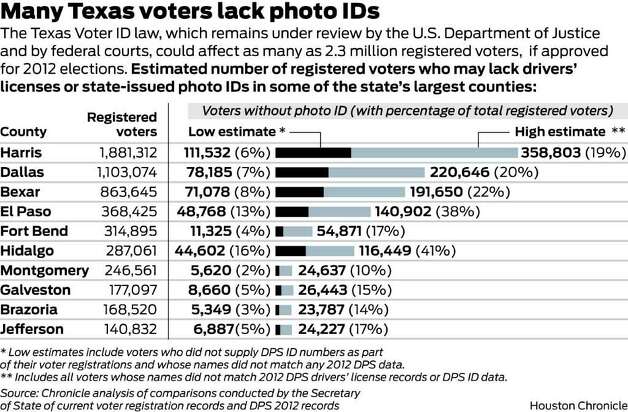
Aside from redistricting, the big electoral news recently was the Justice Department's decision to oppose implementation of Texas' new "voter ID" statute, leading the state to launch its own counter-challenge to the Voting Rights Act. I don't care to debate the merits of the DOJ decision - which was based on alleged discriminatory outcomes - but instead am interested in WHY so many Texans lack a state-issued photo ID? Pondering that subject leads to a corollary question: Did the Driver Responsibility Surcharge cause Texas' voter ID law to be rejected? As Lise Olsen reported in the Houston Chronicle:
as many as 18 percent of all registered voters across Texas apparently [lack] state government-issued photo IDs to match their voter registration cards, according to records obtained by the Houston Chronicle.

Texas secretary of state officials did not find matching 2012 driver's licenses or state-issued photo IDs for 2.4 million of the state's 12.8 million registered voters, though all but about 800,000 of those voters supplied a valid identification number when they first registered to vote. The findings come from documents submitted by the state to the U.S. Department of Justice as part of an ongoing review of the new voter ID law.

The "matching" exercises conducted by the state showed up to 22 percent of Bexar County voters apparently lacked the IDs, as well as 20 percent in Dallas County and 19 percent in Harris County, based on the Chronicle's review of the state data.
Here's the Chronicle's summary of the rate of voters with no state ID in selected larger counties:


Why do so many adult Texans lack ID? In part because 2 million drivers have had their drivers licenses revoked because of nonpayment of the Driver Responsibility Surcharge, which readers will recall is a stiff civil penalty tacked on top of any fines, punishments or court costs stemming from certain traffic offenses, including  driving without a license, driving without insurance, "point" accumulation, and DWI. Of those, around 1.2 million have not had their licenses reinstated, which would explain why so many voters may have had a DL number when they registered to vote but don't now. If 2.4 million Texas voters lack state ID, and all but 800,000 had IDs when they registered, then the Driver Responsibility Surcharge could account for as much as three-quarters (1.2 out of 1.6 million) of those who had ID when they registered to vote but do not today.

I'd love to see the state run another matching program to find out how many voters without a current ID have defaulted on one or more Driver Responsibility Surcharges. This redundant civil penalty has inflicted untold misery on drivers who owe it, and judges blame the surcharge for Texas' declining DWI conviction rate. Now it appears the surcharge is a major contributor to Texas' Voter ID law being challenged. Meanwhile the Lege is using most of the "dedicated" funds from the surcharge to balance the budget instead of dispensing it to trauma center hospitals as they promised.

At this point, the surcharge has not only failed at all its goals - both in the enforcement realm and providing revenue for trauma hospitals - it is now interfering with other state goals like DWI enforcement and the Voter ID law. How many negative consequences must the state suffer from this ill-conceived revenue-generation scheme before the Legislature finally repeals it?

Via Kuff.

Thursday, March 15, 2012

DPS outsourced key border security tasks to shadowy private contractor

Here's a story that should have been broken by a Texas publication, but credit must instead go to Tom Barry at Alternet for a remarkable piece of reporting titled "Who Is Securing the Texas Border? How Private Contractors Mislead the Public, Then Get Rich Off Taxpayer Money."
Since 2006 many of the key figures in state-led border security operations and information campaigns have identified themselves as DPS employees or part of the Texas Rangers to the public, policy community and the media, disguising their true identities.

The business card he handed me during the sheriffs meeting identified Sikes as the director of the Border Security Operations Center (BSOC) – which is a type of fusion center for border-security operations in Texas. It’s a project of the Texas Rangers Division, which in turn is a branch of the Texas Department of Public Safety (DPS).

However, Mac Sikes is neither a Texas Ranger nor a DPS employee. Like most of the other key figures behind the Lone Star State’s border security campaign, Sikes is a contract employee.

A “senior operational analyst” at Abrams Learning & Information Systems (ALIS), Sikes became director of BSOC as part of the firm’s $3-5 million annual contracts with DPS since 2006. The recent DPS decision -- in response to a public records request -- to release the ALIS contract revealed the true identity of Sikes.

The Border Security Operations Center is the nexus of the Texas’ own border security initiatives, collectively known as Operation Border Star. ALIS, a homeland-security consulting firm with offices in Arlington, Virginia, was founded in 2004 by Ret. Army Gen. John Abrams to cash in on the billions of dollars in new government contracting funds that started to flow after the creation of the Department of Homeland Security in 2003.

Since 2006 ALIS functioned as the hidden force behind virtually all non-federal border-security operations in Texas. Whether it’s strategy formulation, border crime-mapping, operations management, or public relations, ALIS and its team of consultants have been closely involved in creating what Governor Rick Perry calls the “Texas model of border security.”
Says Barry, "It would be hard to exaggerate the degree to which Governor Perry and DPS Chief McCraw have outsourced state border-security, homeland-security, and public-safety programs to Washington Beltway contractors." Further, and this is certainly accurate, "There has been absolutely no review by policy makers or by the public of DPS outsourcing of border-security strategy and operations." Maybe now it will come.

In addition, wrote Barry, a February report (pdf) from the Texas state auditor found a number of irregularities with federal grant spending:
The audit reviewed a representative selection of cases among the $265.9 million in federal grants and subgrants to DPS -- in the areas of homeland security, border security, emergency management, and law enforcement interoperability.
Among the findings of negligence and incompetence were these startling instances:
  • A draw-down of $755,509 in federal funds to issue a duplicate payment to one subgrantee.
  •  Five of the six procurements (83%) examined by the auditor in the cluster of federal grants for homeland and border security were not bid competitively as required.
  • DPS categorized four of the five procurements examined by the auditor as “emergency procurements,” and in three of those four DPS was unable to document why they were processed as “emergency” contracts.
  • DPS has no system to track, administer, monitor federal subgrants – as federal guidelines require, leading to routine occurrences of duplicate payments, dipping into one federal fund to pay for unrelated programs, and failure to submit required reports and audits.
  • Complete failure to track interest rates on unused federal funds and to remit those funds, as required by federal grant guidelines.
  • Access to law-enforcement databases by contract programmers who lacked proper authorization or clearance.
This is a good example why Grits is under the impression that Texas would benefit from more original reporting on criminal-justice topics. Our media should have picked up on the outsourcing of border security operations long ago, but not a single reporter (MSM or otherwise) regularly attends meetings of the Public Safety Commission, much less covers the agency in remotely the level of detail, say, that the Austin Statesman's Mike Ward does for TDCJ. There's just a vacuum of coverage on the agency's activities that journalism should but doesn't routinely fill. I'm happy Mr. Barry wrote the piece, but every political or crime-beat reporter and editor in Texas should be kicking themselves for having missed the story for the last half-dozen years until after the practice is a fait accompli.

See more at Barry's blog, Border Lines.

MORE: From the Austin Statesman.

Is ASCLD/LAB crime-lab accreditation inadequate?

A reader forwarded me this remarkable 31-page memo (pdf) submitted last year to the New York Forensic Science Commission severely criticizing ASCLD/LAB, which is the primary accreditation body for American crime labs, including in Texas. The memo's' author was Marvin E. Schechter, who several months later was named chair of the criminal justice section of the New York State Bar. I've always thought ASCLD/LAB's approach seemed a bit squishy and lab-friendly, but Scheichter's memo questions whether lameness too often extends to complicity, and even whether it's appropriate to rely on the private accreditation body at all:
The repeated instances of nationwide lab failures at facilities under ASCLD/LAB accreditation combined with the severity, scope and magnitude of the North Carolina SBI Laboratory scandal, the pending legislative reforms in North Carolina and the San Francisco DNA mix-up/cover-up warrant that the CFS examine precisely what role ASCLD/LAB plays in forensic review, its methodology, the design of its model and the very integrity of the organization itself, including but not limited to potential, if not actual conflicts of interest. Further there must be a serious discussion of whether the CFS can continue to rely on ASCLD/LAB as an accrediting agency.
I certainly hadn't realized until reading this piece that ASCLD/LAB is no longer  the accreditation body for the United States Army Criminal Investigation Laboratory (USACIL), which dropped ASCLD/LAB after it was reaccredited despite one of its examiners having "engaged in repeated misconduct known to supervisors." ASCLD/LAB only required an internal audit in response and did not publicly acknowledge the problem until it was outed in a newspaper series years later.

Equally damning, as we debate prosecutorial misconduct and Brady issues here in Texas, is the accreditation body's lax attitude toward notification of defendants or sometimes even prosecutors when crime lab errors are discovered:
Transparency does not include notification to District Attorneys (San Francisco, Nassau County) when laboratories engage in misconduct. It does not mean notification to defense attorneys in cases where the representation of their clients is affected. It would appear to be ASCLD/LAB’s position that notifying anyone other than an affected laboratory is not how transparency, or for that matter accreditation, should be viewed.
Prosecutors can't hand over Brady material they never see, just as defendants can't challenge flawed forensic evidence if its imperfections are concealed.

I've heard bits and pieces of these critiques in isolation over the years, but it's stunning to see them all together marshaled into a coherent argument for the first time (for me, anyway). Given the weight afforded to private accreditation in Texas (and other states which have legislated crime lab reforms in the 21st century), anyone with more than a passing interest in crime labs should read the whole thing (pdf). The implications if ASCLD/LAB accreditation really is fundamentally inadequate are significant indeed.

Opposing mass incarceration means opposing private prison growth opportunities

Several headlines about the private-prison industry caught Grits' eye and merit readers' attention. First, apparently most states, including Texas, are rejecting Correction Corporation of America's offer (see Grits' discussion) to purchase state-owned prisons if the states would guarantee 90% occupancy for 20 years. Let's hope that trend continues.

The blog Texas Prison Bidness points out that previous, similar deals between states and the company (ticker symbol: CXW) haven't panned out so well, quoting an ACLU-Ohio's assessment that, “While CCA claims it will save Ohioans $3 million per year, a recent report analyzing the state's contract shows that taxpayers will actually lose money over the next 20 years.  Of course, this is not earth-shattering news, as other fiscal analyses in Ohio and Arizona have produced similar results.”

On the flip side, a new immigration detention center in Karnes County, TX supposedly is a kinder and gentler version of involuntary detention for economic immigrants and other low-risk detainees awaiting deportation. The facility is the first of what may be a new market for private prison companies in "softer" incarceration  venues, though holding people against their will would remain at the heart of their business model. The changes come in response to complaints from advocates, and to a large extent outside this facility, those complaints still hold. “[L]ast fall, a report put out by an international human rights organization suggested that in spite of promises to make detention centers more liveable, 'the overwhelming majority of detainees are still held in jails or jail-like facilities.'”

For Grits' part, my primary concern with immigration detention doesn't just stem from treating civil detainees, including blameless children, like criminals, though that's a serious problem. My beef stems from the fact of their long-term incarceration in the first place, even if most of it is supposedly the equivalent of pretrial detention before their case is heard before backlogged federal judges. Grits believes that, at this historical juncture, it's time to scale back mass-incarceration in all its forms, and immigration detention has been the primary growth sector for new incarceration in the 21st Century, particularly under the Obama Administration, even as crime has declined and criminal incarceration rates have peaked and begun to drop.

To me, large-scale immigration detention is yet another example of using the mechanisms of the criminal justice system to confront social problems that are more readily resolved by other means. While recognizing that some incarceration is necessary and socially beneficial, IMO the United States - and Texas, even more so - have long past the point where the marginal costs of increased incarceration exceed the marginal benefit, and today we're throwing good money after bad, in part in deference to the influential private prison lobby.

Really, though, the debate shouldn't be over whether state-run beds are superior to private ones, but whether current incarceration levels are justified at all. The industry is a parasite, but it's also an expression in many ways of misguided public sentiment favoring mass incarceration that IMO is slowly but steadily eroding . Grover Norquist famously said he hoped to shrink the federal government until it was small enough to drown in a bath tub. Grits harbors similar, perhaps fantastic hopes for one day shrinking the overall market for private-prison beds.

Wednesday, March 14, 2012

TDCJ Ombudsman public conference in Huntsville, March 24

Thanks to Texas Voices' Mary Sue Molnar for alerting me to TDCJ Ombudsman's upcoming "Public Awareness - Corrections Today (PACT) conference in Huntsville Saturday week. This "is a free daylong conference open to the public that is held every other year in Huntsville. This year's conference is scheduled for March 24, 2012, at the Sam Houston State University, George J. Beto Criminal Justice Center." According  to the description on TDCJ's website, the conference is:
structured to also benefit offender family members and advocates, as well as the general public, community leaders, criminal justice volunteers, and jail and prison ministries. It provides attendees with direct access to information about TDCJ programs, services, and policies and procedures. Participants have the opportunity to learn about virtually every aspect of the TDCJ, and how best to help those that are incarcerated or on parole.

As a part of the conference's agenda, informative presentations and panel discussions are held on varying topics. There are exhibit rooms where agency representatives are on hand to distribute brochures and information about their programs and have one-on-one discussions. Staff members are available throughout the conference to interact with attendees and answer questions.

The PACT Conference routinely focuses its main presentations on parole, incarceration, rehabilitation and health care. Topics timely in nature, such as agency organizational changes, or new programs and initiatives, are also highlighted. Representatives from the Board of Pardons and Paroles participate in the conference to address issues relating to the parole approval process. There also is an exhibit room dedicated to the GO KIDS (Giving Offenders' Kids Incentive and Direction to Succeed) initiative. This exhibit room includes resource tables for organizations that provide assistance to strengthen the bond between incarcerated parents and their children.

Presentations for this year's conference will feature programs related to operational matters of Correctional Institutions, Parole, Rehabilitative Programs, Community Justice Assistance, Health Services, and the Reentry and Integration divisions, as well as the Windham School District and the Board of Pardons and Paroles. ...
This agency's business is truly a people business and, as with any business, communication with your constituency is essential to being successful. The TDCJ PACT Conference provides an outstanding venue for our stakeholders to familiarize themselves with the agency and to interactively communicate with knowledgeable staff representing TDCJ and other criminal justice agencies. Don't miss this opportunity to join us on March 24, 2012!

TCJC: Giddings youth feel safe, though 85% were in a fight since arrival

Via Brandi Grissom at the Texas Tribune:
More than 100 youths surveyed at one of the state's largest juvenile correctional facilities said their most important concern is attacks from their peers, according to a report released today by the Texas Criminal Justice Coalition.

"They had a lot of concerns about staff being really negative to them, and they had a lot of concerns about youth-on-youth violence," said Benet Magnuson, juvenile justice analyst at the coalition, which advocates for incarcerated youths.

Magnuson and a team of interviewers surveyed 115 youths at the Giddings State School in January and asked them about living conditions, services and treatment at the facility, which housed about 270 youths on average in 2011. The majority of youths reported that they felt safe and were hopeful about their future. But they also noted negative interactions with staff and worries about fights with other youths.
Reports Grissom:
In the survey, 89 percent of the youths said they felt OK, kind of safe or very safe at the Giddings facility. Only 2 percent reported feeling very unsafe.

But the youths also reported a significant amount of fighting and gang-related activity at the facility. About 85 percent of the youths said they had been in a physical fight during their stay. And 70 percent said that gangs had either a lot of power or a huge amount of power at Giddings.

"There’s too much fighting on this campus. Fights, riots, gangs – trying to see who’s tougher. It makes me feel less safe," one youth wrote in a survey response.
Looking at the report, this tidbit stood out:
Although positive family involvement significantly improves outcomes both during and aft er placement in secure facilities,1 the youth reported that the long distance between home and the state secure facilities caused family visits to drop precipitously following commitment to the state secure facilities. 62 percent reported receiving visits at least once per week while in county facilities, but only 15 percent reported receiving visits at least once per week while in a state secure facility.
TCJC also expressed concern that Giddings' rural location limited access to mentoring opportunities, though noting that "TJJD reports that mentored youth in its state secure facilities achieve significantly better education and recidivism outcomes than non-mentored youth." This was cited as one of several arguments for enhancing and funding policies to keep kids closer to their home counties instead of being sent to rural TJJD lockups.

Another notable recommendation arising from the survey:
From the perspective of the surveyed youth, negative staff interactions increase misbehavior, hinder treatment, and create a perception of favoritism and unfair rule enforcement. Based on informal conversations with staff and administrators, those negative interactions also increase staff turnover, injuries, and job dissatisfaction. Not surprisingly, the surveyed youth identified negative staff interactions as the greatest barrier to their rehabilitation. Policy-makers and TJJD should support positive staff interactions by increasing funding for training programs at state and county facilities, such as Bexar County’s successful Restraint and Seclusion Reduction Initiative training program. (Emphasis in original.)
A press release accompanying the survey said "The Giddings facility has been in the news lately following a riot on the campus in late November and a report last month that youth-on-youth violence at the facility was increasing. [TCJC attorney Benet] Magnuson says the survey results are a wake-up call for leaders to double down on reforms to expand local programs for kids in trouble."

See the full report here (pdf).

Please take Grits reader survey

Grits is considering a number of possible changes to the blog about which I'd like readers' input, so I sent out a note today to Grits email subscribers asking them to fill out a short reader survey, and thought I'd post the request here as well:
Dear Grits reader,

First, thank you for subscribing to Grits for Breakfast, and I hope you find the content useful. Please take a moment to fill out this reader survey in order to help me make the blog even more useful and interesting to you.

With the justice system ballooning and the number of mainstream reporters declining, there's more and more ground to cover on the issue areas Grits writes about, and fewer people than ever devoted to the task. Key agency boards and legislative committees too often meet in virtual secrecy, as far as the public is concerned, simply because no one shows up to report what they are doing.

I am considering taking this hobby to the next level by devoting myself to performing more actual, ground-level journalism on Grits for Breakfast (as opposed to mainly commenting on stories written by others). But before proceeding, I need to better understand your needs, and whether you would support expanded coverage in key areas. The additional time and expense might even require a paid subscription to access premium, original content, so I want to move carefully and with plenty of input from you.

To that end, it would help me tremendously if you could take a couple of minutes to fill out this brief reader poll to help me decide whether this idea makes sense.

With gratitude,

Scott Henson
Grits for Breakfast
The idea would be to continue to have link-and-comment type posts on the public part of the blog but to begin featuring more original, in-depth content behind a paywall. Take the survey and let me know what you think of the idea.

Tuesday, March 13, 2012

Special prosecutor in Michael Morton court of inquiry is Rusty Hardin

The stakes for Williamson County District Judge Ken Anderson just got a lot higher with this news, via the Texas Tribune:
Houston criminal defense lawyer Rusty Hardin will be the special prosecutor in the court of inquiry looking into possible misconduct in the case of Michael Morton, who was wrongfully convicted in 1987 of bludgeoning his wife to death.

This won't be Hardin's first high-profile case. The former Harris County prosecutor has represented Roger Clemens, J. Howard Marshall's estate in the Anna Nicole Smith lawsuit, and, during the Enron scandal, accounting firm Arthur Andersen.

Tarrant County state district Judge Louis Sturns will lead a court of inquiry to investigate allegations of criminal prosecutorial misconduct against former Williamson County District Attorney Ken Anderson, who saw to the wrongful murder conviction of Michael Morton. 
Hardin is a major-league legal talent, a respected crime victims' advocate, and a man widely recognized as one of the top criminal-law attorneys in Texas. If Judge Anderson wasn't taking the Court of Inquiry process seriously before - and that's been my sense - you can bet your bottom dollar he is now. As Patti Hart at the Houston Chronicle pointed out, "A former Harris County prosecutor, Hardin is no stranger to taking on public officials. In 2009, he represented a woman who accused former U.S. District Judge Samuel Kent of sexual harassment. Kent was impeached and sent to prison." This Court of Inquiry is shaping up to be quite a dramatic event.

MORE: From Pam Colloff at Texas Monthly.

Kerry Max Cook: 'Rogue' DAs don't deserve 'Prosecutor of the Year' honors

Kerry Max Cook, who is seeking post-conviction DNA testing to formally, finally exonerate him of a 1978 murder for which he was sent to death row three separate times, asked Grits to post this brief essay:
“ …It shall be the primary duty of all prosecuting attorneys, including any special prosecutors, not to convict, but to see that justice is done.  They shall not suppress facts or secrete witnesses capable of establishing the innocence of the accused.” (Texas Code of Criminal Procedure, Article 2.01)

There is definitely something broken - - and broken badly - - when the Texas County and District Attorney Association section of the State Bar of Texas awards and sanctions rogue prosecutors by unabashedly nominating them "Prosecutors of the Year."
My name is Kerry Max Cook. I am the author of a memoir called CHASING JUSTICE:  My story of freeing myself after two decades on death row for a crime I didn’t commit. [Ed note: See a review.]
What do Williamson County’s Ken Anderson and Smith County’s Jack Skeen share in common? Both were awarded "Prosecutor of the Year" by the County and District Attorneys section of the Texas State Bar.  And both were later appointed to District Judgeships by Gov. Rick Perry.

When a Tyler Judge in Smith County moved my case to Williamson County in 1992 for the first of what would become a series of retrials in the ‘90’s, then-District Attorney Jack Skeen sent me back to death row a second time. In fact, of all the things you can say Jack Skeen and Ken Anderson have in common, the one thing they don't is that Jack Skeen is not facing a Court of Inquiry and Ken Anderson is.

If anyone really sat down and took the time to wade through all the documented Jack Skeen and David Dobbs misconduct in my case, I think you would be shocked at how bad it really was. It would make the machinations of John Bradley look like Cinderella.  But that won't happen. You see, in Texas we have what I like to call Sak's Fifth Avenue justice for the Ken Andersons and Jack Skeens, and Wal-Mart justice for the Michael Mortons and Kerry Cooks.

Take my case for example. Here you have one of our largest newspapers in Texas, the Dallas Morning News, from 1980 until 1992 writing an award-winning series of investigative stories on my persecution that began with "Inmate was Railroaded, Testimony in Cook case called mostly false," "Convicted Man Called Innocent," "Key Evidence in Cook Case Suppressed," "Wrong Man on Death row," "Psychologist Views on Inmate Disputed," "Conclusions Wrong, Experts Say," "Police Didn't Pursue Leads in '77 Killing: Tyler Inquiry called Sloppy," and many more. These headlines were published across the state of Texas.

The man responsible  who caused those torrid headlines to be written was 1977-78 Smith County district attorney A.D. Clark, III.

Fourteen years later, Jack Skeen (A.D. Clark, III’s first-cousin) used the exact same "fraudulent” case A.D. Clark, III first built to convict me and then pushed it until he got a second conviction and death sentence at a third trial in 1994 with a Williamson County jury.

These Dallas Morning News investigative headlines had already splashed across Texas long before Jack Skeen received his “Prosecutor of the Year” award in 1997. In addition, by this time, Jack Skeen had already sent me back to death row once more and was on his way to do it again in a fourth trial after the conviction he obtained in my third trial with the use of the very same "fraudulent evidence” (See Tex. Ct. Crim. Apps. Nov. 6th. 1996 Opinion). The County and District Attorney's Association knew all of this when they nominated Jack Skeen “Prosecutor of the Year” in 1997.

Maybe  one day the spirit of the words found in Article 2.01 of the Texas Code of Criminal Procedure can have meaning in Texas. Today, they don't. After what I have gone through in Smith County, I'm not sure they ever did.
RELATED: See Cook's motion to recuse and disqualify (pdf) Judge Jack Skeen in future proceedings in his case. Here's a good summary from Texas Monthly's Michael Hall on Cook's efforts to seek exoneration, and recent commentary from former Dallas News reporter David Hanners, mentioned above, who believes Cook is actually innocent.. Finally, here's an oldie but a goodie, this Houston Chronicle story from 2000 alleging prosecutorial misconduct in Smith County, using Cook's case as a prime example. (Then Smith County DA Jack Skeen sued the paper for libel over the story and lost.) Also, in addition to Judges Anderson and Skeen, it's worth mentioning that Williamson County DA John Bradley is also a past "Prosecutor of the Year" recipient.

Monday, March 12, 2012

Illegal everything, no-knock warrants, and the right to BearKats

Here are a few disparate items that deserve Grits readers attention.

Suing property owners to reduce crime
Rather than prosecute individual crimes in criminal court, the Harris County Attorney is suing property owners seeking an injunction to end illegal behavior.

'The Right to BearKats'
I've seen reports of quite a few Texas departments purchasing these vehicles and ones like it.

Grand jury no-bill in police shooting becomes issue in Austin DA's race
A racially charged police shooting in Austin remains a flashpoint after separate grand juries refused to indict either the surviving civilian who was accused of driving his car at a officer or that officer's partner who shot the passenger in response. The grand jury's no-bill of the officer has become an issue in the DA's race, with Charlie Baird saying he would take the case back to the grand jury if elected. Grits has not followed the details of this case closely, but I can speak generally from past experience to say, while I like Travis County DA Rosemary Lehmberg well enough on many issues, she's never been aggressive when it comes to prosecuting police officers who are unduly violent or abuse their position, dating back to her position as Ronnie Earle's first assistant. Even when misconduct is obvious, serious charges tend to get pled down to misdemeanors. She may be vulnerable on that score.

'No-knock' warrants may mean civil liability for SAPD
The Texas Civil Rights Project won a victory at the 5th Circuit Court of Appeals, which "found that the officers' failure to knock and announce their presence before entering the women's home might have violated their Fourth Amendment rights to be free from illegal search and seizure." Reported the SA Express-News, "The court sent the case back to San Antonio for a jury trial later this year that also could determine whether the city is on the hook because the cops were following its policy of “'no-knock' entries during raids."

'The War on Drugs Has Failed: Is Legalization the Answer?'
See a report from one of the presenters at an event in Houston held by the Baker Institute (as in former Republican Sec. of State James Baker) titled, "The War on Drugs Has Failed: Is Legalization the Answer?"

Consultant: Privatize Cameron jail
Consultant MGT recommended that Cameron County privatize its jail, but it's unclear if privatization would reduce costs or only reduce accountability. Savings would supposedly come from "pension liability, health insurance, liability insurance, workers’ compensation insurance, insurance rates in general, overtime, inmate health care, food service and commissary costs."

'A strange business to be in'
Business Insider posts excerpts from a Corrections Corporation of America presentation to investors and declares it's "one of the creepiest presentations we've ever seen," though they're "not judging," merely concluding that "it's a strange business to be in: Caging humans for profit."

'Illegal Everything'
I'm not a tremendous fan of John Stossel, but this segment titled "Illegal Everything" includes rare commentary on seafood-related felonies, which long-time readers should appreciate, as well as the criminalization of children's lemonade stands.

'Death row inmate's case about more than innocence'

Brandi Grissom has a story at the Texas Tribune with the same title as this post about the habeas claims of death-row inmate Rob Will, who was condemned for a 2000 murder of a Houston Deputy Sheriff. Writes Grissom:
Witnesses have testified that another man confessed to Deputy Hill’s murder. But in a January ruling, U.S. District Court Judge Keith Ellison lamented that even though he was concerned Will could be innocent, he had to deny his motion for a new trial.

“The questions raised during post-judgment factual development about Will’s actual innocence create disturbing uncertainties,” he wrote. “Federal law does not recognize actual innocence as a mechanism to overturn an otherwise valid conviction.”

Will’s best chance for a new trial may lie with an Arizona case that the U.S. Supreme Court is soon expected to rule on. States across the country are anxiously awaiting the ruling, which could establish that defendants have a constitutional right to adequate appellate lawyers. For some states, that could require major spending on court-appointed lawyers for thousands of convicts.
The federal case mentioned is Martinez v. Ryan, which has been heard at oral argument (see the transcript [pdf]) but not yet decided. See SCOTUSBlog's page on the case, where the "plain English" description of the case reads: "Ordinarily, criminal defendants have a constitutional right to have a lawyer appointed to represent them at their trial and during their direct appeal, but not during any subsequent post-conviction proceedings. When a state system only allows prisoners to argue that their lawyers were inadequate during post-conviction proceedings, does the defendant have a right to appointed counsel during that proceeding?"

Texas Attorney General Greg Abbott signed on to an amicus brief (pdf) opposing the right to counsel in such cases, while the Innocence Network, of which my employers at the Innocence Project of Texas are a member, issued an amicus brief (pdf) on the other side.

Setting aside the legal merits of the case, IMO there's a strong policy argument for providing counsel for more post-conviction writ claims. Quite honestly, habeas litigation is such a mess, with so many badly crafted pro se filings clogging the docket, it might relieve the courts and make the system a lot cleaner if counsel were appointed to do one serious habeas claim instead of a bunch of petty ones that the prisoner either writes up on their own or barters for some untrained writ writer to prepare. The Court of Criminal Appeals get thousands of habeas claims each year, and state laws limiting so-called "subsequent writs" (intended to reduce post-conviction litigation) mean that, if pro se litigants don't get it right the first time, often they don't get another chance later if and when an attorney tries to take a more serious shot.

In Will's case, it seems like he really did have ineffective counsel. Wrote Grissom: "In Will’s first appeal, his state-appointed lawyer, Leslie Ribnik, filed a 29-page boilerplate court document that had little application to Will’s case. Ribnik defended his work, but in 2006, the Texas Court of Criminal Appeals removed him from the list of approved death penalty defense lawyers."

Providing indigent counsel for habeas writs - particularly those alleging ineffective counsel in their original proceedings, but really in most cases - would make the habeas process more of a truth seeking endeavor. In the current process, as in Will's case, too often procedure trumps substance, focusing on the bureaucratic exercise of seeking out errors by non-lawyers as an excuse to dismiss writs as rapidly as possible, if only in order to make a dent in the ever-expanding pile.

Like the pardon power, 21st century habeas corpus has been largely denuded of its ability to fulfill the function the Founding Fathers envisioned for it in the 18th. When a federal judge can write in a capital case, truthfully, that “Federal law does not recognize actual innocence as a mechanism to overturn an otherwise valid conviction,” then we've reached the point where mass incarceration - indeed in Will's case even capital punishment - rests primarily on procedural justifications, no longer moral ones.

Sunday, March 11, 2012

Reaping what you sow at the body farm

I don't know what if anything it says about us, but there are five "body farms" in the United States where scientists perform real-world studies on how corpses decay, and two of them are in Texas, at Sam Houston State and Texas State Universities. AP has a story about the body farm in San Marcos (TSU), which has been studying the relation between vultures and decomposition, including findings that could have implications in possible innocence cases.
“If you say someone did it and you say it was at least a year, could it have been two weeks instead?” said Michelle Hamilton, an assistant professor at the school’s forensic anthropology research facility. “It has larger implications than what we thought initially.”

The vulture study, conducted on 26 acres near the Texas campus, stemmed from previous studies that used dead pigs, which decompose much like humans. Scientists set up a motion-sensing camera that captured the vultures jumping up and down on the woman’s body, breaking some of her ribs, which investigators could also misinterpret as trauma suffered during a beating.
Grits first heard about Texas' body farms last year from an SHSU prof who was excited by the work, and indeed, in its macabre fashion, this is important, cutting edge stuff, applying the scientific method to subjects about which medical examiners have given expert opinions for years with little hard data to support definitive conclusions. Fascinating stuff.

Saturday, March 10, 2012

Keller tries to derail Keith Hampton's candidacy; Mark Bennett to challenge Hervey as Libertarian

It's a rare day when the Texas Court of Criminal Appeals makes the news for anything but the occasional overzealous death penalty ruling or suborning some cockamamie brand of junk science, but this week brings two tidbits of electoral political news that merit attention: Republican Sharon Keller levied a challenge with the Democratic Party to the candidacy of her presumed opponent Keith Hampton, aiming to keep his name off the November ballot. And Mark Bennett, the Houston criminal defense attorney who blogs at Defending People, signed up as a Libertarian candidate to run against Judge Barbara Hervey in the fall.

Let's take these two in order of importance: Since her fellow CCA judge Larry Meyers decided at the last minute not to challenge Sharon Keller in the GOP primary (after previously announcing he would do so), eliminating Hampton in the courtroom instead of the ballot box would relieve voters of any option whatsoever for replacing Keller for a fourth term as Presiding Judge. Given that, here's hoping Keith Hampton got his act together on his signatures before the filing deadline and his candidacy is approved. See Hampton's press release responding to Keller's gambit.

As for Mark Bennett (visit his campaign site), Grits must confess disappointment that he signed up to run as Libertarian when there's no Democrat running against Republican Barbara Hervey. Bennett understatedly declared that "the Libertarian candidate in a race for a seat on the Court of Criminal Appeals faces a steep uphill battle." In reality, as a practical matter, the Libertarian candidate has entered into a political suicide pact. Bennett himself demonstrates why in a  post laying out vote results from 2008, the last CCA race coinciding with a presidential election:
Place 3:
Republican Incumbent
3,940,954
Democratic Candidate
3,477,426
Libertarian Candidate
215,427

Place 4:
Republican Incumbent
4,035,683
Democratic Candidate
3,336,944
Libertarian Candidate
249,921

Place 9:
Republican Incumbent
4,709,086
Libertarian Candidate
1,041,499
Your mileage may vary, but these downballot races barely run campaigns and do not typically spend money on paid media. Very few voters can even name a member of the Court of Criminal Appeals, much less meaningfully evaluate their record. And the MSM are lucky to devote one story per election to the race at any given outlet, with political reporters generally understanding as little about the court as the general public. As a result, CCA vote totals derive almost purely from party identification.

Let me step back for a moment to make clear that I respect Mark Bennett tremendously, both as an attorney (by reputation) and as a writer, and that's speaking as someone who may have read every single word he's written, or close to it, virtually since the day he began Defending People. He's a great guy and I think he'd make a terrific judicial candidate. Now let me proceed to chastise him, though merely on grounds of political naivete and perhaps a wee bit of selfishness, not ill intent.

(Grits should add that, despite my various policy differences with Judges Hervey and Keller, neither woman has ever been anything but extraordinarily gracious and polite toward me. Judge Keller seems like an authentically sweet person on a personal level, though admittedly she's never wanted to chit chat much, while I genuinely enjoy Judge Hervey's company. The fact that I'd like to see the voting bloc responsible for decisions like this one and this one broken up on the court doesn't mean I hold any personal animus toward either of them.)

Bennett tells us he chose to run for the Court of Criminal Appeals because the slot against Barbara Hervey was the only one statewide where Libertarians hadn't lined up a candidate. Well, guess what? That means that was the single race where - before Bennett filed as Libertarian - a candidate who seriously wanted to unseat Hervey and begin voting and writing opinions in her stead could have filed as a Democrat and had the best chance in more than a decade of unseating an incumbent statewide Republican.

Libertarian votes are protest votes - the electoral version of "none of the above." If there were no Libertarian candidate, most of those votes would go to the non-incumbent, which in Texas means to the Democrat, or else those folks just wouldn't vote at all. I've always inferred from the large Libertarian vote in CCA races that there's a disproportionate amount of dissatisfaction with the Court of Criminal Appeals among voters under Sharon Keller's leadership, or else why would the Libertarian totals get so high when a Dem is absent? In other races where Rs run unopposed by a D, L totals are typically much lower.

So Bennett's candidacy in Grits' estimation represents not a cause for celebration but a missed opportunity to unseat a member of the court faction who, with Judge Keller, has systematically slanted the court's jurisprudence far to the pro-prosecution end of the spectrum. That said, Judge Hervey - both in several notable opinions and her work with the Criminal Justice Integrity Unit - has distinguished herself as more thoughtful and slightly less hard-line than Sharon Keller, but in the scheme of things the two women's records aren't all that different, particularly compared to where a Mark Bennett might come down on the issues.

Bennett nobly announces that "I don’t want a single vote from anyone who can’t explain to me what my job will be if I’m elected." Translation: He doesn't actually want to be elected. Why would he, since he grants elsewhere that "getting elected would entail a brutal pay cut"? Sure, as Bennett declared on Defending People, this is "an office in which [he] could do real and lasting good." But the harsh truth is if the goal was to get on the court and do good instead of just talk about it, he'd have run as a Democrat or in the GOP primary.

Running quixotic campaigns for office to "educate" the public about this or that subject or to "send a message" is about as ineffective a tactic imaginable, substituting a single candidate's personal ambition for the policy goals of whatever ideals one hopes to champion. The only reason to run for office is to try to win, because power comes with winning and elections are how we decide who gets to wield it. That's all it's about. If you want to "educate" people, write on your blog or even better, use the money you were going to spend on a campaign on paid advertising to promote your message. More people will receive it that way.

Grits has opined for years that the CCA races (and to a lesser extent, the Texas Supreme Court) are the Texas elections where Dems have far and away the best chance of unseating a statewide Republican. Bennett notes that "in the closest 2008 Court of Criminal Appeals Race there was more than a 200,000-voter difference (that is, the result would have been different only if more than 200,000 voters had [switched their votes]) between the winner and second place." That's not an insurmountable margin, particularly compared to other statewide races, if a serious candidate were to run an actual, well-resourced campaign.  If there were no Libertarian candidate and most of those L protest votes went to the D challenger, the race tightens up considerably. In an R v. L matchup, though, the risk of success is a null set. Bennett's lotto numbers have a better chance of coming up.

Keith Hampton, however, has a puncher's chance to defeat Sharon Keller if he can make it onto the ballot, particularly in a year where conservative voters could stay home if Mitt Romney is the GOP presidential nominee. That's where the real action lies, to the extent it's possible for any Dem to win a statewide race in Texas at this historical juncture. Bennett's candidacy will be fun for his readers - and I hope for him - but regrettably inconsequential.

Friday, March 09, 2012

Debating Texas' travel warning on Mexico: DPS should leave travel advisories to the State Department

Despite his self-interested subject position, I have to agree with the writer from the Mexican Tourism Board who criticized the Texas Department of Public Safety for a stern travel warning issued on Tuesday titled, bluntly, "DPS Advises Against Spring Break Travel to Mexico." Countering that sentiment, writes Rodolfo Lopez-Negrete in the Austin Statesman:
Over the course of the next three months, Mexico will play host to a who's who of the world's most influential leaders.

In April, the World Economic Forum on Latin America will take place in Puerto Vallarta. In May, leading tourism industry figures will converge on Cancún for the regional summit of the World Travel and Tourism Council. The culmination of this trifecta will take place in June, when leaders from the world's 20 largest economies will meet in Los Cabos for the annual meeting of the G20.

This hardly sounds like a place to be avoided en masse. Yet, this is precisely what the Texas government has urged its citizens to do in its most recent warning about travel to Mexico, released Tuesday and simply entitled, "DPS Advises Against Spring Break Travel to Mexico."

This warning paints Mexico with a massively broad brush, discounting nuance, logic and facts. Mexico remains Texas' No. 1 trading partner and largest export market — in other words we are "friends" and as such, are disappointed by this travel warning.

In 2011, 22.7 million international tourists visited Mexico (not including those who arrived by cruise line or border crossings), trumping our previous tourism record, set in 2008. Furthermore, Mexico continues to be the No. 1 destination for American travelers. The overwhelming majority of these tourists enjoyed our beautiful beach resorts, gastronomical delights and world-class cultural offerings without the slightest negative incidents.
Lopez-Negrete does "not at all dispute the fact that there are parts of Mexico that are prone to violent incidents and are not currently safe for travel," though he may overstate things when he adds that "The same could be said of Austin, Houston or Dallas, for that matter." There is no place in Texas, or perhaps the world, outside a war zone, as violence prone as Juarez.

That said, when Houston recently posted its lowest murder rate in nearly five decades, Grits reminded celebrants that the record-low still left H-Town's murder rate higher than Mexico City's (9.4 per 100,000 compared to 8.3). The missus and I visited Mexico City last summer with a then-4-year old with no incident whatsoever, as is typical, and had a wonderful time.

Now, should vacationers be visiting Juarez, or for that matter, Acapulco? Probably not, though even in Acapulco the State Department says, "the popular tourist area of Diamante, just south of the city, has been less affected by violence." My own planned vacation in Mexico this summer has shifted from Veracruz to the Yucatan/Quintana Roo because of drug-related violence - perhaps being more careful than necessary, but why risk it?

So I certainly agree Americans should exercise caution visiting parts of Mexico (or Miami, or Chicago, or Houston, or LA), but the DPS travel advisory paints with too broad a brush. By contrast, the US State Department travel advisory offers a detailed, frequently updated state-by-state breakdown of which parts of Mexico to avoid and which are relatively safe. Most of the major spring break sites with the notable exceptions of Acapulco and Baja, appear OK. (MORE: Commenter Paul-UK supplies a link to the United Kingdom's travel advisory on Mexico.)

Mexico is an enormous place, not to mention one of the Texas' pivotal economic partners. DPS should stop this sort of politicized demagoguery - which seems aimed more at sucking away tourist dollars than promoting public safety - and tell anyone who asks about Mexican travel to check with the State Department.

Texas, other states should decline Corrections Corporation of America's offer to buy prisons

According to the Houston Chronicle's Patti Hart and other reports, the letter Corrections Corporation of America (CXW on the stock exchange) sent to 48 states last month offering to buy their old facilities included a perverse and unconscionable set of proposed conditions: CXW would only buy the prisons "if the selling state would guarantee to keep it filled [to] 90 percent capacity for 20 years."

With incarceration declining nationwide, I understand why CXW is seeking long-term stability. It's the same reason states should turn them down. It appears the incarceration bubble is bursting, with immigration detention the only near-term growth sector in private prisons' portfolio. Texas state prisons are full but incarceration rates are declining, with crime falling at an even steeper rate. Last year for the first time ever, Texas closed a prison unit instead of building or leasing more. In the past four years, the state has reduced the juvenile prison population by more than 2/3, including closing several facilities including a private one in Coke County.

At the county level, despite pockets of overcrowding (caused mostly by local elected officials' aberrant decision making), county jails statewide are terribly overbuilt, operating collectively at 68.4% capacity as of February 1, with 93,535 jail beds statewide and only 63,985 inmates to fill them. Imagine what a fix counties would be in if 5 years ago they'd sold their facilities to a private company and guaranteed them 90% capacity!

CXW and (even more so) its chief competitor the GEO Group are already overladen to the gills with debt, so the offer only makes sense if states agree to guarantee them a 90% occupancy rate two decades into the future, and any state pol who fell for that would be buying a pig in a poke. Conversely, if the company were to buy old prisons without such a guarantee, they'd be the suckers. State Senate Criminal Justice Committee Chairman John Whitmire has been quoted in press reports saying he disfavors the idea, and Grits hopes Texas officials as well as leaders in other states universally follow his lead.

Will history judge society by our graffiti?

Dostoevsky said the "degree of civilization in a society can be judged by entering its prisons," but perhaps future historians will judge us instead by our graffiti, or at least the graff that escapes buffing. The headline of a recent article in Science Daily proclaimed: "Ancient 'graffiti' unlocks the life of the common man," referring to 2,000 year-old graffiti in Israel as a sociological treasure trove equivalent to the "tweets of antiquity."

It must infuriate anti-graff zealots like the good folks in Corpus Christi to imagine that history might someday judge them by the scrawls they buff, cover and prosecute with Sisyphian doggedness.

Thursday, March 08, 2012

TPPF: 'Public Safety and Cost Control Solutions for Texas County Jails'

The title of the latest policy brief (pdf) from the Texas Public Policy Foundation, a conservative Austin-based think tank, is "Public Safety and Cost Control Solutions for Texas County Jails." Their recommendations touch on many themes that will be familiar to Grits readers, including:
  • Reexamine Bond Schedules
  • Ensure The Judiciary Has All Relevant Information When Setting Bond Amounts
  • Increase Court Efficiency
  • Inform Jail Inmates of All Release Options
  • Strengthen Jail Reentry Practices
  • Consider Utilizing Improved Electronic Monitoring Technologies
  • Implement the Cite and Release Option in Appropriate Cases

TX Court of Criminal Appeals okays 'trial by polygraph'

The Texas Court of Criminal Appeals continues to struggle with how to handle junk science, issuing (at least) its second 5-4 opinion in the last year (Ex Parte Robbins is the other I have in mind) allowing courts to rely on known junk science, this time reversing the lower court to proactively affirm the use of polygraphs as a basis for revoking sex offenders' probation. Chuck Lindell at the Austin Statesman gives the only MSM account I've see of the case of William Leonard ("Appeals court allows polygraph evidence, in limited way," Mar. 8), whose probation was revoked because he failed 5 polygraphs during mandatory treatment. Other than the polygraph, "appellant was halfway through his treatment plan and had faithfully attended the required meetings, participated in group therapy, and fulfilled all other terms and conditions of the treatment program," according to Judge Cathy Cochran's dissent. Moreover, "his therapist testified that the polygraph results were the only reason Leonard was discharged from treatment." Lindell explains the import of the decision:
In a 5-4 decision Wednesday, the Court of Criminal Appeals upheld Leonard's probation and prison term, saying the polygraph results were admissible in court because the information formed the basis of the therapist's expert opinion.

"Even generally inadmissible facts or data may be used by an expert in forming an opinion, as long as the facts or data are of a type reasonably relied upon by other experts in the field," said Judge Lawrence Meyers, writing for the majority.

"Polygraph exams are reasonably relied upon by experts in sex offender psychotherapy," Meyers added.

The majority reaffirmed that polygraph results are always inadmissible before a jury.

But there is less danger of undue influence if the information is revealed during revocation hearings because there is no jury and because the judge "is not determining guilt of the original offense," Meyers wrote.

But Judge Cathy Cochran, writing in dissent, said the majority opinion employs logic that leads the legal system "down a very steep and slippery slope."

Leonard was sent to prison based solely on the failed polygraphs, Cochran wrote, despite numerous scientific studies and reports that have cast doubt on the accuracy of the tests.

"No court should admit or consider scientifically unreliable evidence," Cochran wrote, adding that Leonard experienced "not only ‘revocation by polygraph' but also ‘revocation by an expert's reliance on unreliable science.' "
The 11th Court of Appeals had reversed the trial judge's back-door theory for admitting inadmissible evidence, calling this "trial by polygraph," and that's exactly right. The Statesman headline says polygraph evidence will be allowed in a "limited" way, but Cochran's more accurate when she decries the "steep and slippery slope" down which the opinion launches the court's jurisprudence: The harm from allowing unreliable evidence as the sole basis for incarceration decisions isn't mitigated because the probation officer and/or the court deferred their evaluation to a therapist. Hokum is hokum, no matter who relies on it.

If it were one piece of evidence among a panoply resulting from an investigation, that's one thing (you'll sometimes see polygraphs used in actual innocence cases that way, particularly out of Dallas). However, as Cochran wrote, "Although an expert may base his opinion, at least in part, on otherwise inadmissible evidence, it must nonetheless be reliable inadmissible evidence." Or at least that was the case until yesterday. Now, probationers can be revoked based on testimony from experts who base their conclusions exclusively on unreliable evidence.

Bottom line, because we're talking about sex offenders, the courts are willing to bend over backward to maximize punitive sanctions, even to the point of allowing pseudoscience to dictate sentencing decisions, as in this case. But now that the precedent has been set, you can be sure prosecutors will get more creative about probation conditions that defer polygraph use to some third party so it will be admissible when it otherwise wouldn't be. Consider the implications, for example, of using polygraphs vis a vis treatment programs associated with DWI convictions: If that happened, this decision could balloon quite quickly into a big deal affecting a lot of cases.

See Judge Meyers opinion (joined by Keller, Hervey, Keasler and Alcala) and Judge Cochran's dissent (joined by Price, Womack and Johnson). I'm particularly disappointed to see Judge Alcala was the critical swing vote for Keller and Co. on the opinion. There are a ton of junk science issues looming before criminal courts in the wake of the National Academy of Sciences reevaluation of forensics, so this blasé attitude toward relying on junk science bodes particularly ill at this historical juncture.

Bad, bad opinion. So bad maybe the Lege should act next year to say that polygraph tests can't be the sole basis for probation revocation, whether they're administered by law enforcement or a therapist at the direction of the court.