Showing posts with label Media. Show all posts

Monday, January 22, 2024

Icarus in Heels and Fur: A Murder Mystery

My next neighborhood history zine, Icarus in Heels and Fur, comes out February 22nd. Without exaggeration, I think it may be the best thing I've ever written. Pre-order here. This one is essentially a noir murder mystery from the 1940s:

When, after her husband's murder, a petite but ruthless widow builds a thriving nightclub empire in 1940s Austin, her roller coaster of bebop-era decadence, ambition, and danger climaxes in a sordid, unsolved murder, leaving her young lover on trial for his life.

Cover art by Lakeem Wilson

The central character, Vera Barton, more or less put the fatale in femme fatale, with friends, husbands, and employees all at risk seemingly just from proximity. And yet, she was big-hearted, family-oriented, and a savvy young businesswoman. Until she showed up dead in the back of her Caddy.

Vera was the sister-in-law of Essie Mae Barton, the entrepreneur profiled in my first neighborhood zine, "Meet Me At Hudspeth's Corner," published last July. Vera was a much spicier figure, though: basically a gangster version of Essie Mae. Zine launch will be February 22nd, 6:30 p.m., at the Future Front meeting space, the site of Vera's old Barton's Tavern on East 12th Street. District Attorney Jose Garza will co-host the event: Open records requests for historical documents from his office made the research possible, and all sorts of fascinating criminal-justice policy questions arise from the story.

Josie Duffy Rice, a well-known criminal-justice-reform advocate and former editor-in-chief at The Appeal, served as guest editor. That was particularly fun; I've been looking for a project to work with her on for a while.

Please help spread the word. Pre-orders really help w/ the economics of zine publishing, so if you're interested, order now and I'll mail it to you as soon as it's out. 

Monday, July 17, 2023

Congressman headlining Grits' zine launch event

For folks in Austin, please come to Grits' zine launch Sunday, July 23rd, from 2-4 p.m.. We're going to record interviews w/ me and others by Congressman Greg Casar about the zine topic (the history of a neighborhood grocery store 2 blocks from my house that turns 100 years old this year) and publish it afterward as a podcast. Event is at:

Community Garden wine bar
Hudspeth's Corner
1401 Cedar Ave., Austin, 78702
(between 12th and MLK, in East Austin)

The zine essentially takes the same investigative reporting skills Grits readers have seen me exercise on this blog for two decades, and applies them to a seemingly mundane topic -- a dilapidated corner grocery store -- with remarkable and compelling stories emerging that inform the whole history of the neighborhood.

If you can't come to the event, please do pre-order a zine, if you haven't already. And thanks, as always for your support over the years and into this next phase.


Monday, July 10, 2023

Pre-order Grits' new micro-history zine


With the paltry rate of posting on Grits, you might have thought I was no longer writing. But I'm pleased to announce a new zine I've been working on over the past couple of years: A micro-history of a small, 100-year-old neighborhood grocery store 2 blocks from my home, in a shopping center dubbed Hudspeth's Corner. (This is the cover art, above, by the wonderful Lakeem Wilson.)

No one living knew the site's origins, but it's a decidedly epic tale of the rise and fall of a segregation-era black family business. The saga, spanning 5 generations, provides a  unique window into the history of the whole neighborhood. (More or less against my will, the story includes significant criminal-justice themes as well.)

Undertaken as a palate cleanser after the 2021 legislative session, I began researching a series of deep, historical stories in the East Austin "Chestnut" neighborhood where I've lived for 33 years, all within a few blocks of my house. The rest will be released in 2024 and 2025, but because of the 100-year anniversary, Kathy and I wanted to get this one out now before we leave in August to go to Mexico for the rest of the year! 

It would really help if folks pre-ordered copies; you can do that here, ensuring your copy will get dropped in the mail the moment it rolls off the presses. (Price is $6 plus s/h.)

Then, on July 23, we're having a zine launch at the Community Garden wine bar at the Hudspeth's Corner site. Congressman Greg Casar has agreed to cohost and we're going to record a little podcast about the store featuring historians, preservationists, and neighborhood folks. If you're in Austin, join us! 

I'm excited to put this out; it's been a fun little project.

Saturday, February 06, 2021

Crime, Bail, and the Media: A century-old recipe for error and injustice

Grits readers have seen me complain about sensationalist, de-contextualized media coverage of crime and punishment nearly since this humble blog's inception. Turns out, if your correspondent had been transported in a time machine to the early 1920s, the problem would be even worse and Grits may well have gone clean out of my mind.

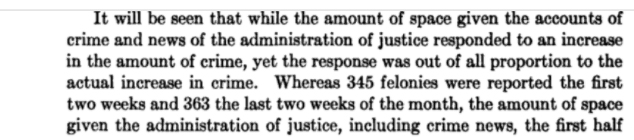
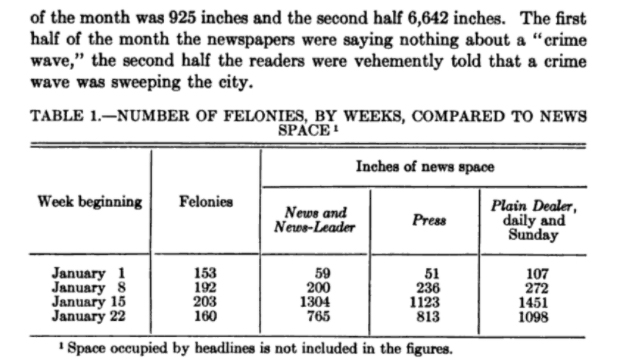
Recently, I ran across what appears to be the earliest quantitative analysis of media crime coverage in America in a massive, 700+-page document titled, "Criminal Justice in Cleveland: Reports of the Cleveland Foundation Survey of the Administration of Justice in Cleveland Ohio." On p. 544 of this behemoth, we find this remarkable assessment of a media driven crime panic over the course of one month in Cleveland and the predictable, and current-day-relevant policy results from this brand of journalistic malpractice.


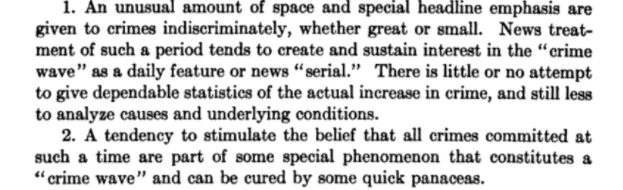
The Cleveland Foundation summarized its criticisms of local media coverage thusly: 


Further:

The same sort of misguided attacks were made on parole decisions, focusing on high-profile recidivists while ignoring more numerous, less-attention-grabbing success stories.

The Cleveland Foundation wrote this near the height of a massive, media-driven crime-wave panic. Google has a search function to see how often a word or phrase was used in books they've scanned that were published that year. Here's the graph for the phrase "crime wave."


I've read more than a few historians and critics over the years trace the American media's crime obsession to the cases of Bonnie and Clyde and John Dillinger in the 1930s, when such outlaws became well-known anti-heroes in the eyes of huge swaths of the public. But this graph and the Cleveland survey tell us that compulsion was in full flower - and perhaps even more intense - more than a decade earlier.

Perhaps most telling was their depiction of an episode in 1919 Cleveland which could have been taken straight from 2019 Houston: 
During January and February, 1919, there occurred what was known as the 'bail bond expose.' ... It became known that a number of persons suspected or actually arrested and charged with crimes had been previously under arrest and released on bail. Special newspaper attention was given to the fact that bail was fixed by judges on the recommendation of the prosecutor, and in view of this power of fixing bail by recommendation the prosecutor was urged to demand higher bail.
The over-the-top language was totally out of proportion with all data and designed to mislead and rile up the public. For example: "The toll of pillage and murder increases. Gangsters scoff at law and courts. And peaceful citizens shudder."

This is reminiscent of a litany of overhyped commentary in Houston - most of it in TV news stories quoting Andy Kahan at CrimeStoppers or Houston police Chief Art Acevedo - criticizing judges for lenient bail practices. So this is at least a century-old trope: You could use the same time machine to transport those two back to the 1920s (indeed, I wish you would) and their quotes would blend right in with the rest of the media landscape. In fact, the results of their advocacy in Houston have been similar to the unintended (but predictable) consequences in Cleveland: Jails full of low-level offenders who needn't be there. From the report:


Many of those locked up were liquor law violators who couldn't pay fines; some who couldn't pay were sent to "the workhouse." Even so, the Cleveland Foundation lamented that "the work of individual judges receives special but wholly erroneous interest" in the press, and that demagoguery against judges became so intense that one judge received personal death threats. Even more concerning to judges, however, were the day-to-day practical problems it created:


Houston judges are in the same boat. The jail is currently overcrowded as a result of some combination of regressive media influence, COVID-driven court backlogs, and the governor's executive order limiting bail. The COVID delays are exogenous to this question, but media pressure on judges and the governor's executive order are directly analogous to the judges' and prosecutors' actions in response to media coverage in Cleveland. Here's the lede to a recent Houston Chronicle story about overcrowding at the Harris County Jail:
Preston Chaney died of COVID-19 after more than three months at the Harris County Jail on allegations he stole lawn equipment and frozen meat. Two days later, Chaney’s court-appointed lawyer, who’d logged just two hours on his case, billed for additional work.

Chaney had a hold and was rejected for personal bail under Gov. Greg Abbott’s pandemic order banning the release of anyone with violent charges or prior arrests. Had the 64-year-old been able to scrape together $100, he could have waited for trial away from the packed downtown lockup.

This was an avoidable death. Tuff on crime demagoguery has consequences. Local media, particularly in TV news, deserve a share of the blame for it.

Monday, December 21, 2020

How should journalists cover blatantly false or misleading statements from self-interested pols?

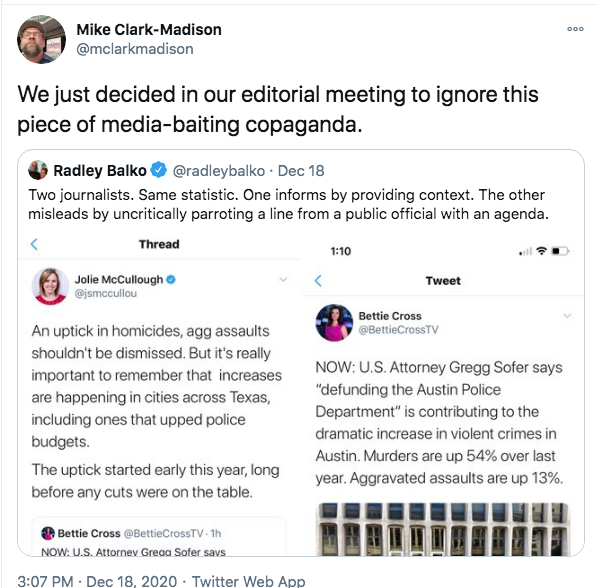
Last week, Grits considered responding to Austin-bashing press conference by the US Attorney for Texas' Western District, but the phony outrage was so tired and lame I couldn't muster the energy. Luckily, at least some in the Austin press corps - notably  Jolie McCullough at the Texas Tribune and Mike Clark Madison at the Austin Chronicle - chose either to debunk the falsehoods or just not to take the bait.

It's all been so silly. The murder increase in Fort Worth has been larger than in Austin, and they started with many more murders to begin with. But Austin gets special federal focus?

I don't blame Mike Clark Madison for choosing to ignore this piece of "copaganda" from a Trump Administration official who won't have a job in a month. But the Texas Tribune's McCullough took the opposite tack, aiming to debunk the misinformation instead:

“When you defund the police, relax enforcement of existing criminal law, and release repeat offenders and violent criminals into our streets, increased violence is exactly what you can expect,” Gregg Sofer, a newly appointed U.S attorney for the Western District of Texas, said in a statement after a press conference.

Austin police, like those in Fort Worth, recently stopped citing and arresting people for possessing small amounts of marijuana. The decisions arose from the state Legislature's legalization of hemp in 2019, which made it difficult for law enforcement officers to distinguish between legal and illegal cannabis. Recent decisions by several Texas counties to release more people from jail during the pandemic also brought backlash from the governor.

Last month, Austin Police Lt. Jeff Greenwalt addressed the rise in homicides at a press conference, but he said violent crimes detectives were still in the same shape under the new budget, “if not better.” He said given the city’s safe standing among other cities, he wasn’t yet concerned with the rise in some crimes. It’s hard to predict trends off of a small amount of data.

“We saw a rise in violent crime in the very early months of 2020, before the reimagining and the defunding conversations came up,” Greenwalt said. “I don’t think that we can say that the numbers in 2020 are reflective of that issue.”

Which is the right approach when public officials spread misinformation, ignore it or debunk it? I'd suggest both, in that order. Ignore it today, debunk it tomorrow.

Journalists should avoid reporting false statements from press events like the US Attorney's, even to debunk them, at least in the news cycle or two after they're released. The false information is being timed for a reason. As a journalist, don't be a tool for spreading it unless you fully understand what it is. Later, the information can and should be contextualized and debunked, with falsehoods a) clearly identified and b) the main point of the story.

In my imaginary world of journalism best practices, when Greg Abbott held a press conference in Fort Worth to say they were doing criminal justice right compared to Austin, pointing to the rising murder rate in the capital while ignoring that Fort Worth's was much higher, reporters would have taken note of the event but not immediately written about it. After all, it's a false statement; it has no news value.

What does have news value is the story, "Governor Makes False Statement." But that story takes research and context to write, and is more appropriate several days hence.

Live footage of reporter trying to decide how to cover Austin-bashing copaganda
Live footage of reporter trying to decide
how to cover Austin-bashing copaganda
Same goes for the US Attorney. Mike and Jolie both were right. It's not good to promote false memes, and it's also good to debunk them. It's not at all obvious which approach is right and puts the reporter in the position of a baserunner caught in a rundown between second and third: No great options.

While I realize many people believe all politicians lie, things are objectively different now. The dam has broken in the last four years, and especially in 2020. The Trump presidency demonstrated what a bind it puts journalists in when politicians are willing to openly flaunt facts. Now, state and local reporters face the same tactics and the same hard decisions about how to cover them. Ignore them? Debunk them? Report "both sides"? Should they characterize false representations as "lies"? "Mistakes"? "Spin"? "Wishful thinking"? "Blatant falsehoods"? If falsehoods further a political agenda, when should motives be impugned? These are not easy or obvious questions.

Eight years ago, Grits wrote a short essay titled "Ten Maxims for Making Journalism Relevant in the 21st Century." In retrospect it holds up well to the post-Trumpian era as a guide for how to approach these and related questions. Those interested should give it a read.

Tuesday, May 26, 2020

Reasonably Suspicious podcast back from hiatus: Austin police chief under fire, COVID in TX prisons and jails, Harris DA calls to overturn shady drug convictions, and other stories

After a three-month hiatus while your correspondent underwent throat-cancer treatment, here's the May 2020 episode of Just Liberty's Reasonably Suspicious podcast, co-hosted as always by me and Mandy Marzullo. Grits must admit, until I was editing all this together, I hadn't realized how much the radiation treatment had affected my vocal chords: I sound like a different person, decidedly heading in the raspy, Tom-Waits-ish direction. (Really that's wishful thinking; my singing voice is completely shot.) Regardless, it was good to see Mandy again and climb back into the podcasting saddle.

We went a little longer this time because the segment on Austin PD includes a half-dozen excerpts from a community forum held last week by the Austin Justice Coalition. Lots of good stuff there. Thanks to Chas Moore for getting me the audio. As always, the podcast is available on Soundcloud, iTunes, and Google podcasts, or you can listen to it here:


Here's what we discussed this month, with time stamps in case you want to jump to an individual segment:

Top Stories
  • Community groups call for Austin police chief's ouster (1:46)
  • Coronavirus in Texas jails and prisons (32:40)
Fill in the Blank
  • Ransomware attack on Texas courts (44:40)
  • The Texas AG and Rosa Jimenez (48:15)
  • Editor of Palestine paper wins Pulitzer for series on jail oversight (51:30)
The Last Hurrah (53:25)
  • Harris County DA calls to overturn shady drug convictions
  • San Marcos mandates citations instead of arrests for petty crimes
  • Joe Bryan gets parole
Find a transcript of the podcast below the jump. Enjoy!

Tuesday, May 05, 2020

Small town TX editor wins Pulitzer for jail-death series

Congratulations to Jefferey Gerritt of the Palestine Herald Press, who won a Pulitzer Prize this week for his excellent series on problematic Texas jail deaths. Go here to read them all. Nicely done!

MORE: Texas Monthly has more background on Mr. Gerritt and his award.

Sunday, January 19, 2020

Journalists can always find a cop or prosecutor to contradict good-news data on marijuana decrim, but should they?

Society in general, and Texas in particular, is in such a weird place right now when it comes to marijuana policy. A remarkable debate is emerging which really only appears to exist in the minds of reporters and law enforcement types but, in terms of evidence and data, is a one-sided argument.

A recent article in The New Yorker by Matthew Hutson has earned praise for rightly articulating in a publicly accessible way the differences between the two main measurements of crime in the United States and the difficulties of judging crime trends. It's a useful analysis, I recommend you read his article for that alone.

But setting his data discussion aside, the article was framed in what Grits considered an especially odd and unhelpful way. Hutson posed the question of whether legalizing marijuana causes crime to rise or fall, centering his discussion on a study out of Washington state showing that both rapes and thefts decreased in the aftermath of that state legalizing marijuana.

Hutson offered no data from other states showing that legalizing pot caused crime to increase (the studies mostly say the opposite), but instead, to offer counterpoints, he:
reached out to more than seventy-five county sheriffs in California, Colorado, Maine, Massachusetts, Michigan, Nevada, Oregon, Vermont, and Washington—states where recreational marijuana is legal. (It’s also legal in Alaska.) Of the twenty-five sheriffs who got back to me, half said they hadn’t noticed a trend, and the rest were certain that legalizing marijuana had made crime go up.
For some reason, Hutson valued the opinion of the half of sheriffs who said crime went up over the half who hadn't noticed a trend. (What's half of 25, again?) Regardless, he's asking law-enforcement folks whose professional careers have centered around marijuana enforcement to give their views on a politicized question. Placing that on a scale alongside reported-crime trends and pretending it balances strikes me as more of a (weak) journalist's construction than a true debate.

Ask someone in the coal industry whether power plants should use gas or coal and what do you think they'll tell you? That's essentially what you're asking these sheriffs. If Hutson were to investigate further, Grits would bet dollars to donuts the violent-crime data in their counties wouldn't support their claims. It's just the kind of thing cops say to the press. 

I feel like Texans can say with some certainty that the sky won't fall when police stop making marijuana arrests because, after the Legislature legalized hemp and accidentally made marijuana laws de-facto un-enforceable last year, enforcement plummeted and there's been no massive violent crime wave in response. It's just not happened.

We don't yet have any academic study of this odd, natural experiment, but as a practical matter, the end of marijuana enforcement in most of Texas has been a big nothingburger in terms of its impact on public safety. If anything, the change has freed up police officers to focus on other things. But that hasn't stopped local law enforcement from playing their perfunctory Chicken Little roles, nor local journalists from providing them a megaphone. 

Pleased with the less-arrests, less-wasted-police-time, no-effect-on-crime, happier-constituents dynamic the new policy generated, the Austin City Council announced plans to codify the results of this natural experiment by directing Austin police to stop making user-level pot possession arrests altogether.

In response, District Attorney Margaret Moore went on Fox News in Austin and declared, with no evidence whatsoever, that "what we've seen that is alarming is an increase in violent crime that goes along with marijuana or THC distribution." Really? We've seen that? Let's see her data. And doesn't she have an asset-forfeiture fund from which she could pay for testing in cases where she truly believes public safety at grave risk? Methinks Chicken Little doth protest too much.

Anyway, the city council isn't recommending police stop enforcing laws against distribution, only penny-ante misdemeanor possession cases that Moore's office doesn't handle anyway. So this is just demagoguery, using the platform afforded by her office to spread misinformation. 

This is a dilemma facing journalists at both the national and local level. If Hutson had called Margaret Moore, she'd happily have joined the Sheriffs claiming reduced pot enforcement increased violent crime. 

Highlighting statements from public officials that contradict the data their own agencies report promotes a false equivalency, exploiting a weakness in the traditional journalism model. The data should be used to debunk official pronouncements that don't match observable facts, not to balance against them and pretend we just can't know.

Friday, September 06, 2019

Decrying one-sided Statesman stenography on criminal justice (again)

Regular readers know Grits has complained for several years about the unremittingly poor quality of journalism on #cjreform issues in Austin, particularly from the Austin Statesman. A great example of their one-sided coverage - basically functioning as stenographer/mouthpiece for local law enforcement interests and excluding other voices - may be found in Mark Wilson's coverage of a proposal for Austin PD to pay for new equipment to test THC levels in marijuana.

This is necessary, of course, because the Legislature legalized "hemp," which is from the same plant as marijuana, and the distinguishing feature under the law is THC levels. Around the state, prosecutors have begun dismissing cases because they can't prove that element of the crime. But Austin PD wants those cases prosecuted, despite the lack of any real public-safety motivation for doing so.

The Statesman coverage quotes only law enforcement sources and gives no air time to the actual debate that took place in the hearing on the topic.

By contrast, check out a report from the Austin Chronicle by Kevin Curtin. From that coverage you actually get a sense of what went on in the meeting. Critics of the police position were quoted, as were questions from the dais by council members that law enforcement had trouble answering. He also included an utterly ridiculous declaration from Assistant police chief Troy Gay that failure to arrest pot smokers would encourage murders, home invasions and armed robberies.

The public deserves to know he said that, so we can appropriately mock it. It's asinine, ass-i-ten, ass-eleven ...

How can the citizenry be informed enough to engage in effective oversight of elected officials if public debates are misrepresented in such a one-side way? When the paper of record only quotes cops and prosecutors, that's an awfully biased lens through which one's readers must somehow interpret the world. And really, in the end, they can't. It's a big reason why #cjreform is so difficult: Reform voices can barely get in the public conversation.

I've been critical of both the Statesman and Chronicle's coverage in recent years. Since Jordan Smith left the Chronicle, most local coverage of criminal-justice topics has amounted to stenography for the cops, not journalism. So Curtin's piece was a welcome antidote. He didn't take the side of reformers, but neither did he go out of his way to exclude their voices from his coverage. That's really all I'm looking for.

Friday, August 23, 2019

Roundup: Debtors prison practices, a hempsplainer, why the Harris DA opposes bail reform, and other stories

Here are a few odds and ends that merit Grits readers' attention:

Debtors Prison Blues
Texas was one of five over-represented states in this Governing magazine feature story on municipalities that get more than 10% of their budgets from traffic fines. Great piece; reminded me of this Marshall Project story. In Texas, the agencies most reliant on traffic fines are primarily in East Texas, and up and down I-35. Long-time readers may recall Grits wrote a theme song for these agencies:


District Attorney opposing Harris County bail settlement
Harris County DA Kim Ogg issued an amicus brief opposing the new bail-reform settlement agreed to by judges and the county.

On the pitfalls of state police patrolling local police beats
Texas DPS this spring began sending troopers to patrol in the Dallas city limits. But when they shot and killed somebody, it turned out they're not as accountable as local cops.

Hempsplainer
The Texas Forensic Science Commission put out an explainer document (a "hempsplainer"?) related to the new requirement that prosecutors prove the THC levels in marijuana to secure a conviction for possession. In related news: Add Amarillo to the jurisdictions where Class B marijuana cases are being dismissed.

Grappling with excessive police-union power
Check out an essay on "The Unjust Power of Police Unions."

On racial stereotyping
Grits found this interview on racial (and other) stereotyping interesting and useful.

Mitigating harm from if-it-bleeds-it-leads crime coverage

Monday, August 19, 2019

Judges' 'unchecked power' to blame for high TX indigent defense caseloads

"Unchecked power" of and "conflict of interests" by local judges are the biggest barriers to reforming Texas' indigent defense system, reported Neena Satija, writing for the Texas Tribune and Texas Monthly. Go read the whole thing, excerpts won't do it justice.

Neena began this feature when working for the Trib, but was hired by the Washington Post in the meantime, so Grits had feared it might never come out. But it was worth the wait. Using Texas' database of attorney caseloads for defendants with appointed counsel, she explored how these high caseloads pressure attorneys to cut corners in ways that harm clients. She documented multiple instances of judges retaliating against defense attorneys for representing clients aggressively by refusing to appoint them in the future, or even handing off their cases to other lawyers.

Unstated in this story, but key to understanding the motivations at play: The two biggest sources of campaign contributions for local criminal-law judges are defense attorneys and the bail-bond industry. Lawyers give money hoping for appointments to cases and goodwill when they're in a judge's courtroom, while bail bondsmen want all sorts of little favors (like when judges make behind-the-scenes debt-forgiveness decisions about whether bond agents must pay up after someone absconds).

Two important justice reforms - creation of public defender offices and elimination of money bail - amount to indirect attacks on campaign contributions for judges. Without them, there is no incumbent advantage. That's the main, unspoken reason you see judges fighting both of those reforms.

For more background on the attorney-caseload issues at play in this story, see this interview with then-Texas-Fair-Defense-Project Executive Director Becky Bernhardt after the caseload recommendations came out in 2015.

To look up attorney caseloads in your own county, here's the link to the Texas Indigent Defense Commission database. No other state has data as good as Texas' on this topic, and Neena's story absolutely couldn't have been written without it.

Wednesday, December 05, 2018

Squeaky wheels get grease: CCA posting oral arguments again

Grits had been complaining to court staff about the failure to post videos of Texas Court of Criminal Appeals oral arguments for a couple of months. But they only, finally began posting the video after I publicly wrote about it on the blog last week.

Since your correspondent is both a public-policy advocate and also media, in a sense, I'm frequently afforded a unique perspective when these sorts of situations arise.

There is a telling pattern regarding how government agency leaders and politicians respond to advocates vs. how they respond to the media. Grits gets to see both.

Say a problem exists in government (any problem, pick a problem), but the only people aware of it are those trying to manage it. As an advocate deep in the weeds on policy, one becomes aware of problems about which the general public may not know. As a general model, an advocate might tell the folks in charge of the situation about the problem and, where feasible, recommend solutions. That's the job.

The smartest agency heads will admit mistakes instead of cover them up and attempt to fix the situation then. But most are not the smartest. Most are average. Indeed, by definition, half are below average! And so the typical response is to ignore the problem and stonewall advocates.

Things are different for the media, because drawing outside attention to an issue creates political pressures and hassles, highlighting failures the agency would rather conceal, either from voters or the people controlling its purse strings. So, the Houston Chronicle's Keri Blakinger might see the Texas Department of Criminal Justice act on concerns in her articles when the same problems raised by Jennifer Erschabek of the Texas Inmate Family Association were more easily ignored.

Grits sees this a lot. My go to move as an advocate is not to immediately run to the blog and flame anyone who's not doing what I prefer. There have been plenty of instances when Grits has identified a some glitchy, technical problem in government, shared it with someone in charge, and it was fixed without my ever having discussed it on the blog. By the time I'm writing about such matters, frequently it's out of exasperation, grumpy that I'm having to use political capital to pressure someone to do their job, when quietly fixing the situation would have avoided conflict.

That's sort of the dynamic here. I've been asking the CCA to post this material since before the October episode of Reasonably Suspicious. We had hoped to cover the James Calvert case, argued in September, in a podcast segment. By the November episode, it was still not available. Last week, once more I asked when the files would be posted and was told there was an indefinite delay, that there was no way to tell when they might resolve technical problems. Since the court is, after all, required by statute to post the video, Grits reported that news. And lo and behold, the Calvert file was posted online Monday.

For the record, thank you to CCA and Office of Court Administration staff who finally got these posted. But wouldn't have it been easier and less embarrassing to behave with similar alacrity two months ago when I first inquired?

Saturday, November 24, 2018

Two Dirty Little Secrets About the 'Distracted Driving' Debate

The Houston Chronicle has published a series on traffic deaths which, from Grits' observation, mostly has repeated tropes from self-interested secondary sources rather than investigate causes and solutions.  Only one article in the series - on traffic engineering - advocated for solutions Grits believes would significantly contribute to traffic-death reductions. The rest gave platforms for elites to promote their own, self-interested agendas.

Readers will recall the Chron's extended advocacy piece masquerading as news advocating for an increase in patrol officers to make DWI arrests. Having covered the vagaries of DWI arrest-and-death data for several years, Grits responded to point out that, in fact, there appeared to be little relation. DWI enforcement has plummeted in recent years, along with traffic enforcement, as police shifted to other priorities and the Department of Public Safety increasingly sent its traffic-patrol force to the border. But per-capita DWI death rates declined, despite the radical drop in enforcement. The Chronicle ignored that data to advocate for more arrests.

Their latest offering promotes the fake-news media bugaboo of distracted driving, calling for a criminal ban on talking or texting on the phone while driving and stiffer enforcement of current prohibitions.

I say "fake news" because the press have chosen to hone in on banning cell-phone use despite evidence that a criminalize-it approach doesn't work and may do more harm than good. That's what happened here, and in this case, I'd presented the reporters with contrary information that they either downplayed or didn't report.

The article significantly, and one must conclude, intentionally, overstates the extent to which cell-phone distractions contribute to deaths. But because they had seen the contrary information (I sent it to them), they phrase it in a way that acknowledges the counter-narrative then ignores the implications to pivot to a relatively minor cause of "distraction." Their commentary avoids ever making a declarative statement saying cell-phone use is a significant cause of traffic fatalities (since really, it is not), instead declaring experts are focusing on it, which apparently gives the authors license to never focus anywhere else. Here's their assessment of the problem:
The problem of distracted driving is as old as the automobile. Cellphones get the bulk of the blame of late, but safety experts say a range of features and pastimes — from stereos to food to the seemingly endless variety of gauges, indicators and dashboard displays — can present a danger. Sometimes the distraction is not even inside the vehicle; roadside vistas or startling scenes draw drivers' attention away from the lanes ahead. As long as people have passengers or the propensity to daydream, drivers will always have something else on their minds.

The issue has particular relevance in Houston and Texas, where cars are personal and sacred spaces, in part because of how much time drivers spend in them. The average one-way commute in the Houston area is nearly 30 minutes, and it is not uncommon for workers to spend an hour or more in the car each morning and evening.

So drivers pass the time as pleasantly or as usefully as they can. They listen to music or podcasts. They make work or personal phone calls. They eat and drink. During the morning commute, drivers can check their rear-view mirrors and see a man making last-minute hair fixes or a woman applying makeup. Many are doing multiple things at once, such as smoking a cigarette while holding their phone while reaching to turn down the radio or grab a sip of coffee. 
All of it adds up to distraction. Safety experts have zeroed in on cellphones, mostly because the devices have become ubiquitous in everyday life.
The rest of the article is an advocacy piece for criminalizing cell-phone use in the car, masquerading as a news article. Like the unnamed experts, the authors "zeroed in on cellphones" while ignoring much more significant distractions.

Conflating "distracted driving" with cell-phone use and focusing on the latter is like trying to reduce one's carbon footprint by installing a single, energy-efficient light bulb in the utility room while driving a gas-guzzling SUV.

Here's Dirty Little Secret #1 about this debate: People who are prone to distraction will find something to distract them. Take away one distraction and they will find another. Mainly we're talking about young people, whose accident rates were higher than adults long before smart-phones showed up on the scene.

Daydreaming is a bigger distraction, by far, than talking and texting on the phone combined. Should we criminalize that? In my own experience, trying to manage or discipline kids in the back seat while driving can be a bigger distraction than any phone call, in part because it can require looking back and taking one's eyes off the road. Number two for me would be fiddling with the radio (at least, before the radio was replaced by my phone). But I've never heard any of the distracted driving whiners suggest bans on those common behaviors.

Ditto for eating in the car; reporters do that routinely so THAT'S not going to be the low-impact behavior they choose to castigate. And while, because of gender-subject position, I cannot speak with first-hand knowledge, I've wondered with amazement as I've seen women in traffic putting on their make up in the rear-view mirror. It's hard to imagine a greater distraction than that, short of just opening up a broadsheet newspaper and reading a bullshit article about distracted driving.

In reality, only 1.2 percent of fatal traffic crashes involve distracting cell phone use. And indeed, late in the article, after laying out their advocacy argument for increased criminalization, they acknowledge the data don't justify their suggestions under a subhed labeled "Irregular reporting." "From 2010 through 2017, there were 4,997 roadway fatalities in the region, and crash reports listed a cellphone being in use in only 60 of them," they inform us, which would seem to be a de minumus source, in the scheme of things.

Rather than accept the implications of the data in front of them, they quote someone paid to "advocat[e] nationally for tougher phone laws" declaring "We're quite certain it's underreported." The rest of the article goes on in detail about how few people are ticketed for texting while driving and implicitly chastising agencies that don't share the reporters' priorities.

Given that per-capita traffic-death rates have been declining in Texas, it's hard to see where this supposed epidemic is causing some new raft of problems.

Indeed, nowhere in the article do we see mention of a study by an insurance-industry institute, which I told them about, which found that states enacting texting bans had higher texting-related-death rates as a result. The insurance-industry folks behind the study hypothesized that criminalizing the behavior made people hold their phones in their laps instead of up by the wheel where they could keep half an eye on the road.

Whatever the reason, shouldn't that counter-intuitive result  at least be part of the calculus? Shouldn't Texas learn from the mistakes of other states and not pass laws that may increase traffic deaths? For that matter, should Houston Chronicle readers be made aware of real-world results that contradict the thrust of reporters' advocacy for criminalizing widespread behaviors?

Which brings us to Dirty Little Secret #2: Cell-phone bans are a blame-the-victim coverup by politicians to shift attention from their own failures to invest in road safety. That includes both public transportation in and in between major Texas cities, and the sorts of traffic-engineering investments described in their one, useful article in this series.

Because roads are expensive and Texas politicians for two decades have been falling over themselves to outdo one another on who is the most anti-tax, Texas has failed to invest in its road systems, in its bridges and overpasses, in accommodations for cyclists and pedestrians (and now, scooters), much less in engineering improvements that would increase traffic safety. And this failure to invest is costing lives, as Grits wrote back in 2014:
By contrast, few politicians want to talk about the much more significant cause of fatal accidents in Texas: Under-investment in transportation infrastructure, particularly in the oil patch where the Eagle Ford shale region has seen a 40 percent increase in fatal crashes, but really throughout the state. Those parsimonious budget decisions at the Legislature are contributing more to the traffic fatality total than drivers talking on cell phones. But it's not as much fun to hold a press conference demagoguing against oneself. So it's better from a pol's perspective to find some group to blame and criminalize, like cell-phone users, even if in the scheme of things that's not the most common cause of driving fatalities, by a long shot, and bans may even make the problem worse.
And lo and behold, which Texas legislator is the state's most vocal proponent of texting-while-driving bans? Why, it's state Rep. Tom Craddick, a former House Speaker who represents the Permian-Basin-oil-patch, but whose leadership did not coincide with investments that might have prevented the spike in deaths described above.

As it turns out, the majority of Texas traffic deaths are in rural areas; by contrast, about 15% of the state's population lives in rural areas. That means a lot of the urban, commuter-oriented critiques on which the Chronicle focused miss the big-picture patterns driving traffic deaths.

This focus on "distracted driving," in Grits' view, is at root a self-interested distraction for the public aimed at diverting attention from the much more significant causes of traffic deaths - mainly failure to invest in various types of infrastructure. Those stem from politicians' direct decisions, for which they could and should be held accountable. By name. During elections.

Instead, the newspaper quotes those same politicians blaming the public for using their phones while they're stuck on the dysfunctional transportation system their government has provided them, in the Houston area, sometimes for hours at a time. And they do so even though they know (because data they reported show it) that cell-phone use is at most a minor contributor to traffic deaths.

This is lazy reporting. Not only does it ignore data in the authors' possession and fail to follow up on its implications, the narrative it presents told us nothing that hasn't already been reported a hundred times. More, even, than promoting misinformation in service of an elite agenda, un-originality may be these reporters' most serious offense.

Friday, November 09, 2018

The scandal behind the scandal of journalist Mike Ward making up quotes

While other journalists have expressed astonishment that Mike Ward, the former Austin bureau chief of the Houston Chronicle and long-time Austin Statesman reporter, was caught making up quotes in his stories, Grits cannot muster much surprise.

As a journalist, Ward was a sycophant to power. The quotes he made up were of so-called average people because those were the folks whom he didn't bother to talk to, whose opinions he assumed he knew. Rarely were reform-minded opinions portrayed fully or fairly, for example, if they were portrayed at all. Instead, they were spun in a fashion he knew would please the powerful people who were his main sources and ultimate constituency.

Newspapers love journos like that because they appear to have "access," which, in the journalism world, counts as currency. But often "access" just means a politician knows a writer would never publish anything contrary to their interests, and at that point they've become more publicist than reporter.

By the time a journalist is making up quotes, filing articles with one or two comments from his powerful friends and then making up common folk to frame their message, they've devolved into full-blown fiction writing, or what the President would call "fake news." The Chron couldn't identify 122 people quoted as sources in 72 stories.

But Mike's writing was nearly as problematic in the stories where quotes weren't made up because of the way he pandered to the powerful. Even if the comments were real, he wasn't going to put anything in there that his patrons didn't want. To this long-time observer of Texas criminal-justice reporting, that's the scandal behind the scandal.

Monday, September 24, 2018

On the Houston Chronicle's 'misplaced pride' and flawed reporting on DWI deaths

In an unsigned staff editorial, the Houston Chronicle complained that, "misplaced pride needlessly costs the lives of hundreds of people every year" because of DWI. But their own pride caused the Opinion section of the paper to double down on flawed reporting from the news side on DWI deaths.

The editorial board joined the news section's call for a regressive tuff-on-crime response to DWI, flying in the face of recent evidence about factors impacting DWI fatalities.

And they continued to manipulate data on the topic, focusing on aggregated numbers over a sixteen year period without parsing annual trends. This obfuscation leads them to disingenuously pretend that DWI-related fatalities might go down "if local law enforcement agencies assigned more officers to the task" of arresting people.

But we know that's not true. As demonstrated in this Grits post, the paper's assertion of a link between police deployments, DWI arrests, and alcohol-related fatalities simply isn't backed up by the evidence.

Texas has just witnessed a natural experiment regarding the relationship between DWI enforcement and alcohol-related-traffic fatalities, and something unexpected happened: DWI enforcement declined significantly in the past few years, Texas' overall population increased, and per capita traffic fatalities declined.

That's the opposite of what would have occurred if the relationship between police staffing and fatalities posited by the Chronicle were true.

Chronicle writers are able to keep up this pretension by relying on 16 years of data, aggregated altogether, but ignoring points where recent trends belie law-enforcement assertions in the story. The approach masks clear flaws in their recommendations, which for the most part are recycled wish-list items from the local police chief (hire more officers, authorize traffic checkpoints, etc.).

If more staffing assigned to DWI enforcement would reduce deaths, then traffic deaths in 2010 would have been lower than they are today. After all, Texas cops were making tens of thousands more annual DWI arrests at the time.

But clearly, from the annualized data trends, police enforcement levels weren't a decisive factor. What might be? ¿Quien sabe? My guess is that public-service advertising, changing cultural norms, and the rise of Lyft and Uber had something to do with edging per-capita death rates down. But one certainly couldn't tell from the Chronicle's reporting.

Other commentary was just weird. For example, the staff editorial opined that, "Texas has some of the most lenient license suspension laws in the country." But in reality, as The Washington Post reported earlier this year, Texas has suspended more drivers' licenses than any other state: 1.7 million, all told. It's like the editorial board didn't even Google the topic before writing this stuff.

It was disappointing that, instead of parsing facts to discover what works and what doesn't, the Chronicle recycled a bunch of tired, tuff-on-crime memes that fly in the face of the data. It all feels depressingly familiar, like throwback coverage from the 1990s.

RELATED: Check out this Reasonably Suspicious podcast segment from May hypothesizing causes for the decline in DWI and drunkenness arrests across Texas.

Tuesday, September 18, 2018

Interview: ProPublica reporter Pam Colloff on the Joe Bryan case, blood-spatter evidence, resistance to change in forensic science fields, the best #cjreform podcasts, and the effects of a changing media environment on crime coverage

At a dramatic hearing yesterday on his habeas corpus writ in Comanche, TX, a small town near Brownwood, all of the evidence accusing former high-school principal Joe Bryan fell apart, including blood-spatter evidence which even the original analyst would no long stand behind. Ace ProPublica reporter Pam Colloff gave the details in a followup to her massive, long-form story on the case, which was published in the New York Times Magazine back in May.

As it turns out, Joe Bryan was almost certainly innocent and has been unjustly incarcerated for more than 32 years. Most of the blood spatter on the flashlight turned out not to be blood, and what blood was present could be linked neither to Bryan nor his wife, Mickey, the victim. Underwear that the prosecution told a jury contained semen did not. By the time the hearing was over, virtually nothing was left of the prosecution's case, reported Colloff.

With this news, and the renewed attention on Colloff's blood-spatter reporting, Grits thought it would be a good time to stop procrastinating and put out the full interview I did with Colloff over the summer. An excerpt was included in our August podcast, but here's our full conversation. We talked about the Bryan case, blood-spatter analysis (including the training course she took to conduct it), the state of forensics generally, her favorite criminal-justice podcasts, and changes in the media landscape affecting criminal-justice coverage. The whole thing runs about 40 minutes, you can listen to it here:


Find a transcript of our conversation below the jump. You can subscribe via iTunes or GooglePlay.

Tuesday, August 28, 2018

Podcast: Colloff on blood spatter, causes of long lines at DPS license centers, understaffing at rural prisons, and other stories

If you can get past a few bad puns in the intro, I think we've got a good show for you this time on the better-late-than-never August 2018 edition of the Reasonably Suspicious podcast, Just Liberty's monthly discussion of Texas criminal-justice politics and policy.


The segment I've been most looking forward to, of course, was the interview with Pamela Colloff, long-form journalist extraordinaire, who left Texas Monthly last year to write for ProPublica. We discussed her latest New York Times Magazine cover story about an apparent false conviction based on more-than-dubious blood-spatter evidence. (I'll publish my full interview with Colloff over the weekend.) But I was happy with the rest of the show, too. Here's what my co-host Mandy Marzullo, executive director of the Texas Defender Service, are discussing this month:
Top Stories
Death and Texas
Interview:
  • Scott Henson interviews Pam Colloff of ProPublica/New York Times Magazine on her latest feature on blood-spatter evidence and more.
The Last Hurrah
One minor error I noticed when I was editing this together: I'd said during the Death and Texas segment that DPS licenses forensic hypnotists, when in fact it's the Texas Commission on Law Enforcement.

Find a transcript of the podcast below the jump.

Monday, June 18, 2018

The Intercept: State DA association understates extent of prosecutor misconduct

A recent Texas House Criminal Jurisprudence Committee hearing covered that panel's fourth "interim charge" - essentially a study assignment the House Speaker gives committees in between Texas' once-every-two-years legislative sessions - related to both prosecutor misconduct and ineffective assistance of counsel (aka, defense misconduct).

Grits had analyzed the key debates from that hearing related to ineffective assistance. And now, my neighbor Jordan Smith has a report on the prosecutor-misconduct portion of that debate for The Intercept. Jordan explored in some depth, and ably refuted, the state prosecutor association's claims that legislators should interpret the low number of prosecutors sanctioned for misconduct as evidence that prosecutorial misconduct doesn't (or barely) exists.

Between those two reports, one can get a decent sense of the terms of debate presented to the Criminal Jurisprudence Committee surrounding that interim charge.

Sunday, April 01, 2018

NY Times story on Galveston indigent defense ripe for other reporters to localize

In the New York Times last week (March 29), former Austin Statesman editor Richard Oppell authored an article that could resonate throughout Texas indigent defense systems, as it describes a practice that's widespread, not remotely limited to the judge or attorney in Galveston at the center of the story. Here's the heart of the allegations:
A criminal defense lawyer in Galveston, Tex., says he was pulled off cases defending poor clients because he spent too much time on them and requested funds to have their charges investigated. 
Needless to say, his clients were not the ones complaining. Instead, it was the judge, Jack Ewing, who appoints lawyers for those in his courtroom who cannot afford them. “You overwork cases,” Judge Ewing told the lawyer, Drew Willey, according to excerpts from a recorded conversation cited in the lawsuit. 
Though an estimated four of every five criminal defendants in the United States use court-appointed lawyers or public defenders, many of the nation’s indigent defense systems have been criticized as desperately inadequate, leading to false guilty pleas and overincarceration. 
Lawyers who represent the poor can be required to juggle hundreds of cases at a time, accept pay far lower than the market rate, or take cases for which they have little experience. 
This new case, though, exposes another potential problem: Indigent defense lawyers often get their assignments from the judges in whose courtroom they appear. This discourages a robust defense, experts say, and leads to an emphasis on resolving cases quickly. 
The tensions may be familiar to lawyers, but they are rarely so candidly aired as in this lawsuit, filed in federal court last week and bolstered by parts of a recorded conversation with the judge.
Grits has heard similar stories from defense attorneys for as long as I've paid attention to the Texas justice system, including attorneys stiffed not just for time worked but also for investigators' fees or even forensic services.

Which brings me to this observation for Texas-based reporters: This is a national story which can be localized. This isn't the only Texas jurisdiction, by any stretch, in which judges reduced pay requests from lawyers as excessive when they tried to put on a zealous defense. There are also stories out there of lawyers losing out on appointments because judges considered them a tad too zealous. Attorneys who make a living representing indigent clients must routinely take on caseloads well beyond bar-association-recommended guidelines in order to pay for a mortgage, middle-class lifestyle, and law-school debts. This story explains why, and it's not just happening in Galveston.

So, for my reporter friends on the local courthouse beat: There's a courthouse paper trail on cases where judges reduce attorneys' fees, which a local attorney who takes indigent cases or the court coordinator can help you identify. Then, one simply calls up the attorneys to ask why they requested the additional pay. Follow up with calls to the judges in question to get their side of the story; the county judge so s/he can lodge a complaint about unfunded mandates from the state; then make a call to indigent defense experts like the Texas Fair Defense Project or Civil Rights Corps (the two nonprofits that sued over Harris County's unconstitutional bail practices), and you've just localized a national story.

Indeed, there's a small mountain of data, including lawyer-specific payment information, available from the Texas Indigent Defense Commission. Once you dig into these topics, there's a lot of material for an enterprising reporter with which to work.

So thanks, Richard Oppell, for exposing a statewide problem in the form of this Galveston anecdote. Now it's up to Texas reporters to pick up the baton and expose the same practices in their own jurisdictions. The story's there to be had, and "It would make some local judges mad" isn't a good enough reason not to report it.

Friday, December 29, 2017

More one-sided MSM reporting on Austin PD retirements

Grits had earlier cited reporting by local journalists over projected retirements by Austin police officers in the wake of the city council rejecting their police-union contract as an example of the local press acting as a mouthpiece for proponents of the contract. The spin before the contract vote was that up to 300 officers could retire if the council didn't approve it, a number Chief Brian Manley amended to up-to-160 on the night of the city-council vote, after touting the higher number for weeks. 

Now, the real numbers are out and KXAN-TV has published the most misleading report yet, again without letting contract critics correct the spin. It turns out, only 33 officers are retiring this month before the new contract terms take effect, or about 5% of the highest, earlier estimates being touted in headlines and TV news stories. Reported KXAN in their lede:
The number of Austin police officers leaving the department spiked this month, nearly doubling the year’s total up to this point. 
At least 33 city police lieutenants, sergeants, detectives, corporals and officers have left the Austin Police Department this month in the wake of City Council’s decision to reject a new union contract two weeks ago. In the first 11 months of the year combined, 43 officers left the department.
So 76 officers will  retire this year, including perhaps a couple of dozen extra retiring at the end of the year because of the rejected contract. How should we judge whether this is significant? From Grits' earlier post on the topic:
So, since we can't expect local reporters to do it, let's go ahead and answer the question, "Is 25-50 retirements significant?" It turns out, according to the annual report from the Austin police officer retirement system (p. 133), 56 officers retired in 2016, and 71 retired in 2015. So even minimalist reporting, checking the most basic facts about the topic in easily accessible public sources, would show that these numbers of retirements aren't really a big deal at all.
From a statistical perspective, this is entirely within normal range, with just five more retirements than in 2015. Yawn!!

Yet at KXAN, this merits the headline, "APD sees big spike in retirements after council rejects new contract"! This, to me, seems almost like intentional bias, promoting sky-is-falling arguments from one side of a public debate while ignoring both data from public sources and credible alternative voices. Could they really be this bad accidentally? I guess it's possible, but ...