Showing posts with label video. Show all posts

Wednesday, January 20, 2021

Review of Austin police training videos finds bias and selective deescalation tactics

Videos used to train Austin police officers in the cadet academy contribute to bias, stereotypes, and model disproportionate application of force and deescalation tactics, says a group created to review them. Will the mayor and city council plow forward with a new cadet class, anyway, or will this news finally cause them to take concerns about the academy's pedagogical shortcomings seriously?

A community panel charged with reviewing video materials used for teaching Austin police cadets at the academy has completed its work, and the results are damning. From the executive summary, here's the meat of their critique:
The overall library of videos selected perpetuated dangerous racial and class stereotypes that displayed working class people and communities of color as disproportionate recipients of violent and deadly responses from police. People of color seldom benefited from crisis intervention or deescalation strategies from officers in videos. Instead, a strong emphasis on gaining compliance and control over all else from communities of color often led to rapid escalation with often violent and even deadly results for minor infractions. In contrast, white community members were most often extended grace and understanding. Opportunities for story-telling and building empathy was almost exclusively given to white men.
Here's the full report, and initial coverage from KXAN. A companion document prepared by the panel's facilitators echoed similar concerns. These criticisms come on the heels of a review by the city's Equity Office finding Austin's police academy subjected cadets to unnecessary hazing and fostered a "culture of violence."


Mayor Steve Adler and the City Council's newest member, McKenzie Kelly, want to restart the police academy as soon as March. The analogy being used behind the scenes is that APD can repair the plane (i.e., the academy) while they're flying it. I wonder if aircraft mechanics are as enamored of that idea as politicians who want to restart cadet classes without addressing the underlying problems?

Among the flaws the community panel wants them to fix: "An emphasis on 'winning' interactions and a 'warrior mentality' in many videos created and repeatedly reinforced an 'us versus them' and 'good guy/bad guy' dynamic that pits officers against community members."

In addition, "Many videos emphasized a transactional approach to interacting with the community with a focus on liability and quid pro quo exchanges, rather than what is needed to develop genuine, authentic interactions with community members to sustain long-term trust and relationships."

Further, "Videos that showed officers antagonizing community members and using excessive force were attributed to aberrant individual behavior rather than acknowledging the cultural and systemic factors that permit or encourage such behavior."

None of this is new: Cadets themselves identified all these problems years ago and some of them sued the department over it. Now, though, two different independent reviews commissioned by the city itself - one performed by consultants, the other by a community panel - have corroborated and reinforced those criticisms.

This has been going on a long time now. City Manager Spencer Cronk was told in December 2019 to begin the review whose results we're seeing now. He blew off the city council and asked them to restart cadet classes over the summer without having fixed the curriculum. In August, though, the city council told him, "No, we're serious," and the city finally began the long-awaited review.

Between the equity audit and the video review, its' clear at this point that Austin's curriculum for cadets needs a soup-to-nuts overhaul. There's no emergency need for officers so pressing that an academy can't wait a few months to fix all the pedagogical problems. Indeed, after everything we've been through in Austin over the last year, it would be a tremendous betrayal of trust to ignore these recommendations and move forward as though the same ol' same ol' was still good enough.

Wednesday, July 05, 2017

Suggestions to maximize usefulness of CCA argument video

The Texas Court of Criminal Appeals will finally get cameras in the courtroom, reported the Austin Statesman, at least for purposes of recording public oral arguments. Grits disagrees with Judge Keller, who in the past opposed cameras for the CCA, that the measure of their importance will be how many people watch the videos. More important is that they are available upon demand when needed for individuals researching the court and issues before it. Grits probably won't watch all the arguments live, for example, but I'll go back and look at them when I'm covering a case, and the same goes for journalists, attorneys, legislative staff, and others with occasional-but-not-constant needs to monitor the court.

To that end, Grits would suggest a simple means to maximize the video's usefulness:

For starters, each argument's video should be presented separately. If there are two or three arguments heard in a day, segment out each of them for ease of use. Don't make us fast forward through the first case to get to the second one. Plus, if they're segmented out they could be linked on the case-page with all the briefs and opinions.

Similarly, for each recorded argument, the court should create an index declaring when discussion began, listing the attorneys and who they represent, and providing a time-stamp for when each lawyer took the microphone. That way, someone who wants to review the defense argument in a case or hear what the prosecutor had to say can find it quickly without watching the whole thing.

Watching Court of Criminal Appeals arguments will never become a popular pastime for most Texans. But they'll become more accessible if you don't have to physically go to the capitol complex to listen to them, and a marginal improvement in transparency is what to expect here, not some silver bullet.

Monday, December 26, 2016

Rudeness or racism? And we should care, why?

The Fort Worth Police chief said he was "disturbed" by viral video showing his officer provoking a confrontation with a woman who called 911 then arresting her when she reacted. But, said the chief, “There’s a difference between rude and racism.” Grits agrees. But there are also similarities between rudeness and racism. For example, if dash-or-bodycam footage showed the same officer isn't routinely "rude" to white folks, that could be revealing. OTOH, if the guy is just rude to people generally and is not guilty of racism, why do you want him representing your department? In fact, why is he on the force in the first place and why didn't his bosses catch it before if that's just generally how he treats people? Which leads to the question, in their routine, day-to-day functions, do Fort Worth PD supervisors discourage these behaviors, or do they or teach them? After all, they're recruiting Stormtroopers, right? (See Grits' earlier commentary.)

The practice of police verbally provoking victims, drivers, etc., lies at the root of a lot of these confrontations and the fact of the matter is, officers are trained to do it. I'm sure that will be the police union's defense if and when the department tries to fire the guy. And there's more than a grain of truth to it. Police officers don't behave that way because they're all racist jerks. They do so because of the training they receive, the culture they work in, and the values and priorities of management, which are expressed through the actions of their employees more than through public statements. The Fort Worth chief is right that the problem may not be racism. But that's a much bigger concern than if this were just a one-off where a single racist slipped through the cracks and made it onto the force.

MORE: From James Ragland at the Dallas News.

Friday, December 23, 2016

Who at Fort Worth PD wore Stormtrooper look better?

Fort Worth PD was the subject of two viral videos this month: One where an officer arrested a distraught woman and her daughter after she'd called 911, and another produced by the department for recruiting purposes featuring a Darth-Vader-backed Stortrooper training to become a FWPD officer.

Who wore the Stormtrooper look better?

One notes that, if State Sen. Konni Burton's SB 271 banning arrests for nonjailable offenses had been in effect, these women couldn't have been arrested.

Monday, August 29, 2016

'Body Camera Obscura': Videos of police violence and matters of perspective

Image from fatal police shooting in Palestine, TX, 2015.
Those thinking through the implications of police body-camera policies and procedures may find useful this academic article I read over the weekend from Georgia State law prof Caren Myers Morrison, titled "Body Camera Obscura: The Semiotics of Police Video." Her analysis takes a step back from legalistic controversies to think more deeply about how meaning is derived from video images of police violence, particularly in courtroom settings. "Using insights from semiotics, film criticism, cultural theory, and cognitive psychology, [the article attempts] to sketch out a more nuanced way of approaching video evidence in the context of these cases. The aim of this article is primarily descriptive and diagnostic: we are in danger of misunderstanding a new source of evidence in these hotly contested cases, and making an already permissive standard even more lax." As things stand, she wrote, "Courts seem remarkably unsophisticated and credulous when dealing with video evidence."

"A bit of a touchy-feely approach for my tastes," Grits thought upon seeing the title and abstract, but Morrison has produced a thoughtful and useful piece that systematically runs through various strains of bias which can infect those interpreting video and result in different types of errors. "Because video evidence is so emotionally compelling," she wrote, "it makes factfinders vulnerable to a host of biases, including naïve realism, or the belief that what one sees is the uncontroverted truth, the inability to recognize the role of subjectivity, the fragmentation of perspective, and identification bias." The article then discusses each of those in turn in the specific context of police body cameras - a valuable contribution.

One critique I don't agree with: The author writes that the "unquestionable usefulness of video recordings comes with a dark side; cases without video now tend to be devalued and overlooked by the public." Of course, that's true, but it's not necessarily problematic.

Grits' own criminal-justice reform work began in response to a string of bad police shootings and misconduct in Austin in the mid-1990s. In 1997 I launched a now-defunct site called the Austin Police Department Hall of Shame, which documented sustained misconduct and questionable use-of-force incidents by Austin police officers, expanding the work statewide in 2000 into a site called the Texas Police Reform Center. (That site shut down when Grits for Breakfast launched in 2004.)

So, having spent years trying to convince the public to care about police misconduct in the pre-cell phone era (I was director of the Police Accountability Project at ACLU of Texas for seven years, 2000-2006), Grits can say with confidence that, before cell-phone and dash cam video, those cases were devalued and overlooked anyway, going back many generations. Without video, even convincing people there was a problem was a difficult slog. It wasn't real to the white public until they could see it with their own eyes. And a glimpse of the truth is better than no access to it at all. With video, the public ignores cases without video; without video, they ignore these issues entirely.

Regardless, lots of other interesting stuff here. This discussion of the implications of Morrison's humanities-based approach gives a flavor:
Police video is video recorded by the police in the course of their official duties, either via dashboard-mounted cameras (“dash cams”) or body-worn cameras (“body cams”). Eyewitness video, often recorded on a cellphone, is taken by bystander-witnesses or victims, either spontaneously or as part of a Copwatching program. These two types of videos offer contrasting narratives. Police video tends to recirculate dominant narratives of violence and masculinity as heroic ideals that coexist easily with the legal standard of the reasonable officer. In contrast, the perspective in eyewitness videos typically challenges those narratives and offers the counter-narrative of an abusive state.

The malleability of video in the context of police use-of-force cases has been apparent since a primarily white state jury found four white Los Angeles police officers not guilty of unlawfully assaulting black motorist Rodney King in 1991, despite a video capturing the beating. Arguably, this was because video recordings don’t actually show the “truth” of any interaction— they are inherently indeterminate. Video will reflect a different reality depending not only on who is watching, but also on who is recording. Therefore, in the context of police violence cases, legal actors need to view images with greater skepticism, and be aware of the competing narratives they offer.

While images have evidentiary value, they also have cultural currency. There is a tension between the use of video as “both evidence and a call to action,” on the one hand, and as entertainment, recycling a historical spectacle of black victimhood, on the other.  Because the paradigmatic video is that of a black man shot by the police, these images reflect back to us our feelings about violence, race, masculinity, and the law, and how we believe they should interact.  But the salience of the videos that make news headlines tends to focus attention on the worst kinds of police violence, and their shock value may distract us from thinking more deeply about systemic questions that go beyond individual encounters.
Not sure I completely agree that bodycam footage always portrays officers as a hero, but it's inarguable that they only show one perspective, and not always a determinative one. I also agree that focusing on the most extreme cases discourages deeper systemic thinking, in much the same way that myopic focus on death-penalty cases overlooks problems in the far-more-vast non-capital parts of the system.

"Video evidence is at its most powerful and least ambiguous when it can contradict a false account given by the police," she noted - an effect entirely obviated by policies that allow officers to see the footage and other evidence against them before answering questions from police investigators. But in more ambiguous, workaday cases, "video evidence needs interpretation just as much, if not more than any other type of evidence."

The SCOTUS standard applied in police use of force cases "does not take into account the police officer’s actions in precipitating the confrontation," the author observed, leading to allegations that the standard "condones unnecessary violence" by ignoring the officer's role in getting to that point. The standard focuses only on the split second in which the officer makes the decision to fire, not "what went before."
For all of its benefits, video evidence encourages this atomization of facts, literally focusing the factfinder on the narrowest of moments in the encounter. When examining police video, particularly body cam video, the legal standard melds with the perspective of video, reducing a confrontation informed by many factors to a simple matter of whether the officer might plausibly have been in fear for his life at that one moment. This is where the “deceptive intensity” of video evidence can be problematic. If police video can heighten the sense of danger to the officer, it may place a thumb on the scale in favor of the officer in the eyes of many viewers.
The meat of the article examines case studies exemplifying various types of biases and showing how subjective interpretation colors every image, whether it's police, prosecutors, courts or the public doing the interpreting. Police body cams are new, but theoretical work regarding how people interpret moving images extends back a century. Grits learned a few things seeing the latter applied to the former.

Thursday, December 17, 2015

Nueces jailer who beat inmate, accused him of assaulting a public servant, faces no consequences

Here's a story that reminded me of the unheralded Carlos Flores exoneration, where a man pled guilty to assaulting an officer when really the officer had assaulted him, while handcuffed, and the police department had exculpatory video in its possession that it failed to turn over to prosecutors.

In Corpus Christi in August, reported Krista Torralva at the Caller Times (Aug. 12):
A Nueces County jailer who accused a former inmate of attacking him admitted video footage showed the inmate was the victim, according to a sheriff's office investigator's report.

Prosecutors declined to move forward in June with a charge of assault on a public servant against the inmate, Danny Gonzales. Last week, a case against him involving another jailer in a separate incident in the jail was dismissed.
Though none of the newspaper's coverage names the jailer, to its credit, the Caller Times filed extensive open records requests regarding the incident and obtained video:
Video of the May 31 incident shows an officer open the door to Gonzales' cell. Gonzales approaches the officer and appears to say something to him. The officer then pushes Gonzales, pins him against the cell wall and wrestles him to the ground while another officer looks on. The second officer joins the first in forcing Gonzales to the ground and the two officers punch the inmate several times. At one point, the second officer pushes Gonzales' face against the ground. About six additional jailers respond as the incident ends. Two of the officers then lead Gonzales out of the cell.

The video, which lasted about three minutes, has no audio.

Both officers wrote in their reports that Gonzales swung at one of them when they tried to secure his left arm. The officer told a sheriff's office investigator that he placed his hand on Gonzales' arm to have him back up before Gonzales struck him, according to the investigator's report. The video does not show the officer placing a hand on Gonzales before charging him.

The investigator wrote that she had the officer watch the video and asked "if he still considered himself as the victim or if he felt that he assaulted" Gonzales.

"(Correctional Officer) stated that after viewing the video surveillance that Inmate Gonzales was the victim," the investigator wrote in the incident report.
In addition:
Lorena Whitney, a chief prosecutor, cited the video when she declined to accept the case against the inmate.

"Video does not match what officers described as to what occurred before assault (and) during assault," Whitney wrote in a form rejecting the case dated June 11, five days before the investigator interviewed the officer.
In the next day's paper (Aug. 13), Sheriff Jim Kaelin defended the jailer's action, and emphasized that the victim was somebody they'd frequently seen before. "Gonzales has a 2013 conviction for assaulting a public servant," the paper reported, and "Court records show he also has misdemeanor convictions including failing to identify himself as a fugitive, driving with an invalid license and for assaulting a family member. Gonzales was arrested last year for violating conditions of his probation."

For prosecutors, though, that didn't mitigate what they'd seen on the videotape:
District Attorney Mark Skurka said as a result his office is tightening its requirements of the jail to accept assault on public servant cases. He expects prosecutors will need video evidence in most cases of assaults on jailers or an explanation as to why video does not exist. He also wants any existing reports of prior or subsequent incidents involving the inmate and jailer.

Each year, the district attorney's office gets an estimated 30-40 cases from the jail involving assault on a public servant, Skurka said.
One wonders how many of those 30-40 cases per year have people who, like Gonzales, were in fact innocent of the charges?

So far, though, the jailer has faced no reprisals, has not been charged with a crime, nor even been named publicly in news coverage. On September 11, Torralva reported that:
A Nueces County jailer shown hitting an inmate in a cell during a videotaped confrontation has been cleared of any wrongdoing through an internal investigation.

"His actions were justified and were not in violation of rules and policies," Nueces County Sheriff's Office Chief Deputy John Galvan said.
In that story, we get this tidbit:
During a video taped interview with a sergeant before the internal affairs investigation one officer changed his account after watching video of the incident. The sergeant tells the officer his actions were inappropriate and asks him if he still feels like he is the victim, to which he answers "no."

Twice, Sergeant Marilyn King asks the officer if he assaulted Gonzales. The officer answers "yes" both times.

"I don't feel like I was the victim," the officer said.
So the correctional officer admitted he was not the victim of an assault, as he'd claimed in an official report, and that in fact he'd assaulted the inmate. But the Sheriff's department cleared him of any wrongdoing, and so far the DA's office has not indicted him.

At least, unlike in the Carlos Flores case, prosecutors vetted the evidence and outed the jailer's assault before forcing Gonzales to plea bargain to a crime he didn't commit. Thank heaven for small blessings.

Thursday, December 03, 2015

Texas Voices v. small towns; CLEAT v. Governor, Lawyers v. client, and other stories

Here are a few short tidbits while your correspondent's attention is focused elsewhere:

Texas Voices may litigate to overturn illegal small-town sex-offender residency restrictions
See bloggerly coverage of possible litigation by Texas Voices for Reason and Justice to repeal municipal sex offender residency restrictions in 46 small municipalities which are not legally authorized to impose them. See an announcement from Texas Voices leader Mary Sue Molnar, who's done a great job with her team building the group from scratch and giving it a credible presence at the Legislature. Legal action would kick their work up a few notches. Good for them. I'm proud of you, Mary Sue, keep up the great work!

Wrong question about lawyers refusing to help death-row client
At the American Constitution Society blog, Brandon Garrett poses the question, "Can a Lawyer Oppose His Client's Plea to Live?" In Texas, we know the answer to that question is clearly, obviously, and incontrovertibly, "Yes." The real questions are, "Does that make said lawyer an asshole?," and "Will the lawyers' peers at the state bar tolerate such behavior as acceptable?" Grits believes the answers to those questions are also "Yes," and "Yes." I'm kind of pissed at the defense bar right now. They're not very good at policing their own, Mark Bennett's on-point blog screeds notwithstanding. See the latest on the case from the Texas Tribune and coverage from The New Yorker.

CLEAT adopting Alinskyite attack tactics vs. governor
Fascinating. Our Alinskyite friends at the Combined Law Enforcement Associations of Texas (CLEAT) are mad at Governor Greg Abbott, reported the Dallas News' Brandi Grissom, because he "appointed Josh McGee, a vice president at the Houston-based Laura and John Arnold Foundation, to the State Pension Review Board this week.The review board, created by the state legislature, is charged with overseeing state and local government retirement systems. McGee has penned articles warning of financial ruin cities could face because of mismanaged pensions." CLEAT, naturally, has adopted a Chicken Little stance, pronouncing that the end of the world is nigh and the Governor has sold them out. That didn't take long!

Anthony Graves hagiography
Check out a sweet little profile of exoneree and Houston crime-lab board member Anthony Graves at Houstonia. I'd vote for him. What's he running for, again?

Well, probably not the only one
"The Real Problem With Police Video" Should police control the footage?

Apologia obscures accountability on Sandra Bland death
Read the Austin Statesman's Ken Herman on "What white people think about Sandra Bland" "Cops hands not bloodless but Sandra Bland not murdered." For the record, Grits never thought she was murdered. But I do think, as Herman finally acknowledged near the end of his column, that "Law enforcement’s mishandling of this case led directly to Bland’s death." And I wish law enforcement and their apologists spent as much time focusing on that fact as they do debunking an emotional statement to the media by Bland's family in the immediate aftermath of her passing. Sandra Bland wasn't murdered. So what? If "Law enforcement’s mishandling of this case led directly to Bland’s death," what will be done to impose accountability and ensure similar "mishandling" won't recur in the future? Why isn't that the focus of MSM opiners?

On the consequences of locking up Mom
Researchers at Sam Houston State are studying whether having an incarcerated mother contributes to criminality among adult offspring. The not-shocking answer from a longitudinal study is "yes."

Saturday, July 11, 2015

Bodycam legislation closed too many records

Texas' new legislation related to police body cameras has been mostly praised in the media, but Grits must admit I'm not a fan. Your correspondent didn't have the bandwidth to track the legislation this year, but if I had I've have ardently opposed the version that passed.

Admittedly, the best thing the Lege did on the topic this year was to authorize $10 million in grants for police departments to purchase body cams, reminiscent of a $18 million bond issue in 2003 for in-car dashcams which your correspondent helped push for back in the day.

But the dashcam legislation - which was really part of a larger bill defining and banning racial profiling - did not include the sort of closed records provision in Texas bodycam bill, SB 158, which to me go too far. ACLU of Texas and the NAACP reportedly negotiated these provisions. With all due respect to my friends at those groups, if they really agreed to these closed records provisions then frankly they got rolled.

Under Texas' Public Information Act, police already don't have to release video unless there's a conviction or deferred adjudication in a case. So there exists plenty of discretion to protect privacy in situations where there's no public interest in disclosing the footage. 

At first glance, SB 158 appears to include open records provisions but, on closer inspection, imposed new, needless restrictions. (See text.) For example:
A member of the public is required to provide the following information when submitting a written request to a law enforcement agency for information recorded by a body worn camera:
     (1)  the date and approximate time of the recording;
     (2)  the specific location where the recording occurred; and
     (3)  the name of one or more persons known to be a subject of the recording.
So if you don't know all of those details, you can't access the records. Say you witnessed an event but didn't know the people involved? Can't get the records. Say you know who was involved and the date but not the "specific location"? Can't get the records. Moreover, this would prevent research projects using the video because one could not, for example, get all video for a certain time period if you didn't have the specifics stated above regarding each police encounter.

I really can't think of another brand of open records request where the requester must know so much detail before filing the request. Typically one files open records requests to get that sort of detail, requiring folks to have it up front is an unnecessary barrier.

Another loophole you can drive a truck through: You can't get bodycam videos from misdemeanor traffic stops under an open records request without written permission from the person being recorded, even though about 44% of police encounters with the public are at traffic stops. From the bill:
A law enforcement agency may not release any portion of a recording made in a private space, or of a recording involving the investigation of conduct that constitutes a misdemeanor punishable by fine only and does not result in arrest, without written authorization from the person who is the subject of that portion of the recording or, if the person is deceased, from the person's authorized representative.
As ESPN's Stephen A. Smith might say, that's asinine, assiten, asseleven ...

Consider: Dashcam video is still public at traffic stops but the bodycam video is not? What possibly justifies that distinction? Drivers in public don't have a legal expectation of privacy, so to me this is more about protecting the cop from accountability than enforcing privacy rights.

Ditto for the bit about a "private space." Once you let a cop in your door, you've lost any reasonable expectation of privacy regarding what they see.

And why should open records laws be different for Class C misdemeanors than other offenses?

These are awful provisions from a transparency perspective and, on the whole, I'd have rather no money have been allocated for camera grants at all if the tradeoff was scuttling open records access. Large departments are acquiring body cams anyway and there's also federal money; I don't think this trend is dependent on a small pot of state grant money.

These opacity provisions should be revisited by the Lege in 2017; they're seriously screwed up.

Friday, March 27, 2015

Bill to criminalize filming police pulled down before hearing

State Rep. Jason Villaba's controversial bill criminalizing filming police officers within 25 feet - and forcing concealed handgun licensees with cameras to stay 100 feet back (astonishingly) - was scheduled to be heard yesterday in the House Select Committee on Emerging Law Enforcement Issues. Hours before the meeting, though, he pulled the bill down.

It's hard to blame him. As it turned out, they announced on the House floor, yesterday was Villaba's birthday. Who wants to show up in committee on your birthday to have people hate on you for two hours on a bill that's already DOA? What's the point, really?

There were a few grumpy people who'd come in from out of town to castigate Villaba and his bill. Some left frustrated that they didn't get their say. But they got the outcome they wanted, which is all that matters in this stage of the legislative process.

Monday, October 20, 2014

Backlash brewing against video-only jail visitation

In Austin, activists are pushing for the Sheriff to allow face-to-face visitation for county jail inmates, a practice ended as part of a new contract with Dallas-based Securus Technologies which provides for video-based visitation only. (See prior Grits coverage.) As a backdrop, the Texas Observer's Forrest Wilder reported recently (Oct. 16) on controversies surrounding Securus and video-only jail visitation. That article concluded:
In Dallas, activists and some local leaders, especially County Judge Clay Jenkins, helped kill a contract with Securus that included a provision stipulating that the jail had to eliminate all in-person visits. “It is very important that we do not profit on the backs of inmates in the jail,” Dallas County Commissioner Elba Garcia said in The Dallas Morning News.

The Bastrop County Jail is set to eliminate all face-to-face visitation in early November. Instead, visitors can use a free video terminal at the jail or pay $1 per minute to use the remote video system.

The contract, reviewed by the Observer, cuts the county in for 20 percent of Securus’ revenues. It doesn’t require, like the Dallas contract, that in-person visitation be eliminated, but it stipulates that for the first two years the county only gets paid if it produces 534 paid visits per month.

In Austin, the Travis County Commissioners Court voted in October 2012 to add video visitation as an ancillary service—something prisoners’ rights advocates are fine with as long as the rates are reasonable and the service is reliable. But in May 2013, Travis County Sheriff Greg Hamilton quietly eliminated in-person visitation. Defense attorneys and inmates sued in April, claiming that the jail and Securus were unlawfully recording privileged conversations between inmates and attorneys and leaking them to prosecutors. On top of that, [Grassroots Leadership's Kymberlie] Quong Charles says the lack of human interaction is worsening conditions.

“What we found is that everything they said would happen in terms of improving conditions has actually gotten worse,” she said. “I think people are frustrated, they’re not getting to see anybody.”
A report released this morning by Grassroots Leadership and the Texas Criminal Justice Coalition found that disciplinary infractions, assaults and contraband cases all increased within the year after the video-only policy was put in place. The report concedes that the trends may be an aberration or temporary but cites social science and long-standing prison policies holding that visitations improves jail security and lowers recidivism rates. One study of 16,420 offenders commissioned by the Minnesota Department of Corrections, for example, found that “prison visitation can significantly improve the transition offenders make from the institution to the community.” Even one visit lowered the risk that a person would re-offend by 13 percent.

“Video-only visitation policies ignore best practices that call for face-to-face visits to foster family relationships,” the report argues. “They advance arguments about security that are dubious, not rooted in research, and may be counter-productive.”

Grassroots Leadership and the Texas Criminal Justice Coalition report found 10 counties in Texas that have already deployed video-only systems, with more considering the option.

Friday, August 01, 2014

Wearable tech and the corrections market

GPS ankle monitor: Looks uncomfortable
Lately, your correspondent has been fiddling in my spare time with a hobbyist-level wearable technology project involving a couple of cheap sensors (which soon will be) wired into a pair of gloves to generate beats, tones, and lights. In the process, I've become more familiar with the state of wearable technology, even attending a Austin techie meetup on the topic a few weeks back.

It's not hard to imagine useful implications in different industries for wearable tech, but as a distinct consumer market, many observers view the field as a disappointment. The Guardian recently asked, "Wearable technology hasn't taken off the way it was expected to - why not?" A few serious, local startups are working on exercise or health-related wearable apps, but consumers haven't bitten beyond a few kids in light-up tennis shoes or cheap club gear. At this point, your refrigerator and thermostat are more likely to talk to your computer than your clothes.

What you don't see in any of the business tech press about wearables are analyses of wearable tech in the law enforcement and corrections industries, though that may be their biggest field of success so far. The use of GPS trackers on probationers and pretrial defendants out on bail has become so ubiquitous that larger departments suffer from data overload. In treatment courts, but also in some jurisdictions for regular DWI probationers, so-called SCRAM technology - an anklet with a sensor that measures alcohol in one's perspiration - are so popular that Texas courts can't afford nearly all of them that judges would like to use. (I'm waiting for the day probationers' anklet can talk to them; the tech already exists.)

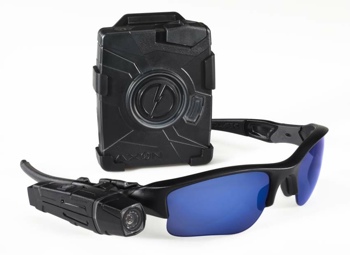
Awkward police 'body cam'
Setting aside community supervision issues, police officers today are ever-more frequently decked out with body mics and cameras, a market that Taser International leads almost by default. Police today often make traffic stops in state of the art body armor, boasting an array of gadgetry around their belts that remind one of Batman. To the extent that routine tech can be incorporated seamlessly into something the officer is wearing anyway - especially tech that can transmit useful data back to a supervisor in real time - there's a significant law-enforcement market to be had.

For quite some time, cops and crooks arguably have been the biggest markets for "wearable tech," even if it's seldom discussed in that frame. That will remain true for the near future, with much room for expansion in that market in the near term. There's even a (perhaps overly optimistic) argument to be made that wearable corrections tech could "make it possible to replace the system of large-scale imprisonment," that manufacturers in that market contribute to progressive de-incarceration goals.

I'd love to see a company like Adafruit take on wearable tech for law enforcement - somebody that cares if the product is ugly, if it's elegant, well-designed, comfortable, if it works as advertised. If Adafruit started re-imagining police body cams and alcohol sensors for probationers, IMO they'd leave Taser and SCRAM in the dust. Those folks have forgotten more about wearable tech than the other two companies likely know.

The wearable market so far has pigeon-holed itself largely into areas - exercise and health - where people themselves use generated data, or fashion, where sensor data may trigger an accessory but not necessarily a paper trail. In corrections fields, though, it's police management, probation officers, or pretrial services divisions that make use of the data, not the wearer themselves. Those sorts of institutional customers with significant baseline demand constitute a captive market, if you'll pardon the pun. While it may seem distasteful to design technologies of control, it's better if highly skilled engineers sensitive to the wearers' experience create this tech. Either way, somebody's going to profit from it. Bet on that.

Zocalo, Mexico City, a great place for light-up garb at night
BTW, I do think there's an untapped market for a lot of the light-up or sound-generating wearable stuff for youth, but a lot of those items come relatively cheap from China and suffer from low margins. The more significant profit potential comes when you can find ongoing, real-world uses for wearable-generated data, which is why Grits foresees big profits for wearables in the corrections market.

AN ASIDE: Just for fun, we took some light-up garb with us to Mexico City to the zocalo after dark: The granddaughter's hoodie with EL Wire stitched around the edges, a few dozen small glow sticks, a couple of balloons with flashing RGB LEDs inside them, and three battery operated EL Wire strands long enough to use as a jump rope, one of which ended up lining a hat. Folks approached in gaggles wanting to buy one or the other of the light-up goodies, with somebody offering five times for a strand of EL Wire what I'd paid for it. We gave away glow-stick bracelets to the kids and referred would-be customers to the websites where I'd bought them. (This was a great way to meet families with kids, btw.) When it was bed time, the young'un gave away the balloons with flashing LEDs to a couple of little girls in the square and distributed the last of the glowsticks to a passel of teenagers before she turned, hoodie flashing, and we walked back through the seemingly ever-present multitude to our hotel. SEE MORE from a kid-centric vacation here.

Saturday, May 24, 2014

Exonerating video surfaces midway through Hays County murder trial

The Austin Statesman reported ("Exonerating video surfaces midway through Hays County murder trial," May 23) on a dramatic turn of events in a Hays County murder trial, in which the prosecution handed over exonerating video to the defense four days into the jury trial, though it had been in the state's possession, supposedly never viewed, for 15 months. Wrote Esther Robards-Forbes:
Brelyn Sorrells was halfway through his murder trial, meeting with his attorney at the Hays County Jail, when they got a call from the prosecution.

A video had been found. ...

Sorrells, 21, knew that video, recorded at a party where he was accused of stabbing 20-year-old Arthur Martinez to death, was the key to his exoneration. It had been self-defense, he said.

The video had sat in evidence, unwatched for more than 15 months ... because the digital file had a time stamp indicating it was shot hours after the fight had happened. Investigators had not realized that it was stamped in Greenwich Mean Time, not Central Standard Time, a possible glitch in the phone or the data, police said.

“Nobody viewed the video because it was thought that it was not relevant to the trial,” Williams said.

According to court documents, the video was part of the large batch of evidence turned over to the defense in May 2013. But Payan said the video wasn’t part of the evidence he received.

It was at the end of the fourth day of the trial, May 15, that prosecutors alerted Payan to the video. It was the same day prosecutors had discovered it actually showed the fight in question. It is unclear why or how the video came to light. Officials with the DA’s office have refused to comment beyond an official statement that was issued this week.

“In this case, the main issue was always whether or not the defendant acted in self-defense,” the statement said. “A grand jury heard evidence and determined that there was probable cause to indict the case.”

The grand jury indicted Sorrells in May 2013, before the video came to light. ...
A [petit] jury took nine hours to find him not guilty. They told defense attorneys that the video had significantly contributed to their decision.
 Better late than never, I suppose, but wow! Talk about your eleventh hour Brady disclosures!

Wednesday, April 30, 2014

Travis County Jail recorded attorney-client phone calls, gave them to prosecutors

When the Travis County Jail installed video visitation technology and ceased the practice of in-person visitation, they promised that attorneys conversations wouldn't be recorded. Turned out, that's not always true. Reported the Austin Statesman ("Lawsuit: Travis County inmates' calls to defense lawyers were recorded, shared with prosecutors," April 29):
A group of Austin defense lawyers and prisoners is suing the top law enforcement agencies in Travis County, alleging the private Dallas firm hired to tape inmate visits at county jails is illegally capturing their conversations with attorneys and turning over the recordings to prosecutors.

The Austin Lawyers Guild, the Prison Justice League and several independent defense attorneys are seeking that a federal judge order authorities to stop the practice, which they call “unconstitutional eavesdropping and an invasion of attorney-client communication,” according to the lawsuit filed Tuesday in a U.S. district court in Austin. They say they also want the sheriff’s office and Securus Technology Inc. to destroy all the copies of such phone and jail calls already in existence, which could number in the thousands.
Named in the suit were the Sheriff, the vendor Securus Technologies, and the district and county attorneys offices.
Both parties claim visits between defendants and their legal counsel are secure, completely confidential and not recorded, as protected by attorney-client privilege, the lawsuit states. But prosecutors at both the district attorney’s office and the county attorney’s office have procured copies of the private conversations, some of which have been disclosed to defense lawyers among discovery materials, according to the court records.
Judges say the recordings are automatically deemed inadmissible as evidence in court, but the lawsuit alleges some prosecutors are using them to prepare their cases — sometimes to their tactical advantage without admitting they obtained or listened to them.
The Sheriff and DA say the recorded attorney client conversations were mistakes, the result of deputies failing to check the appropriate boxes on computerized forms. But those mechanisms are internal to the Sheriff and there's no mechanism for defense counsel to ascertain whether their conversations were recorded or shared with prosecutors unless the state later hands them over, by which time any strategic damage has been done. Said Austin Criminal Defense Lawyers Association president Bradley Hargis, “Basically, we just have to trust the sheriff and prosecutors not to listen to these calls but we have no way to verify they won’t.”

Similar allegations were lodged against Securus two years ago in Alaska. In Massachussetts, evidence from attorney-client phone calls recorded by Securus was suppressed in a 2006 criminal case. In 2008, NBC News reported that, "In the past two years, privileged conversations between inmates and lawyers have been recorded in Alameda, Santa Clara and Riverside counties in California, as well as Broward County, Fla.; Lansing, Mich.; and Dallas," as well as San Diego, CA.

Since all these were alleged accidents, according to Securus, which in each case promised to implement procedures to keep it from happening again, the assurances that this practice will definitively stop ring somewhat hollow. If nothing else, Travis County should begin providing attorneys with a comprehensive list of calls to and from their client that were monitored or recorded. "Trust us, we're the government" isn't a good enough response given that recorded attorney conversations have already turned up in prosecutors' files.

MORE: From the Courthouse News Service, and see earlier coverage from the Austin Monitor. Here's a copy of the complaint filed yesterday in federal court.

Thursday, January 16, 2014

Roundup: Too crazy to drive? ... and other stories

Here are a few odds and ends that haven't made it into their own, individual posts but deserve Grits readers' attention:

Drivers license application includes pointless, invasive mental health question
The Houston Chronicle today reported on criticism of a question on the Texas Department of Public Safety driver's license application asking, "Within the past two years, have you been diagnosed with, been hospitalized for or are you now receiving treatment for a psychiatric disorder?" The question has been on the application since the 1970s, but "Gyl Switzer, public policy director for Mental Health America of Texas, said the mental health questioning should be purged from applications." In 2012, 242 applications were flagged for review by an advisory board at the Department of State Health Services. Of those, 102 "did not forward information from their doctor so their applications were tossed out. The board recommended 32 people be denied a license."

Travis jail eliminates in-person visitation, profits from video contract
The Travis County Jail has switched exclusively to video visitation, eliminating face-to-face visits with inmates by friends and family, reported the Austin Statesman. Now, only attorneys can meet in person with inmates. Notably, the jail is making money off the deal. "Securus Technologies Inc. installed the system at no cost to the county last year. Securus charges outside callers $20 for a 20-minute conversation with an inmate and gives the county $4.60 from each call." County commissioners, though, weren't told when the deal was approved that face-to-face visits would be eliminated. Notably, the Prison Policy Initiative last month called on the FCC to regulate charges for video visitation, complaining that the elimination of in-person visits often resulted from "perverse incentives" created by such contracts.

Metal detectors installed to prevent cell-phone smuggling in Bexar Jail
The Bexar County Jail has installed metal detectors that all staff are now required to pass through in order to combat contraband smuggling after they found a smuggled cell phone, reported the SA Express-News. "In October, inmate Paul Reyes was caught with a cellphone after photos of him in jail surfaced on Facebook."

'The Real Victims of Satanic Ritual Abuse'
An article from Slate with the same title as this subhed explored the Fran and Dan Keller case out of Travis County.

Frisco man arrested for sign warning drivers of speed trap
Another arrest for contempt of cop.

SAPD may test "feasibility" of body cameras
San Antonio is considering a pilot program to test the "feasibility" of police officers wearing body cams, reported the Express-News. I'm a big fan of this idea. A New York Times story on the topic last year said departments using body cams saw dramatic reductions both in citizen complaints and use of force incidents. (Note to Adafruit and other wearable tech producers: Don't let Taser International corner this market!)

Border Patrol lending drones to local law enforcement
The Border Patrol has been using drones on behalf of local law enforcement agencies, including along the Mexican border, though they won't say which ones. Reported the Washington Post, "there is a huge, unfed appetite among police agencies for drones and their powerful surveillance tools, which include infrared cameras and specialized radar."

Wednesday, November 13, 2013

Video contradicted Garland cop's story of deadly police chase, led to manslaughter charges

For the second time in recent months, a Dallas-area police officer shot someone then filed a false police report about the incident. In October it was a Dallas cop who shot a mentally ill man, then along with his partner filed a false report declaring he'd approached them menacingly with a raised knife. Now, a Garland officer has been charged with manslaughter after an August 31st incident in which he plowed his car into a suspect's at the end of a high-speed chase, falsely claiming the man had rammed his police vehicle. Officer Patrick Tuter fired 41 rounds hitting the man three times, emptying his clip and reloading twice during the barrage.

The DA's office asked for a $10,000 bond, well short of the standard $25,000 bail typical of manslaughter charges in Dallas County. But the judge raised it to $100K, declaring “I’m not concerned about whether he is going to return to court or not. I’m concerned about public safety.” According to the judge, "the only other officer on scene did not fire, and also sought refuge from the bullets behind his patrol car," reported the Dallas News.

According to Mint Press News, "Since 9/11, about 5,000 Americans have been killed by U.S. police officers, which is almost equivalent to the number of U.S. soldiers who have been killed in the line of duty in Iraq." Nearly all of these are deemed justified by Internal Affairs investigators, but for the most part the press and the public must take the word of police flacks in determining what happened.

These episodes to me demonstrate the need for police departments to quickly move to body cams worn by officers that can corroborate police accounts or dispel lies when they dissemble after the fact. "Trust us, we're the government" just isn't good enough in an era when the fact of police "testilying" is well established and video is ubiquitous and cheap. The blog Simple Justice has a running series titled "But for Video" describing episodes where video documented police misconduct that would otherwise have gone undetected.

Dashcams have improved the situation and helped debunk the officer's false report in this case. (There was also a woman in the car with the deceased suspect who likely contradicted his story; press reports so far haven't revealed whether the second officer backed up Tuter's false report.)  But too often the tech malfunctions at just the wrong moment, or the right one from the perspective of officers covering up misconduct. In Cincinnati recently, an officer's dashcam reportedly malfunctioned seconds before he ran over an innocent bystander during a high speed chase. This was the second recent episode where the same officer's dashcam malfunctioned at a critical moment; the first in 2012 involved a high-profile shooting. There are also many instances when dashcams are functioning but simply pointed in the wrong direction.

Body cams and mics for police would provide evidence of misconduct when it happens, protect officers from false accusations, and provide better evidence for prosecutors to use in court. There's little excuse in the 21st century for not deploying such technology as rapidly as budgets will allow. Certainly you could probably outfit the entire Garland Police Department with them for the amount the lawsuit in this case by the victim's family will ultimately cost the taxpayers.

Friday, October 19, 2012

AG correctly interprets bad law: Open Records Act nostalgia and law enforcement records

The Attorney General's open records division ruled that the state does not have to release security footage of two Brownsville police officers shooting an eighth grader at a middle school . Reported the Brownsville Herald ("Ruling: Security footage should not be released to public," Oct. 17):
Jaime Gonzalez Jr., 15, an eighth-grader at the school, was killed by two Brownsville police officers in a school hallway after he pointed a weapon at them and refused to put it down, despite being ordered repeatedly to do so. The weapon was later determined to be a pellet gun.

John Bussian, the attorney who handles First Amendment issues for AIM Media Texas LLC, the parent company of The Brownsville Herald, said the AG’s office issued its ruling on an issue that was not even addressed in the request made by the DA’s office to keep the video confidential.

“Unfortunately, the Attorney General found another excuse not to allow public access to this important material that would remove any suspicion about what happened. The downside of the ruling is that whenever a juvenile dies the public will never have access to the records of the surrounding circumstances,” Bussian said.

In a letter to the state dated Aug. 28, the DA’s office argued that since no charges were filed in the case, the video need not be made public.
Despite the fact that the court perhaps unnecessarily relied on arguments, apparently, that the state did not make to come to its decision, from my own understanding of the Public Information Act, Grits reluctantly agrees with the court ruling. That's because I think the court correctly interpreted the current statute, which leaves release of such information to the discretion of  the agency in cases where there's no criminal prosecution. But as a long-time user of the Public Information Act, the Open Records Act, I also understand that before 1996, those records would absolutely have been public information, and I'd like to see the Legislature reverse the changes in 1996-97 spawned by the Texas Supreme Court case Holmes v. Morales, and at a pivotal moment codified the following session into state law. State Rep. Harold Dutton has heroically carried legislation in the past that would perform that good-government mitzvah, but his bill deserves bipartisan sponsorship. Right now, departments pick and choose when they'll release such information based on their own, short-term public relations goals.

A quarter-century ago when I began using it in earnest, the Texas Open Records Act was a mighty tool for justice, allowing the weak to challenge the powerful in ways that today have been diminished or sometimes shut down entirely, particularly when it comes to criminal justice. Back then, when the law was less than two decades old, many of the Open Records Act's original proponents were still at the Texas statehouse to defend it from attack, while then-Attorney General Jim Mattox was building up what, in retrospect, was the most pro-transparency record of any Texas AG, ever. Looking back, though I couldn't have known it at the time, those were the salad days of government transparency in Texas. Today, not so much.

About half of all open-records requests, if we are to judge from the proportion of cases sent to the Attorney General for review, relate to law enforcement and/or criminal cases, so the criminal-justice system is one of the main things the general public actually wants to know about. But as Grits has related before, the courts, the Legislature and a series of lame Attorneys General have conspired to gut the open records act (now annoyingly rebranded the "Public Information Act"), particularly as it regards records related to law enforcement and the criminal justice system. This is an example of a correct court decision interpreting a law  that gave too much discretion to law enforcement. But it hasn't always been thus; they're interpreting a section of the Public Information Act, section 552.108, which was rewritten in 1997, just a few short years before the GOP took control of the Texas House and Senate. The Lege could go back to the Mattox-era interpretation - as Rep. Dutton has proposed - if GOP champions existed to take up the mantle for transparency.

There's a lot of new blood coming into the Texas Lege, particularly in the House, where perhaps a third of the members will be freshmen or sophomores, and for the most part their views (read: "voting patterns," not espoused views) on open-records matters remain a mystery. Some may have never seriously considered the subject. In the Senate, long-time Public Information Act custodian Jeff Wentworth, who was generally a barrier to any and all pro-transparency reforms and an ally of law enforcement (and other) interests intent on weakening the act, was defeated in the primary, so that body will need to find a new go-to senator (or at the most, two) on the issue. Whoever that senator might be, their priorities will significantly influence whether that body will take a pro-government or pro-citizen requestor approach. Given that uncertainty, Grits cannot begin to guess how (or whether) the Lege might consider open records issues next session, and if so, whether they'll be pro-government or pro-transparency. I just know the status quo could use some shaking up and government transparency could use some new champions in both legislative chambers. Be on the lookout and let me know in the comments if you hear of any.

MORE: From the Corpus Christi Caller Times.

Tuesday, August 28, 2012

Austin police say photographers should stay 50-60 feet from arrests

Austin police are "working on guidelines" which would require "people filming the police to stay 50 to 60 feet away," reported the Austin Statesman, after the the second arrest this year of police accountability activist Anthony Bueheler for filming cops while they were arresting someone. In the latest incident, the activist was filming from 15-20 feet away, which seems plenty far enough to avoid any interference. He was arrested because the person being handcuffed and carted away yelled at the photographer to stop filming, allegedly causing an officer to "stumble."

In an email to media received by Grits, and which she posted on her Austin Gonzo blog, Austin police accountability activist Debbie Russell posed a series of important questions, not the least of which is: "If random bystanders are 10' from a detainment, as they often are without ANY concern by LEOs, are they going to be arrested if officers are also planning to arrest a videographer 30' away? If not, why? How is someone holding a camera further away MORE of a danger than someone closer, without a camera (with their hands free)?" Good point.

Russell pointed to a Department of Justice memo (beginning on p. 3 of the pdf) outlining the USDOJ's "position on the basic elements of a constitutionally adequate policy on individuals’ right to record police activity," and the specifics are worth quoting in some detail. DOJ contends that "private individuals have a First Amendment right to record police officers in the public discharge of their duties, and that officers violate individuals’ Fourth and Fourteenth Amendment rights when they seize and destroy such recordings without a warrant or due process."

Monday, August 27, 2012

Police v cameras in public spaces: A recurring conflict

In Austin, a West Point graduate, Iraq war vet and police accountability activist was arrested for the second time this year for recording police officers in the course of their duties. Reported the Austin Statesman ("Attorney: Man arrested second time for filming police officers," Aug. 27):
A man arrested on New Year’s Day for filming police officers was taken into custody a second time early Sunday, when he was taping officers detain an intoxicated man downtown, his attorney told reporters outside of Travis County Jail.

Antonio Buehler, 35, organizer of the Peaceful Streets Project, is facing a charge for interfering with public duty, his attorney, Joe James Sawyer, said Sunday afternoon. The lawyer said his client was detained about 2:30 a.m. Sunday on Sixth Street.

Austin police officials confirmed officers had arrested Buehler but did not release further information, saying they were reviewing the facts of the case. An official statement is expected to be released Monday. Sawyer called Buehler’s arrest a “deliberate action and part of a calculated effort to protect the officer who arrested him New Year’s Day.”

Buehler, an Army veteran, was arrested at about 1:15 a.m. New Year’s day and charged with harassment of a public servant after he stopped to take photographs of an arrest in Central Austin, according to court records. Police said Buehler interfered with her arrest. He filed a complaint against the arresting officers, who were cleared by an internal affairs investigation in July.
Recording police or anybody else in public should not be an arrestable offense, but some in law enforcement don't agree. In June in Dallas a motorcyclist was arrested essentially for contempt of cop after refusing to hand over video from a helmet cam. After he declined to give up the video, the deputy arrested him for allegedly having an obstructed license plate and the video was seized incident to arrest.

Tuesday, August 09, 2011

On proof of innocence, reasonable doubt, and false rape accusations

Having gotten to know quite a few of Texas' DNA exonerees over the last few years working with the Innocence Prjoejct of Texas, I couldn't help but think about the outcome of their cases after reading a pair of stories out of Houston about false rape accusations. First, reports Richard Connelly at the Houston Press Hair Balls blog:
"Gotcha" moments don't come more classic than the one that happened in Montgomery County recently.

The Sheriff's Office blotter says two officers were called to an apartment to investigate a sexual assault.
"The alleged victim stated to the deputies that her 26-year-old male friend had sexually assaulted her," the report says.
Fair enough, and with that friend standing in the same apartment, no big manhunt needed.

Not so fast: "Upon further investigation the deputies watched a video recording the male had made that showed the female telling him that she was calling the police because he was making her leave the apartment and she would tell the police he assaulted her."

That must have been some look on the woman's face when the dude hit "play."

Sheriff's Lt. Dan Norris tells Hair Balls he doesn't have any further info on the incident, including the name of the woman, who was arrested for making a false report.

"It was unusual, though," he says. "I remember reading that report and going, 'The man was looking out for himself.'"
It's a good thing he was looking out for himself, because without that recording, his accuser's testimony alone would have been enough to convict the fellow.

Another story in today's Houston Chronicle by Ryan Crockett describes what happened to a man who was falsely accused of rape when a 14-year old victim picked him out of a photo lineup, an event which ruined his life before DNA evidence cleared his name. The article opens:
Six months after being charged with rape in a case that left his personal life in shambles,  Jose Torres is now able to begin picking up the pieces.

Citing insufficient evidence, the Harris County District Attorney's Office on Thursday dismissed an aggravated sexual assault charge against the Houston man, according to court records.

Torres, 32, served two months in jail early this year and is still trying recover from the stigma of being an accused rapist.

"Right now, my whole life is ruined," Torres said Monday. "I lost my job and was evicted from my apartment. I'm trying to pick myself up."

Torres was charged in February in the reported sexual assault of a 14-year-old girl in her southeast Houston home in July 2010.

According to police, Torres visited the house two days before the incident as a contract sales representative for Comcast. The girl identified him in a photo lineup, which led to his arrest. 

Torres is criticizing how police handled the case. "This whole story was messed up since the beginning," Torres said. "The family said I went into the house, I never went inside that house. There was no evidence and no witnesses. I had to prove my innocence instead of them proving my guilt."

Torres and his attorney, Juan Guerra, said negative DNA results led to the dismissal.

The district attorney's office could not be reached to confirm the reason for the dismissal. Houston police have not yet commented on Torres' statements.
Though it's hard to say someone is fortunate after being falsely accused of rape, there's a real sense in which both these gentlemen were damn lucky. Whether the falsehoods stemmed from malice or mere error, the alleged victim's testimony alone under Texas law would have been enough to send either of these guys to prison for decades. But biological evidence is only available in less than 10% of violent crimes, and very few people exhibit the wherewithal and forethought to record a confrontation where they might end up being falsely accused. My questions: How many others similarly positioned had no DNA evidence or video to prove their innocence? And despite current lax standards of evidence in such cases, can a conviction secured based on the testimony of a single, uncorroborated witness ever really prove guilt beyond a reasonable doubt?

MORE: From Paul Kennedy at The Defense Rests about the Torres case, who concludes his post with these notable comments:
Once you're arrested you ain't innocent unless proven guilty. No, you're guilty unless you can prove otherwise. Let's slap a high bond on you so that you can't fight your case from the outside. Let's put pressure on you to accept a deal for a crime you never committed. After all, how could the state and its allies, the black-robed prosecutors, possibly be wrong? ...

Once upon a time the grand jury system was devised as a way of protecting the reputations of those accused of crime unless there was sufficient evidence to warrant a trial. Nowadays the grand jury is nothing more than a de facto division of the DA's Office who takes its marching orders from the prosecutor presenting the case.

You could argue that in this case "the system" worked as it should. Just don't try telling that to Mr. Torres.

Sunday, May 02, 2010

A viral video event waiting to happen: Alleged beating of 15-year old by 8 Houston cops caught on video

Richard Connelly at the Houston Press' Hairballs' blog says:
Reports are everywhere about eight Houston police officers allegedly caught on tape beating a suspect. But the worst is no doubt yet to come, when the video eventually gets released.

Mayor Annise Parker tried to describe what's seen on the security-cam footage as calmly as possible to reporters yesterday, but anytime you have to say of your police force that they're alleged to have "handcuffed the suspect and then may have beaten that suspect while he was in custody and handcuffed," it's not good.
The 15-year old suspect ran from the cops, who allegedly handcuffed then beat him after they caught up with him, not realizing their actions were captured by a surveillance camera at a self-storage facility. The FBI are reviewing the video to evaluate possible civil rights charges. Connelly concludes, "So brace yourself, Houston. At some point you may be getting yet another black eye in terms of world opinion. Not as bad as getting a beating while handcuffed and on the ground, to be sure, but not terrific either."

Some things seemingly never change. It's like Chris Rock said about running from the cops in his classic video (below): "Everybody knows, if the police have to come and get you, they're bringing an ass kicking with them."


For more excellent advice on interacting with police, see the various videos and materials available from the group Flex Your Rights.