Showing posts with label crime data. Show all posts

Wednesday, October 27, 2021

Not that anyone cares, but "violent victimizations" were actually down last year

Your correspondent has not been writing here recently because I'm in the process of evaluating the continued effectiveness of making fact-based arguments on public-policy topics. Texas politics no longer seems to value facts, so I'm not sure what benefit there is from discussing them. Hewing to them just makes one a target and causes one's enemies to believe the opposite out of some twisted, oppositional principle.

And yet, facts persist. Sigh. Let's talk about one that nobody in the political class wants to believe, and that will certainly only bring Grits grief for even mentioning: The just-released National Crime Victimization Survey - one of the two main measurements of crime in the United States - found that, "From 2019 to 2020, the total violent victimization rate declined 22%, from 21.0 to 16.4 victimizations per 1,000 persons age 12 or older." Burglaries and trespassing complaints declined, the survey found. And the decline was especially pronounced among youth age 12-17, for whom violent victimizations decreased 51%.

Does that jibe with the breathless news coverage about crime you've read in the last year? Of course not. The decline in violent victimization won't attract viewers/readers the same way as "Be afraid, killers on the loose," so it won't be reported. Compare this to how the increase in murders played out in the press last year.

As John Pfaff observed on Twitter, this news reinforces the extent to which the reported crime increase being touted near-daily in the press has been largely about homicides. Assaults and violent victimizations overall were down last year, according to this metric, particularly in suburban areas. Simple assaults were down, but also more serious ones. Firearm victimizations, which in this survey includes pointing a firearm as well as firing one, declined from 481,950 in 2019 to 350,460 in 2020. Burglaries were down 19%.

The NCVS is one of two main, national crime measurements in the United States. The "Uniform Crime Reports" (UCR) count crimes reported to law enforcement agencies, while the NCVS surveys crime victims to include crime victims who didn't report to police.

The NCVS is especially important right now because of changes to UCR data. Without going too deep in the weeds, the feds are shifting to an incident-based reporting system that supposedly is more accurate but results in data that's not an apples-to-apples comparison to what was reported before. Plus, many smaller agencies haven't yet made the switch. So for the next few years, it will be problematic to judge crime trends based on these data: They'll be establishing a new baseline that's not comparable to the old numbers.

The NCVS, by contrast, is still performed as it was in the past, though in-person interviews were halted last year for a time bc of COVID. Moreover, the story it tells corroborates UCR data on crime beyond homicides: News reporters and criminologists have puzzled that murders increased but reports of other types of violent crime went down. The NCVS confirms that crime victims simply were victimized less, not just that reporting went down because of distrust of police (or whatever reason one wants to assign).

So many in law enforcement have taken the recent murder spike as an excuse for a money grab, there's little reason to hope public policy might adjust to reflect actual, in-real-life crime data. So Grits offers up the NCVS analysis without any real belief that it will convince anybody of anything. Everyone will just look at it for evidence that confirms their priors, cherrypick that, and move on.

In the context of declining violent crime victimization, it's worth revisiting recent research from Dr. Bill Spelman at the UT LBJ School. He analyzed the major risks of death for Austinites and found murder was a far less salient risk than traffic deaths, suicides, or drug overdoses.
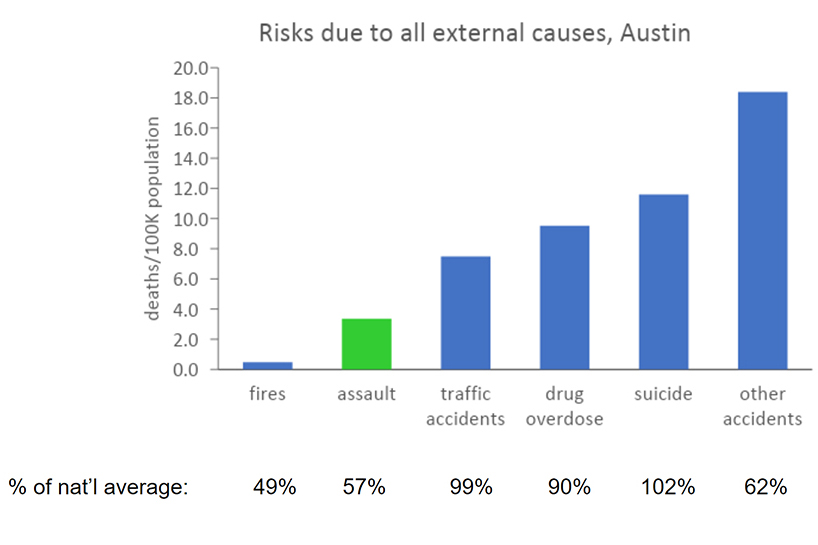
Anyone truly concerned about "public safety" in this town would, by any reasonable measure, be chiefly concerned with the causes of death on the right-hand side of this chart. But we spend most of our time in city politics and a majority of the city budget on the causes on the left hand side. It's exhausting. And stupid. And I don't know if it can or will ever change.

A good start would be for Austinites to vote against Prop A. Early voting is going on right now and election day is next Tuesday. But if you've read this far, you're probably already a Prop A opponent. 

Wednesday, September 22, 2021

More police won't help with Austin's biggest public-safety threats

Let's talk for a moment about public safety in Austin.

The argument for Prop A - the GOP-backed initiative to force the city of Austin to hire 500+ more police officers - is premised on the notion that Texas' capital has become uniquely dangerous as a result of the city council's anti-law enforcement policies. Local media have doubled down on this meme, touting Austin's "record" number of homicides while downplaying the fact that we're now a city of a million people and the record was set 40 years ago. 

How journalists present this information tells us more about them than whether Austin is a safe town. You can run with the scary headline, "Austin hits all-time murder record," or the equally accurate, "Austin has slightly more murders than when it was a much smaller town 40 years ago." The former may work better as clickbait (which is why they do it - hi, Tony Plohetski!) but the latter, contextualized account gives a more accurate sense of the threat.

Though you wouldn't know it from the local media's framing, the murder spike in Austin last year tracked nationwide trends and other Texas cities - including Republican-led communities like Fort Worth and Lubbock - saw even greater increases. So the notion that the murder spike resulted from Austin-specific policies or local attitudes toward police are dubious at best: Nobody thinks Lubbock's city council is anti-police, and they saw a 105% increase in homicides last year.

Even if you think crime is a problem, there's strong evidence hiring more police won't help. The question of whether hiring more police reduces crime has been intensively studied for decades with consistent findings, according to a 2013 metastudy analyzing hundreds of research findings over 40 years. Those researchers concluded, "This line of research has exhausted its utility. Changing policing strategy is likely to have a greater impact on crime than adding more police."

Prof. Bill Spelman, a criminologist and former Austin city council member, now retired from UT's LBJ School, made similar assertions on local Fox news this week. He pointed to the lack of correlation between police staffing size and homicide increases last year, noting that departments of all sizes saw murder spikes, including agencies with high and low staffing ratios alike.

Indeed, Prop A arises from a fundamental misunderstanding of the safety risks faced by the public. Murders are a scary way to die, but in Austin they're an incredibly uncommon one. By comparison, more than one thousand Austinites have died from COVID in the past year and a half. Prof. Spelman analyzed the various death risks in Austin and compared them to national averages. Here's what he found:

Austinites are far less likely to die from murders than other Americans, but we're not doing nearly so well on drug overdoses and suicide. In fact, former Austin Police Chief Brian Manley refused to allow police officers to carry donated Narcan to prevent overdose deaths, declaring that providing medical care was EMS's job. His successor, Joe Chacon, reversed that policy earlier this year, but police in Austin have not until VERY recently considered drug overdoses their problem.

Austin PD has also resisted efforts to send mental-health workers to suicide calls. The city funded a pilot to have teams led by medical professionals handle most of these cases, but after the first year, few real-world calls had been diverted.

Suicides and drug overdoses aren't areas where police play a meaningful role and increasing their number won't prevent deaths by those causes.

Similarly, there's little evidence increased policing will reduce traffic deaths. Statewide in Texas, traffic enforcement decreased by more than half since 2008, during a period when the population and miles driven boomed. And yet, accidents-per-mile driven fluctuated over this period then declined: There's been no apparent public-safety detriment from most traffic tickets going away.

Indeed, in Austin, in particular, the biggest sources of traffic deaths stem from flaws in traffic engineering. This city has until recently prioritized automobile traffic over bikes and pedestrians, so when those groups interact with cars, it often doesn't end well. Public-works improvement like segregated bike lanes and pedestrian tunnels will do more to prevent these deaths than hiring extra cops. But ironically, Prop A would prevent such spending by forcing the city to prioritize hiring police.

For that reason, on traffic, Prop A arguably makes Austin less safe.

Spelman's research re-frames the public-safety question more broadly to include ALL the threats people face, not just scary murderers. And as soon as one considers that broader question, the murders don't seem so scary. They're terrible events happening to small numbers of folks, but their existence shouldn't cause us to de-prioritize responses to threats that pose equally grave danger to far more people.

Thursday, September 02, 2021

Prosecuting crimes of poverty isn't the same as combating a "crime wave"

The following is a guest blog post co-authored by Elizabeth Rossi of Civil Rights Corps and Amanda Woog of the Texas Fair Defense Project. Their organizations are among the civil rights groups involved in bail litigation against Harris County. Related: this discussion of the District Attorney's claims to be fighting a "crime wave" in Houston harken to this analysis of media coverage of crime and jails from a century ago. Sometimes, the more things change, the more they stay the same.

The Chronicle’s recent editorial “How Harris County prosecutors are trying to stop Houston’s crime wave,” casts District Attorney Kim Ogg’s office as engaged in some heroic task of ferreting out the County’s most dangerous “criminals,” when in fact the DA is funneling millions of dollars toward the prosecution of poor people charged with crimes of poverty. Without a shred of evidence, the Chronicle adopted the DA’s party line, asserting that “more prosecutions means more justice and a safer community.”

Expert research -- including some paid for by the County -- shows that's not true.

The County hired national experts at the Justice Management Institute last summer to address exactly this question. JMI assessed the backlog and concluded that the safest and most fiscally responsible solution to the backlog would be “to dismiss all non-violent felony cases older than nine months,” with certain exceptions for cases like DWI, so that the DAO could devote its resources to prosecuting violent cases. The experts at JMI pointed out that only 42% of all felony cases (not just “violent” crimes) closed in 2019 resulted in a conviction. The other 58% resulted in dismissal, deferred adjudication, or acquittal. And even among the 42% of cases that resulted in conviction, the majority involved people who were released immediately into the community on probation. The idea that the DAO is rescuing Houston from a “crime wave” by prosecuting years-old theft-by-check cases and other poverty crimes is laughable.

But the Chronicle ignores this information.

The paper also ignores a recent academic study by researchers finding that non-prosecution of low-level offenses can lead to less crime without any negative effects on public safety. Ogg has offered no answer to these findings. And now she is asking for millions of dollars more to fund 22 additional prosecutors to conduct intakes -- which will bring even more people into the broken system, exacerbating a problem that Ogg created.

The DAO is to blame for this tragedy. Ogg has enormous discretion to decide whom to prosecute, and most of the cases that Ogg is now begging for resources to resolve shouldn’t even be in the system. Evidence and research show that expanding the wasteful punishment bureaucracy through initiatives like the DA’s “triage” program does nothing for public safety, but does a lot to expand the government’s control over and surveillance of poor people and Black and Brown people, exacerbating poverty, separating families, and making it more difficult for people to find jobs and housing - all conditions that tend to increase future crime, not decrease it.

Ultimately the Chronicle piece is hailing prosecutors as heroes for solving a problem that they created and that they can end without spending a single penny more. Ogg doesn’t need more money to do her job. Instead, Harris County needs to invest that money in proven solutions to public safety issues-- programs like violence interruption, mental health, youth programs, non-carceral crisis response, streetlights, and other interventions that prevent harm before it occurs -- and should stop spending millions of taxpayer dollars for the DAO to prosecute crimes of poverty from 2016.

Thursday, July 22, 2021

Murders in Texas increased 37% statewide in 2020, with Republican-led communities suffering the biggest spikes. But overdose deaths doubled murders. Are we focused on the wrong problems?

Much attention has been given to the nationwide murder spike, but Texans were more than twice as likely to die from a drug overdose in 2020 than to be murdered. And like murders, overdose deaths saw a big increase during the pandemic. "More than 4,000 Texans died of drug overdoses in the year ending Nov. 30, 2020 – a 33% increase compared to the previous year," reported Libby Seline at the Houston Chronicle.

By contrast, DPS reported 1,403 homicides statewide in 2019, and 1,927 in 2020. While that's a big increase - 37% statewide, and not at all concentrated in Austin and Houston, as the Governor would have you believe - it still means overdose deaths are killing far more Texans than murderers.

Republicans are pointing to the murder spike to call for massive increases in police spending and regressive changes to the state's bail system, even though there's  no evidence that higher police department budgets or limits on charitable bail organizations will stop these murders (Abbott's pet projects). 

By contrast, there are proven policies that reduce drug overdose deaths. One is reminded at this point that Gov. Abbott in 2015 vetoed Good Samaritan legislation that would have let people who call 911 when someone overdoses on illegal drugs avoid criminal charges. The following year, 1,257 Texans died from overdoses; since then the number has ballooned to more than 4,000! Local programs launched and funded last year in Austin were aimed directly at reducing overdose deaths, sending paramedics instead of police to respond. (Then-Chief Manley had insisted his officers would not administer naloxone to overdose victims, declaring EMS should play that role.) But before we could see the results, Abbott pushed through a law to punish Austin for its public-safety budget choices. Apparently, some dead sons and daughters are more important to the governor than others.

And what Abbott thinks, regrettably, has a lot more to do with what the MSM deems "news" than the relative death counts. While Seline's story is the first we're hearing of last year's overdose death increase, how many stories have we seen on the murder spike in this or that city, usually based only on a partial year's worth of data, and WITHOUT acknowledging the statewide numbers?

Before this blog post, I've been unable to find anyone reporting Texas' 2020 statewide murder totals in the press: Google the topic and nearly all the stories involve city-level analyses, at most. (To be fair, the statewide "Crime in Texas" report from DPS for 2020 hasn't been published yet; I found the 1,927 number in a DPS report on border crime.)

No matter how you slice it, the statewide murder increase last year was far too big to attribute to Democrat-led cities alone. Even Houston, which saw its murder total spike by more than 100, can't explain more than a fraction of the increase. Like overdoses, this was something that happened everywhere in the state. It would not be unreasonable, in fact, for voters think the governor should be held to account for that. But that hasn't happened because skewed press coverage handed Abbott a megaphone to attack his enemies instead of vetting his claims. To their credit, the Texas Tribune pushed back on this meme, and now, finally, a few outlets are joining in. But the damage has been done.

Some days I think the media beating the drums about homicides while downplaying or ignoring much greater public health/safety risks reveals a partisan agenda; others, I think it's an economic one. Texas' lapdog press may be mostly content to recycle misleading and politicized crime headlines because the MSM's business model has been built on sensationalizing crime for more than a century. 

But this year, in this election cycle, there's a new level of hyperbole. Governor Abbott and his local acolytes want to blame leaders in Austin for murder increases, but the capital city, with more than a million people living here, had just 19 more murders in 2020 than it did the year before. That's tragic, but by comparison, Texas saw murders increase statewide by 524 last year on the Governor's watch, and Republican-led cities like Fort Worth and Lubbock saw much bigger percentage increases than Austin (e.g.: murders increased 60% in Fort Worth, whose population is slightly smaller than Austin's, from 70 to 112; in Lubbock, which is a quarter of Austin's size, murders spiked 105%, from 20 to 41.)

You'd almost think the demagoguery about Austin was a smokescreen so no one would ask about murder increases statewide under Republican leadership, much less overdose deaths and how much Abbott's policies (and veto) contributed to them. 

In reality, murder and overdose deaths - which increased in both Democratic and Republican-controlled cities and counties - appear to be things which are IRL unaffected by your party of choice. They aren't partisan problems, they don't lend themselves to partisan solutions, and when the media and government leaders insist on considering them through a partisan frame, it makes the situation much more stupid and untenable.

Thursday, March 04, 2021

Arrests for minor offenses continued at Texas traffic stops in 2020: New #SandraBland Act data still shaky on racial breakouts, but shows scope of arrests, police use of force at Texas traffic stops

Texas' 2020 racial profiling data from millions of Texas traffic stops was finalized this week at the Texas Commission on Law Enforcement. This was the first year racial breakouts were included in new data collected under Rep. Garnet Coleman's 2017 Sandra Bland Act. I'd posted preliminary data on Twitter before reporting was complete, but now we have the full dataset for 2020.* What does this tell us about Texas law enforcement's work in the field?

It is starting to tell us quite a lot about what police readily admit are "pretext" stops. Police stop people for minor traffic infractions if they think something else might be going on. If you are so stopped, and you don't agree to a search, you can be arrested for that minor traffic infraction so they can do their search without your approval. More than 41,000 people experienced such an arrest last year. 

That said, we still don't have great data on race: Various racial categories separately total more than the total number of stops recorded. Likely much of this is because of crossover between white and Hispanic categories, but there are many reasons racial identifications are problematic.

It was also a weird first year to gather racial data. With COVID driving down traffic everywhere, traffic stops were down 35% statewide, from 9.7 million in 2019 to 6.3 million in 2020.

Still, that's a lot of stops When police search, are they finding much? Usually nothing. And when they do, it's usually insignificant contraband that doesn't result in an arrest, according to the data.

Texas cops conducted searches 362,113 times in 2020, or at 5.8% of stops. That's about one out of every 17 time they pulled someone over. Of those, 27% were based on the drivers' consent.

In less than half of searches, contraband was discovered - 158,815 times in 2020 or 43.6% of searches. Most of what was found was drugs or paraphernalia (69%). Remarkably, three out of five times contraband was found, no arrest was made (93,998 cases). One supposes in these cases police found small amounts of marijuana, rolling papers, or items that weren't in and of themselves incriminating like cash or legal weapons. 

Arrests occurred at traffic stops 171,976 times in 2020, or at 2.7% of stops. Of those, 24% of arrests were for Class C misdemeanors (traffic infractions are generally Class Cs); another 24% were for outstanding warrants; the rest for penal code violations.

Class C arrests, which would mostly be banned under bills at the Texas Legislature like HB 830 and the Texas George Floyd Act, happened 41,731 times in 2020, down from 64,100 times in 2019. 

Physical force resulting in serious bodily injury was used against people 5,141 times at Texas traffic stops in 2020, or about once every thousand stops.

Black folks represented 24.6% of force victims compared to 16.7% of drivers stopped.

For the third year running, Houston PD came in on the high end of use-of-force rates at large departments. HPD officers used force 82.6 times out of every 10,000 stops; the statewide average was 10.7. At San Antonio PD, by comparison, force was used at 3.4 out of every 10,000 traffic stops; at Austin PD it was 5.4.

Out of 2,500+ agencies statewide, there were 19 agencies with higher use-of-force rates than Houston PD. But all were small agencies making fewer than 4,500 traffic stops; together, those 19 departments reported 388 force incidents. HPD, by contrast, made 217,288 stops in 2020 and reported 1,795 force incidents to TCOLE.

Complaints were made 4,047 times in 2020 based on officer behavior at Texas traffic stops, but officers were only disciplined 10 times as a result.

These are a lot of datapoints, and there's a lot to think about here. Why has Houston PD  seen more force at traffic stops than other large agencies? Why do HPD's officers arrest for Class Cs at much lower rates than the Harris County Constable in Precinct One? 

But the big finding on searches is unsurprising. Most of the time, when officers search drivers or arrest them because they think something else is going on (also called "proactive policing"), the biggest "find" is either 1) a traffic warrant for unpaid tickets; 2) contraband so minor it isn't worth charging over; or most commonly, 3) nothing at all, meaning the underlying arrest and trip downtown were utterly pointless.

This is the "tool in the toolbox" that police agencies are so frantic to save, but the volumes of arrests with so little resulting public safety benefit are a testament to the damage being done and why it must stop.

Notes on data cleanup. This is messy data. When departments submitted data with obvious errors, I deleted them, but there's probably still some bad and/or messy data still in there. All deleted data were from small agencies conducting relatively few stops. E.g., the tiny Cleveland Police Department reported arresting 2.9 million black people at traffic stops, though they reported fewer than 2,000 stops overall. Several agencies reported arresting every driver at every traffic stop: Little River Academy Police Department, Jefferson County Constable Pct. 4, Wharton Co. Constable Pct. 1, Orange Grove Police Department, Crosbyton Police Department, the City of Alma Police Department, Tiki Island Police Department, Palo Pinto Co. Constable Pct. 3, Montgomery ISD Police Department, Presidio ISD Police Department, Taylor County Constable Pct. 2, and the LaSalle Co. Sheriff's Office. Jonestown Police Department reported using force on drivers at every traffic stop. I omitted data from these agencies when making aggregate counts. It's highly likely several other agencies submitted problematic data, but I cannot confirm it at the moment and only omitted data when evidence of error was indisputable on its face.

Monday, December 21, 2020

How should journalists cover blatantly false or misleading statements from self-interested pols?

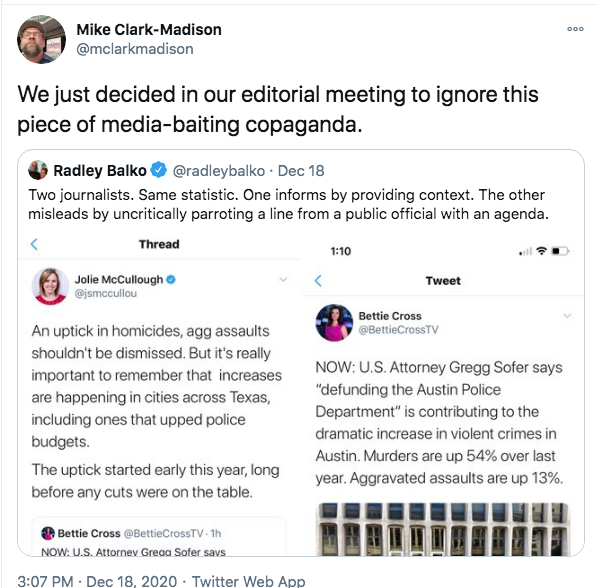
Last week, Grits considered responding to Austin-bashing press conference by the US Attorney for Texas' Western District, but the phony outrage was so tired and lame I couldn't muster the energy. Luckily, at least some in the Austin press corps - notably  Jolie McCullough at the Texas Tribune and Mike Clark Madison at the Austin Chronicle - chose either to debunk the falsehoods or just not to take the bait.

It's all been so silly. The murder increase in Fort Worth has been larger than in Austin, and they started with many more murders to begin with. But Austin gets special federal focus?

I don't blame Mike Clark Madison for choosing to ignore this piece of "copaganda" from a Trump Administration official who won't have a job in a month. But the Texas Tribune's McCullough took the opposite tack, aiming to debunk the misinformation instead:

“When you defund the police, relax enforcement of existing criminal law, and release repeat offenders and violent criminals into our streets, increased violence is exactly what you can expect,” Gregg Sofer, a newly appointed U.S attorney for the Western District of Texas, said in a statement after a press conference.

Austin police, like those in Fort Worth, recently stopped citing and arresting people for possessing small amounts of marijuana. The decisions arose from the state Legislature's legalization of hemp in 2019, which made it difficult for law enforcement officers to distinguish between legal and illegal cannabis. Recent decisions by several Texas counties to release more people from jail during the pandemic also brought backlash from the governor.

Last month, Austin Police Lt. Jeff Greenwalt addressed the rise in homicides at a press conference, but he said violent crimes detectives were still in the same shape under the new budget, “if not better.” He said given the city’s safe standing among other cities, he wasn’t yet concerned with the rise in some crimes. It’s hard to predict trends off of a small amount of data.

“We saw a rise in violent crime in the very early months of 2020, before the reimagining and the defunding conversations came up,” Greenwalt said. “I don’t think that we can say that the numbers in 2020 are reflective of that issue.”

Which is the right approach when public officials spread misinformation, ignore it or debunk it? I'd suggest both, in that order. Ignore it today, debunk it tomorrow.

Journalists should avoid reporting false statements from press events like the US Attorney's, even to debunk them, at least in the news cycle or two after they're released. The false information is being timed for a reason. As a journalist, don't be a tool for spreading it unless you fully understand what it is. Later, the information can and should be contextualized and debunked, with falsehoods a) clearly identified and b) the main point of the story.

In my imaginary world of journalism best practices, when Greg Abbott held a press conference in Fort Worth to say they were doing criminal justice right compared to Austin, pointing to the rising murder rate in the capital while ignoring that Fort Worth's was much higher, reporters would have taken note of the event but not immediately written about it. After all, it's a false statement; it has no news value.

What does have news value is the story, "Governor Makes False Statement." But that story takes research and context to write, and is more appropriate several days hence.

Live footage of reporter trying to decide how to cover Austin-bashing copaganda
Live footage of reporter trying to decide
how to cover Austin-bashing copaganda
Same goes for the US Attorney. Mike and Jolie both were right. It's not good to promote false memes, and it's also good to debunk them. It's not at all obvious which approach is right and puts the reporter in the position of a baserunner caught in a rundown between second and third: No great options.

While I realize many people believe all politicians lie, things are objectively different now. The dam has broken in the last four years, and especially in 2020. The Trump presidency demonstrated what a bind it puts journalists in when politicians are willing to openly flaunt facts. Now, state and local reporters face the same tactics and the same hard decisions about how to cover them. Ignore them? Debunk them? Report "both sides"? Should they characterize false representations as "lies"? "Mistakes"? "Spin"? "Wishful thinking"? "Blatant falsehoods"? If falsehoods further a political agenda, when should motives be impugned? These are not easy or obvious questions.

Eight years ago, Grits wrote a short essay titled "Ten Maxims for Making Journalism Relevant in the 21st Century." In retrospect it holds up well to the post-Trumpian era as a guide for how to approach these and related questions. Those interested should give it a read.

Monday, November 23, 2020

On the link between murder rates and violent crime trends: What happens when there isn't one?

Murder rates are up this year in Texas' big cities and across the country, but other (much more common) types of violent crime remain down.

Grits has puzzled over this trend. We usually think of murders as a subset of violent crime - the outliers with worst-case outcomes. Criminologists frequently treat murders as a proxy for other violent crime that may be less well documented. (Rapes or robberies may go unreported, but it's harder to hide dead bodies.) This year, though, those traditional correlations flew out the window. As Jeff Asher and Ben Horvitz wrote in the NY Times this summer:
There have been only four years since 1960 (1993, 2000, 2002 and 2003) when murder increased but overall violent crime decreased nationally, and the increase in murder was small in each of those years. The average absolute difference between the national change in murder and violent crime since 1990 has been just 2.2 percent, so a big increase in murder nationally while violent crime falls is almost unheard-of.
So we're in uncharted territory. If murders go up but other categories of violent crime go down, are we seeing a big-picture trend of more violent crime? Grits has wondered if something else may be happening.

Strangely, police have been solving homicides at ever-lower rates for quite some time now. (Reported the Houston Chronicle, "Homicide detectives [in Houston] solved 89 percent of homicides in 2011. As of May, that number had fallen to 49 percent.") So even if murders were declining before 2020, it wasn't necessarily because the cops did a great job. Moreover, if low clearance rates corresponded to lower murder totals in years past, it's hard to blame the spike this year on police solving fewer crimes.

What else might explain the trend? As hospitals struggle with ICU capacity over COVID, it's possible gunshot victims are losing the competition for resources and dying at higher rates. Earlier this year, a trauma surgeon in Philadelphia identified this tension in a New York Times column, but I haven't seen any follow-up analysis to tell us if that might explain all or part of the rising murder rate. Part of me thinks not. In New York and Chicago, total shooting incidents increased, not just murders. That said, I'm not sure hospitals would admit it if gunshot victims died more often because of ICU shortages.

Regardless, something odd is happening. In a year with so many anomalous occurrences, though, it may be impossible in the near term to figure out just what it is.

Tuesday, September 22, 2020

Justice data poorly calibrated to researchers' needs

At a Austin City Council's Public Safety Committee meeting yesterday discussing 911 call data, the Police Department's Chief Data Officer, Jonathan Kringen, reiterated an observation that Grits has made several times over the years: "this data system is built to try to manage an activity. It's not actually built to support researcher analysis." 

That's the biggest problem with most criminal-justice number crunching: Data is collected at points when the bureaucracy either interacts with other government systems or makes decisions about individuals being processed. But those data serve the needs of government tracking, they can't explain the causes of crime or explore dynamics that occurred prior to government intervention. In general, we don't measure the things needed to answer the most critical questions about public safety because the data is collected for different purposes.

As Kringen explained, "there are many things in the data that the way they are set up are functional and they serve the operational need, but they don't actually serve the analytic function that should come thereafter to help figure out what best practices should be."

Amen, brother.

Here are a couple of related academic discussions about the paucity of useful criminal-justice data. The latter article argues that, "Blind trust in the police, fear of a powerful police lobby, and a law enforcement culture of secrecy and insulation results in a serious information failure."

Here's the power point presentation Austin city staff gave to the committee, video of their Zoom call, and here's a data dashboard providing various analyses of APD 911 data. Grits may dig deeper into these dashboards later.

Related: Three quarters of Austin PD 911 responses went to non-crime situations: National experts analyze Austin PD data for clues on how officers spend their time

Sunday, April 05, 2020

Blakinger: Myriad pandemic updates, conflicting accounts on intra-prison transports, and one happy story to cheer you up

Our pal Keri Blakinger offered up another excellent and much-appreciated email update while Grits' blog content ramps back up. I couldn't be more grateful, thanks Keri!

Hey Grits,

Guess what I had for breakfast? Actual grits. For the first time in my life. I always skipped grits days in the prison mess hall but now I bought a bunch for my pandemic pantry. They are surprisingly good!

I was pleased to see your update and welcome your imminent return to the blogosphere! Here is one more get well and come back soon email and update.

As I’m sure you’ve noticed, the world is falling apart. So I’ve included eight depressing virus-related items, one longer discussion of an uncovered issue, and one short happy thing!! You have to make it to the end for the happy thing, no cheating!

Depressing Items
  1. As coronavirus began making its way across the country a few weeks ago, people suddenly realized: Prisons literally banned a lot of basic disease prevention measures. With a lot of pressure some of this has changed, but generally, as of a few weeks ago prisons across the country banned alcohol-based hand sanitizer, made social distancing impossible, and did not allow face masks. (Relatedly, this is a good Stateman story from a few weeks ago about supplies/prisons.) 
  2. There are a lot of aging and medically needy prisoners. This is a thing you have, of course, written about. And it came up a lot in the Pack litigation. But now it could be extremely problematic for the prisons and jails that are about to be overwhelmed with an illness that particularly puts medically compromised and aging populations at risk.
  3. Given all that, prisoners are suing TDCJ. The attorneys on the case are - of course! - Scott Medlock and Jeff Edwards. Their names should be familiar to Grits readers because of the air conditioning and hepatitis C lawsuits. FWIW, there are a lot of corona-related lawsuits out there across the country, but most of the ones I’ve seen seem to be about release. This one is about conditions; i.e., they’re asking for supplies like hand sanitizer and measures like social distancing, not arguing that they should get out.
  4. Speaking of release, everyone from experts to advocates to law enforcement officials to editorial boards has been advocating for jail and prison releases as a way to minimize the spread behind bars. The exact mechanics vary but the Galveston jail population is down 20 percent, Travis County is down some 600 people, and Dallas County - where 20 inmates have tested positive - is down a few hundred.
  5. In addition to f***ing up the jails, prisons, courts and every aspect of life in general, the coronavirus is f***ing up death. Specifically, the pandemic has forced Texas to postpone three execution dates and seems likely to force the state to call off more. It’s also slowing down litigation, investigations and clemency efforts, as well as delaying trials, hearings and argument. Maurice Chammah and I quote your beloved podcast co-host Amanda Marzullo in our coverage of it.
  6. The state is actively fighting to keep people in jail. First, Ken Paxton - himself a felony arrestee out on personal bond - filed to intervene and prevent the possible release on personal bond of 4,000 Harris County inmates who he said would be able to “roam freely and commit more crimes during the ongoing COVID-19 pandemic.” Then, the governor stepped in and did an executive order banning use of personal bond for anyone with any current or prior violent charge. The misdemeanor judges here in Harris County DNGAF. The felony courts are a little more complicated, as Gabrielle Banks and frenemy Sinjin report.
  7. Speaking of death, a lot of people are buying guns. Federal background checks for gun sales are way up over last month, Ted Oberg reported. This is exactly not at all surprising - though the fact that in Texas gun stores have stayed open and abortion clinics were closed seems to have raised some eyebrows.
  8. We all know short-term fluctuations in crime aren’t necessarily indicative of anything, but FWIW crime is down. I guess it’s hard to burglarize when everybody is at home. But at the same time, police are worried about seeing an increase in child abuse and domestic violence in the coming weeks. (In Dallas, the CBS affiliate already reported that happening more than two weeks ago, and Houston Public Media wrote about it this week.) I’m sure that’s only one of many awful, terrible things to come. Sorry this is the world you’re coming back to Grits, things got fucked up while you were gone!
The Longer Discussion:

The Texas prison system was slow to give employees access to protective gear and to halt inmate transfers, both practices that officers and advocates worried would create health risks during a pandemic that has already made its way into the state prison system. (As of Sunday evening, 18 inmates and 25 TDCJ staff had tested positive and some 3,700 prisoners were on medical restriction.)

Typically, hundreds of prisoners across the state are moved around every day, and there are more than 200 transport officers whose jobs are dedicated to making that happen. Sometimes the moves are for medical reasons, but other times it’s for court appearances, in preparation for release, to go to a unit that offers a specific type of program. The moves - often in the wee hours of the night - are stressful for everyone involved, and typically involve being chained to another person and loaded onto the white prison buses zipping up and down I-45.

But in the era of social distancing, that poses a clear safety risk - both because of the forced proximity and because of the possibility of spreading disease across the system through asymptomatic carriers. TDCJ - like every other prison system in the country - has already cut off visitation and programming, as well as attorney visits and in-person parole board interviews. But the continued need for prisoner transports has been a source of some tension. 


Even after officials in late March said the agency had stopped all but medical transports, officers repeatedly said that wasn’t true. At one point, it broke out into a little spat on Facebook between the Texas Correctional Institute Facebook page, a group run by TDCJ officers involved in a nonprofit by the same name.

“Texas prisons are breeding grounds for spreading COVID-19 with non medical chain buses running daily and staff lacking proper PPE such as N95 mask,” Texas Correctional Institute (TCI) posted on March 26, linking to an article titled: “Could Prison System Contribute To Increased Spread of COVID-19?”

“You are wrong,” spokesman Jeremy Desel wrote in response. “There are only medically necessary transfers occurring along with intake from unaffected counties. There are also significant supplies of N-95.”

The TCI main page and numerous individual posters disputed that, as did several officers I interviewed. 

Later, when I called Desel about it for a story, he clarified: Almost all transports had ceased, but sometimes people have to be moved from one unit to another to make room for other medical-related transports. The officers I’ve talked to still say that’s understating what’s going on, and point out that the agency is still accepting new intakes from counties and out-of-state. For example, officials in Louisiana confirmed sending two people to Texas last weekend - and both are now in custody of TDCJ. 

So it appears that even as the governor was drafting an last weekend’s executive order for any travelers from Louisiana self-quarantine, Texas was taking in new inmates freshly transported from a part of the country with one of the highest coronavirus infection rates in the country. It’s unclear if they’re parole violators or if they were picked up by a local law enforcement entity before ending up in TDCJ.

In recent days, officers have confirmed that internal transfers are down significantly, but the allegation that too many happened for too long is not unique to Texas: Across the country, other prison systems - particularly the BOP - were seemingly reluctant to slow down internal moves, facing some criticism for it.

Another source of criticism for prison officials in Texas and elsewhere has been the reluctance to allow the use of masks - both by prisoners and staff.  In the federal system, some units have issued them to prisoners and in New York they’ve (as of last week) been allowed for corrections staff and some prisoners. In Nebraska, last week the agency mandated masks for employees (and the prison director posed in one to make the point). Here, officers and union leaders voiced concerns over the past week or so about the lack of access to masks, which many report they have were not permitted to wear at work. 

“We’re already 4,800 officers short, we can’t afford a mass exodus because they’re not provided PPE,” AFSCME Texas Corrections president Jeff Ormsby told me. “The CDC is recommending a mask anywhere you go now, but we should be letting the staff wear them in prison.”

Late Sunday, that changed. Now, all medically restricted prisoners and all agency staff will be issued cloth masks. And, prisoners at the garment factories are making more. 

On the one hand, this raises questions as to whether the agency could have acted sooner - but on the other hand, it’s hard to fathom what a really successful intervention might look like in a prison system. In the absolute best case scenario, meaningful social distancing is just not possible in most housing areas, and so many of the other mitigation efforts pose significant logistical challenges. So what’s next? The union is pushing for a systemwide lockdown. So far, I haven't heard any official support for that idea but with the pace of this news cycle - who knows.

The Good Thing

PAM COLLOFF HAS A HAPPY STORY. Everybody hearts Pam, and I especially heart her right now for providing a rare, rare moment of hope when everything seems to be on fire. I could go on but you’ve read enough words by now so here it is: Joe Bryan got out. ENJOY. Congrats to Pam, and welcome home to Joe.

Wednesday, February 12, 2020

What the jury didn't hear, against SWAT raids for routine search warrants, bail explainers, courthouse architecture, and other stories

Here are a few odds and ends that merit Grits readers' attention:

Margaret Moore, Rosa Jimenez, and what the jury didn't hear
Weird comments from Travis County DA Margaret Moore on the Rosa Jimenez case in The Appeal: “There is an ultimate fact question that was resolved by the 12 men and women who actually saw all the evidence and heard opinion testimony,” Moore told The Appeal. “Everything after that is opinion by people who were not in that courtroom.” But here's the thing: The reason four judges have now said Jimenez is likely innocent and should be released is that the jury heard false, un-rebutted expert testimony that biased their view. When judges looked at all the same evidence, and also evidence to which the jury wasn't privy rebutting junk science in the case, they said Rosa didn't do it. So jurors didn't consider all the evidence. That seems disingenuous. (See prior Grits coverage, and listen to a segment on the case on the latest Reasonably Suspicious podcast, plus coverage from a Travis DA Democratic candidates forum over the weekend.)

Use of SWAT raids for routine search warrants creates needless risk
The practice of using SWAT tactics to execute routine search warrants continues to result in unnecessary deaths. A Waller County man was killed in a SWAT raid by police who wanted to seize a computer (someone else's) over alleged possession of child pornography. Can it really require a no-knock raid to seize a computer? This was unnecessary; the man's death was much more a predictable policy failure than it was an accident.

Fewer inmates beaten up more often at TDCJ
Recent inmate deaths at the hands of guards in Texas prisons highlights that use of force by staff has increased dramatically in recent years, reported the Texas Tribune, even as the number of inmates supervised declined and eight prison units closed.

Whistleblower gaining momentum in Sheriff's race
Liz Donegan, the Austin PD whistleblower who was removed as head of that agency's Sex Crimes unit because she wouldn't improperly classify cases as "cleared," is now running for Travis County Sheriff and, remarkably, earned the Austin Statesman's endorsement. Although Donegan was removed from her Sex Crimes post during Chief Art Acevedo's tenure, current Chief Bryan Manley earned ownership of the topic by blaming data errors on victims when the story came out. Him having her as a Sheriff-to-Chief peer would be deliciously awkward.

Bail explainers
Egged on by police, the Dallas Morning News has been blaming Dallas County DA John Creuzot for failures in the legacy bail system. But when they tried to do that in front of the City Council, staff gave everyone a primer on who is in charge of setting bail in Texas: Judges, not prosecutors. In Harris County, a judge demanded an explanation from prosecutors on why they blamed her in the press for a violent criminal's release when they'd never informed her of the details. Meanwhile, at the Paris News (TX, not France), a local reporter offered better explanatory coverage of the bail system than the Dallas News has yet.

Travis County judges dip toes in bail-reform waters
Travis County judges are saying they want to implement bail reform, including requiring defense attorneys at magistration, despite opposition from Travis County DA Margaret Moore. But the Texas Fair Defense Project and their allies say there would still be too much delay before release under the new proposal, and called for changes to the draft. Still, judges taking leadership on this is heartening news. They'd mostly dug in their heels before now.

No extra prosecutors for you, Kim Ogg
For the Harris County Commissioners Court, turning down District Attorney Kim Ogg when she asks for more prosecutors has become habit forming.

Houston crime lab to use disputed DNA mixture software
The Houston Forensic Science Center has begun using STR-Mix software for analyzing DNA mixture evidence. But last fall, a federal district judge in Michigan excluded such software from evidence after a "Daubert" hearing. DNA mixture analyses have been fraught with error for many years. Under the Michigan judge's ruling, based on recommendations from President Obama's forensics commission, STR-Mix software may be used when a) there are no more than three contributors and b) when DNA from the target makes up at least 20 percent of the sample. No word if HFSC intends to abide by those limitations.

Cherry picking data for scary headlines
The Austin Statesman issued a story with the headline: "Violent crimes with homeless suspects, victims went up in 2019, data show." The big news was that reported violent-crime incidents in the city increased by one percent last year, with a small increase attributable to the city's homeless population. What they didn't say was that Austin's population has been growing by 2-3% annually, so the rate likely decreased! Austinites were less likely to be victimized by violent crime last year than the year before. Why wasn't that the headline?

Defending Austin's federal courthouse architecture
The Department of Justice wants all federal courthouses to look like Roman temples and specifically criticized Austin's federal courthouse as an example of what they don't want. But I really like the federal courthouse in Austin. I was there recently for a hearing in the Rosa Jimenez case, then later to retrieve audio from the clerk. It's incredibly well-designed, with much more natural light and customer-friendly arrangement than most of them. Here's more on the Austin courthouse's architectural approach.

Fines and fees
Two essays on fines and fees for you:
'Doing justice isn't left, it's right'
The Texas Public Policy Foundation's Marc Levin thinks progressive prosecutors are mis-labeled.

Saturday, February 01, 2020

Drug War propping up Texas criminal caseloads in a time of declining crime

The new 2019 annual statistical report for the Texas Office of Court Administration provides these broad datapoints about the Texas criminal-justice system:

The number of new misdemeanor cases continued to decline last year in Texas, but felony cases continued to rise slightly.


Drug cases contributed to a huge amount of this volume, both for misdemeanors (mostly pot) and especially new felony filings:


FY 2019 data already showed a slight drop in marijuana caseloads, even though the Legislature didn't change the hemp law until the fiscal year was nearly over. But felony drug cases continued to rise, helping generate overall felony caseload increases even though reported crime rates have hovered around generational lows in recent years.

Sunday, January 19, 2020

Journalists can always find a cop or prosecutor to contradict good-news data on marijuana decrim, but should they?

Society in general, and Texas in particular, is in such a weird place right now when it comes to marijuana policy. A remarkable debate is emerging which really only appears to exist in the minds of reporters and law enforcement types but, in terms of evidence and data, is a one-sided argument.

A recent article in The New Yorker by Matthew Hutson has earned praise for rightly articulating in a publicly accessible way the differences between the two main measurements of crime in the United States and the difficulties of judging crime trends. It's a useful analysis, I recommend you read his article for that alone.

But setting his data discussion aside, the article was framed in what Grits considered an especially odd and unhelpful way. Hutson posed the question of whether legalizing marijuana causes crime to rise or fall, centering his discussion on a study out of Washington state showing that both rapes and thefts decreased in the aftermath of that state legalizing marijuana.

Hutson offered no data from other states showing that legalizing pot caused crime to increase (the studies mostly say the opposite), but instead, to offer counterpoints, he:
reached out to more than seventy-five county sheriffs in California, Colorado, Maine, Massachusetts, Michigan, Nevada, Oregon, Vermont, and Washington—states where recreational marijuana is legal. (It’s also legal in Alaska.) Of the twenty-five sheriffs who got back to me, half said they hadn’t noticed a trend, and the rest were certain that legalizing marijuana had made crime go up.
For some reason, Hutson valued the opinion of the half of sheriffs who said crime went up over the half who hadn't noticed a trend. (What's half of 25, again?) Regardless, he's asking law-enforcement folks whose professional careers have centered around marijuana enforcement to give their views on a politicized question. Placing that on a scale alongside reported-crime trends and pretending it balances strikes me as more of a (weak) journalist's construction than a true debate.

Ask someone in the coal industry whether power plants should use gas or coal and what do you think they'll tell you? That's essentially what you're asking these sheriffs. If Hutson were to investigate further, Grits would bet dollars to donuts the violent-crime data in their counties wouldn't support their claims. It's just the kind of thing cops say to the press. 

I feel like Texans can say with some certainty that the sky won't fall when police stop making marijuana arrests because, after the Legislature legalized hemp and accidentally made marijuana laws de-facto un-enforceable last year, enforcement plummeted and there's been no massive violent crime wave in response. It's just not happened.

We don't yet have any academic study of this odd, natural experiment, but as a practical matter, the end of marijuana enforcement in most of Texas has been a big nothingburger in terms of its impact on public safety. If anything, the change has freed up police officers to focus on other things. But that hasn't stopped local law enforcement from playing their perfunctory Chicken Little roles, nor local journalists from providing them a megaphone. 

Pleased with the less-arrests, less-wasted-police-time, no-effect-on-crime, happier-constituents dynamic the new policy generated, the Austin City Council announced plans to codify the results of this natural experiment by directing Austin police to stop making user-level pot possession arrests altogether.

In response, District Attorney Margaret Moore went on Fox News in Austin and declared, with no evidence whatsoever, that "what we've seen that is alarming is an increase in violent crime that goes along with marijuana or THC distribution." Really? We've seen that? Let's see her data. And doesn't she have an asset-forfeiture fund from which she could pay for testing in cases where she truly believes public safety at grave risk? Methinks Chicken Little doth protest too much.

Anyway, the city council isn't recommending police stop enforcing laws against distribution, only penny-ante misdemeanor possession cases that Moore's office doesn't handle anyway. So this is just demagoguery, using the platform afforded by her office to spread misinformation. 

This is a dilemma facing journalists at both the national and local level. If Hutson had called Margaret Moore, she'd happily have joined the Sheriffs claiming reduced pot enforcement increased violent crime. 

Highlighting statements from public officials that contradict the data their own agencies report promotes a false equivalency, exploiting a weakness in the traditional journalism model. The data should be used to debunk official pronouncements that don't match observable facts, not to balance against them and pretend we just can't know.

Thursday, January 16, 2020

On the limits of regression analysis by economists and justice researchers

Since Grits recently issued dire complaints regarding the role of economists in criminal-justice policy, the publication of this statistician's related complaints the following day set off all sorts of wonderful, confirmation-bias-generated dopamine in your correspondent's brain, as well as filling out a more rigorous critique of economists' use of regression analysis only hinted at in my offering. The author, Andrew Gelman, writes about the interdisciplinary use of statistics in the social sciences. In his view:
We’re in a situation now with forking paths in applied-statistics-being-done-by-economists where we were, about ten years ago, in applied-statistics-being-done-by-psychologists. (I was going to use the terms “econometrics” and “psychometrics” here, but that’s not quite right, because I think these mistakes are mostly being made, by applied researchers in economics and psychology, but not so much by actual econometricians and psychometricians.) 
It goes like this. There’s a natural experiment, where some people get the treatment or exposure and some people don’t. At this point, you can do an observational study: start by comparing the average outcomes in the treated and control group, then do statistical adjustment for pre-treatment differences between groups. This is all fine. Resulting inferences will be model-dependent, but there’s no way around it. You report your results, recognize your uncertainty, and go forward. 
That’s what should happen. Instead, what often happens is that researchers push that big button on their computer labeled REGRESSION DISCONTINUITY ANALYSIS, which does two bad things: First, it points them toward an analysis that focuses obsessively on adjusting for just one pre-treatment variable, often a relatively unimportant variable, while insufficiently adjusting for other differences between treatment and control groups. Second, it leads to an overconfidence borne from the slogan, “causal identification,” which leads researchers, reviewers, and outsiders to think that the analysis has some special truth value. 
What we typically have is a noisy, untrustworthy estimate of a causal effect, presented with little to no sense of the statistical challenges of observational research. And, for the usual “garden of forking paths” reason, the result will typically be “statistically significant,” and, for the usual “statistical significance filter” reason, the resulting estimate will be large and newsworthy. 
Then the result appears in the news media, often reported entirely uncritically or with minimal caveats (“while it’s too hasty to draw sweeping conclusions on the basis of one study,” etc.).
Sound familiar? I couldn't begin to count the number of criminal-justice-related news stories I've seen over the years built around that formula. Gelman cast shade on journalists for not interrogating academic research more deeply, but his sharpest message was for economists:
Savvy psychologists have realized that just because a paper has a bunch of experiments, each with a statistically significant result, it doesn’t mean we should trust any of the claims in the paper. It took psychologists (and statisticians such as myself) a long time to grasp this. But now we have. 
So, to you economists: Make that transition that savvy psychologists have already made. In your case, my advice is, no longer accept a claim by default just because it contains an identification strategy, statistical significance, and robustness checks. Don’t think that a claim should stand, just cos nobody’s pointed out any obvious flaws. And when non-economists do come along and point out some flaws, don’t immediately jump to the defense. 
Psychologists have made the conceptual leap: so can you.
There's much more, you should go read it. Gelman also has an earlier essay hypothesizing how economists justify to themselves the fairly obvious contradictions in their worldview that seem self-evident to nearly everyone else listening to them. I enjoyed both these offerings.

Couple Gelman's observation about limits of the methods economists use with Grits' analysis of the limits of the data they're analyzing and the foundations underlying their mathematical pronouncements in the justice realm begin to crumble. As I'd written the other day:
The greater problem with applied math in the criminal-justice realm is the data to which said math is applied. The justice system typically doesn't gather data on the points upon which policy debates often hinge. Rather, it gathers data at the points where different bureaucratic entities interact when dealing with an individual. Cops hand off suspect to the county jail: a record is created. Charges filed by prosecutors on that person: another record is created. Then more, potentially, as prosecutors interact with judges and defense counsel, as those convicted enter prisons or probation, and so on. 
For the most part, data generated from these interactions cannot answer the most pressing questions facing the justice system, such as what causes crime to rise or fall, what causes people to desist from crime, what incentives face various decision makers throughout the process, etc..
Economists aren't policy makers (even if some of them aspire to be). But taken as a whole, their profession allowed, and often encouraged, the misuse of economic theory to justify and bolster the ideological underpinnings of mass incarceration. Before the #cjreform movement looks to economists for further solutions, Grits believes we should demand their assistance in exposing and undoing that harm.

MORE: Wow, the rabbit hole goes even deeper!