Showing posts with label SCRAM. Show all posts

Saturday, August 30, 2014

Taser's business model on police body cams

Grits observed earlier this month that the most successful wearable tech businesses so far have been in the corrections industry - e.g., police body cams, GPS trackers, and alcohol monitors - and dominated by a few companies narrowly focused on law enforcement tech. I'd argued that in the wearables market, "The more significant profit potential comes when you can find ongoing, real-world uses for wearable-generated data." So I was interested to see a recent New York Times piece ("Police cameras can shed light but raise privacy concerns," Aug. 20) describing Taser International's services and fee schedule for its (relatively) new police body cam service:
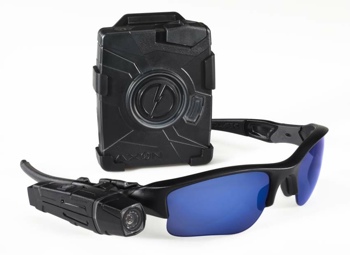
In 2012, Taser began selling its most advanced body camera, the Axon Flex, which can be clipped to an officer’s sunglasses, hat, helmet or epaulets. The Flex, which sells for $599 a unit, captures a wide-angle view that is close to what an officer sees while on patrol. Other cameras, including those made by Vievu, Taser’s largest competitor, clip to an officer’s shirt or belt. Because on-body cameras also capture high-fidelity audio, watching their videos offers a strangely intimate view of police work, as if you’re playing a video game.

Throughout an officer’s shift, Taser’s camera is constantly recording what it sees. But most of its images are kept in a 30-second buffer, after which they’re discarded. The unit begins saving longer segments of video — and begins capturing audio — only when an officer double-taps a control switch.

The 30-second buffer is a way of allowing officers to essentially record events that began in the past. “Say the officer sees someone run a red light — obviously the officer didn’t know that was going to happen,” Mr. Smith said. “But once he starts recording, we go back and grab that 30 seconds before that.”

The buffer includes just video, not audio, which is saved after the officer hits Record. The video-only buffer is meant to protect officers’ privacy.

Taser’s Axon cameras are paired with the company’s online storage service, Evidence.com, for which police departments pay a monthly fee of $15 to $55 per officer, depending on how much storage space they use.

At the end of each shift, an officer plugs the camera into a charging dock, and all videos are uploaded to Evidence.com. Police departments determine how long videos are retained; often retention times are related to the statute of limitations for the episodes the videos depict. Departments also set policies on who can watch the videos, and Evidence.com keeps an audit trail of all views.
Here's an example of what I was talking about: Not only is Taser charging a substantial sum for the camera itself, the per-officer fee generates ongoing revenue over time. Most corrections oriented "wearables" share that trait, which is why I think we'll continue to see greater market growth there in the near term than in the much-more ballyhooed wearable-tech fashion field. Many wearable apps struggle to find useful things or interesting things to do with data they generate, while corrections folks know what to do with data about their subjects - whether it's video, their location, blood-alcohol levels, etc. - and exhibit a voracious appetite for it.

In related news, Houston police chief Charles McLelland asked city hall this week "for $8 million to equip 3,500 police officers over three years with small body cameras to record encounters between law enforcement and residents as a way of improving accountability and transparency," reported the Houston Chronicle (Aug. 28). HPD had piloted the idea with 100 officers and now wants to take it department-wide.
Capt. Mike Skillern, who heads HPD's gang unit and is involved in testing the cameras, said his fellow officers act "a little more professionally" when wearing the devices.

A recent Cambridge University study of the small police department in Rialto, Calif. reported a more than 50 percent reduction of use of force incidents with officers wearing cameras and an 89 percent decline in the number of complaints against officers during the yearlong trial. 
See also a recent blog post from Paul Cassell at the Volokh Conspiracy favoring police body cams and a report published this year (pdf) sponsored by the US Department of Justice assessing research so far on their use in the field. (It concludes with a call for more research, finding that "Most of the claims made by advocates and critics of the technology remain untested.") MORE: From Ars Technica.

Friday, August 01, 2014

Wearable tech and the corrections market

GPS ankle monitor: Looks uncomfortable
Lately, your correspondent has been fiddling in my spare time with a hobbyist-level wearable technology project involving a couple of cheap sensors (which soon will be) wired into a pair of gloves to generate beats, tones, and lights. In the process, I've become more familiar with the state of wearable technology, even attending a Austin techie meetup on the topic a few weeks back.

It's not hard to imagine useful implications in different industries for wearable tech, but as a distinct consumer market, many observers view the field as a disappointment. The Guardian recently asked, "Wearable technology hasn't taken off the way it was expected to - why not?" A few serious, local startups are working on exercise or health-related wearable apps, but consumers haven't bitten beyond a few kids in light-up tennis shoes or cheap club gear. At this point, your refrigerator and thermostat are more likely to talk to your computer than your clothes.

What you don't see in any of the business tech press about wearables are analyses of wearable tech in the law enforcement and corrections industries, though that may be their biggest field of success so far. The use of GPS trackers on probationers and pretrial defendants out on bail has become so ubiquitous that larger departments suffer from data overload. In treatment courts, but also in some jurisdictions for regular DWI probationers, so-called SCRAM technology - an anklet with a sensor that measures alcohol in one's perspiration - are so popular that Texas courts can't afford nearly all of them that judges would like to use. (I'm waiting for the day probationers' anklet can talk to them; the tech already exists.)

Awkward police 'body cam'
Setting aside community supervision issues, police officers today are ever-more frequently decked out with body mics and cameras, a market that Taser International leads almost by default. Police today often make traffic stops in state of the art body armor, boasting an array of gadgetry around their belts that remind one of Batman. To the extent that routine tech can be incorporated seamlessly into something the officer is wearing anyway - especially tech that can transmit useful data back to a supervisor in real time - there's a significant law-enforcement market to be had.

For quite some time, cops and crooks arguably have been the biggest markets for "wearable tech," even if it's seldom discussed in that frame. That will remain true for the near future, with much room for expansion in that market in the near term. There's even a (perhaps overly optimistic) argument to be made that wearable corrections tech could "make it possible to replace the system of large-scale imprisonment," that manufacturers in that market contribute to progressive de-incarceration goals.

I'd love to see a company like Adafruit take on wearable tech for law enforcement - somebody that cares if the product is ugly, if it's elegant, well-designed, comfortable, if it works as advertised. If Adafruit started re-imagining police body cams and alcohol sensors for probationers, IMO they'd leave Taser and SCRAM in the dust. Those folks have forgotten more about wearable tech than the other two companies likely know.

The wearable market so far has pigeon-holed itself largely into areas - exercise and health - where people themselves use generated data, or fashion, where sensor data may trigger an accessory but not necessarily a paper trail. In corrections fields, though, it's police management, probation officers, or pretrial services divisions that make use of the data, not the wearer themselves. Those sorts of institutional customers with significant baseline demand constitute a captive market, if you'll pardon the pun. While it may seem distasteful to design technologies of control, it's better if highly skilled engineers sensitive to the wearers' experience create this tech. Either way, somebody's going to profit from it. Bet on that.

Zocalo, Mexico City, a great place for light-up garb at night
BTW, I do think there's an untapped market for a lot of the light-up or sound-generating wearable stuff for youth, but a lot of those items come relatively cheap from China and suffer from low margins. The more significant profit potential comes when you can find ongoing, real-world uses for wearable-generated data, which is why Grits foresees big profits for wearables in the corrections market.

AN ASIDE: Just for fun, we took some light-up garb with us to Mexico City to the zocalo after dark: The granddaughter's hoodie with EL Wire stitched around the edges, a few dozen small glow sticks, a couple of balloons with flashing RGB LEDs inside them, and three battery operated EL Wire strands long enough to use as a jump rope, one of which ended up lining a hat. Folks approached in gaggles wanting to buy one or the other of the light-up goodies, with somebody offering five times for a strand of EL Wire what I'd paid for it. We gave away glow-stick bracelets to the kids and referred would-be customers to the websites where I'd bought them. (This was a great way to meet families with kids, btw.) When it was bed time, the young'un gave away the balloons with flashing LEDs to a couple of little girls in the square and distributed the last of the glowsticks to a passel of teenagers before she turned, hoodie flashing, and we walked back through the seemingly ever-present multitude to our hotel. SEE MORE from a kid-centric vacation here.

Friday, January 15, 2010

Confronting SCRAM

With the US Supreme Court this week revisiting at oral argument the question of requiring confrontation at trial for lab reports (i.e., giving the defense the right to cross-examine the lab worker), I found this anecdote from DA Confidential a particularly compelling example of why the right to vigorously question forensic evidence is important, regardless of complaints about "inefficiency" and cost. The case involved a defendant required to wear a SCRAM device, which is an anklet commonly used for DWI probationers that purportedly monitors blood alcohol levels. As DA Confidential tells it:
Where was I? Ah yes, the gentleman wearing a Scram. I'll call him Mr. Smith. So his bond was revoked and he was put back in jail when his Scram showed he'd been drinking just before Christmas. He told his lawyer (a young man I checked with today, and who was too modest to allow me to use his name, so I'll call him Mr. Jones*) that he'd not been drinking. Insisted, in fact, that he'd not been drinking. So, doing his duty, Mr. Jones went before the judge and tried to explain that there'd been a mistake. So the judge, wanting to be fair, had the people responsible for the Scram come into court.

They showed him their proof, a print out of a black-and-white graph.

On that graph were two lines, one showing whether the Scram had been tampered with, one showing whether Mr. Smith had been drinking. Both lines spiked. Thank you Scram people, Mr. Smith stays in jail.

But Mr. Jones wasn't satisfied. Presumably because his client was less than satisfied and, oddly in the face of technical and scientific evidence, still claimed to have been at work and not drinking.

So Mr. Jones went back to the Scram office and obtained another copy of the graph. But he made to sure to get a print out in color, not just a photocopy. Lo and behold, the color graph contained three lines (as opposed to two), each a different color:
  • one showing whether Mr. Smith used alcohol
  • one showing whether Mr. Smith tampered with the Scram
  • one showing Mr. Smith's body temperature
The spikes were in the bottom two lines, the ones showing body temp and tampering. The line showing his alcohol use was a flat-line at the bottom of the graph, and had been mistaken by everyone as the baseline, the line you'd draw at the bottom of every graph.

Ooops. Mr. Smith had not, it was now clear, used alcohol.

But that still left the tampering spike. Well, the ever-diligent Mr. Jones obtained the second page of the Scram report, which showed examples of spikes when the Scram had aluminum shoved under it, a wet cloth stuck under it, and when a sock got stuck under it.

Guess which it was? Right, the sock.

Finally, Mr. Jones obtained proof from Mr. Smith's employer that he'd been at work when he said he had. Even better, the hours he'd been at work were almost exactly the hours his sock had messed with the Scram.

Result: the judge commended the defense lawyer on his excellent work and politely requested the presence of the Scram people. I was not privy to all of what he said to them but I do know that they accepted responsibility for the mistake and it, hopefully, won't happen again.
As our correspondent notes, that was an especially fine piece of lawyering by a fellow later identified as Matt Dorsen, who works for lawyer Steve Lee. But the questions raised by the example have broader implications than just for this single defendant.

In how many previous cases, one wonders, have SCRAM employees misinterpreted a black and white graph to falsely accuse someone in court? How often has their word been taken over a defendant's, even in the face of adamant denials? Probably quite regularly. That's clearly what was happening here before the defense attorney's exceptional efforts. Will anyone now go back and look to see if something similar might have happened in past cases? No way. The judge just gave company officials a good talking to in private and the county will continue to use the device.

Cases like this show why, even when mistakes are discovered, we can't necessarily rely on judges or prosecutors to vet such forensic technologies properly - they don't have the knowledge or resources to do so and must rely on others to ensure they're not making decisions based on junk science. After all, as Williamson DA John Bradley pointed out to the House Criminal Jurisprudence Committee earlier this week, the reason they all went to law school is that they weren't any good at math or science.

That's why there must be an explicit right to confront forensic evidence and those who come up with it at the level of detail exhibited here, or else an affidavit purporting to interpret evidence becomes precisely as credible as the piece of paper which reads only "Trust us, we're the government." Misreading the graph because somebody was too cheap to use a color printer sounds like a segment out of Reno 911!, except this was a real defendant who a Travis County court tossed in jail over the error. I hope the guy didn't lose his job.

This SCRAM device, in particular, may not be ready for prime time, according to a recent story at The Crime Report:
many everyday products, such as hairspray and household cleaners, contain a type of alcohol that is detected by the bracelets. Exposure to large amounts of those products could trigger the monitor, leading some critics to charge that they produce false positives. Failing a test can mean being sent to jail.

“The problem is distinguishing the alcohol,” said Michael Hlastala, a professor of physiology at the University of Washington who has testified in several court hearings against the accuracy of SCRAM. “They don’t have a good way of separating out interference from drinking alcohol.”

“The device went to market before adequate scientific work was done. There are problems that have not yet been addressed experimentally,” he said.

Courts have yet to seriously address the reliability of SCRAM technology, according to The Crime Report:

Though the devices are widely used, it appears only a handful of cases have called their reliability into question. Kenneth Cooper claims in a lawsuit that he was jailed for 17 days in Henderson, Nev., based on several erroneous readings from his SCRAM monitor, which he was forced to wear after he pleaded no contest to driving under the influence. His attorney, James Dilbeck, said the time it takes for AMS to receive the data and contact law enforcement prevents wearers from effectively challenging what may be false reports.

“It sends a silent signal, and then a few days later someone comes and picks you up. By then you have no way to defend yourself other than your word,” he said. “This is an unregulated service, and judges are taking as gospel what these things report. And you cannot defend yourself. I think its garbage.”

Outside the courtroom, says Crime Report, "SCRAM has not been widely tested in independent, peer-reviewed studies. But in the testing that has been done so far, the devices have received mostly positive marks."

I don't know enough about the technology to assess its accuracy, but the story from Mr. DA Confidential doesn't inspire confidence. It does make me confident, though, that SCOTUS decided the Melendez-Diaz case properly last year when they found that defendants had the right to cross-examine lab workers whose reports are presented as evidence at trial. Without that right, in this instance Mr. Dorsen's client would still be sitting in the Travis County Jail based on a clumsy (and perhaps common) forensic error.