Showing posts with label Probation. Show all posts

Tuesday, November 05, 2019

Oklahoma! (does #cjreform); HPD raid response doesn't address phony informant; why do probationers die at high rates? And other stories

Here are a few browser clearing odds and ends:

One out of 8 Travis County jail bookings in 2018 was for Class C misdemeanors
In Travis County last year, more than 5,000 people were arrested for a Class-C misdemeanor only - about one out of every eight people booked into the county jail. Between the Freedom Cities ordinance restricting Class C arrests, beginning in January, and the elimination in June of the local no-sit-no-lie ordinance aimed at the homeless, those bookings should decline significantly for 2019.

Post-raid HPD reforms don't address faked informant that got 4 officers shot and killed 2 innocent people
After a no-knock drug raid in Houston this spring killed two innocent people and left four officers shot, HPD Chief Art Acevedo has announced he's creating a special division of the narcotics unit to execute search warrants in drug cases. But as I told the Houston Chronicle:
“His reform is not on point to what caused the problem,” said Scott Henson, policy director with the criminal justice reform nonprofit Just Liberty. “It’s not solving the problem that your investigators are relying on fabricated informants — [it] wasn’t a function of who’s doing the raid, but why you’re doing the raid, and the reliance on this informant, who it turns out didn’t exist. That’s what caused everybody to get shot. It just elides the core issue of what really happened.”
Attacking junk blood-spatter evidence
Check out an amicus brief arguing to disallow blood-spatter evidence in the Joe Bryan murder case that was the subject of Pam Colloff's massive NY Times Magazine/Pro Publica feature. In it, Duke law-school faculty and students argue that, based on current standards, the blood-spatter expert in Bryan's case could not today testify to the main points used to convict him.

Not so natural after all
His death in the Victoria County Jail was attributed to "natural causes." It turns out, he was denied his methadone prescription and died from preventable withdrawal symptoms. Read the excellent Victoria Advocate account from Kali Venable. See also the Advocate editorial board's condemnation of using jails and prisons to treat addiction.

"Power concedes nothing without a demand ..."
"... it never has, and it never will," said Frederick Douglass. So Grits doesn't feel too bad that elected officials in Austin consider criminal-justice reformers excessively pushy, as several implied in this Austin Statesman article about a string of successful, capital-city #cjreform campaigns. Nobody was going to do any of those things if reformers said "Pretty please" and then waited politely for a response.

Own it!
Gov. Greg Abbott's intervention into Austin's homelessness crisis means he now owns the issue. If it isn't solved, it's his fault. Not sure that was the wisest political choice, but it's the one he made. MORE: Now the governor "owns" his own homeless encampment, with neither a budget line item nor any apparent exit plan besides providing still hypothetical services to Austin's homeless ad infinitum. That'll teach 'em! 

Why do probationers die at high rates?
Here's a possible, future, Suspicious Mysteries segment for the Reasonably Suspicious podcast: Grits has long been aware of research showing incarceration in prison reduces life expectancy. But a new study shows that being on probation is associated with a much higher morbidity rate than being in prison or jail, much less in the free world. I don't know how to parse these competing claims. One one hand, while prison healthcare isn't great, being in prison makes it easier to treat chronic conditions because the patient is always available and can't easily decline treatment. On the other, prison can make you sick; e.g., people who contract Hep C in prison  may suffer liver failure later, once they're out. Meanwhile, to the extent criminal laws in general target the poor, the developmentally disabled, substance abusers, the mentally ill, minority communities subject to discrimination, etc., it's not surprising probationers would be an especially sick lot. Or maybe the difference is that people in prison aren't at risk of dying from car crashes! Who knows? Grits would like to better understand this nexus of corrections, health, and morbidity rates. I haven't yet wrapped my head around it. When people die in prison or jail, there is an independent investigation; no one investigates when probationers die, so outside of the above-linked study, we don't have very much information at all regarding why that is.

The Probation Trap
Probation as an institution changes its form and purpose depending on the angle from which one looks at it. Viewed one way, it diverts people from prison. Viewed another, it's a net-widening trap. The Philadelphia Inquirer has published an excellent series expounding the latter view. Via SL&P.

Oklahoma!
As much as it pains me to say so, Oklahoma has now definitely out-paced Texas as the red-state poster child for criminal-justice reform. Also via SL&P:
On the ground, #cjreform is not really a red-state-blue-state issue.

When smelling pot is pretext for a search
In Philadelphia, police officers who said they searched a car because they smelled marijuana were extremely unlikely to find any and disproportionately searched black people. When the data was gathered, public defenders argued that "the odor of marijuana [should] no longer be considered probable cause for officers to believe a crime has occurred and conduct a search."

Breathalyzer tests as junk science
The New York Times took a trip down the rabbit hole of DWI breath-test forensics. Like DNA mixture software, analysts treat breathalyzers as a magical black box they simply assume supplies reliable results. The problems, however, have been long known.

'Five facts about crime in the U.S.'
Read this from the Pew Research Center.

Tuesday, October 01, 2019

Humpty Dumpty, the Castle Doctrine, and other stories

Here are a few odds and ends that merit Grits readers' attention:

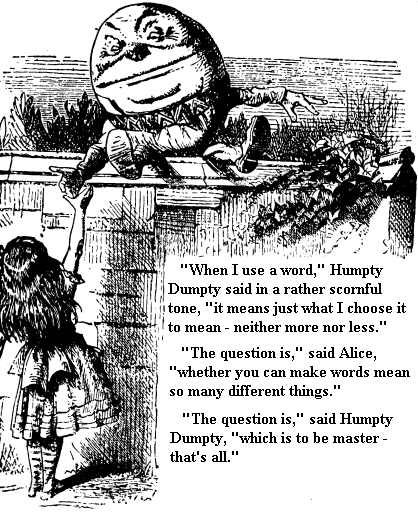
Humpty Dumpty and the Castle Doctrine
The judge in former Dallas police officer Amber Guyger's murder trial for the shooting of Botham Jean gave the jury instructions on the Castle Doctrine defense, despite the fact that Guyger entered Jean's home and shot him, and wasn't defending her "castle." Her lawyers employed this argument as their primary defense (that it wasn't her home was a "mistake of fact," they said) so the judge had no choice but to address it, but Humpty Dumpty would be proud! The claim didn't help Guyger, however. She was convicted, anyway. UPDATE: Guyger was sentenced to ten years.

Death of trailblazing deputy raises difficult, familiar questions
The tragic shooting death of a Harris County Sheriff's deputy - a trail blazing figure who was the first Sikh to work in Harris County law enforcement - raises familiar questions with no satisfying answers. The alleged killer is a severely schizophrenic parolee who had gone off his meds and heard voices telling him to kill people. Is the criminal-justice system the best way to deal with people whose offenses are rooted in severe mental illness? How did this convicted felon and parolee get a firearm? He already was the subject of a warrant for violating his parole, should more resources be allocated to search for high-risk parole violators? His family had told officials he was dangerous and off his meds: Are there "red flag" laws that could have allowed them to act sooner? The circumstances surrounding this awful episode will provide fodder for these and many other debates in coming years. The public dialogue would have been easier, in a sense, if this had turned out to be a hate crime. The issues surrounding mental illness and the politics of gun proliferation are much more complex and difficult to deal with.

Private jail operator keeps screwing up
At the Liberty County Jail, which is operated by the Geo Group, "In the last 60 days, there have been two felony escapes, one of their correctional officers was arrested for stealing from inmates while on duty, and most recently, there are questions surrounding the death of a prisoner who hanged himself while in their custody. Apart from those instances, they have also flunked two jail inspections this year, one on April 22 and the second on June 28," the Houston Chronicle reported. Local officials are considering whether to terminate ties with the private prison contractor.

The economics of high probation fees
Check out a new article from our friend Todd Jermstad, probation director in Bell County, on the history and future of court-imposed fees at Texas probation departments. Especially interesting was his thesis that policymakers should take into account reduced means of Gen X and Millenial defendants, whose economic prospects remain less robust than earlier generations. Grits may delve more deeply into this soon, but for now, here's the link.

Bail litigation roundup
See a write-up from The Appeal of recent bail-litigation news, including from Houston and Galveston. See also related Grits coverage and our discussion of the topic in Just Liberty's most recent Reasonably Suspicious podcast.

Over friggin' pot?
In Hutto, a police officer responding to a call that someone was smoking marijuana beat up a man in his driveway and made false accusations in official documents to justify it. The victim had no marijuana in his possession, and bodycam video proved the cop was lying about the victim pushing the officer before he was attacked. The officer was fired, was indicted in May, and the victim has filed a civil rights suit, reported KXAN-TV.

Homelessness problems and solutions
In the wake of Austin's tendentious debate over homeless policy, I was interested to see this excellent New Republic article on "housing insecurity in the nation's richest cities." When, in the 1990s, my wife and I could rent a dilapidated three-bedroom house in East Austin for $190, homelessness wasn't such a big problem. Now that rents in my neighborhood for similar homes approach $3k per month, it's little wonder more people are on the streets. Meanwhile, Bloomberg News had an informative piece a couple of months back on how Finland all but eliminated people sleeping on the streets by investing in preventive strategies like rent subsidies.

How police misconduct gets covered up by plea bargaining
Here's an excellent analysis from Brooklyn public defender Scott Hechinger of how mandatory minimums and the threat of long sentences help cover up police misconduct that would otherwise come out in court. That's because "victims of police abuse — illegal stops and frisks, car stops and searches, home raids, manufactured charges and excessive force — routinely forgo their constitutional right to challenge police abuse in a pretrial hearing in exchange for plea deals." This is undeniably true. It's only in cases like the episode in Hutto, described above, where victims face no charges that officers can be held accountable through regular court processes.

Financial motive not only reason prosecutors oppose actual-innocence claims
The New York Times published a feature on falsely convicted people who've been exonerated by the evidence but cannot secure an "actual innocence" ruling because prosecutors fear the financial consequences of civil rights lawsuits against local jurisdictions. All of the examples are from other states, but Texas' situation casts additional light on this topic. I was policy director at the Innocence Project of Texas when the Legislature passed the best-in-the-nation compensation package for exonerees in 2009. We hoped to avoid this dynamic by having the state compensate innocent convicts instead of the locals. Indeed, the bill was sold as a form of "tort reform," eliminating local liability for what were seen as systemic flaws causing false convictions. But it turned out, the real, underlying complaints weren't financial. Many prosecutors and some judges on the Court of Criminal Appeals simply don't want to see falsely convicted people compensated, ever, and go to great lengths to oppose actual-innocence claims, despite the fact that locals weren't on the hook. So Grits is skeptical of the article's thesis that the motive behind opposing actual-innocence claims is financial. I think it's more pernicious than that.

Sheriffs and #cjreform
Our pal Jessica Pishko published a New York Times op ed on Sheriff's offices, declaring "The problem of sheriffs is particularly acute in the South and Southwest, where the office has more power and was historically used to prop up white supremacy." She calls for Sheriffs to undertake what amounts to a truth-and-reconciliation process for past wrongs. That sanguine suggestion to me seems unlikely. Texas alone has 254 counties, after all - a few might do that, under the right political circumstances, but most will not. And abolishing the office, as some have called for, doesn't change the fact that someone has to perform those functions. Grits has often thought that sheriffs' jail-management duties should be separated from their responsibilities to patrol unincorporated areas. These are distinct functions involving very different skill sets, and typically those elected to the office only have knowledge of one or the other. Whether Sheriffs should be an elected position is a question for another day.

Deep thinking on sex-offender policies
A recent NY Times piece examined emerging research on people who are sexually attracted to minors, finding that its roots are not genetic, but are "prenatal," and "can be traced to specific periods of development in the womb." And this Marshall Project story looks at evidence-based anti-recidivism programs aimed at people convicted of violent, sexual crimes once their sentence is complete. I found both articles to be thoughtful contributions to the discussion.

Most crime dropping nationally, but look at those rape numbers!
New Uniform Crime Report data is out, and most categories of crime have continued to fall, except rape, which has risen precipitously since 2014. See first-cut analyses from the Brennan Center and the Marshall Project. No one knows for sure what's behind the rise in rape numbers. The feds began using a more expansive definition of sexual assault in 2014, but the numbers increased even using the "legacy" definition. The question arises: Have there actually been more rapes committed over this period, or are we simply now getting a more complete picture of the scope of the problem in the wake of increased reporting thanks to the #MeToo movement? ¿Quien sabe? Regardless, the year-over-year decline in property crimes, murders, robberies, etc., is cause for celebration, while the sex-assault data should contribute to deeper conversations on the question.

Tuesday, August 27, 2019

Harris probation director clarifies case highlighted in Grits post

Last week, Grits posted an item about the Harris County probation department that included a critique of a Tweet touting a client who could now pay for a new child seat for her infant because she was rid of her probation fees. Theresa May, the director of the Harris County probation department, sent me an email clarifying some facts around that case. Although she expressly did not request a correction, I wanted to pass along her note for additional context:
Hello Scott! 
I hope all is well! I read your commentary on our post regarding one of our clients who was released early. 
As written, it was fair criticism and not something we would want to post as a pat on our back. Unfortunately, the summary of what happened with this client, as written, did not provide a clear picture of what actually occurred. Too many relevant facts and the context were not included. 
For what it’s worth, I did follow-up to look into the case as I had the same concerns you did when I read the post. In reviewing the case, the officer advocated for the DA’s office to release this client five months early (from a one year pre-trial diversion contract for a felony case) which would require agreement to waive all of the fees and community service hours for the entire pre-trial diversion and supervision of the case, not just the portion that would be granted automatically with early release. The client had not paid any fees to date for the pre-trial diversion case and had accrued a balance. It appears the officer felt the ADA would be more amenable to early release if the client completed one requirement, the Effective Decision Making Class and paid the class fee only. Reading the officer’s chrono entries, it appears the client’s parents helped her pay for the class and the client completed the class. It appears, the client’s parents were very supportive but the client struggled to be self-sufficient financially and struggled with her choices as well. The officer submitted the request for early release, noting the client completed the class and had made positive progress in making better choices. In turn, the ADA agreed to early release the client from the contract which discharged the entire balance the client had accrued. 
When the officer conveyed the message to the client that her case would be early released and that all fees accrued for the Pre-Trial case to date would be waived, the client told the officer she planned to use the money she no longer owed for the Pre-Trial case to purchase a better, more suitable car seat for her infant. During the course of her Pre-Trial Supervision, the officer worked with the client to make better choices, focusing on supporting and caring for her infant as opposed to going out with friends and using drugs. In reading the chronos, the officer clearly invested a lot of time working with this client one on one to help her learn to make healthier choices. The officer used EPICs skills (cognitive restructuring and reinforcement) and it appeared to pay off. The client made significant progress in making a deliberate choice to focus on caring for her infant rather than going out with friends and using drugs. This was a significant shift in this client’s lifestyle and choices that benefited both the client and her infant. Clearly, the officer was very happy to hear the client’s first thought was to purchase a better car seat for her infant as opposed to what may have occurred in the past. The officer requested early release for this client to reinforce the significant progress she made in her lifestyle by making better choices to the benefit of her and the infant.

The officers commonly advocate for early release for our clients if at all possible, so that is not the highlight of this story. This story was submitted by the officer’s supervisor because of the work the officer invested with this client and the progress the client made. Unfortunately, that point was completely lost in this post. 
Scott, I greatly appreciate the work you do in fighting for criminal justice reform and find your blog to always be fair. You were fighting before it became a major focus. We deserved the criticism in your blog based on what was written. I wanted to share this information with you out of great respect for all you do. There is no need to make any changes to the blog, please. We did not communicate clearly and earned the criticism. We are far from perfect and have a lot of work yet to do. I hope the day will come where we can change the way probation departments are funded to one that does not include reliance on fees. 
On a side note, I appreciate your insight as to how improvement in one aspect of the system has a positive impact on the rest…. That is an important take away from the Pre-Trial Diversion program and the RIC docket. 
Best wishes, 
Teresa May Ph.D.
Director
Harris County CSCD

Wednesday, August 21, 2019

Harris County probation department making big improvements, but it's still probation

As part of reforms implemented with its MacArthur grant, Harris County consolidated all of its state jail cases into one district-court docket called the "Responsive Intervention for Change (RIC) Docket." According to the Texas Comptroller:
Before the reforms, a disproportionate share of Texas' state jail felons (SJFs) were from Harris County — 26 percent in 2014, well in excess of the county's 16 percent share of the state's population. Five years later, its share of the total had declined by 90 percent, from 5,817 to 611. Harris County still sends more felons to state jail than any other county, but its overall share of the SJF population has fallen to 10 percent
The difference, May explains, is that the county has increased the number of defendants willing to accept probation through its RIC Docket, specialized caseloads (e.g., for substance abusers) and pre-trial diversion (PTD) programs offering mental healthcare, drug rehabilitation and work-release programs rather than prosecution. The county also significantly reduced the time defendants spend in jail awaiting trial, which greatly curtailed “good time” credit, removing the incentive to just sit idle or plead out to state jail, thereby reducing incarceration costs. 
"When defendants are not racking up a substantial amount of back time in jail awaiting disposition," May says, "they are more open to diversion or community supervision." 
Before their cases are decided, defendants' risk levels are assessed and their needs identified to target what's causing their criminal behaviors. The most common contributing factors, according to the CSCD, are attitude, peers, personality, family, education/employment, activities and substance abuse. 
On the back end, greater community supervision has helped to halve the re-arrest rate of the county's released SJFs, from more than 60 percent to less than 30 percent.
These are excellent outcomes and a great improvement over past practices. Grits finds particularly interesting the correlation between reduced pretrial detention and people's willingness to accept probation in a plea bargain. Reducing inefficiencies in one part of the system generated ancillary benefits in another.

Even so, there are moments when Harris County reminds us even the best probation departments are still doling out harm. This week, they tweeted out a success story of a woman named Sarah who completed probation and was released five-months early. HCCSCD praised her for having paid money to complete an "Effective Decision Making" class, then patted themselves on the back that, now that she has no fees, she can afford a new child's seat for her infant!

"How many people still paying fees are making similar tradeoffs to complete probation requirements?" Grits wondered aloud on Twitter. Certainly, more than a few.

The department's use of early release for successful probationers is commendable and deserving of praise, as is the new state-jail docket. But the perverse choices forced on this successful probationer - whether to pay for an "Effective Decision Making" class or a car seat for her infant daughter - are commonplace throughout the system. At this point, they're more a feature than a bug.

RELATED: From the state comptroller, "Texas state jails: Time for a reboot?"

Sunday, June 30, 2019

Judge abused discretion, violated due-process rights, by revoking probation w/o a hearing: Will he be sanctioned?

A misdemeanor DWI case out of San Antonio deserves broader attention, with interesting and important implications on several levels.

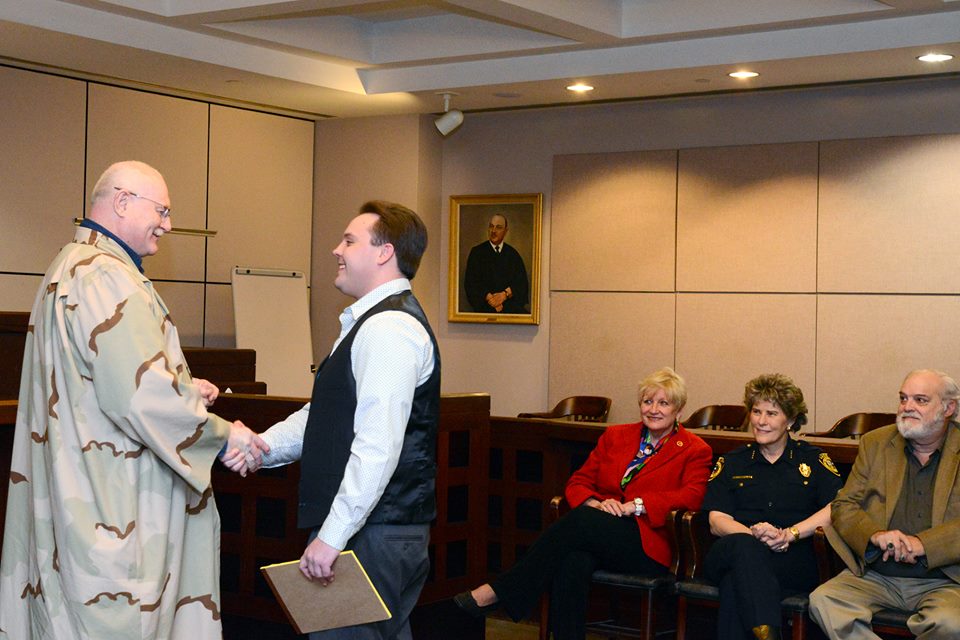
Wayne Christian - a Republican county-court-at-law judge in Bexar County first elected in 1996, who ran unopposed in the 2018 election - has routinely inserted himself on behalf of the state in lieu of county prosecutors in probation revocation cases, often refusing to allow testimony and deciding them with no evidence. But thanks to appellant Allison Jacobs, her attorneys, and perhaps most interestingly, new Bexar DA Joe Gonzalez, that practice will now be revisited.

Here's Judge Christian dressed in a camo robe. (source)
According to columnist Josh Brodesky of the SA Express News, Judge Christian's court "leads all County Court-at-Law judges in what’s known as MTRs - motions to revoke probation. He also leads other judges in jail bed days."

In Jacobs' case, she'd been a model probationer but failed three urinalysis tests toward the end of her 14-month probation period. Her attorney wanted to argue that this was a false positive caused by a diet pill she'd been taking, which long-time readers know is not an implausible scenario, particularly in Bexar County.

But Judge Christian refused to hold a hearing and based his decision to revoke on a brief conversation with the court liaison from the probation department. This violated Jacobs' due process rights, which should have entitled her to challenge evidence against her in a hearing before she's revoked to jail. But Christian went even further. Reported Brodesky:
Not only did Christian sentence her [to jail], but court records show he also denied her appeal for reasonable bail. He then modified a district court judge’s order of bail for $1,600 to make conditions more onerous. Another district judge lessened those conditions, and when Jacobs was finally released from the Bexar County Adult Detention Center in November, Christian responded. 
According to court filings: Upon release on bail, Jacobs was scheduled for a pretrial services orientation on Nov. 19, 2018. But Christian called pretrial services and had the orientation changed to Nov. 13, 2018. Pretrial services was unable to notify her about this change, so she missed the orientation. The next day Christian revoked her bail, issuing a warrant for an arrest. 
What gives? This is a defendant who was two weeks away from completing 14 months of probation for a serious, but misdemeanor charge. 
[Jacobs' attorney Jodi] Soyars said she likes Christian personally, and, obviously, has concerns about crossing him. She has other cases in his court. But she viewed this as representative of a broader issue and unfair to her client.
“He routinely denies defendants the right to due process,” she said.
So the judge routinely disallows prosecutors from participating in revocation decisions, acting himself on behalf of the state. And he doesn't allow a defendant to present evidence of possible actual innocence, simply declaring the allegations "true" by fiat without, as Soyars said in her brief, a "scintilla of evidence."

And it wasn't an isolated incident. Again from Brodesky: “There have been situations where our prosecutors have been placed in positions where they are not in agreement with going forward on a motion to revoke,” District Attorney Joe Gonzales said. “And they have made the decision to not sign off on the motions, and the judge has moved on them on his own.”

Let's delve into the secondary issue of denying the defendant bail while her appeal was litigated. The actions attributed to Judge Christian, who went out of his way to thwart the decision of a district judge in a habeas corpus writ, seem like extraordinary measures for a judge to take. The brief from Jacobs' attorney includes a footnote - which the DA's office corroborated (more on this later) - describing the remarkable sequence of events in more detail (citations to the record omitted):
While the appeal and motion for new trial procedures were taking place, some additional procedural issues arose and were dealt with, which are evident in the clerk’s record. A brief explanation to make sense of the clerk’s record follows: After a Notice of Appeal was filed, a Motion for Reasonable Bail Pending Appeal was also filed. . This is a misdemeanor case and bail was required to be granted. Judge Wayne Christian denied bail. An Application for Writ of Habeas Corpus Seeking Setting of Reasonable Bail was then filed and heard by District Court Judge Melisa Skinner in the 290th District Court. Judge Skinner granted the Writ and ordered bail of $1,600 and SCRAM as a condition. . The same day, Judge Christian called his clerk and added full GPS, daily reporting, and daily UAs as conditions of release, effectively changing the order of a District Court judge. A second Application for Writ of Habeas Corpus was then filed, requesting reasonable release conditions. Judge Joey Contreras in the 187th District Court set this Writ for a hearing on October 17, 2018. At the hearing, Judge Contreras granted reasonable conditions. After several weeks passed with Jacobs unable to meet the bail requirements, Judge Contreras amended his bond order to allow Jacobs a way to be released pending the appeal.  Jacobs was released from jail and given an orientation date of November 19, 2018 to report to pre-trial services. On November 13, 2018, Judge Christian called pre-trial services and ordered pre-trial services to require Jacobs to report on that date. Pre-trial services was unable to contact Jacobs and Jacobs had not yet had her orientation that would put her under the requirements of pre-trial supervision. Judge Christian then required pre-trial services to send over a violation report on November 14, 2018, whereupon Judge Christian revoked her bail and issued a warrant. Judge Contreras again intervened and reinstated Jacobs’ bail on November 16, 2018.
This conduct to my mind, deserves public censure if not ouster by the State Commission on Judicial Conduct. And indeed, in its opinion, the 4th Court of Appeals called Christian's actions an example of "an unsuitable practice by a county court at law judge."

All of this is remarkable, and more than a bit concerning. Judge Christian seems intent on ignoring the mandates of his job and substituting his own judgments for the process. In doing so, he's also increasing incarceration - keep in mind he has the highest numbers of all Bexar-county-court-at-law judges on both revocations and resulting jail-bed days.

But perhaps the most remarkable aspect of the case was the fact that District Attorney Joe Gonzales joined with defense counsel to dispute Christian's "unsuitable" practices, which apparently had been tolerated by his predecessors without contest for many years. 

One aspect of electing reform-minded prosecutors Grits had not fully considered (or perhaps more accurately, had not dared dream possible) is that they could challenge unconstitutional court practices from the inside, or join those challenges, as happened here. So kudos to Gonzalez for his stance here, that's a big deal!

Prosecutors' role should be to "seek justice." But too often, they see themselves as on a side, and it's the opposite side from the defendant. So when the judge plays prosecutor as well, as is the practice in Judge Christian's court, defendants without means to pay a phalanx of private lawyers have little chance.

Finally, Grits was interested in the Express-News' analysis that Christian leads all other Bexar judges in motions to revoke. How do we know? That's something tracked in state-level court data, but totals are only available in Office of Court Administration queries at the county-wide level.

Grits doesn't immediately know the data source from which Brodesky identified the number of probation revocations by court. (If any readers know how to access this data from public sources, please let us know in the comments.) But that's a useful figure because, as regular readers are aware, probation revocations are a significant cause of Texas prison admissions, and revoked misdemeanor probationers go to county jail, contributing to local costs. 

So, to summarize, here are the implications and questions Grits would take away from this episode (feel free to suggest more in the comments):
  1. A judge for years felt free to ignore his duties to hold probation-revocation hearings and neither local defense attorneys nor the DA's office called him on it. Is this happening elsewhere?
  2. Will the State Commission on Judicial Conduct sanction Judge Christian?
  3. Does this flagrant disregard for judicial duties rise to the level of the state bar challenging Christian's licensure?
  4. Will media in other jurisdictions begin analyzing which judges have the most probation revocations and hold them accountable for successes/abuses?
  5. An under-examined aspect of evaluating "progressive" prosecutors will be how they respond to appeals challenging unconstitutional practices and other reform litigation. People have discussed this in the context of bail reform, but Jacobs case shows there are potentially many more areas where this could become important.  
This is quite a significant case, I think, certainly for San Antonio, and potentially exposing an area where judges may be abusing their discretion in other jurisdictions as well, if reporters and advocates were to look. The pressures on ADAs and defense counsel to acquiesce in judges' abuses for the sake of other cases certainly aren't unique to Bexar County.

Monday, June 24, 2019

Why revocations from probation and parole make up nearly half of Texas prison admissions and what to do about it

Two recent reports on supervising people in the community post-conviction deserve Grits readers' attention:

From the Texas Public Policy Foundation, Marc Levin has a 10-point agenda on parole that's more aggressive than any decarceration proposal that conservative group has promoted before.

Meanwhile, the Council of State Governments issued an analysis of the proportion of prison admissions related to revoked probation and parole terms.

Let's look at the CSG report first, since it provides the lay of the land. They have state-specific pages for each jurisdiction; here's the one for Texas.

By their calculations, 47 percent of people entering Texas prisons in 2017 were revoked either from probation or parole - 36 percent from probation, 11 percent from parole.

My first thought was to double-check their math, so here's my calculations using verifiable, public sourcing.

In Texas, according to an annual TDCJ report to the legislature, probation revocations to prison in FY 2017 totaled 23,101; of that, 11,522 were for technical violations.

In FY 2017, according to the Board of Pardons and Paroles' Annual Statistical Report, 6,555 parolees were revoked; of those, 1,043 were for technical violations.

Combined, that's 29,656 people revoked from probation and parole combined in 2017; 12,565 of those were for technical violations only.

TDCJ admitted 65,278 total people that year, according to the TDCJ Annual Statistical Report.

So, by my math, that's 45% of TDCJ admissions from probation and parole revocations, not 47%, with 19% coming from technical violations alone. (According to their methodology appendix, they had trouble coming up with data on technical probation violations, which may account for some of the disparity.)

But that's nitpicking. The authors' point was to demonstrate that nearly half of prison admissions arise from supervision revocations, not new convictions. That is certainly true, which brings us to Marc Levin's TPPF policy brief on parole.

Whereas CSG aimed to identify the scope of the problem, Levin proposes reforms to reduce unnecessary supervision and revocations.

In Mr. Levin's ideal world, prisons would begin planning for reentry soon after a person is incarcerated and make sure all necessary treatment and programming has been completed by the time they're first eligible for parole. Moreover, he would have the parole board mainly assess risk to the public going forward, emphasizing behavior while in prison and participation in programming. By contrast, in Texas, one of the most common reasons for denial of parole is "nature of the offense," which cannot ever change.

He touts a Michigan statute, in particular, which limits the reasons parole can be denied to 11, mostly public-safety oriented items. (The references in this document are a treasure trove.)

Levin wants to ensure parole conditions are manageable and adjusted based on risk level, with lower-risk people receiving less supervision. He wants prisoners to get credit for "earned time," which in Texas is optional for the parole board to recognize (this provides scant incentive for program participation, cooperation on work details, etc.). He would reduce barriers to employment for parolees and stop the use of regressive zoning practices to restrict where parolees can live. (January Advisors just did a major analysis on this topic focused on Houston.)

Levin wants to alter how parole officers are evaluated, focusing on recidivism reduction. And finally, he wants some reentry duties currently performed by the justice system to be performed by nonprofits and other entities, which incidentally is what happened recently in Colorado with its community reinvestment program.

I'm glad to see people thinking more deeply both about how to measure the community-supervision elements of mass incarceration as well as how to better utilize those tools for reducing prison populations and preventing recidivism. Taken together, these two documents reaffirm many of the findings in an analysis published last year from the Columbia University Justice Lab titled, "Too Big to Succeed" (which also has informative footnotes), that gave recommendations for cutting the size of community corrections systems in half.

Friday, January 11, 2019

In praise of pretrial-detention algorithms, the 'failure to appear fallacy,' Louisiana ↓ technical revocations, and other stories

Several national items merit Grits readers' attention here during the calm before the 86th Texas Legislature storm.

Debtors-prison reform: Economic populism and the justice system
The New York Times this week published a lengthy, excellent feature on how criminal fines and fees oppress the poor. Good analysis and background.

Best evidence supports use of risk assessments in pretrial release decisions
Some prominent heavyweight corrections researchers responded to criticisms in the press, not to mention by left-wing advocacy groups (I'm talking to you, ACLU of Texas), of risk-assessment algorithms used to aid pretrial detention decisions. One of the authors, Jennifer Skeem, has presented to Texas probation audiences, and is someone whose research Grits has relied on for years. Everyone concerned with the use of risk assessments in pretrial release determination should read this 20-page analysis. They show that the best evidence available - taking into account all the available studies about what works - supports use of risk assessments, which generate better safety outcomes and less unfairness than judges flying by the seat of their pants. The authors document consistent research-based findings that a structured decision making process, in which judges formally take pretrial risk assessments into account, produces the best results. If you care about bail reform, read this. Their analysis more or less coincides with Grits' views, perhaps because mine are to a significant degree influenced by Skeem's scholarship: Racial disparities created by validated risk assessments in pretrial detention decisions (the analysis differs for sentencing, predictive policing, and other risk-assessment uses) are measurably less problematic than disparities and injustices such assessments prevent.

The Failure to Appear Fallacy
A lot goes in to Failure To Appear (FTA) rates, and this extensive article from The Appeal offers one of the the more nuanced looks you'll see on the topic, including a detailed description of how judges in Harris County - most of whom were ousted in the last election cycle - sabotaged bail reform in an effort to artificially drive up FTA rates and use them as a "political football." Excellent background for bail reformers.

Louisiana successfully decreased technical-probation revocations; why can't Texas?
After the Texas Legislature created Intermediate Sanctions Facilities as part of the state's widely lauded 2007 probation reforms, the parole system was able to radically reduce the number of people sent to prison for technical violations. However, the probation system could never accomplish it: half of revoked probationers in Texas were sent away for technical violations, not because they committed a new crime. So I was interested to see the Pew Charitable Trusts researching causes for a big reduction in technical probation violations in Louisiana. The Bayou State was able to reduce the amount of time revoked probationers were incarcerated, reduce the number of revocations for new crimes (read: reduce crime), and save millions of dollars in incarceration costs, Pew found. If they can do it, why can't Texas?

Prisons during shut down
The Marshall Project has the best coverage I've seen of the brutal effects on federal prisons from the government shut down. MORE: From the Washington Post.

Bail injustice worst case
For all of the flaws which may exist in Texas' pretrial-detention system, they're minimal compared to the Philippines, which is the only other nation in the world besides (some states in) the U.S. that uses wealth-based bail to determine pretrial detention. Money quote: “When you are detained in Philippine jails, you are being tortured.”

Friday, June 29, 2018

Should the government give high-risk offenders gaming systems to reduce crime?

Regular readers will recall that Lt. Gov. Dan Patrick responded to the school shooting in Santa Fe by suggesting that Texas eliminate subsidies aimed at luring video game companies to the state. Grits responded by disputing the purported link between video-game violence and violent crime.

The more I think about it, though, I wonder if video games might be part of a solution to violent crime?

Here's an outside-the-box (but not the Xbox) suggestion for reducing crime that's cheaper than incarceration and gives authorities a better tool to help offenders comply with probation: Give young people at high risk of committing serious crimes gaming systems as part of probation terms and make taking them away a punishment for violating conditions.

Several different strands of thought led me to this idea, which I've not seen proposed elsewhere.

In recent years, we've seen pilot programs where law enforcement identified the people at the highest risk of committing violent crime and simply paid them not to. And it seems to work! Some of the methods for identifying the most high-risk folk can be pretty sophisticated.

At the same time, we've seen studies showing that youth playing violent video games (or really, any video games) tend to commit less crime because of the voluntary incapacitation effect: The kid playing Grand Theft Auto for hours doesn't have time to be out stealing my car.

(On Twitter, John Pfaff recently pointed to a paper showing a similar voluntary incapacitation effect related to violent movies.)

My personal belief is that the rise of video games and online entertainment caused a much greater proportion of the crime decline witnessed in the past quarter century than most observers have considered.

Young males through about their mid-to-late twenties are the highest risk population group for committing crime. This is also the group with whom video games are most popular.

So what if we combined these observations to create a correctional strategy? What if high-risk young male offenders on probation were given a PlayStation or Xbox and a few popular games when they went on supervision, and allowed to keep the equipment if they successfully completed their probation term?

I see several benefits:

1) The incapacitation effect: The more time these youth spend playing video games, the less likelihood they'll get into trouble.

2) Incentive for good behavior: Just like payment is a positive incentive not to commit crime in the pilot programs described above, access to a video game station is a significant incentive not break the law or violate probation rules, as well as to complete probation.

3) Tool to address rules violations: Similarly, taking access to the video game system away is a significant additional negative incentive, a tool that could be used to punish technical non-compliance (half of all revocations to prison from probation in Texas are for technical violations).

4) Economics: Gaming systems are cheaper than paying a monthly stipend, as in the above-cited examples, and the project could be scaled up more easily.

The complaint would come from people who say, "My kids don't have a Playstation, why should the government buy one for criminals?" But since the answer is so firmly rooted in public-safety goals - particularly if the tactic were reserved for the most serious, high-risk probationers - IMO it could be justified. We spend a lot of money already on these high-risk populations.

The same parental controls that keep young kids from accessing inappropriate stuff could be used to limit improper use of the system (contacting victims, etc.), and of course improper use could be punished by taking it away.

IMO this could reduce crime among the population eligible for the program and make it easier to get people to comply with their probation terms. The cost of each system is significant (~$300 + games), but a lot less than incarceration, and I bet under such circumstances the state could get a bulk-purchase discount.

This is a brainstorming post, not a fully formed policy suggestion. But as cost-effective public safety solutions go, this idea seems to check a lot of the boxes.

Monday, May 07, 2018

Plummeting probation numbers leave fewer Texans under corrections control than nationally

Grits recently calculated the ten-year change in rates for the proportion of adults under control of the correctional system in Texas from 2008 to 2018, defined as everyone in prison, in jail, on probation and on parole, comparing that total to the total adult population. Texas' rate of people under government-control was one-in-22 adults in '08, compared to one-in-41 in 2018.

Let's revisit the question after the Washington Post publishing a similar analysis using national data for the period 2006-2016. According to them "In 2016, 1 in 38 adults were under one of these forms of “correctional supervision”; 10 years earlier, the figure was 1 out of every 31."

By these lights, Texans overall are supervised in 2018 at slightly lower rates than the 2016 national average. That surprised me.

How could that be? Texas' prison population remains the largest in the country. And parole numbers grew slightly over this period (Texas releases nearly 70,000 inmates per year).

That means the big reductions have come on the probation rolls, and to a much lesser extent, at county jails. By the numbers:

In 2008, the total probation population in Texas, felony and misdemeanor, stood at 429,689, according to TDCJ's annual statistical report.  Earlier this year, a TDCJ legislative handout put the number at 232,278, representing an astonishing 46 percent reduction!

Jail numbers also declined, though far less dramatically. On March 1, 2008, the statewide jail population was 69,397. On March 1st of this year it was 64,537. So just a seven percent reduction, which was entirely offset by an increase in the number of parolees being supervised.

Notably, most of the change in probation numbers is relatively recent. After a step down in the total cohort of probationers following reform measures passed in 2007, their numbers remained relatively high: In 2016, according to TDCJ, the total number of felony and misdemeanor probationers was 374,980. So that's a 38 percent drop in the last two years!

Grits cannot explain the plummeting numbers from 2016 to 2018 - certainly I can't think of any change in state policy which would justify it - but the fact of it helps clarify many political dynamics surrounding decarceration reforms.

In recent years, the most vocal opponents of sentencing reform in Texas have been probation directors, who fear that shifting non-violent offenses from a felony to a misdemeanor will reduce their funding. That's because they receive more money for supervising felons than misdemeanants, and felony probation generally lasts longer.

But Grits had underestimated the extent to which probation departments were feeling the squeeze. They survive on probationer fees and a per-probationer stipend from the state. So reducing numbers means reducing revenue. If their probationer numbers really dropped 38 percent in two years, then so did their budgets. No wonder they're in a panic about their money!

This news doesn't justify probation directors' regressive stances, but it explains some of the self interest behind them. And perhaps it will help state leaders put probation directors' advocacy for tough drug penalties in context as more a plea for budget relief than for public safety.

MORE:

Theft reductions explain much of probation decline

On Twitter, Doug Smith from the Texas Criminal Justice Coalition offered this explanation for the reduction:
It's a decline in misdemeanor placements. Felony placements are up slightly 2016-2018. Over past 10 years, felony placements ↓ 8% and misdemeanors ↓ 25%. Index crime rate ↓ 29% over same period, so felony placements should be lower, but possession cases up 30%+.
Digging a little deeper, much of the decline in misdemeanor probation appears to stem from reductions in theft cases, a trend made more pronounced when the Legislature in 2015 adjusted property-theft thresholds to account for inflation. According to the Office of Court Administration's Annual Statistical Report for FY 2017, "The number of new misdemeanor theft cases filed [in FY '17] fell 28 percent from the previous year and was the lowest number filed in at least 30 years."

An accompanying chart (p. 27 of the pdf) showed misdemeanor theft charges maxxed out in Texas in 2004 at >120,000, but came in at less than a third of that (38,377) last year. By contrast, "The number of new misdemeanor drug cases filed [ed. note: almost all marijuana possession cases] increased 1 percent from the previous year, reaching a new peak in filings in this category."

In the five years ending in 2017, misdemeanor theft filings overall declined by 41 percent. This trend was led by a 76 percent reduction in "theft by check" charges. The theft-by-check part of that trend is technologically driven, but the decline in theft charges exceeds the amount which can be explained by that reduction. Texas has a larger population that's simply accused of stealing at much lower rates than in years past.

Notably, this has been a period when many types of petty criminal cases in Texas have dropped like a stone. The number of traffic and parking tickets issued, for example, maxxed out in 2006 at 12.1 million, declining more than 50 percent to 5.5 million last year. Non-traffic citations declined from 2.1 million to 1.1 million over the same stretch (p. 31 of the pdf).

Nobody has been able to fully explain that traffic-ticket drop, which occurred across agencies and jurisdictions, seemingly without any coordinated effort.

But other types of cases have fallen, too. The number of new juvenile cases of all types maxxed out in 2008 at just more than 53,000 and has fallen to 29,153 last year (p. 33 of the pdf). Led by a reduction in truancy-related cases following legislative reforms, all non-traffic categories of Class C tickets given to juveniles declined radically over the last five years.

So, as Doug described, Texas has just gone through an era when crime declined quite a lot, and the number of case filings - except for drug cases, which accounted for 32 percent of felony charges in 2017 and 21 percent of misdemeanors (p. 26 of the pdf) - has mostly gone down with it.

Grits' conclusion from these data: The failed War on Drugs is propping up mass incarceration in Texas. That's why Texas probation directors oppose right-sizing penalties for low-level drug possession. That's the only growth-area in their business.

Tuesday, May 01, 2018

Checking in on TX probation revocations: A major incarceration driver

Revocations from probation remain a major source of new entrants into Texas prison system (>23,000 on FY 2017). Here's the best report we have in Texas describing probation revocations, covering FY 2017. A few highlights:

The number of probation officers statewide is down more than 400 since 2010 (3,530/3,115). However, this decline tracks the overall reduction in probationer numbers, caseloads remain below 2010 levels.

Only 20 percent of probationers revoked to prison in Texas were serving time for violent offenses, according to the report. The others were on probation for nonviolent property or drug crimes (63%), felony DWI (6.2%) or other miscellaneous offenses (10.8%).

Technical revocations - or revocations for violating probation rules as opposed to committing new crimes - were up slightly since 2010 and accounted for 50% of all revocations statewide. These are the percentage of revocations which were for "technical" violations among Texas' largest counties:
Harris: 57.6
Dallas: 57.4
Bexar: 41.9
Tarrant: 56.8
Travis: 34.8
El Paso: 46.3
Said the report: "The majority of technical revocations were among offenders who were placed on community supervision for a property or controlled substance offense (66.0%)."

Despite crime declining overall during this period, felony probation placements have increased each year since their 2014 nadir. Similarly, early discharges from probation - where a probationer is rewarded for good behavior via early release from probation - decreased each year since 2014. Caseloads also began to rise slightly after 2014.

Bexar, El Paso, and Collin Counties saw big one-year spikes in their numbers of probationers revoked to TDCJ from FYs 2016 to 2017: Increases were 20.1%, 29.7%, and 28.2%, respectively.

Overall, about a quarter of probationers with the shortest probation sentences (up to two years) were revoked last year: "Revocations accounted for 38.9% of those offenders terminating community supervision with a probation length of up to two years and 25.3% of all offenders placed on community supervision in FY2015 for up to two years."

Even after they've succeeded on probation for more than two years, most probationers still face active supervision: "Less than a quarter of offenders remaining under supervision two years after placement were supervised indirectly. Most offenders were directly supervised, meaning they had face-to-face contact with a community supervision officer at least once every 90 days."

Monday, January 01, 2018

Texas getting better at identifying problems at juvie facilities, but not fixing them

In reaction to revelations of dysfunctional youth prisons, advocates including your correspondent have been calling to dismantle them and shift to smaller facilities located closer to the urban areas from which most of the youth first came. (Check out Grits' interview with former Dallas News reporter Brandi Grissom on the topic.) I still think that's a good idea.

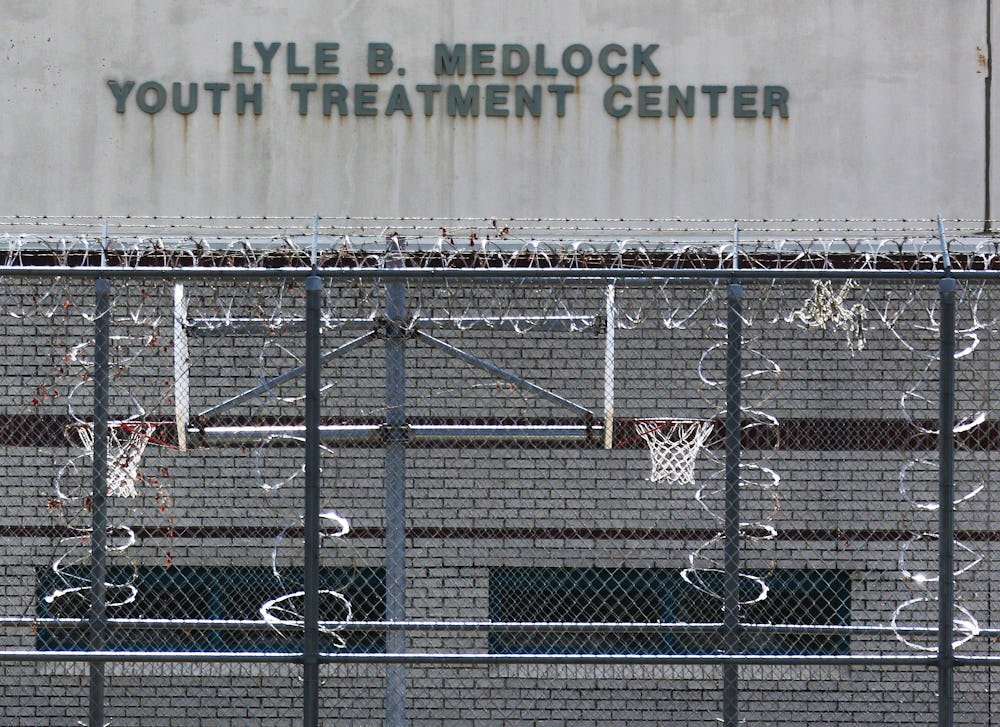
But we must then pay closer attention to how locals are treating juvenile offenders under their care. For example, inmates at one secure youth-treatment center in Dallas may go months without being allowed to exercise outside. Here's the lede to the Dallas News article breaking the story:

Unused basketball courts at the Lyle B. Medlock
Youth Treatment Center in South Dallas
Death row inmates in Texas are given at least an hour a week outdoors. Hardened criminals inside California's famous San Quentin prison get 10 hours.

Yet kids at a Dallas County correctional center for boys went months, sometimes more than a year, without going outdoors more than a few times.

For years, the boys at the Lyle B. Medlock Youth Treatment Center in southern Dallas County were rarely allowed outdoors, according to former guards, probation officers and families of incarcerated teens.

One boy said he was locked up for nearly 10 months and wasn't let outside for exercise once.
That we even know about this is a testament to the creation of the Independent Ombudsman at TJJD as part of the 2007 reforms, and the expansion of their authority to include local facilities. They began inspecting local juvenile detention facilities in 2015 and immediately identified the issue, reported the DMN. By May 2016, "During a third ombudsman visit, in May 2016, the inspector again noted the lack of outdoor time and submitted a 'Request for Plan of Action' to Dallas County juvenile officials: 'What plan can be developed and implemented at Medlock that would ensure youth have access to outdoor recreational areas?'"

So the mechanism to identify the problem worked, but the Ombudsman was not empowered to enforce her request to create an action plan for changing a bad policy. That didn't happen until the County Judge saw the Morning News article and sent the juvenile probation director a Nastygram, after which the policy was immediately changed.

Ideally, you want government structures that identify problems in order to fix them, not to allow them to linger until some reporter catches on and embarrasses the government into changing bad policies. This reminds me of Austin's police monitor, which at its best made important recommendations for reform but had no authority to fix the problems they'd identified.

At a minimum, when the Independent Ombudsman recommends this sort of policy change, local officials should be required to either implement the recommendation or formally reply to explain why they won't.

The TJJD Ombudsman had similarly identified most of the problems the Dallas Morning News reported on as Brandi Grissom was on her way out the door (check out Grits' interview with her; this was Brandi's final story as Austin bureau chief). So they're giving government officials an opportunity to rectify problems long before they become front-page news, but it's just not happening.

Which leads Grits to this conclusion: Legislators were successful in 2007 at creating a mechanism to identify problems at state and local facilities. But waiting until already-identified problems mushroom into front-page scandals and crises makes little sense. Someone must be empowered to fix identified problems, and to force local actors to adjust bad practices when they persist in the face of Ombudsman recommendations.

Thursday, October 05, 2017

Declines in TX recidivism led by parole success

Texas' recidivism rates are declining, according to this publication from the Council of State Governments Justice Center. According to them, parole revocations are down 33 percent since 2007, re-incarceration rates are down 25 percent, and rearrest rates are down 6 percent.

Reduced parole revocations are clearly the biggest success (and account for a big chunk of the decline in re-incarceration, as well). The document attributes those reductions to Texas' landmark legislation in 2007 which "Enhanced the use of parole for people at a low risk of reoffending and expanded the capacity of treatment and diversion programs," and "Expanded the capacity of substance use treatment programs and the use of intermediate sanction facilities to divert people from prison."

By contrast, probation revocations remained high. That same 2007 legislation included grants which were supposed to "Incentiviz[e] counties to create progressive sanctioning models for effective responses on probation." Some supposedly did, but unlike on the parole side, it didn't result in reduced revocations. Grits believes that's in part because the grants weren't structured to reduce if the desired outcomes weren't achieved. They just became part of probation departments' baseline funding, not an "incentive" to change behavior.

If Texas could figure out how to reduce probation revocations to the same extent we have for parole, we could close quite a few more prisons and save taxpayers a small fortune.

RELATED: See Texas' official recidivism data from the Legislative Budget Board.

Wednesday, August 30, 2017

Texans contributed to community corrections 'consensus'

There were some familiar Texan faces involved with coming up with a consensus document on community corrections at Harvard's Kennedy School of Government. See commentary at the Marshall Project, an overview of the process, and the consensus document itself.

Tuesday, February 21, 2017

Reduce technical revocations to cut prison admissions, costs

Let's delve further into the Government Effectiveness and Efficiency Report prepared biennially by the Legislative Budget Board, in particular on the topic of "Estimated net costs of technical revocations from community supervision and parole" (on pp. 389-393 of the pdf).

Technical revocations are when people's probation or parole is revoked for rules violations or failing to fulfill conditions of release, not commission of a new crime.

In an era when prisons are over-bloated and budget-cutters are looking to cut costs, the number of technical revocations to prison seem ripe for reduction. According to the GEER report, "In fiscal year 2015, 50.0 percent of offenders entering Texas prisons entered as a result of ... revocation."

With half of offenders entering prison coming from this source, reducing revocations is a big potential cost saver for TDCJ. But it's not a priority for local probation departments and so far Grits hasn't seen legislation filed this session aimed at reducing revocations for technicals (someone please correct me if I've missed something).

These days, technical revocations are mainly a probation problem. "Since the implementation of diversion initiatives in Texas, revocations in the parole population decreased dramatically." But, "In contrast to the significant decreases in parole revocations, revocations from community supervision have remained largely consistent." In 2015, 5,608 parolees were revoked en toto, with 910 of them for technical violations. On the probation side, 24,062 felons were revoked, with technical violations making up 51.4 percent of that number (12,362). So it's probation driving the revocation numbers.

A 2007 study, the report noted, found that 94.3 percent of probation revocations led to incarceration in a state jail (52.4 percent) or prison (41.9 percent).

When you examine the issue department by department, revocation rates are all over the map. From this document (p. 15 of pdf) we get the number of revocations  per agency for the ten biggest probation departments. From those data, Grits calculated these rates:

2016 Revocations as Percentage of 
Supervised Felons - Probation

Dallas: 8.3%
Harris: 11.9%
Bexar: 10.0%
Tarrant: 12.5%
Hidalgo: 6.4%
El Paso: 4.3%
Travis: 7.8%
Cameron: 6.6%
Collin: 9.5%
Nueces: 8.8%

Just reducing outliers like Tarrant, Harris and Bexar to average levels (8.6%) would ratchet down the number of annual prison entrants significantly.

Ironically, all these revocations are occurring while recidivism is relatively low. "For the fiscal year 2007 release cohort, the five-year recidivism rate for offenders supervised on parole is 37.0 percent, and the rate for the fiscal year 2010 cohort of offenders on community supervision is 28.1 percent. Moreover, people on probation are "substantially more likely to recidivate based on misdemeanors." 

What should we take from this?
  • The 2007 treatment reforms succeeded in reducing technical violations on the parole side, but probation departments and local judges stubbornly persist in revoking probationers for technicals at high rates.
  • The extent of the problem varies department to department, with a handful of probation agencies revoking disproportionately more people.
  • New policies and incentives must be created to reduce technical probation violations since existing structures from the 2007 reforms aren't doing the trick. Funding the SB 1055 program passed by the Lege in 2011 would be a good start, incentivizing departments to punish low-risk offenders in the community.

Shackled to Debt, Forfeiture Fail, a Self-Interested Revolt, and other stories

Here are a few odds and ends that merit Grits readers attention at the legislative session begins to heat up.

Rebellion of the Clerks: A self-interested revolt
There's only one real reason that clerks don't want a statewide database of court records, and it has nothing to do with quality control. They currently charge a dollar a page for records and don't want to lose the revenue. Their argument is the same as newspapers complaining about online competition from Craig's List for their classified ads. And yet, these are the most public of public records. And there's significant public demand for them. There's really no good reason not to make them available online, and the legislators lining up to stop the rollout of the new system are doing their constituents a real disservice, placing the interests of local elected officials over the public interest. Grits doesn't do oppo work for campaigns anymore, but there's easily an attack ad to be had aimed at anybody who supported a bill aimed at keeping public records from the public via unjustifiably high fees.

More critics denounce forfeiture fail
Momentum for reining in asset forfeiture continues to grow, with prosecutors going on the defensive. Go to the Just Liberty site to send a message to lawmakers supporting reform.

Union bashing bill leaves out law enforcement
Critics at a State Affairs hearing raised the same criticism Grits did about legislation by Chair Joan Huffman to eliminate union-dues checkoffs for public employees - why leave out law enforcement, which are the most powerful public employee unions in the state? The bill was voted out on a 6-2 vote with the disparate treatment intact.

TDCJ chief exec interviewed
See an interview with new TDCJ chief mugwump Brian Collier from the Huntsville Item.

Raise the Age!
Three different newspaper editorials this week backed so-called raise-the-age legislation:
For more background, see the House Research Organization's primer on the topic. Go to the Just Liberty site to send a message to lawmakers supporting this legislation.

If you've got the money, honey ...
As I write this, there are folks scouring the budget to find money to eliminate the Driver Responsibility surcharge. For their benefit, here's a presentation from the Legislative Budget Board last year with a great deal of seldom-discussed detail about the program. (Send an email to your legislators asking them to abolish the surcharge.)

Shackled to Debt
New report via Harvard's Kennedy School and the NIJ: "Shackled to Debt: Criminal-justice Financial Obligations and the Barriers to Re-Entry They Create."

Monday, February 06, 2017

Incentivize probation to punish offenders in community

Grits wanted to highlight a recent report from our pals at the Texas Public Policy Foundation's Center for Effective Justice. Via Greg Glod, see an analysis of Texas' probation system and a recommendation for the Legislature to fund a program created in 2011 (which incidentally was Texas' last budget crunch) to use grant incentives to encourage probation departments to stop revoking so many offenders on technical violations and punish more offenders in the community instead of with maximally expensive prison sentences. In return, they'd keep 35 percent of the savings if they achieve performance goals. Unfortunately, wrote Glod:
The amount estimated for the most recent budget, and every budget since [SB 1055's] passage has been $0. It appears that not enough money in excess has been returned for the bill to be implemented. However, the structure of SB 1055 requires the commitment reduction plan to be submitted “no later than the 60th day after the date on which the time for gubernatorial action on the state budget has expired under Section 14, Article IV, Texas Constitution.” This might be too rigid of a timeframe to determine whether funding is available, and if it is, enough time to get a commitment reduction plan in place.  
To provide more flexibility and feasibility, current language from SB 1055 should be changed to allow CJAD and each local jurisdiction to reach agreement on how much each local jurisdiction needs for upfront funding, as well as for performance-based funding, at a later date than what the code today requires. 
The Texas Legislature should authorize this funding because it is a no-lose situation for the state and the counties. If the counties reach their goals, they will receive savings via the reduction in commitments. If they do not, the counties are required by statute to reimburse the amount they did not save but intended to save.
TPPF also recommended reviving vetoed legislation from 2007 to incentivize probation departments to reduce technical revocations. Former Republican House Corrections Committee Chairman Jerry Madden carried the bill which passed the Legislature easily but was vetoed. Here's what Glod had to say about it:
The majority of state funds distributed to probation departments are based upon the number of individuals the department has under direct supervision. This means that there is a substantial disincentive to terminate probation sentences for individuals who have followed all requirements of their probation, timely paid their restitution, and no longer need to be supervised. 
In 2007, House Bill 3200 was passed. The bill directed CJAD to develop a new basic probation funding formula based on certain criteria. First, it would base funding on the number of felony defendants placed on community supervision, rather than directly supervised. This means the department would not lose out on funding for terminating an individual’s probation early. Second, funding would be additionally based on each felony defendant participating in a pretrial program and supervised by the county. This addresses the current fiscal disincentive for local jurisdictions to divert appropriate individuals from probation altogether, such as by not bringing or by dismissing charges against those arrested for first-time, low-level drug possession contingent on completion of a drug treatment program. Third, a per diem amount would apply for each misdemeanant placed on community supervision. Fourth, higher rates of funding would be established for felony defendants who are serving the early years of their term rather than felony defendants who are serving the end of their term. This is based on data showing most new offenses and revocations occur within the first two years a person is on probation and that for those who have been exemplary in that time there is little or no benefit to further supervision. Fifth, funding would be reduced for departments with excessive numbers of technical revocations. Sixth, additional funding would be provided based on the number of early terminations, which is partly designed to compensate for the lost probation fees, which may be disproportionate to the savings from not supervising a person who required little supervision to begin with. 
The bill was vetoed because “technical revocation” was not defined. A possible solution is to define technical revocation can be defined as violating the terms of probation without any allegation of a new criminal offense. Additionally, it would be beneficial to instruct CJAD that in determining the penalty for excessive technical revocations consideration should be given to the risk level of a department’s caseload and the jurisdiction’s rate of sentencing nonviolent and low-risk offenders to prison. This ensures that jurisdictions that utilize probation in cases involving more challenging offenders are not penalized.
That same year, Perry signed probation reform legislation which he'd vetoed the session before, but he had not progressed far enough down the #cjreform path to embrace this part of the package at a time when critics were hollering at the tops of their lungs that the sky would fall if one less prisoner was incarcerated. With the benefit of 20/20 hindsight, it's easy to see that crime continued to fall after those reforms and implementing the economic-incentive part of the package surely would have been fine. If TPPF has its way, maybe the current governor will have another opportunity this year to sign such a bill.

Frequently economic incentives effect change in government more concretely than policy dicta. The reason half of revocations by local probation departments are still for technical violations, not new criminal charges, is that in 2007, the Legislature issued policy dicta but the Governor vetoed the accompanying economic incentives in HB 3200 that made it all work. So the main effects of the 2007 reforms were on the parole side, where technical revocations were driven down to record-low levels and parole release rates ticked up. Implementing Madden's idea would create new incentives - a "nudge," to use Cass Sunstein's phrase - for the same beneficial trends on the probation front.

Grits hasn't seen legislation to this effect yet, but I hope it's coming.

Sunday, January 08, 2017

House Corrections committee rethinking probation fees

The Texas House Corrections Committee interim report to the 84th Legislature began with a discussion of excessive fees in the criminal justice system which merits readers' attention. The committee, chaired by Republican state Rep. Jim Murphy, focused on relatively obscure aspects of the system which nonetheless are incredibly important to the people affected by them, both people who must pay and government employees who collect them. On probation, for example:
If someone is on probation, there will be a lot of fees. First, a probationer pays up to $60 a month for supervision. Depending on the crime, there will be program fees for drug education or domestic violence classes. If substance abuse is involved, there will be costs for random urinalysis tests, and perhaps an ignition interlock (for DWI cases). If you have lost your license, which happens with any drug conviction, you will have to take a class to renew that license. Once the class is completed, you will need to go to the Department of Public Safety and pay between $125 and $325 to get your license back.
Larding on court costs
The committee examined various court fees, particularly ones aimed purely at revenue generation:
The 83rd Legislature directed the Office of Court Administration to study the necessity of certain court costs and fees in the state. The report outlined several troubling trends (link added).
Many of the court fees and costs, whether deposited at the state or local level, are not dedicated fees and are simply deposited in the general fund of the state or local government. They are then appropriated at the discretion of the funding body. 
Some of these court fees and costs are used to fund programs outside of and unrelated to the judiciary. Meanwhile, court fees and costs are generally insufficient to cover the cost of funding the judiciary at the local government level, with expenditures for the judiciary oftentimes far surpassing collected revenues for court fees and costs.  
There are hundreds of these fees, with a few dozen of them ending up in state coffers. 
The best known Texas court fees are "consolidated court costs," which run:
Up to $133 for felonies, $83 for misdemeanors, $40 for nonjailable misdemeanor offenses. Ninety percent of collected funding goes to the state for 14 purposes, including; crime stoppers assistance, abused children's counseling, law enforcement and custodial officer supplemental retirement fund, judicial and court personnel training fund, and emergency radio infrastructure account
Many fees are spent in ways which have nothing to do with their ostensible purpose. A $250 DNA fee on sexual assault cases, for example, is split between general state coffers and  the highway fund, with no relationship to funding the activity for which it's named. The committee could have added that this is happening at a time when DNA labs are underfunded and strained trying to keep up which evolving science, not to mention re-testing backlogs of DNA-mixture cases that were evaluated using flawed methodologies. 

Half of the state portion of the fee for "failure to appear" goes into the general fund with no specification that it be used for purposes related to that purpose. A $15 fee paid by bail bondsmen for each surety issued contributes to the state's Fair Defense account and to supplement salaries for assistant prosecutors. (That latter element may be a big, unstated reason some district attorneys dislike bail reform.)

The report added, "There are fees for records management, for juries, for judicial support, for court security, and for indigent defense. Pages and pages of fees. It boggles the mind to read it. Think of what it must be like to live it."

Notably, the committee observed, "Ability to pay these fees often isn't determined until later in the process. When a judge sentences a person to probation, and assesses fees and costs, he or she often has no idea if that person can actually pay. That is often left to the CSCDs, whose officers help the probationer draw up a budget to help them manage their obligations." They added, "In an era when you can find out your credit score for free on the internet, would it be that difficult to determine if a person is indigent prior to appearing before a judge?" Good question!

Relationship between fees and absconding
The interim report included this insightful passage about the relationship between high probation fees and absconding:
Although it may seem simple: pay your fees, attend your programs, etc., real life isn't that way. And for those who lack life skills, real life is challenging in a way that it isn't for those of us who have resources. 
And most of us are still living precariously. An Associated Press Poll indicates that threequarters of people in households making less than $50,000 a year and two-thirds of those making between $50,000 and $100,000 would have difficulty coming up with $1,000 to cover an unexpected bill. And being arrested would definitely qualify as unexpected. 
If someone has been convicted of a minor drug offense (less than a gram of a controlled substance that is not marijuana), there are a number of studies that indicate he or she is likely unemployed and experiencing deficiencies in educational attainment. He or she probably has substance abuse and mental health issues, and could be homeless. One-third of these minor drug offenders are under the age of 25, experiencing all that one might experience in terms of low impulse control and developmental factors. 
If you have resources, you probably take them for granted. These include access to cash, orparents who can help you out with a loan; trusted friends who can give you good advice or a ride when you need one; a permanent home. You have a job, you are educated. These things help to keep you out of trouble. 
If a person without these types of resources is ordered to attend a DWI program, but has no one to drive him to the program (because license revocation is part of DWI), then there are parts of the state where there are only two choices: drive to the program without a license, or forgo the program. Either one is reason to have probation revoked. 
Situations like this can be discussed and dealt with by a probation officer, who is likely to NOT revoke your probation on this technical violation. After all, life happens. But conversations like this are stressful. And standing before a judge is scary. So those without the skills to maneuver the stress see only one option: avoid the problem. Don't show up for scheduled meetings. Unfortunately, that's called absconding, and when the probationer is finally located, he or she will be in a lot more trouble than before.
Incentives for poor 'inadvertently created modern-day debtors prisons'
The committee explicitly recognized that probation fees and obligations have become so onerous they're creating incentives for defendants to choose incarceration over community supervision, even when locking them up serves no purpose from a public safety perspective: "because those who are poor and have no resources choose jail time, we've inadvertently created a modern day debtors' prison," they concluded, adding that the problem had also reached acute stages at municipal courts over Class C misdemeanor offenses, and extending the same criticism to the bail system:
Failure to pay isn't limited to the probation system or the municipal courts. Texas county jails currently detain 40,300 inmates who are awaiting trial, representing over 62% of the entire jail population of the state. The decision about who is released and who is detained before trial is determined primarily by a person's financial resources rather than his or her risk to public safety or likelihood to return to court. The National Association of Counties has found that 60% of the confined population presents a low risk of pretrial misconduct. 
These kind of statistics add to the consensus that being imprisoned for lack of resources is the same thing as making poverty a crime. And although municipal courts and pre-trial detainees weren't officially part of this committee's charge, it is worth mentioning as part of an overall trend. And that trend also contributes to overcrowding county jails, which is mistakenly seen as being caused by state policies.  
Rethinking probation as a payment plan
They concluded that the state should assume more of probation costs, allow more defendants to earn early release from probation through good behavior, and eliminate as many collateral consequences as possible:
Perhaps it is time to think of probation as a payment plan. If you have been given probation for one year, fulfill all of your obligations such as classes and restitution, and discharge six months ahead of time, that's great. However, you should still owe six months of probation fees. 
Conversely, no one should be kept on probation merely because they still owe restitution. If one year of probation is up, and restitution is still owed, then a payment plan should be set up for the restitution. And since that person is no longer on probation, CSCDs should no longer be collecting that restitution. 
During testimony heard by the joint committee, it became clear that many of those convicted of a DWI face uneven sanctions. If someone convicted of a homicide goes on probation for ten years, that person can be removed from probation after a few years if they do not get into further trouble. Not so for DWIs. It makes no sense to keep a DWI on probation if they attend classes, quit drinking, and go several years without further incident. 
A federal program mandates automatic suspension of a driver's license for any drug conviction, including a small amount of marijuana. Getting a license back can cost a lot of money, and Texas has the ability to opt out of the federal program. The state should do so. 
The fee system for probation should not be done away with entirely. In fact, the upcoming session promises to be a difficult one, with agencies encouraged to start looking at possible budget reductions now. Fees have a place in probation, as those who pay for a program are more likely to attend that program. However, when jail time is chosen over probation, the fees are too burdensome. For that reason, the state should start to assume more of this cost, which would likely be less expensive than paying for unnecessary incarceration.
The state should consider allowing a CSCD to receive full state share of misdemeanor probation, but allow for non-report for minor offenses. Consideration should also be given to a system where those charged with Class B misdemeanors complete a class or perform community service rather than complete the full term of probation. This would allow CSCDs to dedicate their time and energies to people with a more intensive level of need. 
The committee posed a provocative, new-to-me idea: "If probationer fees could be collected from individuals after they have completed treatment and achieved employment and housing stability, revocation rates should be lowered." That's a useful, interesting suggestion that makes a lot of sense. However, it's also true, as this section of the report concluded, that "until the state bears a greater burden of the costs of rehabilitating people" and shifts away from regressive probation and court fees, "real reform will be difficult."