Tuesday, July 26, 2022
Reimagining History at the Austin Police Academy
Friday, July 30, 2021
Austin PD teaches cadets US Constitution using material from John-Birch-Society shill
Wednesday, January 20, 2021
Review of Austin police training videos finds bias and selective deescalation tactics
The overall library of videos selected perpetuated dangerous racial and class stereotypes that displayed working class people and communities of color as disproportionate recipients of violent and deadly responses from police. People of color seldom benefited from crisis intervention or deescalation strategies from officers in videos. Instead, a strong emphasis on gaining compliance and control over all else from communities of color often led to rapid escalation with often violent and even deadly results for minor infractions. In contrast, white community members were most often extended grace and understanding. Opportunities for story-telling and building empathy was almost exclusively given to white men.Here's the full report, and initial coverage from KXAN. A companion document prepared by the panel's facilitators echoed similar concerns. These criticisms come on the heels of a review by the city's Equity Office finding Austin's police academy subjected cadets to unnecessary hazing and fostered a "culture of violence."
Mayor Steve Adler and the City Council's newest member, McKenzie Kelly, want to restart the police academy as soon as March. The analogy being used behind the scenes is that APD can repair the plane (i.e., the academy) while they're flying it. I wonder if aircraft mechanics are as enamored of that idea as politicians who want to restart cadet classes without addressing the underlying problems?
Among the flaws the community panel wants them to fix: "An emphasis on 'winning' interactions and a 'warrior mentality' in many videos created and repeatedly reinforced an 'us versus them' and 'good guy/bad guy' dynamic that pits officers against community members."
In addition, "Many videos emphasized a transactional approach to interacting with the community with a focus on liability and quid pro quo exchanges, rather than what is needed to develop genuine, authentic interactions with community members to sustain long-term trust and relationships."Further, "Videos that showed officers antagonizing community members and using excessive force were attributed to aberrant individual behavior rather than acknowledging the cultural and systemic factors that permit or encourage such behavior."
None of this is new: Cadets themselves identified all these problems years ago and some of them sued the department over it. Now, though, two different independent reviews commissioned by the city itself - one performed by consultants, the other by a community panel - have corroborated and reinforced those criticisms.
This has been going on a long time now. City Manager Spencer Cronk was told in December 2019 to begin the review whose results we're seeing now. He blew off the city council and asked them to restart cadet classes over the summer without having fixed the curriculum. In August, though, the city council told him, "No, we're serious," and the city finally began the long-awaited review.
Between the equity audit and the video review, its' clear at this point that Austin's curriculum for cadets needs a soup-to-nuts overhaul. There's no emergency need for officers so pressing that an academy can't wait a few months to fix all the pedagogical problems. Indeed, after everything we've been through in Austin over the last year, it would be a tremendous betrayal of trust to ignore these recommendations and move forward as though the same ol' same ol' was still good enough.
Saturday, January 02, 2021
Shocking allegations of hazing and a 'culture of violence' at Austin's police academy
Just before the New Year's holiday, the city released the first of these audits from its Equity Office, and it was a scathing and unabashed take down of the APD training process. The report "recommends that City leaders suspend all cadet classes until APD leadership and Equity Office officials can develop and implement an equity-driven action plan that reforms and rebuilds APD’s Training division, including the training academy."
Among the biggest complaints was a culture of violence and hazing within the academy. "Interviews with former cadets revealed an academy culture that prioritizes physical aggression above all else. Multiple cadets stated that training staff subjected them to hours of grueling physical and psychological stress drills, refusing water to dehydrated cadets and engaging in other dangerous practices."
Training isn't just grueling, but demeaning and regressive: “In multiple interviews, cadets confirmed the narrative that an APD trainer asked a new cadet why they wanted to be a police officer, interrupting the cadet’s response by saying 'If you tell me you want to help people, I will punch you in the face.'”
The Equity Office conducted an event to include community perspectives on training materials. "Community members raised additional concerns at the depiction of an increasingly hostile and aggressive public in APD training materials," expressing worry that "this message will only make officers more violent and aggressive when they interact with the community."
If the training materials risk making officers more "hostile and aggressive," how much more so does telling recruits they'll be punched in the face if they say they want to help people? In this case, the cadet interviews corroborated and bolstered community complaints. Later this month, the audit of all the videos used in APD training will be released, and through the grapevine your correspondent has heard that these auditors will raise similar concerns.
The most severe portions of the training appear to have no relationship to preparing officers for any real-world tasks they will perform:
According to interview respondents, many of the academy’s trainers rely overwhelmingly on “violent”, “brutal”, “traumatizing” practices designed to “manufacture soldiers” rather than produce community-driven law enforcement professionals adept at de-escalation. Trainers place cadets in dangerous, demoralizing, and inhumane exercises with “zero regard for the health and safety of cadets.” Multiple cadets stated that they and their colleagues had been screamed at or punished for checking on one another or drinking water during intense physical drills, which last for hours in sweltering summer heat. Multiple cadets confirmed that they were deprived of water during extended physical drills in extreme heat. Data provided by APD confirms that a troubling number of cadets were treated for heat exhaustion and dehydration during the academy. Multiple cadets expressed that even though they hydrated heavily at home, as advised by APD training staff during orientation, it was impossible to avoid dehydration when training staff refused to allow them water during these extended physical drills. Cadets could not identify a plausible real-world scenario during which they would be deprived of access to water in extreme heat for extended periods of time. Multiple cadets expressed that this deprivation was rooted in nothing more than cruelty and had no basis in the reality faced by police officers. Some narratives, corroborated by multiple respondents, are simply too violent to understand how they were ever allowed to occur, including many cadets being forced to resign or risk serious injury in the face of seemingly endless “hazing” and “abuse.”
Interviews revealed that cadets were subjected to so-called "smoking sessions," which are:
unscripted, unscheduled physical and psychological stress drills that instructors instigate without notice. According to multiple interviews, these smoking sessions are often used as collective punishment for individual violations, though their use is just as frequently unexplainable. Some respondents indicated that Training division staff seemed to enjoy putting cadets through the stress drills, which often go on for hours during the summer heat. Multiple respondents claimed that cadets are refused water during these stress drills, that instructors punish cadets for looking at one another (even if checking the condition of fellow cadets), and that medical staff are not posted close enough to the cadets to assess symptoms of dehydration or heat stroke. Multiple respondents witnessed instructors refuse water and fail to render aid to cadets who were visibly suffering symptoms of dehydration. It is well documented that these practices resulted in multiple serious injuries to cadets.
The report suggested APD trainers were harsher, even, than at military boot camps and prioritized "brutality and aggression":
The academy’s training staff employ dangerous training tactics that have been described by cadets with military backgrounds as “worse than anything I went through in [US military training].” Multiple former cadets allege that the academy is driven purely by brutality and that physical aggression is the primary quality that trainers seek when promoting cadets toward graduation. The Training division’s practices and culture are driving highly qualified candidates to leave the academy, depriving Austin of the diverse, community-driven police force that City leaders and residents envision.
Nationally, according to the Bureau of Justice Statistics, only 23 percent of training academies have curricula which is all or mostly stress-based, as is clearly the case in Austin. That means more than three quarters of training academies have eschewed that approach, but Austin PD clings to it.
The Equity Office highlighted the wastefulness of stress-based "teaching," separate and apart from the moral and ethical problems with it:
What benefit is it to eliminate brilliant candidates for the sake of maintaining a battlefield mindset? How much money is spent recruiting these bright, capable, highly educated, successful and diverse candidates, bringing them through a months-long recruiting process, vetting them intensely, dedicating an unknown number of personnel hours to interviews and investigations -- only to have them driven out of the academy by a culture of brutality, militarism and violence? What benefit is it to subject highly-qualified, diverse, committed cadets to training that is more intense than some military training programs?
That to me is the best argument for putting off a new academy until training can be revamped. With such high dropout rates and a terrible, regressive pedagogical approach, it makes no sense to hold another class until all the problems have been identified and fixed.
The "culture of violence" identified at the academy wasn't the only regressive aspect of police training. Given the number of homeless people in this town, it's remarkable (and sad) to read that "Multiple former cadets in separate, individual interviews confirmed that training staff made negative comments toward individuals experiencing homelessness and told cadets that if they are 'having a slow day,' they could seek out someone experiencing homelessness as an easy target for various citations." The city council has taken steps to limit those citations, but it's clear they're running up against a deeply engrained culture within the department.
Whether as a result of this violent culture or because of other factors, the department is failing at its diversity goals. In fact, "The Training division’s leadership failed to produce any measurable standards for ensuring equitable practices. The division’s self-assessment identified one Black employee out of 57."
Overall, black recruits were more likely to drop out of the academy. "Data provided by APD highlighted further disparities in graduation rates, with 81.6% of white male cadets graduating the academy compared to 48.5% of Black male cadets."
Black cadets were also more likely to be injured during training.
According to data provided by APD, at least 509 injuries occurred during the APD training academy between 2015 and 2020. Of the cadets who were injured and included in this data, 348 (68.37%) were white, 85 (16.7%) were Hispanic, 57 (11.2%) were Black, and 19 (3.73%) were Asian. While the percentage of injuries sustained by white cadets reflects the percentage of white candidates that graduate from the academy, the percentage of injuries sustained by Black cadets (11.2%) is more than twice the percentage of Black cadets that graduate (5.19%). APD’s data illustrates inequitable outcomes for Black cadets who enroll in the APD training academy. Black cadets in APD’s training academy are underrepresented when compared to the population of Austin, less likely than their peers to graduate from the academy, and more likely to be injured during APD’s training academy than any other race.
This reminds me of research showing white folks think young black people are older, more mature, and potentially more threatening than they are. Is violence used more harshly against black cadets because of these implicit biases, for explicitly biased reasons, or for some other cause? Regardless, the violence-centered pedagogical approach is clearly thwarting diversity goals.
Finally, the report corroborated complaints of APD leadership bucking and slow walking reforms, identifying the biggest barrier to fixing the identified problems as, "Lack of political will among APD leadership at many levels threatens meaningful change."
This report should put an end to discussions of restarting the police academy any time soon, and certainly by March, as Mayor Steve Adler had suggested. We're only just beginning to understand the depths of problems at the academy, which start with agency leadership. They won't be fixed overnight.
Monday, December 14, 2020
Beyond the Bait and Switch: What we really need from police training reform
But that doesn't mean training is unimportant. Any honest assessment of American policing would conclude that its problems begin with what cops are taught in the academy about what the job is, what they should expect, and how they should behave. Police are trained poorly, often by amateurs, and for too short a time.
We've discussed how, in Texas, the Commission on Law Enforcement has insufficient staff or expertise to exercise meaningful oversight over police training and curriculum. And even if training were excellent, there's too little of it. Cosmetologists must undergo more basic training in Texas than police officers. By contrast, in Germany police officers train 2.5 years before being deployed in the field.
Austin's police academy had become so dysfunctional that, a year ago this month, the City Council ordered Chief Brian Manley to conduct an audit of its curriculum, setting a deadline of June. They were reacting in part to complaints by a group of cadets who sued the department alleging abusive behavior and incompetence by trainers. The chief and city manager were told at the time that the audit must be finished and improvements to the training program completed before new cadet classes could resume. If they had done that work when they were instructed, only one cadet class would have been delayed.
But in June, City Manager Spencer Cronk returned to the City Council to say they had never begun the audit because of COVID but would like to hold more cadet classes anyway. By that time, though, George Floyd and Mike Ramos were dead and the nation and city had erupted in protest. Council stuck to their guns and unanimously replied, "No audit, no cadet class." Then in the FY 2021 budget which began in October, they called the City Manager's bluff, omitting new cadet classes pending the outcome of the audit process. The Council pledged to revisit the budget in six months, halfway through the fiscal year, at which time changes could be considered. As of this writing, however, the audit still hasn't been completed, much less have needed alterations to the curriculum been identified nor alternative approaches been considered. Instead, the police department and its allies are again pushing to restart the academy before that work has been done.
It's in this context that Grits this morning read a feature in Time magazine regarding police academy training. Texas wasn't mentioned, but the the complications caused by low-quality training and a lack of state oversight struck this writer as a highly relevant, cautionary tale. Every criticism made of training in these other states arises in Texas in spades, in part because we have a disproportionate number of agencies. Texas has about 1/11th of the US population but nearly 1/6th of the nation's law-enforcement agencies. If training at the larger agencies can be problematic, training for smaller agencies amounts to an unregulated hodge podge.
I was also glad the Time article pointed me to this Bureau of Justice Statistics analysis of police recruiting and training, which I'd not seen before. The average length of US police academies is 21 weeks, according to BJS; in Texas, minimum training takes about 18 weeks (696 hours). The Houston Chronicle recently had an excellent report that highlighted some of these shortcomings:
The Sunset report found that Texas requires more time in basic training for cosmetologists (1,000 hours) than for cops (696 hours). Air conditioning and refrigeration contractors, meanwhile, have to put in 2,000 hours of training to get licensed. The Houston Police Department requires at least 48 semester hours of college credit for prospective officers but a high school diploma or GED is enough in other parts of the state.
The type of training officers receive is also out of whack with real world demands. Requiring 48 hours for firearms training and 40 hours for instruction in arrest, search and seizure is appropriate, but the regimen also includes four hours of work on interacting with canines while requiring only two hours on interacting with civilians.
The standard Basic Peace Officer Course includes only four hours for education on “Family Violence, Child Victims, and Related Assaultive Offenses” and no special training for dealing with rape victims.
In Austin, officers get slightly more training than cosmetologists, but less than air-conditioner repair people, before being handed a badge and gun and sent out into the streets.
The Time article emphasized the extent to which basic training has been outsourced to educational institutions, which almost certainly applies to entry-level training for most smaller Texas agencies. BJS reported that:
From 2011 to 2013, nearly half (47%) of the academies that provided basic training for new recruits were based at an educational institution such as a 2-year college (33%), 4-year college or university (7%), or technical school (7%) (table 1). Municipal police departments operated 20% of academies, sheriffs’ offices operated 10%, and state police or highway patrol agencies operated 6%. State Peace Officer Standards and Training (POST) agencies, which typically certify peace officers, operated 5% of academies.
That was a trend I hadn't considered, though I knew places like Sam Houston State are making bank off of police training. But I hadn't understood that half of all training happened at academic institutions, nor considered the implications arising from differences between that training and instruction by department-run academies.
In Austin, cops are drafted from other duties to teach in the academy for short stints and given little if any pedagogical training or instructional support. Cadets complained that instructors over-used Power Point and appeared to have little understanding of basic pedagogical theory or adult education. One would at least anticipate that instructors at academic institutions might have greater access to teacher trainings and peer support on pedagogical questions. But that may be a false assumption; I have no idea what those academic curricula look like.
Another complaint about Austin's academy was instructors' over-aggressive methods. Turns out, subjecting cadets to a "stress-based" learning experience is a common approach. According to BJS:
Nearly 1 in 4 academies (23%) reported their training environment was all or mostly stress oriented (table 2). State police or highway patrol academies (61%) were the most likely to use this type of training model. For all other types of academies, no more than 32% used a predominantly stress-oriented training model.
These debates are going to surface repeatedly in the coming months, both locally regarding whether and when to resume Austin's academy and at the Legislature as TCOLE undergoes Sunset review. In both instances, more resources are needed to bring either officer training or state regulation up to snuff.
Though some defund-the-police advocates may be offended, this is one area where Grits and many other reformers don't mind spending more money on law enforcement, particularly if officers are trained for longer and curriculum contents improve. Until the day we abolish police, we have to train them better. Cadets need to be taught under a more regulated, pedagogically sound curriculum, and God forbid, maybe for even as long as the refrigeration-repair guy. That's certainly true in Austin and, if the blue-ribbon panel suggested by the Sunset Commission is ever created, it's a safe bet they'll agree.
Saturday, October 03, 2020
Houston Mayor's Policing Task Force Recap, Part 3: Mental-health first response, What counts as diversion?, the 'all-purpose panacea promoted by people who oppose policy change,' and other stories
Mental-Health First Response
In Austin, Dallas, and elsewhere across the country, one of the approaches to displacing police from non-law-enforcement tasks has been mental-health first response, where many clients do not ask for a law-enforcement presence and end up in involuntary detention, more often than not, because police don't know what else to do with them. Adding insult to injury, when cops drop them off at the emergency room, they get credit for a "jail diversion"!
The Task Force found that "Diversion of mental-health-related 911 calls at the call center level is the earliest point of diversion before any law enforcement involvement. Since the beginning of the [counseling] program, CCD [Crisis Call Diversion] diverted more than 4,902 calls from law enforcement response and saved the equivalent of 7,353 hours of police time (March 2016 to May 2019)." The Task Force recommended funding 24/7 counselors to boost the diversion rate, as well as boosting the number of Mobile Crisis Outreach teams (civilian medical folks who respond to MH crises in the field), and tripling the number of HPD's CIRT teams, which are police officers teamed with mental-health practitioners.
The Task Force endorsed a legislative proposal folks in Dallas and Austin have been clamoring for as well: Amending state law (Chapter 573 of the TX Health and Safety Code) to allow health care professionals to handle decisions related to emergency detentions. Right now, only police can do so, and that law is a barrier to removing law enforcement from the equation in non-criminal mental health calls.
Mental health cases are a growing part of HPD's case load, as they are all over the state. In an article on CIRT teams, the Chronicle mentioned that, "In Houston, encounters between police and people with mental illness ballooned over the last decade from 23,913 mental-health calls in 2009 to 40,884 in 2019." That means that the Crisis Call Diversion handles a rather paltry 3.8% of calls.
The Mayor's task force claims HPD's CIRT teams focused on mental-health cases has a 95.9% rate of "diversion from jails." But that's a miseading figure. Fewer than one in four calls are resolved at the scene; in all other instances, somebody is taken away, usually against their will, and sometimes against the wishes of their parents, guardians, or care givers.
It's time for H-Town to challenge itself to substantially increase the share of mental-health calls met with a non-police response. A major goal should be boosting that "resolved on scene" number from less than 25% to 2/3 or more, reserving "emergency detention" for situations where a person poses a danger to themselves or others. Those criteria may include abusive behavior toward family and there may be good reason to detain any given individual (so spare me the parade of anecdotes in the comments, I get it). But in a huge number of cases there is not; too often, cops take someone based on a "better safe than sorry" logic. After all, the hospital/ambulance bills aren't going to show up in their mailbox months later.
Domestic calls: Do all of them need a cop?
The Task Force endorses a pilot program at HPD for intervention with high-risk domestic violence victims called DART (Domestic Abuse Response Team), which pairs officers with a victim advocate nurse. The pilot has been ongoing since January 2019, operating three nights per week (7pm to 3am) in three HPD districts. No information on how much it would cost to expand.
For that matter, I'd love to see any outcomes or research based on this pilot, comparisons to control groups, etc.. When I searched on the HPD website regarding the program, I only found one responsive web page: This flyer. If it's been going for nearly two years, one would think there'd be something out there.
When agencies do pilots, Grits believes they should always budget a research and data collection component. Domestic violence policies and police responses have always been all over the map. Maybe this is a great program; maybe other approaches would be better. When experimental programs are tested, somebody should be tasked with reporting on what they're doing, including any relevant metrics. Even better: Evaluating the program compared to a control population. That doesn't appear to be have been done yet for DART.
Regardless, Grits remains unconvinced that police need to go to every domestic disturbance call, even as security, as described in the DART program. There must be a response, and if a cops are needed, they should be called. But once the cop engages in violence or pulls their gun, that trumps clinicians' authority or decisions. Sending them only when needed reduces the chances that happens.
Indeed, one can make an argument that cops are simply the wrong messengers on this topic, as our pal Jessica Pishko recently reminded:
Other studies have found that police themselves are often the perpetrators of domestic and sexual violence, rendering them undesirable as a source of help, particularly for women of color who experience much greater rates of violence, including sexual violence, from police. Interactions with the police can also exacerbate existing conditions, like economic instability or trauma.Pishko quoted law prof Aya Gruber expressing a sentiment your correspondent has held for some time: "victims may be making a rational choice when they decline to testify against their abusers. 'Domestic violence prosecutions have little benefit to women and in fact can harm them,' she explained, 'but the prosecutors are very convinced they are saving women’s lives.'"
Task Force: Decriminalize prostitution! But make them work in criminalized environs.
Grits didn't foresee the Mayor's Task Force recommending that prostitution be decriminalized. That said, they weren't exactly suggesting the re-establishment of the city's red-light district: They still think the state should to prosecute "pimps, brothel and illicit massage parlor owners and managers, sex tourism operators, and sex buyers." But right now, they declare, "Law enforcement is arresting the wrong people."
Here's the oddity: Clearly they consider most prostitutes victims who deserve protection. Different folks feel differently about that, including sex workers, and I'm not trying to launch that debate. But I do question the virtue of claiming to "decriminalize" prostitution and then criminalizing everything about the industry except service provision.
In the age of the internet-personal ad, many prostitutes operate individual sole proprietorships without a formal "pimp" or brothel. For them, the Task Force's distinction doesn't make a difference.
If we're now going to express sympathy for prostitutes, then let's be clear: The biggest dangers they face all stem from the government banning their services and forcing members of the Oldest Profession to provide their wares in a black market. The sole proprietor of the liquor store may rely on police for protection; the sole-proprietor prostitute seeking security must turn to a pimp, which is an inherently unhealthy partnership.
Training: The all-purpose panacea promoted by people who oppose policy change
Look, I'm all for good police training. Indeed, much of what I've learned about police practices (and jailers, and prosecutors, and defense lawyers, and district judges, and appellate judges, and forensic analysts, etc.) has come from attending their professional training sessions, conferences, and CLEs over many years and/or reading training materials (plus chasing down items from their footnotes) from those events. While, between my illness and COVID, 2020 has been a dry spell, in the past I might normally attend several such events per year, including many that put me in rooms filled with police officers. Frankly, I've never had a bad experience doing that and highly recommend it.
That said, having worked on police reform now for more than 25 years, here's Grits' view: "More training" is the first thing reform opponents suggest whenever substantive reforms are proposed. It's always the first "reform" suggested and, as soon as it's implemented, reform opponents push hard to stop there. Every time. Some of the trainings on implicit bias and racial equity in particular appear to have little effect on outcomes. Grits didn't consider it good enough a quarter century ago and it's certainly not good enough now.
Yes, change your policies, train on the improved ones, and consistently, effectively punish officers who fail to follow them. That's how you change departmental culture. But training alone won't help.
Reflections on Mayor's Task Force Recommendations
Having now gone through the entire report, what to make of it as a whole? There are moments where it is bold, for example, recommending changes to the 180-day rule and insisting officers suspected of misconduct should be questioned at the beginning of the investigation process. And I was excited to see the recommendation that un-redacted bodycam video should be released, though I don't agree to limiting that to critical incidents.
Similarly, the suggestions that 1) Houston PD create a complaints database and 2) publish an annual report on disciplinary actions against officers, would constitute a major leap forward in transparency for the department. But it falls short of what's needed: Police departments also need to begin publishing data and detail about use of force incidents in online databases where researchers and the public can access them. Grits knows for a fact legislation requiring that statewide will be filed during the 87th Legislature, and the an executive order from Donald Trump mandated creation of a national database documenting "instances of excessive use of force."
Texas already has good data on police shootings and deaths in custody. That's the next step.
Grits remains less than confident they've figured out the right way to keep Houston cops from shooting people on mental-health calls or domestic disturbance calls. I'd prefer to see them working to expand the subset of those encounters at which police are absent entirely. They can always be called in if needed.
Other suggestions seem more like half measures that don't really get at the problems they hope to solve - redesign a website, issue a report on diversity efforts, etc.. All perfectly reasonable stuff the government must think about, but boring and unlikely to be decisive in addressing the problems.
Finally, I don't believe they've identified the right model for the Independent Police Oversight Board, potentially designing it to perform a fruitless, Sisyphean task that leaves them set up to fail. The Task Force acknowledged that the all-volunteer IPOB needs significant staff to do its job, and that more staff are needed to process complaints, both from the community and from officers themselves. Why not follow Austin's lead and create a full-blown Police Monitor to manage that staff, add value through regular reporting, and to advise the Mayor and Council on issues related to departmental conduct, discipline, and culture from an independent perspective?
Grits sees these Task Force recommendations as the beginning of a conversation, not in any sense the final word on what reform in Houston might look like. If all of them were implemented tomorrow, it would be a Banner Day for Criminal-Justice Reform. And yet, it would be insufficient. In just a few years, many of the same problems would arise.
This report had a great deal of crossover with recommendations from several city council members earlier this week, and was in a sense even more aggressive. Between them, they're a good conversation starter, but now the conversation must move forward.
Monday, May 25, 2020
Rainy Day Reading
Monday, May 04, 2020
Why there's no way Austin PD can hold a July cadet class and comply with City Council's orders
Austin City Manager Spencer Cronk announced today that the Austin Police Department will hold another cadet class in mid-July, despite having achieved very few of the benchmarks the Austin City Council said they must address before doing so. Here's the council's resolution.
For example, what has been done about "Improving background checks and screening of incoming cadets as well as active officers being considered for promotion as it relates to topics such as explicit and implicit bias, racism, homophobia, gender bias and other forms of discrimination"?
Wednesday, October 30, 2019
Podcast: New evidence of Rodney Reed's innocence, first thoughts on the Atatiana Jefferson shooting, and the Mystery of the Disappearing Misdemeanor Arrests
This is the October 2019 episode of Just Liberty's Reasonably Suspicious podcast covering Texas criminal-justice policy and politics. This month, my cohost Amanda Marzullo and I interviewed attorneys for Rodney Reed, who is on death row with an execution date of November 20th. We plumbed unknowable but interesting questions about misdemeanor arrests, discussed the sad, grim, story of Atatiana Jefferson's shooting in Fort Worth, and complained that the moments spent reading and talking about a new ACLU report on how to end mass incarceration are time we'll never get back. :)
- First takes on the Atatiana Jefferson shooting in Fort Worth (2:34)
- Evaluating ACLU decarceration recommendations for Texas (8:34)
Suspicious Mysteries
Why have misdemeanor arrests declined? Why didn't they decline earlier when crime first dropped? What do we really know about why crime dropped or the relationship between crime and arrests? Mandy and I discuss some known unknowns. (27:15)
The Last Hurrah (36:40)
- Hard to reprimand Texas judges
- Years-long backlogs at crime labs
- Message sent by jury in prison-guard murder trial
Tuesday, November 20, 2018
Texas voters think justice system rigged for the wealthy, NY Times reporting repeats forensics fail, pay to play in Harris County juvie appointments?, and other stories
State should end practice of letting untrained guards work in jails
Untrained jailers legally working on probation status at the privately managed Parker County Jail were involved in the violent death of an inmate. Excellent story, go read it. The Texas Legislature should close the loophole allowing jailers to work in county jails before they've received training. They should have to fulfill training requirements before being put on the line, just like police officers must complete the police academy before being deployed in the field.
Texas voters think justice system rigged for the wealthy
Voters support bail reform, says a new poll, which also found that "90 percent of registered Texas voters are dissatisfied with the criminal justice system overall and 55 percent want a complete overhaul or major change." Further, "81 percent of Texas registered voters believe the wealthy enjoy substantially better outcomes in the criminal justice than poor and working-class people."
Pay to play in Harris juvie appointments?
The feds are investigating the Harris County juvenile justice system, zeroing in on potential "pay to play" relationships between criminal defense lawyers receiving appointments and judges receiving their campaign contributions. Readers may recall that just two judges in Harris County account for 20 percent of all juvenile commitments to Texas youth prisons.
NY Times reporter repeats HouChron failures in ballistics coverage
This New York Times story on ballistics matching made many of the exact same errors as did a Houston Chronicle story I'd criticized last month: Failing to acknowledge the lack of standards or any scientific basis for the practice. I commented on the article in a brief Twitter thread.
Charting new paths for District Attorney offices
Progressive District Attorneys elected around the country in the last couple of cycles are pioneering new approaches to reducing mass incarceration offices. For example:
- Boston's new DA Rachel Rollins will refuse to prosecute 15 different low-level offenses, including drug possession.
- Philadelphia DA Larry Krasner has pulled out of the Pennsylvania District Attorney's Association because they promote regressive policies at the legislature. As their largest member, that's a big financial blow.
- The Washington Post this weekend featured Nueces County DA Mark Gonzalez as representative of a new breed of reformer DAs.
Monday, December 26, 2016
Rudeness or racism? And we should care, why?
The practice of police verbally provoking victims, drivers, etc., lies at the root of a lot of these confrontations and the fact of the matter is, officers are trained to do it. I'm sure that will be the police union's defense if and when the department tries to fire the guy. And there's more than a grain of truth to it. Police officers don't behave that way because they're all racist jerks. They do so because of the training they receive, the culture they work in, and the values and priorities of management, which are expressed through the actions of their employees more than through public statements. The Fort Worth chief is right that the problem may not be racism. But that's a much bigger concern than if this were just a one-off where a single racist slipped through the cracks and made it onto the force.
MORE: From James Ragland at the Dallas News.
Tuesday, November 01, 2016
Cop talk: Eight hours of verbal de-escalation training
I figured I’d be the only one in the class who doesn’t have to carry a gun – and potentially use it – to do my job.
Almost everyone taking a recent eight-hour verbal de-escalation training class in San Antonio was a commissioned peace officer. Most of the pupils were men; a handful were in plainclothes, about 15 donning beige Texas Department of Public Safety uniforms and roughly 10 more wearing other law enforcement uniforms or department shirts.
I took a seat near the beverage station and a heaping tray of donuts, next to a couple of administrative assistants who said they’d been “voluntold” to attend.

I was there to learn firsthand what law enforcement learn about de-escalation. The topic comes up often in my reporting for Point of Impact, a yearlong series investigating officer-involved shootings of unarmed people in Texas.
It was easy enough to sign up for the class online, but in a world where the media has been blamed for inciting violence against law enforcement and is often criticized for its coverage of police shootings, I expected some might be displeased I was there.
I’d hoped to be inconspicuous and left my home in Austin two hours early. San Antonio’s traffic crushed that hope, exposing the belated entrance of the lone journalist into a room full of officers.
Bob Christy, a regional training director for the Texas Police Association, trudged over with the attendance list and a course packet. I signed in next to my name and affiliation – UT Austin, where I’m a graduate student – and tried to disappear into my desk chair.
Despite having the least amount of experience with the use-of-force continuum, I found myself immediately more engaged than many of my classmates. The instructor even had to ask one man to put away his cellphone for a little bit.
During the first of many breaks – officers can only tolerate an hour of sitting still at a time, I learned – the instructor, J. Mark Warren, told me it’s common for officers to discount the importance of the course at the start, but ensured their enthusiasm would grow.
I introduced myself as a journalist to Warren, explaining that I’d paid the $70 non-TPA-member fee and then braced for the expected request to leave.
But he was happy to have me there. I took a deep breath and settled in to learn how law enforcement can use words and body language to diffuse a situation. A 19-year veteran of DPS’ training academy, Warren spent more than a dozen years teaching a communications course called “Verbal Judo.”
Everything a police officer does involves communication, and Warren is a die-hard believer that good policing requires good communication skills.
Repeatedly throughout the day, Warren reiterated that the course material wasn’t applicable in violent encounters - "You know how to deal with those," he said. Instead, the methods apply to the 90 percent of contacts who aren't violent.
We learned how to better communicate with people who are compliant but might "fail the attitude test," which Warren said legally does not justify escalation. We also learned how different types of people react to stressful situations, and what might work best in interactions with each personality.
Warren taught us tips to identify a person's ego state - parent, adult or child – so we could best communicate with them, and we practiced those skills in pairs. Ideal is the adult state, the only frame of mind in which individuals are capable of making independent, unbiased decisions. Parent ego states are authoritarian and lead to conflict and child states are selfish and short-sighted.
During one exercise, Warren instructed students to face another student and stand casually with our hands on our hips. "Easy," I thought, looking around only to realize it’s impossible for a trooper wearing his duty belt to look casual with one hand on his hip holster.
The point was the importance of body language: “Even if you’re just trying to be casual, you’re going to come across as defensive,” Warren later explained.
Sure enough, my fellow classmates did become engaged, interested and took notes, even when Warren mentioned the Police Executive Research Forum, whose recommendations on de-escalation have been met with mixed reviews from some in law enforcement.
One point of contention among the law enforcement community is with a staple of PERF’s 30 guiding principles on use of force. The agency would like to retire the “21-foot rule,” a practice that permits officers to shoot someone armed with an edged weapon who gets too close, because PERF says the rule sometimes wrongly justifies shootings. Warren disagrees.
But he supports another PERF guideline – that de-escalation training should be a core theme of an agency's training program. At least at DPS, the methods are now a core theme of one day in the classroom.
That wasn’t the case before July 2015, when a DPS trooper stopped Sandra Bland for a traffic violation. She was arrested and died in a Waller County jail cell three days later. The trooper responsible was indicted and fired from DPS, and Bland’s relatives sued him and others for her death.
When the case settled for $1.9 million in September, it was reported that de-escalation would now be required for all troopers in the field. DPS said at the time that the class was already required.
Warren’s timeline backs that up: He was tapped by TPA to teach the course starting last December, and has since trained about 700 officers, most of whom were DPS troopers and leadership. At my training, a few plainclothes officers were DPS brass, Warren said, and one was another jurisdiction’s chief.
As someone who lacks the rest of the training that Texas law enforcement receives, I felt unworthy of the completion certificate. It’s impossible to master, after one day, how to verbally communicate with a myriad of people who react in a variety of ways under stress.
DPS has also said that new officers will start to receive verbal de-escalation training in the academy. But aren’t the new officers too busy cramming for the state exam to study verbal communication, which isn’t tested?
Maybe at this point, the emphasis on verbal de-escalation is more of a symbolic first step.
“This is only the beginning,” Warren said. “History and current events being what they are, there’s never been a value on verbal de-escalation like there is now.”
Thursday, September 22, 2016
DPS on de-escalation training: We already do that
The Houston Chronicle reported that Waller County agreed to the terms, including shelling out $1.8 million, on Wednesday. In an emailed press release, Waller County Judge Trey Duhon said the county will be "increasing the training and education of jail employees in respect to mental health assessments in jail and improving our policies and processes."
Another $100,000 is said to be forthcoming from the Texas Department of Public Safety, although spokesman Tom Vinger says that DPS hasn't settled and is not a party to any agreements between the plaintiffs and Waller County.
Technically, DPS isn't a party, since the lawsuit named Trooper Brian Encinia, who was terminated earlier this year and faces a perjury charge. So how could they be responsible for any settlement terms?
Cannon Lambert, Geneva Reed-Veal's lead attorney, said DPS will be paying Encinia's piece of the settlement, and in a phone call, said the training agreement was true despite DPS' statement. "It's just one of the things that Ms. Geneva was very interested to see happen. Obviously she knows she can't get Sandy back, but there are things she can impact going forward," Lambert said. He said DPS agreed to implementing deescalation training taught by a third-party both in the field and for new recruits.
"We understood that it would be done very soon," Lambert said, adding that better deescalation tactics would have kept Bland out of the Waller County Jail, where she later died.
But according to Vinger, new recruits already get training on deescalation. He also said that "earlier this year," DPS began requiring troopers to complete an 8-hour deescalation course - provided by the Texas Police Association, a third-party.
When told about DPS' comment, Lambert said, "That's not what they conveyed to us." He also said that the agreement was that DPS was willing to "look at the circumstances and change what they are doing." Lambert is pleased that deescalation training will be enhanced, saying, "I just wish they'd have done this a year and a half ago."
[From 9/18/16 Grits post: Policy folks seeking more background on deescalation training and policies should check out the Police Executive Research Forum's "Guiding Principles on Use of Force" (pdf, 136 pages).]
RELATED: From the Texas Tribune, "DPS changes in wake of Sandra Bland death in dispute."
Sunday, September 18, 2016
Bland settlement requires deescalation training for DPS troopers
That's certainly appropriate, since former state trooper Brian Encina's unnecessary escalation of the episode was the proximate cause for the chain of events leading to Bland's death. Texas Lawyer reported that Governor Abbott personally signed off on this element of the settlement.
Requiring deescalation training for state troopers is a significant policy development which one hopes could have trickle-down effects, helping make deescalation tactics more common and culturally acceptable among Texas law enforcement across the board. DPS operates everywhere in the state, so everyone will be able to tell first hand whether deescalation tactics work as advertised. Policy folks seeking more background on deescalation training and policies should check out the Police Executive Research Forum's "Guiding Principles on Use of Force" (pdf, 136 pages).
Grits has come to believe that deescalation training and policies are key to changing police culture and stopping the sorts of incidents which have roiled the national psyche for the last couple of years. So it's good that the Sandra Bland settlement could make a significant contribution on this score, even if the celebration is mitigated by the knowledge that so many other forgotten lives ended in unnecessary jail deaths before we ever reached this point.
Wednesday, August 31, 2016
Powerful people more likely to support #cjreform post-indictment, and other stories
Bail required of most Harris Co. misdemeanor defendants
Only 8.5 percent of misdemeanor defendants in Harris County are released on personal bonds, not 20 percent as the county earlier told a federal court, reported Lise Olsen at the Houston Chronicle. In reality, "in 2015 only 8.5 percent of the 50,947 people arrested for misdemeanors were released on so-called personal bonds, which do not require cash or a bail bondsman." That's 4,307 people in 2015.
Pro tip: Don't destroy evidence from pending drug prosecutions
The Harris County DA must dismiss dozens of cases because a since-fired constable's deputy mistakenly destroyed evidence in hundreds of cases. Reportedly, there are "25,000 pieces of evidence since 2007" which were possibly affected. No telling yet precisely how deep this rabbit hole goes. So far, the Houston Chronicle reported, "prosecutors have yet to issue any so-called Brady notices of possibly exculpatory evidence, either to defendants with pending cases or to those who already had been convicted to inform them of the problems with the evidence."
Soros push to elect reformer DAs should target Nueces
Grits hopes that whomever is guiding George Soros' effort to elect reformer DAs has picked up on the Nueces County race Grits discussed Sunday. A significant investment there could put Mr. Gonzales over the top.
Powerful people more likely to support #cjreform post-indictment
Speaking of Nueces County, renowned liberal trial lawyer Mikal Watts and his family have found a new appreciation for criminal justice reform after he was acquitted at trial of 66 criminal allegations relating to his handling of litigation following the BP oil spill. "I fear our federal prisons are full of people who, threatened with a life sentence like I was, plead to a crime to which they are not guilty," he told Krista Torralva at the Caller Times. This seems to be a pattern which crosses party lines. One noticed that Rick Perry's appreciation for the problem of prosecutorial overreach similarly deepened following his own expensively defended indictment. Indeed, one of the earliest conservative proponents of criminal justice reform was Chuck Colson, a Richard Nixon crony imprisoned after Watergate who saw the light on criminal justice reform when he came out and founded the influential Prison Fellowship. It'd be as fun as it is unlikely to see Watts and Perry team up to champion criminal justice reform; that'd tickle Grits to no end.
Pepper spray violation draws suspension, violent traffic encounter results in lawsuit
An Austin cop received a 45 day suspension for gratuitously pepper spraying a restrained suspect in a police paddy wagon. What do you think would have been his punishment if local copwatchers hadn't caught his actions on video? In related news, Breaion King, who dashcam video showed being violently flung to the ground by an officer twice her size, filed suit against him and the city this week. It may be that APD and the city have no real incentive to effect change unless they're held financially liable.
Training and police reform
Grits is more confident than in the past that improved training might reduce police violence because of the proliferation of training based in de-escalation tactics. (See this discussion.) The Atlantic has an article out confronting this question titled, "How much can better training do to improve policing?" No one reform will be a panacea. But shifting away from a use-of-force continuum which assumes escalation and instead requiring training to emphasize the sanctity of human life as a primary value, as the Police Executive Research Forum has suggested, to Grits must be an important component.
Moonlighting cops and police shootings
Having mentioned the Texas Tribune's item on Texas police shootings that occurred while officers are off duty, I should point out this new academic article analyzing "Moonlighting: The Private Employment of Police Officers," which has joined Grits' backlogged reading list.
Sunday, August 14, 2016
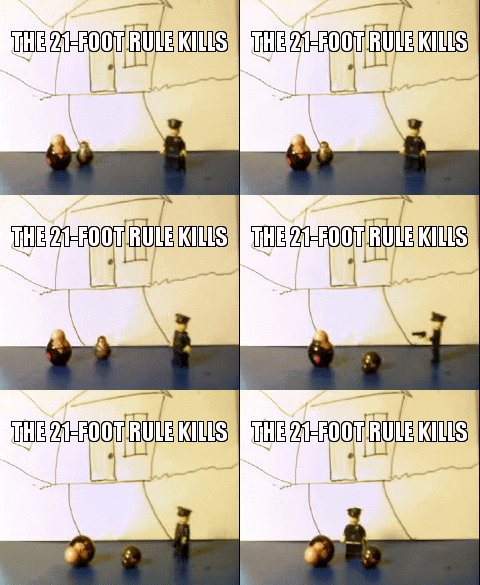
Best Practices: Police training, policies should prioritize deescalation, get rid of the '21-foot rule'
First, "There is a lack of complete and reliable national data on police use of force," the report noted, and until the feds improve national data, private data from sources like the Washington Post and the Guardian are the best we've got. They advocated data improvements along the lines recently suggested by the USDOJ. (I'd be interested in reading any comments PERF submits in response to the recent Federal Register announcement.)
Notably, PERF guidelines don not apply to cases where "the person who died was shooting at officers or someone else" or where "the person was pointing a gun," which according to the Washington Post accounted for 59 percent of fatal police shootings in 2015. Rather, they're focused on reducing deaths in very specific situations:
Several Hundred Officer-Involved Shootings Last YearBroadly, PERF recommended "discontinuing outdated concepts, such as use-of-force continuums, the so-called “21-foot rule,” and the idea that police must “draw a line in the sand” and resolve all situations as quickly as possible." (bold in original)
Did Not Involve Subjects with Firearms
Regarding non-firearm encounters, the Washington Post data indicate the following:
• In approximately 25 percent of the 990 fatal officer-involved shootings in 2015, the subject displayed signs of mental illness.
• In 16 percent of the cases, the subject was armed with a knife.
• In 9 percent, the subject was unarmed.
• In 5 percent, the subject was “armed” with a vehicle.
It is in these types of cases, representing as many as one-third of the annual total of fatal officer-involved shootings, that leading police executives believe there is significant potential for de-escalation and resolving encounters by means other than the use of deadly force.
![]() |
| Animation by Grits for Breakfast |
Police chiefs at PERF’s May 7 conference said that the 21-foot rule has sometimes been used wrongly to suggest that if a suspect moves to close the distance between himself and the officer, the officer can shoot the suspect and cite the 21-foot rule to justify the use of deadly force. This is the wrong approach, they told us at our meeting. The 21-foot rule should never be seen as “a green light to use deadly force” or a “kill zone.”The report cited examples from Northern Ireland regarding alternative ways to deal with a knife-wielding suspect besides shooting them:
Rather, officers should be given broader training in sound decision-making, de-escalation strategies, and tactics for creating time and distance, so they can better manage the incident without needing force.
Police Service of Northern Ireland Sergeant Dave McNally:
Our Officers Are Seldom Required To Use Firearms Because They Have Other Options
It’s a consequence of the terrorist threat that our police officers are all armed with a handgun, which isn’t the case in Scotland, England, and Wales. Our officers are armed for their protection, but there are many, many circumstances that routine officers respond to—domestic disturbances, robberies, burglaries—where they are not required to use their firearms because they have other options available to them.
I can’t think of an example where a police officer in Northern Ireland has had to use live rounds against an individual with a knife or a bat. There are numerous calls to those individuals that are dealt with daily by routine officers, armed only with a handgun for personal protection. There are numerous calls on a weekly basis. I can’t think of an example where officers have had to open fire.


.jpg)