Wednesday, February 20, 2008

Back Gate Back to Regular, Excellent Publishing Regimen

Though their remodeled site does not have permalinks, making it impossible to link to individual stories (please guys, fix this and you'll get a lot more traffic from me, at the very least!), The Back Gate, a blog operated by Texas prison guards, has published some excellent, informative posts in the last couple of weeks, including an item by a Sergeant who was accidentally pricked with a prison tattoo needle (pictured) during a cell search. He describes the torturous wait for medical test results to come back, and how the preventive treatment regimen changed his life for months thereafter.

Virtually everyone who goes to prison comes back with one or more tattoos, though all of the required equipment is considered contraband. In New Mexico under Republican Governor Bill Richardson, state prisons actually set up tattoo parlors inside the walls to reduce the spread of HIV and Hepatitis C through dirty needles. With medical costs rising, that might be something to think about; it's not like the current system has eliminated the practice of applying prison tats.

Another Back Gate story informs us about a Farmers Branch-based company called Unique Performance that used Texas inmates to build muscle cars. The vehicles were allegedly fraudulently marketed and never delivered to hundreds of customers around the globe. Another Back Gate story lets us know about an instance where a company using prison labor wound up competing directly with a local company for contracts, drawing political backlash that included intervention by Texas legislators and Ag Commissioner Todd Staples.

Good stuff from our friends at TBG. Visit them for more.

National Guard corruption highlights border security challenges

Two of the National Guard troops deployed in 2006 by Gov. Perry as part of Operation Linebacker have been convicted of helping smuggle illegal immigrants across the border, further evidence that it's the checkpoints, not the empty spaces in between, serving as primary entry points for illegal smugglers. Another National Guardsman was arrested recently in Fort Worth smuggling drugs when he bragged to an informant how he eluded police.

So it appears the National Guard troops sent by the governor to "secure" the border have proven as subject to corruption as every other border enforcement agency. I continue to believe this cross-border trade can only exist because of official corruption on both sides of the border.

You hear folks say we must "secure the border first," but I think that's premature. Eliminate official corruption first and rationalize immigration laws, then you might be able to have a serious discussion about improving safety at the border.

Tuesday, February 19, 2008

Voluntary guidelines don't "ensure" Ex-Im Bank won't give more loans to drug cartels

According to the Sarbanes-Oxley Compliance Journal, the Ex-Im Bank's new "Know Your Customer" initiative - which Grits readers will recall was created after WFAA-TV reporter Byron Harris in Dallas revealed the agency had given loans to figures associated with drug cartels - will be "ensuring that Ex-Im Bank supports creditworthy and legitimate transactions."

The problem is, the Know Your Customer background checks that would notify authorities of drug-related loans aren't mandatory under the guidelines.

So how does that "ensure" anything? It's one thing to identify "best practices"; it's quite another to require them to be implemented before your loanmakers give taxpayers' money to criminal smuggling gangs.

I'd like to see the Government Accounting Office or some independent auditor follow up on WFAA's revelations about Ex-Im Bank loans to drug cartels. Their self policing obviously is insufficient, and my guess is that Mr. Harris has only uncovered the tip of the iceberg.

Who's on TV?

Early voting starts today, so I'm curious, who has commercials on TV in the major criminal justice races where you live?

In recent elections, about half of voters cast their ballots early, and most of those are cast during the first three days or the last three days of the early voting period. So if you're not up on television when early voting starts, you've missed getting your message to what's become a significant chunk of the electorate who'll vote by the end of the week.

In the Travis County DA's race, so far I've only seen Rosemary Lehmberg on television with what I thought was an effective ad emphasizing her experience and the incumbent's endorsement. Her ad's running a lot, and she may win by default if nobody else goes on the air soon.

I'm curious if anybody's seen TV ads for any of the GOP candidates for DA in Harris County - who can afford TV advertising could easily decide that primary race, since voters don't know most of the candidates. If you live in Houston, do any of these candidates have TV ads running already?

Similarly, I'm curious whether there have been ads running in the Sheriff's race in either Dallas or Bexar Counties in either primary. I haven't heard of any, but that doesn't mean it's not happening. Ditto for the race to replace the late Sheriff Leo Samaniego out in El Paso. It's crunch time for all of these important races.

Let me know whose ads you've seen, if anybody's, in these or other crim-just races, and what you thought of them.

Support resolutions at precinct conventions to reform adult and youth corrections: A Grits mini-campaign

In Texas' Democratic primary this year, voters get to "vote twice," meaning they can vote once at the ballot box and, for the very committed, they can go to local precinct conventions on election night and vote again in party caucuses.

For many people, these caucuses will be their first experience with their political party's internal machinery (on the GOP side, precinct-level battles have been more common over the last two decades). Burnt Orange Report recently had an excellent two-part series describing the delegate selection process on the D-side, and Mark Camann over at BOR had a nice post describing the resolutions process that inspired this campaign.

With so many folks attending their precinct conventions for the first time, I decided to craft two criminal justice related resolutions for readers to propose when they go, and we're going to run a little mini-campaign here on Grits to see in how many different places around the state we can get them passed.

These resolutions serve two purposes: 1) if they pass, they formally request action by legislators and county officials from the party that can assist in persuading politicians on issues, and 2) the process educates party members about criminal justice problems and solutions and expands the base of support for these ideas among politically active people. Basically, you get a lot of public education bang for the buck by directly educating influential people and opinion leaders, particularly in a year when so many more folks will be attending.

Every blogger operates within their own personal theoretical framework about what blogs are for, what they're not, and what they are able to accomplish. For me, from the beginning, part of that framework has been, as I wrote in 2005, that "Blogs are a media strategy, not an activist medium." A lot of bloggers disagree with that conclusion, which I drew in part after observing the results of blog promotion in the Howard Dean campaign. But the blogosphere has matured substantially since then, and certainly Grits' readership is much larger now. So with your help, we're going to re-test the hypothesis, to see whether blogs can effectively generate direct political action, or at least whether this one can.

Last week I proposed drafts of both resolutions, and I've updated the one on TYC to include many suggestions from readers. If you're going to propose one or both of the resolutions, use these versions I posted on Google Documents:
These versions are written for the Texas Democratic Party, but the resolutions are equally suitable for use in the Republican Party of Texas just by changing out the party name. These issues are mostly bipartisan and support (and opposition) comes from both sides of the aisle.

If you're planning to attend your election-night precinct convention (in either party), please print out copies of these resolutions and propose them to your fellow precinct meeting attendees. I
f you represent a group that would like to endorse these proposals, let me know via email or in the comments, and we'll create an endorsement list for folks to take with them on election night.

Remember, as a regular Grits reader, you've given these issues a lot more thought than most people, and your expertise will matter to others. Many readers, such as TYC employees and inmate family members, have special experiences to bring to bear that will encourage people will listen to you.

All successful grassroots campaigns have three basic components: Identify, educate, and mobilize. That means identifying supporters (and in larger campaigns, opposition and "swing" constituencies), then educating them about the issue, messaging, and the process so that, at the appropriate time, they can be mobilized to participate in an election, a legislative vote, or whatever is at stake.

To perform these tasks, we're going to use several online tools to promote these resolutions. For starters, I'm asking participants to take this short survey, which will let us know how many people are going to propose the resolutions and where they are geographically.
(That's the "identify" part.)

The survey collects an email (that won't be shared, and from which you can opt out) for direct correspondence with campaign participants via a Google group I set up just for this purpose (announcement only--no piles of email). That process and the blog itself will constitute the "education" portion of the campaign.

Then, on election night, the goal of the campaign is to pass the resolutions in as many different precincts in both parties in as many senate districts as possible. If I can figure out the back end, I'm hoping to utilize a Twitter account so folks can tell us by cell phone what the results were at their precinct. If it works, those results will show up on an RSS feed on Grits in real time. Feel "mobilized" yet?

After March 4, the process is not over. With luck, some reader-participants will have been named delegates to the county conventions, which is the next stop in the process. Precincts suggest resolutions to their county conventions, which themselves must recommend them to the convention at the state senate district level. There are 31 state senate districts, and the idea is to get the resolutions approved in as many separate senate districts as possible leading up to the state conventions.

My purpose here is two-fold: To support solutions-oriented criminal justice positions among Texas pols in both parties (who are used to hearing mostly politicized, "tuff on crime" rhetoric), and to test the possibilities and limits of blog-generated grass roots activism, including several specific free or low-cost tools. So we'll be following the process closely on Grits to report what works and what doesn't.

So if you'd like to participate in Grits' online mini-campaign, take this short survey. Be sure to give me an email address so you can receive campaign updates and a last-minute reminder.

Finally email this post to anyone you know who may be interested in promoting these resolutions, post it to listservs of party clubs or neighborhood groups, etc., help generate endorsements if you can, and let's see what kind of support we can generate for these solutions-oriented criminal justice proposals on election night.

Monday, February 18, 2008

The Cost of Closure: How much did Texas spend to fail to execute John Paul Penry?

Doug Berman over at Sentencing Law & Policy has been wondering about the cost of the death penalty in Texas, estimating (perhaps inflatedly) that the John Paul Penry case - where the defendant received life without parole after nearly 30 years of litigating his case in the appellate courts, including three trials and two trips to the US Supreme Court - cost Texas $1 billion when it was all said and done. The professor wonders:
how many underfunded local police forces or local schools or crime victim funds or roads construction crews could have been more productive than was the criminal justice system with this billion dollars wasted by Texas prosecutors trying to have the state kill Johnny Paul Penry for his admitted crime[?]

The particular irony in the Penry case is that prosecutors' pursuit of the death penalty lead to accomplishments, but mostly by those favoring death penalty abolition. The time and money spent on the Penry case surely diverted some Texas prosecutors from spending time and money pursuing other capital cases. Moreover, the two Supreme Court Penry decision were critical catalysts for the Court's ultimate ruling in 2002 that the Eighth Amendment demands a categorical ban on the execution of all persons who suffer from mental retardation. So, to be accurate, the billion dollars invested by Texas prosecutors in the Penry case did have some positive pay-off — but really only for those who oppose capital punishment.

Quite a few commenters thought the $1 billion estimate was way too high (don't people become lawyers so they won't have to do math?), but Berman replied that "Given that NJ spent $250,000,000 on its death penalty without even having a single DP case go deep into the federal habeas process, I do not think the ONE BILLION price tag for the Penry case is completely out of whack as an educated guess."

Karl Keys thought the number might be closer to $50 million - a large sum to be sure, but 1/20 of Professor Berman's estimate. Calculated in current day dollars (i.e, taking into account inflation over 30 years), the total might exceed double that amount, since much of the cost was borne in the 1980s and '90s. Karl suggested, correctly:
I think your math is bad due to a faulty assumption about per unit costs. The per unit cost of the first execution is high but dramatically drops once you get out to 400+ execution range that Texas now occupies.
That's a good point, though a sad commentary. Last year more than 60% of all executions carried out in America took place in Texas. At a certain point you create an economy of scale, and soon thereafter, a monstrosity.

Jail Sucks! Unless You're a Bail Bondsman

Yesterday at the grocery store, I was taken aback to see a tall, blond-haired man wearing a t-shirt with big black letters on the front declaring simply, "Jail Sucks!"

What can I say? The t-shirt made me grin. I thought maybe Diana Claitor at the Texas Jail Project had come out with a new apparel line.

Curious, I wheeled my cart around the other direction onto the next aisle to see what was on the back: It was a number for a bail bondsman.

Immigration laws prevent police from solving crime

The most important public safety argument for expanding legal immigration and legalizing undocumented immigrants, to me, is the fact that immigrants tend not to cooperate with law enforcement as either a victim or a witness, even in cases of domestic abuse. KXAN-TV in Austin had a recent story on this topic:
For those living in this country illegally, the fear of deportation can keep them from reporting a crime. ...

"Women in general are afraid to report domestic violence," said Detective Darla Fuller of the Travis County Sheriff's Office. "When a woman is afraid of deportation, usually that is something that the batterer has used to keep her in line or to try to keep her from calling law enforcement."
There are supposedly around 1.6 million undocumented immigrants living in Texas. That's 1.6 million people who are unlikely to either report crimes against them (particularly those committed by a family member) or cooperate with police as a witness.

Austin PD and the Travis County Sheriff both say they don't ask victims about immigration status, but the Travis Sheriff has just allowed federal immigration agents to set up shop in the jail, so in cases of domestic violence, if the immigration status of the offender is the same as the victim, the policy still keeps people from calling.

The Sheriff's Department actually recommended women in this position call the Political Asylum Project or SafePlace, a shelter for abused women, if they're worried about immigration status issues getting mixed up in a domestic abuse case. That seems outrageous to me: Our immigration policies are now causing law enforcement to refer out domestic violence cases to non-profits? That can't be good for public safety.

In a related safety matter, security expert Bruce Schneier makes similar arguments as to why illegal immigrants, as a practical matter, "we are all safer if we encourage every adult in America to get a driver's license," he wrote. Read his full essay from the Detroit Free Press where he argues, "We are all safer if everyone in society trusts and respects law enforcement. A society where illegal immigrants are afraid to talk to police because of fear of deportation is a society where fewer people come forward to report crimes, aid police investigations, and testify as witnesses."

Sunday, February 17, 2008

Congresswoman still spreading Tulia's lessons in Washington

The battle to get rid of Texas' network of drug task forces in the wake of the Tulia scandal contained a bipartisan (or rather non-partisan) "strange bedfellows" aspect that appears to be replicating itself in Washington, D.C.. President Bush, who for many years supported eliminating the "Byrne grant" fund entirely, has settled for slashing the budget by 2/3 in his final year.

Texas Byrne grant money now goes to fund border security projects of questionable effectiveness and a variety of smaller, mostly beneficial local programs. But in most states, the bulk of Byrne grant funding goes to pay for drug task forces, which is why Senators Kit Bond (R-Missouri) and Tom Harkin (D-Iowa) want to keep the pork barrel funds flowing. ("Bush budget slashes drug task force grants," The Wichita Eagle, Feb. 17)

Currently, [Bond] said, the Byrne grant money is the major source of funding for 25 to 29 drug task forces, in which officers from various counties and cities join forces with state agencies such as the Highway Patrol to go after drug dealers. The politics surrounding the Byrne grants are producing odd bedfellows in Washington. While Bond finds himself at loggerheads with a president of his own party, some Democrats have joined the Bush administration in raising questions about the value of the grants.

Democratic Rep. Sheila Jackson Lee of Texas has been among the most persistent critics. She said the drug task forces financed by Byrne grants are subject to little federal oversight and that some of them have used racial profiling to pursue drug dealers.

In one case, in Tulia, Texas, in 1999, dozens of people were sentenced to decades in prison based on the uncorroborated testimony of one drug task force officer. Most of them were pardoned four years later, and the officer was convicted of perjury.

In 2005, the Bush administration's Office of Management and Budget said the Byrne program lacked goals, solid management and planning. Since 2002, the program has been cut from $900 million to $170 million. Bush is now proposing to spend $200 million on the program in 2009, while Harkin and Bond are proposing to return to $660 million.

Bully for the Texas Congresswoman for insisting that folks in Washington recognize the important lessons from Tulia, an episode which took place nearly a decade ago in a town of fewer than 5,000 that continues to influence how America thinks about the justice system.

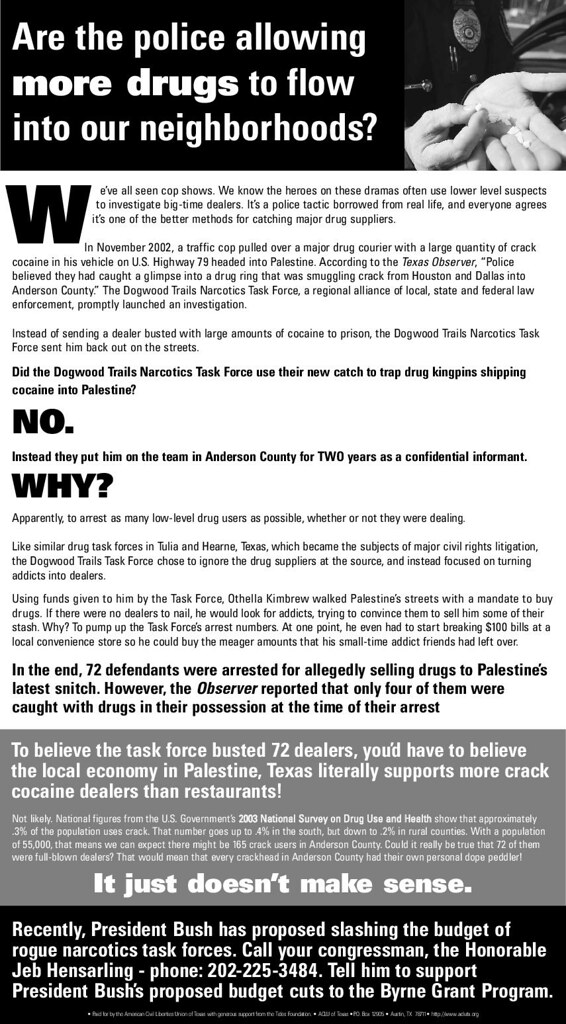
For that matter, this is an issue where I've long supported President Bush, even producing a series of full-page newspaper ads in support of his budget cuts that ran when I worked for ACLU. (Here's one that ran in the Jacksonville Progress; click on the image to enlarge.)

The sky didn't fall in Texas when our drug task forces lost their funding, and these other states will all survive, too. Democrats and Republicans alike should support President Bush's efforts to de-fund Tulia-style drug task forces nationwide.

Whitmire still angry over D'Pope's dismissal but the deed is done

The Dallas News this morning has a long feature on Texas Youth Commission woes that indicates Sen. John Whitmire is still on the warpath against the new conservator, Richard Nedelkoff. Whitmire intends to use a hearing scheduled on Friday to call Mr. N on the carpet for his decision to fire Dimitria Pope, the senator's long-time close friend. Reported Doug Swanson:

"I don't know who's on first base, and I'm not sure Nedelkoff knows what inning we're in," Mr. Whitmire said. "I don't have confidence that he knows what's going on."

Mr. Whitmire co-chairs the special joint legislative committee on TYC, which convenes Friday in Austin. He and other legislators say they will direct Mr. Nedelkoff – who in December became the agency's third conservator in nine months – to bring some desperately needed calm and purpose to the agency.

"It's awful," Mr. Whitmire said. "We need stability."

Apparently, Whitmire said, Pope misled the Legislature last year when she told them TYC was making good progress, telling him behind the scenes things were worse than ever:

Ms. Pope, who spent eight months as acting executive director, did not reply to several requests for comment. In December, she declared that TYC's progress toward reform was excellent. Behind the scenes, however, a different conversation was occurring.

"Ms. Pope's gone, but the problems still exist," Mr. Whitmire said last week. "She told me last month that things are a lot worse at TYC than anyone knows."

But inexplicably, the Senator is not angry at Ms. Pope for concealing these problems in her testimony before his committee on numerous occasions, but at the new conservator for recognizing she was covering up a big mess and getting rid of her. How much sense does that make?

Meanwhile, new concerns revealed at recent visits by the Ombudsman and Harris County's TYC liaison to the McFadden Ranch halfway house in Denton typify a slew of unresolved difficulties facing the new conservator:

Privately, senior TYC officials talk now of "hitting the reset button" on the agency for another rebuilding effort in many crucial areas. Among them: replacing failed therapy programs, finding qualified correctional officers to hire and maintaining order at isolated and outmoded youth prisons.

Recent reports by two independent inspectors found some of the old problems persisting. The reports, by TYC's independent ombudsman and Harris County's TYC liaison, were released to The Dallas Morning News by the ombudsman after a request under the Texas Public Information Act.

Both sets of findings were issued after unannounced visits to TYC's McFadden Ranch halfway house at Roanoke in Denton County. They detail repeated instances of failure to provide timely medical treatment to sick or injured youths.

One boy reported waiting weeks to see a doctor for a torn tendon in his wrist. Others complained of long delays in treatment for serious cuts, broken bones and breathing problems.

Several said they had not complained about medical treatment before because they were afraid of retaliation by staff.

The grievance procedures – by which youths file complaints – received strong criticism in the reports. Juveniles at McFadden "have consistently reported that they do not file grievances because it only makes their situation worse," the Harris County liaison wrote. "Youth report they are often singled out and ... the staff the grievance was filed against becomes angry and ridicules the youth by calling them 'snitch.' "

You can't say Pope or the Committee didn't know about McFadden Ranch's woes. Sen. Whitmire's joint committee was told about medical-related abuses there last August, and Ms. Pope told them she would immediately follow up. But here we are. (The comment string on the post about that committee's McFadden Ranch discussion is the longest ever in Grits' history - currently at 676 comments - including many other first-hand problematic allegations.)

Sen. Whitmire may well put the conservator through the ringer on Friday, but it won't matter. The deed is done. Hopefully other committee members will prefer to look toward the future.

One final note, apparently you really could tell who were the Grits readers at TYC after Dimitria Pope's firing. Swanson lede declares:
After Dimitria Pope's forced resignation from the Texas Youth Commission last week, some TYC employees began singing, "Ding-dong, the witch is dead," from The Wizard of Oz.
What Doug didn't mention was that those singing had all heard the tune as a result of its posting in Grits' comments soon after her departure was announced. So guess what, guys, you made the paper!

Saturday, February 16, 2008

Does the Texas GOP need judges who think being Latino makes you a "continuing danger"?

Texas Monthly and many others consider them "Texas' Worst Court," and in this writer's opinion, everyone should seize every available opportunity to vote against incumbent members of the Texas Court of Criminal Appeals. If you're voting in the GOP primary on March 4, you'll get that chance in in one of the three races.

The San Antonio Express News today endorsed challenger Robert Francis, a state district judge from Dallas whose candidacy Grits examined here, against Texas Court of Criminal Appeals Judge Paul Womack. There are plenty of reasons to vote against Womack, but the paper trots out this oldie but goodie:

Womack, who has served on the court for 12 years, also wrote the outrageous 2002 Saldano opinion, which allowed ethnicity to be considered as evidence that a defendant would be a continuing danger to society.

Two years earlier, then-Texas Attorney General John Cornyn had successfully petitioned the U.S. Supreme Court to overrule a previous Texas Court of Criminal Appeals decision in the case.

A psychologist testified during Victor Hugo Saldano's sentencing that he would be a continuing danger to society because he was Hispanic.

Dismissing the concerns of the state's top lawyer, Womack wrote the majority opinion that denied a new sentencing hearing because the defense attorney did not object to the testimony during the trial.

So one's Latino ethnicity, if it were left up to Judge Womack and the CCA majority, could be used by "experts" at trial to convince jurors the defendant is a continuing danger to society. (I can't decide which is more outrageous - that decision or Presiding Judge Sharon Keller's refusal to accept a last-minute death penalty appeal.) Even John Cornyn, then Texas AG, felt it necessary to ask SCOTUS to bench slap his fellow Republicans.

This was one of a series of opinions (see it in full) where the CCA essentially thumbed its nose at the US Supreme Court and refused to follow its dicta. It sounds unbelievable, but that's who we've got representing us on Texas' highest criminal court.

Are you embarrassed yet? Republicans will get a chance to do something about it on March 4.

UPDATE: The Fort Worth Star Telegram also endorses Francis. See more coverage of the race from the Houston Chronicle.

What's the appropriate sentence for official corruption?

Rooting out corrupt law enforcement would do more IMO to stymie drug cartel smuggling activity than all the interdiction tactics we can muster, so on one hand I'm glad to see the prosecution of a DPS crime lab technician and his cohorts this week in Houston for stealing 26 kilos of cocaine from the evidence locker. The technician was sentenced to 45 years in prison (out of a possible range of 5-99).

One Chron reader declared that "Whenever a public safety employee betrays the public trust they can and should receive a harsher sentence." That's true. But we see drug sentences that long for civilians, too, so it's not the official corruption that explains it. Even if the 31-year old lab technician is paroled after half his sentence, it will cost taxpayers $360,000 (in present-day dollars @$16K per year) to incarcerate him that long.

I'm all for prosecuting corrupt cops, but I agree with Chronicle readers who found the sentence over the top. After all, it's possible to get probation for murder in this state. An elected Sheriff from Cameron County who was actively assisting a drug cartel smuggling loads through his jurisdiction only received a 24 year sentence under federal guidelines.

What do you think? What's the right sentence in a case like this?

I'm not sure I see a good public safety reason for any non-violent offense to garner more than a second degree felony charge, which brings punishment of 2-20 years. The only possible argument for such long sentences is to "send a message," but in my book if you want to send a message, rent a billboard. Criminal law should be about justice, not public relations, but this sentence seems more about the latter than the former.

Challenging eyewitness IDs in court

The price is a little dear for my means, but some of you legal eagles may be interested in an event sponsored by the National Association of Criminal Defense Lawyers in New York City in March on litigating eyewitness ID testimony, a timely topic in the wake of increasingly strong evidence that faulty witness and victim identifications are the leading cause of wrongful convictions. In addition to instruction on applying cutting edge research and litigation techniques to challenge the veracity of eyewitness identification in court, the event will:
afford attendees the opportunity to forge relationships with the Eyewitness Identification Reform Litigation Network, which now has over 70 “point people” in 40 states. The Network is interested in working with the nation’s best criminal defense attorneys on pinpointing eyewitness identification cases with potential for creating favorable appellate decisions that incorporate the psychological research on identification issues and/or mandate procedural reform. As part of this endeavor, the second day of the training will include “break-out” sessions in which attorneys will workshop pre-selected cases which could become test cases for the Network’s reform litigation agenda. The training will be recorded and available via CD-ROM for CLE credit, and will be accompanied by a set of “master materials” corresponding to the topics covered.
While my guess is that neither the Texas Court of Criminal Appeals nor the Fifth Circuit are the first places the Network will seek to establish "favorable appellate decisions," we've had some cases in Texas that seem like poster children for their cause. I hope someone attends who blogs from the event. Registration information is here.

h/t: Eyewitness ID Blog

Where is Congressional investigation of steroid abuse among law enforcement?

Ever since the US Department of Justice (USDOJ) began selectively prosecuting high-profile athletes amidst Congressional media grandstanding, I've been wondering why the same focus isn't placed on law enforcement, where there's at least as much evidence of widespread use.

It turns out a fellow Texan beat me to that argument; Dr. John Hoberman of UT-Austin in 2005 wrote an informative article on the subject ("Dopers in Uniform," May 22, 2005). The full, footnoted piece is well worth reading, but here's an excerpt that shows the connections between police and steroids has been recognized for quite some time:
One of the remarkable anomalies of the anti-steroid campaign of the past two decades is that it has virtually ignored the many reports of steroid use by police officers in the United States and in other countries. Unknown but clearly significant numbers of policemen have imported, smuggled, sold, and used anabolic steroids over this time period. According to an article that appeared in the FBI Law Enforcement Bulletin in 1991: "Anabolic steroid abuse by police officers is a serious problem that merits greater awareness by departments across the country." In 2003 another expert offered a similar assessment. Little research has been done on the use of steroids by police, said Larry Gaines, former executive director of the Kentucky Chiefs of Police Association. "But I think it's a larger problem than people think.".

A segment of the CBS-TV program "60 Minutes" had already made that point on November 5, 1989. "Beefing Up the Force" presented interviews with three officers whose use of steroids had apparently caused the hyper-aggressiveness that had gotten them into serious trouble. The worst case involved what one psychiatrist called "a real Jekyll and Hyde change" in the personality of a prison security guard in Oregon who had kidnapped and shot a woman who made a casual remark he didn't like. He got 20 years in prison, and she was paralyzed for life. The personality he presented during his prison interview made it seem utterly improbable that he would have been capable of such an act. But his testosterone level when he committed the crime was 50 times the normal level. This broadcast conveyed the message that steroid problems were lurking in many police departments across the country, and that police officials were turning a blind eye to a significant threat to public safety.

It was no accident that the "60 Minutes" segment paid special attention to a "hard core group" of steroid users on the Miami police force. Two years earlier the Miami Herald had run a long article on steroid-using police officers. The seven notorious Miami "River Cops", who in 1987 were on trial for alleged crimes including cocaine trafficking and conspiracy to commit murder, included Armando "Scarface" Garcia, a weightlifter who had publicly admitted to taking steroids. "There's a great potential for an officer abusing steroids to physically mistreat people," said the police chief of nearby Hollywood, Florida, who had told his investigators to be on the lookout for officers who looked like "small mountains." The Miami Herald article may have been the first of the tiny number of analytical treatments of this subject that have appeared in American newspapers since the 1980s.
So the next time you hear someone say that steroid abuse isn't a problem among cops or that there isn't a documented need to investigate the issue compared to professional athletes, you might share Dr. Hoberman's piece with them. (I can't find the referenced 1991 FBI Bulletin online, but I'll see if I can lay my hands on it.)

The House Government Oversight Committee's grandstanding witch hunt over steroid use in sports constitutes one of the craven abuses of power I've seen in a while. In an election year, Waxman's antics honestly makes me wonder whether national Democrats are ready to run the country? The Chairman actually told the New York Times:
“I’m sorry we had the hearing. I regret that we had the hearing. And the only reason we had the hearing was because Roger Clemens and his lawyers insisted on it.”
Well gee, sir, NOW you regret it? Who controls the damn committee besides you? Clemens insisted on the hearing because the other option was for you to issue a report smearing him without including his side of the story! Houston lawyer Rusty Hardin's views are closer to my own on this when he:
said Waxman’s statements were “unbelievable, disingenuous and outrageous.”

“He is the one who created this circus in the first place,” Hardin said of Waxman, contending that Clemens and his lawyers had asked several weeks ago for the hearing to be called off, only to be rebuffed by Waxman’s staff.

“We didn’t think any good would come out of having a food fight with the accuser,” Hardin said in reference to McNamee. But once the depositions were taken last week, he said, the Clemens side felt it had no choice but to proceed, fearing that the committee would use the depositions to produce a hostile written report. “We wanted this out in the open,” Hardin said.
The Justice Department should never have assisted Mitchell Report investigators, and certainly it was a mistake to include uncorroborated allegations from an informant who'd been threatened with incarceration. The hearing was little more than an elaborate perjury trap.

But more than that, why is Congress investigating baseball, anyway, especially when the feds have known for two decades there's a significant problem with steroid abuse in law enforcement they're utterly ignoring? Where are your priorities, Chairman Waxman?

I'm still wondering, as are many Americans, why the steroid hearings were so partisan, with Republicans mostly supporting Clemens and Democrats like Waxman fairly openly supporting Brian McNamee? Stephen Colbert suggested the other night it was because Republicans supported drug users while Democrats supported drug dealers! That explanation makes about as much sense as any. But nothing I've heard explains to my satisfaction why this was any of Congress' business.

Friday, February 15, 2008

Rosenthal Finally Chucks It

First Dimitria Pope's resignation at the beginning of the week and now Harris County DA Chuck Rosenthal has resigned. Somebody pinch me!

Why would Rosenthal leave now after all he's endured? According to his resignation letter, reports the Houston Chronicle, he declared that "Although I have enjoyed excellent medical and pharmacological treatment, I have come to learn that the particular combination of drugs prescribed for me in the past has caused some impairment in my judgment."

Evan Smith at Texas Monthly thinks the excuse would "make Lindsay Lohan proud." "The drugs did it!," he wrote. "That explains everything! And excuses nothing."

Speaking of Evan, in honor of this occasion he's submitted his own Chuck Rosenthal Haiku to commemorate the degraded DA's final hoorah; I think it sums up matters quite well:

Chuck’s awful career
gets a lethal injection:
Drugs made him do it.

Goodbye Chuck Rosenthal! Don't let the door hit you in the keyster on your way out.

UPDATE: See thorough coverage from Texas Lawyer. Also, Mark Bennett at Defending People makes the following connection between Rosenthal's drug habit and one of the GOP candidates running to replace him:

Dr. Sam Siegler has been described as Chuck's personal physician; from the emails released back in January it appears that Dr. Siegler's office was Chuck's go-to source for prescription meds.

Who prescribed the drugs that impaired Chuck's judgment? Dr. Sam Siegler?

Who is Dr. Siegler married to? Kelly Siegler.

Whose position is Kelly now running for? Chuck's.

Cozy, no?

Did Chuck's impairment escape the notice of those who worked with him at the DA's Office? If you realized that he was impaired, why didn't you speak up? If you realized it and didn't comment, or didn't realize it, what does that say about your judgment?

Give me your opinion on a draft resolution supporting TYC reform and we'll see if Grits readers can get it passed

This year the presidential fight for every last delegate in Texas ensures that Democratic precinct conventions on March 4 will be better attended than any time since I've been politically active.

Precinct-level battles on the GOP side have long ago been won, by and large, by the religious right, and are mostly attended by party regulars. On the D-side, though, this year's precinct conventions will see a lot of new faces. Democrats get to "vote twice" for President: Once at the ballot box, and for the committed, again on election night selecting delegates at their local precinct convention.

One of the roles of these "conventions" in both parties (besides selecting presidential delegates and party leadership) is to propose resolutions for legislative action or changes to the party platform. The missus liked the resolution I wrote on prison and jail diversion, and suggested that readers might appreciate it if one were prepared about the Texas Youth Commission.

I agree, but on this one, I'm going to propose a draft and let folks make suggestions for changes and improvements before creating a final version. Then next week I'll roll out a little mini-blog based campaign to support both resolutions, just to see how far we can take the idea. If you're going to attend your precinct convention anyway - as will record numbers of Democrats, I predict, to support their presidential choices - you can take these resolutions with you and see if you can garner support.

Proposing resolutions in this fashion serves a couple of purposes: Though hardly anyone reads the platforms (deservedly), if you can get a resolution passed, a letter from the party telling the party delegation to support X, Y, and Z carries some weight. Perhaps more importantly, though, the process of getting them passed (or even proposing them and failing) educates party regulars and opinion leaders about problems and needed solutions on the issues you're discussing.

Though the language below is written for presentation at the Texas Democratic Party, obviously you could change that to the "Republican Party of Texas" and propose it on the GOP side, if that's where you vote. Both support and opposition for these ideas is pretty bipartisan.

While I've written before that "Blogs are a media strategy, not an activist medium," that belief is based on analysis, not real-world experimentation and evaluating results. Since I wrote that, e.g., Grits' readership has probably quintupled. So who knows if it remains true in today's dynamic environment? (It's certainly worth launching a low-stakes experiment to find out.)

Let me know what you'd add, change, delete, etc., with the language below, then next week we'll put together some tools to assist Grits readers who'd like to promote these resolutions when you go to support your candidate. Here's a draft of the TYC resolution:
RESOLUTON CALLING FOR JUVENILE JUSTICE IMPROVEMENTS AND REFORM OF THE TEXAS YOUTH COMMISSION

WHEREAS the Texas Youth Commission (TYC) became embroiled last year in an internationally publicized sex scandal involving multiple facilities that cast a harsh light on problems in the state's juvenile justice system, causing its executive director and most top staff to resign or be fired;

WHEREAS the Governor's initial appointments to run TYC all came from the adult prison system and wrongfully spent the last year implementing policies based on an adult corrections approach;

WHEREAS a Blue Ribbon Panel convened to suggest solutions for TYC proposed shifting from large, adult-style units to smaller, community-based settings following national best practices;

WHEREAS the Blue Ribbon Panel found that TYC had developed a "punishment culture" similar to adult prison settings including overuse of physical restraints and solitary confinement, and recommended a shift toward a rehabilitative model;

WHEREAS most incarcerated youth in TYC facilities committed nonviolent offenses and end up there because local systems for educating and supporting kids with special needs have failed;

WHEREAS virtually all TYC youth will re-enter society in just a few years, and under the current "punishment culture" more than half commit new offenses when they leave incarceration;

WHEREAS TYC, like the adult prison system, suffers from chronic understaffing that makes both employees and youth in their care less safe and prevents treatment and rehabilitative programming;

WHEREAS because of underfunding by the Legislature and a lack of qualified treatment providers, youth sent to TYC routinely spend many extra months incarcerated waiting for spots in required treatment programs;

WHEREAS a significant percentage of TYC youth suffer from unmet mental health needs, and serious problems like post-traumatic stress treatment for abused youth go untreated;

BE IT THEREFORE RESOLVED that the Texas Democratic Party encourages the Texas Legislature to follow the recommendations of the Blue Ribbon Panel aimed at rehabilitating youth and ending the agency's counterproductive "punishment culture";

BE IT RESOLVED that the Texas Democratic Party encourages the Legislature to provide substantial additional funding to TYC to eliminate backlogs for drug and alcohol treatment, anger management, and other required programming, and to increase employee pay to eliminate chronic staffing shortages;

BE IT RESOLVED that the Texas Democratic Party encourages the Legislature to expand programming through county juvenile probation departments and asks county juvenile court judges to shift youth whenever possible away from youth prisons to community based settings;

BE IT RESOLVED that the Texas Democratic Party encourages the Legislature to prioritize expanding mental health treatment for youth in both carceral and community based settings, diverting mentally ill youth away from incarceration;

BE IT FURTHER RESOLVED that the Texas Democratic Party urges county governments to expand treatment and diversion programs to reduce the number of TYC commitments.

Submitted to and Adopted by Precinct ____ in ________________ County, Texas, Senatorial District ___, on March 4, 2008.

___________________
Convention Secretary
What would you change? What do you like? What should be added or deleted? Let me know what you think in the comments and we'll get a final version out next week.

Thursday, February 14, 2008

Watch Travis County DA Candidate Forum Online

I just finished listening to a Travis County DA candidate forum held by the Austin chapter of ACLU and the Texas Moratorium Network, which Scott Cobb of TMN placed online over at Burnt Orange Report. (Isn't the internet a wonderful thing? I regretted missing the forum which took place about a half mile from my house, but Voila!, here it is!) Honestly, we're pretty lucky: From what I've seen, I'd be proud to have any of these Democratic candidates (there's no Republican running) represent me.

A couple of highlights: It was good news to me that all of the candidates supported expanding pretrial diversion for drug crimes and simply not prosecuting many of these cases. As mentioned recently, Travis County has the highest rate of pretrial detention for low-level offenses among large Texas counties - 24% of Travis County jail inmates are misdemeanants or state jail felons, compared to a statewide average of 10%.

Mindy Montford backed an idea for 24-hour ADA coverage to work more quickly process cases as they come in. I thought that was a good idea; the defense lawyers have to work all hours, the ADAs can do so, too! Seriously, processing cases faster at the front end of the process, particularly if we're going to expand pretrial diversion programs, is an important way to improve the system. That should be done no matter who wins the election.

Rick Reed got on my good side when he called for an "open file" policy at the DA's office. Reed also declared he would ask police to stop performing "consent searches" on Class C matters; they're disproportionately happening in poor and minority communities, he said. Long-time readers know I'm a big fan of that idea.

Candidates were asked about the recent study by the Justice Policy Institute that found that Travis County incarcerates black folks at 31 times the rate of whites. I was surprised to hear Rosemary Lehmberg, the long-time First Assistant to retiring incumbent Ronnie Earle, say that "police are making too many drug busts on one-rock cases." Gary Cobb suggested an idea from North Carolina where police videotape open-air drug dealers then intervene with their families combined with threats of prosecution to get them to stop.

Finally, on the question of the death penalty, Cobb asked the panelists whether they would support a moratorium on the death penalty in their office - not just while we're waiting for SCOTUS to decide Baze, but in general as a policy of the office. Only Rick Reed said he would do so; he declared when he was first hired as a prosecutor in Dallas he told them that he would be unwilling to prosecute such cases (he'd notify his supervisor, he promised, whenever it came up). He held that position, he said, because "regardless of advancements in technology there can always be human error throughout the process."

Rosemary Lehmberg replied that the death penalty now in Travis County is seldom used; Travis currently only has five defendants on death row. Lehmberg said she helped craft the current process for making capital punishment decisions which had become a national model, and recommended a Time magazine feature describing the process, "Guarding Death's Door."

Rick Reed's answers were probably the closest to my own opinions, and after watching the forum I'm probably leaning in his direction. But all four candidates had different things going for them. The whole video is a little more than 90 minutes long, so if like me you're still trying to figure out who you support, take the time to watch. And let me know what you think of the various candidates in the comments.

RELATED: See this string from the state prosecutors association debating the ethics of a candidate for DA declaring opposition to the death penalty.

UPDATE: Scott Cobb lets us know that there will be two more chances to watch these candidates debate. He has the details of a forum on Monday evening at the Dell Jewish Center, or you can watch a taped debate on Channel 8 or even on demand! Good for you, Time Warner Austin. Wrote Cobb:
You have three opportunities this weekend to watch a debate among the four Democratic Primary candidates for Travis County District Attorney on News 8 Austin. Here are the details from their website:
The debate will be on News 8 Saturday at 5 p.m., and twice on Sunday at 11 a.m. and 7 p.m. Also, beginning this weekend you can catch the debate at your convenience on News 8-on-Demand on Time Warner Cable Channel 1408.

Prosecutorial palavers about dildos, unhackable passwords, bogus forensics and copper theft

I hadn't visited the Texas prosecutors association message board in a while, and doing so today found several interesting goodies there:

One less felony on the books: Texas ban on sex toys struck down
I've mentioned before that Texas had 2,324 separate felonies on the books, but as of yesterday the new number is 2,323. Via this post, we learn that the 5th Circuit struck down Texas' statute criminalizing the sale of sex toys. See the 5th Circuit opinion, which relies primarily on the 14th Amendment as explicated in two landmark cases - Griswold v. Connecticut and Lawrence v. Texas - to determine that the state could not prohibit the toys' sale. From a distance this looks like quite a shift for the 5th Circuit, which at times has seemed barely aware of either the 14th Amendment or this line of cases. The Denton ADA who posted the item hoped wistfully the case might be appealed to the US Supreme Court, but more likely than not this decision will stand and simply erase Texas' prudish and outdated law.

Unhackable Passwords
I found this thread quite interesting on the limits of police ability to hack into hard drives using the PGP ("Pretty Good Privacy) encryption system.

Bogus Forensics
Yet another interesting thread focused on allegedly "bogus forensics," where one prosecutor declared ""the chances of being wrongly punished because of a false positive or bogus test are smaller today then they've ever been." Another commenter disagreed, though, declaring:
I'm not so certain this is true, because today there are so many tests (with attendant experts) out there - many of them with no real scientific grounding. What's worse, even if the theory underlying the science is valid, the actual practice is often undertaken by people/organizations with less than stellar competence. Example 1: The Houston crime lab fiasco. On CSI you see all these hyper-smart highly motivated experts working with 'state of the art' technology in an aesthetically pleasing laboratory....reality is often an under-achieving lab tech with a 'safe' government job in a crowded, dirty, underfunded, basement lab who knows there is little chance of being caught 'drylabbing.'
See the rest of sjf's comments for an interesting discussion of the downsides of science in the courtroom.

It may be a felony but you still have to catch them
This TDCAA discussion string focused on copper theft, which the Texas Legislature just made a state jail felony last year, even for stealing small amounts. The discussion tells me that the main problem isn't how harshly copper thieves are punished, but how to catch them? This seems to me another case where the Lege increased penalties to look like they're doing something, but the real problem goes unresolved because what's really needed is better front-end enforcement. The strategy described in Houston seems more likely to yield results:
Undercover police officers would go to scrap metal dealers posing as employees of an air conditioning company. They told the operators of several scrap metal places that they wanted to sell the coils from air conditioning units. But, they would ask if the dealer ever did business with the company that hey "purportedly" worked for. They didn't want someone from their company or thier boss to show up while they were trying to sell the coils. They made it clear that they were stealing the coils from their employer and wanted cash for the copper in the coils. All of this was recorded. They wouldn''t arrest anyone at that time but just sell them the coils. After they visited several places on more than one occassion each selling "stolen" coils to them the officers then met with me and I dreafted search warrants of each location for documentation of the purchase of the items. Texas law requires that they document the purchases. In every purchase, the owners of the scrpa metal dealership would fill out a receipt, as required by Texas law, but they put in phony names and dates, which we could substantiate from the taped recordings of the purchase.
See other discussion threads from Texas prosecutors - they always make for interesting reading.

Texas law bloggers enjoy deep talent pool

Scott Greenfield at Simple Justice thinks there must be something in the water that generates so many Texas law blawggers:
It seems like there's another new blawg by a Texas lawyer for every new one by a lawyer anywhere else in the country. Why is that? Today, I stumbled upon two blogs I'd never seen before, Bad Court Thingy and Not Guilty. The former is by a new lawyer who has inexplicably chosen to post anonymously, while the latter comes from a more experienced lawyer who is skirting the edges of the blawgosphere and self-promotion. Then, there's the eponymous Life at the Harris County Criminal Justice Center, a tad parochial on the parochial side.

The odd thing about the Texas blawgs is that they tend to focus largely on the sovereign Nation of Texas. Some might think they are narrow for that reason. I just think they don't give a hoot about what happens in foreign lands, like the United States of America.
Greenfield also wishes, as I do, that we saw more posts from Austin Criminal Defense Lawyer, declaring "another MIA blawger is Jamie Spencer, whose posts are always exceptional but increasingly sporadic. Come on Jamie, hunker down and get to work."

In the comments I suggested several reasons for the large number of Texas Blawgs:

First, it' s not just law bloggers. I saw recently that Austin is the leading city nationwide in terms of blog readership. Also, Texas is huge - 23 million people. Doug Berman did a post about Kansas recently and I realized their entire state prison system is smaller than the Harris County Jail!

Plus we've got a lot of solo practitioners in Texas, and they're just the kind of people who blogging appeals to - folks with big egos, lots of opinions and a yen for self promotion.

Finally, Texas had several early adopters like Houston's Clear Thinkers, Grits and the (now dormant) Texas Law Blog that spread the idea of blogging on state and local legal topics in TX pretty early on, inspiring others to try it.

Some combination of those reasons, plus several, I'm sure, I haven't thought of, probably explain it. Whatever the reason, it's really true though. Texas has more good law blogs that have gone out of business than most states have currently active! Here are a few more blogs with good recent posts that demonstrate the depth of the Texas legal blawgosphere:
Let me know in the comments why a) you think Texas has such a depth of blogging talent on legal issues, and b) any other active Texas legal blogs you enjoy that I'm missing, particularly ones not already named in Grits' sidebar, which I've not been updating as regularly as I should.

Wednesday, February 13, 2008

Congressional steroid hearings an abuse of power

We're at war. The nation's credit system and housing markets are headed down the toilet. One quarter of Americans don't have healthcare and about 2 million Americans are locked up behind bars. But Congress and the nation's media today will focus their rapt attention on steroids and baseball, with "Rocket" Roger Clemens scheduled to testify under oath, risking perjury charges if he lies.

Let me repeat that: Clemens will testify under oath to Congress. We couldn't get Condi Rice to testify under oath about 9/11, and myriad Bush administration officials under the GOP Congress were allowed to appear before Congress without risk of perjury charges if they lied. But now Congress will give a baseball pitcher the third degree? I can just see the D.C. pols thinking, "We've got to get that guy's testimony straight. The fate of the republic is at stake."

No wonder Congress polls lower, even, than the President! What a bunch of grandstanding fools.

I'll give Clemens this: If he testifies under oath at risk of perjury that his ex-trainer did not give him steroids, the chief argument of his critics will be taken away. Senator Mitchell and others have said that Brian McNamee's testimony was credible because he risked perjury charges if he lied. But if, after this hearing, Clemens is in the same position and there's no other evidence besides the informant, all you have is a he-said, he-said situation where no one can prove what happened.

Which is why this witch hunt was a bad idea in the first place, and why it was improper for the Justice Department to participate in this PR-driven investigation.

I'd still like to know why the Justice Department and Congress don't pay this much attention to the just as clear evidence of widespread steroid use among law enforcement?

Just to have mentioned it, and this is naught but suspicions from afar, but I couldn't help but suspect foul play when I saw in the New York Times that the pharmacist who allegedly sold steroids to New York City police officers in an ongoing scandal turned up dead. I kid you not, officials ruled it a suicide (because they found a note and a gun) even though police said he died from "gunshot wounds to the chest and head."

Have you ever heard of a suicide with two shots to the chest and the head? If the guy accusing Roger Clemens turned up dead under these circumstances, do you think there'd be a bigger media hoopla than the one-day story in passing that constituted coverage of this pharmacist's death?

I bring up the NYC police case because the Department of Justice (and hence Congress) actually has an historic role investigating police corruption. But under the Bush administration, DOJ has turned a blind eye to police use of steroids and focused on high-profile athletes. That may make bigger headlines, but the approach results in little public safety benefit, especially when you consider that the "path not taken" in the steroids investigation would have been to go after corrupt cops.

Using Congressional investigative authority to create perjury traps for athletes is a joke when the government doesn't have to play by the same rules.

UPDATE: Here's an oddity from the long, grueling hearing: I got to watch the last half of it, and there was a clear pattern among the Congressional questioners. With the exception of drug war zealot Indiana Republican Mark Souder, all the GOP members appeared sympathetic to Clemens, while the Democrats appeared more accusatory of the baseball star. That pattern culminated when, in his closing remarks, Chairman Henry Waxman, a Democrat, actually apologized to Brian McNamee for comments by his colleagues, even though all they'd said was that he is a liar and a drug dealer, both things to which he's already admitted.

I don't understand why Congressional loyalties would fall along partisan lines? What am I missing that explains this pattern?

The rest of the "new" evidence that came to light was hearsay that would never hold up in court, so unlike the ESPN talking heads I don't expect any perjury charges to arise from this episode in either direction.

Waxman told the press the hearing was held because Roger Clemens insisted on it, but that's not how I see it. I think the hearing was held because the Mitchell report irresponsibly named Clemens based on the word of an informant coerced with threats of incarceration. After that horse was out of the barn, all Clemens could do was try and clear his name. At this point, whoever you believe, Roger Clemens has done everything he could possibly do to try to achieve that increasingly unlikely goal.