Time for Grits' year-end list of Texas' Top Ten Criminal Justice Stories of 2007. Let me know what other big stories deserve recollection as we close out an eventful year.
Texas Youth Commission Meltdown
It's hard to imagine a state agency enduring more turmoil than TYC has gone through this year. New administrators appointed by Governor Perry took an already troubled agency and nearly ran it into the ground. Hopefully the agency's new conservator, who's been awfully quiet since his appointment just before Christmas, will begin to clean house and move TYC in a new direction. I've written so much on this subject it would be fruitless to try to summarize the past gut wrenching year in this space, but see prior Grits TYC-related posts for an in-depth look at what's happened to this agency in 2007.
Prisons Full and Understaffed: Sentences too long and parole too rare
With Texas prisons full and unable to staff current units, the Legislature and voters approved debt to build three new prisons. However, with staffing problems unresolved, the system really must pin its hopes on increasing parole rates for low-level, non-violent offenders, which under current Board of Pardons and Parole Chair Rissie Owens have reached all-time lows. The Sunset Commission said low parole rates were the main cause of prison overcrowding in the last few years along with lengthier sentences "enhanced" by the Legislature. Now the parole board must change course and dramatically shorten prison stays for many non-violent offenders, who make up a majority of Texas prisoners, in order to free up space to keep more dangerous criminals behind bars.
Rehabilitation Re-Emphasized in Adult System
Ironically, while youth corrections moved away from a rehabilitative model toward simply warehousing youth, Texas' adult prison system took important first steps in 2007 toward embracing and funding long-ignored treatment and rehab programs. The Lege shortened probation lengths for many low-level offenders, giving them new opportunities to earn their way off probation through good behavior. In addition, local use of drug courts expanded this year - 37 different such courts statewide recently received federal pass-through support grants from the Governor. Even more importantly, the Legislature ponied up more than $200 million to expand drug treatment and intermediate sanctions facilities that give courts new tools to combat substance abuse and reduce recidivism among chronic low-level offenders.
Exonerations Inspire Dallas DA to Team Up with Innocence Project
Dallas District Attorney Craig Watkins reacted to a string of DNA exonerations in his county quite differently from his predecessor: Rather than fight fact-based exonerations tooth and nail, Watkins teamed up with the Texas Tech-based Innocence Project of Texas to ensure that every offender who's innocence could possibly be verified through DNA testing had their case independently reviewed. In an era when prosecutors like Chuck Rosenthal and Mike Nifong more frequently dominate headlines and political discourse, Watkins has been a breath of fresh air, and is fast becoming a media darling for pioneering new strategies for managing flaws in the justice system, not to mention, as the Dallas News put it, shifting the DA's Office's focus from "winning" to "justice."
Sharon Keller Disgraces Court, State
While in most states the big death penalty news in 2007 was the de facto moratorium until SCOTUS decides on the constitutionality of lethal injection procedures, in Texas the bigger controversy arose around the de jure decision to execute Michael Richard after SCOTUS issued its decision to review lethal injection in Baze. How many sitting judges can say about 150 attorneys and a thousand other citizens have signed onto complaints against them with the state Commission on Judicial Conduct? Only one that I know of: Texas Court of Criminal Appeals Presiding Judge Sharon Keller. Her decision not to notify her fellow judges of an 11th hour delay in a death penalty appeal - including keeping the jurist responsible for the decision out of the loop - arguably could have ranked at the top of the list except for one reason: Keller and the CCA have so long ago disgraced themselves that the egregious behavior that shocked the rest of the world seems to those of us here in Texas nearly routine. We'll find out in the coming week whether any Democrats will file to challenge incumbent Republican CCA members - I'll have more news on that score real soon. Arguably these judicial seats rank among the most vulnerable statewide races in the 2008 elections.
Actual and Perceived Corruption on the Rise
This year saw a great deal of both actual and perceived corruption discovered, with the public left wondering how deep it all goes. Though claims of terrorist infiltration along the border all turned out to be bogus, an increasingly impressive number of officers on the US side have been accused of accepting bribes at a time when cartels have begun to extend their influence northward, including recruiting hitmen among poor US teens in border towns. Meanwhile, the US Export Import Bank was revealed to have given millions in loans to known drug cartel members. A corruption probe in El Paso accusing public officials of bribe taking includes more prominent local names every time I see new coverage. In Houston, an assistant chief testified under oath that a woman who performed oral sex to avoid arrest engaged in a "consensual" agreement with the officer. In Dallas, more than a dozen Democratic politicos were accused of various corruption charges by the feds in 2007, including state Rep. Terri Hodge who allegedly accepted free rent for several years from a developer for whom she did political favors, according to the federal indictment. At the Texas Youth Commission, a probably unnecessary contract to re-categorize inmates was given with no bidding process to Gregg Phillips, a lobbyist friend of former state Rep. Arlene Wohlgemuth who has been accused in the past of improperly steering state contracts to friends and family. The Bexar County Sheriff resigned to avoid a felony indictment for bribery regarding a contract with a private firm to operate the jail commissary.
New DPS Drug Enforcement Rules Boost Seizures, Reduce Arrests
Vying with the previous item for the "Most important, seldom told story of the year," the Texas Department of Public Safety reported this year that new drug enforcement priorities implemented in recently adopted agency rules growing out of the "Tulia" debacle had produced remarkable results, doubling the number of drug seizures in the first year while overall drug arrests declined 40%. That's because the new rules place "no priority" on arresting "end users," defined as "the intended user of illegal drugs [who is] generally motivated by addiction." Instead, DPS now targets "Drug Trafficking Organizations" with five or more identified participants. One especially notable aspect of this new strategy was the elimination of drug interdiction units on the highway: I was fascinated to realize that even though DPS no longer fishes for drug shipments on the Interstates, their total drug seizures increased. Congrats to Commander Patrick O'Burke and everybody else in DPS Narcotics for transforming the Tulia tragedy into a legacy of improved, more professional drug enforcement statewide.
Hype-Driven Pedophilia Law Makes Family Abuse Victims Less Likely to Come Forward
Succumbing to an extraordinary season of hype about child abusers during the 2006 election, the Texas Legislature in 2007 passed "Jessica's Law," an ill-considered piece of legislative flotsam that created a new crime, "continuous sexual abuse of a child," with minimum penalties of 25 years on the first offense and allowing death on the second, and eliminated the statute of limitations for sexual offenses against children. When the bill passed, I predicted that "the 25 year mandatory minimum first offense will be reduced by a future Texas Legislature soon after the first instance discovered where a family did not turn in a pedophilia case involving a young child because of stiff first-time sentences. I hope I'm wrong, but I don't think so."
Border security policy misses target
Despite evidence that "Operation Linebacker" and its bureaucratic descendants failed to reduce crime in the areas that received new funding, Governor Perry and his legislative supporters dramatically expanded funding for this pork barrel program, approving more than $100 million for "border security" in the 2008-2009 biennium. So far, the Governor has focused on establishing a parallel bureaucracy to Texas' traditional security agencies like the Department of Public Safety that are under his control, but unfortunately these new entities don't typically communicate or work with other agencies, according to legislative testimony. Bottom line: That dynamic has made the Governor's homeland security division a quite expensive and counterproductive third wheel whose sole function appears to be to fight with older bureaucracies over "turf." This policy makes no one happy: Conservatives who want immigration enforcement will be disappointed because, despite all the hype, none of the money goes toward that purpose, while anyone concerned with battling drug cartels will find little direct correlation between new money spent and outcomes on the ground.
Healthcare in prisons and jails nearing crisis
With the federal government having ordered the state of California to open up the taxpayers collective wallet to pay for long-neglected prisoner healthcare, a looming subterranean health crisis faces Texas prisons and many jails. The University of Texas Medical Branch at Galveston, in particular, has admitted in legislative hearings that the care they provide in adult prisons is "barely constitutional," while the care they provide at the Texas Youth Commission actually got worse after the agency went into conservatorship, UTMB reported. Until 2006 UTMB was responsible for jail healthcare in Dallas, but county officials ended that contract because of outcomes so bad they invited a federal civil rights lawsuit. Could healthcare in Texas prisons, which UTMB runs using the same telemedicine scheme used in Dallas, be far behind? How long will Texas get a pass for spending half the amount per inmate on healthcare compared to California and most other large states? Time will tell, but my guess is not long after a certain former Texas Governor leaves the White House - particularly under a Democratic President, but really either way - we can expect litigation aiming to force increased spending for Texas prison healthcare from the US Justice Department.
Honorable Mention:
Public Sentiment Waning for New Jail Spending
In what I consider a bellwether election on the subject in November, voters in two of Texas' most conservative, "tuff on crime" counties - Harris (Houston) and Smith (Tyler) - rejected new debt for jail building. In Tyler, where opponents mounted an active anti-jail campaign, voters rejected a new jail by a 69-31 margin. In Houston, heavy turnout in black neighborhoods and modest support elsewhere doomed the proposal by a narrower margin - 51-49 - with no opposing campaign and with blogs as the only vocal opposition. Notably, it was the first time Houstonians rejected bonds on any public ballot in more than 20 years. Voters may like the "tuff on crime" message, but these elections show they may not be so happy when presented with the long-term bill. The Legislature responded to local jail overcrowding by expanding the range of offenses for which police can use a "cite and summons" mechanism instead of arresting non-violent class B offenders, but so far officers in most counties aren't using this new authority. Time will tell if these is an electoral blip on the radar screen or the beginning of a more significant trend.
See last year's list, and a recent update on those stories.
Annual contenders:
Monday, December 31, 2007


What is the "pro-animal" agenda?
I got to visit yesterday with a friend who works for the Humane Society, who mentioned something I found interesting: I enviously observed that it must be a lot easier to advocate for puppies and kittens than for people caught up in the justice system, to which she replied that the Humane Society policy agenda was "boring." "It's all enhancements," she said, "just increasing penalties for animal cruelty, stuff like that."
 That's a shame. Nobody is more pro-dog than me (not really a cat person), but it makes little sense to increase penalties for animal cruelty when the current laws go largely unenforced until an animal has already met its untimely demise. If you want to prevent animal cruelty, or investigate allegations thereof, spending greater resources on enforcement on the front end would do a lot more good than punishing the occasional person actually caught more severely.
It shouldn't be necessary for criminal justice reformers and animal advocates like the Humane Society to be on opposite sides of the political fence. Historically, the knee-jerk, bipartisan first reaction to every social woe is to pass a law against it and increase penalties if the law doesn't stop it. For many offenses though, like drug use and animal cruelty, that approach has largely failed to stop the behaviors.
So what might a more effective pro-animal political agenda look like that did not focus on increasing criminal penalties?
Most public education efforts typically aren't very effective, my friend said, but perhaps it would be possible to think creatively about that: We don't need to "educate" everyone, since most people don't abuse animals, but only those who've engaged in the behavior. What if the punishment for animal cruelty weren't incarceration, but education for offenders including community service jobs that provide supervised services to abused animals (or even just shoveling poop at the dog pound). Maybe education resources would be better spent more intensively on the handful of people prone to abusing animals rather than on the general population.
What other pro-animal agenda might be developed that doesn't involve penalty increases? The obvious ones are funding for dog pounds, spay/neutering functions, "rescue" services, perhaps marketing for pet adoption, programs to train dogs for dog owners with disabilities or other special needs. I'd also like to see offenders sentenced to some sort of peer education, using those who've engaged in activities like dog fighting, e.g., to perform pub ed functions within their own social networks as part of community supervision.
There must be other ways the government could reduce animal cruelty besides just increasing penalties. Let me know in the comments if you can think of any others.
 That's a shame. Nobody is more pro-dog than me (not really a cat person), but it makes little sense to increase penalties for animal cruelty when the current laws go largely unenforced until an animal has already met its untimely demise. If you want to prevent animal cruelty, or investigate allegations thereof, spending greater resources on enforcement on the front end would do a lot more good than punishing the occasional person actually caught more severely.
It shouldn't be necessary for criminal justice reformers and animal advocates like the Humane Society to be on opposite sides of the political fence. Historically, the knee-jerk, bipartisan first reaction to every social woe is to pass a law against it and increase penalties if the law doesn't stop it. For many offenses though, like drug use and animal cruelty, that approach has largely failed to stop the behaviors.
So what might a more effective pro-animal political agenda look like that did not focus on increasing criminal penalties?
Most public education efforts typically aren't very effective, my friend said, but perhaps it would be possible to think creatively about that: We don't need to "educate" everyone, since most people don't abuse animals, but only those who've engaged in the behavior. What if the punishment for animal cruelty weren't incarceration, but education for offenders including community service jobs that provide supervised services to abused animals (or even just shoveling poop at the dog pound). Maybe education resources would be better spent more intensively on the handful of people prone to abusing animals rather than on the general population.
What other pro-animal agenda might be developed that doesn't involve penalty increases? The obvious ones are funding for dog pounds, spay/neutering functions, "rescue" services, perhaps marketing for pet adoption, programs to train dogs for dog owners with disabilities or other special needs. I'd also like to see offenders sentenced to some sort of peer education, using those who've engaged in activities like dog fighting, e.g., to perform pub ed functions within their own social networks as part of community supervision.
There must be other ways the government could reduce animal cruelty besides just increasing penalties. Let me know in the comments if you can think of any others.
Sunday, December 30, 2007
Smith County Justice Gets New Web Watchdog
Go say "Howdy" to SmithCountyJustice.org, a new website dedicated to "fighting injustice and corruption in Smith County, Texas." Regular readers know I grew up in Smith County (in the county seat of Tyler, actually), and try to keep up with local crime and punishment issues back in the hometown as much as possible. The site joins another local blog, Smith County: Tell the Truth, documenting the social, public safety and monetary costs of Tyler's legendary "tuff on crime" brand of justice.
Wichita Falls task force proves asset forfeiture can't finance drug units
There's a lesson to be drawn from the final demise of the North Texas Regional Drug Task Force based in Wichita Falls: It's hard for an honest privateer to make a living these days.
One of the last remaining Tulia-style drug task forces, the North Texas task force had hoped to continue operations based solely on asset forfeitures and funds seized from drug interdiction on the highways. As media everywhere publish their year-end retrospectives (Grits' own feature on the Top Ten Texas Criminal Justice Stories of 2007 will appear tomorrow), we find news from the local daily that the task force couldn't make their budget just by seizing funds. Reported the Times Record News ("Top stories of the year," Dec. 29):
But the second reason given explains why THAT plan failed: "the trend of drug traffickers to choose methamphetamine over cocaine, which resulted in lower cash seizures." The narco-warriors simply couldn't make enough money through asset forfeiture to make the special unit worthwhile.
Fighting crime should not be a for-profit enterprise, which is what they tried to turn this task force into in Wichita Falls. It's one thing to occasionally benefit from asset forfeiture funds, and quite another to rely upon them routinely for one's annual budget. It was a bad idea from the start and I'm pleased, if unsurprised, to discover that it failed.
When the Tulia scandal broke in 1999, Texas had more than 50 of these regional drug task forces. With the demise of the Wichita Fallas TF, we're down to four, none of them any longer receiving federal Byrne grant funds. The fate of these task forces, perhaps especially the one in Wichita Falls, represents an important step in the ongoing shift in thinking in Texas about how best to combat harms from drug abuse and trafficking.
One of the last remaining Tulia-style drug task forces, the North Texas task force had hoped to continue operations based solely on asset forfeitures and funds seized from drug interdiction on the highways. As media everywhere publish their year-end retrospectives (Grits' own feature on the Top Ten Texas Criminal Justice Stories of 2007 will appear tomorrow), we find news from the local daily that the task force couldn't make their budget just by seizing funds. Reported the Times Record News ("Top stories of the year," Dec. 29):
The two reasons given by the Times Record News for the task force's closure deserve closer attention. It's certainly true that Governor Rick Perry eliminated funding for Texas drug task forces in 2006, shifting the money to pay for border security grants to 16 Sheriff's departments along the Rio Grande, an initiative which itself has met with mixed results. That's what caused the North Texas Drug Task Force to venture out on its own, attempting to operate based on forfeiture funds.The North Texas Regional Drug Task Force closed down in 2007, victim of budget cuts. The consortium of law officers had served 23 counties in drug investigations. The Texas Legislature curtailed its funding of regional task forces and federal grant money was diverted to other purposes.
Another factor was the trend of drug traffickers to choose methamphetamine over cocaine, which resulted in lower cash seizures by the task force.
City and county governments chipped in enough money to keep the task force, which operated out of the Wichita Falls Police Department, running though 2007. But the money wasn’t available for 2008. The task force officers were absorbed into WFPD or other agencies.
But the second reason given explains why THAT plan failed: "the trend of drug traffickers to choose methamphetamine over cocaine, which resulted in lower cash seizures." The narco-warriors simply couldn't make enough money through asset forfeiture to make the special unit worthwhile.
Fighting crime should not be a for-profit enterprise, which is what they tried to turn this task force into in Wichita Falls. It's one thing to occasionally benefit from asset forfeiture funds, and quite another to rely upon them routinely for one's annual budget. It was a bad idea from the start and I'm pleased, if unsurprised, to discover that it failed.
When the Tulia scandal broke in 1999, Texas had more than 50 of these regional drug task forces. With the demise of the Wichita Fallas TF, we're down to four, none of them any longer receiving federal Byrne grant funds. The fate of these task forces, perhaps especially the one in Wichita Falls, represents an important step in the ongoing shift in thinking in Texas about how best to combat harms from drug abuse and trafficking.
Magic Johnson Goes to Texas Prison for "Wall Talk"
 Here's one sports star I never expected to see in prison, even with all the professional athletes out there in trouble with the law: Basketball legend Earvin "Magic" Johnson. Fortunately, he was just visiting the Darrington Unit to participate in TDCJ's "peer education program, 'Wall Talk,'" filming a video that will be shown to "at risk" offenders. The prisoners Johnson met with are "trained to 'spread the word,' ... [to] help educate fellow offenders about preventive health care as it relates to HIV/AIDS, tuberculosis, hepatitis A, B and C, as well as diabetes and staph infections." Good for him! Also, good for TDCJ for using peer education to supplement top-down approaches to its longstanding healthcare failings; they have to try something! Johnson and TDCJ "filmed a discussion he had with a group of offenders. The resultant DVD will be used to disseminate his message further into at-risk communities"
Missouri juvie justice profiled
AP has a story on Missouri's juvenile corrections model that most juvie justice professionals believe constitutes the best practices currently known for reforming delinquent youth. Texas Youth Commission previously dismissed Missouri's approach, but I'm hoping the new conservator will provide leadership to take the agency in that direction.
Saturday, December 29, 2007
Aggie administrators ignore risk from bioterrorism research
Viruses created as bioweapons rank among technology's most grim contributions to the human experiment, but too often those researching these deadly bugs seem quite callous and casual about the risk of spreading them to the public.
I've written before that we've met the bioterrorism threat in Texas and it is us, but you wouldn't know it from how our state leaders behave. Texas A&M University claims it's ready to re-certify it's biodefense lab after a lab worker was accidentally exposed to a virus during an experiment this summer. Reports AP:
 Upon studying bioterror threats at some length as a member of Texas' Bioterrorism Preparedness Task Force several years ago, I became convinced that a graver risk existed from an accident among our own domestic "defense" programs than from Al Qaeda or some terrorist group. Perhaps the most concise statement of my views on the subject was laid out in this 2004 letter to a Texas Senate committee. (I notice Jay Kimbrough, then the Governor's homeland security guru, was cc'd on the 2004 letter, so at least he's heard these arguments before.)
Not every Texas university needs a BSL-3 or BSL-4 lab to handle the planet's most deadly bugs. The existing labs in Galveston and San Antonio mean Texas already does more than it's share of biodefense research, and I don't think officials pursuing the expanded lab at A&M have fully grokked the massive potential risk that comes along with the new federal dollars they're pursuing. We shouldn't have to wait until another labworker is exposed, they walk outside onto the campus and kill a bunch of hapless Aggies before these concerns are taken more seriously.
At a minimum I wish officials weren't in such a rush to get the lab back online. It's one thing for Mike McKinney and Jay Kimbrough to say the lab is ready to go, but I'd feel a lot better if the CDC and the Sunshine Project agreed with their assessment.
I've written before that we've met the bioterrorism threat in Texas and it is us, but you wouldn't know it from how our state leaders behave. Texas A&M University claims it's ready to re-certify it's biodefense lab after a lab worker was accidentally exposed to a virus during an experiment this summer. Reports AP:
American biodefense labs have experienced more than 100 accidents or missing shipments since 2003, and more deadly viruses and toxins are being transported routinely among more labs than ever before.After learning about lab workers' exposure to bioweapons agents, the CDC launched an investigation that uncovered other failures, including several missing vials of Brucella and at least seven cases in which the school allowed unauthorized access to select agents.
Edward Hammond, director of The Sunshine Project, an Austin-based bioweapon watchdog, said university officials were "excessively optimistic" when they said publicly that they expected to be up and running by the end of 2007.
"When they said that, they were trying to put a spin on it, trying to trivialize, to minimize, the implications of what had happened," Hammond said. "They thought this was a problem minor enough to be fixed in short order. Turns out, that's not the case."
The Sunshine Project first discovered that workers had been exposed to the toxic agents while researching the universities vying to host a new National Bio and Agro-Defense Facility. Texas A&M had been among the applicants for the homeland security project.
 Upon studying bioterror threats at some length as a member of Texas' Bioterrorism Preparedness Task Force several years ago, I became convinced that a graver risk existed from an accident among our own domestic "defense" programs than from Al Qaeda or some terrorist group. Perhaps the most concise statement of my views on the subject was laid out in this 2004 letter to a Texas Senate committee. (I notice Jay Kimbrough, then the Governor's homeland security guru, was cc'd on the 2004 letter, so at least he's heard these arguments before.)
Not every Texas university needs a BSL-3 or BSL-4 lab to handle the planet's most deadly bugs. The existing labs in Galveston and San Antonio mean Texas already does more than it's share of biodefense research, and I don't think officials pursuing the expanded lab at A&M have fully grokked the massive potential risk that comes along with the new federal dollars they're pursuing. We shouldn't have to wait until another labworker is exposed, they walk outside onto the campus and kill a bunch of hapless Aggies before these concerns are taken more seriously.
At a minimum I wish officials weren't in such a rush to get the lab back online. It's one thing for Mike McKinney and Jay Kimbrough to say the lab is ready to go, but I'd feel a lot better if the CDC and the Sunshine Project agreed with their assessment.
Is it reasonable to believe taxation policy will influence sexual assault, or is Texas' "pole tax" just another boondoggle?
I don't closely watch the Ways and Means Committee in the Texas House or Finance in the Senate, so somehow I missed the creation of this new tax during the 80th Texas Legislature.
And where are all the anti-tax hawks when it comes to sin taxes? That's a LOT of money: State officials estimate it will raise $40 million per year, which would mean about 22,000 people per day visit strip clubs, but by my own back of the envelope calculations, that figure probably underestimates revenue just like they did with the cigarette tax. I suppose legislators assume these taxpayers a) don't vote and b) won't mind being unfairly, officially blamed for causing sex crimes.
In what some have dubbed the “pole tax,” Texas will require its 150 or so strip clubs to collect a $5-per-customer levy, with most proceeds going to help rape victims.Helping rape victims is certainly a noble cause, but why link that to strip clubs? Why not pay for services with extra drivers license fees, or better yet through regular ol' property or sales taxes? Do legislators really believe strip club devotees are somehow collectively, esoterically responsible for rape? More than, say, beer commercials and music videos filled with scantily clad women on TV every day?
And where are all the anti-tax hawks when it comes to sin taxes? That's a LOT of money: State officials estimate it will raise $40 million per year, which would mean about 22,000 people per day visit strip clubs, but by my own back of the envelope calculations, that figure probably underestimates revenue just like they did with the cigarette tax. I suppose legislators assume these taxpayers a) don't vote and b) won't mind being unfairly, officially blamed for causing sex crimes.
El Paso's Sheriff Leo Samaniego, R.I.P.
 Spare months after announcing his retirement, long-time El Paso County Sheriff Leo Samaniego (see his pdf bio prepared by El Paso County) passed away yesterday, succumbing to cancer that had not been previously disclosed. While this blog disagreed with Samaniego on certain policies (particularly his desire for the local Sheriff to enforce immigration laws), by all accounts he was a man of integrity, an old-school cop who acted on what he believed in rather than just talk about it. In choosing politicians, I've learned from bitter experience to prefer pols with integrity who may disagree with me to spineless ones who say what I want to hear, and Samaniego, to my mind, always fell in the former category. El Paso was lucky to have him, and I hope his family and friends will accept Grits' bloggerly condolences as they honor the Sheriff and a full life devoted to public service.
Blog On, Anonymous
Here's a news item I'd overlooked that will please the many anonymous commenters on this blog: Mary Alice Robbins at Texas Lawyer's Ex Parte blog informs us that the 6th Texas Court of Appeals in Texarkana issued a ruling on Dec. 12 that:
Long live the anonymous blog commenter, and long live anonymous blogs!
protects the identity of an anonymous blogger. The appeals court ruled in In Re: Does 1-10 that an Internet provider does not have to reveal the blogger’s identity. As noted in the 6th Court’s opinion, written by Justice Jack Carter, Essent PRMC, the company that owns Paris Regional Medical Center, sued the blogger and nine of his anonymous commentators in June, alleging in its original petition that John Doe 1 had set up a blog that is defamatory, containing “scurrilous” comments about the hospital and its staff. Essent also filed an ex parte request for disclosure of information from a nonparty to the suit, SuddenLink Communications, Doe 1’s Internet provider. The trial court, which is not identified in the 6th Court’s opinion, ordered SuddenLink to disclose Doe 1’s name and address, basing its order on Essent’s argument on a provision in the Cable Communications Policy Act, 47 U.S.C. §551(c). Doe 1 filed a petition for a writ of mandamus with the 6th Court, which found that “the federal statute is not a procedural vehicle for obtaining such a court order.” The 6th Court also held that the operator of the blog site has a First Amendment right to anonymity in the defamation suit, unless Essent provides proof that the blog postings caused it financial harm. Carter wrote for the 6th Court that “an author’s decision to remain anonymous . . . is an aspect of the freedom of speech protected by the First Amendment.” Chief Justice Josh Morriss III and Justice Bailey C. Moseley joined in the decision.The literally thousands of anonymous comments from employees at the Texas Youth Commission on Grits this year demonstrated to me once and for all why preserving anonymity is important. While it's a shame so many people feel too intimidated to use their real name when engaging in public debate, the fact that they do shows why anonymity is needed: It allows debates over topics where participants would otherwise refuse to engage for fear of reprisal.
Long live the anonymous blog commenter, and long live anonymous blogs!
Friday, December 28, 2007
Ex-Im Bank Scandal Looks Like Tip of Corruption Iceberg
The WFAA story about the Ex-Im Bank giving loans to Sinaloa and Juarez drug cartel associates threw me for a bit of a loop, and I thought I'd take a moment to explore the implications a little further. (Read this Grits post if you don't know what I'm talking about. Go ahead ... I'll wait.)
Until today, I hadn't thought much about the Ex-Im Bank since I was an economics major in college, but insofar as corruption of major international trade institutions goes, this is a really big deal!
Some of these loans went to companies that didn't even give a valid address: One business, WFAA reported, gave a Dallas address on "Highway 10." There's no Highway 10 of any kind in Dallas, though Interstate 10 runs from Houston through San Antonio and El Paso more than 250 miles south.
What could it mean? What will it mean? Who is in charge of the Ex-Im Bank and who oversees their activities? Who approved the loans in question? Certainly David Carter, Vice President of Credit Underwriting, has some questions to answer, as well as Business Credit VP Pamela Bowers. How did President Bush come to name these particular people to serve on the board - are they donors, friends, banking careerists?
Cui bono? Who benefits? For that matter, particularly for these phony front companies, who cashed the checks when the loan funds were released?
Let me say for starters that I'd hate for the Ex-Im Bank's overall mission to take a hit. If I had my druthers, US loans to Mexican business enterprises would be a key strategy to reduce immigration, which largely stems from a shortage of job opportunities in Mexico. But when you see stories of fabricated front companies receiving loans, it's hard to argue for more lending.
The Ex Im Bank gives loans that are supposed to create new markets for American exports. Here's a web page with overview information on the Ex-Im Bank's role in Mexico. What's needed, at a minimum, is an immediate Government Accountability Office (GAO) audit to determine the scope of the problem and whether the program is utterly corrupt or if only the medium-term loans were affected. That's where WFAA found most of the phony loans that it has documented so far, according to reports (it's also the type of loan for which Ms Bowers created a "fast track" program, according to the Ex-Im website, that probably also deserves a second look).
If steroid use in Major League Baseball deserves Congressional hearings, surely the allegations presented by WFAA deserve a similarly full and high profile investigation. Certainly it matters much more to the nation's security if, as WFAA's investigation strongly implies, US trade organs are being used to finance drug cartel operations in Mexico.
Does Congress or any federal law enforcement agency care, or is it just WFAA?
UPDATE: It's not just Mexico, apparently - here's news of a scam to secure phony loans to Fillipino companies for export goods that never existed. The company "acted as a purported exporter, falsified records given to US banks and diverted $2.1 million in loan proceeds guaranteed by the Ex-Im Bank," reported ABC News. Between this news and revelations that Ex-Im loans in Mexico went to known drug cartel figures, this agency needs a serious housecleaning.
Perhaps I'm being paranoid, but the mind reels at the possibilities of how deep this might go: If a bold thinker wanted the perfect front for massive-scale, global money laundering, you couldn't ask for a better vehicle than the Ex-Im Bank. At a minimum, I think I'll add the Ex-Im Bank to my Google News feeds for a while and see what else pops up.
Until today, I hadn't thought much about the Ex-Im Bank since I was an economics major in college, but insofar as corruption of major international trade institutions goes, this is a really big deal!
Some of these loans went to companies that didn't even give a valid address: One business, WFAA reported, gave a Dallas address on "Highway 10." There's no Highway 10 of any kind in Dallas, though Interstate 10 runs from Houston through San Antonio and El Paso more than 250 miles south.
What could it mean? What will it mean? Who is in charge of the Ex-Im Bank and who oversees their activities? Who approved the loans in question? Certainly David Carter, Vice President of Credit Underwriting, has some questions to answer, as well as Business Credit VP Pamela Bowers. How did President Bush come to name these particular people to serve on the board - are they donors, friends, banking careerists?
Cui bono? Who benefits? For that matter, particularly for these phony front companies, who cashed the checks when the loan funds were released?
Let me say for starters that I'd hate for the Ex-Im Bank's overall mission to take a hit. If I had my druthers, US loans to Mexican business enterprises would be a key strategy to reduce immigration, which largely stems from a shortage of job opportunities in Mexico. But when you see stories of fabricated front companies receiving loans, it's hard to argue for more lending.
The Ex Im Bank gives loans that are supposed to create new markets for American exports. Here's a web page with overview information on the Ex-Im Bank's role in Mexico. What's needed, at a minimum, is an immediate Government Accountability Office (GAO) audit to determine the scope of the problem and whether the program is utterly corrupt or if only the medium-term loans were affected. That's where WFAA found most of the phony loans that it has documented so far, according to reports (it's also the type of loan for which Ms Bowers created a "fast track" program, according to the Ex-Im website, that probably also deserves a second look).
If steroid use in Major League Baseball deserves Congressional hearings, surely the allegations presented by WFAA deserve a similarly full and high profile investigation. Certainly it matters much more to the nation's security if, as WFAA's investigation strongly implies, US trade organs are being used to finance drug cartel operations in Mexico.
Does Congress or any federal law enforcement agency care, or is it just WFAA?
UPDATE: It's not just Mexico, apparently - here's news of a scam to secure phony loans to Fillipino companies for export goods that never existed. The company "acted as a purported exporter, falsified records given to US banks and diverted $2.1 million in loan proceeds guaranteed by the Ex-Im Bank," reported ABC News. Between this news and revelations that Ex-Im loans in Mexico went to known drug cartel figures, this agency needs a serious housecleaning.
Perhaps I'm being paranoid, but the mind reels at the possibilities of how deep this might go: If a bold thinker wanted the perfect front for massive-scale, global money laundering, you couldn't ask for a better vehicle than the Ex-Im Bank. At a minimum, I think I'll add the Ex-Im Bank to my Google News feeds for a while and see what else pops up.
Texas Jail News Roundup
Here are several jail related items I've been watching that may interest Grits readers:
Federal suit filed against Dallas jail for medical neglect
This has been a long time coming: A civil rights lawsuit filed by Jeffrey Ellard alleging medical neglect at the Dallas County Jail, especially notable as the first such litigation since Parkland hospital took over medical care at the jail from UTMB Galveston's correctional managed care service, which had been blamed for past problems. UTMB currently provides healthcare services for youth incarcerated in TYC and for most adult Texas prison inmates, where similar problems have been alleged.
Freestone County Jail History
The Mexia Daily News supplies a history of the five jails in Freestone County dating to a log cabin built in 1852 that was later used as a barn. According to this article, until 1925 executions were performed in local county jails, and three of the five jail buildings in Freestone County at various points served the death house function. J.R. "Sonny" Sessions wrote that "The last legal hanging in Texas was in Waco on Jully 30, 1923 of a man who admitted 8 murders and terrorized the area for a year."
Tuff on crime pols can't also be cheapskates
Here's a classic penny-wise, pound foolish moment: Johnson County has a reputation as one of the "tuffest" jurisdictions in the state, but when they looked at a consultant's and contractors' recommendation for a new roof on their overbuilt jail they decided to do it on the cheap. The county is willing to pay about 40% of the $547,800 low bid, said the county judge, perhaps $200,000 or less. Hmmm. Do they foresee the county's function to oversee the jail ceasing at some point, or do commissioners just think that when the roof fails again it will be somebody else's problem? If you want to be tuff on crime, you have to be willing to pay the piper.
Anderson commissioners pressure to open entrepreneurial jail wing
Speaking of paying the piper, the Anderson County Jail in Palestine intentionally overbuilt its new facility in order to take in prisoners from other counties on an entrepreneurial basis. Commissioners there are growing impatient for new revenue to begin flowing to help pay the debt.
Reimbursing counties for 'criminal alien' costs
Here's a good description in the Mineral Wells Index of the State Criminal Alien Assistance Program, a federal program that reimburses counties for incarceration costs for felons and repeat misdemeanants identified for an immigration hold. "Payment to Texas counties ranged from $308 to Dimmit County to $2.8 million to Harris County (Houston)."
Bexar's bricks and mortar jail unsecure, so why push tent jail?
Okay, Bexar County cannot prevent escapes or secure it's bricks and mortar jail from contraband, according to WOAI radio, so why do Commisioner Tommy Adkisson and others insist on pushing a tent jail, where the problem of excluding contraband and preventing escapes would be much worse?
Federal suit filed against Dallas jail for medical neglect
This has been a long time coming: A civil rights lawsuit filed by Jeffrey Ellard alleging medical neglect at the Dallas County Jail, especially notable as the first such litigation since Parkland hospital took over medical care at the jail from UTMB Galveston's correctional managed care service, which had been blamed for past problems. UTMB currently provides healthcare services for youth incarcerated in TYC and for most adult Texas prison inmates, where similar problems have been alleged.
Freestone County Jail History
The Mexia Daily News supplies a history of the five jails in Freestone County dating to a log cabin built in 1852 that was later used as a barn. According to this article, until 1925 executions were performed in local county jails, and three of the five jail buildings in Freestone County at various points served the death house function. J.R. "Sonny" Sessions wrote that "The last legal hanging in Texas was in Waco on Jully 30, 1923 of a man who admitted 8 murders and terrorized the area for a year."
Tuff on crime pols can't also be cheapskates
Here's a classic penny-wise, pound foolish moment: Johnson County has a reputation as one of the "tuffest" jurisdictions in the state, but when they looked at a consultant's and contractors' recommendation for a new roof on their overbuilt jail they decided to do it on the cheap. The county is willing to pay about 40% of the $547,800 low bid, said the county judge, perhaps $200,000 or less. Hmmm. Do they foresee the county's function to oversee the jail ceasing at some point, or do commissioners just think that when the roof fails again it will be somebody else's problem? If you want to be tuff on crime, you have to be willing to pay the piper.
Anderson commissioners pressure to open entrepreneurial jail wing
Speaking of paying the piper, the Anderson County Jail in Palestine intentionally overbuilt its new facility in order to take in prisoners from other counties on an entrepreneurial basis. Commissioners there are growing impatient for new revenue to begin flowing to help pay the debt.
Reimbursing counties for 'criminal alien' costs
Here's a good description in the Mineral Wells Index of the State Criminal Alien Assistance Program, a federal program that reimburses counties for incarceration costs for felons and repeat misdemeanants identified for an immigration hold. "Payment to Texas counties ranged from $308 to Dimmit County to $2.8 million to Harris County (Houston)."
Bexar's bricks and mortar jail unsecure, so why push tent jail?
Okay, Bexar County cannot prevent escapes or secure it's bricks and mortar jail from contraband, according to WOAI radio, so why do Commisioner Tommy Adkisson and others insist on pushing a tent jail, where the problem of excluding contraband and preventing escapes would be much worse?
Bloggers look back at 2007 criminal justice stories, and ahead
As we reflect on 2007 headed into the BCS bowl weekend ... er ... the New Year, here a some year-end top ten lists worth reading:
- A Prediction of 2008 Government Power Grabs by Radley Balko
- Drug War Chronicle's Top Ten Drug War Stories of 2007
- Sentencing Law & Policy's 2007 Top Ten Sentencing Stories
- The Sentencing Project here has a review of 2007 developments in felon disenfranchisement reform.
- White Collar Crime Prof Blog here gives out "2007 White Collar Crime Awards"
- The Death Penalty Information Center (as previously discussed here) has made available here its 13th annual Year-End Report.
Who are the big American drug bosses? How about the Ex-Im Bank?!
We've been wondering on this blog who are the big American drug bosses and American drug financiers, and Byron Harris at WFAA in Dallas yesterday offered up another clue: A first-rate piece of broadcast journalism ("Drugs tied to $243 million bogus loans," Dec. 27) analyzing records obtained under FOIA to show that:
UPDATE: Ex-Im Bank looks like tip of corruption iceberg.
Between these revelations and the questions about US ownership of a drug plane downed earlier this year, not to mention the raft of official corruption, you have to seriously wonder whether at least some of the "drug bosses" on the American side might just reside quietly in the bowels of government?small business loans sponsored by the Export-Import Bank of the United States were made to non-existing companies for equipment that wasn't even real.
Now, New 8 has discovered that some of the people who got the Ex-Im Bank loans may have drug connections. The $243 million worth of bad loans were originally made to help trade with Mexico.
The loans have been linked to the Juarez drug cartel, which is known for its brutal murders. The cartel killed one dozen people and buried them in a suburban backyard across the border fro El Paso.
Another loan was linked to the Sinaloa drug cartel, whose business is smuggling heroin into the United States.
The federally funded Ex-Im Bank apparently backed loans to people affiliated with both cartels and the Mexican drug trade.
Under the Freedom of Information Act, News 8 asked for all documentation related to defaulted small business loans made to Mexico from 2002 to 2005. Although there were nearly 200 bad loans, so far, information on only 34 cases has been turned over.
But the bank did give a list of the defaulted loans and the names and addresses of the people who got them in Mexico.
"They have drug connections, which is very disheartening to think that the U.S. government is lending money to documented traffickers in the drug trade that are tied into the cartels in Mexico," said Phil Jordan, the former head of the El Paso Intelligence Center for the DEA and Border Patrol in El Paso.
Jordan ran background checks of the borrowers with two federal sources and found borrowers from Juarez and Sinaloa with criminal ties to money laundering, organized crime or drugs in Mexico. Jordan said he was surprised to find that the Ex-Im Bank didn't do similar checks before guaranteeing the loans.
"To lend them millions of dollars and then to not be a fail safe system of checks and balances is just throwing money away," he said.
UPDATE: Ex-Im Bank looks like tip of corruption iceberg.
Swinford on HB 13: There I was, slaying the dragon, when the ACLU stole my sword and steed
House State Affairs Committee Chairman David Swinford and I sure remember the debate over his bill HB 13 a lot differently. Wrote Bob Campbell ("Texas House committee plans second immigration hearing," Dec. 27):
Conservative Republicans control the State Affairs Committee, which Swinford chairs, by a 7-2 margin. So it was his own party members, not the ACLU, who wouldn't go along with that proposal in the filed bill, a fact Campbell could easily have checked on the state capitol website. (See the text of the House committee report and other versions of the bill.)
Which three or more Republican members of his committee, I wonder, does Swinford consider "beholden" to the ACLU, an organization that does not endorse candidates, give money, or participate in elections? When you look at it that way, it sounds pretty silly, doesn't it?
HB 13 died because Chairman Swinford played fast and loose with the bill from start to finish, and because the Senate larded the thing up like a Christmas tree in May with junk, much of it given them by the Governor, that turned the bill into a monstrosity before it finally died a much deserved death. Swinford appeared willing to say anything to pass the bill, and at times didn't know the facts behind the legislation's details, which from my observation had more to do with why the bill died than anything else, at the end of the day.
State Affairs Committee Chairman David Swinford, R-Dumas, was disappointed when representatives backed by the American Civil Liberties Union defeated his House Bill 13 last spring in Austin to withhold state money from "sanctuary cities" that refuse to cooperate.I watched debates over this legislation pretty closely and wrote about them on Grits (see below), and from my recollection that's hardly an accurate rendition of what happened. The version of the bill that died with a point of order at the end of the process contained no such language, though ACLU (among quite a few others) certainly opposed it. But you can't blame ACLU for killing the provisions Swinford blames them for; that was done by GOP legislators on his own committee.
So he was pleased that Craddick gave him the responsibility to draft legislation for the 81st Legislature in January 2009.
"The ACLU got it killed because some representatives were more beholden to them than to protecting our kids from the drug dealers," Swinford said. "It's absolutely untrue that people on the U.S.-Mexico border don't want border security because who is the first to get whacked? They are."
"My bill said, 'You need to enforce all the laws. If you pick and choose, the state will withhold some of your funds because we are not a sanctuary state, we're a law abiding state."
Conservative Republicans control the State Affairs Committee, which Swinford chairs, by a 7-2 margin. So it was his own party members, not the ACLU, who wouldn't go along with that proposal in the filed bill, a fact Campbell could easily have checked on the state capitol website. (See the text of the House committee report and other versions of the bill.)
Which three or more Republican members of his committee, I wonder, does Swinford consider "beholden" to the ACLU, an organization that does not endorse candidates, give money, or participate in elections? When you look at it that way, it sounds pretty silly, doesn't it?
HB 13 died because Chairman Swinford played fast and loose with the bill from start to finish, and because the Senate larded the thing up like a Christmas tree in May with junk, much of it given them by the Governor, that turned the bill into a monstrosity before it finally died a much deserved death. Swinford appeared willing to say anything to pass the bill, and at times didn't know the facts behind the legislation's details, which from my observation had more to do with why the bill died than anything else, at the end of the day.
- Don't Do It! Perry moves to consolidate intelligence gathering in the Governor's office
- The Governor's Great Border Security Power Grab
- Border chiefs dislike Governor's homeland security bill
- Swinford's line in the sand on HB 13 makes no sense
- The case of the missing data
- Farrar: HB 13 won't secure border, risks political interference with law enforcement
- Most states don't run homeland security money through the Governor
- How David Swinford's bad day made HB 13 a better bill
- No Chairman Swinford, they're not Byrne grants
- Ding dong, the witch is dead! Why HB 13 died and why it doesn't matter
Thursday, December 27, 2007
Holiday week blog linkage
As Grits' posting and blog reading has been light during the holiday season, I find myself today playing catch up. Rather than reinvent the wheel on several important stories, let me refer readers to recent posts at these blogs that merit your attention:
More important stuff there, certainly, than I have time to write about. Finally, I should link in particular to I Was The State, if only in thanks for the joy I derived from the excellent C.S. Lewis quote Robert scrounged up for the holidays on the tyranny of good intentions:
More important stuff there, certainly, than I have time to write about. Finally, I should link in particular to I Was The State, if only in thanks for the joy I derived from the excellent C.S. Lewis quote Robert scrounged up for the holidays on the tyranny of good intentions:
Of all tyrannies, a tyranny sincerely exercised for the good of its victims may be the most oppressive. It would be better to live under robber barons than under omnipotent moral busybodies. The robber baron's cruelty may sometimes sleep, his cupidity may at some point be satiated; but those who torment us for our own good will torment us without end for they do so with the approval of their own conscience.Amen. May we all resolve in the new year to resist both brands of tyranny.
Former (?) paramour receives fat salary, county car, and 'ickey' love notes from Harris DA Chuck Rosenthal
At the Harris County District Attorney's office, that squawking you hear is the sound of chickens coming home to roost.
On its front page today, the Houston Chronicle reports that an attorney in a civil rights suit believes Harris DA Chuck Rosenthal did not prosecute two Sheriffs deputies because he feared an affair with his executive secretary Kerry Stevens would be revealed. "The very next time I see you, I want to kiss you behind your right ear," Rosenthal wrote to Stevens on Aug. 10, 2007. Reported the Chronicle ("Judge seals Harris DA's revealing emails," Dec. 27):
Another commenter summed up my own feelings: "Hiring your former paramour as your executive assistant, giving her a County car to drive around town (so the car can receive preventative maintenance!) and using the County's computer system in the manner he did is just plain 'ickey'. ... Chuck Rosenthal really needs to do the honorable thing and resign so that another untainted candidate can run against C.O. Bradford."
UPDATE: See more from the blogosphere here, here, here, here, here, and here. In addition, here's a photo of Rosenthal and Ms. Stevens from the Harris DA's website:

On its front page today, the Houston Chronicle reports that an attorney in a civil rights suit believes Harris DA Chuck Rosenthal did not prosecute two Sheriffs deputies because he feared an affair with his executive secretary Kerry Stevens would be revealed. "The very next time I see you, I want to kiss you behind your right ear," Rosenthal wrote to Stevens on Aug. 10, 2007. Reported the Chronicle ("Judge seals Harris DA's revealing emails," Dec. 27):
Kelley is a friend and former law partner of C.O. Bradford, the former Houston police chief and Rosenthal nemesis who is running for DA as a Democrat, so the story has the appearance of a political hit. But that doesn't mean it's not a legitimate story. As one of many commenters on the Chronicle website pointed out, "If he were in the private sector, he would at least be severely reprimanded and most likely fired.""It's five years later; why weren't they investigated?" [attorney Lloyd] Kelley asked. "The e-mails establish the reason why Rosenthal did nothing — you scratch my back, I'll scratch yours."
When deposing Rosenthal on Nov. 29 for the case, Kelley asked if he was having an affair, a question Rosenthal's attorney wouldn't let him answer.
He also wasn't allowed to answer Kelley's question about whether his friends, Sheriff Thomas and Harris County commissioners Jerry Eversole and Steve Radack, were aware of his relationship with Stevens.
Kelley then asked, "Mr. Rosenthal, is it because you are engaged in activities that you want to keep quiet, is that why you won't rock the boat and investigate the sheriff and his activities?"
"No," Rosenthal responded.
During discovery for the case, Kelley asked for all of the e-mails sent or received by Rosenthal, his first assistant Bert Graham and his general counsel, Scott Durfee from July to Oct. 15.
In court documents protesting the release of the e-mails, attorneys for Rosenthal argue they "relate to private expressions of affection between Rosenthal and Stevens."
While the 51 e-mails between the two contain the phrase "I love you" more than a dozen times, and Rosenthal asks Stevens to let him hold her, the messages are not explicit.
Rosenthal said Wednesday he is not having an affair with Stevens, but that he had an affair with her in the 1980s when he was married to his first wife. He said the affair did not end that marriage, but he did later divorce.
Rosenthal later remarried and said he told his current wife about the affair before hiring Stevens as his executive assistant when he took office in 2000.
Another commenter summed up my own feelings: "Hiring your former paramour as your executive assistant, giving her a County car to drive around town (so the car can receive preventative maintenance!) and using the County's computer system in the manner he did is just plain 'ickey'. ... Chuck Rosenthal really needs to do the honorable thing and resign so that another untainted candidate can run against C.O. Bradford."
UPDATE: See more from the blogosphere here, here, here, here, here, and here. In addition, here's a photo of Rosenthal and Ms. Stevens from the Harris DA's website:

NPR: No reduction in overall cocaine supplies
US Drug Czar John Walters has claimed that drug enforcement efforts had created a cocaine supply shortage in 37 US cities, but a report from National Public Radio yesterday poked holes in those assertions, finding that any supply reduction in cities like Houston were transitory and already passed. Retail prices in San Antonio for cocaine remain unchanged, NPR declared, and Dallas experienced no supply shortage at all.
Reporter John Burnett's investigative story confirmed "long-established trends: that price spikes are transitory, and that over time, dealers find other distribution routes, while users may find other drugs." The National Drug Intelligence Center also contradicted Walters' claims, declaring "Cocaine availability appears to have returned to previous levels in some, but not all, drug markets, as traffickers re-establish stable sources of supply and distribution networks."
You can listen to the full 7.5 minute story here.
Reporter John Burnett's investigative story confirmed "long-established trends: that price spikes are transitory, and that over time, dealers find other distribution routes, while users may find other drugs." The National Drug Intelligence Center also contradicted Walters' claims, declaring "Cocaine availability appears to have returned to previous levels in some, but not all, drug markets, as traffickers re-establish stable sources of supply and distribution networks."
You can listen to the full 7.5 minute story here.
Dallas PD internal affairs can't bust through cops' No Snitching code
The "stop snitching" street code apparently applies to police officers, as well.
The Dallas News yesterday published on page one a story about the Dallas PD's dysfunctional internal affairs investigation against three Dallas police officers. Reported the News ("Ticket writing inquiry shows flaws in policing police," Dec. 26):
In any event, if the Dallas News hadn't pursued this case it would never have come to fruition - IAD had already cleared the officers and likely would have dropped the matter if the News hadn't researched the allegations independently, located citizen victims, and published their stories.
Police chief David Kunkle understatedly said that, "Everybody mistrusts IAD – from the public to the officers." I can understand why; from this account they sound like a pretty worthless bunch.
The Dallas News yesterday published on page one a story about the Dallas PD's dysfunctional internal affairs investigation against three Dallas police officers. Reported the News ("Ticket writing inquiry shows flaws in policing police," Dec. 26):
Not only did IAD fail to investigate thoroughly, many officers refused to cooperate with Internal Affairs, the News reported, because they feared they'd be disciplined themselves for failing to report the offense earlier. (I'm not sure I buy that excuse; since when has the Dallas PD ever fired officers for failing to report misconduct? I've never heard of it.)At key points during nearly a year of investigations, questions were not asked and witnesses were not interviewed.
The investigation may also have been hampered by officers' fear of reprisal for not reporting possible misconduct sooner and an early belief among high-ranking officials that the three officers – Senior Cpls. Jeffrey Nelson, Al Schoelen and Timothy Stecker – were simply gruff, old-school cops who didn't mesh well with younger officers.
Officials said they now realize that belief wasn't entirely correct.
Cpls. Nelson and Schoelen face discipline after investigators found that they engaged in a pattern of unacceptable enforcement activity. One activity included arresting vagrants, prostitutes and other habitual offenders and adding citations that are mailed, even though many of these people did not have stable addresses. The officers were also issuing tickets to people under more than one name at the same time.
Investigators also concluded that Cpl. Nelson used inappropriate force in an incident involving a handcuffed woman. They also later concluded that Cpls. Nelson and Stecker made homeless people, prostitutes and others sign blank citations so the officers could fill out the tickets later.
But it took about 10 months and investigations at several levels within the department to get there.
In any event, if the Dallas News hadn't pursued this case it would never have come to fruition - IAD had already cleared the officers and likely would have dropped the matter if the News hadn't researched the allegations independently, located citizen victims, and published their stories.
Police chief David Kunkle understatedly said that, "Everybody mistrusts IAD – from the public to the officers." I can understand why; from this account they sound like a pretty worthless bunch.
ID drug task force informant accused of murder
Though it's not a Texas case, a scandal arising from an Idaho drug task force touches on themes Grits has discussed in recent months, particularly law enforcement tolerating crimes by informants in order to prosecute low-level offenders. Reported AP:
Would Idahoans have been safer if police had viewed Mr. McElhiney as an investigative target instead of as a tool? Certainly the 18-year old victim might have been.
RELATED: See another informant-related scandal from the Pacific Northwest, in this case a lying informant who set up an innocent person through "controlled buys" monitored by drug task force officers. In Oklahoma, a drug task force officer pled guilty to a misdemeanor this month embezzling seized drug money and staging a burglary to cover up the crime.
ALSO RELATED: The federal Byrne grant fund that pays for regional drug task forces has been cut by 2/3 in the most recent federal budget. In 2006 Texas abolished its drug task forces, shifting Byrne grant money to drug enforcement on the border.
A 31-year-old charged in a September slaying had apparently worked previously as a drug informant for law-enforcement agencies in southcentral Idaho.When you're investigating serious crime, unfortunately, saints and angels do not often present themselves as witnesses. But this case shows why criminal informant use should be restricted to more serious crimes and not employed profligately to pursue low-level offenders: Not infrequently, police wind up tolerating more serious offenses by their snitches than they're investigating in the first place.
John Henry McElhiney faces trial along with Cameron Watts, 29, next March in the killing of 18-year-old Dale Miller.
His body was discovered Sept. 12 bound with wire and stuffed inside a barrel in the garage of a Twin Falls apartment complex.
McElhiney had previously been enlisted by the Blaine County Sheriff's Office in some of its drug investigations.
Detective Steve Harkin called McElhiney a "cooperative individual" on some probes into drug peddling in the region.
Miller's slaying has already been linked to drug activity
Would Idahoans have been safer if police had viewed Mr. McElhiney as an investigative target instead of as a tool? Certainly the 18-year old victim might have been.
RELATED: See another informant-related scandal from the Pacific Northwest, in this case a lying informant who set up an innocent person through "controlled buys" monitored by drug task force officers. In Oklahoma, a drug task force officer pled guilty to a misdemeanor this month embezzling seized drug money and staging a burglary to cover up the crime.
ALSO RELATED: The federal Byrne grant fund that pays for regional drug task forces has been cut by 2/3 in the most recent federal budget. In 2006 Texas abolished its drug task forces, shifting Byrne grant money to drug enforcement on the border.
Wednesday, December 26, 2007
One year retrospective: A look at what Grits thought were the important stories when the year began, and where they are now
At the end of 2006 in this post, I created a top ten list of the most important Texas criminal justice stories, many of which still rank among the state's most vexing public policy dilemmas.
In a link-rich post, I described how Governor Perry's 2005 vetoes ensured Texas' prison overcrowding crisis, and the 80th Legislature responded with the worst possible scenario: Building prisons the state can't staff or afford to operate.
Innocence cases were the next on the 2006 top ten list, but despite the steady stream of DNA exonerations throughout the year, the Legislature did virtually nothing to reform the procedural flaws that we now know generate wrongful convictions.
As in 2006, immigration detention in 2007 continued to drive incarceration expansion, though the Texas Legislature also added thousands of new beds, both in secure lockdown facilities and in treatment and intermediate sanctions beds. It remains unclear whether it will be possible to staff those new facilities.
I predicted that local jail overcrowding would worsen, illustrating the section with a picture of Harris County jail inmates sleeping on the floor. There's little question that it has. In November, Harris County voters rejected new jail bonds by a 51-49 margin; today the county rents 600 beds from a private facility in Louisiana. Another proposed jail in Tyler was voted down by a whopping 69-31 margin, the second time in two years Smith County voters said "no" to a new jail. Throughout the state, increased pretrial detention is the main reason for increased jail populations, even where overall crime is falling. Voter antipathy for new jail building is forcing some counties to re-evaluate those expensive policy choices.
I'd named the federal investigation of TYC's Evins unit as one of the top ten 2006 Texas criminal justice stories, but no one (except maybe Nate Blakeslee or Alison Brock) could have predicted how the Youth Commission story would explode onto the national and international stage, to the point where the agency has become the subject of frequent NY Times editorials and coverage in recent months. TYC surely must be the most scrutinized agency in the state, but so far that hasn't meant that's it's been run any more ably.
The next top-ten story was the Court of Criminal Appeals thumbing its nose at the Supreme Court and President Bush. Things got worse this year, when the Presiding Judge Sharon Keller began to thumb her nose at the rest of her colleagues as well, presuming to turn down an appeal in a death penalty case without notifying the judge who should have made the decision.
A section called "Sex offender election hype promotes dangerous non-solutions" predicted nearly precisely what came to happen with "Jessica's Law": A sweeping and costly new statute that victim advocates argue will make it less likely pedophiles are reported. Time will tell.
In 2006, Texas' federal "Byrne grant" money was taken away from regional drug task forces and split among 16 Sheriff's departments along the border. Gov. Perry convinced the Legislature to institutionalize that model in 2007, with little oversight or reporting required for how they spend the funds or whether border enforcement strategies are productive. I'm convinced border enforcement must be a key state security spending priority, and consider the influence of drug cartels arguably the greatest criminal threat Texans face. But without spending resources to ferret out corruption among law enforcement, it's very easy for such money to go to people who themselves wind up helping the drug traffickers. I'm also afraid that's what will happen with President Bush's proposed funding for Mexican law enforcement.
Finally, in the honorable mention category, I suggested that in 2007, "Dallas Dems must now put up or shut up on criminal justice," arguing specifically that Sheriff Lupe Valdez and new DA Craig Watkins in Dallas County must each step up to solve problems they inherited from their predecessors. To my mind, one has and one hasn't. As of this writing, Sheriff Valdez in particular has failed to creatively lead her department in new directions, particularly when compared to Craig Watkins' national-class performance. In part I'm told that's because, unlike Watkins, she failed to bring in a cadre of new leadership loyal to her when she took over the department, and thus has less support from her top commanders than does the DA's shop. That should be a lesson for anyone assuming new control of executive positions after next year's elections: If you win, get folks in the top slots who you can trust.
I'm going to publish a similar retrospective piece on New Year's Day looking back at 2007. Tell me what you think were the biggest Texas criminal justice stories in 2007. Clearly the TYC meltdown will make the list, but what are some of the important stories hovering just a little further below the radar? Full prisons? Spooky databases? And which of the issues from 2006 should still make the list for 2007?
And while you're at it, give me your Texas criminal justice predictions for 2008, on whatever topic. Tell me you're opinion and I'll publish Grits' 2007 "Top Ten" essay on Jan. 1.
In a link-rich post, I described how Governor Perry's 2005 vetoes ensured Texas' prison overcrowding crisis, and the 80th Legislature responded with the worst possible scenario: Building prisons the state can't staff or afford to operate.
Innocence cases were the next on the 2006 top ten list, but despite the steady stream of DNA exonerations throughout the year, the Legislature did virtually nothing to reform the procedural flaws that we now know generate wrongful convictions.
As in 2006, immigration detention in 2007 continued to drive incarceration expansion, though the Texas Legislature also added thousands of new beds, both in secure lockdown facilities and in treatment and intermediate sanctions beds. It remains unclear whether it will be possible to staff those new facilities.
I predicted that local jail overcrowding would worsen, illustrating the section with a picture of Harris County jail inmates sleeping on the floor. There's little question that it has. In November, Harris County voters rejected new jail bonds by a 51-49 margin; today the county rents 600 beds from a private facility in Louisiana. Another proposed jail in Tyler was voted down by a whopping 69-31 margin, the second time in two years Smith County voters said "no" to a new jail. Throughout the state, increased pretrial detention is the main reason for increased jail populations, even where overall crime is falling. Voter antipathy for new jail building is forcing some counties to re-evaluate those expensive policy choices.
I'd named the federal investigation of TYC's Evins unit as one of the top ten 2006 Texas criminal justice stories, but no one (except maybe Nate Blakeslee or Alison Brock) could have predicted how the Youth Commission story would explode onto the national and international stage, to the point where the agency has become the subject of frequent NY Times editorials and coverage in recent months. TYC surely must be the most scrutinized agency in the state, but so far that hasn't meant that's it's been run any more ably.
The next top-ten story was the Court of Criminal Appeals thumbing its nose at the Supreme Court and President Bush. Things got worse this year, when the Presiding Judge Sharon Keller began to thumb her nose at the rest of her colleagues as well, presuming to turn down an appeal in a death penalty case without notifying the judge who should have made the decision.
A section called "Sex offender election hype promotes dangerous non-solutions" predicted nearly precisely what came to happen with "Jessica's Law": A sweeping and costly new statute that victim advocates argue will make it less likely pedophiles are reported. Time will tell.
In 2006, Texas' federal "Byrne grant" money was taken away from regional drug task forces and split among 16 Sheriff's departments along the border. Gov. Perry convinced the Legislature to institutionalize that model in 2007, with little oversight or reporting required for how they spend the funds or whether border enforcement strategies are productive. I'm convinced border enforcement must be a key state security spending priority, and consider the influence of drug cartels arguably the greatest criminal threat Texans face. But without spending resources to ferret out corruption among law enforcement, it's very easy for such money to go to people who themselves wind up helping the drug traffickers. I'm also afraid that's what will happen with President Bush's proposed funding for Mexican law enforcement.
Finally, in the honorable mention category, I suggested that in 2007, "Dallas Dems must now put up or shut up on criminal justice," arguing specifically that Sheriff Lupe Valdez and new DA Craig Watkins in Dallas County must each step up to solve problems they inherited from their predecessors. To my mind, one has and one hasn't. As of this writing, Sheriff Valdez in particular has failed to creatively lead her department in new directions, particularly when compared to Craig Watkins' national-class performance. In part I'm told that's because, unlike Watkins, she failed to bring in a cadre of new leadership loyal to her when she took over the department, and thus has less support from her top commanders than does the DA's shop. That should be a lesson for anyone assuming new control of executive positions after next year's elections: If you win, get folks in the top slots who you can trust.
I'm going to publish a similar retrospective piece on New Year's Day looking back at 2007. Tell me what you think were the biggest Texas criminal justice stories in 2007. Clearly the TYC meltdown will make the list, but what are some of the important stories hovering just a little further below the radar? Full prisons? Spooky databases? And which of the issues from 2006 should still make the list for 2007?
And while you're at it, give me your Texas criminal justice predictions for 2008, on whatever topic. Tell me you're opinion and I'll publish Grits' 2007 "Top Ten" essay on Jan. 1.
If CIA can record interrogations, so should police
Over the holiday I put my finger on what's been bugging me about the national debate over the destruction of CIA recordings of interrogation sessions: If the CIA can record interrogations, why can't local police departments? Some jurisdictions already do.
It makes sense for the CIA to record interrogations because they're looking for intelligence, so they don't want to miss something said in passing might later become important.
More routine law enforcement benefits from a similar approach, but police interrogations in the United States rely on the "Reid technique," which takes an accusatory ("admit you did it") rather than an information gathering ("tell me what happened") approach toward the suspect. Interrogators using the Reid technique desire a confession, not necessarily information, and may not to want to record other parts of a defendant's statement (like denials) that might later confuse the jury.
There's little technological barrier today to recording interrogations, only official recalcitrance that serves no discernible public policy purpose. Recording custodial interrogations would be easier than ever - my niece received for Christmas a pocket video camera with which she can record and upload video to YouTube with incredible ease. (At eleven, she and a friend plan to launch their own podcast.)
When in 2001 the Legislature passed Texas' racial profiling statute requiring squad cars doing traffic enforcement to use cameras, many officers opposed the idea. Police unions said having cameras in their squad cars amounted to "Big Brother" watching over officers' every move. Now police know from practical experience that good cops all benefit from having cameras in the cars - both by verifying their version of events when motorists contradict their account, and by giving supervisors tools to weed out officers who abuse their authority at traffic stops. Today there's very little debate about whether recording traffic stops is a good idea.
I think the same thing would happen if police began recording custodial interrogations. Not only would they accumulate more evidence by recording full interrogations at the investigations' earliest stages, the recording protects police against false accusations, protects defendants against coerced confessions, and generally makes the justice system more transparent and accountable all the way around.
More information doesn't just benefit one side of the bar or another; instead it makes errors less likely by the system as a whole, which should be in everyone's interest. If the CIA can record custodial interrogations out in the Afghani hinterlands, there's no reason the local cops can't do the same thing where you live.
It makes sense for the CIA to record interrogations because they're looking for intelligence, so they don't want to miss something said in passing might later become important.
More routine law enforcement benefits from a similar approach, but police interrogations in the United States rely on the "Reid technique," which takes an accusatory ("admit you did it") rather than an information gathering ("tell me what happened") approach toward the suspect. Interrogators using the Reid technique desire a confession, not necessarily information, and may not to want to record other parts of a defendant's statement (like denials) that might later confuse the jury.
There's little technological barrier today to recording interrogations, only official recalcitrance that serves no discernible public policy purpose. Recording custodial interrogations would be easier than ever - my niece received for Christmas a pocket video camera with which she can record and upload video to YouTube with incredible ease. (At eleven, she and a friend plan to launch their own podcast.)
When in 2001 the Legislature passed Texas' racial profiling statute requiring squad cars doing traffic enforcement to use cameras, many officers opposed the idea. Police unions said having cameras in their squad cars amounted to "Big Brother" watching over officers' every move. Now police know from practical experience that good cops all benefit from having cameras in the cars - both by verifying their version of events when motorists contradict their account, and by giving supervisors tools to weed out officers who abuse their authority at traffic stops. Today there's very little debate about whether recording traffic stops is a good idea.
I think the same thing would happen if police began recording custodial interrogations. Not only would they accumulate more evidence by recording full interrogations at the investigations' earliest stages, the recording protects police against false accusations, protects defendants against coerced confessions, and generally makes the justice system more transparent and accountable all the way around.
More information doesn't just benefit one side of the bar or another; instead it makes errors less likely by the system as a whole, which should be in everyone's interest. If the CIA can record custodial interrogations out in the Afghani hinterlands, there's no reason the local cops can't do the same thing where you live.
Sunday, December 23, 2007
Merry Christmas, Everybody
I'll be away from the blog until at least Wednesday; I hope the holiday finds you all happy and well. Thanks for visiting.
What do Cleveland, Dallas and Hearne, TX have in common?
Speaking of informants, since I've been harping on the topic this week, here's a case from out of state where a federal informant wrongfully accused innocent people of crimes in exchange for informant fees ("Informant admits to lying about drug deals," Cleveland Plain Dealer, Dec. 20). Though no officers have yet been charged, it sounds a lot from the news accounts like one or more undercover officers participated in the set up: Otherwise, you'd have to believe the undercover who purchased drugs from the informant's friends did not later recognize that a different person entirely was accused in court in every instance!
The case reminds me a great deal of the Dallas Sheetrock scandal, where a drug dealing informant packaged up minute amounts of cocaine and fake drugs to set up innocent people, as well as setting up at least one person with real drugs. These cases are always treated as isolated incidents, but soon after the Dallas scandal cropped up we saw the informant-driven debacle in Hearne, leading the Texas Legislature to require corroboration for informant testimony in undercover drug cases in 2001. (Personally I think corroboration should be required for all incentivized informant testimony, at a minimum.)
Bottom line: It happens often enough to make you wonder how many times informants set up innocent people when it's not discovered. Mendacious informants are the second leading cause of wrongful convictions behind erroneous eyewitness testimony. In the Cleveland case, the informant used his insider power to set up a woman who refused to date him as well as a competing drug dealer, among others, reports the Plain Dealer.
The case reminds me a great deal of the Dallas Sheetrock scandal, where a drug dealing informant packaged up minute amounts of cocaine and fake drugs to set up innocent people, as well as setting up at least one person with real drugs. These cases are always treated as isolated incidents, but soon after the Dallas scandal cropped up we saw the informant-driven debacle in Hearne, leading the Texas Legislature to require corroboration for informant testimony in undercover drug cases in 2001. (Personally I think corroboration should be required for all incentivized informant testimony, at a minimum.)
Bottom line: It happens often enough to make you wonder how many times informants set up innocent people when it's not discovered. Mendacious informants are the second leading cause of wrongful convictions behind erroneous eyewitness testimony. In the Cleveland case, the informant used his insider power to set up a woman who refused to date him as well as a competing drug dealer, among others, reports the Plain Dealer.
Saturday, December 22, 2007
The Whisperers: 3/4 of Grits readers have known of drug possession crimes and didn't snitch
 Here's another unscientific metric that makes me think most people have a very mixed opinion about the ethics of informants and "snitching": Perhaps unsurprisingly, more than 75% of respondents in last week's Grits readers poll said that, at some point, they have known about a drug possession crime committed by another person and failed to tell the authorities.
That's a big percentage who don't necessarily think, for whatever reason, that reporting a crime is always a good idea, that sometimes one's loyalty lies more with the "criminal" than with the state. I'm not surprised because the result confirms other recent data: A majority of Americans in a scientific poll said they wouldn't snitch on co-workers who embezzled or violated tax laws.
Via Wikipedia recently I ran across this webpage developed by a professor and students to evaluate public values concerning "snitching." Applied psychology students this year at a community college in Philadelphia have been surveying their peers using this instrument to better understand the values around snitching, and I'll be interested to see their results when they're published. The questions asked imply, as we see from these results, that people view "snitching" differently based on who is the offender, who is the victim, the nature of the offense, and whether the snitch received compensation in either treasure or reduced culpability for their own crimes.
Relatedly, driving home this morning from an early errand, I heard on NPR an interview with Professor Orlando Liges who authored a book called "The Whisperers," chronicling tales of how the use of informants in Soviet Russia influenced the culture and family life. Wrote Liges:
The Russian language has two words for a 'whisperer' — one for somebody who whispers out of fear of being overheard (shepchushchii), another for the person who informs or whispers behind people's backs to the authorities (sheptun). The distinction has its origins in the idiom of the Stalin years, when the whole of Soviet society was made up of whisperers of one sort or another.The book appears to focus on the ways the informant culture degraded everyday human relations, and I wondered as I listened to the story how much of what the author describes would also apply to the use of informants in the American drug war, particularly in crime-ridden black neighborhoods our largest cities.
 Don't get me wrong: the Stalinist purges outpaced the American drug war in brutality and especially their death count by many orders of magnitude, and I'm not comparing the two in that way. However, a study of the corrosive influence of an informant culture in any context may offer lessons for the sociological effects of tactic's use elsewhere on a wide scale. In an era when the network of law enforcement's drug informants, particularly in minority neighborhoods with high crime rates, rivals in volume that of the Stasi or the KGB under communist rule, I think an analysis of how that dynamic affects the individual family structure may illuminate dynamics that occur in more than a few American households in the here and now.
Prof. Alexandra Natapoff has estimated that one in 12 black men returning home from prison may be informants for police at any one time. In 2002, 41% of Texas' approximately 150,000 inmates were black (compared to 12% of the overall population), as were more than 24,000 of the 55,183 inmates Texas released from prison in 2001. If Natapoff's estimate is accurate, that means more than 2000 black men who left Texas prisons in 2001 became informants after they got out. And that's just for one state, in one year. Many more become informants much earlier in the process, before they're even arrested or before final conviction. While it's impossible to accurately estimate the number of police informants in the United States from publicly available data, these numbers imply that the total is not insignificant, arguably approaching a scale unseen in modern times outside of communist totalitarian states.
If you change out "fear of repression" with "fear of imprisonment for drugs," what Stalin-era families went through isn't much different than the dilemmas facing people accused of drug crimes and their families:
Millions of people lived like Antonina in a constant state of fear because their relatives had been repressed. How did they cope with that insecurity? What sort of balance could they strike between their natural feelings of injustice and alienation from the Soviet system and their need to find a place in it? What adjustments did they have to make to overcome the stigma of their 'spoilt biography' and become accepted as equal members of society?The idea of a "spoilt" biography is especially interesting to me, as that phrase could easily be used to describe the effects of a felony record on drug offenders today. When a person's options are limited by their "spoilt biography," the petty incentives and harms that may be imposed by authorities at their whimsy can overwhelm ethical concerns for someone struggling to survive
LULAC estimated a couple of years ago that nearly one in eleven Texas adults have a felony conviction on their record, while nearly one in twenty are currently under control of the criminal justice system, either in prison, jail, on probation or parole.
The results of Grits reader poll tells me that the drug war today creates similar dynamics where average, law abiding people find themselves confronting conflicting motives and values over whether to supply police with information. Those 75% of the 211 blog readers who answered "Yes" to this poll question are themselves the drug war's version of "The Whisperers," people torn between duty to family, friends, community and the state, all making individual choices about when to cooperate on a case by case basis.
RELATED: Grits posts on values behind anti-snitching ethos -
- "Don't Snitch, Jack"
- Survey: Most US workers don't snitch
- Antipathy for snitching part of US culture, not just hip hop
- Snitching Undermines Justice Institutions
- What Would Jesus Do about uncorroborated snitch testimony?
- Snitching on Good Friday: Rethinking Judas
- Stop Snitching: God Said So
- No snitching code reinforced throughout culture, not just rappers
- A prison guard's aversion to snitches
- Schneier: Faulty war on terror tactics target 'unique, unorthodox, and unexpected'
- Alberto Gonzales takes 'stop snitching' code to new heights
- Snitching and the Drug War at TPM Cafe Book Club
First image via Confessions of an Insomniac.
Friday, December 21, 2007
Expert: Drug dogs wrong 48% of the time
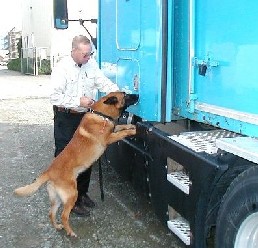 Robert Guest at I Was the State posted an interview this week with an Austin-based consultant who reviews the performance of drug sniffing dogs. In his experience, most drug dogs are only accurate 52% of the time, meaning that 48% of the time dogs wrongfully give police probable cause for a search.
Why not just flip a coin to see if there's probable cause?
The consultant, Steven Nicely, believes that dog handling officers should be required to keep logs of their dogs' success rate and that dogs should be removed from service (or their handlers switched out, when that's the problem), when success rates fall below 80%. Nicely says that "most of the trainers and handlers I have met do not want to improve their dogs," and that officers should be prosecuted for official oppression when they don't keep records on drug dog success rates or ensure that dogs meet a minimum reliability threshold.
I knew that sniffer dogs don't perform well in crowds, but Nicely's assessment makes me wonder if sniffer dogs' use can be justified at all - I'm not sure a one in five rate of wrongful searches is acceptable, but surely a 48% error rate means the dogs' "expert" assessment constitutes little better than a guess.
End of the Week Roundup
Blogging here has been a little slow this week, so let's round up a few items I haven't had time to write about in more detail:
Just one more thing before you evacuate
 Several readers sent notice of what has to be the most absurd idea I've heard from emergency planners since 9/11: Criminal background checks prior to an evacuation! Texas gave AT&T the contract to perform such checks, and evacuees will wear wristbands with RFIDs so they can be tracked and their past analyzed by officials. This is a solution looking for a problem, or maybe just an excuse to hand out a fat, unnecessary contract. When has there ever been an issue with sex offenders, e.g., assaulting someone during an evacuation on a bus?! I've never heard of such a thing. According to Wired, "what’s not explained is where all the sex-offenders and parolees end up? Their own facility? I’ll bet communities are just lining up to host that type of “special needs” shelter." No kidding! Does anybody remember when Houston tried to evacuate during Hurricane Rita and we wound up with cars running out of gas en masse on the highways out of town? We have no solution to THAT problem, but somehow this foolishness is going to make things better.
Death house chaplain now an abolitionist
Rev. Carroll Pickett witnessed dozens of executions as a Texas prison chaplain, including men he believed innocent when they were killed. Now he's a death penalty abolitionist. Read why.
UT law clinic intervenes in child murderer's case
Doc Berman points to this article in the National Law Journal about a South Carolina case being appealed to the US Supreme Court by a UT Austin law school clinic on behalf of a boy who killed his grandparents when he was twelve and received a thirty year sentence.
Harris County ships more inmates to Crawfishlandia
With voters having rejected a new jail in November, Harris County plans to outsource an additional 200 county jail inmates to a private firm in Louisiana, in addition to 400 local inmates already housed there, we learn from Texas Prison Bidness.
School holidays lead to spike in graffiti
The El Paso Times documents a steep rise in graffiti around town since school let out for the holidays. I'll bet that's a pretty predictable trend that probably holds true every year.
Clemens snitch still uncorroborated
 A potential corroborating source for the Mitchell report's allegation that Roger Clemens used steriods turned out to be a bust: The "Grimsley affidavit" had long been rumored to include Clemens, which has been cited by some as possible corroboration for claims by an informant that the Cy Young winner used performance enhancing drugs. I'm willing to bet the Rocket's absence in this document won't make nearly the same national press as did his inclusion in the Mitchell report, confirming a common pattern: Informants' uncorroborated accusations are nearly always given more media play than later debunking arguments or retractions, meaning for those accused, often significant damage has already been done. Did McNamee name Clemens because he, too, had heard the Grimsley rumors and thought he was handing Sen. Mitchell somebody they already knew about? There's just no way to know.
Just one more thing before you evacuate
 Several readers sent notice of what has to be the most absurd idea I've heard from emergency planners since 9/11: Criminal background checks prior to an evacuation! Texas gave AT&T the contract to perform such checks, and evacuees will wear wristbands with RFIDs so they can be tracked and their past analyzed by officials. This is a solution looking for a problem, or maybe just an excuse to hand out a fat, unnecessary contract. When has there ever been an issue with sex offenders, e.g., assaulting someone during an evacuation on a bus?! I've never heard of such a thing. According to Wired, "what’s not explained is where all the sex-offenders and parolees end up? Their own facility? I’ll bet communities are just lining up to host that type of “special needs” shelter." No kidding! Does anybody remember when Houston tried to evacuate during Hurricane Rita and we wound up with cars running out of gas en masse on the highways out of town? We have no solution to THAT problem, but somehow this foolishness is going to make things better.
Death house chaplain now an abolitionist
Rev. Carroll Pickett witnessed dozens of executions as a Texas prison chaplain, including men he believed innocent when they were killed. Now he's a death penalty abolitionist. Read why.
UT law clinic intervenes in child murderer's case
Doc Berman points to this article in the National Law Journal about a South Carolina case being appealed to the US Supreme Court by a UT Austin law school clinic on behalf of a boy who killed his grandparents when he was twelve and received a thirty year sentence.
Harris County ships more inmates to Crawfishlandia
With voters having rejected a new jail in November, Harris County plans to outsource an additional 200 county jail inmates to a private firm in Louisiana, in addition to 400 local inmates already housed there, we learn from Texas Prison Bidness.
School holidays lead to spike in graffiti
The El Paso Times documents a steep rise in graffiti around town since school let out for the holidays. I'll bet that's a pretty predictable trend that probably holds true every year.
Clemens snitch still uncorroborated
 A potential corroborating source for the Mitchell report's allegation that Roger Clemens used steriods turned out to be a bust: The "Grimsley affidavit" had long been rumored to include Clemens, which has been cited by some as possible corroboration for claims by an informant that the Cy Young winner used performance enhancing drugs. I'm willing to bet the Rocket's absence in this document won't make nearly the same national press as did his inclusion in the Mitchell report, confirming a common pattern: Informants' uncorroborated accusations are nearly always given more media play than later debunking arguments or retractions, meaning for those accused, often significant damage has already been done. Did McNamee name Clemens because he, too, had heard the Grimsley rumors and thought he was handing Sen. Mitchell somebody they already knew about? There's just no way to know.
Subscribe to:
Posts (Atom)


.jpg)

