Showing posts sorted by relevance for query probation murder. Sort by date Show all posts

Wednesday, November 21, 2007

Privatize the death penalty? Victims who "need killin'," or why probation for murder may not always be such a bad idea

Last week's Dallas News series on murderers sentenced to probation left me at a bit of a loss concerning what message to take from the story overall. An impressive piece of paper-trail journalism, Dallas News reporters Brooks Egerton and Reese Dunklin identified 120 people who'd received sentences of probation for murder - either from a plea deal or a jury verdict - between 2000 and 2006.

Unfortunately, the series suffered from a bit of a breathless tone that invited readers to conclude, "Can you believe Texas is soft on crime? We should get tuffer!" To me, that's decidedly not the conclusion I draw from the evidence they've presented, but what if any larger lessons may be drawn from their work? Houston defense attorney Mark Bennett's observation on the subject IMO hits closer to the mark:

The truth is that Texas's propensity for killing its citizens, and its leniency with some murderers, are both expressions of the a single principle. Texas doesn't execute murderers to show its regard for the value of life; it does so because some people (as the parable says) need killing. Sometimes the guy who -- in the eyes of Texas -- needs killing is the accused, and sometimes he's the complainant.

"He needed killin', and my guy was the guy to do it" has long been a viable defense in some Texas murder cases. These are cases in which the State often couldn't secure convictions despite being technically murder; it'll be even less able to secure convictions in the future from juries that know that, if they convict, prison will be the only option.

That strikes me as an accurate assessment of the general public's attitude toward intentional killing in Texas, whether by the state or by individuals. Looking at specific cases analyzed by the News, that analysis explains quite a few of them. As I wrote in a "first impression" about the series, it's possible to:
identify several recurring situations where murderers frequently received probation: a) Prosecutors had weak or circumstantial cases and the defendant may not have done it, b) the defendant was guilty via the "law of parties" but didn't actually kill anyone themselves, c) the defendant was elderly, sick or incapacitated to the point where they were no longer a threat, and d) the victim was a worse person than the murderer and basically "needed killin'," so juries sympathized and gave the defendant another chance.
While Dallas News columnist Gromer Jeffers identifies what's wrong with reason A for granting probation in murder cases, who thinks reasons B, C, or D are not sometimes justified? Following Bennett's lead, let's think more closely about category D, in particular, the ones whose victims "needed killin'." Consider the case of Synnissa Gabriel who murdered Hosia Abdallah, her estranged boyfriend:
She told police in 2005 that Mr. Abdallah had stalked her and vandalized her home, in violation of a protective order. Then she tracked him down and shot him several times.

Heath Hyde, who prosecuted the case, said he offered a deal because the victim had a long history of violence against women. That made it unlikely jurors would sentence his killer to prison, he said. Defense attorney Nancy Ohan described her client as "the classic case of the battered woman ... there was a definite mental break."
So a battered woman who continued to be stalked and harassed in violation of a protective order finally took matters into her own hands and gunned down her assailant. Why'd she get probation? Because prosecutors believed jurors would conclude the victim "needed killin'" - in other words, that justice had been served by the defendants' actions. It may not be true under the law, but in the gray-area balancing act jurors do in their own minds while making life or death decisions, it's true in point of fact.

In some other cases, defendants had possibly viable self-defense claims or otherwise could credibly portray themselves to a jury as protecting themselves. Not all the cases find a sympathetic killer and a much-scarier victim, but when they do, is it wrong for a jury to sympathize with the defendant?

Isn't that what juries are about, letting members of the public come to their own conclusions about what constitutes justice?

I've described before my own mixed feelings on the death penalty: It's not that I don't think there are bad folks out there who "need killin'," I just don't trust the government's ability to distinguish between them and the rest of us. (If Texas hasn't already executed an innocent person, at the rate we're going it's only a matter of time.) Bureaucratic mistakes that we tolerate at the drivers license bureau are unacceptable in deciding whether someone should live or die, so I'm troubled by placing such an irreversible decision in the hands of government bureaucrats, even ones with "J.D." after their names.

The "needed killin'" defense and the possibility for receiving probation for murder (after Sept. 1, prosecutors can still plead to deferred adjudication, though juries may no longer grant probation) basically recognize, pragmatically, that many Texans hold similar sentiments, that some murders occur amidst shades of gray, and that the prosecutor may not always be right just because they work for the gub'mint.

From a public interest perspective in these cases, at least in a pro-death penalty Texas jury's mind, the existence of the death penalty assumes it is possible for intentional killing to promote justice. If you believe that (and capital juries must be "death penalty qualified," so sometimes they are REQUIRED to believe it even to serve), you might well believe, upon hearing the facts, that the victim had it coming, as prosecutors feared they would in Ms. Gabriel's case.

In that sense, the punitive mentality that supports the death penalty may also be a two-edged sword for prosecutors in ways that aren't very often discussed. Texas juries may well decide it's just fine to essentially privatize the death penalty, to decide that the killer's vigilante justice was the right justice and give the defendant a pass. (The mentality perhaps harks back to Texas' frontier days, when Mexican alcaldes assessed penalties for theft at four times the amount stolen, but left justice for murder to the friends and family of the deceased.)

The more I think about it, the idea of defendants getting probation for murder on a case by case basis for the reasons described in the series really doesn't bother me save that, upon reflection, I think the Legislature should revisit the question to reinstate juries' authority to give that punishment.

The missus thinks I'm going to "get in trouble" for writing this, but I think, as a practical matter, I'd prefer a death penalty privatized on a case by case basis at the discretion of 12 jurors than operated by the government itself. What do you think?

More from the Dallas News:
BLOGVERSATION:

Thursday, August 30, 2012

Harris probation director resigns in wake of urinalysis errors that put innocents in jail

An outrageous scandal has engulfed the Harris County probation department and forced the ouster of its director.

Harris County probation director Paul Becker tendered his resignation, reported the Houston Chronicle ("Harris County's probation director resigns," August 29) in the wake of a hearing which concluded with State District Judge Denise Collins issuing a moratorium on using urinalysis results from the probation department in her court and calling for Becker and his three deputies to resign.

Moreover, "On Tuesday, the Harris County District Attorney's Office joined the judge in refusing to use any of the division's drug test results in the 36 other criminal courts until further notice because they have questions about the reliability." (Regular readers may recall that the Bexar County DA had to do the same thing back in 2009 when similar allegations arose there.)

KPRC-TV (Aug. 28) summed up the core allegation thusly: "The fallout comes after days of testimony showing a long list of problems, errors and mix-ups in the way the county's probation department tests probationers for illegal drugs. In some cases, positive drug tests were linked to the wrong people. Local 2 Investigates reported last week that at least one probationer went to jail in part because of an erroneous drug test result."

Further, "Probation department leaders admitted they never told prosecutors or even judges about the problems, even when they knew probationers with erroneous tests went to jail."

Judges now say they would have stopped requiring urinalysis in every case if they'd been told the probation department was overhelmed, reported KTRK-TV, though hindsight is always 20/20:
Judge Michael McSpadden says he wishes the Probation Department had told judges they were overwhelmed with the testing

"When you're overwhelmed, what you do is go to the judges is say don't make the requirements in every single case, we are overwhelmed. We never heard that," Judge McSpadden said.

Even with Tuesday's moratorium, the biggest problem for Judge Collins is that there is no way to tell how many probationers were wrongly sent to jail.

"And I don't think we have any idea, and we never will, how many people have been impacted by this. There's no way to measure it," said Judge Collins.
In truth, Grits doubts most Harris County judges would have stopped requiring urinalysis in every case without this kind of scandal to force their hand. Back in 2005, Grits reported based on a consultant's evaluation that Harris County had been told that "Urinalysis requirements in particular, while popular among prosecutors and judges, take up a huge amount of staff time and cause delays throughout the system." The consultant, Justice Management Institute, specifically recommended that "The courts should seek to develop cost-effective common policies concerning when drug testing should be ordered," but that never happened. So judges knew the department was overloaded by too many drug testing orders but willfully ignored the problem. That's not Mr. Becker's fault.

In some ways I feel sorry for Becker, who was in a damned if you do, damned if you don't situation. Probation departments are underfunded, relying mainly on probationer fees and a relatively small stipend from the state. Plus, in Harris they've been asked to provide urinalysis and supervision not just for people on probation but often for defendants out on bail pretrial. The system has grown so large and unwieldy that, to me, these types of errors are regrettable but unsurprising, not that that does wrongly jailed defendants any good. Mr. Becker may have fallen on his sword, but by no means are he and his staff the only ones to blame.

This episode also reminds us that people who've spent decades in prison on false rape or murder convictions before being freed by DNA aren't the only or even the most common category of innocent defendants jailed based on false accusations. These more workaday, low-level cases have just as much room for mistakes, but are also much more easily swept under the rug. Most defendants are indigent and can't afford to mount the type of full-court press that resulted in Judge Collins' findings this week. It's a great mitzvah that attorney Lisa Andrews did so on behalf of her client, but if defense attorneys in Harris County had been aggressively confronting false forensic evidence against their clients on an ongoing basis, maybe the problems would have been identified and rectified long ago.

RELATED: "Houston probationers did jail time based on faulty drug tests." SEE ALSO: Coverage from the ABA Journal, and a blog post from Paul Kennedy at The Defense Rests titled "Judge calls for heads in drug test fiasco." A Houston radio station quoted an attorney predicting civil litigation from wrongly incarcerated defendants.

AND MORE: The Houston Chronicle's Lisa Falkenberg has an interview with attorney Lisa Andrews.

Sunday, August 26, 2012

Houston probationers did jail time based on faulty drug test results

Usually when this blog discusses actual innocence cases, we're talking about people wrongfully convicted of extremely serious crimes like rape or murder, typically where DNA evidence provides sufficient proof to overturn a jury verdict. Seldom, though, will the state acknowledge that innocent people are falsely accused on more petty, mundane matters, sometimes based on faulty forensic science or even a mere clerical error.

That's what's happened in Houston where the probation department has sometimes jailed probationers based on faulty or misrecorded results from urinalysis tests. Reported KTRK's Ted Oberg:
On Thursday, the head of the Harris County Probation Department told us he didn't know of anyone sent to jail over a bad drug test. On Friday, one of his own probationers came to court to prove him wrong.

The very problem the Harris Co. Probation Dept. would rather hide and deny walked right into court and swore to tell the truth.

"I wish I could have said more to that probation officer," said Richard Youst.

Youst was on probation for DWI when a judge put him in jail for 10 days after a supposed positive drug test for cocaine. It was a bad test result, but before attorneys figured it out, Youst lost his driver's license, his apartment and his job.

"Our practice is to act on it as soon as we know that there is an error," said Ray Garcia with Harris Co. Community Supervision.

Probation officers have known for a month, but never owned up to it.

"Nobody has contacted me from that probation office," said Youst.

A freelance Houston airline executive had the same problem. He didn't want to be identified, but he spent 16 hours in jail after a false test for marijuana. He lost two days of work including a huge presentation and lost his chance at a promotion.

"They knew about what had happened to other people and they did not fix it," said defense attorney Lisa Andrews.

Every drug test at the Harris Co. Probation Dept. gets an ID number. They're supposed to be scanned electronically, but according to testimony they often have to be entered into the computer by hand. There's no other ID that goes with it. So if the data entry is even one digit off, an innocent probationer gets hit with someone else's positive drug test result.

"They need to get their stuff straight," said Youst.

From inside the department Friday, Donald Martin, a 22-year probation employee, told Judge Denise Collins she may not be able to trust any Harris County drug test results. Martin testified, "The chain of custody has so many holes, I don't know if you can say any of the positives are truly positive." 
See additional coverage from Oberg and the Houston Chronicle. According to the Chronicle:
A supervisor who testified Friday said finding 3-month-old urine samples in the back of the division's unlocked refrigerators was not uncommon.

The old samples would simply be sent out as though it had been collected that day, said Donald Martin, a supervisor at the department.

As part of the court-mandated "chain of custody" that ensures the integrity of evidence, law enforcement has to show that an appropriate custodian has kept evidence from being tampered with before it can be admitted in court.

"When it comes to chain of custody," Martin testified, "there are more holes than Swiss cheese."
Doesn't inspire confidence, does it?

Tuesday, January 03, 2017

If tough-on-crime works so well, what's up with murder spikes in Texas cities?

So mass incarceration is working because crime is down, right?

Then what to make of the fact that Austin, San Antonio, Dallas, Houston, and Arlington all experienced significant increases in murders this year, as various media outlets have reported (although official data won't be available for a few months as the final cases of the year are categorized)?

These increases occurred despite Texas incarcerating more people - including more violent criminals - than any other state in the country. They occurred despite vast probation and parole systems monitoring hundreds of thousands of offenders in the community. They happened at a moment when more Texas cops are employed at more Texas law enforcement agencies than at any time in history, and in an era when Texas prosecutors have been granted nearly unfettered discretion. And it occurred even though the largest faction on the Court of Criminal Appeals essentially finds for the government in almost every case.

If big-government tough on crime policies failed to prevent murder spikes in Texas - which can hardly be accused of blue-state leniency when it comes to filling up courtrooms, jails, and prisons - then maybe it's not worth the expense?

That said, as is always the case when dealing with crime stats, one must place these increases in context. In Austin and San Antonio, headline writers emphasized that murder totals were the highest in two decades, which is certainly true. However, Austin had just one fewer murder in 2010, so the number isn't that much of an outlier from recent years. And besides, both Austin's and San Antonio's populations have grown monumentally since the mid-'90s (as has Arlington's, which saw an eyepopping increase in murder numbers this year). So, even after these recent spikes, murder rates remain low by comparison and residents of those cities are safer today, by a longshot, than 20 years ago. That's worth emphasizing more than press reports have done so far.

The press and public focus on murders because a) they're among the most egregious crimes b) they often come with the most compelling stories, and c) the numbers for murders are among the most solid in the crime-data realm because the dead are easy to count. Other crimes are less easy to categorize: Is it a burglary if later investigators come to suspect, but could never prove, that an adult child living with their parents was the real thief? How about if mom and dad decide not to press charges or later claim they were wrong and nothing was stolen? There are no such ambiguities when it comes to murder victims.

OTOH, murders are rare events, their numbers are generally small compared to other crimes, and totals can fluctuate quite a bit year to year for no apparent reason. Even with large, single-year spikes, one learns over time to look for long-term trends, not short-term fluctuations, to understand what's really happening. All of these cities have experienced one-year increases in murders before over the past couple of decades, even though the overall trajectory for each has been downward.

And what's happening may be different in different cities. After all, there's nothing connecting murderers but the outcome of their actions. They're solely responsible for what they do and police realistically have few means to prevent them from doing it. The cops' job is to clean up after them.

In San Antonio, the chief insisted that, “What we’re seeing now is a lot of spontaneous murders,” adding, “It’s really difficult to put a reason on it.” Dallas has also seen a spike, the majority of which the department attributed to home invasions of drug houses. But then, two years ago Dallas was crowing that its murder rates were the lowest since 1930. In Austin, the Statesman reported the murder total was "highest in nearly 20 years," but didn't mention that the per capta rates are now much lower because of the population boom. (Good for AP, which added that tidbit to their version.) Percentage increases look bigger when starting numbers are extremely small.*

Murders are terrible things but to act without understanding rarely achieves the desired results. And overreaction can also have its costs. As Chief McManus in San Antonio warned, attempts at “'arresting the problem away' or 'overpolicing' could just lead to distrust." When rare events like murders do happen, there needs to be a modicum of community trust for police to find and make use of leads, witnesses and other such indispensable assets.

I led off this column by joking about whether the murder spike means mass incarceration "works." The jibe is intended in part at my fellow Texans who've belittled other jurisdictions like Chicago or Los Angeles when they've suffered violent-crime woes. The truth is, crime has very little to do with government enforcement policies and is broadly more responsive to other societal trends and cues.

IMO, cops, prosecutors and prisons didn't have much to do with the bulk of the crime decline of the last two decades, so if they keep doing what they do and crime goes back up, that won't surprise me either. But it should surprise, and concern, anyone who has believed the tough-on-crime hype surrounding the benefits of mass incarceration. Even in red-state Texas, incarcerating more people than anywhere else, we're not immune to national trends and can't pretend being tougher has achieved any better outcomes. It hasn't.

*Pro tip for news consumers: When you see the words "fastest growing" in a headline or news article, substitute "smallest" to understand what the reporter is really describing. Things grow fast when they start small and their increases are relatively large compared to a tiny denominator. H/T to John Pfaff for harping on that observation.

Thursday, January 09, 2014

Overcriminalization and tort reform: No easy choices for conservatives

Yesterday, Grits attended a panel at the Texas Public Policy Foundation's annual Policy Orientation (a multi-issue conference sponsored by a conservative think tank in Austin) on the topic of "Overcriminalization." Attendees were treated to one of the more productive, frank discussions of the topic among ideological conservatives I've run across, maybe ever.

Shannon Edmonds of the Texas District and County Attorneys Association said the fundamental problem is that the Texas Legislature is "addicted" to creating new crimes and boosting penalties for existing ones, joking that, “Admitting you have an addiction is the first step on the road to recovery.” Since 2005, he said, the Texas Lege has created 233 new crimes, by his count:

'05: 49
'07: 50
'09: 40
'11: 53
'13: 41
TDCAA doesn't include in that count new ways to commit old offenses or so-called "enhancements" that merely increased penalties. These are all activities that were legal before and illegal now - an average of 47 new items per session. After Texas revamped its Penal Code in 1993, there were 160 enumerated crimes on the books, Edmonds told the audience. Today, there are around 225 crimes in the Penal Code, said Edmonds, and more than 1,500 in other parts of the law. The Occupations Code alone now contains more crimes than did the entire Penal Code 20 years ago. If you want less government, Edmonds told the crowd, the Legislature can't keep giving the government more and more things to do.

Paul Larkin of the Heritage Foundation aptly noted that "overcriminalization" has several components, occurring when there are too many laws, when laws have too severe a penalty, as well as when the state uses criminal law as a regulatory device. In many cases, he said, the state has criminalized behavior that historically society has not considered "blameworthy," often to protect "rent-seeking activity." In essence, he argued, one way to enlarge the scope of your business is to make it a crime for other people to compete with you.

Larkin suggested four, related responses aimed at reducing overcriminalization. 1) Don't pass new criminal laws. 2) Cull unnecessary statutes. 3) Only criminalize "willful" behavior, buttressing the concept of mens rea, or criminal intent. And finally, 4) allow a mistake of law to be raised as a defense in situations where no reasonable person would know a particular act is a crime. For example, he said, everyone knows you can't rob, rape, or murder, but not everyone knows what items they throw in the trash may qualify as hazardous waste.

Problem is, society still needs ways to disincentivize improper disposal of hazardous waste. That essentially leaves two options: Regulatory enforcement and civil litigation, both of which conservatives traditionally have railed against with even more fury than "overcriminalization."

State Rep. Bryan Hughes, while acknowledging that, in the tort-reform era, he was “wandering off into traffic,” proposed what he called a “wonderful solution” to the overcriminalization problem: Bolstering rights under the 7th Amendment to the US Constitution to sue over torts in civil court. Regrettably, there was no one in the room from Texans for Lawsuit Reform to rebut that suggestion, which incidentally was echoed by TDCAA's Edmonds. I'd have loved to hear their reaction to the idea.

There's a certain historical symmetry to the notion of reinvigorating private litigation to reduce overcriminalization. It's a relatively modern concept that, as Edmonds put it, crime victims get "free lawyers," which we call "prosecutors." Under 18th century English common law, as noted by David Friedman, "Prosecution of almost all criminal offenses was private, usually by the victim. Intermediate punishments for serious offenses were strikingly absent" and there were "no public officials corresponding to either police or district attorneys." Though by 1820 most US states had some form of public prosecutor, "privately funded prosecutors constituted a significant element of the state criminal justice system throughout the 19th century," historian Robert Ireland has written. Indeed, he noted, there is evidence that railroad companies hired some of the prosecutors who secured the conviction of Frank James for murder and train robbery.

Certainly the modern practice of having public prosecutors employed by the state evolved for good reasons: For example, public prosecutors are (supposedly) bound to presume a defendant innocent until proven guilty, while private prosecutors were paid to assume the defendant guilty and seek a conviction. But when we're talking about crimes lacking mens rea - essentially torts that have been criminalized - the legacy of private prosecution may still have value. That's especially true in instance where criminal law is used to bolster rent seeking activities and/or commercial interests. Arguably, some of these "offenses" should be handled by private attorneys in civil courts.

Rep. Hughes offered an anecdote showing how the use of criminal law in commercial disputes can distort justice, describing a constituent of his named “Brenda” who bounced a check for $410 in 2004. She was prosecuted, appointed a state-paid defense lawyer, and received deferred adjudication probation, which required payment of probation fees, fines, etc.. In 2008 she lost her job, quit paying her probation fees, and stopped attending required meetings with her probation officer. Her probation was revoked and she was sentenced to 18 months in state jail, Hughes said. The irony, though, was that over course of her sentence she had paid thousands of dollars in probation fees to the state, but none of the money went to the business to whom she bounced the check. (The use of prosecutors' bounced check divisions is particularly insidious when they're employed on behalf of payday lenders, a topic The Texas Observer has explored and this blog has deplored.)

The conservative movement has a fundamental dilemma if they hope to address overcriminalization. Promoting "tort reform" has been a huge source of campaign funds for conservative candidates, who have also historically fought new regulations on behalf of business-oriented constituents. However, that doesn't stop other, more numerous constituents from looking to government for "justice" when they've been wronged, which is why such regulations end up in the criminal code instead of being enforced by regulatory bodies or resolved through civil lawsuits.


Panel moderator Vikrant Reddy mentioned the absurdist Politifact fact check of a Grits for Breakfast claim that there are eleven different felonies in Texas you can commit with an oyster. (Politifact said it was "mostly true" because it might be 16, or seven, depending on how one counted them.) All those oyster laws are items that could and should be handled more effectively either through regulations or in civil court. (Most of them have never been prosecuted.) But when conservative politicians reflexively oppose business regulation and neuter the civil courts, people are going to seek redress somewhere. However absurd and ineffectual, creating new criminal laws allows politicians to claim they're "doing something," even if it's mainly symbolic.

When Republicans were the minority party, they could advocate "less government" as a general meme on all fronts and no one thought much about it. But now that they control all three branches of Texas state government, when the public seeks redress of their grievances, politicians can't say "no" to everything. Sue in civil court? No, we'll limit damages through tort reform. Regulation by state agencies? No, it would make businesses inefficient. So if conservatives also want to fight "overcriminalization," what means are left for government to respond to the concerns of constituents? Incumbent politicians don't get to just tell them, "Sorry, you're screwed." Not if they want to stay in office.

I agreed with almost everything said yesterday about overcriminalization, but in the end conservatives are confronted with hard choices. Government would surely be "smaller" if more disputes were handled in civil than criminal courts. But going that route would inflame powerful constituencies. The principled path is seldom the easiest one.


MORE: See quotes culled from yesterday's event on the Right on Crime Twitter feed.

Monday, May 04, 2009

Texas considers eliminating LWOP for juvies, two steps ahead of SCOTUS

Amazingly, for once Texas appears to be ahead of the curve regarding reforms to capital sentencing, with the state Legislature poised to potentially eliminate life without parole entirely for juveniles, even as the US Supreme Court has decided to consider whether to ban the practice for juveniles in non-murder cases.

SCOTUS today agreed to hear two cases out of Florida that will determine the constitutionality of sentencing juveniles in non-murder cases to life without parole (LWOP), Reuters reports:

The nation's high court agreed to hear two Florida cases, one involving a 13-year-old convicted of raping an elderly woman and the other involving a 17-year-old who took part in an armed home-invasion robbery while on probation for an earlier violent crime.

Their lawyers appealed to the Supreme Court and argued that life imprisonment, without the possibility of parole, for juveniles whose crimes did not involve murder violated the Constitution's ban on cruel and unusual punishment.

The Supreme Court in 2005 abolished the death penalty for juveniles.

The justices will consider in the two cases whether to extend that ruling to sentences of life without parole for juveniles convicted of crimes other than murder.

Doc Berman notes that in one of the cases before SCOTUS, a Florida youth sentenced to LWOP was actually sent to prison for a probation violation (!) after earlier committing armed robbery.

Meanwhile, Texas law only authorizes LWOP for juveniles in capital murder cases, but the Texas House Criminal Jurisprudence Committee on Wednesday will consider SB 839 by Hinojosa to eliminate LWOP for juveniles entirely and substitute a 40-year minimum sentence. Most observers believed clearing the Senate was this bill's biggest hurdle and the legislation has an excellent chance of making it through the process and becoming law, thanks in part to assistance from some unlikely supporters.

It's nice, for a change, to feel like our state is one step ahead of SCOTUS on these matters. Perhaps it's possible, just this once, for Texas to adjust our most extreme sentencing practices without first enduring a series of embarrassing scandals and bench slaps from the federal courts.

SCOTUSBlog has the relevant legal materials from the Florida cases.

Thursday, January 15, 2009

Estimating false convictions: Thousands of Texas prisoners are likely innocent

The string of DNA exonerations witnessed in recent years has made everyone in the justice system aware that more innocent people are convicted of crimes than anyone previously thought. But what percentage of total convictions are false ones?

This is a difficult question because it's hard to find an accurate denominator for comparison.

Nobody thinks every innocent person has been identified through DNA testing, and indeed no biological evidence exists to test in the vast majority of criminal cases. So even though we know 39 Texans have been exonerated by DNA, we don't know what percentage of criminal convictions overall are false.

One of the few datasets that generates a statistically viable denominator comes from capital murder cases, for which a new study from Michigan State provides a new, national calculation:
Among defendants sentenced to death in the United States since 1973, at least 2.3 percent—and possibly more—were falsely convicted, said U-M law professor Samuel Gross in a study co-authored by Barbara O'Brien, a professor at Michigan State University College of Law.

If defendants who were sentenced to prison had been freed because of innocence at the same rate as those who were sentenced to death, there would have been nearly 87,000 non-death row exonerations in the United States from 1989 through 2003, rather than the 266 that were reported, the study said.

"The main thing we can safely conclude from exonerations of falsely convicted defendants is that there are many other false convictions that we have not discovered," said Gross, whose research has focused on the death penalty, false convictions and eyewitness identification.

Since 1989, nearly all exonerations in the United States fall into three categories: rape convictions, because of post-conviction DNA testing; murder convictions, and especially death sentences, which are subjected to much more detailed post-conviction reinvestigation than other convictions; and a few groups of false drug and gun possession convictions that were produced by concerted programs of police perjury that later unraveled.

As result, researchers know little about false convictions among crimes of violence other than murder or rape, even though false convictions for robbery could greatly outnumber those for rape and murder. And researchers know next to nothing about false convictions for other types of crimes, such as property crimes, misdemeanors and white collar crimes.
The exoneration rate in Texas for capital murder convictions is slightly lower than in this national study.

Another dataset that lends itself to statistically valid innocence estimates come from DNA exonerations. In Texas, 3.3% of cases solved by DNA evidence resulted in exonerating convicted defendants.

So let's guess that the false conviction rate in Texas is somewhere between 2.3-3.3%: With around 155,000 prisoners, that would mean between 3,500 and 5,000 or so current Texas prison inmates were falsely convicted.

Another 10-15,000 falsely convicted people are on the probation rolls, this data implies - perhaps even more since innocent people may be more likely to accept a plea for probation than risk incarceration for something they didn't do.

That's a helluva lot of folks.

Wednesday, January 10, 2018

Twin Peaks defendants offered misdemeanor probation, negligent murder, and other stories

Let's clear some browser tabs with a roundup post. Here are several items of which Grits readers should be aware, even if I haven't had time to write about them:

Twin Peaks defendants headed to trial
The McLennan DA offered one of the 150+ defendants in the Twin Peaks biker massacre a plea deal of a deferred misdemeanor probation instead of the first-degree felony he was charged with, and the defendant said no, we're going to trial. Grits had earlier placed the over-under regarding how many of the original 177 people arrested would be convicted of anything at 1.5. That still sounds about right, though at the moment, if Grits were a betting man, I'd place my wager on "under." I couldn't begin to estimate the over-under regarding how much this fiasco may eventually cost McLennan County in civil suits for constitutional rights violations, but it'd be a good bet it'll be a non-trivial number.

Firing director not a cure-all for Dallas juvie detention woes
In Dallas, the juvenile probation director may or may not have been run out of her job but is definitely on the hot seat for allegations that youth under her care at a treatment center weren't allowed time for outdoor exercise. The same facility last year witnessed allegations  that five boys aged 13 to 17 engaged in sex acts with one another while sleeping on the floor of the cafeteria due to understaffing. I don't dispute that the chief needs to go, but this is not an NFL team. Firing the coach doesn't change much about a government bureaucracy, which is more effectively influenced through the passage of laws, policies, and budgets. At the end of the day, real solutions will likely involve ponying up more money for staff and services to solve the problem, not just firing the bureaucrat in charge.

All about the money
It took a guest columnist instead of working reporters to get to the heart of the debate over Austin's newly rejected police contract. Read Lauren Ross' article, it's the first time in the local press that the economic critiques of contract critics have been presented to MSM consumers in full form.

Six year old died in awful shooting by Bexar deputies
A six year old was killed by a stray bullet last month after four Bexar County Sheriff's deputies, including one with a rifle, opened fire at an unarmed suspect, who also died (law enforcement insists she earlier had a gun but now cannot find it). As a result, the Sheriff is reviewing use of force policies. This one is a mess. The officers appear to have fired based on assumptions they brought with them to the scene, not what they saw in front of them. And clearly they didn't take into account that she was standing in front of an occupied mobile home when they opened fire. Bodycam footage would help here. A GoFundMe page was created on behalf of the family to cover funeral expenses.

Some TDCJ units ill-equipped for cold weather
The Texas Department of Criminal Justice faces allegations that inmates at up to 30 units slept in un- or under-heated cells during the recent cold snap. TDCJ denies the problem, but the Texas Inmate Family Association identified a couple of dozen underheated units, notably including the Allred Unit near Wichita Falls. Editorialized the Fort Worth Star-Telegram, "An ongoing lawsuit is demanding the state improve summer conditions. While they’re at it they should fix the heating for winter."

Negligent murder?
In Waco, a murder conviction was overturned because the jury was instructed to convict a defendant of murder based on "reckless" and "negligent" rather than "intentional" behavior. (A day care owner had given children in her care Benadryl and one of them died.) Prosecutors have appealed the case to the Texas Court of Criminal Appeals, where three votes to uphold the conviction are virtually guaranteed.

Clemency beneficiary reoffends
When Barack Obama issued sentence commutations to hundreds of drug offenders, it was inevitable that some of them would eventually reoffend. That has finally happened in San Antonio. The Express-News had the coverage. While some may use this to criticize the commutations, to me it's remarkable it's taken so long for somebody to screw up, and more remarkable still that the overwhelming majority of those with commuted sentences have not gotten into trouble again.

3 policies that punish the poor
Rudy Apodaca, the former chief judge of the New Mexico Court of Appeals, now living in Austin, had a column in the Express News linking three punishing policies for the poor: Overreliance on property taxes, money bail for criminal defendants, and the Driver Responsibility surcharge. He concluded, "Without change, the rich will continue to get richer and the poor poorer, the gap between them growing further apart. And caught in between, the middle class will keep struggling."

(Literally) sick of prison food
The Atlantic has the story of prison food literally making inmates sick. Prison inmates are six times as likely to contract a food-borne illness compared to the rest of the population, a recent study found.

With less crime, do we need fewer cops?
The Washington Post pointed out that, despite crime plummeting in the last three decades, the number of police has not declined. "In 2016, there were slightly more officers per capita than in 1991, when violent crime peaked, according to data collected by the F.B.I. Now, officers deal with half the crimes per capita that they did then." Grits could make an even stronger case that we have too many prosecutors.

Monday, April 07, 2014

Attorney General: State fire marshal may continue arson review

The Texas Attorney General ruled on Friday that the state fire marshal has authority to review old arson cases, rebuffing West Texas DA Rod Ponton who'd hoped the AG would intervene to stop its consideration of bad science in the Sonia Cacy arson case, in which the court this week will consider a habeas corpus writ based on actual innocence and junk science claims. The Austin Statesman's Chuck Lindell reported today:
The State Fire Marshal’s Office may continue reviewing old arson cases for bad science, Attorney General Greg Abbott said in a formal opinion released Monday.

Nothing in state law limits the office from testing old convictions to determine if the arson cases were based on science or scientific techniques now known to be flawed, false or misleading, the opinion said.

The opinion was in response to a West Texas prosecutor who was upset after the review raised questions about a 1993 murder conviction.

Rod Ponton, district attorney of a four-county area that includes Fort Stockton, believed the fire marshal overstepped his authority by examining — and discrediting — evidence used by his office to convict Sonia Cacy of dousing her uncle with gasoline and setting him alight.

In a letter dated Oct. 1, Ponton asked Abbott to determine that the fire marshal has “no authority to make sweeping legal pronouncements on 20-year-old criminal cases.”

Abbott’s opinion, however, stated that state law gives the fire marshal broad authority to investigate cases of arson and suspected arson.
In the Cacy case, reported Lindell:
According to the [state fire marshal's] experts:
  • Today’s science doesn’t support a finding of arson. Instead, the cause of the Cacy fire should have been listed as undetermined.
  • The most damning evidence — a forensic test that found gasoline on her uncle’s clothes — was based on misinterpreted results.
  • With no smoke inhalation or heat damage to [alleged victim Bill] Richardson’s throat and lungs, there is no evidence he was alive at the time of the fire.
Instead, it appears that Richardson, a 76-year-old who smoked up to three packs of cigarettes a day, died of a heart attack while smoking in bed, Cacy’s lawyers argue, adding that numerous burn marks on the furniture show that Richardson was a careless smoker.

Other experts reached similar conclusions in 1998, prompting the Texas Board of Pardons and Paroles to order Cacy released from prison after serving less than six years of her 99-year sentence. Cacy’s murder conviction, however, was unaffected, and she remains on parole.

Defense lawyers have filed an appeal to overturn the murder conviction.
Meanwhile, my colleagues Nick Vilbas and Jeff Blackburn from the Innocence Project of Texas (IPOT) reported Friday morning at the Forensic Science Commission that the fire marshal's Science Advisory Workgroup (SAW) has identified junk science used to secure convictions in five cases so far, including Cacy's. IPOT sent questionnaires to more than a thousand prisoners in TDCJ convicted of arson, getting responses back from about a quarter of them. Prioritizing murder cases, they vetted them to identify instances where convictions relied solely on testimony from arson investigators and older, outdated techniques, forwarding nine of them so far to a committee of experts convened by the fire marshal. Of those, five of them relied on bad science, in two of them science supported the original conclusion, and two cases had inconclusive results.

The review was not comprehensive. Most prisoners did not return questionnaires and many people convicted were sentenced to probation or had already been paroled. But so far, about two percent of older arson cases examined involve people who claimed innocence and were convicted based on what's now considered junk science - less than one might have expected going in. (The Todd Willingham case, having already been vetted by numerous experts including an extensive report [pdf] from the Forensic Science Commission, was not among the nine reviewed by the fire marshal.)

Those numbers are lower than some experts predicted when the review began. In many cases, there was other evidence besides expert testimony - including confessions, video, and eyewitnesses - that supported findings of guilt. Many inmates who returned the questionnaire did not dispute that they'd started a fire. Blackburn told the commission that the relatively low number of possible innocence cases identified should inspire confidence in the process.

Going forward, now that fire marshal has vetted murder cases, IPOT will be assisting the agency reviewing non-murder cases starting in 2002 (the agency only keeps files going back 12 years). Said IPOT's Nick Vilbas, "We should be able to find some other cases needing review by the SAW panel through this process."

MORE (April 9): The Austin Statesman editorial board praised the new AG opinion and encouraged the fire marshal's arson review to continue.

See related Grits posts:

Wednesday, August 03, 2011

Innocence Roundup: Struggles to succeed

A number of innocence-related stories caught Grits' attention recently:

Habeas, 'actual innocence,' probation and misdemeanors
The debate over postconviction relief for "actual innocence" has mostly centered around extremely serious crimes involving rape or murder. That's mostly because DNA evidence didn't exist or wasn't preserved in other types of cases and without it, the odds of exoneration under existing legal standards are extraordinarily long. DNA evidence exists in 10% or less of violent crimes and not at all in most other cases, leaving few avenues for overturning convictions in less serious cases. But that doesn't mean false convictions don't occur in drug and property crimes or misdemeanor offenses, just that those defendants are far less likely to ever seek or receive relief.

Jordan Smith at the Austin Chronicle has a story of a man seeking habeas relief based on actual innocence for a misdemeanor assault for which he was convicted and received probation in high school (shooting a teacher with a bb-pistol from a moving car). The local press at the time (Statesman and Chronicle) ran heart-tugging stories featuring teachers calling for his prosecution and ouster from the school. The fellow who actually did the deed has come belatedly forward to accept responsibility. The conviction has prevented Cleo Hill from several jobs he sought, and now he wants the conviction overturned so he can attend nursing school. "This is the first filing to my knowledge [in Texas] of a writ of actual innocence for someone who's never been in jail," said his attorney. "In this case, Cleo wants to go to nursing school, something he can't do with an assault misdemeanor on his record." Wrote Smith:
Hill's experience provides a bitter confirmation that guilty or innocent – and whatever the punishment – a criminal history is a life sentence. While it differs in important ways from prison time, it remains a heavy, lifelong burden. Professor William Kelly, director of the Center for Criminology and Criminal Justice Research at the University of Texas, says policymakers generally consider only concrete terms of punishment like probation or jail time, seldom the legacy of conviction itself. "The reality is that the punishment continues into the future," said Kelly. Once the jail time or probation period has ended, there will always be that question on any job or housing application: Have you ever been convicted of a crime? "If we could dip offenders into punishment and pull them out, it would be okay," said Kelly. "But that's not how it works."

Having a record can paradoxically force someone deeper into criminal activity. "Being labeled early on does nothing to ensure the likelihood of success," said Kelly. "In fact, it perpetuates a cycle of reoffending." Kelly concedes that many felony charges have justifiably significant, continuing consequences, but he believes a lifetime record is disproportional for a misdemeanor. "We have to ask ourselves, is this really the impact that we want to have?"
'Sixteen and life to go'
Continuing with the theme of innocent people not exonerated, John Browning at the Southeast Texas Record has part one of a story titled "Sixteen and life to go," in which he describes a likely innocent man who it now appears may never be exonerated. (See the story for details of the case.) Chad Uptergrove was tried as an adult when he was 16 and just celebrated his 32nd birthday in prison, having now spent half his life behind bars. The Court of Criminal Appeals recently denied him habeas relief. There was no DNA evidence to prove his innocence conclusively and a Brady violation (failing to tell the defense about an exculpatory witness) was deemed harmless error, which pretty much the only type of error the CCA thinks prosecutors ever make.

Struggling to succeed: Exoneration and reentry
Exoneree Calvin Johnson out of Waco spent 15 years behind bars for a rape and murder he didn't commit before he and his co-defendant were cleared by DNA of the offense in 2001. According to the Waco Tribune Herald, though (subscription only), Johnson struggled after his release, ultimately succumbing to a heroin addiction that has now landed him back in prison with an eight year sentence. The new conviction makes him ineligible for the annuity which was made retroactive in 2009. The Trib's Cindy Culp reported:
Washington’s experience is not unique. Experts who work with exonerees said the majority experience problems after their release. Most don’t go back to prison, but a “large minority” do, said Vanessa Potkin, a senior staff attorney for the national Innocence Project. 

“It’s understandable for those who have been debilitated by what they’ve been through,” Potkin said. “It’s more shocking, I think, that so many thrive, do so well and contribute to society.” 

A total of 272 people in the United States have been cleared by post-conviction DNA testing, according to the project. It does not have data on how many of them have been arrested after their release. 

But research done by the New York Times in 2007 showed one-sixth of exonerees returned to prison or suffered from drug or alcohol addiction. Most struggled to keep a job, rebuild relationships and deal with the psychological scars of wrongful imprisonment, the newspaper reported.
The story goes on to feature the Texas Exoneree Project - which is a group of Texas exonerees who've formed a support group out of Dallas to help one another and others newly exonerated.
The group played a key role in the passage of improved compensation measures during the past two legislative sessions, [Innocence Project of Texas policy director Cory] Session said. Plus, members show up every time a newly exonerated Texan is released. 

“They travel around the state to help that next person,” Session said. “(Because of that), exonerees are getting a lot more help than ever before.” 

Charles Chatman, who spent 27 years in prison after he was mistakenly identified in a rape case, said he can’t overstate how critical the group has been to him. Some of the issues exonerees face can’t be understood by anyone else, he said. 

Family relationships often have to be rebuilt from “ground zero,” Chatman said. Navigating new technology can be tough, too. He said he can still remember how frustrated he felt the first time he tried to use an automatic checkout lane at the grocery store. 

Finances can be another stumbling block, Chatman said. The compensation money is helpful, but it also creates problems. A number of people in the group have had to deal with demanding relatives or unscrupulous financial advisers, he said. 

“Everybody takes advantage of us,” Chatman said. “It really hurts.” 

The group doesn’t push specific advice on new exonerees, Chatman said. But it lets them know members are available to help as needed, he said.
Compensating Anthony Graves
Finally, the Texas Tribune has an update on changes to the state compensation law that will allow Anthony Graves and others similarly situated to receive compensation for their false convictions - even if the case wasn't overturned based on a habeas writ finding "actual innocence" - if the judge and prosecutor agree they were falsely convicted. "The measure also makes wrongfully imprisoned people eligible to receive the same health benefits given to employees of the Texas Department of Criminal Justice for a period equal to the time they spent in prison. Their families, however, would not qualify for coverage, and the individuals would still have to pay a monthly contribution."

Thursday, January 22, 2015

Kerr County Sheriff defends jail bond vote; Grits responds

After Grits critiqued the numbers behind the proposed Kerr County jail bond vote in May, Sheriff Rusty Hierholzer sent around an email attempting to justify the proposed new debt and accompanying higher taxes. His direction "please forward to all" meant it eventually found its way to me, so thanks to the thoughtful reader who passed it along. Find his letter below the jump, followed by Grits' reactions.

Wednesday, December 05, 2007

New York Times focuses on "law of parties" that leads to frequent unjust outcomes at the ignominious Texas Court of Criminal Appeals

Evan Smith from Texas Monthly forwarded me a link to this NY Times article, which Doc Berman also points to, about a Florida man convicted of murder under the "law of parties" for providing a car for a burglary that ended in homicide. Smith asked if this wasn't similar to a recent high-profile Texas case?

I think he's referring to Kenneth Foster, the driver of a vehicle used in a getaway after a murder whose execution sentence Governor Perry recently commuted to life. (In all honesty, given the state of Texas' prisons, I'm not sure LWOP is a better deal.) But the same situation also explains quite a few of the "murderers" who got probation in the big Dallas News series on "probation for murder." The "law of parties" as practiced has been expansively broadened at the ignominious Texas Court of Criminal Appeals under Presiding Judge Sharon Keller and Co.. By contrast:
India and other common law countries have followed England in abolishing the doctrine. In 1990, the Canadian Supreme Court did away with felony murder liability for accomplices, saying it violated “the principle that punishment must be proportionate to the moral blameworthiness of the offender.”
That approach, to me, seems more just.Here's another great example why Democrats need some horses, er ... candidates, to step up and run for the Texas Court of Criminal Appeals, not just for Democrats to appear competitive in every seat, a laudable but not necessarily strategic goal, but just in case Democrats get lucky and experience a Dallas-style Democratic sweep because of national electoral trends. If that happens, failure to field candidates in these three statewide seats will appear, in retrospect, like leaving money on the table. If there's a chance to improve this egregious court in the least and Texans don't take it, it would be a tremendous waste.

There's only a short time left to get the necessary signatures from around the state, although I'll bet some of our friends in the netroots could help accomplish that quicker than might otherwise be possible. So if you're planning to throw your hat in the ring, shoot me an email to let me know and I'll help you tap into several other folks who are desperately looking for horses ... er, candidates, to run for these three seats.

Sunday, July 07, 2019

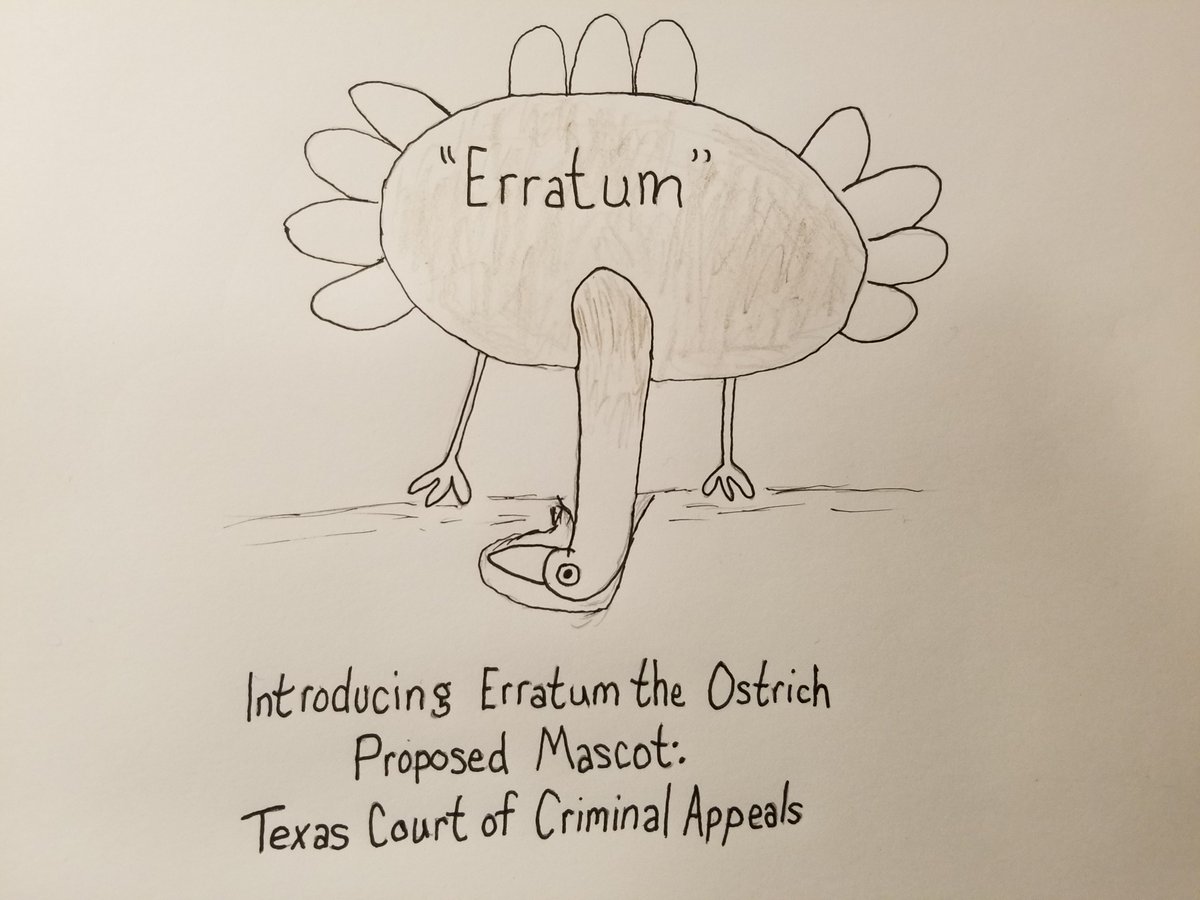
Reasonably Suspicious podcast, July 2019 episode: Featuring an interview with TPPF's Marc Levin about parole, allegations of judicial misconduct in San Antonio, and a proposed mascot for the Texas Court of Criminal Appeals

Here's the July 2019 episode of Just Liberty's Reasonably Suspicious podcast, covering Texas criminal justice politics and policy. Co-hosted by me and Amanda Marzullo, it's also available on iTunes, Google Play, and Soundcloud.


This month:

Top Stories
  • Texas Legislature legalizes hemp and in the process may have accidentally made it impossible to prosecute workaday pot cases. Is this really a problem?
  • San Antonio Judge ignores due process on probation revocations. How common is this?
Interview
Marc Levin of the Texas Public Policy Foundation discusses probation and parole policy.

Interview
Chris Harris of Just Liberty on the rollback of Austin's anti-homelessness ordinances.

The Last Hurrah
  • Texas Legislature created 50 new crimes in 2019
  • Alfred Brown denied innocence compensation
  • The Canadian Supreme Court has a fuzzy mascot owl named "Amicus." What should be the mascot for the Texas Court of Criminal Appeals? My suggestion:
Find a transcript below the jump.

Saturday, January 02, 2010

Texas' 2009 judiciary by the numbers

The FY 2009 annual report on the Texas Judiciary (pdf) from the Office of Court Administration came out last month and included a number of notable tidbits related to criminal cases that deserve Grits readers attention.

Trials extremely rare
In district courts, "Less than 2 percent of all cases (excluding transfers and motions to revoke probation) went to trial in 2009. Trial rates were significantly higher, however, in capital murder and murder cases, which went to trial in 24.3 percent and 20.2 percent of cases, respectively." In county courts, which handle misdemeanors, only one percent of cases went to trial.

Prosecutor background predominates among judges
Among Texas' 434 district judges, 37% had prior experience as a prosecutor, while just 15% had experience as a lower court judge.

Ousting judges at the ballot box
Among state appellate and district judges, 6.6% in 2009 left office as a result of losing a primary or general election in 2008 - a bit of a surprising number which was bolstered substantially by Democratic gains in the judiciary in Harris County. An equal number resigned or chose not to seek reelection.

Some types of cases growing faster than population, crime rate
According to the annual report, "Four categories of criminal cases increased more than 100 percent over the past 20 years. Misdemeanor assault cases (filed in county-level courts) increased 169 percent; felony assault or attempted murder cases increased 131 percent; felony and misdemeanor drug offense cases increased 144 percent; and “other” felonies increased 116 percent."

These growth rates far outstrip Texas' population expansion over the same period and come during a time when crime overall has been declining. As such, these types of cases contribute to a bloated justice system, and particularly highlight the role of prosecutorial discretion: Incidents that 20 years ago would not bring criminal charges now are more likely to face accusations of misdemeanor assault. More serious assaults are more likely to be charged as felonies or attempted murder. Drug crimes - mostly possession cases - are being prosecuted at much higher rates than before. And as for "other, this is a function of the proliferation of boutique crimes through the dozens of new crimes and "enhancements" passed by the Texas Legislature every two years (including 59 new felonies created in 2009). These data explain why incarceration pressures continue to increase even during periods of reduced crime rates.

Juvie cases decline rapidly
One of the most startling pieces of data came on the juvenile front: "The number of cases addedto the juvenile dockets of district and county-level courts in 2009—44,257 cases—was 10.1 percent lower than the number added during the previous year and was the lowest number added since 1999 (44,003 cases)." Some of that's the result of demographic shifts and declining juvenile crime, but I wonder what other factors contributed? That seems like a big one-year dropoff.

Local practices clearly vary widely. In Harris County, youth are charged with crimes at double the rate of kids in Dallas or Fort Worth. In Harris, 3.0 new cases per 1,000 kids were filed in 2009; in Dallas and Tarrant Counties the figure was 1.3 and 1.2 respectively. A few rural counties have rates as high as 4-10 cases added per every 1,000 kids.

Juries giving fewer death sentences
At the trial court level, the percentage of capital murder convictions statewide resulting in the death penalty has declined remarkably steadily since 1990 from 24.4% to just 5% last year. Some of that's a function of the creation of life without parole as a sentencing option in 2005, but a chart on p. 41 of the report shows that the decline actually began in the mid-90s.

Fewer opinions from the CCA
Judges on the Court of Criminal Appeals issued 447 opinions in 2009, which is the lowest number of opinions issued since 1994 when Sharon Keller was elected Presiding Judge. Less than one-third (29.3 percent) of 2009 opinions were signed, 47.4 percent were per curiam, 12.5 percent were concurring, and 10.1 percent were dissenting.

Discretionary review by CCA varies widely by appeals court
There was wide variation in how frequently the CCA granted petitions for discretionary review in criminal cases from the various Courts of Appeals, from 2.5% from the 14th court in Houston, to 35.5% from the 3rd Court of Appeals out of Austin. A lower rate means the CCA agrees with the court more often, and vice versa. I compiled the rates for each appellate court in this table:


Interestingly, though the 14th court in Houston has the lowest number of PDRs granted, Harris County according to the report has the largest number of criminal cases overall appealed to higher courts.

Cashing in on court collections
Justice of the Peace courts have turned into cash cows, but the amount of revenue they generate may have peaked.
The amount of fines, fees and court costs collected by justice courts generally increased over the past 20 years; however, in 2009, courts collected approximately $372.5 million—a decrease of 1.5 percent from the amount collected the previous year. The amount collected in 2009 was 230 percent higher than that collected in 1990, or 90.3 percent higher when adjusted for inflation.
By contrast, municipal courts have seen even greater revnue growth, which continued last year and seems to know no limits:
In 2009, [municipal] courts collected approximately $734 million—an increase of 1.2 percent from the previous year. The amount collected in 2009 was 287.3 percent higher than that collected 20 years previously in 1990, or 123.1 percent higher when adjusted for inflation.
These growth rates far outstrip population growth.

These are just a few highlights from the jam-packed 89-page report, so those interested in more detail should check out the whole thing.

Tuesday, July 08, 2008

TV station: False UA positives tolerated in Bexar "because the county wants to save a few bucks."

A San Antonio TV station is preparing an investigative report following up on allegations that the contractor performing urinalysis for the Bexar County adult probation department is using methodologies that produce false positives. From WOAI-TV:

Nobody likes being accused of something they didn't do. But many probationers here in Bexar County say that is exactly what is happening to them. And some are winding up in jail.

News 4 Trouble Shooter Brian Collister is probing problems with the Probation department's drug tests.

Since the county's probation department switched to a new drug testing lab earlier this year, the number of positive drug tests by probationers has skyrocketed.

But many of them say they are clean.

Lani Bennett tested positive for drugs while on probation. She was shocked when she was arrested at the drivers license office because of a warrant for a dirty drug test.

"They didn't give me any warning or anything," says Lani. "I'm (at) DPS trying to get a status of my license cause I'm trying to change over insurances for my car and I'm getting taken out in handcuffs."

She later got a hair test that shows she was clean.

"People are capable of change. I have the legal paperwork to prove that I have changed and I did not use."

And she is not alone.

In fact, a News 4 Trouble Shooters investigation uncovered a flaw in the way the county is conducting these tests. Turns out people go to jail because the county wants to save a few bucks.
The full story airs tonight, and continues a rocky recent stretch for the Bexar adult probation department. Director Bill Fitzgerald fired the whistleblower who first identified problems with the drug tests, but chose to retain the contractor. Then last week, Fitzgerald fired his second in command without giving him or the public a reason.

After beginning a consulting stint recently working for the Innocence Project of Texas, it's struck me that frequently "innocence" issues in the public lexicon are defined pretty narrowly - for the most part limited to murder or sexual assault cases involving DNA exonerations.

But "innocence" is also an issue whenever a probationer is sent to jail because because of a false positive on a urinalysis test, or when errors in breathalyzer technology falsely accuse someone of driving drunk. Faulty forensics aren't just limited to arson or ballistics: High error rates are tolerated in a variety of forensic disciplines.

While some high-profile exonerations have involved alleged police misconduct or prosecutors withholding Brady material, much more frequently innocent people are punished as a result of reliance on unreliable investigative methods and sloppy forensics. From the perspective of the person wrongly accused, however, the motives of authorities promoting false accusations matter very little.

Monday, February 12, 2024

What was that guy's name again? Attacks on a progressive DA by a philistine

An old-school tough-on-crime campaign has been launched in the Travis County Democratic primary by Some Guy I've Never Heard Of named Jeremy Silverbelly, or Silverspoon, or something. To be honest. I never can remember his name. He's just the guy a bunch of Republican donors picked to try to oust José Garza. 

In the interest of full disclosure, I've been paid a small sum to help Garza's campaign with political messaging. But long-time Grits readers will be aware that my interest in supporting him goes beyond the financial, and José's campaign did not see nor approve of this blog post prior to publication. 

Polls mostly show Austinites feel safe and one only need go downtown on any weekend, day or night, to see that's true. The central business district hasn't fully recovered during the week from the effects of work-from-home, but that's because of economics, not fear of crime. Weekend foot traffic tells the story of a bustling town unafraid of its own shadow.

Mr. Silversuckle can only win if voters are hair-on-fire afraid and believe that "Soft on Crime" policies by the District Attorney are enabling the forces they fear. So we get stories like this doozy from KXAN, a local TV station which my wife refers to on Facebook, incidentally, as the "Mouthpiece for the Police State." They put out a deeply misleading attack piece on Garza that intentionally and somewhat blatantly avoided any and all apples-to-apples comparisons to focus exclusively on red herrings.

Their central claim, summed up in the headline, was that, "More felony convictions in Travis County end up in local jail than anywhere else in Texas," with the reporter placing blame for this supposed affront on José Garza's shoulders. Mr. Silversurfer and the presumptive Republican nominee (more on him in a minute) were the main people commenting on the data, placing their sights squarely on the incumbent DA.

The story, however, compares Garza's stats on who gets probation/jail/prison, etc. to other Texas counties, not to his predecessor. The exact same story could have been written about Margaret Moore, and Travis County DAs going back to Ronnie Earle (let's please all just agree to forget the ignominious Lehmberg era, though of course, that was also a legacy of the Ronnie Earle era).

Yes, Harris, Dallas, Bexar, etc., utilize prison much more than Travis County, but it has ever been thus. In 2019, for example, the last year before COVID skewed everyone's numbers, the Travis County DA under Margaret Moore sent 20% of felony defendants to prison; under José Garza it was 16%, according to KXAN. But comparing him to jurisdictions that incarcerate at closer to or above statewide rates, instead of his predecessor, for whom Mr. SillyPutty worked, is simply disingenuous to the point of spreading misinformation.

Nearly the entire difference between the number of people sent to local jail rather than prison under Margaret Moore compared to José Garza can be explained by how Garza's office is handling state-jail-felony drug cases, with almost all of those ending up on probation or serving county jail time compared to Margaret Moore's tenure. But that's about it. Otherwise, the patterns under Margaret were remarkably similar to how José's office runs. But supposedly, according to Mr. Silverhair, those were the halcyon tough-on-crime days and José is some radical.

In reality, as I predicted when he was elected, the scope of change that's possible to enact from that position has been signifant, even important, but modest. José has done what he can, but the position is limited by a myriad other actors in the system and the particular role that prosecutors play in it. He's showing us the limits of what can be accomplished as a "progressive prosecutor" under the existing system. And since José himself is a rather wonky, thoughtful, careful little dude, he's doing what he can within the system, not attempting to break it.

That's why, for example, he dropped charges against police officers for shooting protesters after the city belatedly reported that supervisors distributed faulty munitions, knowing what could happen. The city did not tell the DA this until AFTER the statute of limitations ran out on the supervisors' decisions, and it would have been against his charge to "seek justice" to hold officers accountable in cases for which their supervisors were more culpable. There are certainly factions of Democrats who wanted to see those cases go forward. But José did the right thing by dismissing them.

Yet another example comes from what to me is a particularly sad quarter. Daryl Slusher, a former journalist turned city councilmember turned career-city bureaucrat turned neocon curmudgeon, wrote up another KXAN story from last year trying to smear José, but omtting even the nod to honest reporting their reporter made in that story.

The story is about a sex offender who attacked several women in public settings. He ended up with a sentence of 10 years probation, a requirement to undergo sex-offender treatment, and was placed on the sex-offender registry. Reported KXAN at the time (though omitted in Slusher's version): 

Those who accused Rios do feel a sense of justice, though they wish he had received a tougher sentence than probation.

“It’s difficult to sit in the courtroom and listen to these difficult experiences that they went through,” Jorge Vela, Rios’ attorney, said. “We recognize that, this is not lost on us. This was a deal that was reached with the district attorney’s office after 16 months of negotiation. It took into account my client’s lack of criminal history…There are different purposes in the criminal justice system, and one of those is rehabilitation.”

Vela said Rios is receiving sex-offender treatment. Rios was on house arrest for six months prior to being on probation now, according to Vela.

“There will be no more survivors,” Judge Karen Sage of the 299th Criminal District Court said at the conclusion of Rios’ sentencing. “This is it. It ends here.”
Several things here stand out: First, being placed on the sex-offender registry is a serious punishment that will affect this man for the rest of his life. Characterizing that outcome as letting him "walk free," as Slusher did, is disigenuous in the extreme. Second, I think most people don't fully appreciate what's associated with sex-offender treatment in Texas. Until you've googled "penile plethysmograph," you probably don't fully grok how these ritual humiliations are anything but a slap on the wrist. 

After 16 months of evaluation -- including six months under house arrest -- Judge Karen Sage and the prosecutor on the case concluded this was the best way to hold the offender accountable, ensure he entered treatment, and end his victimizing behaviors. "It ends here" is, in fact, the outcome you want if the goal of punishment is to maximize public safety and change the behavior of offenders. If the goal is something else, Mr. Sillysack and his abettors should say what that is. Because, on its face, the only plausible one I can think of is to scare the public into voting against José.

In reality, Travis County saw a murder spike in 2020 and 2021 that mirrored national trends and caused all manner of overreaction and blaming of progressive politics. The police were never defunded but the murder spike was incessantly blamed by many of these same, disingenous voices on protesters calling for that outcome and the election of progressive prosecutors like José Garza, who took office in January 2021. Murders peaked that year, then declined, but equally interesting is the trend on "crimes against persons." These are the data from the Austin police chief's monthly report:

If we're going to blame Garza when crime increases, let's also give him credit when it goes down. Margaret Moore would have been amazed to see crimes against persons decline more than 10% on her watch, and the TV news folks would have eagerly touted her effectiveness had that occurred (it did not). But the crime decline took place under a self-avowed liberal, so we get weird, manufactured stories pretending the Texas state capitol has devolved into some dystopian hellscape.

I'm hopeful Travis County Democrats will see through these attacks and stick with José Garza, but H.L. Mencken wasn't wrong that no one ever went broke underestimating the intelligence of the American public. That's Mr. Sillysack's only hope of defeating Garza, which is why you're seeing these attacks being planted in the press, and will soon see them (or similar ones) replicated on television. 

Okay, fine, so his name is not Sillysack, or Silverbelly, or any of these other names that keep emerging in my head. It's not my fault I can't remember the name of this cipher of a candidate backed by Republican money who applied for a job on José's leadership team but quit when Garza promoted a more qualified woman over him. 

Mr. Sillyseason's name is difficult to remember, even though he's been endorsed by the GOP DA candidate (who is encouraging Republican voters to cross over to the Democratic primary to vote against Garza). I doubt the Republicans will remember his name, either. OTOH, it doesn't matter what his name is, no one is voting for Mr. Silverstreaker. They're voting for or against José Garza.

Still, there are too many silly/silver puns and wordplay options available; I need a mnemonic to remind me of this guy's name, and I'm betting you do, too. I got it! "Sylestine." Rhymes with "philistine." 

Don't vote for him.

UPDATE: Silverbell's first negative TV ad is now up. He accuses Garza of  lenient plea deals with "more than a thousand" violent criminals, ignoring that in every jurisdiction in every state in the country, virtually all cases, violent felonies or otherwise, result in plea bargains. This couldn't be more disingenous. It's not like he's going to end plea bargaining, after all, or would even want to. It's not even an attack, really, just pure fearmongering: Say some scary words, show a darkened image of the incumbent over tense, scary music, and hope the public jumps in your direction. We'll see soon if Democratic primary voters fall for it.

Wednesday, December 09, 2020

Top Ten Texas Criminal Justice Stories of 2020: Looking back at a crazy, (literally) sick year

It's been a crazy year,  both for me personally (I underwent throat-cancer treatment and lost nearly 100 pounds) and for the state and nation generally, between COVID, the Trump un-election, and the massive protests surrounding Houstonite George Floyd's death that in many ways defined the year.

If we were ranking criminal-justice stories, those protests would be the biggest one from any traditional newsroom perspective, even if the coronavirus in jails and prisons claimed more lives. But those protests were also part of an ongoing dialogue that began before the protests and continued after them, particularly in Austin.  So I decided not to rank the top ten 2020 stories and just choose ten. From a certain vantage point, some of them might be considered different parts of the same narrative. Regardless, looking back at 2020, here's what Grits considers the biggest Texas criminal-justice stories from what by any measure was a tumultuous 12-month stretch:

The Beginning of the End of (Most) Marijuana Enforcement in Texas: 2020 was the first full calendar year in which marijuana was effectively decriminalized in much of the state after the Texas Legislature inadvertently redefined it to exclude "hemp," which is a less potent part of the same plant that gets people high. The Texas Tribune estimated arrests for marijuana possession dropped by more than half. Some jurisdictions still want to prosecute, but Texas DPS has said it won't provide testing for misdemeanor marijuana cases because the volume would overwhelm its crime labs. That means most smaller jurisdictions around the state don't have access to testing unless their governing body chooses to pay for an outside lab. For most, the cost-benefit analysis for doing so just doesn't make sense. Gov. Abbott and Lt. Gov. Dan Patrick have taken full-blown "legalization" off the table, so the Texas Legislature in 2021 can either 1) pay for expanded marijuana testing, 2) repeal the hemp law, or 3) leave things be. Grits is fine with option #3, at least until the Legislature musters the political will to do something closer to full-blown decrim or legalization, which is what the public prefers.

Ransomware attack sidelines Texas courts: A ransomware attack briefly crippled Texas' appellate court system; no journalist or government auditor has ever given us a detailed report of the complete fallout, but Grits is looking forward to reading it when it happens.

COVID in Texas Prisons: As of 12/8, according to the Texas Department of Criminal Justice, 167 Texas inmate deaths were either confirmed or presumed to be caused by COVID in 2020, with another 50 awaiting testing. The agency attributes 25 additional employee deaths to COVID. Much-publicized COVID infestations at some of the larger units contributed to already-severe staffing shortages to drive understaffing at Texas prisons to heretofore unseen levels. Luckily for the agency, prisoner levels dropped precipitously, driven by plummeting intake, as most types of crime along with jail admissions dropped like a stone around the state this spring. Jail populations began creeping back up in the fall, but many court systems are only beginning to hold criminal trials and cases are backlogged.

George Floyd Protests: Nationwide protests over Houston-native George Floyd's killing by Minneapolis police, including large protests in Texas cities large and small across the state. Texas saw protests in places like Tyler, Jasper, and Hondo which the civil-rights movement had bypassed without them. In Austin, peaceful protesters were severely injured by so-called less-than-lethal crowd-control weapons deployed by police. Despite isolated incidents of arson and property damage, mainly in Austin and Dallas during the final weekend in May, the overwhelming majority of protests in Texas were peaceful. Journalists starting with Texas Monthly's Michael Hall quickly realized George Floyd was from Houston, a friend and peer of DJ Screw, and a potential victim of corrupt Houston narcotics cop Gerald Goines, who lied about informants and has had hundreds of his old cases, including Floyd's, called into question. State Rep. Senfronia Thompson  of  Houston has filed the eponymous George Floyd Act, ensuring his death remains central to public debates around policing in his home state into the new year.

Brian Manley Under Fire; Renee Hall Goes Down: In April, a month before George Floyd died in Minneapolis, more than two dozen community groups called for the firing or resignation of Austin police Chief Brian Manley after police shot an unarmed man named Mike Ramos based on a policy Manley personally overturned regarding shooting at moving vehicles. The episode surfaced an array of complaints against the sitting police chief, mobilizing groups which would later work together over the summer on budget issues and related topics. But when the smoke cleared from the summer protests, it was Dallas' police chief Renee Hall who resigned while Manley and his patron, city manager Spencer Cronk, spent the entire second half of the year within the crosshairs of at least half the city council, which issued a unanimous "no confidence" vote criticizing the chief and his leadership in June. A few weeks later, Just Liberty and the Austin Justice Coalition issued this commemorative jingle to remind people of the city council's vote:


Houston flirts with reforms, then waits; SA and Austin activists seek civil-service repeal: Houston had some of the largest protests in the country, including one with more than 60,000 people at which the mayor and police chief participated. The Mayor appointed a task force to study policing issues, which soon came back with detailed recommendations. The Mayors response was to increase the police department's budget and then ... crickets. Meanwhile, in both San Antonio and Austin, independent advocacy groups that grew out of this summer's protests have launched petition drives to formally hold elections on whether those cities should pull out of the "civil service" framework in Ch. 143 of Texas' Local Government Code. If they win, the playing field over police accountability would shift irrevocably. But just the fact that this has become contested terrain to a certain extent impacts the power dynamics surrounding police union politics in large Texas cities. The new book, Greedy Bastards, by the former San Antonio City Manager Sheryl Sculley, demonstrates that elite opinion about police unions is changing in addition to all the grassroots ire expressed in the streets. Whether that translates into tangible change is this generation's responsibility.

Austin Budget Cuts: In the wake of the Mike Ramos protests, which in Austin morphed into the George Floyd protests, the city of Austin restricted the Austin PD budget for the first time in decades, including a 4.6% cut derived mainly from delaying cadet classes while the department's training curriculum undergoes a soup-to-nuts revamp. The City Council suggested spinning off other aspects of the department, including forensics, the 911 call center, and potentially the Internal Affairs Division. The Council created a task force to reconsider certain other aspects of local policing, including the future of mounted and K9 units. Even now, though, some of these gains are being undermined while most changes recommended have yet to be implemented. The decisive battles will all come in the new year.

Murder spikes; other crimes dip: As the nation's economy waned this spring, an unusual crime trend emerged: murder spiked while other types of crime, including both violent and property crime, plunged as the streets emptied and large portions of the public began to work from home. In response, everywhere, opponents of criminal-justice reform attributed these spikes to whatever recent, local policies they didn't like: In Austin, murders from the spring and summer were  blamed on the city budget which took effect in October. In Houston, local officials blamed a comparable murder spike on misdemeanor bail reform. In Dallas, the mayor would like to blame the murder spike on the outgoing police chief, since she's leaving, anyway. This pattern played out in state after state, with reform opponents pointing to increased murder rates as an excuse to roll back whatever recent, usually small local gains their enemies might have made. (Indeed, the blame-the-locals tactic was already being used before the first US COVID shutdowns.) Usually, there was only a tenuous link between the despised policies and murder rates, if critics bothered to draw one at all. While such rhetoric may have had political implications, it's likely that, in the coming years we'll come to understand that, just as the reduction in homicides in recent decades was an international trend not directly attributable to any narrow local development, the murder increase of 2020 is (at least) a nationwide phenomenon. Grits can't find sufficient 2020 international data on murders (yet) to tell if the US trend holds true in other countries. But reports from large cities in other states show that Texas' increases aren't some isolated trend.

Governor Abbott Embraces His Inner Demagogue:  What Austin did was significant, if hardly radical. And Texas' murder increase is rightfully concerning, even if Grits finds alarmist rhetoric unhelpful and the city-by-city blame game a little silly. Gov. Greg Abbott's response, however, has became increasingly unhinged from any reasonable interpretation of real-world public-safety facts. Weirdly, he held a press conference in Fort Worth declaring Cowtown's approach to policing was superior to Austin's. But if Austin's murder rate were as high as Fort Worth's, we'd be at double the current total. Why should Austin emulate Fort Worth, exactly? For the alleged crime of not copying cities with worse outcomes, Gov. Abbott first threatened to freeze Austin's taxes in response to the new budget, only to face backlash from conservative constituents who'd like their own taxes frozen,  thank you very much. Then he suggested de-annexing portions of cities that "defunded the police." Finally, he suggested the state might take over the Austin Police Department and operate it through the Department of Public Safety, despite the fact that APD officers make more than DPS troopers or even Texas Rangers. None of this seems very realistic to your correspondent, though I'm told some big Republican donors are pushing these ideas behind the scenes. OTOH, the Governor is angrily lashing out at Austin, which is never a good thing, and eventually some of the ideas he throws at the wall may stick. One can certainly tell Abbott wants to punish Austin for its budget, which can't be good, even if the punishments suggested so far seem ... er, uh ... ill considered.

Texas prison population plummets: In the biggest story nobody's paying attention to, whether due to COVID, declining crime, county court backlogs, or other causes, Texas' prison population this year reached levels unseen since the mid-'90s, allowing TDCJ to shutter several additional units. A dozen years ago, one in 22 Texans were in prison, in jail, on probation or on parole. I re-calculated that number this week: We're now at one in 62. There's still a long way to go, and nobody's stopping, but that's not an insignificant change in a year with not featuring a lot of high points.