When one closely examines the politics of bipartisan justice reforms, support on the Republican side comes from four discrete sources: 1) libertarians (particularly from the Ron-Paul wing of the party), 2) Second Amendment advocates (many of whom enthusiastically support the rest of the Bill of Rights), 3) office-holders worried about budgets (read: fiscal conservatives), and 4) religious conservatives, or at least a faction of them.
This article from Christianity Today examines opinion data from evangelical conservatives and determines that the evangelical base is more supportive of justice reform than both their leadership and average Americans, especially on prison conditions.
Notably, prison-conditions issues have been hard to move forward in Texas because the main advocates for it at the Legislature have been formerly incarcerated folks and prisoners' families. Isolated without a broader coalition, their bills mostly have been stymied. This news tells us there's untapped evangelical support along that vector from which messengers could perhaps be drafted whom Texas' GOP-led Legislature would find more convincing. It would be quite an organizing task, but it also might move the needle.
When Emmett Solomon led the Restorative Justice Ministries Network, he was able to mobilize evangelical support through his vast connections with local church-based prison ministries. But after Emmett passed away a few years ago, no organizers of his caliber have stepped up to fill the void.
While evangelical Christians are more likely than average Americans to support prison reform, reported Christianity Today, they are also less likely to change their vote based on justice topics. My guess is that's because other Culture War issues like abortion, traditional marriage, etc., more fervently animate their zeal on election day. But that doesn't mean evangelical Christians can't be tapped as messengers to support legislation. Judging from this data, many would be pleased to help.
Showing posts with label Religion and Politics. Show all posts
Showing posts with label Religion and Politics. Show all posts
Thursday, January 23, 2020


Sunday, July 02, 2017
Time for 'Jubilee' on criminal-justice debt
Ten years ago today, as part of coverage from a conference on restorative justice, Grits published a blog post suggesting that modern policymakers embrace the biblical concept of "Jubilee" - the elimination of debts, not to mention the freeing of slaves and prisoners, mandated in the Old Testament once every 50 years. In the New Testament, Christ and His apostles embraced and promoted the concept.
Part of the bible verse which first introduced the Jubilee tradition is actually inscribed on the Liberty Bell in Philadelphia:
Part of the bible verse which first introduced the Jubilee tradition is actually inscribed on the Liberty Bell in Philadelphia:
And he shall hallow the fiftieth year, and proclaim liberty throughout all the land unto all the inhabitants thereof: it shall be a jubilee unto you; and ye shall return every man unto his possession, and ye shall return every man unto his family (Leviticus 25.10, KJV)Grits does not imagine any instance where a modern, 21st century government would embrace Isaiah's Jubilee dictate of "opening of the prison to them that are bound," even if it may be warranted for all but the most dangerous offenders. But the idea of debt forgiveness within the justice system is certainly a valid one, starting with criminal justice debt.
Unpaid tickets, fines, Driver Responsibility surcharges - these can linger for years and cause immense social and economic harm. For example, recently the Travis County Attorney made headlines by trying to collect old debt from thirty years ago. Is there really a strong argument that such debt shouldn't periodically be Jubilee'd away?
Monday, December 23, 2013
'Santa was in prison and Jesus got the death penalty'
Concludes a terrific post from Solitary Watch on the topic, "Christians go to church to worship an executed savior and shop to
commemorate an incarcerated saint. And most Americans give little
thought to their 2 million countrymen who are spending this Christmas
behind bars."
While most folks are familiar with Jesus' fateful run-in with the criminal justice system, "Less well known is the fact that Saint Nicholas, the early Christian saint who inspired Santa Claus, was once a prisoner, like one in every 100 Americans today. Though he was beloved for his kindness and generosity, Nicholas acquired sainthood not only by giving alms, but by performing a miracle that more or less amounted to a prison break."
While most folks are familiar with Jesus' fateful run-in with the criminal justice system, "Less well known is the fact that Saint Nicholas, the early Christian saint who inspired Santa Claus, was once a prisoner, like one in every 100 Americans today. Though he was beloved for his kindness and generosity, Nicholas acquired sainthood not only by giving alms, but by performing a miracle that more or less amounted to a prison break."
Friday, October 11, 2013
'The Recanters': False convictions more likely as law strays further from biblical standard
One frequently hears Christians lament how far society has strayed from biblical teachings, and it's true. In many cases that's a good thing, as one needn't look far to find abhorrent examples like the murdering of homosexuals or non-virgin brides. But there are elements of biblical law whose wisdom still rings true and I've always thought that, among them, is the notion that convictions for crimes should only be sustained upon the testimony of "two or three witnesses." In both the Old and New Testament, corroboration of an accusation was seen as essential to justifying punishment.
In the modern era, though, there are increasingly many situations where mere accusation by one individual is enough to convict, even (in fact, especially) when that individual is a child. At The Texas Observer, Maurice Chammah has a story that highlights the conundrum created by uncorroborated accusations titled, "The Recanters: What happens when abuse claims come undone." The main protagonist in Chammah's featured horror story says she was "bullied her into accusing her stepfather" by a social worker at age eight during a three-and-a-half hour interview. Her testimony on the stand contradicted itself and included incredible, unlikely accusations, like her stepfather bathing her vagina with a washcloth filled with broken glass. After his conviction, she was shipped off to foster care; the state thought her mother unfit because she refused to believe her husband was guilty. Ironically, she told Chammah, in foster care she really was molested by a foster parent in Killeen. Whether or not the stepfather was guilty - and both he and the alleged victim insist he was not - it seems impossible to argue the state's intervention benefited the child.
 Wrote Chammah, "Advocates for the wrongfully convicted and advocates for child
victims both understand the difficulties of child witnesses. They agree
that their memories are more malleable than an adult’s. Both see that
problem as evidence that their side is losing." The Texas Legislature, for its part, keeps amending the law to make it easier to secure convictions in such cases without corroboration:
Wrote Chammah, "Advocates for the wrongfully convicted and advocates for child
victims both understand the difficulties of child witnesses. They agree
that their memories are more malleable than an adult’s. Both see that
problem as evidence that their side is losing." The Texas Legislature, for its part, keeps amending the law to make it easier to secure convictions in such cases without corroboration:
Which brings me back to the "two or three witnesses" standard promulgated in Mosaic law and repeated in the New Testament by both Christ and the Apostle Paul. There is real wisdom in that requirement. As stories of "the recanters" remind us, accusations are not proof.
RELATED: See earlier Grits coverage of Huffman's bill here and here.
In the modern era, though, there are increasingly many situations where mere accusation by one individual is enough to convict, even (in fact, especially) when that individual is a child. At The Texas Observer, Maurice Chammah has a story that highlights the conundrum created by uncorroborated accusations titled, "The Recanters: What happens when abuse claims come undone." The main protagonist in Chammah's featured horror story says she was "bullied her into accusing her stepfather" by a social worker at age eight during a three-and-a-half hour interview. Her testimony on the stand contradicted itself and included incredible, unlikely accusations, like her stepfather bathing her vagina with a washcloth filled with broken glass. After his conviction, she was shipped off to foster care; the state thought her mother unfit because she refused to believe her husband was guilty. Ironically, she told Chammah, in foster care she really was molested by a foster parent in Killeen. Whether or not the stepfather was guilty - and both he and the alleged victim insist he was not - it seems impossible to argue the state's intervention benefited the child.
 Wrote Chammah, "Advocates for the wrongfully convicted and advocates for child
victims both understand the difficulties of child witnesses. They agree
that their memories are more malleable than an adult’s. Both see that
problem as evidence that their side is losing." The Texas Legislature, for its part, keeps amending the law to make it easier to secure convictions in such cases without corroboration:
Wrote Chammah, "Advocates for the wrongfully convicted and advocates for child
victims both understand the difficulties of child witnesses. They agree
that their memories are more malleable than an adult’s. Both see that
problem as evidence that their side is losing." The Texas Legislature, for its part, keeps amending the law to make it easier to secure convictions in such cases without corroboration:Earlier this year, Republican state Sen. Joan Huffman passed Senate Bill 12, which will allow prosecutors to introduce evidence against child-sex assault defendants of prior offenses, including accusations by other children. “Very often it’s hard for jurors to believe the testimony of a small child, especially when there is no physical evidence,” Huffman, a former Houston prosecutor and judge, told me. Often, so much time has passed before the child comes forward that any physical evidence has washed away or healed over.Both concerns are legitimate. I agree that child molestation cases - especially accusations of long-ago abuse with no physical evidence - are difficult to prosecute. I also agree that changing the law to reduce the amount of evidence against a defendant necessary to convict is likely to send more innocent people in prison. Texas' many DNA exonerations in sex assault cases show that even uncorroborated adult testimony can lead to false convictions.
Kristin Etter of the Texas Criminal Defense Lawyers Association told lawmakers that the bill “will lead to more wrongful convictions.”
Which brings me back to the "two or three witnesses" standard promulgated in Mosaic law and repeated in the New Testament by both Christ and the Apostle Paul. There is real wisdom in that requirement. As stories of "the recanters" remind us, accusations are not proof.
RELATED: See earlier Grits coverage of Huffman's bill here and here.
Wednesday, March 06, 2013
Legislators learn about forgiveness, justice at hearing on innocence commission bill
Grits spent much of yesterday at the House Criminal Jurisprudence Committee, which heard legislation calling for creation of an Innocence Commission to study the causes of wrongful convictions. As in the past when this bill has come up, several Texas exonerees testified in favor of the legislation, offering up powerful narratives of injustice that the committee clearly found moving and compelling.
Several legislators expressed astonishment that more exonerees aren't bitter and angry about what happened to them - Rep. Terry Canales said if he were falsely convicted of a terrible crime, he could be legitimately charged with arson upon exoneration because he'd want to "burn down the courthouse." To be certain, some of them do feel that way. But having had the privilege of working with exonerees for several years now in the course of my duties with the Innocence Project of Texas, the grace and aplomb exhibited by most no longer surprises me. Numerous exonerees have said the same thing to me when I've expressed similar views to Rep. Canales: They must forgive those who wronged them, for their own peace of mind. Holding on to anger harms the angry person more than it harms anger's targets, I've been told many times, which is a bit of hard-earned wisdom from which we could all benefit. The Lord's Prayer, an exoneree once told me, asks God to "forgive us our trespasses as we forgive those who trespass against us." He went on to add, though, that it took many years in prison before he realized that forgiveness was necessary for his own, personal tranquility. He could never be happy, never move on with his life, until he forgave those who wronged him. I've never forgotten that conversation and hope I never will. To me, that attitude represents the epitome of Christian charity at a depth so profound I can hardly fathom it.
Anyway, the committee was remarkably receptive to Rep. McLendon's bill. Here's an excerpt from YNN-Austin's coverage of the hearing:
Shannon Edmonds from the prosecutors' association spoke last and attempted to muddy the waters by implying that an innocence commission was unnecessary because it duplicates work by the innocence clinics at the four public law schools in Texas. Those comments, however, ignore reality. Yes, when exonerations result from work by innocence clinic students - as happened in four cases in 2012 - they are obliged by statute to write a report detailing the causes of the false convictions and suggest ways to prevent similar travesties of justice in the future. But the overwhelming majority of Texas exonerations have not come out of those clinics, but from the work of private lawyers, the Texas and national nonprofit Innocence Projects, reviews of old cases by the Dallas District Attorney, and other actors outside the clinics.
Shannon's point is well taken, though, that the work of an Innocence Commission would dovetail nicely with the work of the law-school innocence clinics, building on the work already being done. The Innocence Commission bill includes no money in its fiscal note, instead operating with administrative support from "the Legislative Budget Board, the University of Texas at Austin, and any other state agency able to assist the commission." It could also apply for grants and accept private donations. But if the innocence clinics receive the extra funding provided them in the Senate Finance Committee recommendations - which upped the clinics' budgets to $150,000 per year in their committee markup - it's possible they could assist an innocence commission in preparing similar reports for all innocence case as they're now doing for exonerations that come through their own labors.
Judging from reactions from the dais, the bill seems certain to pass out of committee. Last session the legislation died on the House floor on a more or less party line vote, but the bipartisan support evidenced in the committee and the bill authorship perhaps bodes well for a better outcome this time around.
Go here to watch the hearing on the bill for yourself. It begins at about the 47:00 minute mark.
MORE: See additional coverage from the Austin Chronicle and the Dallas Morning News.
Several legislators expressed astonishment that more exonerees aren't bitter and angry about what happened to them - Rep. Terry Canales said if he were falsely convicted of a terrible crime, he could be legitimately charged with arson upon exoneration because he'd want to "burn down the courthouse." To be certain, some of them do feel that way. But having had the privilege of working with exonerees for several years now in the course of my duties with the Innocence Project of Texas, the grace and aplomb exhibited by most no longer surprises me. Numerous exonerees have said the same thing to me when I've expressed similar views to Rep. Canales: They must forgive those who wronged them, for their own peace of mind. Holding on to anger harms the angry person more than it harms anger's targets, I've been told many times, which is a bit of hard-earned wisdom from which we could all benefit. The Lord's Prayer, an exoneree once told me, asks God to "forgive us our trespasses as we forgive those who trespass against us." He went on to add, though, that it took many years in prison before he realized that forgiveness was necessary for his own, personal tranquility. He could never be happy, never move on with his life, until he forgave those who wronged him. I've never forgotten that conversation and hope I never will. To me, that attitude represents the epitome of Christian charity at a depth so profound I can hardly fathom it.
Anyway, the committee was remarkably receptive to Rep. McLendon's bill. Here's an excerpt from YNN-Austin's coverage of the hearing:
Texas may lead the country with 47 post-conviction exonerations, but some legislators argue the Lone Star State needs to do more to ensure that innocent men and women aren’t sent to prison.Notably, the legislation enjoys bipartisan joint and co-authors, including Republicans Myra Crownover, Susan King, and Mike Leach, and Democrats Joe Moody and Terry Canales (Leach, Moody and Canales are all on the committee) and the members on the dais clearly were supportive of the idea. Chairman Abel Herrero was especially complimentary of bill author Ruth Jones-McLendon for bringing the legislation.
Lawmakers have proposed House Bill 166 to do just that. The bill would create the Timothy Cole Exoneration Review Panel.
Named after Timothy Cole, a man who died in a Texas prison while serving time for a crime he did not commit, the commission would investigate the cause for wrongful convictions. It would then place prosecutors and judges under the spotlight.
“If it saves one person from going being incarcerated wrongfully in jail for one day, then it did its job," Rep. Terry Canales said.
Released from prison in 2008, Johnny Lindsey served 26 years for a rape the courts now know he didn't commit.
"Prosecutor misconduct, that is the thing that is causing all of these problems," Lindsey said.
Shannon Edmonds from the prosecutors' association spoke last and attempted to muddy the waters by implying that an innocence commission was unnecessary because it duplicates work by the innocence clinics at the four public law schools in Texas. Those comments, however, ignore reality. Yes, when exonerations result from work by innocence clinic students - as happened in four cases in 2012 - they are obliged by statute to write a report detailing the causes of the false convictions and suggest ways to prevent similar travesties of justice in the future. But the overwhelming majority of Texas exonerations have not come out of those clinics, but from the work of private lawyers, the Texas and national nonprofit Innocence Projects, reviews of old cases by the Dallas District Attorney, and other actors outside the clinics.
Shannon's point is well taken, though, that the work of an Innocence Commission would dovetail nicely with the work of the law-school innocence clinics, building on the work already being done. The Innocence Commission bill includes no money in its fiscal note, instead operating with administrative support from "the Legislative Budget Board, the University of Texas at Austin, and any other state agency able to assist the commission." It could also apply for grants and accept private donations. But if the innocence clinics receive the extra funding provided them in the Senate Finance Committee recommendations - which upped the clinics' budgets to $150,000 per year in their committee markup - it's possible they could assist an innocence commission in preparing similar reports for all innocence case as they're now doing for exonerations that come through their own labors.
Judging from reactions from the dais, the bill seems certain to pass out of committee. Last session the legislation died on the House floor on a more or less party line vote, but the bipartisan support evidenced in the committee and the bill authorship perhaps bodes well for a better outcome this time around.
Go here to watch the hearing on the bill for yourself. It begins at about the 47:00 minute mark.
MORE: See additional coverage from the Austin Chronicle and the Dallas Morning News.
Sunday, April 22, 2012
Chuck Colson, RIP
While the web is filled with commentary on his passing, see especially a tribute from Christianity Today to Chuck Colson, the Nixon-era dirty trickster turned prison evangelist and reformer, who died last week of a brain hemorrhage. Cynics often pooh-pooh jailhouse conversions, and Colson's in particular has been derided by liberals for decades. But the prison stint served for his Watergate-related crimes transformed the compiler of Nixon's "Enemies List" into a pioneer of the conservative justice reform agenda whose influence will long outlive him. Whether one agreed with his theology or political views, without Chuck Colson, Grits certainly doubts the nascent Right on Crime effort could ever have materialized. May he rest in peace.
Sunday, April 08, 2012
Jesus Christ 'the all-time poster child for the innocence movement'
Grits offered up these musings about Easter last year and thought I'd reprise them today:
Easter is strikingly filled with criminal justice themes, isn't it? The Christian religion was essentially founded on a repudiation of Roman capital punishment. Easter celebrates the sinless Man-God killed for His beliefs who triumphed over the grave, mooting, even while respecting to the end, the earth-bound laws that condemned Him. Jesus, a blameless man executed, is the all-time poster child for the innocence movement. Corrupt and biased prosecutors prevailed in His case because of a judge's personal indifference and deference to the mob. Christ's betrayal by Judas was the archetype cementing into Christian values a lingering distrust of snitches and informants. Romans accused the disciples of grave robbery. St. Peter committed assault with a deadly weapon in the Garden of Gethsemane then thrice lied about his identity to avoid arrest. And taken as a whole, the passion story documents Jesus' arrest, trial, and execution all taking place in an incredibly short span, as though criminal convictions could be obtained as quickly in real life as on an episode of Law & Order.RELATED: For more Easter-themed Grits, see: Snitching on Good Friday: Rethinking Judas.
Christmas is a story about family. Easter is a story about a wrongful criminal conviction, the misapplication of the death penalty, the overweening power of the state, and the irrepressible urge of humanity to resist it.
Happy Easter, gentle readers. Enjoy this beautiful day.
Friday, November 18, 2011
On the Road to Damascus: The Conversion of John Bradley?
Saul, Saul, why persecutest thou me?
-Voice of Jesus speaking to St. Paul on the road to Damascus, Acts 9:4, KJV
 In the Trib story, Bradley describes his former vision of the prosecutor's role literally as that of a "predator": “I always felt like I was swimming among sharks,” he said. “And you had to defend yourself, and you have to be the same predator back.” I've never seen a prosecutor openly compare their role to a "predator," usually aiming such inflammatory language toward their adversaries (as Bradley more comfortably does in the first half of the quote). But it's a revealing statement, nonetheless.
If Bradley-the-prosecutor cared little about building relations with the local defense bar, the story tells us, he certainly knew which relations to develop to advance his political career:
As then DA Ken Anderson's first assistant, "Bradley developed a close relationship with his boss. They co-wrote two law books. Under Anderson, he began working with lawmakers at the Capitol, just a 30-minute drive south of Georgetown. When Gov. Rick Perry appointed Anderson as a state judge in 2002 he also appointed Bradley to take over as district attorney."So we've got a self-described "predator" who came to Williamson County from Houston with the mentality of a shark who treated the small pond full of perch and catfish in the defense bar essentially as prey while spending his spare time currying favor with officials in Williamson County and Austin. Largely thanks to those powerful patrons, particularly Judge Anderson and the Governor, until now Bradley has never faced a serious electoral challenge since Perry first appointed him. (He lost the only truly competitive race he's ever run, for the the Court of Criminal Appeals in the '90s.)
Like Ken Anderson's second chair Mike Davis, Bradley attempted to shift blame and focus for the Morton fiasco onto Judge Anderson, whose situation increasingly appears untenable. (I'm quite looking forward to reading his forthcoming deposition.) But Anderson's failings don't excuse Bradley's own decisions to fight disclosure of exculpatory evidence and DNA testing that eventually exonerated Mr. Morton. Grissom provides a detailed recital of Bradley's own role in this mess for which there's no one to blame but him:
In 2005, Morton began asking the state to test DNA evidence on a number of items, including a bloody blue bandana found near their home the day after the murder.
Bradley tenaciously fought the requests. In the press, he berated the idea that DNA would lead to some “mystery killer.” And he said Morton’s lawyers were “grasping at straws.” ...
Morton’s lawyers also asked Bradley, through public information requests, for investigative materials in the case. From the time of his conviction, Morton’s lawyers suspected that prosecutors had withheld key evidence that could have caused jurors to doubt his guilt. Bradley fought that request, too, arguing it would interfere with the DNA litigation.
Eventually, Bradley lost that fight and turned over the files. Reports from the sheriff’s department showed that in 1987 investigators had several clues that pointed to someone other than Morton as the killer. There was a transcript in which Morton’s mother-in-law told a sheriff’s deputy that the couple’s 3-year-old son saw a “monster” with a big mustache attack his mother — and the monster wasn’t his father. There were reports that Morton’s credit card had been used and a check had been cashed with her forged signature days after her death. Morton’s lawyers, though, had seen none of that information during his trial. ...
While the Willingham controversy continued in 2010, the Morton case was beginning to unravel. An appeals court ordered the prosecutor’s office to allow DNA testing on the bandana found near the murder scene. In June, the test results revealed that Christine Morton’s blood was mixed with the hair of a man who was not her husband. In August, a national DNA database search matched that DNA to a felon with a record in California....
But it wasn’t just the DNA.
The court in August also ordered the unsealing of a file that was supposed to contain all of the reports from the initial investigation of Morton’s murder. During a dispute in 1987 over evidence, the judge had ordered Anderson, the prosecutor, to provide him all of the investigator’s reports so that he could determine whether there was any information that could help Morton prove his innocence.
When that file was opened two decades later, Bradley and Morton’s lawyers found a paltry six pages of police reports.
Both Bradley and Morton’s lawyers knew that there were many more pages. Despite his order, the judge was not given the transcript that included the Mortons’ son’s description of the murder or the financial transactions that occurred after Morton’s death.
For the defense attorneys, it seemed to confirm their suspicions: the prosecutor’s office had withheld critical information so they could secure a conviction. For Bradley, the development was a shocking revelation that raised serious questions about his former boss and friend.
“I fully expected that that sealed file would contradict some pretty strong accusations,” Bradley said. “It didn’t.”

In September, Travis County investigators linked the DNA from the Morton bandana to DNA found on a hair at the scene of the 1988 murder of Debra Masters Baker. The man whose DNA was on those items during the 1980s lived only blocks away from Baker and about 12 miles away from the Morton’s home.
“It’s the kind of thing that happens only in Hollywood movies,” Bradley said. "I am still awed by the combination of circumstances that came together at the right time."
For Grits, the supposed transformation in Bradley's thinking brings to mind not a Hollywood story but a biblical one: The Apostle Paul's miraculous conversion from persecutor of Christians to their champion. Your correspondent was quoted at the end of Grissom's article making that allusion: "Scott Henson, who writes the well-regarded criminal justice blog Grits for Breakfast, said Bradley could demonstrate his changed perspective by joining with innocence advocates to promote reforms to the Texas justice system. 'He’s got a long record,' Henson said. 'And it will take more than a few words of humility to get everyone to believe that he’s had some road to Damascus moment.'"
Somewhat ironically, Bradley now says, "I consider Barry Scheck a good friend," so perhaps Barry can play Ananais to Bradley's St. Paul, causing the scales to fall from his eyes and leading him toward a path of righteousness. Any such optimism regarding Bradley's newly announced conversion, though, should for now remain measured. As Christ warned Saul on the road to Damascus, "it's hard for thee to kick against the pricks."
MORE: See the transcript from the Trib's Bradley interview.
AND MORE: From Wilco Watchdog. Also, from Jordan Smith at the Austin Chronicle, "Morton prosecutor wrote the book on crime." YET MORE: From Wilco Watchdog on John Bradley's "election transformation."
Sunday, August 28, 2011
Four year theology degree to be offered at TDCJ while vocational ed slashed to the bone
Given that the state slashed funding for vocational and traditional education in Texas prisons this year, it seems counter-intuitive that a new religious seminary will open Monday in the Darrington Unit giving four-year religious degrees (from my preacher-brother's alma mater at the Southwestern Baptist Theological Seminary, no less), but that's what's happening according to this item in the Fort Worth Star-Telegram:
On one hand I can understand the impetus. Since the invention of the penitentiary religious reformers have believed prisons should actively seek to promote spiritual transformation. On the other, I'm not sure there's evidence religious education benefits prisoners more than the educational initiatives recently gutted at the Windham School District in TDCJ, and clearly there's nobody out there beating the bushes for "private grants and donations" to keep those programs running.
Another thing: Though the stories say the program will be non-denominational, the Southwestern Theological Seminary in Fort Worth was the site of a major fight between fundamentalist Baptist factions and less dogmatic religious scholars including Russel Dilday, the moderate president who was ousted by fundamentalists in 1994 for not toeing the hardest possible theological line. He even wrote a book (really a collection of columns) about the incident, titled "Glimpses of a seminary under assault." Can we really expect the trustees of an institution still ruled by the same faction that ousted Dilday to hew to a non-denominational, non-fundamentalist doctrine? For how long?
Relatedly, I wonder if the same deference would be granted when some Muslim sheikhs from Saudi Arabia or Pakistan show up and want to start a madrasah in TDCJ at no "cost to the taxpayer." If that happened, I'm guessing, the enthusiasm level among state officials wouldn't be nearly so high.
Texas' newest seminary will launch Monday -- inside a Texas prison.A Statesman story on the initiative by Mike Ward declared:
It starts with 40 inmates who will be trained at the Texas Department of Criminal Justice's Darrington Unit in Rosharon, about 300 miles southeast of Fort Worth.
Fort Worth's Southwestern Baptist Theological Seminary will play a big role in the seminary, as will the Southern Baptists of Texas Convention and the Heart of Texas Foundation, as co-sponsors of the nondenominational program.
After inmates finish the 125-credit-hour program over four years, they receive bachelor's degrees in biblical studies and are sent to other Texas prisons, where they "minister to their fellow offenders," according to a release.
"The opportunity to provide education and growth for those in a prison unit .. is the opportunity to enable these inmates to discover a significant new way that through study will change life, perspective and hope for hundreds," said Paige Patterson, president of the Fort Worth seminary.
prison officials and supporters say that by making the program voluntary and without a denominational focus — much like another faith-based rehabilitation program operated for prisoners for more than a decade and now highly acclaimed at another nearby prison — any such issues have been avoided.Ward points out an interesting distinction between the seminary idea from other rehabilitation programs: "Unlike most current prison rehabilitation programs, the initiative is not designed for convicts who are about to be released or paroled. Instead, its participants are serving long sentences, most for violent crimes, and most will be behind bars for many additional years — if not the rest of their lives." Ward adds that "The cost to taxpayers: zero. Private grants and donations will pay all expenses of the seminary, which is patterned after a highly acclaimed minister-training program in Louisiana, officials said."
In fact, Texas offers religious programs at all of its 111 state prisons and has faith-based programs and initiatives involving more than 2,700 convicts at 24 of them.
On one hand I can understand the impetus. Since the invention of the penitentiary religious reformers have believed prisons should actively seek to promote spiritual transformation. On the other, I'm not sure there's evidence religious education benefits prisoners more than the educational initiatives recently gutted at the Windham School District in TDCJ, and clearly there's nobody out there beating the bushes for "private grants and donations" to keep those programs running.
Another thing: Though the stories say the program will be non-denominational, the Southwestern Theological Seminary in Fort Worth was the site of a major fight between fundamentalist Baptist factions and less dogmatic religious scholars including Russel Dilday, the moderate president who was ousted by fundamentalists in 1994 for not toeing the hardest possible theological line. He even wrote a book (really a collection of columns) about the incident, titled "Glimpses of a seminary under assault." Can we really expect the trustees of an institution still ruled by the same faction that ousted Dilday to hew to a non-denominational, non-fundamentalist doctrine? For how long?
Relatedly, I wonder if the same deference would be granted when some Muslim sheikhs from Saudi Arabia or Pakistan show up and want to start a madrasah in TDCJ at no "cost to the taxpayer." If that happened, I'm guessing, the enthusiasm level among state officials wouldn't be nearly so high.
Sunday, April 24, 2011
Easter full of criminal justice themes
Easter is strikingly filled with criminal justice themes, isn't it? The Christian religion was essentially founded on a repudiation of Roman capital punishment. Easter celebrates the sinless Man-God killed for His beliefs who triumphed over the grave, mooting, even while respecting to the end, the earth-bound laws that condemned Him. Jesus, a blameless man executed, is the all-time poster child for the innocence movement. Corrupt and biased prosecutors prevailed in His case because of a judge's personal indifference and deference to the mob. Christ's betrayal by Judas was the archetype cementing into Christian values a lingering distrust of snitches and informants. Romans accused the disciples of grave robbery. St. Peter committed assault with a deadly weapon in the Garden of Gethsemane then thrice lied about his identity to avoid arrest. And taken as a whole, the passion story documents Jesus' arrest, trial, and execution all taking place in an incredibly short span, as though criminal convictions could be obtained as quickly in real life as on an episode of Law & Order.
Christmas is a story about family. Easter is a story about a wrongful criminal conviction, the misapplication of the death penalty, the overweening power of the state, and the irrepressible urge of humanity to resist it.
Happy Easter, gentle readers. Enjoy this beautiful day.
Christmas is a story about family. Easter is a story about a wrongful criminal conviction, the misapplication of the death penalty, the overweening power of the state, and the irrepressible urge of humanity to resist it.
Happy Easter, gentle readers. Enjoy this beautiful day.
Sunday, March 20, 2011
Roundup: Assorted facts and heresies
Here are a few disparate items that merit Grits readers attention before I turn mine for the day to college hoops:
Constable pursues truancy make-work to justify staff increase
Usually it's a mistake when the criminal-justice system seeks to solve social problems unrelated to traditional "crime," and that certainly applies to using constables to enforce truancy laws instead of investing in schools until the product they offer is valuable enough to students to make them want to go. Here in Austin, a local constable wants to hire four full-time deputies to enforce truancy laws. This is make-work and another example why I'd prefer constables were simply eliminated or radically scaled back instead of giving them leeway to seek out new missions to justify their anachronistic existence. State Sen. John Whitmire is right that ticketing under criminal laws will never be a true solution for what ails Texas' school system.
DWI supervision on a budget more difficult in age of media hype
The death of a police officer killed by a drunk driver in San Antonio has spawned absurdist commentary in the Alamo City that somehow Texas doesn't "take DWI seriously," when really the situation bemoaned may be attributed to the shortcomings of two decades of unrealistic, media-driven git-tuff efforts that prioritized rhetoric over reality. The driver was already on probation with an ignition interlock mandated for his motorcycle, but he was driving another vehicle he owned. The fact is, so-called "technocorrections" like ignition interlocks or GPS monitoring are not cure-alls. They require substantial investment in human resources to monitor the data generated by the electronics, and cuts to investments in supervision - e.g., proposed elimination of state funding for misdemeanor probation - exacerbate that already serious shortcoming. It doesn't make sense, for example, to expand ignition interlocks to first-time offenders when cases like this one show local departments can't effectively supervise those with interlocks now. Talk is cheap, but rhetoric doesn't pay to supervise high-risk probationers. For that you need probation officers with manageable caseloads. Meanwhile, such rhetorical broadsides fail to address the biggest problem with DWI enforcement in Texas: Declining conviction rates attributable to the so-called Driver Responsibility surcharge. We're arresting more people than ever for DWI, but securing fewer convictions. The House Public Safety Committee has a chance next week to address that problem when it considers legislation by Rep. Leo Berman to abolish the surcharge, but unraveling that public policy mess isn't nearly as sexy, it seems, as shaking one's fist at the devil over the most recent tragedy of the day.
Fewer than 300 graff convictions statewide in 2010
How many graffiti crimes do you suspect are committed in Texas each year? Tens, possibly hundreds of thousands, right? Most of it is never reported to police as a crime, just cleaned up by property owners (or not). But Texas cities spend millions collectively cleaning graffiti at thousands of sites across the state. So how many people do you suppose are convicted of graffiti crimes each year? The answer comes from the Criminal Justice Impact Statement for a recent graffiti enhancement bill (discussed in this Grits post): "In fiscal year 2010, 212 offenders were placed on misdemeanor community supervision, 56 offenders were placed on felony community supervision, and 21 offenders were admitted to prison or state jail." So that's 289 people total convicted and sentenced for graffiti crimes in FY 2010 statewide! And most of them received probation. Two recurring themes on this blog are that criminal penalties can't solve every social problem and that criminal penalty enhancements have little effect on crimes with low clearance rates. Both observations apply in spades to graffiti crimes.
A brief (passing) moment of economic realism on closing the border
People who say the want to "close" or "shut down" the border over immigration, drug smuggling, etc., simply have no clue about the interconnectedness of Texas border economies with Mexico or the astonishing volume of goods and people that travel each direction through the checkpoints. This story from the El Paso Times provides a glimpse of that hidden but critical relationship which a) is growing at a vast rate and b) benefits the United States at least as much as our southern neighbor. The more ideologically driven and detached from business interests calls for immigration enforcement grow, the more explicit this tension will become, but do not doubt that Texas' economy will be harmed if the search for solutions to black markets cause our legal markets to become less competitive or generate fewer jobs. You could never hire enough Border Patrol agents to make up for the economic and employment growth along Texas' southern border over the last decade. Bottom line: One may become frustrated with a goose laying golden eggs, but that won't make it wise to cook it for supper.
Prisoners can pay more if allowed to earn
Here in Texas, legislators have proposed increased prisoner copays for healthcare. In Ohio, the Governor wants prisoners to pay part of their electricity bill. But in Canada, I learned, prisoners are paid minimal wages and charged part of their rent if the take exceeds a certain amount during a pay period. Prisoners in Canada are paid as an "incentive to invite them to actively take part in their rehabilitation." In Canada, prisoners "generally make, before deductions, $35 to $40, every two weeks and that’s for 12 hours a day, generally six days a week," and their advocates are pushing for their first raise in 25 years. Ten percent of their earnings is put in a savings account, but the amounts aren't large enough to be significant upon reentry. The Canadian example struck me as interesting because, whenever prisoner pays ideas are proposed as in Texas and Ohio, I often think they're either trying to get blood from a stone or will wind up mulcting families instead of the person who committed the crime. But if prisoners can earn, it's less problematic to require them to pay. Henry Ford wanted to pay his employees enough where they could buy one of his cars from him, and similarly if states want inmates to help solve their budget crises, it might behoove them to allow inmates to earn more money so they can pay more of the freight.
Army rocked by crime lab scandal
Read about another ugly crime lab scandal, this time from the military courts.
Jury out on effectiveness of faith based prisons
A comprehensive meta-analysis of research regarding the benefits from faith based prisons found, unsurprisingly if unhelpfully, that "based on current research, there’s no strong reason to believe that faith-based prisons work. However, there’s also no strong reason to believe that they don’t work." The author concludes "with thoughts on how faith-based prison programs might be improved, and ... a strategy that would allow such experimentation to proceed consistent with the Constitution." Via Sentencing Law & Policy.
Constable pursues truancy make-work to justify staff increase
Usually it's a mistake when the criminal-justice system seeks to solve social problems unrelated to traditional "crime," and that certainly applies to using constables to enforce truancy laws instead of investing in schools until the product they offer is valuable enough to students to make them want to go. Here in Austin, a local constable wants to hire four full-time deputies to enforce truancy laws. This is make-work and another example why I'd prefer constables were simply eliminated or radically scaled back instead of giving them leeway to seek out new missions to justify their anachronistic existence. State Sen. John Whitmire is right that ticketing under criminal laws will never be a true solution for what ails Texas' school system.
DWI supervision on a budget more difficult in age of media hype
The death of a police officer killed by a drunk driver in San Antonio has spawned absurdist commentary in the Alamo City that somehow Texas doesn't "take DWI seriously," when really the situation bemoaned may be attributed to the shortcomings of two decades of unrealistic, media-driven git-tuff efforts that prioritized rhetoric over reality. The driver was already on probation with an ignition interlock mandated for his motorcycle, but he was driving another vehicle he owned. The fact is, so-called "technocorrections" like ignition interlocks or GPS monitoring are not cure-alls. They require substantial investment in human resources to monitor the data generated by the electronics, and cuts to investments in supervision - e.g., proposed elimination of state funding for misdemeanor probation - exacerbate that already serious shortcoming. It doesn't make sense, for example, to expand ignition interlocks to first-time offenders when cases like this one show local departments can't effectively supervise those with interlocks now. Talk is cheap, but rhetoric doesn't pay to supervise high-risk probationers. For that you need probation officers with manageable caseloads. Meanwhile, such rhetorical broadsides fail to address the biggest problem with DWI enforcement in Texas: Declining conviction rates attributable to the so-called Driver Responsibility surcharge. We're arresting more people than ever for DWI, but securing fewer convictions. The House Public Safety Committee has a chance next week to address that problem when it considers legislation by Rep. Leo Berman to abolish the surcharge, but unraveling that public policy mess isn't nearly as sexy, it seems, as shaking one's fist at the devil over the most recent tragedy of the day.
Fewer than 300 graff convictions statewide in 2010
How many graffiti crimes do you suspect are committed in Texas each year? Tens, possibly hundreds of thousands, right? Most of it is never reported to police as a crime, just cleaned up by property owners (or not). But Texas cities spend millions collectively cleaning graffiti at thousands of sites across the state. So how many people do you suppose are convicted of graffiti crimes each year? The answer comes from the Criminal Justice Impact Statement for a recent graffiti enhancement bill (discussed in this Grits post): "In fiscal year 2010, 212 offenders were placed on misdemeanor community supervision, 56 offenders were placed on felony community supervision, and 21 offenders were admitted to prison or state jail." So that's 289 people total convicted and sentenced for graffiti crimes in FY 2010 statewide! And most of them received probation. Two recurring themes on this blog are that criminal penalties can't solve every social problem and that criminal penalty enhancements have little effect on crimes with low clearance rates. Both observations apply in spades to graffiti crimes.
A brief (passing) moment of economic realism on closing the border
People who say the want to "close" or "shut down" the border over immigration, drug smuggling, etc., simply have no clue about the interconnectedness of Texas border economies with Mexico or the astonishing volume of goods and people that travel each direction through the checkpoints. This story from the El Paso Times provides a glimpse of that hidden but critical relationship which a) is growing at a vast rate and b) benefits the United States at least as much as our southern neighbor. The more ideologically driven and detached from business interests calls for immigration enforcement grow, the more explicit this tension will become, but do not doubt that Texas' economy will be harmed if the search for solutions to black markets cause our legal markets to become less competitive or generate fewer jobs. You could never hire enough Border Patrol agents to make up for the economic and employment growth along Texas' southern border over the last decade. Bottom line: One may become frustrated with a goose laying golden eggs, but that won't make it wise to cook it for supper.
Prisoners can pay more if allowed to earn
Here in Texas, legislators have proposed increased prisoner copays for healthcare. In Ohio, the Governor wants prisoners to pay part of their electricity bill. But in Canada, I learned, prisoners are paid minimal wages and charged part of their rent if the take exceeds a certain amount during a pay period. Prisoners in Canada are paid as an "incentive to invite them to actively take part in their rehabilitation." In Canada, prisoners "generally make, before deductions, $35 to $40, every two weeks and that’s for 12 hours a day, generally six days a week," and their advocates are pushing for their first raise in 25 years. Ten percent of their earnings is put in a savings account, but the amounts aren't large enough to be significant upon reentry. The Canadian example struck me as interesting because, whenever prisoner pays ideas are proposed as in Texas and Ohio, I often think they're either trying to get blood from a stone or will wind up mulcting families instead of the person who committed the crime. But if prisoners can earn, it's less problematic to require them to pay. Henry Ford wanted to pay his employees enough where they could buy one of his cars from him, and similarly if states want inmates to help solve their budget crises, it might behoove them to allow inmates to earn more money so they can pay more of the freight.
Army rocked by crime lab scandal
Read about another ugly crime lab scandal, this time from the military courts.
Jury out on effectiveness of faith based prisons
A comprehensive meta-analysis of research regarding the benefits from faith based prisons found, unsurprisingly if unhelpfully, that "based on current research, there’s no strong reason to believe that faith-based prisons work. However, there’s also no strong reason to believe that they don’t work." The author concludes "with thoughts on how faith-based prison programs might be improved, and ... a strategy that would allow such experimentation to proceed consistent with the Constitution." Via Sentencing Law & Policy.
Monday, November 15, 2010
Likelihood of Innocence: Quantifying reasonable doubt and acceptable collateral damage from false prosecutions
I thought I'd share with readers some interesting stuff I've been reading and thinking about lately from the blogosphere and elsewhere. The missus thinks that, if only for yall's benefit, I should split this up into three posts. She's right, but I've spent too much time editing the damn thing already so I'll just apologize in advance for the length and dive right into it:
The Likelihood of Guilt and Statistical Probability
Via Simple Justice and Eugene Volokh, I found this pair of posts from Steven Landsburg at The Big Questions both provocative and interesting. Go read them both before continuing with this post, since I'll refer to them but won't quote them extensively:
Basically Landsburg offers an example where a small but statistically significant sample (of black and red balls taken from an urn) points to a particular outcome with a 98% probability of accuracy, arguing that that level of certainty should be sufficient to secure a conviction "beyond a reasonable doubt."
As a probability game, that's all fine and good. As an analogy for the likelihood of guilt in a given situation, however, perhaps not so much. Even from a statistical perspective, I think the good professor is wrong, at least when you scale up his analysis to a systemic level. He is engaging in what's known among mathematicians as the "base rate fallacy," as evidenced by this example offered up by of all sources, the CIA:
There's another mitigating wildcard to examine before we declare this one piece of datum sufficient for a conviction: Landsburg's assumptions included the statement, "While you weren’t looking, I reached into one of these urns and randomly drew out a dozen balls…4 of them were red and 8 were black." But what if that's a lie? What if while you weren't looking, Prof. Landsburg went into the left-hand urn and counted out a precise, predetermined number of red and black balls for his own purposes? Provocatively, Landsburg goes so far as to declare that "If I were on trial for the crime of drawing from the right urn, I hope this evidence would be strong enough to convict me," without even insisting that the balls in each urn be counted to ensure the theft really took place!
If taking balls from the right urn is a crime, why should we take the word of a criminal that the balls were indeed chosen randomly? :) In all seriousness, actually creating a law against taking balls from the right urn creates an incentive for the ball-taker to lie. For that matter, if someone wanted to make it falsely appear that the right urn was the source of balls that were really handpicked from the left, they would successfully fool others 98% of the time if they made sure their "random" pickings mirrored a right-urn pattern. In the world of statistical parlor games governed by hard-and-fast assumptions and rational decisions, those percentages make sense. In a world where 25% of DNA exonerations involved false confessions or guilty pleas, not so much.
Landsburg says "I hope this evidence would be strong enough to convict me," but depending on the jurisdiction that might be overly hopeful. In Texas state court, it may. In military courts martial, though, as well as in federal court, a confession must be independently corroborated by other evidence. The assumption that the balls were taken from an urn randomly comes from a stand-alone confession for which there is no corroboration. And of course, as one of Landsburg's commenters noted, in the real world one seldom would know the exact distribution of balls in each urn: In other words, much evidence in criminal cases includes elements of uncertainty which are merely assumed away in this hypothetical. Moreover, witnesses sometimes embellish or lie in ways that aren't always anticipated by game theory.
'n Guilty Men'
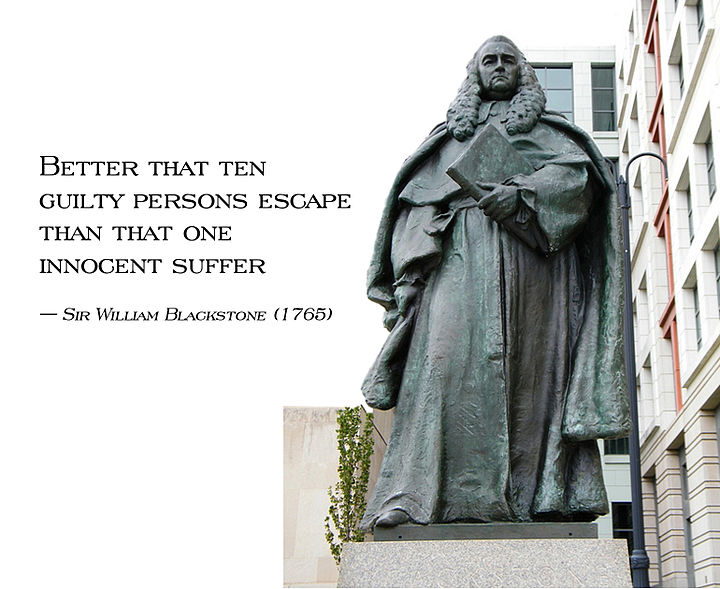
Relatedly, via Landsburg's discussion and Eugene Volokh's tout, I also discovered this wonderful and humorous 1997 law review article, "n Guilty Men," by Alexader Volokh (brother of Eugene), which traces the variations throughout history of the sentiment, most famously stated by William Blackstone, that it's better for ten guilty men to go free than to punish an innocent one. He begins by pointing out that there's not universal agreement on whether ten is the right number:
Volokh also cites Talmudic interpretations from the middle ages of Exodus 23:7 which came to the conclusion that, for purposes of execution, it was better to let 1,000 guilty men go free rather than convict an innocent one! (To jibe with Volokh's calculations vis a vis Abraham's bargain, Sodom's population would have had to have been 10,010.) I'm really just providing a taste, though, the whole thing is a must-read and IMO flat-out hysterical. (My favorite part is the send up of Blackstone's divinity and immortality.)
Acceptable Error Rates?
These discussions are dancing around the question of how many innocent people are falsely accused and convicted? And assuming the answer is greater than zero, what error rate is tolerable? Over the past couple of years this blog has compiled available estimates of actual innocence rates among prison inmates based on various methodologies and datasets, with results ranging on the low end from .75% to 3.3% on the high end. However you slice it, that's a not-insignificant false-positive rate. At a rate of .75%, we would assume there are 1,200 actually innocent people locked up in Texas prisons right now; at 3.3%, the total exceeds 5,000. (The rate among probationers is likely a little higher because of the incentive innocent people have to take a deal to avoid incarceration.)
Perhaps, given these data, Blackstone's 10-1 false-negative to false-positive ratio was always a little too stingy; perhaps Ben Franklin's n=100 is a better standard. I fail to understand why, if manufacturing companies can adopt "six sigma" error standards where "in which 99.99966% of the products manufactured are statistically expected to be free of defects (3.4 defects per million)," that the criminal justice system couldn't shoot for at least a four-sigma error rate (99.38% accurate). Criminal justice is a field where relatively high error rates are routinely tolerated in high-stakes circumstances.
These debates hone in on key, fundamental questions: What error rate is tolerable in the justice system - both false positives and false negatives - and how may those errors be reduced? How many innocent people is it acceptable to punish in pursuit of punishing the guilty, or is that ever justified? How much evidence is sufficient to convict and what constitutes reasonable doubt? I don't know the answer to all these questions, but they're interesting topics to think about and discuss.
The Likelihood of Guilt and Statistical Probability
Via Simple Justice and Eugene Volokh, I found this pair of posts from Steven Landsburg at The Big Questions both provocative and interesting. Go read them both before continuing with this post, since I'll refer to them but won't quote them extensively:
Basically Landsburg offers an example where a small but statistically significant sample (of black and red balls taken from an urn) points to a particular outcome with a 98% probability of accuracy, arguing that that level of certainty should be sufficient to secure a conviction "beyond a reasonable doubt."
As a probability game, that's all fine and good. As an analogy for the likelihood of guilt in a given situation, however, perhaps not so much. Even from a statistical perspective, I think the good professor is wrong, at least when you scale up his analysis to a systemic level. He is engaging in what's known among mathematicians as the "base rate fallacy," as evidenced by this example offered up by of all sources, the CIA:
During the Vietnam War, a fighter plane made a non-fatal strafing attack on a US aerial reconnaissance mission at twilight. Both Cambodian and Vietnamese jets operate in the area. You know the following facts:Bruce Schneier offers a similar example regarding data mining:
(a) Specific case information: The US pilot identified the fighter as Cambodian. The pilot's aircraft recognition capabilities were tested under appropriate visibility and flight conditions. When presented with a sample of fighters (half with Vietnamese markings and half with Cambodian) the pilot made correct identifications 80 percent of the time and erred 20 percent of the time.
(b) Base rate data: 85 percent of the jet fighters in that area are Vietnamese; 15 percent are Cambodian.
Question: What is the probability that the fighter was Cambodian rather than Vietnamese?
A common procedure in answering this question is to reason as follows: We know the pilot identified the aircraft as Cambodian. We also know the pilot's identifications are correct 80 percent of the time; therefore, there is an 80 percent probability the fighter was Cambodian. This reasoning appears plausible but is incorrect. It ignores the base rate--that 85 percent of the fighters in that area are Vietnamese. The base rate, or prior probability, is what you can say about any hostile fighter in that area before you learn anything about the specific sighting.
It is actually more likely that the plane was Vietnamese than Cambodian despite the pilot's "probably correct" identification. Readers who are unfamiliar with probabilistic reasoning and do not grasp this point should imagine 100 cases in which the pilot has a similar encounter. Based on paragraph (a), we know that 80 percent or 68 of the 85 Vietnamese aircraft will be correctly identified as Vietnamese, while 20 percent or 17 will be incorrectly identified as Cambodian. Based on paragraph (b), we know that 85 of these encounters will be with Vietnamese aircraft, 15 with Cambodian.
Similarly, 80 percent or 12 of the 15 Cambodian aircraft will be correctly identified as Cambodian, while 20 percent or three will be incorrectly identified as Vietnamese. This makes a total of 71 Vietnamese and 29 Cambodian sightings, of which only 12 of the 29 Cambodian sightings are correct; the other 17 are incorrect sightings of Vietnamese aircraft. Therefore, when the pilot claims the attack was by a Cambodian fighter, the probability that the craft was actually Cambodian is only 12/29ths or 41 percent, despite the fact that the pilot's identifications are correct 80 percent of the time.
This may seem like a mathematical trick, but it is not. The difference stems from the strong prior probability of the pilot observing a Vietnamese aircraft. The difficulty in understanding this arises because untrained intuitive judgment does not incorporate some of the basic statistical principles of probabilistic reasoning.
Data mining is like searching for a needle in a haystack. There are 900 million credit cards in circulation in the United States. According to the FTC September 2003 Identity Theft Survey Report, about 1% (10 million) cards are stolen and fraudulently used each year. Terrorism is different. There are trillions of connections between people and events -- things that the data mining system will have to "look at" -- and very few plots. This rarity makes even accurate identification systems useless.So if the evaluation of Prof. Landsburg's culpability were an isolated incident, perhaps his analytical assumptions make sense. If the same investigative technique is applied to many people, however, even a 98% level of certainty can produce many false positives, as in these examples.
Let's look at some numbers. We'll be optimistic. We'll assume the system has a 1 in 100 false positive rate (99% accurate), and a 1 in 1,000 false negative rate (99.9% accurate).
Assume one trillion possible indicators to sift through: that's about ten events -- e-mails, phone calls, purchases, web surfings, whatever -- per person in the U.S. per day. Also assume that 10 of them are actually terrorists plotting.
This unrealistically-accurate system will generate one billion false alarms for every real terrorist plot it uncovers. Every day of every year, the police will have to investigate 27 million potential plots in order to find the one real terrorist plot per month. Raise that false-positive accuracy to an absurd 99.9999% and you're still chasing 2,750 false alarms per day -- but that will inevitably raise your false negatives, and you're going to miss some of those ten real plots.
There's another mitigating wildcard to examine before we declare this one piece of datum sufficient for a conviction: Landsburg's assumptions included the statement, "While you weren’t looking, I reached into one of these urns and randomly drew out a dozen balls…4 of them were red and 8 were black." But what if that's a lie? What if while you weren't looking, Prof. Landsburg went into the left-hand urn and counted out a precise, predetermined number of red and black balls for his own purposes? Provocatively, Landsburg goes so far as to declare that "If I were on trial for the crime of drawing from the right urn, I hope this evidence would be strong enough to convict me," without even insisting that the balls in each urn be counted to ensure the theft really took place!
If taking balls from the right urn is a crime, why should we take the word of a criminal that the balls were indeed chosen randomly? :) In all seriousness, actually creating a law against taking balls from the right urn creates an incentive for the ball-taker to lie. For that matter, if someone wanted to make it falsely appear that the right urn was the source of balls that were really handpicked from the left, they would successfully fool others 98% of the time if they made sure their "random" pickings mirrored a right-urn pattern. In the world of statistical parlor games governed by hard-and-fast assumptions and rational decisions, those percentages make sense. In a world where 25% of DNA exonerations involved false confessions or guilty pleas, not so much.
Landsburg says "I hope this evidence would be strong enough to convict me," but depending on the jurisdiction that might be overly hopeful. In Texas state court, it may. In military courts martial, though, as well as in federal court, a confession must be independently corroborated by other evidence. The assumption that the balls were taken from an urn randomly comes from a stand-alone confession for which there is no corroboration. And of course, as one of Landsburg's commenters noted, in the real world one seldom would know the exact distribution of balls in each urn: In other words, much evidence in criminal cases includes elements of uncertainty which are merely assumed away in this hypothetical. Moreover, witnesses sometimes embellish or lie in ways that aren't always anticipated by game theory.
'n Guilty Men'
Relatedly, via Landsburg's discussion and Eugene Volokh's tout, I also discovered this wonderful and humorous 1997 law review article, "n Guilty Men," by Alexader Volokh (brother of Eugene), which traces the variations throughout history of the sentiment, most famously stated by William Blackstone, that it's better for ten guilty men to go free than to punish an innocent one. He begins by pointing out that there's not universal agreement on whether ten is the right number:
But why ten? Other eminent legal authorities through the ages have put their weight behind other numbers. "One" has appeared on Geraldo. 7 "It's better for four guilty men to go free than one innocent man to be imprisoned," says basketball coach George Raveling. 8 But "it's better to turn five guilty men loose than it is to convict one innocent man," according to ex-Mississippi executioner and roadside fruit stand operator Thomas Berry Bruce, who ought to know. 9 "It is better to let nine guilty men free than to convict one innocent man," counters lawyer Bruce Rosen from Madison, Wisconsin. 10 Justice Benjamin Cardozo certainly believed in five for execution, 11 and allegedly favored ten for imprisonment, 12 which is a bit counterintuitive. Benjamin Franklin thought "that it is better [one hundred] guilty Persons should escape than that one innocent Person should suffer." 13 Mario Puzo's Don Clericuzio heard about letting a hundred guilty men go free and, "struck almost dumb by the beauty of the concept . . . became an ardent patriot." 14 Denver radio talk show host Mike Rosen claims to have heard it argued "in the abstract" that it's better that 1000 guilty men go free than one innocent man be imprisoned, and comments, "Well, we get our wish." 15Excellent stuff, huh? Volokh sees the roots of these mathematical calculations over the relative value of innocent men in the story of Abraham haggling with God over the fate of the sinful city Sodom, the scriptural account of which is the epigraph to his article:
Or, perhaps, it may be merely "a few," 16 "some," 17 "several," 18 "many" (and particularly more than eight), 19 "a considerable amount," 20 or even "a goodly number." 21 Not all commentators weigh acquitting the guilty against the conviction of one innocent man. A Missouri district court said in 1877 that it was "better that some guilty ones should escape than that many innocent persons should be subjected to the expense and disgrace attendant upon being arrested upon a criminal charge." 22 And in Judge Henry J. Friendly's opinion, "Most Americans would allow a considerable number of guilty persons to go free than to convict any appreciable number of innocent men." 23 It is unclear whether "considerable" is greater or less than "appreciable." 24
n guilty men, then. The travels and metamorphoses of n through all lands and eras are the stuff that epic miniseries are made of. n is the father of criminal law. This is its story.
And Abraham drew near and said, Wilt thou also destroy the righteous with the wicked? Peradventure there be fifty righteous within the city: wilt thou also destroy and not spare the place for the fifty righteous that are therein? That be far from thee to do after this manner, to slay the righteous with the wicked: and that the righteous should be as the wicked, that be far from thee: Shall not the Judge of all the earth do right? And the Lord said, If I find in Sodom fifty righteous within the city, then I will spare all the place for their sakes.From this Volokh sensibly takes it that God's bottom line n for guilty people who may be freed for the sake of an innocent person would be n = (P-10)/10 where P = the population of Sodom. So, if Sodom was a town of 3000 people, by this logic God would countenance letting 299 guilty men go free for the sake of a single innocent [(3000 - 10)/10].
And Abraham answered and said, Behold now, I have taken upon me to speak unto the Lord, which am but dust and ashes: Peradventure there shall lack five of the fifty righteous: wilt thou destroy all the city for lack of five? And he said, If I find there forty and five, I will not destroy it. And he spake unto him yet again, and said, Peradventure there shall be forty found there. And he said, I will not do it for forty's sake. And he said unto him, Oh let not the Lord be angry, and I will speak: Peradventure there shall thirty be found there. And he said, I will not do it, if I find thirty there. And he said, Behold now, I have taken upon me to speak unto the Lord: Peradventure there shall be twenty found there. And he said, I will not destroy it for twenty's sake.
And he said, Oh let not the Lord be angry, and I will speak yet but this once: Peradventure ten shall be found there. And he said, I will not destroy it for ten's sake.
Volokh also cites Talmudic interpretations from the middle ages of Exodus 23:7 which came to the conclusion that, for purposes of execution, it was better to let 1,000 guilty men go free rather than convict an innocent one! (To jibe with Volokh's calculations vis a vis Abraham's bargain, Sodom's population would have had to have been 10,010.) I'm really just providing a taste, though, the whole thing is a must-read and IMO flat-out hysterical. (My favorite part is the send up of Blackstone's divinity and immortality.)
Acceptable Error Rates?
These discussions are dancing around the question of how many innocent people are falsely accused and convicted? And assuming the answer is greater than zero, what error rate is tolerable? Over the past couple of years this blog has compiled available estimates of actual innocence rates among prison inmates based on various methodologies and datasets, with results ranging on the low end from .75% to 3.3% on the high end. However you slice it, that's a not-insignificant false-positive rate. At a rate of .75%, we would assume there are 1,200 actually innocent people locked up in Texas prisons right now; at 3.3%, the total exceeds 5,000. (The rate among probationers is likely a little higher because of the incentive innocent people have to take a deal to avoid incarceration.)
Perhaps, given these data, Blackstone's 10-1 false-negative to false-positive ratio was always a little too stingy; perhaps Ben Franklin's n=100 is a better standard. I fail to understand why, if manufacturing companies can adopt "six sigma" error standards where "in which 99.99966% of the products manufactured are statistically expected to be free of defects (3.4 defects per million)," that the criminal justice system couldn't shoot for at least a four-sigma error rate (99.38% accurate). Criminal justice is a field where relatively high error rates are routinely tolerated in high-stakes circumstances.
These debates hone in on key, fundamental questions: What error rate is tolerable in the justice system - both false positives and false negatives - and how may those errors be reduced? How many innocent people is it acceptable to punish in pursuit of punishing the guilty, or is that ever justified? How much evidence is sufficient to convict and what constitutes reasonable doubt? I don't know the answer to all these questions, but they're interesting topics to think about and discuss.
Tuesday, November 09, 2010
TYC football team receives spirited welcome
Occasionally, following this nationally publicized example, schools on the schedules of TYC's fooball teams have taken to welcoming the visiting squad with their own cheering section, food after the game, etc.. Here's a story of a private Austin school which showed the Giddings State School Indians a good time before and after a thorough on-the-field trouncing. With the emphasis on group prayer and affirming the humanity of offenders, plus the fact that some of the schools putting on these welcomes, like this one, are religious academies, such events almost have the feel of prison ministry work. I'm glad to see it.
Tuesday, May 25, 2010
Whitmire, Patrick suggest seminary inside prison
Reports Mike Ward at the Austin Statesman:
Depending on how they implement it I suppose there could be some establishment clause problems, but in general I see this as basically just a job training program, not much different than if they decided to train groups of inmates as yoga instructors who would then provide classes to their peers. Not everybody can or should be a preacher, though (particularly not everybody in prison - there are enough charlatans in the field already!) and I wish there was a broader focus on providing meaningful job skills in emerging industries.
In Texas, Southwestern Seminary in Fort Worth has sometimes been the domain of feuding factions of Baptists, which makes me wonder which religious group would be chosen for such a task and whether that might generate unforeseen controversy? Will the seminary train Catholics, Baptists, Pentecostals, Unitarians, Muslims, Wiccans? Quien sabe? Moreover, each of those groups has internal factions to contend with; none are monolithic and the brand of religion taught will inevitably fail to match every taste.After visiting a once-violent Louisiana prison that is now ranked as one of the most tame thanks to a minister-training program, two key state senators today proposed bringing the concept to Texas.
The proposal is to locate a religious seminary inside a Texas lockup.
Senate Criminal Justice Committee Chairman John Whitmire, D-Houston, and Sen. Dan Patrick, R-Houston, a member of the committee, said they think that the rehabilitation project that has worked well at the Louisiana State Penitentiary at Angola could be just as successful in Texas.
Whitmire and Patrick spent three days last week at the Angola lockup, once ranked as the most violent prison in America, along with representatives of the Texas Department of Criminal Justice and the Texas Bible College.
“I found this to be a remarkable program that Sen. Patrick and I will present to state leadership and the Texas Board of Criminal Justice, and will work with Texas prison officials to locate the right unit, the right warden, and the right staff to duplicate the effort in Texas,” Whitmire said.
“It certainly deserves the attention of our state leaders and prison officials.”
As the largest maximum-security prison in the United States with about 5,000 violent-crime felons — more than 3,600 of them serving life sentences — the prison now houses an arm of the New Orleans Baptist Theological Seminary which provides a four-year program that so far has trained about 150 ministers.
Depending on how they implement it I suppose there could be some establishment clause problems, but in general I see this as basically just a job training program, not much different than if they decided to train groups of inmates as yoga instructors who would then provide classes to their peers. Not everybody can or should be a preacher, though (particularly not everybody in prison - there are enough charlatans in the field already!) and I wish there was a broader focus on providing meaningful job skills in emerging industries.
Tuesday, April 13, 2010
'Faith-based row' program earns Governor's volunteer award
This is interesting; from a press release reprinted in the Huntsville Item:
The G4 Faith Based Row, a program launched in the Wynne Unit in Huntsville, received the Governor’s 2010 Criminal Justice Volunteer Service Award in recognition of its dedication to ministering to offenders incarcerated within the Texas Department of Criminal Justice [last week].
The award was presented by Texas Board of Criminal Justice Chairman Oliver Bell, and TDCJ Executive Director Brad Livingston today during a ceremony held in Austin.
G4 Faith Based , which was the recipient of the “Most Innovative Program” award, is one of 20 individuals and initiatives from across the state recognized for their efforts to help inmates and those who are on parole or probation.
"The men and women recognized this year have promoted positive change both in those inmates who are incarcerated, and those who have been released,” said Livingston. “They have given selflessly to the State of Texas and we are grateful for their efforts.”
The G4 Faith Based Row is an off-shoot of the successful Faith-Based Dorm program that is being implemented at units across the state. The difference though is in the classification of the offenders who participate.
G4 offenders are classified as medium custody because of behavioral problems and as a result, live with certain restrictions. Through the innovative efforts of Wynne Unit Warden Vernon Pittman, his staff and dedicated volunteers, a row in the medium custody wing of the Wynne Unit became a faith-based row and lives began to change.
The G4 offenders began participating in Life Change Groups, emphasizing Bible education, personal accountability and ministry to others. As a result, the G4 offenders began to make serious changes in their behavior and in their lives and they began promoting out of this restricted custody level through the classification process. The Wynne Unit now has a faith-based row on a general population cellblock so that these offenders can continue their spiritual journey even as they are promoted to less restrictive custody levels.
Friday, November 13, 2009
Buddhism in Texas prisons
One usually thinks of prison ministries as a Christian or perhaps an Islamic calling, but according to an informative article by Zen Zheng in the Houston Chronicle ("Cultivating her faith," Nov. 12) "Buddhist volunteers work in eight of 113 state prisons." Buddhist prison ministries are spearheaded by Myokei Caine-Barrett, a Texan who was introduced to Buddhism in El Paso and Houston. She has performed weekly services at TDCJ facilities since becoming ordained in 2007.
Wednesday, November 11, 2009
When bringing Christianity into the jury box, bring all of it
I've ignored until now a Texas case receiving international notoriety in which jurors consulted some of the more punitive verses in the Christian Bible during deliberations in a death penalty case. It's been getting wide play elsewhere because it hits on two culture-war touchstones - the death penalty and church-state separation - that this writer finds boring, dull and repetitive.
However, this morning I ran across an angle on the case that interests me more. Scott Greenfield at Simple Justice has a post on the case, describing how the 5th Circuit agreed the scripture constituted an "external influence" on the jury but concluded that "under the "highly deferential standard" by which federal courts should review state court decisions, [the defendant] had failed to prove that he had been prejudiced by this unconstitutional juror conduct." SCOTUS recently declined to hear the matter, so the Bible-influenced verdict stood and the defendant was executed last week. A commenter at Simple Justice, Wayne Clemons, points out that:
It's funny (and not ha-ha funny) how those most aggressively positing a biblical, scriptural basis for capital punishment often appear unconcerned at such biblical due process niceties.
Recently I wrote about a capital murder case in which the only evidence against the defendant was a jailhouse snitch and a scent lineup by Fort Bend County Sheriff's Deputy Keith Pikett's dogs. So I guess that's two witnesses, if you count the dog. But really it's none, since the snitch didn't actually see the crime and was compensated by the state with official leniency for his testimony.
In reality, our judicial system simply does not require proof "beyond a reasonable doubt," even if that's the hackneyed catch phrase with which juries are instructed - not when a jailhouse snitch and an accusation from a dog can get you a capital murder conviction (thankfully in that case the jury gave sentence of life without parole). Until Texas became one of the only states to change its law (in 2001), thousands of drug defendants were convicted based solely on the testimony of an undercover snitch, many of them by drug task forces like the ones memorialized in book and film in Tulia and Hearne. In non-drug cases, that's still legally enough to convict.
The real, workaday standard of proof typically employed in criminal cases is closer to what lawyers would call a "preponderance of the evidence" - based on the evidence heard by the jury, guilt is more likely than not, but by no means certain. That's about all you can say about a case made on testimony by a jailhouse snitch and a dog. There's absolutely no way under those circumstances that all "reasonable doubt" could be extinguished. Ditto for the Tulia cases, where testimony from one lying cop was enough to convict some three dozen people.
Courts routinely allow convictions based on a single eyewitness' identification, even when the witness had never seen the defendant before the encounter. But research shows the error rates in such identifications are unconscionably high, particularly when police don't use best practices and contaminate eyewitness evidence during a lineup.
As I said in the comments at Simple Justice, "It wouldn't matter if you kept the Bible out of the jury room. Folks who believe strongly that way can quote chapter and verse." But I also lamented "that VERY few Christians emphasize the 'two or three witnesses' requirement as strongly as the 'eye for an eye' stuff," even though "for Christians, the New Testament retains the former and rejects the latter." (See this discussion.)
I don't kid myself that jurors won't bring their religious beliefs with them into the courtroom - including those who believe in biblical infallibility, whose number in Texas are not insignificant. But I wish when that happens, Christian jurors would focus as much attention on the Bible's insistence the right person be punished as they do on Old Testament penalties.
RELATED: Three guys who couldn't be on a Harris County jury: Moses, Jesus and the Apostle Paul
However, this morning I ran across an angle on the case that interests me more. Scott Greenfield at Simple Justice has a post on the case, describing how the 5th Circuit agreed the scripture constituted an "external influence" on the jury but concluded that "under the "highly deferential standard" by which federal courts should review state court decisions, [the defendant] had failed to prove that he had been prejudiced by this unconstitutional juror conduct." SCOTUS recently declined to hear the matter, so the Bible-influenced verdict stood and the defendant was executed last week. A commenter at Simple Justice, Wayne Clemons, points out that:
Reading a few verses down, the jury would have found:It's not just murder, of course, for which the Bible would require mulitple witnesses: "One witness shall not rise up against a man for any iniquity, or for any sin, in any sin that he sinneth: at the mouth of two witnesses, or at the mouth of three witnesses, shall the matter be established." (Deuteronomy 19:15)
"Anyone who kills a person is to be put to death as a murderer only on the testimony of witnesses. But no one is to be put to death on the testimony of only one witness."
It's funny (and not ha-ha funny) how those most aggressively positing a biblical, scriptural basis for capital punishment often appear unconcerned at such biblical due process niceties.
Recently I wrote about a capital murder case in which the only evidence against the defendant was a jailhouse snitch and a scent lineup by Fort Bend County Sheriff's Deputy Keith Pikett's dogs. So I guess that's two witnesses, if you count the dog. But really it's none, since the snitch didn't actually see the crime and was compensated by the state with official leniency for his testimony.
In reality, our judicial system simply does not require proof "beyond a reasonable doubt," even if that's the hackneyed catch phrase with which juries are instructed - not when a jailhouse snitch and an accusation from a dog can get you a capital murder conviction (thankfully in that case the jury gave sentence of life without parole). Until Texas became one of the only states to change its law (in 2001), thousands of drug defendants were convicted based solely on the testimony of an undercover snitch, many of them by drug task forces like the ones memorialized in book and film in Tulia and Hearne. In non-drug cases, that's still legally enough to convict.
The real, workaday standard of proof typically employed in criminal cases is closer to what lawyers would call a "preponderance of the evidence" - based on the evidence heard by the jury, guilt is more likely than not, but by no means certain. That's about all you can say about a case made on testimony by a jailhouse snitch and a dog. There's absolutely no way under those circumstances that all "reasonable doubt" could be extinguished. Ditto for the Tulia cases, where testimony from one lying cop was enough to convict some three dozen people.
Courts routinely allow convictions based on a single eyewitness' identification, even when the witness had never seen the defendant before the encounter. But research shows the error rates in such identifications are unconscionably high, particularly when police don't use best practices and contaminate eyewitness evidence during a lineup.
As I said in the comments at Simple Justice, "It wouldn't matter if you kept the Bible out of the jury room. Folks who believe strongly that way can quote chapter and verse." But I also lamented "that VERY few Christians emphasize the 'two or three witnesses' requirement as strongly as the 'eye for an eye' stuff," even though "for Christians, the New Testament retains the former and rejects the latter." (See this discussion.)
I don't kid myself that jurors won't bring their religious beliefs with them into the courtroom - including those who believe in biblical infallibility, whose number in Texas are not insignificant. But I wish when that happens, Christian jurors would focus as much attention on the Bible's insistence the right person be punished as they do on Old Testament penalties.
RELATED: Three guys who couldn't be on a Harris County jury: Moses, Jesus and the Apostle Paul
Thursday, August 27, 2009
At TDCJ, Wiccan is 'non-denominational'
Some readers may be interested in discussing the debate over an inmate in South Texas who sued claiming he's being denied the right to perform Wiccan religious services. Reported the Brownsville Herald:
Charles Roberts, 28, of Brownsville, alleges he has asked several times for religious books, pentagrams and a person to lead Wiccan services at the Texas Department of Criminal Justice’s Lopez Unit but has received no assistance from the prison’s chaplain. ...
Under current prison policy, there must be three inmates of the same faith in a given facility before employees will allow them to meet for worship services. An outside volunteer is also required to lead the sessions.
The department has established Catholic, Muslim, Jewish, Native American and non-denominational Christian services at all of their prisons. Wiccan volunteers also lead worship sessions at two TDCJ facilities outside of Houston, department spokesman Jason Clark said.
But Roberts – a Brownsville native incarcerated for a 2004 conviction on aggravated assault charges — claims that prison officials failed to even note his religion correctly on his inmate intake forms.
When he told him practiced Wicca – a neo-pagan, nature based religion — an intake officer classified him as "non-denominational," his lawsuit states.
"The fact that my religious preference is said to be non-denominational goes to show that nothing is being done," he wrote.
A number of Texas inmates from various faiths have challenged the prison’s religious policies on similar grounds over the past several years. In nearly every case, federal judges and appeals court justices have found that the department’s guidelines does not put undo restraints on inmates’ ability to practice their faith.
I don't find the policy particularly unreasonable that there must be three inmates of a given faith in a unit to justify holding a worship service, but if they offer Wiccan services at other units I don't see why TDCJ doesn't just offer to transfer the fellow to one of them. It sounds like the failure to provide books and other religious materials may stem from the simple misidentification of religious preference on the intake form.
Sunday, April 26, 2009
'Imprisoned by Stereotypes'
From Doc Berman:
Inside Out, the online magazine of the Prison Fellowship, has this interesting cover story with the same title as the title of this post. Here is how it gets started:
Here's a brief description of the three Texas prison ministry volunteers profiled:When the average person conjures an image of a prisoner, what is pictured? Does the mind’s eye see a lone shadow with defiance and anger on his face and evil and ill-intent in his heart, prowling for trouble and poised to wreak violence? And who or what provides this image? Movies? The news media? Fear?
When three people from Texas look into the faces of prisoners, they see an opportunity for repentance, a prospect for a second chance, a vessel of potential. Their perception of prisoners is not based on sensationalized images from any screen, or on what they think it means to be a prisoner. Among them, they have more than three decades of experience in prison ministry. And while they, too, acknowledge that there are prisoners who live up to society’s stereotypes, there are also those who reduce such notions into myth.
With 15 years of prison ministry experience, Lloyd Knapp points out that people inside prison and people outside of prison have at least one major similarity: the capability of making poor choices. The difference between prisoners and nonprisoners most often lies within circumstance. “There are those of us who commit crimes, and there are those of us who don’t get caught. Obviously most of us haven’t committed murder or done drugs, but we’ve done things that we regret or wish we hadn’t. Prisoners make mistakes, too, but they habitually make those mistakes. They’re not evil at heart; they’ve just been down that road so long, it’s difficult for them to change.”
Judy Indermuehle, a prison volunteer for more than nine years, agrees with Lloyd. In fact, she says that looking inside a prison is like looking into a large cultural mirror. “The prison population is a large mix of society,” says Judy, “same as we have outside. Prisoners are bad and evil, just like we are. We are capable of what they’ve done, and unless we are able to view ourselves that way, it would seem we are full of arrogance.”
Adelaide Biggs, a volunteer with more than nine years of experience inside prisons, echoes Judy’s tenacious sentiment. “We need to remember that we’re all sinners,” she says. “Jesus changes us. Most of the people I see have lived a horrible life and made terrible choices, but they know they can be different people through Christ. And isn’t that the Christian faith?”
All three volunteers agree: Prisoners are neither more nor less evil than those outside of prison. The main difference between the majority of the incarcerated and the majority of the free is not something inherent, so much as it is something acquired.
Monday, September 08, 2008
Houston appeals court: Church of Christ, other Protestants may have no privilege in communications with clergy
Are communications with your minister covered by the clergy-commnicant privilege? To find out you'd better first study up on your Church's detailed doctrines on the topic. Catholics and Jews seem pretty much safe, but if a new appellate ruling stands, most Protestants in Texas may no longer be eligible to claim the privilege.
Rule 505 from the Texas Rules of Evidence declares that "A person has a privilege to refuse to disclose and to prevent another from disclosing a confidential communication by the person to a member of the clergy in the member's professional character as spiritual adviser."
Further, declares Rule 505, "A 'member of the clergy"' is a minister, priest, rabbi, accredited Christian Science Practitioner, or other similar functionary of a religious organization or an individual reasonably believed so to be by the person consulting with such individual.
So perhaps readers will forgive this non-lawyer's confusion over a recent appellate decision by the First Court of Appeals in Houston declaring there exists no privilege for communicants and clergy in the Church of Christ, which is a major Protestant denomination in Texas. The court ruled that the Church of Christ has no doctrine of keeping confessions secret. As usefully described at Evidence Prof Blog:
There's a slippery slope factor here - if this ruling stands, in the First Court's jurisdiction, at least, now each individual religion's doctrines are subject to evaluation by judges to determine if Rule 505 applies to their clergy. I'd guess most evangelical and Protestant Christian denominations in particular have no such formal doctrine.
I don't believe such judicial interpretations of Church doctrine were either intended or authorized by Rule 505, which makes no such distinctions in the plain language of the text. Though I'm not a lawyer, I agree with Evidence Prof blogger Colin Miller this is a novel distinction established by the First Court, which enjoys a reputation as one of the more aggressively activist, pro-prosecution appellate courts out of the 14 in Texas.
One hopes the state Court of Criminal Appeals might take up the issue and overrule the First Court; this seems like a pointless, even anti-religious instance of judicial activism and a bad precedent to set.
BLOGVERSATION: Corrupt Hive agrees with the ruling.
Rule 505 from the Texas Rules of Evidence declares that "A person has a privilege to refuse to disclose and to prevent another from disclosing a confidential communication by the person to a member of the clergy in the member's professional character as spiritual adviser."
Further, declares Rule 505, "A 'member of the clergy"' is a minister, priest, rabbi, accredited Christian Science Practitioner, or other similar functionary of a religious organization or an individual reasonably believed so to be by the person consulting with such individual.
So perhaps readers will forgive this non-lawyer's confusion over a recent appellate decision by the First Court of Appeals in Houston declaring there exists no privilege for communicants and clergy in the Church of Christ, which is a major Protestant denomination in Texas. The court ruled that the Church of Christ has no doctrine of keeping confessions secret. As usefully described at Evidence Prof Blog:
Does Judaism have any formal doctrine of confessional secrecy? If so I'm not aware of it but "rabbis" are specifically named in the rule. Certainly there's no such formal doctrine among Southern Baptists, the faith tradition in which I was raised.Without even having to get into waiver issues, the Court of Appeals of Texas found that the privilege did not apply. Why? According to the court, a former elder of [defendant] Leach's church, the Church of Christ, testified that the church does not have a doctrine that confessions will be kept confidential. Moreover, Leach's father testified that a member of the congregation can confess to an elder, and the elder will stand up and tell the congregation what he has confessed, and they will all pray together
Leach's father also indicated that no communication is private unless requested. And one of the elders of the church testified that Leach never told him that he wanted his communication to be kept private. Moreover, Leach's mother and father both testified that Leach never expressly indicated that he wanted his statements to the clergy to be kept private. Finally, Leach's mother also testified that Leach "knew when he told us what had happened that it was no longer going to be private once it got out."
All of this is fairly fascinating to me. I had assumed that all religious institutions had policies of keeping their penitents' "confessions" confidential, meaning that such confessions would normally be inadmissible under cleric-penitent privileges in the same way that confessions to attorneys are normally inadmissible under the attorney-client privilege and confessions to psychotherapists are normally inadmissible under the psychotherapist-patient privilege. Obviously, though, this is not the policy with the Church of Christ, and it might not be the policy with other religious institutions. In Evidence class, I like to say that the so called "professional privileges" are all very similar, but this seems to me to be a key difference.
There's a slippery slope factor here - if this ruling stands, in the First Court's jurisdiction, at least, now each individual religion's doctrines are subject to evaluation by judges to determine if Rule 505 applies to their clergy. I'd guess most evangelical and Protestant Christian denominations in particular have no such formal doctrine.
I don't believe such judicial interpretations of Church doctrine were either intended or authorized by Rule 505, which makes no such distinctions in the plain language of the text. Though I'm not a lawyer, I agree with Evidence Prof blogger Colin Miller this is a novel distinction established by the First Court, which enjoys a reputation as one of the more aggressively activist, pro-prosecution appellate courts out of the 14 in Texas.
One hopes the state Court of Criminal Appeals might take up the issue and overrule the First Court; this seems like a pointless, even anti-religious instance of judicial activism and a bad precedent to set.
BLOGVERSATION: Corrupt Hive agrees with the ruling.
Subscribe to:
Posts (Atom)


.jpg)


