Showing posts with label Williamson County. Show all posts

Tuesday, September 20, 2016

Cash-register justice, against drug-free zones, and other stories

Here are a few odds and ends which merit Grits readers' attention while I'm focused elsewhere today:

Williamson County to allow citations for pot, DWLI
Great news: Williamson County has decided to let Round Rock police officers issue citations for low-level marijuana possession and driving with an invalid license, utilizing a 2007 statute authored by former House Corrections Chairman Jerry Madden. The move is being pitched as a pilot program which could expand to other agencies if successful.

Capital Appellate Fail
The Texas Defender Service today released a major report from our pal Amanda Marzullo on the inadequacy of the direct appeals process in capital cases. See the executive summary and the full report, as well as initial coverage from the Houston Chronicle. More on this later, perhaps, after Grits has had the chance to read it.

Guidance on operating inmate web pages
At the Electronic Frontier Foundation, Dave Maas offered guidance for people operating social media or web pages on behalf of  Texas prison inmates, after TDCJ earlier this year banned such accounts when operated by a third party.

Ticketed drivers need 'safe haven' to deal with debt
College Station muni Judge Edward Spillane had a great suggestion for encouraging drivers with outstanding tickets to come to court: "Why not encourage defendants to come to court and not be in jail by mandating legislatively or as a start courts having a policy that coming to court removes any pending warrant out of that court for misdemeanor charges on fine-only cases?" Comparing the idea to the mediaeval concept of "sanctuary" in churches, Spillane argued that "Safe Haven" legislation would reduce incarceration, encourage defendants to come to court, and "make it clear that jail is not the proper punishment for fine-only cases."

Contemplating collateral consequences
Noting that more than 7,000 felons return to Bexar County every year, the SA Express-News published a good story recently on collateral consequences from felony convictions. The gist: "Tough-on-crime policies extend well beyond harsh sentencing. There is a series of invisible sanctions we impose after the official sentence is met. People with felony records, especially drug-related cases, are legally discriminated against when seeking jobs, public housing, food assistance and student loans, not to mention voting and jury duty. One of the most harmful of these sanctions may be the discrimination of employment because a stable job with a living wage is a critical factor in keeping former convicts from relapsing into the criminal justice system."

Against 'drug-free zone' statutes
In Texas, drug offenses in a "drug-free zone" can result in lengthy mandatory minimums rivaling those for deadly weapon offenses. Texas prosecutors especially like the statute because, in the wake of earlier drug-law reforms, "keeping drug offenders in prison is becoming increasingly difficult." As other states reconsider drug free zones, eliminating that enhancement seems like a good way to stop sending a discrete class of nonviolent offenders away for super-long sentences.

Requiem for junk science
At the Wall Street Journal, Judge Alex Kozinski opined on the significance of a "new study from the President’s Council of Advisors on Science and Technology [which] examines the scientific validity of forensic-evidence techniques—DNA, fingerprint, bitemark, firearm, footwear and hair analysis. It concludes that virtually all of these methods are flawed, some irredeemably so." Wrote Kozinski, "Some forensic methods have significant error rates and others are rank guesswork." For example, "Bitemark analysis is about as reliable as astrology."

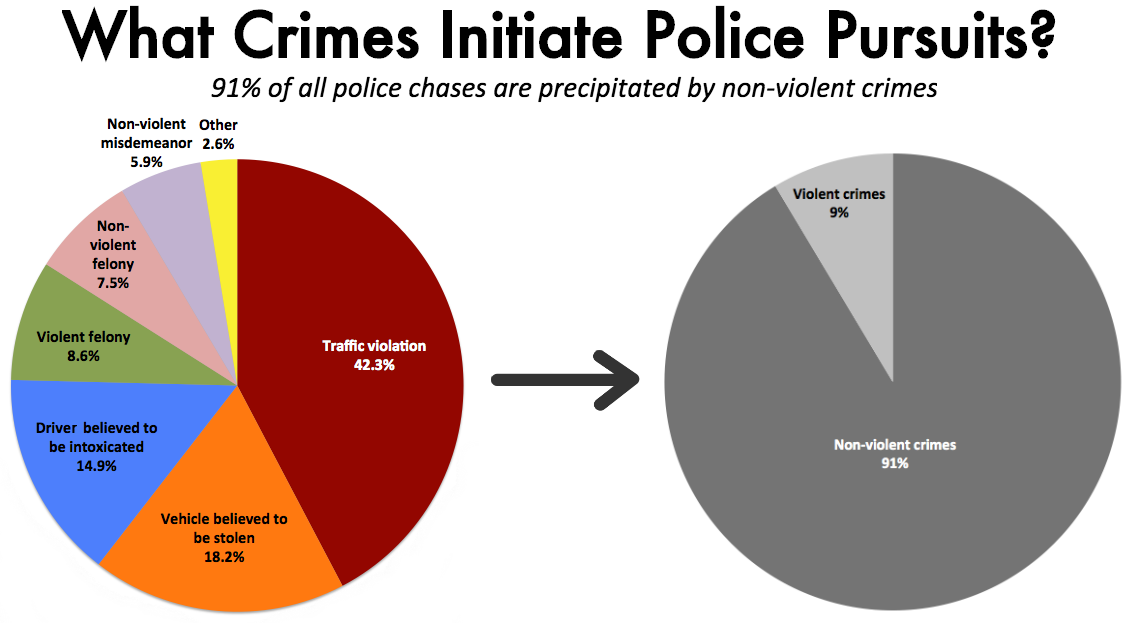
Most police pursuits over nonviolent offenses
What crimes generate police pursuits? Very few are violent felonies.

Cash-Register Justice
An academic paper confronting debtors prison issues from earlier this year has been appended to Grits' ongoing reading list. Here's the abstract:
Criminal justice debt has aggressively metastasized throughout the criminal system. A bewildering array of fees, fines, court costs, non-payment penalties, and high interest rates have turned criminal process into a booming revenue center for state courts and corrections. As criminal justice administrative costs have skyrocketed, the burden to fund the system has fallen largely on the system’s users, primarily poor or indigent, who often cannot pay their burden. Unpaid criminal justice debt often leads to actual incarceration or substantial punitive fines, which turns rapidly into “punishment.” Such punishment at the hands of a court, bureaucracy, or private entity compromises the Sixth Amendment right to have all punishment imposed by a jury. This Article explores the netherworld of criminal justice debt and analyzes implications for the Sixth Amendment jury trial right, offering a new way to attack the problem. The specter of “cash-register justice,” which overwhelmingly affects the poor and dispossessed, perpetuates hidden inequities within the criminal justice system. I offer solutions rooted in Sixth Amendment jurisprudence.

Thursday, June 09, 2016

Risk assessments, visitation, and imaginary prisons

While I'm preoccupied with other matters, including another small video project to be unveiled soon (the last one has been viewed about 100K times now and received nearly 1,000 Facebook shares), here are a number of items which merit Grits readers' attention:

On the risks of risk assessments
Grits' views on risk assessments are still up in the air, or more specifically, situational. I tend to dislike the idea at sentencing (a lot of "future dangerousness" testimony in capital cases has been pure junk) but mind them less for parole boards, whose members by definition make risk assessments with or without a formal instrument. I also mind the idea less for pretrial assessments, when the alternative is to leave folks sitting in jail. But the critique is that risk assessments are inaccurate and discriminatory, and this blogger did a good job compiling links to stories that call them into question, for those interested. This is an important emerging debate among both advocates and criminal justice professionals; I hope it can be had with a tad less vitriol than has characterized the discussion so far. Folks can disagree in good faith here.

In favor of in-person visitation
Check out a cool interview with our pal Jorge Renaud in a publication called The Establishment on the grassroots pushback against elimination of in-person visitation at prisons and jails.

Offender Orientation manual
A new version of the TDCJ Offender Orientation manual came out in April.

Williamson County DAs keep embarrassing local voters
Between John Bradley and now Jana Duty, who was recently disciplined by the state bar, Williamson County voters sure know how to pick reputable DAs! Local leaders this week held a press conference giving her until "sunset" on Friday to resign, though I'm not sure there is legal leverage to bounce her out. Every Texan above a certain age knows of "sundown towns," of which there used to be a few here, but this is the first time I've heard of such an ultimatum aimed at a sitting elected prosecutor.

Imaginary Prisons
An old college buddy, local architect-turned-furniture-maker Mark Maček, turned me on to Giovanni Battista Piranesi (1720–1778), which led me in turn to this 16-print series of sketches titled "Imaginary Prisons." Awesome.


If you've got a spare $400K or so you could probably buy a copy. I'd like to read the orientation manual for THAT place.

Saturday, September 12, 2015

One-termers

District Attorneys Susan Hawk in Dallas and Jana Duty in Williamson County both defeated incumbent DAs with widely reported problems, but both women have since run into troubles of their own.

Duty defeated incumbent DA John Bradley in a GOP primary in 2012, essentially running the long-time prosecutor stalwart out of town. (He's now prosecuting fishing crimes in Palau.) But lately, she appears to be headed down her own dark path. Duty spent time in jail for contempt in August for violating a gag order and last week the same judge ruled she intentionally withheld evidence at a capital murder trial. Reported the Austin Statesman:
Crispin Harmel can face a second trial because Duty did not intend to provoke a mistrial during his first trial, according to a court document filed Friday by District Judge Rick Kennon.

“It is unknown to the court why Ms. Duty intentionally and willfully withheld the means to view time stamps on the Walmart Surveillance video other than from Ms. Duty’s statement that “(defense counsel) acted so horribly to me during the first trial, that I just — I didn’t want to speak to them,’” the court document said.

“The court does not approve of this conduct or the reason for it. However, the court finds no evidence that Ms. Duty intended to goad a mistrial or avoid an acquittal.”

Prosecutors and defense lawyers have been barred from commenting on the case by a gag order.
Defense attorney Kristin Jernigan filed a notice Friday that she plans to appeal Kennon’s decision to the 3rd Court of Appeals. She has previously argued that Harmel could not be tried again because double jeopardy bars a retrial when the prosecutor’s conduct was intentional in provoking the request for a mistrial.
That makes it sound like Duty essentially just threw a snit fit. To intentionally withhold evidence in a capital murder trial because opposing counsel "acted so horribly to me" bespeaks a profound lack of professionalism.

And in Dallas, after ousting Democrat Craig Watkins in the 2014 general election, Republican Susan Hawk revealed that she suffers from major depression and has taken a leave of absence to be hospitalized for treatment which is approaching the two-month mark.

Dallas News political writer Gromer Jeffers had a column recently documenting the details of her undoing - paranoia, fallouts with long-time allies, divorcing her husband just as she took office, and her unexplained absence from the job in August which was ultimately revealed to stem from mental health issues that she concealed from voters during her campaign. Moreover, she "fired or forced the resignation of at least six key employees under controversial circumstances" since she took office in January, some of them close allies.

I've heard attorneys in Dallas openly speculate she may never come back. But unless she resigns, she's there until 2018.

One empathizes with Judge Hawk but the local perception is she lied to voters and going AWOL is a bad look.

Both women are beginning to look like one-termers.

Tuesday, September 16, 2014

Ugly allegations of abuse, inmate hazing at Bartlett State Jail

Holy God! I hardly know what to make of this! From the San Antonio Express-News ("Lawsuit: Texas prison okays odd sex assault," Sept. 26):
A lawsuit filed against the Corrections Corporation of America in Austin alleges the private prison company violated a former prisoner's constitutional rights by allowing a hazing tradition called "ass on the glass" that led to a sexual assault.

The suit, filed in federal district court, claims a Bartlett State Jail guard knowingly allowed the man, referred to as John Doe in the court documents, and more than 50 other prisoners to be subjected to the hazing tradition that involves forcibly stripping an individual, turning him upside down and slamming his buttocks against the glass of a guard's station.

During a two-hour incident last October in which all 55 prisoners in the cell block were subjected to the hazing, a prisoner allegedly "inserted his finger into Mr. Doe's anus, and another grabbed his testicles, sexually assaulting him in violation of the Texas Penal Code," according to the documents.

The defendant claims that the one officer on duty, responsible for four cell blocks with 55 prisoners in each, "watched dozens of men get slammed up against the glass wall" and "did nothing." ...
 The Bartlett State Jail, a men's prison, is located in Williamson County and has 140 security employees and a capacity of 1,049 inmates, according to the TCDJ.
The Texas Civil Rights Project is handling the case. TCRP attorney Scott Medlock, formerly an attorney with the Texas Civil Rights Project, told the Express-News that "the man was sentenced to 180 days in state jail for possession of less than a gram of a controlled substance. He said the defendant 'made a mistake, was punished for the mistake, but did not deserve to be sexually assaulted.'"

Of course, for now these are only allegations, but they're certainly disturbing ones. If they're true, it makes you wonder about a) the effectiveness of TDCJ contract monitoring with private prisons and b) whether Corrections Corporation of America's recently announced commitment to preventing recidivism and reentry programs could possibly jibe with the organization's historic institutional culture.

In the meantime, add the Bartlett State Jail to the list of facilities the Legislature might consider shuttering if they decide to close more prisons. If its institutional culture was tolerating this, it's hard to imagine staff there will suddenly shift toward a rehabilitation mindset. Better to just end the contract and cut bait.

MORE: From Texas Prison Bidness.

Wednesday, July 09, 2014

Palau president defends John Bradley hire

Via Agence-France-Press, the President of Palau felt the need to explain the island nation's decision to hire former Williamson County DA John Bradley as a prosecutor in their Attorney General's office.
[President Tommy] Remengesau said Bradley acknowledged he was wrong to block the DNA testing and "is painfully aware that his actions kept an innocent man locked up for longer than he should have been".

But he said Bradley deserved a second chance and was seeking it in the island nation of 22,000 people, which is best known for its spectacular diving sites.

"Mr. Bradley says that the Morton case has changed him as a person and has made him a more balanced, fair, and humble prosecutor," Remengesau said in a statement.

He said Bradley had more than 25 years of prosecution experience and had never been found to have violated any law or ethical rule over the Morton case.

"The Republic hired Mr. Bradley because our nation needs experienced and skilled prosecutors to help keep our community safe Mr. Bradley fits that bill," he said.

Bradley is expected to start in his new role before Palau hosts the Pacific Islands Forum at the end of this month.
Hmmmm ... I thought Bradley had recanted his road to Damascus conversion rhetoric, but apparently it's a meme he still trots out when it benefits him, like in a job interview. Grits hopes it's true Bradley is a changed man and that he won't bring the same, misbegotten attitude and arrogance to Palau that he displayed as a prosecutor in Texas. OTOH, on the off chance he hasn't changed, I'd rather him perform that function on an island 8,000 miles away than here. Adios, JB. Don't let the door hit you in the ass on the way out.

MORE: A commenter chastised me for this post engaging in "snark." However, since I didn't consider this post particularly snarky, let's add some. I'd mentioned earlier that this story sounded like a bad sitcom plot. A friend of the blog emailed this morning to say, "I have a name for the reality show that Bradley will star in: Kangaroo Court. Or maybe Banana Republic. Can [Charles] Sebesta be in it too?" 

Imagine JB will be prosecuting in a place where more people speak Palauan than English, natives live in a matrilineal society, and at least some of them dress like this:


I located the job posting for Bradley's new gig on the Texas District and County Attorneys Association (TDCAA) website; for his sake, I hope $65K goes further in Palau than it does here.

For a nation of about 20,000 people, Palau has 145 cops, which seems like overkill until you realize they must cover around 250 islands that, according to Wikipedia, span an area of ocean the size of France. One of the big crimes they're focused on is illegal fishing with dynamite. A State Department report mentioned that, as of 2012 in Palau, "There were 51 prisoners, including one woman and one juvenile. The prison can hold up to 80 prisoners." During his Williamson County days, Bradley's shop would have filled up that prison in a week or two, so this new scenario will be quite a change of pace for TDCAA's 2009 Prosecutor of the Year.

AND MORE: Here's a statement from Palau's president on the hiring.

Thursday, February 06, 2014

Trooper accused of perjury at DWI stop

Reported the Austin Statesman yesterday:
The DWI case against former Williamson County Sheriff’s spokesman John Foster should be dismissed because a trooper lied during pretrial testimony, according to a press release issued today by Eve Alcantar, one of the former spokesman’s attorneys.

Alcantar said she has presented perjury evidence to Williamson County Attorney Dee Hobbs, but Hobbs has not responded to her request to dismiss the case. Hobbs said this morning he was preparing a reply to Alcantar’s press release, which he plans to comment on today.

The case is set for another pretrial hearing Friday in front of a different judge because county court-at-law judge Tim Wright recused himself after a previous pretrial hearing Jan. 17. Wright did not give a reason for the recusal in official court documents.

Department of Public Safety trooper Joseph Stuart committed perjury because he said during the previous pretrial hearing Jan. 17 that he didn’t consult with another trooper before he arrested John Foster on June 29, 2013, Alcantar said in the press release. ...
Foster was placed on paid administrative leave after he was initially arrested but is now on unpaid leave.
Williamson County Attorney Dee Hobbs responded with a statement declaring he was "disappointed by defense counsel’s decision to release evidence related to a pending criminal matter outside the courtroom.” Moreover, “We are also disappointed by defense counsel’s decision to publicly attack a witness to an ongoing criminal matter outside of the courtroom.” Doesn't exactly sound like a denial on the "perjury" allegation.

Saturday, November 09, 2013

Ken Anderson's punishment for Brady violations tepid justice

Former Williamson County DA and District Judge Ken Anderson has resigned and yesterday entered into a plea deal that requires him to give up his law license and spend ten days in jail (or nine, depending on which media outlet you believe) for withholding evidence in the Michael Morton case nearly three decades ago, a zillion news outlets have reported. Morton, by contrast, spent a quarter-century in jail because of Anderson's prosecutorial misconduct and his successor, John Bradley's decision to fight DNA testing in the case tooth and nail for years on end. Still, according to KVUE-TV in Austin:
"It's a good day," Morton, who was present in the courtroom, told media after the hearing. "When it began, when I was asked what I wanted, I said, 'The only thing that I want as a baseline is for Ken Anderson to be off the bench and for him to no longer practice law,' and both of those things have happened and more."

According to Innocent Project attorney Barry Scheck, the "more" will be an independent audit into every case prosecuted by Anderson as well as former Williamson County District Attorney John Bradley.

Scheck told media he hopes the entire process will send a message, while expressing continued frustration with Anderson.

"To this very day he still wants to somehow say, 'The system went wrong. I did nothing wrong,'" said Scheck. "That is not an example for anybody, and it is frankly disgraceful."
Mark Godsey at The Huffington Post says this is the first time ever a prosecutor has gone to jail for withholding evidence. Wrote Godsey, "What's newsworthy and novel about today's plea is that a prosecutor was for his transgressions."

A prosecutor going to jail for Brady violations may be a first, but compared to what Morton faced, it's hard to say with a straight face that Anderson was "actually punished in a meaningful way." Losing his bar license is surely a bigger deal than ten days in jail. And at his age, with his judicial pension intact, losing his license wasn't as harsh a punishment as the national media disapprobation he's endured. As justice goes, this outcome represents relatively weak tea compared to the monstrous injustice Michael Morton endured at Anderson's hands.

That said, legislation passed this year bearing Morton's name requires Texas prosecutors going forward to open up their files to defense counsel, a measure that probably would have prevented Morton from ever being convicted if it were in place back in 1986. That new law will produce greater justice than Ken Anderson will ever face. In essence, Michael Morton sacrificed most of his adult life to secure that pivotal reform. When he looks back on this misbegotten episode, that will be the most important part of his legacy, while Ken Anderson's tepid punishment will amount to a footnote.

Tuesday, September 24, 2013

From the 'Too Little, Too Late Department': Judge Ken Anderson resigns

District Judge Ken Anderson, who as Williamson County District Attorney prosecuted Michael Morton in the 1980s, allegedly withholding exculpatory evidence from the defense, has finally, formally resigned, Brandi Grissom reported at the Texas Tribune. Apparently the move was prompted by his looming trial date next week regarding a "complaint from the State Bar of Texas that could end with Anderson's license to practice law being revoked over the Morton matter. That hearing remains scheduled regardless of Anderson's resignation," reported KXAN-TV.

Grits must admit, I thought Judge Anderson would ride this out til the bitter end. He seemed to care little about the disgrace he brought to the office and has never admitted the least culpability in Michael Morton's false conviction. Perhaps his resignation tells us the man isn't completely shameless, or perhaps he was just backed into a corner.

MORE: See Texas Monthly's Pam Colloff's take, "Why Michael Morton's prosecutor finally resigned." Her piece concluded:
No one’s talking right now about what may, or may not, be going on behind the scenes. But on Wednesday, WilcoOnline.com posted a story—which has since disappeared—citing “unconfirmed sources” who said that Anderson has worked out a deal in which he would surrender his law license and spend ten days in jail in exchange for the dismissal of both the criminal and civil cases against him. No word on whether these “unconfirmed sources” are reliable or not.

Whatever happens, it’s an ignoble ending for the man who the Texas bar once named “Prosecutor of the Year.” Anderson, once a well-respected member of the community, had recently set his sights on obtaining an appointment to the Court of Criminal Appeals. Now, even if he somehow avoids standing trial, it may not be the end of his troubles. This week, state Senator Rodney Ellis  told Brandi Grissom at the  Texas Tribune  that he hoped local officials would review additional cases that Anderson had prosecuted in the past to see if there had been other “miscarriages of justice.”

Tuesday, August 27, 2013

Tuff-on-crime ideology should play no role in Williamson County forensic science

The Austin Statesman last week published an ill-considered op-ed by Williamson County Justice of the Peace Bill Gravell titled "Time to plan for medical examiner's office and crime lab" (Aug. 22) arguing that Williamson County should create its own medical examiner's office and crime lab instead of continuing to rely on larger Travis County. Here are the three reasons Gravell argues Williamson County should reject a proposal for joint expansion and chart its own path:
First, the Travis County project lacks clarity. The numbers were unclear and confusing. One supporter of the Travis County plan stated the project would cost between $400 and $600 dollars per square-foot simply for the bricks and mortar. Williamson County would be expected to contribute between $6- and $8 million, while continuing to pay the cost of each autopsy. The fine folks of Williamson County know the value of a dollar. We are fiscally very conservative. A project costing $600 per square-foot would put many of us in the morgue.
Second, we have different values than Travis County. People move to Williamson County because of our values. We like the tough on crime attitude and our small-town feel. Our elected officials have a strong track record of working together. Is it wise for us to collaborate on a multi-million dollar project when our political, financial and philosophical views are so divergent? I don’t think so.
Third, the plan lacks vision. We are a people from strong stock. It is time for us to be independent and be visionary leaders. Williamson County is one of the fastest-growing counties in America. Within the next 25 to 30 years, we will exceed Travis County in size.
Reasons one and three are essentially the same ("lacks clarity," "lacks vision") and the economics of the proposal are a judgment call, even if rhetoric like "put many of us in the morgue" sounds like silly hyperbole. On its face, one would think both counties would benefit from economies of scale and that it'd be cheaper in the long run to run just one shop, though the devil inevitably lies in the details. This is an area where skimping on costs up front can generate larger costs and delays on the back end. Running a crime lab involves ongoing investments in both lab tech and personnel. It's not something counties should try to do on the cheap.  The Houston Chronicle opined several years ago that, "In Houston, we're now paying a high cost for trying too hard to save money on forensics."

But it's reason number two that raises a big red flag. Whether Williamson County residents have a "tough on crime attitude" or a "small-town feel" should have zero implications for how a crime lab does its business. Crime labs operating essentially in the pocket of law enforcement have created big headaches for the agencies that run them - ask the City of Houston and most recently, the state of Massachusetts, where lab techs viewed themselves as part of the law enforcement team instead of acting as independent scientists rigorously evaluating evidence.

Notably, eliminating conflicts of interest and cognitive bias were big reasons the National Academy of Sciences in 2009 recommended making crime labs independent of law enforcement agencies. There's too much potential for cross-contamination when police and prosecutors are in a position to pressure scientists for the results they want.

The Michael Morton case out of Williamson County provides an excellent example of how biased science can lead to catastrophic results. Robert Bayardo, the Travis County medical examiner who testified in Morton's case, was exactly the sort of ME who viewed his role as an agent of the prosecution instead of an independent, objective scientist. (Bayardo notoriously never took notes during autopsies so that defense counsel couldn't later subpoena them.) Texas Montly's Pam Colloff described how Bayardo changed his testimony to implicate Morton after meeting with prosecutors:
Originally, based on his belief that she had eaten dinner as late as 11 p.m., Bayardo had found that Christine could have died as late as 6 a.m., a half hour after Michael left for work. But the medical examiner would later testify that he made that determination when “I didn’t know all the facts. I didn’t know when she had her last meal.” Bayardo changed his estimate shortly after [prosecutors] Boutwell and Anderson visited the City Grill and retrieved a credit card receipt showing that Michael had paid for their meal at 9:21 p.m. According to Bayardo’s revised time of death, Christine could not have died after 1:30 a.m.

This conclusion was based on an examination of her partially digested stomach contents, a notoriously imprecise method for determining the time of death that was not recognized, even 26 years ago, as sound science. Bayardo’s math also defied logic; although the time that the Mortons’ dinner ended had been revised by less than two hours, he had adjusted the estimated time of death more dramatically, by nearly five hours. Still, his conclusion was crucial to the state’s case: besides [Morton's son] Eric, the only person who had been with Christine between 9:30 p.m. and 1:30 a.m. was Michael.
Though Bayardo told Morton's attorneys he was "very much disturbed" that prosecutor (now judge) Ken Anderson misrepresented his forensic testimony to the jury, he never stepped forward to say so until DNA testing exonerated Morton a quarter-century later. Morton's exoneration was an internationally publicized disgrace for Williamson County, but it sounds like Judge Gravell is willing to risk replicating that approach.

From an economic perspective, one can debate whether Williamson County should own and operate its own crime lab. But to argue based on the county's "values" that it needs a pro-law enforcement crime lab and medical examiner's office defies basic ethics and common sense.  Science should stand on its own, independent of the values held by jurors who hear the evidence or the voters electing the judges and DA. It's fairly stunning to see that argument made in Williamson County so soon in the aftermath of the Michael Morton exoneration.

Tuesday, July 23, 2013

Williamson County getting off light financially for Michael Morton exoneration

The aftermath of the Michael Morton exoneration has cost Williamson County more than half a million dollars, reported the Austin Statesman (July 22), mostly in legal fees surrounding the court of inquiry but also for the prosecution of the real killer, Mark Norwood, whose DNA was found at the scene on a belatedly tested bloody handkerchief. Reported the paper:
[Rusty] Hardin submitted a bill of $365,045.13, which included $39,587.63 for expenses such as Fed Ex, copying, mileage and hotels, [assistant auditor Julie] Kiley said. The remainder of the bill was for 1553.50 hours of legal service, she said. Sturns only authorized that the county pay $339,492, she said.

Kiley said the judge didn’t explain why he adjusted the bill down, but such adjustments aren’t unusual in criminal cases. ...

The county’s previous legal costs of more than $158,000 include $145,879.84 for the Norwood trial and $12,780 for judge’s fees, transcripts and court reporting for the court of inquiry, Kiley said.
Considering the state paid nearly two million dollars to Morton in a lump sum and that Texas taxpayers created a lifetime annuity for Morton in a like amount, quite honestly, it seems to me the county is getting off light. One of Morton's unrequited reform suggestions was for counties to bear at least part of the burden for compensating exonerees since local officials were fundamentally responsible for most false convictions. That idea didn't move forward, but it would be folly to think the county would get off scot-free while Judge Ken Anderson, who prosecuted Morton and was arrested this spring for allegedly secreting exculpatory evidence in the case, remains on the bench. For that matter, "If a trial is held, the county will face more expenses."

Monday, April 22, 2013

Judge Sturns on Ken Anderson

A reader forwarded me a copy of Friday's ruling by Judge Louis Sturns against Judge Ken Anderson from the Michael Morton court of inquiry. Here's the link for those interested in reading the whole thing and a few related news stories for more background:
MORE: See analysis of the ruling from the blog Simple Justice. AND MORE: From Mark Bennett on the statute of limitations question. Y MAS: from Paul Kennedy.

Friday, April 19, 2013

Rough day for Central Texas prosecutors: Anderson, Lehmberg headed to jail

Today was a rough day for Central Texas prosecutors:

Re: Judge Ken Anderson and the Michael Morton court of inquiry:
Former Williamson County District Attorney Ken Anderson was ordered arrested and booked into jail for the “intentionally harmful act” of hiding favorable evidence to secure Michael Morton’s 1987 conviction for murder, the court of inquiry found.
“This court cannot think of a more intentionally harmful act than a prosecutor’s conscious choice to hide mitigating evidence so as to create an uneven playing field for a defendant facing a murder charge and a life sentence,” District Judge Louis Sturns ruled. [Ed. note: See his findings.]
Sturns found probable cause to believe that Anderson broke two state laws and committed criminal contempt of court, then ordered Anderson to be arrested.
Re: Travis DA Rosemary Lehmberg, sentenced to 45 days in jail for DWI:
Attorney David Sheppard, representing Travis County District Attorney Rosemary Lehmberg at her plea hearing, said Lehmberg's punishment is “without a doubt” the “harshest” sentence for a first-time drunken driving charge in the history of Travis County. Lehmberg pleaded guilty Friday to drunken driving and was sentenced to 45 days in jail before being immediately taken into custody. Lehmberg’s driver’s license was also suspended for 180 days.
Between these extraordinary events and the crazy news out of Kaufman County, where the murderer of the DA, his wife and another local prosecutor allegedly turned out to be a former Justice of the Peace (as opposed to the Aryan Brotherhood or Mexican drug cartels, as widely speculated), it's been a truly remarkable week for Texas prosecutors. I can't offhand think of another one like it.

Sunday, February 24, 2013

Cleaning out the snake pit at Williamson DA's office

This anecdote gives a good sense of why change was needed at the Williamson County District Attorney's office: "When new District Attorney Jana Duty moved into her office in the Williamson County Justice Center in Georgetown on Jan. 2, she found a dead coral snake with the head cut off in her desk drawer."

Classy, huh? Former DA John Bradley said he had nothing to do with it, and I believe him, but the episode surely says something about the office culture that surrounded him. Duty has begun to clean out the snake pit, but odds are whoever put the reptile there still works in the DA's office.

Friday, February 08, 2013

John Bradley reverses course on the road to Damascus

A titillating excerpt from the Tribune's coverage of the Ken Anderson court of inquiry, where former Williamson County DA John Bradley recanted his always-suspect road to Damascus moment from the primary campaign:
Bradley contended that Barry Scheck of the Innocence Project, one of Morton's lawyers, had drafted the affidavit he signed in 2011. The words in the affidavit, Bradley said, were Scheck's, not his. And Bradley said the statements in the affidavit were "true and correct" but not "true and accurate."

"I didn’t have a lot of control over this," said Bradley, the longtime DA and former Texas Forensic Science Commission chairman known for his hard-nosed approach. "It was going to be his statement not mine."
"True and correct" but not "true and accurate"? Is there truth that is correct but inaccurate?

And do we believe John Bradley was just Barry Scheck's pawn? That the sitting DA was powerless to author his own affidavit and was serving as the puppet of a slick New York lawyer? That's quite an admission.

How far the mighty have fallen.

Thursday, February 07, 2013

Roundup: Ken Anderson court of inquiry coverage

I've had work to do that's kept me from attending or closely tracking the Ken Anderson court of inquiry involving alleged prosecutor misconduct in the Michael Morton case in Georgetown. But this morning I took time to peruse the media coverage so far and thought I'd at least provide a link roundup:
The Austin Statesman's Chuck Lindell is providing updates from the trial on Twitter, if you're into that sort of thing. Let me know in the comments if you've seen good coverage that I've missed.

UPDATE: It didn't take long for John Bradley's road to Damascus conversion to stall out. The headline today from the Ken Anderson court of inquiry blares, "Bradley says he's changed his mind about Morton documents." See also an interview of Michael Morton with Brandi Grissom from the Texas Tribune.

Wednesday, December 05, 2012

Pam Colloff on Michael Morton: The GFB Interview

Pam Colloff, Texas Monthly
Texas Monthly's Pam Colloff recently authored a massive, two-part, must-read story (see here and here) on Michael Morton' dramatic DNA exoneration, presaging the court of inquiry in February alleging prosecutor misconduct by former Williamson County DA and current District Judge Ken Anderson. In the past, Colloff covered Anthony Graves' false conviction (see here and here) as well as Hannah Overton's pending habeas petition.

Grits sat down with Pam yesterday to discuss the Morton case and other innocence-related issues in an interview that lasted just more than half an hour. Though I've read her work for years, this was our first-ever opportunity to visit face to face. By the time it was over, I wished we'd had another hour to talk about the Morton case and related questions, particularly some of the issues surrounding the role of the media touched on toward the end of our colloquy. You can listen to the conversation here (mp3) and I've also uploaded a transcript, edited slightly for grammar and clarity. Enjoy.

Sunday, November 18, 2012

Cleaning house at the Williamson County DA

There have been a couple of John Bradley sightings this week as he prepares to turn over the reins of the Williamson County District Attorney's office to Jana Duty following a bitter primary campaign. After Duty announced her intention to fire a dozen staffers at the DA's office, including five prosecutors, Bradley said her decision showed she was “blinded by her political hatred” of him and his crew. By contrast, reported the Austin Statesman ("Next Williamson County DA already shaking up staff," Nov. 16), Rob Kepple of the Texas District and County Attorneys Association said, “It’s not unusual to have a lot of changes early on. Everybody gets to set their office up and get the people in that they want.” For her part, “Duty said the reasons for the other planned terminations departures in the office varied. 'Some people were rude. Some are unprofessional. Some I do not trust.'”

Further, "Duty said she didn’t want to keep some of the prosecutors because they were 'indoctrinated in the John Bradley school of thought,' what she called a closed-file policy under which defense attorneys weren’t allowed to see the evidence against their clients until shortly before trial." Bradley, for his part, insisted his office implemented an open file policy about a year ago, but local defense attorneys say that in practice that's not true. It'll be interesting to see what changes Ms. Duty makes to the policy once she's in charge and what files become open that aren't presently being released. (Grits will try and remember to check up on that point next spring.)

In other Bradley-related news, Wilco Watchdog reported that, "according to sources, Bradley has met with District Judges and is attempting to meet with county commissioners to garner support for creating two positions for indigent defense appellate work; one for himself and the other for Kristen Jernigan," an appellate lawyer who handled the Michael Morton case for the DA's office. We knew Bradley had applied to run the Special Prosecution Unit at TDCJ, so here's another datapoint regarding his job hunt, though I'm admittedly surprised to see him seeking to do indigent defense. The Watchdog says Bradley sought the county-level position because he is unlikely to be hired at the State Prosecution Unit, whose overseers consider him "toxic."

Another of the fired prosecutors, Lindsey Roberts, reported the Watchdog, "has stated he has future political aspirations to run for District Judge in 2014." 

Notably, according to the Watchdog, "Bradley has only been seen at his office a handful of times since his May 29th defeat," perhaps as a result of his active job hunt. Since these two gigs may be slipping away from his grasp, I encourage readers to suggest other employment options for Mr. Bradley in the comments.

Tuesday, November 06, 2012

Judge Ken Anderson faces litigation on civil, criminal fronts based on Michael Morton false conviction

Brandi Grissom at the Texas Tribune runs down Williamson County  District Judge Ken Anderson's response to misconduct allegations from the State Bar, noting that his arguments regarding the statute of limitations on such proceedings inevitably presage the judge's focus at the upcoming Court of Inquiry beginning December 10. Wrote Grissom:
The State Bar conducted a 10-month investigation after a grievance was filed against Anderson in the case.

The State Bar’s Commission for Lawyer Discipline wrote in its lawsuit against Anderson that he knew of the evidence and withheld it. The lawsuit also alleges that Anderson made a false statement to the court when he told the judge he had no evidence that could support Morton’s claims of innocence.

His conduct, the State Bar commission wrote, violated five of the state’s disciplinary rules of professional conduct.

Those rules, though, come with a statute of limitations: “No attorney licensed to practice law in Texas may be disciplined for Professional Misconduct occurring more than four years before the time when the allegation of Professional Misconduct is brought to the attention of the Office of Chief Disciplinary Counsel, except in cases in which disbarment or suspension is compulsory.”

The statute of limitations doesn’t begin to run in cases of concealment — like what is alleged in the Morton case — until the alleged misconduct “is discovered or should have been discovered.”
The court of inquiry is coming up quick and will be quite the denouement, short of any legislative action next spring, to Michael Morton's long and breathtakingly awful ordeal. I admit not knowing quite what to expect at this unique event, though thanks to an earlier Trib report we know the proceedings will be public.

Thursday, October 25, 2012

Dallas News: Prosecutorial misconduct deserves 'more than a slap on the wrist'

A Dallas News staff editorial titled "Policing the Prosecutors" (Oct. 24) commented favorably on the state bar's lawsuit against Williamson County District Judge and former District Attorney Ken Anderson over alleged "Brady violations," or withholding exculpatory evidence, in the Michael Morton case, previewing the court of inquiry scheduled for December. However, they warned:
state lawmakers can’t wait for the results of these inquiries to strengthen the laws against prosecutorial misconduct and find more effective ways to prevent it.

One step advocated by experts, including the state’s Timothy Cole Advisory Panel on Wrongful Convictions, is mandatory pretrial reciprocal file sharing between prosecutors and defense attorneys. Cards on the table, in other words.

Identifying blatantly malfeasant prosecutors is a tougher issue for lawmakers, since those who make honest mistakes deserve legal protection, and honest professionals should not be subject to harassment by criminals who belong in prison.

But dishonesty and willful violation of constitutional rights deserve more than a slap on the wrist. The Legislature should make that clear.
Related: See, "What can the Texas Legislature do to reduce prosecutorial misconduct?"

Tuesday, October 23, 2012

Bradley would answer to board of elected prosecutors at Special Prosecution Unit

I'd mentioned that Williamson County DA John Bradley was up for a job at Texas' Special Prosecution Unit (SPU), and a commenter pointed out this list of juvenile cases prosecuted by that office. Go through the list for a couple of quarters and think about whether these are the sorts of cases where you want John Bradley, pre-or-post conversion, to be making these calls. If Bradley ends up at the SPU, he would join discredited death-penalty expert A.P. Merillat, so his hiring would make the agency sort of an odd haven for debased prosecutor favorites. One wonders, is Terry McEachern looking for work?

The hiring decision will be made by the SPU's board, which somewhat oddly (and unbeknownst to me) is composed of the elected district and county attoreys from every Texas county where the state operates adult or juvenile facilities. Bradley's uniquely positioned to gather votes among that group so he's got a real shot at getting the gig. By the same token, a rebuke for this job would truly be a rebuke by his peers. I hadn't quite fully grokked that when the Texas Tribune first reported he was up for the job.