Showing posts with label overdoses. Show all posts

Wednesday, September 22, 2021

More police won't help with Austin's biggest public-safety threats

Let's talk for a moment about public safety in Austin.

The argument for Prop A - the GOP-backed initiative to force the city of Austin to hire 500+ more police officers - is premised on the notion that Texas' capital has become uniquely dangerous as a result of the city council's anti-law enforcement policies. Local media have doubled down on this meme, touting Austin's "record" number of homicides while downplaying the fact that we're now a city of a million people and the record was set 40 years ago. 

How journalists present this information tells us more about them than whether Austin is a safe town. You can run with the scary headline, "Austin hits all-time murder record," or the equally accurate, "Austin has slightly more murders than when it was a much smaller town 40 years ago." The former may work better as clickbait (which is why they do it - hi, Tony Plohetski!) but the latter, contextualized account gives a more accurate sense of the threat.

Though you wouldn't know it from the local media's framing, the murder spike in Austin last year tracked nationwide trends and other Texas cities - including Republican-led communities like Fort Worth and Lubbock - saw even greater increases. So the notion that the murder spike resulted from Austin-specific policies or local attitudes toward police are dubious at best: Nobody thinks Lubbock's city council is anti-police, and they saw a 105% increase in homicides last year.

Even if you think crime is a problem, there's strong evidence hiring more police won't help. The question of whether hiring more police reduces crime has been intensively studied for decades with consistent findings, according to a 2013 metastudy analyzing hundreds of research findings over 40 years. Those researchers concluded, "This line of research has exhausted its utility. Changing policing strategy is likely to have a greater impact on crime than adding more police."

Prof. Bill Spelman, a criminologist and former Austin city council member, now retired from UT's LBJ School, made similar assertions on local Fox news this week. He pointed to the lack of correlation between police staffing size and homicide increases last year, noting that departments of all sizes saw murder spikes, including agencies with high and low staffing ratios alike.

Indeed, Prop A arises from a fundamental misunderstanding of the safety risks faced by the public. Murders are a scary way to die, but in Austin they're an incredibly uncommon one. By comparison, more than one thousand Austinites have died from COVID in the past year and a half. Prof. Spelman analyzed the various death risks in Austin and compared them to national averages. Here's what he found:

Austinites are far less likely to die from murders than other Americans, but we're not doing nearly so well on drug overdoses and suicide. In fact, former Austin Police Chief Brian Manley refused to allow police officers to carry donated Narcan to prevent overdose deaths, declaring that providing medical care was EMS's job. His successor, Joe Chacon, reversed that policy earlier this year, but police in Austin have not until VERY recently considered drug overdoses their problem.

Austin PD has also resisted efforts to send mental-health workers to suicide calls. The city funded a pilot to have teams led by medical professionals handle most of these cases, but after the first year, few real-world calls had been diverted.

Suicides and drug overdoses aren't areas where police play a meaningful role and increasing their number won't prevent deaths by those causes.

Similarly, there's little evidence increased policing will reduce traffic deaths. Statewide in Texas, traffic enforcement decreased by more than half since 2008, during a period when the population and miles driven boomed. And yet, accidents-per-mile driven fluctuated over this period then declined: There's been no apparent public-safety detriment from most traffic tickets going away.

Indeed, in Austin, in particular, the biggest sources of traffic deaths stem from flaws in traffic engineering. This city has until recently prioritized automobile traffic over bikes and pedestrians, so when those groups interact with cars, it often doesn't end well. Public-works improvement like segregated bike lanes and pedestrian tunnels will do more to prevent these deaths than hiring extra cops. But ironically, Prop A would prevent such spending by forcing the city to prioritize hiring police.

For that reason, on traffic, Prop A arguably makes Austin less safe.

Spelman's research re-frames the public-safety question more broadly to include ALL the threats people face, not just scary murderers. And as soon as one considers that broader question, the murders don't seem so scary. They're terrible events happening to small numbers of folks, but their existence shouldn't cause us to de-prioritize responses to threats that pose equally grave danger to far more people.

Thursday, July 22, 2021

Murders in Texas increased 37% statewide in 2020, with Republican-led communities suffering the biggest spikes. But overdose deaths doubled murders. Are we focused on the wrong problems?

Much attention has been given to the nationwide murder spike, but Texans were more than twice as likely to die from a drug overdose in 2020 than to be murdered. And like murders, overdose deaths saw a big increase during the pandemic. "More than 4,000 Texans died of drug overdoses in the year ending Nov. 30, 2020 – a 33% increase compared to the previous year," reported Libby Seline at the Houston Chronicle.

By contrast, DPS reported 1,403 homicides statewide in 2019, and 1,927 in 2020. While that's a big increase - 37% statewide, and not at all concentrated in Austin and Houston, as the Governor would have you believe - it still means overdose deaths are killing far more Texans than murderers.

Republicans are pointing to the murder spike to call for massive increases in police spending and regressive changes to the state's bail system, even though there's  no evidence that higher police department budgets or limits on charitable bail organizations will stop these murders (Abbott's pet projects). 

By contrast, there are proven policies that reduce drug overdose deaths. One is reminded at this point that Gov. Abbott in 2015 vetoed Good Samaritan legislation that would have let people who call 911 when someone overdoses on illegal drugs avoid criminal charges. The following year, 1,257 Texans died from overdoses; since then the number has ballooned to more than 4,000! Local programs launched and funded last year in Austin were aimed directly at reducing overdose deaths, sending paramedics instead of police to respond. (Then-Chief Manley had insisted his officers would not administer naloxone to overdose victims, declaring EMS should play that role.) But before we could see the results, Abbott pushed through a law to punish Austin for its public-safety budget choices. Apparently, some dead sons and daughters are more important to the governor than others.

And what Abbott thinks, regrettably, has a lot more to do with what the MSM deems "news" than the relative death counts. While Seline's story is the first we're hearing of last year's overdose death increase, how many stories have we seen on the murder spike in this or that city, usually based only on a partial year's worth of data, and WITHOUT acknowledging the statewide numbers?

Before this blog post, I've been unable to find anyone reporting Texas' 2020 statewide murder totals in the press: Google the topic and nearly all the stories involve city-level analyses, at most. (To be fair, the statewide "Crime in Texas" report from DPS for 2020 hasn't been published yet; I found the 1,927 number in a DPS report on border crime.)

No matter how you slice it, the statewide murder increase last year was far too big to attribute to Democrat-led cities alone. Even Houston, which saw its murder total spike by more than 100, can't explain more than a fraction of the increase. Like overdoses, this was something that happened everywhere in the state. It would not be unreasonable, in fact, for voters think the governor should be held to account for that. But that hasn't happened because skewed press coverage handed Abbott a megaphone to attack his enemies instead of vetting his claims. To their credit, the Texas Tribune pushed back on this meme, and now, finally, a few outlets are joining in. But the damage has been done.

Some days I think the media beating the drums about homicides while downplaying or ignoring much greater public health/safety risks reveals a partisan agenda; others, I think it's an economic one. Texas' lapdog press may be mostly content to recycle misleading and politicized crime headlines because the MSM's business model has been built on sensationalizing crime for more than a century

But this year, in this election cycle, there's a new level of hyperbole. Governor Abbott and his local acolytes want to blame leaders in Austin for murder increases, but the capital city, with more than a million people living here, had just 19 more murders in 2020 than it did the year before. That's tragic, but by comparison, Texas saw murders increase statewide by 524 last year on the Governor's watch, and Republican-led cities like Fort Worth and Lubbock saw much bigger percentage increases than Austin (e.g.: murders increased 60% in Fort Worth, whose population is slightly smaller than Austin's, from 70 to 112; in Lubbock, which is a quarter of Austin's size, murders spiked 105%, from 20 to 41.)

You'd almost think the demagoguery about Austin was a smokescreen so no one would ask about murder increases statewide under Republican leadership, much less overdose deaths and how much Abbott's policies (and veto) contributed to them. 

In reality, murder and overdose deaths - which increased in both Democratic and Republican-controlled cities and counties - appear to be things which are IRL unaffected by your party of choice. They aren't partisan problems, they don't lend themselves to partisan solutions, and when the media and government leaders insist on considering them through a partisan frame, it makes the situation much more stupid and untenable.

Wednesday, May 06, 2020

CCA passes on judging forensic hypnosis, paroled but still imprisoned, Ken Paxton's 'lonely and misguided' crusade, and other stories

Here are a few odds and ends that merit Grits readers' attention:

On the absurdity of keeping 15k already-paroled prisoners in TDCJ so they can do treatment by correspondence
The Marshall Project's Beth Schwartzapfel has a story on an ongoing problem that's taken on new life in the coronavirus era: More than 15,000 Texas prisoners have already been paroled but can't leave prison because they haven't completed required treatment programming and the state underfunds it so badly there's a massive waiting list. This is pointless and stupid in the best of times, but at a moment when 1,299 TX prisoners have been diagnosed with COVID-19 and another 48,674 inmates are on precautionary lockdown because of the virus, it makes even less sense. According to the article, TDCJ has already stopped doing these treatment programs in person and has switched to correspondence courses where prisoners work on written packets in their cells. If that's the case, why not parole them and let them complete the packets at home?

Ken Paxton's 'lonely and misguided crusade' against Rosa Jimenez
Attorney General Ken Paxton won't drop his federal appeal in Rosa Jimenez's habeas corpus writ, even though DA Margaret Moore has finally, belatedly, acknowledged that the evidence used to convict her was flawed and she deserves a new trial. What a strange situation! Moore's position is hardly progressive. She insists she will retry Jimenez despite the fact that the forensics used to convict her was flawed and there was no other accusatory evidence in the case. But Paxton's position is nonsensical; a Statesman editorial dubbed it a "lonely and misguided crusade." All sides have briefed Judge Lee Yeakel, with Paxton arguing for maximum harshness. Her attorneys, by contrast, "urged Yeakel to allow Jimenez to leave prison on a personal recognizance bond while the appeal continues, arguing that COVID-19 puts her life at risk because she has stage 4 kidney disease." Grits has no idea what Paxton thinks he's trying to accomplish here. It's one of the weirdest legal postures I've seen a Texas AG take in the three decades I've been following state politics.

Man exonerated of drug charges after DNA evidence disproved faulty eyewitness testimony 
In Houston, James Harris has been exonerated of drug charges eleven years after his false conviction based on erroneous eyewitness identification. DNA testing finally exonerated him. Long-time Grits readers know that the Legislature enacted solid guidelines for how police conduct eyewitness identification procedures, but Texas courts have ruled that such testimony still can be used to convict even if police do not follow them. Harris was both more persistent than most people, pursuing the case for years after he got out of prison, and also incredibly lucky that DNA evidence, which is unavailable in most cases, was able to exonerate him. Most people who're falsely convicted under these circumstances have no way to clear their name.

CCA judges decline to judge forensic hypnosis
The Texas Court of Criminal Appeals declined to rule on the merits of forensic hypnosis in the case of Charles Don Flores. Instead, they said he could not use the state's junk-science writ to challenge his conviction, but did not articulate a reason why - classic outcome-oriented judging to uphold an execution from the Government-Always-Wins faction on the court. See their ruling, coverage from the Dallas Morning News, and prior Grits coverage of forensic hypnosis rounded up here.

COVID cases in Texas jails continue to skyrocket
As the number of state prisoners diagnosed with COVID continues to rise, so too does the number in county jails. As of Monday, 5/4, Texas jails were up to 980 inmates diagnosed with the virus, according to the Texas Commission on Jail Standards, up from 142 on April 17. That's a 590% increase in about 2-1/2 weeks. Harris County, which leads the state in inmates diagnosed with COVID at 449, just reported its first inmate death from the virus.

Overdoses spike nationally
Grits had mentioned earlier Travis and Williamson Counties had seen a spike in opiod overdoses. It turns out, the same is true nationwide, in part attributable to lack of access to treatment services thanks to the COVID shutdown. This article from The Daily Beast provides more detail.

Wednesday, August 21, 2019

Bexar County to give Narcan to addicts exiting jail, but many still won't call 911 for fear of felony arrest

Addicts leaving the county jail in San Antonio will now receive a dose of Narcan in case they overdose, the Express News reported. Overdoses are more common after incarceration because addicts may have lost some of their tolerance. That can cause people to overdose when they use the same amounts they used before. Funding for the program came from a federal grant.

Of course, folks can still be arrested for drug possession if they call 911 to report an overdose. A Bexar Sheriff's deputy told the paper that:
people shouldn’t be concerned about contacting authorities should a friend or family member overdose. 
“That’s the least of your worries at that point, ending up in jail,” he said. “You should be worried about surviving, or about leaving your child without a mother or father.”
That's easy to say, but it would mean more if Gov. Greg Abbott hadn't vetoed Good Samaritan legislation in 2015 that would have prevented 911-callers from being arrested for calling in an overdose.

In 2018, the Austin Statesman reported that, "similar laws in other states have resulted in as much as a 15 percent drop in opioid overdoses in the past five years, despite nationwide increases. The laws also do not appear to increase the number of drug users, the data shows."

That's shaping up as one of the worst and most destructive vetoes of Abbott's tenure so far.

Wednesday, July 31, 2019

Texas' fumbling response to the opioid epidemic

Texas has botched its response to the opioid epidemic six ways from Sunday.

First, Gov. Greg Abbott vetoed a bill passed by the Texas Legislature in 2015 to allow people to call 911 in the event of an overdose without being charged with drug possession. As the law stands, it disincentivizes calling for emergency services because helping a friend who overdosed exposes the caller to prosecution. More people die every year because of Gov. Abbott's cruel and senseless decision on that front.

Then, the state decided to crack down on opiate prescribers, except rules the Pharmacy Board developed are a chaotic mess and exacerbating the problems they were created to solve. The Dallas News editorial board gave a good assessment of the problem.

Finally, and most damagingly, Texas remains one of a minority of states whose leaders have adamantly refused to expand Medicaid, even though every analysis of the opioid crisis has emphasized the woeful lack of resources for drug treatment as the state's biggest barrier to addressing it. More than half of Texas' drug treatment resources come through matched funds from the federal Medicaid program, while nearly all the rest is spent by the Texas Department of Criminal Justice.

As Grits has written before, there are two ways for Texas to increase drug-treatment spending without raising taxes: A) Expand Medicaid under the Affordable Care Act, or B) reduce penalties for low-level drug possession and use the savings from reduced incarceration to pay for more treatment services. There is no option C.

Thursday, June 28, 2018

Abbott's veto of Good Samaritan legislation responsible for hundreds of preventable overdose deaths

Texas legislators continue to discuss the wrong problems when it comes to addiction and overdoses, focusing on opiod overdoses and fentanyl - which aren't as prominent here as in other parts of the country - when the bigger problem in Texas is meth. (Most fentanyl deaths involve mixing it with heroin, and the black-tar heroin sold in Texas and California is too low purity to mix with fentanyl.) 

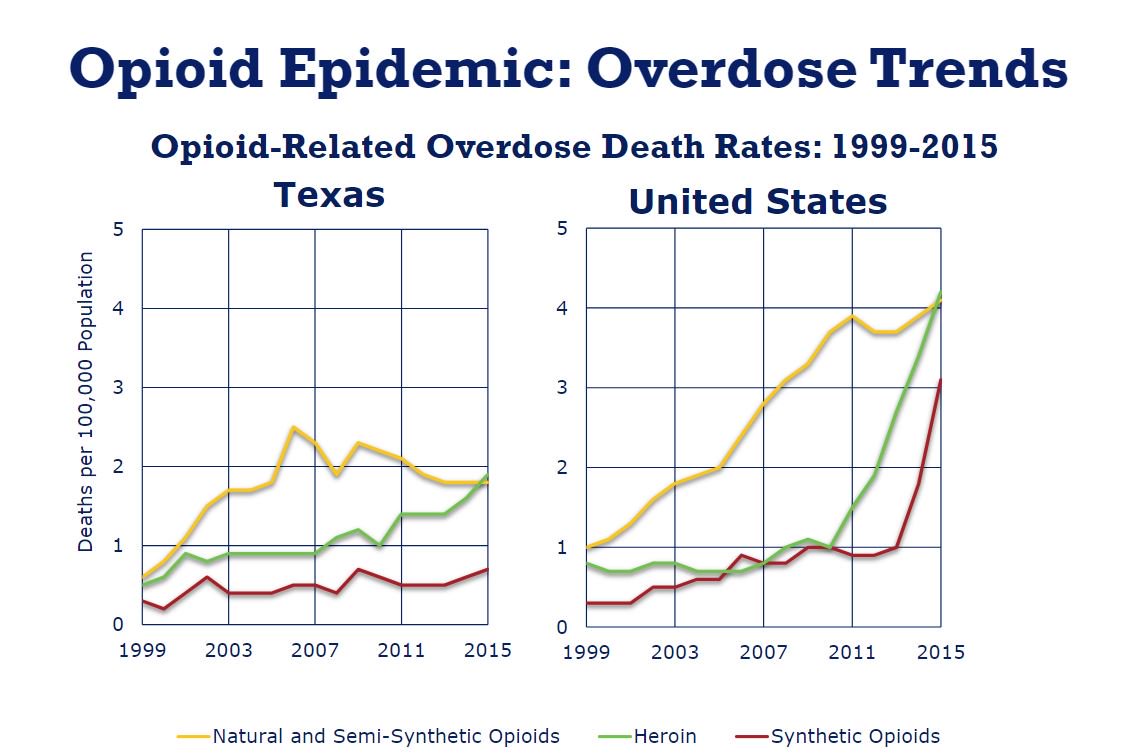
Digging into the data, Texas' drug addiction problem is less deadly than in the hardest-hit parts of the country, and more focused on speed than smack. Nationwide, heroin overdoses now outnumber gun homicides as cause of death, but in Texas, murders continue to slightly outpace the total number of overdose deaths.

IMO this obfuscation of state-level trends is happening because legislators are relying on law enforcement as experts instead of addiction researchers and public health professionals. Texas DPS and other agencies are picking up national memes and touting them, even if they don't track with Texas' experience.

That said, I was pleased to see that the committee is considering one solution that Grits worked hard on a couple of sessions back: the Good Samaritan law Gov. Abbott vetoed at the end of his first session as Governor in 2015. Reported the Austin Statesman:
[State Rep. Four] Price said it’s possible lawmakers could craft a new good Samaritan law, which protects people who call police to report a drug overdose from prosecution for some offenses. A similar bill passed the House and Senate with wide support in 2015, but was vetoed by Gov. Greg Abbott because it did not “include adequate protections to prevent its misuse by habitual drug abusers and drug dealers.” 
New data presented by the Texas Department of State Health Services on Tuesday showed similar laws in other states have resulted in as much as a 15 percent drop in opioid overdoses in the past five years, despite nationwide increases. The laws also do not appear to increase the number of drug users, the data shows. 
“It indicates that there is some effectiveness if implemented and crafted effectively,” Price said. “That is something we should continue to review.”
Keep in mind that there were 1,254 overdose deaths in Texas in 2016 - 715 from meth and 539 from heroin. If a Good Samaritan law would have reduced that number by 15 percent, that means 188 people died that year because of Governor Abbott's ill-considered veto! That means hundreds of  lives would have been saved by now if Gov. Abbott had signed the law in 2015.

IMO, vetoing the Good Samaritan bill was one of Greg Abbott's worst decisions as Governor.

Wednesday, April 04, 2018

Texas overdose problem still more focused on meth than opiods

The Texas House Select Committee on Opiods and Substance Abuse posted handouts from their March 27 hearing, and Grits thought it worthwhile to point out a few highlights. See in particular handouts from:
Let's do a quick overview of substance abuse resources in Texas, then try to answer a couple of questions raised by the Texas District and County Attorneys Association on their Twitter feed.

For starters, funding for substance abuse in Texas comes primarily from two sources: Medicaid and TDCJ. Between them, those two sources account for 97.4 percent of all government substance-abuse funding in the state, split roughly equally, reported LBB. Just more than $386 million are spent on SA treatment through Medicaid, while around $343 million is spent on treatment through TDCJ.

The difference, though, is where state money is spent. Overall, 58 percent of funds spent on substance abuse come from state general revenue coffers. But most of that is spent on treatment in corrections environments. Overall, state general revenue funds pay for only 24 percent of Medicaid expenditures on substance abuse, but more than 98 percent of treatment funds at TDCJ.

With a total incarcerated population of 145,399, TDCJ has 10,047 incarceration beds dedicated to substance abuse, and the parole system has 7,592 people on specialized substance abuse caseloads.

There are another 2,897 secure treatment beds used by the probation system, TDCJ reported.

Source: Meadows Foundation
The Meadows Foundation estimated that nearly eight (8) out of 100 Texans suffer from a substance abuse disorder. More than half of adult Texans drink alcohol, 10 percent use marijuana (!), and 2 percent use cocaine, the foundation reported.

Treatment admissions for alcohol, cocaine/crack, and opiods have declined in recent years, while admissions for heroin and meth have been rising. Overwhelmingly, the largest number of admissions were for alcohol.

Source: TX HHSC
TDCAA on its Twitter feed linked to a chart showing opiod deaths in Texas happen at a lower rate than nationally, and would like to credit law enforcement efforts. They tweeted: "Questions for #txlege to answer next session will include (a) why is TX faring better? and (b) how to we maintain/improve that performance?"

Certainly, people without access to healthcare have a tougher time getting addicted to prescription opiods, and Texas has among the highest uninsured rates in the country. Moreover, while not approaching spikes seen in some states, overdose deaths attributable to opiods and heroin have more than doubled since the turn of the century, according to the HHSC graphic cited.

But really, the comment mainly just ignores the fact that drug use differs regionally and Texas addicts still tend to favor meth over heroin. This fact has historical roots. When Texas clamped down regulating legal antihistamines used by addicts to cook meth, Mexican drug cartels took over the trade and began pumping truckloads of cheap speed into the state to fill the gap in the market. Meth prices plummeted while addiction and overdoses increased. So it's not so much that Texas is "faring better" as that the state's patterns of addiction aren't the same as in Ohio and Pennsylvania. According to the Addiction Research Institute at the UT-Austin School of Social Work, "There were 715 deaths due to methamphetamine in Texas in 2016, as compared with 539 due to heroin."

Tack on those deaths, and all of a sudden Texas isn't so much "faring better" than "faring differently."

Moreover, the Addiction Research Institute gave the best explanation for why Texas hasn't seen as many opiod deaths as in the Northeast, and it's not because of law enforcement efforts but because of differences in the market: " Texas has not yet suffered the epidemic of overdoses seen in the northeast because the heroin in Texas is Mexican Black Tar which cannot easily be mixed with fentanyl. The purity of Black Tar is 45%-50% as compared to 80%-85% purity for Mexican-South American heroin in the northeast."

So the answers to TDCAA's questions are, 1) "We aren't faring better, our problems are just different," and 2) "Market trends among cartels, not Texas policy, account for the different overdose patterns. Since neither Texas policy nor the 'performance' of law enforcement is responsible for the lower number of opiod deaths, there's no policy implied that would 'sustain or improve that performance.'" This is not a Texas-does-it-better issue, it's an all-problems-are-local issue.

Saturday, May 27, 2017

Bad bills rising, how to tell if debtors-prison reform works, TX police misconduct roundup, and other stories

Here are a few odds and ends as the final days of the 85th Texas legislative session wind down:

Lawyers to rep Harris defendants at bail hearings
Grits is interested to learn what effect it will have when Harris County deploys public defenders to represent indigent defendants at bail hearings. It's never been done before so all the suggestions about what effect it will have remain unproven. But in theory, it should reduce pretrial detention at the Harris County Jail more than enough to cover the cost of the lawyers. Glad we're finally going to find out!

How to tell if debtors-prison reform bill works
The House concurred to Senate amendments on HB 351, a bill initially generated from a GFB blog post aimed at limiting debtors' prison practices. The amendments included a small item applying property thresholds to check forgery and another that lets probation departments use treatment beds for pretrial diversion clients.

It'll be easy to tell if the debtors prison portion of the bill works. The Texas Tribune reported that 3 million warrants were issued for fine-only Class C tickets in 2015. However, "judges rarely used community service to resolve 'fine-only' cases – just 1.3 percent of the time. In fewer than 1 percent of cases, they waived fines or reduced payments owed because the defendant couldn't afford to pay." If those numbers don't increase substantially, and the warrant numbers don't go down, then the Lege will need to come back in 2019 to beef up protections against jailing indigent drivers. But this is a start.

Bad Bills Rising
Among bad bills passing this session, there was a massive "hate crimes"/enhancement bill for assaults against police that Grits has argued will increase pressure on defendants to plea guilty to false convictions based on police misconduct. The Lege also approved a strange little bill creating a specialty court for prosecuting police officers, treating active duty cops like veterans eligible for veterans court services. Both of these are bad ideas, reduce accountability for police, and deserve to be vetoed, though neither probably will be.

Fed $$ coming to prevent opioid deaths
Texas will  receive money to combat opioid-related overdoses, despite Gov. Abbott vetoing life-saving Good-Samaritan legislation in 2015 and moving the goalposts to stymie the bill from passing in 2017. Reported the Austin Statesman:
The Texas Health and Human Services Commission on May 19 announced that Texas would receive a $27.4 million federal grant to combat opioid-use disorders. 
The increasing rate of opioid use continues to be an issue nationwide, and of the more than 33,000 opioid-related deaths in the U.S. in 2015, 1,186 were in Texas. The grant funds will be used for prevention, training, outreach, treatment and recovery support services and will directly help an estimated 14,000 people over a two-year period, according to the agency.
Texas police misconduct roundup
While I've got you, here are a few stories related to police accountability which merit Grits readers' attention:
  • Eva Ruth Moravec has perhaps her best feature yet at Point of Impact documenting Texas law enforcement shootings of unarmed people, this time a black man in Carthage who was shot seven times, five times in the back, by a DPS trooper. He was one of seven unarmed black men shot by Texas law enforcement last year. Scroll down to the end of her article for extensive backup documentation from the story. 
  • The mother of an unarmed man shot to death by police in Laredo says police are lying about what happened during the incident.
  • A video has surfaced showing a San Antonio police officer hitting a teenage girl. See the SA Express News coverage
  • Cell phone footage also captured a Lampasas Sheriff's deputy punching the hell out of an 18-year old suspect at a traffic stop.
  • A young woman who is currently Miss Black Texas and an intern at the Hunt County DA's Office has accused the Commerce police chief of arresting her after a motorist called her a "black bitch" in a road rage incident. Initially, she thought the chief was the driver, but he was the arresting officer. Regardless, by all accounts he took her in for evading arrest because she refused to apologize to the racist who berated her and tried to walk back to her car. What an embarrassment.
  • In Baytown, an officer is under investigation for soliciting nude photos from female drivers in exchange for letting them off of traffic tickets.
  • In Fort Worth, two police commanders were demoted for allegedly releasing bodycam video made secret under a bad 2015 Texas law. They claim they've done nothing wrong. The CATO Institute has commentary on what the punishments say about police priorities.
  • Another leaked bodycam video shows that the Balch Springs officer who shot Jordan Edwards previously tasered a handcuffed man. Police are investigation the leak, instead of investigating how such a person was retained on the force after such behavior.
  • An SAPD officer was suspended 45 days for disabling his bodycam and one additional day for telling a crime victim that police officers "hate citizens."
  • An Ector County Sheriff's deputy pled guilty to tipping off a game room operator about investigations and raids.
  • In San Juan, a police officer was arrested for stealing three packages of cocaine from a drug bust. See the federal criminal complaint against him. His partner was arrested last month for allegedly lying to the FBI about the missing evidence. 
  • See Texas Tribune coverage of new legislation punishing law enforcement agencies which don't report officer-involved shootings to the AG with a $1,000 per day fine. Criminal penalties for failing to report incidents to the Attorney General's death-in-custody database - including about 25% of police shootings over the last decade - have never been used.

Monday, December 19, 2016

Texas overdose numbers high enough for concern

Note to Texas journalists: Stop saying Texas has "fewer" overdoses than other states. It's not true. Texas has a lower RATE of overdoses than many other states, but because we're so populous, that still adds up to a lot of folks: 1,287 in 2015 alone - about the same as the number of murders that year (1,316), so no small thing. Texas ranked 8th nationally among states in total overdose deaths.

Texas' leaders have chosen to bury their heads in the sand over opiod overdoses, adopting hard-nosed policy stances which have cost lives. Understating Texas' overdose problem improperly lets them off the hook.

Saturday, December 10, 2016

Priorities, choices, and poor drug-war outcomes

What a world we live in.

Asset forfeiture by the government now takes more money from people than burglars and the number of heroin deaths has surpassed gun homicides.

Can't blame Donald Trump for that, huh?

OTOH, one recalls that Gov. Greg Abbott last session vetoed "Good Samaritan" legislation which would have prevented prosecution of people who called 911 during an overdose, stayed with the victim, and cooperated with police. That would have helped prevent overdose deaths. When the bill comes back this time in the 85th Texas Legislature, they should pass it again and Greg Abbott should sign it.

In a related, poor state policy decision which likely resulted in more heroin deaths, the Texas Department of State Health Services recently failed to solicit a federal grant to pay for first responders to have access to Naloxone, an opiod antagonist with no significant side effects which can keep overdose victims from dying.

Similarly, the Lege has an opportunity this session to rein in asset forfeitures by law enforcement which are unrelated to a criminal conviction. The Texas Public Policy Foundation this week published a myth-busting document explaining why they can and should do so.

These sorts of statistics aren't just things that happen in the world, they're a result of government priorities and policy choices. If we want different outcomes, government must change both.

Monday, June 01, 2015

Greg Abbott to veto harm reduction legislation

Grits was informed this afternoon by Rep. Ryan Guillen's staff that the governor will veto HB 225 creating a defense to prosecution for people who call 911 during a drug overdoses. Because, why would you want to prevent a drug user from dying? Twenty-four states and the District of Columbia have passed Good Samaritan laws that protect overdose witnesses and victims who request emergency medical assistance

The bill passed 140-4 in the Texas House and 30-1 in the Senate, so until now it didn't seem controversial.

Thankfully, a portion of the bill expanding access to naloxone, an opiod antagonist, passed as a standalone, SB 1462, and also went to the governor. Maybe that piece will make it through.

See prior Grits coverage here, here, and here, and the House Research Organization report (pdf, p. 21) on the bill. See also a detailed (88 page) fact sheet on Good Samaritan laws and overdose prevention from the Network for Public Health Law.

What a terrible decision. That doesn't bode well.

UPDATE (6/2): The bill has been formally vetoed. Reported the Texas Tribune, "In a veto statement Tuesday, Abbott said HB-225 lacks 'adequate protections to prevent its misuse by habitual drug abusers and drug dealers.' He noted his office came up with amendments to address the concern, but they did not make it into the final version of the bill." That's a bit of a half-truth. First, Abbott's people never raised concerns with the House author at all, waiting to intervene after the bill had already won overwhelming approval in the lower chamber. And second, some of Abbott's amendments were accepted, but the rest were designed to thwart the fundamental intent of the bill. Plus, his staff kept moving the target. Some observers believed Abbott's amendments would have made the bill worse than current law in terms of providing disincentives for calling 911 in an overdose emergency. Further, there's really no valid use case where "misuse" can even be credibly hypothesized, all the valid concerns were entirely addressed. But a veto doesn't need credible argument, just a stamp and a signature. 

MORE: See additional coverage from the Dallas Observer

Wednesday, May 13, 2015

Overdose prevention legislation soon headed to governor

As Texas' needle exchange legislation heads from the House to the Senate, another harm reduction bill - HB 225 by Guillen, aka the Good Samaritan overdose prevention bill - has passed both chambers and is all but on its way to the governor's desk. Your correspondent supported the bill in both chambers on behalf of the Texas Criminal Justice Coalition.

The Good Samaritan piece of this bill creates a defense to prosecution for people who dial 911 during an overdose if they stay on the scene, cooperate with police, etc.. The bill had never moved far in past sessions but this year rocketed through the system early, with nearly unanimous support. Along the way, Sen. West's legislation expanding access to naloxone for first responders and people with a prescription got tacked onto the bill, creating a more comprehensive overdose prevention package which enjoyed wide support. Sen. Lois Kolkhorst was the lone "no" vote in the senate, joining four House members who opposed the bill.

Now, there's just one vote left who matters: Gov. Greg Abbott. Given news this spring that the state has dramatically under-counted opiod overdoses and the unquestioned effectiveness of naloxone at saving lives, it's hard to see a downside to the governor signing it, or an upside to making this his first veto. But you never know.

For more background on these naloxone access and Good Samaritan laws, see this extensive and detailed fact sheet from the Network for Public Health Law.

Sunday, April 26, 2015

News of TX overdose undercount bolsters 'Good Samaritan' bill

As the Texas Senate Criminal Justice Committee prepares to hear overdose prevention legislation (HB 225 by Guillen/Watson) on Tuesday, news comes that the state has dramatically and systematically undercounted overdose deaths in recent years.

The Houston Chronicle's Lise Olsen and the Austin Statesman's Mary Ann Roser this week (April 24) coauthored an important and impressive feature documenting how Texas dramatically undercounts overdose deaths, particularly those stemming from prescription opiates. "Overdose deaths from all drugs have skyrocketed nationwide in the last decade, outpacing even motor vehicle accident fatalities, according to the Centers for Disease Control and Prevention," they reported. But prescription opiods account for the largest source of the increase.
Last summer, Dr. David Lakey, then the Texas Department of State Health Services commissioner, told a Senate committee studying the problem that Texas has one of the nation's lowest prescription drug fatality rates and that his data showed deaths had peaked in 2006. But Lakey was referring only to deaths involving certain painkillers, not all prescription drugs. His report did not include information from medical examiners, who use drug screens to identify many more overdoses, according to a joint investigation by the Houston Chronicle and the Austin American-Statesman.

Only 622 deaths reported across Texas in 2013 were specifically blamed on opioids - mostly painkillers, based on death certificate data cited by Lakey's department.

But 798 prescription-drug related deaths were recorded by local medical examiners that year in just 17 of the state's 254 counties, the Chronicle and Statesman found. The newspapers found that medical examiner reports in Harris, Travis, Dallas, Tarrant and El Paso counties, as well as some smaller counties, attribute many more deaths to prescription drug overdoses than the state has counted in opioid overdoses.
The reporters determined that, "the state's method of tracking the problem undercounts deaths in every major county across Texas." E.g.:
In Travis County, which includes Austin, the state reported 17 deaths from prescription painkillers in its preliminary count of death certificates for 2013, but the administrator of the county's Medical Examiner's Office hand-counted 114 deaths involving all prescription drugs that year.

In Tarrant County, which includes Fort Worth, the medical examiner's office recorded 44 deaths in 2013 involving specific prescription drugs and another 57 fatalities from "mixed drugs." The state's count was 24 opioid overdoses.
Counties where justices of the peace determine cause of death instead of a medical examiner exacerbate the undercount. Some of that is because JPs are unqualified to make such a determination, while there are also economic incentives to undercount: "Many justices of the peace hail from counties with tight budgets, so there can be pressure to reduce the number of cases they send to a medical examiner for an autopsy."

The article mentioned legislation by Sen. Charles Schwertner "to better monitor patients who may be 'doctor shopping' for drugs." That bill passed the senate two weeks ago but has yet to be referred to committee in the House. But they failed to mention HB 225 by Guillen/Watson, which will be one of the first House bills taken up by the Senate Criminal Justice Committee when they hear the bill on Tuesday. That legislation would authorize use of the opiod antagonist naloxone (an antidote with no known side effects which is highly effective for heroin and many prescription pain medications) by first responders and adults with a prescription. It would also create a "Good Samaritan" provision - a defense to prosecution for people who call 911 in response to an overdose. (N.b., your correspondent supported HB 225 in the House on behalf of the Texas Criminal Justice Coalition.)

This joint feature from the Chronicle and Statesman makes the arguments for such overdose prevention legislation much more immediate and poignant. Since they didn't mention Guillen's Good Samaritan bill, I doubt the story was timed to benefit that legislation. But it's certainly a timely and helpful coincidence. For more background on HB 225, see recent coverage from NPR, prior Grits coverage and the House Research Organization report (pdf, p. 21) on the bill. MORE: See a brand new, detailed (88 page) fact sheet on precisely these topics from the Network for Public Health Law.

Friday, April 17, 2015

Texas House moving harm reduction measures

There were a couple of positive developments on the harm reduction front in the Texas House this week involving bills your correspondent supported in committee:

Good Samaritan bill moves to Senate
On Tuesday, the lower chamber approved HB 225 creating a defense to prosecution when someone calls 911 in response to an overdose, stays at the scene, and cooperates with police - so called "Good Samaritan" legislation. It passed by a 140-4 margin. This is an important sleeper issue, as "overdosing on medications and illicit drugs has been a bigger killer in the U.S. than car crashes or gun deaths at more than 120 per day," according to coverage of the bill from Texas Public Radio. The legislation also authorizes first responders and folks with prescriptions to use naloxone, an opiod antagonist that can save lives during emergency situations but which itself is non-addictive and causes no known side effects. The bill is now in the Senate where its companion was referred to the Criminal Justice Committee.

Unanimous committee support for needle exchange bill
After some initial confusion and a motion to reconsider, CSHB 65 authorizing privately funded and operated needle exchange pilots in several counties passed out of the County Affairs Committee yesterday on a 9-0 vote. See supportive coverage of the bill out of San Antonio and an earlier Grits analysis. HB 65 had seemingly stalled before conservatives threw their support behind language which eliminated all public funding and empowered counties and hospital districts only to authorize other organizations to operate needle exchanges - county government won't operate the programs. Volunteers with authorized needle exchanges will be exempt from prosecution under the paraphernalia laws and the bill includes some reporting requirements for participating organizations on the back end. Indiana of all places, recently suspended that state's ban on needle exchanges in response to a public health crisis.

Thursday, December 11, 2014

How Texas police can better prevent overdose deaths

Yahoo! News reported (Dec. 3) that, "The rate of deaths involving prescription painkillers like Oxycontin and Vicodin more than tripled between 1999 and 2012, according to a new CDC report. The heroin-related death rate is also on the rise, increasing nearly threefold in the same time period."

Which raises the question: Can law enforcement do more to reduce drug overdoses than just make arrests?

In timely coincidence, out last month from the Bureau of Justice Statistics: A "Law Enforcement Naloxone Toolkit" titled "Engaging law enforcement in opioid overdose response: Frequently asked questions." The introduction to the document reads:
Claiming nearly 120 American lives daily, drug overdose is a true national crisis. The main driver of this epidemic is opioid overdose (OOD), which cuts across class, race, and demographic characteristics. Certain groups, including veterans, residents of rural and tribal areas, recently-released inmates, and people completing drug treatment/detox programs are at an especially high risk of OOD.

The vast majority of OODs are accidental and result from taking inappropriate doses of opioids or mixing opioid drugs with other substances. These drug poisonings typically take 45-90 minutes to turn fatal, creating a critical window of opportunity for lifesaving intervention. Appropriate assistance, including administration of the antidote naloxone, can quickly and effectively reverse the OOD.

Reducing the time between the onset of OOD symptoms and effective intervention is a matter of life and death. Tragically, many victims do not receive timely medical attention. In many cases, witnesses delay calling for help because they do not recognize OOD symptoms or are concerned about getting in trouble with the law. In other cases, emergency medical response may take too long to arrive or the victim may not be discovered until it is too late.

Law enforcement officers (LEOs) have always been on the front lines of the battle against drug-related harm in our communities. The current OOD crisis is no different. Across the US, law enforcement agencies are increasingly initiating programs to stem the tide of overdose fatalities. This document provides an overview of the frequently asked questions (FAQs) that may arise in agencies that are considering or initiating such efforts.
A couple of Texas legislators (Eric Johnson, Ryan Guillen) have already filed bills to create a defense when drug users call 911 to report an overdose. But equally important is having patrol officers carry Naloxone, an opioid antagonist which "has no potential for abuse," according to the FAQ. It is a "very safe medication with the potential side effect of a theoretical risk of allergy that has never been documented." It can administered nasally or be injected - a company that makes a naloxone auto-injector makes the product available at a discount for law enforcement.

Texas has never passed statutes about the drug one way or another, according to a website that tracks state laws related to naloxone, but I've never heard of a Texas police agency using it."Almost half the states in the United States have passed naloxone access laws that shield 'any person' from civil and criminal liability if they administer naloxone."

The FAQ recommends police agencies partner with local health agencies to procure naloxone and train officers in its use. "In most cases, a protocol called a 'standing order' can be issued for the entire department by any provider holding a license to write prescriptions. Larger departments may have a medical director or other licensed prescribers already on staff, the FAQ noted. In New Jersey and New York, their Boards of Pharmacy "have streamlined the process by which law enforcement agencies can order the medication, allowing these agencies to purchase naloxone directly from a wholesaler instead of receiving it from a retail pharmacy via a prescription from a health care provider." (NYPD equipped nearly 20,000 officers with naloxone.) And North Carolina authorized "agreements between law enforcement overdose response programs and EMS agencies to handle purchasing and training."

Grits would like to see Greg Abbott's Criminal Justice Division look into the possibility of grants to Texas police departments interested in these sorts of overdose prevention programs. There seems to be little downside that I can see and also a real opportunity to save lives.

Thursday, December 04, 2014

Police, Lege can do more to prevent overdose deaths

I wonder how many Texas police departments have patrol officers carry naloxone to save lives after drug overdoses? The New York Times coverage this week prominently re-raised the issue and US Attorney General Eric Holder this summer said it was a good idea (possibly the kiss of death in these parts). But Grits hasn't heard the question confronted for years here in Texas, so I'm guessing not many. Increasingly naloxone is used to respond to overdoses from prescription opioids as well as illicit ones, which along with its high rate of effectiveness and general overall safety may explain growing public support. "That naloxone has rapidly gained acceptance, expanding from needle-exchange programs to police precinct station houses, underscores how widespread the twin scourges of heroin use and painkiller abuse have become in recent years," the Times reported.

Here in Texas, Rep. Ryan Guillen has filed "Good Samaritan" legislation creating a defense from prosecution for people who call 911 when a drug user overdoses. Rep. Eric Johnson filed similar legislation two years ago and may still do so again. But that's just one component of overdose prevention. Equipping and training first responders with naloxone would help a lot, too, especially in departments facing a serious heroin problem. (States with legal needle exchanges may train addicts to use naloxone and send them home with a dose in case of emergency, but obviously Texas is several steps away from that.)

According to the CDC, "In 2012, there were 41,502 deaths due to drug poisoning (often referred to as drug-overdose deaths) in the United States, of which 16,007 involved opioid analgesics and 5,925 involved heroin."  Texas' death rate from overdoses is slightly lower than the national average, at 9.8 deaths per 100,000 people, while nationally. the death rate from drug poisoning is around 13.1 per 100,000, up from 6.1 in 1999, says CDC.

Though lower than the national average, the number of overdose deaths grew in Texas by 150 percent from 1999 to 2007, according to the most recent available analysis from the Drug Policy Alliance, which added that, "Legal prescription opioid drugs such as oxycodone and hydrocodone were identified in 50% of all accidental overdose deaths between 2005 and 2009 in Houston, claiming more lives than all illegal drugs combined." Indeed, "in 2007 more people died from accidental overdose in Houston than from car crashes." Further, "Statewide, accidental poisoning (most commonly due to drug overdose) is the third-leading cause of injury-related death in Texas, behind car crashes and suicide."

For more on the scope of this problem, check out this tidbit promoted in October by Mother Frances hospital in Tyler titled, "Prescription painkillers fueling overdoses in ERs, study finds." The press release concluded:
Study author Michael Yokell, medical student at Stanford University School of Medicine, and his colleagues reached their conclusion by analyzing tens of thousands of reports of narcotic overdoses from a sample of nationwide emergency room visits from 2010.

Almost 68 percent of the overdoses involved prescription drugs. That number may be higher since the drugs were unspecified in 13 percent of cases, and multiple narcotics were involved in 3 percent of cases in the study. Heroin alone was responsible for 16 percent of the overdoses.

Narcotic overdoses were most likely to happen in urban areas (84 percent) and the South (40 percent of the total). Most were in women; 1.4 percent of the total patients in the study died.

"Opioid [narcotic] overdose exacts a significant financial and health care utilization burden on the U.S. health care system. Most patients in our sample overdosed on prescription opioids, suggesting that further efforts to stem the prescription opioid overdose epidemic are urgently needed," the researchers wrote.

The study is published online Oct. 27 in the journal JAMA Internal Medicine.
Training first responders to use naloxone and allowing cities and counties to sanction legal needle exchanges both make good public policy sense for the same reason drug and veterans courts work: At root, addicts must not just abstain from drugs but change their lifestyle in order to avoid recidivism and possibly death. Put an overdose treatment in someone's hand and perhaps its mere presence reminds of the dangers and serves as a deterrent. Similarly, the interaction with needle exchange workers that puts the naloxone in an addict's hands represents an opportunity to provide education, shepherd them toward treatment and medical assistance, and in more ways than one potentially save their lives.

It's hard to stop people's bad choices and they can't change unless they want to. But there are ways at the margins to keep overdoses from turning tragic, saving the addict's life until they can turn it around: Where they don't already, patrol officers and EMTs should keep naloxone in their vehicles and be trained how to use it. And the Legislature could authorize local needle exchange pilots in cities that want them and allow them to distribute naloxone to heroin addicts along with needles, kit cleaning equipment, medical and treatment referrals, etc.. Nobody wants addicts to use drugs, but the public has an equal or greater interest in drug users not spreading Hep C, HIV (which the taxpayers will likely pay for through either Medicaid or the prison system), or overdosing with no insurance and being taken to the local ER.

Though it's treated as a crime, and regrettably the only treatment options available for many people are through the courts, at root substance abuse is more of a health (or perhaps mental-health) issue than a traditional crime with victims, etc.. When confronted with an overdosed addict, whether the cause is heroin or Oxy, the sensible approach is to save their life first and worry about punishment, treatment, or whatever one thinks is the right legal comeuppance later.

Tuesday, November 18, 2014

More criminal justice bills pre-filed at the Texas Lege

Here are a few more bills (see here, here, here and here for earlier installments) from the first week of pre-filing at the Texas Legislature that may merit Grits readers' attention:

Can prison spending be limited to population/inflation growth rates?
There are a couple of bills out there to restrict state spending to the combined effects of inflation and population growth, like this one, so it's worth mentioning that state prison spending has far surpassed those rates consistently for more than three decades. Also, there's a basic math problem with a constitutional amendment proposed by rookie Sen. Charles Perry limiting budget growth to the sum of inflation and population growth (or personal income growth, whichever is lesser). However, to actually index spending you would multiply those rates, not add them. Over time, his method would systematically under-fund the budget if not corrected. Perhaps if legislators want a smaller budget, they should propose cuts instead of constitutional amendments.

Whither border security funding if highway money spent on highways?
Also on the budget front, SB 139 by rookie Sen. Charles Perry and SB 184 by Sen. Charles Schwertner would cease using money from the state highway fund to finance the Department of Public Safety. The questions then become: Where does DPS funding come from? And, is their border security profile sustainable without tax increases?

How to raise local property taxes everywhere
HB 191 by Rep. Jim Murphy creating mandatory minimums for people convicted of multiple misdemeanors would launch a new 21st century jail building boom in Texas. County commissioners and Sheriffs, if they're wise, will come out of the woodwork to oppose this. In many counties in recent years, rising jail costs have been the primary driver for local property tax increases.

Record custodial interrogations
State Sen. Rodney Ellis has once again filed legislation to require recording interrogations of people suspected of serious, violent offenses. Make me philosopher king and I'd require recording of all custodial interrogations, but this is a good start. Last session state  Rep. Terry Canales carried  companion legislation in the House and Grits expects him to file the bill again in the 84th session.

Prioritize saving lives over prosecution in overdose cases
Rep. Ryan Guillen put forward a version of a Good Samaritan bill, HB 225, to make it a defense to prosecution on drug charges for people who call 911 when someone they're with overdoses. There have been several versions of this kicking around over the years. Last session a version cleared committee but, like many criminal justice reform bills, never received a vote on the House floor.

Grants, policies for police bodycams
In 2003, state Sen. Royce West carried legislation that created a grant fund for police departments to apply to install dashcams in patrol cars, and most of them did. Now he's filed SB 158 which would authorize the state to issue grants for police body cams and requires those using them to create written policies that govern their use and train on them. The difference between this and the one authorizing dashcams is that in 2003, Sen. West also passed a measure authorizing a statewide bond election for money to pay for them (which voters approved) and requirements for racial profiling reporting that were more stringent if departments didn't have cameras in their cars. This bill presently includes neither as many carrots nor sticks as his earlier legislation. For body cams to be adopted as widely as dashcams, there'd need to be a pot of money to fund these grants and some incentive for departments to use them.

No probation for illegal immigrants?
In SB 174, Sen. Joan Huffman recommends that "illegal aliens" be denied the chance to receive community supervision as a punishment, another potential budget buster for both state prisons and county jails. If this bill doesn't receive a gigantic "fiscal note" it will be proof once and for all that the Legislative Budget Board's mechanism for assessing bills' fiscal cost is utterly and profoundly broken.

Wednesday, November 07, 2012

Criminalizing prescription drug use, distribution: The next frontier for 21st century drug warriors

Should prescription drug abuse be treated primarily as a medical or a criminal justice matter? At the Texas Senate Criminal Justice Committee last week, the answer to that question seemed nearly a faint accompli, with the focus more on tactics and best practices for maximizing prosecutions of doctors and potentially patients. See the Texas Tribune's coverage.

Americans consume 80% of the world's opiates, including 99% of the world's hydrocodone, Dr. Emilie Becker of the Texas Department of State Health Services told the Texas Senate Criminal Justice Committee last week. (Here's the agenda and here's the link to the online video.) In 1990, said Becker, the Center for Disease Control estimated there were  575,000 new opiod users nationally; by 2010 that number had mushroomed to 4.5 million, with the number of drug-related deaths rising with use. She presented this striking chart to the committee, demonstrating that last year, for the first time, drug overdoses eclipsed deaths from firearms and traffic accidents:

Wednesday, November 17, 2010

Solutions for Texas' "Overdose Crisis"

A new briefing paper (pdf) from the Drug Policy Alliance hones in on Texas drug overdoses, pointing out that, "Between 1999 and 2007, overdose deaths increased by more than 250 percent. Statewide, accidental poisoning (most commonly due to drug overdose) is the third-leading cause of injuryrelated death in Texas, behind car crashes and suicide. While a majority of these poisoning victims are middle age adults or older (ages 35-54), almost one-third (31.4%) were either youth or young adults (ages 15-34)."

Most of these, says DPA, are preventable deaths: "over half of all accidental overdose deaths in Houston in the past five years could have been prevented if the overdose reversal medication naloxone, coupled with overdose prevention education, had been available to people at risk of an opiate overdose and their loved ones."

Our current approaches to the problem, however, may be making things worse, says DPA: "Despite the severity of this epidemic, the steps the state has taken to date have been ineffective, and even counterproductive. Texas has largely focused on punitive measures, like prosecuting people who use drugs with someone that later overdoses, such as the case of Kristin Metz, a 29-year-old woman sentenced to 10 years for injecting her best friend with heroin, at the friend’s request."

Among the group's policy recommendations are to expand access to drugs that counter the effects of opiate overdose: "Naloxone, or Narcan, is a life saving tool used to reverse opiate-based drug overdoses. Naloxone has been FDAapproved since 1971, and presents no potential for abuse as it has no pharmacological effect; it also has no effect if it is taken by a person that does not have opiates in their system. It needs to be made more readily available to those who may be in a position to respond to an overdose."

However, suggestions which cost new money, regrettably, will be difficult to pass in the 82nd Texas Legislature because of the massive budget shortfall. But DPA did suggest one excellent idea that would cost no new money and which could immediately start to save lives:
911 Good Samaritan Laws encourage people to call 911 by creating an exemption from arrest, charge or prosecution for possession of small amounts of drugs or alcohol when needing or calling for medical assistance in the event of an overdose. The policy prioritizes saving lives over arrests for minor drug or alcohol law violations. Such laws are essential because overdose fatalities often occur when peers delay or forego calling 911 out of fear of arrest or police involvement, which researchers identify as the most significant barrier to the ideal first response of calling emergency services.

Such legislation does not protect people from arrest for other offenses, such as selling or trafficking drugs. This policy protects only the caller and overdose victim from arrest and prosecution for simple drug possession, possession of paraphernalia, and/or being under the influence.

Texas’ neighbor, New Mexico, became the first state in the nation to adopt a life-saving Good Samaritan law in 2007. Washington passed a Good Samaritan law in 2009 and several other states are considering similar legislation.

In fact, Good Samaritan policies for alcohol and/or other drugs are already saving lives at many of Texas’s major universities, including the University of Texas at Austin, Rice University, Baylor University, Southern Methodist University, and Texas Christian University, as well as nearly one hundred other college campuses nationwide. SMU’s decision to adopt a Good Samaritan policy for alcohol and other drugs was a direct response to the tragic overdose deaths of several students in recent years. According to school officials, the policy appears to be working: students are less reluctant to call for help now that they do not face student conduct sanctions.
This suggestion raises the question: Should the goal of drug policy be to save lives or maximize punishment? Historically, it's been the latter, but to me the approaches suggested by DPA make a lot of sense.

UPDATE: Via Sifting the Haystack, "8th Annual Harm Reduction Conference Comes to Texas Nov. 18-21."