Showing posts with label independent oversight. Show all posts

Tuesday, September 29, 2020

Want to improve police oversight? Settle in for the long haul

The "Independent Police Oversight Board" for the Houston Police Department arguably represents a worst-case scenario when it comes to reform efforts: It took years for advocates to install and, by providing a veneer of meaningless oversight, probably does more to obscure episodes of police misconduct than illuminate problems.

OTOH, it also represents a common path for police-reform efforts: Indeed, I've never seen it work otherwise. Seldom does the first wave of reforms installed achieve their goals because police have been so powerful over the years, they usually can keep the most important changes from happening. So frequently a second round of reform is needed, maybe a third, once the board has been installed, operated for a few years, and its shortcomings become clear. 

In H-Town, they are now clear. Houston city council members have suggested an aggressive reform package aimed at improving oversight and empowering the board. Mayor Sylvester Turner appointed a task force to propose its own reforms, which are significant but not as aggressive as the council members wanted. (That said, the mayor doesn't always back the findings of his various task forces.)

There is no short-term fix on these questions. It always takes years, potentially decades, never weeks or months. Ask Johnny Mata, who's been at this work for more than four decades, was involved in getting the board created initially, and now spends his waking hours trying to improve it.

We see this at the Legislature: They passed the initial law requiring gathering of racial-profiling data in 2001, didn't begin collecting the reports from departments statewide until 2009, and finally acknowledged the data's shortcomings and made it more robust in 2017. Even then, the Texas Commission on Law Enforcement screwed up implementation of the 2017 legislation, failing to collect racial breakdowns for most of the so-called "racial profiling" dataset. It's being fixed now and by 2021 - twenty years after Texas' racial profiling law first passed! - Texas' data will be robust enough to identify discriminatory practices.

Your correspondent spent five years involved in a campaign culminating in creation of Austin's Police Monitor and review board around the turn of the century; after the police union gutted it in closed-door negotiations, the system was a disaster, and we weren't able to fix the biggest problems until 18 years later, when the Austin Justice Coalition won changes to the police-union contract. It's still far from perfect, but it did significantly expand complaint intake, putting it in civilian hands and providing de-identified, public accounts of alleged misconduct. We now see written reprimands in addition to cases where officers are suspended, thanks to changes in APD's 2018 contract.

So, we're getting useful information out of the process and the Office of Police Oversight has become an occasional counterweight to the police union and anti-reform police administrators who'd prefer to avoid the topic.

That's far from the vision of an independent board that investigates and punishes officers outside of law enforcement's purview. But it's not clear to me anyone has completely dis-empowered the police hierarchy in departmental discipline, anywhere, nor am I certain it's a good idea. Police management may frequently disappoint when it comes to punishing misconduct, but they're 1) closest to the problem and 2) the only ones empowered under state law to do it (at least, for Ch. 143 civil service cities like Austin and Houston). 

Grits has come to believe that empowering police managers to manage personnel is a necessary pre-requisite to holding them accountable, as counter-intuitive as that may seem. I may believe Austin Police Chief Brian Manley should be fired, but I generally want his position to become more empowered within the disciplinary process, at least when it comes to his ability to punish and fire wrong-doers among his officers.

Making sure that, when a bad cop is fired, they don't repeatedly get back on the force is an important aspect of cleaning up a department. For the time being, state law forbids empowering a civilian review board to take over that task in Houston or Austin, and the chance of Greg Abbott or Dan Patrick approving legislation to change that fall somewhere along the shady line between "slim" and "none."

Protesters this summer wanted things "now," but as budget battles nearly everywhere but Austin proved, police reform doesn't typically happen on a "now" timeline. And even in Austin, what really happened is a process was created that will take years to fully implement.

So yes, by all means, fight for police reform. But settle in for the long haul.

Friday, April 10, 2020

New Austin PD complaint policies undermine police oversight to minimize complaints from the public

Grits has been catching up on all that's gone on while I've been under the weather and was dismayed to learn that, in February, Austin PD Chief Bryan Manley radically revised his department's complaint process explicitly to make police misconduct more opaque and to undermine both the new police contract and the Office of Police Oversight (OPO).

Honestly, this is just bad faith. The Austin City Council should act as soon as practicable to override this decision-by-fiat. None of this has been covered yet in the local press.

Here's the freshly revised APD General Orders. Section 902, which governs administrative investigations of officer misconduct, begins on p. 14 of the pdf (p. 548 of the General Orders).

On March 13, Austin Police Monitor Farah Muscadin wrote a letter to Chief Manley formally objecting to the changes, which he had sent her on January 21, giving her 24 hours to respond. Her office couldn't meet that (unreasonable) timeline, but they issued a formal response on January 24. However, Chief Manley "completely disregarded OPO feedback and the objectionable revisions were made to the General Orders on February 6, 2020."

Last year, Muscadin's office had jointly negotiated new Standard Operating Procedures with the department on these topics, but Chief Manley never signed the resulting document (which she appended at the end of her letter). She attributed the resistance to the "obstructionist tendencies of APD's Internal Affairs (IA)" department. As a result, she said, APD "continued to allow investigators in IA to obstruct oversight staff."

In particular, the new orders created "new obstacles designed to trivialize substantive complaints and disguise them under newly created categories that APD has created against OPO's recommendation." These changes will "limit the OPO's ability to share information with the public and contradict previous communications made to the public, thereby reducing the level of transparency."

The orders created a new category of complaints which are no longer called "complaints" but "external information." For "external information" incidents from the public, punishment will be limited to a written reprimand. If an "information incident" is "satisfactorily handled" by a supervisor (whatever that means), it may be closed and the public will never learn of it.

Muscadin correctly opined that "this new category is detrimental to the established process and attempts to minimize complaints from the public."

Without getting too deep into the weeds, the new orders also changed how complaints submitted to the OPO are classified by the department. Previously, there were three complaint categories at the OPO: formal complaints, supervisor referrals, and citizen concerns. Now, "citizen concerns" will be recorded as "external information," and may be closed by IA upon initial categorization with no investigation required.

Supervisor referrals, bizarrely, will now be categorized as "citizen concerns," while a new category called 'Minor Policy Violations' will now be labeled "supervisor referrals." Got that?

Finally, incoming complaints historically are categorized A, B, C, or D, depending on an initial assessment of their validity/severity by either IA or the officer's supervisor. Another big change is that only those classified A or B will now be considered "formal" complaints.

Notably, IA only classifies "administrative" complaints. Complaints of "serious or criminal nature" are categorized and initially investigated by a supervisor with the rank of sergeant or above.

Muscadin declared that these new categorizations "will mislead the public and continue to feed a false narrative that complaints filed with the OPO against APD are not rigorously assessed," as well as "leave complainants without any meaningful resolution or sense of procedural justice."

She could have gone further and pointed out that, for complaints NOT submitted through the OPO, it makes it more likely no one outside the department will ever learn of them, significantly undermining her office's oversight authority.

These changes should be seen in light of revisions to the contract between the City of Austin and the Austin Police Association implemented after a bitter, year-long fight in 2018. The most important changes increased transparency and made certain complainants will receive more information about how their complaints were handled and what happened to them. These alterations undermine those goals directly by redefining terms so that things which were previously transparent become opaque.

Like I said, bad faith.

The Austin City Council wasn't cc'd on Muscadin's letter - for that matter, neither was the city manager - so it's unclear whether they even know this has happened. If not, that's an even more egregious breach of trust.

The Austin City Council should move with haste to override these changes and find some way to punish the Chief for thumbing his nose at the city's oversight processes. Manley clearly thought he could bully Muscadin and sneak all this through without informing the council or the public. I'm proud of her for standing up to defend her office's authority. Now, we'll learn who on the City Council does or doesn't have her back ... just in time for the November elections.

Note: Austin PD uses the phrase "citizen" complaints, concerns, etc., but that's inaccurate. The OPO rightly takes complaints from citizens and non-citizens alike. Though I was tracking their language, I've removed the term from the headline.

UPDATE: Reacting to (but not acknowledging) this blog post, the Austin Statesman covered this story today.

Wednesday, November 28, 2018

Union contract fight gave Austin advocates leverage to improve police oversight

Austin Justice Coalition's victory over police union
brings to mind history's greatest upsets
(Updated with background links, photos, and an addendum.)

Although the local media has reported that the Austin police contract was finally approved and activists were happy with the result, only one local TV station report that I saw attempted to parse changes in the contract from a police accountability standpoint.

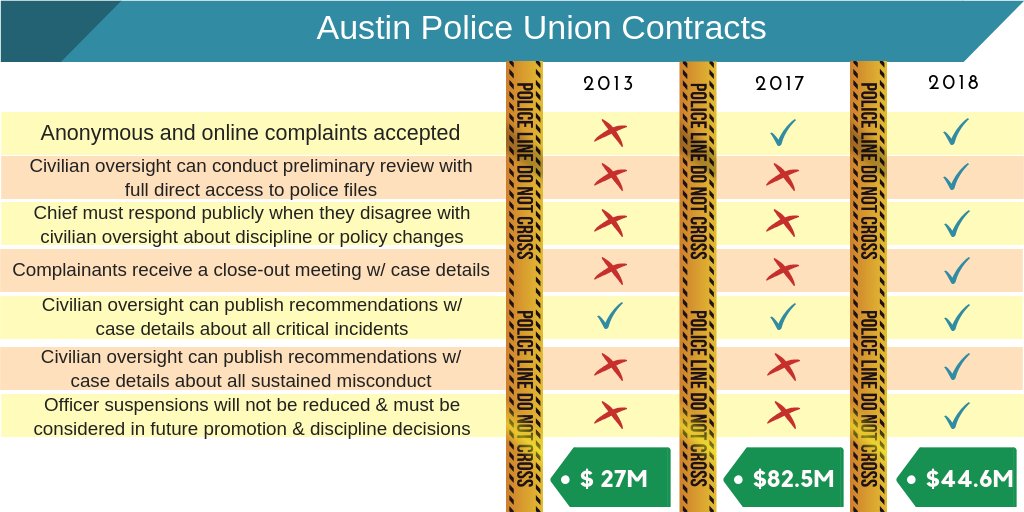
Advocates' year-long battle resulted in savings of $10 million per year compared to the contract rejected last December, as well as achieving greater transparency about police misconduct, the ability of the Police Monitor to accept anonymous complaints, and an end to the practice downgrading violations after a period of time so that they disappeared from public view (and couldn't be considered by the Chief in the event of future misconduct.)

Activists didn't get all they wanted. Of the six items in Campaign Zero's wish list for accountable police contracts, for example, the Austin Justice Coalition (AJC) and its allies only won one of them. That said, there were other accountability items specific to the Austin contract (e.g., downgrading violations over time) that weren't on Campaign Zero's list, and they were important, too.

Campaign Zero co-founder Sam Sinyangwe with
Austin Justice Coalition co-founder Chas Moore
Compromises notwithstanding, this was a major police-accountability victory. To my knowledge, no police-union contract in the United States, before this one, had been rejected by elected officials because of concerns over police accountability. From the moment the contract was defeated last December, it gave Chas Moore, his AJC compatriots and their allies tremendous leverage; more than police reformers in Austin have had at any time in living memory.

Before the contract defeat, AJC could get no traction for reforming oversight. In the months before last December's marathon hearing, at which the proposed union contract was finally voted down, AJC and allies presented eight reforms to both the City and the police association. The association never sat down with reformers, and the city failed to introduce the ideas into the negotiation process.

But after the entire city witnessed Moore and AJC standing over the defeated police union like Ali looking down at Sonny Liston (shouting "Give us police oversight!" instead of Ali's "Get up and fight, sucker!"), their voices could no longer be ignored.

Campaign Zero's Deray McKesson with the
Austin Justice Coalition policy team in Grits' living room.
The union swapped out their president for a new, co-lead negotiator, who in turn reached out to reformers. With strong, continued interest from council offices, the city rolled the reform proposals into the negotiation and discovered that hanging tougher brought rewards. In the version of the contract finally approved, the oversight mechanisms were moved to a city ordinance and the contract includes a more limited list of issues that required police association buy-in. That not only meant a lower cost. It also put the city council back in control of police oversight instead of giving the police union veto power.

As it happens, my wife was heavily involved in AJC's efforts to influence the contract and create a new oversight system for Austin. In the most recent episode of Just Liberty's Reasonably Suspicious podcast, she outlined the changes made and what comes next. Since the details of the new oversight system have received so little attention, I decided to pull out those comments as a stand-alone segment for anyone interested. Give them a listen:


Next month, both Chas Moore and Ron DeLord, the lead negotiator for the police union, have agreed to a joint interview/conversation on the podcast to describe the process and lessons learned from it, so I'm looking forward to that.

MORE: Chris Harris of Grassroots Leadership posted on Twitter this helpful graphic showing the impact of grassroots advocacy on the police-union contract and civilian oversight in Austin. The left-hand column was the old contract; the middle column is the one rejected by the City Council after a populist uprising last December; and the right-hand column is the new, final contract. Quite an improvement, huh? Especially on the price tag!


For more background, see these prior, related Grits posts:

Thursday, September 15, 2016

Settlement of Sandra Bland lawsuit an important step in the right direction, but no panacea for ensuring safe jail conditions

Today's news about the $1.9 million settlement of the lawsuit filed by Sandra Bland's family against the Waller County Jail and the Texas Department of Public Safety surely comes as a welcome development for many supporters and observers around the country.  As reported by Johnathan Silver in the Texas Tribune, the terms of the settlement include the following:
  •  "Waller County will pay the family $1.8 million.  The Texas Department of Public Safety will pay the family $100,000."
  • "To prevent future document falsifications, Waller County jail will use automated electronic sensors to ensure accurate and timely cell checks."
  • "From here forward, Waller County jail will now provide an on-duty nurse or EMT for all shifts."
  • "The Waller County Judge pledges to actively seek passage of state legislation providing for more funding for jail intake, booking, screening training and other jail support like telemedicine access for Texas county jails AND HE SUPPORTS HAVING ANY RESULTING LEGISLATION NAMED IN SANDRA BLAND'S HONOR!" [emphasis in original]
  • "The Waller County Sheriff's Office shall provide additional jailer training (including ongoing continuing education) on booking and intake screening."
The financial settlement may strike some as too high and others as too low, but in the world of death in jail custody lawsuits, it is a very solid settlement and in the neighborhood of some other very high-profile cases with which this writer is familiar.  Of greater interest for purposes of this post, though, are the non-financial parts of the settlement.

I was pleased to see that the settlement includes efforts to address problems in the intake screening process, the need for additional staff training, concerns about medical care, and problems with falsification of records about staff rounds in the jail.  These are all steps in the right direction and can definitely help shift the culture in the jail towards one that is more responsive to the needs of inmates and to compliance with constitutional standards of care.

But some caution is also necessary:  none of these settlement terms will guarantee inmate safety, and more details and steps are necessary.

Take, for example, the use of electronic sensors to "ensure" that staff conduct their rounds in a timely fashion.  There is always a danger in over-reliance on technology.  Yes, the electronic wands can be helpful, but the technology can also mask poor performance or other operational problems in the jail.  Staff have been known to quickly dash through the cellblocks touching wands to sensors to ensure that a record exists of their rounds, but they haven't necessarily taken the time to carefully observe the inmates or engage with them--even though observation and engagement (not sensor-touching) is the objective of the rounds.  We need to ask questions about WHY records get falsified or observations aren't conducted properly.  Are there staffing shortages that limit officers' ability to leave their posts to make rounds?  Is there a culture at the jail that does not hold staff accountable when they don't follow procedures?

Also, while it is good news that Waller County will be bringing in an on-duty nurse for all shifts, there is no indication about what type of nurse it must be.  Too many jails rely on LVNs, who are not authorized to handle certain medical tasks.   A California jail recently settled a lawsuit for $8.3 million in a wrongful death case that involved private correctional health provider Corizon's improper use of an LVN to do jail intake medical assessments.

Also, the Waller County Jail has had other recently reported serious problems in the delivery of medical care with disastrous results, despite the involvement of a nurse at the Jail.

The training provisions in the Bland settlement are important, but it would be good to clarify what that training will consist of, how many hours of training will be offered, and who will conduct it.

As the settlement suggests, there will be a critical role for the Legislature on these jail safety issues next session.  The Legislature can do a great service for county jails around the state--especially small and medium-sized jails--by providing resources for improved intake procedures, staff training, and access to telemedicine.  But just as critical, the Legislature needs to ensure the availability of mental health services (including detoxification centers) in local communities so that arrested individuals with mental health issues and those who are heavily intoxicated or high on drugs can be diverted to these more appropriate settings.  Legislators also need to support the creation and training of Crisis Intervention Teams in various law enforcement departments to help de-escalate situations that could lead to violent confrontations.

Beyond all this, it is essential to improve external oversight of Texas's county jails.  The Texas Commission on Jail Standards, which regulates the jails' compliance with certain minimum standards, needs more resources to ensure its ability to conduct regular inspections of each jail and to provide jails with technical assistance.

And Texas also needs to create a form of independent oversight that allows for assessment of inmate complaints about their safety and treatment, since the Commission on Jail Standards was never designed to fulfill that function.  For example, inmate complaints about poor medical care, mental health care, brutality, and sexual assault are well outside the scope of the Commission's mandate.  Just as Texas created an Independent Ombudsman to ensure the safety of incarcerated youth in Texas in the wake of the 2007 TYC scandal, the creation of such an Ombudsman function for the state's jails would be a wise move.  In fact, rather than creating a new entity, it would be easy enough to expand the current Ombudsman's role to include oversight of adult jails.      

The bottom line is that the settlement of the Sandra Bland case is an important step in the right direction, but no one should mistake this development for a solution to safety problems in the jail.  The operational issues that led to Sandra Bland's death and to other inmates' medical problems will require ongoing scrutiny from external oversight bodies, more resources from state and local officials, and careful monitoring by jail managers.