Showing posts with label podcast. Show all posts

Tuesday, May 26, 2020

Reasonably Suspicious podcast back from hiatus: Austin police chief under fire, COVID in TX prisons and jails, Harris DA calls to overturn shady drug convictions, and other stories

After a three-month hiatus while your correspondent underwent throat-cancer treatment, here's the May 2020 episode of Just Liberty's Reasonably Suspicious podcast, co-hosted as always by me and Mandy Marzullo. Grits must admit, until I was editing all this together, I hadn't realized how much the radiation treatment had affected my vocal chords: I sound like a different person, decidedly heading in the raspy, Tom-Waits-ish direction. (Really that's wishful thinking; my singing voice is completely shot.) Regardless, it was good to see Mandy again and climb back into the podcasting saddle.

We went a little longer this time because the segment on Austin PD includes a half-dozen excerpts from a community forum held last week by the Austin Justice Coalition. Lots of good stuff there. Thanks to Chas Moore for getting me the audio. As always, the podcast is available on Soundcloud, iTunes, and Google podcasts, or you can listen to it here:


Here's what we discussed this month, with time stamps in case you want to jump to an individual segment:

Top Stories
  • Community groups call for Austin police chief's ouster (1:46)
  • Coronavirus in Texas jails and prisons (32:40)
Fill in the Blank
  • Ransomware attack on Texas courts (44:40)
  • The Texas AG and Rosa Jimenez (48:15)
  • Editor of Palestine paper wins Pulitzer for series on jail oversight (51:30)
The Last Hurrah (53:25)
  • Harris County DA calls to overturn shady drug convictions
  • San Marcos mandates citations instead of arrests for petty crimes
  • Joe Bryan gets parole
Find a transcript of the podcast below the jump. Enjoy!

Thursday, January 23, 2020

Meaty January episode of Reasonably Suspicious podcast: Hear federal judge scold Travis County DA; what's the remedy for school principal convicted based on junk science?; why DPS troopers' chase policy is a bad fit for urban policing, and more

Here's the January 2020 episode of Just Liberty's Reasonably Suspicious podcast, co-hosted by me and Mandy Marzullo. We have a meaty, jam-packed show for you this month.


The Texas parole board is the last hope for Joe Bryan, the Bosque County school principal falsely convicted in 1985 based on erroneous blood-spatter testimony. Travis County DA Margaret Moore can't accept the results in an innocence case. And the Fifth Circuit Court of Appeals says Texas prison guards couldn't have known it was a problem to keep a prisoner naked sleeping in feces and urine for six days. (And really, how could anyone have guessed?)

Intro
Bail reform not responsible for alleged repeat-offender monkey in Galveston

Top Stories
Marijuana prosecutions in Texas declined by 2/3 since Legislature legalized hemp. Does anybody besides cops and prosecutors miss them? (2:20)

Home Court Disadvantage
This month, the cases highlighted found defendants and plaintiffs at extreme disadvantage:
  • Joe Bryan (6:16): The Court of Criminal Appeals turned down the former school principal, who was the subject of a major New York Times Magazine/Pro Public investigation by Pam Colloff. Now, it's up to the parole board to free him, if it happens at all.
  • Rosa Jimenez (10:10): Four different judges have found her innocent. But Margaret Moore and the Court of Criminal Appeals don't want her released. Hear audio from a disgruntled federal judge scolding the Travis County DA's office for their handling of this increasingly high-profile case.
  • Trent Taylor (19:02): The Fifth Circuit won't hold TDCJ responsible for what they deemed deliberate indifference that put Mr. Taylor at risk of serious harm because the courts had never ruled that six days was too long to endure such conditions. Infuriating.
The Last Hurrah (25:49)
As always, I'll order a transcript and add it below the jump when it comes back. Until then, enjoy!

Wednesday, December 18, 2019

Reasonably Suspicious Christmas episode: The Grinch story "if the Whos were us," plus the policy failure of high fines, examining recent innocence cases, and reviewing Texas' biggest criminal-justice stories of 2019

Here's the December 2019 episode of Just Liberty's Reasonably Suspicious podcast, co-hosted by me and our good friend Mandy Marzullo, of the Texas Defender Service. This month includes a special Christmas poem in the intro! Enjoy:


Here's what's on deck this month:

Intro
  • Christmas Poem: "If The Whos Were Us"
Top Stories
  • Why high fines and fees are a plague on the criminal-justice system.
Musical interlude: Debtors Prison Blues
  • What recent Texas innocent cases tell us about needed policy reforms.
Year in Review: Fill in the Blank
  • Bail reform in Harris County
  • Abolition of the Driver Responsibility surcharge
  • Texas Legislature unintentionally decriminalizes marijuana
  • More prosecutors going after cops in police shootings
The Last Hurrah
  • Care for seniors makes up half of Texas prison health budget
  • Prison supervisor busted in contraband scheme
  • How Potter County lost ALL its historic criminal-court data to a ransomware attack and what it means
You can listen to the podcast here or subscribe on iTunes, Google Play, or SoundCloud. As always, I'll order a transcript and post it below the jump when it's ready.

Wednesday, November 27, 2019

On the dangers of dick-ish drug enforcement, racist cop rose in Austin PD ranks, indigent defense denied in Amarillo, and other stories

Just in time for the drive to Grandma's house, here's the November 2019 episode* of Just Liberty's Reasonably Suspicious podcast covering Texas criminal justice politics and policy, co-hosted with Amanda Marzullo of the Texas Defender Service.


In this month's episode:

Introductory tomfoolery
Top Stories
Fill in the Blank
The Last Hurrah (29:30)
  • Denouement of Harris County bail litigation
  • Why Greg Abbott owns a homeless camp
  • Rodney Reed execution stayed
*N.b. It really is the November episode, despite my embarrassing screw up in the intro to say it's June. 

Find a transcript of this episode below the jump.

Thursday, November 07, 2019

Bonus tracks from Reasonably Suspicious interview with #RodneyReed's attorneys: Why all the forensics from his case have been discredited

For the October Reasonably Suspicious podcast, my co-host Mandy Marzullo and I interviewed attorneys for death-row inmate Rodney Reed, who is scheduled to be executed on November 20th. Despite this apparent failure, Bryce Benjet of the national Innocence Project and Quinncy McNeal of Mayer-Brown in Houston are in fact excellent lawyers, and their habeas-corpus-phase deconstruction has left little evidence remaining from the prosecution's case that convicted their client.

Regardless, Reed's execution looms.

We published the first part of the interview on the main, monthly podcast in October. Now, here's the full interview, including the final portion describing how all of the forensic evidence in Reed's case has evaporated.


If you already listened to the first part on the podcast, part two of the interview starts at the 11:40 mark.

Bottom line, the state's case hinged on two prongs: 1) forensic testimony that Reed must have had sex with victim Stacey Stites soon before her death, and 2) the fact that only friends of Reed, not Stites' acquaintances, corroborated his version that the two were engaged in an illicit affair.

Now, a re-investigation of the case by Quinncy McNeal has uncovered several additional witnesses who corroborate the relationship between Reed and Stites, none of whom had any relationship with Reed whatsoever. Indeed, after this interview was conducted, a witness came forward who says Stites' fiancee, Jimmy Fennell, confessed to killing her while in prison.

Meanwhile - and this is the portion of the interview that wasn't included in the October podcast - all of the prosecution forensics in the case have been discredited. The defense has secured retraction letters from the former Travis County medical examiner and the DPS crime lab saying the testimony provided against Reed at trial was wrong. If jurors had heard the corrected forensic testimony, much less the independent corroboration of his and Stites' relationship, Rodney Reed almost certainly would never have been convicted in the first place.

With evidence of Reed's likely innocence mounting, the decision whether he will live or die is up to Gov. Greg Abbott and the Board of Pardons and Paroles. They have less than two weeks to decide. Twenty-six Texas House members - 13 Rs and 13 Ds - have asked the Governor to commute Reed's sentence.

For more background, including the best exposition of recent evidence in the case, see Reed's "clemency petition." See also the Texas Tribune's latest coverage.

Find a transcript of our conversation below the jump:

Monday, October 21, 2019

Interview: Parsing the civil-rights lawsuit demanding Hepatitis C treatment for Texas prisoners

In last month's Reasonably Suspicious podcast, co-host Mandy Marzullo and I interviewed Texas civil-rights attorney Scott Medlock about his new lawsuit against the Texas prison system over the state's failure to treat inmates suffering from Hepatitis C. (See the original complaint here, and coverage from the Houston Chronicle.) Medlock first learned of the issue in a Grits for Breakfast blog post and filed the suit over the summer. Listen to the excerpted segment here, and find a transcript of our conversation below the jump:


Friday, September 27, 2019

Podcast: Texas bail reform litigation, demagoguery on crime in Houston, and Grits' contribution to new TDCJ Hep C litigation

Here's the September 2019 episode of Just Liberty's Reasonably Suspicious podcast, co-hosted by Scott Henson and Amanda Marzullo. Special thanks to Scott Medlock, who's suing TDCJ over failure to adequately treat Hepatitis C. I didn't realize until he told me the idea from the suit originated from a Grits for Breakfast blog post several years ago! That's exciting. Here's this month's episode:


In this episode:

Top Stories
  • Harris and Galveston County bail litigation - 1:40
  • HPD Chief Art Acevedo demagogues on bail reform - 10:30
  • Interview: Attorney Scott Medlock on TDCJ Hep C lawsuit - 14:45
Fill in the Blank
  • TPPF on police union politics - 27:45
  • Crime debates in Houston mayor's race - 32:45
The Last Hurrah (37:25)
  • DPS stops patrols in Dallas
  • Do Dallas police murder indictments signal changing attitudes?
  • Oklahoma parole changes a model for Texas?
Find a transcript of this episode below the jump.

Sunday, July 07, 2019

Reasonably Suspicious podcast, July 2019 episode: Featuring an interview with TPPF's Marc Levin about parole, allegations of judicial misconduct in San Antonio, and a proposed mascot for the Texas Court of Criminal Appeals

Here's the July 2019 episode of Just Liberty's Reasonably Suspicious podcast, covering Texas criminal justice politics and policy. Co-hosted by me and Amanda Marzullo, it's also available on iTunes, Google Play, and Soundcloud.


This month:

Top Stories
  • Texas Legislature legalizes hemp and in the process may have accidentally made it impossible to prosecute workaday pot cases. Is this really a problem?
  • San Antonio Judge ignores due process on probation revocations. How common is this?
Interview
Marc Levin of the Texas Public Policy Foundation discusses probation and parole policy.

Interview
Chris Harris of Just Liberty on the rollback of Austin's anti-homelessness ordinances.

The Last Hurrah
  • Texas Legislature created 50 new crimes in 2019
  • Alfred Brown denied innocence compensation
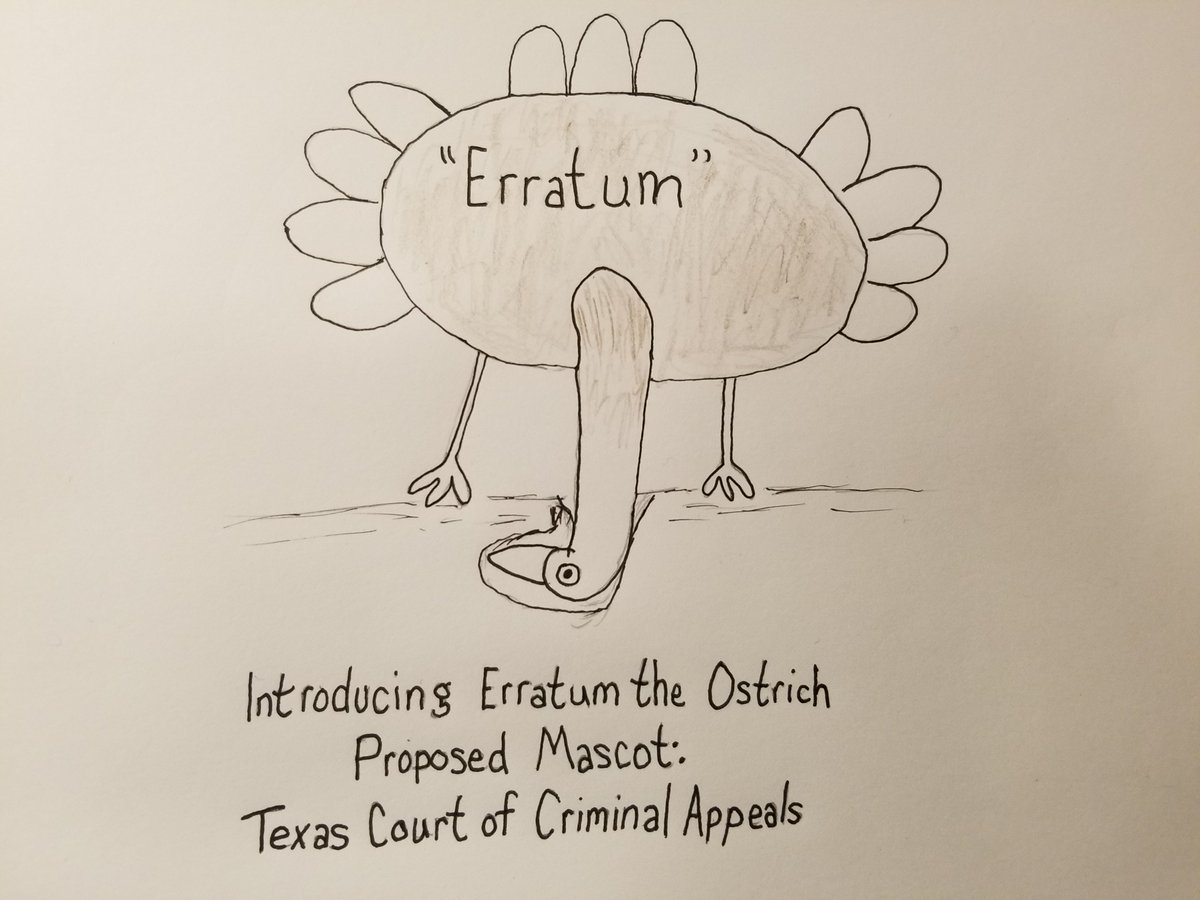
  • The Canadian Supreme Court has a fuzzy mascot owl named "Amicus." What should be the mascot for the Texas Court of Criminal Appeals? My suggestion:
Find a transcript below the jump.

Tuesday, June 11, 2019

Reasonably Suspicious, June 2019 episode: 2019 #txlege roundup, Dallas cops' racist Facebook posts, and are 'progressive prosecutors' really a thing?

Here's the June 2019 episode of Just Liberty's Reasonably Suspicious podcast:


In this month's episode:

Top Stories
Fill in the Blank
  • Texas Supreme Court: DAs can order prosecutors to violate constitutional rights
  • Bail-reform died, and that's a good thing
  • Should Texas prisoners all become plumbers?
Discussion: Are progressive prosecutors really a thing?

The Last Hurrah
  • Red-light cameras abolished, will debts be erased?
  • Colorado, Oklahoma surpassing Texas on #cjreform
  • Evidence left behind after Houston SWAT raid
Find a transcript below the jump.

Monday, March 18, 2019

Podcast: Elsa Alcala says Texas death penalty unreliable; parsing new TX traffic-stop data; prospects for Lone-Star marijuana reform, and other stories

Here's the March 2018 episode  of the Reasonably Suspicious podcast, recorded last week on the SXSW Podcast Stage hosted by Cadence13. Former Texas Court of Criminal Appeals Judge Elsa Alcala was our special guest, focusing on junk forensic science and the death penalty.


Here's what's on this month's show:

Opening Riff
Would permanently shifting to Daylight Savings Time reduce crime?

Top Stories
  • Prospects for marijuana reform in Texas
  • New data on use of force at Texas traffic stops
  • Legislative proposals to end the Driver Responsibility surcharge
Forensic Focus
Judge Elsa Alcala discusses junk science cases at the Texas Court of Criminal Appeals.

Death and Texas
Judge Alcala discusses the evolution of her views on capital punishment, from proponent to critic, and what the Texas Legislature should do to fix the state's unconstitutional laws on executing people with developmental disabilities.

The Last Hurrah
  • More corruption revealed after botched drug raid in Houston
  • Should stealing Amazon packages become a felony?
  • Closing the "Dead Suspect" loophole to the Texas Public Information Act
Find a transcript of the show below the jump.

Thursday, February 28, 2019

Reasonably Suspicious podcast: Harris commissioners nixed DA hiring request, and other stories

The Harris County District Attorney can't hire more prosecutors, the Houston PD can't find the informant behind a botched SWAT-style narcotics raid, and the chairman of the House Corrections Committee can't understand why local government spends so much money jailing people. My co-host Mandy "Tiger" Marzullo and I discussed all this and more in the better-late-than-never February episode of the Reasonably Suspicious podcast:


Here's what we discussed on the show this month:

Top Stories
  • Harris County rejects DA request for new prosecutors (2:15)
  • Houston PD can't find informant behind botched, deadly SWAT raid (8:00)
Interview
House Corrections Committee Chairman James White (14:30)

Data Corner
Conversation with Just Liberty's Chris Harris about Class C misdemeanors (21:00)

The Last Hurrah (31:38)
  • Texas jails and prisons gathering voiceprint data from inmate phone calls
  • Long lines at DPS staffing centers
  • Guard salaries, A/C, and staff turnover at TDCJ
Find a transcript of the podcast below the jump.

Friday, January 25, 2019

Podcast: Taking a bite out of junk science, update on bail-reform litigation, and much more

The January episode of Just Liberty's Reasonably Suspicious podcast was delayed a bit by my co-host's enviable trip to Vietnam at the beginning of the year. But the results were worth the wait. You can subscribe to the podcast on iTunes, GooglePlay, or SoundCloud, or listen to this month's episode here:


We've got a good show this month, featuring a review of bail-reform litigation around the state and how it might influence legislation in Texas. We updated listeners on criminal-justice reform bills, including many with bipartisan support in both major Texas party platforms. And we talked through the Texas Court of Criminal Appeals' Chaney decision invalidating bite-mark evidence and debating innocence standards, plus much more. Here's what we discussed this month:

Top Stories
  • Bail reform (2:00)
  • Texas #cjreform legislation with bipartisan support (6:55)
  • Policing bills to watch (14:20)
Home Court Advantage
  • Bite marks, junk-science and innocence: The Court of Criminal Appeals' Chaney decision (20:00)
Fill in the Blank
  • Prison healthcare budgets (32:00)
  • First Step Act (36:00)
  • Rape clearance rates and the Austin police chief (39:30)
The Last Hurrah (43:55)
  • Convict leasing victims found in Sugar Land
  • Forensic commission suggests using high-error-rate drug field tests
  • 'Dead Suspects Loophole' to the Public Information Act
Find a transcript of the show below the jump. Enjoy!

Thursday, December 20, 2018

Let's Talk: A compilation of #cjreform interviews

Grits has been enjoying the interviews for Just Liberty's Reasonably Suspicious podcast and  compiled them all in one spot, plus some of the interviews done on Grits (with apologies for the lesser audio quality) before we moved to a format with better production values. I'd first published this in February and thought I'd update it at year's end. Enjoy:
  • Ron DeLord of the Combined Law Enforcement Associations of Texas, Chris Perkins of the Austin Police Association, and Chas Moore of the Austin Justice Coalition discuss the battle over installing accountability reforms in and around the Austin police contract. 
  • Kathy Mitchell on new police accountability reform measures in Austin.
  • Susanne Pringle of the Texas Fair Defense Act gives a primer on the status of Harris County bail litigation as of October 2018.
  • Audio of Dallas DA candidate debate between John Creuzot and Faith Johnson.
  • Pamela Colloff, writer for ProPublica and New York Times Magazine discusses the apparent false conviction of former high-school principal Joe Bryan based on faulty blood-spatter evidence.
  • Texas Republicans for Justice Reform: Our special, hour-long podcast aimed at promoting justice reform in the state Republican party platform at the state convention featured interviews with Right on Crime Director Derek Cohen, Conservative Coalition Research Institute Director Jason Isaac, outgoing Texas Young Republican Federation Chairman John Baucum, Charles Blain from Empower Texans' Restore Justice Project, Heather Fazio of Citizens for Responsible Marijuana Policy, and David Safavian, of the American Conservative Union Foundation.
  • Democratic Convention Special: This special podcast promoted #cjreform planks in the Texas state Democratic platform in 2018. It features original music and interviews with state Rep. Gene Wu, Austin Justice Coalition executive director Chas Moore, as well as Sukyi McMahon and Kathy Mitchell with Just Liberty.
  • Susanne Pringle: The legal director of the Texas Fair Defense Project discusses the ongoing civil rights litigation over unconstitutional bail practices in Harris County as of April 2018.
  • Kent Whitaker, father and only surviving victim of death-row inmate scheduled for execution February 2018 pleads for his son's life.
  • Ron DeLord, founder of the Combined Law Enforcement Associations of Texas and lead negotiator on the Austin police union contract.
  • Peter Neufeld, co-founder of the national Innocence Project, discussing prospects and barriers to forensic reform.
  • Brandi Grissom, former Austin bureau chief at the Dallas Morning News on the Texas Juvenile Justice Department sex-abuse scandal she covered as her final story.
  • Sam Sinyangwe, co-founder of Campaign Zero and director of the Mapping Police Violence Project discussing police violence and the Austin police-union contract.
  • Emily Gerrick, staff attorney at the Texas Fair Defense Project, discussing legislation reforming debtors prisons and what Texas judges can do to reduce incarceration for debt.
  • James White, Chairman of the Corrections Committee in the Texas House, discussing the 2017 legislative session and future prospects for sentencing reform.
  • Becky Bernhardt, executive director of the Texas Fair Defense Project discusses Harris County bail-reform litigation to which her group is a party.
  • Amanda Marzullo, executive director of the Texas Defender Service, making the case for a capital appellate public defender.
  • Eva Ruth Moravec, reporter covering police shootings of unarmed people in Texas talks about her beat.
  • Amanda Woog, academic discussing her project gathering data on Texas police shootings and deaths in custody. See an earlier interview about her project.
  • Sandra Guerra Thompson, law professor at the University of Houston discussing her new book, Cops in Lab Coats.
  • Erica Gammill, executive director of the Prison Justice League discusses the problems and opportunities posed by organizing prisoners directly.
  • Amanda Marzullo, policy director of the Texas Defender Service, discusses implementation of the Michael Morton Act.
  • Amanda Marzullo, policy director of the Texas Defender Service, discusses what's next after 2015 grand jury reforms.
  • Amanda Marzullo, policy director of the Texas Defender Service, discusses the interplay between the Legislature and the Court of Criminal Appeals regarding Texas' junk-science writ, as well as 2015 legislation requiring prosecutors to notify defense when seeking an execution date.
  • Becky Bernhardt: On excessive caseloads of attorneys representing indigent defendants.
  • Jennifer Laurin, UT law professor, discussing prosecutorial misconduct and oversight.
  • Jeff Blackburn, Amarillo attorney and former legal director of the Innocence Project of Texas, discussing traffic tickets as local revenue generators.

Monday, December 17, 2018

Police union reps sit down with reform advocate for post mortem on Austin-police-contract fight

On December 13, 2017, a contract negotiated between the Austin police union and city management was voted down by the city council in response to a large community uprising led by the Austin Justice Coalition. After nearly a year-long standoff, the sides came to an agreement in November, with the union agreeing to significant new reforms and $10 million per year less than in the previously negotiated contract.

On December 4th, police union representatives Ron DeLord and Chris Perkins sat down with Chas Moore of the Austin Justice Coalition in Grits' dining room to discuss the 18-month-long struggle to install accountability measures in the Austin police union contract. Excerpts from the discussion were included in a segment in Just Liberty's December 2018 Reasonably Suspicious podcast, but here's the full, 38-minute conversation:


Friday, December 14, 2018

Podcast excerpt: TX Court of Criminal Appeals hears arguments about when it's okay to electrocute pro se defendants

James Calvert is a mentally ill capital murder defendant who allegedly murdered his ex-wife on Halloween night in 2012. He represented himself at trial in Smith County, Texas and was sentenced to the death penalty. Among other remarkable elements of the case, Mr. Calvert was shocked with a 50,000 volt stun belt during the trial for refusing to obey the court's demands. In addition, Judge Jack Skeen, who presided over the trial, repeatedly made negative comments about Mr. Calvert and the evidence he presented. Many observers believed Calvert should never have been allowed to represent himself in the first place.

In September, the Texas Court of Criminal Appeals heard oral arguments in Calvert's case, delivering perhaps the clearest window yet into the issues that may decide his fate. On the December 2018 episode of the Reasonably Suspicious podcast, my co-host, Texas Defender Service Executive Director Mandy Marzullo, and I reviewed highlights from oral arguments and discussed key issues in the case. Because of high levels of interest in the case, particularly in Grits' hometown, I've excerpted the podcast segment dealing with the case; listen to it here:


For a transcript of of the segment, go here.

And by the way, if, like me, the story about shocking a defendant with a 50,000 volt stun belt left you wondering, "What kind of company manufactures such a torture device, and how is there a market for such a thing?," here's a two-decade old Washington Post story offering some background, using a Texas case study, of course.

Wednesday, December 12, 2018

Podcast: Adversaries over Austin police-union contract sit down; when is it okay for courts to electrocute mentally ill defendants?; pythons as stocking stuffers?; and other stories

When is it okay for a judge to electrocute a mentally ill defendant?

What leverage did a Texas civil rights activist say enabled Austin advocates to force reforms into the city's police-union contract?

How many pet pythons are too many, and are they appropriate to give at Christmas as stocking stuffers?

These and other questions are answered on this month's episode of the Reasonably Suspicious podcast. As always, you can subscribe on iTunes, Google Play, or SoundCloud, or listen to it here:


Here's what's in this month's episode:

Opening: Pythons as stocking stuffers?

Top Story
Interview
Police-union negotiators Ron DeLord and Chris Perkins sit down with a now-familiar adversary, Chas Moore of the Austin Justice Coalition, to discuss the aftermath of the year-long fight over the capital city's police-union contract.

Home Court Advantage
  • When is it okay to electrocute a mentally ill defendant in court? Discussion of James Calvert oral arguments
  • Ken-Paxton prosecutors de-funded, but at what cost to indigent defense?
The Last Hurrah
  • Dallas PD officer indicted for murder
  • Lawsuit challenges driver surcharges
  • Ray Hill, R.I.P.
Find a transcript of the show below the jump.

Wednesday, November 28, 2018

Union contract fight gave Austin advocates leverage to improve police oversight

Austin Justice Coalition's victory over police union
brings to mind history's greatest upsets
(Updated with background links, photos, and an addendum.)

Although the local media has reported that the Austin police contract was finally approved and activists were happy with the result, only one local TV station report that I saw attempted to parse changes in the contract from a police accountability standpoint.

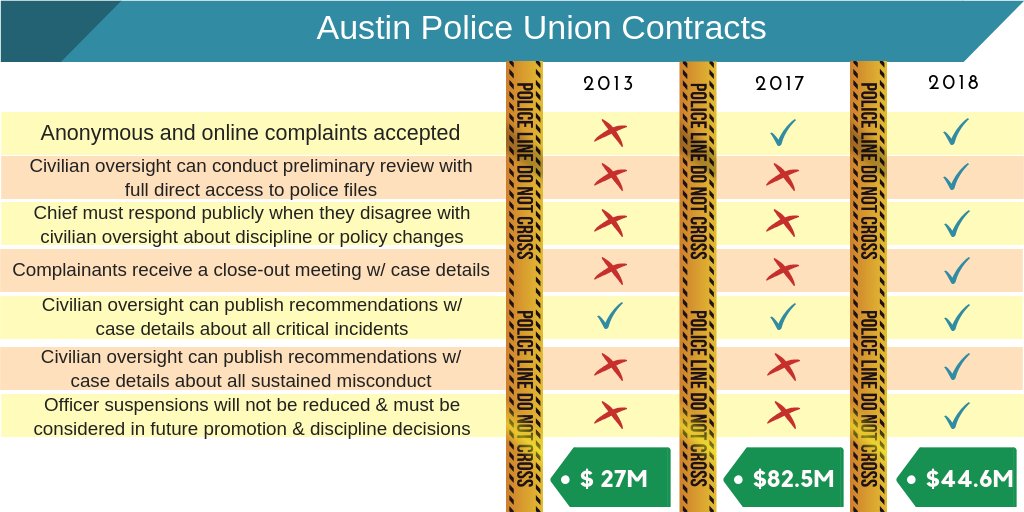
Advocates' year-long battle resulted in savings of $10 million per year compared to the contract rejected last December, as well as achieving greater transparency about police misconduct, the ability of the Police Monitor to accept anonymous complaints, and an end to the practice downgrading violations after a period of time so that they disappeared from public view (and couldn't be considered by the Chief in the event of future misconduct.)

Activists didn't get all they wanted. Of the six items in Campaign Zero's wish list for accountable police contracts, for example, the Austin Justice Coalition (AJC) and its allies only won one of them. That said, there were other accountability items specific to the Austin contract (e.g., downgrading violations over time) that weren't on Campaign Zero's list, and they were important, too.

Campaign Zero co-founder Sam Sinyangwe with
Austin Justice Coalition co-founder Chas Moore
Compromises notwithstanding, this was a major police-accountability victory. To my knowledge, no police-union contract in the United States, before this one, had been rejected by elected officials because of concerns over police accountability. From the moment the contract was defeated last December, it gave Chas Moore, his AJC compatriots and their allies tremendous leverage; more than police reformers in Austin have had at any time in living memory.

Before the contract defeat, AJC could get no traction for reforming oversight. In the months before last December's marathon hearing, at which the proposed union contract was finally voted down, AJC and allies presented eight reforms to both the City and the police association. The association never sat down with reformers, and the city failed to introduce the ideas into the negotiation process.

But after the entire city witnessed Moore and AJC standing over the defeated police union like Ali looking down at Sonny Liston (shouting "Give us police oversight!" instead of Ali's "Get up and fight, sucker!"), their voices could no longer be ignored.

Campaign Zero's Deray McKesson with the
Austin Justice Coalition policy team in Grits' living room.
The union swapped out their president for a new, co-lead negotiator, who in turn reached out to reformers. With strong, continued interest from council offices, the city rolled the reform proposals into the negotiation and discovered that hanging tougher brought rewards. In the version of the contract finally approved, the oversight mechanisms were moved to a city ordinance and the contract includes a more limited list of issues that required police association buy-in. That not only meant a lower cost. It also put the city council back in control of police oversight instead of giving the police union veto power.

As it happens, my wife was heavily involved in AJC's efforts to influence the contract and create a new oversight system for Austin. In the most recent episode of Just Liberty's Reasonably Suspicious podcast, she outlined the changes made and what comes next. Since the details of the new oversight system have received so little attention, I decided to pull out those comments as a stand-alone segment for anyone interested. Give them a listen:


Next month, both Chas Moore and Ron DeLord, the lead negotiator for the police union, have agreed to a joint interview/conversation on the podcast to describe the process and lessons learned from it, so I'm looking forward to that.

MORE: Chris Harris of Grassroots Leadership posted on Twitter this helpful graphic showing the impact of grassroots advocacy on the police-union contract and civilian oversight in Austin. The left-hand column was the old contract; the middle column is the one rejected by the City Council after a populist uprising last December; and the right-hand column is the new, final contract. Quite an improvement, huh? Especially on the price tag!


For more background, see these prior, related Grits posts:

Wednesday, November 21, 2018

Reasonably Suspicious podcast: TX elections through a #cjreform lens, artists confront the justice system, update on Austin police contract victory, and a bid to ban forensic hypnosis from Texas courtrooms

If you find yourself with a spare 45 minutes over the holiday, or get bored on the ride home from Grandma's, here's the November 2018 episode of Just Liberty's Reasonably Suspicious podcast. As always, you can also listen to it on iTunes, Google Play, and SoundCloud.


This month:

Top Stories
Interview
Kathy Mitchell on the Austin police contract

Forensic Focus
Bill filed to eliminate forensic hypnosis

Fill in the Blank
The Last Hurrah
Find a transcript of the podcast below the jump.

Sunday, October 21, 2018

Special election-season podcast: Excerpts from Dallas DA debates; TX bail litigation update; ballot access for jail inmates; plus, conversations on forensics, racial disparities, and regulating 'robot brothels'

Check out a special, hour-long election-season episode of Just Liberty's Reasonably Suspicious podcast. As always, you can subscribe on iTunes, Google Play, or Soundcloud, or listen to it here:


I'm excited about this episode. It includes extended excerpts from a debate between Dallas District Attorney candidates which Just Liberty co-sponsored with a Dallas-area group called Evolve. They had a very interesting and sometimes contentious discussion. (I'll publish audio of the full, hour-and-a-half debate in a couple of days.)

Meanwhile, attorney Susanne Pringle provides the first, detailed update I've heard on the status of bail litigation in Texas in the wake of the 5th Circuit scaling back the Harris County injunction and a new injunction emerging in Dallas. Her organization, the Texas Fair Defense Project, is one of the groups representing plaintiffs in both the Harris and Dallas County litigation. If you care about this topic, give it a listen; no MSM source has yet tried to make sense of this clear-as-mud legal muddle.

Plus, another discussion of unreliable forensics, racial disparities in marijuana arrests, an effort to provide inmates ballot access in the Travis County Jail, and, of course, sex robots.

Here's this month's lineup:


Top Stories
  • Houston's proposed robot-brothel ban
Special Report
  • Excerpts from the Dallas County District Attorneys debate between Republican incumbent Faith Johnson and Democratic challenger John Creuzot, hosted by Evolve and Just Liberty.
Interview
Susanne Pringle from the Texas Fair Defense Project explains the status of Texas bail litigation and what legislative policy makers should take away from it so far.

Suspicious Mysteries
Probing reasons for differences behind racial disparity between DWI and marijuana arrests in Houston.

Forensic Focus
  • Ballistics over-hyped in media coverage
  • Junk science writ strikes again: child trauma edition
Interview
Conversation with Hope Doty, who's been spearheading an effort to secure ballot access for Travis County Jail inmates. (There are a couple of unfortunate audio glitches here - my apologies.)

The Last Hurrah
  • Prospects for federal #cjreform
  • Prison guard beat handcuffed inmate
  • Governor Abbott endorses reduced pot penalties
Find a transcript of the podcast below the jump.

Tuesday, September 25, 2018

Podcast: Did the innocence movement cause decline in clearance rates?

Check out the September, 2018 episode of the Reasonably Suspicious podcast from Just Liberty. Notably, the introduction features a brief poem regarding the Supreme Court nomination, per Keri Blakinger's request. ;)


Beyond that, here are the topics we're discussing this month:

Top Stories
Musical Interlude #1: Debtors Prison Blues

Home Court Advantage
Game segment: Fill in the Blank
Musical Interlude #2: Stop the Train

The Last Hurrah
  • Waco jail is full of pretrial prisoners
  • Twin Peaks cases delayed until new DA takes office
  • Why haven't incarceration, prosecutions, declined with crime rates?
Find a transcript of the podcast below the jump.