Grits is still catching up on all that went on while I was under the weather these last few months, and wanted to visit the new, much-worse bodycam policy enacted by Austin PD on March 16. Farah Muscadin at the city's Office of Police Oversight put out a formal objection to the new policy two weeks ago that deserves readers' attention.
Basically, APD downgraded violations of the bodycam policy and made those violations much less transparent. Wrote Muscadin, "These changes delegitimize the discipline process by trivializing conduct that has historically been treated as a significant policy violation."
In essence, this is a reaction to the (relatively) new police contract enacted in 2018. Under the revised contract, written reprimands of officers became public records for the first time. Previously, the public couldn't know about disciplined officers unless they were suspended from duty as a punishment.
Under the old policy, on the first offense bodycam violations received punishments ranging from a written reprimand to a one to three day suspension, with penalties increasing by one level on the second and third offenses.
Now, officers receive "oral counseling" on the first offense, get a "counseling memorandum" on the second offense, and on the third offense punishments range from an "oral reprimand" to a one-to-three day suspension.
So, as Muscadin notes, "Due to the March 16th changes, an officers third sustained violation of the [bodycam policy] now results in lighter discipline than an officer used to receive upon their first violation of those policies." And since they'll no longer receive written reprimands, the public can no longer discover these violations under the Public Information Act.
APD notified the Office of Police Oversight on the same day it took effect. Noted Muscadin, "APD's practice of soliciting feedback on proposed policy changes without providing adequate notice or opportunity to respond is unacceptable and contradictory to APD's support of civilian oversight."
Muscadin recommended the department reverse this policy and go back to the old one and Grits couldn't agree more. Enacting the policy without giving anyone - even the OPO - a realistic chance to respond reeks of bad faith, and mirrors their behavior gutting the police complaint process, which Grits discussed previously, to make that process more opaque.
Finally, this is another big story at Austin PD which has been utterly, 100% ignored by the local media. Apparently, if the APD Public Information Office doesn't spoon feed reporters a story, they just don't cover it. And when APD does spoon fed them something, they spin it to avoid saying anything critical.
Grits hopes the Austin City Council intervenes to reverse both the bodycam policy and the new policy on the complaint process. These changes appear intentionally designed to undermine police oversight and hard-won gains in the police contract process. They must not stand.
Showing posts with label bodycams. Show all posts
Showing posts with label bodycams. Show all posts
Wednesday, April 22, 2020


Friday, January 05, 2018
Austin press coverage of police contract still sucks, and other stories
Here are a few odds and ends that deserve readers' attention even if I haven't had time to turn them into full, independent blog posts:
Austin press coverage of police contract still sucks
The Austin press continues its one-sided coverage of the City Council's rejection of the police-union contract, larding their articles with quotes from contract supporters and minimizing the views of critics without fully explaining them. In an Austin Chronicle story published yesterday, for example, contract supporters were given a platform for predicting doom while contract critics were dismissed as know-nothings (e.g., my wife was dubbed a "gadfly"). According to reporter Nina Hernandez, council members who voted against the contract (all of them) "hadn't exactly considered the consequences of their decision," though there's no sourcing, much less factual basis offered for that opinion. Later, appearing to contradict herself, she complained that the council was "suffering information overload," which hardly jibes with her earlier calumny that they hadn't sufficiently studied the topic.
The truth is, MSM reporters in Austin appear as a class to have misunderstood and misreported this entire debate from the get go. Ms. Hernandez now says she recognizes that, as one council member instructed her, "the Council's vote was more about the money" than the oversight piece (which means the press were the only ones in the room that night who didn't understand what they were watching). But no one in the local media is yet reporting on the most important implications of the scuttled contract: Freeing up around $10 million that the city council can spend in the current fiscal year over and above their current budget. How and when to spend that money is where the actual debate has moved at city hall, as well as among the activist players involved. But the press continues to flail, having missed the story and spun false narratives for so long that they don't now know how to begin to catch up. It's as though there's an almost willful decision by the local Austin press corps not to publicly report on what these debates are actually about.
Texas law mandates bad bodycam policies
Note to reporters who want to localize a story about police bodycams based on the Leadership Conference/Upturn recommendations, like this recent SA Express News story: Texas' law is the source of the most important bad practices, like letting officers accused of misconduct review video before they're questioned, or erecting barriers to accessing video under open records. Increasingly more departments, most recently Arlington and Plano, are purchasing body cameras for their officers. MORE: Here's a new academic piece on body cameras from Seth Stoughton for the to-read pile.
Private prison company gets rep on Windham task force
One of the governor's new appointees to Texas' task force on "Academic Credit and Industry Recognition" at the Windham School District (which operates educational programming at the Texas Department of Criminal Justice) works for a private prison company, reported the Longview News Journal.
Maybe time to tone down the 'war on cops' meme
The number of police officers killed in the line of duty in 2017 was the second lowest total in 50 years. While every death of an officer is a tragedy, this low total doesn't comport with the "war on cops" meme that's been prevalent for the last couple of years. Suicides and traffic deaths remain the more significant killers of sworn police officers.
Analyzing 2017 shootings by police
The new report from Mapping Police Violence is a must-read. By their count, 1,129 people were killed by police in America in 2017. MPV researchers "were able to identify officers in 534 cases. At least 43 had shot or killed someone before. 12 had multiple prior shootings." Also, "Most killings began with police responding to suspected non-violent offenses or cases where no crime was reported. 87 people were killed after police stopped them for a traffic violation." The number of those killed who were unarmed was 147. Notably, "Police recruits spend 7x as many hours training to shoot than they do training to de-escalate situations." FWIW, the Washington Post came up with a slightly lower number for Americans killed by police; Grits doesn't yet understand why the difference. It's remarkable that the number of people shot and killed by the government isn't tracked more closely than this in an official capacity. This should be a number we know.
Why long sentences matter
Too much of 2016 and 2017 was spent debating Prof. John Pfaff's position that long sentences weren't a significant driver of mass incarceration. He was wrong. This 17-minute podcast from the Urban Institute lays out the problem of too-long sentences and shows why reducing them is key to ending mass incarceration.
Healthcare spending reduces crime, violence
In the big picture, the observation from the Brookings Institute that health care spending prevents crime makes loads of sense. That's particularly true where health and crime specifically intersect - like drug abuse and mental illness, where treatment and related social-service supports can prevent crime both directly and indirectly. One study they cited "found that an increase in the number of treatment facilities causes a reduction in both violent and financially-motivated crime. This is likely due to a combination of forces: reducing drug abuse can reduce violent behavior that is caused by particular drugs, as well as property crimes like theft committed to fund an addiction. Reducing demand for illegal drugs might also reduce violence associated with the illegal drug trade."
Trump DOJ rescinds anti-debtors prison guidelines
The decision by the Trump DOJ to rescind guidance on minimizing debtors-prison practices was ill-conceived and a disappointment. But it was only ever guidance, and rescinding it in and of itself changes nothing. What has always mattered more is what state and particularly local actors choose to do on the ground, and that remains an open question. Texas legislators in 2017 took long-awaited first steps toward confronting the problem of arresting poor people over fines, but there's much more to be done. It remains to be seen whether - much like the push to reform asset forfeiture laws - movement conservatives continue to push for reform in spite of the Trump Administration staking out a more regressive agenda.
Austin press coverage of police contract still sucks
The Austin press continues its one-sided coverage of the City Council's rejection of the police-union contract, larding their articles with quotes from contract supporters and minimizing the views of critics without fully explaining them. In an Austin Chronicle story published yesterday, for example, contract supporters were given a platform for predicting doom while contract critics were dismissed as know-nothings (e.g., my wife was dubbed a "gadfly"). According to reporter Nina Hernandez, council members who voted against the contract (all of them) "hadn't exactly considered the consequences of their decision," though there's no sourcing, much less factual basis offered for that opinion. Later, appearing to contradict herself, she complained that the council was "suffering information overload," which hardly jibes with her earlier calumny that they hadn't sufficiently studied the topic.
The truth is, MSM reporters in Austin appear as a class to have misunderstood and misreported this entire debate from the get go. Ms. Hernandez now says she recognizes that, as one council member instructed her, "the Council's vote was more about the money" than the oversight piece (which means the press were the only ones in the room that night who didn't understand what they were watching). But no one in the local media is yet reporting on the most important implications of the scuttled contract: Freeing up around $10 million that the city council can spend in the current fiscal year over and above their current budget. How and when to spend that money is where the actual debate has moved at city hall, as well as among the activist players involved. But the press continues to flail, having missed the story and spun false narratives for so long that they don't now know how to begin to catch up. It's as though there's an almost willful decision by the local Austin press corps not to publicly report on what these debates are actually about.
Texas law mandates bad bodycam policies
Note to reporters who want to localize a story about police bodycams based on the Leadership Conference/Upturn recommendations, like this recent SA Express News story: Texas' law is the source of the most important bad practices, like letting officers accused of misconduct review video before they're questioned, or erecting barriers to accessing video under open records. Increasingly more departments, most recently Arlington and Plano, are purchasing body cameras for their officers. MORE: Here's a new academic piece on body cameras from Seth Stoughton for the to-read pile.
Private prison company gets rep on Windham task force
One of the governor's new appointees to Texas' task force on "Academic Credit and Industry Recognition" at the Windham School District (which operates educational programming at the Texas Department of Criminal Justice) works for a private prison company, reported the Longview News Journal.
Maybe time to tone down the 'war on cops' meme
The number of police officers killed in the line of duty in 2017 was the second lowest total in 50 years. While every death of an officer is a tragedy, this low total doesn't comport with the "war on cops" meme that's been prevalent for the last couple of years. Suicides and traffic deaths remain the more significant killers of sworn police officers.
Analyzing 2017 shootings by police
The new report from Mapping Police Violence is a must-read. By their count, 1,129 people were killed by police in America in 2017. MPV researchers "were able to identify officers in 534 cases. At least 43 had shot or killed someone before. 12 had multiple prior shootings." Also, "Most killings began with police responding to suspected non-violent offenses or cases where no crime was reported. 87 people were killed after police stopped them for a traffic violation." The number of those killed who were unarmed was 147. Notably, "Police recruits spend 7x as many hours training to shoot than they do training to de-escalate situations." FWIW, the Washington Post came up with a slightly lower number for Americans killed by police; Grits doesn't yet understand why the difference. It's remarkable that the number of people shot and killed by the government isn't tracked more closely than this in an official capacity. This should be a number we know.
Why long sentences matter
Too much of 2016 and 2017 was spent debating Prof. John Pfaff's position that long sentences weren't a significant driver of mass incarceration. He was wrong. This 17-minute podcast from the Urban Institute lays out the problem of too-long sentences and shows why reducing them is key to ending mass incarceration.
Healthcare spending reduces crime, violence
In the big picture, the observation from the Brookings Institute that health care spending prevents crime makes loads of sense. That's particularly true where health and crime specifically intersect - like drug abuse and mental illness, where treatment and related social-service supports can prevent crime both directly and indirectly. One study they cited "found that an increase in the number of treatment facilities causes a reduction in both violent and financially-motivated crime. This is likely due to a combination of forces: reducing drug abuse can reduce violent behavior that is caused by particular drugs, as well as property crimes like theft committed to fund an addiction. Reducing demand for illegal drugs might also reduce violence associated with the illegal drug trade."
Trump DOJ rescinds anti-debtors prison guidelines
The decision by the Trump DOJ to rescind guidance on minimizing debtors-prison practices was ill-conceived and a disappointment. But it was only ever guidance, and rescinding it in and of itself changes nothing. What has always mattered more is what state and particularly local actors choose to do on the ground, and that remains an open question. Texas legislators in 2017 took long-awaited first steps toward confronting the problem of arresting poor people over fines, but there's much more to be done. It remains to be seen whether - much like the push to reform asset forfeiture laws - movement conservatives continue to push for reform in spite of the Trump Administration staking out a more regressive agenda.
Thursday, November 30, 2017
Police unions, the media, and me ... and other stories
Grits fell ill at the end of the holiday weekend, am only now really back on my feet, and find myself in a desperate need to clear my browser tabs. So, y'all get a roundup of all the stuff I don't have time to blog about right now.
Police officers indicted more often, but seldom convicted after shootings
More police officers in Texas are being charged after questionable shootings, but prosecutors who were able to convince grand juries to indict have been less successful at securing convictions at trial, reported Tasha Tsiaperas the Dallas Morning News (who has a really cool, bond-villain-type name!). In related news, Grits contributing writer Eva Ruth Moravec had a feature in the Houston Chronicle about a Freeport police officer acquitted by a Brazoria County jury for shooting his unarmed neighbor in the next apartment. It was as negligent a situation as one could imagine, so maybe civil court is still an option: The cop apparently slept with a loaded gun in his bed (and in this case, his finger on the trigger, safety off) and fired it through his headboard into the next door apartment. Attn: Texas Monthly, this is mandatory Bum Steer material.
Police unions, the media, and me
Most local media coverage of the Austin police contract has been dismissive of the push by the Austin Justice Coalition and their growing list of allies to get the city council to vote "no." This, despite opposition to the contract from hundreds of signators, more than a dozen groups, and even though, in a staunchly Democratic county, D precinct chairs unanimously voted for a resolution urging city council to kill the deal. Currently the vote is scheduled for December 14th. At the Texas Observer, Michael Barajas has a feature explaining more fully "How the expiration of Austin's police union contract could be a rare opportunity for reform." Former CLEAT mugwump and long-time police-union leader Ron DeLord, who was lead negotiator for the Austin Police Association on the contract, complained on Twitter that Barajas didn't talk to him. So I suggested DeLord do a podcast interview to air his views, and he agreed(!). I hope y'all are looking forward to that as much as I am. Mainly I want to talk to him about his books: See Grits' discussion of his latest one, and also the opening segment of our August Reasonably Suspicious podcast discussing his remarkably accurate prediction of Texas' police-pension crisis, which was a contentious legislative imbroglio this year resulting in outcomes with which no one is happy, but which brokered an uneasy, temporary truce among the parties. If the economy holds.
Evaluating police bodycams
Coupla items here: A new study found bodycams reduced use of force episodes at the Las Vegas PD while providing quality evidence that supported criminal convictions mostly of defendants, not cops. But many advocates, your correspondent included, believe the laws limiting transparency around footage reduce the accountability benefits. Supporting that claim, Nick Selby wrote on The Crime Report that, "In October of this year, the biggest-ever randomized study of body cameras showed no measurable reduction in complaints or use of force by officers in Washington, D.C." So the jury's still out on whether this will turn out to be an important accountability measure, as they were originally pitched in the hyped aftermath of the Ferguson protests.
With shortfall looming, a way to reduce DPS crime-lab volume
Plano PD is testing a device that can tell whether DNA exists on a piece of evidence before they send it to the lab instead of after. If this works as advertised, Governor Greg Abbott, his grants division, and DPS crime-lab folk should take heed. It might even be worth the Governor considering emergency grants to buy these for the biggest users of DPS DNA lab services to reduce the volume of cases. A lot of material sent has no DNA on it at all, and to screen that out up front would make a big difference on volume in a biennium when the Legislature told DPS to collect fees for part of their budget and the Governor has stopped them from doing it. That creates a shortfall unless they can find ways to reduce volume. This could be an important one.
Death penalty now mainly an LWOP plea-bargain chip
Texas will perform no more executions this year after the Court of Criminal Appeals issued a stay and halted Juan Castillo's planned trip to the death chamber. But expect life without parole sentences to keep stacking up as Christmas approaches. In 2016, according to the Texas Office of Court Administration, just three new death sentences were secured by Texas prosecutors, compared to 64 LWOP sentences. (A whopping 426 total capital cases were filed statewide last year, which was a ten percent increase from the year before, so many are called, but few are chosen.) These days, the death penalty is mostly a threat to get people to accept life without parole sentences in a plea bargain.
Harris judges sabotaging pretrial release order from feds
Harris County judges are sabotaging the pretrial release system mandated under a federal court order by refusing to release thousands of defendants who qualify, according to a report by the Texas Tribune (which doesn't use such strong language but supplies all the relevant details). Instead, the Sheriff has to release them outside of the purview of the Pretrial Services system, where they predictably have higher no-show rates. (One of the most important things pretrial services does to get them there are reminder calls and texts.) The key problem:
Defendants who are ordered for no-cost release by a judge or magistrate are entered into the county’s Pretrial Services department, which works to ensure those out on personal bonds know the date of their next court appearance and can provide additional conditions like drug testing, mental health services or GPS ankle bracelets. Those released by the sheriff aren’t monitored once they leave the jail.On judges as gatekeepers, redux
Here's a law review article by Stephanie Damon-Moore on a question Grits has thought about a lot: "why trial judges, who have an independent obligation to screen expert testimony presented in their courts, would routinely admit evidence devoid of scientific integrity."
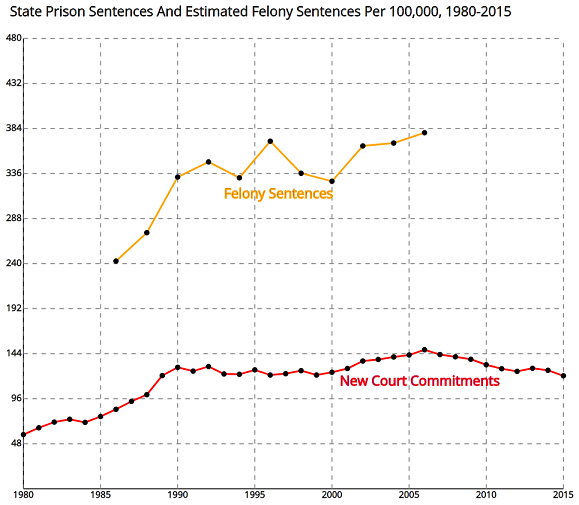
We've established that the War on Drugs contributed more to mass incarceration than critics like John Pfaff have claimed. But now the statistician who best proved that has come out with a new analysis demonstrating even deeper, more insidious aspects to the drug war's role. Compared to new prison sentences, which themselves skyrocketed, the number of total felony sentences (including probation, deferred adjudication, etc.) went up even faster! See here, and check out the whole analysis:
Wednesday, November 15, 2017
Opacity policies a big reason why bodycams haven't lived up to the hype
Grits appreciated Eva Ruth Moravec's post on police bodycams and Texas' low ranking vis a vis accountability compared to other jurisdictions. I've been harping about Texas' bad statute since it first passed, but this new research places its badness in a national context, which is to say, "among the worst in the country."
Am I surprised? Not in the least. But before now no one had done the legwork to prove it, so bully for Upturn and the Leadership Conference, the groups that performed the analysis. Our old pal Vanita Gupta - who was one of the lead attorneys on behalf of those convicted-and-later-pardoned in the Tulia drug stings back in the day - is now running the Leadership Conference after a stint in the Obama Administration running the DOJ Civil Rights Division, so it's nice to see her still producing good work.
In light of this news, it seemed like an opportune moment to pull out a brief excerpt from the November Reasonably Suspicious podcast, in which Grits offered my own view on why bodycams haven't improved accountability as much as predicted, colored significantly by Texas' situation:
Since it's short, here's the full transcript:
Am I surprised? Not in the least. But before now no one had done the legwork to prove it, so bully for Upturn and the Leadership Conference, the groups that performed the analysis. Our old pal Vanita Gupta - who was one of the lead attorneys on behalf of those convicted-and-later-pardoned in the Tulia drug stings back in the day - is now running the Leadership Conference after a stint in the Obama Administration running the DOJ Civil Rights Division, so it's nice to see her still producing good work.
In light of this news, it seemed like an opportune moment to pull out a brief excerpt from the November Reasonably Suspicious podcast, in which Grits offered my own view on why bodycams haven't improved accountability as much as predicted, colored significantly by Texas' situation:
Since it's short, here's the full transcript:
Mandy Marzullo: A new study found police body cams were doing little to change police behavior. What's the problem?
Scott Henson: Mainly it’s that the laws implementing them aren't designed to use body cams for accountability. They're designed to use them to gather evidence against defendants. In most states including Texas, it's very hard to get access to the body cam footage, and so advocates aren't able to use it for holding police accountable and the only way they're getting used is as evidence in criminal trials. So for everyone who thought, "Hey, this will be a great police accountability tool," it's all in the implementation.
In addition, Michael Barajas at the Texas Observer had a story in September on the shortcomings of Texas' bodycam statute as viewed through the lens of police accountability debates in Dallas.
See related Grits coverage of Texas' bodycam statute:
See related Grits coverage of Texas' bodycam statute:
Sunday, November 12, 2017
November Reasonably Suspicious Podcast: Let me be your lawyer dog, or I won't be your man at all ...
Check out the November edition of Just Liberty's Reasonably Suspicious podcast, covering Texas criminal justice policy and politics. We're coming out a little early this month to keep things on the right side of the Thanksgiving holiday. You can listen to the latest episode here, or access it on all the usual channels: iTunes, Google Play, YouTube, or SoundCloud.
If you haven't subscribed yet, take a moment to do so now to make sure you won't miss an episode. Topics this go-round include:
.jpg) Top Stories
Top Stories
Looking forward to criminal-justice-related interim charges at the Texas Legislature.
Rapid fire quick takes:
If you haven't subscribed yet, take a moment to do so now to make sure you won't miss an episode. Topics this go-round include:
- The Louisiana Supreme Court said a man who told police "Why don't you just give me a lawyer, dawg?" wasn't really asking for a lawyer. But this is common. A recent Texas case denied an attorney on the same basis.
- Risk assessments have come under fire from liberals for generating racial disparities. What are the implications for using them as part of Harris County bail reform?
Looking forward to criminal-justice-related interim charges at the Texas Legislature.
- Appropriate treatment, services to offenders aged 17-25 to reduce recidivism, future crime. (See an earlier podcast segment on the topic.)
- Ineffective Assistance of Counsel: Front-end and back-end solutions.
- US Supreme Court hears oral arguments in Ayestas v. Davis, seeking funds for investigation into an ineffective assistance claim.
- A state district court considers Ex Parte Flores in which the key eyewitness was subjected to hypnosis before changing her ID of the suspect. She at first told police the suspect was a white man with long hair. Mr. Flores is an Hispanic man with short hair.
Rapid fire quick takes:
- USDOJ deleted 70% of tables from the newest edition of the national Uniform Crime Reports.
- A new study says police bodycams haven't changed police behavior. Why is that?
- Rent to own furniture companies as modern debtors prisons.
Monday, June 26, 2017
When Mom is arrested, assault by Tazer, and other stories
Having just returned from a brief if much-needed vacation, let's round up a few items that popped up in the last week while Grits was gone:
What happens to kids when Mom is arrested?
The Dallas Morning News published an excellent feature on what happens to kids when Mom gets arrested. Nobody tracks them in the system and neither police or jails ask arrestees about dependent children upon intake. The article included this short video:
Litigation over weather-related deaths at TDCJ heats up
After years of anticipation, TDCJ finds itself in trial this week to determine whether their un-air conditioned prisons which have caused numerous heat-related deaths constitute unconstitutionally cruel and unusual punishment.
Straight ticket voting ends for Texas judges in 2020
The Legislature this year eliminated straight ticket voting for judicial elections beginning in 2020. This should help, but the SA Express News is right it would be better if they were entirely non-partisan. There aren't Democratic or Republican positions on most questions judges must answer and forcing them to pander to their parties primary voters leads to some strange outcomes, like the guy in 2016 who made it into a runoff for the Court of Criminal Appeals running on an anti-abortion, pro-Second Amendment platform unrelated to the duties of the court.
Good legislation still didn't 'end' debtors prison practices
Grits remains exceedingly pleased that Texas' debtors-prison reform legislation (HB 351/SB 1913) passed this year, but to my friends in the MSM: Let's please stop claiming that this will "end" debtors prison practices. It will at best ameliorate them. Texas has improved the situation. It has not solved the problem. People will still be jailed because they can't afford to pay traffic tickets, we just don't know yet what the reduction in jail sentences will be. For that matter, barring intervention by the federal courts, Texas will continue its pay-or-stay bail practices, which in Grits' view also constitute "debtors prison" policies.
Are bodycams effective even with terrible public policies?
A big debate over bodycams is coming and it's going to be a mess. The rollout in Texas came with terrible legislation by Democratic state Sen. Royce West making it secret in many instances and difficult to get in all others, even though dashcam video from police cars has been effectively governed by the Public Information Act with no negative consequences. In practice, bodycams are used far more often to accuse defendants than to hold officers accountable. Indeed, Texas law says officers can view the video with their lawyers before talking to their supervisors about what happened when they're accused of misconduct so that they can craft their story to fit the facts. Criminal defendants, of course, would never be afforded such a privilege. And yet, police officers knowing their actions are being recorded still appears to be having an effect. A new study from the Urban Institute found that people expressed greater satisfaction in encounters with officers who wore body cameras, even when they were unaware of the cameras! So is it worth it despite the one-sided secrecy? Maybe, with caveats. But the secrecy still sucks.
When does Tazing become assault?
An Austin police officer was given a 20-day suspension for Tazing a suspect after the man was handcuffed and not resisting. The officer will undergo a psychological assessment and be placed on probation for a year. A question for the peanut gallery: Is there any good reason why the officer should not have been charged with assault in addition to the department's administrative punishment?
Will more training get Houston lawyers to take indigent criminal cases?
The South Texas College of Law in Houston received a fat $1.27 million grant to train local criminal defense lawyers. From Texas Lawyer:
What happens to kids when Mom is arrested?
The Dallas Morning News published an excellent feature on what happens to kids when Mom gets arrested. Nobody tracks them in the system and neither police or jails ask arrestees about dependent children upon intake. The article included this short video:
Litigation over weather-related deaths at TDCJ heats up
After years of anticipation, TDCJ finds itself in trial this week to determine whether their un-air conditioned prisons which have caused numerous heat-related deaths constitute unconstitutionally cruel and unusual punishment.
Straight ticket voting ends for Texas judges in 2020
The Legislature this year eliminated straight ticket voting for judicial elections beginning in 2020. This should help, but the SA Express News is right it would be better if they were entirely non-partisan. There aren't Democratic or Republican positions on most questions judges must answer and forcing them to pander to their parties primary voters leads to some strange outcomes, like the guy in 2016 who made it into a runoff for the Court of Criminal Appeals running on an anti-abortion, pro-Second Amendment platform unrelated to the duties of the court.
Good legislation still didn't 'end' debtors prison practices
Grits remains exceedingly pleased that Texas' debtors-prison reform legislation (HB 351/SB 1913) passed this year, but to my friends in the MSM: Let's please stop claiming that this will "end" debtors prison practices. It will at best ameliorate them. Texas has improved the situation. It has not solved the problem. People will still be jailed because they can't afford to pay traffic tickets, we just don't know yet what the reduction in jail sentences will be. For that matter, barring intervention by the federal courts, Texas will continue its pay-or-stay bail practices, which in Grits' view also constitute "debtors prison" policies.
Are bodycams effective even with terrible public policies?
A big debate over bodycams is coming and it's going to be a mess. The rollout in Texas came with terrible legislation by Democratic state Sen. Royce West making it secret in many instances and difficult to get in all others, even though dashcam video from police cars has been effectively governed by the Public Information Act with no negative consequences. In practice, bodycams are used far more often to accuse defendants than to hold officers accountable. Indeed, Texas law says officers can view the video with their lawyers before talking to their supervisors about what happened when they're accused of misconduct so that they can craft their story to fit the facts. Criminal defendants, of course, would never be afforded such a privilege. And yet, police officers knowing their actions are being recorded still appears to be having an effect. A new study from the Urban Institute found that people expressed greater satisfaction in encounters with officers who wore body cameras, even when they were unaware of the cameras! So is it worth it despite the one-sided secrecy? Maybe, with caveats. But the secrecy still sucks.
When does Tazing become assault?
An Austin police officer was given a 20-day suspension for Tazing a suspect after the man was handcuffed and not resisting. The officer will undergo a psychological assessment and be placed on probation for a year. A question for the peanut gallery: Is there any good reason why the officer should not have been charged with assault in addition to the department's administrative punishment?
Will more training get Houston lawyers to take indigent criminal cases?
The South Texas College of Law in Houston received a fat $1.27 million grant to train local criminal defense lawyers. From Texas Lawyer:
The school said that in 2016, 451 attorneys accepted about 70,000 indigent appointments of counsel in the district and county courts in Harris County. The top 10 percent of these attorneys accepted indigent court appointments for more than 375 cases each over the course of the year. A report issued by the Texas Indigent Defense Commission in January 2015, "Guidelines for Indigent Defense Caseloads," suggests an indigent defender's annual caseload should be closer to between 77 and 236 cases, depending on the level of offenses handled.
To join Harris County's list for indigent appointments in criminal court, an attorney must have at least four years of practice experience in criminal law, with at least four felony jury trials acting as lead attorney, that are tried all the way to verdict, the school said. The experience requirements have led to the creation of an exclusive list of older attorneys, with younger one disillusioned with the process, the school said. "Clearly, the system is broken," said [Catherine Greene Burnett, vice president, associate dean and professor of law at the school], noting that the Harris County Public Defender's Office can only reasonably handle about 9 percent of indigent cases.
Thursday, November 17, 2016
Bodycams and transparency: Houston PD edition
Just got an email from the good folks at KHOU. It read in part:
In an era of smartphones and social media, body cameras have become increasingly prevalent in police departments nationwide. Our five-person investigative team, based out of Houston, is part of TEGNA and KHOU. TEGNA has a new initiative in two of its stations to take a group of journalists “off the grid” and allow them to work on a project until it’s complete. On Sunday, our team launched our first project and we are hoping you will share our investigation with the readers of Grits For Breakfast. We researched more than 60 police departments nationwide to get information on their body-camera programs.
Here’s a bit more information:
Body cameras are touted as tools to help on both sides of the lens: for the police and the citizens. To date, nearly 4,000 departments have implemented a body-camera program. The focus of our investigation is the Houston Police Department’s $8 million body-camera program, touted as the blueprint to transparency and accountability.
But a four-month investigation by KHOU-TV, the CBS affiliate in Houston, found that the body-camera program is falling short of its promise. In a four-part docu-series called Transparency, KHOU investigates HPD’s implementation of the program.
The major findings were:
- HPD promised to conduct monthly audits of videos to check that officers are recording when it counts. We found that one random audit was conducted in six months.
- The Harris County District Attorney’s Office is missing videos in more than 700 cases. Houston’s interim police chief did not dispute this, but said they are investigating the issue.
- HPD delivered videos in 132 cases to the DA for use in court after the cases were already closed.
You can see the full investigation at bodycamtransparency.com.
- Although the vendor that provides HPD’s cameras offers a safety net that ensures that footage will not be missed (free of charge), HPD chose not to activate that function.
Monday, August 29, 2016
'Body Camera Obscura': Videos of police violence and matters of perspective
 |
| Image from fatal police shooting in Palestine, TX, 2015. |
"A bit of a touchy-feely approach for my tastes," Grits thought upon seeing the title and abstract, but Morrison has produced a thoughtful and useful piece that systematically runs through various strains of bias which can infect those interpreting video and result in different types of errors. "Because video evidence is so emotionally compelling," she wrote, "it makes factfinders vulnerable to a host of biases, including naïve realism, or the belief that what one sees is the uncontroverted truth, the inability to recognize the role of subjectivity, the fragmentation of perspective, and identification bias." The article then discusses each of those in turn in the specific context of police body cameras - a valuable contribution.
One critique I don't agree with: The author writes that the "unquestionable usefulness of video recordings comes with a dark side; cases without video now tend to be devalued and overlooked by the public." Of course, that's true, but it's not necessarily problematic.
Grits' own criminal-justice reform work began in response to a string of bad police shootings and misconduct in Austin in the mid-1990s. In 1997 I launched a now-defunct site called the Austin Police Department Hall of Shame, which documented sustained misconduct and questionable use-of-force incidents by Austin police officers, expanding the work statewide in 2000 into a site called the Texas Police Reform Center. (That site shut down when Grits for Breakfast launched in 2004.)
So, having spent years trying to convince the public to care about police misconduct in the pre-cell phone era (I was director of the Police Accountability Project at ACLU of Texas for seven years, 2000-2006), Grits can say with confidence that, before cell-phone and dash cam video, those cases were devalued and overlooked anyway, going back many generations. Without video, even convincing people there was a problem was a difficult slog. It wasn't real to the white public until they could see it with their own eyes. And a glimpse of the truth is better than no access to it at all. With video, the public ignores cases without video; without video, they ignore these issues entirely.
Regardless, lots of other interesting stuff here. This discussion of the implications of Morrison's humanities-based approach gives a flavor:
Police video is video recorded by the police in the course of their official duties, either via dashboard-mounted cameras (“dash cams”) or body-worn cameras (“body cams”). Eyewitness video, often recorded on a cellphone, is taken by bystander-witnesses or victims, either spontaneously or as part of a Copwatching program. These two types of videos offer contrasting narratives. Police video tends to recirculate dominant narratives of violence and masculinity as heroic ideals that coexist easily with the legal standard of the reasonable officer. In contrast, the perspective in eyewitness videos typically challenges those narratives and offers the counter-narrative of an abusive state.Not sure I completely agree that bodycam footage always portrays officers as a hero, but it's inarguable that they only show one perspective, and not always a determinative one. I also agree that focusing on the most extreme cases discourages deeper systemic thinking, in much the same way that myopic focus on death-penalty cases overlooks problems in the far-more-vast non-capital parts of the system.
The malleability of video in the context of police use-of-force cases has been apparent since a primarily white state jury found four white Los Angeles police officers not guilty of unlawfully assaulting black motorist Rodney King in 1991, despite a video capturing the beating. Arguably, this was because video recordings don’t actually show the “truth” of any interaction— they are inherently indeterminate. Video will reflect a different reality depending not only on who is watching, but also on who is recording. Therefore, in the context of police violence cases, legal actors need to view images with greater skepticism, and be aware of the competing narratives they offer.
While images have evidentiary value, they also have cultural currency. There is a tension between the use of video as “both evidence and a call to action,” on the one hand, and as entertainment, recycling a historical spectacle of black victimhood, on the other. Because the paradigmatic video is that of a black man shot by the police, these images reflect back to us our feelings about violence, race, masculinity, and the law, and how we believe they should interact. But the salience of the videos that make news headlines tends to focus attention on the worst kinds of police violence, and their shock value may distract us from thinking more deeply about systemic questions that go beyond individual encounters.
"Video evidence is at its most powerful and least ambiguous when it can contradict a false account given by the police," she noted - an effect entirely obviated by policies that allow officers to see the footage and other evidence against them before answering questions from police investigators. But in more ambiguous, workaday cases, "video evidence needs interpretation just as much, if not more than any other type of evidence."
The SCOTUS standard applied in police use of force cases "does not take into account the police officer’s actions in precipitating the confrontation," the author observed, leading to allegations that the standard "condones unnecessary violence" by ignoring the officer's role in getting to that point. The standard focuses only on the split second in which the officer makes the decision to fire, not "what went before."
For all of its benefits, video evidence encourages this atomization of facts, literally focusing the factfinder on the narrowest of moments in the encounter. When examining police video, particularly body cam video, the legal standard melds with the perspective of video, reducing a confrontation informed by many factors to a simple matter of whether the officer might plausibly have been in fear for his life at that one moment. This is where the “deceptive intensity” of video evidence can be problematic. If police video can heighten the sense of danger to the officer, it may place a thumb on the scale in favor of the officer in the eyes of many viewers.The meat of the article examines case studies exemplifying various types of biases and showing how subjective interpretation colors every image, whether it's police, prosecutors, courts or the public doing the interpreting. Police body cams are new, but theoretical work regarding how people interpret moving images extends back a century. Grits learned a few things seeing the latter applied to the former.
Friday, July 01, 2016
Roundup: Policing the police
Here are a number of police accountability topics which merit Grits readers' attention:
Austin had one of the worst police union contracts in the nation when it comes to protecting bad cops who engage in misconduct, according to a new analysis from Campaign Zero, a spinoff project of the national Black Lives Matter movement. See Campaign Zero's comprehensive policy agenda.
Body cameras have been touted as a cutting-edge police accountability strategy, and Grits broadly supports their implementation. However the Daily Dot outlined the main concerns regarding this development - particularly hidden biases generated from the cameras' unique perspective - which have not been fully taken into account. See Debbie Russell's critique of Austin's new contract for body cameras, in which the city overpaid for equipment and failed to sufficiently respect the need for transparency when it comes to securing the public trust. Texas' law needs to be upgraded to allow for greater openness if the public is going to perceive cameras as a real reform effort.
Meanwhile, PBS Frontline had an excellent documentary this week on efforts to instill police accountability in Newark which has implications for every jurisdiction confronting these issues, particularly its focus on the challenge of changing internal police culture and officer attitudes. Really good stuff.
This item at The Atlantic suggested that, "The criminal justice system just doesn’t possess the will, tools, or objectivity to consistently deliver justice for victims of police violence. ... But the idea of restorative justice provides a sorely-needed alternative."
Finally, Fusion has launched a series titled Arresting America, analyzing arrest records from 16,000 jurisdictions nationwide. Among their findings: Arrests for violent crimes such as murder, manslaughter, rape, and robbery made up only one percent of the total (~85,000 out of 8.5 million total arrests)
Austin had one of the worst police union contracts in the nation when it comes to protecting bad cops who engage in misconduct, according to a new analysis from Campaign Zero, a spinoff project of the national Black Lives Matter movement. See Campaign Zero's comprehensive policy agenda.
Body cameras have been touted as a cutting-edge police accountability strategy, and Grits broadly supports their implementation. However the Daily Dot outlined the main concerns regarding this development - particularly hidden biases generated from the cameras' unique perspective - which have not been fully taken into account. See Debbie Russell's critique of Austin's new contract for body cameras, in which the city overpaid for equipment and failed to sufficiently respect the need for transparency when it comes to securing the public trust. Texas' law needs to be upgraded to allow for greater openness if the public is going to perceive cameras as a real reform effort.
Meanwhile, PBS Frontline had an excellent documentary this week on efforts to instill police accountability in Newark which has implications for every jurisdiction confronting these issues, particularly its focus on the challenge of changing internal police culture and officer attitudes. Really good stuff.
This item at The Atlantic suggested that, "The criminal justice system just doesn’t possess the will, tools, or objectivity to consistently deliver justice for victims of police violence. ... But the idea of restorative justice provides a sorely-needed alternative."
Finally, Fusion has launched a series titled Arresting America, analyzing arrest records from 16,000 jurisdictions nationwide. Among their findings: Arrests for violent crimes such as murder, manslaughter, rape, and robbery made up only one percent of the total (~85,000 out of 8.5 million total arrests)
Wednesday, June 22, 2016
Cameras, cameras everywhere, but who can see the footage?
Cameras are changing 21st century policing and debates this week in Austin typify two examples how:
1. Check out an article by Tony Plohetski at the Austin Statesman on the running war of words and video between the Austin PD and the Peaceful Streets Project, a grassroots group which films APD officers mostly on Sixth Street and has sometimes caught police officers engaging in disreputable behavior. Grits approves of filming cops - some of my earliest allies in the criminal justice reform movement were young folks in a now-defunct group called Cop Watch. But I don't understand why some Peaceful Streets leaders insist on treating police with profanity-laced hostility. It's unnecessary and discredits what's otherwise important and difficult work.
2. On Thursday, the Austin City Council will consider whether to give Taser an eight-figure contract for body cameras and related data services - most of the cost for the latter, as is their business model. On her blog, Debbie Russell has been all over the dubious economics behind the Taser deal. APD wants to move forward with the contract without having specified in their written policy how and when the public can access video. Check out the Open Austin website advocating for transparency and a press release from advocacy groups describing how little APD has budged on key transparency topics.
Grits considers cheap digital cameras a great boon to police accountability, with the caveat that they also pose risks as a means of mass surveillance, a potential threat to crime victims' privacy (and for that matter, police officers'), and risk other abuses of the technology which we may not be able to predict right now. My hope is that, in the medium to long run, bodycams, dashcams, recorded interrogations, and the rise of citizen cellphone cams will collectively serve to regularize and professionalize police interactions with the public.
But that will only happen to the extent the footage is used to hold officers accountable. If they can keep bodycam footage secret, as APD would prefer, they can conceal their dirty laundry. Knowing about problems you will not fix is NOT the point of this multi-million dollar camera investment! And anyway, in this day and age, cops can't shut down the public's cameras. They're quite literally everywhere.
1. Check out an article by Tony Plohetski at the Austin Statesman on the running war of words and video between the Austin PD and the Peaceful Streets Project, a grassroots group which films APD officers mostly on Sixth Street and has sometimes caught police officers engaging in disreputable behavior. Grits approves of filming cops - some of my earliest allies in the criminal justice reform movement were young folks in a now-defunct group called Cop Watch. But I don't understand why some Peaceful Streets leaders insist on treating police with profanity-laced hostility. It's unnecessary and discredits what's otherwise important and difficult work.
2. On Thursday, the Austin City Council will consider whether to give Taser an eight-figure contract for body cameras and related data services - most of the cost for the latter, as is their business model. On her blog, Debbie Russell has been all over the dubious economics behind the Taser deal. APD wants to move forward with the contract without having specified in their written policy how and when the public can access video. Check out the Open Austin website advocating for transparency and a press release from advocacy groups describing how little APD has budged on key transparency topics.
Grits considers cheap digital cameras a great boon to police accountability, with the caveat that they also pose risks as a means of mass surveillance, a potential threat to crime victims' privacy (and for that matter, police officers'), and risk other abuses of the technology which we may not be able to predict right now. My hope is that, in the medium to long run, bodycams, dashcams, recorded interrogations, and the rise of citizen cellphone cams will collectively serve to regularize and professionalize police interactions with the public.
But that will only happen to the extent the footage is used to hold officers accountable. If they can keep bodycam footage secret, as APD would prefer, they can conceal their dirty laundry. Knowing about problems you will not fix is NOT the point of this multi-million dollar camera investment! And anyway, in this day and age, cops can't shut down the public's cameras. They're quite literally everywhere.
Thursday, June 09, 2016
Advocate: Police bodycam prices all over the map, Austin about to overpay
Longtime grassroots advocate Debbie Russell cc'd me on an email to the Austin City Council about the cost of bodycams the city is proposing to purchase from Taser International. The council postponed the decision to consider beefing up the APD policy governing camera use. But Debbie remains focused on the economics of the decision. Here's an excerpt from her letter:
Check out the website from Open Austin promoting an opt-in process for making police bodycam footage public.
I've been researching what Taser charged other cities for body cams, and we are NOT getting a good deal--in fact, with the additional phones -- I still can't believe this is the best solution: I bet Panasonic's app will work on their current phones (has anyone asked?) -- we are getting seriously ripped off.In a followup email, Russell noted the Austin City Council has also suggested outfitting officers with smart phones what would work in conduit with the bodycam equipment and Taser's evidence-storage services, calculating that, "if you add in the $5,029,200 for the phones, it actually comes to $10,135 per camera/system." Yowza! Good job, Debbie.
The contract comes out to $7,177 per camera. WOW. Ft. Worth paid $3,333 per camera on their 2013 contract; and $6,750 per camera on their 2014 contract (tech prices are supposed to go DOWN, not up - as well as storage - which is built into all the contracts). San Antonio paid $4,260 per camera. Dallas: $3,700. New Orleans paid $3,333 per camera. Taser's proposal to Houston was for $475 per camera - although they turned it down and went with a more expensive vendor ...Taser proposed a $57.6 million contract to Los Angeles for 7000 bodycams; putting it at $8,228 per camera. Negotiations shut down in April of this year because of the sticker shock. It was found that the chief there had ties to Taser (as did the Ft. Worth chief) - reminiscent of days when such ties were exposed when chiefs where selling city councils on the "amazing/must-have" Tasers.So if we're getting another 2 week delay to work on the policy portion--I hope you'll also use that time to also find out why APD thinks Taser, Int. is so special (other than their 2 full-time lobbyists living in Austin to wine and dine them); why the other 9 vendors were turned down/what their prices were and why the heck we aren't considering going with the state data storage solution - which will save us tons of money.
Check out the website from Open Austin promoting an opt-in process for making police bodycam footage public.
Sunday, May 22, 2016
Use of force, bodycams, and conservative arguments for justice reform
Recording some links here for my own purposes, but perhaps some Grits readers will find them useful, too:
Conservative arguments for justice reform
Our pal Vikrant Reddy, of the Koch Institute via the Texas Public Policy Foundation, has been busy recently proselytizing criminal-justice reform as a conservative cause. Check out:
See a good resource page on body camera policies including links to local policies in numerous jurisdictions. As the Austin City Council's Public Safety Committee prepares to consider APD's policy on Monday, check out this site from OpenAustin.org arguing for maximum transparency. There's an excellent resource list on that site, too, if you scroll to the bottom of the page.
Debating/reforming police use of force
Posting links to a few items on police use of force and disciplinary issues so I can find them to read later: The Police Executive Research Forum's 30 "Guiding Principles on Use of Force," released earlier this year, deserves more attention from reformers who have not been as quick to defend the suggestions as opponents have been to attack them. Beyond defense, there's an immediate need to build on that work. So far, nobody has compared them to local policies to find places to suggest improvements, but that work needs to be done. (Black Lives Matter's Campaign Zero has performed a more limited, independent analysis of some cities' use of force policies, including three in Texas.) In Congress, a suggestion has arisen to deny grants to law enforcement agencies which fail to adopt best practices regarding use of force. Meanwhile, Grits hasn't yet had time to read this detailed analysis of use of force at the NYPD, published last fall, but wanted to flag the link for future reference. For a sense of how police-union lawyers view these use of force issues, check out this cover story titled, "Deadly Force: The rights of suspects and police officers," from the National Association of Criminal Defense Lawyer's Association's house magazine last year. (For a more balanced view of limits on police use of deadly force, see this 2008 article from law prof Rachel Harmon.) Finally, this is as good a place as any to mention that nine Texas advocacy groups have petitioned the governor to weigh in on use of force by law enforcement in schools.
Conservative arguments for justice reform
- Conservative Reform Network: A New Agenda for Criminal Justice
- National Review: Criminal Justice: The Real Reasons for Reform
- US Civil Rights Commission testimony: Municipal Policing and Courts: A Search for Justice or a Quest for Revenue?
See a good resource page on body camera policies including links to local policies in numerous jurisdictions. As the Austin City Council's Public Safety Committee prepares to consider APD's policy on Monday, check out this site from OpenAustin.org arguing for maximum transparency. There's an excellent resource list on that site, too, if you scroll to the bottom of the page.
Debating/reforming police use of force
Posting links to a few items on police use of force and disciplinary issues so I can find them to read later: The Police Executive Research Forum's 30 "Guiding Principles on Use of Force," released earlier this year, deserves more attention from reformers who have not been as quick to defend the suggestions as opponents have been to attack them. Beyond defense, there's an immediate need to build on that work. So far, nobody has compared them to local policies to find places to suggest improvements, but that work needs to be done. (Black Lives Matter's Campaign Zero has performed a more limited, independent analysis of some cities' use of force policies, including three in Texas.) In Congress, a suggestion has arisen to deny grants to law enforcement agencies which fail to adopt best practices regarding use of force. Meanwhile, Grits hasn't yet had time to read this detailed analysis of use of force at the NYPD, published last fall, but wanted to flag the link for future reference. For a sense of how police-union lawyers view these use of force issues, check out this cover story titled, "Deadly Force: The rights of suspects and police officers," from the National Association of Criminal Defense Lawyer's Association's house magazine last year. (For a more balanced view of limits on police use of deadly force, see this 2008 article from law prof Rachel Harmon.) Finally, this is as good a place as any to mention that nine Texas advocacy groups have petitioned the governor to weigh in on use of force by law enforcement in schools.
Tuesday, May 10, 2016
Austin bodycam contract up next Thursday
Next Thursday, May 19, the Austin City Council has contracts on its agenda to purchase body cameras from Taser and license plate readers from Vigilant Solutions. Check out an activist website advocating for maximal openness surrounding bodycam records.
(Ed note: Hearing date corrected from the original posting.)
See related Grits posts on bodycams:
(Ed note: Hearing date corrected from the original posting.)
See related Grits posts on bodycams:
Wednesday, April 27, 2016
Body cameras and the purpose of law enforcement
My wife, Kathy Mitchell, who incidentally joined the staff of the Texas Criminal Justice Coalition at the beginning of this month, has been working on the issues surrounding local policies police departments must enact governing use of body cameras under Texas' new statute passed in 2015. She authored this item reacting to debates with city staff in Austin surrounding whether to view body camera footage primarily as evidence in criminal cases or also as a police accountability tool. See also her earlier commentary on bodycams.
What is a “law enforcement purpose?” Pretty straight forward. We have a police department to solve crimes and keep the public safe. But is accountability to the public a part of that job? In Texas, where officers shoot people at higher rates than NYC or Chicago, it should be, but that idea is very much up for debate.
Today’s news that APD Chief Art Acevedo has been reprimanded, with five days lost pay, for talking too much about the officer-involved shooting of David Joseph, does not bode well.
In a refreshing move from the perspective of those who have watched many investigations of officer involved shootings drag on for a year or more, Chief Acevedo moved quickly to complete an investigation that resulted in the termination of Officer Geoffrey Freeman.
At issue: Did Officer Freeman reasonably fear for his life from a “charging” but naked and clearly unarmed teen?
What if Officer Freeman had been wearing a body camera? And what if the video had been released immediately, or even upon completion of the internal investigation? Then everyone in Austin would now have detailed factual information about exactly what happened. Instead of debating whether Chief Acevedo talked too much, we could be debating the real issues around police use of force.
The police union defends Freeman based on a framework for the use of force that is long overdue for change. After years of work, the Police Executive Research Forum, a national law enforcement standards group, last month released new principles for use of force that could make the public and police officers safer.
But first we need to overcome the information problem. We cannot come together as a city around reforms if we don’t move towards a shared information framework. That is the promise of body camera video if it is released.
Austin City Council will move forward in mid-May with a proposal to contract with Taser for an initial 500 police body cameras. APD’s pilot of the Taser technology has already been completed and the contract will be completed quickly once Council approves the expenditure. But right now, we don’t have policies in place that will result in public access to the video.
The state law governing body cameras allows for a great deal of secrecy surrounding body camera video.
The statute fails to define “law enforcement purpose” in this context. Worst case, APD could release video that reflects well on its officers and not release more troubling video. The public would never know why APD selectively released some videos and not others.
But Austin can decide that transparency and accountability are “law enforcement purpose[s]” which will trigger public release of all body camera video after a critical incident (shootings, injuries). A calendar for such release (say, within 10 days of providing it to all parties in any criminal or administrative case) would give both the public and APD officers confidence that every case will be treated the same way.
Public trust built on transparency and accountability are clearly “law enforcement purposes” in the aftermath of Chicago's experience. Chicago launched lengthy court battles to prevent public release of videos showing police shoot Cedrick Chapman and Laquan McDonald. Austin must be different, and our decisions on this front will be critical to creating public confidence in the city's body camera program.
What is a “law enforcement purpose?” Pretty straight forward. We have a police department to solve crimes and keep the public safe. But is accountability to the public a part of that job? In Texas, where officers shoot people at higher rates than NYC or Chicago, it should be, but that idea is very much up for debate.
Today’s news that APD Chief Art Acevedo has been reprimanded, with five days lost pay, for talking too much about the officer-involved shooting of David Joseph, does not bode well.
In a refreshing move from the perspective of those who have watched many investigations of officer involved shootings drag on for a year or more, Chief Acevedo moved quickly to complete an investigation that resulted in the termination of Officer Geoffrey Freeman.
At issue: Did Officer Freeman reasonably fear for his life from a “charging” but naked and clearly unarmed teen?
What if Officer Freeman had been wearing a body camera? And what if the video had been released immediately, or even upon completion of the internal investigation? Then everyone in Austin would now have detailed factual information about exactly what happened. Instead of debating whether Chief Acevedo talked too much, we could be debating the real issues around police use of force.
The police union defends Freeman based on a framework for the use of force that is long overdue for change. After years of work, the Police Executive Research Forum, a national law enforcement standards group, last month released new principles for use of force that could make the public and police officers safer.
But first we need to overcome the information problem. We cannot come together as a city around reforms if we don’t move towards a shared information framework. That is the promise of body camera video if it is released.
Austin City Council will move forward in mid-May with a proposal to contract with Taser for an initial 500 police body cameras. APD’s pilot of the Taser technology has already been completed and the contract will be completed quickly once Council approves the expenditure. But right now, we don’t have policies in place that will result in public access to the video.
The state law governing body cameras allows for a great deal of secrecy surrounding body camera video.
(a) Except as provided by Subsection (b), a recording created with a body worn camera and documenting an incident that involves the use of deadly force by a peace officer or that is otherwise related to an administrative or criminal investigation of an officer may not be deleted, destroyed, or released to the public until all criminal matters have been finally adjudicated and all related administrative investigations have concluded.What does all that mean? That depends.
(b) …
(c) This section does not affect the authority of a law enforcement agency to withhold under Section 552.108, Government Code, information related to a closed criminal investigation that did not result in a conviction or a grant of deferred adjudication community supervision.
- If an officer is actually prosecuted for a crime (Officer Kleinert in the Larry Jackson shooting is the only example of that in the past decade) then the video can be held in secret for years until all appeals have been concluded. If the officer is not convicted, the video can be permanently sealed.
- If the DA takes the issue to a grand jury and the grand jury declines to recommend prosecution (the Travis County Grand Jury has “no-billed” three officer involved shootings and a taser incident so far this year) the video may be released by the DA’s office at the time of the grand jury decision – typically a year or more after the incident. This is discretionary; not all counties release this information.
- If there is a complaint after an incident but the DA does not take the case to the grand jury, then it is most likely the city would never be required to release video because the details of administrative procedures can be kept closed under civil service law. (Govt. Code 143.089(g))
The statute fails to define “law enforcement purpose” in this context. Worst case, APD could release video that reflects well on its officers and not release more troubling video. The public would never know why APD selectively released some videos and not others.
But Austin can decide that transparency and accountability are “law enforcement purpose[s]” which will trigger public release of all body camera video after a critical incident (shootings, injuries). A calendar for such release (say, within 10 days of providing it to all parties in any criminal or administrative case) would give both the public and APD officers confidence that every case will be treated the same way.
Public trust built on transparency and accountability are clearly “law enforcement purposes” in the aftermath of Chicago's experience. Chicago launched lengthy court battles to prevent public release of videos showing police shoot Cedrick Chapman and Laquan McDonald. Austin must be different, and our decisions on this front will be critical to creating public confidence in the city's body camera program.
Tuesday, April 12, 2016
State data solution makes most financial sense for agencies deploying bodycams
Sometimes, "big government" solutions make the most sense.
Taser International's body-camera data processing service, Evidence.com, may cost twice as much as the state plans to charge local agencies for the same service through the Department of Information Resources.
The El Paso Times (April 11) reported the most I've seen about Taser's cost structure for its body camera service. Here are the details of a contract the commissioners court in El Paso is considering:
There is, however, a less expensive option. Dale Richardson of the state Department of Information Resources, told a legislative committee recently that his agency plans to leverage the state's two data centers to provide video storage services for bodycams and other law-enforcement video. They're creating a "vendor agnostic" platform which would allow sharing data across agencies. Local departments would have a device on site where video footage from body cameras and dash cameras could be uploaded. DIR would store the video, back it up, and supply the necessary information management tools to make the data useful.
Richardson told the committee the program would be subscription-based and cost about $50 per bodycam per month, or $600 per year, so less than half the amount Taser has offered. Admittedly, the proposed El Paso contract also includes storage of additional video (which the DIR can also support), but the Taser-and-interrogation videos will take up de minimis space, and dashcam footage isn't nearly as voluminous as bodycams. Most of that cost is for the bodycam service.
What's more, because they're not a profit making entity, the more agencies which sign up with DIR for this service, the cheaper it could become thanks to economies of scale.
Bottom line, as Grits reported recently based on an analysis of the company's SEC documents, Taser treats bodycams as a loss leader, expecting to make its profits off of long-term data contracts like the one being considered in El Paso. But local agencies might be better served financially by only paying the company for equipment and using the Department of Information Resources' service to manage bodycam video.
To be sure, DIR's role as a repository won't answer every extant question about bodycam data. The agency needs polices to prevent video from being automatically shared with state fusion centers and to keep facial recognition tools from being used to generate large-scale databases about police interactions with the public beyond the video itself. Most people who cops talk to aren't criminals and their privacy should be respected. OTOH, those questions haven't been answered with respect to Taser either, although the company is gaining data storage contracts with many jurisdictions nationwide. It may be easier to regulate data sharing if all the sharing happens through a state agency and is subject to public oversight.
Taser International's body-camera data processing service, Evidence.com, may cost twice as much as the state plans to charge local agencies for the same service through the Department of Information Resources.
The El Paso Times (April 11) reported the most I've seen about Taser's cost structure for its body camera service. Here are the details of a contract the commissioners court in El Paso is considering:
The company offers 397 tasers, 250 body cameras, and a five-year contract for data storage that will hold the body-camera videos, taser videos, the sheriff’s in-car videos, and any interview camera videos that the department collects in criminal investigations, all for $1.7 million. The amount includes $331,000 a year for video storage.So, $1,655,000 of the $1.7 million in Taser's proposed body camera contract would go for information services, not equipment. If the cost for data management is $331,000 per year for 250 cameras, that's comes out to about $1,324 per unit per year. (The county will delay approval of the contract so they consider it during their regular budgeting process over the summer.)
There is, however, a less expensive option. Dale Richardson of the state Department of Information Resources, told a legislative committee recently that his agency plans to leverage the state's two data centers to provide video storage services for bodycams and other law-enforcement video. They're creating a "vendor agnostic" platform which would allow sharing data across agencies. Local departments would have a device on site where video footage from body cameras and dash cameras could be uploaded. DIR would store the video, back it up, and supply the necessary information management tools to make the data useful.
Richardson told the committee the program would be subscription-based and cost about $50 per bodycam per month, or $600 per year, so less than half the amount Taser has offered. Admittedly, the proposed El Paso contract also includes storage of additional video (which the DIR can also support), but the Taser-and-interrogation videos will take up de minimis space, and dashcam footage isn't nearly as voluminous as bodycams. Most of that cost is for the bodycam service.
What's more, because they're not a profit making entity, the more agencies which sign up with DIR for this service, the cheaper it could become thanks to economies of scale.
Bottom line, as Grits reported recently based on an analysis of the company's SEC documents, Taser treats bodycams as a loss leader, expecting to make its profits off of long-term data contracts like the one being considered in El Paso. But local agencies might be better served financially by only paying the company for equipment and using the Department of Information Resources' service to manage bodycam video.
To be sure, DIR's role as a repository won't answer every extant question about bodycam data. The agency needs polices to prevent video from being automatically shared with state fusion centers and to keep facial recognition tools from being used to generate large-scale databases about police interactions with the public beyond the video itself. Most people who cops talk to aren't criminals and their privacy should be respected. OTOH, those questions haven't been answered with respect to Taser either, although the company is gaining data storage contracts with many jurisdictions nationwide. It may be easier to regulate data sharing if all the sharing happens through a state agency and is subject to public oversight.
Sunday, March 27, 2016
Looking forward, dreaming big: Bodycams are TASER's loss leader
Taser International, the middling military and police contractor most famous for its eponymous product, has big dreams: to supply equipment and services to every single police officer in America and abroad. Beyond just stun-gun tech, they plan to hold and manage data from body cameras and charge cities for the service. Austin gave Taser a boost toward that goal last week with the announcement that Taser will supply APD officers with body cameras.
The company's 10-K report for 2015 filed with the Securities and Exchange Commission this month lays out their vision in some detail.
According to the company, "approximately one out of every fifty eligible law enforcement officers carries a TASER CEW [a Taser-brand stun gun]." However, they continued, "Our goal is to have our CEWs be standard issue equipment for all domestic and international law agencies."
Meanwhile, the company's fastest growing business is body cameras and camera data services. "We are building out our Axon platform with body cameras and video management, which are driving rapid growth and market penetration today. However, the real opportunity is to leverage this connected platform to enable a broad suite of mobile, wearable, and data management capabilities to bring modern information technology capabilities to every law enforcement officer." According to the financials, Taser's sales grew 12% last year, but their body camera and data segment grew by 88%.
In a footnote, the company frankly admits its data-business model: sell cameras cheap as a loss-leader and make their money long-term on the data contracts. (For background, Axon is Taser's body camera brand and Evidence.com is their back-end site managing data from the cameras.) As they explained, in the footnote:
At least for a while, Taser may be able to get around such problems where police agencies use asset forfeiture money to buy stun guns or body cameras. But critics from both sides of the aisle may be mucking up that revenue source, too. Taser admits in its 10-K that, "Changes in civil forfeiture laws may affect our customers’ ability to purchase our products."
Meanwhile, Grits thoroughly enjoyed TASER's remarkably long list of "forward looking statements," each of which is "qualified by important factors that could cause our actual results to differ materially from those reflected by the forward-looking statements." In other words, some or all of Taser's claims on the following topics about Tasers, body cams and data services may not be true -- the jury is still out:
Finally, going through their 10-K, Grits noticed a few angles some intrepid reporter or activist may find useful as a followup. If you research them, let me know:
If anyone wanted to research TASER's foreign sales, the company "must obtain export licenses from the Department of Commerce for all shipments to foreign countries other than Canada." They mentioned that "Most of our requests for export licenses have been granted," but it'd be particularly interesting to examine the license requests that were denied.
There was also a reference to risks related to possible changes in regulations that probably few reformers have ever considered: "We rely on the opinions of the Bureau of Alcohol, Tobacco and Firearms, including the determination that a device that has projectiles propelled by the release of compressed gas in place of the expanding gases from ignited gunpowder, are not classified as firearms. Changes in statutes, regulations, and interpretation outside of our control may result in our products being classified or reclassified as firearms." The City of Austin recently, it should be noted, adopted "a new policy that would treat Taser stun guns as a more serious weapon capable of inflicting harm and subject its use by city police officers to greater scrutiny each time the guns are fired," so how to categorize Taser weapons remains an active, open issue on which departments differ.
In addition, the company's "consumer products are regulated by the U.S. Consumer Product Safety Commission." And their 10-K mentioned that "our private citizen market could be substantially reduced if consumers are required to obtain a registration to own a firearm prior to purchasing our products."
For more background on Taser and its eight board-of-directors members, which includes a former Governor of Montana and a young tech entrepreneur who founded Code.org, see the company's most recent proxy statement.
RELATED: Taser's business model on bodycams. ALSO: The federal 4th Circuit Court of Appeals recently found that police officers "could lose on-the-job immunity from civil lawsuits if they use a Taser to shock suspects in the face of nonviolent resistance," reported the Baltimore Sun (3/26). The suit alleges that "police are too often turning to Tasers before exhausting other options." WHILE I HAVE YOU: From today's McAllen Monitor: "Edinburg man says police used Taser on genitals." Ouch!
The company's 10-K report for 2015 filed with the Securities and Exchange Commission this month lays out their vision in some detail.
According to the company, "approximately one out of every fifty eligible law enforcement officers carries a TASER CEW [a Taser-brand stun gun]." However, they continued, "Our goal is to have our CEWs be standard issue equipment for all domestic and international law agencies."
Meanwhile, the company's fastest growing business is body cameras and camera data services. "We are building out our Axon platform with body cameras and video management, which are driving rapid growth and market penetration today. However, the real opportunity is to leverage this connected platform to enable a broad suite of mobile, wearable, and data management capabilities to bring modern information technology capabilities to every law enforcement officer." According to the financials, Taser's sales grew 12% last year, but their body camera and data segment grew by 88%.
In a footnote, the company frankly admits its data-business model: sell cameras cheap as a loss-leader and make their money long-term on the data contracts. (For background, Axon is Taser's body camera brand and Evidence.com is their back-end site managing data from the cameras.) As they explained, in the footnote:
Evidence.com, Axon cameras and related accessories are sometimes sold separately, but in most instances are sold together. In these instances, customers typically purchase and pay for the equipment and one year of Evidence.com in advance. Additional years of service are generally billed annually over a specified service term, which has typically ranged from one to five years. Axon equipment represents a deliverable that is provided to the customer at the time of sale, while Evidence.com services are provided over the specified term of the contract. ... At times the Company subsidizes the cost of Axon devices provided to customers to secure long-term Evidence.com service contracts.The Legislature authorized $10 million for matching grants to purchase body cameras, but I don't know if anybody considered whether or not that money is supposed to pay for back-end data storage as well. The state Department of Information resources is developing a service departments can use for a fee of around $50 per officer per month, their COO told a legislative committee last week.
At least for a while, Taser may be able to get around such problems where police agencies use asset forfeiture money to buy stun guns or body cameras. But critics from both sides of the aisle may be mucking up that revenue source, too. Taser admits in its 10-K that, "Changes in civil forfeiture laws may affect our customers’ ability to purchase our products."
Meanwhile, Grits thoroughly enjoyed TASER's remarkably long list of "forward looking statements," each of which is "qualified by important factors that could cause our actual results to differ materially from those reflected by the forward-looking statements." In other words, some or all of Taser's claims on the following topics about Tasers, body cams and data services may not be true -- the jury is still out:
- the benefits of our CEW [stun guns] products compared to other lethal and less-lethal alternatives;
- the benefits of our Axon products compared to our competitors';
- our ability to maintain secure and consistent customer data access and storage, including the use of third party data storage providers, and the impact of a loss of customer data, a breach of security or an extended outage;
- that the complaint filed by Digital Ally [related to unfair trade practices including bribing public officials] is frivolous;
- that Axon Fleet will ship during fiscal 2016
Finally, going through their 10-K, Grits noticed a few angles some intrepid reporter or activist may find useful as a followup. If you research them, let me know:
If anyone wanted to research TASER's foreign sales, the company "must obtain export licenses from the Department of Commerce for all shipments to foreign countries other than Canada." They mentioned that "Most of our requests for export licenses have been granted," but it'd be particularly interesting to examine the license requests that were denied.
There was also a reference to risks related to possible changes in regulations that probably few reformers have ever considered: "We rely on the opinions of the Bureau of Alcohol, Tobacco and Firearms, including the determination that a device that has projectiles propelled by the release of compressed gas in place of the expanding gases from ignited gunpowder, are not classified as firearms. Changes in statutes, regulations, and interpretation outside of our control may result in our products being classified or reclassified as firearms." The City of Austin recently, it should be noted, adopted "a new policy that would treat Taser stun guns as a more serious weapon capable of inflicting harm and subject its use by city police officers to greater scrutiny each time the guns are fired," so how to categorize Taser weapons remains an active, open issue on which departments differ.
In addition, the company's "consumer products are regulated by the U.S. Consumer Product Safety Commission." And their 10-K mentioned that "our private citizen market could be substantially reduced if consumers are required to obtain a registration to own a firearm prior to purchasing our products."
For more background on Taser and its eight board-of-directors members, which includes a former Governor of Montana and a young tech entrepreneur who founded Code.org, see the company's most recent proxy statement.
RELATED: Taser's business model on bodycams. ALSO: The federal 4th Circuit Court of Appeals recently found that police officers "could lose on-the-job immunity from civil lawsuits if they use a Taser to shock suspects in the face of nonviolent resistance," reported the Baltimore Sun (3/26). The suit alleges that "police are too often turning to Tasers before exhausting other options." WHILE I HAVE YOU: From today's McAllen Monitor: "Edinburg man says police used Taser on genitals." Ouch!
Wednesday, February 24, 2016
Why so little video of Houston police shootings?
A New York Times article yesterday titled "Lack of video hampers inquiries into Houston police shootings," discussed here by Amanda Woog, highlighted the fact that, unlike most other Texas police departments, Houston PD does not have dashcams in the overwhelming majority of its police cars. As a result, "there was no video of ... most of the dozens of other
questionable shootings of unarmed people by Houston police officers during the past decade. None of them led to the criminal prosecution of an officer or significant discipline by the department"
What the article didn't explain was why Houston cop cars don't have cameras.
Most Texas law enforcement agencies first installed dashchams after Texas' racial profiling law passed in 2001. That legislation required reporting on racial information about drivers at traffic stops and vehicle searches. In addition, the Lege authorized $18 million in bonds (which voters approved) to pay for dashcams to be installed in local police cars. As an incentive to use them, the Lege created much more extensive data reporting requirements which an agency could opt out of if it installed dashcams in their cars. If an agency had applied for a camera grant but there wasn't enough money, the law stipulated, they were still exempt from the extra reporting.
Ironically, at the time the law-enforcement lobby collectively was far more afraid of the data reporting than the video. The "tier one" data collection gave some information, but it's impossible to prove discrimination from it in any meaningful sense. The "tier two" data, however, included more detail on consent search patterns which would, it was presumed, be sufficient to measure use of officer discretion, and that's what departments really wanted to avoid. Thus, dashcams were adopted rather non-controversially by agencies which received grants.
It turned out, though, the cameras were the much more significant reform. While in the first year there was some probative reporting by departments, by the second the larger ones had begun to parse their definitions differently and report data in ways that made it more difficult to draw valid conclusions. (You can't really tell much from the tier two data as it's reported today.) Meanwhile, dashcam video became commonplace and brought with it more of an impulse toward accountability than one would have assumed from the intensity of debates back in 2001 over data collection.
As a practical matter, the bond money paid for everybody who applied for dashcams except for Texas' two largest cities - Dallas and Houston. So they were able to forego full implementation of dashcams, with Houston, if memory serves, getting either none or a token number. Reported the Times, "Currently, only about 100 of the department’s 5,200 officers have [body] cameras, and about 200 cars are equipped with dashboard cameras."
HPD now says "most officers would have body cameras within 18 months," reported the Times, but as we know, most body camera footage, unlike dashcam footage, is not subject to the Public Information Act.
What the article didn't explain was why Houston cop cars don't have cameras.
Most Texas law enforcement agencies first installed dashchams after Texas' racial profiling law passed in 2001. That legislation required reporting on racial information about drivers at traffic stops and vehicle searches. In addition, the Lege authorized $18 million in bonds (which voters approved) to pay for dashcams to be installed in local police cars. As an incentive to use them, the Lege created much more extensive data reporting requirements which an agency could opt out of if it installed dashcams in their cars. If an agency had applied for a camera grant but there wasn't enough money, the law stipulated, they were still exempt from the extra reporting.
Ironically, at the time the law-enforcement lobby collectively was far more afraid of the data reporting than the video. The "tier one" data collection gave some information, but it's impossible to prove discrimination from it in any meaningful sense. The "tier two" data, however, included more detail on consent search patterns which would, it was presumed, be sufficient to measure use of officer discretion, and that's what departments really wanted to avoid. Thus, dashcams were adopted rather non-controversially by agencies which received grants.
It turned out, though, the cameras were the much more significant reform. While in the first year there was some probative reporting by departments, by the second the larger ones had begun to parse their definitions differently and report data in ways that made it more difficult to draw valid conclusions. (You can't really tell much from the tier two data as it's reported today.) Meanwhile, dashcam video became commonplace and brought with it more of an impulse toward accountability than one would have assumed from the intensity of debates back in 2001 over data collection.
As a practical matter, the bond money paid for everybody who applied for dashcams except for Texas' two largest cities - Dallas and Houston. So they were able to forego full implementation of dashcams, with Houston, if memory serves, getting either none or a token number. Reported the Times, "Currently, only about 100 of the department’s 5,200 officers have [body] cameras, and about 200 cars are equipped with dashboard cameras."
HPD now says "most officers would have body cameras within 18 months," reported the Times, but as we know, most body camera footage, unlike dashcam footage, is not subject to the Public Information Act.
Monday, February 15, 2016
Bodycam rollout must come with transparency
My wife, Kathy Mitchell, has been working with local advocates on the rollout of police bodycams and the implementation of local policies governing their use. She authored this guest post articulating shortcomings in both Austin's current bodycam policy as well as the governing state statute.
We've all heard the old conundrum, if a tree falls in the forest and no one is there to hear it, did it make a sound? The rollout of police bodycams in Texas raises a similar dilemma: If misconduct is recorded on a police bodycam but the public isn't allowed to see it, do the cameras really hold police accountable?
The City of Austin recently closed its RFP for a body camera vendor. According to the calendar in the RFP (about page 22 of the document), the department plans to move quickly, picking a top vendor and launching a pilot by March 1.
However, APD has yet to resolve any of the more complex issues that must be addressed by a body camera policy before cameras can be turned on everyone that an officer might encounter:
During one public meeting last December after the release of some draft policy concepts, members of the public pressed for answers in another key area -- when and how the public will be able to see video related to incidents of police misconduct. In the aftermath of Chicago's lengthy court battles to prevent public release of videos showing police shoot Cedrick Chapman and Laquan McDonald, Austin's decisions on this front will be critical to creating public confidence in the body camera program.
Radley Balko of the Washington Post took a look at what can happen if the local policy falls short. He notes that, with the notable exception of Seattle, many cities have announced that the police department will decide who gets to see video and when. "Seattle has found a way to put the videos online while anonymizing the faces of people who appear in them." That sounds like a good model for Austin.
Austin starts this process with a profoundly flawed legislative framework passed last session along with the more laudable (and more widely publicized) $10 million in grant funds to outfit local police with body cameras. Under Sec. 1701.655 of the Occupations Code, Austin must include in its policy a provision "entitling an officer to access any recording of an incident involving the officer before the officer is required to make a statement about the incident." That clause alone serves to undermine the entire endeavor. Citizens who are part of an "incident" involving police won't get to see video before making a statement because they might fabricate a story to fit the video. But isn't the same true for officers? This needs to be fixed in 2017.
The statute gives police departments the ability to keep video essentially secret, but it also gives cities and counties the option to release the video for any "law enforcement purpose." So, why wouldn't the city just define transparency and accountability as a "law enforcement purpose?" Doing so would create a local framework for releasing video of incidents of deadly force and incidents leading to an investigation of an officer. Austin is not Chicago, and should take steps to demonstrate that fact before the first body cameras are clipped to an officer's uniform.
The new statute (Sec. 1701.661) also suggests a framework for giving the public a great deal of control over which videos related to minor incidents like traffic stops can be released. APD cannot release these videos without "written authorization." Austin can define "written authorization" to be a simple opt-to-release clause on traffic tickets and citations. An officer can tell a motorist that the interaction has been videotaped and ask if the motorist agrees to public release of the video. One would guess that people who have been very happy with their encounter or very unhappy with their encounter are most likely to agree to public release.
But a lot has to happen very rapidly for a strong body camera policy to emerge from City Council and Chief Acevedo's office by the March 1 deadline for the pilot project set out in the RFP.
RELATED: See an editorial from the Beaumont Enterprise titled "Police bodycam footage must be accessible."
We've all heard the old conundrum, if a tree falls in the forest and no one is there to hear it, did it make a sound? The rollout of police bodycams in Texas raises a similar dilemma: If misconduct is recorded on a police bodycam but the public isn't allowed to see it, do the cameras really hold police accountable?
The City of Austin recently closed its RFP for a body camera vendor. According to the calendar in the RFP (about page 22 of the document), the department plans to move quickly, picking a top vendor and launching a pilot by March 1.
However, APD has yet to resolve any of the more complex issues that must be addressed by a body camera policy before cameras can be turned on everyone that an officer might encounter:
- when can officers turn off cameras and what documentation must accompany such a decision?
- when can the public see video related to allegations of misconduct?
- when can a complainant get a copy of a video related to a complaint?
- how and when can members of the public elect to have video of their encounters with police made public?
- under what circumstances can the media or community groups see video of officers' encounters with members of the public?
- can facial recognition technology be used to turn video storage databases into data about individuals?
During one public meeting last December after the release of some draft policy concepts, members of the public pressed for answers in another key area -- when and how the public will be able to see video related to incidents of police misconduct. In the aftermath of Chicago's lengthy court battles to prevent public release of videos showing police shoot Cedrick Chapman and Laquan McDonald, Austin's decisions on this front will be critical to creating public confidence in the body camera program.
Radley Balko of the Washington Post took a look at what can happen if the local policy falls short. He notes that, with the notable exception of Seattle, many cities have announced that the police department will decide who gets to see video and when. "Seattle has found a way to put the videos online while anonymizing the faces of people who appear in them." That sounds like a good model for Austin.
Austin starts this process with a profoundly flawed legislative framework passed last session along with the more laudable (and more widely publicized) $10 million in grant funds to outfit local police with body cameras. Under Sec. 1701.655 of the Occupations Code, Austin must include in its policy a provision "entitling an officer to access any recording of an incident involving the officer before the officer is required to make a statement about the incident." That clause alone serves to undermine the entire endeavor. Citizens who are part of an "incident" involving police won't get to see video before making a statement because they might fabricate a story to fit the video. But isn't the same true for officers? This needs to be fixed in 2017.
The statute gives police departments the ability to keep video essentially secret, but it also gives cities and counties the option to release the video for any "law enforcement purpose." So, why wouldn't the city just define transparency and accountability as a "law enforcement purpose?" Doing so would create a local framework for releasing video of incidents of deadly force and incidents leading to an investigation of an officer. Austin is not Chicago, and should take steps to demonstrate that fact before the first body cameras are clipped to an officer's uniform.
The new statute (Sec. 1701.661) also suggests a framework for giving the public a great deal of control over which videos related to minor incidents like traffic stops can be released. APD cannot release these videos without "written authorization." Austin can define "written authorization" to be a simple opt-to-release clause on traffic tickets and citations. An officer can tell a motorist that the interaction has been videotaped and ask if the motorist agrees to public release of the video. One would guess that people who have been very happy with their encounter or very unhappy with their encounter are most likely to agree to public release.
But a lot has to happen very rapidly for a strong body camera policy to emerge from City Council and Chief Acevedo's office by the March 1 deadline for the pilot project set out in the RFP.
RELATED: See an editorial from the Beaumont Enterprise titled "Police bodycam footage must be accessible."
Sunday, January 10, 2016
More on Texas police bodycam opacity
In her Quorum Report story on police bodycam transparency, mentioned here, Eva Ruth Moravec described how the Attorney General's office has been ruling on requests for bodycam footage:
First, the closed records provisions in the bodycam bill itself were fatally flawed, establishing difficult barriers for requestors to access footage and creating sweeping exceptions for many police interactions. Grits has discussed these problems in depth.
But notice the final comment attributed to the AG: "in most of the cases, the state added that the request would have been denied anyway under the criminal investigation caveat."
That one gets less attention because the damage to transparency wasn't done last session but two decades ago in an episode which most folks - cops and reformers alike - have long forgotten, even if it comes up again and again in police accountability contexts.
In 1996, a case styled Holmes v. Morales - that would be former Harris County DA Johnny Holmes vs. former Texas AG Dan Morales - was decided by the Texas Supreme Court in a way that gutted a quarter century of Texas open records law. In particular, the Texas Supreme Court overturned a longstanding interpretation of the law from the Jim Mattox era to create a much more stifling standard for accessing police records.
The following session in 1997, instead of reinstituting our old standard - which ranked Texas, basically tied with Florida, as the most transparent state in the nation regarding law enforcement records - police unions and their employers combined in a successful campaign to convince the Legislature to codify the bad Texas Supreme Court ruling, permanently closing records which had been de rigeur for reporters and researchers to access throughout my own adult lifetime. (During this period Grits was a professional opposition researcher, so I routinely accessed these records and had a front-row seat for the day-and-night shift in transparency that occurred with this transition.)
As it turned out, this was the episode that convinced Grits, before there was Grits, to first begin going to the Legislature on criminal justice issues. There had been no reformers on the ground to fight closed records provisions in 1997 and so much was lost with that one bad bill, I decided in 1999 that it behooved me to begin showing up, at the time as a volunteer.
All this to say: As legislators consider opacity problems with the new bodycam legislation, there need to be two fixes: 1) the barriers to accessing footage in the new bill should be eliminated and 2) Section 552.108 of the Public Information Act, which is the law enforcement exception, should be amended to codify the Mattox-era interpretation of the old open records act to restore Texas' status as a beacon of transparency on criminal justice which we'd enjoyed nationally since the 1970s. (State Rep. Harold Dutton has filed legislation on this score in years past, but it's never seemed to gain momentum.)
If we're going to take on these transparency issues, let's take on all of them. The bodycam legislation needs to be fixed, but that's hardly the only problem we face in Texas regarding closed police records.
Since the bill became law on Sept. 1, [Attorney General Ken] Paxton has used its criteria for requesting footage in ruling that body camera footage may be withheld in at least eight cases, based on a search of AG rulings.There are two issues going on here, both of which require legislative resolution:
In each case, the state told cities like Fort Worth, Freeport, Fisco, Lubbock, Pflugerville, DeSoto and College Station that the "requestor did not properly request the body worn camera recordings," so, "it need not be released."
The requestor may try again, the state advised – but in most of the cases, the state added that the request would have been denied anyway under the criminal investigation caveat.
West's office said he is monitoring the law's implementation and could focus next session on issues with open records and transparency.
First, the closed records provisions in the bodycam bill itself were fatally flawed, establishing difficult barriers for requestors to access footage and creating sweeping exceptions for many police interactions. Grits has discussed these problems in depth.
But notice the final comment attributed to the AG: "in most of the cases, the state added that the request would have been denied anyway under the criminal investigation caveat."
That one gets less attention because the damage to transparency wasn't done last session but two decades ago in an episode which most folks - cops and reformers alike - have long forgotten, even if it comes up again and again in police accountability contexts.
In 1996, a case styled Holmes v. Morales - that would be former Harris County DA Johnny Holmes vs. former Texas AG Dan Morales - was decided by the Texas Supreme Court in a way that gutted a quarter century of Texas open records law. In particular, the Texas Supreme Court overturned a longstanding interpretation of the law from the Jim Mattox era to create a much more stifling standard for accessing police records.
The following session in 1997, instead of reinstituting our old standard - which ranked Texas, basically tied with Florida, as the most transparent state in the nation regarding law enforcement records - police unions and their employers combined in a successful campaign to convince the Legislature to codify the bad Texas Supreme Court ruling, permanently closing records which had been de rigeur for reporters and researchers to access throughout my own adult lifetime. (During this period Grits was a professional opposition researcher, so I routinely accessed these records and had a front-row seat for the day-and-night shift in transparency that occurred with this transition.)
As it turned out, this was the episode that convinced Grits, before there was Grits, to first begin going to the Legislature on criminal justice issues. There had been no reformers on the ground to fight closed records provisions in 1997 and so much was lost with that one bad bill, I decided in 1999 that it behooved me to begin showing up, at the time as a volunteer.
All this to say: As legislators consider opacity problems with the new bodycam legislation, there need to be two fixes: 1) the barriers to accessing footage in the new bill should be eliminated and 2) Section 552.108 of the Public Information Act, which is the law enforcement exception, should be amended to codify the Mattox-era interpretation of the old open records act to restore Texas' status as a beacon of transparency on criminal justice which we'd enjoyed nationally since the 1970s. (State Rep. Harold Dutton has filed legislation on this score in years past, but it's never seemed to gain momentum.)
If we're going to take on these transparency issues, let's take on all of them. The bodycam legislation needs to be fixed, but that's hardly the only problem we face in Texas regarding closed police records.
Friday, January 08, 2016
Texas body camera bill closed too many records
Our pal Eva Ruth Moravec has a news item behind the paywall at Quorum Report titled, "Obtaining police body camera footage may be tough under state law," offering up the concern that:
Stakeholders – and there were many – in Texas' new comprehensive police body camera law largely agree the legislation was a necessary first step. But there are serious concerns that the law, which sets policies and establishes a grant program to fund the cameras, will allow law enforcement agencies to keep the public from ever seeing footage that may show police in a negative light.That's exactly right. This is an emerging issue about which we'll no doubt be hearing much more in the future. For a non-paywalled discussion of the bad closed records provisions in Texas' new body camera law, see this prior Grits post.
Subscribe to:
Posts (Atom)


