Showing posts with label terrorism. Show all posts

Saturday, April 10, 2021

Ridding South Texas of DPS part of forgotten populist agenda for the region

Many Democrats were surprised in November when their candidates lost ground in Texas border regions, but Grits was not: The party has no substantive agenda either to entice voters in rural areas or to address the unique challenges facing the sprawling mass of increasingly urban voters in the Rio Grande Valley.

Here's a topic state candidates could run on: From the Rio Grande Guardian, "Heavy DPS Presence in Starr County is Unnecessary." Starr County Judge Eloy Vera articulated populist criticisms of DPS' presence that would no doubt resonate with most border residents who don't profit from it:

Drive along U.S. 83 and they are parked every 100 or 200 feet, he said. Unless there is a speed chase they have nothing to do but write tickets for motorists with tail lights not working, the judge said.

“Our people are complaining that they are getting stopped and getting cited. So, even though that was not the purpose of DPS being down here, and I was assured that they were not going to be stopping people and giving a lot of warnings, that is what is happening,” said Vera, pictured above. “I think a lot of our people are being cited.”

Debtors-prison practices, including the state's Omnibase program which uses arrest warrants to collect debt, turn this over-policing into a de facto, year-round warrant roundup:

“The other problem this causes is on the warrant side. If someone has a warrant, and this is by statute, they (DPS) pick them up and they take them to the jail and that is putting a burden on our jail. Now, we don’t have beds for paying inmates because we have a bunch of ours.”

Vera said he wanted to reiterate that he is pro-law enforcement.

“I guess in a nutshell we certainly appreciate the law enforcement help that we are getting but again they must stick to what their mission is and that is to curtail drug and human trafficking. If someone has a lightbulb that is not working, there is not need to cite them or anyone else, in my opinion.”

For those who don't live in the region, these criticisms fly in the face of glowing praise from politicians for DPS' presence we routinely see in the press. DPS and the Governor will always be able to find locals to sing their praises because a small minority of people profit from their presence. But for average folks, it creates more problems, reported the Guardan.

The one good thing about having so many state troopers in Starr County, Vera said, is that they fill up the local restaurants and hotels.

“Our restaurants and hotels and those people, they love it because it is more business for us. But the average citizen that is barely making it, it is a big burden for them.”

These are not isolated sentiments:

McAllen Mayor Dim Darling has also spoken about the recent influx of DPS troopers to the Rio Grande Valley. Appearing on a Zoom conversation with U.S. Rep. Veronica Escobar that was hosted by the Texas Tribune, Darling shook his head and rolled his eyes when asked a question about DPS.

“I’ve always said they need social workers not DPS. And we have a lot of DPS officers. If you ride around near Chimney Park and all that, I feel sorry for them. Sitting out there and there really is not much for them to do from the standpoint they do not have jurisdiction,” Darling said.

Chimney Park in Mission is on the banks of the Rio Grande.

“If you really want to do it, at least maybe split it half DPS and half social workers. The social work could get done by the people that know how to do it and send the Border Patrol back out to protect the border like they want to do and they are paid and trained to do,” Darling said.

“It is just ridiculous. If you talk to the average Border Patrol person, they are miserable, they are not doing what they are supposed to do. They are not trained to take care of kids. They are not social workers.”

It's been long acknowledged DPS border deployments have had little impact on drug trafficking. Meanwhile, DPS has pulled all these troopers from the rest of the state, contributing to DWI enforcement statewide declining despite large population increases during this period, after their border deployment began. Here's a graphic from the 2020 Office of Court Administration Annual Statistical Report depicting the decline:


So there's your political messaging: DPS over-polices border communities, resulting in ratcheting up debtor's prison practices along the border, while reducing DWI enforcement elsewhere and making all Texans less safe. Hell, I've even got theme music for the debtor's prison angle:

It's been years - maybe since Carlos Truan, God rest his soul, was state senator from the Valley - since I've heard politicians talking about a populist agenda to benefit South Texas. In recent years, the debate's all been about preventing imaginary terrorists from sneaking across the border. But for a Democratic statewide candidate, it wouldn't be hard to find a justice-reform-and-infrastructure agenda that would excite South Texans: Scale back DPS' presence; build a new, job-creating South Texas port and another international bridge to take traffic pressure off the Houston port and I-35. Tack on Medicaid expansion, and bada bing, bada boom, there's an agenda that would speak to South Texas voters.

You're welcome, Gov. McConaughey.

Saturday, December 19, 2015

On arresting kids for their electronics

Once they figure out it's battery charger, not a bomb, couldn't the arrest and two nights in juvie for a 12-year old kid of Indian descent be avoided? (Not the clock kid, another one, this time down the road in Arlington.)

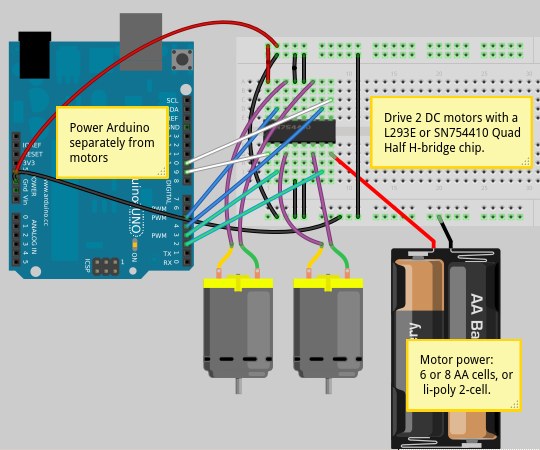
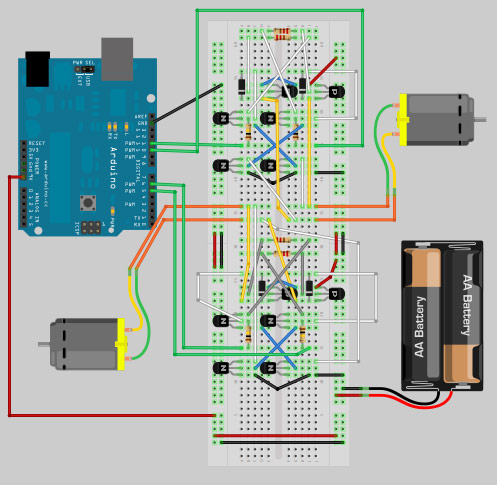
We're in an era of DIY electronics, robotics, Arduinos, Raspberry Pis, the Internet of Things, etc., where lots things in a prototyping stage and even, apparently, some finished projects "look like bombs" based on pop culture, with all sorts of wires and components which seem inexplicable to the uninitiated but are entirely benign.

Circuitry to control 2 DC motors with an Arduino

Your correspondent has been teaching an after-school group one day a week at the granddaughter's elementary school where, this year, we took apart a broken printer to harvest the motor systems and will wire one of them up independently to make what we're dubbing a laser shooting robot. ("Robot" is strong - the kids will control it, it's not autonomous - but I find they're bored by "electronics" and love "robots," so it's a robot.)

Though I didn't blog about it, Grits must admit to watching the whole "clock boy" episode with great interest because our project poses similar risks of misinterpretation by the ignorant. When you use an Arduino, breadboard and H-bridge chip to control a simple DC motor, the resulting patch of wires would "look like a bomb" once it's jammed into a briefcase or backpack, even though it couldn't be more benign.

Partly for that reason, after the clock-boy incident I decided to hunt down a pre-fab part that would control a motor without them having to wire up a chip themselves. The last thing I want is some cretinous bully, whether cop or administrator, hassling my kids over a project that's supposed to be fun for them. So risk aversion lessens their learning experience. I don't like that, but it's the practical effect that story had on our little program.

This thing about arresting kids over their electronics gear will likely continue to happen - especially for youth whose families hail from south or west Asia - because electronics have become so much more accessible to kids at a younger and younger age and fear appears to have outstripped reason.

School cops and administrators need a better grasp of what hobbyist electronics look like before assuming every brown-skinned kid with a wired up project is a villain from an episode of Homeland.

Tuesday, October 06, 2015

Students cited for terroristic threat in volume

From a story in the Fort Worth Star-Telegram (Oct. 1) about new federal reporting requirements for public schools regarding student discipline, Grits ran across this fact-bite: "Statewide, a total of 1,463 Texas students were cited for making a terrorist threat during the 2013-14 school year, according to Texas Education Agency PEIMS (Public Education Information Management System) data."

I hadn't seen that figure during all the "I stand with Ahmed" brouhaha, but that's a pretty big number.

Read more here: http://www.star-telegram.com/news/local/community/fort-worth/article37241166.html#storylink=cpy

Friday, December 05, 2014

McCraw: Terrorist threat at Texas border a myth, or, In favor of reality-based border-security policy: A minority view

The dumbest part of Texas' border "surge": There are no, none, zilch, zero viable metrics for measuring success. It's a truism in public policy of any sort that one cannot solve a problem one cannot measure. A Dec. 4 Austin Statesman story said DPS claimed this week that the surge worked because of increased illegal-immigrant apprehensions. but Rep. Donna Howard called them on this particular line of bullshit, pointing out “that officials also have claimed success when the number of apprehensions is down, which she said has been described as a sign of deterrence. That makes it difficult for lawmakers to figure out 'how much money to appropriate for this activity,'” she said. That's an understatement!

It's not that data-driven policy isn't possible. The McAllen Monitor recently offered thoughtful, incredibly detailed suggestions for fixing federal immigration courts that made loads of sense. (Read them, a summary won't do them justice.) Problem is, at the federal level neither party is advocating an approach that actually processes cases faster. These are good ideas, though, showing the problems are not insoluble if politicians actually wanted to resolve them.

Instead, the state plans to add 4,000 cameras along the border, another initiative that Grits considers a complete waste. There's little evidence cameras work even in crime-ridden inner-city hotspots, much less out in the boondocks along hundreds of miles of border. Then you have to pay people to watch them as well as waste manpower on responding to lots of false positives.

Finally, in a rare moment of (post-election) candor, DPS Col. Steve McCraw affirmed to the committee what anyone with access to Google already knew: That "there is 'no credible information that a terrorist has crossed or will cross' the Texas-Mexico border." I'd add one caveat: There's no evidence that terrorists are coming from Mexico to the United States to do harm. There's evidence that Texas prison gangs crossed the border south to work as soldiers in the Juarez cartel wars and may be responsible for hundreds or even thousands of murders there. Whether one considers them "terrorists" is a political and semantic question.

Otherwise, Greg Abbott, Dan Patrick and other state officials should adjust their rhetoric to reflect acknowledged reality from the state's top law enforcement official. Perhaps it would help to stand before a mirror each morning and recite McCraw's words aloud three times before the day begins - there is no credible information that a terrorist has crossed or will cross the Texas-Mexico border. (In particular, perhaps Breitbart Texas editors would benefit from such an exercise.) Barring that, I don't know what it will take to get Texas politicians to stop telling lies about border security threats.

Tuesday, October 14, 2014

ISIS in Texas and the 'global war on jackalopes'

On BurkaBlog (Oct. 9), Eric Greider at Texas Monthly showed that claims of ISIS terrorists entering Texas through the Mexican border are falsehoods, suggesting the next logical step for those blustering over terrorists crossing the border should be to launch a "global war on jackalopes," which pose a similar level of threat. She concluded:
there's no plausible reason to think that this is one of those cases where the lack of evidence suggests conspiracy or suppression, rather than an actual lack of evidence of ISIS fighters trying to cross the border. In certain circles, both of the preceding points--the lack of evidence and the lack of logic--are being dismissed by some fearmongers on the basis that it's better to be safe than sorry. They may be correct about that principle, and if so, we should all be concerned. If Texans focus undue energy on being infiltrated by ISIS, that necessarily limits the resources we can direct to fighting other threats--some of which, unlike this one, are actually serious issues on the border; some of which, unlike this one, are real.
See related, past Grits coverage.

MORE: The lies just keep on coming.

Thursday, October 09, 2014

Roundup: Of atonement, prison bankers, pot and imaginary terrorists

Lots going on and I won't have time to write about all of it. Here are several items clogging my web browser that merit Grits readers attention, even if they may not make it into independent posts:

Dallas PD will move to citations for pot possession
After revamping its systems, Dallas PD will attempt for the second time to exercise authority granted them by the Legislature in 2007 to issue citations instead of arrest people for marijuana possession and a handful of other Class B misdemeanors, reported the Dallas News. The main reason is to keep police officers on the street, saving: "each officer the two to four hours squandered in driving a nonviolent misdemeanor suspect to the county jail and going through the booking rigamarole." At a House County Affairs Committee hearing in May, legislators discussed simply reducing penalties for pot possession and driving with an invalid license (DWLI) because so few departments were using this authority and local jails were still too full of petty pot offenders. MORE: From Unfair Park.

Austin to eliminate rape kit backlog
Thanks to extra staff and funding, Austin PD plans to eliminate its rape-kit backlog - which is much smaller than was Houston's - within 12 months, the chief announced.

Dallas DA's race goes negative, gets personal
The Dallas DA's race is getting ugly and personal. This is the kind of election that both makes me miss performing opposition research in campaigns and simultaneously glad to stay miles away from the process. Watkins should, and may still, win this election going away. The only things keeping it close are inexplicable, self-generated gaffes. His opponent Susan Hawk may have strayed over the line implying he was drunk at a debate. There are various means for launching an attack and that wasn't the smartest way to stage that one. But Watkins doesn't look much better. He seems bent on providing fodder for critics instead of creating an alternative narrative voters can latch onto. Such races make me miss oppo research because this is the sort of race where well-crafted negative messages could make a big difference. (Neither side seems to have that sort of professional help, judging from the predominant messages in the campaign.) It makes me glad to stay away because the whole thing is becoming highly personal and will result in grudges held by the principals for many years to come. I don't need that kind of pointless, narcissistic drama in my life.

Bexar considers expanding public defender office
In San Antonio, Bexar County officials are mulling a full-blown public defender office, expanding on the appellate and mental health public defenders operating there now. This article by Michelle Cassady discussed obstacles to creating a public defender steps the county is taking to overcome them. The reason for the move: economics. "Defendants in 64 percent of all criminal cases filed in the county last year declared themselves indigent — too poor to afford representation — and were appointed an attorney, according to county records."

Do criminal laws rob offenders of atonement?
Hanna Liebman Dershowitz, a former staffer for state Sen. Rodney Ellis and now an attorney with the Jewish Council for public affairs, had an article in the Jewish Daily Forward (Oct. 6) which opened, "We are emerging from the Day of Repentance — a time for contrition for misdeeds, focusing on self-improvement and making a fresh start. But what about people who don’t have the luxury of wiping their slates clean, even for minor transgressions? Are our laws and policies robbing millions of citizens of their own opportunities to turn toward good, to achieve the possibility of teshuvah, atonement, that we claim for ourselves each year?"

ISIS still not infiltrating the Texas border
Politicians are going to keep repeating this garbage so it's worth highlighting the factual counter whenever it's offered: The "claim that Islamic State fighters were apprehended in Texas" was “categorically false” according to the Department of Homeland Security and “not supported by any credible intelligence.” The allegations "gained widespread attention on Wednesday, especially on conservative news websites." And remarkably, "The National Republican Congressional Committee, for example, is running an ad in Arizona that claims terrorists are entering the country through the state’s southern border." Rick Perry put similar, garbage allegations on TV in 2006. It was a lie then, just like now, but that didn't make the political message any less successful. The reason politicians just make stuff up and stick to their guns in the face of all evidence is that, as often as not, it works.

'Meet the prison bankers who profit from the inmates'
The subhed is the title of a recent Time magazine article focused on the little analyzed topic of moving inmates' money.

Police and private surveillance
Every time one turns around there are new stories out that make you question the vast scope of mass public surveillance, including these developments regarding private surveillance of public spaces.

Tuesday, October 09, 2012

Texas work product overrepresented among fusion-center reports criticized by Senate subcommittee

Grits mentioned the publication of a rare, bipartisan report (pdf) from a US Senate subcommittee which was highly critical of fusion centers (see additional recent coverage here). Texas now has seven, out of 77 nationally. Perhaps predictably, the local recipients of fusion-center grant funds have spoken out to say all the money they received was well spent and they'd like more of it, please, or that's the gist of Patrick George's piece, "Austin police, DPS defend fusion centers after critical Senate report," published last night on the Austin Statesman site, which opened.
Law enforcement officials in Austin are defending the use of “fusion centers,” some of which across the country were lambasted by a U.S. Senate subcommittee recently as spending wastefully, being intrusive into citizens’ private lives and producing information of little value for counterterrorism.
Austin is home to two such centers, the Police Department’s Austin Regional Intelligence Center and the Department of Public Safety’s Texas Fusion Center, both of which opened in late 2010. Fusion centers are designed to enable law enforcement agencies to pool and share information with one another.
Responding to the Senate criticism, DPS Director Steve McCraw said in a statement that the report is inaccurate because investigators did not get a large enough sample of how the nation’s 77 fusion centers operate.
“In fact, they did not visit even one of the seven fusion centers operating in Texas, including the state level fusion center,” McCraw said.
Assistant Police Chief David Carter, who oversees the Austin Regional Intelligence Center, said the Senate report mainly focused on fusion centers’ work in counter-terrorism. He said the Austin center was set up from the beginning with an “all crimes” approach and has proved useful in several investigations.
While it's true no Texas fusion  centers were named, a Texas report was chronicled on p. 33 (p. 39 of the pdf) as an exemplar of the type of a non-actionable HIRs [Homeland Information Reports] that fusion centers pass on to DHS which must be canceled by federal reviewers. So it's not at all accurate to claim the Senate subcommittee didn't closely evaluate the work of Texas fusion centers. Indeed, they studied Texas' work more than any other. From the subcommittee report:
As noted, the Subcommittee investigation reviewed every raw DHS intelligence report drafted on information from state and local fusion centers from April 1, 2009, to April 30, 2010....

The Subcommittee investigation counted that, during that period, DHS intelligence officers at state and local fusion centers around the country filed 610 draft reports to DHS headquarters for dissemination. During that period, the draft HIRs came from fusion centers in just 31 states; fusion centers in 19 states generated no reports at all. In addition, the vast majority of the 574 unclassified draft reports filed came from DHS detailees assigned to fusion centers in just three states – Texas (186 drafts), California (141) and Arizona (89). Meanwhile, fusion centers in most other states produced little to no reporting.
Contrary to Col McCraw's complaint, Texas' fusion center reporting was closely examined, making up a disproportionate share (32%, or 186 out of 574 unclassified draft reports) of the sample judged by the subcommittee.And how did we fare?
Of the 574 unclassified draft reports field officers filed, the Subcommittee investigation counted 188 marked by DHS reviewers as cancelled, nearly a third. Reviewers recommending cancellation of drafts faulted the reports for lacking any useful information, for running afoul of departmental guidelines meant to guard against civil liberties or Privacy Act protections, or for having no connection to any of DHS’s many missions, among other reasons.

Of the 386 unclassified reports published, the Subcommittee investigation counted only 94 which related in some way to potential terrorist activity, or the activities of a known or suspected terrorist. Of those 94 reports, most were published months after they were received; more than a quarter appeared to duplicate a faster intelligence-sharing process administered by the FBI; and some were based on information drawn from publicly available websites or dated public reports. In one case, DHS intelligence officials appear to have published a report which drew from or repeated information in a Department of Justice press release published months earlier. In short, the utility of many of the 94 terrorism-related reports was questionable.

The Subcommittee investigation found that fusion center reporting that attempted to share terrorism-related information was more likely to be cancelled than reporting on other topics. While the overall cancellation rate of draft intelligence reports from fusion centers during the period of review was around 30 percent, the cancellation rate for reports which alleged or indicated a possible connection to terrorism had a higher cancellation rate – over 45 percent.
To review: Texas provided the largest number of reports of any state in the dataset from which the subcommittee faulted  fusion center reporting for "lacking any useful information, for running afoul of departmental guidelines meant to guard against civil liberties or Privacy Act protections, or for having no connection to any of DHS’s many missions, among other reasons." The subcommittee may not have named which specific Texas fusion centers published the most reports that were canceled by DHS reviewers  - and granted, the two Austin fusion centers reportedly came on line after the period they analyzed - but they were definitely looking at Texas fusion centers' work product when they made those assessments, as either Col. McCraw or the reporter should have known from reading the report.

Speaking of which, it should be mentioned that, as if in direct response to Ast. Chief Carter's published remarks, the subcommittee report specifically discussed shortcomings of the "all crimes" approach that Austin PD endorses, lamenting that, “Most [fusion] centers focus on the priority mission of the law enforcement agency that owns/manages them; primarily analytical case support to drug, gang, and violent crime investigations for the geographic area of responsibility,” the report stated. “As a result many centers struggle to build the necessary capabilities required to support federal counterterrorism mission requirements, specifically in the areas of intelligence analysis and information sharing beyond their jurisdictions.” In a subsection titled, "DHS “Success Stories” Do Not Demonstrate Centers’ Value to Counterterrorism Efforts," the report made a point echoed in a recent Grits post:
On its web site, DHS has devoted a page to fusion center “success stories.” On that page, DHS includes many events unrelated to terrorism in a long list of fusion center “successes.” DHS praises, for example, fusion center efforts that have helped to reduce automobile thefts, apprehend a man suspected of kidnapping and rape, and bust up a drug ring
While those anticrime successes are notable, they do not advance the DHS counter terrorism mission; they do not fulfill the promise federal officials made to Congress and the public that the significant taxpayer support directed to fusion centers would aid in the fight against terror; and they do not meet the expectations set by legislative and executive mandates which make clear both branches expected fusion centers to perform as conduits of terrorism information-sharing to and from the federal government.
The feds aren't funding fusion centers just to augment the state's local anti-crime work, in the view of the subcommittee, but based on metrics more at the direct service of federal counter-terrorism efforts. From that perspective, it's easy to see how an "all crimes" or "all hazards" focus of Texas fusion centers doesn't mitigate the Senate subcommittee's negative appraisal, it personifies it. Fusion centers have indulged in massive mission creep, is the federal criticism, and serve little if any anti-terrorism function. DPS and APD would respond, yeah, but we can use that money to go after our own, local bad guys, and when budget times weren't so tight, for years that was enough to justify the grants' rapid expansion. But in budget cutting times, fusion center funding looks like low-hanging fruit that's not fulfilling its mission, from a federal counter terrorism perspective.

Will federal budget cutters succeed in scaling back domestic surveillance, forging new political grounds where civil libertarian critics were too tepid to tread? That's my hope after reviewing the subcommittee report.

Either way, the report effectively rebuts the present claims by Col. McCraw and Ast Chief Carter in the Statesman story: Texas' work was analyzed along with everyone else's and in the end, criticisms in the report can't simply be dodged with claims that "we're different" or they"did not get a large enough sample." The  comment about sample size was either uninformed or disingenuous: If anything, the main problem with the subcommittee's sample was that they looked at Texas fusion centers' work product perhaps a little too closely.

MORE: See, from Government Executive, "Defenders of fusion centers hit back at Senate panel criticisms."

Wednesday, October 12, 2011

Not buying story of Iranian links to drug cartels

The news story making waves that the Iranian government allegedly tried to have the Saudi Arabian ambassador assassinated on US soil strikes me as squirrelly and self-interested. Said Secretary of State Hillary Clinton, "The idea that they would attempt to go to a Mexican drug cartel to solicit murder-for-hire to kill the Saudi ambassador? Nobody could make that up, right?" Well, nobody but government officials who rely on a lazy, compliant media to repeat their spin countless times before vetting the facts. (See Bruce Ivins' story, and Steven Hatfill's for classic illustrations, or since these charges could start a war, maybe the Gulf of Tonkin is a better example, or Bush II's claims that Iraq had chemical weapons.)

As it turns out, the suspects did not go to any "Mexican drug cartel" at all, but the case is based on a paid informant from Corpus Christi unaffiliated with any cartel who had state charges dropped in exchange for his services. In reality, the feds could have used an informant pretending to be from the Italian mob, the Crips, Bloods, you name it, since the only link to drug cartels is the cover story they fabricated.

Reported the Texas Tribune, the corporate intelligence service Stratfor says, "It seems unusual that the Iranians would approach a Mexican cartel to carry out the assassination, when the Iranians probably have the capability themselves," and that "at this point the cartels have not been directly linked to the plot."

Why would the Iranian government seek the Saudi ambassador's assassination, and if true, why would they choose to do it on American soil? It makes no sense. I don't yet know what to believe about these allegations, but one thing I know for sure: Only a fool would agree that "Nobody could make that up."

MORE: From Sylvia Longmire and Pete Guither. Amy Davidson at the New Yorker says one thing the story has going for it is an indictment. Read the full complaint here (pdf).