Showing posts with label GPS. Show all posts

Thursday, July 19, 2018

Do ankle monitors on parolees make anyone safer?

In response to episodes where two different parolees being supervised by ankle monitors reportedly committed murder, one of them allegedly killing three people, law enforcement officials in Houston have been blaming TDCJ for not notifying them more promptly that a potentially dangerous parolee wasn't being monitored. From the Houston Chronicle:
Harris County Sheriff Ed Gonzalez said the current system reveals communication gaps between TDCJ and local law enforcement. 
“There has to be a better way to identify those individuals that are parole violators who pose a serious threat to public safety,” said Gonzalez. 
Rodriguez’s case is not the only one in recent days that raised concerns about the monitoring of dangerous parolees. Earlier this month, parolee Garry Jenkins, 56, slipped out of his house after curfew — a violation that should have been detected by the ankle monitor that was a condition of his parole — and later allegedly stabbed his mother to death. Five days later, after being arrested for violating parole, he was charged with murder. 
Houston Police Chief Art Acevedo said the recent incidents highlighted the need to notify law enforcement of potential parole violations more quickly. 
“We need to come up with a process that’s almost instantaneous,” said Acevedo, who added that he wants to work with other departments around the area to create a regional task force dedicated to parole violations. 
Houston Police Officers Union President Joseph Gamaldi agreed. 
“We need to know when these monitors are … being cut off, so we can send people out there to look up these people and make sure they’re doing what they’re supposed to do,” Gamaldi said. “Three days is entirely too long before we know about it, that (someone) could get out there, do crimes and victimize people in our community.”
To the uninitiated, a call for "almost instantaneous" notification whenever parolees' ankle monitors raise a red flag surely sounds reasonable. But people in law enforcement circles - including IMO the officials making these comments - know it's complete bullshit.

In reality, ankle monitors are unreliable supervisors that create more problems than they solve. They exist because the idea sounds good in principle to the political class and is promoted aggressively by vendors, who've seen a big increase in market share. But in practice, if Houston PD began hunting down parole violators every time they (may have) absconded based on GPS data, they'd do almost nothing but that and still not make a dent in the problem they're trying to solve.

That's because ankle monitors have been plagued with false positive problems, to the point that they generate so much bad data as to be practically useless for supervision purposes.

In California, ankle monitors strapped to "high-risk" felons resulted in "agents [who] are drowning in a flood of meaningless data, masking alarms that could signal real danger." One expert told the LA Times in 2014:
"When these alerts are in the tens of thousands, it seems like an unwinnable situation," said Matthew DeMichele, a former researcher for the American Probation and Parole Assn. and coauthor of the Justice Department's guide on electronic monitoring. 
"In some ways, GPS vendors are selling law enforcement agencies, politicians, the public a false bag of goods," he said.
In Massachusetts, according to criminal-defense lawyer Daniel Capetta, "About 3,000 people are currently subject to electronic monitoring in Massachusetts. It has been reported that of these 3,000 GPS bracelets, there are approximately 1,800 alerts generated per day. In the overwhelming majority of these cases, there is no real problem."

In 2007 in Arizona, "140 offenders monitored that year experienced a total of 35,601 false alerts, due to problems such as low batteries or signals lost in dead zones." Of those, "The study group found 463 confirmed violations, meaning that false alerts outnumbered proven infractions by a 77-1 margin."

An essay from the Brookings Institute last year was titled, "Decades later, electronic monitoring of offenders is still prone to failure." Many GPS trackers are easily removed. They mainly exist to provide the public a false sense of security, a CYA backstop for probation and parole departments, and political cover for judges and/or parole boards making release decisions. 

By reducing available supervision resources thanks to spending so much time on false positives, however, arguably these devices harm public safety when used as widely as they are today. It would be even more harmful if HPD officers began spending lots of time tracking down parolees every time an anomalous blip shows up from their tracking device.

Not only can false positives make it hard to track actual evil-doers, they risk punishing innocent people because of technological glitches. Notably one of the inventors of an early GPS monitoring system now thinks they're used improperly and their functions could be shifted to smart phones. He also thinks companies that operate these services should be liable when they exacerbate public safety problems instead of improve them, characterizing their rent seeking posture coupled with a let-the-chips-fall-where-they-may attitude as a "negligent tort."

The same cost-benefit analysis related to ankle monitors applies to sending local police chasing after every parole absconder. According to the latest TDCJ Annual Statistical Report (2016), as of Aug. 31, 2016 (page 5), there were 12,883 parolees, out of 113,363, categorized as "pre-revocation, not in custody." Figure a fifth or so of those are in Houston. However, most of those pose nothing like the danger of the "mattress killer" parolee who allegedly went on a killing spree after cutting his ankle monitor. In fact, many of them just missed a meeting, will likely show up at the next one, and would not be revoked even if captured and brought in.

The truth is, even if TDCJ had notified them "instantaneously" in the recent cases, the Sheriff's Office wouldn't have followed up until a crime had been committed. The Associated Press reported that Harris County "deputies don’t necessarily search for parolees who have violated their terms of release and would only arrest those offenders they come across during the course of a patrol and run a background check."

The chief, sheriff, and police union have a mutual interest in hyping fear in an era of declining crime when law enforcement is making fewer arrests than any time in decades. They all have an interest in bigger budgets, more officers, and increased moral authority for themselves when the public sees them as protectors rather than incompetent bureaucrats.

So there's self-interest in their decision to ignore the problems with ankle monitors - even though their shortcomings are widely understood in law enforcement circles - and IMO it's that self interest we're seeing bubbling up in these comments. It's a win-win: deflects blame for local crimes onto TDCJ, and sets them up to look like champions of public safety when really the solutions suggested harm public safety thanks both to their politicized nature and extreme impracticality.

Monday, October 05, 2015

Most Twin Peaks bikers off ankle monitors, few if any prosecutions likely

None of the 177 Twin Peaks bikers remain incarcerated in the county jail, even though all of them initially were assigned a $1 million bond, and of 135 required to wear ankle monitors, reported the Waco Tribune-Herald, all but 22 have been allowed to remove them "after agreements between their attorneys and state prosecutors to amend the conditions of their bonds." Grits thought these comments, representing one of the few informed views I've seen on the topic from anyone outside the DA's office, are likely prescient.
Houston attorney Paul Looney said two of his three clients, a married couple from Brenham, were not required to wear the ankle monitors and his third client had his removed in an agreement with prosecutors.

“I can only speculate, but my guess is that the ones that are still wearing the ankle bracelets present some type of specific flight risk, or, in the alternative, their lawyers are lazy and they just haven’t come in to visit with the prosecutor,” he said. “A lot of lawyers haven’t done that.”

Looney cautioned that there likely is no connection between levels of culpability and those still wearing ankle monitors.

“I have gone through the discovery, and right now I am of the opinion that they might not successfully prosecute anybody who is still alive. I think they may have a couple of dead people they may be able to convict, but the ones who committed the crimes are dead. Everybody else was defending themselves or other people,” Looney said.
If it's really true that no one alive can be prosecuted, history will judge the roundup of 177 bikers much differently than the DA and local officials are presently portraying.

Relatedly, GQ published the most extensive piece of investigative journalism yet on the Twin Peaks massacre, piecing together narratives from dozens of interviews. Give it a read.

Wednesday, September 17, 2014

Cops, prosecutors, raise white flag, vow to fight on warrants for cell-phone location data

I only saw two news outlets covering electronic privacy debates at the Texas Senate State Affairs Committee meeting yesterday:
The meeting was led by new Chairman Craig Estes who last session sponsored legislation to require a warrant for cell phone location data. See my own written testimony to the committee on behalf of the Texas Electronic Privacy Coalition. The key TXEPC recommendations, fleshed out in greater detail in the full written testimony, included themes familiar to Grits readers.:
  • Require law enforcement to obtain a search warrant to obtain historic cell-phone location data.
  • Require a warrant to install GPS tracking devices on vehicles.
  • Centralize use of 'stingrays,' aka, IMSI catchers at DPS the way the state does wiretaps and require a warrant for their use.
  • Limit data retention on innocent drivers for automatic license plate readers, limit access to the databases to trained, authorized personnel, and restrict sale of data.
  • Evaluate the Department of Public Safety's unilateral decision to take all ten fingerprints when drivers obtain or renew their licenses based on potential privacy violations involving personal electronic devices using fingerprints in lieu of passcodes.
A big highlight for me was expert testimony by Chris Soghoian, a tech expert now working for national ACLU whose dissertation (pdf) first broke open this issue and spawned my own interest in these location-data issues. Thanks, Chris, for coming down!

The hearing took a strange turn, as prosecutors and a detective from the Houston Police Department insisted that changes to state law last session meant law enforcement already had to get a warrant to access cell phone location data. I'm not a lawyer, but that seems downright bizarre since the bill to require a warrant for location data failed; only content, not "metadata" (as it has come to be called post-Edward Snowden), was protected in the language that passed in HB 2268.

The prosecutors' new stance is especially odd because two different Texas appellate courts ruled in recent months affirming no warrant is currently required in Texas to obtain historical cell-phone location data. The US Fifth Circuit Court of Appeals ruled the same way, creating a federal circuit split. (See a related, earlier Grits discussion.) Indeed, the portion of Sec. 5 in Art. 18.21 of the Code of Criminal Procedure that the Fourth Texas Court of Appeals decision in Ford v. State relied upon was not changed in the amendment to HB 2268 requiring warrants for content. I just don't understand how that claim can be justified.

A case summary of Ford on the prosecutors association website even recommended their members rely on the case for precedent in the future ("Because there is precious little caselaw that construes Article 18.21, this decision could turn out to be helpful to others on that basis as well"). And in Barfield v. State, police obtained cell-phone location with an administrative subpoena and Texas' 14th Court of Appeals in Houston upheld it being admitted into evidence. (The Department of Insurance testified that it, too gets cell-phone location data with only a subpoena.)

There appear to be no court cases supporting this novel view that Texas law already requires a warrant to access cell-phone location data. Its proponents could not even provide examples of local district judges suppressing location data, nor of any jurist denying police access to this information. All they offered were hypotheticals.

But no matter how often they kept repeating that the law requires a warrant now, your correspondent simply sees no evidence for the claim. Again, I'm not a lawyer. But attorneys for service providers like Data Foundry and Golden Frog also insisted that warrants are not required in Texas presently for law enforcement to access location data. And that was certainly the universal, contemporary understanding at the time the 83rd session ended. Just a weird debate to have.

The Observer piece by Eric Nicholson summed up the odd tenor of the event thusly: "The debate over whether warrants are currently required is a bit of a head spinner. (Cops are in the paradoxical position of arguing both that warrants are necessary to obtain cell-phone metadata and that they will fight efforts during the 2015 legislative session to require warrants for cell-phone metadata.)" To be sure, I hope they're right and I'm wrong. I want a warrant requirement for these records in Texas (and nationally, though your lowly correspondent can't do anything about that). But until the judiciary agrees a warrant is required, it's hard to buy what police and prosecutors were selling at yesterday's State Affairs hearing.

Go here if you'd like to watch the whole thing online.

MORE: I was interviewed this afternoon along with Rep. Bryan Hughes on the Texas Public Radio show The Source about yesterday's hearing and location tracking issues generally. Go here to listen to the broadcast.

Saturday, August 30, 2014

Taser's business model on police body cams

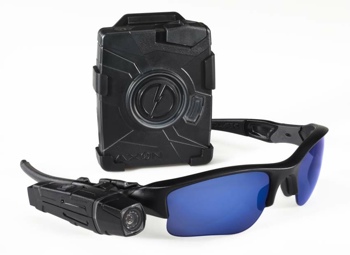
Grits observed earlier this month that the most successful wearable tech businesses so far have been in the corrections industry - e.g., police body cams, GPS trackers, and alcohol monitors - and dominated by a few companies narrowly focused on law enforcement tech. I'd argued that in the wearables market, "The more significant profit potential comes when you can find ongoing, real-world uses for wearable-generated data." So I was interested to see a recent New York Times piece ("Police cameras can shed light but raise privacy concerns," Aug. 20) describing Taser International's services and fee schedule for its (relatively) new police body cam service:
In 2012, Taser began selling its most advanced body camera, the Axon Flex, which can be clipped to an officer’s sunglasses, hat, helmet or epaulets. The Flex, which sells for $599 a unit, captures a wide-angle view that is close to what an officer sees while on patrol. Other cameras, including those made by Vievu, Taser’s largest competitor, clip to an officer’s shirt or belt. Because on-body cameras also capture high-fidelity audio, watching their videos offers a strangely intimate view of police work, as if you’re playing a video game.

Throughout an officer’s shift, Taser’s camera is constantly recording what it sees. But most of its images are kept in a 30-second buffer, after which they’re discarded. The unit begins saving longer segments of video — and begins capturing audio — only when an officer double-taps a control switch.

The 30-second buffer is a way of allowing officers to essentially record events that began in the past. “Say the officer sees someone run a red light — obviously the officer didn’t know that was going to happen,” Mr. Smith said. “But once he starts recording, we go back and grab that 30 seconds before that.”

The buffer includes just video, not audio, which is saved after the officer hits Record. The video-only buffer is meant to protect officers’ privacy.

Taser’s Axon cameras are paired with the company’s online storage service, Evidence.com, for which police departments pay a monthly fee of $15 to $55 per officer, depending on how much storage space they use.

At the end of each shift, an officer plugs the camera into a charging dock, and all videos are uploaded to Evidence.com. Police departments determine how long videos are retained; often retention times are related to the statute of limitations for the episodes the videos depict. Departments also set policies on who can watch the videos, and Evidence.com keeps an audit trail of all views.
Here's an example of what I was talking about: Not only is Taser charging a substantial sum for the camera itself, the per-officer fee generates ongoing revenue over time. Most corrections oriented "wearables" share that trait, which is why I think we'll continue to see greater market growth there in the near term than in the much-more ballyhooed wearable-tech fashion field. Many wearable apps struggle to find useful things or interesting things to do with data they generate, while corrections folks know what to do with data about their subjects - whether it's video, their location, blood-alcohol levels, etc. - and exhibit a voracious appetite for it.

In related news, Houston police chief Charles McLelland asked city hall this week "for $8 million to equip 3,500 police officers over three years with small body cameras to record encounters between law enforcement and residents as a way of improving accountability and transparency," reported the Houston Chronicle (Aug. 28). HPD had piloted the idea with 100 officers and now wants to take it department-wide.
Capt. Mike Skillern, who heads HPD's gang unit and is involved in testing the cameras, said his fellow officers act "a little more professionally" when wearing the devices.

A recent Cambridge University study of the small police department in Rialto, Calif. reported a more than 50 percent reduction of use of force incidents with officers wearing cameras and an 89 percent decline in the number of complaints against officers during the yearlong trial. 
See also a recent blog post from Paul Cassell at the Volokh Conspiracy favoring police body cams and a report published this year (pdf) sponsored by the US Department of Justice assessing research so far on their use in the field. (It concludes with a call for more research, finding that "Most of the claims made by advocates and critics of the technology remain untested.") MORE: From Ars Technica.

Friday, August 22, 2014

Creepy sci-fi corrections tech in sight

Grits observed recently that the the most notable examples of successful wearable tech businesses arguably have been in the corrections field. Similarly, when I see articles like this one about healthy people being microchipped with a RFID to access day to day items, I can't really imagine many average people wanting to do that of their own accord. But as an alternative to prison? A lot of folks might say "yes."

I'm not advocating it. I'm saying it will be advocated; the tech exists now.


MORE: Here's a philosophy prof working on a paper entitled ‘Cyborg justice: punishment in the age of transformative technology’

Friday, August 01, 2014

Wearable tech and the corrections market

GPS ankle monitor: Looks uncomfortable
Lately, your correspondent has been fiddling in my spare time with a hobbyist-level wearable technology project involving a couple of cheap sensors (which soon will be) wired into a pair of gloves to generate beats, tones, and lights. In the process, I've become more familiar with the state of wearable technology, even attending a Austin techie meetup on the topic a few weeks back.

It's not hard to imagine useful implications in different industries for wearable tech, but as a distinct consumer market, many observers view the field as a disappointment. The Guardian recently asked, "Wearable technology hasn't taken off the way it was expected to - why not?" A few serious, local startups are working on exercise or health-related wearable apps, but consumers haven't bitten beyond a few kids in light-up tennis shoes or cheap club gear. At this point, your refrigerator and thermostat are more likely to talk to your computer than your clothes.

What you don't see in any of the business tech press about wearables are analyses of wearable tech in the law enforcement and corrections industries, though that may be their biggest field of success so far. The use of GPS trackers on probationers and pretrial defendants out on bail has become so ubiquitous that larger departments suffer from data overload. In treatment courts, but also in some jurisdictions for regular DWI probationers, so-called SCRAM technology - an anklet with a sensor that measures alcohol in one's perspiration - are so popular that Texas courts can't afford nearly all of them that judges would like to use. (I'm waiting for the day probationers' anklet can talk to them; the tech already exists.)

Awkward police 'body cam'
Setting aside community supervision issues, police officers today are ever-more frequently decked out with body mics and cameras, a market that Taser International leads almost by default. Police today often make traffic stops in state of the art body armor, boasting an array of gadgetry around their belts that remind one of Batman. To the extent that routine tech can be incorporated seamlessly into something the officer is wearing anyway - especially tech that can transmit useful data back to a supervisor in real time - there's a significant law-enforcement market to be had.

For quite some time, cops and crooks arguably have been the biggest markets for "wearable tech," even if it's seldom discussed in that frame. That will remain true for the near future, with much room for expansion in that market in the near term. There's even a (perhaps overly optimistic) argument to be made that wearable corrections tech could "make it possible to replace the system of large-scale imprisonment," that manufacturers in that market contribute to progressive de-incarceration goals.

I'd love to see a company like Adafruit take on wearable tech for law enforcement - somebody that cares if the product is ugly, if it's elegant, well-designed, comfortable, if it works as advertised. If Adafruit started re-imagining police body cams and alcohol sensors for probationers, IMO they'd leave Taser and SCRAM in the dust. Those folks have forgotten more about wearable tech than the other two companies likely know.

The wearable market so far has pigeon-holed itself largely into areas - exercise and health - where people themselves use generated data, or fashion, where sensor data may trigger an accessory but not necessarily a paper trail. In corrections fields, though, it's police management, probation officers, or pretrial services divisions that make use of the data, not the wearer themselves. Those sorts of institutional customers with significant baseline demand constitute a captive market, if you'll pardon the pun. While it may seem distasteful to design technologies of control, it's better if highly skilled engineers sensitive to the wearers' experience create this tech. Either way, somebody's going to profit from it. Bet on that.

Zocalo, Mexico City, a great place for light-up garb at night
BTW, I do think there's an untapped market for a lot of the light-up or sound-generating wearable stuff for youth, but a lot of those items come relatively cheap from China and suffer from low margins. The more significant profit potential comes when you can find ongoing, real-world uses for wearable-generated data, which is why Grits foresees big profits for wearables in the corrections market.

AN ASIDE: Just for fun, we took some light-up garb with us to Mexico City to the zocalo after dark: The granddaughter's hoodie with EL Wire stitched around the edges, a few dozen small glow sticks, a couple of balloons with flashing RGB LEDs inside them, and three battery operated EL Wire strands long enough to use as a jump rope, one of which ended up lining a hat. Folks approached in gaggles wanting to buy one or the other of the light-up goodies, with somebody offering five times for a strand of EL Wire what I'd paid for it. We gave away glow-stick bracelets to the kids and referred would-be customers to the websites where I'd bought them. (This was a great way to meet families with kids, btw.) When it was bed time, the young'un gave away the balloons with flashing LEDs to a couple of little girls in the square and distributed the last of the glowsticks to a passel of teenagers before she turned, hoodie flashing, and we walked back through the seemingly ever-present multitude to our hotel. SEE MORE from a kid-centric vacation here.

Wednesday, April 30, 2014

TPPF in the news: Reducing technical revocations, clarifying recidivism data

A couple of recent Texas Public Policy Foundation reports got good press coverage this week:
and
Good idea on reducing technical probation revocations
In the report on supervision tech, I particularly liked this suggestion for reducing incarceration based on technical violations of petty absconders:
Currently, there are more than 24,000 felony probation absconders in Texas. While they may succeed for a time in skirting their obligations to report to a probation officer when they are pulled over for a traffic violation or are otherwise apprehended, they will face the prospect of being revoked to prison. At least 35 percent of probationers revoked for technical violations (where there is no allegation of a new offense) were classified as absconders at the time. Based on the 12,287 total technical revocations in 2013, this amounts to at least 4,300 technical revocations associated with absconders, which translates into annual incarceration costs of $79 million, not counting the compounding effect over time as the revocation time served will exceed a year in most cases.

This analysis demonstrates the potential of utilizing GPS to reduce the number of technical revocations. Given that any type of GPS monitoring costs a fraction of the $50.49 per day prison cost,  it is a particularly sensible option for those who were placed on probation for a non-violent offense and have failed to report, but are not assessed as a high risk of re-offending. (Citations omitted.)
Recidivism clarification
In the comments to the Trib story, I offered one minor but important correction. The reporter had written that "Sixty-two percent of all Texas inmates return to prison within three years of their release. But that's not quite right.

Looking at the TPPF report, it says 62% of state jail inmates, not "all Texas inmates" are rearrested within three years, not "return to prison." State jail inmates have the highest recidivism rates of all prisoners, in part because they serve sentences day for day and leave without any post-incarceration supervision.

According to the Legislative Budget Board's latest report on the topic titled "Statewide Criminal Justice Recidivism and Revocation Rates" (pdf), the percentage of Texas prisoners who return to prison after three years was 22.6% for the most recent cohort - far lower than the national average. Among state jail inmates the number returning to prison is slightly higher - 31.1%.

The difference between rearrest and re-incarceration numbers is significant. After all, in Texas you can be arrested for a Class C misdemeanor, so many ex-offenders who are rearrested for minor offenses within three years of release do not actually return to prison.

UPDATE: The Tribune has updated its story to correct the error.

Sunday, February 16, 2014

Golden State GPS probation failures

Fascinating story today from the Los Angeles Times about the pitfalls of GPS monitoring by probation departments in California. Bottom line: Too much data. Here are some highlights:
The nation's largest probation department strapped GPS ankle monitors on the highest-risk of those convicts, expecting the satellite receivers to keep tabs on where they spent their days and nights, and therefore keep the public safe.

Instead, agents are drowning in a flood of meaningless data, masking alarms that could signal real danger.

County probation officers are inundated with alerts, and at times received as many as 1,000 a day. Most of the warnings mean little: a blocked signal or low battery.

The messages are routinely ignored and at times have been deleted because there were so many, officers say.
Auditors making a spot check last fall found more than a dozen cases in which officers failed to notice that the devices were dead and probationers roamed unmonitored, some for weeks.
"If we keep getting false positives, we're not going to know the real one that means danger," said John Tuchek, a vice president for the Assn. of Probation Supervisors.

California's statewide system for monitoring sex offenders sends out as many as 40,000 alerts each month to state parole agents.

The consequences of ignoring such warnings can be disastrous.

In upstate New York, federal probation officers deluged with false alarms opted to disregard tampering alerts that cleared themselves within five minutes.
Ironically, or perhaps just coincidentally, I had first-hand experience just today that Travis County's probation department experiences similar difficulties with false positives for absconders. I'm guessing this is a generalized issue with the tech, not something specific to California.

Tuesday, December 17, 2013

Driverless cars and the future of law enforcement

The Texas Tribune has a story out on a new report (pdf) from UT-Austin's Center for Transportation Research that opens thusly: "Self-driving cars once seemed the stuff of science fiction. But with such projects from companies like Google already being showcased in Texas, lawmakers and transportation officials see an opportunity to use new technology to relieve congestion and improve safety in the rapidly growing state."

Volvo has suggested they'll have cars on the market by 2020 that are "impossible to crash"; the Tribune estimates driverless cars will be marketed to the public by 2025. And of course, it'll take some time to transition to the new tech and/or retrofit older vehicles. But a couple of decades from now, when the technology has been well-established, one can foresee a day when insurance companies may charge more or even refuse to cover people driving without such high-tech crash prevention technology.

From a traffic safety perspective, self-driving cars can't come soon enough as far as I'm concerned. When it finally happens, though, it's going to change law enforcement forever. For starters, no more drunk drivers, roadside breathalyzers, DWI cases in court, or for that matter $1,000 per year surcharges . Ethan Couch could be as drunk as he wanted in Google's driverless car and get home safely every time. But the even bigger change could be redirecting law enforcement away from the traffic stop as their primary enforcement strategy, since presumably vehicles would be programmed to obey the traffic laws. In that case, what would become of law enforcement's much-beloved pretext stop? As pointed out in this Grits post from January:
In 2008, according to the Bureau of Justice Statistics (pdf), 59.2% of all citizen contacts with police were traffic related. That year, police conducted searches at about 5% of traffic stops nationally, discovering contraband in about one out of every10 searches. While most drivers (84.5%) thought they were pulled over for good cause, an overwhelming majority of drivers searched, said BJS, said the search was "perceived as not legitimate." Police arrested 2.6% of drivers they stopped that year.

When police no longer have traffic enforcement as a pretext for getting around the Fourth Amendment, law enforcement in this country will lose what's become a primary crime fighting strategy. In that sense, Grits views the focus on traffic enforcement and pretext stops as an example of short-term, numbers-driven myopia. Just as fishermen fish where the fish are, law enforcement focuses on traffic enforcement not just to prevent crashes but also because that's the most cost-effective way to maximize arrests for other offenses, allowing police to find contraband when they otherwise would have no cause to stop, much less search average citizens. For now that makes sense if their goal is to maximize arrests. But police seeking to maximize arrests in the future may have to rely on different tactics that today they tend to downplay, like investigating and solving reported crime.
Overall, I'd view such a shift in law enforcement tactics and culture as a good thing.

On the negative side, the privacy implications are fairly profound because GPS tracking is pivotal to the functioning of driverless cars. There would need to be some way to ensure anonymity before driverless cars are unleashed en masse. That's not an insurmountable problem, but if driverless cars rolled out in large numbers without some sort of anonymizing feature, it would be a privacy concern on the scale of the NSA mining cell-phone location data.

There will be pros and cons to change but make no mistake: In the words of Sam Cooke, "Change is gonna come."

MORE: Here's a piece from Forbes on the massive amounts of data accumulated by new cars and potential privacy implications. The author also articulates some of the limits of anonymizing vehicle data.

Wednesday, October 30, 2013

Are we on the verge of a Fourth Amendment revival?

Former Williamson County DA John Bradley has been keeping a low profile since voters ousted him from office last year, at least everywhere but the Texas District and County Attorney Association user forums where he remains a prolific contributor. I may often disagree with him, but Bradley's a smart guy and last week he posed an interesting question that merits Grits readers attention:
When SCOTUS decided the Jones case and said placing a GPS device on a car was a search, the Court did not decide whether a warrant was required. Texas law has not required a warrant. But here is one federal court that has said a warrant is required:

Details.

Given the SCOTUS requirement for a warrant in the McNeely blood draw case, is the national trend toward requiring warrants?
He could have added the example of the Texas Legislature becoming the first state to require a warrant for law enforcement to access cloud-based emails. Moreover, legislation with 107 joint and co-authors in the Texas House, which received 126 votes as an amendment on the House floor, would have required warrants both to place GPS devices on vehicles as well as to access people's cell-phone location data if procedural machinations hadn't kept the amendment off the final bill. (Maine and Montana passed similar legislation this year.) Also, Texas' new law regulating drones requires law enforcement to secure warrants to use them for investigative purposes, even tacking on a powerful exclusionary rule if drones are used without them.

I think JB's right that we're witnessing a "national trend toward requiring warrants" and, moreover, Texas has been a leader in that trend as it regards electronic privacy issues. The Fourth Amendment has been so battered in recent decades by judicial-manufactured exceptions that significant factions in both political parties are beginning to endorse its revival through the legislative process. Hell, it's one of the few issues that seems capable of drawing bipartisan support even in Washington, D.C..

Perhaps that's just false hope and/or wishful thinking on my part, but clearly Grits isn't the only one observing these changing trends. IMO there's a window opening over the next few years during which the opportunity to bolster the Fourth Amendment will re-assert itself. The question will be whether judges, politicians and advocates can discover the courage and wherewithal to seize the moment.

Thursday, May 02, 2013

Electronic privacy roundup: Hating on the drone bill and other downers

Here are a few electronic privacy issues that caught my eye:

Cell phone triangulation now as accurate as GPS
So much for the idea that cell-phone location data is less accurate than GPS, see "Cell phone network upgrades make location tracking almost as precise as GPS." Said an expert quoted in the story, "It is no longer valid to assume that the cell sector recorded by the network will give only an approximate indication of a user's location," See Slate's coverage of the recent Congressional hearing on warrantless cell-phone tracking.

Publisher contests use of wiretapped conversation with journalist as evidence
A judge will not suppress a wiretapped conversation between a south Texas reporter and a state district judge but has not yet decided whether it may be used to prosecute corruption charges against a former Cameron County District Attorney. Sounds like a quagmire. Also sounds like wiretap tools were available when they were needed.

Hating on the drone bill
Law enforcement doesn't like Rep. Lance Gooden's drone bill HB 912, reported the Texas Tribune. They want a complete exemption for their own uses. Grits has suggested cops should have to get a warrant to use drones for surveillance targeting an individual. That said, while I think drone regulation is appropriate and important, Gooden's bill, regrettably, is the wrong approach. One cannot conduct aircraft regulation primarily through the use of misdemeanor criminal penalties,which is how HB 912 is structured. It's a classic example of overcriminalization - using criminal laws to address civil, regulatory questions. Grits sympathizes with Rep. Gooden's intentions and I even think there's a way to craft a state-level drone bill that satisfies stakeholders and protects privacy. HB 912, though, as written fails to accomplish that ambitious goal. RELATED: Aggie drones. What could go wrong?

'US gives big secret push to internet surveillance'
Read the full story here.

'The Public-Private Surveillance Partnership'
Bruce Schneier, as always, rocks. His latest essay suggests:
In a few years, the whole notion of a government-issued ID will seem quaint. Among facial recognition, the unique signature from your smart phone, the RFID chips in your clothing and other items you own, and whatever new technologies that will broadcast your identity, no one will have to ask to see ID. When you walk into a store, they'll already know who you are. When you interact with a policeman, she'll already have your personal information displayed on her Internet-enabled glasses.

Soon, governments won't have to bother collecting personal data. We're willingly giving it to a vast network of for-profit data collectors, and they're more than happy to pass it on to the government without our knowledge or consent.

Friday, April 26, 2013

Texas at forefront of national debates on electronic privacy

A couple of national stories have implication for electronic privacy legislation presently moving through both chambers of the US Congress:

Law enforcement as computer hackers
Texan Jennifer Valentino-DeVries broke the story for the Wall Street Journal,, but since her article is behind their paywall see a summary from Slate by Ryan Gallagher about a decision by Houston Magistrate Judge Stephen Smith this week to deny "an FBI request to install a spy Trojan on a computer in an unknown location in order to track down a suspected fraudster. The order rejecting the request revealed that the FBI wanted to use the surveillance tool to covertly infiltrate the computer and take photographs of its user through his or her webcam. The plan also included recording Internet activity, user location, email contents, chat messaging logs, photographs, documents, and passwords."

Grits was privileged to meet Judge Smith and hear him talk on related Fourth Amendment topics at a conference at the Yale Law School earlier this year, so I'm not surprised to learn he's requiring more information from prosecutors before allowing the use of this sort of spyware. Wrote Gallagher, "Back in 2007, the bureau was revealed to be using a spyware that could infect computers and gather IP addresses, the last visited website address, and a range of other metadata. But the spy Trojan disclosed in the Houston documents is far more advanced, capable of copying content and turning a person’s webcam effectively into a surveillance camera."

Federal electronic privacy legislation moving
Relatedly, yesterday the Senate Judiciary Committee approved legislation requiring a warrant to access emails held by third parties more than 180 days old, a bill that mirrors Texas legislation by freshman state Rep. Jon Stickland to require warrants for state and local law enforcement in Texas to access old email. Meanwhile, in the US House a congressional subcommittee heard testimony yesterday related to regulating law enforcement access to cell phone location data. See their press release. DOJ declined to testify at the hearing. The chair said he was tempted to leave an empty chair at the witness table in case they changed their mind. Go here to access the congressional webcast and written testimony from invited experts. See more from the Blog of Legal Times and ACLU's Free Future Blog. Texas' HB 1608 by Hughes requiring law enforcement to obtain a warrant for cell-phone location data was recently reported favorably out of committee and now needs the House Calendars committee to set it as soon as possible for a vote.

More on location tracking and biometrics conference
Finally, the Connecticut Law Tribune this month published a story about the conference Grits attended in early March at the Yale Law School on Location Tracking and Biometrics. Thanks again to readers who generously paid for that trip; I learned a lot there. Here's my own blow-by-blow coverage of each of the panels at that event.

Thursday, April 11, 2013

Electronic privacy roundup

Here are several national electronic privacy stories that relate to presently pending Texas legislation.

Tuesday, April 09, 2013

Historical data needs protection as cell-phone location tracking moves indoors

At recent hearings regarding whether law enforcement should have to get a warrant for cell-phone location tracking, police from Dallas and Houston as well as an ostensibly (if not actually) neutral witness from the US Marshal's Service claimed that historical location data should not require a warrant because it is relatively inaccurate. At the House panel in particular that suggestion was rebuffed by the 2009 example of Malte Spitz, a German politician who sued for access to his cell-phone location data and collaborated with a newspaper to generate this graphic tracking his every move for six months. In general, though, it turns out the notion that historical location data is inaccurate was an ill-timed argument. In the past month, a flurry of new developments have shown location data is rapidly becoming more accurate than ever, particularly a new study showing cell-phone users can be identified via location data using relatively few "pings."

Now, this week's IT news features discussion of emerging "indoor location tracking" by smart phones that in the near future will provide ever-more precise location data on anyone carrying one:
Claburn's piece is the only critical item of the bunch, pointing out that, "this technology isn't really for consumers. It's for businesses, so they can track you and glean more data about what you're looking at, where you're going, how long you spend in a place and so on." He could have added that it's also for law enforcement, which makes thousands of requests for cell-phone location data every day - more every year as the technology becomes more ubiquitous and precise.

Most discussions of location tracking at the Texas Legislature have been about either GPS, which doesn't work indoors or when line of sight to a satellite is blocked, or cell-phone tower triangulation, which generally does work indoors but in some circumstances is less accurate. Increasingly, though, both those methods are being enhanced by an array of technologies that collaborate to generate extremely accurate tracking data. Find below the jump an expurgated version of a startling list compiled by Mr. Dodge of some of the means being used to make location tracking data more accurate in the next few years, even indoors.

Wednesday, April 03, 2013

Momentum gaining for cell-phone privacy bill

Legislation by Texas state Rep. Bryan Hughes and Sen. Juan "Chuy" Hinojosa  to require a warrant for cell phone location data continues to get good publicity. Mike Ward's piece in the Austin Statesman has been picked up widely - I even saw a reprint in an Aussie publication. The Dallas News covered the cell phone bill, Rep. Lance Gooden's drone bill, and another bill related to smart meters in a piece on privacy legislation. There was an op ed in the Houston Chronicle last week in support. And the Fort Worth Star-Telegram published a supportive editorial on Monday.

The state of Maine has its own legislation moving in the statehouse to require warrants for cell phone location data. According to this source, "Legislation targeting different aspects of geolocation privacy has already been introduced in at least 11 states and the U.S. House of Representatives." States with currently pending legislation on the topic include Maryland, Iowa, Illinois, Kentucky, Massachusetts, Maine, Oklahoma, Oregon, Texas, and Virginia. A bill in California last year passed both chambers but was vetoed by Gov. Jerry Brown.

The Obama Administration is doing all it can to help Republicans support these bills by staking out the most extremist, pro-government positions on location privacy imaginable. (If his supporters are not embarrassed by that stance, they have lost the capacity for shame.)

Meanwhile, new research published last week shows that historical location data, far from the portrayal by law enforcement as being too inaccurate to constitute a search, actually provides a virtual "fingerprint" by which it's possible to identify individuals from just a few data points. Reported Slate:
An oft-repeated refrain among the privacy conscious is that a cellphone is really a tracking device that lets you make calls. But a major new study suggests the digital trail left by a cellphone can identify more than mere movements—it can be used as a “fingerprint” to identify people with a striking degree of accuracy.
In a report published this week, a team including researchers from MIT and Harvard revealed that anonymized cellphone location data demonstrate patterns of behavior that could be used to identify a person. They were able to “uniquely identify 95 percent of the individuals” so long as they had hourly updates showing cellphone location and could measure it against four distinct “spatio-temporal points” on a map. The finding was significant. It illustrates “fundamental constraints to an individual's privacy,” according to the researchers.
The Texas legislation will move forward first in the House, where the Criminal Jurisprudence Committee is expected to vote out a committee substitute to the bill in the next week. On its face, the votes appear to be there. An extraordinary list of 106 House members (out of 150) have joined Rep. Bryan Hughes as "authors" of the bill, including six of nine committee members and nine of 15 members of the Calendars Committee, which sets bills to be heard on the House floor. While some in law enforcement remain opposed, the so far it seems to have strong momentum.

Sunday, March 31, 2013

On the importance of visual aids: Location tracking edition

Mike Ward at the Austin Statesman has a nice feature in today's paper on the push to require a warrant for police to access historical personal cell phone tracking information ("Should police require a warrant to track cellphone users? Some legislators think so," March 31), an effort in which your correspondent has been privileged to be involved through the Texas Electronic Privacy Coalition. His article opened:
As the video played in the Texas Capitol meeting room, the red target jerked back and forth across the map, tracing every movement that Malte Spitz, a German politician, had made during several months in 2009 — when he was riding a train, when he was at a nuclear protest, when he was in meetings or at a store, and when he was at home.

Who was tracking him? His cellphone.

Using records of cell use — from phone calls to Twitter usage to Web access — Spitz was able to construct “an exact road map of what he did,” as state Rep. Bryan Hughes, R-Mineola, explained to fellow lawmakers gathered in the room. He was tracked in Germany by his phone company, and he sued to get his own records to see how minutely his movements could be tracked.

In much the same manner, Hughes explained, law enforcement in Texas and across the United States is using call-tracking information in investigations. That has led to questions about whether the technology violates the constitutional right to privacy or whether it is simply a high-tech shortcut to solve crimes.

A large group of Texas legislators wants to ban the practice unless police obtain a court order, and the issue is pitting tea party activists and others who oppose intrusive Big Brother government against the police, who say it is a boon to solving crimes. The House bill alone has nearly 100 co-authors in the 150-member chamber.

“This is a case where the law needs to catch up with technology,” Hughes told the wide-eyed House Criminal Jurisprudence Committee, as the video ended. “There seems to be broad consensus that accessing this information should require some form of probable cause. … It doesn’t require that now.”
Here's a link to the video referenced in the lede demonstrating Green Party politician Malte Spitz's cell-phone tracking data mapped over six months and linked to his public Twitter and Facebook entries. The fact that legislators were "wide eyed" when the video was shown to them well after midnight tells you Spitz's infographic was quite the attention grabber. Keep in mind that this data was compiled by his phone company in 2009, but the more towers that exist, the more accurate the tracking. The rise of smart phones has necessitated construction of thousands of new towers and antenna nationwide, so historical tracking today is much more accurate than when Herr Spitz sued his phone company to get his location data and will continue to become more accurate as time goes on and even more cell towers and antenna generate ever-more data points. I bet Mr. Spitz never thought his lawsuit results would be presented as Exhibit A by a Republican legislator in Texas to show how invasive location tracking could be. (See Spitz's TED Talk.)

Regrettably, the article continues to perpetuate a false characterization from the hearing about how personal location data is currently obtained. Ward quoted Brian Tabor of the Dallas Police Department who opined, “We have a problem with raising the bar from reasonable suspicion (that does not require a warrant) to probable cause (that does). It takes away a valuable tool.” That comment, though, misstates the current standard law enforcement must meet to use cell phone tracking, which under Texas and federal law is authorized merely when the information may be "relevant." "Reasonable suspicion" is not required under Texas law except for physical mobile tracking devices like those at issue in US v. Jones. And some agencies, like the Texas Department of Insurance, don't even rise to that threshold, obtaining location data from cell phone companies under an administrative subpoena without any contact with a judge, according to testimony at the hearing.

One other clarification: Mike slightly understated the bill's support when he wrote that it has "nearly 100 co-authors in the 150-member [House] chamber." As of Tuesday, the day the bill was heard in committee, HB 1608 had 101 "co-authors," four "joint authors," plus of course the primary author Bryan Hughes for a total of 106 out of 150 House members, or 71% of the Texas House, so far. Six of the nine House Criminal Jurisprudence Committee members are presently primary, joint or co-authors, and 9 of 15 members on the Calendars Committee have also signed on to support the bill as co-authors. Anything can happen, but that's an enviably optimistic starting point for HB 1608.

Ward depicted support for the bill as sort of a Tea Party uprising - he wrote, "the issue is pitting tea party activists and others who oppose intrusive Big Brother government against the police, who say it is a boon to solving crimes" - but support for requiring warrants for cell-phone tracking is more bipartisan than that. Looking at the list of 106, a majority of both Democrats and Republicans in the lower chamber have signed on to support the bill. Rep. Hughes has done a terrific job of promoting the legislation across party lines..

BTW, if your state rep is not on this list, then call them to ask them to become a co-author of HB 1608 (you can look up their contact info here.) If your state rep is already on the list, call them to say thank you and ask them to hang tough on the warrant and reporting requirements.

See related, recent Grits coverage:

Wednesday, March 27, 2013

Your past is not your own: Police say historic location data not invasive

Graphic via End the Lie
In the wee hours of the morning, long after the 101st co-author had signed on to HB 1608, prosecutors and police argued to the House Criminal Jurisprudence Committee, as they had to the Senate Criminal Justice Committee earlier in the afternoon, that they should not be required to get a warrant for cell-phone users' historical location data. Police from Houston and Dallas, the Harris County DA's office and an expert from the US Marshals Service all contended (to greater and lesser effect in the Senate and House committees respectively) that it was okay for "real time" and prospective location data to require a warrant but historic location data should not.

At the House hearing (go here to watch; debate on HB 1608 begins at the 3:37:15 mark.), bill author Rep. Bryan Hughes had a screen drop behind the committee as he laid out the bill and played a bit from the online graphic created by a newspaper based on six months of German politician Malte Spitz's cell-phone location records. That presentation took a bit of the edge off of arguments (which had been better received in the Senate committee) about how inexact historic location records could be. Spitz's graphic was created from 2009 data he obtained through a lawsuit against his cell-phone carrier. A newspaper married a map of his cell-phone location data with a narrative derived from his Facebook and Twitter accounts. Since 2009, the number of cell towers and antenna spiraled upward to handle the massive amounts of data associated with smartphone functionality, pointed out Dr. Chris Soghoian of Yale's Information Society Project, who is one of the leading national experts on cell-phone surveillance. (For anyone wanting to delve into the details of cell-phone tracking, his dissertation [pdf] submitted last year is a must read, which I don't say about many dissertations.) Over time, as more cell towers and antenna are constructed, "historic" location data will only become more accurate.

Similarly effective rebuttals were offered to the phony "real-time vs. historic" hair splitting, an obsessive refrain that had scarcely been raised before the hearing, though a national legal expert from ACLU had predicted the tack. (Personally I don't get it: In an era where your phone pings the nearest tower once a minute to check for email, location data becomes "historic" - i.e., stored on a third party server - within seconds. Is there really a meaningful difference anymore?) Anyway, I wish I'd known yesterday that, while we were waiting around at the capitol, a site called The Security Ledger was publishing an item titled, "Mobile Phone Use Patterns: The New Fingerprint," reporting on a newly published on-point study, "Unique in the Crowd: The privacy bounds of human mobility." Apparently researchers found that:
data from just four, randomly chosen “spatio-temporal points” (for example, mobile device pings to carrier antennas) was enough to uniquely identify 95% of the individuals, based on their pattern of movement. Even with just two randomly chosen points, the researchers say they could uniquely characterize around half of the 1.5 million mobile phone users. The research has profound implications for privacy, suggesting that the use of mobile devices makes it impossible to remain anonymous – even without the use of tracking software.
Not only does this news rebut the late-night argument from law enforcement that historical data can't identify someone - as if Malte Spitz's cell-phone diary hadn't proved the point - it confirmed observations by the Electronic Frontier Foundation's Jennifer Lynch (reported in this Grits post) that location data is essentially itself a "biometric" because no two things can be in the same place and human habits are as unique as they are personal. You are where you go. Arguably, your location is one of the most unique and personal things about you.

The other main law enforcement argument mirrored those from the Obama Administration which aggressively maintains that cell phone users have no privacy interest in their cell-phone location data because that information belonged to the cell-phone company and thus was accessible to law enforcement as a third-party business record.

That dubious point was rebutted well enough at the hearings by EFF-Austin board member Matt Henry (see his column in the Houston Chronicle) who compared the situation to US v. Miller, which similarly relied on the third party doctrine to hold that people's bank records were the property of the bank and not subject to a warrant requirement. Two years later Congress responded by passing the "Right to Financial Privacy Act" which essentially reversed Miller for purposes of personal financial records. Too much of our digital fingerprint today lies in the hands of third parties for that anachronistic doctrine to remain valid, which is why I hope the Lege gives freshman Jon Stickland's HB 3164, which would require a warrant for stored email, a fair shake this session.

The third-party doctrine as a premise of the courts is likely here to stay for the lifetime of anyone reading this. But legislative bodies can carve out exceptions - let's call them zones of privacy - and this should be one of them. For me, SB 786 and HB 1608 are not just about requiring a warrant for location data, but also encouraging the legislative branch to continue the reconsideration of the third-party doctrine begun by Justice Sonia Sotomayor in her concurrence to US v. Jones. In an era of cloud computing, its strict application becomes antiquated and ill-considered. Nobody reasonably expects that their cell-phone is being tracked on the minute scale that Herr Spitz was tracked. And if the courts are going to create a "reasonable expectation of privacy" exception to the Fourth Amendment, the law must adjust, through legislation, where courts aren't up to the job, when technology forces "reasonable" expectations to change.

Courts are not the only branch of government that's sworn to uphold the Constitution. That burden falls just as heavily on the legislative branch, particularly when the judiciary cannot confront the issue in a timely manner. The telephone was invented in the 1870s, I reminded the committee last night, but the Supreme Court didn't get around to requiring a warrant for wiretapping until 1967 in the Katz decision where the court coined the term "reasonable expectation of privacy." Today, people's reasonable expectations are different than in 1967, when the high court placed so much import on the fact that Mr. Katz closed the door to the phone booth to establish his reasonable expectation of privacy. The door to the phone booth is open.

Much energy was spent at both hearings on what to me was a rather pointless question. Some in law enforcement claimed that this information already required a "court order," but they kept misrepresenting the standard. The so-called "d" order from the federal code or the comparable Art. 18.21 Sec. 5 in Texas Code of Criminal Procedure  both tell judges they "shall" grant the order if the location data is relevant to an investigation - a far cry from "reasonable suspicion," much less "probable cause." A few, vocal police detectives maintained aggressively throughout the hearing that everyone who gets location data does so under a federal "d" order and cell phone companies were prohibited by law from giving out that information otherwise. This was contradicted by an attorney for small cell-service providers who said his clients handed over information in response to administrative subpoenas, Section 5 orders under the Texas Code of Criminal Procedure, federal "d" orders, orders based on "reasonable suspicion" as well as straight-up, probable cause based search warrants (which some DAs seek of their own volition). For myself, I couldn't see a point to the debate: If Rep. Hughes and Sen. Hinojosa want to apply a "probable cause" standard, why should the fact that they meet the much lower "relevant" standard be, well, relevant?

Anyway, law enforcement (mostly from Dallas and Houston) vigorously denied the notion that location information was available by subpoena until the next to last witness: A poor gal from the Texas Department of Insurance who signed up "on" the bill as a resource witness. Resolving the dispute once and for all, their law-enforcement division, she said, obtained location information using administrative subpoenas and she was there to explain to the committee how they used location information and why it was a useful tool. A generally "anti-" resource witness from the US Marshal's office, testifying "on" the bill, grumbled that the Department of Insurance and any cell-phone carriers they'd subpoenaed had committed federal crimes. I noticed, though, that he didn't arrest anybody, at least before the chair pended the bill a bit after 1:30 a.m. and mercifully ended what for me had been about a 16-hour day at the capitol.

MORE: EFF-Austin's Twitter feed had a blow by blow recounting of the day's events.

Thursday, March 21, 2013

86 92 Texas House members have endorsed warrants for personal cell-phone tracking

State Rep. Bryan Hughes, R-Mineola
Check out the updated list of joint and co-authors from state Rep. Bryan Hughes' HB 1608 requiring warrants for police to access location tracking data from cell phones. His four "joint" authors are Reps Lois Kolkhorst, Jon Stickland, Lon Burnam (who like Hughes and three more co-authors, is on the committee that will hear the bill), and, signing on yesterday, Senfronia Thompson, the grand dame of the Texas House. Plus, as of Wednesday, the bill had 81 (!) additional "co-athors," meaning 86 members total have signed onto the bill out of a House chamber of 150.

So a majority of the nine-member House Criminal Jurisprudence Committee has already endorsed the legislation, as have numerous Calendars Committee members, and an enviable bipartisan majority of the House has become co-authors, which (knock wood) should mean the bill, if and when it gets to the floor, will enjoy a welcoming reception. Couple that with bipartisan support for a warrant requirement in the Senate and this idea looks like it has legs. (See earlier Texas Tribune coverage.)

To me, the nascent popularity of this bill speaks to an emerging bipartisan consensus that 20th Century notions of privacy are inadequate to protect personal privacy in the digital age. The Obama Administration may oppose requiring warrants for location data and some of the law enforcement agencies aren't happy about the application of the Fourth Amendment to this purpose. But aside from special interests that actually want to engage in warrantless invasions of privacy, most people consider the idea a no-brainer. Indeed, perhaps the most common response from legislative staffers when the Texas Electronic Privacy Coalition was talking with potential co-authors was, "You mean that doesn't require a warrant already?" Most people carry cell phones or smart phones (which bleed more personal information, even, than older models) and have what to them seems like an eminently "reasonable expectation" that they won't be tracked or monitored without probable cause, even if the courts and the executive branch haven't caught up to them on these questions. That's exactly the sort of situation that requires a legislative solution and it's good to see Texas legislators stepping up to the plate.

UPDATE: As of the end of the day, 3/21, we're up to 87 co-authors, meaning 92 out of 150 House members have already endorsed the bill. MORE: This bill was posted for a hearing in the House Criminal Jurisprudence Committee on Tuesday, March 26. Also on the same committee calendar, HB 912 regulating drones, bills on reciprocal discovery, and a pair of bills adjusting quantities and sentencing categories for low-level drug possession offenses. AND MORE: Apparently this issue crosses party lines nationally, too, with anti-tax maven Grover Norquist teaming up with the ACLU and the Center for Democracy and Technology for a campaign to require warrants for location data. See his essay published March 20. Federal legislation was filed yesterday on the subject but who knows at this stage what are its chances. NUTHER UPDATE: As of April 5, there were 103 co-authors, along with the four "joint" authors and the primary author Rep. Bryan Hughes.

See prior, related Grits posts:

Wednesday, March 20, 2013

Big Government run amok: Obama Administration says citizens have no 'reasonable expectation' the government won't track them everywhere they go

Despite the US Supreme Court's ruling in US v. Jones that such an activity constituted a Fourth Amendment search, the Obama Administration continues to maintain that it may install a GPS tracker on personal vehicles without a warrant or demonstrating probable cause. (From Wired see: "Feds: No warrant needed to tack your car with GPS device." The government's latest brief (pdf) on subject to the Third Circuit Court of Appeals says they should be able to use such trackers to develop probable cause, a notion that turns the Fourth Amendment on its head.

If the court doesn't buy that argument, the feds maintain judges should apply the automobile exception to the Fourth Amendment that allows a lower standard to search a vehicle at a traffic stop than a person's home. The automobile exception, though, was created to let police look for contraband. It's quite another thing entirely to say it justifies continuous tracking over time.

Incidentally, Mr. Jones, of US v. Jones fame, saw his case result in a deadlocked jury earlier this month. The government, after being told it couldn't use information from the GPS tracking device in his car, used tracking data from his cell-phone instead to generate the same location information. So it wasn't the lack of location data that soured the case but the state's failure to provide other, sufficient proof of his guilt. Still, the episode shows the relationship between cell-phone tracking and US v. Jones - if that loophole isn't closed, Jones becomes essentially useless for protecting personal privacy in an era where nearly every adult has a cell phone.

These federal cases demonstrate why Rep. Bryan Hughes HB 1608 has received so much support in the Texas House, along with bipartisan support for a warrant requirement for cell-phone location data in the Senate. Opponents of the measure have been arguing of late that your personal location information does not belong to you, that you've given up any "reasonable expectation of privacy" regarding your location simply by carrying a cell phone. This is the "third-party" exception - an ill-advised, SCOTUS-written carve-out of the Fourth Amendment that Justice Sonia Sotomayor argued should be reconsidered in her concurrence to Jones in an era when so much data about us is now held by private companies. Sotomayor argued that to allow continuous, warrantless tracking by the government would "alter the relationship between citizen and government in a way that is inimical to democratic society." She's right.

Nine Justices in Jones said putting a location tracker on your car is a search, and a majority of justices held it was a search not just because of the physical intrusion of placing a tracker on your car but because continuous tracking of one's movements violated reasonable expectations of privacy. Judges, though, aren't the only ones who take an oath to uphold the Constitution. Legislators, too, bear that obligation and when judges or the executive branch fail to act, it's incumbent on legislatures to step in to protect constitutional rights. The Texas Legislature has a chance this session to exercise leadership on this question, rebuffing the Obama Administration's absurd, self serving contention that we have no "reasonable expectation" the government won't track us everywhere we go.