Showing posts with label weather. Show all posts

Monday, September 09, 2019

TDCJ 'behaved dishonorably' in prison-heat litigation, says federal judge

A federal judge declared that Texas Department of Criminal Justice officials had "behaved dishonorably" by allegedly providing the court false information about broken air conditioners and heat levels inside Texas prisons, the Associated Press reported over the weekend. In this exchange, Judge Keith Ellison appeared to contemplate giving TDCJ officials a taste of their own medicine:
"Shouldn't we have as a sanction, prison officials in the cells dealing with the same temperatures as the prisoners?" Ellison asked Leah O'Leary, a lawyer with the Texas Attorney General's Office, which represented the state's prison system. 
O'Leary disagreed with Ellison's idea and said the state was working to fix the problems.
"You have our attention," said O'Leary, who spoke at the hearing by phone. 
"I'm afraid I don't," Ellison replied. 
Ellison delayed making a ruling on possible sanctions until he heard from officials, including prison wardens, at a hearing on Tuesday.
Further, "Ellison said while the settlement only covers prisoners from the Pack Unit, he believes the Texas prison system should air condition all of its units."

Grits has maintained for years that this is an issue only the federal courts can address: Without a sea change in priorities at the Texas Legislature, I can't see a path toward cooling Texas prison units through the political arena. A federal court would have to make them do it. 

If and when that ever happens, it will put significant economic pressure on state government to further reduce incarceration levels.

By the same token, Judge Ellison sounds like he's losing patience with TDCJ, and every summer, the situation becomes more dire. When a federal judge openly declares public officials have "behaved dishonorably," it's hard to imagine his next ruling is going to put smiles on their faces.

MORE: See Texas Tribune coverage.

UPDATE: The agency has now admitted it violated the settlement agreement. Also, "the prison agency has identified 13,000 inmates in the prison system that are heat vulnerable and it has already put 8,000 of them in air-conditioned beds. The remaining 5,000 will be placed in air-conditioned beds in 12 to 24 months."

Saturday, August 31, 2019

License center lines to get lenghier, the case for medical-led mental-health first response, and other stories

Here are a few odds and ends that merit Grits readers' attention:

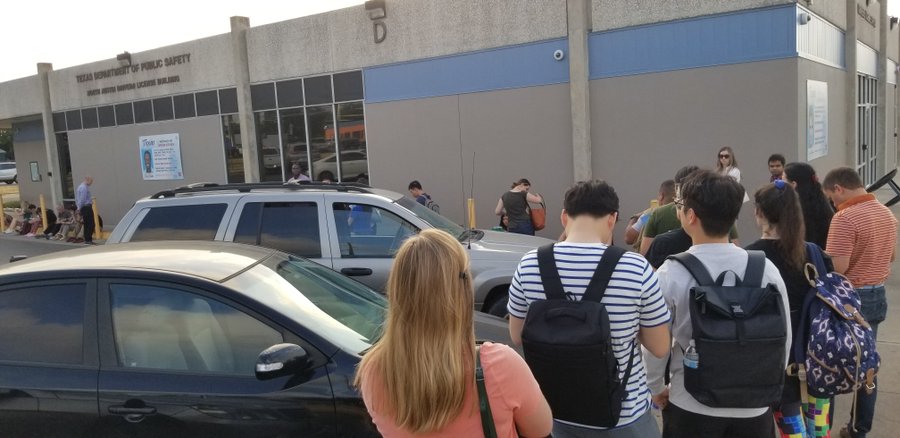
License renewals from abolished driver surcharges may exacerbate lines at DPS license centers
Line outside DPS license center on North Lamar
in Austin ~7:30 a.m. Friday morning
It's going to be a rough fall at the DPS license centers. The Texas Legislature gave them $200 million to staff up at some of its biggest facilities, but those new workers won't come online for several months. In the meantime, about one million people with suspended licenses on Monday will have had all their Driver Responsibility surcharges wiped clean and can finally renew their driver's licenses, likely significantly adding to lines.

Sheriff shot up wrong vehicle
Somebody took a shot at a state trooper in Kimble County, and he called it in. The sheriff heard the call, set up on the side of the highway with an assault rifle, and shot up a passing pickup in response, wounding the driver. It was the wrong vehicle; the trooper had called in a "gray" truck and the pickup the sheriff shot up was white. Good piece from Eric Dexheimer with the details.

The case for medical-led mental-health first response
Here's an excellent case study out of Austin showing why cops shouldn't spearhead first response to most mental health calls. The Austin City Council is presently considering whether to shift to a medical-led response in most instances, following the lead of a Dallas PD pilot program.

'Cooking them to death'
The Marshall Project and the Weather Channel teamed up to report on the effects of excessive heat in Texas prisons.

Coming soon: New Travis County public defender office
Great news: The Texas Indigent Defense Commission approved grant funding for a new public-defender office in Travis County.

'Arrest, release, repeat'
The Prison Policy Institute came out with a new analysis discussing "How police and jails are misused to respond to social problems."

Feds failing at collecting police use-of-force data
Since 1994, the Bureau of Justice Statistics has been charged with gathering data on police use of force. But most agencies' data is garbage and most of the information is suspect or unusable, reported Kenny Jacoby of Gatehouse News.

Monday, July 30, 2018

Taking cops off point on mental-health cases, commissary questions, a $7 million-plus AC bill, and more

Let's clear some browser tabs with a roundup of items which merit Grits readers' attention even if I don't have time to construct a full blog post around each of them:

Blood will tell you more
Following Pam Colloff's masterful two-part story on faulty blood-spatter evidence, ProPublica has launched a special newsletter in which she's following up on the articles and providing more context. You can sign up hereTeaser: In the upcoming, August episode of the Reasonably Suspicious podcast, we'll air an interview with Colloff about her story and the state of forensic science in Texas and beyond. Look for that in about three weeks. (You can subscribe to the podcast on iTunes, GooglePlay or SoundCloud so you don't miss it, and until then check out the July episode.)

Cornyn praises promising pilot on mental-health diversion
Grits is excited about the pilot program at Dallas PD praised by US Sen. John Cornyn in this Dallas News article. They're sending out interdisciplinary teams led by mental health workers to respond to 911 calls related to mental health crises, with cops participating as backup and support as opposed to shot callers. Not only are there better outcomes for mentally ill folks, it saved money and resources: Under the program, "of the 709 mental health emergency calls fielded since January, just 3 percent ended in arrest." In fact, "In the first three months of the program, the clinician's diversion of calls saved the police force about two weeks of salaried work."

Police are asked to handle too many social problems and mental health is one of the biggest. For the most part, the issue needs to be taken out of the hands of law enforcement and jailers and re-center the response around healthcare needs and social services, instead.

Commissary Questions
Earlier this year, the Prison Policy Institute (shoutout to their new employee, Texan Jorge Renaud) published a report titled, "The Company Store" about prison commissary economics. Now, they have some specific, commissary-related questions for the Texas prison system, including why Citibank would receive more than $6 million in commissary funds in a year and pertaining to the wisdom of collaborating with certain vendors using dubious financing methods that arguably short-change inmates. Legislators on committees overseeing the prison system may want to dig into this.

A $7 million AC bill and climbing
After spending $7 million on legal fees fighting against providing air conditioning to at-risk prison inmates during the summer, TDCJ is now beginning to do so, reported the Texas Tribune. This raises the questions: How much will TDCJ ask the Lege for air conditioning? How much will the Legislature give them? And will that be enough, or will more litigation ensue? Tune into the 86th Texas Legislature in 2019 to find out!

Marijuana not only issue where TX political parties agree
We've seen media coverage of the fact that both Texas political parties included some form of marijuana reform in their state party platforms last month, with pundits opining that the development makes passage of reform legislation more likely. But nobody in the MSM has discussed other points of agreement in the platforms on either criminal justice or other issues facing the state. On all those issues, the same analysis applies: Bills where both party platforms agree arguably begin the process with a leg up. It doesn't guarantee they'll pass, but it's a potent expression of an issue's potential.

Framing of inmates spurs renewed calls for TDCJ overight
Recent indictments of TDCJ staff who set up inmates in a fake discipline scam have renewed calls for independent oversight at Texas' prison agency, reported the Texas Tribune. Whatever form oversight takes, it's inarguable that having all your watchdogs report to the same board - as TDCJ does - gives an appearance of conflict and almost certainly creates actual ones. The system isn't adequately policing itself.

Four years waiting on trial from no-knock raid shooting
A Killeen man, who thought he was responding to a burglary, shot and killed a police officer when they executed a no-knock raid on his home four years ago and is still awaiting trial, with no denouement in sight. His attorneys have been ready for trial for some time, but the state has yet to press forward, leaving him sitting in jail while he waits. RawStory has a report.

DWI drylabbing allegations
A DPS lab analyst in El Paso, who in the past was caught allegedly falsifying drug weights, cutting and pasting data from other samples, has again been accused of dry labbing, this time failing to conduct tests on 22 DWI samples and cutting and pasting results from other cases. DPS said the error was unintentional, but its quality control reviewer saw the problem and didn't catch it. When samples were retested, the analyst combined good data with bad. She and the technical reviewer who approved her work are no longer with the agency.

Documenting the 'trial penalty'
The National Association of Criminal Defense Lawyers has a new report out on the extent of the "trial penalty" in federal court when defendants refuse to accept a plea deal. In related news, the Washington Post has an item on a juror speaking out against harsh, mandatory federal sentences, and conservative columnist George Will authored a piece on the topic.

'Misdemeanorland'
A new book addresses "Criminal Courts and Social Control in the Age of Broken Windows Policing." Check out a review.

Saturday, October 14, 2017

How's the weather?

Two recent weather related stories deserve Grits readers attention: The Marshall Project this week offered excellent coverage of Texas' prison heat litigation in a joint project with the Weather Channel, while The Nation covered the issue of prisoners stranded during the recent Hurricane Harvey floods.

Guard tower at TDCJ prison in Rosharon Nation/AP
We knew that federal prisoners in Beaumont had lived through flooded conditions. But notably, The Nation story alleged that TDCJ prisoners at the Gist, LeBlanc, and Stiles Units were subjected to extreme conditions: "Water in some cells was knee-high, and toilets were overflowing with feces and urine. Inmates described suffering from heat, dehydration, hunger, mold, and being unable to communicate with anxious family members on the outside." Grits had not previously seen flooding reports from those units and, during our last podcast, had credited TDCJ for moving prisoners in other units which flooded. But the second wave of flooding around Beaumont/Port Arthur may have caught them off guard.

National Lawyers Guild attorneys suing over the conditions say reports from nearly 100 inmates corroborated the allegations, but TDCJ categorically denied them, declaring that "Stiles did not flood, and the inmates in all three TDCJ units were given sufficient water, food, and access to toilets." So there's some fact finding to be done. TDCJ inmates don't have access to email like in federal prisons, so it's more difficult for their stories to get out.

Declared one of the NLG attorneys, "We know these storms are going to become more and more frequent. If the plan is that every time there is a severe weather event people just don’t get food and water for a few weeks, and live in cages with their own excrement, that’s not an okay plan.”

Sunday, September 17, 2017

Reasonably Suspicious: Listen to the podcast, join us for our Launch Party!

After several months of working out the kinks in a soft launch, Just Liberty's Reasonably Suspicious podcast now is up and running on numerous platforms - iTunes, Google Play, YouTube, SoundCloud, etc..  Please subscribe and give it a try! I'm proud of the results so far, and we're improving every time.


We've now got a fresh new logo created by the legendary Guy Juke, plus original music by producer/guitar virtuoso Gabe Rhodes and some of the best musicians in Texas. I couldn't ask for a smarter, more able co-host than Mandy Marzullo from the Texas Defender Service. The excuses for failure are dwindling! :)

Just Liberty will host a podcast launch party in Austin on Wednesday, September 20th to celebrate the new project. Please join us if you can! See our Facebook event page for details.

You can listen to the podcast here, or as usual find a transcript with links to underlying documents and news stories below the jump.


Here are the topics covered in the September 2017 episode:

Top Stories
  • Police-union pension crisis predicted by Ron DeLord
  • Prosecutors ill-advised to withhold witness statements
  • Big implications for Harris County bail-reform litigation
Forensic Follies
  • Junk Science Writs and the Goldilocks Problem
  • First DNA-mixture "black box" broken open
Last Hurrah (quick takes)

Saturday, September 09, 2017

Federal prisoners stranded in Harvey, Harris County inmates released into it

When disasters like Hurricane Harvey strike, inmates in coastal prisons and jails are sitting ducks unless the authorities in control of their fates take action to protect them.

Downtown Houston on the day
jail inmates were summarily released
TruthOut has emails from inmates in a flooded federal prison in Beaumont showing inmates stranded and scared in desperate conditions. And in Houston, the county jail allegedly released prisoners from a drug treatment facility at the height of the flooding without money, clothes, or medication because officials couldn't feed or supervise them.

After this episode, there really won't be any excuse going forward for coastal jails and prison units to have anything but fully operational disaster plans, including privately run units. That should have been the case after inmates were stranded during Hurricanes Katrina (New Orleans) and Ike (Galveston). But now it would be clearly negligent not to do so.

The Texas Department of Criminal Justice appears to have done a good job evacuating inmates in harm's way. But the federal Bureau of Prisons clearly dropped the ball, and the Texas Commission on Jail Standards surely should review policies on releasing inmates into hazardous conditions.

It's a safe bet Harvey won't be the last time these issues come up.

RELATED: Add accountability to rehab, reentry arguments for inmates' access to email.

MORE: According to the Houston Press, federal officials disputed the extent of the flooding reported in Beaumont.

Wednesday, August 30, 2017

A few facts and an observation about labor economics, immigration politics, and the aftermath of Hurricane Harvey

If readers will forgive an off-topic aside, here are a few facts and a quick observation regarding Texan labor economics, Hurricane Harvey, and the current political moment:

Fact: Hurricane Harvey is about to leave Houston facing one of the biggest reconstruction jobs in the history of the planet.

Fact: Between 28 percent and half of Texas construction workers are illegal immigrants. And Texas home prices are already rising because many of them are departing.

Fact: If President Trump's border wall is funded, either large numbers of illegal immigrants will assist in its construction, ironically, or there won't be enough workers to build it. And that's before any national infrastructure plan adds additional large jobs to the plate of the Texas construction industry.

Fact: The feds have promised ramped up immigration enforcement and the Texas Legislature passed SB 4 (aka, the "show me your papers law") mandating greater law enforcement cooperation with immigration authorities and authorizing more aggressive police tactics toward illegal immigrants. Their stated aim was to increase the number of deportations of people picked up by law enforcement, even for minor traffic violations.

All of which leads to this observation:

Despite high-profile roundups after President Trump took office - sending ICE agents into Texas courthouses to arrest domestic violence victims, for example - as a practical matter the threat of mass deportations, at least in Texas, probably ended after Hurricane Harvey. Somebody actually must perform the labor involved in rebuilding America's fourth largest city.

White Texans aren't going to learn the skills to participate in the booming building trades overnight, nor would most of us be willing to endure the labor conditions typically involved in that industry. Anyway, we're basically at full employment already in Texas and there are only so many workers.

Regardless, just as Bush II was judged on Hurricane Katrina, President Trump will be judged in a major way based on how well he handles Harvey's aftermath. This president cares deeply about others' opinions about him, and IMO he will soon come to understand that what happens in Houston going forward will define his historical legacy.

In the medium term, once someone explains the labor market issues to him, Grits suspects Hurricane Harvey may turn out to stymie the President's anti-immigration fervor for the foreseeable future. And maybe even scrap the border wall, too, at least in Texas. It will be impossible to rebuild Houston while simultaneously deporting the construction industry's labor pool, much less build a pointless 18-30 foot high wall across the desert.

In the end, you can't do all the contradictory stuff he says - eventually you have to pick - and Hurricane Harvey in all likelihood just made a lot of President Trump's choices for him.

Sunday, August 27, 2017

Odds and ends on a rain-drenched weekend

Here are a few odds and ends to keep Grits readers occupied on a rainy weekend:

Public Safety Commission to decide on JL petition in October
Here's an update on Just Liberty's petition to DPS for rulemaking on Class C misdemeanor arrests. The Houston Chronicle also had coverage. More than 5,100 Texans have sent emails to DPS Director Steve McCraw urging support for this proposal. Go here to join them.

DA: Police must improve before I'll work with them
The Aransas County Attorney won't accept more cases from the Rockville PD until its officers are better trained about deliberately withholding evidence. Good for her! That's a new one. "According to prosecutors, the Rockville officers needs to demonstrate a commitment to truthful reporting and to correcting problematic officer behavior."

Pew: Ban the box increases discrimination against black folk
One of our contributing writers, Amanda Woog, was a big supporter of ban-the-box proposals in Austin and elsewhere, but Grits personally remained more skeptical. This commentary from the Pew Charitable Trusts explains why: the policy heightens discrimination against black people, whether or not they have a criminal record, while mostly white folks benefit. Martin Luther King, Jr. looked forward to a day when people are judged not by the color of their skin but the content of their character. BTB legislation asks employers to overlook evidence of people's character (past criminal acts), leaving them only the color of the applicant's skin as a marker for such concerns. The result is a worsened pattern of discrimination, according to the best available employment studies on the topic.

On the limits of legalizing running over protesters
The Texas state rep who filed a bill limiting criminal and civil liability for drivers who run over protesters wants to distinguish his bill from what happened in Charlottesville. His legislation would not protect an intentional murder, he insisted. But in truth, the bill was a political jab at liberal protesters and, whether the specifics would apply to the driver in Virginia, the intent was unquestionably to send a message to protesters blocking streets that they deserve to die and the government shouldn't protect them or care about their fate. Walking that back in the face of an actual such incident is understandable, but Rep. Pat Fallon doth protest too much.

Greg Kelley exonerated
In the end, Greg Kelley not only had to battle the government, which had falsely convicted him of sexually assaulting a 4-year old based on a shoddy investigation by Cedar Park PD, but his own trial attorney intervening in his case against his interests. Regardless, that lawyer was found ineffective and Kelley has been freed - prosecutors now say the evidence points to an alternative suspect. As an aside, Kelley was released thanks to a 2003 statute carried by Sen. John Whitmire to allow the Tulia drug sting defendants to get out on bail while they waited for their habeas corpus writs to clear the Court of Criminal Appeals. When that passed, we thought it would for the most part only affect those Tulia defendants, but it's become a prominent and important feature of many modern, Texas exonerations.

Prison evacuations
Several thousand TDCJ inmates housed in units along the Brazos River were evacuated because of flooding, something which is becoming more or less an annual event. I haven't seen significant reporting on what happened with inmates in county jails who were housed in the hurricane's path.

Bail industry ramping up against reforms
The bail reform lawsuit in Harris County and bail-reform legislation in New Jersey are the two biggest, bleeding-edge flashpoints for the fight to reduce poverty-based incarceration. In both instances, the bail industry has emerged as a powerful and well-funded, if increasingly isolated, belligerent. They're going to try to Willie-Horton these reforms to death, so it will be more important than ever that advocates continue making the public safety case for bail reform. People who want fewer murders should be on the reformers' side.

Violent crime limits economic prospects
Check out an intriguing story by CityLab about new research showing that living around violent crime limits children's economic prospects.

Time to test income and reentry
Providing an income to ex-offenders would reduce recidivism. The barriers to testing such a strategy on a broader scale are political, but as a practical matter, " It is past time that a government or nonprofit combined a minimally conditional cash transfer with traditional reentry interventions and hire an evaluator to assess the experiment’s impact. While a man exiting prison today might receive job training and see a clinician for mental health needs, an additional cash transfer could enable him to secure a place to live, a mass transit fare, and groceries for his family. Cash—or a restricted, EBT-styled debit card—would provide for immediate needs and ease the stressful reentry process."

Thursday, July 20, 2017

What is the upshot of TDCJ heat litigation injunction?

Hard to know the full implications, yet, but the issuance of injunctive relief by a federal district judge in favor of inmates complaining of un-air-conditioned housing in TDCJ's Wallace Pack Unit surely changes the terms of debate surrounding heat-related deaths of Texas prisoners. See coverage from the Houston Chronicle and the judge's 100+ page order.

It's hard to know the implications for several reasons. First, the ruling only applies to one TDCJ unit, not all of them, and Grits is unclear of how this ruling might affect other facilities. Is it a one-off that only applies to the Pack unit, or will TDCJ be forced to adopt similar remedial measures to similarly situated inmates in other facilities?

Also, the judge's ruling that air conditioning must be supplied only applies to heat-sensitive inmates - i.e., inmates who are elderly, disabled, or who have special needs. It does not apply to younger, able-bodied inmates who are housed at the facility to do the work.

Still, it's going to apply to a lot of folks. From the ruling:
The parties stipulated that, as of September 18, 2014, the Pack Unit contained 728 men with hypertension (high blood pressure), 212 men with diabetes, 142 men with coronary artery disease, 111 obese men, 53 men with a psychiatric condition, 66 men prescribed an anti-psychotic medication, 22 men with cirrhosis of the liver, 84 men with chronic obstructive pulmonary disorder (“COPD”), 189 with thyroid dysfunction, and 113 with asthma. There are 188 men in the Pack Unit over the age of 65. Id. Many of these conditions overlap within one person. However, all of the conditions, individually, cause heat sensitivity[.]
If everybody with a psychiatric condition, everyone taking mental health meds, everyone with asthma, everyone over age 65, etc., all require air conditioning, TDCJ will find itself facing similar issues in dozens of facilities across the state.

It was also interesting to note that the judge believes some of TDCJ's heat mitigation methods are counterproductive. Fans used when the heat index surpasses 95 degrees Fahrenheit, for example, just blow hot air onto inmates and worsen the problem. Similarly, misters like those restaurants sometimes use to cool off patrons are less effective in prisons where they can't cover much area and over time actually serve to increase the humidity.

One interesting suggestion has arisen. Texas county jails overbuilt based on speculation that the mass incarceration boom would go on forever, and those facilities are air conditioned as required by state law and regulations by the Texas Commission on Jail Standards. The County Judge in Newton County has already suggested that TDCJ inmates could be housed in his facility.

This thought, though not a terrible idea, raises its own set of issues. First, Grits wouldn't support shifting inmates to county contracts unless the state simultaneously moved to close un-air-conditioned state-run units. I wouldn't want to see this plan become a back-door means to raising capacity during an era when we should continue cutting it.

Second, because many of the inmates subject to the injunction are special needs inmates, there'd need to be expanded training and maybe additional hiring of more qualified jailers and support staff in order to handle TDCJ's sick and elderly, which is a quite different demographic of inmate than those who routinely cycle through county jails. I'm not certain most local facilities are able to handle them, and extremely rural sites like in Newton County may not have access to medical and mental-health supports that inmates with special needs might require.

Still, if TDCJ moved special needs inmates to air-conditioned county facilities, ensured they received adequate medical and mental-health care, and closed some state-owned prison units that couldn't be retrofitted with A/C, Grits can think of worse outcomes.

All that said, like the federal judge, Grits believes TDCJ is vastly overstating the costs to upgrade the Pack unit to add A/C. So when the real numbers are acknowledged, it may be cheapest and most efficient just to improve the facility and continue to treat elderly and disabled inmates where they are. If the agency can provide air conditioning for their hogs, they can do so for sick and elderly inmates.

Finally, all this depends on what the 5th Circuit does in response to the state's appeal. They have upheld injunctive relief in other prisoner-heat cases but insisted it be cabined to inmates with special heat-sensitivity issues. This ruling tracks that reasoning pretty closely, but the makeup of the 5th Circuit could change soon and there's no way to predict what mood they'll be in when they consider the case. And if the case ended up with cert granted at the US Supreme Court, your correspondent wouldn't be particularly surprised.

Monday, June 26, 2017

When Mom is arrested, assault by Tazer, and other stories

Having just returned from a brief if much-needed vacation, let's round up a few items that popped up in the last week while Grits was gone:

What happens to kids when Mom is arrested?
The Dallas Morning News published an excellent feature on what happens to kids when Mom gets arrested. Nobody tracks them in the system and neither police or jails ask arrestees about dependent children upon intake. The article included this short video:


Litigation over weather-related deaths at TDCJ heats up
After years of anticipation, TDCJ finds itself in trial this week to determine whether their un-air conditioned prisons which have caused numerous heat-related deaths constitute unconstitutionally cruel and unusual punishment.

Straight ticket voting ends for Texas judges in 2020
The Legislature this year eliminated straight ticket voting for judicial elections beginning in 2020. This should help, but the SA Express News is right it would be better if they were entirely non-partisan. There aren't Democratic or Republican positions on most questions judges must answer and forcing them to pander to their parties primary voters leads to some strange outcomes, like the guy in 2016 who made it into a runoff for the Court of Criminal Appeals running on an anti-abortion, pro-Second Amendment platform unrelated to the duties of the court.

Good legislation still didn't 'end' debtors prison practices
Grits remains exceedingly pleased that Texas' debtors-prison reform legislation (HB 351/SB 1913) passed this year, but to my friends in the MSM: Let's please stop claiming that this will "end" debtors prison practices. It will at best ameliorate them. Texas has improved the situation. It has not solved the problem. People will still be jailed because they can't afford to pay traffic tickets, we just don't know yet what the reduction in jail sentences will be. For that matter, barring intervention by the federal courts, Texas will continue its pay-or-stay bail practices, which in Grits' view also constitute "debtors prison" policies.

Are bodycams effective even with terrible public policies?
A big debate over bodycams is coming and it's going to be a mess. The rollout in Texas came with terrible legislation by Democratic state Sen. Royce West making it secret in many instances and difficult to get in all others, even though dashcam video from police cars has been effectively governed by the Public Information Act with no negative consequences. In practice, bodycams are used far more often to accuse defendants than to hold officers accountable. Indeed, Texas law says officers can view the video with their lawyers before talking to their supervisors about what happened when they're accused of misconduct so that they can craft their story to fit the facts. Criminal defendants, of course, would never be afforded such a privilege. And yet, police officers knowing their actions are being recorded still appears to be having an effect. A new study from the Urban Institute found that people expressed greater satisfaction in encounters with officers who wore body cameras, even when they were unaware of the cameras! So is it worth it despite the one-sided secrecy? Maybe, with caveats. But the secrecy still sucks.

When does Tazing become assault?
An Austin police officer was given a 20-day suspension for Tazing a suspect after the man was handcuffed and not resisting. The officer will undergo a psychological assessment and be placed on probation for a year. A question for the peanut gallery: Is there any good reason why the officer should not have been charged with assault in addition to the department's administrative punishment?

Will more training get Houston lawyers to take indigent criminal cases?
The South Texas College of Law in Houston received a fat $1.27 million grant to train local criminal defense lawyers. From Texas Lawyer:
The school said that in 2016, 451 attorneys accepted about 70,000 indigent appointments of counsel in the district and county courts in Harris County. The top 10 percent of these attorneys accepted indigent court appointments for more than 375 cases each over the course of the year. A report issued by the Texas Indigent Defense Commission in January 2015, "Guidelines for Indigent Defense Caseloads," suggests an indigent defender's annual caseload should be closer to between 77 and 236 cases, depending on the level of offenses handled. 
To join Harris County's list for indigent appointments in criminal court, an attorney must have at least four years of practice experience in criminal law, with at least four felony jury trials acting as lead attorney, that are tried all the way to verdict, the school said. The experience requirements have led to the creation of an exclusive list of older attorneys, with younger one disillusioned with the process, the school said. "Clearly, the system is broken," said [Catherine Greene Burnett, vice president, associate dean and professor of law at the school], noting that the Harris County Public Defender's Office can only reasonably handle about 9 percent of indigent cases.

Friday, February 17, 2017

Texas should decarcerate before heat litigation spikes costs

The decision by a federal district judge to allow Texas' prison heat litigation go to trial places state officials in a bind.  Grits has said for many years that the only way Texas will ever pay for heat mitigation beyond what it does now is if litigation succeeds. The state has been kicking the can down the road for many years whenever people complain or someone dies.

Now that a trial is imminent, however, there's a big risk taking the case to a jury. The cost of cooling prisons to the same levels required at county jails would be a budget buster - possibly as much as $100 million per facility, reported the Houston Press, though that figure sounds too high to this writer. Some units may need to close because they're too outdated to retrofit.

Will the state settle? I doubt it. But it might be the smart thing to do.

It should be mentioned that this is also an argument for implementing further decarceration reforms this session - perhaps reducing low-level drug penalties from a felony to a misdemeanor - since the state needn't pay to cool inmates whom they do not incarcerate. So even if the litigation isn't complete, that's something they can do to reduce baseline prison costs before the feds make them tack on an air conditioning bill  If federal courts order TDCJ to perform heat mitigation, it will be a little late to start thinking about reducing prisoner numbers.

Saturday, July 11, 2015

Officials point fingers as Abilene prisons' mid-summer water outages challenge heat-mitigation tactics

A pair of prisons in Abilene have suffered from low water pressure since Wednesday, and TDCJ and local officials are pointing fingers regarding who's to blame. Reported KTXS-TV:
Jason Clark, the director of public information for the Texas Department of Criminal Justice, confirmed water pressure has been low since Wednesday.

Clark said water use is being restricted -- showers and laundry are limited, and water to some buildings is being shut off intermittently.

“When the water is off to those buildings, obviously the persons cannot flush the toilet at that point, but once it comes back on they have the ability to do that,” Clark said. “We're just ensuring we restrict water so we can keep that water pressure up.”

The TDCJ and the city of Abilene are working on the problem. Both say the issue is the other’s responsibility.

“It does not appear at this time that it's [the problem’s] on our property, so they continue to investigate that,” Clark said.

“We suspect there is an issue on their side of the meter,” Rodney Taylor, interim director of water utilities, said. “We really don't have access on that side of the meter to help them resolve the issue.”
Long-time readers may recall that TDCJ is Abilene's largest water user, by far.

This news comes on the heels of a related 5th Circuit ruling. As the Austin Statesman reported, "Wednesday’s appeals court decision said Louisiana prisons could avoid heat-related cruel and unusual punishment by cooling common areas and supplying personal ice containers and ample cold water."

The weather forecast in Abilene predicts highs of 95-99 degrees Fahrenheit over the next few days. How exactly will TDCJ provide ice or cold water if there's not enough water to flush the toilets?

Friday, July 10, 2015

5th Circuit: Hot prisons may be cruel and unusual, but A/C not required

Texas may not be required to air condition its prisons, but there's a good chance they'll need additional heat mitigation measures judging by a federal court ruling this week. The Fifth Circuit Court of Appeals overruled a Louisiana judge who'd ordered air conditioning on death row because of excessive heat, but at the same time "stated that extreme temperatures in prison cells can violate the Eighth Amendment’s restriction on cruel and unusual punishment." Reported the Austin Statesman (7/10):
What’s more, the federal court said inmates don’t need to show that hot temperatures caused death or serious injuries to prove that prison conditions are unconstitutional.

“They need only show that there is a substantial risk of serious harm,” [Judge Edith] Jones wrote.

The ruling by the 5th Circuit, which also has jurisdiction over Texas, could prove important for similar legal challenges in the Lone Star State — particularly a lawsuit scheduled to go to trial in February that claims at least 12 Texas prisoners have died from heat stroke since 2011, while hundreds of others experienced heat-related illnesses.
Regarding possible additional measures, "Wednesday’s appeals court decision said Louisiana prisons could avoid heat-related cruel and unusual punishment by cooling common areas and supplying personal ice containers and ample cold water, as well as by providing many of the solutions used in Texas prisons."

One difference between the Texas and Louisiana litigation is that here the suit was joined by prison guards complaining of extremist working conditions. One wonders, since the 5th Circuit declined to combine the cases, if the focus on employment conditions as opposed to incarceration conditions might provide an additional foothold. Regardless, TDCJ can now see the bare minimum improvements needed to mitigate overheated prisons; they shouldn't wait for a court order before beginning to deploy them.

See related Grits posts:

Friday, October 31, 2014

Last minute oppo dumps in Harris DA race, y otras historias

Here are several items which haven't made it into independent posts this week but which merit readers' attention:

Blog vs. blog in Harris DA race
The gloves are coming off as the blogosphere dukes it out over the Harris County District Attorney race. Read Big Jolly on Devon Anderson and Murray Newman on Kim Ogg. Murray's complaint seems to be that Ogg complied with a court order rather than defy a judge and go to jail for contempt of court. And here's Jolly's cheapest shot:
Prostitute Court – Ms. Anderson wants to create a special court for prostitutes because “they are victims”. Yeah, right. [Ed. note: Yeah, really.]

Teachers – Ms. Anderson is going to help HISD crack down on cheating because teachers can’t be trusted. But hey, prostitutes, ya know?
Unfair? Perhaps. But it's also really funny. What this tells me is that the campaigns are dumping the kitchen sink on one another and the stuff that couldn't get placed on TV news or in the Chronicle is now being handed to folks at the Houston Press, second-tier media and bloggers to disseminate as widely as they can before election day. Nothing wrong with that. If campaigns didn't raise the issues, it's not like the media would lay out the strongest cases against candidates or dig up dirty laundry at the DA's office on their own. Some stories only ever get told if somebody has an interest in telling them.

That said, when I worked professionally as an opposition researcher I loathed these end-of-race mud-fests, which (to me) usually are the mark of a statistically close and strategically sloppy campaign. Anyone can go ballistic. The art to oppo work is to find the Big Theme that will both defeat an opponent and simultaneously elevate your candidate, not to hit the other side with everything you've got and hope for the best. ("Those who win every battle are not really skillful," the ancient Chinese general Sun Tzu opined, while "those who render others' armies helpless without fighting are the best of all.") Such kitchen-sink tactics reek of desperation by both sides. But then, there's a lot at stake. I will say it's much more fun to watch the process as a non-participant.

Is Craig Watkins in electoral trouble?
The Dallas News has a detailed analysis of the DA's race in that county. There, Republican Susan Hawk has run a more disciplined campaign than we've seen in Houston, in part because incumbent Craig Watkins seems to have barely taken the field, raising little money, using family members as campaign staff, and relying on the Wendy Davis campaign to drive turnout. So Hawk can control her own message more effectively, attacking on broad themes and letting the media and her opponent's own tone-deaf responses to their stories do most of the dirty work for her. Meanwhile, Watkins doesn't have money to frame his own message on TV, which leaves his image in the hands of his opponent and his attacks in the hands of the local press, which has not lately been kind to him. A couple of weeks ago I thought he was still the betting favorite; today I think it's a coin flip, at best. Hot race.

Human rights panel reviews hot Texas prisons
Speaking of hot, the Houston Chronicle reported that "The head of an international human rights panel recommended Monday that the federal government intercede in a legal dispute over excessive heat in Texas prisons." Texas officials say the group shouldn't be reviewing the matter until pending federal litigation is complete. See related recent coverage from The Atlantic.

A primer on approved interrogation tactics at Dallas PD
Texas Monthly's Skip Hollandsworth has a long-form piece based on the civil suit by Olivia Lord, a Dallas woman who was falsely accused by police of her husband's death (he committed suicide, see prior Grits coverage) and subjected to bullying interrogation tactics by a Dallas detective who moonlighted for the TV show The First 48.

The strange detention of Cheryl Irvin
Check out this strange story of Judge Denise Collins in Houston ordering the (probably illegal) detention of a criminal defense lawyer in her courtroom to prevent her from conferring with her client. (Probably another example of a last-minute oppo dump.)

Rod Ponton vs. Reason on synthetic drugs
West Texas DA Rod Ponton got angry with Reason magazine and fired off a 10-point rebuttal to a  of story about a synthetic drug case he's prosecuting. The magazine published his letter and addressed his points in detail, standing by their original story. Go see their back and forth along with the original article that got Ponton riled up.

'How will a small town in Arizona manage an ICE facility in Texas?'
A story from NPR with the same title as this subhed relays bizarre news regarding the management structure of what's about to become the largest immigrant detention center in the country in South Texas.

'Cops need to obey Facebook's rules'
You can't create fake profiles on Facebook, but law enforcement feels free to do so. Facebook wants them to stop.

Should the Fourth Amendment keep hotels from providing guest info to police without a warrant?
The Supreme Court will answer the question in a case they've agreed to hear from the Ninth Circuit. Here's an academic paper arguing that "the expectation of privacy in hotels should be measured in the same way that the Fourth Amendment deals with other types of residences."

Sunday, October 12, 2014

Feds won't combine prison heat litigation cases

The National Law Journal reported (Oct. 10) that the federal courts will not combine the numerous lawsuits challenging excessive heat in Texas prisons as cruel and unusual punishment under the Eighth Amendment. Here's a notable excerpt from the story:
A federal panel has refused to coordinate lawsuits filed on behalf of inmates in Texas state prisons who died or suffered heat strokes from soaring temperatures during the summers of 2011 and 2012.

The Texas Department of Criminal Justice and its executive director, Brad Livingston, represented by Texas Attorney General Greg Abbott, moved on July 14 to transfer seven cases for pretrial purposes to U.S. District Judge Keith Ellison in the Southern District of Texas, where a class action is pending on behalf of inmates of the Wallace Pack Unit, a geriatric prison facility near Houston. Jeffrey Edwards of Edwards Law in Austin, who represents the plaintiffs in most of the cases, supported the move.

The cases—all filed in federal courts in Texas—allege that being housed in temperatures of more than 100 degrees constituted “cruel and unusual punishment” under the Eighth Amendment. They also claim they were not accommodated under the Americans With Disabilities Act and the Rehabilitation Act. Most of the prisoners had disabilities, such as diabetes or hypertension.

The U.S. Judicial Panel on Multidistrict Litigation heard oral arguments on Oct. 2 in Louisville. On Thursday, the panel found that coordination wasn’t appropriate because the cases were at varying stages of discovery and the same plaintiffs attorney had brought most of them.

That attorney, Edwards, who has partnered with the Texas Civil Rights Project on the litigation, said he represents the families of eight inmates who have died and one who survived a heat stroke. But others have been filed by inmates themselves. “There was some concern about the effect an MDL would have on pro se inmates filing these claims,” he said of the panel’s decision.

Tuesday, September 30, 2014

Do sweltering Texas prisons violate international human rights standards?

This morning I received a press a press release from UT Law School's Human Rights Clinic related to the Inter-American Commission on Human Rights'  announcement that it "will hold a hearing in Washington, D.C. on October 27, 2014 regarding Texas' violation of prison inmates' human rights by exposing them to dangerously hot temperatures. The IACHR is an independent organ of the Organization of American States, whose mission is to promote and protect human rights in the Western hemisphere." Find the full text of the press release below the jump:

Wednesday, August 27, 2014

Litigation heating up over summertime prison conditions: 5th Circuit may rule in Louisiana case by end of year

At Texas Monthly's website, Annie Melton reflects on the looming question: "Will a ruling on extreme conditions at the Louisiana State Penitentiary influence lawsuits pending in Texas?" She's talking about a federal court's ruling in favor of death row inmates in the Angola unit in Louisiana which may soon cause our Bayou State neighbors to "join the long, still-growing list of states that have established temperature regulations for their prisons," just like Texas requires for county jails. (See prior Grits coverage.)

The state prison system has asked the Fifth Circuit Court of Appeals, which also includes Texas and Mississippi, to overturn the decision. Their appeal "is currently at the briefing stage within the Fifth Circuit, and no ruling is expected until later this year." Many court watchers think their ruling in that suit will either govern the Texas cases or at least show which way the wind blows on the court regarding very similar claims.

Keep in mind, in 2012 the Fifth Circuit expressly allowed prison heat litigation in Texas to go forward, reversing the ruling of the trial judge and inspiring several more, similar suits at other Texas units. So, after greenlighting the Texas suits just two years ago, will the appellate court now shut those cases down or further them along with its coming ruling? Or, perhaps the court will affirm or overturn the district judge's ruling in a way that won't affect the Texas cases. ¿Quien sabe? Nothing is certain.

Still, judging from commentary from the bench during oral arguments at the Fifth Circuit in the Texas case, if I were TDCJ Chief Mugwump Brad Livingston, I think I'd be pricing air conditioners and the cost of installing and using them at dozens of Texas prison units, if not all of them. There's a decent chance that, by the time the Legislature meets next spring, Livingston will find himself facing some legislator in a committee hearing waving around a new decision from the Fifth Circuit and asking him how much it would cost.

Saturday, June 21, 2014

Pot penalties, jails and mental health, prison heat, recording interrogations, immigration and judges

Here are several items that aren't going to make it into independent Grits posts but which deserve readers' attention:

Pot penalties too harsh on large amounts and small
The Statesman editorial board joined the chorus this week to say the 5-99 year penalty range being applied for pot brownies to a Williamson County teen is too harsh. While I don't believe the kid's at significant risk of spending 99 years in TDCJ for the offense or anything like it, it's true the penalties are out of whack. We've talked about reducing marijuana penalties on the misdemeanor end, but is there any level of marijuana possession that deserves the same first-degree felony charges one would get for murder or kidnapping? Really all Texas marijuana penalties, not just user-level penalty categories, should be ratcheted down one notch.

Harris Sheriff blasts state for failure to fund mental health treatment
Reported Ross Ramsey at the Texas Tribune, Harris County Sheriff Adrian Garcia says the Department of State Health Services "is not offering the care that it is required to provide." "Given proper treatment, the sheriff argues, some patients would not be committing the crimes of which they are accused. Instead, they end up in Harris County’s jails, where they are a health care and financial burden to the county." Garcia's "recommendations include increasing staff for the hospitals and expanding capacity by contracting with local providers whenever possible" I do find questionable Garcia's claim that "the majority of people who are in my custody who are in this mental illness category are coming here largely because of their illness and not necessarily because of their actions." IMO, that's not true, and the best research on the topic conflicts with that view. Mental-health treatment is an important component for the sub-group of offenders who need it, but it's not a silver-bullet cure all.

Veterans, PTSD, and medical pot
Grits recently spent a morning in San Antonio listening to Texas legislators from two House committees discuss Veterans Courts and treatment services for ex-military personnel charged with crimes who suffered from PTSD and Traumatic Brain Injury. But nobody addressed the question from the angle taken by Bill Martin in this June 2014 Texas Monthly story, "War Without End": Medical pot. The subhed to his story sums up his well-versed argument: "As veterans return home from combat in the Middle East, many struggle to leave their experiences behind. They are sleepless, anxious, and angry. And medications often make the situation worse. No wonder a growing number of former soldiers are turning to a treatment that makes them criminals in Texas: Marijuana."

Texas heat litigation seeks class-action status
Yet more litigation has been filed related to excessive heat in Texas prisons, this time out "at a Navasota lockup where [inmates] allege it is so hot that metal tables are too hot to touch and metal-walled cell blocks are like ovens." According to the Houston Chronicle, out of all the various heat-related lawsuits against TDCJ, this is "the first one seeking class-action status that could open the prison system up to statewide litigation." See additional coverage from Texas Monthly and the Washington Post.

A law enforcement response to a humanitarian crisis
So thousands of unaccompanied minors show up at the Texas border from Central America: Texas' response: DPS will conduct another pointless "surge" at a cost of $1.3 million per week. If Texas Republicans want to a) show it's untrue they cease to care about children the moment they're not aborted, b) convince Latino voters to stop believing they're a bunch of xenophobic zealots, and c) confront actual problems at the border instead tilting at trumped up fictions, why not respond with humanitarian assistance for the kids instead of overtime pay for troopers to drive around the Valley? Just a thought.

New US Senate filibuster rules haven't busted Texas' federal judge shortage 
Like the Statesman editorial board, I'm glad to see more federal judge slots filled in Texas, but as  Jazmine Ulloa reported, "federal judicial vacancies across the state remain among the highest nationwide, even as the Texas courts struggle to handle some of the busiest and most complicated dockets in the country. Recent budget cuts have compounded the problem." Couple the ongoing shortages with the recent arrival of tens of thousands of unaccompanied children at the Texas border and all the family law issues those cases will entail, and the feds need to fill judicial vacancies in the southern and western districts, in particular. Wrote Ulloa, "Two more vacancies are expected within the next year," so, "If there are no replacements by then, one federal bench in every five in the state will be empty. And there aren't enough judges allotted to Texas' Western district to handle their dockets, even if they were fully staffed at present levels. How is it possible to stiffen up immigration enforcement if the federal judiciary isn't staffed up sufficiently to handle the caseload?

Arguments against recording interrogations falling by wayside
If the FBI can record custodial interrogations, why can't Texas? Momentum on this issue is shifting. The Rodney Ellis/Terry Canales bill requiring police to record interrogations in serious cases has a good chance to finally make it through the Texas legislative process in 2015.

Sunday, May 25, 2014

Hot in Louisiana: Federal suit may set precedent for Texas

A federal judge has ruled in favor of plaintiffs from death row in Louisiana, calling excessive heat there "cruel and unusual" punishment and appointing a "special master" to supervise compliance with his court order, which includes installation of air conditioning as well as "providing chests filled with ice and allowing inmates once-daily cold showers." I'm sure Texas prison officials are closely watching our neighbor's reaction and wondering whether the hottest Texas prisons may be next.

Louisiana, like Texas, lies in the the Fifth Circuit Court of Appeals. So if the Fifth Circuit greenlights a heat mitigation order there, it could signal which way Texas' pivotal litigation may go. The state of Louisiana has already announced it would appeal: “Given the significant issues involved in this litigation which have far-reaching effects on many correctional institutions in Louisiana, Texas and Mississippi, the Department intends to seek a thorough review of the trial court’s decision with the U.S. Fifth Circuit Court of Appeals.” Count on the state of Texas at some point to submit amici, which should be interesting to read.

Two years ago, the Fifth Circuit ruled that Texas prisoners could sue over excessive heat. This Louisiana case may tell us the extent to which the court is willing to endorse more coercive remedies to limit heat in prisons under its jurisdiction. Bottom line: If this judgment and precedent is allowed to stand, it's not difficult to chart a path on which Texas could find itself facing federal court orders to mitigate heat in many prison units, not just death row.

As a practical matter, a federal court order is the only way politically Texas prisons could ever be forced to install air conditioning, even in the hottest units, or pay for more labor-intensive heat mitigation measures that cost the state money. If a federal court were to issue such an order, there would be much bipartisan weeping and gnashing of teeth among the political classes about the relative comfort of prisoners vs. the poor, soldiers in Afghanistan, etc., and a great deal of post hoc grumbling about the misplaced priorities of liberalism and the federal government. But the state really would have no choice, in the end, but to pony up and comply.

Time will tell. I've been surprised at the Fifth Circuit's reaction in recent years to heat litigation. They have a reputation as generally unfriendly both to prisoners and civil rights litigation. So if they allow district judges in Louisiana to order heat mitigation at the state level, Texas prison officials and the legislature had better start reaching for their pocketbooks. There's a good chance the hottest Texas prisons won't be far behind.

See related Grits posts:

Tuesday, April 22, 2014

Report: 'Deadly Heat in Texas Prisons'

A new report (pdf) titled "Deadly Heat in Texas Prison" from the Human Rights Clinic at the University of Texas School of Law argues that, "The Texas Department of Criminal Justice (TDCJ) is currently violating the human and constitutional rights of inmates in Texas by exposing them to dangerously high temperatures and extreme heat conditions." Citing recent court precedent, they argue that:
The United States Court of Appeals for the Fifth Circuit has recognized time and again that extreme heat in prisons can constitute a violation of inmates’ Eighth Amendment rights. In a 2012 case, a 63 year old Texas prisoner presented with a preexisting blood pressure condition, and was taking medication that would affect his body’s ability to regulate temperature. The court decided that a reasonable jury could conclude that a failure to provide air conditioning, among other things, to an individual with these conditions was a violation of the prisoner’s constitutional rights. Most recently, the Middle District of Louisiana issued a decision in 2013 condemning the extreme heat conditions in a Louisiana prison facility similar to those conditions present in TDCJ facilities as a violation of the Constitution. There is therefore clear and recent precedent for denouncing the hot conditions in TDCJ facilities as violating the guarantees and rights of inmates under the Eighth Amendment.
On page ten of the report there's a TDCJ temperature log from the Hutchins unit indicating that temperatures reached 114 degrees Fahrenheit and the "heat index" at mid-day reached as high as 149-150 degrees. According to the report, "almost half of TDCJ facilities are built with outer walls that are either partially or fully constructed from metal. Temperatures in these metal-constructed facilities are consistently higher than ambient temperatures or temperatures in concrete facilities. Inmates housed in these facilities have no way of escaping the heat, and are placed at risk of suffering heatstroke as a result."

The report recommends implementing standards similar to those promulgated by the Texas Commission on Jail Standards for county jails, where Sheriffs are required to keep jails below 85 degrees Fahrenheit, or nearly 30 degrees lower than the highest temperature documented at the Hutchins unit in the TDCJ log mentioned above. Those interested should read the whole report.

After the federal court ruling in a Louisiana case last year and the 5th Circuit's ruling that Texas can be sued on the topic, Grits expects TDCJ to ultimately lose the pending heat litigation and for the Legislature to eventually find itself forced to implement significant mitigation measures to reduce heat exposure of inmates and guards. It won't be popular but if the 5th Circuit rules like they did in Louisiana, they won't have a choice.

MORE: From the Houston Chronicle, the Austin Statesman and the Texas Tribune, as well as a column by HouChron columnist Lisa Falkenberg. AND MORE: From the Austin Chronicle, which points out TDCJ's ironic advice to employees on keeping pets safe in the heat while they're at work, noting that "The same level of care is not considered for Texas inmates."