Showing posts sorted by date for query forensic errors DNA. Sort by relevance Show all posts

Wednesday, February 12, 2020

What the jury didn't hear, against SWAT raids for routine search warrants, bail explainers, courthouse architecture, and other stories

Here are a few odds and ends that merit Grits readers' attention:

Margaret Moore, Rosa Jimenez, and what the jury didn't hear
Weird comments from Travis County DA Margaret Moore on the Rosa Jimenez case in The Appeal: “There is an ultimate fact question that was resolved by the 12 men and women who actually saw all the evidence and heard opinion testimony,” Moore told The Appeal. “Everything after that is opinion by people who were not in that courtroom.” But here's the thing: The reason four judges have now said Jimenez is likely innocent and should be released is that the jury heard false, un-rebutted expert testimony that biased their view. When judges looked at all the same evidence, and also evidence to which the jury wasn't privy rebutting junk science in the case, they said Rosa didn't do it. So jurors didn't consider all the evidence. That seems disingenuous. (See prior Grits coverage, and listen to a segment on the case on the latest Reasonably Suspicious podcast, plus coverage from a Travis DA Democratic candidates forum over the weekend.)

Use of SWAT raids for routine search warrants creates needless risk
The practice of using SWAT tactics to execute routine search warrants continues to result in unnecessary deaths. A Waller County man was killed in a SWAT raid by police who wanted to seize a computer (someone else's) over alleged possession of child pornography. Can it really require a no-knock raid to seize a computer? This was unnecessary; the man's death was much more a predictable policy failure than it was an accident.

Fewer inmates beaten up more often at TDCJ
Recent inmate deaths at the hands of guards in Texas prisons highlights that use of force by staff has increased dramatically in recent years, reported the Texas Tribune, even as the number of inmates supervised declined and eight prison units closed.

Whistleblower gaining momentum in Sheriff's race
Liz Donegan, the Austin PD whistleblower who was removed as head of that agency's Sex Crimes unit because she wouldn't improperly classify cases as "cleared," is now running for Travis County Sheriff and, remarkably, earned the Austin Statesman's endorsement. Although Donegan was removed from her Sex Crimes post during Chief Art Acevedo's tenure, current Chief Bryan Manley earned ownership of the topic by blaming data errors on victims when the story came out. Him having her as a Sheriff-to-Chief peer would be deliciously awkward.

Bail explainers
Egged on by police, the Dallas Morning News has been blaming Dallas County DA John Creuzot for failures in the legacy bail system. But when they tried to do that in front of the City Council, staff gave everyone a primer on who is in charge of setting bail in Texas: Judges, not prosecutors. In Harris County, a judge demanded an explanation from prosecutors on why they blamed her in the press for a violent criminal's release when they'd never informed her of the details. Meanwhile, at the Paris News (TX, not France), a local reporter offered better explanatory coverage of the bail system than the Dallas News has yet.

Travis County judges dip toes in bail-reform waters
Travis County judges are saying they want to implement bail reform, including requiring defense attorneys at magistration, despite opposition from Travis County DA Margaret Moore. But the Texas Fair Defense Project and their allies say there would still be too much delay before release under the new proposal, and called for changes to the draft. Still, judges taking leadership on this is heartening news. They'd mostly dug in their heels before now.

No extra prosecutors for you, Kim Ogg
For the Harris County Commissioners Court, turning down District Attorney Kim Ogg when she asks for more prosecutors has become habit forming.

Houston crime lab to use disputed DNA mixture software
The Houston Forensic Science Center has begun using STR-Mix software for analyzing DNA mixture evidence. But last fall, a federal district judge in Michigan excluded such software from evidence after a "Daubert" hearing. DNA mixture analyses have been fraught with error for many years. Under the Michigan judge's ruling, based on recommendations from President Obama's forensics commission, STR-Mix software may be used when a) there are no more than three contributors and b) when DNA from the target makes up at least 20 percent of the sample. No word if HFSC intends to abide by those limitations.

Cherry picking data for scary headlines
The Austin Statesman issued a story with the headline: "Violent crimes with homeless suspects, victims went up in 2019, data show." The big news was that reported violent-crime incidents in the city increased by one percent last year, with a small increase attributable to the city's homeless population. What they didn't say was that Austin's population has been growing by 2-3% annually, so the rate likely decreased! Austinites were less likely to be victimized by violent crime last year than the year before. Why wasn't that the headline?

Defending Austin's federal courthouse architecture
The Department of Justice wants all federal courthouses to look like Roman temples and specifically criticized Austin's federal courthouse as an example of what they don't want. But I really like the federal courthouse in Austin. I was there recently for a hearing in the Rosa Jimenez case, then later to retrieve audio from the clerk. It's incredibly well-designed, with much more natural light and customer-friendly arrangement than most of them. Here's more on the Austin courthouse's architectural approach.

Fines and fees
Two essays on fines and fees for you:
'Doing justice isn't left, it's right'
The Texas Public Policy Foundation's Marc Levin thinks progressive prosecutors are mis-labeled.

Wednesday, January 29, 2020

DNA mixture math errors discovered in 2015 weren't the first

Grits this week revisited the 2007 "Bromwich report" regarding what then was the Houston PD crime lab while researching DNA-mixture evidence issues and realized something I hadn't understood at the time - or perhaps just never connected the dots: Errors calculating DNA-mixture probabilities were at the center of the years-long crisis that engulfed the Houston crime lab's DNA section for most of the aughts.

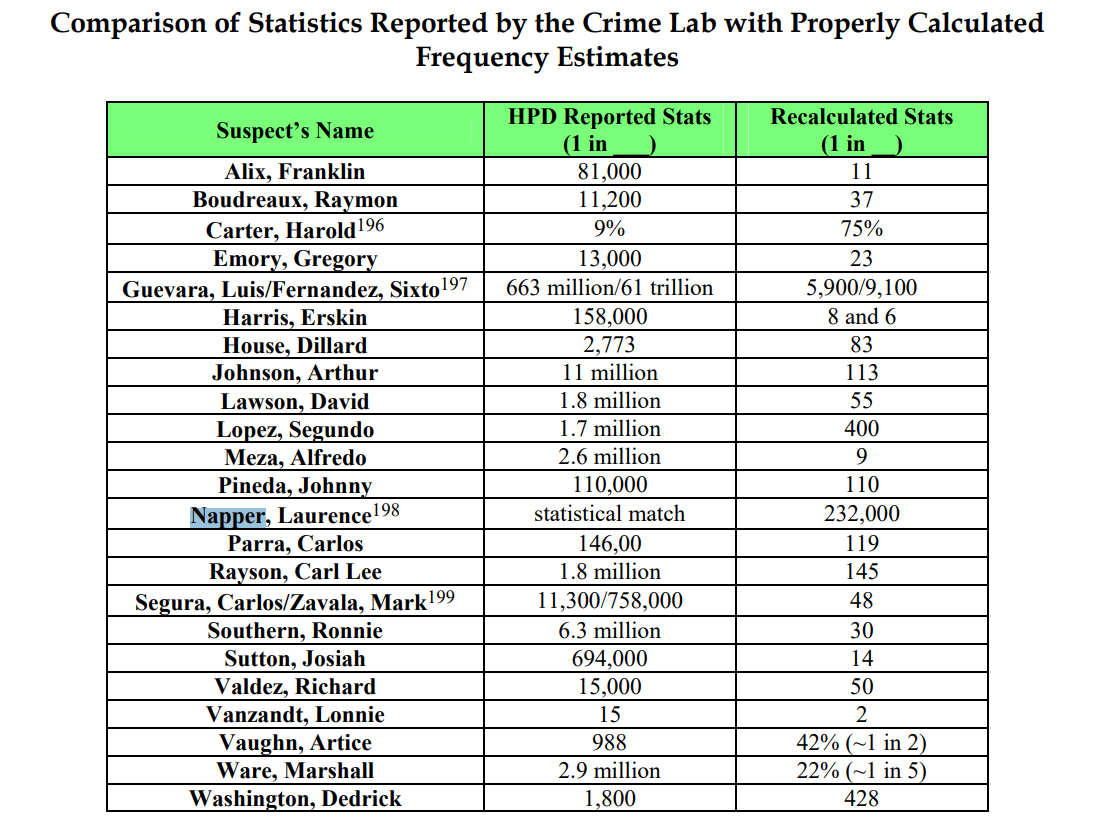
Readers will recall, in 2015, we discovered that all Texas crime labs were miscalculating DNA-mixture probabilities - in one case, a sample jurors were told matched one person out of a billion really matched one out of 50. Well, the same thing was happening at the Houston crime lab. Check out this chart from the Bromwich report identifying cases where DNA analysts vastly over-estimated the probability ratios:


So in Houston, they discovered the crime lab was miscalculating probabilities in the aughts, updated the math, then in 2015 discovered that math was wrong and had to update it again. Wow! This '07 comment from Bromwich about the HPD lab would have applied equally to every Texas crime lab as recently as 2015:
It is clear that DNA analysts in the historical Crime Lab ... did not fully understand the scientific basis for calculating frequency estimates from DNA profiles obtained from evidence samples and that they were not trained in the methods of properly calculating statistics associated with DNA mixture profiles and partial DNA profiles.
Notably, the method Texas labs were advised to shift to in 2015 - "probabilistic genotyping," most commonly using equipment/software from a company called STR-Mix - lately has itself come under fire. A federal judge out of Michigan recently excluded such evidence in a Daubert hearing. So it's possible DNA analysts will need to re-do their math again.

Returning to the Houston PD crime lab example, these are in many cases radical downward adjustments. From one in 6.3 million to one in 30? From a one in 2.9 million chance to one in 5? Would juries have convicted if they'd heard the lower numbers? I wonder if other crime labs were using the same method as HPD's during this period?

Of the cases in this chart, Franklin Alix was executed despite DNA testimony in his case having been declared unreliable. Only Josiah Sutton was ever exonerated; 11 remain incarcerated. By all accounts, the criminal-defense bar in Houston failed to step up in many instances, leaving most of these folks un-or-poorly represented.

It's highly likely there are more actually-innocent people on that list, but we'll never know. The DNA lab's other big problem was that it had a leaky roof and most of the historical DNA evidence was destroyed and couldn't be re-tested.

See prior, related Grits posts:

Tuesday, October 29, 2019

Digesting new Daubert opinion on DNA mixtures

Grits earlier referenced the opinion from federal District Judge Janet Neff, in Michigan's western district, who directly evaluated the most common, commercial DNA-mixture software using probabilistic genotyping under the Daubert standard for whether to allow expert testimony. Texas courts heretofore have let in such evidence but avoided a direct Daubert evaluation.

There was a Texas connection in the case. Dr. Michael Coble, of the University of North Texas Health Science Center, was the expert employed by the prosecution. He has been one of several key advisers to the Texas Forensic Science Commission and the legal system in general as the state has struggled with this DNA-mixture issue. The expert for the defense, whose arguments more frequently prevailed in Neff's opinion, was Dr. Dan Krane, from Wright State in Ohio.

Judge Neff evaluated each prong of the Daubert standard as it related to the STR-Mix DNA mixture-analysis software. This program employs high-end math that few DNA-lab practitioners can actually reproduce called "probabilistic genotyping." But programs are only as good as the assumptions that guide their work, and some of the assumptions in each case - e.g., the number of contributing samples - are inputted by the user. There are subjective judgment calls throughout the process. Further, because the math results from tens of thousands of randomized guesses, the results aren't replicable test to test.

Judge Neff was disquieted that, unlike for one-to-one DNA matching or two-source mixtures, as with a rape kit, there are no controlling standards for interpreting DNA mixtures, especially for samples with very small amounts of DNA - maybe only a few scattered cells.

The judge also made the interesting point that, even if the math behind the STR-Mix software is impeccable, there were international standards for coding such high-end math projects and the STR-Mix software didn't meet them all. Coble was dismissive that other fields might have standards to contribute, but the product in question is so obviously an intersection of an array of multidisciplinary work, the judge didn't buy it.

Further, the judge echoed concern that most validation studies on the software so far have been conducted by company principals. And while there was peer-reviewed support for STR-Mix (again, mostly for studies by people with a financial stake in the project), none of that peer-reviewed work focused on low-level samples as in this case, where just a few cells were found that were said to belong to the defendant.

One point that's always bugged me was raised in an expository section of the opinion but not included in her reasons for her Daubert denial: “[D]ue to the methodologies used in STRMix, '[t]he results of no two analyses will be completely the same',” she wrote. Elsewhere, she quoted an academic article noting that, "for a technique to be broadly applicable, it must be based on measurements that can be replicated." Supporters of the software, however, say replicability isn't necessary and it should be good enough if the results were all in some acceptable range. Regardless, while Judge Neff clearly observed this incongruity, it wasn't included in her final reasons for her ruling.

Clearly the most persuasive piece of evidence for Judge Neff was the 2016 PCAST report which expressly stated that STR-Mix was validated for up to three sources if the sample to be identified is at least 20 percent of the total. She did not find further validation regarding smaller samples, and the very small sample in this case, she believed, merited even greater caution. She essentially treated the threshold cited by PCAST as a bright line regarding the current state of the science. STR-Mix can be used for traditional one or two-source DNA matching, she ruled, and for three-source mixtures if the sample to be matched made up 20 percent or more of the whole. But otherwise, the estimates would be inadmissible.

One small upside for backlogged crime labs using STR-Mix: This would make it easier to screen DNA mixture submissions. Samples with more than 3 contributors should probably be rejected up front as unanalyzable "crap," to use the words of a prominent DNA expert who advised Texas crime labs on the topic.

Errors in such cases can cause false convictions, so Grits is glad to see this increasingly dirt-common evidence more carefully vetted. From the time probabilistic genotyping was first introduced to Texas crime labs in 2015, experts were warning against stretching the limits of the math (i.e., trying to analyze "crap"). Judge Neff would set a bright-line threshold, and given the current state of the literature, it's not an unreasonable choice. In many ways, it's the most defensible (it would probably be easier to get past it by improving the tech than defeating her arguments). But whatever threshold one chooses, her decision highlights that one must exist, even if courts haven't heretofore required it.

I'd quoted it earlier, but I loved Judge Neff's conclusory analysis of current DNA-mixture-evidence practices, so let's give her the final word here:
The DNA evidence sought to be admitted in this case—in essence, that it is 49 million times more likely if Daniel Gissantaner is a contributor to the DNA on the gun than if he is not— is not really evidence at all. It is a combination of forensic DNA techniques, mathematical theory, statistical methods (including Monte Carlo-Markov Chain modeling, as in the Monte Carlo gambling venue), decisional theory, computer algorithms, interpretation, and subjective opinions that cannot in the circumstances of this case be said to be a reliable sum of its parts. Our system of justice requires more.
Anyone interested should definitely read the whole opinion. This summary hardly does it justice.

MORE: From Techdirt.

See prior, related Grits posts:

Friday, October 25, 2019

DNA mixture software widely used in Texas disallowed by MI federal judge

For some time, Grits has been skeptical whether DNA-mixture software would hold up to "Daubert" scrutiny if judges were to directly evaluate it. In 2015, this blog reluctantly broke the story in Texas about errors and uncertainties regarding how to evaluate DNA mixture evidence. (They were being openly discussed by the Forensic Science Commission and the Court of Criminal Appeals' Criminal Justice Integrity Unit when I worked for the Innocence Project of Texas, but reporters weren't covering the complicated, math-heavy story.) After that, I've followed the issue from afar even after I stopped tracking forensics in any professional capacity.

STR-Mix is one of a handful of companies selling their product as a solution to the conundrum of how to evaluate DNA mixture evidence. Now, a federal district judge in Michigan, Janet Neff, after an exhaustive review of the science, has ruled directly on the Daubert-based admissibility questions surrounding this product that Texas courts punted on. In particular, Judge Neff ruled in favor of defendant David Gissantaner, concluding that
The DNA evidence sought to be admitted in this case—in essence, that it is 49 million times more likely if Daniel Gissantaner is a contributor to the DNA on the gun than if he is not— is not really evidence at all. It is a combination of forensic DNA techniques, mathematical theory, statistical methods (including Monte Carlo-Markov Chain modeling, as in the Monte Carlo gambling venue), decisional theory, computer algorithms, interpretation, and subjective opinions that cannot in the circumstances of this case be said to be a reliable sum of its parts. Our system of justice requires more. 
It is the Court’s hope that this decision brings to light the shortcomings or, at the very least, points of inquiry necessary in evaluating this advancing technology as a tool in forensic DNA analysis. There must be a dialogue among key players in the general interest of the development and refinement of the technology, the software and its application by the individuals charged with its use in the field, rather than post-hoc testing of its reliability in the context of a criminal prosecution where the ultimate question is the freedom and guilt or innocence of the person of interest. 
Here, because the sum of the parts simply does not add up to a reliable whole, the DNA analysis/likelihood ratio resulting from the use of the STRmix probabilistic genotyping software must be excluded. Defendant’s motion to exclude evidence is granted. An Order will enter consistent with this Opinion.
Wow! Obviously, this doesn't apply in Texas nor anywhere in the 5th Circuit. But it's the first time to my knowledge that a federal judge has taken a deep dive into the science behind proprietary DNA mixture software and rejected it based on the Daubert standard. Welcome to the party, Judge! Grits was beginning to feel a bit lonely in that view!

In one-to-one DNA matches, or two-source matches like a rape kit where the DNA of the victim is known, DNA evidence remains the gold standard of forensic science. But analyzing DNA mixture evidence - e.g., "touch DNA" on a doorknob or DNA from a blanket on a couch - remains a more subjective process that's sometimes more of a guess than a "match."

I want to delve into the judge's opinion more deeply before commenting further, but this seems like a big development. We know at least some Texas labs use the same proprietary DNA software the federal judge in Michigan disallowed.

Clarification: More on this soon, but having now more closely read the opinion, Grits should clarify that the court recognized STR-Mix software results could be considered valid for distinguishing up to three-sourced DNA mixture samples, but only if the DNA one is attempting to match makes up at least 20% of the sample; in this case it made up 7%. So saying STR-Mix software was "disallowed" in the headline was too broad. Under this ruling, STR-Mix results for one and two source DNA samples would remain admissible, and for three sources, if the sample one wanted to identify made up at least 20 percent of the total. But it couldn't be used when there were only trace amounts from the third DNA source, or when there are four or more sources. Here is a spot where user expectations for forensics exceed the capabilities of actual science. In many ways, the judge's advice corroborates what experts have said in Texas since this issue first arose: beyond a certain point, DNA mixtures become un-interpretable "crap." You can push the math further, but the evidence doesn't therefore improve.

Tuesday, September 25, 2018

Podcast: Did the innocence movement cause decline in clearance rates?

Check out the September, 2018 episode of the Reasonably Suspicious podcast from Just Liberty. Notably, the introduction features a brief poem regarding the Supreme Court nomination, per Keri Blakinger's request. ;)


Beyond that, here are the topics we're discussing this month:

Top Stories
Musical Interlude #1: Debtors Prison Blues

Home Court Advantage
Game segment: Fill in the Blank
Musical Interlude #2: Stop the Train

The Last Hurrah
  • Waco jail is full of pretrial prisoners
  • Twin Peaks cases delayed until new DA takes office
  • Why haven't incarceration, prosecutions, declined with crime rates?
Find a transcript of the podcast below the jump.

Tuesday, September 18, 2018

Interview: ProPublica reporter Pam Colloff on the Joe Bryan case, blood-spatter evidence, resistance to change in forensic science fields, the best #cjreform podcasts, and the effects of a changing media environment on crime coverage

At a dramatic hearing yesterday on his habeas corpus writ in Comanche, TX, a small town near Brownwood, all of the evidence accusing former high-school principal Joe Bryan fell apart, including blood-spatter evidence which even the original analyst would no long stand behind. Ace ProPublica reporter Pam Colloff gave the details in a followup to her massive, long-form story on the case, which was published in the New York Times Magazine back in May.

As it turns out, Joe Bryan was almost certainly innocent and has been unjustly incarcerated for more than 32 years. Most of the blood spatter on the flashlight turned out not to be blood, and what blood was present could be linked neither to Bryan nor his wife, Mickey, the victim. Underwear that the prosecution told a jury contained semen did not. By the time the hearing was over, virtually nothing was left of the prosecution's case, reported Colloff.

With this news, and the renewed attention on Colloff's blood-spatter reporting, Grits thought it would be a good time to stop procrastinating and put out the full interview I did with Colloff over the summer. An excerpt was included in our August podcast, but here's our full conversation. We talked about the Bryan case, blood-spatter analysis (including the training course she took to conduct it), the state of forensics generally, her favorite criminal-justice podcasts, and changes in the media landscape affecting criminal-justice coverage. The whole thing runs about 40 minutes, you can listen to it here:


Find a transcript of our conversation below the jump. You can subscribe via iTunes or GooglePlay.

Tuesday, August 28, 2018

Podcast: Colloff on blood spatter, causes of long lines at DPS license centers, understaffing at rural prisons, and other stories

If you can get past a few bad puns in the intro, I think we've got a good show for you this time on the better-late-than-never August 2018 edition of the Reasonably Suspicious podcast, Just Liberty's monthly discussion of Texas criminal-justice politics and policy.


The segment I've been most looking forward to, of course, was the interview with Pamela Colloff, long-form journalist extraordinaire, who left Texas Monthly last year to write for ProPublica. We discussed her latest New York Times Magazine cover story about an apparent false conviction based on more-than-dubious blood-spatter evidence. (I'll publish my full interview with Colloff over the weekend.) But I was happy with the rest of the show, too. Here's what my co-host Mandy Marzullo, executive director of the Texas Defender Service, are discussing this month:
Top Stories
Death and Texas
Interview:
  • Scott Henson interviews Pam Colloff of ProPublica/New York Times Magazine on her latest feature on blood-spatter evidence and more.
The Last Hurrah
One minor error I noticed when I was editing this together: I'd said during the Death and Texas segment that DPS licenses forensic hypnotists, when in fact it's the Texas Commission on Law Enforcement.

Find a transcript of the podcast below the jump.

Wednesday, July 25, 2018

Top 10 junk forensic sciences challenged in Texas

In the wake of the Forensic Science Commission declaring blood-spatter evidence in a 30-year old murder case "not accurate or scientifically supported," Texas has lately again been getting deserved credit as a national leader on forensic reform. Our forensic commission is the best in the country, according to Innocence Project cofounder Peter Neufeld, and our first-of-its-kind junk science writ has made Texas one of only two states (California followed suit) with the means in place to challenge junk science in old convictions through habeas corpus writs.

The most commonly used forensics that were questioned by the National Academy of Sciences 2009 report, "Strengthening Forensic Science: A Path Forward" - like fingerprints or ballistics matching - have yet to face concerted challenges. But quite a few second-tier forensic methods have begun to wilt under scrutiny.

Here's Grits list of the top 10 forensics challenged in Texas to date.
  1. Dog-scent lineups
  2. Outdated arson standards
  3. Hair comparisons
  4. Bite marks
  5. Blood spatter
  6. DNA mixtures
  7. Field tests for narcotics
  8. Future dangerousness testimony
  9. Shaken baby syndrome
  10. Forensic hypnosis
Honorable mention: Estimating suspects' height based on forensic video analysis.
Of these, only dog-scent lineups and flawed arson testimony have been eliminated, with hair comparisons mostly displaced by mitochondrial DNA testing in 21st century cases. A prosecutor in Collin County recently stipulated that bite-mark testimony is junk, so the Court of Criminal Appeals will soon get a chance to declare it non-viable. The rest are under dispute but still in use. Moreover, Texas has yet to figure out how to respond when forensic errors impact large numbers of already-decided cases.

That's why I've said before, Texas may be ahead of other states on forensic reform, but don't gloat. Most other states are behind because they never left the starting gate, and despite some notable progress, most of our needed forensic reforms remain in front of us.

Thursday, February 01, 2018

Keller threatened at the ballot box, remembering Johnnie Lindsay, and other stories

Here are a few odds and ends that merit Grits readers attention:

Remembering Johnnie Lindsay
Johnnie Lindsay, one of the early Dallas DNA exonerees who became active pushing for changes to the law in Austin, is on his deathbed. Jennifer Emily at the Dallas News had moving coverage. I knew Johnnie well through his work at the capitol while I was policy director at the Innocence Project of Texas. Great guy. He will be missed.

Support closing Texas youth prisons
More than 930 Just Liberty supporters have emailed the Governor and Lt. Governor in the last two weeks to ask them to close Texas' 5 remaining youth prisons and shift juvenile offenders into smaller, home-like settings focused on treatment, following the path charged by Gov. Scott Walker in Wiconsin. Go here to join them in sending a message to your elected officials.

Keller threatened at the ballot box?
David Bridges from the 5th Texas Court of Appeals out of Dallas has proven to be a strong challenger to Presiding Judge Sharon Keller on the Court of Criminal Appeals. Her hometown newspaper recently endorsed him, and I've heard Republicans in a couple of different venues recently suggest he is gaining ground. That would be a seismic shift on the state's highest criminal court.

Going gets weird in Bexar DA race
The two big DA races to watch in the Texas primaries are both on the Democratic side, in Bexar and Dallas counties. In San Antonio, Nico Lahood apparently thinks it's a good idea to "tongue-lash" constituents at town-hall meetings. Sigh. At least he's not talking about vaccines. OTOH, he just announced Bexar would begin diverting low-level marijuana cases, which is a plus.

Police and fire pensions blowing up
Following up on themes raised by Ron DeLord in the January Reasonably Suspicious podcast, Reason magazine has published a map of Texas police and fire pensions funded below the 40 percent level. It's a lot of them. And from ALEC, see an article on shifting from defined benefit pensions to 401k-like retirement policies, which DeLord predicted would happen for Texas police departments within 20-25 years.

Forensic errors caught, but still too common
An analyst at the Houston Forensic Science Center was fired after she shredded her notes in a murder case rather than document the source of errors in an analysis, the Houston Chronicle reported. The good news: The system caught the errors. But there have also been problems, the paper added: "Last April, it was reported that 65 criminal cases were jeopardized because of errors by Houston crime-scene investigators, including 26 homicides, five officer-involved shootings and six child deaths." Further, " March 2016, Houston's Office of Inspector General recommended the center revise its quality-control policy procedures after an investigation into three incidents the year earlier found that analysts had mistakenly contaminated evidence."

Don't jail juvie probationers on technical violations
Juvenile probationers in Harris County are being jailed for technical probation violations at high rates, reported the Houston Chronicle.

Trumpian Justice reform focused on reentry
The Texas Public Policy Foundation's Brooke Rollins outlines the Trumpian view for criminal-justice reform. Sentencing and forensic reform probably dead, but reentry initiatives are newly in vogue.

Pattern-recognition based forensics a problem
See a good discussion of forensics based on pattern recognition.

Wednesday, December 20, 2017

Christmas and the Surveillance State: December Reasonably Suspicious podcast

Check out the December edition of Just Liberty's Reasonably Suspicious podcast, covering Texas criminal justice policy and politics. Two great interviews this month - one with reporter Brandi Grissom Swicegood about the alleged abuse and turmoil at the Gainesville State School, and another with Peter Neufeld, co-founder of the national Innocence Project, regarding forensic-science reform. You can listen to the latest episode here, or subscribe on iTunes, Google Play, YouTube, or SoundCloud.


If you haven't subscribed yet, take a moment to do so now to make sure you won't miss an episode. Topics this month include:

Top Stories
US v. Carpenter: SCOTUS appears likely to require a warrant for cell-phone location data.

Interview
Brandi Grissom, discussing the staff-on-youth sex scandal at the Gainesville State School.

Home Court Advantage
Evaluating a sharply split decision from the Texas Court of Criminal Appeals upholding a first-degree felony drug conviction in which a police officer stole the product and laced sheetrock with less than a gram of cocaine to frame the defendant. (See prior Grits coverage.)

Interview
Peter Neufeld of the national Innocence Project, discussing forensic science reform.

Errors and Updates
The Last Hurrah
  • TDCJ prison understaffing and staff safety
  • Death penalty use declining: A first for Harris County in 40 years
  • Dallas pilot program de-escalates mental-health calls by sending medical staff instead of cops
Find a full transcript of the podcast below the jump.

Wednesday, December 13, 2017

A brief primer on forensic hypnosis

In the November Reasonably Suspicious podcast, my colleague Amanda Marzullo and I discussed a capital case out of Dallas - Ex Parte Flores - in which the Dallas PD used hypnosis on the primary witness, who ultimately switched her story. She at first said a long-haired white man was the perpetrator before identifying a short-haired Hispanic man (Mr. Flores) at trial.

On the podcast, we marveled that DPD had access to an on-staff hypnotist, wondering whether DPD might also consult Tarot card experts or palm readers? But Grits underestimated the level of official status that "forensic hypnosis" has achieved in Texas, by quite a bit! I'm putting these links up mostly for my own purposes, but thought Grits readers may also be interested, so here you go:

For starters, to be clear, most states (28) do not allow hypnosis-influenced testimony to be admitted into evidence at all. Of the states that do, Texas has over the years had one of the more robust programs. The Texas Court of Criminal Appeals approved the use of hypnosis in a case called Zani v. State from 1988, the year after  the Texas Legislature via SB 992 ordered what was then the Texas Commission on Law Enforcement Officer Standards and Education (TCLEOSE) to create an "Investigative Hypnosis certificate." (See a 2015 synopsis of their 50-hour training course, and here's the relevant section of the Occupations Code.)

The CCA reaffirmed the use of hypnotically induced testimony in a 2004 case, State v. Medrano.

The best journalism on this topic that your correspondent has seen came from Andy East at Reporting Texas in December 2014, in a story I'd missed when it came out. According to Mr. East:
Texas and 21 other states allow court testimony by witnesses who previously were hypnotized to enhance their memories, according to a study by Steven Lynn, a professor of psychology at Binghamton University in New York. The Texas Rangers have used hypnosis 66 times since 2009, according to the state Department of Public Safety. Most law enforcement agencies in Texas don’t keep statistics on hypnosis.
Further:
Investigative hypnotists in Texas must be certified by the Texas Commission on Law Enforcement. That requires taking a 50-hour course and passing an exam. Since licensing was mandated in 1987, commission records show that 858 law enforcement officers have been certified . Four officers have been certified in the past two years. In October 2013, the commission began requiring licensed investigative hypnotists to take a refresher course every two years.
According to an article by a former DPS trooper and prominent forensic hypnotist (touting the "Texas model" and outlining a "Road Map to Admissibility" for hypnotically enhanced witness testimony), some 80 police officers participated in the first TCLEOSE training once the official certification was created.

There is actually a Texas Association of Investigative Hypnosis, and regrettably we just missed their annual conference! That would have been a hoot. Here's a website of a prominent practitioner and former DPS trooper.

American Public Media in 2016 took on the story from a national perspective. They warned that:
Especially if done poorly, the process - basically a means of trying to induce a more focused state of mind — can plant memories or skew existing memories. It can also make witnesses or victims more certain of what they saw, even if the recollections turn out to be false. Today, hypnosis is a rare feature in police work and even rarer in the courtroom, partly because so many courts have ruled "hypnotically induced" testimony inadmissible. The process is viewed as roughly on par with another quasi-scientific investigative tool, the polygraph test.
They noted that, "Minnesota was one of the first to restrict such testimony when the state Supreme Court ruled in State v. Mack, in 1980, to bar testimony recalled for the first time under hypnosis." Here's a Candadian case from 2007 declaring post-hypnosis witness identifications inadmissible.

Over the years, scientific support for the technique has eroded significantly. These days, a 2016 academic analysis concluded, "Scientific research ... suggests, fairly overwhelmingly, that hypnosis does not reliably increase the accuracy of eyewitness recall and recognition; rather, the research shows that when effects do occur, hypnosis can produce an increase in false, distorted, or manufactured memories."

Further, said the same source: "it is not only the distortion of memory which is at issue, but also the sincerity with which people believe their distorted memories to be accurate. Because hypnotically recovered memories are remembered in such detail and with such emotion, subjects often develop false confidence in it."

According to this academic analysis (FN 35), there are at least five DNA exonerees who were convicted after information about hypnosis-induced testimony was concealed from their juries!

A DOJ manual for US Attorneys informs practitioners, "The information obtained from a person while in a hypnotic trance cannot be assumed to be accurate."

Memory expert Elizabeth Loftus has shown that hypnosis can be used to implant memories of things that never occurred.

Most academic papers I've found on forensic hypnosis are behind paywalls. The abstract to this 2015 academic paper suggests that hypnosis poses more risks of error than other memory recall methods. Another academic paper suggested more errors occur from hypnosis when the contents of memories are very emotional.

As far as Grits can tell, this is junk science at its worst. In Zani, ironically, the CCA already understood that proponent's claims had been seriously challenged: The majority opinion observed that:
Proponents of the use of hypnosis to restore a crime victim's memory to facilitate his trial testimony, most notable of whom is Dr. Martin Reiser, a psychologist and forensic hypnotist with the Los Angeles Police Department, advocate a "videotape recorder" theory of human memory. By this theory the human mind is thought to receive and store in the subconscious every bit of data taken in by the senses. Hypnosis is regarded as a legitimate vehicle for tapping the subconscious to retrieve data recorded therein which has proven to be inaccessible to the subject's conscious memory. "The assumption, however, that a process analogous to a multichannel videotape recorder inside the head records all sensory impressions and stores them in their pristine form indefinitely is not consistent with research findings or with current theories of memory." 
Today, thanks to research with fMRIs and other modern neuroscience advancements, we know conclusively that the "videotape recorder" theory is hoakum. It can't even be said to be a disputed question anymore. And that's the main basis upon which proponents rested their arguments for using hypnosis on witnesses.

It's hard to understand how "forensic hypnosis" is still a thing in 2017. Further evidence, if any were needed, that judges in general make rotten forensic gatekeepers. This is just embarrassing.

Sunday, July 23, 2017

'Reasonably Suspicious': Check out latest Just Liberty podcast

Check out the latest "Reasonably Suspicious" podcast from Just Liberty, hosted by your correspondent and Amanda Marzullo of the Texas Defender Service. This month's episode features an excerpt from an interview with Texas House Corrections Chair James White (I'll publish our full conversation later in the week) plus a discussion of a new petition for rule making, which will be submitted on Monday by Just Liberty to the Texas Department of Public Safety, calling for limits on arrests for non-jailable offenses. Also, be among the first to hear the new, original music produced for the podcast by Gabe Rhodes and an all-star crew of musicians.

Other topics covered include:
  • Why police shootings declined in Texas in 2016
  • Judge sides with prisoners in TDCJ heat litigation
  • DPS charging local agencies for crime lab services
  • Police overtime for court appearances
  • Cameras in the courtroom at the Texas Court of Criminal Appeals ...
And more! You can also access the podcast via YouTube and Soundcloud.

Find a full transcript of July's Reasonably Suspicious podcast below the jump.

Monday, February 13, 2017

'Outdated messages,' and timely ones

A few odds and ends while your correspondent is focused elsewhere.
  • Maybe Texas should build a monument to legislators who end asset forfeiture, writes conservative commentator Roy Reynolds in rebuttal to President Trump's recent digression on the topic. Well done. Columnist George Will also took a run at the topic. MORE: The President's unexpected approbation for civil asset forfeiture appears to have gone a long way toward consolidating support for reform. See supportive commentary from the Dallas News, the Abilene Reporter-News, and an op ed from state Sen. Juan "Chuy" Hinojosa in the McAllen Monitor. ALSO: From the New Yorker, which places the President's comments in the context of Texas' Tenaha case.
  • Check out coverage of Harris County bail litigation from the Houston Press. Can we please clone Meagan Flynn and spread her dopplegangers around the state to report courthouse stories? She's doing a bang up job on this complicated subject.
  • Retired Dallas Chief David Brown was among a law enforcement group visiting the President this week seeking criminal-justice reform. Here's a report he co-authored suggesting a criminal justice agenda for the new Administration.
  • Ron DeLord, long-time CLEAT mugwump and police union attorney, has a new book out he's co-written with Ron York arguing that police unions have overreached. They believe that tactics of bitterly attacking all who criticize union stances, hoping to intimidate critics into silence, aren't working anymore. For example, "Outdated messages such as 'we risk our lives' are no longer resonating with elected officials or the public." I just got my copy in the mail, hot off the presses, and am only a couple of chapters in, but you'd almost think the Dallas police pension fiasco is a tailor-made case study of what he's talking about. Maybe he'll get there.
  • The other book which came in the mail this week was a review copy of Prof. John Pfaff's Locked In. Grits has discussed his theories in the past and will have more to say when I read the full volume.
  • Notifications of defendants where the Austin DNA lab screwed up, beginning with possible innocence cases, have begun to be sent out. There are about 2,200 cases in the first batch, of which they only had good addresses for 642. As is the case in the aftermath of all large-scale forensic errors, this will be an ongoing problem.

Monday, July 25, 2016

FSC questions admissibility of unaccredited forensics

Here are a couple of items related to forensic error that merit Grits readers' attention:

Challenging admissibility of junk science
The Texas Forensic Science Commission's Lynn Garcia posed what to me sounds like a blockbuster question to the Attorney General about the admissibility of forensic analyses from non-accredited sources. (See the letter.) The issue arose because of the bite mark review, as the San Antonio Current noted, but her question was not limited to it.

There are a number of questions posed in the letter, but the one that caught Grits' eye was whether "unaccredited forensic analyses that are also not exempt from accreditation by statute or administrative rule are admissible under the Texas Code of Criminal Procedure?" If the AG answers "no," the implications would extend well beyond bite marks. There are quite a few other "unaccredited forensic analyses that are also not exempt from accreditation by statute or administrative rule." Some are unaccredited because they're obscure, seldom-used techniques adapted from lay experts. Others lack accreditation because they're junky, subjective stuff cops do to accuse people but which have no underlying scientific basis, like bite mark comparisons.

See the Texas Administrative Code 651.5-7 for details on which disciplines are accredited and which ones are exempt.

The AG wouldn't have the final word on this either way. The Court of Criminal Appeals would. So if the AG answers "no," somebody will still need to test that theory in court and see if Judge Keller and Co. agree. But it's a damned interesting question!

Understanding the DNA mixture debate
Since Grits first broke the story last year that DNA mixture evidence had been widely misinterpreted, journalists in Texas and other states were initially slow to cover the story. After all, Texas politics has a reputation as right-wing, pro-prosecutor, and anti-science. To outsiders or the uninitiated, it's odd that Texas would confront the issues before other, more "progressive" states or the feds.

For most journalists, either the science or the law involved in this story would be complex enough to prevent a thoughtful analysis, much less an area involving the cutting-edge intersection of both. So other states with the same problems haven't necessarily seen them exposed yet. (MORE: E.g., here's an example of a crime lab out of Fort Lauderdale, FL, that made similar errors.) Indeed, it's likely the same issues extend internationally. There's no reason to think Texas scientists - who were taking their sometimes-misinterpreted cues from the broader scientific community - were alone in their misunderstanding of this subjective, highly technical, and math-laden sub-specialty of DNA science.

So I was glad to see that the FSC will stage a continuing legal education course next month in San Antonio on these topics. This is a big story which has not gotten the attention it merits because of the complexity of the math and science involved. If I were a journalist anywhere in the country looking to play catch up on DNA-mixture errors, I'd be planning my trip to SA right about now.

Monday, June 13, 2016

Austin PD crime lab DNA section screwed the pooch

Austin has closed the DNA division of its crime lab because of problems with their processes testing DNA mixtures dating to 2010, reported the Austin Statesman:
The Austin Police Department has temporarily suspended operations at its DNA lab because of concerns raised by the Texas Forensic Science Commission, a lack of properly trained supervision and the need to allow staff to learn a new federally required way of verifying evidence, the American-Statesman and KVUE-TV have learned.
The decision means that hundreds of DNA samples — often crucial evidence in crimes such as homicides and sexual assaults — will either be shipped to the Texas Department of Public Safety lab or to private labs for analysis, possibly delaying the outcome of pending cases in already backlogged Travis County criminal courts.
The article declared that the closure "comes at a time when DNA labs nationally are adapting to new federally required procedures." However, when I emailed the FSC's Lynn Garcia, she said she's "not sure what federal guidelines they are referring to." Really APD just screwed up the science, using a method which is "neither scientifically valid nor supported by the forensic DNA community," according to the six-page letter from the FSC to Austin PD critiquing their methods, which Garcia provided to your correspondent.

Embarrassingly, according to the letter, the main problem was that lab personnel didn't understand past federal directives: "Technical Leaders (TLs) and senior analysts in the APD DNA Lab appear to have misunderstood language from the Scientific Working Group on DNA Analysis Methods (SWGDAM) Interpretation Guidelines for Autosomal STR Typing by Forensic DNA Testing Laboratories ... and from Dr. John M. Butler's textbook, 'Advanced Topics in Foensic DNA Typing: Methodology.'"

"Of greater concern, the analysts themselves were aware the [method] was ineffective because they observed ... [problems] in their own casework" and did nothing. They cherrypicked data, choosing which loci to compare based on whichever ones show up in the sample. "The appropriate approach is to decide which locus (or lici) should be used first ... as indicated by the overall analysis of the evidentiary sample, not on which alleles are present or absent based on the victim or suspect known profiles."

The FSC identified at least one case where contamination made APD's results invalid, as confirmed later by a private lab. They also found ten cases of contaminated reagents.

Worryingly, the problems were not revealed by ASCLD/LAB assessments, even though deficiencies were evident in the data they were given.
These observations raise legitimate questions regarding the limits of accreditation and the consistency of assessor teams. Specifically,: (a) Are the scope and limitations of accreditation well understood by the criminal justice community? (b) Do assessors consistently consider whether the laboratory's protocols and underlying validation based on sound scientific principles or do they limit their review solely to determining whether the laboratory has a protocol in place that it follows? (c) Should assessors re-review validation data from prior years considering that validation studies are relied upon to build subsequent protocols?
Most of that detail wasn't included in the Statesman story.

Concluded the paper, "the Austin Police Department’s crime lab, which will have to recalculate statistics on about half of the 1,297 Travis County cases identified so far, is still validating new software and updating its protocols. Meanwhile, the lab’s backlog of cases awaiting DNA analysis has risen to about 1,300, the most in the past five years."

It's a mess, but it's not that different than what most other crime labs in the state are going through, except most of them didn't shut down operations until their staff are retrained. After all, the errors relate only to mixtures. There are still quite a few cases, including most rape kits, where there is only one unknown sample. That part Grits finds odd, but I'm glad they're belatedly getting their act together on this topic.

MORE: From Forensic magazine.

See prior, related Grits posts:

Monday, February 22, 2016

DNA mixture SNAFU a mess, but don't expect 'deluge' of innocence claims

An otherwise well-done Fort Worth Star-Telegram story on the Texas Court of Criminal Appeals races opened with this comment: "The Texas Court of Criminal Appeals is about to get hit by a deluge of post-conviction claims that 'junk' science was used to convict the innocent. It could hear as many as 50,000 post-conviction cases involving the improper handling of 'mixed DNA' alone."

For the record, Grits thinks that assessment dramatically overstates matters. Yes, it's possible there are as many as 50,000 cases involving DNA mixtures statewide. But the likelihood that all will result in habeas writs, much less that those writs would ever make it past the trial-court level to the CCA, is another matter entirely.

Over the next few months we'll begin to see re-evaluations of DNA mixture analyses and learn what proportion of those 50,000 cases may have been so far off as to constitute grounds for relief. But the number will almost certainly be much, much lower than 50K. And even where bad science was used to secure a conviction, there may be other evidence against a defendant which the CCA could decide still holds up.

Similarly, reviews of bite-mark and hair-and-fiber cases involve hundreds and thousands of cases, respectively, but a much smaller number will evince errors in expert testimony so significant that a defendant may realistically expect relief. Typically bite-mark or hair microscopy were not the sole evidence used to accuse a defendant.

We're all guessing right now. No one can know for sure and I reserve the right to adjust this guesstimate based on new information. But if the number of successful habeas writs over DNA-mixture claims rises to several hundred, the process will have exceeded your correspondent's expectations. There will be some, but others surely will fall through the cracks. And, of course, in many cases re-evaluating DNA-mixture calculations won't affect the outcome at all.

For these reasons, Grits sees little evidence yet that the creation of Texas' junk science writ and the state's reviews of flawed forensics at the Forensic Science Commission will lead to vast numbers of post-conviction innocence claims. There remains significant uncertainty surrounding the process, but the fact that we don't know the outcome yet doesn't justify speculating the most exorbitant estimates.

Read more here: http://www.star-telegram.com/news/politics-government/article61513892.html?utm_source=WhatCountsEmail&utm_medium=newsmail_premium_texastake&utm_campaign=newsmail_Texas%20Take%20Newsletter#storylink=cpy"

Monday, December 07, 2015

The challenge of notifying defendants in large-scale forensic-error cases

The Annie Dookhan case in Massachusetts is an even bigger mess than was the Jonathan Salvador debacle in Texas. If you don't remember Ms. Dookhan, she was the ultimate cop-in-a-lab-coat, to use Sandra Guerra Thompson's phrase. Dookhan worked on many more cases than Salvador and her malfeasance allegedly involved explicitly manufacturing evidence and falsifying documents for the purposes of framing people.

By contrast, Jonathan Salvador apparently copied results from old MDMA evidence because he wasn't technically competent to process the pills and feared his supervisors might fire him for not understanding the basic chemistry underlying his job five years in. So the instances of faked results were less widespread, less malicious in intent, and less likely to occur in cases where the true results were exculpatory.

Nonetheless, when one reads the Boston Globe saying, "It's time to clean up Annie Dookhan's drug lab mess," some of those same criticisms apply to Texas' handling of L'Affaire de Salvador. That article opened:
Imagine, for a moment, you are one of the thousands of defendants whose cases were sullied by Annie Dookhan’s drug-lab skulduggery.

Shouldn’t someone let you know?

But who? Should it be the prosecutors who made cases using evidence her actions tainted? Or, less plausibly, the overburdened defense attorneys whose clients were harmed by her?

Incredibly, more than four years after Dookhan’s crimes were first uncovered, this simple question of justice remains unresolved. Thousands of those whose lives were affected haven’t been notified of their rights, including the possibility of a new trial. Many still have no idea they are Dookhan defendants.
That's true in Texas, too. Most prosecutors did eventually send notices to either last known addresses of defendants or to defense attorneys. But defense attorneys who were appointed to take a case won't see some potential post-conviction claim as falling within their obligations. And, except for defendants still in prison, there's little certainty and much doubt regarding whether most defendants were actually notified. In fact, most folks are pretty sure that many were not.

That's important because the Texas Court of Criminal Appeals has said defendants in the Salvador case are entitled to relief if evidence in their cases had been destroyed and could not be retested. Best estimates given to the Forensic Science Commission were that that was the situation in between a quarter and half of the nearly 5,000 cases Salvador worked on in a DPS crime lab in Houston. But we've not seen remotely that many writs coming through the CCA. Grits thinks that's largely because of breakdowns in the notification process, with a secondary cause of defendants who were notified having no resources for an attorney. (In most cases, there's no right to counsel for habeas corpus writs.)

So, while prosecutors have done more in Texas than in Massachusetts, by no means does Texas have this figured out. Unlike in Massachusetts, Texas courts and prosecutors have granted that notification in these cases is necessary. But nobody has yet figured out how to perform that function effectively.

Similar issues inevitably will arise in the hair microscopy and DNA mixture reviews: How do you effectively notify defendants beyond a pro forma, sure-to-be-returned letter to the last known address? Perhaps there are big data solutions to finding folks, or other methods which haven't been tried yet. But notification never received is hardly superior to no notification at all.

See prior Grits coverage of the Jonathan Salvador case:

Sunday, December 06, 2015

Grits' Holiday Reading List

Having recently mentioned law review articles by Sasha Natapoff and Grits' own Jennifer Laurin, I realized there were essays by both which should go on my reading list, and a few others, too, which I'll compile here in case anybody else finds them useful.

For newly minted Grits contributor UT Law Prof. Jennifer Laurin, see her academic oeuvre here. Grits mentioned I've been re-reading her Gideon by the Numbers. Here are a few more of her greatest hits for those not hip to her work:
When Santa finishes his rounds he likes
to catch up on his criminal-justice policy reading
Your correspondent has found Prof. Laurin's writing immensely helpful as I've confronted some of these same issues over the years. None of the above-listed articles IMO have gotten nearly the attention they deserve, especially the last item which offers a remarkably timely analysis as Texas' various forensic reviews begin to take root and mature.

While we're on the subject of forensics and Grits contributing writers, see this review of University of Houston Law Prof. Sandra Guerra Thompson's new book, Cops in Lab Coats, which I understand makes an excellent stocking-stuffer. See her oeuvre of academic articles, of which I also want to read this older essay on flawed eyewitness identification, suggesting a corroboration requirement.

And since we're listing law review articles I want to read, Grits can't ignore Alexandra Natapoff: See her academic oeuvre here; if you haven't read her stuff on snitching and misdemeanors, start there. For my own catch-up list, Grits wants to sit down soon with:
Another academic writer Grits has relied upon over the years, Richard Leo from the University of San Francisco (see his oeuvre of academic articles), has expanded beyond the false-confession terrain where he made his bones and coauthored a couple of interesting looking articles, both out last month, which I intend to read:
I'm unfamiliar with Rachel Harmon's work but the abstract for her article "Why Arrest?" caught my eye. Looking at her academic oeuvre, I spotted another essay from last year, "Why Do We (Still) Lack Data on Policing?," whose abstract sounds like she's lamenting some of the shortcomings Grits contributor Amanda Woog is confronting regarding gaps in Texas police shooting data and how to measure progress toward reform.

Prof. Laurin said Erin Murphy's book, Inside the Cell: The Dark Side of Forensic DNA is "burning a hole in my desk" for wont of reading. (Here's an interview with Murphy about the book.) She also suggested I add Eve Primus' article, "Culture as a Structural Problem in Indigent Defense" to the list. So let it be written, so let it be done.

Cecelia Klingele's article, "The Promises and Perils of Evidence-Based Corrections," looks both thought provoking and a tad depressing. She "seeks to highlight the unintended ways in which evidence-based tools could be used to expand, rather than reduce, state correctional control over justice-involved individuals."

Here's an analysis from last year I hadn't seen by Alycia Welch at the UT-Austin LBJ School titled, "Harris County Sheriff's Office Management Failures: Inadequate Medical Care at the Harris County Jail."

From TDCJ, "Report to Governor and Legislative Budget Board on the Monitoring of Community Supervision Diversion Funds," Dec. 1, 2015. 

Here's the Texas Indigent Defense Coalition's fall newsletter, the Office of Court Administration's October newsletter, and the latest director's report from the Texas Judicial Council. For those who never saw it, the OCA's Dec. 2014 report on DPS and county interactions over asset forfeiture is worth a read. Nothing groundbreaking but some good, technical background.

Finally, the September OCA newsletter included links to several resources on pretrial detention and bail reform that look useful:
This list is mainly for my own reference, to compile links to stuff I want to read so I can check them off as I go. (For that matter, I'll probably add to it.) But since Grits readers are passionate about many of these same issues, perhaps my list will interest you, too.

For that matter, though I've finished most of it, there are a few items left on my end-of-session reading list Grits never got around to; perhaps that's true for you, too.

MORE: Sandra Guerra Thompson chimes in to pass along materials from a working session convened by the White House and DOJ on Fees Fines titled, “A Cycle of Incarceration:  Prison, Debt and Bail Practices.” See:
See especially the report at the third bullet. The email containing these links concluded, "In the coming months, we will provide additional information about the tool from the OJP Diagnostic Center that will describe a policy and research agenda and include examples of significant reform efforts that were discussed at the event."