Showing posts with label risk assessment. Show all posts

Tuesday, April 07, 2020

'The Peter Parker Problem': With great (judicial) power comes great responsibility

What does that Spiderman story have to do with judges setting bail? From a psychological perspective, as it turns out, everything!

Since everyone is looking for diversions while American society shuts down over the coronavirus, here's an interesting article I read recently that merits Grits readers' attention. Check out "The Peter Parker Problem." The premise: After Peter failed to help police apprehend a criminal who ran right past him and later killed his uncle,
Peter is sure he caused his uncle’s death. Even though this seems natural, stop to consider whether it is. First, Peter emphasizes his agency in not stopping the thief. But what about the agency of the thief? The thief decided to rob Uncle Ben, the thief decided to kill Ben when the robbery went wrong, and the theif planned to make his money through theft. Second, Peter overweights the likelihood of the thief killing his uncle because it happened. But how was Peter to know, as the thief was running down the hall, that the thief would kill anyone, much less his uncle? There was no particular evidence of violence at the time, and thieves as a class are not automatically violent. Third, Peter’s sense of responsibility is amplified by proximity (“I was so close”)—he would feel differently if he had been far away in place and time (seeing the thief run away from a distance, for example, even if he could have caught the thief if he sprinted). Peter thinks about the tragedy in terms of simple, one-to-one causes (“If only I had stopped him”) rather than many-to-many or other problems (e.g., “If only we had better gun control”). He thinks about the cause in terms of choices (dispositionism—e.g., “If I only I had done something”) rather than situational factors that would be equally effective (“If only the elevator had been out of order, or if only Uncle Ben had gotten food poisoning last night and not gone out of the house today, or if only he had left five minutes later or five minutes earlier, or if only the thief had killed someone else or Uncle Ben had been killed by a different perp.”).
Santa Clara University law professor David Ball argues (citations omitted) that
Criminal law is rife with examples of this kind of “just in case” thinking. California prison officials denied medical parole to a quadriplegic man on the grounds that he posed a threat to public safety, just in case he were to “possibly use his vocal cords, which are not paralyzed, to order crimes, maybe attacks on state employees.” Police officers stopped and frisked hundreds of thousands of mostly black and brown people in New York just in case some of them had weapons, even though the overwhelming majority didn’t. The United States Supreme Court held that it was reasonable to strip search someone wrongly arrested on a bench warrant because he could have been smuggling drugs—just in case, that is, he anticipated both the clerical error and the timing of the enforcement of the bench warrant and secreted drugs in his rectum. A well-known law professor argued that we should allow torture just in case we come across a situation where we know that there is a bomb, we know that it is going to go off soon, we know that the person we’ve detained knows all about it and won’t tell us unless we torture him—but, despite knowing almost everything about the scheme, we just don’t know where the bomb is. (Sometimes the claims of safety risks, particularly in a carceral context, are even less developed.) And if these harms never arrive? We got lucky—this time.
This article confronts a question which has thwarted many a reformer, particularly related to pretrial detention and parole decisions: what if risk assessments by actors in the justice system are really "psychological, not actuarial? What if different decisions about these populations (and the differences in how we view them) are not based in different assessments of risk, but about the psychological heuristics we use to analyze them?"

The current system, argues Ball, doesn't so much assess risk as "invoke" it as an excuse to ignore other risks. For example, the risk that "Detainees get longer sentences, they plead guilty more often, they are at risk for violence in jails if they suffer from mental illnesses and, even if the case is dismissed, they suffer economic losses from foregone work during detention. Though these losses are substantial, they are less salient. It is harder to keep them front of mind."

The article explores experimental research by behavioral psychologists on regret and counterfactuals to provide a compelling case for what's really driving high rates of pretrial detention.

Good stuff. Give it a read.

Wednesday, September 25, 2019

The case for risk assessments despite allegations they are racist

Here's an unpopular take that I'll probably regret offering:

Grits finds himself a tad annoyed with well-intentioned liberals crowing from the rooftops that risk assessments in criminal justice fields are "racist," and wishes these debates allowed for more nuance.

While I agree that criminal-justice data skews to overstate risk for black folks, I don't necessarily agree that foregoing data-driven risk assessments achieves better outcomes. Judges making seat-of-the-pants decisions rely on the same discriminatory data, and incarcerate people of all races at greater rates than risk-assessments would dictate.

Let's cut to the chase. Consider a thought experiment in which a jurisdiction is 85% white and 15% black. In this jurisdiction, based on judges' stand-alone decisions, 100 people are being held pretrial, and the proportions by race are 60 white folks and 40 black folks, so there's a significant racial disparity.

Now lets say the risk-assessment algorithm also discriminates because of the use of data from a system embedded with a racist, even white-supremacist ideology, as well as historical disparities in violent crime rates by race.*

For the sake of argument, let's say the risk assessment labels 1 in 3 white people incarcerated as "low risk" and recommends release, but only 1 in 4 black defendants. Now let's assume judges release every inmate labeled "low risk." What would be the result?

Under this scenario, 40 white people would be incarcerated compared to 30 black people. Thus, the percentage of black folks incarcerated would go up, from 40 to 43 percent. So, it's possible to accurately say that use of the risk assessment INCREASES racial disparities.

But which outcome is better from a civil-rights perspective - 40 black folks locked up in jail or 30?

I'm a middle-aged white guy and certainly can't and won't attempt to speak for black people. But my own belief is that the outcome under the risk-assessment model is more tolerable. Others' mileage may vary.

What am I missing here?

CAVEAT: There are many offenses where no risk assessment need be used at all. In the Harris County bail settlement, 85% of misdemeanor defendants will be released without a bail determination hearing of any sort. Where that's not possible, IMO risk assessments are superior to judges making the determination on their own, at least until someone convinces me otherwise.

*Violent crime rates among black folks have been declining dramatically in recent years, falling at greater rates, even, than overall crime declines. But the rates remain higher than other racial categories. According to the 2017 National Crime Victimization Survey, "Based on victims reports, there were about four fifths as many white [violent-crime] offenders as the percentage of whites in the population, [and] about twice as many black offenders as the percentage of blacks in the population." Because most victims of violent crime are attacked by someone of the same race, this also translates into more black victims: "For the year 2015, blacks represented 13 percent of the nation’s population, yet accounted for 51 percent of all homicide victims." This dynamic is a source of some but by no means all of the disparities attributed to risk assessments.

Friday, January 11, 2019

In praise of pretrial-detention algorithms, the 'failure to appear fallacy,' Louisiana ↓ technical revocations, and other stories

Several national items merit Grits readers' attention here during the calm before the 86th Texas Legislature storm.

Debtors-prison reform: Economic populism and the justice system
The New York Times this week published a lengthy, excellent feature on how criminal fines and fees oppress the poor. Good analysis and background.

Best evidence supports use of risk assessments in pretrial release decisions
Some prominent heavyweight corrections researchers responded to criticisms in the press, not to mention by left-wing advocacy groups (I'm talking to you, ACLU of Texas), of risk-assessment algorithms used to aid pretrial detention decisions. One of the authors, Jennifer Skeem, has presented to Texas probation audiences, and is someone whose research Grits has relied on for years. Everyone concerned with the use of risk assessments in pretrial release determination should read this 20-page analysis. They show that the best evidence available - taking into account all the available studies about what works - supports use of risk assessments, which generate better safety outcomes and less unfairness than judges flying by the seat of their pants. The authors document consistent research-based findings that a structured decision making process, in which judges formally take pretrial risk assessments into account, produces the best results. If you care about bail reform, read this. Their analysis more or less coincides with Grits' views, perhaps because mine are to a significant degree influenced by Skeem's scholarship: Racial disparities created by validated risk assessments in pretrial detention decisions (the analysis differs for sentencing, predictive policing, and other risk-assessment uses) are measurably less problematic than disparities and injustices such assessments prevent.

The Failure to Appear Fallacy
A lot goes in to Failure To Appear (FTA) rates, and this extensive article from The Appeal offers one of the the more nuanced looks you'll see on the topic, including a detailed description of how judges in Harris County - most of whom were ousted in the last election cycle - sabotaged bail reform in an effort to artificially drive up FTA rates and use them as a "political football." Excellent background for bail reformers.

Louisiana successfully decreased technical-probation revocations; why can't Texas?
After the Texas Legislature created Intermediate Sanctions Facilities as part of the state's widely lauded 2007 probation reforms, the parole system was able to radically reduce the number of people sent to prison for technical violations. However, the probation system could never accomplish it: half of revoked probationers in Texas were sent away for technical violations, not because they committed a new crime. So I was interested to see the Pew Charitable Trusts researching causes for a big reduction in technical probation violations in Louisiana. The Bayou State was able to reduce the amount of time revoked probationers were incarcerated, reduce the number of revocations for new crimes (read: reduce crime), and save millions of dollars in incarceration costs, Pew found. If they can do it, why can't Texas?

Prisons during shut down
The Marshall Project has the best coverage I've seen of the brutal effects on federal prisons from the government shut down. MORE: From the Washington Post.

Bail injustice worst case
For all of the flaws which may exist in Texas' pretrial-detention system, they're minimal compared to the Philippines, which is the only other nation in the world besides (some states in) the U.S. that uses wealth-based bail to determine pretrial detention. Money quote: “When you are detained in Philippine jails, you are being tortured.”

Wednesday, August 01, 2018

Conservatives 💗 'progressive' prosecutors, risk-assessment deep dive, on the limits of a punitive approach on fines, and other stories

As Grits prepares for a brief hiatus, let's clear some browser tabs and perform a quick roundup of items that merit readers' attention (or which I'd like to look at more closely once I get back):

TDCJ heat deaths magically stopped when litigation started
TDCJ says that only ten people in the prison system were diagnosed with heat stroke or heat exhaustion, or given intravenous fluids for a heat-related illness, during the recent high-temperature spate, and that no one has died of heat-related illnesses since 2012. Both those numbers seem unlikely to me. Rather, it's more probable that TDCJ just stopped labeling deaths as heat-related after litigation began in 2012. Plus, given what they're counting, when heat-related illnesses arise, TDCJ can keep inmates from being counted simply by NOT treating them with IV fluids. These low numbers don't seem credible; another reason we need independent oversight so that causes of death aren't being spun to avoid accountability.

TPPF's lingering hunger for grand-jury reform
The Texas Public Policy Foundation is ramping up to support grand-jury reform in the 86th Legislature, and published this item arguing for allowing grand-jury witnesses to be represented by counsel.

Poll: Public warming to justice reform
A new national poll demonstrates widespread support for the FIRST-STEP prison reform act, which Grits endorsed here, as well as criminal-justice reform, generally. See coverage from The Hill.

Conservatives 💗 'progressive' prosecutors
We've discussed on this blog the memo from Philadelphia DA Larry Krasner detailing what prosecutors can do to scale back mass incarceration. IMO it's one of the most important justice-reform documents in the last decade - as important for operationalizing the critique of mass incarceration as Michelle Alexander's New Jim Crow book was to popularizing it. But we haven't yet discussed the bipartisan appeal of Krasner's message. The American Conservative published an article arguing that Krasner's "objectives dovetail closely with those of conservative and libertarian justice reformers. All share a broader vision of radically reshaping a criminal justice system that is deeply unjust and out of line with American constitutional and moral values."

Deep dive into risk assessment debate in PA
Grits has expressed disagreement with liberal reformers over sweeping criticisms of risk assessment instruments based on alleged racial disparities in some models promoted by private vendors. Based on analyses I've seen, Grits argued that "the maximal harm hypothesized from risk assessments simply doesn't outweigh harms from the status quo of requiring money bail for everyone." So I was interested to see that many of those same national critics got a new risk-assessment regimen in Pennsylvania put off for six months for evaluation based on allegations of racial bias. In particular, links to all the written testimony submitted to their sentencing commission were published online, and I wanted to post the link so I can go through them later.

It's not that I couldn't be convinced that liberal opposition to risk-assessment-based bail reform isn't throwing the baby out with the bathwater. I'm just unconvinced by the arguments I've heard thus far. Too often, such critics fail to acknowledge that the alternative isn't some un-biased utopia but the even-more-biased status quo where judges sentence less harshly after lunch and harbor myriad biases that may just as harmfully infect the system, but with far less transparency than risk assessments. At least risk assessments can (and should) be adjusted and re-validated over time. Perhaps the extensive testimony out of Pennsylvania will cast more light on this emerging debate.

On the limits of a punitive approach on fines
Some of what's happening across many vectors in the justice system today is that we've reached the limits of the tools traditionally used to fight crime that now result in diminishing returns. When penalties were low, raising them perhaps created more deterrent. But once they're high, raising them more can be counter-productive. That's what you're seeing in Chicago, where a move to raise ticket amounts for vehicle-sticker violations backfired. Rather than raise millions in revenue, as projected by the city, it drove thousands of predominantly black Chicagoans into "substantial debt," and caused many "to lose their licenses, lose their cars and even declare bankruptcy," according to an investigation by ProPublica. One can't squeeze blood from a stone.

Monday, July 09, 2018

Critique of bail reform and public safety ignores best evidence

An odd editorial last month on the TribTalk site by Stacie Rumenap, identified as President of Stop Child Predators, titled, "Bail reform: A slap in the face to victims and survivors," deserves Grits' readers attention as an example of fallacious anti-bail reform arguments.

The whole article is premised on conflating violent sexual predators with the masses of low-level folk who cycle through the average county jail on everything from marijuana possession to driving with an invalid license. For example, she writes:
it’s my job to educate families on sexual assault prevention and to stem the tide of dangerous trends that allow predators to roam our streets and commit such grotesque crimes in the first place. 
That’s why I am surprised that proponents of bail reform are calling for changes that will make it easier for criminals to get out of jail and recommit crimes in Texas, a state that has historically remained “tough on crime.”
That "criminals" category cuts a wide swath, capturing rapists and pot-possessors in the same breath. But surely the public interest in detaining those two categories of offenders differs widely? Can we really make no distinction between them?

Rumenap further lamented that  "reformers are not taking into account the impact bail reform will have on victims of sexual assault, especially child victims of sexual assault. The silence has been deafening. Bail reform has resulted in widespread release of defendants without bail and without consequence, raising alarming questions about public safety."

Let's stop right there and say that, no, in fact the exact opposite is true! Public safety is probably the strongest argument for using risk assessments instead of money bail. The best reason to do it is precisely to have less violent crime!

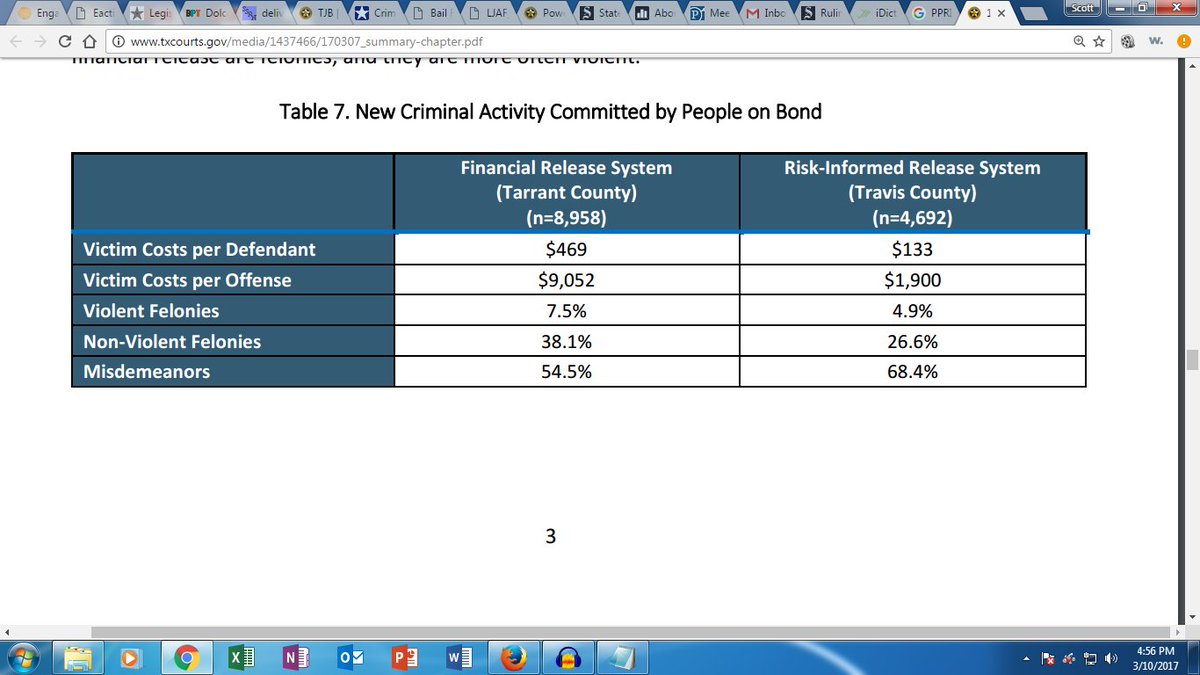
The Public Policy Research Institute at Texas A&M studied the pool of released defendants in Travis and Tarrant Counties, which use a risk-assessment and money bail system, respectively, over three-and-a-half years to compare outcomes.

During that period, the study found, released defendants in Tarrant County were responsible for 20 percent more crimes committed and 12 percent more serious violent crimes. Here are the details (p. 49):
financial bond is less effective at preventing involvement in criminal activity. The rate of new offending stands at 13.5% in the financial release system, a rate 20% higher than in the risk-informed system (11.1%). Violent offending is also 12% more prevalent where people are released based on ability to pay – 2.7% in Tarrant County compared to 2.4% in Travis County. Of all offenses committed by people on bond, 50% more are violent felonies where release is determined by financial ability (7.5% versus 4.9% in the risk-informed jurisdiction). 
So more crimes were committed by pretrial defendants under the money-bail system, and a much greater proportion of those (50% more!) were violent crimes.

Perhaps most significantly, as Grits has noted before, there were zero murders committed by pretrial defendants under the risk-based system in Travis, compared to ~18 under a money bail system in Tarrant.

In other words, the best, Texas-based research found exactly the opposite of what Ms. Rumenap is claiming.

That's why anyone seriously concerned about public safety in light of these numbers should support risk-based bail reform. There may be other valid arguments against using risk assessments (e.g., they work best as part of a well-developed pretrial services system that doesn't everywhere exist). But the best public-safety arguments are on the side of reformers.

SEE ALSO: Responses on TribTalk to Rumenap's article from the Smart on Crime Coalition and Mary Mergler of Texas Appleseed.

Tuesday, April 24, 2018

Levin: Rural counties need to get on justice-reform train

The Texas Public Policy Foundation's newsletter arrived in my Inbox this morning and their top story related to over-incarceration in rural counties, focusing on pretrial detention:
What to Know: Criminal justice reforms are decreasing jail populations and recidivism rates. 
“The American criminal justice system’s gradual realization that too many people are in jail needlessly just got a large, visible boost from the city of Philadelphia,” the Washington Post reports. “The city announced last week that it would close its notorious 91-year-old House of Correction jail because reforms begun two years ago have dropped the city’s jail population by 33 percent, without causing any increase in crime or chaos. 
Defense attorneys are working harder to get defendants released quickly with no bail or low bail, prosecutors typically don’t oppose that, and the city’s judges are releasing them. Philadelphia police are taking more defendants to treatment rather than jail. More petitions for early parole from longer sentences are being granted. More space is now available in the city’s six jails for rehabilitation programs, and less overtime pay is needed for jail guards.” 
The TPPF Take: Such reforms are making a real difference in many urban areas like Philadelphia, but some rural areas are lagging behind. 
“Rural jail populations are continuing to explode even while the last five years have seen sharp declines in urban areas and modest drops in suburban areas,” says TPPF’s Marc Levin, who heads the Right on Crime project. “The largest contributor to these jail populations are defendants awaiting trial. Fortunately, there is light at the end of the tunnel. As we highlight in a report to be released at the end of the month, many jurisdictions are stepping up to stem the tide of pretrial incarceration in rural areas.”
They then linked to a recent column in The Hill by TPPF's Marc Levin arguing that rural over-incarceration risks those areas being "left behind as the criminal justice reform train leaves the station."

Wrote Levin, "rural jail populations are continuing to explode even while the last five years have seen sharp declines in urban areas and modest drops in suburban areas. The largest contributor to these jail populations are defendants awaiting trial."

He could (and perhaps should) have also added, as the New York Times reported last fall, that rural counties are sending people for incarceration in state prisons at vastly greater rates than their urban counterparts. And of course, since people who can't make bail are sentenced to incarceration more often than those who are released pretrial, there's a strong correlation between excessive pretrial detention and over-incarceration at TDCJ.

These are choices being made by local officials in rural counties - it's not just them being left behind by the criminal-justice-reform train because they don't have the internet, or a ticket, or whatever. Not in 2018. 

The fact that the the tuff-on-crime ideology of rural over-incarcerators remains intractable has political consequences, explaining a great deal of the opposition to criminal-justice reform at the Texas Legislature.

The Texas Sheriff's Association, for example, is politically dominated by rural Sheriffs because they far outnumber their urban counterparts with the result that they're among the most regressive anti-reform advocates at the capitol. Same goes for the Texas District and County Attorneys Association. The big city DAs get more press, but as far as the Association's internal politics goes, they're outnumbered by their rural counterparts. That's why the group retains an essentially regressive agenda, even though the big-city DA offices who pay most of their bills are moving in a more moderate direction. (Related: From In Justice Today on state prosecutor associations: "Prosecutors aren't just enforcing the law, they're making it.")

Grits is glad to see TPPF focusing on rural over-incarceration; there's no other organization in Texas taking up the banner, and the conservative think tank is well-positioned to address the topic. 

At some point, reformers must also address rural law enforcement's regressive impact on both the state-prison population and its political culture. But journeys of a thousand miles begin with first steps.

Wednesday, December 27, 2017

In defense of using risk assessments at bail hearings

Echoing sentiments your correspondent expressed in a segment our November Reasonably Suspicious podcast and amplifying them with additional research, three statisticians recently made the case in the New York Times that, despite allegations that some algorithms promote racially discriminatory outcomes, they remain "powerful tools for combating the capricious and biased nature of human decisions." Here's a notable excerpt:
Bail decisions have traditionally been made by judges relying on intuition and personal preference, in a hasty process that often lasts just a few minutes. In New York City, the strictest judges are more than twice as likely to demand bail as the most lenient ones. 
To combat such arbitrariness, judges in some cities now receive algorithmically generated scores that rate a defendant’s risk of skipping trial or committing a violent crime if released. Judges are free to exercise discretion, but algorithms bring a measure of consistency and evenhandedness to the process. 
The use of these algorithms often yields immediate and tangible benefits: Jail populations, for example, can decline without adversely affecting public safety. 
In one recent experiment, agencies in Virginia were randomly selected to use an algorithm that rated both defendants’ likelihood of skipping trial and their likelihood of being arrested if released. Nearly twice as many defendants were released, and there was no increase in pretrial crime. 
New Jersey similarly reformed its bail system this year, adopting algorithmic tools that contributed to a 16 percent drop in its pretrial jail population, again with no increase in crime.
Reacting to a risk-assessment algorithm used by the probation department in Broward County which was criticized in a widely cited ProPublica article, the authors insist that:
It is not biased algorithms but broader societal inequalities that drive the troubling racial differences we see in Broward County and throughout the country. It is misleading and counterproductive to blame the algorithm for uncovering real statistical patterns. Ignoring these patterns would not resolve the underlying disparities.
On our podcast, Amanda Marzullo and I concluded that the addition of a right to counsel for indigent defendants at bail hearings could add an additional layer of protection and a means to make an individualized case for specific defendants whose situation may be more sympathetic then their algorithmic scores. So not just risk-assessments, but risk-assessments-plus. The authors similarly conclude algorithms are only one part of a broader puzzle: they "are not a panacea for past and present discrimination. Nor are they a substitute for sound policy, which demands inherently human, not algorithmic, choices."

Monday, November 20, 2017

Evaluating criticisms of risk-assessments in bail reform

Risk assessments have always been part of the justice system in some form or fashion. But until recently, there was little if any transparency surrounding them. Instead, they involved some unknown process that goes on in a prosecutor's mind, or a judge's, or a probation officer - even police officers. All of these people assess risk of re-offense and "future dangerousness" every day as part of their jobs. But who can really know on what basis?

That's why outsourcing risk assessments to external, independent, transparent instruments has been so controversial - 1) it's taking a decision making function from humans in the system who may rebel at a perception of decreased power, and 2) the fact of its transparency means a risk-assessment instrument may be criticized in a level of detail that the inner workings of a judge or probation officer's decisions could never be.

Grits has argued that risk assessments play a different role in different parts of the system and that pretrial detention is an area where the benefits likely outweigh the problems. Here's an excerpt (6 min.) from the November episode of the Reasonably Suspicious podcast elaborating on that conversation.


While criticisms of risk assessments have not yet scared me off their use in the pretrial detention context, they have caused me to pay closer attention to arguments from those who think they may be problematic.

Beyond critiques of racial disparities, these academic authors (Upturn's John Logan Koepke and David G. Robinson of Georgetown Law) blame risk assessments for using historical data which may not take into account concurrent reforms enacted alongside risk assessments that can mitigate the risk of pretrial failure (the most effective of which, they say, are repetitive reminder calls and texts). They also criticize agencies for basing risk assessments on data from other jurisdictions,  though they note that those created for a specific jurisdiction often have much smaller datasets. So there's a tradeoff between locality and a robust dataset, the importance of which they undersell just a bit. They recommend the instruments be frequently updated using local data to the greatest extent possible (which is a theme we visited in our podcast segment).

In essence, the concern is that data-based actuarial tools are inherently backward-looking and can't capture the effects of concurrent reforms. For example, "Expanded pretrial services will reduce the risk of failure to appear," but a risk assessment based on pre-expansion data wouldn't capture that. On the other hand, if the instruments are updated and validated periodically, over time that should work itself out.

Finally, in the case of bail reform - at least in the Harris County, Texas context - the maximal harm hypothesized from risk assessments simply doesn't outweigh harms from the status quo of requiring money bail for everyone:
If a risk assessment system is developed on data from before risk mitigating reform, and misjudges a defendant’s true level of risk, such decision-making frameworks might unnecessarily burden defendants who, in reality, do not need to be jailed or to receive as much supervision upon release as the matrix suggests, in order to succeed. This observation is especially relevant given the literature on lower-risk defendants and release conditions. Multiple studies have shown that lower-risk defendants actually succeed on release more often when released without conditions, and that placing conditions of release on lower-risk defendants can actually worsen their odds of success.  
Such a scenario — where defendants are systematically overestimated as riskier than they truly are, leading lower-risk defendants to be subjected to conditions of release that are counterproductive — could perversely sustain an avoidably elevated pre-trial failure rate. In the future, policymakers might look back on the move toward non-financial conditions of release as misguided, and might inaccurately conclude that, despite its ills, a money bail system is the least bad option. As we detailed above, the history of bail reform is one of unintended consequences. The risks we describe in here are not an unimaginable parade of horribles. Instead, they are plausible unintended consequences from today’s bail reforms.
That said, Grits agrees this is the greatest potential problem from implementing risk assessments. In many ways it's a bigger issue than racial disparities, or rather, it's the main reason why racial disparities are important. The impact of assessing low-risk people as medium or high can itself have a criminogenic effect and result almost in a self fulfilling prophecy. IMO that's a great argument for constantly updating and validating risk assessment instruments, but not for avoiding their use - at least in a place like Harris County where nearly all defendants, low-risk or high, would otherwise be held pretrial if they couldn't make bail.

The authors suggest adjusting risk assessment scores when the RA is based on pre-reform data:
jurisdictions that are reforming bail practices should rely on fresh and local data, gathered after their other pretrial reforms have taken root, in order either to build or to calibrate their risk assessment tools. Where prereform data is used, the tools must be numerically adjusted to take account of the helpful impact of reforms. Existing “off the shelf” risk assessment tools, whose predictions assume that defendants still face the same long odds of succeeding outside jail, should not be used without adjustment in jurisdictions where those risks have been mitigated.
In my experience that may be a hard sell. Those adjustments would become highly politicized numbers, and I'm not confident decision makers who spent millions fighting bail reform in the courts would rely on reformers' estimates to make them. Plus, if the reforms work, revisiting and adjusting the RA every couple of years, or even more often, would over time resolve the problem. But it's certainly another argument for continuous evaluation of the risk-assessment instrument.

In the podcast, where we landed was that supplementing RA information with counsel at bail hearings might mitigate disparities because a lawyer (in theory) can communicate a client's particularized circumstance to the court in a way the risk assessment cannot. In the near term, before assessments can be evaluated to take into account the effects of concurrent reforms, that may be the best guard we have against their shortcomings - known and unknown - resulting in negative, unintended consequences.

Sunday, November 12, 2017

November Reasonably Suspicious Podcast: Let me be your lawyer dog, or I won't be your man at all ...

Check out the November edition of Just Liberty's Reasonably Suspicious podcast, covering Texas criminal justice policy and politics. We're coming out a little early this month to keep things on the right side of the Thanksgiving holiday. You can listen to the latest episode here, or access it on all the usual channels: iTunes, Google Play, YouTube, or SoundCloud.


If you haven't subscribed yet, take a moment to do so now to make sure you won't miss an episode. Topics this go-round include:

Top Stories
  • The Louisiana Supreme Court said a man who told police "Why don't you just give me a lawyer, dawg?" wasn't really asking for a lawyer. But this is common. A recent Texas case denied an attorney on the same basis.
  • Risk assessments have come under fire from liberals for generating racial disparities. What are the implications for using them as part of Harris County bail reform?
Game Segment: Tea Leaf Reading
Looking forward to criminal-justice-related interim charges at the Texas Legislature.
  • Appropriate treatment, services to offenders aged 17-25 to reduce recidivism, future crime. (See an earlier podcast segment on the topic.)
  • Ineffective Assistance of Counsel: Front-end and back-end solutions.
Death and Texas
  • US Supreme Court hears oral arguments in Ayestas v. Davis, seeking funds for investigation into an ineffective assistance claim.
  • A state district court considers Ex Parte Flores in which the key eyewitness was subjected to hypnosis before changing her ID of the suspect. She at first told police the suspect was a white man with long hair. Mr. Flores is an Hispanic man with short hair.
The Last Hurrah
Rapid fire quick takes:
  • USDOJ deleted 70% of tables from the newest edition of the national Uniform Crime Reports.
  • A new study says police bodycams haven't changed police behavior. Why is that?
  • Rent to own furniture companies as modern debtors prisons.

Thursday, October 26, 2017

Risk assessments under fire, but critics don't differentiate uses

Grits has been a supporter of risk assessments as part of pretrial detention determinations in lieu of bail, which available evidence suggests leads to far better outcomes. But lately there has been much weeping and gnashing of teeth among liberals over risk-assessment instruments, charging that they result in racial bias depending on which variables are used.


In all these debates, Grits has seldom if ever seen commentators focus on a key distinction between how risk assessments are used at different stages in the process.

Grits is not a fan of their use in any but an advisory capacity for predictive policing or in sentencing. In policing, probable cause must always be individualized to a specific person. And punishments should be decided by judges and juries, not algorithms (although if we're honest, that process is really controlled by prosecutors and certainly isn't immune from racial bias).

But using risk assessments to decide pretrial detention is a horse of a different color, because the alternative is that money bail is required of all. That means people who can't afford bail must rot in jail until their case is resolved, putting immense pressure on even-innocent people to plea. In that circumstance, the benefits to liberty from applying a risk-assessment tool that lets the majority of poor people out pretrial outweighs any detriment from bias in the instrument.

Risk assessments also have well-recognized uses for probation systems which are key to reducing recidivism and encouraging probationers' success. Low-risk probationers subjected to intensive programming (or for that matter, who are revoked to prison) tend to escalate in criminality in ways which are counterproductive, a growing body of research indicates. So assessing risk/needs is key to deciding what programming should be assigned.

In those circumstances, Grits remains unconvinced that bias from these instruments is greater or more harmful than the bias being exhibited by judges. For example, the videos of bail hearings before magistrate judges which arose out of the Harris County bail litigation demonstrated near-universal disrespect for misdemeanor defendants' pretrial liberty interests, whereas the risk assessment would have freed most of them. So which is more biased? And which bias is more concerning?

Predicting "future dangerousness" (as the courts have dubbed risk assessment by juries in the sentencing phase of capital cases) is always a dubious prospect, but also a fundamental part of what the justice system does. In most phases of the process, those decisions should probably be left to the decision-makers traditionally in charge of them.

In the case of pretrial detention, though, where the defendants are still presumed innocent by the system, IMO opposing the use of risk-assessment tools amounts to allowing the perfect to become the enemy of the good. Ditto for probation where there's a pragmatic need to assess probationers' risk in order to make decisions about programming, and risk levels can change significantly over time.

The desire to purge the system of racial bias is understandable, but please let's not throw the baby out with the bath water.

Wednesday, August 23, 2017

The Public Safety Case for Bail Reform

Bail reform failed at the Texas Legislature this year, but litigation pending against Harris County may still dramatically alter the landscape regarding judges making pretrial detention decisions based on the ability to pay. (Grits interviewed one of the litigants, Texas Fair Defense Project Executive Director Becky Bernhardt, when the litigation launched last fall.)

Harris County lost Round One in federal district court. While we wait to see what the 5th Circuit thinks about that case, the action on bail reform shifts to New Jersey, where Gov. Chris Christie signed comprehensive bail reform into law last year. The bail bond industry is hitting back hard. See coverage from the NY Times and NBC News.

Reform opponents including the Texas District and County Attorney Association Twitter feed have been touting this case as an example of the failures of risk-assessment systems. In that episode in San Francisco, a court employee entered mistaken data into a risk assessment developed by Texas' Laura and John Arnold Foundation and a released inmate committed a murder.

That is indeed a terrible tragedy. But if a court employee entered flawed data, that's hardly an indictment of the tool. Moreover, nobody said the risk assessment system will never make mistakes, only that it will make FEWER mistakes than human jurists. In the end, flaws in either system can only be judged by answering the question, "Relative to what?"

These are vast human systems prone to error at the margins. Based on various studies by academics and practitioners, Grits has estimated in the past that perhaps 1.5 to 2.5 percent of TDCJ inmates at any given time are actually innocent people falsely convicted. Some of them, like Timothy Cole or Carlos De Luna, may die before they're exonerated. And where there are false positives, there are also false negatives, where people should have been jailed but aren't. In extreme cases, some of them will take the additional opportunity to commit murder. We're talking about an error-ridden system with a change-resistant culture.

But because both risk-based and bail systems can generate errors, the question becomes, "which is more erroneous?" And the answer is the money bail system by a country mile.

A study out of Texas A&M comparing Tarrant County's money bail system to a risk-based system in Travis County found that 7.5 percent of those released on bail committed a violent felony while they were out compared to 4.9 percent under a risk-based system. Victim costs were also much lower under the risk-based system.

Page 50 of that report includes a table with more detail. Under Tarrant's money-bail system, 4.6 percent of those out on bail allegedly committed a violent assaultive offense, compared to 3.6 percent under a risk-based system. Similarly, 2.1 percent released on bail in Tarrant allegedly committed robberies, compared to 0.8 percent in Travis. So the risk assessment system doesn't always identify potential problems, but it does a better job than human judges.

To the point of the case out of San Francisco involving the Arnold Foundation risk assessment, the A&M study found that 0.2 percent of defendants released on money-bail in Tarrant during this period committed homicides, compared to 0.0 percent in Travis. That's about 18 murders over the 3.5 year period studied, which for the record is more than zero.

But, even if there had been a homicide or two committed by pretrial releasees in Travis County under the risk assessment model, any criticism must be couched in some context: Compared to what? Are we judging based on a comparison to outcomes under the money-bail status quo, which are much worse? Or are we comparing to some Platonic ideal/fantasy where no one released pretrial ever commits a new offense or fails to show up for court? Every system looks terrible compared to the fantasy. But if we're picking the best among real-world options, errors under the risk assessment model are more tolerable.

If one murder by a pretrial releasee is hyped by reality TV stars and heavily covered by the media, while 18 murders under the money bail system in a single Texas county get no coverage at all, that doesn't mean all the problems lie on the risk assessment side. It just means the bail-bond side is more adroit than reformers at PR.

A risk assessment tool does what it says, assesses risk. It does not eliminate risk. And it is not a crystal ball. Moreover, as they're implemented, tools should and inevitably will be constantly evaluated and tweaked to improve performance. We're at the beginning of this conversation, neither the Arnold Foundation assessment nor any other represents the last word on what these tools will finally look like.

But even at these early stages, it's possible to identify and dismiss disingenuous and self-interested criticisms, particularly those which ask us to judge risk-assessment errors in a context-free environment. When confronting a problem as decentralized, vast, and flawed as American mass incarceration, it's important not to allow the perfect to become the enemy of the good.

Thursday, March 09, 2017

Dead dogs, shot owners, greedy clerks, phony risks, and a 'seismic change in police interrogations'

Here are a few odds and ends that each merit their own blog posts, or at least they would if I weren't spending my days writing Just Liberty emails and action alerts. (E.g., go here to send your state rep an email asking them to sign on in support of Rep. Garnet Coleman's "Sandra Bland Act.") So while Grits is focused elsewhere, check out:

Tuesday, January 03, 2017

Pot proposals, waiting on bail reform, and other stories

Here are a few odds and ends which merit Grits readers attention:

Juvenile justice agenda detailed
Following up on the Texas Appleseed/Texans Care for Children report on school discipline, the Dallas News editorial board suggested this agenda for juvenile justice reform in 2017 at the Texas Lege: "Find funds to help schools hire more counselors and mental health professionals; eliminate the use of tasers and pepper spray on students if a weapon is not involved; improve data collection on police activities in schools to better understand the complexities of the school-to-prison pipeline."

Waco DA: We don't need no stinking evidence
The first trial of a biker charged after the 2015 Twin Peaks shootings will occur in April, nearly two years after the event. These are weird cases. In the overwhelming majority there is no individualized evidence against the defendants. A prosecutor in the story said the trials would take about two weeks, but that presumes there's evidence to present that these individuals participated in a conspiracy. By all accounts, for most of them there's not. Here's a Grits prediction: When all is said and done, when trials are all over and appellate courts are through with it, I don't believe the number of people convicted of any crime related to the shootings, out of the 155 who've been charged, will ever reach double digits. The McLennan DA long ago entered witch hunt territory regarding these cases, and so far the judiciary has declined to rein him in. But even in Waco, Texas, you can't convict dozens of people with no accusatory evidence at all. And in the main, that's the Kafkaesque situation in which the overwhelming majority of these 155 defendants seemingly find themselves.

Bail reform poster-child
This Dallas News story offers up a poster-child case for bail reform: "Why Dallas County can set $150,000 bail for a $105 shoplifting charge, and how taxpayers lose." We still haven't seen legislative proposals yet implementing the Judicial Council's bail reform recommendations. But in the meantime, New Jersey is implementing a risk-assessment based system which assumes most defendants will be released while awaiting trial. Grits hopes the Texas bill follows suit.

Pot proposals
Here's a Fort Worth Star Telegram article detailing the various bills softening penalties for low-level marijuana possession being filed at the Texas Lege. The new Houston police chief, Art Acevedo, is predicting Texas will shift policies on pot. Also, in the Bryan College Station Eagle, retired District Judge John Delaney supported "decriminalization" of marijuna - a term which one discovers upon entering the debate means different things to different people. In Texas' context, "decriminalization" means backing HB 81/SB 170 creating a new civil penalty for pot possession instead of making it a criminal charge like a traffic ticket. Wrote Delaney:
Supporters of "decriminalization" argue it's a better approach because it doesn't result in the numerous collateral consequences of a normal conviction. One of those is an automatic 180-day driver's license suspension, regardless of whether the offense was connected to driving a vehicle. And license reinstatement isn't automatic, unlike release from jail after serving a sentence. To get a license back one has to file an application, pay a $100 fee, buy expensive "SR-22" insurance, and complete a 15-hour drug education course. 
Another consequence is a permanent criminal record of the conviction. It can affect employment opportunities for a lifetime. Just ask any small business owner about how hard it is to hire an employee with any drug conviction on his or her record, even if it happened more than a decade earlier. 
Another advantage to "decriminalization" is that it begins with a citation instead of an arrest. That avoids the two hours of police time it takes to process someone who's arrested, leaving officers free to respond to calls such as burglary or domestic violence.
Cornyn key for D.C. justice reform
Grits fails to see why criminal-justice reform legislation couldn't pass under a Republican Congress. We've won reform measures in Texas with an all-R government. Maybe Texas Sen. John Cornyn can pass his sentencing reform bill now that there's no risk that a Democratic president might claim credit for the success.

Prison Policy Initiative 2016 retrospectives
Our friends at the Prison Policy Initiative ended the year with roundups of 2016's best criminal-justice commentary (including a couple of Grits items), the year's best research, and their own wish list for "winnable" reforms in 2017. Lots of good stuff amidst those links for those with a little reading time on your hands.

Monday, October 17, 2016

Forensic snafus, depressed DAs and judges, and the risks of risk assessments

In a few weeks, this accursed presidential election will be over and, the following week in Texas, state legislators will begin prefiling bills. Until then, there's little for the policy-minded to do but hunker down until the circus leaves town and plan ahead for what's next. To that end, here are a variety of recent stories which merit Grits readers attention more, IMHO, than the latest bloviations on the presidential campaign trail.*

Ask CCA candidate why she won't use public defenders
Texas Court of Criminal Appeals candidate Mary Lou Keel stopped using the Harris County Public Defender Office because of a dispute with some of their attorneys, and the HCPD won't say what it involved, the Houston Chronicle reported. Journalists should inquire and she should say. After this most wretched primary season which saw ignorance rewarded and qualified candidates punished, Grits harbors few illusions that people cast informed votes in these races. But in theory, at least, it'd be useful for voters to know the likely next CCA judge's views on public-defender systems and indigent defense, to the extent the conflict sheds any light on them. News of the conflict emerged in light of a new state audit of Harris County indigent defense systems, a document which Grit may delve into in more detail in a future post.

Another forensics SNAFU could affect thousands of DWI cases
In Dallas, "Thousands of DWI convictions in North Texas could be jeopardized after the testimony of a state forensic scientist recently came under scrutiny." Get used to these sort of headlines. In the coming years, many forensics historically admitted into evidence by courts will either be invalidated or, even where the science is valid, found to be performed by incompetent analysts using unjustifiable methods. The temptation to treat them each as isolated incidents should be ignored. In many cases, folks are looking skeptically at long-used forensics for the first time to assess their validity, and more often than not, what they discover isn't up to snuff.

What to do with a depressed judge or DA?
Resignations from Dallas County District Attorney Susan Hawk and 5th Court of Appeals Justice David Lewis raise questions about what should happen when public officials suffer from severe depression or other serious mental illness while in office. The office-holder leaving voluntarily solves the instant problem from the perspective of formally staffing the slot, often after months or longer of putting off the inevitable. But it's a near certainty the situation will recur. There was apparently a move underway to remove Justice Lewis (whom Grits first met when he was one of the attorneys in the Dallas sheetrock/fake-drug scandal, an outrageous frame-up job around the turn of the century in which informants and DPD narcotics detectives intentionally framed illegal immigrants). I feel bad for him and Judge Hawk, but I'm glad they're stepping down. It's extraordinarily difficult to oust someone from public office in Texas for a medical condition, as it should be; even writing the words seems wrong. Some will argue that behavioral health problems are different from cancer or a heart condition because they specifically impact cognition. OTOH, plenty of Texas prosecutors and judges without diagnosed mental illnesses have suffered from poor judgment and impaired cognition - sometimes to much more deleterious effects than in either of these two instances - and nobody but voters can take them out.

Documenting a dystopian, modern-day witch hunt
The documentary "Southwest of Salem" about the San Antonio Four aired on the Discovery ID network over the weekend. See Rolling Stone's writeup, which observed that transcripts from the trial "read like a dystopian nightmare."

Debating the risks of risk assessments
This assessment at the Washington Post of the debate surrounding whether "risk assessments" generate racially discriminatory outcomes more or less sums up my view: 1) There are no perfect risk assessments because some of the risk factors reflect societal disparities and interpreting their meaning involves value judgments and tradeoffs, not static, objective analyses. However, 2) risk assessment instruments overall pretty clearly generate more consistent justice for more people and discriminate less than judges and prosecutors.  So for now - depending on the instrument - Grits generally favors them, though I'd like to see not-for-profit models used which don't involve black-box analyses which defense lawyers can't refute nor cross-examine.

Conflict of interest and prosecutorial discretion
A new article for Grits' reading list: "Rethinking prosecutors' conflicts of interest." The authors urge in particular reconsideringprosecutorial discretion, opining that "Conflicts of interest are endemic to almost all prosecutors’ discretionary decisions, and are the source of many instances of misconduct and abuse."

* It's hard to imagine that, at this late date, anyone politics-and-policy-focused enough to read this blog is still an "undecided" presidential voter. And if you've already decided, reading the latest back-and-forth provides no new or useful information. If one can muster the mental discipline to ignore it, doing so frees up a lot of brain space.

Monday, September 05, 2016

Rural counties driving prison growth, and other stories

With Labor Day off, let's take an opportunity to clear Grits' browser tabs of stories which won't immediately make it into individual blog posts:

Celebrate the CCA by sunsetting it
The Texas Court of Criminal Appeals turns 125 this year, according to a perfunctory salute and abbreviated history from the state bar. Grits believes we should celebrate by eliminating it and merging Texas' two high courts.

Focus on recurrent deaths, medical care at Harris jail
According to an article in the Huffington Post, which prominently quoted Harris County Public Defender Alex Bunin, "Texas largest jail hasn't learned much from Sandra Bland's death." According to the story, "Inmates die [in the Harris County Jail] at a higher rate per capita than most other jails in the nation, according to a Huffington Post analysis of death data from July 13, 2015, to July 13, 2016." Moreover, "Most of the deaths were related to medical issues, as opposed to the results of assault or suicide."

DAs: Keep junk science if it supports our convictions
A presidential advisory commission announced it will issue a draft report critical of several different brands of junk science and the national district attorneys association went batshit crazy, issuing this Chicken-Littlish screed most notable for its breathless tone and sweeping overstatements about what seems to be a fairly modest document. This commission isn't saying anything different than the National Academy of Sciences did in 2009; it's not that controversial at this point to say that bite-mark, tire print, or tool-mark evidence has no scientific basis, and the subjective nature of DNA mixture interpretation is becoming increasingly well known (particularly here in Texas). NDAA's tantrum reads like they're shaking their fists at the sky and decrying that it's blue.

Rural counties driving mass incarceration?
This New York Times report documented at the national level a trend which has been evident in Texas for some time: Incarceration rates for people from rural counties now far outstrip urban ones, and  differences in crime rates cannot justify the differences. Scroll down for an interactive county level map showing incarceration rates and trends. As in the rest of the country, incarceration rates per 10,000 residents for the largest Texas cities were on the low side: Travis 21.1, Bexar 29.6, Harris 30.9, Dallas 32.3, Tarrant 31.2, El Paso 14.2.

By contrast, the highest incarceration rate was Kenedy County in South Texas, with 225 residents per 10,000 incarcerated. In some cases, counties side by side had radically different rates, posing provocative and awkward questions about whether Texas is providing equal justice across jurisdictions. E.g., Randall County's incarceration rate per 10,000 was 31.7; next door in Potter County it was 76.5 (Amarillo straddles the county line). Similarly, suburban Collin County had an incarceration rate of 11 per 10,000, while its poorer, more rural northern neighbor, Grayson County, had a 58.4 per 10,000 rate.

SA police union bullying tactics partially succeeded
I thought this was a pretty clear-eyed assessment of the recently inked labor deal between the city of San Antonio and the local police union. A notable tidbit: "City Councilmen Rey Saldaña and Ron Nirenberg cast lone votes against the new contract last week, and while their opposition did not attract allies, it did serve to highlight what local members of the #BlackLivesMatter movement have been saying all along: the contract inhibits police leaders from imposing disciplinary actions on officers and making the punishment stick."

Just in time for Labor Day
Continuing a theme Grits began on Saturday, the NY Times yesterday offered up an editorial titled, "When police unions impede justice." Give it a read.

Risk assessment resources
Heard of the Laura and John Arnold Foundation's risk assessment model but haven't dug into the details? Here's a page describing it with a link to related resources and video from a number of prominent Houston pols.

Koch Institute on Kaepernick
The Charles Koch Institute published a column defending San Francisco 49ers QB Colin Kaepernick's decision not to stand for the national anthem because of racial injustice and police brutality issues, comparing Kaepernick's position to Frederick Douglass and citing Antonin Scalia in support of his free speech rights. Grits mentioned the other day that the Charles Koch Foundation recently funded a major journalism project on police shootings of unarmed people in Texas, so it's not just a one-off. Coupled with Rick Perry's and Glenn Beck's recent embrasure of the #BlackLivesMatter cause, sympathy among Koch outlets contributes to the impression that the movement for black lives may find conservative allies for significant chunks of its criminal-justice agenda. There have definitely been overtures.

Monday, June 27, 2016

New White Paper on pretrial release and bail reform in Texas

Under my (Michele Deitch's) supervision, graduate students at the LBJ School of Public Affairs wrote a series of policy briefs in response to issues raised at the University of Houston's Symposium on Police, Jails, and Vulnerable People held this past January and announced previously on this blog. These briefs provide useful background information and practical policy recommendations for Texas to consider adopting in the 2017 Legislative Session.

The first policy brief we've released, Risk Not Resources- Improving the Pretrial Release Process in Texas, is related to pretrial practices in Texas. It looks like pretrial reform has some traction at the Lege and we expect this brief to be a welcome resource for people interested in thinking about what steps need to be taken to improve our ineffective bail system.

A few highlights from the report:

1. The only way to have a fair pretrial system is to evaluate people based on their risk of missing court or getting re-arrested. There are modern risk assessments (most notably, the PSA-Court developed by the Arnold Foundation, which Harris County will begin using shortly) that can be performed quickly and inexpensively because they do not require a defendant interview, relying instead on information that booking officers should be looking up in any event.

2. Using risk assessment and releasing low-risk people is cheaper and more effective than the current bail system. Statistically, most people are likely to come back to court without the imposition of any conditions or the requirement of collateral. Counties spend millions of dollars every year locking up poor, low-risk people who are legally innocent and unlikely to cause any problems before trial. If we released those individuals and redirected a portion of those savings toward evaluating defendants' risk on the front-end and supervising the higher-risk folks who were released, we could decrease the total bill for the county without any negative public safety implications.

3. Texas needs a presumption of release with the least-restrictive conditions necessary to ensure the safety of the community and the defendant's return to court. This is the logical progression of the state's right to bail - we need to remember that bail was originally intended as a way to release people before trial, and our statutes should reflect that. Bail schedules requiring every arrested person to pay a cash bond to be released for even the most minor offenses are ineffective, unfair, and in the words of the US Department of Justice, "bad public policy."

A more functional pretrial release system will help prevent our jails from housing defendants who don't need to be there, make sure that defendants who pose a high risk to the community are either properly supervised or detained, reduce overcrowding, and save the county money.  But of course, there are other issues to be addressed as well if we want our pretrial system to be safer, fairer, and more effective.  Stay tuned for future policy briefs regarding diversion of people with mental health issues, jail safety and suicide prevention, and the need for improved oversight of Texas jails.

You can read Risk, Not Resources:  Improving the Pretrial Release Process in Texas, written by LBJ School graduate students Nathan Fennell and Meridith Prescott, here.

Thursday, June 09, 2016

Risk assessments, visitation, and imaginary prisons

While I'm preoccupied with other matters, including another small video project to be unveiled soon (the last one has been viewed about 100K times now and received nearly 1,000 Facebook shares), here are a number of items which merit Grits readers' attention:

On the risks of risk assessments
Grits' views on risk assessments are still up in the air, or more specifically, situational. I tend to dislike the idea at sentencing (a lot of "future dangerousness" testimony in capital cases has been pure junk) but mind them less for parole boards, whose members by definition make risk assessments with or without a formal instrument. I also mind the idea less for pretrial assessments, when the alternative is to leave folks sitting in jail. But the critique is that risk assessments are inaccurate and discriminatory, and this blogger did a good job compiling links to stories that call them into question, for those interested. This is an important emerging debate among both advocates and criminal justice professionals; I hope it can be had with a tad less vitriol than has characterized the discussion so far. Folks can disagree in good faith here.

In favor of in-person visitation
Check out a cool interview with our pal Jorge Renaud in a publication called The Establishment on the grassroots pushback against elimination of in-person visitation at prisons and jails.

Offender Orientation manual
A new version of the TDCJ Offender Orientation manual came out in April.

Williamson County DAs keep embarrassing local voters
Between John Bradley and now Jana Duty, who was recently disciplined by the state bar, Williamson County voters sure know how to pick reputable DAs! Local leaders this week held a press conference giving her until "sunset" on Friday to resign, though I'm not sure there is legal leverage to bounce her out. Every Texan above a certain age knows of "sundown towns," of which there used to be a few here, but this is the first time I've heard of such an ultimatum aimed at a sitting elected prosecutor.

Imaginary Prisons
An old college buddy, local architect-turned-furniture-maker Mark Maček, turned me on to Giovanni Battista Piranesi (1720–1778), which led me in turn to this 16-print series of sketches titled "Imaginary Prisons." Awesome.


If you've got a spare $400K or so you could probably buy a copy. I'd like to read the orientation manual for THAT place.

Thursday, May 26, 2016

Reform on bail and muni fines would be big boon for H-Town indigents

Two different stories out of Houston portray folks chipping away at unnecessary local jail detention from different angles.

Bail litigation adds oomph to reform push
First, see Lise Olsen's story, "Lawsuit adds pregnant mom who was jailed five days after traffic stop: Harris County pretrial detention practices challenged as unlawful," Houston Chronicle, May 24. She runs through the named plaintiffs in  potentially important impact litigation "filed last Thursday by a Washington D.C. group called Equal Justice Under Law, which has been challenging what it calls money bail practices in federal court cases filed all across the United States. Other jurisdictions it has challenged include Ferguson, Mo. and San Francisco, Ca." (See earlier Chronicle coverage.)  Reported Olsen:
The lawsuit names Harris County Sheriff Ron Hickman, who oversees the jail, and the five county hearing officers that generally review such cases and set bond. On any given day, more than 70 percent of those jailed in Harris County are pretrial defendants who have been accused but not yet convicted of a crime, though typically only about 500 at any one time are jailed for minor misdemeanor offenses like petty theft or trespassing.

U.S. Department of Justice attorneys have been monitoring conditions in Harris County jail since 2008. An investigation by the Houston Chronicle found that 55 pretrial detainees died in Harris County custody from 2009-2015, including offenders jailed for misdemeanor crimes like trespassing. Last month, another man  detained because he could not post bail after allegedly stealing a guitar - a misdemeanor - was beaten to death by two inmates jailed on felony charges.

In part because of federal pressure, county officials have been working on reforms - announcing this year that they had obtained a grant to create a diversion court, revamp pretrial reviews and attempt to urge judges to increase release options for non-violent offenders. But advocates like Sen. Rodney Ellis of Houston say those plans left the flawed bond hearings in place - opening the door for the federal civil rights challenge that he supports.

The civil rights case remains pending in federal court - where Equal Justice Under Law attorneys are seeking reforms in lieu of any kind of monetary compensation for all pretrial defendants jailed in Harris County on misdemeanor offenses.
There was a time 10-15 years ago when the prospects for such litigation would have been much dimmer in the 5th Circuit, despite a similar fact pattern existing for a long time. That's a big reason why most of the 21st century reform movement in Texas has focused on legislative solutions. But shifts on the court itself, in the controlling jurisprudence, and, more generally, in the national conversation over justice reform, have opened up new windows of possibility for successful federal civil rights litigation. Grits is excited about the prospects for this one.

In a separate, related story, the Chronicle's Brian Rogers reported that, in response to examples like this new plaintiff, "On Tuesday, Harris County officials took an important step in attempting to address the issue, by announcing a new screening process to help judges determine which suspects awaiting trial can be freed without bail." (Ed. note: before the top of her head justifiably blows off, let it be said former Pretrial Services director Carol Oeller tried to get them to do this for years!)
Proponents of personal recognizance bonds have been stymied in the past by a reluctance on the part of Harris County judges to let suspects out of jail without bail. The conventional wisdom has been that suspects who do not have a financial stake in returning to court will abscond.

On Tuesday, though, county officials touted a new diagnostic tool as a way to move past a decades-old culture that has required every defendant in Houston to put up money or collateral to ensure they would return to court to resolve their cases.

"Obviously, dangerous people need to stay locked up," state District Judge Susan Brown said at a news conference. "For others, the most effective and efficient course of action may be to release them before trial - with conditions such as electronic monitoring or supervision within their community."
Rogers' analysis shows why I'm less apt to reject all uses of risk assessments. Without them, nobody gets a PR bond! Rogers goes on to give a little more information on the risk-assessment instrument they'll be using in Houston, developed by the indigenous Arnold Foundation:
Tuesday's announcement was made by a county committee that has long worked toward reform, the Criminal Justice Coordinating Council. Earlier this year, the committee spearheaded an effort to diagnose and solve problems in the system with a grant from the MacArthur Foundation.

The diagnostic test announced Tuesday was developed by the Houston-based Laura and John Arnold Foundation. It was described as a neutral-based data tool that would assist judges in gauging the risk that a defendant poses to the community.

Foundation representatives were on hand to explain that defendants do not have to be interviewed and given a subjective assessment. Instead, information about them that is readily available in court documents will be weighed by an algorithm to put each person on a continuum of risk. That assessment will be provided to judges who determine whether a defendant can be released without bail.

The nine factors that are considered include age, prior convictions - including misdemeanors, felonies and information about whether the offenses were violent - and whether they appeared for court in other cases. The assessment does not consider race, gender, past drug use, national origin or income.

Matt Alsdorf, vice president of criminal justice at the Arnold Foundation, said the diagnostic tool was developed using more than 1.5 million cases across the country.

"Our research team figured out the factors that are most predictive of defendants' likelihood of missing court or being re-arrested, and in particular being re-arrested for a violent crime," he said. "There's actually a fairly limited set of factors that are highly predictive of those outcomes."

The tool, which backers said has seen success in cities like Chicago and in the state of Kentucky, is being provided with training to the county for free.

Alsdorf said the assessment will provide judges with two risk scores: one on whether defendants will return to court and another on whether they will commit another offense.

With that information, a judge can decide if a suspect should be freed without bail, offered a bail outlined in the county's posted bond schedule or held without bail.

Screening suspects to figure out, statistically, who can be released on a personal recognizance bond, sometimes called "free bail," is expected to lower jail populations, which represent a major county expense.

But officials said it may take weeks or months to train personnel and launch the new system
Not only is this good news for Harris County, it also bodes well for Senate Criminal Justice Committee Chairman John Whitmire's pledged push to enact bail reform during the 85th Texas Legislature. Litigation can help achieve reform not just by getting courts to order it, but it can also spur action to either preempt or react to the courts, as witnessed with the implementation of this new screening tool. Litigation helps prime the institutional players to steel themselves for possible change, giving them a common enemy and thus a psychological motivation for solidarity. After all, every local official has an interest in them calling the shots over their respective areas of turf instead of some federal judge. So next session will be an excellent moment to show up proposing solutions, both for the chairman and for advocates hoping to effect bail reform statewide.

Houston muni courts almost never waive debt for indigence
Next, let's turn to municipal courts and debtors prison issues. Check out "Get a ticket while being poor in Houston? Here's how you might end up in jail," Michael Barajas, Houston Press, May 24. Explained Barajas:
Under Texas law, if you fail to pay, miss your court date and get arrested on an outstanding municipal court warrant for that no-insurance ticket you couldn’t afford to quickly pay, a municipal court judge (or, if you’re in the county’s jurisdiction, the local justice of the peace) is supposed to hold a hearing to determine why you didn’t pay. If the judge finds that you’re too poor and can’t afford the fines against you, you’re supposed to be given some options, like a reduced fine or community service, to pull you out of the red.

That rarely happens in Houston, according to a report by Mayor Sylvester Turner’s transition team tasked with studying the city’s criminal justice policies. According to that report, of the 168,948 Houston municipal court convictions in 2014, community service was offered in lieu of fines in only 2,759 cases. In only six cases did a judge deem someone poor enough to justify reducing or partially waiving fines. That means that while nearly a quarter of Houstonians live below the poverty line, the alternatives for low-income people struggling to pay tickets are used in fewer than 2 percent of cases before Houston’s municipal court judges. The mayor’s transition team report calls Houston’s Municipal Courts Department a “profit center” designed to rake in as much in fines and fees as possible, disproportionately punishing the city’s poor in the process.

Despite reforms her department has implemented in recent years, Presiding Judge Barbara Hartle says a number of factors can lead to someone’s arrest over simple municipal court fines, from overwhelmed judges and court staff to defendants who aren’t forthcoming to the court about the problems they have paying their fines and instead skip their court dates. Plus, she says, it’s not always up to the court who lands in jail for fine-only offenses. Hartle says she’s explicitly asked that Houston police officers stop arresting and jailing people with only class C warrants and instead bring them to an on-call judge. Hartle says that both state and local politicians have for far too long looked to municipal courts as revenue-generators — Hartle’s court, the largest in the state, sends millions of dollars to both the state of Texas and Houston’s general fund every year.
Those interested can see the Mayoral crimjust transition team's full report. (Full disclosure: The document was produced by a committee chaired by Grits contributing writer Prof. Sandra Guerra Thompson.)

Interestingly, Barajas offered this background on the Texan origins of the relevant federal court precedent:
By the late 1960s, Preston Tate had picked up $425 in fines for rolling through stop signs, running red lights and driving without a license on the streets of Houston. Paying off his debt wasn’t an option, not with a wife and two kids to feed off the measly $290 a month he earned, so a judge ordered Tate to serve 85 days at the local prison farm instead.

When Tate’s case reached the U.S. Supreme Court, his lawyers argued that jailing him violated his Fourteenth Amendment right to equal protection under the law, since a wealthy man would have easily avoided jail. The high court justices unanimously agreed, saying defendants must be offered some sort of alternative to jail if they truly can’t pay off the punishment on a fine-only offense.

The same year Tate’s landmark case was decided, his home state passed reforms allowing judges to offer payment plans for people who can’t afford to quickly pay for fines. In later years, the Texas Legislature added community service as an alternative to fines as well as a requirement that judges determine whether someone is indigent before locking that person up for failing to pay. A law passed in 2007 requires judges to make that determination in writing.
Despite the decade-old requirement that muni judges and JPs now must make indigency determinations in writing, wrote Barajas:
Lawsuits filed across the state contend that’s not happening. Last year, Austin was added to the growing list of cities across the country that have come under fire for municipal court practices, with a class action lawsuit filed in federal court by the Texas Fair Defense Project alleging the city “operates a debt-collection scheme that jails dozens of people each month because they are too poor to pay.” Earlier this year, attorneys in Amarillo filed a similar lawsuit saying that city’s collection practices amount to a “modern-day debtors’ prison.” [Ed. note: Our old friend Jeff Blackburn is involved with this one.] According to the lawsuit, Amarillo’s courts dispose of cases by assessing jail time over alternative punishments (like community service, a waiver or a fee reduction) at a ratio of about 47 to 1, despite the city’s 17.1 percent poverty rate. The Texas Civil Rights Project sued the city of El Paso following a Buzzfeed News investigation that uncovered several Texas courts, including one in El Paso, that had failed to give defendants a legally required indigency hearing before jailing them.
Here's an issue I hadn't seen flagged before:
That Houston cops would jail someone for outstanding municipal court warrants isn’t surprising, not when you consider the language printed on each of those warrants commanding “any peace officer of Houston, Texas” to take the defendant into custody “and place him in the jail of your city until the said amount due upon said judgment and the further costs of collecting the same are paid or until the said defendant is otherwise legally discharged.” Trigilio with the ACLU called the wording of those warrants “problematic.”
We also get this data tidbit:
It’s unclear how many of the thousands of people Houston municipal courts have sent to jail in recent years couldn’t pay or simply would not pay. However, Mary Schmid Mergler, with the advocacy group Texas Appleseed, says there’s pretty good evidence the city is jailing people who should obviously qualify as indigent. Mergler, who is compiling a report due out next month on municipal court practices across the state, says data she pulled from Houston’s Municipal Courts Department show that between the start of 2012 and the end of 2015, 12,132 people were jailed for failure to pay fines or to otherwise comply with a municipal court judge’s orders. That averages out to approximately 3,000 per year, or about eight per day. According to Mergler, more than 1,000 of those defendants were listed as “homeless.”
Good stuff. It's exciting to see all the interest and action surrounding these heretofore obscure and seldom-discussed issues. We are living through a period pregnant with opportunity for criminal-justice reform, from Congress to the statehouse in Austin all the way to the most humble county jail or municipal court. One prays Texas doesn't miss the moment.