Showing posts with label social media. Show all posts

Tuesday, June 11, 2019

Reasonably Suspicious, June 2019 episode: 2019 #txlege roundup, Dallas cops' racist Facebook posts, and are 'progressive prosecutors' really a thing?

Here's the June 2019 episode of Just Liberty's Reasonably Suspicious podcast:


In this month's episode:

Top Stories
Fill in the Blank
  • Texas Supreme Court: DAs can order prosecutors to violate constitutional rights
  • Bail-reform died, and that's a good thing
  • Should Texas prisoners all become plumbers?
Discussion: Are progressive prosecutors really a thing?

The Last Hurrah
  • Red-light cameras abolished, will debts be erased?
  • Colorado, Oklahoma surpassing Texas on #cjreform
  • Evidence left behind after Houston SWAT raid
Find a transcript below the jump.

Tuesday, September 20, 2016

Cash-register justice, against drug-free zones, and other stories

Here are a few odds and ends which merit Grits readers' attention while I'm focused elsewhere today:

Williamson County to allow citations for pot, DWLI
Great news: Williamson County has decided to let Round Rock police officers issue citations for low-level marijuana possession and driving with an invalid license, utilizing a 2007 statute authored by former House Corrections Chairman Jerry Madden. The move is being pitched as a pilot program which could expand to other agencies if successful.

Capital Appellate Fail
The Texas Defender Service today released a major report from our pal Amanda Marzullo on the inadequacy of the direct appeals process in capital cases. See the executive summary and the full report, as well as initial coverage from the Houston Chronicle. More on this later, perhaps, after Grits has had the chance to read it.

Guidance on operating inmate web pages
At the Electronic Frontier Foundation, Dave Maas offered guidance for people operating social media or web pages on behalf of  Texas prison inmates, after TDCJ earlier this year banned such accounts when operated by a third party.

Ticketed drivers need 'safe haven' to deal with debt
College Station muni Judge Edward Spillane had a great suggestion for encouraging drivers with outstanding tickets to come to court: "Why not encourage defendants to come to court and not be in jail by mandating legislatively or as a start courts having a policy that coming to court removes any pending warrant out of that court for misdemeanor charges on fine-only cases?" Comparing the idea to the mediaeval concept of "sanctuary" in churches, Spillane argued that "Safe Haven" legislation would reduce incarceration, encourage defendants to come to court, and "make it clear that jail is not the proper punishment for fine-only cases."

Contemplating collateral consequences
Noting that more than 7,000 felons return to Bexar County every year, the SA Express-News published a good story recently on collateral consequences from felony convictions. The gist: "Tough-on-crime policies extend well beyond harsh sentencing. There is a series of invisible sanctions we impose after the official sentence is met. People with felony records, especially drug-related cases, are legally discriminated against when seeking jobs, public housing, food assistance and student loans, not to mention voting and jury duty. One of the most harmful of these sanctions may be the discrimination of employment because a stable job with a living wage is a critical factor in keeping former convicts from relapsing into the criminal justice system."

Against 'drug-free zone' statutes
In Texas, drug offenses in a "drug-free zone" can result in lengthy mandatory minimums rivaling those for deadly weapon offenses. Texas prosecutors especially like the statute because, in the wake of earlier drug-law reforms, "keeping drug offenders in prison is becoming increasingly difficult." As other states reconsider drug free zones, eliminating that enhancement seems like a good way to stop sending a discrete class of nonviolent offenders away for super-long sentences.

Requiem for junk science
At the Wall Street Journal, Judge Alex Kozinski opined on the significance of a "new study from the President’s Council of Advisors on Science and Technology [which] examines the scientific validity of forensic-evidence techniques—DNA, fingerprint, bitemark, firearm, footwear and hair analysis. It concludes that virtually all of these methods are flawed, some irredeemably so." Wrote Kozinski, "Some forensic methods have significant error rates and others are rank guesswork." For example, "Bitemark analysis is about as reliable as astrology."

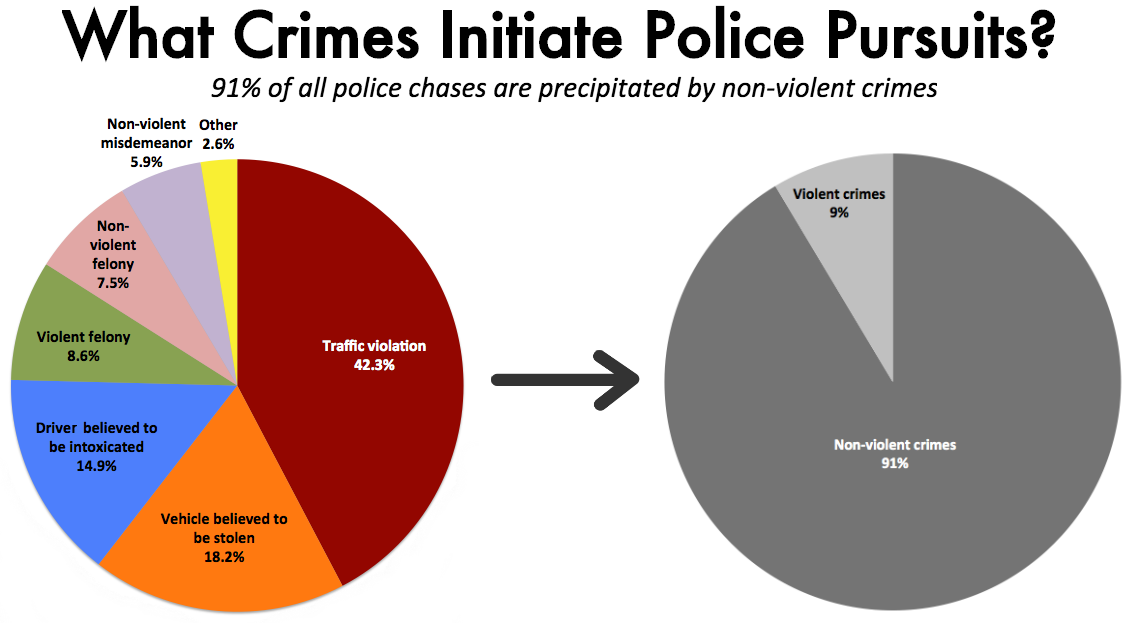
Most police pursuits over nonviolent offenses
What crimes generate police pursuits? Very few are violent felonies.


Cash-Register Justice
An academic paper confronting debtors prison issues from earlier this year has been appended to Grits' ongoing reading list. Here's the abstract:
Criminal justice debt has aggressively metastasized throughout the criminal system. A bewildering array of fees, fines, court costs, non-payment penalties, and high interest rates have turned criminal process into a booming revenue center for state courts and corrections. As criminal justice administrative costs have skyrocketed, the burden to fund the system has fallen largely on the system’s users, primarily poor or indigent, who often cannot pay their burden. Unpaid criminal justice debt often leads to actual incarceration or substantial punitive fines, which turns rapidly into “punishment.” Such punishment at the hands of a court, bureaucracy, or private entity compromises the Sixth Amendment right to have all punishment imposed by a jury. This Article explores the netherworld of criminal justice debt and analyzes implications for the Sixth Amendment jury trial right, offering a new way to attack the problem. The specter of “cash-register justice,” which overwhelmingly affects the poor and dispossessed, perpetuates hidden inequities within the criminal justice system. I offer solutions rooted in Sixth Amendment jurisprudence.

Friday, August 19, 2016

A judge's writing "tinged with despair"

This is how it feels to serve as the resident voice of reason on the Texas Court of Criminal Appeals:

Thursday, April 14, 2016

Ban on surrogate social media for inmates a bad idea on many levels

Leave it to TDCJ to do exactly the wrong thing on inmate social media accounts. The Texas Tribune reported today that:
Texas prison inmates shouldn't be allowed to have active social media accounts, even if friends or family on the outside actually run them, the Texas Department of Criminal Justice has decided.
Earlier this month, the department updated its criminal handbook to prohibit prisoners from having personal pages on Facebook, Twitter or Instagram run in their name by others. When pages violating the policy are discovered, the department plans to report the violations to the appropriate social network.

"What really prompted the rule was that social media companies now require some sort of specific rule in place that's going to prohibit offenders from maintaining their social media accounts," said department spokesman Jason Clark. "I can tell you increasingly it has become more difficult to ask those companies to take it down. They would come back to us and say, 'You don't have a specific policy that says they can't have it.'"

But the new rule is eliciting free-speech concerns from civil liberties groups and raising questions about how friends or family can advocate for inmates.
Besides the fact that the new policy will almost certainly prove impossible to enforce, and that it was enacted without legislative authorization or even soliciting stakeholder input, this decision was wrongheaded on multiple levels.

Invites First Amendment kerfuffle
First, it invites litigation. It almost feels like they're trying to pick a legal fight. TDCJ just had to change their policy banning beards for Muslim prisoners because of a recent Supreme Court ruling, so we know SCOTUS thinks inmates don't comprehensively lose their First Amendment rights. And in this case, the rights involved aren't limited to the inmate.

Wayne Krause Yang, an attorney for the Texas Civil Rights Project, suggested "the prison system's reach exceeds its legal grasp" with this rule, reported the Trib. "Typically, prisons control the things inside the prisons. they don't traditionally get to pass prison policies that extend far beyond the bars, and it seems like that's what they're trying to do here," he said. "Those types of policies have a name – they're called laws. They should be considered by the representatives of the people, too, because this policy doesn't just affect the people behind the bars."

IANAL, much less a First Amendment expert. But it's not hard to imagine that maintaining a website in the name of another person, with their permission, is protected speech. In February a district judge ruled Texas' online impersonation statute - outlawing the use of another person's name without their permission - is unconstitutional. How much more protected might the courts consider these consensual arrangements?

Incarceration affects more people than just the person incarcerated and those other folks have free speech rights. TDCJ can't by rule take those away. And it raises serious constitutional concerns to threaten to punish an inmate if someone in the free world exercises their right to free speech by posting excerpts from inmate communications on social media.

Grits expects this to be litigated nearly instantly. I have no inside knowledge, but there are too many examples of inmates' social media sites being maintained by friends or loved ones for this not to be quickly and aggressively challenged, if I had to guess.

Misses reintegration opportunity: Should encourage inmates to connect to family, friends
Beyond civil libertarian concerns, though, TDCJ's ham-handed policy misses an opportunity for rehabilitation and reintegration of offenders into the community.

One often hears the estimate that Texas prisons incarcerate around 150,000 inmates, give or take, but that number is not static. Texas releases more than 70,000 prisoners per year, with local law enforcement sending them a roughly like amount to fill the beds they're emptying. That enormous number remained steady over the prior decade, even as crime dramatically declined, for reasons this blog has frequently discussed..

Most offenders aren't in prison that long and when they get out, having retained connections to friends and family facilitates rehabilitation. Average time served for people leaving TDCJ in 2014 was 2.8 years (0.8 years for those in state jails; 4.2 years for those in regular prison units). And they have to keep releasing that many because, despite the crime decline, county prosecutors keep convicting as many or more people of felony offenses than ever, boosting the ratio of convictions-per-arrest in ways that John Pfaff has shown are part of a national trend.

So the typical offender headed to TDCJ will get out four years hence. If they return having no connection to the folks most likely to help them succeed (TDCJ only gives them $100 and a bus ticket when they get out), how is that helping anybody?

These days, people stay connected to one another over distance through the internet, to which Texas inmates don't have access. To me, the solution here is simple and the opposite of what TDCJ has suggested: Allow inmates limited, regulated internet access and the ability to maintain social media accounts. Establish rules making them private except for approved contacts and monitor (by algorithm and, upon suspicion, by staff) and regulate the content of interactions. Give TDCJ back-end access, a kill switch if inmates don't follow the rules, and give inmates an appeals process if TDCJ abuses its authority.

Recently, following up on last year's coverage on Vice and our pal Maurice Chammah's good work for the Marshall Project, CBS' 60 Minutes had a feature on German prisons. The recurring mantra in that piece was that the overarching goal of Deutchland prisons - beyond retribution or incapacitation - was "being reintegrated into a normal life" as a rehabilitated individual. Here's an exchange between the 60 Minutes correspondent and a German prison official:
Joerg Jesse: The real goal is reintegration into society, train them to find a different way to handle their situation outside, life without further crimes, life without creating new victims, things like that.
Bill Whitaker: Where does punishment come in?

Joerg Jesse: The incarceration, the imprisonment itself is punishment. The loss of freedom, that's it.
Bill Whitaker: I think Americans think crime and punishment. You say punishment is not even part of the goal of the German prison.

Joerg Jesse: No.

Bill Whitaker: At all?

Joerg Jesse: Not at all.
Now, I'm not going to suggest for a moment Texas should model its prisons on Germany. We're about as far away from that as Grits is from a hiking route to Berlin. But would it kill us to pay homage to that "reintegration" goal where it can be done in a reasonable, secure fashion? And must prisons be the ONLY institution in society utterly unaffected by the advent of 21st century technology? Are Texans really so unimaginative that the only thing officials can think to do with the new social media phenomenon is close their eyes and wish it would go away?

We're missing an opportunity here to allow inmates to maintain greater connections to the outside world, connections they're going to need to succeed when they get out. Without them, there's a greater likelihood that, alienated and isolated, they fall back into a life of criminality after their incarceration ends.

19th century thinking bad for 21st century security
Let's be frank. Despite Sen. John Whitmire declaring a "zero tolerance" policy on contraband cell phones in Texas prisons, they're still smuggled in fairly routinely and inmates find ways to rent them if they want them. So right now inmates with sufficient resources can get online, create an account, and say or do whatever they want. Happens all the time.

If motivated inmates can access social media, anyway, then Lyndon Johnson's famous quote about J. Edgar Hoover comes to mind: "It's probably better to have him inside the tent pissing out than outside the tent pissing in." Having been unsuccessful at banning internet access, why not allow it, regulate it, and use it for public-spirited goals instead of relegating it to the black market?

Wouldn't it be a better approach if prison units all had a computer lab where inmates could a) learn skills with which they might support themselves in modern service economy and which b) allowed inmates to have email and social media accounts through which the agency could monitor and regulate their content and connections? If TDCJ allowed inmates email and basic social media access - say a Facebook account - and imposed similar content rules to what it does on outgoing mail, most offenders would just use that service and the market for contraband phones might just dry up. Federal prisons allow inmates limited email access, which is a start. but social media is how a lot of people stay connected, particularly among families.

Heck, one could see cell phones with limited access - the way parents can control contents for kids - that inmates could check out or keep in their cell. Keystroke logging could keep track of how it's used. And restricting access would become a probably-very-effective behavior management tool. (Long-time readers may recall Grits has been calling for some version of this change since at least 2011.)

If phones or computers are being used for criminality, harassing victims, etc., this way you know about them and can easily secure evidence. If they're plotting crimes or harassing victims on a contraband phone, what can you really do? Anyway, TDCJ can't know comprehensively who has a social media presence out in the world, especially if they use pseudonyms. So it's hard to stop that behavior on a contraband phone unless someone informs on them. If inmates are communicating using the agency's tech, by contrast, those sorts of things are a lot easier to monitor.

* * *

Bottom line, TDCJ treats inmate connectivity as something to fear and banish, but in cyberspace as with visits, letters, and phone calls, contact with the outside world is something prisons must manage. Positive communications that support goals of reintegration and maintenance of healthy relationships should be encouraged while negative interactions must be identified and stopped. TDCJ may have justified its new social media policy based on security. But by promoting greater demand for contraband and eschewing avenues for monitoring and regulating social media access, not to mention trampling on the free speech rights of free-world folk in probably-unconstitutional ways, in the medium to long run my guess is that this decision caused more problems than it solved.

MORE: From Maurice Chammah at the Marshall Project.

Monday, September 16, 2013

'Tweetalong' latest Texas police PR strategy

Cops tweeting from their shifts. Grits supposes, in retrospect, it was inevitable; indeed,  it could eventually become both a constant and ubiquitous public relations tool. For now, though, it's just an occasional gimmick. Last week, several Texas police departments participated in a "Tweetalong" - a portmanteau of "Tweet" and "ride-along" - where officers tweeted what they were doing from their shifts. Or at least, to paraphrase the Grey Lady, all the news that's fit to tweet.  There was apparently a previous Tweetalong over the summer. See the string at #tweetalong.

Texas Tweetalong promotional logo
Arlington cops' Twitter selfie
Carrollton PD Tweetalong Twitter pic
Game wardens get into the act.


Dash and body cams are about accountability. Tweetalongs are about PR.

Wednesday, June 19, 2013

Legislators blast prosecutor association for Twitter taunts

The Texas District and County Attorneys Association was called out in the House Criminal Jurisprudence Committee today for "demagoguery" on its Twitter feed by Rep. Matt Schafer, while Rep. Steve Toth called their lobbyist Shannon Edmonds "totally disingenuous" and "dishonest" for some of his Twitter comments accusing committee members of being sympathetic toward cop killers.

The episode reminded me of John Bradley's posts on the DA's user forum coming back to haunt him in the Senate Nominations Committee last session, except this essentially happened in real time, with Shannon tweeting from the back of the room and legislators calling him out for it on the dais.

Over the years I'm afraid Grits has become jaded. I've heard that sort of demagoguery so often from prosecutors' representatives at the Lege that it almost seems normal. But clearly most of the legislators on the dais hadn't been exposed to such attitudes.

They were debating SB 23 remaking sentences for capital offenses committed by juveniles to comply with the Supreme Court's ruling in Miller v. Alabama. The bill passed out of committee 7-2 in the same form it cleared the Senate but will likely be amended on the House floor.

UPDATE: Go here to watch the exchange, which begins with comments by Rep. Toth at the 43:50 mark. Rep. Schafer chimed in on the topic at the 53:10 mark, followed by Reps Carter and Canales.

MORE: See SA Express-News coverage of the hearing. The bill is scheduled for a House floor vote on Friday.

Sunday, January 13, 2013

Roundup: Big Brother online, little brother on your cell phone

A number of recent items related to electronic privacy, or the lack thereof, merit Grits readers' attention:

What cops get from Facebook
Wanna know what information Facebook will give up about you if any law enforcement agency sends them a subpoena? See here.

Big Brother is a Democrat, for today
The Obama Administration last year succeeded in authorizing a version of "Total Information Awareness" where the Bush Administration failed, the Wall Street Journal reported last month. Apparently the key was to do it behind closed doors and not to tell the press until months after the deed was done.

Your cell phone may be spying on you
The government isn't the only one who can invade your privacy. This company and others are marketing software which can be covertly downloaded onto a smart phone "through an untraceable installation process that takes less than 2 minutes" that lets you "listen in on live conversations in real-time and without the risk of being detected or traced!" Even more concerning, it contains a feature that "allows you to activate the target smartphone device’s integrated microphone through an SMS command, enabling you to record the conversation taking place in the surrounding environment." In other words, it can listen to your face-to-face conversations if the phone is in the same room with you. Marketed to helicopter parents and spouses suspecting cheaters, but also to employers, the technology is both creepy and cheap. The New York Times has a report on new legislation (pdf) moving in the Senate which would place limits on such applications and give consumers more control over their location data.

Congress sucks: Stored communications edition
A quarter-century old law allows the government to access your email if it's stored on a third-party server for longer than 180 days, and during the week between Christmas and the New Year, Congress gutted provisions in its reauthorization that would have updated the law to protect privacy during the era of cloud computing. If you use Gmail or other services to store your old emails, the government can access them, content and all, with only a subpoena, as the nation learned during the David Petraeus debacle. FWIW, Article 18.21, Section 4 of Texas' Code of Criminal Procedure requires state and local law enforcement in Texas to notify a suspect when they access  "stored communications" older than 180 days with an administrative subpoena, but contains a drive-a-truck-through it loophole, "as otherwise permitted by applicable federal law," that on its face seems to moot those protections.

Monday, October 01, 2012

TDCJ backs off firing of CO with prisoner as Facebook friend

Kudos to The Back Gate for reporting a story that went viral after the Houston Press and the Austin Statesman's Mike Ward picked it up about TDCJ being forced to reinstate correctional officer Heath Lara, who was fired for having a prisoner with whom he'd attended high school friended on Facebook. (It always seems odd to me to use "friend" as a verb, but such is the Facebook usage.)  According to The Back Gate:
After the termination, Lara did a little investigating of his own. He located and documented a dozen other current TDCJ employees that were also friends with the offender in question. All of whom grew up and went to Huntsville area schools together and had some connection. But it was one individual facebook friend in particular present on the offender's account that may have swayed administrators on how to deal with the issue. That friend being none other then current TDCJ -CFO (Chief Financial Officer, Director of finance) Jerry McGinty.  As Lara presented his newly discovered information at his mediation hearing to attempt to get his job back, the tides seemed to have turned. In a memo the Backgate received through open records, the Huntsville Human Resources headquarters sent an electronic email regarding Sgt. Lara to others in their office, and the Regional Office. " Based on action by the agency representative, the recommendation for dismissal has been overturned and all charges have been dismissed."
 Mike Ward added that:
Even though Lara won his case, [AFSCME local President Lance] Lowry and others say other prison employees haven’t been so lucky.

According to complaints by several employees in recent months: at least three other corrections workers have been terminated or disciplined in the past year for having Facebook friends who are convicts or ex-convicts; several wardens are reported to have initiated investigations into guards’ Facebook accounts; and several employees say they have been ordered to “unfriend” anyone they don’t personally know.
Some guards consider Facebook a bad idea in their line of work.

“I don’t know why anyone in the prison business would want to be on Facebook, with their family photos and everything out there for anyone to see,” said retired Huntsville prison guard John Wheeler, echoing sentiments of current officers who weren’t authorized to speak publicly. “You’re just asking for trouble, on the job and off.”

Despite the policy change, critics say the current policy is still ripe for abuse.

“The only way the agency does anything now is if someone rats someone else off,” said Brian Olsen, executive director of a correctional employees union that represents more than 6,000 prison workers.
Even so, prison officials say the change should resolve a big issue. “To violate the policy has to be more than just ‘friend’ status on Facebook,” Clark said.
Ward's item caused numerous national outlets to pick up the story, but regrettably he didn't credit The Back Gate with breaking the news, though they've been the main outlet digging into it. "Over the past three months the Backgate has monitored the issues regarding Facebook and found even more cases of harassment, selected enforcement, and odd punishments. Contrary to what TDCJ has stated publicly, units are still asking for employee social media passwords, and if you fail to hand them over you better look for another line of work," said their latest report.

Notably, Facebook earlier this year criticized and threatened to sue employers who require employees to hand over their passwords, as TDCJ has allegedly sometimes done, The Back Gate maintains that, "Most of the inquiries [for Facebook passwords] made by administrators don't even seem to pertain to suspected employee/offender relationships but is a way to see what the employee is saying about the agency, or it's administrators."

Friday, March 02, 2012

Police, defendants, social media and internet privacy

The Dallas News had an interesting item this week behind the paywall about police officers getting into trouble for outing misconduct or criticizing one another via social media and online message boards. The story opened:
The online message board postings read, at times, like a typical teenager attacking a classmate.

“She has an attitude problem and is all mouth,” wrote “Eskimo88” in one December post.

“SHES AN IDIOT,” he wrote in another, referring to the same person in a post the next day as “bat [expletive] crazy.”

But the posts weren’t made by an angry adolescent. They were published on a members-only local law enforcement message board, undergroundcop.com, by Dallas police Public Integrity Detective Jeff Baum, according to public records. He made the postings in reference to a since-fired officer whom Baum’s unit investigated for criminal misconduct.

The revelation that Baum is “Eskimo88” could threaten the credibility of pending criminal cases against former Sgt. Stormy Magiera, who is accused among other things of lying about a December Dallas robbery in which police believe she was trying to buy prescription drugs. And the case highlights a culture among some officers of gossip, rumor-mongering and personal attacks that can have career-threatening consequences in the Internet era.

“We are seeing people lose their careers over a posting on Facebook, whether it was about a crime that they went to or about another officer or about a citizen,” said Harvey Hedden, executive director of the International Law Enforcement and Trainers Association.
It's been quite the trend in recent years for police to mine social media for information about defendants, but I haven't seen it used as often to allege police misconduct. That said, allowing such unfettered, anonymous carping by employees in a criminal justice setting can become corrosive and harmful. I know Grits shut down some TYC/juvenile justice strings because of exactly that type of unproductive, personal sniping against non-public figures, and it's unsurprising, if disappointing, that the online culture in some police departments isn't much better.

Perhaps relatedly, the blog Liberty and Justice for Y'all has a post on a unanimous Court of Criminal Appeals ruling which confusingly seemed to adopt a three-pronged standard from a Maryland case for authenticating that online postings actually came from a specific individual and not just someone using their computer or posing as them. However, wrote B.W. Barnett, "While the State failed, in the Tienda case, to use any of the methods articulated by the Maryland Court of Appeals, the CCA nonetheless held, that based on the circumstantial indicia of authenticity, the State created a prima facie case that would justify submitting the ultimate question of authenticity to the jury." So the court invokes a standard, then fails to follow it, but allows the evidence in anyway, declaring those methods are not exclusive. That, my friends, is outcome-based jurisprudence: Pick the outcome you want then pull a reason out of thin air to justify it.

In any event, the Tienda case will make it easier to establish the identities of police officers on sites like undergroundcop.com just like it makes it easier to prosecute workaday criminal defendants. In an odd sense, the police commenter Eskimo88 and the defendant in Tienda had somewhat aligned legal interests, at least as far as favoring a precedent that maximally protects internet privacy, forcing the state to prove authorship definitively as opposed to circumstantially.

What you say online, even anonymously, is increasingly likely to get you in trouble on the job or even with the justice system. I don't know that we've yet reached "the end of anonymity," but Internet privacy - for cops and citizens alike - certainly hangs by a tenuous thread.

Friday, September 30, 2011

Police bone up on social media, high-tech crime investigations

After Grits' recent post about Austin PD's ill-conceived "wardriving" strategy to seek out and map open wifi connections - which was shut down by APD Chief Art Acevedo - I learned that the detective in charge of the department's Digital Analysis Response Team (DART) is the president of the Austin High Tech Crime Investigators Association, which will hold a two-day training late next month. (See details here.) One 3.5 hour session pertains to "Wifi Investigations and Exploits," which seems on point with the wardriving tactic, as well as other seminars on various aspects of high-tech forensics and investigations. Since these are topics I know little about, I signed up for the $130 event - thanks to Grits readers' generous contributions - so here in a month or so perhaps we'll have a bit more insight into the goals and methods behind such approaches and a better sense of what's going on in the field with police departments, high-tech investigations and digital forensics.

I can only attend such events because of generous support of Grits contributors, so to those who give monthly or have donated to the blog in the past, thank you: My goal is for y'all to get a better blog product in return by using contributions to pay for learning opportunities like this one. If I had to cover such things out of my own pocket, it just couldn't happen.

Relatedly, see the Dallas Observer's coverage of the "SMILE" conference in Dallas this week where police departments are learning to use social media for both publicity and investigations. Grits had an item previewing the SMILE conference back in August.

MORE: Scott D from the Crime Analyst's blog is at the SMILE conference and has posts here and here from the event.

NUTHER THOUGHT: I'd like to know what if any discussion took place at the conference regarding recent murders by Mexican drug cartels of social media users who exposed or criticized organized crime gangs online. Perhaps Scott D can tell us if the subject came up.

Tuesday, August 23, 2011

Dallas PD hosts conference on social media

In September the Dallas Police Department is hosting a conference titled "Social Media In Law Enforcement" (SMILE). Here's a topline description:
Adoption of social media by law enforcement is in a stage of exponential growth. Some law enforcement agencies have already experienced tremendous successes; while others are ready but don’t know how to get started. The law enforcement field is ready to add another weapon to its arsenal. The Social Media the Internet and Law Enforcement (SMILE) conference will arm you with all the technical hands-on skills and the practical knowledge to enter the social media world with confidence.

The SMILE Conference is the leading conference devoted to Social Media, the Internet and Law Enforcement initiatives. The SMILE Conference has pioneered the adoption of social media by law enforcement agencies across the world for public outreach, crime prevention, and forensics. In conjunction with the ConnectedCOPS™ blog, The SMILE Conference has become both the go-to and most trusted source by law enforcement agencies worldwide.

–> A SPECIAL EMPHASIS ON PUBLIC ORDER, SOCIAL ACTIVISM, AND THE CHANGING RELATIONSHIP WITH TRADITIONAL MEDIA

The first day of the conference, attendees hear from law enforcement and communication professionals on topics of social media strategy, reputation management, policy and other issues pertaining to community outreach. This (the fourth) SMILE Conference will also emphasize the changing role between law enforcement, social activists and traditional media. Thursday will offer an entire day of topics covering social activists’ interference with investigations, maintaining public order, and mass surveillance in an open source world.
At $499 for pre-registration, it's a bit on the pricey side, but it'd sure be interesting to hear more about law enforcement and social media, both as a outbound communications strategy and their efforts to conduct "mass surveillance in an open source world."