Thursday, April 12, 2018

Myths and dilemmas surrounding DNA testing backlogs

The Fair Punishment Project has a good roundup in its In Justice Today Texas newsletter of stories on Texas' efforts to reduce the so-called "rape kit backlog," and I was pleased to see among them this item identifying "5 myths" surrounding the controversy over un-tested rape kits from the co-founders of People for Enforcement of Rape Laws.

I agree with most of that commentary, but there's one other "myth" they didn't cover: That every un-tested rape kit has the potential to identify a criminal. Many times, the reason rape kits go un-tested is that the identity of the alleged assailant isn't the issue. Rather, the issue is whether a sexual act was consensual, and the existence of DNA doesn't prove culpability.

For more context, check out the lab director from the Los Angeles Sheriff's Office discussing the cost-benefit issues surrounding testing of rape-kit backlogs at a National Institute of Justice event in 2010. They spent $1.7 million to analyze their rape-kit backlog to find just two viable suspects.

In Houston, by contrast, they found many more un-solved cases when old rape kits were tested. IMO that's because HPD was doing a much poorer job of investigating sexual assaults than the Los Angeles Sheriff. This speaks to one of the main critiques of the authors of the "5 myths" article:
The failure of law enforcement to properly investigate rape is not limited to testing rape kits. Too often, investigations are closed before a kit is even taken. Investigating and solving a rape case takes actual police work. Detectives must find and interview witnesses, interview the victim, track down evidence, corroborate the account of events with both the victim and witnesses, and compare the case details to unsolved cases to try to detect patterns. Yet instead of doing this necessary legwork, police unfound, downgrade, and “disappear” rape cases. 
Take the Detroit police department, which, “under nine chiefs, both male and female, sustained a culture in which officers routinely neglected rape complaints or actively discouraged victims from seeking redress, all without fear of consequence,” according to Detroit Free Press columnist Nancy Kaffer. The department, like others, has a long history of underreporting rape. In 2001, the department admitted that the statistics it reported to the FBI for rape arrests — which were at least twice the national average throughout the 1990s — were seriously flawed.
That's a fair analysis, but it doesn't apply to every agency. The examples of HPD and the LA County Sheriff illuminate how widely that can vary from department to department. Not every agency suffers from a culture of neglected rape complaints, but when it happens, it compounds tragedy in bunches.

At one point, the National Institute of Justice had issued a grant to Houston PD (also Detroit) to develop protocols regarding when it was and wasn't appropriate to perform DNA testing on rape kits. There is a detailed website illuminating all sorts of interesting aspects about this project, but Grits has still never seen any final recommendation regarding exactly under what circumstances law enforcement should choose not to have a rape kit processed at the crime lab. (If I've just missed them, please, somebody point them out; once my job ended as the Innocence Project of Texas policy director, I stopped tracking these topics closely.)

Grits mentions this not to discourage testing of rape kits, nor to make excuses for those in the past who allowed rape cases to languish un-investigated. But because there are, in fact, viable circumstances under which the expense of rape-kit testing isn't justified - particularly in cases where the principle issue is consent, not identity - until such protocols are promulgated, law enforcement will continue to make decisions about whether to test rape kits on a case by case basis.

Better to just create a set of reasonable best practices then pressure everyone to follow them, than to insist that every rape kit be tested and backlogs always = zero. Then, police will know what's expected of them and the public will better understand why an un-tested rape kit isn't per se evidence of police negligence or incompetence.

Another question raised by such test-or-no-test protocols: Might there be rape victims who are unnecessarily subjected to invasive evidence-gathering procedures who needn't be? It's not fun to go through that (I'm told), and in cases where it's clear from the get-go it's not necessary, maybe a lot of these women needn't go through the experience in the first place. Stranger rape is pretty rare, after all. If police were trained up front when rape-kit evidence might be pertinent to an investigation and when it's unnecessary, maybe you could chip away at the number of un-tested kits from that direction.

Finally, having mused over this recent spate of reporting on the topic, Grits should point out a related, recent article from the Washington Post that raises the fraught and difficult question looming over all these rape-kit backlog debates: What happens when the results come back? Nothing simple, is the short answer.  Houston's approach seems as reasonable as any:
Houston tried a different model. A hotline was set up and publicized, so that any victim who wanted information about their old kit could ask for it. Then, police and prosecutors combed through the CODIS hits and decided which cases actually had a chance of moving forward in the criminal justice system. Victims were notified only if their cases seemed “actionable.” “What’s at stake is the well-being and mental health of sexual assault victims,” says Noël Busch-Armendariz, a researcher who was involved in Houston’s process. “You never know where people are in their lives and what support systems they have or don’t have ready for them.”
Louisville, by contrast, notified every woman on the list her kit would be tested, even if there turned out to be no one else's DNA in the sample. "In Virginia," according to the Post, "this dilemma would ultimately pit police, prosecutors, advocates and lawmakers against one another, making the situation far more complicated than they ever intended. Everyone wanted to do the right thing for victims; there was just no way to know what that was."

Ironically, for a situation in which everyone wants to "do the right thing for victims," often victims opinions in the process are either unsolicited or roundly ignored.

These are incredibly difficult questions which won't be resolved anytime soon. The USDOJ under the Trump Administration has issued a recommendation that every rape kit associated with a criminal complaint be tested, reported the Post, but law enforcement agencies on tight budgets likely will balk at truly unnecessary testing, especially if it becomes required in volume.

Your correspondent doesn't have solutions to these issues, but there's a growing urgency to confront them.

Wednesday, April 11, 2018

Texas' juvie decarceration provides example for adult side

This graphic from a recent Dallas News story (4/6) says nearly all you need to know about juvenile corrections in Texas over the last four decades:


The main thing to add is that juvenile crime increased during most of the period the curve went up and was (and is) decreasing on the downward side of the slope. For the most part, high incarceration levels have demonstrated little correlation with crime, with juvenile crime reducing drastically during the period the state decarcerated its youth prisons.

Juvie decarceration in Texas is arguably the most important accomplishment of the "Right on Crime" era among Lone-Star Republicans, even if the job remains unfinished. Texas launched its juvenile decarceration scheme just four years after the GOP took over the Texas Legislature for the first time since Reconstruction, and has now been sustained through successive governors, with reductions now accelerating again under Gov. Abbott.

Texas has proven the concept on the juvie side. Now the task is to convince those same leaders to apply the same lessons to the adult system, where our prison population remains the highest in the nation and the prison system releases some 70,000 people per year. Many of those people would be less likely to recidivate if they'd never been sent to prison at all!

Some days, your correspondent despairs that Texas' behemoth of a prison system can ever be successfully dismantled. This example provides hope. If juvie prisons can reduce their populations by three quarters and the public barely noticed, maybe state leaders will see that there's little political risk and a lot to gain by reining in a sprawling and outdated adult system. Indeed, as on the juvie side, adult decarceration should seen as something for which politicians can take credit, with failure to embrace it garnering blame.

Tuesday, April 10, 2018

On indigent defense and 'unfunded mandates'

Grits is broadly sympathetic to the much-ballyhooed claim (championed most prominently by the Texas Association of Counties) that Texas state government unfairly cost shifts to county and municipal governments via "unfunded mandates." But critics of unfunded mandates are wrong to include indigent defense in the "unfunded mandate" critique and are only doing so by ignoring the real and much more costly "unfunded mandates" running in the other direction.

In the Waco Tribune Herald, McLennan County Precinct 4 Commissioner Ben Perry articulated the oft-heard complaint:
Indigent defenses expenses are a good example of an unfunded mandate forced on counties, Perry said. 
The state once covered the costs of providing legal representation for people accused of crimes who cannot afford adequate defense, as required by the U.S. Constitution. But the state has been reducing its contribution for years. 
The county has almost $4.7 million budgeted for indigent defense this year, up from $4.1 million in 2014. 
That includes $270,000 in state money this year, down from $532,000 in 2014. 
The Texas Fair Defense Act of 2001 does not include a way to pay for its requirements, shifting the expenses to county taxpayers, the county’s resolution states. Statewide spending on indigent defense in 2016 was more than 2.7 times as much as it was when the act passed, according to the Texas Association of Counties. 
The state spent $247.4 million in 2016, up from $91.4 million in 2001.
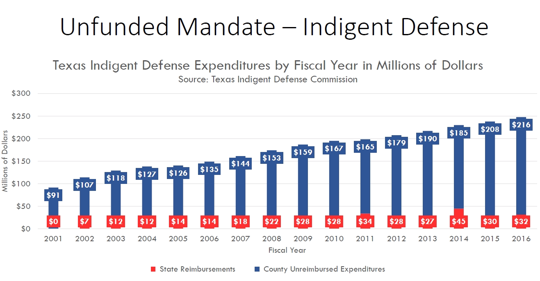
The second paragraph in that pull quote is just a lie. There has never been a time when the state paid for all indigent defense costs in Texas; it was entirely a county-level responsibility until after the new millenium. The article itself includes a graphic demonstrating that claim is false:


Notice the state contribution in 2001 was $0. The state began to put in MORE money after the Fair Defense Act, not less. Moreover, the majority of the increase at the county level may be accounted for by inflation and population growth. 

The big (unstated above) problem is that, before the Fair Defense Act, counties simply didn't comply with their obligations to appoint counsel, especially in misdemeanor cases. That was, indeed, cheaper. In many counties, when the Fair Defense Act passed, no misdemeanor defendants were appointed counsel - zero, zilch, nada. Now, appointment rates often approach 50 percent, not great but better. You can blame the state for making the locals comply with the constitution, if you prefer to deprive defendants of their 6th Amendment right to counsel to save a buck. But that doesn't make this an unfunded mandate, any more than it's an unfunded mandate to require counties to pay for local prosecutors.

The volume of indigent defense services required is largely a function of local decisions and priorities, so if the DA's office is still prosecuting lots of penny ante cases even after crime has declined for two decades, locals should foot the bill for those defense costs.

The flip side of this "unfunded mandate" argument are the un-discussed unfunded mandates to the state. McLennan County has a reputation for securing tougher-than-typical plea bargains, but state taxpayers must pick up the tab for high incarceration rates and longer sentences. And those costs are FAR greater than the costs for those prisoners' lawyers.

Grits has long believed the Lege should offer the Texas Association of Counties a deal on indigent defense: The state picks up the full indigent defense tab, and counties pay to incarcerate every defendant they send to TDCJ for the whole time they're inside. Then everything would be "fair."

Except that "fair," as I frequently tell my granddaughter, is a place where they judge pigs. It doesn't generally have much to do with the Texas justice system, and certainly not with how it's financed.

RELATED: If crime is down, asks legislator, why are indigent defense costs rising?

ALSO RELATED: 'Cap and Trade' proposal could end mass incarceration

Thursday, April 05, 2018

Secret courts, Kafkaesque tales, and a prosecutor fired for fidelity to the law

Let's clear a few browser tabs with a quick roundup:

'Kafkaesque' tale began with Class C stop
Here's a story from In Justice Today - "Traffic stop begins man's Kafkaesque journey through a Texas county's bail system" - that ties together the issues of arrests for Class C misdemeanors in Harris County and their bail litigation, about which we updated with an interview from one of the plaintiff's attorneys in our latest Reasonably Suspicious podcast.

Harvey washed away Harris jail crowding gains
Speaking of the Harris County Jail, after making some progress in recent years, it's overcrowded again thanks to court backlogs from Hurricane Harvey. They may seek variances to use temporary beds at the next Jail Standards Commission meeting.

Secret courts in Dallas?
Bail hearings in Dallas are held in secret, reported the Texas Observer! That's nuts. Open courts doctrine, anyone? Anyone?

SCOT to decide if DA can fire prosecutors for refusing to violate Michael Morton Act
Private employers cannot fire an employee for refusing to violate the law, but former Nueces County DA Mark Skurka fired a prosecutor named Greg Hillman for refusing to withhold exculpatory evidence from the defense in violation of the Michael Morton Act. Now, the Texas Supreme Court will decide whether sovereign immunity protects the DA from accountability. Lisa Falkenberg at the Houston Chronicle authored a fine article on the subject.

Not faking
A Milam County Jail inmate - a probationer awaiting access to drug treatment services - has filed suit after receiving a beating from guards that left him paralyzed from the waste down. He alleges that staff ignored his injuries and a nurse accused him of "faking." See coverage from The Daily Beast and KWTX.com.

Police reform model passes in CA
California has passed major police accountability legislation. I will be curious to see what they did and compare it to the big Texas bill on the topic proposed by Rep. Senfronia Thompson last session.

'The Recidivism Trap'
Our old pal Vincent Schiraldi along with John Jay's Jeffrey Butts authored an important commentary for the Marshall Project titled, "The Recidivism Trap." They argue persuasively that, "Rather than asking 'what’s the recidivism rate?' we should ask an entirely different set of questions about justice interventions." Related: Grits has previously questioned whether low recidivism rates are always an appropriate goal (see here and here), since states like Texas and Oklahoma which over-incarcerate low-risk offenders are more likely to see low recidivism than states that limit 24/7/365 caging to more high-risk people.

Wednesday, April 04, 2018

Considering Texas DA primaries in light of new models out of Philly for prosecutors opposing mass incarceration

The March episode of the Reasonably Suspicious podcast we included an update on the March 6 primary elections involving Texas District Attorneys and the Court of Criminal Appeals.  Then we compared so-called "progressive" District Attorney candidates in Dallas to Philadelphia's new DA, Larry Krasner, discussing a new memo Krasner put out directing his prosecutors to use their discretion to reduce mass incarceration. By contrast, Texas' "progressive" DAs and DA candidates are all much more moderate. I've excerpted those two segments here:


See a transcript below the jump.

Texas overdose problem still more focused on meth than opiods

The Texas House Select Committee on Opiods and Substance Abuse posted handouts from their March 27 hearing, and Grits thought it worthwhile to point out a few highlights. See in particular handouts from:
Let's do a quick overview of substance abuse resources in Texas, then try to answer a couple of questions raised by the Texas District and County Attorneys Association on their Twitter feed.

For starters, funding for substance abuse in Texas comes primarily from two sources: Medicaid and TDCJ. Between them, those two sources account for 97.4 percent of all government substance-abuse funding in the state, split roughly equally, reported LBB. Just more than $386 million are spent on SA treatment through Medicaid, while around $343 million is spent on treatment through TDCJ.

The difference, though, is where state money is spent. Overall, 58 percent of funds spent on substance abuse come from state general revenue coffers. But most of that is spent on treatment in corrections environments. Overall, state general revenue funds pay for only 24 percent of Medicaid expenditures on substance abuse, but more than 98 percent of treatment funds at TDCJ.

With a total incarcerated population of 145,399, TDCJ has 10,047 incarceration beds dedicated to substance abuse, and the parole system has 7,592 people on specialized substance abuse caseloads.

There are another 2,897 secure treatment beds used by the probation system, TDCJ reported.

Source: Meadows Foundation
The Meadows Foundation estimated that nearly eight (8) out of 100 Texans suffer from a substance abuse disorder. More than half of adult Texans drink alcohol, 10 percent use marijuana (!), and 2 percent use cocaine, the foundation reported.

Treatment admissions for alcohol, cocaine/crack, and opiods have declined in recent years, while admissions for heroin and meth have been rising. Overwhelmingly, the largest number of admissions were for alcohol.

Source: TX HHSC
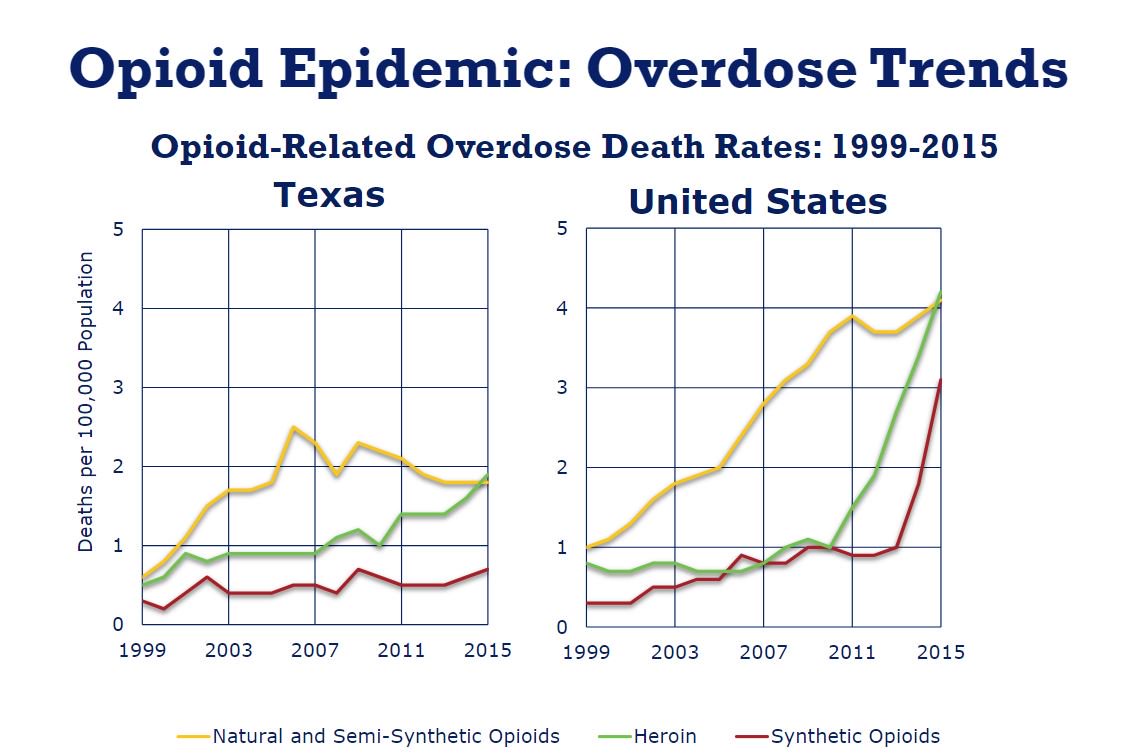
TDCAA on its Twitter feed linked to a chart showing opiod deaths in Texas happen at a lower rate than nationally, and would like to credit law enforcement efforts. They tweeted: "Questions for #txlege to answer next session will include (a) why is TX faring better? and (b) how to we maintain/improve that performance?"

Certainly, people without access to healthcare have a tougher time getting addicted to prescription opiods, and Texas has among the highest uninsured rates in the country. Moreover, while not approaching spikes seen in some states, overdose deaths attributable to opiods and heroin have more than doubled since the turn of the century, according to the HHSC graphic cited.

But really, the comment mainly just ignores the fact that drug use differs regionally and Texas addicts still tend to favor meth over heroin. This fact has historical roots. When Texas clamped down regulating legal antihistamines used by addicts to cook meth, Mexican drug cartels took over the trade and began pumping truckloads of cheap speed into the state to fill the gap in the market. Meth prices plummeted while addiction and overdoses increased. So it's not so much that Texas is "faring better" as that the state's patterns of addiction aren't the same as in Ohio and Pennsylvania. According to the Addiction Research Institute at the UT-Austin School of Social Work, "There were 715 deaths due to methamphetamine in Texas in 2016, as compared with 539 due to heroin."

Tack on those deaths, and all of a sudden Texas isn't so much "faring better" than "faring differently."

Moreover, the Addiction Research Institute gave the best explanation for why Texas hasn't seen as many opiod deaths as in the Northeast, and it's not because of law enforcement efforts but because of differences in the market: " Texas has not yet suffered the epidemic of overdoses seen in the northeast because the heroin in Texas is Mexican Black Tar which cannot easily be mixed with fentanyl. The purity of Black Tar is 45%-50% as compared to 80%-85% purity for Mexican-South American heroin in the northeast."

So the answers to TDCAA's questions are, 1) "We aren't faring better, our problems are just different," and 2) "Market trends among cartels, not Texas policy, account for the different overdose patterns. Since neither Texas policy nor the 'performance' of law enforcement is responsible for the lower number of opiod deaths, there's no policy implied that would 'sustain or improve that performance.'" This is not a Texas-does-it-better issue, it's an all-problems-are-local issue.

Tuesday, April 03, 2018

Revenge porn from the DA? ... and other stories

Let's clear a few browser tabs with a quick roundup:

Just Liberty Platform Campaign Update
As results roll in from around the state, Just Liberty's platform project turned out to be even more successful than we thought. Resolutions to implement #cjreform were passed in 17 Republican senate districts and 16 Democratic ones. Most of the Democratic SDs approved all 16 Just Liberty resolutions. And on the Republican side, the Young Republican Federation of Texas endorsed our entire agenda and encouraged their members to champion #cjreform resolutions in their own local conventions. We even created a catchy little jingle to promote the campaign online. Now it's on to the state conventions, where the party platforms will be finally approved and hopefully include our proposals. The process of promoting the resolutions within these party processes has already helped identify new allies around the state, whom we hope in turn will add weight and credibility the legislative push on #cjreform issues in 2019.

Voting case against ex-felon a politicized disgrace
This Tarrant County case of a woman receiving a five year sentence for voting with a felony record is one of the most absurd and politicized abuses of justice I've seen in quite a while (perhaps going back to the roundup after the Twin Peaks Biker Massacre, if we're ranking episodes of prosecutorial overreach).

The DA, discovery, and 'revenge porn'
Speaking of the Twin Peaks Biker Massacre, DA Abel Reyna's office got dinged by a judge for releasing nude photos of a defendant's wife that he had on his phone to the other 176 defendants as part of discovery materials. Critics dubbed the episode a case of "revenge porn," which is a bit far-fetched, but a funny way to frame it. The defendants have all been ordered to delete the images.

'Confessions taken here'
All the high-profile murderers who pass through Williamson County appear to confess to this guy. Or maybe the confidential informant system incentivizes fabricated testimony. You make the call.

Might more ticket writing reduce traffic fatalities?
Corpus Christi has announced a plan to ramp up traffic ticket writing in response to traffic fatalities, although there's at best a tentative and unproven correlation between the two. For example, statewide, Texas has seen traffic fatalities decline during periods when police officers wrote fewer tickets. The correlation between writing more tickets and generating more revenue, by contrast, is much more firmly established.

Texas seeks shorter capital deadlines
Texas is seeking to opt-in to shortened timelines for death penalty appeals, reported Keri Blakinger at the Houston Chronicle, after Attorney General Jeff Sessions suggested it last year. Given the often-poor quality of capital representation under current timelines, it can't be a great idea to squeeze those timelines even further.

Sunday, April 01, 2018

NY Times story on Galveston indigent defense ripe for other reporters to localize

In the New York Times last week (March 29), former Austin Statesman editor Richard Oppell authored an article that could resonate throughout Texas indigent defense systems, as it describes a practice that's widespread, not remotely limited to the judge or attorney in Galveston at the center of the story. Here's the heart of the allegations:
A criminal defense lawyer in Galveston, Tex., says he was pulled off cases defending poor clients because he spent too much time on them and requested funds to have their charges investigated. 
Needless to say, his clients were not the ones complaining. Instead, it was the judge, Jack Ewing, who appoints lawyers for those in his courtroom who cannot afford them. “You overwork cases,” Judge Ewing told the lawyer, Drew Willey, according to excerpts from a recorded conversation cited in the lawsuit. 
Though an estimated four of every five criminal defendants in the United States use court-appointed lawyers or public defenders, many of the nation’s indigent defense systems have been criticized as desperately inadequate, leading to false guilty pleas and overincarceration. 
Lawyers who represent the poor can be required to juggle hundreds of cases at a time, accept pay far lower than the market rate, or take cases for which they have little experience. 
This new case, though, exposes another potential problem: Indigent defense lawyers often get their assignments from the judges in whose courtroom they appear. This discourages a robust defense, experts say, and leads to an emphasis on resolving cases quickly. 
The tensions may be familiar to lawyers, but they are rarely so candidly aired as in this lawsuit, filed in federal court last week and bolstered by parts of a recorded conversation with the judge.
Grits has heard similar stories from defense attorneys for as long as I've paid attention to the Texas justice system, including attorneys stiffed not just for time worked but also for investigators' fees or even forensic services.

Which brings me to this observation for Texas-based reporters: This is a national story which can be localized. This isn't the only Texas jurisdiction, by any stretch, in which judges reduced pay requests from lawyers as excessive when they tried to put on a zealous defense. There are also stories out there of lawyers losing out on appointments because judges considered them a tad too zealous. Attorneys who make a living representing indigent clients must routinely take on caseloads well beyond bar-association-recommended guidelines in order to pay for a mortgage, middle-class lifestyle, and law-school debts. This story explains why, and it's not just happening in Galveston.

So, for my reporter friends on the local courthouse beat: There's a courthouse paper trail on cases where judges reduce attorneys' fees, which a local attorney who takes indigent cases or the court coordinator can help you identify. Then, one simply calls up the attorneys to ask why they requested the additional pay. Follow up with calls to the judges in question to get their side of the story; the county judge so s/he can lodge a complaint about unfunded mandates from the state; then make a call to indigent defense experts like the Texas Fair Defense Project or Civil Rights Corps (the two nonprofits that sued over Harris County's unconstitutional bail practices), and you've just localized a national story.

Indeed, there's a small mountain of data, including lawyer-specific payment information, available from the Texas Indigent Defense Commission. Once you dig into these topics, there's a lot of material for an enterprising reporter with which to work.

So thanks, Richard Oppell, for exposing a statewide problem in the form of this Galveston anecdote. Now it's up to Texas reporters to pick up the baton and expose the same practices in their own jurisdictions. The story's there to be had, and "It would make some local judges mad" isn't a good enough reason not to report it.

Danny Ray Thomas shooting cast harsh spotlight on Harris County police shootings

The shooting of Danny Ray Thomas, a mentally ill man with his pants around his ankles who was shot to death by a Harris County Sheriff's deputy, has made national headlines and led to a greater-than-ever light cast on shootings by law enforcement in Texas' largest county.

Grits wanted to round up a few of the more notable stories, as this episode appears as though it will frame debates over police accountability in Texas for the foreseeable future:

Friday, March 30, 2018

March Reasonably Suspicious Podcast: Primary election wrap-up, pushing #cjreform in state party platforms, unconstitutional legal fees, Harris County bail suit update, a stunning judicial power play, and more

Sliding in under the wire at the end of the month, check out the March 2018 episode of Just Liberty's Reasonably Suspicious podcast, covering Texas criminal justice politics and policy. Subscribe on iTunes, GooglePlay, or SoundCloud, or listen to the podcast here:


Here's what my co-host Mandy Marzullo and I talked about this month:

Top Stories
Primary election roundup
  • Recapping Texas contested Texas DA and Court of Criminal Appeals races
  • Comparing "progressive" DA candidates in Dallas and elsewhere to Philadelphia's Larry Krasner
  • Update on Just Liberty's campaign to include criminal-justice reform in both Texas state party platforms. Includes Just Liberty's catchy jingle done by some of the same amazing musicians who performed our original podcast music.
Check in on Texas pretrial reform litigation
  • Harris County bail litigation: Interview with Susanne Pringle, executive director of the Texas Fair Defense Project, regarding the 5th Circuit's ruling in the Harris County bail litigation in which her group is one of the plaintiffs.
  • Travis County plea mill challenged: Local attorneys file a demand letter challenging misdemeanor dockets where lawyers must negotiate plea bargains almost immediately after receiving the file and meeting their clients for the first time.
The Last Hurrah
Find a transcript of the podcast below the jump.

Thursday, March 29, 2018

Open records review should include criminal justice, and other stories

A few quick hits before I finish editing our podcast today:

CCA takes up cell-phone location data case
Grits was a bit surprised to see that the Texas Court of Criminal Appeals granted review on Ex Parte Christian Sims involving Fourth Amendment/cell-phone location data issues, given that the US Supreme Court's ruling in Carpenter is expected to come out this term. See the petition here and a case summary from the State Prosecuting Attorney.) OTOH, the CCA and SCOTUS are addressing slightly different questions: Whether cell-phone location data is subject to Fourth Amendment protections is the question at stake in Carpenter, while Sims asks whether Texas' statutory exclusionary rule applies to violations of the Fourth Amendment and Art. 1, Sec. 9 of the Texas Constitution.

Possible innocence case
DNA testing excluded a Tarrant County man who's been in prison 19 years for alleged child molestation and point to another, unknown party. Prosecutors insist he's guilty, anyway.  Good coverage from the Fort Worth Star Telegram.

Open records review should include criminal justice
The House Committee on Government Transparency meets next week in part to discuss updating open records laws (see coverage from the Caller Times). The push to do so doesn't involve criminal justice, but transparency laws in that area need serious attention. See this Grits commentary from 2016 regarding aspects of the Public Information Act related to the justice system which have been gutted in favor of opacity over the last three decades.

Skimping on mental health boosts crim-just costs
The SA Express News recently featured a good editorial on how the Texas Legislature's failure to fund mental health services impacts the criminal-justice system. Reported the paper:
[Texas] taxpayers are footing an estimated annual bill of $1.4 billion in emergency room costs and another $650 million through local justice systems to address mental illness and substance abuse disorders. 
In Bexar County alone, 10 percent of the 31,438 individuals booked in the county lockup were diagnosed and treated for mental illness.
The editorial touted the recently created Judicial Commission on Mental Health as a potential vehicle for suggesting reforms.

Wednesday, March 28, 2018

Forensic hypnosis under fire

In December, Grits posted a "brief primer on forensic hypnosis" after we'd discussed a capital case out of Farmer's Branch involving a hypnotized witness in the November Reasonably Suspicious podcast. Now, Christian McPhate at the Dallas Observer has published an extensive profile of that case and how the courts and law enforcement have handled hypnosis-influenced testimony in Texas over time. Anyone interested in junk-science issues should give it a read.

Monday, March 26, 2018

Benchmark created for 'progressive prosecutors,' and other stories

Grits doesn't have time to blog on these topics at the moment but y'all should probably be aware of them:

Philly prosecutor pioneering decarceration measures
Grits has argued before that electing "progressive" prosecutors wouldn't necessarily stop mass incarceration unless they used their discretion in ways that none of our Texas folks have done yet. Larry Krasner in Philadelphia is the first DA in the nation to actually attempt to use his discretion in that way. Here's the memo he sent to his prosecutors changing practices. Give it a read, there's cool stuff all the way through to the end. See coverage from Slate. This will provide a blueprint for what can be expected of future, self-styled "progressive prosecutors" who win District Attorney races. By contrast, for example, in the Dallas primary one couldn't slide a piece of paper between the positions of the two DA candidates in the Democratic primary, both of whom wanted to claim a "progressive" mantle. It would have been a more interesting race if those two could have been made to tell voters whether they'd go so far as Mr. Krasner, and if not, why not.

Corrections chair target of sleazy GOP oppo campaign
Republican Steve Stockman decided to play hardball with Texas House Corrections Committee Chairman and friend-of-the-blog James White on the off chance he decided to run for Congress, including planting an intern in his capitol office, among other dirty tricks.

Youthful Offender Program may receive more scrutiny
Briscoe Cain, a Tea Party Republican state rep, is calling for an investigation into the problems at the TDCJ Youthful Offender Program that caused them to fire the warden and move the program from Amarillo Brazoria County to Huntsville. Absurdly, TDCJ's new flack has portrayed the incident spurring the changes as not involving systemic flaws, but nobody fires wardens or moves programs which have been in place for years unless there's a systemic problem. Such comments speak to a culture of denial in the agency. See related Grits coverage.

Pantsed, then shot dead
Before video footage was common, these sorts of incidents were more easily swept under the rug. A Harris County Sheriff's Deputy shot a man with his pants around his ankles. And in Fort Worth, video led to the indictment of a police officer who attacked a young black man at a local hospital. "[Jon Preston] Romer ... was indicted last week on charges of official oppression, aggravated perjury and making a false report to a police officer in connection with the incident."

Litigation to watch
A Texas prisoner's family has sued after his suicide, alleging that TDCJ didn't provide him with needed medications.

Good riddance
Read a post mortem on the Abel Reyna campaign.

Saturday, March 24, 2018

5th Circuit benchslapped! All about the money, Tx bodycam law a boon to bad cops, and other stories

Here are a few odds and ends which merit Grits' readers interest while my own is focused elsewhere:

Benchslapped!
The US Supreme Court issued a unanimous benchslapping to the Fifth Circuit Court of Appeals in Ayestas v. Davis for denying funds for a defense investigator to develop a record about the defendant's mental health and family history. Mandy Marzullo and I had discussed the case on the Reasonably Suspicious podcast in November.

All about the money
The Texas House Appropriations subcommittee that covers criminal-justice will hear testimony next month regarding two interim charges which may interest Grits readers: Adult and juvenile probation funding formulas, and whether to establish a fee-for-service model at DPS crime labs to cover the looming shortfall.

The former is important because adult probation directors are the most vocal and strident opponents of sentencing reform, fearing that reducing drug-possession charges to a misdemeanor, for example, would result in a large, immediate drop in revenue. So debates over their funding formula are central to whether the Legislature can muster the political will to continue decarceration reforms. As for the crime labs, the Legislature only gave them enough general revenue funding to cover part of the biennium, then the Governor eliminated new fees created to cover the rest of their budget. As of now, they're expected run out of money completely a few months (maybe we'll learn how many at this hearing) after the new fiscal year begins in September.

Texas bodycam law a boon to bad cops
Grits readers are well aware of Texas' crappy bodycam law, but now thanks to a new Attorney General opinion, even Republican District Attorneys are learning just how far this bad law goes to protect cops who cross the line. Dallas DA Faith Johnson had asked the Attorney General whether, under the law, an officer was entitled to review only his own bodycam footage, or all bodycam footage from the scene. After all, that would mean the officer had LOTS more information to which he would not have had access at the time before he's required to make a statement, creating a risk that he or she might embellish or alter their story to fit a narrative instead of just testifying truthfully. Indeed, in her letter Johnson feared that, even if an officer didn't alter his or her story, it would be difficult to combat a public perception that that had happened. But Paxton said officers get to see everything. See coverage from Michael Barajas at the Texas Observer.

Prosecutor's song choice may connote misconduct
Texas' first death sentence of 2018 involved a case from a small town featuring alleged prosecutor misconduct, including Brady violations and, at closing, playing "an emotional song from the hit 2012 movie Pitch Perfect in a bid to allude to evidence the judge had already ruled inadmissible." (Cue NFL hall-of-famer Chis Carter declaring, "C'mon, man!") Wrote Lauren Gill at InJustice Today, "in 2017, nearly half of the stays of execution granted in the state involved cases that 'may have been tainted by false or unreliable evidence,' according to the website The Open File, which tracks prosecutorial misconduct."

Police 'testilying'
When Grits stopped working professionally on police accountability topics after leaving the ACLU of Texas in the mid-aughts, my focus on mendacious informants and testilying police officers waned. But it remains a significant problem, and the New York Times recently published a feature on police perjury that's well worth reading. They're citing New York examples, but it's by no means only a New York problem.

Texas should act to improve criminal-justice data
Now that we have a different governor, isn't it time for Texas to consider the re-creation of the Criminal Justice Policy Council or something similar? The New York Times just published a feature on "missing" criminal justice data and how much policy is made on the topic flying more or less blind thanks to the lack of it. It's a fair point. After Rick Perry fired Tony Fabelo and line-item vetoed the Criminal Justice Policy Council back in 2003, Texas has had various agencies and actors pick up these functions piecemeal. But the left hand seldom sees what the right is doing and often it's left to outlets like this blog or various nonprofits to connect the dots. But that should be somebody's job in the government. Now (or rather, 2019) would be a good time to bring back that sort of capacity.

Friday, March 23, 2018

Justice Needs a Platform: Young Republican Federation backs justice reform

With most county and senate-district political conventions being held tomorrow for both major political parties, readers will recall that Just Liberty, working with key allies, had proposed a variety of resolutions to amend both the Republican and Democratic Texas state party platforms to include key criminal-justice reform provisions. If you haven't heard the little jingle we created to promote this campaign, check out this promo for people attending Democratic conventions tomorrow:


Notably, the Texas Young Republican Federation took up the banner and helped propose these resolutions at the grassroots level in the GOP. Check out an op ed by Jason Vaughan, the YRs State Republican Executive Committee liaison, laying out the 16 resolutions and declaring justice reform a top priority for his group.

Opined Mr. Vaughan, "Texas Young Republicans represent the entire spectrum of the Republican Party. Because of this, sometimes finding agreement on specific policy can be tough. There can be a lot of differences on how Republican principles should become policy. The one area where we see overwhelming support is criminal justice reform."

This is a big reason why justice reform is possible in a red state like Texas. Significant constituencies within the GOP base support it, including more than a few young people who represent the future of the party.

Thursday, March 22, 2018

On the limits of tuff-on-crime ideology at the Texas Court of Criminal Appeals

One of Grits' favorite pastimes is parsing contentious Texas Court of Criminal Appeals decisions to better understand the dynamics and factions arising on various topics. Since nobody in the mainstream media routinely covers these cases, this usually involves tilling virgin soil. And such is the situation with Ex Parte Jeremy Wade Pue, which was decided on March 13 but has been ignored in the press. Mr. Pue was represented by an attorney from the State Counsel for Offenders.

Judge Bert Richardson wrote the main opinion, with Judges Mary Lou Keel and Sharon Keller authoring concurrences and Judge Kevin Yeary isolated by himself in dissent, which is a space he's increasingly chosen to occupy in recent cases. To me, this is perhaps the most significant change in the court's dynamic in the wake of the 2016 election, when Judges Keel and Walker joined the court.

While on capital cases, Judge Yeary has tended to be more defense-oriented, in more workaday cases he has proven himself a tuff-on-crime outlier, even compared to the Government-Always-Wins (GAW) faction, led by Judge Keller. Indeed, Yeary's pro-prosecutor stances are sometimes so extreme that even the traditional GAW faction members (Keller, Hervey, and Keasler) cannot abide them. That's what happened in Pue, where the state sought to uphold a 30-year sentence which, in light of the facts, clearly was improper.

The case involved an illegal sentence for evading arrest with a vehicle, which in Texas is a third degree felony punishable by 2-10 years. Two California cases were used as an enhancement under Texas law to increase the penalty to thirty years under the habitual-offender statute. But the California convictions were not "final," as required by Texas law, and the defendant's lawyer failed to appeal the issue. (Mr. Pue separately has also alleged an ineffective assistance claim.) The CCA majority said the sentence was illegal, and even the GAW faction agreed.

Judge Yeary would let the sentence stand, insisting the claim should have been raised on direct appeal and should not be alleged for the first time in a habeas writ.  Moreover, he made a distinction (which Judge Keel rightly considered spurious) between a sentence outside the prescribed range (for example, a life sentence for a third degree felony where the max should be ten years), and illegally using a prior conviction to increase the penalty outside the prescribed range. Keel called out Yeary for "inconsistent" reasoning, and he tried to respond in a footnote. But when you read them both, it's pretty clear she's right and he's confused. Even Judges Keller and Keasler thought so.

Further, Judge Keller believed Pue's lawyer performed ineffectively:
Because the conviction was not final regardless of what law applies, and because Applicant has no other prior convictions (aside from the two in California), I would hold that counsel was deficient for failing to challenge the use of this conviction for enhancement purposes, and Applicant was prejudiced because his thirty-year sentence exceeds the maximum punishment allowed for his offense.
Keller believed Pue's lawyer's performance was deficient on its face ("Given the circumstances, I would hold that there is no conceivable strategy for failing to challenge the prior conviction, and so, there is no need to remand for factual development.") Judge Richardson and the majority, however, noted that the issue was raised at trial and he was reluctant to allege ineffective assistance for not doing so on appeal because "there were existing intermediate Texas appellate court decisions to the contrary" about whether California or Texas law controlled which offenses could be used for enhancements. (Going forward, the answer is "Texas'.")

As case law, Pue does little more than confirm common perceptions about which cases qualify for an habitual-offender enhancement. But it certainly reveals telling dynamics on a court suffering from strained personal relations and often-bitter legal disagreements. We're beginning to see previously unplumbed limits regarding how far certain members of the court are willing to go just because a prosecutor asked them for something.

Will Judge Yeary's extremist views solidify control of the court among moderates like Richardson, staking out positions so harsh and unyielding that they drive even the GAW faction toward more centrist stances? Time will tell but, to this observer, that looms as an increasingly likely (and admittedly unexpected) possibility.

Tuesday, March 13, 2018

Additions to Grits' Reading Pile: On prosecutors, pretrial detention, plea bargaining, and more

Let's add a few items to Grits' reading pile, and perhaps to your own. First,

On pretrial detention
On Prosecutors
David Alan Sklansky says the least understood "problem with prosecutors" is the ambiguity of their role. Here's a brief item on "Post-conviction Prosecutorial Duties."

On Forensics
Brandon Garrett and Chris Fabricant analyzed 229 Daubert rulings (admitting scientific or expert evidence) purporting to assess the "reliability" of forensic evidence and found that the "reliability test" is seldom applied and almost never used to exclude potentially unreliable testimony.

On Instructing Juries
See an interesting proposal for fixing known flaws in common jury instructions surrounding "beyond a reasonable doubt" by articulating for their jury their relative strength compared to lower burden-of-proof thresholds, like "preponderance" or "clear and convincing."

On the Fourth Amendment
The title evokes one of the most vexing legal questions of the digital age: "The Third Party Doctrine and the Future of the Cloud." Can't wait for Carpenter to come out!

On Plea Bargains
A coupla items here:
On Competency Restoration
This was a long-time Grits hobby horse to which of late I haven't had the bandwidth to pay much attention. But I've long been a fan of at least testing outpatient models - mainly as an expression of my lack of confidence that the Texas Legislature will ever sufficiently fund forensic beds at state mental hospitals - and have regretted that Texas never doubled down on that strategy after testing it in pilot programs. So I'm interested to read this academic offering from Susan McMahon out of Georgetown Law titled, "Reforming Competence Restoration Statutes: An Outpatient Model." Texas' failed system for competency restoration at state mental hospitals has been underfunded to the point of crisis since at least the earliest days of this humble opuscule. Maybe she can point to a better path.

Monday, March 12, 2018

Pop quiz on forensics

A recent research paper from Jonathan Koehler, a Northwestern University law professor, titled "How trial judges should think about forensic science evidence," opened with a short quiz. Grits readers should be well educated on these topics, but let's see how you do:

"Here is a forensic science test for you. Please answer each of the three questions below True or False.

"1. Scientific tests conducted over the past 100 years have repeatedly demonstrated that everyone has a unique set of fingerprints.

"2. Recent scientific studies show that the chance that DNA samples from two different people will be identified as a “match” by a competent, well-trained DNA examiner is less than one in a million.

"3. Data from scientific tests conducted over the past few decades provide a reliable basis from which to estimate the accuracy of most forensic methods that have been admitted in U.S. courts.

TDCJ Youthful Offender Program accused of 'culture of cover-up'

Readers will recall that, after more staff-on-youth sex-assault scandals were uncovered at Texas Juvenile Justice Department facilities, the new executive director immediately sought to certify 35 youthful offenders as adults and send them to TDCJ, even though staff, not inmates, had caused all the scandals that forced her predecessor's ouster.

So where did she want to send those 35 kids? To the Youthful Offender Program at TDCJ. And now Lauren McGaughy at the Dallas News - in a story called, "'Culture of Coverup': Warden forced to retire from prison where whistleblower says teen inmates abused" - has pulled back the curtain on how youth are treated there, thanks to the diligent reporting of misconduct, abuse, and neglect by a now retired program supervisor* who formerly worked there. Read the whole story, excerpts won't do it justice. TDCJ has fired the warden and moved the youth to a unit in Huntsville.

What does it say about the state's priorities that, rather than solve problems of violence and abuse by staff on youth inmates, the first big policy shift from the new TJJD leadership was to ship off 35 kids to another environment characterized by abuse, fear, and predatory staff?

What exactly are we solving for here? Is the goal to protect the kids or to generate a headline where pols and bureaucrats can say, "We're changing something in response, so everyone can move on. Problem solved." Except the change didn't correlate to the problem and may create even bigger problems for those 35 youth.

Everyone essentially knows what needs to be done. Grits has discussed the expert consensus on the topic before (see below), and an extensive recent blog post from Texans Care for Children elaborated even more.

Bottom line, we need to move away from large units sited in rural areas far away from services and youth inmates' families and adopt the same model Gov. Scott Walker has embraced for Wisconsin, creating smaller, treatment-oriented facilities closer to urban areas following what's known as the "Missouri model." That's the same recommendation made by a blue-ribbon panel convened by the Texas Legislature eleven years ago after another sex-abuse scandal at Texas youth prisons. The National Conference of State Legislators recently issued similar advice.

Everyone basically agrees with this approach except Governor Abbott, his new appointee at TJJD, and handful of legislators. But they're the only ones who can make the necessary changes!

That's the conundrum. Fixing the problem will require spending more money on the same number of kids (or even fewer, if juvenile crime continues to go down), because there are fixed costs involved with creating a new system of smaller facilities. Plus, the current ones are understaffed, suffering from the highest turnover rate of any state agency.

(N.b., one anticipates private contractors will want in on this action, too, and state facilities have a terrible track record to try to defend, so increased privatization of youth services is likely on the horizon if reform succeeds. That would reduce the initial sunk costs but create a host of additional issues.)

We're not going to make youth safe by shipping them off to TDCJ or extending that agency's control to TJJD. Wherever they're housed, more must be done to keep youth safe from both predatory staff and from being victimized by other offenders. But the mistake in the past has been to assume keeping them safe is enough. It isn't. The system is failing on many levels and, at this point, it's hard to see the resistance to following best practices recommended by basically everybody who's deeply thought about it.

From shifting the Missouri model, raising the age of criminal responsibility from 17 to 18, etc., pretty much everyone knows what the best policies are for protecting and reducing recidivism among youth. But the policies instead are being created based on what's best for the politicians who want to avoid accepting responsibility for bad outcomes on their watch. As long as that continues to be the case, this pattern of abuse-scandal-and-blame will continue to arise every few years. Convincing the public to ignore a problem is not the same as solving it.

MORE: See Texas Appleseed's response to the latest scandal at TDCJ's Youthful Offender Program, titled, "Young Offenders Need Developmentally Appropriate Rehabilitation."

See prior, related Grits coverage:
* The original version of this post said the whistleblower was a correctional officer. In fact, she was a supervisor for a youth program.

Thursday, March 08, 2018

Texas CCA and DA election roundup

Let's update the Texas DA and Court of Criminal Appeals races we discussed in the February podcast, as well as others that deserve mention. It was a rough primary for incumbents, and a number of open seats created opportunities for outsider candidates to elbow their way past more establishment figures.

Keller narrowly prevails
First, Sharon Keller squeaked by in the race for Court of Criminal Appeals Presiding Judge, garnering just 52 percent of the GOP primary vote. She is without question the most and maybe only vulnerable statewide Republican in Texas, assuming there's any sort of "blue wave" occurring in November, as touted in the national press. If I were a Dem strategist looking for a blue victory in a statewide race, I'd be putting real money behind her general-election opponent, Judge Maria Jackson out of Houston. As my great grandfather liked to say when I was a child, there ain't never been a horse that can't be rode, never been a cowboy can't be throwed. That said, the most likely outcome is that Keller will prevail in November, and by the time her next term ends, she'd have spent 30 years as Presiding Judge of that court and the intellectual leader of what Grits has dubbed the Government-Always-Wins (GAW) faction.

Least qualified candidate emerges from GOP CCA primary, again
In the race to replace Judge Elsa Alcala, Michelle Slaughter defeated two more qualified candidates because she ran as a cultural conservative touting culture war memes and garnered the most grassroots endorsements. Grits might have preferred Jay Brandon over Dib Waldrip, but either were qualified for the spot. But for the second cycle in a row, GOP primary voters ignored the most qualified candidates and picked the person they thought was the most ideologically conservative. According to the Texas Tribune, "She was the only one of the three without a criminal appellate background, having worked in civil law before becoming a judge. But she also had the most conservative endorsements, including backing by Empower Texans, Texas Right to Life and numerous local Tea Party groups." There's no Democrat running in this race.

Progressive power remains a phantom in Dallas DA race
National liberal activists and progressive organizations which haven't traditionally participated in Texas DA races tried to play the role of Queen-maker in Big D, backing Elizabeth Frizell against liberal establishment stalwart John Creuzot. Creuzot won by 516 votes. Though it was close, the outcome calls into question the clout of liberal groups backing his opponent. Readers will recall the same thing happened in Houston in 2016, with liberal groups backing Morris Overstreet in the primary before turning to support Kim Ogg in the fall. Grits' takeaway: Criminal-justice reform continues to enjoy bipartisan support in Texas - there are strong supporters in both parties - but perhaps because it's become a bipartisan issue, it's not yet become an axis along which Democratic primary elections are decided. Creuzot won the right to face incumbent Faith Johnson in the general election. This'll be one of the state's marquis down-ballot races.

MORE: Reflecting on the race, in which he and his PAC supported Frizell, New York writer and activist Shaun King describes what it's like for a bunch of amateurs who learned about politics in books to get schooled by "crafty" Texas political consultants who understand how to "game the system" (read: run winning campaigns).  Don't sweat it, Shaun, it's how you learn. Politics here is blood sport and enthusiasm isn't always sufficient to trump skill. Besides, Creuzot is a good guy. When "progressive" Ds from out of state want to demonize someone like him in favor of a candidate whose record is more sparse and whose policy positions are essentially identical, long-time reformers like me have to wonder why we should choose to die on that particular hill? Of all the DA candidates in this roundup of whom I'd think, "We need to keep that person out of office," he wouldn't crack the top five. For instance ...

Bexar voters done with the crazy
Nico Lahood lost. Thank heavens.

Abel Reyna loses in embarrassing fashion
In the end, the Twin Peaks case cost him the race, which was won by a guy who just moved back to town from Dallas last year after 3 decades away. On the day of the election, voters awoke to headlines declaring a visiting judge had scolded Reyna thusly for using video from the case in his campaign ads:
“The way you have handled this case is absolutely shameful and misleading to the citizens of this county,” Judge Doug Shaver told Reyna on Monday. “So I know the election is tomorrow, and we can’t do anything about it up to this point. But you should be ashamed of yourself, and if I could enforce any of the gag order against you, I would and (would) put you in custody. But since I can’t, you are excused.”
And by the end of the day, the voters had excused him as well.

Tyler establishment fails to quash Tea Party insurgent
Perhaps (almost) equally significant, the establishment candidate for District Attorney in Smith County lost to a 35-year old upstart who accused the sitting DA of corruption and was backed by local Tea Party figures . Jacob Putman defeated a candidate recruited by the sitting DA and his allies to run against him, and overcame the incumbent releasing opposition materials critical of his prosecution record at the height of the campaign. This is a significant snub for the Jack-Skeen-Matt-Bingham cohort which has run the DA office there for decades in my hometown.

DWI cuts both ways in DA races
In Victoria, voters ousted an incumbent who'd sought to prove his tough-on-crime credentials by taking every DWI case to trial. Challenger Constance Filley Johnson defeated the incumbent in a campaign critical of this grandstanding brand of prosecutorial overreach, and voters overwhelmingly sided with her.

In Walker County, however, Will Durham won by running against the incumbent's First Assistant, with criticisms mainly centering around alleged leniency on DWI cases. The incumbent, David Weeks, had allowed some DWI cases to be pled down to alternative offenses,  which circumstantially points to prosecutors allowing defendants to avoid being assessed the (ignominious) Driver Responsibility surcharge. Walker County is the epicenter of the Texas prison system and the policy likely was implemented so that prison-guard employees with DWIs on their record could keep their driver licenses and be able to legally get to work. Whether getting "tougher" on these cases affects local correctional officer employment remains to be seen, but barring abolition of the surcharge, in 2-3 years it wouldn't surprise me if Durham's git-tuff policies come back to bite Walker County voters or even TDCJ itself, just as happened in Victoria.

A vote for DAs independence from law enforcement
In Fort Bend County, a 71-year old retired judge named Cliff Vacek won the GOP primary, but the real contest there will be in November, where general elections are becoming tighter and Democrats have a real shot. Debates in the GOP race centered around independence of the office, with Vacek's opponent claiming he'd have a closer relationship with local law enforcement agencies, and Vacek insisting that the DA office must remain independent, working with local law enforcement but not becoming beholden to them. Interesting terms of debate: These aren't themes which came up in the other races.

Death penalty decline an issue in Wichita DA race
In Wichita County, incumbent Maureen Shelton was ousted by John Gillespie in a campaign which centered around Shelton's reticent to pursue the death penalty, a high turnover rate among attorneys in the office, and Shelton's decision to serve as an administrator instead of personally trying cases in the courtroom.

Incumbents incumbenting
In Denton County GOP primary, the incumbent Paul Johnson defeated a challenger who'd called him soft on crime. And in Hidalgo County's Dem primary, one-term incumbent Ricardo Rodriguez easily quashed a quixotic campaign against a strident but politically isolated and self-funded challenger who'd accused him of corruption. Galveston DA Jack Roady defeated a challenger who'd accused him of being "soft on crime."

MORE: The incumbent in Gregg County (Longview) also lost, although the race doesn't seem to have been run along any reform-vs-tuff-on-crime axis, like some of the others.

AND MORE (3/12): From the Texas Tribune: "Half of Texas' sitting district attorneys in contested primaries lost. What does that mean?"

AND EVEN MORE: See a roundup of primary results for prosecutors from the Texas District and County Attorneys Association.

Monday, March 05, 2018

His chief weapons are surprise and fear

Nobody expects the Spanish Inquisition, the actors in Monte Python insisted, and Grits must admit I didn't expect Texas judges to begin adopting torturous means to extract the answers they want from defendants before them.

But then, I've never met Judge George Gallagher from the 396th District Court in Tarrant County, whose chief weapons are surprise and fear, fear and surprise. ... Live and learn.

In the category of "things that make you go 'Hmmmmm,'" here's the crux of an opinion out of the El Paso Court of Appeals
Because the trial transcript clearly shows that the trial judge, during a heated exchanged with the defendant outside the presence of the jury, ordered his bailiff to electrocute the defendant three times with a stun belt—not for legitimate security purposes, but solely as a show of the court’s power as the defendant asked the court to stop “torturing” him—we harbor grave doubts as to whether Morris’ trial comported with basic constitutional mandates. As such, we have no choice but to overturn Morris’ conviction and remand for a new trial.
See briefs from the appellant and the State for all the lurid details, and a bevy of self-serving arguments by the Tarrant DA office which the appeals court rejected. 

It remains to be seen whether the prosecution will seek review from the Court of Criminal Appeals, much less what that court might do. Grits could see a tight, 5-4 decision either way, or maybe 6-3 to uphold, just because the facts are so bad. But you never know. And depending on the outcome of the race to replace Judge Elsa Alcala, that projected vote count could change.

Friday, March 02, 2018

Texas judicial elections broken but far from radar screen of legislative power brokers

Here are a few odds and ends that merit Grits readers' attention even if I haven't found time to author full posts on the topic.

Dallas DA race coverage
InJustice Today has a good piece summarizing the race from a reformer perspective.

Texas judicial elections broken but far from radar screen of legislative power brokers
The Baker Institute makes the case against electing Texas judges. Is anybody listening? According to the author, Mark Jones, "Texas is one of only two states that initially elects and then re-elects its judges in partisan elections where voters have the option of casting a straight-ticket vote." Notably, one of Texas' most distinguished jurists, Elsa Alcala is voting with her feet, leaving the Court of Criminal Appeals in large part because the election system is broken, as she told the Texas Tribune:
“Either [people] don’t vote in the race, or they vote based on familiar-sounding names,” Alcala said. “It’s not an educated vote in many instances.”

It’s largely why she’s leaving the court. Alcala was appointed to her position in 2011 by former Gov. Rick Perry, then elected to a six-year term the next year. When she announced in 2016 that she wouldn’t run again, she said a main reason was the “random and unreliable” results in partisan judicial elections.
See coverage of both competitive CCA primaries from the Austin Statesman. Meanwhile, out of state money is fueling a judicial candidate in the GOP primary for the Austin 3rd Court of Appeals who's running on a Trumpian, culture-war-style platform. And another Tribune story suggests qualified judges with Hispanic surnames have trouble making it through the GOP primary.

Systemic problems at juvenile justice agency
Texans Care for Children has a detailed blog post up on problems with Texas youth prisons and how to solve them. Notable quote: "When news breaks of staff abuses in these facilities, or even youth misbehaving, it's immediately labeled a crisis or a scandal. But in reality, it's not a new crisis. We are looking at a systemic problem."

More unconstitutional court fees defenestrated

On Twitter, the Texas District and County Attorneys Association mocked a defendant represented by the Harris County Public Defender for winning a court-fee reduction of about $13. And if that's all there were to it, they'd be right to criticize the court for wasting its time.

But in reality (which in general lies FAR away from the TDCAA twitter feed), the Court of Criminal Appeals overturned a lower court's finding, holding that portions of the "consolidated court cost relating to 'law enforcement officers standards and education,' 'comprehensive rehabilitation,' and 'abused children’s counseling' were all facially unconstitutional" and couldn't be applied to anyone. To boot, the 8-1 margin means the ruling is unlikely to change if one or even two judges are replaced during this election cycle.

So sure, if we were just talking about one defendant getting $13 back, it might be a small thing. But reducing all consolidated court costs by about 10 percent and eliminating those specific funding streams? That's a big deal no matter how much snark and disdain arises from prosecutors.

Jani Maselli-Wood, a former Republican CCA candidate who works at the Harris County Public Defender Office, has been knocking down these unconstitutional fees one by one after they were exposed in a legislatively mandated report written by her husband, Ted Wood, when he was at the Office of Court Administration.

TDCAA sees that marital link as evidence of conspiracy, but if eight members of the CCA including three of the four members of the Government-Always-Wins faction, agreed the fees are unconstitutional (Grits is now counting Yeary in that GAW cohort), it seems to me any conspiracy was a good thing. Why would prosecutors or anyone else think it's a good idea to keep unconstitutional laws on the books?