After an initial, failed run led by a tough-on-crime prosecutor, Texas' Forensic Science Commission has oddly been led by medical examiners, even though the agency doesn't regulate that profession and their offices are separate from forensic analysis divisions in most counties. One of these was Tarrant County medical examiner Nizam Peerwani, so Grits was interested to see this news:
A man who was sentenced to death in a 2004 Fort Worth murder case should get a new trial because of false and misleading testimony by Tarrant County Medical Examiner Dr. Nizam Peerwani, a judge has ruled.
In a 51-page finding, Tarrant County District Court Judge Mollee Westfall said Peerwani made “false, inaccurate or misleading” statements in at least 10 crucial elements of the prosecution case.
The timing of the judge's ruling is remarkable because Peerwani recently placed his longtime former top deputy, Dr. Marc Krouse, on administrative leave after an audit of 40 death investigations last year found he made 59 mistakes. Krouse was barred from conducting autopsies in homicide cases in November.
In the the complex and multi-faceted world of criminal-justice reform, forensics and medical examiners are roughly a fourth-tier concern: Police brutality, mass incarceration, an impoverished indigent defense culture, pretrial detention, overcriminalization of juveniles, and myriad other topics grab a greater share of the public's and advocates' attention.
But forensic science is a mess and as the Forensic Science Commission has been larded with new responsibilities including professional licensing, it has become less aggressive over time in using its platform to confront bad science.
Texas has a long, misbegotten history with corrupt medical examiners giving false testimony. Perhaps Peerwani's fall from grace is a good opportunity to begin appointing forensic scientists to lead the FSC instead of politically connected medical examiners? It was always an odd fit.
Now the question is raised: If Peerwani was willing to give "false, inaccurate, or misleading" statements to a jury in a death penalty case, should we accept pronouncements from the FSC during his tenure that exonerated allegedly flawed practices?
Your correspondent stopped tracking the FSC closely after I left my gig at the Innocence Project of Texas: Forensics reform is an issue that requires professional-level engagement; it's hard to do as a sideline. But my impression is that progress has stalled. They've addressed much of the low hanging fruit but elided calling more commonly used forensic methods into question. And even where they've rebuffed old, flawed, forensic methods, the Government Always Wins faction on the Texas Court of Criminal Appeals has frequently refused to then excise them from the courts.
Between the Forensic Science Commission and its first-in-the-nation junk-science writ, Texas has created the infrastructure needed to root out flawed forensics. But its political will to do so seems to have dissipated since the heady days when DNA exonerations seemed to be happening every other month.
That's too bad because the slowing of DNA exonerations isn't because innocent people aren't being convicted anymore. Only 10 percent or so of violent crimes involve DNA evidence, so finding those few doesn't help the other 90 percent convicted on the same bad evidence. DNA exonerations exposed flawed policing methods - including less-than-reliable forensics - but for the most part, the system kept using them.
To the extent that's been because the Forensic Science Commission has been led by medical examiners who're too embedded in the system to critique it, it's probably time for that to change.
Exciting news: Texas DPS has ended the use of forensic hypnosis among the Texas Rangers, the Forensic Science Commission's Lynn Garcia told the Texas Homeland Security and Public Safety Committee yesterday. Your correspondent broke the news on Twitter; see Dallas News coverage here.
The Dallas News had previously reported that the Texas Rangers and the Harris County Sheriff's Office were the last agencies in the state with peace officers carrying hypnosis certifications. Those must be renewed every two years. But Harris County Sheriff Ed Gonzalez said on Twitter his agency doesn't use it anymore, either, so it's possible the last practitioners of forensic hypnosis in the state are all now offline. Certainly the most prolific among them at the Texas Rangers have been permanently benched.
There was a time not long ago when this practice was more widespread; today, it's largely a source of derision and few if any agencies practice it any longer. It was the junkiest of junk sciences I've ever encountered, and Grits has seen some.*
Still, discredited though it was, Texas officials weren't about to ban this junk science technique from the courtroom. The Forensic Science Commission determined they had no jurisdiction to consider hypnosis. Legislation was filed in the Texas Senate in 2019 to banish the practice from courtrooms, but, the committee chair wouldn't give it a hearing. Then the technique was challenged under Texas' junk-science writ, which should have been the end of it. But it was a death penalty case and the Government Always Wins faction on the Court of Criminal Appeals flexed their muscle, declining to apply the writ without giving an explanation.
After the US Supreme Court declined to take up the issue - unsurprising, since the junk-science writ is a state law with no explicit federal skin in the game - efforts to banish forensic hypnosis appeared to be stymied.
The decision by DPS to end the practice came like a bolt from the blue; most folks thought they wouldn't end it unless they were forced to do so. Apparently, someone internally simply decided the technique could no longer be justified. I'd love to know the backstory (off the record tips welcome!). The hypnosis program apparently ended in January but the agency never announced it.
Your correspondent takes some pride at raising the profile of this issue. In the Texas political realm, the topic was first raised in a 2017 Reasonably Suspicious podcast segment brought forward by my co-host Amanda Marzullo on the Charles Don Flores case, the one that SCOTUS later declined to review.
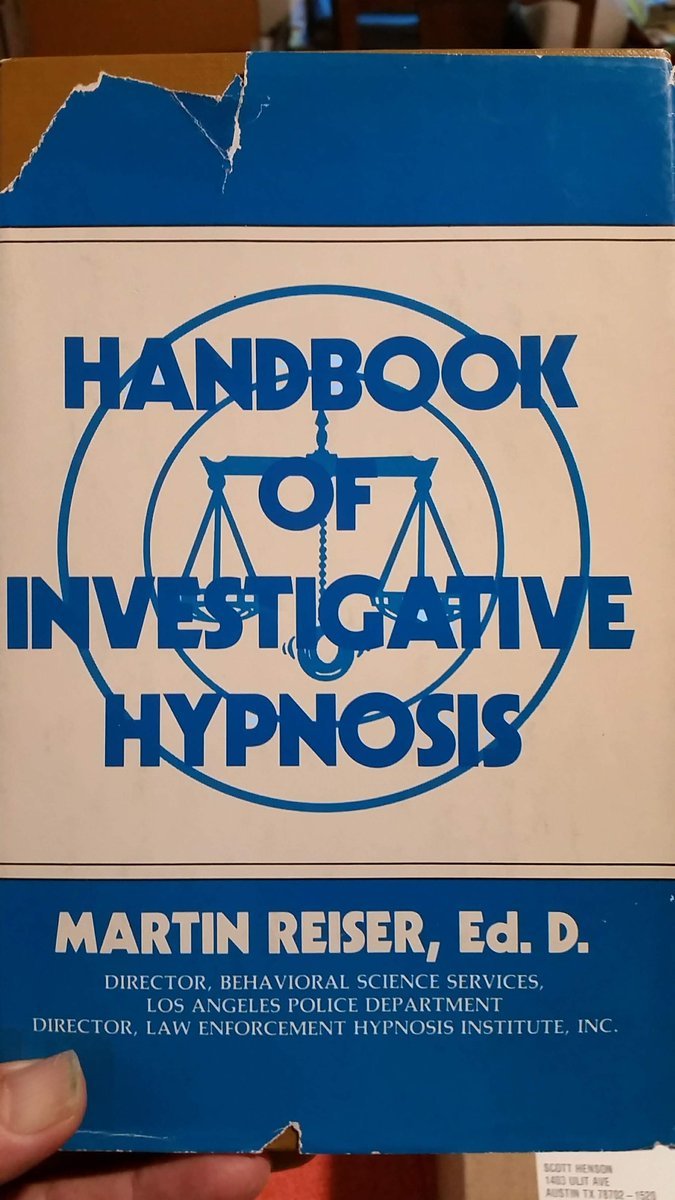
This piqued my interest and Grits followed up with a research primer on the subject that exposed the charlatanism underlying the practice. I purchased a copy of the book used to train forensic hypnotists under TCOLE's training curriculum. It included favorable references to occult practices like "automatic writing," portrayed memory as the equivalent of a videotape that hypnotists could simply play back, and encouraged "age regression" to recall long-ago events. Mandy and I began to follow the Flores case on the podcast.
I pitched the story to Lauren McGaughy at the Dallas News who ably picked up the ball, first publishing a preliminary assessment in 2018. This raised the profile of the topic in state government - helping me convince state Sen. Juan "Chuy" Hinojosa to file his roundly ignored legislation in 2019. Meanwhile, the courts were mimicking the iconic monkeys who see, hear, and speak no evil.
Then, last year, the Dallas News published a major two-part feature McGaughy co-reported with Dave Boucher called "The Memory Room." They spent months pursuing open records requests and dove deep into DPS practices and TCOLE records, revealing details no one outside those agencies knew. It was hard to imagine how responsible decision makers, after reading this damning assessment, could continue to let cops hypnotize witnesses.
Still, Grits wasn't sanguine the Legislature would even take up the topic; the same chairman who wouldn't give the bill a hearing still runs the committee, and the Court of Criminal Appeals' failure to take up the cause seemed to have shunted the issue to the back burner for state government.
DPS ending its hypnosis program changes the landscape, surprising all observers and opening up new opportunities. If neither they nor HCSO any longer use hypnosis, Texas can now shut down the practice entirely. Reported McGaughy, "Texas remains the only state known to have an active certification program for law enforcement officers to learn hypnosis and is also the home to likely the nation’s only extant police organization for investigative hypnotists."
There's no need for that certification program now and the Legislature should eliminate it as part of the TCOLE Sunset bill. This is EXACTLY the sort of thing the Sunset process was created to do: Extinguish outdated, anachronistic, and unnecessary programs.
Here's the rub: Even if the Legislature ends the certification, there are still numerous cases - nobody knows how many, but including Mr. Flores' death-penalty case - marching forward through the system like zombies based on past convictions secured using this practice, and more people locked up in TDCJ or on parole whose convictions were tainted by the same junk science.
I'm not a lawyer but Grits doesn't know if there's any way to help those folks if the CCA won't apply the junk-science writ. I suppose the Forensic Science Commission's jurisdiction could be expanded to evaluate this now-mostly-dead forensic method so that courts would have a basis to revisit it. But that's an open-ended, speculative process that could take years. It seems like waste of time when the CCA could already have done the right thing, and still could.
Grits' takeaways: The Texas Legislature should both abolish the hypnosis-certification program (TCOLE's Sunset review is remarkably well-timed for this purpose) and expand FSC jurisdiction to evaluate forensic hypnosis. The Texas Rangers may have stopped using this particular junk-science technique, but the topic won't finally go away until the courts do.
* I was Policy Director at the Innocence Project of Texas for 8 years and conceived of and negotiated with prosecutors to pass Texas' junk-science writ. The only bogus "science" I've seen that's arguably as junky as forensic hypnosis was dog-scent lineups, and the CCA got rid of that abomination.
Poking around this afternoon on some state agency websites, I ran across several disparate items I wanted to record for my own purposes which may also interest Grits readers:
State Prosecuting Attorney: Check out an interesting Power Point detailing different legal provisions establishing prosecutors' duty to disclose evidence to the defense in Texas, as well as limitations on defense attorneys' ability to advise clients on how to handle potentially incriminating evidence.
Texas Indigent Defense Commission: See a variety of linked training resources related to magistration, managed-assigned counsel programs, and competency restoration from a conference in January. This presentation on the challenges of implementing the Fair Defense Act included a chart demonstrating smaller Texas counties are still resisting requirements to appoint counsel for indigent defendants in misdemeanor cases.
Texas Commission on Jail Standards: Here's their guidance to jails on implementing Governor Abbott's new executive order forbidding county jail visitation except for attorneys and clergy.
Most Americans got their first sense of "hypnosis" from watching cartoons, where the mind-control trope has been a staple for decades. But it's no laughing matter when the practice enters the courtroom and people are sent to prison for decades, or even executed, based on such pseudoscientific foolishness.
Texas is the "epicenter" of forensic-hypnosis use in the United States, according to a pair of investigative stories published this week at the Dallas Morning News by Lauren McGaughy and Dave Boucher. The feature was two years in the making. Check them out here:
The title of the series comes from jargon used by forensic hypnotists at Texas DPS who tell witnesses to enter a "Memory Room" where they supposedly can review their memories as though watching a TV, hitting rewind, pausing, and generally treating one's memory as though watching a recorded video.
According to videos and documents The News obtained, police hypnotists use methods crafted at least as early as the 1970s and ’80s. Texas Rangers, among the most prolific hypnotists in the state, are still telling subjects to close their eyes, enter an imaginary “Memory Room” and watch their recollections on a television, as though they were a movie. It is an effort to find supposedly lost or buried clues, but experts refute this technique as dangerous and misleading.
Here's a little more detail:
This approach is still popular with the Rangers. In videos of some sessions The News obtained, hypnotists used the same method before instructing witnesses to imagine standing atop a staircase. As they walk down the steps in their minds, they are supposed to go deeper and deeper into a trance.
At the bottom, they are told they see a door. A sign on or above that door reads “Memory Room.” Upon entering, they are told to sit in front of a television. The hypnotist directs them to watch their memories on the screen.
In real life, scientists now understand that memories are recreated each time they are recalled and change substantially over time. The idea that a secret videotape is stored somewhere in the "subconscious" which may be reviewed during hypnosis has zero scientific credibility and, outside of law enforcement, has been relegated in the modern era to the realm of two-bit stage magicians. Even so, a Texas Ranger told the Morning News, "It's a very precise science."
These disproven misconceptions about memory are central both to the Texas court cases that approved this junk-science technique, as well as the state-approved training materials still used to this day training forensic hypnotists in Texas.
The Texas Court of Criminal Appeals has for a couple of years now had a death-penalty case before it which will revisit whether forensic hypnosis remains a valid technique in this state. With the Government Always Wins faction presently in firm control of that body, Grits fears the worst from this ruling. The fact that the case has taken so long to decide tells you there's a likely intense, behind-the-scenes disagreement among judges over how to proceed.
There's little scientific justification remaining behind the central tenets of Zani v. Texas, the 1988 decision in which the CCA first approved the technique's use, so it's possible that even the GAW faction of the CCA can't find enough meat left on that bone to continue the practice. The most detailed academic analysis I've seen of the pros and cons of admitting such testimony in court concluded, "Admitting hypnotically enhanced testimony into evidence creates grave dangers that miscarriages of justice will occur. The problems that arise from this practice are so great that hypnotically enhanced testimony should never be admissible."
Part one of the Morning News package includes an excellent graphic presenting data on every case they could document at DPS using forensic hypnosis going back to 1980 (a total of 1,789 cases). While not used as frequently as other forensic methods, it's often used in high-profile cases where little other evidence exists. Eleven people have been executed based at least in part on hypnotically-induced testimony.
The central example case, fleshed out in detail in Part 2, involved a black security guard convicted of assaulting a white woman in the 1980s. No physical or other evidence linked him to the case and the victim did not identify him in a photo array after the incident. But following a hypnosis session that experts say included leading questions from the hypnotist, she declared the security guard did it. He served 31 years of a 60 year sentence and to this day insists he was wrongfully convicted.
Here's hoping the Court of Criminal Appeals disallows this junk science going forward. The Texas Forensic Science Commission cannot study the question under its enabling statute because it relates to testimonial, not "physical" evidence. And though State Sen. Juan "Chuy" Hinojosa filed legislation last year to ban the technique from Texas courtrooms, Senate Criminal Justice Committee Chairman John Whitmire wouldn't give the bill a hearing. So if the CCA doesn't disallow such testimony, there appear to be no near-term options available for challenging the practice.
Read both the Morning News stories, they're easily the best thing I've seen from the MSM on these topics.
Grits earlier referenced the opinion from federal District Judge Janet Neff, in Michigan's western district, who directly evaluated the most common, commercial DNA-mixture software using probabilistic genotyping under the Daubert standard for whether to allow expert testimony. Texas courts heretofore have let in such evidence but avoided a direct Daubert evaluation.
There was a Texas connection in the case. Dr. Michael Coble, of the University of North Texas Health Science Center, was the expert employed by the prosecution. He has been one of several key advisers to the Texas Forensic Science Commission and the legal system in general as the state has struggled with this DNA-mixture issue. The expert for the defense, whose arguments more frequently prevailed in Neff's opinion, was Dr. Dan Krane, from Wright State in Ohio.
Judge Neff evaluated each prong of the Daubert standard as it related to the STR-Mix DNA mixture-analysis software. This program employs high-end math that few DNA-lab practitioners can actually reproduce called "probabilistic genotyping." But programs are only as good as the assumptions that guide their work, and some of the assumptions in each case - e.g., the number of contributing samples - are inputted by the user. There are subjective judgment calls throughout the process. Further, because the math results from tens of thousands of randomized guesses, the results aren't replicable test to test.
Judge Neff was disquieted that, unlike for one-to-one DNA matching or two-source mixtures, as with a rape kit, there are no controlling standards for interpreting DNA mixtures, especially for samples with very small amounts of DNA - maybe only a few scattered cells.
The judge also made the interesting point that, even if the math behind the STR-Mix software is impeccable, there were international standards for coding such high-end math projects and the STR-Mix software didn't meet them all. Coble was dismissive that other fields might have standards to contribute, but the product in question is so obviously an intersection of an array of multidisciplinary work, the judge didn't buy it.
Further, the judge echoed concern that most validation studies on the software so far have been conducted by company principals. And while there was peer-reviewed support for STR-Mix (again, mostly for studies by people with a financial stake in the project), none of that peer-reviewed work focused on low-level samples as in this case, where just a few cells were found that were said to belong to the defendant.
One point that's always bugged me was raised in an expository section of the opinion but not included in her reasons for her Daubert denial: “[D]ue to the methodologies used in STRMix, '[t]he results of no two analyses will be completely the same',” she wrote. Elsewhere, she quoted an academic article noting that, "for a technique to be broadly applicable, it must be based on measurements that can be replicated." Supporters of the software, however, say replicability isn't necessary and it should be good enough if the results were all in some acceptable range. Regardless, while Judge Neff clearly observed this incongruity, it wasn't included in her final reasons for her ruling.
Clearly the most persuasive piece of evidence for Judge Neff was the 2016 PCAST report which expressly stated that STR-Mix was validated for up to three sources if the sample to be identified is at least 20 percent of the total. She did not find further validation regarding smaller samples, and the very small sample in this case, she believed, merited even greater caution. She essentially treated the threshold cited by PCAST as a bright line regarding the current state of the science. STR-Mix can be used for traditional one or two-source DNA matching, she ruled, and for three-source mixtures if the sample to be matched made up 20 percent or more of the whole. But otherwise, the estimates would be inadmissible.
One small upside for backlogged crime labs using STR-Mix: This would make it easier to screen DNA mixture submissions. Samples with more than 3 contributors should probably be rejected up front as unanalyzable "crap," to use the words of a prominent DNA expert who advised Texas crime labs on the topic.
Errors in such cases can cause false convictions, so Grits is glad to see this increasingly dirt-common evidence more carefully vetted. From the time probabilistic genotyping was first introduced to Texas crime labs in 2015, experts were warning against stretching the limits of the math (i.e., trying to analyze "crap"). Judge Neff would set a bright-line threshold, and given the current state of the literature, it's not an unreasonable choice. In many ways, it's the most defensible (it would probably be easier to get past it by improving the tech than defeating her arguments). But whatever threshold one chooses, her decision highlights that one must exist, even if courts haven't heretofore required it.
I'd quoted it earlier, but I loved Judge Neff's conclusory analysis of current DNA-mixture-evidence practices, so let's give her the final word here:
The DNA evidence sought to be admitted in this case—in essence, that it is 49 million times more likely if Daniel Gissantaner is a contributor to the DNA on the gun than if he is not— is not really evidence at all. It is a combination of forensic DNA techniques, mathematical theory, statistical methods (including Monte Carlo-Markov Chain modeling, as in the Monte Carlo gambling venue), decisional theory, computer algorithms, interpretation, and subjective opinions that cannot in the circumstances of this case be said to be a reliable sum of its parts. Our system of justice requires more.
Anyone interested should definitely read the whole opinion. This summary hardly does it justice.
For some time, Grits has been skeptical whether DNA-mixture software would hold up to "Daubert" scrutiny if judges were to directly evaluate it. In 2015, this blog reluctantly broke the story in Texas about errors and uncertainties regarding how to evaluate DNA mixture evidence. (They were being openly discussed by the Forensic Science Commission and the Court of Criminal Appeals' Criminal Justice Integrity Unit when I worked for the Innocence Project of Texas, but reporters weren't covering the complicated, math-heavy story.) After that, I've followed the issue from afar even after I stopped tracking forensics in any professional capacity.
STR-Mix is one of a handful of companies selling their product as a solution to the conundrum of how to evaluate DNA mixture evidence. Now, a federal district judge in Michigan, Janet Neff, after an exhaustive review of the science, has ruled directly on the Daubert-based admissibility questions surrounding this product that Texas courts punted on. In particular, Judge Neff ruled in favor of defendant David Gissantaner, concluding that
The DNA evidence sought to be admitted in this case—in essence, that it is 49 million times more likely if Daniel Gissantaner is a contributor to the DNA on the gun than if he is not— is not really evidence at all. It is a combination of forensic DNA techniques, mathematical theory, statistical methods (including Monte Carlo-Markov Chain modeling, as in the Monte Carlo gambling venue), decisional theory, computer algorithms, interpretation, and subjective opinions that cannot in the circumstances of this case be said to be a reliable sum of its parts. Our system of justice requires more.
It is the Court’s hope that this decision brings to light the shortcomings or, at the very least, points of inquiry necessary in evaluating this advancing technology as a tool in forensic DNA analysis. There must be a dialogue among key players in the general interest of the development and refinement of the technology, the software and its application by the individuals charged with its use in the field, rather than post-hoc testing of its reliability in the context of a criminal prosecution where the ultimate question is the freedom and guilt or innocence of the person of interest.
Here, because the sum of the parts simply does not add up to a reliable whole, the DNA analysis/likelihood ratio resulting from the use of the STRmix probabilistic genotyping software must be excluded. Defendant’s motion to exclude evidence is granted. An Order will enter consistent with this Opinion.
Wow! Obviously, this doesn't apply in Texas nor anywhere in the 5th Circuit. But it's the first time to my knowledge that a federal judge has taken a deep dive into the science behind proprietary DNA mixture software and rejected it based on the Daubert standard. Welcome to the party, Judge! Grits was beginning to feel a bit lonely in that view!
In one-to-one DNA matches, or two-source matches like a rape kit where the DNA of the victim is known, DNA evidence remains the gold standard of forensic science. But analyzing DNA mixture evidence - e.g., "touch DNA" on a doorknob or DNA from a blanket on a couch - remains a more subjective process that's sometimes more of a guess than a "match."
I want to delve into the judge's opinion more deeply before commenting further, but this seems like a big development. We know at least some Texas labs use the same proprietary DNA software the federal judge in Michigan disallowed.
Clarification: More on this soon, but having now more closely read the opinion, Grits should clarify that the court recognized STR-Mix software results could be considered valid for distinguishing up to three-sourced DNA mixture samples, but only if the DNA one is attempting to match makes up at least 20% of the sample; in this case it made up 7%. So saying STR-Mix software was "disallowed" in the headline was too broad. Under this ruling, STR-Mix results for one and two source DNA samples would remain admissible, and for three sources, if the sample one wanted to identify made up at least 20 percent of the total. But it couldn't be used when there were only trace amounts from the third DNA source, or when there are four or more sources. Here is a spot where user expectations for forensics exceed the capabilities of actual science. In many ways, the judge's advice corroborates what experts have said in Texas since this issue first arose: beyond a certain point, DNA mixtures become un-interpretable "crap." You can push the math further, but the evidence doesn't therefore improve.
Here are a few odds and ends that merit Grits readers' attention:
Lawsuit seeking Hep C treatment could come with BIG pricetag
More than 18,000 Texas prison inmates have been diagnosed with Hepatitis C - almost certainly an undercount since TDCJ does not do comprehensive testing - but only a tiny handful receive treatment. The Houston Chronicle reported on a new federal lawsuit demanding they receive treatment, which could cost up to $63,000 per person. See prior Grits coverageand video of testimony from 2014 regarding Hep C treatment in TDCJ.
Conservative think tank takes on police unions
In a significant development, the conservative Texas Public Policy Foundation published a new report criticizing police unions for undermining police accountability reforms. In Texas, conservative politicians in the 21st century have largely kowtowed to these groups. Maybe the state's leading conservative think tank can convince them that's a bad approach. In related news, in St. Louis, prosecutors voted last December to join the local police union in response to the election of a new, reform-minded DA. This academic article makes the case that "This complete and public union of prosecutorial and police interests represents a collapse not only of prosecutorial ethical standards, but also a very real threat against democratically elected prosecutors who would seek to enact the reforms that their constituents desire."
Deep data dive for Big D and H-Town
The project by the Texas Criminal Justice Coalition and January Advisors to publish "data dashboards" for Harris and Dallas Counties' arrest, dismissal, and conviction information allows for important analyses that have never been possible before from publicly available data. They just published this overview of the project, which includes links to the dashboards and a description of what's there.
Handful of police-officer indictments in Dallas stand out
The Dallas DA's office has indicted four police officers for murder in three years, with two of them convicted. The trial for another, Amber Guyger, begins Monday. Notably, the indictments came under both Republican and Democratic District Attorneys. The Dallas News has a story describing how rare this is at other agencies. Even in Dallas, only one officer was indicted this year out of 50 (!) officer involved shootings taken to grand juries. Despite the rarity of such developments, the head of the local police union was quoted saying the indictments were evidence of anti-police bias.
DPS out of Dallas, with mixed reviews
The Department of Public Safety has ended its deployment in Dallas launched by the governor earlier this year. According to an item from the Houston Chronicle's Austin bureau, "The influx of state troopers drew criticism from some residents and a city councilman, who called for the operation’s end after hearing complaints that enforcement was unfairly targeting people of color, The Dallas Morning News reported. In August, two troopers fatally shot a Dallas man who the agency said pulled a handgun after a traffic stop, the News reported." Despite these criticisms, DPS Col. Steve McCraw declared the operation a success, declaring "Certainly there's been some that don't appreciate it, usually the ones that are arrested or have relatives arrested, and we understand that." That seems like an odd assertion when one of the most vocal critics is a city council member.
DNA analyst resigned over high-profile error
Grits had missed the news in August that a DNA examiner resigned at the Forensic Science Commission after a report by her employer found that she had testified incorrectly in a high-profile murder case in which a UT student was strangled, declaring the defendants' DNA could be excluded when that was not true. (She worked for DPS at the time she gave the testimony.) Though she told FSC investigators she "misspoke," she did so TEN times. The commission found that her error constituted professional "negligence," but not "misconduct." Whether or not there was any bad intention behind the mistake, it highlights the difficulties and pitfalls of interpreting DNA mixture evidence, which is more subjective and less definitive than one-to-one DNA matching.
Can refined patrol strategies free up more officer time?
A criminologist at UT-Dallas developed an algorithm to help the Carrollton PD refine its patrol strategies so officers waste less time in their vehicles. Notably, the recent staffing study for Dallas PD similarly recommended refining patrol routes to free up officer time spent driving long distances.
Does EMS need tactical teams? Montgomery County thinks so
The Montgomery County Hospital District has created a tactical team to join local police on SWAT raids. One paramedic said he joined the team because "There was more of the excitement appeal."
Alternative to police response for mental health, homelessness, substance abuse
Regular readers know that Austin recently funded a new program to have medical personnel respond to some mental-health calls instead of police. At the same time, the city has been engulfed in a debate over how to confront homelessness. A program out of Oregon called CAHOOTS demonstrates an approach that could address both issues with a non-police response. Medical teams in a van respond to mental health crises and provide services to people suffering from substance abuse or homelessness, leaving law enforcement out of the equation. That's a great idea.
Okies boost parole rates
Parole rates in Oklahoma are up 41 percent from last year, and commutations (which previously almost never happened) are up 1,300 percent, reported the Tulsa World. Texas parole rates remain stagnant in recent years at around 35 percent. Most offenders in Texas prisons are parole-eligible and could be released today if the parole board agreed.
Policing practices parsed in Congress
The US House Judiciary Committee held a four-hour oversight hearing this week on policing practices. Watch it here.
The public's cognitive dissonance over forensic science
A new academic analysis finds that the public is losing faith in the accuracy of forensic science, but still believe forensics over other types of evidence. As evidence of this cognitive dissonance, "Respondents still believe that forensic evidence is a key part of a criminal case with nearly 40% of respondents believing that the absence of forensic evidence is sufficient for a prosecutor to drop the case and that the presence of forensic evidence, even if other forms of evidence suggest that the defendant is not guilty, is enough to convict the defendant." (Emphasis added.)
A new constituency for pot legalization?
Should convenience-store owners become marijuana legalization proponents? It might boost their sales. A academic analysis published in February found that legalizing recreational pot use resulted in increased junk food sales.
The eugenicist who gave us fingerprint identification
I didn't know that the original creator of fingerprint identification in the 19th century was also the enthusiastic progenitor of the eugenics movement. It doesn't sound like the fingerprint discipline has changed much since he first convinced Scotland Yard to undertake it.
The criminogenic effect of police stops on black and Latino boys
A study published in April found that "the frequency of police stops [of black and Latino teenage boys] predicted more frequent engagement in delinquent behavior 6, 12, and 18 mo later, whereas delinquent behavior did not predict subsequent reports of police stops." In other words, police stopping minority youth was predictive of future delinquency, but self-reported engagement in delinquency was NOT predictive of police stops! The implication is that proactive policing strategies like stop-and-frisk may actually cause juvenile crime instead of deterring it.
The January episode of Just Liberty's Reasonably Suspicious podcast was delayed a bit by my co-host's enviable trip to Vietnam at the beginning of the year. But the results were worth the wait. You can subscribe to the podcast on iTunes, GooglePlay, or SoundCloud, or listen to this month's episode here:
We've got a good show this month, featuring a review of bail-reform litigation around the state and how it might influence legislation in Texas. We updated listeners on criminal-justice reform bills, including many with bipartisan support in both major Texas party platforms. And we talked through the Texas Court of Criminal Appeals' Chaney decision invalidating bite-mark evidence and debating innocence standards, plus much more. Here's what we discussed this month:
Top Stories
Bail reform (2:00)
Texas #cjreform legislation with bipartisan support (6:55)
Policing bills to watch (14:20)
Home Court Advantage
Bite marks, junk-science and innocence: The Court of Criminal Appeals' Chaney decision (20:00)
Fill in the Blank
Prison healthcare budgets (32:00)
First Step Act (36:00)
Rape clearance rates and the Austin police chief (39:30)
The Last Hurrah (43:55)
Convict leasing victims found in Sugar Land
Forensic commission suggests using high-error-rate drug field tests
'Dead Suspects Loophole' to the Public Information Act
Find a transcript of the show below the jump. Enjoy!
There are three reasons that Grits expects the Lone Star State to emerge as the epicenter of forensic reform over the coming couple of decades. First, our Forensic Science Commission has altered the terms of debate among legislators and stakeholders about how to react when errors and bad science are discovered. I may not agree with everything they put out, but they've educated stakeholders here to a much greater extent than in most other states.
Second is Texas' junk-science writ, as discussed on Wednesday in the context of the Court of Criminal Appeals' Chaney decision invalidating bite-mark identification testimony. Texas and California are the only two states so far to expand habeas corpus in this way. (Comparable legislation has never been pushed in Congress, but that's a Texas innovation they should copy.)
These two Texas reform measures have been widely praised. But together they would be insufficient to rigorously reevaluate the array of questioned forensics identified by the National Academy of Sciences and the disbanded Obama-era president's commission on forensics. Texas courts have refused to exclude such testimony in front-end suppression hearings under the Daubert standard. And courts have discretion which habeas petitions to consider, so there's no way to compel them to take up these difficult cases.
The main reason Grits can confidently predict Texas will emerge at the forefront of forthcoming forensic debates is that we still actively use the death penalty. That's proven to be a critical factor because, as I'd observed previously:
In Texas, capital cases are the one sliver of indigent defendants whose appeals are all paid for by the state, meaning those defendants have access to attorneys to file a state habeas corpus writ. So it makes sense that many of the most high-profile, early uses of the junk-science writ would come in death-penalty cases. By contrast, plea the case to life without parole, and a defendant accused of the same crime with the same evidence would have no access to an attorney at the habeas corpus stage.
I discussed exactly this dynamic with Amanda Marzullo, the executive director of the Texas Defender Service, a nonprofit that represents capital-murder defendants, in a segment on the August episode of Just Liberty's Reasonably Suspicious podcast. Check out that conversation here:
This explains why California's writ hasn't as yet had as big an impact: Their capital punishment system is moribund and few executions are set, so there isn't the constant stream of deadlines requiring courts to act. These days, quite a few death-penalty cases include junk-science writ claims, and the Court of Criminal Appeals is required to consider all of them.
It's not inevitable that death-penalty cases will dominate the initial round of Texas junk-science writs. Instead, it's a function of which indigent defendants have access to counsel to challenge bad evidence in their cases.
Judge Elsa Alcala on the Court of Criminal Appeals has suggested the Legislature should extend the right to counsel to habeas corpus proceedings in ineffective assistance of counsel cases. If the Legislature were to do that for cases challenging old forensics under the junk-science writ, perhaps expanding the Office of Capital and Forensic Writs to take on the function, then junk-science writs would arise in a wider variety of cases.
Eight states, according to Judge Alcala's counting, appoint counsel for every indigent habeas-corpus petitioner. If indigent habeas petitioners in Texas had such access, capital cases wouldn't dominate the junk-science writ process.
As things stand in Texas, with forensics disproportionately being challenged in capital writs, Grits won't be surprised if it takes another 20 years or more for all of the dubious forensics identified by the NAS to be challenged and either confirmed or dismissed through the junk-science writ process. But at least we have a process. Most states and the federal government do not.
The Texas Forensic Science Commission has completed its legislatively mandated report on the validity of field tests for controlled substances, and it was released today. Here's a first-cut look at what they found.
Let's be frank. Lynn Garcia has led the commission to perform some of the most able and erudite investigations of flawed forensic practices of anyone, anywhere in the United States. She is my friend and I am a fan of hers. This is not their best work.
In the past, when the Commission has been charged with evaluating junk science - e.g., arson, hair-and-fiber, bite marks, blood spatter - they have earned national praise for courageously confronting the problems instead of allowing flawed forensics to go unchallenged, as most jurisdictions choose to do.
In this instance, though, the FSC evaluated a brand of junk science so pervasive to how the justice system operates, and so heavily relied upon by law enforcement, they couldn't bring themselves to recommend it be discarded.
Field tests being used today were developed in the 1960s, we learn in the report. Despite having been around for more than a half century, however, "With respect to scientific reliability, there are very few published validation studies for field tests." Manufacturers of these kits do not publish their own validation data, "thereby raising questions about the veracity of marketing statements."
Indeed, the likelihood of error regarding these tests has been long known: "Under Texas law, confirmatory analysis performed by an accredited crime laboratory is required in order for the evidence to be admitted in a criminal action." Advocates around the country have been calling for a moratorium on their use for years.
The Texas Department of Public Safety and several other agencies no longer use them. However, in a survey conducted by the FSC, prosecutors reported that most agencies in most counties surveyed still used drug field tests.
Speaking of which, one wonders: Why only survey prosecutors? Since the FSC was tasked to evaluate the forensic source of a brand of false convictions - and since all they did for prosecutors is put a survey on a listserv - it couldn't have been that much more difficult to get input from the defense side.
The reason the FSC was asked to do this report is that hundreds of people in Harris County alone have been falsely convicted when they pled guilty in order to get out of jail, even though they would be exonerated many months later when forensic tests came back. People just didn't want to wait months in jail until the labs got around to their sample. One of the best backgrounders on the issue was actually done by a comedian. Check it out, it's worth watching:
In the FSC report, the euphemism for "innocent people falsely convicted" is "Unintended Adverse Consequences in Some Plea Cases." With that framing, they describe how:
The most significant unintended consequence of the widespread use of field drug tests is the extent to which they impact cases resolved by plea agreement.Of the approximately 55,000 seized drugs cases analyzed at the Texas Department of Safety (DPS) each year, examiners testify in less than 1% of the cases. This means the vast majority of cases submitted to the laboratory are resolved by plea.
The survey of prosecutors found that half of "large" jurisdictions (more than 100,000 population) took plea deals without a final lab report; a third of mid-sized agencies did so, while all of the small-county prosecutors entered plea deals based on field tests.
There is no statutory prohibition against accepting pleas without a laboratory test. There is no broad-based rule providing that a laboratory must complete instrumental analysis even where a plea has been reached. DPS reports that policies with respect to this issue vary from jurisdiction to jurisdiction. While many jurisdictions require DPS to complete testing even after a plea has been reached, this is not true in all cases.
Regrettably, the Commission declined to recommend such a "statutory prohibition" or "broad-based rule," even though that omission is the primary source of "Unintended Adverse Consequences in Some Plea Cases" (read: false convictions).
Indeed, we don't even know how many false convictions have occurred because "there is no central repository in Texas for drug pleas that were later overturned by contradictory laboratory testing."
Lamentably, DPS has a policy not to perform testing on controlled substances if a plea deal has been reached. "This is not because the DPS laboratory does not appreciate the reliability concerns surrounding the use of field drug tests, but rather as a necessary component of limited resource allocation."
So in precisely the circumstance most likely to produce a wrongful conviction, by policy the agency does not double-check to make sure there wasn't one. Statewide, 1,475 agencies rely on DPS for their forensic testing, according to the report.
Yes, it's because the agency is underfunded. That funding gap is why the Legislature authorized user fees, which the Governor rescinded. But that's cold comfort to the falsely accused person pressured to plead guilty in order to get out of jail.
Nor does the FSC recommend that DPS be required to test cases after plea deals have been reached, although they did advocate that the agency be given more resources.
Rather, the report pins the blame on a dysfunctional bail system rather than suggesting fixes involving the labs or standards of evidence. That's because:
for indigent defendants who cannot afford to post bail but do not pose a risk to public safety, the result of a policy requiring confirmatory testing can be a lengthy jail stays which have severe impacts on economic stability for affected families as well as unnecessary costs for local government.
At the same time, the report operates under an odd pretense that these low-level drug offenders are themselves a serious safety threat, implying maybe they shouldn't be released pretrial:
Even more important to public safety are cases in which defendants pose a serious risk of re-offending but are released on personal recognizance (PR) bonds after 90 days because lab results are still pending and judges refuse to continue to hold the defendants. TDCAA survey respondents describe circumstances where they “have defendants out on these PR bonds who commit new crimes because we haven't been able to get them into court. This is very frustrating to prosecutors, law enforcement and most importantly to the citizens of our county.”
This may have been a moment in the report when the Commission might have benefited from a defense perspective, particularly if they were going to focus on policy concerns instead of scientific ones.
Regrettably, very few of the Commission's recommendations address the fundamental causes of junk-science-based false convictions in these cases, unless you count the suggestion to throw lots of money at crime labs. Grits agrees DPS crime labs need more funding - it's why your correspondent supported user fees passed last session - but money won't in and of itself solve the false-conviction issue.
One solution could be for agencies to simply stop using junk science this unproven forensic method:
In 2017, a number of Texas law enforcement agencies (e.g., Houston Police Department, Pasadena Police Department, DPS state troopers, etc.) announced they wouldno longer use field drug test kits. These law enforcement agencies cited officer safety and concern over exposure to fentanyl, carfentanil and similarly dangerous substances as the primary rationale for discontinuing the practice. However, not all agencies that have discontinued the practice issued public statements announcing their decisions, making the total number of law enforcement agencies that have abandoned the practice difficult to assess.
However:
For counties that have ended the practice of field drug testing, officers still must make an assessment of whether a particular substance encountered on the scene is likely to be a controlled drug. In Harris County, the criteria to replace field drug testing include but are not limited to: contraband color, contraband texture, the presence of drug-related paraphernalia, demeanor of the suspect, and prior arrests and convictions involving controlled substances of the suspect. It is important to note that relying on officer observations is not a perfect solution, as many of these criteria depend upon the training and experience of the officer.
So, rather than suggest law enforcement cease using junk science field tests, the Commission weakly opined that they should at least follow directions on the packaging. "To the extent field drug tests are still used," according to the report, "they should be subjected to basic quality standards. For example, agencies should ensure against the use of expired reagents, store the reagents in an appropriate environment, and require at least some baseline level of training."
But they knew even as they wrote it that even that would be too much to ask: "because Texas has approximately 1,750 law enforcement agencies of various size and resources, enforcement of these principles poses a particular challenge."
The Commission and law enforcement agencies using this junk science are hoping tech advancements will bail them out before they have to change practices.
There is technology on the horizon - dubbed Raman spectroscopy - that may eventually replace chemical field tests. The report recommended the FSC collaborate with a state bar committee convened by the president-elect of the state prosecutors association to explore it. This is not a perfect solution, the report emphasizes. E.g., the test cannot identify either heroin or pot. Most of its errors, though, are false negatives instead of false positives, according to the report, which is a plus from an innocence perspective.
The failure to condemn the use of inaccurate and unproven forensics is an off-brand misstep for the Commission. Their role is to evaluate science, not policy. Grits had expected more out of this report.
Required textbook for Texas
forensic hypnosis certification class
In this Twitter-string in response to SB 130, I briefly made the case for ending the practice. In essence, modern brain science has shown most of the thinking behind it is garbage. For example, recently I purchased a copy of the textbook the Texas Commission on Law Enforcement requires for forensic hypnosis trainings. That learned tome informs us that the "conscious" mind takes up 1/8 of the brain and the "subconscious" 7/8(!), with memories stored in the latter. It suggests "automatic writing" may be "useful in eliciting suppressed" memories, as well as "age regression," allowing witnesses to reenact past events.
Another Tweet in that string cited to the TCOLE curriculum for forensic hypnosiswondering aloud why the state would require detectives being trained in forensic hypnosis to demonstrate proficiency in post-hypnotic suggestions? (Item 14) Should detectives really be taught to implant memories in hypnotized witnesses? That seems dubious, at best.
There was a time when more than 800 Texas peace officers boasted forensic hypnosis certifications. Today, just two agencies - Texas DPS and the Harris County Sheriff's Office - employ nearly all of the fewer than two dozen forensic hypnotists in the state.
Indeed, forensic hypnosis appears to be a dying profession in Texas. There aren't many trainings conducted anymore. Pam Colloff, Mandy Marzullo and I wanted to take a forensic-hypnosis-certification course this year, but could not find one given in the state of Texas throughout all of 2018.
Most practitioners boast gray hair and decades-long resumes, and there doesn't appear to be an eager new guard anxious to stake their careers on a practice that's perhaps a half step above a tarot-card reading in terms of investigative utility.
The Texas Legislature should absolutely pass Sen. Hinojosa's SB 130, and while they're at it, they should get rid of this ridiculous certification at TCOLE. It can't be fixed. There's no scientific version of hypnosis-based memory enhancement to fall back on, even if the agency wanted to revise its trainings, which mostly don't occur anymore.
Anyway, TCOLE doesn't have sufficient curriculum staff to revise outdated police trainings, which is a budget question this blog will be revisiting later. They could use three additional FTEs for that purpose, according to the "exceptional items" request in their LAR. (And that's a no-BS request; their backlog is worrying.)
Neither can the Legislature count on the Forensic Science Commission to address the question, although they have received multiple complaints on the topic. That's because, by statute, they are only allowed to consider forensics related to "physical evidence." So hypnosis has somehow slithered through unintended gaps in the government's forensic-vetting apparatus.
That leaves the issue on the Legislature's doorstep. The case seems easy to make: In 2018, a curriculum suggesting police try to get witnesses to engage in "automatic writing," or teaching cops to implant post-hypnotic suggestions, doesn't even pass the laugh test. And yet that's the state of evidence Texas courts have allowed, with the Court of Criminal Appeals reaffirming the admissibility of hypnotically induced testimony as recently as 2004.
Courts in Texas have until now abdicated their duty to protect the public from junk science when it comes to admissibility of forensic hypnosis. In such instances, it's necessary and proper for the Legislature to step in. Bully for Chuy Hinojosa for doing so.
At a dramatic hearing yesterday on his habeas corpus writ in Comanche, TX, a small town near Brownwood, all of the evidence accusing former high-school principal Joe Bryan fell apart, including blood-spatter evidence which even the original analyst would no long stand behind. Ace ProPublica reporter Pam Colloff gave the details in a followup to her massive, long-form story on the case, which was published in the New York Times Magazine back in May.
As it turns out, Joe Bryan was almost certainly innocent and has been unjustly incarcerated for more than 32 years. Most of the blood spatter on the flashlight turned out not to be blood, and what blood was present could be linked neither to Bryan nor his wife, Mickey, the victim. Underwear that the prosecution told a jury contained semen did not. By the time the hearing was over, virtually nothing was left of the prosecution's case, reported Colloff.
With this news, and the renewed attention on Colloff's blood-spatter reporting, Grits thought it would be a good time to stop procrastinating and put out the full interview I did with Colloff over the summer. An excerpt was included in our August podcast, but here's our full conversation. We talked about the Bryan case, blood-spatter analysis (including the training course she took to conduct it), the state of forensics generally, her favorite criminal-justice podcasts, and changes in the media landscape affecting criminal-justice coverage. The whole thing runs about 40 minutes, you can listen to it here:
Find a transcript of our conversation below the jump. You can subscribe via iTunes or GooglePlay.
The most commonly used forensics that were questioned by the National Academy of Sciences 2009 report, "Strengthening Forensic Science: A Path Forward" - like fingerprints or ballistics matching - have yet to face concerted challenges. But quite a few second-tier forensic methods have begun to wilt under scrutiny.
Here's Grits list of the top 10 forensics challenged in Texas to date.
Of these, only dog-scent lineups and flawed arson testimony have been eliminated, with hair comparisons mostly displaced by mitochondrial DNA testing in 21st century cases. A prosecutor in Collin County recently stipulated that bite-mark testimony is junk, so the Court of Criminal Appeals will soon get a chance to declare it non-viable. The rest are under dispute but still in use. Moreover, Texas has yet to figure out how to respond when forensic errors impact large numbers of already-decided cases.
That's why I've said before, Texas may be ahead of other states on forensic reform, but don't gloat. Most other states are behind because they never left the starting gate, and despite some notable progress, most of our needed forensic reforms remain in front of us.
In the December episode of the Reasonably Suspicious podcast, we published an excerpt from an interview Grits conducted with national Innocence Project co-founder Peter Neufeld. We mainly discussed forensic-science topics including the abolition of the national forensic science commission, of which he was a member, and DNA mixture controversies. You can listen to the full interview here.
Find a transcript of our conversation below the jump.
Here's a brief, browser-tab clearing roundup of items about which I haven't had time to blog, but of which Grits readers should be aware:
Forensic commission can't address 'forensic hypnosis'
First, updating an earlier Grits report, I communicated with Lynn Garcia, General Counsel for the Texas Forensic Science Commission, who informs me that forensic hypnosis does not fall under their jurisdiction, even as a general area they're authorized to study, because it does not involve "physical evidence," which is defined in the statute as something tangible. She said they've received complaints about the practice in the past, including one recently, and agrees it's problematic, but doesn't believe it falls within their jurisdiction. While I understand her legal interpretation, that leads to an unfortunate situation where government-sanctioned junk science (the Texas Commission on Law Enforcement gives out certifications in forensic hypnosis) cannot be evaluated by the state Forensic Science Commission. That should change in 2019.
Maybe they'll listen if they Rangers tell 'em
Governor Abbott has asked the Texas Rangers to investigate sexual abuse at the Gainesville State School. But we've had an Ombudsman complaining about these problems and recommending solutions for years, and for the most part those recommendations have been ignored. Most of the details in the disturbing press reports out of Gainesville came from Debbie Unruh, the TJJD independent ombudsman, and had been included in her prior reports. Why would we imagine state leaders will listen to the Texas Rangers when they haven't implemented the recommendations from Unruh who's been sounding the alarm all this time? The state already knows the solutions here, they just haven't heretofore been willing to pay for them.
Did TDCJ understaffing allow rape of prison teacher?
A teacher at a TDCJ prison blames chronic understaffing for the circumstances that led to her rape. Grits readers know this is a longstanding problem. The solution here is to reduce incarceration levels and close understaffed units. There just aren't enough people in some of these rural areas to consistently staff the prison units there. And the problem will be much-exacerbated at certain South and West Texas units if and when oil prices go back up.
Coverup at TDCJ?
The Texas Department of Criminal Justice allegedly shredded documents they were obligated to turn over as discovery in a federal lawsuit alleging the summer heat in un-air conditioned prisons constitutes cruel and unusual punishment. The warden who approved the shredding allegedly already knew about the litigation. Hard to interpret it otherwise: This smacks of a coverup.
Executing non-killers
Something about executing a person for a murder they didn't themselves commit feels inherently unjust. Even the prosecutor from Jeff Wood's capital conviction, who had 13 months experience as an attorney at the time she was designated shot-caller in the case, has asked the Governor to commute his sentence. Wood's example reinforces Grits' belief that the law-of-parties doctrine is ripe for revision: the concept stems from British common law, but Parliament abolished it in 1957, followed soon thereafter by all of Europe, India, and in 1990, Canada. This is a holdover from a less evolved time.
Paying for public defenders would reduce incarceration costs
Long-time Grits readers are aware that defendants represented by public defenders have better outcomes than those with appointed attorneys. We've seen this both in national data and Texasexamples. But a new national analysis suggests that public defenders do such a better job that using them reduces incarceration costs: Using "public defenders reduce[s] the probability of any prison sentence by 22%, as well as the length of prison by 10%."
When your 'tiny house' means a tiny privacy footprint Here's an unintended consequence to the "tiny house" movement: If your tiny house is on a trailer, your Fourth Amendment rights are likely diminished and the automobile exception will apply to searches of your residence, according to academic from Texas State.
Life without plea bargaining? For the reading pile: India's court system doesn't do plea bargains. They've tried to implement them in the last decade and it's been a flop. I want to read this new academic article to learn more about the situation.
After several months of working out the kinks in a soft launch, Just Liberty's Reasonably Suspicious podcast now is up and running on numerous platforms - iTunes, Google Play, YouTube, SoundCloud, etc.. Please subscribe and give it a try! I'm proud of the results so far, and we're improving every time.
We've now got a fresh new logo created by the legendary Guy Juke, plus original music by producer/guitar virtuoso Gabe Rhodes and some of thebestmusiciansinTexas. I couldn't ask for a smarter, more able co-host than Mandy Marzullo from the Texas Defender Service. The excuses for failure are dwindling! :)
Just Liberty will host a podcast launch party in Austin on Wednesday, September 20th to celebrate the new project. Please join us if you can! See our Facebook event page for details.
You can listen to the podcast here, or as usual find a transcript with links to underlying documents and news stories below the jump.
Here are the topics covered in the September 2017 episode:
Top Stories
Police-union pension crisis predicted by Ron DeLord
Prosecutors ill-advised to withhold witness statements
Big implications for Harris County bail-reform litigation
Check out video from the National Institute of Standards and Technology "Error Management Symposium" of presentations by Peter Stout from the Houston Forensic Science Center and Lynn Garcia of the Texas Forensic Science Commission:
Interesting note from Stout's presentation: He said the HFSC has gotten along well with the Houston Police Department, but the police union had been the source of most of the friction. The union v. crime lab tension hadn't occurred to me before.
Garcia suggested that the adversarial legal system stands at odds with improving forensic science, citing the FSC's experience with the Todd Willingham arson case as a prime example. Her description of the DNA mixture issues we've been discussing recently begins at about the 1:41:00 mark.
RELATED: Forensic bite mark analysis takes another hit in an article using its failures to highlight "the weak scientific culture of forensic science and the law’s difficulty in evaluating and responding to unreliable and unscientific evidence."
Reasonably Suspicious: Hosted by Scott Henson and Mandy Marzullo
Blurbs
"exceptionally terrific"
- Blawg Wisdom
"A protein-laden dose of big thinking on criminal justice reform."
- Evan Smith, Editor-in-chief and publisher, The Texas Tribune
"A powerful and well-researched site."
- The Austin Chronicle
GFB is "an indispensable handle if you're interested in criminal justice in Texas."
- Emily Bazelon, Slate
"Grits is the first thing I read every morning and I learn something every single time."
- Pam Colloff, ProPublica/NY Times Magazine
"plenty of biting commentary and credible research"
- San Antonio Current
Scott Henson is "one of the nation’s finest criminal-justice policy wonks."
- Conor Friedersdorf, The Atlantic
Grits for Breakfast "is the best blog about criminal justice in Texas" and "as usual extremely fair"
- Erica Grieder, The Economist
"the best coverage of criminal justice in the entire state"
- Pamela Colloff, Texas Monthly
"I respect the work Scott does and appreciate his thoughtful and extensive coverage of Texas’s criminal justice system"
Jim Bethke, Texas Indigent Defense Commission "Grits for Breakfast has done a terrific job covering Texas prison overcrowding issues."
- Doug Berman, Sentencing Law & Policy
"the indispensable blog on criminal justice and law enforcement in Texas"
- Marie Gottschalk, author of 'Caught'
"plugged in and well written"
- DallasBlog
"I always tell people interested in these issues that your blog is the most important news source, and have had high-ranking corrections officials tell me they read it regularly."
- Scott Medlock, Texas Civil Rights Project
"a helluva blog"
- Solomon Moore, NY Times criminal justice correspondent
"Congrats on building one of the most read and important blogs on a specific policy area that I've ever seen"
- Donald Lee, Texas Conference of Urban Counties
GFB "is a fact-packed, trustworthy reporter of the weirdness that makes up corrections and criminal law in the Lone Star State" and has "shown more naked emperors than Hans Christian Andersen ever did."
-Attorney Bob Mabry, Conroe
"Grits really shows the potential of a single-state focused criminal law blog"
- Corey Yung, Sex Crimes Blog
"I regard Grits for Breakfast as one of the most welcome and helpful vehicles we elected officials have for understanding the problems and their solutions."
Tommy Adkisson, Bexar County Commissioner
"dude really has a pragmatic approach to crime fighting, almost like he’s some kind of statistics superhero"
- Dirty Third Streets
"concise, knowledgeable, in-depth and sometimes counter-to-prevailing wisdom"
- Rob Patterson, The Austin Post"Scott Henson's 'Grits for Breakfast' is one of the most insightful blogs on criminal justice issues in Texas."
- Texas Public Policy Foundation
"Nobody does it better or works harder getting it right"
David Jennings, aka "Big Jolly"
"I appreciate the fact that you obviously try to see both sides of an issue, regardless of which side you end up supporting."
Kim Vickers, Texas Commission on Law Enforcement Officer Standards and EducationGrits for Breakfast "has probably broken more criminal justice stories than any TX reporter, but stays under the radar. Fascinating guy."
Maurice Chammah, The Marshall Project "unrestrained and uneducated"
John Bradley, Former Williamson County District Attorney, now former Attorney General of Palau
"our favorite blog"
- Texas District and County Attorneys Association Twitter feed"Scott Henson ... writes his terrific blog Grits for Breakfast from an outhouse in Texas."




.jpg)