Showing posts with label Innocence. Show all posts

Thursday, October 22, 2020

Four stories let public peer into soul of Houston justice system

The justice system can be difficult to understand for experts and darn near impossible for laypeople. Grits believes that's in part because the public best understands issues of crime, punishment and justice through storytelling. But there are too many stories emerging from the system which often seem to produce contradictory moral conclusions. Which story one latches onto may tell more about the storyteller (or the listener) than the system. Yet at the same time, the stories are important and without them, the public can't comprehend what's happening and drowns in a sea of policy recommendations.

Many of the most difficult dynamics facing the 21st-century justice system are revealed through the lenses of four black Houston men's tragic stories making recent headlines: Houston PD Sgt. Harold Preston, shot down after 41 years on the force while responding to a domestic dispute; Narcotics Detective Gerald Goines, whose false affidavit resulted in the deaths of two innocent homeowners; George Floyd, whose death in Minneapolis was preceded by numerous run-ins with Houston PD, including a drug conviction in which he was possibly set up by Detective Goines; and Lydell Grant, a Houston man convicted of murder and exonerated by DNA and the confession of the real killer, but whose innocence the Texas Court of Criminal Appeals refuses to acknowledge.

The justice system in Houston isn't just one of these stories, it's all of them. (And many more, but these are all particularly iconic.) There are good cops like Sgt. Preston who touched many lives and are a credit to their badges. But the same department provided tolerance and succor to Detective Goines and a sizable cohort of allegedly corrupt cops at an HPD Narcotics Division that arguably should be shut down. Telling either story without acknowledging the other provides an incomplete perspective.

Like Sgt. Preston, George Floyd grew up in the Third Ward and attended Jack Yates High School. The Washington Post has published an excellent series titled "George Floyd's America" which does a better job than I could showing how the justice system, Houston schools, and segregated housing layered together to present virtually insurmountable barriers for Floyd and generations of youth just like him.

Then there's Lydell Grant: Falsely convicted despite a legitimate alibi, based on multiple eyewitnesses' testimony which DNA results later contradicted. The Texas Court of Criminal Appeals wants the witnesses re-questioned, even though DNA evidence contradicted their recollections and the person the DNA matched has confessed to the crime! In essence, Texas' court system would rather uphold a bad conviction than free an innocent man, and it's hardly the first time.

Each of these men's stories reveals unheralded truths about the justice system. George Floyd's sad saga reminds us that it's a short step from institutional racism to terrible, negative outcomes for individual black folks. Lydell Grant's story reinforces the folly of assuming the justice system will seek or embrace just outcomes. Gerald Goines' ignominious apologue highlights the reality that law enforcement appears to tolerate bad actors in its midst, often for many decades. And Sgt. Preston's story reminds us that plenty of cops went into the business for the right reasons and there's still much good to be done in that role.

All of those things can be true at once. Focusing on any one story misses the big picture, while failing to acknowledge individuals' stories misses the most compelling aspect for the public. Today, Grits encourages you to think about four of them.

Tuesday, May 26, 2020

Reasonably Suspicious podcast back from hiatus: Austin police chief under fire, COVID in TX prisons and jails, Harris DA calls to overturn shady drug convictions, and other stories

After a three-month hiatus while your correspondent underwent throat-cancer treatment, here's the May 2020 episode of Just Liberty's Reasonably Suspicious podcast, co-hosted as always by me and Mandy Marzullo. Grits must admit, until I was editing all this together, I hadn't realized how much the radiation treatment had affected my vocal chords: I sound like a different person, decidedly heading in the raspy, Tom-Waits-ish direction. (Really that's wishful thinking; my singing voice is completely shot.) Regardless, it was good to see Mandy again and climb back into the podcasting saddle.

We went a little longer this time because the segment on Austin PD includes a half-dozen excerpts from a community forum held last week by the Austin Justice Coalition. Lots of good stuff there. Thanks to Chas Moore for getting me the audio. As always, the podcast is available on Soundcloud, iTunes, and Google podcasts, or you can listen to it here:


Here's what we discussed this month, with time stamps in case you want to jump to an individual segment:

Top Stories
  • Community groups call for Austin police chief's ouster (1:46)
  • Coronavirus in Texas jails and prisons (32:40)
Fill in the Blank
  • Ransomware attack on Texas courts (44:40)
  • The Texas AG and Rosa Jimenez (48:15)
  • Editor of Palestine paper wins Pulitzer for series on jail oversight (51:30)
The Last Hurrah (53:25)
  • Harris County DA calls to overturn shady drug convictions
  • San Marcos mandates citations instead of arrests for petty crimes
  • Joe Bryan gets parole
Find a transcript of the podcast below the jump. Enjoy!

Monday, May 18, 2020

Blakinger scores big victory for hungry TDCJ inmates, visitation denied, why people convicted of unconstitutional statutes are innocent, and other stories

Here are a few odds and ends that merit Grits readers' attention:

TDCJ to improve lockdown food
The Marshall Project's Keri Blakinger hit another home run recently with her story on what Texas prisoners are being fed during lockdown. It was sprinkled with stomach-churning contraband cell-phone pics from prisoners that corroborated years of allegations about how awful food could be when prison units are locked down. On Friday, she reported on Twitter that TDCJ has told inmate families they will begin providing raw vegetables, cartoned milk instead of powdered, and are considering how to source fruit, pizza and hot pockets. Good for TDCJ, even if it took being shamed to improve things. And thank God for Keri Blakinger!

Many prisoners denied visits, phone calls before the lockdowns
Prisoners' families have been upset during the COVID crisis that so many inmates were forbidden access to phones to call them. Recently, some on lockdown have been allowed 5 minute calls, but that's still not much. Michael Barajas at the Texas Observer reminds us that a significant portion of Texas inmates couldn't call their families and had been banned from visitation even before the coronavirus, but TDCJ doesn't track how many are banned or why. Great job, Michael! Grits readers may recall that, earlier this year, TDCJ made visitation and mail policies even more restrictive, punitive and arbitrary. It's great to see some journalistic light shed on the subject.

Texas women inmates cope with COVID
At the Waco Tribune Herald, reporter Brooke Crum provided a window into how women inmates in Gatesville and their families are coping with coronavirus restrictions.

COVID testing rates vary widely at county jails
There are wide disparities in how frequently county jails are testing inmates and staff for the COVID virus, reported the Dallas News. Harris County is testing more broadly; Dallas County, not so much. Travis County, by contrast, is testing far less frequently than either of them. The thinking appears to be that, if you do not test, you won't have to report that anyone is sick. As of yesterday, 1,314 Texas jail inmates and 234 jail staff had been reported as testing positive to the Texas Commission on Jail Standards. But because some jails are testing so few people, those numbers are surely an undercount.

Ex-prosecutor could be disciplined for withholding exculpatory evidence
Daniel Rizzo, a former Harris County prosecutor, faces an attorney discipline lawsuit for withholding exculpatory evidence in Alfred Dewayne Brown's murder case, Texas Lawyer reported. Rizzo claims he never saw the phone records which later led Mr. Brown to be declared actually innocent, though they were available in his files.

People convicted of unconstitutional online solicitation statute were actually innocent 
The Texas Supreme Court has ruled that people convicted of online solicitation of a minor after the statute was deemed unconstitutional by the Texas Court of Criminal Appeals  qualify for innocence compensation under Texas statutes. (The Legislature enacted a new online-solicitation statute in 2015, but not nearly as stringent as the original.) Grits has wondered for years about how innocence claims from these cases would be handled. Now we know.

Wednesday, May 06, 2020

CCA passes on judging forensic hypnosis, paroled but still imprisoned, Ken Paxton's 'lonely and misguided' crusade, and other stories

Here are a few odds and ends that merit Grits readers' attention:

On the absurdity of keeping 15k already-paroled prisoners in TDCJ so they can do treatment by correspondence
The Marshall Project's Beth Schwartzapfel has a story on an ongoing problem that's taken on new life in the coronavirus era: More than 15,000 Texas prisoners have already been paroled but can't leave prison because they haven't completed required treatment programming and the state underfunds it so badly there's a massive waiting list. This is pointless and stupid in the best of times, but at a moment when 1,299 TX prisoners have been diagnosed with COVID-19 and another 48,674 inmates are on precautionary lockdown because of the virus, it makes even less sense. According to the article, TDCJ has already stopped doing these treatment programs in person and has switched to correspondence courses where prisoners work on written packets in their cells. If that's the case, why not parole them and let them complete the packets at home?

Ken Paxton's 'lonely and misguided crusade' against Rosa Jimenez
Attorney General Ken Paxton won't drop his federal appeal in Rosa Jimenez's habeas corpus writ, even though DA Margaret Moore has finally, belatedly, acknowledged that the evidence used to convict her was flawed and she deserves a new trial. What a strange situation! Moore's position is hardly progressive. She insists she will retry Jimenez despite the fact that the forensics used to convict her was flawed and there was no other accusatory evidence in the case. But Paxton's position is nonsensical; a Statesman editorial dubbed it a "lonely and misguided crusade." All sides have briefed Judge Lee Yeakel, with Paxton arguing for maximum harshness. Her attorneys, by contrast, "urged Yeakel to allow Jimenez to leave prison on a personal recognizance bond while the appeal continues, arguing that COVID-19 puts her life at risk because she has stage 4 kidney disease." Grits has no idea what Paxton thinks he's trying to accomplish here. It's one of the weirdest legal postures I've seen a Texas AG take in the three decades I've been following state politics.

Man exonerated of drug charges after DNA evidence disproved faulty eyewitness testimony 
In Houston, James Harris has been exonerated of drug charges eleven years after his false conviction based on erroneous eyewitness identification. DNA testing finally exonerated him. Long-time Grits readers know that the Legislature enacted solid guidelines for how police conduct eyewitness identification procedures, but Texas courts have ruled that such testimony still can be used to convict even if police do not follow them. Harris was both more persistent than most people, pursuing the case for years after he got out of prison, and also incredibly lucky that DNA evidence, which is unavailable in most cases, was able to exonerate him. Most people who're falsely convicted under these circumstances have no way to clear their name.

CCA judges decline to judge forensic hypnosis
The Texas Court of Criminal Appeals declined to rule on the merits of forensic hypnosis in the case of Charles Don Flores. Instead, they said he could not use the state's junk-science writ to challenge his conviction, but did not articulate a reason why - classic outcome-oriented judging to uphold an execution from the Government-Always-Wins faction on the court. See their ruling, coverage from the Dallas Morning News, and prior Grits coverage of forensic hypnosis rounded up here.

COVID cases in Texas jails continue to skyrocket
As the number of state prisoners diagnosed with COVID continues to rise, so too does the number in county jails. As of Monday, 5/4, Texas jails were up to 980 inmates diagnosed with the virus, according to the Texas Commission on Jail Standards, up from 142 on April 17. That's a 590% increase in about 2-1/2 weeks. Harris County, which leads the state in inmates diagnosed with COVID at 449, just reported its first inmate death from the virus.

Overdoses spike nationally
Grits had mentioned earlier Travis and Williamson Counties had seen a spike in opiod overdoses. It turns out, the same is true nationwide, in part attributable to lack of access to treatment services thanks to the COVID shutdown. This article from The Daily Beast provides more detail.

Wednesday, February 12, 2020

What the jury didn't hear, against SWAT raids for routine search warrants, bail explainers, courthouse architecture, and other stories

Here are a few odds and ends that merit Grits readers' attention:

Margaret Moore, Rosa Jimenez, and what the jury didn't hear
Weird comments from Travis County DA Margaret Moore on the Rosa Jimenez case in The Appeal: “There is an ultimate fact question that was resolved by the 12 men and women who actually saw all the evidence and heard opinion testimony,” Moore told The Appeal. “Everything after that is opinion by people who were not in that courtroom.” But here's the thing: The reason four judges have now said Jimenez is likely innocent and should be released is that the jury heard false, un-rebutted expert testimony that biased their view. When judges looked at all the same evidence, and also evidence to which the jury wasn't privy rebutting junk science in the case, they said Rosa didn't do it. So jurors didn't consider all the evidence. That seems disingenuous. (See prior Grits coverage, and listen to a segment on the case on the latest Reasonably Suspicious podcast, plus coverage from a Travis DA Democratic candidates forum over the weekend.)

Use of SWAT raids for routine search warrants creates needless risk
The practice of using SWAT tactics to execute routine search warrants continues to result in unnecessary deaths. A Waller County man was killed in a SWAT raid by police who wanted to seize a computer (someone else's) over alleged possession of child pornography. Can it really require a no-knock raid to seize a computer? This was unnecessary; the man's death was much more a predictable policy failure than it was an accident.

Fewer inmates beaten up more often at TDCJ
Recent inmate deaths at the hands of guards in Texas prisons highlights that use of force by staff has increased dramatically in recent years, reported the Texas Tribune, even as the number of inmates supervised declined and eight prison units closed.

Whistleblower gaining momentum in Sheriff's race
Liz Donegan, the Austin PD whistleblower who was removed as head of that agency's Sex Crimes unit because she wouldn't improperly classify cases as "cleared," is now running for Travis County Sheriff and, remarkably, earned the Austin Statesman's endorsement. Although Donegan was removed from her Sex Crimes post during Chief Art Acevedo's tenure, current Chief Bryan Manley earned ownership of the topic by blaming data errors on victims when the story came out. Him having her as a Sheriff-to-Chief peer would be deliciously awkward.

Bail explainers
Egged on by police, the Dallas Morning News has been blaming Dallas County DA John Creuzot for failures in the legacy bail system. But when they tried to do that in front of the City Council, staff gave everyone a primer on who is in charge of setting bail in Texas: Judges, not prosecutors. In Harris County, a judge demanded an explanation from prosecutors on why they blamed her in the press for a violent criminal's release when they'd never informed her of the details. Meanwhile, at the Paris News (TX, not France), a local reporter offered better explanatory coverage of the bail system than the Dallas News has yet.

Travis County judges dip toes in bail-reform waters
Travis County judges are saying they want to implement bail reform, including requiring defense attorneys at magistration, despite opposition from Travis County DA Margaret Moore. But the Texas Fair Defense Project and their allies say there would still be too much delay before release under the new proposal, and called for changes to the draft. Still, judges taking leadership on this is heartening news. They'd mostly dug in their heels before now.

No extra prosecutors for you, Kim Ogg
For the Harris County Commissioners Court, turning down District Attorney Kim Ogg when she asks for more prosecutors has become habit forming.

Houston crime lab to use disputed DNA mixture software
The Houston Forensic Science Center has begun using STR-Mix software for analyzing DNA mixture evidence. But last fall, a federal district judge in Michigan excluded such software from evidence after a "Daubert" hearing. DNA mixture analyses have been fraught with error for many years. Under the Michigan judge's ruling, based on recommendations from President Obama's forensics commission, STR-Mix software may be used when a) there are no more than three contributors and b) when DNA from the target makes up at least 20 percent of the sample. No word if HFSC intends to abide by those limitations.

Cherry picking data for scary headlines
The Austin Statesman issued a story with the headline: "Violent crimes with homeless suspects, victims went up in 2019, data show." The big news was that reported violent-crime incidents in the city increased by one percent last year, with a small increase attributable to the city's homeless population. What they didn't say was that Austin's population has been growing by 2-3% annually, so the rate likely decreased! Austinites were less likely to be victimized by violent crime last year than the year before. Why wasn't that the headline?

Defending Austin's federal courthouse architecture
The Department of Justice wants all federal courthouses to look like Roman temples and specifically criticized Austin's federal courthouse as an example of what they don't want. But I really like the federal courthouse in Austin. I was there recently for a hearing in the Rosa Jimenez case, then later to retrieve audio from the clerk. It's incredibly well-designed, with much more natural light and customer-friendly arrangement than most of them. Here's more on the Austin courthouse's architectural approach.

Fines and fees
Two essays on fines and fees for you:
'Doing justice isn't left, it's right'
The Texas Public Policy Foundation's Marc Levin thinks progressive prosecutors are mis-labeled.

Thursday, January 23, 2020

Meaty January episode of Reasonably Suspicious podcast: Hear federal judge scold Travis County DA; what's the remedy for school principal convicted based on junk science?; why DPS troopers' chase policy is a bad fit for urban policing, and more

Here's the January 2020 episode of Just Liberty's Reasonably Suspicious podcast, co-hosted by me and Mandy Marzullo. We have a meaty, jam-packed show for you this month.


The Texas parole board is the last hope for Joe Bryan, the Bosque County school principal falsely convicted in 1985 based on erroneous blood-spatter testimony. Travis County DA Margaret Moore can't accept the results in an innocence case. And the Fifth Circuit Court of Appeals says Texas prison guards couldn't have known it was a problem to keep a prisoner naked sleeping in feces and urine for six days. (And really, how could anyone have guessed?)

Intro
Bail reform not responsible for alleged repeat-offender monkey in Galveston

Top Stories
Marijuana prosecutions in Texas declined by 2/3 since Legislature legalized hemp. Does anybody besides cops and prosecutors miss them? (2:20)

Home Court Disadvantage
This month, the cases highlighted found defendants and plaintiffs at extreme disadvantage:
  • Joe Bryan (6:16): The Court of Criminal Appeals turned down the former school principal, who was the subject of a major New York Times Magazine/Pro Public investigation by Pam Colloff. Now, it's up to the parole board to free him, if it happens at all.
  • Rosa Jimenez (10:10): Four different judges have found her innocent. But Margaret Moore and the Court of Criminal Appeals don't want her released. Hear audio from a disgruntled federal judge scolding the Travis County DA's office for their handling of this increasingly high-profile case.
  • Trent Taylor (19:02): The Fifth Circuit won't hold TDCJ responsible for what they deemed deliberate indifference that put Mr. Taylor at risk of serious harm because the courts had never ruled that six days was too long to endure such conditions. Infuriating.
The Last Hurrah (25:49)
As always, I'll order a transcript and add it below the jump when it comes back. Until then, enjoy!

Wednesday, January 22, 2020

Federal judge annoyed with Travis DA for recalcitrance on innocence case

Rosa Jimenez, the Austin babysitter wrongly convicted of murdering a child in her care 17 years ago, is likely innocent and should be released, four different judges (two federal, two state) have now declared, despite a Texas Court of Criminal Appeals ruling to the contrary. But Travis County DA Margaret Moore insists she intends to re-try Jimenez, and with Attorney General Ken Paxton has petitioned the courts to stay her release. At the Austin Statesman, Chuck Lindell recorded part of the exchange:
the judge turned to Travis County officials in his downtown Austin courtroom.
“Is it my understanding that (District Attorney) Margaret Moore is hot to retry this case? Really?” [magistrate Judge Andrew] Austin asked. 
“We are prepared to retry the case and have informed the victim’s family of the potential of retrying the case,” said Beverly Mathews, director of the special victims unit in the Travis County district attorney’s office. 
“Has she read the four different judge’s orders who said they think it’s likely that an innocent woman has been sitting in jail for 17 years?” Austin asked, adding that the now-retired judge who presided over Jimenez’s trial, Jon Wisser, also concluded that there was a substantial likelihood that Jimenez was not guilty. 
“Margaret Moore really wants a retrial?” he asked again, shaking his head. 
“It is my understanding that she is willing to retry this case,” Mathews replied.
Such a trial would not expected to begin for at least a year, she added.
Grits was in the courtroom when this exchange occurred. Judge Austin was visibly surprised, bordering on amazed, that the Travis County DA wanted one last pound of flesh.

Soon after Lindell's story was published (KXAN was the only other media outlet there to cover it), a local criminal-justice reform advocate I know approached Moore about the case. She told him she planned to talk to the victim's family and there was more to the case than he knew.

My question: Is there more than the 4 judges knew, and if so, why didn't her office present that information in court? It's a 17-year-old case, what could they possibly be holding back?

Adding to Judge Austin's annoyance, an attorney for the AG's office (who represents the state in federal court) wanted to bicker with him about a technicality related to ICE holds. But Austin is a magistrate judge who hears immigration cases all the time. He is an in-the-weeds expert on the topic while the AG's lawyer admitted he had not investigated nor studied any of the processes on which he was opining. Finally, the judge gruffly told him to sit down and stop talking.

Judge Austin's order particularly singled out for disapprobation the Texas Court of Criminal Appeals, which had denied Jimenez's writ:
In doing so, it failed to recognize the extent of defense counsel’s errors and the significant reasons the jury’s verdict is not worthy of confidence. The Court of Criminal Appeals’ decision is both contrary to federal law and involved the unreasonable, if not outright incorrect, application of that law. Its decision was also based on several factual determinations that were plainly unreasonable in light of the record before the state court.
This, my friends, is what's known as a bench slapping.

At the state-habeas level, the district court had recommended approving the habeas petition, in part because of the evidence but also because of ineffective assistance of counsel. The latter was alleged because the defense did not put on expert witnesses to counter the team of expert testifiers put on by the state. But her attorney responded that that was because the judge wouldn't approve funds. In an affidavit submitted to the court, he wrote:
During my pre-trial preparations, I met with Judge [Jon Wisser] to ask for additional funds to retain experts such as Dr. McGeorge and a biomechanical expert. I explained to the judge why we needed these experts, and that I did not think that my current team was adequate to counter the State’s case. Judge [Wisser] told me that he had authorized more experts than usual in a noncapital case, and that he would not pay for any more expert assistance regardless of my need. Based on the judge’s ruling, I was forced to work within the constraints imposed by the Court. Ms. Jimenez was indigent, and I could not afford to hire these experts out of pocket.
So in this case, the defendant's inability to challenge what turned out to be flawed scientific testimony from the state was really an institutional failure of the indigent defense system as much as a failure of forensics per se.

Grits mentions this because, although DA Margaret Moore will draw most of the attention on this case because she's the one choosing to keep Jimenez incarcerated, the Texas Court of Criminal Appeals, the trial court in Austin, and really the entire system is culpable for what happened here.

Friday, January 17, 2020

Parole board now Joe Bryan's only hope after TX CCA's shameful rejection of his habeas writ

The Texas Court of Criminal Appeals' rejection of Joe Bryan's habeas corpus writ may rank as its most embarrassing moment since the 1990s when they refused to recognize DNA evidence exonerating Roy Criner. That episode spurred the Legislature to intervene in 2001 to create a vehicle for DNA exonerations. Will their arrogant, unexplained rejection of Bryan's claims earn a similar backlash?

Bryan's case rose to national prominence after two key events: 1) in 2018, the Texas Forensic Science Commission used it to identify flaws in the overstated way blood-spatter evidence is presented to juries, and 2) Pamela Colloff, an already legendary journalist who cut her teeth covering Texas innocence cases, authored a 22,000 word, two-part cover story for the New York Times Magazine elaborating problems with Bryan's case in overwhelming detail.*

Indeed, Bryan's false conviction has become an important case study used to demonstrate problems with past investigative methods. Reported the New York Times:
Lynn Robitaille Garcia, the general counsel of the Texas Forensic Science Commission, said Mr. Bryan’s case had a significant role in inspiring the state to develop a new licensing program for analysts doing crime scene reconstruction. 
“Everyone now recognizes that was unsupportable work, including the expert himself,” she said in an interview Thursday.
This is an example of the Government Always Wins faction on the CCA exercising raw power to assert their own opinion about the best outcome over the rule of law without fear of significant consequence.

Bryan was in Austin when his wife was murdered 120 miles away in Bosque County in 1985, and the flawed forensic testimony used to accuse him at trial has been recanted as junk science. Had they considered the details, it would have been as obvious to the CCA as it was to New York Times Magazine readers that, without that forensic evidence, Bryan could never have been convicted. So any honest evaluation of the evidence would require they grant him relief.

That left only one option for judges in the court's Government-Always-Wins faction if they wanted the case to stand: Reject Bryan's claim without explaining why. And that's exactly what they did.

“It’s disgusting, really,” said a forensic scientist quoted by the Times. “Judges are not in positions to be arbiters of what’s good science.”

Now that the Court of Criminal Appeals has once again shown its colors, the 80-year-old Bryan's only hope of relief is the Board of Pardons and Paroles. He is up for consideration in April, according to TDCJ's website. In 2019, they rejected his parole, despite an exemplary behavioral record in prison, based on the "nature of the offense." But with credible evidence available that Bryan never committed the offense in the first place, combined with his advancing age and the length of time already served, the parole board should finally release Joe Bryan in the interests of justice.

Bryan's attorneys have requested folks write letters to the parole board in support of his release, hoping to get as many letters as possible by the first week in February. On Facebook, they wrote:
We need the parole board flooded with letters of support on Joe's behalf. You can either e-mail one or send a written letter to the options below: 
E-mail: paroleforjoe@gmail.com
Mailing Address: Place Law Office
109 S 7th St., Gatesville, TX 76528 
Address your letters to the Board of Pardons and Paroles and please send them by the first week of February!
Bryan's TDCJ number is 00419509; be sure to include it in your correspondence. Alternatively, you can send support letters directly to the parole board. It wouldn't hurt to let the Governor know your opinion, either.

Grits readers, please do this. Y'all know better than most Texans what an embarrassment our Court of Criminal Appeals has been over the years. Don't let their un-elaborated rejection be the final chapter in Joe Bryan's story.

* Grits interviewed Colloff about the case after her article came out.

Thursday, December 05, 2019

Public policy responses to informant abuses

 Two informant related stories recall a raft of snitching coverage on this blog, now mostly more than a decade ago.

First, our pal Pam Colloff has the story of a Texas man turned professional snitch, including four death penalty cases, on the NY Times magazine cover this Sunday. Pam has created a newsletter associated with the 13.5k-word story, sign up to receive followups and updates.

Also, Keri Blakinger tweeted out documents showing that Officer Gerald Goines told Houston PD investigators in February that there was no confidential informant in the Hardin Street case, as he had declared in an affidavit justifying a no-knock warrant. Two homeowners died and four officers, including Goines himself, were injured because of those lies.

Long-time readers may recall that Grits extensively covered informant-related policy issues for several years, and in 2006 offered these top-line reform suggestions:
Corroboration: In the Bible, both Mosaic Law and New Testament writings demand that no one be judged guilty of a crime on the uncorroborated testimony of a single witness. Without going that far (though I'm willing if the Legislature is), it makes real sense to require corroboration for all testimony by witnesses who receive incentives, especially cash or reduced sentences for their own crimes. (After innocent people were framed in drug stings in Tulia and Hearne, the Texas Legislature in 2001 enacted a requirement for corroborating informant testimony in drug cases.) 
Reliability hearings: In civil cases, judges decide in reliability hearings whether expert witnesses with long lists of credentials may testify as experts. New statutes should require similar pretrial reliability hearings to ensure a judge deems an informant credible before a jury hears their testimony. 
Supervisory controls: All conversations between police and informants should be recorded. Alternatively, officers should only interview informants in pairs. Informants who will be used on more than one case should be interviewed by a supervisor, and more detailed statistical and other documentation about informants and their activities should be required. More supervisory check-offs on payments to confidential informants are needed, and payments above a de minimus amount should only be made in the presence of supervisors. These ideas could all be implemented administratively at the department level without changing the law. 
Right to counsel: Informant agreements are essentially informal plea bargains. Informants whose culpability for their own crimes will be reduced or prosecution avoided should routinely be afforded a right to an attorney before entering into a "snitch" agreement, just as though they'd been charged with a crime. These "contracts" are generally one-sided and may even obligate informants to commit crimes in which they wouldn't otherwise engage.
Texas has done more than many states to rein in informant abuses. In 2001, Texas required corroboration for drug informant testimony to secure a conviction. In 2009, the corroboration requirement was extended to jailhouse informants. In 2017, the Legislature required prosecutors to track informant use more closely and to disclose informants' histories to the defense. Other reforms, like then-Sen. Rodney Ellis' SB 260 from 2009, which would have required reliability hearings for incentivized informants, never got off the ground.

As far as this blog goes, once I was no longer employed to work on police accountability, Grits moved on to other topics (e.g., innocence, and later, decarceration). But at one time, Grits wrote quite a lot about informants. See prior, related coverage below the jump:

Tuesday, November 05, 2019

Oklahoma! (does #cjreform); HPD raid response doesn't address phony informant; why do probationers die at high rates? And other stories

Here are a few browser clearing odds and ends:

One out of 8 Travis County jail bookings in 2018 was for Class C misdemeanors
In Travis County last year, more than 5,000 people were arrested for a Class-C misdemeanor only - about one out of every eight people booked into the county jail. Between the Freedom Cities ordinance restricting Class C arrests, beginning in January, and the elimination in June of the local no-sit-no-lie ordinance aimed at the homeless, those bookings should decline significantly for 2019.

Post-raid HPD reforms don't address faked informant that got 4 officers shot and killed 2 innocent people
After a no-knock drug raid in Houston this spring killed two innocent people and left four officers shot, HPD Chief Art Acevedo has announced he's creating a special division of the narcotics unit to execute search warrants in drug cases. But as I told the Houston Chronicle:
“His reform is not on point to what caused the problem,” said Scott Henson, policy director with the criminal justice reform nonprofit Just Liberty. “It’s not solving the problem that your investigators are relying on fabricated informants — [it] wasn’t a function of who’s doing the raid, but why you’re doing the raid, and the reliance on this informant, who it turns out didn’t exist. That’s what caused everybody to get shot. It just elides the core issue of what really happened.”
Attacking junk blood-spatter evidence
Check out an amicus brief arguing to disallow blood-spatter evidence in the Joe Bryan murder case that was the subject of Pam Colloff's massive NY Times Magazine/Pro Publica feature. In it, Duke law-school faculty and students argue that, based on current standards, the blood-spatter expert in Bryan's case could not today testify to the main points used to convict him.

Not so natural after all
His death in the Victoria County Jail was attributed to "natural causes." It turns out, he was denied his methadone prescription and died from preventable withdrawal symptoms. Read the excellent Victoria Advocate account from Kali Venable. See also the Advocate editorial board's condemnation of using jails and prisons to treat addiction.

"Power concedes nothing without a demand ..."
"... it never has, and it never will," said Frederick Douglass. So Grits doesn't feel too bad that elected officials in Austin consider criminal-justice reformers excessively pushy, as several implied in this Austin Statesman article about a string of successful, capital-city #cjreform campaigns. Nobody was going to do any of those things if reformers said "Pretty please" and then waited politely for a response.

Own it!
Gov. Greg Abbott's intervention into Austin's homelessness crisis means he now owns the issue. If it isn't solved, it's his fault. Not sure that was the wisest political choice, but it's the one he made. MORE: Now the governor "owns" his own homeless encampment, with neither a budget line item nor any apparent exit plan besides providing still hypothetical services to Austin's homeless ad infinitum. That'll teach 'em! 

Why do probationers die at high rates?
Here's a possible, future, Suspicious Mysteries segment for the Reasonably Suspicious podcast: Grits has long been aware of research showing incarceration in prison reduces life expectancy. But a new study shows that being on probation is associated with a much higher morbidity rate than being in prison or jail, much less in the free world. I don't know how to parse these competing claims. One one hand, while prison healthcare isn't great, being in prison makes it easier to treat chronic conditions because the patient is always available and can't easily decline treatment. On the other, prison can make you sick; e.g., people who contract Hep C in prison  may suffer liver failure later, once they're out. Meanwhile, to the extent criminal laws in general target the poor, the developmentally disabled, substance abusers, the mentally ill, minority communities subject to discrimination, etc., it's not surprising probationers would be an especially sick lot. Or maybe the difference is that people in prison aren't at risk of dying from car crashes! Who knows? Grits would like to better understand this nexus of corrections, health, and morbidity rates. I haven't yet wrapped my head around it. When people die in prison or jail, there is an independent investigation; no one investigates when probationers die, so outside of the above-linked study, we don't have very much information at all regarding why that is.

The Probation Trap
Probation as an institution changes its form and purpose depending on the angle from which one looks at it. Viewed one way, it diverts people from prison. Viewed another, it's a net-widening trap. The Philadelphia Inquirer has published an excellent series expounding the latter view. Via SL&P.

Oklahoma!
As much as it pains me to say so, Oklahoma has now definitely out-paced Texas as the red-state poster child for criminal-justice reform. Also via SL&P:
On the ground, #cjreform is not really a red-state-blue-state issue.

When smelling pot is pretext for a search
In Philadelphia, police officers who said they searched a car because they smelled marijuana were extremely unlikely to find any and disproportionately searched black people. When the data was gathered, public defenders argued that "the odor of marijuana [should] no longer be considered probable cause for officers to believe a crime has occurred and conduct a search."

Breathalyzer tests as junk science
The New York Times took a trip down the rabbit hole of DWI breath-test forensics. Like DNA mixture software, analysts treat breathalyzers as a magical black box they simply assume supplies reliable results. The problems, however, have been long known.

'Five facts about crime in the U.S.'
Read this from the Pew Research Center.

Wednesday, October 30, 2019

Podcast: New evidence of Rodney Reed's innocence, first thoughts on the Atatiana Jefferson shooting, and the Mystery of the Disappearing Misdemeanor Arrests

Here's the latest Reasonably Suspicious podcast from Just Liberty:


This is the October 2019 episode of Just Liberty's Reasonably Suspicious podcast covering Texas criminal-justice policy and politics. This month, my cohost Amanda Marzullo and I interviewed attorneys for Rodney Reed, who is on death row with an execution date of November 20th. We plumbed unknowable but interesting questions about misdemeanor arrests, discussed the sad, grim, story of Atatiana Jefferson's shooting in Fort Worth, and complained that the moments spent reading and talking about a new ACLU report on how to end mass incarceration are time we'll never get back. :)

Intro
Okay, it's probably a crime for a former justice of the peace to pimp slap a Yankees fan at an ALCS game in Houston and make him cry, but it's also pretty funny.

Top Stories
  • First takes on the Atatiana Jefferson shooting in Fort Worth (2:34)
  • Evaluating ACLU decarceration recommendations for Texas (8:34)
Interview

This month, Mandy and I spoke to Bryce Benjet of the national Innocence Project and Quinncy McNeal of Mayer Brown in Houston on the Rodney Reed case. Reed is scheduled to be executed on November 20th. (14:38) This is excerpted from a longer conversation. I'll publish the full interview, which goes into more detail about debunked forensic testimony in the case, separately in a couple of days.

Suspicious Mysteries

Why have misdemeanor arrests declined? Why didn't they decline earlier when crime first dropped? What do we really know about why crime dropped or the relationship between crime and arrests? Mandy and I discuss some known unknowns. (27:15)

The Last Hurrah (36:40)
  • Hard to reprimand Texas judges
  • Years-long backlogs at crime labs
  • Message sent by jury in prison-guard murder trial
As always, I've ordered a transcript and will add it below the jump when it comes back. Enjoy!

Tuesday, October 01, 2019

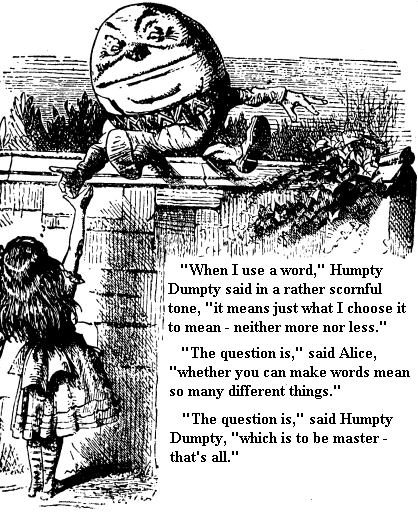
Humpty Dumpty, the Castle Doctrine, and other stories

Here are a few odds and ends that merit Grits readers' attention:

Humpty Dumpty and the Castle Doctrine
The judge in former Dallas police officer Amber Guyger's murder trial for the shooting of Botham Jean gave the jury instructions on the Castle Doctrine defense, despite the fact that Guyger entered Jean's home and shot him, and wasn't defending her "castle." Her lawyers employed this argument as their primary defense (that it wasn't her home was a "mistake of fact," they said) so the judge had no choice but to address it, but Humpty Dumpty would be proud! The claim didn't help Guyger, however. She was convicted, anyway. UPDATE: Guyger was sentenced to ten years.

Death of trailblazing deputy raises difficult, familiar questions
The tragic shooting death of a Harris County Sheriff's deputy - a trail blazing figure who was the first Sikh to work in Harris County law enforcement - raises familiar questions with no satisfying answers. The alleged killer is a severely schizophrenic parolee who had gone off his meds and heard voices telling him to kill people. Is the criminal-justice system the best way to deal with people whose offenses are rooted in severe mental illness? How did this convicted felon and parolee get a firearm? He already was the subject of a warrant for violating his parole, should more resources be allocated to search for high-risk parole violators? His family had told officials he was dangerous and off his meds: Are there "red flag" laws that could have allowed them to act sooner? The circumstances surrounding this awful episode will provide fodder for these and many other debates in coming years. The public dialogue would have been easier, in a sense, if this had turned out to be a hate crime. The issues surrounding mental illness and the politics of gun proliferation are much more complex and difficult to deal with.

Private jail operator keeps screwing up
At the Liberty County Jail, which is operated by the Geo Group, "In the last 60 days, there have been two felony escapes, one of their correctional officers was arrested for stealing from inmates while on duty, and most recently, there are questions surrounding the death of a prisoner who hanged himself while in their custody. Apart from those instances, they have also flunked two jail inspections this year, one on April 22 and the second on June 28," the Houston Chronicle reported. Local officials are considering whether to terminate ties with the private prison contractor.

The economics of high probation fees
Check out a new article from our friend Todd Jermstad, probation director in Bell County, on the history and future of court-imposed fees at Texas probation departments. Especially interesting was his thesis that policymakers should take into account reduced means of Gen X and Millenial defendants, whose economic prospects remain less robust than earlier generations. Grits may delve more deeply into this soon, but for now, here's the link.

Bail litigation roundup
See a write-up from The Appeal of recent bail-litigation news, including from Houston and Galveston. See also related Grits coverage and our discussion of the topic in Just Liberty's most recent Reasonably Suspicious podcast.

Over friggin' pot?
In Hutto, a police officer responding to a call that someone was smoking marijuana beat up a man in his driveway and made false accusations in official documents to justify it. The victim had no marijuana in his possession, and bodycam video proved the cop was lying about the victim pushing the officer before he was attacked. The officer was fired, was indicted in May, and the victim has filed a civil rights suit, reported KXAN-TV.

Homelessness problems and solutions
In the wake of Austin's tendentious debate over homeless policy, I was interested to see this excellent New Republic article on "housing insecurity in the nation's richest cities." When, in the 1990s, my wife and I could rent a dilapidated three-bedroom house in East Austin for $190, homelessness wasn't such a big problem. Now that rents in my neighborhood for similar homes approach $3k per month, it's little wonder more people are on the streets. Meanwhile, Bloomberg News had an informative piece a couple of months back on how Finland all but eliminated people sleeping on the streets by investing in preventive strategies like rent subsidies.

How police misconduct gets covered up by plea bargaining
Here's an excellent analysis from Brooklyn public defender Scott Hechinger of how mandatory minimums and the threat of long sentences help cover up police misconduct that would otherwise come out in court. That's because "victims of police abuse — illegal stops and frisks, car stops and searches, home raids, manufactured charges and excessive force — routinely forgo their constitutional right to challenge police abuse in a pretrial hearing in exchange for plea deals." This is undeniably true. It's only in cases like the episode in Hutto, described above, where victims face no charges that officers can be held accountable through regular court processes.

Financial motive not only reason prosecutors oppose actual-innocence claims
The New York Times published a feature on falsely convicted people who've been exonerated by the evidence but cannot secure an "actual innocence" ruling because prosecutors fear the financial consequences of civil rights lawsuits against local jurisdictions. All of the examples are from other states, but Texas' situation casts additional light on this topic. I was policy director at the Innocence Project of Texas when the Legislature passed the best-in-the-nation compensation package for exonerees in 2009. We hoped to avoid this dynamic by having the state compensate innocent convicts instead of the locals. Indeed, the bill was sold as a form of "tort reform," eliminating local liability for what were seen as systemic flaws causing false convictions. But it turned out, the real, underlying complaints weren't financial. Many prosecutors and some judges on the Court of Criminal Appeals simply don't want to see falsely convicted people compensated, ever, and go to great lengths to oppose actual-innocence claims, despite the fact that locals weren't on the hook. So Grits is skeptical of the article's thesis that the motive behind opposing actual-innocence claims is financial. I think it's more pernicious than that.

Sheriffs and #cjreform
Our pal Jessica Pishko published a New York Times op ed on Sheriff's offices, declaring "The problem of sheriffs is particularly acute in the South and Southwest, where the office has more power and was historically used to prop up white supremacy." She calls for Sheriffs to undertake what amounts to a truth-and-reconciliation process for past wrongs. That sanguine suggestion to me seems unlikely. Texas alone has 254 counties, after all - a few might do that, under the right political circumstances, but most will not. And abolishing the office, as some have called for, doesn't change the fact that someone has to perform those functions. Grits has often thought that sheriffs' jail-management duties should be separated from their responsibilities to patrol unincorporated areas. These are distinct functions involving very different skill sets, and typically those elected to the office only have knowledge of one or the other. Whether Sheriffs should be an elected position is a question for another day.

Deep thinking on sex-offender policies
A recent NY Times piece examined emerging research on people who are sexually attracted to minors, finding that its roots are not genetic, but are "prenatal," and "can be traced to specific periods of development in the womb." And this Marshall Project story looks at evidence-based anti-recidivism programs aimed at people convicted of violent, sexual crimes once their sentence is complete. I found both articles to be thoughtful contributions to the discussion.

Most crime dropping nationally, but look at those rape numbers!
New Uniform Crime Report data is out, and most categories of crime have continued to fall, except rape, which has risen precipitously since 2014. See first-cut analyses from the Brennan Center and the Marshall Project. No one knows for sure what's behind the rise in rape numbers. The feds began using a more expansive definition of sexual assault in 2014, but the numbers increased even using the "legacy" definition. The question arises: Have there actually been more rapes committed over this period, or are we simply now getting a more complete picture of the scope of the problem in the wake of increased reporting thanks to the #MeToo movement? ¿Quien sabe? Regardless, the year-over-year decline in property crimes, murders, robberies, etc., is cause for celebration, while the sex-assault data should contribute to deeper conversations on the question.

Thursday, August 15, 2019

Podcast: Ranking the greatest American prison songs, a crowd-sourced exoneration out of Tyler, and other stories

Check out the August episode of the Reasonably Suspicious podcast. We've got a special treat this month, with Texas Monthly's Michael Hall stopping by to tell us about the latest innocence case he's been covering out of Tyler, and a special segment in which he and I rank the greatest American prison songs


Here's what's on tap this month:

Top Story: 
Hemp SNAFU led to de facto natural decrim experiment for marijuana in many counties.

Interview: 
Texas Monthly's Michael Hall tells the story of an actual innocence case out of Tyler that was broken open by a Michigan podcaster.

Conversation: 
Scott and Michael Hall rank the greatest American prison songs. Go here for a YouTube playlist of all the songs we discussed, plus some from Scott's list that didn't make it into the podcast.

The Last Hurrah:
* DPS intel chief who warned of Mexican rapists arrested for sexual assault
* Texas House members create criminal-justice reform caucus
* Harris County bail lawsuit settled

Find a transcript of the podcast below the jump.

Sunday, January 06, 2019

Innocence Project Math 101: Why it's certain eyewitnesses are still sending innocent people to prison in Texas

Our friends at the prosecutor association want to pretend Texas has solved its problem with eyewitnesses falsely identifying innocent suspects after the state passed non-binding guidelines for police lineups in 2011. Shannon Edmonds last night was crowing on Twitter that the last exoneration based a false ID in Texas was in 2010, and the state had solved the problem in 2011.

This is such a disingenuous claim I thought I'd dissect it without the 140 character limitations.

Texas hasn't seen more eyewitness-based exonerations because we've run out of old DNA cases. Those offered a unique window onto false convictions from which we have learned many lessons. But now that there aren't more of them, it's disingenuous bordering on mendacious to pretend that there aren't more false convictions happening.

All of the false ID cases where someone was exonerated by DNA happened because biological evidence still existed from an old, pre-DNA-era conviction that was available for testing. In new cases, DNA testing will (eventually, hopefully) happen as a matter of course where that's possible. Those DNA exonerations were a one-time thing: A window onto the system's failures provided thanks to the advance of technology.

But here's the rub: DNA evidence only exists in about 10 percent of violent crimes. And in those older cases, in the overwhelming majority of instances, biological evidence had been destroyed or damaged and could not be tested. Evidence was only available in a tiny fraction of cases, and even then, prosecutors fought tooth and nail to keep from having it tested. So for every person exonerated by DNA, there are dozens more whose false convictions could never be discovered because the evidence doesn't exist.

This is Innocence Project Math 101.

The existing crop of DNA exonerees is not remotely all the innocent people who've been falsely convicted, they're just the lucky few who could prove it.

DNA exonerations should be viewed much like a poll. A pollster may interview 500 people to gauge the opinions of 5 million. Because we know there are other criminal cases using the same, flawed evidence as in the exonerees' cases, we can infer that the problem exists more broadly in the same way a pollster can say that X% of people approve or disapprove of the president based on a small sample.

What we learned from that DNA "poll" is that faulty eyewitness IDs are the most common causes of false convictions. And studies show that those errors are reduced, but not remotely eliminated, if cops use the best practices promoted in the 2011 Texas legislation. Error rates are still significant.

Because the same practices that caused false convictions in the DNA exonerations are still being used (the guidelines are not mandatory) - and because best practices only lower the error rate, they don't eliminate it - it's a logical fallacy of the highest order to pretend that, because DNA exonerations have stopped, so have false convictions. They've just become invisible again without the fortuitous window DNA provided.

TDCAA was reacting to a New York Times story about false identifications when suspects are allowed to page through mug shot books, as is common in many jurisdictions across the country. Dallas PD was identified as a department that forbids the practice because it leads to false accusations.

The story cited a study out of Houston which analyzed whether photo lineups should be simultaneous or sequential and whether confident witnesses are more likely to be accurate. Study authors parsed data to say that simultaneous is probably better and confident witnesses are more likely to be accurate - a finding they admit contradicts "[l]aboratory-based mock crime studies."

Shannon disputed the Times' take on that research, quoting the study authors' conclusions that “eyewitness confidence is a highly reliable indicator of accuracy.”

However, there's a LOT of error still being made by witnesses: The Times mentioned one cohort in the Houston study in which 47 percent picked the wrong suspect, but overall, 29 percent of witnesses chose a filler from the lineup, while 32 percent chose a suspect. (The Times also pointed to a meta-analysis of a large number of studies that found witnesses pick the wrong person 37 percent of the time.)

One shortcoming of this analysis: The study operated under a baseline assumption that if the suspect is chosen, it's an accurate ID. That's a dubious, self-fulfilling prophecy. Some of those choices were likely errors, too. When a suspect picks a filler, the detective knows it's wrong. The innocence problem arises when the wrong suspect is in the lineup in the first place and a witness picks them.

Confident witnesses were more likely to pick the person the officer considered a suspect, but there were also less confident witnesses who did so, and some highly confident people picked fillers.

And some of the error was generated by police.

The Houston study evaluated both "blind" and "blinded" lineups. "Blind" means the officer prepares the array and shows it to the witness in a fashion so that they can't view what the witness is looking at. "Blinded" means one officer prepares the array and another detective who does not know the identity of the suspect administers it. Both methods are allowed under Texas law.

It turned out, an independent panel not involved with the crime could pick the suspect out of "blind" lineups 28 percent of the time! (It would only be 1/6 if it were random.) So the arrays themselves were biased. Researchers hypothesized that cops took more care to prepare photos where the suspect doesn't stand out if they know another officer will see their work.

Texas courts won't exclude even the most biased lineups. For example, in 2017, Grits discussed a case in which the witness described a suspect as wearing a red hoodie, and police made him put one on before having his photo taken; he was the only one dressed that way in the photo array. But the 14th Court of Appeals said the testimony was okay because the Legislature made eyewitness procedures guidelines instead of requiring them, and courts had always let it in before.

It's not that reformers didn't want best practices to be mandatory back in 2011. But the DA's association and law enforcement interests fought vigorously against it, and the Lege bowed to their wishes. Hence, biased lineups continue to taint the system. That's what's disingenuous about TDCAA's faux concern over valid lineups - they're the ones whose regressive advocacy ensured bad lineups would continue to be used in court, even after the 2011 law.

RELATED: From the New York Times: "Jazmine Barnes case shows how trauma can affect memory."

Wednesday, December 26, 2018

Sharon Keller, bite-mark evidence, and the end of innocence forestalled

The judges' conferences over the Steven-Chaney bite-mark case, according to reliable sources, was the most contentious at the Texas Court of Criminal Appeals since the fight over Ex Parte Robbins. Both those cases involved Texas' first-in-the-nation junk-science writ, for which Chaney's victory was a landmark event. See coverage from Texas Monthly's Michael Hall, the Texas Tribune, and the national Innocence Project.

It's significant that Judge Barbara Hervey wrote the majority opinion, which amounts to a straight-forward, by-the-book application of Texas' junk-science writ. Grits has criticized Hervey in the past for making public declarations about forensic science that put her on the side of reformers but routinely voting with the Government Always Wins faction in her court opinions. This time, however, the former member of President Obama's now-disbanded forensic commission came through, bringing Judge Keasler with her to split the GAW faction in two. (Keasler suffered a heart attack this year, btw; he will not finish out his term because of his age.)

Grits believes this case will prove important for a number of reasons, and not just for Mr. Chaney or others convicted in the past based on bite-mark evidence.

Taking a bite out of junk forensic science
There are two, major direct implications to the Chaney case: First, bite-mark testimony in the future may only exclude people, or say the result is undetermined. They cannot any longer imply bite-mark evidence points to a specific defendant. This is significant. Texas courts hadn't excluded such evidence via Daubert hearings, which evaluate the fitness of expert evidence at trial, despite the Texas Forensic Science Commission recommending courts abandon such evidence. In fact, the CCA had re-affirmed the use of bite-mark evidence as recently as 2012. So Chaney's case accomplished on the back end what Daubert could not on the front, evincing a new model for ridding the justice system of an unreliable forensic method.

Second, old cases where bite-mark evidence was central to defendants' convictions now also could be overturned. This won't be a huge number of cases; often other evidence existed that courts may still find sufficient to convict. But there's little doubt we'll see more bite-mark-based convictions overturned now that Chaney has discredited such evidence.

And there are broader implications. This was the first time the Court of Criminal Appeals has applied the junk-science writ to one of the more widely used, secondary forensic identification techniques criticized by the National Academy of Sciences in their 2009 report, Strengthening Forensic Science: A Path Forward.

We've seen outdated arson science debunked in Texas before the writ took effect, in part because the State Fire Marshal became an avid proponent for reform. Other forensic writs, as with Ex Parte Robbins, involved scientists recanting very specific scientific findings that applied to few other cases, not more common techniques like bite marks, blood spatter, hair-and-fiber analysis, ballistics, or fingerprints, even though all of those came up for criticism in the NAS report.

Now, the court has unanimously disallowed one of these second-tier forensic identification tactics, and they did so based on arguments primed to be applied to other comparative forensics.

For example, Judge Hervey's majority opinion made much of the fact that scientists cannot say for sure bite marks are unique, which is the basis for forensic dentists in the past claiming they could distinguish bite marks to the point of identifying an individual person. However, "Peer-reviewed studies conducted after the publication of the 2009 NAS Report ... now show that the uniqueness of human dentition can never be established within measurement error."

Well, guess what? There's also significant doubt whether firearms each provide a unique signature that ballistics analysts can effectively match. Indeed, it's unproven whether fingerprints are unique, but pretty clear that some partial prints - which is what examiners are usually matching - may not be unique enough to differentiate.

If and when scientists prove ballistics markings aren't unique - or for that matter, partial fingerprints - will the court still be as bold? If peer-reviewed studies begin to cast doubt on these cornerstone presumptions of uniqueness, how many forensic disciplines might fall?

These were not the elements of the Chaney decision being disputed in the concurrences. The entire court - including the whole Government Always Wins faction - was willing to throw out a brand of forensic analysis that's been in use in Texas and nationwide for many decades. That aspect of the decision likely will be overlooked in the wake of the court's debate over actual innocence, but it's important.

The end of innocence forestalled
The reason for the litany of concurrences in the case was Presiding Judge Keller's decision to take the opportunity in her concurrence to call for a new "beyond a reasonable doubt" standard in "actual innocence" cases - a burden only the prosecution must meet at trial. She thinks that, now that defendants have the junk science writ, and the court has recognized false-evidence claims it did not in the past, defendants have other avenues for relief and the bar for actual-innocence claims should be made more difficult to prove.

Only Judge Yeary was even interested in the idea, which was lambasted in separate concurrences from Richardson, Newell, and Alcala. Everyone concerned about these topics should read all these opinions; they're fascinating and my paraphrases won't do the detailed arguments justice.

As Judge Alcala pointed out, for years the "Elizondo" actual-innocence standard Keller wants to heighten was considered nearly insurmountable. But over time, between DNA exonerations and the rise of more sophisticated, persistent defense counsel in the innocence-movement era, more cases began to meet the court's high threshold. Judge Keller liked it better when almost none of them did.

Judge Richardson took the unusual step of calling out Judges Keller and Yeary by name for almost never agreeing defendants have met the actual-innocence threshold, even in instances like the Sonia Cacy arson case where Richardson considered the defendant clearly innocent. One rarely sees appellate judges confronting their peers so directly, but Richardson explicitly critiqued them in his opinion. Yeary responded, adding a second section to his concurrence that clearly was tacked on later in response to Richardson's criticisms.

Judge Keller has not claimed that Original Sin means no one can be truly innocent, but her legal reasoning leads to essentially that result. No one but DNA exonerees where an alternative suspect was identified and then confessed would qualify for an actual innocence designation in Sharon Keller's worldview, and then only if every detail of their story held up under a first-order assumption that all claims by them and any witnesses supporting their case are lies.

Here, Chaney had multiple alibi witnesses, but Keller refused to credit them, even after all inculpatory evidence put on by the state fell apart. There's something a bit mean-spirited and miserly (ungenerous is too tame a term) about Keller's take on Chaney's defense case. I have often portrayed Judge Keller and the GAW faction as wanting the government to win. But sometimes, as here, she almost seems more interested in making sure that the defendant loses - one of those moments, like declaring herself a "pro-prosecution" judge in past campaigns, that casts doubt on her ability to be a neutral arbiter. It's as though she can't stand for Chaney to receive state compensation due to exonerees, and is willing to upend 20 years of her court's own jurisprudence to try to stop that from happening.

If Keller's position prevailed, in a real sense it virtually would be the "end of innocence" in Texas. No one can say the number of exonerated defendants who would meet her new threshold, but it would be very low. The court considers meeting the current standard a "Herculean" task.

Seven other judges, however, were having none of it. Keller's opinions on innocence couldn't garner one additional vote. Even Kevin Yeary did not sign on. Her extremist stance left her weakened on the court as a result, with her core GAW-faction members abandoning her over the conflict and centrists on the court tag teaming to discredit her positions.

As a frequent critic of the Texas Court of Criminal Appeals, I must say, I'm proud of them all, especially Judge Hervey. She showed more leadership in this case than she has in years on the court; her majority opinion was strong. And while I agreed with her critics, even Presiding Judge Keller was expressing her true beliefs here, which I found distasteful but not disingenuous. (She believes some extremely regressive things about the law that even most conservative Republicans do not buy into, but they're her honest beliefs.) This was a good debate and a good outcome.

See prior Grits coverage of the CCA interpreting Texas' junk science writ: