Showing posts with label bail. Show all posts

Friday, September 03, 2021

Politics explains oddities and strange bedfellows in Harris County bail debate

Harris County District Attorney Kim Ogg issued a 56-page report disputing the findings of federal bail monitors overseeing the settlement agreement between plaintiffs and the county.

Her arguments are so disingenuous, it's a bit tiresome to go through them for rebuttal. But since the Houston Chronicle editorial board recently anointed themselves the DA's PR agents, it's worth at least pointing out her most egregious misstatements. 

The biggest one is a common misrepresentation that you rarely see people claim in writing; it's always something whispered behind the scenes, until now. Ogg claimed: 
“Bail reform” has not been confined to misdemeanors, but has been implemented, in practice, for felony defendants at every level, even repeat violent offenders charged with some of Harris County's most notorious and deadly crimes, including, but not limited to murders and capital murders.
This is inarguably, factually, a lie. Not an overstatement. Not an alternative point of view. Not a difference of opinion. A bold-faced lie by someone who should know better. It's something opponents of bail reform say over and over, but when you dig into the stories, the person inevitably paid cash to get out. The Houston Chronicle looked at more than 200 murders committed by people out on bail since 2013. Less than 1% involved someone out on personal bond.

Regardless, over and over we see personal bonds blamed for crimes committed by people who paid to get out. On the floor of the Texas Senate this summer, Joan Huffman told her colleagues during the first special session that five people who were out on bond had been charged with murders in Houston since that body had adjourned. But it turned out, none of them were out on a personal bond. All of them had paid to be released and their cases wouldn't be affected by the bill. 

By contrast, misdemeanor bail reform involved the use of personal bonds, and misstatements like this are why the Legislature focused on banning them. But that won't affect "repeat violent offenders charged with some of Harris County's most notorious and deadly crimes." It's just not true, no matter how often it's repeated, including by Republicans I respect.

Ogg's central argument is that the number of crimes committed by people out on bail is increasing in Houston. Which is true -- and also far more people are currently awaiting trial than just a few years ago. She frames the discussion in a way that elides that key fact, knowledge of which might lead to different conclusions. Her key "findings" were presented as follows:
  • Re-offending by criminal defendants who have been released on bail is up.
  • Bond failures by criminal defendants are up.
  • Violent offenses committed by defendants free on bail is up.
As an improv comic might say, "Yes, and ..."

None of that is because Houston judges are hesitant to jail people. 

Here's what's really going on, and anybody who's not focused on these specific problems isn't shooting straight with you about wanting to reduce crimes by people out on bail: In the wake of Hurricane Harvey, flooded courthouses created a court backlog that increased the number of people out on bail three-fold, from a little over 30,000 people on bail to more than 90,000, reported the Houston Chronicle recently. COVID exacerbated these delays, while the latest COVID spike has heightened pressure to decarcerate local jails as a growing public health imperative

Harris County's criminal case backlogs could take years to work through unless, as Elizabeth Rossi and Amanda Woog suggested earlier this week on Grits,  the District Attorney begins using her discretion to dismiss broad classes of lower-level cases en masse.

Until then, one would expect the number of crimes committed by people on bail to increase as long as the number of people on bail is increasing.

That said, here's one more datapoint in defense of the federal monitors Ogg is ostensibly criticizing. By the data in her report, the number of crimes committed by this cohort (people out on bail) increased LESS than did the total number released pretrial. So she's complaining that the numerator in a fraction went up without telling you the denominator went up even more. I realize some people go to law school because they're not good at math, but even in that context, this is a little extreme. Her whole memo is based on such preconceptions.

In fact, there's evidence that, faced with a significant problem of the number of people out on bail tripling in a short period of time, judges did a pretty good job of vetting cases. Since the number of people out on bail tripled but the number of crimes committed by that cohort increased less than that, in aggregate, judges seem to have been making the best public-safety oriented decisions they could in response to a bad situation. 

In Texas politics, however, no good deed ever goes unpunished.

Grits believes the DA's complaints and indeed, the entire Texas bail-reform debate, can't be understood outside of a highly politicized context. Between County Judge Lina Hidalgo (who hasn't approved Ogg's open-ended budget requests) and recently elected Democratic Houston judges, some of whom supported her more progressive primary opponents last go round, Ogg and the governor find themselves, at least in the short term, with common enemies. I'm not saying it's planned; more like she's taking potshots, looks up, and all of a sudden she and the Governor are shooting at the same targets. The enemy of my enemy is my friend, etc..

Regardless, there's no way for Harris County to incarcerate its way out of court backlogs. It's a practical impossibility and from a perspective of responsible governance, absurd to demand it. But that's the simplistic vision of "justice" and "safety" that Ogg, Andy Kahan, and Governor Abbott would have you buy into.

If Ogg were working with other Harris County officials to problem solve by getting rid of the backlog, judges might give more credence to her requests for higher bail on actual "repeat violent offenders." And perhaps she'd get a more welcoming reception in her budget asks at the commissioners court. 

But some prosecutors believe it's never their place to negotiate. They see their role as either "I get my way or I'll fight you." That's what we're seeing with Kim Ogg, and it's a severe disappointment.

Thursday, September 02, 2021

Prosecuting crimes of poverty isn't the same as combating a "crime wave"

The following is a guest blog post co-authored by Elizabeth Rossi of Civil Rights Corps and Amanda Woog of the Texas Fair Defense Project. Their organizations are among the civil rights groups involved in bail litigation against Harris County. Related: this discussion of the District Attorney's claims to be fighting a "crime wave" in Houston harken to this analysis of media coverage of crime and jails from a century ago. Sometimes, the more things change, the more they stay the same.

The Chronicle’s recent editorial “How Harris County prosecutors are trying to stop Houston’s crime wave,” casts District Attorney Kim Ogg’s office as engaged in some heroic task of ferreting out the County’s most dangerous “criminals,” when in fact the DA is funneling millions of dollars toward the prosecution of poor people charged with crimes of poverty. Without a shred of evidence, the Chronicle adopted the DA’s party line, asserting that “more prosecutions means more justice and a safer community.”

Expert research -- including some paid for by the County -- shows that's not true.

The County hired national experts at the Justice Management Institute last summer to address exactly this question. JMI assessed the backlog and concluded that the safest and most fiscally responsible solution to the backlog would be “to dismiss all non-violent felony cases older than nine months,” with certain exceptions for cases like DWI, so that the DAO could devote its resources to prosecuting violent cases. The experts at JMI pointed out that only 42% of all felony cases (not just “violent” crimes) closed in 2019 resulted in a conviction. The other 58% resulted in dismissal, deferred adjudication, or acquittal. And even among the 42% of cases that resulted in conviction, the majority involved people who were released immediately into the community on probation. The idea that the DAO is rescuing Houston from a “crime wave” by prosecuting years-old theft-by-check cases and other poverty crimes is laughable.

But the Chronicle ignores this information.

The paper also ignores a recent academic study by researchers finding that non-prosecution of low-level offenses can lead to less crime without any negative effects on public safety. Ogg has offered no answer to these findings. And now she is asking for millions of dollars more to fund 22 additional prosecutors to conduct intakes -- which will bring even more people into the broken system, exacerbating a problem that Ogg created.

The DAO is to blame for this tragedy. Ogg has enormous discretion to decide whom to prosecute, and most of the cases that Ogg is now begging for resources to resolve shouldn’t even be in the system. Evidence and research show that expanding the wasteful punishment bureaucracy through initiatives like the DA’s “triage” program does nothing for public safety, but does a lot to expand the government’s control over and surveillance of poor people and Black and Brown people, exacerbating poverty, separating families, and making it more difficult for people to find jobs and housing - all conditions that tend to increase future crime, not decrease it.

Ultimately the Chronicle piece is hailing prosecutors as heroes for solving a problem that they created and that they can end without spending a single penny more. Ogg doesn’t need more money to do her job. Instead, Harris County needs to invest that money in proven solutions to public safety issues-- programs like violence interruption, mental health, youth programs, non-carceral crisis response, streetlights, and other interventions that prevent harm before it occurs -- and should stop spending millions of taxpayer dollars for the DAO to prosecute crimes of poverty from 2016.

Monday, July 19, 2021

Arguments for Republican bail bill become nonsensical when debating rural jails

I've gotta say, 2021 has been dispiriting on many levels, not the least of which is the partisanship injected into criminal-justice topics turning once-rational individuals into liars and/or idiots.

Over the last week, Just Liberty has been walking around to rural members - almost all Republicans, since the Dems are in Washington, D.C. - discussing the effects of the Governor's bail bill (HB2/SB6/HJR1) on rural jails. (See Grits' testimony to the House Criminal Jurisprudence Committee on the topic.)

The basic argument is that 97 mostly rural jails, as of July 1st, were already full and contracting to house prisoners outside their facilities. Boosting pretrial detention in HB1 is aimed at supposed problems in Houston, but the laws they want to change would affect all of Texas, and would harm rural counties the worst. 

Most member offices were happy to receive information about how the bail bill would affect jails in their districts. But we received bizarre pushback from the offices most closely involved with the bill: They insisted that the claim pretrial detention would increase was "overstated."

This is bizarre because we didn't make any claim about the scope of the increase, just that there would be one. But staffers working on the bill pushed back to say magistrates forbidden from giving personal bonds could just set bail at $1 and then pretrial detention wouldn't go up.

Which would be fine, except then what's the point of the bill? My understanding was that there is a class of defendants currently being released on personal bonds that Andy Kahan, the Governor, and Joan Huffman think should be held in jail instead. To the extent that the bill achieves that goal, it does so by increasing the scope of pretrial detention. If the bill authors don't mind those same defendants being released on $1 bond, and don't think pretrial detention will go up, I'm not sure what the hell we're doing here.

IRL, no serious person believes that HB1/SB6 would not increase pretrial detention. That's a political stance, not a legitimate policy take. If Republican legislators admitted these thoughtless policies put rural counties in an economic bind, the conflict between this legislation and rural interests would quickly become apparent. Historically, that's one of the axes on which even popular legislation can die at the Texas capitol.

But as long as rural, Republican legislators value attacking Democrats in Houston more than protecting the economic interests of the counties they represent, rural interests will continue to be sacrificed on the altar of the Governor's political ambitions.

To be clear, this isn't just about bail; it's part of a larger trend. Texas' government at this point is broken, driven by national, partisan agendas with little connection to the eclectic, diverse communities that make up this state. I'm sure ignoring rural interests to "own the Dems" on bail seems super clever to the Governor's political consultants, but that's the core of their base: Taking them for granted and even harming them to score partisan points may work out in the near term., but long term it's not great politics.

CREATIVE ASIDE: For handouts at the capitol, I'd created this little booklet with a general discussion of how the bail bill affects rural jails:


Then I created member-specific flyers discussing specific issues in members' districts, including the little orange booklet as insert. Here's the one for Rep. Shelby Slawson:


These pieces are a bit of an experiment: With many offices still hard to reach due to COVID protocols, staffers working remotely, and the rise of Zoom meetings, it's become harder to reach legislators and their staff. Whereas it used to be easy to drop into an office and talk to whomever you needed to speak to, these days you're likely to be asked to schedule a Zoom meeting in a week or just drop off a fact sheet. But I question whether anybody's reading the mountain of 8.5x11 paper being dropped off in member offices, so I'm testing different forms for legislative communications, using methods more commonly associated with movement zines to communicate with offices.

I figure if I'm bored with the 8.5x11 fact sheet format, staffers would likely be completely fed up with it.

Humorously, the missus was skeptical about distributing my "arts and crafts project" in a professional environment, but members' staff loved them and our lobbyist came back wanting more of the individualized versions. People liked them because they're unique, relevant, and personalized. We may be living in the Digital Age, but there's still some room for more creative papercraft in political comms.

Thursday, April 08, 2021

Abstract 'sweet spot' imagined on bail reform probably doesn't exist

Your correspondent has mostly stayed out of bail debates this year at the Texas Legislature for two simple reasons: 1) There are many opportunities for criminal-justice reform legislation that Grits believes have a real chance to pass, and 2) IMO there don't exist any opportunities for bail reform in the 87th Texas Legislature that reform-minded advocates will find acceptable or which will stand the test of time once federal courts finally address the issue.

There are three centers of gravity in the bail debate: Governor Abbott, whose positions largely reflect those of the bail industry and tuff-on-crime political ideologues like Andy Kahan; the 5th Circuit, which has at least three Texas bail cases bubbling up in its direction which will establish a new constitutional floor for Texas bail policy; and reform advocates who want to end money bail.

There are several dynamics that make a viable legislative outcome impossible in 2021. Advocates and the 5th Circuit cases are largely focused on bail issues surrounding indigent defendants and reflect concerns about excessive detention. By contrast, the bills filed by Sen. Huffman and Rep. Murr, which reflect approaches more in concert with the Governor's priorities, don't necessarily agree with one another but both reflect a desire to expand detention and to eliminate local options to release defendants pretrial. (There are other bail bills that are better, including one from Rep. Ron Reynolds, but they don't have a prayer while Abbott is Governor.)

Meanwhile, advocates themselves aren't all on the same page. Some think risk assessments are racist harbingers of evil; some think they're fine, or at least inevitable and not worth fighting over. Some want to find a sliver of agreement with the bills moving in order to retain a "seat at the table." Others, and Grits is in this camp, think nothing supportable can pass this year and we should wait for the 5th Circuit to lay the groundwork for what's next.

Essentially, there remain people who believe there's a Venn diagram of bail reform out there that looks like this:

Somewhere, theoretically, they imagine there's a policy no one has found yet that hits the sweet spot and if they just stay at the table long enough, maybe they'll discover it. The problem is, that's not the diagram. The IRL version of bail reform probably looks more like this:

The 5th Circuit cases and reformers are largely engaged in the same project: Reducing pretrial detention for defendants who can't afford bail. It's possible, even likely, that federal courts will choose a route to that goal that's less aggressive than abolishing money bail entirely, as most advocates would prefer. But there's more overlap than distance between the court rulings so far and what #cjreform folks would like to see happen. Certainly the courts are pushing local actors toward bail reform more aggressively than had ever been possible through the political process.

By contrast, Abbott and his legislative enablers are mainly concerned with expanding pretrial detention. Some of their proposals are so radical they'd require amending the Texas Constitution to accomplish. The tiny shreds of overlap between Abbott and the conservative wing of a bipartisan reform movement don't coincide at all with the project the federal courts have undertaken. There was a time several years ago when legislators could have headed off federal litigation by passing bail reform. But they failed to act so the federal judges moved forward and did their jobs. Now that ship has sailed. If the Texas Legislature passes a bill at this point, it will either address issues tangential to the federal litigation or likely be overturned by it in the near future. 

In that light, I don't see a sweet spot on bail reform in 2021 that's a) legislatively viable and b) conforms with what are likely to be new federal court mandates arriving in the next 2-3 years. At this point, bail-reform supporters in Texas should just oppose these bills en toto. For the moment, it's a can't-get-there-from-here situation.

Saturday, February 06, 2021

Crime, Bail, and the Media: A century-old recipe for error and injustice

Grits readers have seen me complain about sensationalist, de-contextualized media coverage of crime and punishment nearly since this humble blog's inception. Turns out, if your correspondent had been transported in a time machine to the early 1920s, the problem would be even worse and Grits may well have gone clean out of my mind.

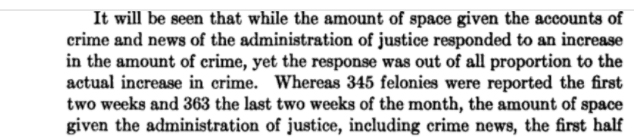
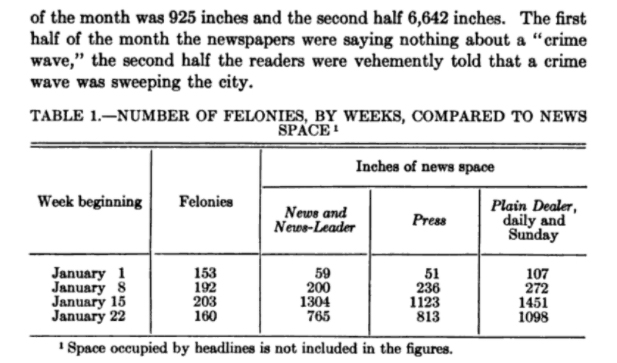
Recently, I ran across what appears to be the earliest quantitative analysis of media crime coverage in America in a massive, 700+-page document titled, "Criminal Justice in Cleveland: Reports of the Cleveland Foundation Survey of the Administration of Justice in Cleveland Ohio." On p. 544 of this behemoth, we find this remarkable assessment of a media driven crime panic over the course of one month in Cleveland and the predictable, and current-day-relevant policy results from this brand of journalistic malpractice.


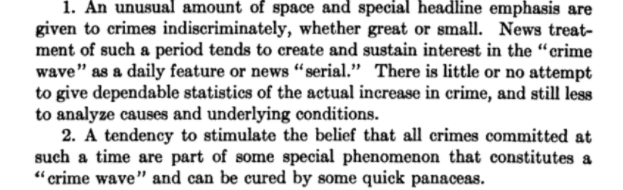
The Cleveland Foundation summarized its criticisms of local media coverage thusly: 


Further:

The same sort of misguided attacks were made on parole decisions, focusing on high-profile recidivists while ignoring more numerous, less-attention-grabbing success stories.

The Cleveland Foundation wrote this near the height of a massive, media-driven crime-wave panic. Google has a search function to see how often a word or phrase was used in books they've scanned that were published that year. Here's the graph for the phrase "crime wave."


I've read more than a few historians and critics over the years trace the American media's crime obsession to the cases of Bonnie and Clyde and John Dillinger in the 1930s, when such outlaws became well-known anti-heroes in the eyes of huge swaths of the public. But this graph and the Cleveland survey tell us that compulsion was in full flower - and perhaps even more intense - more than a decade earlier.

Perhaps most telling was their depiction of an episode in 1919 Cleveland which could have been taken straight from 2019 Houston: 
During January and February, 1919, there occurred what was known as the 'bail bond expose.' ... It became known that a number of persons suspected or actually arrested and charged with crimes had been previously under arrest and released on bail. Special newspaper attention was given to the fact that bail was fixed by judges on the recommendation of the prosecutor, and in view of this power of fixing bail by recommendation the prosecutor was urged to demand higher bail.
The over-the-top language was totally out of proportion with all data and designed to mislead and rile up the public. For example: "The toll of pillage and murder increases. Gangsters scoff at law and courts. And peaceful citizens shudder."

This is reminiscent of a litany of overhyped commentary in Houston - most of it in TV news stories quoting Andy Kahan at CrimeStoppers or Houston police Chief Art Acevedo - criticizing judges for lenient bail practices. So this is at least a century-old trope: You could use the same time machine to transport those two back to the 1920s (indeed, I wish you would) and their quotes would blend right in with the rest of the media landscape. In fact, the results of their advocacy in Houston have been similar to the unintended (but predictable) consequences in Cleveland: Jails full of low-level offenders who needn't be there. From the report:


Many of those locked up were liquor law violators who couldn't pay fines; some who couldn't pay were sent to "the workhouse." Even so, the Cleveland Foundation lamented that "the work of individual judges receives special but wholly erroneous interest" in the press, and that demagoguery against judges became so intense that one judge received personal death threats. Even more concerning to judges, however, were the day-to-day practical problems it created:


Houston judges are in the same boat. The jail is currently overcrowded as a result of some combination of regressive media influence, COVID-driven court backlogs, and the governor's executive order limiting bail. The COVID delays are exogenous to this question, but media pressure on judges and the governor's executive order are directly analogous to the judges' and prosecutors' actions in response to media coverage in Cleveland. Here's the lede to a recent Houston Chronicle story about overcrowding at the Harris County Jail:
Preston Chaney died of COVID-19 after more than three months at the Harris County Jail on allegations he stole lawn equipment and frozen meat. Two days later, Chaney’s court-appointed lawyer, who’d logged just two hours on his case, billed for additional work.

Chaney had a hold and was rejected for personal bail under Gov. Greg Abbott’s pandemic order banning the release of anyone with violent charges or prior arrests. Had the 64-year-old been able to scrape together $100, he could have waited for trial away from the packed downtown lockup.

This was an avoidable death. Tuff on crime demagoguery has consequences. Local media, particularly in TV news, deserve a share of the blame for it.

Thursday, April 23, 2020

Judges may do what they please after Tx Supreme Court says Abbott executive order unenforceable

The Supreme Court's ruling on Greg Abbott's executive order was fascinating to me. They upheld the executive order, but their reasoning amounted to "It's okay to keep it in place because it's completely unenforceable and nothing can or will happen to judges who ignore it."

See initial coverage from the Texas Tribune. Here's the order itself.

The court acknowledged the Governor is not above the law or the constitution, but decided the judges in this case were essentially under no credible threat that anything would happen to them if they violated the order:
We acknowledge the plaintiff judges’ allegation that they face a threat of criminal prosecution if they do not follow the executive order. Any threat to prosecute a judge for his or her judicial decisions raises grave separation-of-powers concerns. The judges, however, do not explain why well-established principles of judicial immunity are insufficient to counter such threats. Troubling as these threatened prosecutions would be, the defendants have disclaimed any such intention, and the judges have not shown a credible threat they actually will be prosecuted. As a result, even if a threat of prosecution could give a judge standing to challenge a substantive legal standard, the alleged threat of criminal prosecution in this case does not give the judges standing to seek the invalidation of GA-13. 
The court considered the threat of enforcement of GA-13 a non-issue because "the executive branch cannot criminally prosecute judges for deciding cases based on what they understand the law to be." In the end, they declared, "Applying the correct law in each individual case is the judge’s job as an institutional matter."

The court found that, even if judges were to openly violate the executive order, "there is no 'credible threat of prosecution.'” Indeed, they noted, "the State in its briefing disclaims any intention by the Governor or the Attorney General to affirmatively enforce GA-13."

Moreover, if local district attorneys tried to enforce the order, the judges would be protected by judicial immunity: "even if criminal prosecution of judges were genuinely threatened, the plaintiffs offer no reason to doubt that long-established principles of judicial immunity provide adequate protection." Said the opinion, "Judicial immunity prevents such 'domination by other branches' by giving a judge absolute immunity from liability for official judicial acts performed within the scope of his or her jurisdiction."

I'm not an attorney, but as Grits reads this, the plaintiffs technically lost the case but won the issue. Judges may simply ignore the executive order with full confidence that it cannot be enforced.

And they should.

RELATED: On Twitter, Judge Elsa Alcala opined, "Have they met the GAW faction of the CCA? LOL. It is an interesting issue that the civil high court is assessing what the criminal high court would hold re criminal prosecution." That's a fair point. But even so, I have a hard time imagining even the Government-Always-Wins faction on the Court of Criminal Appeals finding a theory to justify getting past absolute judicial immunity. I suppose I wouldn't put it past them to try.

Roundup of Texas headlines on COVID in prisons and jails

Several, notable headlines drew Grits' attention related to the coronavirus and Texas prisons and jails. Let's round them up.

Wednesday, April 22, 2020

Defense pushback against Kim Ogg's contention that judges can't consider COVID

Last week, Grits wrote about a unusual motion to the Texas Court of Criminal Appeals from Harris County District Attorney Kim Ogg arguing for higher bail in the case of Timothy Singleton, in which the DA asked the court to rule that judges could not consider issues related to the coronavirus when setting bail. After initially turning her down, Singleton allegedly committed another offense, this time, domestic violence against his girlfriend and her grandmother, and fled. The DA again asked the CCA to intervene, and this time the court required the bond be set at $100,000, although they did not mention nor affirm the DA's contention the judges couldn't consider public health issues during bail decisions.

Now, though, Mr. Singleton has hired counsel, Brent Mayr and Stanley Schneider, who on 4/20 issued a motion for reconsideration to the CCA. The Houston Chronicle's St. John Barned-Smith provided coverage here. Their brief provides a great example why one doesn't get a full story in the courtroom unless both sides get to make arguments.

For example, the DA's brief had not informed the CCA that the pretrial risk assessment instrument magistrates use to guide release decisions scored Singleton at a level suggesting a "Personal Bond Recommendation referred to Magistrate." That would have been useful information to give them, don't you think? The DA recommended no bail, and the magistrate set bail at $500.

The Chronicle story mentioned a few other items from the defense brief that the DA had omitted, including the magistrate's specific reason for her decision:
Court records show the magistrate noted that police did not find any gun when they investigated the allegation against Singleton. His bond paperwork also shows police did not appear to have spoken to any other witnesses, and that Singleton had not missed any court appearances in the two years prior to the incident. 
Magistrate Jennifer Gaut also ordered him not to have contact with the man he was accused of threatening.
Gaut also conditioned his release on complying with curfew restrictions. So, while the DA's brief accused the magistrate of ignoring the state's recitation of Singleton's criminal history, and pretended her sole concern was a desire not to "fill up the jail," clearly she was looking more closely than they gave her credit for at the evidence being presented in the current case, and was following the recommendation of the pretrial risk assessment, which was never mentioned in the state's brief to the CCA.

Attorneys and others closely following bail debates will want to read and digest the analysis in the defense brief, which goes through the relevant statutes governing increasing bail much more thoroughly than did the state's. They claim "The state plays fast and loose with its citations to authority in its motion."

The alleged authority to have the CCA raise the bail amount relied on a statute that only applies to examining trials, argued the defense, while ignoring a more-on-point statute which declares that, once a defendant "has given bail for his appearance in answer to criminal charges, he shall not be required to give another bond in the course of the same criminal action" unless the judge or magistrate "in whose court such action is pending" finds the bond is defective, excessive, or insufficient, or the sureties provided are "not acceptable." Under that statute, the CCA plays no role.

They quoted back to the CCA its own holdings on statutory construction that when "a general statute and a more detailed enactment are in conflict, the latter will prevail." They contend that the statute the DA relied upon, Article 16.16 of the Code of Criminal Procedure, "is a general statute that applies when there is an examining trial and bail in that limited context is found to be insufficient. Article 17.09, however, is much more detailed and provides an explicit prohibition on a defendant having to give another bond. And it limits the authority to require a defendant to be rearrested and give another bond to the judge or magistrate who the matter is pending before."

The defense cited precedent in which Judge Michael Keasler, who is still on the CCA, disallowed judges besides those authorized in Article 17 from changing bail amounts, lamenting this would lead to a system where "all judges have jurisdiction over all things at all times. and where forum shopping to reduce or increase bail amounts flourishes." According to the defense brief, "The action taken by the state here is absolutely no different and for this Court to entertain such action would put it squarely in conflict with this precedent." If the CCA ignores this longstanding precedent, they warn, "the floodgates will open" and appellate courts will be inundated with back-and-forth motions on bail that would "create an endless cycle."

The defense brief iterates that a court's bail decisions may only be reviewed on appeal for "abuse of discretion," and cites precedent that "an appellate court must not substitute its own judgment for that of the trial court and must uphold the trial court's ruling if it is within the zone of reasonable disagreement." Given that the pretrial risk assessment relied upon by magistrates recommended Mr. Singleton receive a personal bond, granting low bail appears to this non-attorney observer as per se within this "zone of reasonable disagreement."

The defense concluded,
Let there be no mistake about what the State is doing here: they are complaining about the decision of the magistrate and the trial court setting bail in this case. The State has no right to appeal a trial court’s decision to set bond. Nor could they seek a writ of mandamus or prohibition. And, yet they are asking this Court to review the trial court’s decision with no record, no findings of fact, nothing more than conclusory affidavits.
Finally, the defense brief addressed the DA's novel argument that courts are disallowed from considering health concerns when setting bail. They argued that concerns about limiting incarceration due to the coronavirus falls directly under the court's authority to consider the "future safety of ... the community," which is explicitly a factor statutes contemplate when judges set bail.

As Grits mentioned the other day, the Harris County jail is struggling more than any other lockup in the state with the coronavirus outbreak, which places not only inmates but jailers and the community at large at risk. Future safety of the community is a broad concept, and nothing in the statute limits how judges should define it. Seems like a pretty strong argument to me.

The Houston Chronicle coverage pointed out how unusual was both the state's motion and the CCA's rapid response to it:
Courthouse veterans said the move was surprising for both the speed with which the CCA ruled on the case, and the judges' decision to set Singleton’s bail above what prosecutors had initially asked for. 
[Harris County Public Defender Alex] Bunin said that when defendants ask the CCA to reduce their bond, the court can take months — or longer — to act. 
“It seems more like they are trying to send a message than create law,” Bunin said, of the appellate judges. “But it’s an unclear message other than ‘don’t set low bonds unless you have somebody with no criminal history and a history of appearing in court when asked.’”
There's no telling how the CCA will react to this new motion, or how quickly. With the Government-Always-Wins faction currently in firm control of the court, one wouldn't be surprised if they side with the District Attorney no matter what. The GAW majority on the court tends to be outcome oriented, first deciding what they want the result to be and then searching out legal arguments to support it instead of interpreting the law and having that decide the outcome. But because that approach would fly in the face of past CCA precedents that benefited the state, in particular a key precedent authored by a GAW judge who's still on the court, it could become a much closer call.

Regardless, Grits finds this debate fascinating. I'm learning a lot from it.

Wednesday, April 15, 2020

Harris County DA: Judges cannot consider health issues as part of pretrial release decisions.

We're still waiting for the Supreme Court of Texas to rule whether Governor Greg Abbott's executive order on COVID-related jail releases is valid (see Grits' writeup here).

In the meantime, though, Harris County District Attorney Kim Ogg has filed an "emergency motion" with the Texas Court of Criminal Appeals arguing that judges do not have authority under the Code of Criminal Procedure to consider "public health matters," including the risks associated with people catching the coronavirus in jail, when they make bail determinations. Her motion opined that:
A concern over COVID-19, and an extra-judicial desire to not “fill the jail up”, entered into Singleton’s bail determination. This was improper.  
Article 17.15 lacks a “catch-all” to permit consideration of public health matters, nor does any existing case law. In addition, nothing in this Court’s First Emergency Order Regarding the COVID-19 State of Disaster, Misc. Docket No. 20-007, permits a court to circumvent art. 17.15. 
The case involves a 31-year old black man named Timothy Singleton who allegedly pointed a gun at someone who allegedly owed him money and threatened to kill him if the man didn't pay. According to the DA's court filing, "Singleton has prior felony convictions for Assault—Family Member, Retaliation, Robbery, Credit Card Abuse, and Delivery of a Controlled Substance." The DA's office wanted a $50,000 bond set, which would mean he'd need to come up with $5,000 for a bail bondsman to be released pretrial.

Singleton's case has been touted widely in the local media and clearly the DA's office hopes to use it to set a precedent stopping judges from considering coronavirus-related issues altogether.

It's worth mentioning that bail is intended only to ensure the defendant shows up in court, it is not supposed to be a punishment. To that end, it's notable that, in fact, Mr. Singleton DID show back up to court so the DA could argue to raise his bail, making it a somewhat dubious claim that the bail amount was too low to get him to come back. (See the second update below)

Regardless of the merits of bail arguments in this particular case, Ogg's is a more regressive stance, even, than the governor's executive order, which did in fact include a catch-all for "health or medical" issues.

By filing this motion, the DA's office is seeking an arrest warrant for the bailed defendant. She quoted this passage from the CCP on that score:
Where it is made to appear by affidavit to a judge of the Court of Criminal Appeals, a justice of a court of appeals, or to a judge of the district or county court, that the bail taken in any case is insufficient in amount, or that the sureties are not good for the amount, or that the bond is for any reason defective or insufficient, such judge shall issue a warrant of arrest, and require of the defendant sufficient bond and security, according to the nature of the case.
I understand the DA's Office is used to getting its way on these matters, but the Code of Criminal Procedure gives judges the authority to call these shots, not her. The Court of Criminal Appeals, however, can overrule local magistrates (if Ogg's reading of the statute is correct - I am not an attorney). And considering the Government-Always-Wins faction of the court currently holds a solid five-member majority on that body, your correspondent fears they may use this opportunity to enact a sweeping precedent.

Attorney Emily Gerrick from the Texas Fair Defense Project pointed out via text that "it's so exceedingly clear that they are not at all worried about wealthy people who might be violent." That's exactly right. Kim Ogg obviously isn't worried about Singleton getting out if he has $5K to pay a bail bondsman. Only poor people should stay locked up pretrial, according to her logic (which incidentally, is similar to, if more regressive than, the governor's logic in his executive order).

This petition comes on the heels of the Texas Department of Criminal Justice announcing it will no longer accept new prison inmates from county jails. So if Ogg prevails and judges cannot consider health issues when determining pretrial release, Texas county jails may quickly find themselves in a full-blown crisis, unable to limit new incarceration due to the coronavirus on the front end and unable to ship people to prison once their cases have been adjudicated.

UPDATE: The Court of Criminal Appeals denied Ogg's motion, declaring she must first pursue it through the Court of Appeals before they would hear it. Thanks to Keri Blakinger for the heads up.

NUTHER UPDATE (4/16): I have been informed today that Mr. Singleton has allegedly engaged in an act of domestic violence (4/17: here's news coverage) while out on bail and is now on the lam. To be clear, I wasn't arguing whether this particular person should or shouldn't have been released. (I know nothing of the case beyond Kim Ogg's motion.) My main concern is what I consider an irresponsible argument from the DA that judges cannot consider health issues when assigning bail.

Wednesday, February 12, 2020

What the jury didn't hear, against SWAT raids for routine search warrants, bail explainers, courthouse architecture, and other stories

Here are a few odds and ends that merit Grits readers' attention:

Margaret Moore, Rosa Jimenez, and what the jury didn't hear
Weird comments from Travis County DA Margaret Moore on the Rosa Jimenez case in The Appeal: “There is an ultimate fact question that was resolved by the 12 men and women who actually saw all the evidence and heard opinion testimony,” Moore told The Appeal. “Everything after that is opinion by people who were not in that courtroom.” But here's the thing: The reason four judges have now said Jimenez is likely innocent and should be released is that the jury heard false, un-rebutted expert testimony that biased their view. When judges looked at all the same evidence, and also evidence to which the jury wasn't privy rebutting junk science in the case, they said Rosa didn't do it. So jurors didn't consider all the evidence. That seems disingenuous. (See prior Grits coverage, and listen to a segment on the case on the latest Reasonably Suspicious podcast, plus coverage from a Travis DA Democratic candidates forum over the weekend.)

Use of SWAT raids for routine search warrants creates needless risk
The practice of using SWAT tactics to execute routine search warrants continues to result in unnecessary deaths. A Waller County man was killed in a SWAT raid by police who wanted to seize a computer (someone else's) over alleged possession of child pornography. Can it really require a no-knock raid to seize a computer? This was unnecessary; the man's death was much more a predictable policy failure than it was an accident.

Fewer inmates beaten up more often at TDCJ
Recent inmate deaths at the hands of guards in Texas prisons highlights that use of force by staff has increased dramatically in recent years, reported the Texas Tribune, even as the number of inmates supervised declined and eight prison units closed.

Whistleblower gaining momentum in Sheriff's race
Liz Donegan, the Austin PD whistleblower who was removed as head of that agency's Sex Crimes unit because she wouldn't improperly classify cases as "cleared," is now running for Travis County Sheriff and, remarkably, earned the Austin Statesman's endorsement. Although Donegan was removed from her Sex Crimes post during Chief Art Acevedo's tenure, current Chief Bryan Manley earned ownership of the topic by blaming data errors on victims when the story came out. Him having her as a Sheriff-to-Chief peer would be deliciously awkward.

Bail explainers
Egged on by police, the Dallas Morning News has been blaming Dallas County DA John Creuzot for failures in the legacy bail system. But when they tried to do that in front of the City Council, staff gave everyone a primer on who is in charge of setting bail in Texas: Judges, not prosecutors. In Harris County, a judge demanded an explanation from prosecutors on why they blamed her in the press for a violent criminal's release when they'd never informed her of the details. Meanwhile, at the Paris News (TX, not France), a local reporter offered better explanatory coverage of the bail system than the Dallas News has yet.

Travis County judges dip toes in bail-reform waters
Travis County judges are saying they want to implement bail reform, including requiring defense attorneys at magistration, despite opposition from Travis County DA Margaret Moore. But the Texas Fair Defense Project and their allies say there would still be too much delay before release under the new proposal, and called for changes to the draft. Still, judges taking leadership on this is heartening news. They'd mostly dug in their heels before now.

No extra prosecutors for you, Kim Ogg
For the Harris County Commissioners Court, turning down District Attorney Kim Ogg when she asks for more prosecutors has become habit forming.

Houston crime lab to use disputed DNA mixture software
The Houston Forensic Science Center has begun using STR-Mix software for analyzing DNA mixture evidence. But last fall, a federal district judge in Michigan excluded such software from evidence after a "Daubert" hearing. DNA mixture analyses have been fraught with error for many years. Under the Michigan judge's ruling, based on recommendations from President Obama's forensics commission, STR-Mix software may be used when a) there are no more than three contributors and b) when DNA from the target makes up at least 20 percent of the sample. No word if HFSC intends to abide by those limitations.

Cherry picking data for scary headlines
The Austin Statesman issued a story with the headline: "Violent crimes with homeless suspects, victims went up in 2019, data show." The big news was that reported violent-crime incidents in the city increased by one percent last year, with a small increase attributable to the city's homeless population. What they didn't say was that Austin's population has been growing by 2-3% annually, so the rate likely decreased! Austinites were less likely to be victimized by violent crime last year than the year before. Why wasn't that the headline?

Defending Austin's federal courthouse architecture
The Department of Justice wants all federal courthouses to look like Roman temples and specifically criticized Austin's federal courthouse as an example of what they don't want. But I really like the federal courthouse in Austin. I was there recently for a hearing in the Rosa Jimenez case, then later to retrieve audio from the clerk. It's incredibly well-designed, with much more natural light and customer-friendly arrangement than most of them. Here's more on the Austin courthouse's architectural approach.

Fines and fees
Two essays on fines and fees for you:
'Doing justice isn't left, it's right'
The Texas Public Policy Foundation's Marc Levin thinks progressive prosecutors are mis-labeled.

Friday, January 31, 2020

Confronting racism at Austin PD, ↓ TX solitary numbers may be an illusion, driver license suspensions not enhancing collections, Big-D bail reform collapses into confusion, and other stories

Here are a few odd and ends that merit Grits readers' attention:

Racial bias and disparities at Austin PD
A new report from the Austin Police Monitor's office demonstrated that black Austinites are disproportionately affected by police stops, searches, and arrests. The disparities are quite large, but Austin PD doesn't provide the data needed to drill down and discover particular officers engaging in discriminatory practices. The report comes in the wake of an assistant chief stepping down in December after a whistleblower revealed racist texts and emails sent to other departmental brass over many years. The city council ordered a review of internal officer communications in response that may reveal more racist officer communication, which has the police union mad as a wet hen. The Police Monitor's report provides a less personal, more systemic assessment of racism in the department, looking beyond individuals' points of view to the impact of departmental practices. Good for the Austin city council for taking this on.

Austin police chief orders arrests for crimes cops can't prove
In other Austin PD news, Grits finds bizarre Chief Bryan Manley's position that the department will continue to arrest and cite people for marijuana possession after the City Council forbade them from doing the lab testing to prove THC levels were above .3% and the substance could be distinguished from hemp. Isn't this the police chief openly saying he has ordered his officers to arrest people when they cannot prove the elements of the crime? To my attorney readers: What legal mechanisms exist to restrain police who openly choose to make wrongful arrests that prosecutors universally dismiss? IANAL, but it seems to me police don't have authority to arrest when there's no probable cause to believe a crime was committed. And since marijuana and hemp come from the same plant, they're indistinguishable without the test.

It's also worth mentioning, bringing the subject back around to the prior item, that marijuana enforcement generates even higher racial disparities than other Austin PD activities, reported the Austin Chronicle:
Data from APD shows that in 2019, a total of 432 citations were issued for marijuana offenses. Of those, 364 went to Black or Latinx Austinites, while just 64 went to white residents – despite similar levels of marijuana use among all three populations. So stopping enforcement of low-level cannabis offenses (see "Council Unani­mous­ly Votes to End Low-Level Pot Enforcement," Jan. 24) could reduce the disproportionate impact arrests and citations have on Austin's Black and brown residents. 
"It's outrageous for APD to be pointlessly writing these worthless pieces of paper," Emily Gerrick, an attorney with the Texas Fair Defense Project and an architect of the POM resolution, told us on Monday, Jan. 27. "Resources could be much better spent trying to address those types of racial disparities in the first place, such as with anti-implicit-bias training."
Competitive DA primaries in Texas
The Appeal compiled a list of competitive DA primaries in Texas. Harris, Travis, and El Paso counties are the big prizes. See a related spreadsheet.

Revenue collection not enhanced through driver license suspensions
The suspension of drivers licenses for nonpayment of traffic fines through the OmniBase program does not correlate with higher payment rates, found an analysis by Texas Appleseed and the Texas Fair Defense Project. The program "has a profound negative impact on people already struggling financially, driving them into a cycle of debt and poverty by taking away their ability to legally drive." The groups encouraged cities and counties to stop using OmniBase altogether, suggesting payment rates may be unaffected.

↓ Texas ad seg numbers may be an illusion
The Texas Observer's Michael Barajas took a deep dive into solitary confinement issues. Texas' numbers of prisoners in solitary, dubbed "ad seg" in TDCJ parlance, has declined by more than half, according to official figures. But Barajas' reporting raises the possibility that some of that reduction stems from reclassifying prisoners, not changing the conditions they live under:
as the Texas Tribune reported last year, some of TDCJ’s new programs may actually mask the extent to which the state has reformed its solitary confinement practices. Inmates moved out of solitary and into a mental health diversion program still live in conditions that seem indistinguishable from solitary; prisoners continue to be confined in small spaces and have limited time outside their cells. Regardless of these similarities, Texas doesn’t count its participants as being in isolated housing.
Dallas bail reform collapses into confusion
In Dallas, D Magazine has the story of how bail-reform their has collapsed into confusion. Was glad to see the article critique the same, ill-conceived op eds from the Dallas News at which Grits lashed out in this post. Here's  how the author, Shawn Shinneman, summarized the flaws in the DMN editorial board's analysis:
That editorial is inaccurate. It suggests we have true bail reform in Dallas County. We don’t. It insinuates Creuzot’s wish-list reforms are in place. For the most part, they aren’t. It also conflates a violent offender with the type of defendant bail reform is targeted at: poor people who are accused of a nonviolent offense, whose lives are upended because they don’t have money to post bond.
Long-time ex-San-Angelo police chief indicted for bribery
Timothy Ray Vasquez, who was police chief in San Angelo from 2004-2016, has been indicted in federal court for allegedly taking bribes related to the purchase of an $11 million radio system. Most of the alleged bribes were funneled through a wedding band called "Funky Munky" the chief played in on the side.

Reentry travails in Tyler
In The Tyler Loop, Jennifer Toon has an excellent essay on the travails of reentry given limited treatment resources and lack of halfway houses outside of the big population centers.

Economists economisting on crime
See the lineup for the Texas Economics of Crime Workship at Texas A&M, organized by Prof. Jennifer Doleac. As regular readers know, I consider economists' analyses of crime generally flawed and harmful. But thankfully, as in this workshop, most economists analyzing criminal-justice issues aren't utilizing economic principles, they're just doing applied math.

Flawed forensics chronicled
Recent coverage of flawed forensics deserves readers' attention:
1994 Crime Bill revisionism
Doug Berman says the 1994 Crime Bill wasn't as bad as you think and maybe even did some good, from the vantage point of 20/20 hindsight. But it still "fostered and reinforced tough-on-crime attitudes in Washington and among state and local criminal justice officials that contributed to historic growth in national prison populations." That's the most important takeaway, IMO. These revisionist analyses are fine, but here's the thing: Federal crimes are a small part of the system, so the biggest impact of the 1994 Crime Bill was political: It galvanized bipartisan support for mass incarceration that led to so-called liberal Democrats running political ads like this one:

Wednesday, January 29, 2020

Bail reform saves lives, "The Ogg Blog," pay-per-surveillance, and other stories

Here are a few odds and ends that merit Grits readers' attention:

Kim Ogg oppo blog launched
The Justice Collaborative has launched The Ogg Blog, providing background on various criticisms vs. embattled Harris County DA Kim Ogg as she faces a bevy of opponents in the coming March primary. Grits is grateful; I'd intended to compile a long, greatest-hits post for Ogg as a bookend to this one about Travis County DA Margaret Moore, so they've saved me the trouble.

Bexar County Jail deaths argue for bail reform
At the Texas Observer, Michael Barajas examines recent deaths in the Bexar County Jail, a topic which  led the Express-News recently to call for an audit. At root, the problems implicate a broken bail system that incarcerates low-risk defendants because they don't have money: "Don’t lose sight of the broad strokes," admonished the Express-News. "Three defendants in their 60s. All charged with criminal trespass. All given nominal cash bonds that kept them incarcerated pretrial. All dead in our jail. All of this in the span of about a year." But local judges, including one who ran a bail-bond company before ascending to the bench, have consistently opposed any move toward reforming bail processes.

To be clear, despite plaintive cries that bail reform will harm public safety, the real reason bail-bond companies oppose reform is all about preserving their anachronistic business model. Continuing to subsidize this industry in the 21st century is akin to subsidizing buggy whip manufacturers in the 20th: Their time has passed.

Fact checking the Governor on homeless policies
PolitiFact fact-checked Governor Greg Abbott on his claims about Austin's homeless. Guess how he fared?

Levin on reducing Big-D murder rate
Marc Levin from Right on Crime appeared on the Point of View podcast to discuss Dallas' plan to reduce its murder rate.

Pay-to-surveil
Google wants to begin charging law enforcement for requests for location information and other user data. The big telecoms already do so.

Monday, January 06, 2020

Conflating federal/state systems to demagogue vs. bail reform

The Dallas Morning News editorial board issued one of the most ignorant, counter-productive commentaries on bail reform I've seen in a while. They announce that:
there is another type of bail “reform” that is growing into a national movement championed by some district attorneys. This type of bail reform drives toward the uncritical release, on outrageously low bonds, of people accused of violent crimes who have a history of violent behavior.
This, of course, is a bald-faced lie. They quote no district attorneys suggesting this because none of them ever have. But that doesn't stop them from pretending that Dallas DA John Creuzot somehow merits criticism on this vector:
Dallas District Attorney John Creuzot has been a leading voice for bail reform, just as he has led Dallas in the embrace of refusing to prosecute low-level crimes. We don’t believe his approach is the most effective to keep Dallas secure, especially in its most vulnerable communities.
The editorial board would like to pretend they support bail reform, just not John Creuzot's brand. What bail reform do they support? None, really. They're engaging in misdirection, attempting to blame bail reform for the failings of the status quo. 

They were reacting to a column by the US Attorney for Texas' Northern District whose headline posed the demagogic question, "Why are many violent criminals back on the streets shortly after being arrested?" Given that crime rates remain at 40-50 year lows, that's awfully phony framing. Despite an uptick this year, on the whole, Dallas residents remain less likely to be victimized by violent crime than at any time in decades. Yes, in a city with so many people, one can always identify scary anecdotes. But overall, crime rates are way down.

The USA's commentary and the Dallas News' editorial board's less nuanced, more ham-handed, and fundamentally stupider assessment both hinge on a misunderstanding of the differences between federal and state law on bail. IMO, the USA intentionally elided these differences. The Morning News' editorial board appeared simply ignorant.

Here's the deal. The federal system doesn't use money bail at all. Instead, there exists a concept called "preventive detention," so most people are simply let go pending trial. OTOH, if they're deemed an imminent danger to the public, defendants may be detained without bail. That's not how it works under the Texas Constitution, Sec. 11a, which in fact forbids preventive detention in all but a handful of circumstances. Everyone else is entitled to money bail, and if they can afford to pay, they are released.

The case of David Cadena, which the Morning News portrayed as the poster child for their stance, offers a case in point. He didn't meet criteria for preventive detention and so he was granted bail for his alleged violent offenses, posting $20K and $25K in two separate incidents.

This is how the system has worked forever: If you have money, you get out of jail; if you don't, you stay in. That's not the fault of bail reform, that's the old-fashioned money-bond system at work. Certainly it's not a function of anything John Creuzot did!

The USA and the Dallas Morning News both pretend that judges had the option of detaining Cadena indefinitely when, in reality, setting bail was required. 

Meanwhile, neither the USA nor the editorial board deny there's a big problem with low-level offenders languishing in jail  because they can't make bond. But they blow past the issue to speciously blame bail reform (which hasn't happened in Dallas) for violent crimes happening under the legacy system. That's disingenuous.

Grits is unsure why a federal prosecutor would stick their nose into these local issues except perhaps for a Trump appointee wanting to score political points against urban Democrats. But the Dallas News routinely offers the worst coverage in the state on all criminal-justice topics, harking back to '90s-era demagoguery in both news and opinion pieces far more frequently than other Texas MSM outlets. This was par for the course for them.

Wednesday, November 27, 2019

On the dangers of dick-ish drug enforcement, racist cop rose in Austin PD ranks, indigent defense denied in Amarillo, and other stories

Just in time for the drive to Grandma's house, here's the November 2019 episode* of Just Liberty's Reasonably Suspicious podcast covering Texas criminal justice politics and policy, co-hosted with Amanda Marzullo of the Texas Defender Service.


In this month's episode:

Introductory tomfoolery
Top Stories
Fill in the Blank
The Last Hurrah (29:30)
  • Denouement of Harris County bail litigation
  • Why Greg Abbott owns a homeless camp
  • Rodney Reed execution stayed
*N.b. It really is the November episode, despite my embarrassing screw up in the intro to say it's June. 

Find a transcript of this episode below the jump.

Tuesday, October 01, 2019

Humpty Dumpty, the Castle Doctrine, and other stories

Here are a few odds and ends that merit Grits readers' attention:

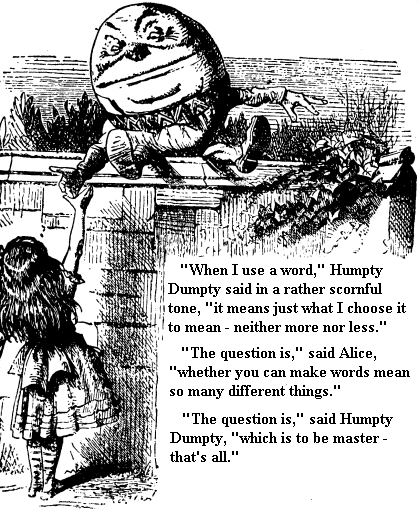
Humpty Dumpty and the Castle Doctrine
The judge in former Dallas police officer Amber Guyger's murder trial for the shooting of Botham Jean gave the jury instructions on the Castle Doctrine defense, despite the fact that Guyger entered Jean's home and shot him, and wasn't defending her "castle." Her lawyers employed this argument as their primary defense (that it wasn't her home was a "mistake of fact," they said) so the judge had no choice but to address it, but Humpty Dumpty would be proud! The claim didn't help Guyger, however. She was convicted, anyway. UPDATE: Guyger was sentenced to ten years.

Death of trailblazing deputy raises difficult, familiar questions
The tragic shooting death of a Harris County Sheriff's deputy - a trail blazing figure who was the first Sikh to work in Harris County law enforcement - raises familiar questions with no satisfying answers. The alleged killer is a severely schizophrenic parolee who had gone off his meds and heard voices telling him to kill people. Is the criminal-justice system the best way to deal with people whose offenses are rooted in severe mental illness? How did this convicted felon and parolee get a firearm? He already was the subject of a warrant for violating his parole, should more resources be allocated to search for high-risk parole violators? His family had told officials he was dangerous and off his meds: Are there "red flag" laws that could have allowed them to act sooner? The circumstances surrounding this awful episode will provide fodder for these and many other debates in coming years. The public dialogue would have been easier, in a sense, if this had turned out to be a hate crime. The issues surrounding mental illness and the politics of gun proliferation are much more complex and difficult to deal with.

Private jail operator keeps screwing up
At the Liberty County Jail, which is operated by the Geo Group, "In the last 60 days, there have been two felony escapes, one of their correctional officers was arrested for stealing from inmates while on duty, and most recently, there are questions surrounding the death of a prisoner who hanged himself while in their custody. Apart from those instances, they have also flunked two jail inspections this year, one on April 22 and the second on June 28," the Houston Chronicle reported. Local officials are considering whether to terminate ties with the private prison contractor.

The economics of high probation fees
Check out a new article from our friend Todd Jermstad, probation director in Bell County, on the history and future of court-imposed fees at Texas probation departments. Especially interesting was his thesis that policymakers should take into account reduced means of Gen X and Millenial defendants, whose economic prospects remain less robust than earlier generations. Grits may delve more deeply into this soon, but for now, here's the link.

Bail litigation roundup
See a write-up from The Appeal of recent bail-litigation news, including from Houston and Galveston. See also related Grits coverage and our discussion of the topic in Just Liberty's most recent Reasonably Suspicious podcast.

Over friggin' pot?
In Hutto, a police officer responding to a call that someone was smoking marijuana beat up a man in his driveway and made false accusations in official documents to justify it. The victim had no marijuana in his possession, and bodycam video proved the cop was lying about the victim pushing the officer before he was attacked. The officer was fired, was indicted in May, and the victim has filed a civil rights suit, reported KXAN-TV.

Homelessness problems and solutions
In the wake of Austin's tendentious debate over homeless policy, I was interested to see this excellent New Republic article on "housing insecurity in the nation's richest cities." When, in the 1990s, my wife and I could rent a dilapidated three-bedroom house in East Austin for $190, homelessness wasn't such a big problem. Now that rents in my neighborhood for similar homes approach $3k per month, it's little wonder more people are on the streets. Meanwhile, Bloomberg News had an informative piece a couple of months back on how Finland all but eliminated people sleeping on the streets by investing in preventive strategies like rent subsidies.

How police misconduct gets covered up by plea bargaining
Here's an excellent analysis from Brooklyn public defender Scott Hechinger of how mandatory minimums and the threat of long sentences help cover up police misconduct that would otherwise come out in court. That's because "victims of police abuse — illegal stops and frisks, car stops and searches, home raids, manufactured charges and excessive force — routinely forgo their constitutional right to challenge police abuse in a pretrial hearing in exchange for plea deals." This is undeniably true. It's only in cases like the episode in Hutto, described above, where victims face no charges that officers can be held accountable through regular court processes.

Financial motive not only reason prosecutors oppose actual-innocence claims
The New York Times published a feature on falsely convicted people who've been exonerated by the evidence but cannot secure an "actual innocence" ruling because prosecutors fear the financial consequences of civil rights lawsuits against local jurisdictions. All of the examples are from other states, but Texas' situation casts additional light on this topic. I was policy director at the Innocence Project of Texas when the Legislature passed the best-in-the-nation compensation package for exonerees in 2009. We hoped to avoid this dynamic by having the state compensate innocent convicts instead of the locals. Indeed, the bill was sold as a form of "tort reform," eliminating local liability for what were seen as systemic flaws causing false convictions. But it turned out, the real, underlying complaints weren't financial. Many prosecutors and some judges on the Court of Criminal Appeals simply don't want to see falsely convicted people compensated, ever, and go to great lengths to oppose actual-innocence claims, despite the fact that locals weren't on the hook. So Grits is skeptical of the article's thesis that the motive behind opposing actual-innocence claims is financial. I think it's more pernicious than that.

Sheriffs and #cjreform
Our pal Jessica Pishko published a New York Times op ed on Sheriff's offices, declaring "The problem of sheriffs is particularly acute in the South and Southwest, where the office has more power and was historically used to prop up white supremacy." She calls for Sheriffs to undertake what amounts to a truth-and-reconciliation process for past wrongs. That sanguine suggestion to me seems unlikely. Texas alone has 254 counties, after all - a few might do that, under the right political circumstances, but most will not. And abolishing the office, as some have called for, doesn't change the fact that someone has to perform those functions. Grits has often thought that sheriffs' jail-management duties should be separated from their responsibilities to patrol unincorporated areas. These are distinct functions involving very different skill sets, and typically those elected to the office only have knowledge of one or the other. Whether Sheriffs should be an elected position is a question for another day.

Deep thinking on sex-offender policies
A recent NY Times piece examined emerging research on people who are sexually attracted to minors, finding that its roots are not genetic, but are "prenatal," and "can be traced to specific periods of development in the womb." And this Marshall Project story looks at evidence-based anti-recidivism programs aimed at people convicted of violent, sexual crimes once their sentence is complete. I found both articles to be thoughtful contributions to the discussion.

Most crime dropping nationally, but look at those rape numbers!
New Uniform Crime Report data is out, and most categories of crime have continued to fall, except rape, which has risen precipitously since 2014. See first-cut analyses from the Brennan Center and the Marshall Project. No one knows for sure what's behind the rise in rape numbers. The feds began using a more expansive definition of sexual assault in 2014, but the numbers increased even using the "legacy" definition. The question arises: Have there actually been more rapes committed over this period, or are we simply now getting a more complete picture of the scope of the problem in the wake of increased reporting thanks to the #MeToo movement? ¿Quien sabe? Regardless, the year-over-year decline in property crimes, murders, robberies, etc., is cause for celebration, while the sex-assault data should contribute to deeper conversations on the question.