Friday, March 23, 2012

Competency restoration: Clinical vs. forensic assessments

One often hears folks in the system say that, though it's lamentable to use jails as a substitute for mental health treatment, at least sick people get services there. Seldom discussed, though, is that the process begins with a concerted effort to prove that mentally ill defendants are not, in fact, sick so they can be shown competent to stand trial. A presentation this morning at the Texas Criminal Justice Integrity Unit's mental health seminar by Dr. Bryan Scott - who assesses defendants' competency for Bexar County - identified some of the key distinctions between his forensic role and that of a clinical diagnostician, both in his discussion and his own demeanor and attitude toward the work.

Scott emphasized the radical differences between the role of a forensic mental health examiner vs. clinical psychologist psychiatrist. In a clinical assessment, he would typically run down a checklist of symptoms: Do you hear voices, etc.? In a forensic setting, he said, he doesn't interrogate symptoms, assuming malingerers would cop to all of them. but instead lets defendants bring symptoms to him. And when they do, he views them very skeptically, with his main task - and to hear him tell it the most "fun" part of the job - that of rooting out alleged malingerers (I say "alleged" because in one prominent example he insisted a man was faking though a jury had overruled him).

For example, instead of listing possible real symptoms, Scott will often suggest phony symptoms (e.g., are symptoms worse when you lie down, stand up, urinate, etc.?) to trip them up if they agree with items not associated with the possible illness. Or he'd ask a series of 50/50 questions ("Does a cow have three legs or four? Is a quarter worth 25 cents or a dollar.? Many mentally ill people, he pointed out, will answer those questions just fine. If they get most wrong, not 50/50 as you might if guessing, he assumes they're likely malingering. So that line of questioning is aimed at tripping up malingerers and merely wasting the time of the actually sick, and is not something you'd see in a clinical assessment.

In some cases, things that might cause a clinical diagnostician to think a mental illness more likely, said Dr. Scott, may mitigate against him believing a defendant. For example, mental illness (particularly bipolar and schizophrenia) are to some extent inheritable, so a family history normally implies it's more likely a patient will have the same problem. In the case of defendants, though, Scott said if their mother suffered from schizophrenia, a malingerer might have more intimate knowledge of symptoms and be able to mimic them. For this reason, he considers family history both "a rule-in and a rule-out" criteria.

Another key difference, said Scott: Forensic examiners determining competency do not have a doctor-patient relationship, though he does tell defendants "I'm here to help you." But his role is "not therapeutic," said Scott, who said it's a "totally different role than seeing a patient." He's not there to get them treatment. There is "no confidentiality," and he lets them know that up front. Indeed, he said, often defense attorneys will sit in on the interviews. That alone is a huge difference between the mental health treatment in jail and out: Is the client the client, or is the court the client?

Scott emphasized he wasn't assessing mental illness per se but legal competency to stand trial, declaring "Just because someone is delusional doesn't mean they're incompetent."

Dr. Scott's gleeful tone as he recounted "tricks of the trade" for identifying (or at least accusing) malingerers was difficult to suppress, and mostly he didn't really try. I don't say that to criticize him, at least too harshly (though at times it did seem a bit much). Malingering happens and somebody has to try to root it out. I certainly don't envy the task. Problem is, everybody including the legitimately ill, who are processed through the system in large numbers, get treated as potential malingerers on the front end, where possible diagnoses aren't probed so much to identify problems as to find excuses to ignore them. What a strange, almost perverse aspect of the system.

In jail, but not 'in custody'

Liberty and Justice for Y'all has the story of a recent US Supreme Court case ruling that an inmate questioned while in jail for an unrelated crime is not "in custody" for purposes of requiring a Miranda warning. Talk about a term of art, when you can be in jail, but not "in custody"!

Hays County 'moveable jail' looking to settle down

Here's a bit of Texas carceral history I was unaware of; reports the Hays County Free Press:
The Hays County Jail’s Moveable Jail Cell in San Marcos is one of nine sites that a statewide preservation group has named to its ninth annual list of Texas’ Most Endangered Historic Places.

The moveable jail cell was constructed for the Hays County Jail in Kyle and, today, it is a rarity of its kind. The cells were referred to as a “calaboose,” the Spanish word for jail, and were constructed using the cribbing method where the walls are arranged in sets of logs or timber in a log-style cabin formation to create a rising rectangle or square.

The jail cell remained in use until 1925 as Kyle’s city jail and, later, was moved to the Texana Village at Aquarena Springs. Due to lack of funding, the jail cell along with other buildings and artifacts were removed from the Village. At the eleventh hour, the jail cell was saved and moved to its current location at the San Marcos Academy.
The jail cell is a valuable piece of Hays County history but for generations it has been shuffled around the county. It needs a permanent home where it can be restored and appreciated, Preservation Texas argues. Local advocates are working to raise funds and to increase public support to preserve the moveable jail cell in order to tell a broader story of the county’s history.
Here's a picture of Hays County's two-man "moveable jail":

Looks like it could be mistaken for a deluxe outhouse! The story says "calaboose" is the "Spanish word for jail," but to clarify, "jail" in Spanish is typically "cárcel," while "calabozo" has more the dark, dank implications of the English "dungeon." Sitting out in the sun during a hot Texas summer, though, this structure would have felt more like some sadistic, claustrophobic sweat lodge.

Is there a place in the modern world for a moveable jail? What functions did mobility fulfill (work crews, perhaps?) that a stand-alone structure wouldn't? Or was it just the case that until 1925, Kyle didn't need more than that?

You can see the idea might be taken to an extreme, if perhaps in the realm of fiction. In my mind's eye I imagine prisons designed as mobile pods with prison transfers accomplished by cranes picking up whole sections filled with inmates and stacking them on trains like boxcars. Or then, perhaps I shouldn't give TDCJ any ideas!

A moveable jail ... who'da thunk?

Overcriminalization Folly of the Week: Felony driving without a license

Grits went to read an important new US Supreme Court opinion (pdf) out this week, Missouri v. Frye, related to whether a plea deal never submitted to a client by his attorney was grounds for post-conviction relief because of ineffective assistance of counsel. It's an interesting question, but I did a double, then a triple take when I read the opening lines describing the underlying case in the opinion, then couldn't get past it: "Respondent Frye was charged with driving with a revoked license. Because he had been convicted of the same offense three times before, he was charged, under Missouri law, with a felony carrying a maximum 4-year prison term."

Huh? A max four-year prison term for driving without a license? Even for the fourth offense, that seems extreme. According to this source, actually, in Missouri it's a felony on the third offense. That seems borderline totalitarian - "Show me your papers, comrade, or I'll slap you in prison for four years." Yikes! You can fill up a gulag pretty darn quickly that way! Even with that extreme penalty, though, one in ten Missouri drivers have no license.

This is overcriminalization run amok. With incarceration costs running in the $20,000 per year range, it'd be a lot cheaper to remove barriers to licensure and spend the money you would have spent on prosecution and incarceration to give out free bicycles and bus passes. The absurdist cost-benefit analysis behind making driving without a license a felony worthy of prison time boggles the mind.

Reduction in federal pork one cause of reduced Texas traffic tickets

A commenter on the last Grits post suggested that a key reason the number of traffic tickets written by Texas police went down last year in Austin and elsewhere may have been cuts to the "Selective Traffic Enforcement Program" (STEP), which are federal pass-through grants distributed to law enforcement through the Texas Department of Transportation to pay for overtime devoted to traffic enforcement. And indeed, that may partially, but not fully, explain the recent decline in traffic tickets written by Texas police.

Searching around on TXDOT's website, I found this memo to law enforcement agencies (pdf) from April 2011 detailing 30% cuts to STEP grants - from $20.2 million to $14.2 million statewide - with a table at the end showing how much each department's grants were cut.

Houston, which has seen its number of traffic tickets decline, lost $360,000 with the reduction in STEP grant funds; Dallas' grant fell by a like amount. The Department of Public Safety took the biggest hit with a $424,521 reduction.

Austin lost about $158,000 in grant funding for overtime with that 30% reduction - not chump change, but not remotely enough to account for the 26% reduction in tickets they recorded in 2011. Austin PD says it wrote fewer tickets because of a policy change - "because the Highway Enforcement Command shifted its mission from citywide traffic enforcement to a focus on the major highways such as IH-35, MoPac and 183" - which seems like a more plausible explanation.

Plus, data from the Office of Court Administration showing a statewide decline in tickets processed in municipal court covered the state fiscal year from September to August, so cuts that took effect April 29 wouldn't have impacted most of that year. In other words, there are indications the decline in ticketing a) predated cuts to STEP grants and b) are too large to be completely explained  by them. That's certainly one of several contributing factors, though, and perhaps reason to think the trend might continue in the near term without local traffic enforcement getting artificially pumped up through federal pork.

See related Grits posts:

Thursday, March 22, 2012

Austin police gave 26% fewer traffic tickets in 2011

It turns out Austin's decline in the number of traffic tickets given out last year was even greater than Grits had supposed according to the city's recent racial profiling report (pdf), which I noticed via this story by Patrick George in the Austin Statesman. Grits has earlier reported that tickets processed in municipal court in Austin had declined from roughly 233,000 to 205,000 from 2010 to 2011 - part of a statewide trend.

The racial profiling report shows Austin officers last year gave far fewer tickets last year. "Austin police officers made 179,882 motor vehicle stops in 2011 compared to 232,848 in 2010," according to the city's racial profiling report. One caveat: That's comparing calendar year to calendar year whereas the Office of Court Administration is measuring the fiscal year (September to August).

Still, that's an amazing 26% fewer tickets from year to year! Said the report: "Overall, the number of stops is lower in 2011, in part, because the Highway Enforcement Command shifted its mission from citywide traffic enforcement to a focus on the major highways such as IH-35, MoPac and 183. As a consequence, the number of traffic citations declined from 224,662 in 2010 to 165,757 in 2011, a 26% reduction. The overall number of motor vehicle stops also decreased by 23%." That has trickle down effects at the jail and throughout the court system because so many arrests originate at traffic stops.

Austin also saw the number of consent searches at traffic stops decline last year, from the highest total since they began tracking in 2010 (19,519) to a more modest 2011 total (11,719)), for a 40% drop.

I went to check the same data source for other cities and was disappointed to see this on the TCLEOSE website: "Note: The link to the 2010 Racial Profiling reports from the TCLEOSE website is no longer available on-line, but may be purchased for $35 (CD disk) through Open Records Request." That's pointless. How much space does it take to archive past years' reports for comparison? I might go ahead and get a couple of years worth for comparison purposes, but that's gratuitous. At least leave the last 3-5 years of reports online to supply some context for the annual data.

SCOTUS expands habeas access on ineffective assistance claims

The US Supreme Court issued an important habeas corpus decision (pdf) this week that may have implications in prominent Texas cases, and though Grits hasn't had time to read through it and digest the implications, I thought I'd at least round up the relevant links, if only so I can go through them myself soon. First, here's how Brandi Grissom at the Texas Tribune described the case:
The nation’s highest court ruled that the failure of initial state habeas lawyers to argue that their client’s trial counsel was ineffective should not prevent the defendant from making that argument later on. Lawyers across the country, including those for at least two Texas death row inmates, were eagerly awaiting the court’s ruling in the Martinez v. Ryan case out of Arizona, which could expand appeals access for inmates.

“A procedural default will not bar a federal habeas court from hearing those claims if, in the initial-review collateral proceeding, there was no counsel or counsel in the proceeding was ineffective,” the court majority held.

Habeas lawyers investigate issues that could or should have been raised during a defendant’s original trial.
The ruling may have direct implications for a case mentioned recently on Grits:
The ruling could also be a boon for death row inmate Rob Will, who was convicted in 2002 of fatally shooting a Harris County sheriff’s deputy. Will says that the man he was with that night was the real shooter and that he is innocent.

In January, U.S. District Court Judge Keith Ellison denied Will’s pleas for a new trial but wrote that he lamented doing so because of “disturbing uncertainties” raised about his guilt.

Will is hoping the court’s ruling in Martinez will allow him to argue that he should get a new trial because both his trial lawyer and his state-appointed habeas lawyer were ineffective when they failed to track down several witnesses who have testified that the other man confessed to the killing.
See the SCOTUSBlog Wiki page on Martinez v. Ryan, good guest blogging on the subject at Sentencing Law & Policy, as well as Adam Liptak's coverage in the New York Times and notable commentary at the ABA Journal, the Courthouse News Service, and the Habeas Book Blog.

Prosecutor Misconduct Roundup: 60 Minutes to feature Michael Morton exoneration Sunday

The TV news show 60 Minutes will broadcast a segment about Michael Morton's exoneration and the struggle to hold Williamson County prosecutors accountable through a court of inquiry this Sunday, March 25 (6:00-7:00 PM, CT) on CBS.

Relatedly, the blog Wilco Watchdog has been diligently chronicling Williamson County DA John Bradley's re-election foibles, including a recent rumpus with a local police union that endorsed his opponent and accused Bradley of misrepresenting their political motives.

That is a hot, hot DA's primary fight in Williamson County. So despite his latter-day conversion, another turn in the barrel for the Michael Morton case in the national media likely won't do Bradley's re-election campaign much good. The man fought for years to keep Mr. Morton from getting exculpatory evidence tested, a record that earned him the distinction of Worst American Prosecutor of 2011, according to a reader poll at The Agitator blog. And Judge Ken Anderson, the former DA accused of withholding evidence in Morton's case 25 years ago, is Bradley's patron, mentor and even sometime writing partner, though JB now says they're on the outs.

Hopefully coverage on the respected 60 Minutes will also ratchet up pressure for reforms at the Texas Legislature next year aimed at stemming prosecutorial misconduct - a subject on which Grits has been compiling reform suggestions. Bradley's future isn't nearly as important as whether the state learns from mistakes like this or allows prosecutors to throw up a smokescreens to prevent legislative intervention. It's clear the courts and/or existing statutes aren't up to the task, so if one wants stronger incentives for prosecutors to play by the rules, the legislative branch is perhaps the best hope.

Finally, I wanted to alert readers in Austin to a timely event on this topic that Grits plans to attend:
Prosecutorial Oversight: A national dialogue in the wake of Connick v. Thompson

Thursday, March 29, 2012
1:30 to 3:30 PM
Francis Auditorium
University of Texas School of Law – Austin, Texas

Please join us for the Texas stop of a national tour to address the issue of prosecutorial oversight.  The Supreme Court’s recent decision in Connick v. Thompson rejected civil liability for Brady violations in lieu of what it took to be effective status quo mechanisms for training, supervising, and remediating prosecutorial disclosure issues. A discussion followed by Q&A will address existing oversight mechanisms in Texas, assess their adequacy, and explore possible avenues of reform.

Speakers include:
  • Betty Blackwell – Attorney, former chair of the Texas Commission for Lawyer Discipline
  • Jennifer Laurin (moderator) – Assistant Professor, University of Texas School of Law
  • Jim Leitner  - First Assistant District Attorney, Harris County
  • Michael Morton – Freed after 25 years in prison in Texas following DNA exoneration and revelation of concealed exculpatory evidence
  • Hon. Bob Perkins (Ret.) – Former judge, 331st District Court, Travis County
  • Professor Robert Schuwerk – Professor, University of Houston Law Center, author of leading treatise on Texas rules of professional conduct
  • John Thompson – Founder and Director of Resurrection After Exoneration and Voices of Innocence and plaintiff in Thompson v. Connick, imprisoned in Louisiana for 18 years (14 on death row), freed after revelation of concealed exculpatory evidence
  • Emily West – Research Director, The Innocence Project
The event is free and open to the public, but RSVPs are encouraged. Please register by Tuesday, March 27 by emailing info@prosecutorialoversight.org.
Event moderator Jennifer Laurin, I notice, has an academic paper on Connick v. Thompson which must also go on Grits' reading list.

CCA Integrity Unit hosts capitol seminar on mental health

Today and tomorrow the Court of Criminal Appeals' Criminal Justice Integrity Unit is holding a two-day seminar on mental health at the capitol. (See a flyer [pdf] for the event.) If you haven't registered (I understand it's full), you can watch online beginning at 9 a.m. this morning; go to the Texas Senate's video page and scroll down to the "Court of Criminal Appeals Seminar," clicking on the Real Player icon to launch the broadcast once it begins. The first day focuses on substance abuse issues; tomorrow they'll cover competency restoration, involuntary commitment, and representing the mentally ill.

Wednesday, March 21, 2012

Pedestrian deaths in Austin and the trouble with drawing conclusions from small numbers

One seldom-discussed drawback with data-driven policing - particularly when its used in mid-size and smaller cities - is that small statistical samples often make drawing valid inferences problematic, and here's a good example: Writes reporter Brenda Bell, "auto-pedestrian deaths are up in Austin, even as deaths from other vehicular collisions are falling. Last year marked an 83 percent increase in pedestrian-bicyclist fatalities; there were 22, compared with a dozen in 2010." Bell reported Sunday that "This year, eight people, including one walking his bike, have already died in collisions with motor vehicles. All but one happened after dark or at dusk. One-third were hit-and-runs."

While certainly it's accurate to say there was an 83% one-year increase, when the numbers are so small that means very little as far as identifying a statistical trend of increasing deaths, and the story didn't include prior years' data. On Sunday Bell did report that "Auto-bike fatalities have averaged one per year over the past seven years," but that means the year you have two it's a hundred percent increase. Is that meaningful data, or just random fluctuation? You see the same issues with murder trends and other infrequent events. Media will report a one-year increase with tremendous drama as a possible trend, even during periods like we're in now when long-term murder rates are declining. When numbers are so small, you need multiple years of data to perform a probative trend analysis, which of course doesn't make for the most attention-grabbing news story.

Perhaps the most obvious death-causing trend evidenced in the stories is that a significant proportion of pedestrian deaths in Austin happen along Interstate 35, which for significant stretches (especially north of 51st Street) is difficult to cross legally on foot and is flanked by extremely busy frontage roads. This datapoint reinforces my sense that jaywalking can be better addressed via traffic engineering solutions that make it safer for pedestrians to get where they're going. If you're walking any significant distance along the access road on I-35, it's likely because you have no other choice.

Another notable trend mentioned is bicyclists being hit after dark, which might argue for efforts narrowly aimed at improving safety equipment. (I see cyclists these days with flashing lights on their bikes instead of reflectors that make them MUCH easier to see after dark.) Cyclists' deficient equipment can be addressed with a variety of tactics from public education, warnings or tickets for equipment violations, improved lighting for dangerous intersections and popular bike routes, etc..

For the most part, though, the city should address these mainly as traffic engineering questions as opposed to law-enforcement concerns. For example, would auto-pedestrian/bike accidents downtown be reduced by creating the proposed Nueces Bike Boulevard? (See here [pdf] for more detail.) Quite possibly. A fascinating and telling map of recent auto-pedestrian/bike accidents accompanying the story shows a large number downtown, though some are concentrated on the east and west entry corridors. Those wouldn't be affected by a north-south route on Nueces, which more aims to reduce accidents on, say, Congress and Lamar.

Instead, Austin PD took a one-size-fits-all enforcement approach, employing a hammer in lieu of a scalpel. In a highly unpopular two-week crackdown last October:
Pedestrians got 1,336 citations and warnings, for offenses such as failure to observe traffic signals, panhandling or stepping into roadways midblock. Drivers got 174.

That lopsided scorecard is par for the course. Between 2008 and 2010, Austin police issued nearly 11,000 citations for violations of auto-pedestrian laws; only 7 percent went to drivers.
Ticketing cyclists may prompt them to get better equipment for biking at night - just handing out lights might even be better - but jaywalking will always be a function of convenience and opportunism. Focusing significant resources on ticketing them IMO is just silly. Meanwhile, as for Austin's much-ballyhooed "3 foot rule" that's supposed to protect "vulnerable" road users?
A city ordinance passed in 2009 requires vehicles to keep at least 3 feet away when passing a "vulnerable user" — a bicyclist, motorcyclist, pedestrian or runner. On four-lane roads, motorists are supposed to yield the lane entirely.

Austin police have issued just eight citations — four per year — under that law.
So that was a bust. Now they're going to try using police as pedestrian "decoys" to ticket motorists. But with 11,000 citations for auto-pedestiran laws over three years and a supposed increase in the problem just now, it doesn't seem like the enforcement-only approach gets to the heart of the problem. Assessing tickets and fines for petty offenses while telling the public it's for their own protection comes off as self serving as it is patronizing in an era when municipal tickets are viewed as a lucrative revenue source.

To be fair, the city does have $13.5 million in bond money available "for projects to enhance mobility and safety for pedestrians, bikers and disabled people," which should do a lot more to prevent deaths than giving pointless tickets to jaywalkers. Certainly it will do more than APD's various proposals for new city bonds at ten times the cost.

Police Chief Art Acevedo told the paper he thinks this trend - which nobody can really say is a trend yet - results from the declining moral character of the citizenry: "Drivers think (pedestrians) don't have the right to cross the street, and pedestrians think they can jump out at the last second," he said. "It used to be ... that when a pedestrian set foot in an intersection, that people stopped. I think it's a commentary on society that we've lost that respect," adding that we're all a bunch of drunks Austin is "one of the heaviest drinking cities in the country."

For Grits' part, I think it's a commentary on Austin PD that, although the chief and the union complain constantly they don't have enough uniformed officers, when they get them they want them deployed ticketing jaywalkers while the civilian APD crime-scene unit doesn't even investigate a majority of burglaries for lack of manpower. And it's perhaps a commentary on the local media that police pronouncements of an "increased rate of pedestrian fatalities on Austin streets" are accepted as valid based on such a limited dataset. (If earlier years' numbers of pedestrian deaths are higher than 12, it might almost seem like the data was cherrypicked.)

These two stories give us insight into Austin PDs traffic enforcement tactics but in many ways for Grits raise more questions than they answer. Once we've seen the number of pedestrian deaths by year, preferably per capita, over a longer period of time, perhaps it would be safer to draw conclusions about trends.

Tuesday, March 20, 2012

Beaumont Enterprise argues both sides of recording confidential attorney-client communications in jail

There's an odd editorial in the Beaumont Enterprise about the Galveston County Jail ending its policy of taping inmate-attorney phone conversations. According to the Houston Chronicle, "Defense attorneys say the practice is common statewide." The Enterprise opines against the practice, favoring protection of client confidentiality, etc.. They close by pointing out that "Prosecutors wouldn't want defendants listening to their phone conversations. That right should be shared by both sides."

Then, strangely, in an argument as detailed than their own editorial judgment, they add:
ANOTHER VIEW: Continue for safety

Jail inmates need to remember an important reality: They simply do not have many of the same rights that other people enjoy. Most jails have a blanket policy of tape-recording all telephone conversations for a good reason: safety.

Jails are hard enough to run as it is. They are filled with many inmates who are dangerous or violent. Their interaction with outsiders has to be closely monitored, even with attorneys.

Prosecutors do not eavesdrop on these recorded conversations to learn tidbits they can use in court. The attorney-client conversations are simply included in the overall taping that goes on each day - again, for safety.

If this tradition is changed, what could prevent inmates from arguing that they should be able to talk to family members without being recorded? That could lead to all kinds of problems, such as inmates planning additional crimes.

This practice has not been a problem in our criminal justice system. It doesn't need fixing.
Grits finds this editorial construction fascinating: A publication basically arguing with itself, and giving its unnamed, theoretical opposition the last word. Is this a minority opinion from an editorial board member? Views expressed privately by the DA or law enforcement? Something somebody read on the Interwebs? Who knows? And what an argument, elevating this practice to a "tradition," no less!

I especially love the phony, red-herring question, "what could prevent inmates from arguing that they should be able to talk to family members without being recorded?' Uh ... perhaps the fact that attorneys engage in privileged communications with their clients while they're incarcerated and family members do not?

Grits doesn't doubt that recording attorney-client conversations in jail is common, and I wonder how often prosecutors or police sneak a listen, not for evidence to use in court but for leads, potential corroboration, etc.? Especially in high-profile cases where there's pressure to convict, but even under more workaday circumstances, the temptation to do so could be great without managerial checks, logs, etc. restricting who can access the data for what reason.

Juvie link roundup

Grits would like to pass on a few links related to juvenile justice issues for interested readers, even if I don't have time right now to delve too deeply into them.

Jail dominates Harris County Sheriff budget whether candidates acknowledge reality or not

Big Jolly has posted a hagiography candidate interview featuring Louis Guthrie, the GOP frontrunner to challenge Adrian Garcia for Harris County Sheriff, who Jolly declares is "a natural born leader," adding that he "couldn’t blame [Guthrie] if he thought I had a man-crush on him."

With Jolly temporarily blinded by his love-goggles, Grits wanted to hone in particularly on the utterly unrealistic discussion of the budget from the challenger. Ironically, his stances mirror positions taken and promises made by Garcia when he first ran for Sheriff, most of which crashed upon the rocky shores of economic reality almost immediately after he took office. Here's the segment (in full) of BJ's post on the budget:
About the budget, I’ve mentioned before (here and here) that most of the primary candidates think that the budget must be increased. Mr. Guthrie was a bit more nuanced in our discussion than he was in the forums – during the forums, he stated that his relationship with Harris County Commissioners Court would result in a larger budget. I asked him point blank if that meant that the Court was playing partisan politics and not giving Sheriff Garcia the resources he needed. His answer was no, that the budget under Garcia had grown and would continue to grow. What he meant was that the Court would see that he was prioritizing the resources better than Garcia and they would be more apt to give him what he asked for versus them seeing that Garcia was building up his command staff and not boots on the ground.
A glaring example of what Sheriff Garcia has done was noted in the Houston Chronicle today in a report by Anita Hassan:
Also, county budget cuts have suspended testing in the auto theft division for now. But overall, testing can help to solve more crimes as well as prevent them, Wilson said.
“If you catch one of those guys (car burglars), you can prevent dozens of them over a period of months,” he said. “They are out there every single day driving those parking lots in every part of this city and county looking for targets. If you get one of them off the streets, there’s no telling how many you may have prevented.”
I asked Mr. Guthrie about this report and he replied:
“Touch DNA is just one of many exciting new techniques now used to help solve crimes that were previously relegated to the “closed with no investigation” file.  While the current Sheriff has created most of his own budgeting problems, cutting funding for programs that help put burglars behind bars is a poor choice for the taxpayers.  Garcia could easily trim fat from his bloated command staff and instead put dollars to work solving crimes and putting more boots on the ground.  That would have a real impact of improving public safety in Harris County.” Louis Guthrie
We talked about the budget for quite some time. I was impressed with his detailed knowledge of how the department works, down to the supplies issued each deputy. I was a bit surprised by this because his highest rank in the department had been Lieutenant and budgeting is typically done by the Captains. He told me that he took it upon himself as a Lt. to break down the numbers passed down by his Captain because he wanted to be certain that taxpayer money was being utilized efficiently.
Two things jump out at Grits here. First is Guthrie's utterly unrealistic portrayal of the budget, pretending that demoting a few senior commanders will allow him to put more "boots on the ground" at a time when the county is paying millions annually in overtime to staff the jail (which is the 800 lbs. gorilla dominating the Sheriff's budget). I replied thusly in the comments:
Hey Big Spender!! So Garcia’s budget is too big, says Guthrie, but he would increase it more? I call BS.

In reality (i.e, outside the campaign trail), the Sheriff’s Office is primarily about running the jail. Garcia cited all the same data and made all the same promises about more patrols when he first ran, then once elected he had to confront reality and had to spend all his budget cushion on overtime for jailers to meet minimum state standards. What “efficiencies” will Guthrie install to change that situation? Nada. Command salaries are a drop in the bucket compared to overtime. If you or anybody believe Guthrie won’t be subject to PRECISELY the same budget dynamic, you’ve got another think coming. Such campaign promises are completely detached from reality.
Voters may not recall, but Sheriff Garcia rode into office four years ago promising to boost patrols in unincorporated parts of the county, then discovered after ascending to the job that his main responsibility is managing the jail and every extra dollar he could lay his hands on had to go to pay jailers' overtime. If Guthrie replaces him, four years from now he'll face a challenger making the same BS criticisms and promises because what he's suggesting is not real and cannot happen given current budget realities. These are not partisan issues, nor even ideological ones. They are difficult, practical economic and management questions on which neither Guthrie nor any other candidate may legitimately claim higher ground. Like Garcia when he made the same promises in 2008, either Guthrie doesn't understand the big picture or he's just blowing smoke up voters' collective ass.

Finally, BJ references an interesting story out of the Houston Chronicle on using "touch DNA" to solve property crimes, criticizing Garcia for not using the technology for car burglaries after the Commissioners Court cut the program's budget. I understand identifying something voters don't like (car burglaries) and blaming one's opponent for it is a typical campaign tactic, but the critique misunderstands who controls the budget strings at the Sheriff's office. The county commissioners court makes that call, not him. Besides, it's difficult to overstate the extent to which using touch DNA in nonviolent offenses would quickly overwhelm crime labs and property rooms. As Grits wrote in January, "The advent of 'touch DNA' and the expansion of DNA evidence to nonviolent offenses like burglary mean the near-term growth potential for DNA examiners may be limited only by how much state and local governments are willing to pay for them." In Harris County, for the foreseeable future, those demands for funds must get in line behind overtime spending for jailers. Changing the party designation of the Sheriff from D to R wouldn't alter that dynamic in the slightest.

RELATED: Here's Charles Kuffner's interview with incumbent Sheriff Adrian Garcia.

Monday, March 19, 2012

Shortcomings at crime lab accrediting body supply role for forensic commission

As Texas' Forensic Science Commission evolves in how it does its work in response to the actual, real-world complaints it receives, it's increasingly clear one of its primary roles will be to plug the gaps created by shortcomings in crime labs' accreditation process. Last week, Grits posted a detailed critique (pdf) of ASCLD/LAB, the crime-lab accrediting agency, submitted last year to the Forensic Science Commission in New York by a prominent attorney who criticized the group for lax oversight. He recommended NY state find a new accrediting body, as the United States Army Criminal Investigation Lab recently did following problems at an accredited lab.

At the Texas Forensic Science Commission, the Willis and Willingham cases involved arson, which is not an ASCLD/LAB accredited discipline. But more recent cases demonstrate why the TX FSC and ASCLD/LAB may end up butting heads in some instances, perhaps sooner than later, over the same issues identified in New York.

The best example may lie in the FSC's investigation of the controlled substances division at the El Paso crime lab. At their January meeting, serious unresolved concerns were raised about the lab and the commission initiated a detailed investigation with the help of the Department of Public Safety. I've uploaded a copy of the letter sent to the EPPD crime lab detailing the extensive checks they demanded be run to ensure the problems had been solved. These included hiring a qualified lab director, retesting all lab work performed since November 2011, and retesting ALL the work ever performed by an analyst found to be incompetent to perform the job, "giving priority to the 60 cases on the DPS list with the greatest possible impact."

The El Paso crime lab was accredited under "legacy" provisions by ASCLD/LAB, meaning they didn't have to meet every last requirement for their initial accreditation. However in April their "legacy" status runs out and the El Paso lab must meet much more rigorous ISO standards or risk losing their accreditation altogether. Ironically, in that light, it came out at the FSC's January meeting that ASCLD/LAB had lifted the probationary status of El Paso's controlled substances division, despite all the looming questions remaining about their competence, lack of leadership, and apparent ill-preparedness to meet the new standards required of them next month. As Grits reported in January:
while most of the media attention has focused on a single lab worker who couldn't pass basic competency tests, Commissioner Sarah Kerrigan, to the nodding affirmation of her peers, strongly urged that that lab worker not be used as a "scapegoat" to avoid bigger changes. When the El Paso lab began its certification process in 2006, the accrediting body found a list of shortcomings they asked them to fix, and which the lab claimed to have resolved. In 2011, though, when the incompetent lab worker came to light, a new assessment identified virtually all the same problems at the lab, still unresolved, that were cited in 2006.
A representative of ASCLD/LAB told the commission that lifting probation didn't mean all the lab's shortcomings have been rectified, which left everyone in the room wondering exactly what it did mean. Looking at the FSC letter detailing the oversight which still hadn't been performed when the lab's probation was lifted, one wonders what regulatory benefit, precisely, that ASCLD/LAB is providing and whether it really has any teeth.

Texas is one of only a few states that requires accreditation of its crime labs, and certainly having some standards to follow is better than flying blind. But standards unenforced are mere suggestions, and it's unclear what besides suggesting the accrediting body does when the labs it regulates don't follow its rules. If the FSC becomes the primary entity regularly performing meaningful crime-lab oversight, it will create a lasting, important role for the commission, particularly over the next decade or so as Texas and the rest of country struggle to correct deficiencies in what has historically passed for forensic science in the courtroom.

The Texas Forensic Science Commission - which at times during the Willlingham/Willis saga seemed to struggle to define its mission - appears to be hitting its stride now that the Culture War circus has left town, they have a chair who actually wants the agency to succeed, and they've found a role to play that the crime labs' accrediting body seems unable or unwilling to embrace.

Sunday, March 18, 2012

Secure Communities boosts otherwise declining jail populations

The Austin Statesman's Dave Harmon has one of the better articles I've seen ("Undocumented immigrants in jail: Who gets deported?," March 18) detailing how the federal "Secure Communities" program - which IDs undocumented immigrants in jail for deportation - actually operates on the ground in Travis County. Harmon found that about 10% of Travis County inmates who've received ICE detainers were jailed for Class C misdemeanors, though that practice is receding, and that most of those deported were arrested for misdemeanors. Among the story's highlights:
The newspaper analyzed ICE's data, then obtained three years' worth of records from the jail — totaling more than 250,000 bookings between 2009 and 2011 — and found that:

■ For every undocumented immigrant deported from Travis County after being arrested for a serious felony, two people were deported after being arrested for some type of misdemeanor, from traffic violations to more serious offenses, such as assault or drunk driving.
■ The more than 10,000 people who received ICE detainers — the first step toward possible deportation — over the three-year period included 1,054 people charged only with Class C misdemeanors, which are punishable by fines only.
■ Nearly 90 percent of those Class C charges were for public intoxication and traffic violations. It's not clear how many of those people were ultimately deported.
■ The number of detainers filed on people charged with Class C misdemeanors has been dropping over the past two years, from an average of 46 a month in the first half of 2010 to an average of 23 a month in the last half of 2011. Since ICE Director John Morton's memo last June instructing employees to use greater discretion, ICE agents have filed about 150 detainers on Class C offenders.
There are lots of case studies and other detail from the institutional players in the lengthy story, which will interest anyone interested in the day to day functioning of county jails. This is a great example why immigration enforcement is one of the last remaining hopes of private-prison interests that incarceration rates might continue to increase. Secure Communities is one of the few recent drivers of increased incarceration in an era when Texas county jails have otherwise experienced population declines, just as immigration detainees are the largest growth sector among federal prisoners. Thus, as is so often the case (see: mental health issues for another example), the program amounts to the state using the criminal justice system as a substitute for rationalizing policies overall - in this case, once and for all implementing immigration reform. Who gets a traffic ticket is a stupid way to choose who may get deported. The process should be a bit more thoughtful and less random than that.

Seeking compensation for non-DNA innocence claims

Here's a story about the difficulty in proving "actual innocence" without DNA and one man's quest seeking compensation in a non-DNA Texas innocence case: Billy Frederick Allen, who was falsely imprisoned for 25+ years based on a case of mistaken identity and evidence the defense failed to unearth before trial. Comptroller Susan Combs says Allen's release was based on claims of ineffective assistance of counsel, not actual innocence, and now the Texas Supreme Court is considering whether Allen may receive compensation like the DNA exonerees in a similar position. The mixup began at the crime scene with the victim's dying words:
The police officer testified that when he asked Sewell who attacked him, he answered, "Billy Allen." But a defense investigator after the trial found two paramedics who heard Sewell saying three names as he was dying, the Court of Criminal Appeals said. One said he heard [victim James] Sewell say "Billy Wayne Allen," the name of another possible suspect. The other paramedic remembered hearing a middle name but couldn't recall it.

That new evidence left the officer's testimony ineffective, and the remaining major piece of evidence -- the palm print on the car -- would not have been enough to convict him, the Court of Criminal Appeals determined. The court overturned Allen's conviction in 2009, and he walked out of prison on bail.

Now, the Texas Supreme Court is considering Allen's compensation claim. Both sides recently argued before the court, with Allen's attorneys saying he had proved himself innocent and was the same as any other ex-inmate who had been released from prison.

"Billy will establish that you don't have to have a DNA exoneration to be compensated," said his attorney, Kris Moore.

Assistant Solicitor General Philip Lionberger, representing the state, said Allen was freed through a claim that raised legitimate questions about his conviction but did not prove he was fully innocent. He said state law only requires payment to former inmates who win their freedom after presenting evidence proving their innocence based on a stricter standard than the one Allen met.

Lionberger said Allen's claim and others like his are "never going to be entitled to compensation."
Allen's case eerily parallels that of James Giles, who was also the victim of a wrong-name mixup that cost him ten years in prison and another 14 as a registered sex offender. The only difference:, DNA evidence existed in Giles' case to prove him innocent, whereas here that absolute standard can't be met.

The Texas Supreme Court has a tough job setting the standard for compensation in non-DNA cases, and if they find the current law is inadequate to compensate Mr. Allen, the Lege should revisit the standard in light of non-DNA exonerations. Where that line gets drawn is a multi-million dollar decision for the state, but we also know DNA exonerations represent just a small fraction of the total number of false convictions. The compensation law should accommodate the types of innocence cases actually out in the world. The Tulia defendants received compensation, after all: DNA has never been a pre-requisite for compensation under Texas' statute and I hope the court doesn't create a precedent now that would make that the case.

Read more here: http://www.star-telegram.com/2012/03/17/3817535/former-inmate-struggles-to-collect.html#storylink=cpy

Saturday, March 17, 2012

48 Hours Mystery to feature Anthony Graves' story

Via the Texas Tribune, we learn that CBS News' 48 Hours Mystery will feature a segment on Anthony Graves' false conviction tonight. See the full story.

Friday, March 16, 2012

DPS, private contractors, and the Great Public Relations Emergency of 2010

The Austin Statesman followed up on Tom Barry's piece at Alternet, discussed here, to provide more detail on the outsourcing of Texas border security to a private contractor called Abrams Learning and Information Systems Inc. (ALIS). Particularly fascinating in reporter Jeremy Schwartz's account is the rise of dissension within DPS as early as four years ago over the contracts, culminating in a budget request to replace them with DPS staff:
By 2008, at least some within DPS believed it was a bad idea — and too expensive — to give private contractors such responsibility over border security operations. In the agency's 2008 budget request to the Legislature, DPS asked for money to hire 19 state employees to replace the contract workers then staffing the border security operations and joint intelligence centers.

"It is more desirable and more cost effective to have state employees planning, coordinating, and evaluating joint state-local border security operations that involve more than $100 million in state appropriated funds," the document says.

Instead, the following year, Abrams received a $4.2 million contract in part to staff and provide "leadership" to the Border Security Operations Center, where it would produce plans, analyses and "decision support tools for Texas leadership."

That same year, 2009, the ALIS contract came under the purview of the Texas Rangers. By the next year, it was discontinued — because, officials said, the state could do the work itself for less money.

"The contract was coming to an end and when I looked at what (ALIS) was doing, I promoted people within the division to do the same jobs. It was more cost effective to do it ourselves," said former Ranger chief Tony Leal.
I also was unaware that in August of 2010 Texas faced a public relations "emergency," but that's the world the good folks at DPS apparently lives in:
In January 2010, DPS Director Steven McCraw told commissioners: "There's a tendency toward everything being an emergency. We recognize that's not the way to do business. We need to plan ahead."

But seven months later, DPS gave Abrams another emergency, no-bid contract, worth $1.4 million, in part to shape the state's public message on border security. ...

In August 2010, the DPS enlisted Abrams to develop a public and media outreach strategy to "position Texas border security efforts in a positive light," paying the firm to develop talking points, presentations, testimony and the "orientation" of senior government leaders. Abrams created a public relations campaign featuring 36 principal messages, including "The success of Texas border security and law enforcement efforts are critical to preserving you and your family's safety and way of life" and "Border Security is a Federal Responsibility but a Texas problem" — the exact language contained in an earlier Perry speech and a common refrain during Perry's presidential campaign.

A draft document obtained by the American-Statesman, titled "Border Security Public Outreach Themes and Messages," includes talking points that would seem to boost the firm's standing. In touting Operation Border Star, the state's principal border security strategy, the document says that law enforcement agencies "join with private companies" to "reduce border-related crime." The messages were meant to be used by the agency's public information department and to guide agency interactions with the media.

DPS officials say they contracted with ALIS on media outreach because they wanted the public to know about Mexican cartels recruiting Texas students to carry drugs and other threats such as smuggling operations and public corruption.
Sounds like the McCaffrey report and the recent Spring Break warning are all part of a broader public relations campaign. For that kind of money, there's likely more misinformation coming, or else this was the most expensive PR advice Texas taxpayers ever paid for.

'Flagrant Conduct': Remembering Lawrence v. Texas

See a NY Times review of Dale Carpenter's new book "Flagrant Conduct," telling the story of Lawrence v. Texas, the 2003 US Supreme Court case which decriminalized homosexuality in Texas. In the wave of overcriminalization sweeping through Texas law over the last two decades, this was a single, notable movement in the opposite direction, and one with far-reaching results. Seldom discussed is the extent to which the original criminal case was based on trumped up charges:
According to Carpenter, almost no one familiar with the incident believed the police report. The judge handling the case suspected that [Deputy Joseph] Quinn had either made up or embellished the sex charge, and the county’s top prosecutor seemed personally reluctant to pursue it. “I’m not sure I agree with government regulating private sex acts between consenting adults,” he told the press, “but it’s not my call.” What kept the case alive, Carpenter shrewdly explains, was relentless pressure from opposite sides of the political spectrum: Republicans seeking a “family values” issue, on one end; gay rights activists handed a good “test case,” on the other. 
What I remember most about this case was the man who argued it for the state before SCOTUS and miserably blew it - Chuck Rosenthal, who the Times review called "the flamboyant, if woefully unprepared, Harris County district attorney." His performance is described thusly:
It is impossible in this limited space to convey the sheer ineptitude of Rosenthal’s presentation. At one point, Justice Scalia had to warn the hapless district attorney that he was about to answer a trick question. “Don’t fall into that trap,” he scolded. Within minutes, the justices were ignoring Rosenthal’s inane responses and arguing the merits themselves, leading Chief Justice William Rehnquist to suggest that “maybe we should go through counsel.” The highlight came when a frustrated Justice Stephen Breyer innocently requested a “straight answer” from Rosenthal, sending waves of laughter through the room.
That's the image of Chuck Rosenthal which always comes to mind, for me anyway, whenever I read Murray Newman waxing on about the good ol' days at the Harris County DA's Office.

It's worth mentioning that Penal Code 21.06 banning homosexuality is still on the books in Texas, despite the Supreme Court striking it down. It's no longer good law, but since 2003 the GOP has held the majority in both chambers of the Texas Legislature, and it's so far been impossible to get Republicans to take an on-the-record vote for repeal, however meaningless, that could be construed by a primary opponent as in favor of homosexuality.

So the strangest conduct of all arguably has been by the government, especially Chuck Rosenthal, but also an allegedly mendacious police officer and special interests pushing to pursue charges nobody really believed for political reasons. A truly Texan tale.

Did the Driver Responsibility Surcharge cause Texas' voter ID law to be rejected?

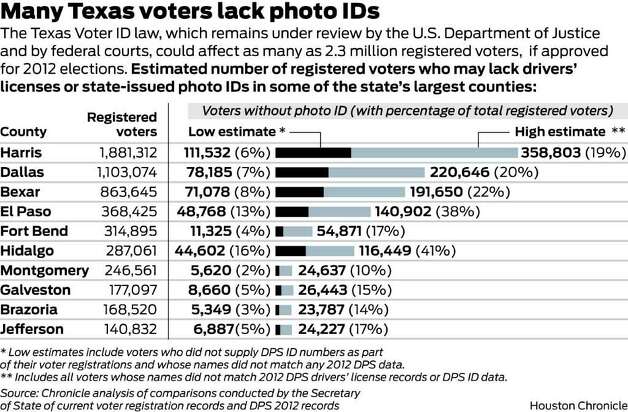
Aside from redistricting, the big electoral news recently was the Justice Department's decision to oppose implementation of Texas' new "voter ID" statute, leading the state to launch its own counter-challenge to the Voting Rights Act. I don't care to debate the merits of the DOJ decision - which was based on alleged discriminatory outcomes - but instead am interested in WHY so many Texans lack a state-issued photo ID? Pondering that subject leads to a corollary question: Did the Driver Responsibility Surcharge cause Texas' voter ID law to be rejected? As Lise Olsen reported in the Houston Chronicle:
as many as 18 percent of all registered voters across Texas apparently [lack] state government-issued photo IDs to match their voter registration cards, according to records obtained by the Houston Chronicle.

Texas secretary of state officials did not find matching 2012 driver's licenses or state-issued photo IDs for 2.4 million of the state's 12.8 million registered voters, though all but about 800,000 of those voters supplied a valid identification number when they first registered to vote. The findings come from documents submitted by the state to the U.S. Department of Justice as part of an ongoing review of the new voter ID law.

The "matching" exercises conducted by the state showed up to 22 percent of Bexar County voters apparently lacked the IDs, as well as 20 percent in Dallas County and 19 percent in Harris County, based on the Chronicle's review of the state data.
Here's the Chronicle's summary of the rate of voters with no state ID in selected larger counties:


Why do so many adult Texans lack ID? In part because 2 million drivers have had their drivers licenses revoked because of nonpayment of the Driver Responsibility Surcharge, which readers will recall is a stiff civil penalty tacked on top of any fines, punishments or court costs stemming from certain traffic offenses, including  driving without a license, driving without insurance, "point" accumulation, and DWI. Of those, around 1.2 million have not had their licenses reinstated, which would explain why so many voters may have had a DL number when they registered to vote but don't now. If 2.4 million Texas voters lack state ID, and all but 800,000 had IDs when they registered, then the Driver Responsibility Surcharge could account for as much as three-quarters (1.2 out of 1.6 million) of those who had ID when they registered to vote but do not today.

I'd love to see the state run another matching program to find out how many voters without a current ID have defaulted on one or more Driver Responsibility Surcharges. This redundant civil penalty has inflicted untold misery on drivers who owe it, and judges blame the surcharge for Texas' declining DWI conviction rate. Now it appears the surcharge is a major contributor to Texas' Voter ID law being challenged. Meanwhile the Lege is using most of the "dedicated" funds from the surcharge to balance the budget instead of dispensing it to trauma center hospitals as they promised.

At this point, the surcharge has not only failed at all its goals - both in the enforcement realm and providing revenue for trauma hospitals - it is now interfering with other state goals like DWI enforcement and the Voter ID law. How many negative consequences must the state suffer from this ill-conceived revenue-generation scheme before the Legislature finally repeals it?

Via Kuff.

Thursday, March 15, 2012

DPS outsourced key border security tasks to shadowy private contractor

Here's a story that should have been broken by a Texas publication, but credit must instead go to Tom Barry at Alternet for a remarkable piece of reporting titled "Who Is Securing the Texas Border? How Private Contractors Mislead the Public, Then Get Rich Off Taxpayer Money."
Since 2006 many of the key figures in state-led border security operations and information campaigns have identified themselves as DPS employees or part of the Texas Rangers to the public, policy community and the media, disguising their true identities.

The business card he handed me during the sheriffs meeting identified Sikes as the director of the Border Security Operations Center (BSOC) – which is a type of fusion center for border-security operations in Texas. It’s a project of the Texas Rangers Division, which in turn is a branch of the Texas Department of Public Safety (DPS).

However, Mac Sikes is neither a Texas Ranger nor a DPS employee. Like most of the other key figures behind the Lone Star State’s border security campaign, Sikes is a contract employee.

A “senior operational analyst” at Abrams Learning & Information Systems (ALIS), Sikes became director of BSOC as part of the firm’s $3-5 million annual contracts with DPS since 2006. The recent DPS decision -- in response to a public records request -- to release the ALIS contract revealed the true identity of Sikes.

The Border Security Operations Center is the nexus of the Texas’ own border security initiatives, collectively known as Operation Border Star. ALIS, a homeland-security consulting firm with offices in Arlington, Virginia, was founded in 2004 by Ret. Army Gen. John Abrams to cash in on the billions of dollars in new government contracting funds that started to flow after the creation of the Department of Homeland Security in 2003.

Since 2006 ALIS functioned as the hidden force behind virtually all non-federal border-security operations in Texas. Whether it’s strategy formulation, border crime-mapping, operations management, or public relations, ALIS and its team of consultants have been closely involved in creating what Governor Rick Perry calls the “Texas model of border security.”
Says Barry, "It would be hard to exaggerate the degree to which Governor Perry and DPS Chief McCraw have outsourced state border-security, homeland-security, and public-safety programs to Washington Beltway contractors." Further, and this is certainly accurate, "There has been absolutely no review by policy makers or by the public of DPS outsourcing of border-security strategy and operations." Maybe now it will come.

In addition, wrote Barry, a February report (pdf) from the Texas state auditor found a number of irregularities with federal grant spending:
The audit reviewed a representative selection of cases among the $265.9 million in federal grants and subgrants to DPS -- in the areas of homeland security, border security, emergency management, and law enforcement interoperability.
Among the findings of negligence and incompetence were these startling instances:
  • A draw-down of $755,509 in federal funds to issue a duplicate payment to one subgrantee.
  •  Five of the six procurements (83%) examined by the auditor in the cluster of federal grants for homeland and border security were not bid competitively as required.
  • DPS categorized four of the five procurements examined by the auditor as “emergency procurements,” and in three of those four DPS was unable to document why they were processed as “emergency” contracts.
  • DPS has no system to track, administer, monitor federal subgrants – as federal guidelines require, leading to routine occurrences of duplicate payments, dipping into one federal fund to pay for unrelated programs, and failure to submit required reports and audits.
  • Complete failure to track interest rates on unused federal funds and to remit those funds, as required by federal grant guidelines.
  • Access to law-enforcement databases by contract programmers who lacked proper authorization or clearance.
This is a good example why Grits is under the impression that Texas would benefit from more original reporting on criminal-justice topics. Our media should have picked up on the outsourcing of border security operations long ago, but not a single reporter (MSM or otherwise) regularly attends meetings of the Public Safety Commission, much less covers the agency in remotely the level of detail, say, that the Austin Statesman's Mike Ward does for TDCJ. There's just a vacuum of coverage on the agency's activities that journalism should but doesn't routinely fill. I'm happy Mr. Barry wrote the piece, but every political or crime-beat reporter and editor in Texas should be kicking themselves for having missed the story for the last half-dozen years until after the practice is a fait accompli.

See more at Barry's blog, Border Lines.

MORE: From the Austin Statesman.

Is ASCLD/LAB crime-lab accreditation inadequate?

A reader forwarded me this remarkable 31-page memo (pdf) submitted last year to the New York Forensic Science Commission severely criticizing ASCLD/LAB, which is the primary accreditation body for American crime labs, including in Texas. The memo's' author was Marvin E. Schechter, who several months later was named chair of the criminal justice section of the New York State Bar. I've always thought ASCLD/LAB's approach seemed a bit squishy and lab-friendly, but Scheichter's memo questions whether lameness too often extends to complicity, and even whether it's appropriate to rely on the private accreditation body at all:
The repeated instances of nationwide lab failures at facilities under ASCLD/LAB accreditation combined with the severity, scope and magnitude of the North Carolina SBI Laboratory scandal, the pending legislative reforms in North Carolina and the San Francisco DNA mix-up/cover-up warrant that the CFS examine precisely what role ASCLD/LAB plays in forensic review, its methodology, the design of its model and the very integrity of the organization itself, including but not limited to potential, if not actual conflicts of interest. Further there must be a serious discussion of whether the CFS can continue to rely on ASCLD/LAB as an accrediting agency.
I certainly hadn't realized until reading this piece that ASCLD/LAB is no longer  the accreditation body for the United States Army Criminal Investigation Laboratory (USACIL), which dropped ASCLD/LAB after it was reaccredited despite one of its examiners having "engaged in repeated misconduct known to supervisors." ASCLD/LAB only required an internal audit in response and did not publicly acknowledge the problem until it was outed in a newspaper series years later.

Equally damning, as we debate prosecutorial misconduct and Brady issues here in Texas, is the accreditation body's lax attitude toward notification of defendants or sometimes even prosecutors when crime lab errors are discovered:
Transparency does not include notification to District Attorneys (San Francisco, Nassau County) when laboratories engage in misconduct. It does not mean notification to defense attorneys in cases where the representation of their clients is affected. It would appear to be ASCLD/LAB’s position that notifying anyone other than an affected laboratory is not how transparency, or for that matter accreditation, should be viewed.
Prosecutors can't hand over Brady material they never see, just as defendants can't challenge flawed forensic evidence if its imperfections are concealed.

I've heard bits and pieces of these critiques in isolation over the years, but it's stunning to see them all together marshaled into a coherent argument for the first time (for me, anyway). Given the weight afforded to private accreditation in Texas (and other states which have legislated crime lab reforms in the 21st century), anyone with more than a passing interest in crime labs should read the whole thing (pdf). The implications if ASCLD/LAB accreditation really is fundamentally inadequate are significant indeed.

Opposing mass incarceration means opposing private prison growth opportunities

Several headlines about the private-prison industry caught Grits' eye and merit readers' attention. First, apparently most states, including Texas, are rejecting Correction Corporation of America's offer (see Grits' discussion) to purchase state-owned prisons if the states would guarantee 90% occupancy for 20 years. Let's hope that trend continues.

The blog Texas Prison Bidness points out that previous, similar deals between states and the company (ticker symbol: CXW) haven't panned out so well, quoting an ACLU-Ohio's assessment that, “While CCA claims it will save Ohioans $3 million per year, a recent report analyzing the state's contract shows that taxpayers will actually lose money over the next 20 years.  Of course, this is not earth-shattering news, as other fiscal analyses in Ohio and Arizona have produced similar results.”

On the flip side, a new immigration detention center in Karnes County, TX supposedly is a kinder and gentler version of involuntary detention for economic immigrants and other low-risk detainees awaiting deportation. The facility is the first of what may be a new market for private prison companies in "softer" incarceration  venues, though holding people against their will would remain at the heart of their business model. The changes come in response to complaints from advocates, and to a large extent outside this facility, those complaints still hold. “[L]ast fall, a report put out by an international human rights organization suggested that in spite of promises to make detention centers more liveable, 'the overwhelming majority of detainees are still held in jails or jail-like facilities.'”

For Grits' part, my primary concern with immigration detention doesn't just stem from treating civil detainees, including blameless children, like criminals, though that's a serious problem. My beef stems from the fact of their long-term incarceration in the first place, even if most of it is supposedly the equivalent of pretrial detention before their case is heard before backlogged federal judges. Grits believes that, at this historical juncture, it's time to scale back mass-incarceration in all its forms, and immigration detention has been the primary growth sector for new incarceration in the 21st Century, particularly under the Obama Administration, even as crime has declined and criminal incarceration rates have peaked and begun to drop.

To me, large-scale immigration detention is yet another example of using the mechanisms of the criminal justice system to confront social problems that are more readily resolved by other means. While recognizing that some incarceration is necessary and socially beneficial, IMO the United States - and Texas, even more so - have long past the point where the marginal costs of increased incarceration exceed the marginal benefit, and today we're throwing good money after bad, in part in deference to the influential private prison lobby.

Really, though, the debate shouldn't be over whether state-run beds are superior to private ones, but whether current incarceration levels are justified at all. The industry is a parasite, but it's also an expression in many ways of misguided public sentiment favoring mass incarceration that IMO is slowly but steadily eroding . Grover Norquist famously said he hoped to shrink the federal government until it was small enough to drown in a bath tub. Grits harbors similar, perhaps fantastic hopes for one day shrinking the overall market for private-prison beds.

Wednesday, March 14, 2012

TDCJ Ombudsman public conference in Huntsville, March 24

Thanks to Texas Voices' Mary Sue Molnar for alerting me to TDCJ Ombudsman's upcoming "Public Awareness - Corrections Today (PACT) conference in Huntsville Saturday week. This "is a free daylong conference open to the public that is held every other year in Huntsville. This year's conference is scheduled for March 24, 2012, at the Sam Houston State University, George J. Beto Criminal Justice Center." According  to the description on TDCJ's website, the conference is:
structured to also benefit offender family members and advocates, as well as the general public, community leaders, criminal justice volunteers, and jail and prison ministries. It provides attendees with direct access to information about TDCJ programs, services, and policies and procedures. Participants have the opportunity to learn about virtually every aspect of the TDCJ, and how best to help those that are incarcerated or on parole.

As a part of the conference's agenda, informative presentations and panel discussions are held on varying topics. There are exhibit rooms where agency representatives are on hand to distribute brochures and information about their programs and have one-on-one discussions. Staff members are available throughout the conference to interact with attendees and answer questions.

The PACT Conference routinely focuses its main presentations on parole, incarceration, rehabilitation and health care. Topics timely in nature, such as agency organizational changes, or new programs and initiatives, are also highlighted. Representatives from the Board of Pardons and Paroles participate in the conference to address issues relating to the parole approval process. There also is an exhibit room dedicated to the GO KIDS (Giving Offenders' Kids Incentive and Direction to Succeed) initiative. This exhibit room includes resource tables for organizations that provide assistance to strengthen the bond between incarcerated parents and their children.

Presentations for this year's conference will feature programs related to operational matters of Correctional Institutions, Parole, Rehabilitative Programs, Community Justice Assistance, Health Services, and the Reentry and Integration divisions, as well as the Windham School District and the Board of Pardons and Paroles. ...
This agency's business is truly a people business and, as with any business, communication with your constituency is essential to being successful. The TDCJ PACT Conference provides an outstanding venue for our stakeholders to familiarize themselves with the agency and to interactively communicate with knowledgeable staff representing TDCJ and other criminal justice agencies. Don't miss this opportunity to join us on March 24, 2012!

TCJC: Giddings youth feel safe, though 85% were in a fight since arrival

Via Brandi Grissom at the Texas Tribune:
More than 100 youths surveyed at one of the state's largest juvenile correctional facilities said their most important concern is attacks from their peers, according to a report released today by the Texas Criminal Justice Coalition.

"They had a lot of concerns about staff being really negative to them, and they had a lot of concerns about youth-on-youth violence," said Benet Magnuson, juvenile justice analyst at the coalition, which advocates for incarcerated youths.

Magnuson and a team of interviewers surveyed 115 youths at the Giddings State School in January and asked them about living conditions, services and treatment at the facility, which housed about 270 youths on average in 2011. The majority of youths reported that they felt safe and were hopeful about their future. But they also noted negative interactions with staff and worries about fights with other youths.
Reports Grissom:
In the survey, 89 percent of the youths said they felt OK, kind of safe or very safe at the Giddings facility. Only 2 percent reported feeling very unsafe.

But the youths also reported a significant amount of fighting and gang-related activity at the facility. About 85 percent of the youths said they had been in a physical fight during their stay. And 70 percent said that gangs had either a lot of power or a huge amount of power at Giddings.

"There’s too much fighting on this campus. Fights, riots, gangs – trying to see who’s tougher. It makes me feel less safe," one youth wrote in a survey response.
Looking at the report, this tidbit stood out:
Although positive family involvement significantly improves outcomes both during and aft er placement in secure facilities,1 the youth reported that the long distance between home and the state secure facilities caused family visits to drop precipitously following commitment to the state secure facilities. 62 percent reported receiving visits at least once per week while in county facilities, but only 15 percent reported receiving visits at least once per week while in a state secure facility.
TCJC also expressed concern that Giddings' rural location limited access to mentoring opportunities, though noting that "TJJD reports that mentored youth in its state secure facilities achieve significantly better education and recidivism outcomes than non-mentored youth." This was cited as one of several arguments for enhancing and funding policies to keep kids closer to their home counties instead of being sent to rural TJJD lockups.

Another notable recommendation arising from the survey:
From the perspective of the surveyed youth, negative staff interactions increase misbehavior, hinder treatment, and create a perception of favoritism and unfair rule enforcement. Based on informal conversations with staff and administrators, those negative interactions also increase staff turnover, injuries, and job dissatisfaction. Not surprisingly, the surveyed youth identified negative staff interactions as the greatest barrier to their rehabilitation. Policy-makers and TJJD should support positive staff interactions by increasing funding for training programs at state and county facilities, such as Bexar County’s successful Restraint and Seclusion Reduction Initiative training program. (Emphasis in original.)
A press release accompanying the survey said "The Giddings facility has been in the news lately following a riot on the campus in late November and a report last month that youth-on-youth violence at the facility was increasing. [TCJC attorney Benet] Magnuson says the survey results are a wake-up call for leaders to double down on reforms to expand local programs for kids in trouble."

See the full report here (pdf).

Please take Grits reader survey

Grits is considering a number of possible changes to the blog about which I'd like readers' input, so I sent out a note today to Grits email subscribers asking them to fill out a short reader survey, and thought I'd post the request here as well:
Dear Grits reader,

First, thank you for subscribing to Grits for Breakfast, and I hope you find the content useful. Please take a moment to fill out this reader survey in order to help me make the blog even more useful and interesting to you.

With the justice system ballooning and the number of mainstream reporters declining, there's more and more ground to cover on the issue areas Grits writes about, and fewer people than ever devoted to the task. Key agency boards and legislative committees too often meet in virtual secrecy, as far as the public is concerned, simply because no one shows up to report what they are doing.

I am considering taking this hobby to the next level by devoting myself to performing more actual, ground-level journalism on Grits for Breakfast (as opposed to mainly commenting on stories written by others). But before proceeding, I need to better understand your needs, and whether you would support expanded coverage in key areas. The additional time and expense might even require a paid subscription to access premium, original content, so I want to move carefully and with plenty of input from you.

To that end, it would help me tremendously if you could take a couple of minutes to fill out this brief reader poll to help me decide whether this idea makes sense.

With gratitude,

Scott Henson
Grits for Breakfast
The idea would be to continue to have link-and-comment type posts on the public part of the blog but to begin featuring more original, in-depth content behind a paywall. Take the survey and let me know what you think of the idea.

Tuesday, March 13, 2012

Special prosecutor in Michael Morton court of inquiry is Rusty Hardin

The stakes for Williamson County District Judge Ken Anderson just got a lot higher with this news, via the Texas Tribune:
Houston criminal defense lawyer Rusty Hardin will be the special prosecutor in the court of inquiry looking into possible misconduct in the case of Michael Morton, who was wrongfully convicted in 1987 of bludgeoning his wife to death.

This won't be Hardin's first high-profile case. The former Harris County prosecutor has represented Roger Clemens, J. Howard Marshall's estate in the Anna Nicole Smith lawsuit, and, during the Enron scandal, accounting firm Arthur Andersen.

Tarrant County state district Judge Louis Sturns will lead a court of inquiry to investigate allegations of criminal prosecutorial misconduct against former Williamson County District Attorney Ken Anderson, who saw to the wrongful murder conviction of Michael Morton. 
Hardin is a major-league legal talent, a respected crime victims' advocate, and a man widely recognized as one of the top criminal-law attorneys in Texas. If Judge Anderson wasn't taking the Court of Inquiry process seriously before - and that's been my sense - you can bet your bottom dollar he is now. As Patti Hart at the Houston Chronicle pointed out, "A former Harris County prosecutor, Hardin is no stranger to taking on public officials. In 2009, he represented a woman who accused former U.S. District Judge Samuel Kent of sexual harassment. Kent was impeached and sent to prison." This Court of Inquiry is shaping up to be quite a dramatic event.

MORE: From Pam Colloff at Texas Monthly.