Thursday, October 17, 2013

Odds and ends: Guilt, innocence, bullying, forgiveness, and drug-war follies

Here are a few odds and ends that caught Grits' attention this week but didn't make it into independent blog posts:

Houston cop pleads guilty to on-duty rape after traffic accident
Ugliest police misconduct story I've read in a while. The cop received a ten-year sentence and will then spend 20 years on the sex-offender registry. His attorney "was hopeful his client will be paroled in two to three years. [former Ofc. Adan] Carranza could also be freed after six months if the judge agrees to 'shock probation,' which is sometimes used to scare first offenders straight without making them serve their entire sentence." That's certainly less than you or I'd have gotten, one imagines, had a civilian committed a rape caught on videotape.

More on whether anti-bullying programs are counterproductive
Grits had earlier cited initial news reports about research claiming anti-bullying programs may increase instead of decrease student victimization. Here's a link to the actual study.

Never too late?
Texas' longest-serving inmate - paroled after 64 years at age 85 - wants the courts to revisit his case, claiming the jury was "rigged.

Waco judges seek to stem costly jail overcrowding, clean up DA's mess
In Waco, District Attorney Abel Reyna has created a massive pileup in the county jail by insisting on such long sentences in routine cases that many defendants choose simply to take their cases to trial. The result: county jail cost overruns are causing property tax hikes with no end in sight. Now, local judges may address the issue by shifting civil judges to preside over trials in the criminal courts, reported the Waco Tribune Herald (Sept. 25). The county has also eliminated Friday "announcement dockets" which "were implemented so a defense attorney and a prosecutor could meet and plan the course of a case, whether setting a trial date or offering a plea deal." Going forward:
The lawyers now will meet throughout the week and turn in a form to the presiding judge indicating the offers that were made, Reyna said. ...

If defense attorneys fail to turn in the forms more than three times, they are taken off of the court-appointed attorney list, Reyna said.
Though the paper had Reyna announcing it, surely only judges could remove defense counsel from the appointment list. Reyna should thank his lucky stars the judges are trying to cover his rear since it's DA's office policies causing all of this. Frankly, I doubt it will be enough.

Ted Cruz 'favors very, very harsh penalties for stealing calculators'
Newsweek had a piece titled "Eight Things You Don't Know About Ted Cruz" which included this criminal-justice related tidbit about Texas' junior senator:
Cruz doesn't talk much about the case of Michael Haley, erroneously sentenced to 14 years in prison for stealing a calculator from Walmart when the maximum sentence was two years. Acknowledging the longer sentence was an error, Cruz nevertheless argued before the Supreme Court that Haley should serve the full 14 years, a position that prompted Justice John Paul Stevens to wonder whether the "state has forgotten its overriding 'obligation to serve the cause of justice.' " The court sent the case back to the lower court, which freed Haley.
Pardon my skepticism: Column pushes Willingham clemency application
Barry Scheck of the national Innocence Project and Texas exoneree Michael Morton had a column in the Houston Chronicle yesterday arguing for the governor to posthumously pardon Todd Willingham based on new evidence of alleged prosecutorial misconduct as well as the debunked arson testimony in his case.  Though I personally believe Willingham did not intentionally kill his children, at this point I think they'd have a better shot convincing Rick Perry to endorse Wendy Davis than to pardon a man he's publicly derided as a "monster." In the meantime, nobody ever seems to want to talk about the scores of other worthy, still-living pardon applicants who're routinely rejected - even after favorable recommendations from the Board of Pardons and Paroles - and almost never garner media attention.

Journalist seeks first-hand jail experience
A San Antonio Express News reporter spent the night in the Bexar county jail to give readers an idea of the experience. My favorite line: "Ventilation doesn’t seem to be a major concern here, and holding cells can smell like caged animals reeking of desperation, anger and vomit." Texas Monthly's Dan Solomon questions whether her experience was typical, her depiction accurate, or her recommendations useful. Answer in each case: Sort of.

Drug war a failure, says paper, but only lame solutions offered
The McAllen Monitor editorial board opined that the US drug war is an abject failure. The article concludes:
A team of U.S. and Canadian researchers, using government data, found that from 1990 to 2007, the average price of marijuana, cocaine and heroin decreased by at least 80 percent, when adjusted for inflation.

Basic economics tells us lower prices mean the supply has gone up or the demand has gone down.
And it isn’t the latter. One former Mexican intelligence official said that the number of marijuana users in the United States has increased from 14.5 million in 2007 to nearly 19 million last year.

U.S. Drug Enforcement Administration seizures increased by 465 percent for marijuana from 1990 to 2010 and by 29 percent for heroin, according to a recent report by BMJ Open, an online publication of the British Medical Journal. It also found that drugs have gotten stronger during later years.

Many global leaders say it’s time to accept defeat and stop the interdiction efforts that have cost us billions in lost dollars and millions of lives lost. Some want decriminalization of drugs.

We’re not advocating for that, but a shift in funds toward more treatment would be a humane strategy that might help reduce demand and incarceration rates.

The evidence shows U.S. officials are losing the current drug war.
Kind of a wimpy prescription after such a bold prognosis. More treatment resources would be a good thing but it won't mean much without addressing overcriminalization of drug possession.

"The 'invisible' crisis of correctional health care"
Good piece on the topic from The Crime Report. While care inside is often sub-par, one expert also lamented that, “There are significant health-related barriers to people returning home from prison ... Often there is no discharge planning and short or no amounts of necessary medications upon release.”

Anthony Graves gives back
Kudos to Texas exoneree Anthony Graves for establishing a legal scholarship in the name of the attorney who sprung him. See Texas Monthly's report. And the people cheered:


SCOTX issues new rules on prosecutor misconduct

The Texas Supreme Court has upgraded its rules regarding prosecutorial misconduct in response to state Sen. John Whitmire's legislation this spring, clarifying that prosecutors may be punished in older cases (like Judge Ken Anderson in the Michael Morton case) where "fraudulent concealment" of probative evidence resulted in a wrongful conviction. See the new rules here.

MORE (Oct. 18): Rep. Ruth-Jones McLendon issued a press release about the new rules which I've appended in full below the jump.

Confronting 'myths' about conservatism and criminal justice reform

Vikrant Reddy at the Texas Public Policy Foundation had a column recently at Fox News addressing "Three myths about conservatives and criminal justice." With his permission, I've reprinted the article in full below the jump, followed by a few of my own observations in response to Doug Berman's critique of the piece.

IRS auditing entrepreneurial Texas jails that improperly used tax-exempt bonds

Finally, the IRS has begun to dig into shady Texas jail schemes where publicly backed bonds were used to enrich private companies, socializing risk while privatizing potential profits. Purchasers of those bonds may soon be on the hook for taxes on their earnings and counties could see their own bond ratings reduced. Turns out, the whole idea of filling entrepreneurial jails with federal inmates should never have qualified for issuance of tax-exempt bonds in the first place.

According to The Bond Buyer (Oct. 17, behind paywall, though you can sign up for a two week trial subscription), "Roughly $23 million of tax-exempt senior lien revenue bonds issued in 2003 to finance a jail may be taxable private activity bonds, an Internal Revenue Service agent has told the West Texas Detention Facility Corp." in Hudspeth County. And they're not the only one:
The jail bond deal is the latest of dozens under audit where the IRS has suggested that significant amounts of federal inmates paid for by the federal government and management contracts with private parties make the bonds taxable private-activity bonds.

Tax-exempt bonds are private-activity bonds if more than 10% of the proceeds are for private use and more than 10% of the payments for debt service are from private parties. Under federal tax laws and rules, the federal government is considered a nongovernmental or private entity. PABs are only tax-exempt if they are issued for a “qualified” purpose, and a jail is not one of these.
For example, in August (8/23), The Bond Buyer reported that:
Bond counsel Jackson Walker LLP, based in Houston, has tentatively agreed to pay $400,000 to settle a tax dispute between Crystal City Public Facility Corp. in Texas and the Internal Revenue Service over $13.94 million of revenue bonds issued to finance prison facilities. The bonds were issued in 2003, but have been under scrutiny by the IRS since 2010 and in default since last year when the U.S. Marshal withdrew inmates because misconduct and security problems, forcing the facilities to close in May 2012 for repairs and improvements.
Their liability would have been greater if they'd succeeded in getting enough federal inmates to pay the bills.
The IRS’ concerns were two-fold, according to bond-related documents. First the IRS took issue with the management contract the city had with BRG, under which the net profits were split between the two. The IRS argued this compensation structure suggested “an equity interest in the operation of the bond-financed facility,” creating a private use and payments problem.

In addition, the IRS claimed the prison had too many federal inmates. Federal inmates are considered private, not public, parties under the tax law. The IRS contended that the economics of the prison would not work without substantial federal, and therefore private, use and payments. The federal government tends to pay more for incarceration of its inmates that state or local governments.
The only reason the Crystal City jail wasn't dinged harder was that the federal inmates never materialized. If they had, "Normally that would cause a problem, but since the bonds are in default, bondholders have not been receiving any tax-exempt interest that the IRS could declare taxable."

Another facility in Burnet County did find federal inmates to fill their extra beds, but as a result may now lose the bonds' tax-exempt status, The Bond Buyer reported Aug. 8:
This week, U.S. Bank N.A. filed event notices for two separate issuers that financed jails saying the IRS had indicated the tax-exempt bonds or COPs were not tax-exempt. The bank was trustee for both sets of bonds.

One notice said the Burnet County, Tex., Public Facility Corp. has received four letters from the IRS, the first on Dec. 12, 2011 and the most recent on April 12 of this year, seeking information about $35.38 million of project revenue bonds that were issued in 2008 to build a jail.

The bank said that, in the most recent IRS letter, the issuer was asked to provide information “regarding a preliminary conclusion by the IRS that the ... bonds ... violate certain Internal Revenue Code rules that cause [them] to be taxable.” The notice said the issuer is cooperating with the IRS and that “it is unknown at this time what the outcome of the IRS examination will be.”
Bill Neve, president of the Burnet County Public Facility Corp., said the county built the 586-bed jail to hold county prisoners but provided for some extra space so it wouldn’t have to expand the jail during the next 20 years or so. The IRS is concerned about the number of federal prisoners in the jail, many of whom were housed for less than 100 days, he said.

The PAB rules contain an exception for short-term private use and define that to be less than 100 days. But Neve and other sources indicated that if the IRS thinks there is a significant number of federal inmates, it does not take that exemption into account.
In yet another instance down in Willacy County, The Bond Buyer reported Aug. 28th that the bond terms actually contemplated the possibility that the tax-exemption would be disallowed, showing they knew up front this was a dicey deal:
Bonds issued for Willacy County, Texas’s $7 million jail in the town of Raymondville are among several being audited by the Internal Revenue Service to determine whether its bonds should lose their tax exemption, according to County Judge John F. Gonzales.

Gonzales disclosed the audit at a meeting of the Willacy County Commissioners Court earlier this month, according to the Valley Morning Star of Harlingen.

The south Texas county, which has invested heavily in the prison industry, has a large stake in the tax-exempt status of the prisons. The county seat of Raymondville has earned the nickname “Prisonville” because of its heavy concentration of private lockups, most housing federal inmates on immigration violations.

Refinancing the $3 million of outstanding bonds as taxable would cost the county about $200,000, Gonzales said. The jail was built using 2004 bonds bearing 7.5% coupons on maturities of 2029 with yields of 7.75%, according to the Municipal Securities Rulemaking Board’s Emma Web site.

The original $7.65 million of unrated bonds were issued in the name of the County Jail Public Facility Corp. of Willacy County. ...

According to the official statement for the 2004 deal, interest rates would rise to 140% of the original issue rate if the deal were found to be taxable, or the issuer could redeem the tax-exempt bonds at a price equal to 105% of principal, plus accrued interest.
For barely populated Willacy County, it should be noted, $200K is real money.

The facility in Jones County that the Legislature refused to bail out last spring was another example of a failed "public-private partnership" whose bonds would lose their tax exemption if it were filled with federal inmates. The Bond Buyer reported May 2
The prison was pitched as an economic stimulus measure that would provide 200 jobs and annual economic impact of $5 million.  County commissioners promised county taxpayers that the for-profit prison would rely on lease payments from the state and never require local tax support. ...

The bonds used to build the prison carried junk ratings of BB from Standard & Poor’s.  Original coupons ranged from 7.25% to 9%. That rating fell to D when the default occurred. ...

The bonds were issued by the Midwest Public Facility Corp., a conduit issuer overseen by the county commissioners.  The bonds were issued as tax-exempt debt.  The issuer failed to make its $2.23 million interest and principal payment due on Oct. 1, 2011.
Meanwhile, The Bond Buyer reported Aug. 16, "Zapata County, Texas, may pay a settlement or refund bonds after an audit of $9.97 million of its debt by the Internal Revenue Service."

Lots of Texas counties have entered into these sorts of entrepreneurial jail deals and many of them have gone bust because federal inmates they counted on to pay the bills never materialized. These stories, though, show these were ill-considered and likely illegal schemes from the get-go - even if they "worked" and federal inmates were found to cover costs. Many Texas counties, like McLennan (Waco), already have had to raise taxes to cover costs for empty, never-should-have-been-built lockups. Now, it's clear their problems won't subside even if those much-touted federal inmates ever do arrive.

Wednesday, October 16, 2013

Rare coverage of Court of Criminal Appeals races out of Longview

Grits has long considered the Longview News-Journal one of if not the best small-town newspaper in the state, so I'm pleased but unsurprised that they're the only media outlet profiling candidates for the Texas Court of Criminal Appeals. Three of the nine seats on the court will be open in next year's elections and multiple candidates have announced for each of them. So far, reporter Glenn Evans has interviewed Jani Jo Wood, Barbara Walther, and W.C. "Bud" Kirkendall. One hopes they'll round out the rest before next spring's primaries. Nobody else seems to be paying attention.

Though more candidates could still jump in before the deadline, of those who've announced so far, Grits presently plans to vote for Judge Bert Richardson out of San Antonio against Walther and Jani Wood from Houston over her opponent, SA appellate prosecutor Kevin Yeary. I don't see how liberty-minded voters could support either of the candidates who've announced for the seat currently held by Judge Cathy Cochran - Kirkendall and Harris County prosecutor David Newell. The less-government crowd still needs a horse in that race.

Though I greatly appreciate their coverage, Grits had some choice words in the comments for Walther's self-serving characterization of her most infamous case - the Great Eldorado Polygamist Roundup. She fibbed that her rulings in that episode were "upheld," but in reality the Third Court of Appeals said she abused her discretion. After her egregious decision to order the seizure of more than 400 kids because of their parents' religious beliefs, I consider Judge Walther a terrible embarrassment. At one point Grits openly wondered if she were the worst judge in Texas. That's still an open question (though there are surely other contenders). Elevating her to the high court would be a disaster and a disgrace

RELATED: Dearth of small-government candidates in Court of Criminal Appeals races, and High-court watching: When the right-hand shoulder becomes the middle of the road.

News flash: Using county jails to score political points on immigration costly to taxpayers

Counties are spending millions to house undocumented immigrants in local jails, reported the Texas Tribune's Brandi Grissom yesterday, but the story regrettably failed to make clear that much of that cost is volitional, not the result of a federal mandate. "Texas county jails spent more than $156.6 million housing more than 131,000 undocumented immigrants with federal detainers between October 2011 and September 2013, according to state jail commission data," said Grissom's lede. (Here's the actual report from the Commission on Jail Standards showing county-level details.)

Some of that would have been spent anyway for housing serious offenders awaiting trial, but the so-called Secure Communities program allows counties to seek detainers locking up even low-level traffic offenders and petty misdemeanants who would otherwise be released on low bail or personal bonds. An Austin Statesman analysis back in 2012 found that, "in Travis County, twice as many people have been deported after a misdemeanor arrest in recent years than have been deported after a felony arrest." At the time, Grits responded to the Statesman story with this analysis:
This is a great example why immigration enforcement is one of the last remaining hopes of private-prison interests that incarceration rates might continue to increase. Secure Communities is one of the few recent drivers of increased incarceration in an era when Texas county jails have otherwise experienced population declines, just as immigration detainees are the largest growth sector among federal prisoners. Thus, as is so often the case (see: mental health issues for another example), the program amounts to the state using the criminal justice system as a substitute for rationalizing policies overall - in this case, once and for all implementing immigration reform. Who gets a traffic ticket is a stupid way to choose who may get deported. The process should be a bit more thoughtful and less random than that.
In Grissom's story, Sen. Tommy Williams said he passed legislation mandating the data gathering to pressure the feds to reimburse the state. But IMO there's little justification for the feds reimbursing incarceration costs for a) serious offenders who'd be jailed awaiting trial anyway or b) low-level offenders who would otherwise be released on bond or, in the case of Class C violators, merely given a ticket. The Obama Administration last year clarified that many if not most of these detainers are not actually required by the feds. Even so, Texas pols have been falling over themselves to demonstrate how anti-immigrant they are - witness the Lt. Governor's race where the big issue has become taking away educational opportunities for children of undocumented immigrants who grew up attending Texas schools. Similarly, some county officials have become overzealous, using the Secure Communities program at the jail to shore up their nativist credentials. That's their choice, not the Obama Administration's.

Grits believes local taxpayers should pay for the consequences of politically driven, spendthrift decisions by county officials. Indeed, I wonder if at some point this newly required reporting may backfire. Will there be a Sheriff's race soon where an incumbent faces blowback from voters because overuse of immigration detainers caused tax increases to pay for jail costs? It wouldn't shock me. Which do GOP primary voters dislike more: Higher taxes or undocumented immigrants who contribute billions to the economy? Judging by the Lite Guv's race, candidates' polling must be telling them primary voters presently disdain the latter more than the former. But there's a tension between the desire for low taxes and this penchant for Big Government Conservatism and I won't be surprised if, at some point in the near future - perhaps starting with the business community, who have the most to lose from deporting workers and customers who pose no serious threat - those priorities shift.

Tuesday, October 15, 2013

Ruby Session, R.I.P.

Grits offers heartfelt condolences to the family of Ruby Cole Session, whose son Timothy Cole died in a Texas prison after his wrongful rape conviction before he was posthumously pardoned by Gov. Rick Perry. Ruby passed away last Thursday. Ruby's son, Cory Session, is a colleague of mine at the Innocence Project of Texas. The Texas Legislature created the Timothy Cole Advisory Panel on Wrongful Convictions named after her son and has implemented five of the six major recommendations made by that group. From AP:
Ruby Cole Session, whose son was wrongly convicted and prompted her campaign to win landmark legislation in Texas, has died. She was 77.

Session lobbied Gov. Rick Perry to sign the Tim Cole Act, named for her son who was convicted of a 1985 rape and died in prison in 1999. The legislation compensates those who are wrongly convicted and spurred other reforms meant to reverse wrongful imprisonments.

DNA results prompted Perry to pardon Cole in 2010. Another man confessed to the rape of a Texas Tech student.

Session was honored earlier this year in the Texas Senate for her achievements as a criminal justice reformer and "fierce champion of the wrongly accused."

Son Cory Session says his mother died Thursday at her Fort Worth home of an aneurysm.
Her memorial service will take place on Saturday in Fort Worth. It's great that she lived to see her son exonerated and to witness the state seeking to reform the justice system in response to his and other DNA exoneration cases. The New Yorker will soon publish a feature on the Tim Cole case and its impact on the Texas justice system (Grits was interviewed for the story in August), not the least of which was the passage of the nation's most generous compensation package for Texas exonerees - legislation that also bore Tim Cole's name. Ruby's passing will make for an unhappy postscript to what otherwise has been an inspiring and triumphant tale of a family seeking posthumous justice for their wrongfully convicted loved one. She will be missed. I know she was proud that she and Cory could so effectively carry on Tim's legacy.

Immigration courts, asset forfeiture, federal public defenders impacted by US government shutdown

I'd been thinking that the federal shutdown would have little effect on the criminal justice system because the criminal courts were exempted and it would be awhile before the shutdown would begin to impact federal grants. But this item from the Associated Press reminds me that the civil courts have been dramatically scaled back, which affects both immigration and federal asset forfeiture cases. Here are a few highlights:
The government shutdown is slowing the wheels of justice in federal courts by delaying civil cases, forcing prosecutors to operate with skeleton staffs and raising uncertainty about the system's immediate future if the stalemate continues past Thursday.

That's when federal courts officials expect the reserve funds they have been using since the Oct. 1 start of the shutdown will run out.

Criminal cases, which are required by law to go to a speedy trial, are still moving ahead, as are most bankruptcy cases and appeals. Civil cases and those in immigration court, however, are feeling the greatest impact from the shutdown. ...
Prosecutors, staff and experts from other federal agencies such as the Fish and Wildlife Service and the Drug Enforcement Agency needed to help try civil cases have been furloughed. U.S. attorneys requested judges to temporarily set aside some cases, while a few districts have requested a blanket halt to all civil cases.

In Los Angeles, 51 federal prosecutors and nearly 50 staff working civil cases have been sent home, leaving the Justice Department to file stay requests as deadlines approach. Some requests have been granted, others denied, U.S. Attorney André Birotte Jr. said. ...
Federal public defenders also are feeling the crunch, deferring an increasing number of cases to private attorneys — a practice that had already been in the rise due to cuts from the automatic budget cuts earlier this year.

But the fund to pay those attorneys ran out in September and the shutdown has made the situation worse, Hall said.
What a cluster f*%k. MORE: From the Austin Statesman.

Steve Stockman, states' rights and marijuana

In the wake of a recent poll showing the majority of Texans and half of Republicans favor marijuana legalization, Texas GOP Congressman Steve Stockman signed on as a sponsor of bipartisan federal legislation requiring the feds to respect state-level marijuana laws, including those allowing medical marijuana use and flat-out legalization regimens in Washington and Colorado. Grits fails to see how any Republican on the states' rights bandwagon could oppose the idea. We'll see where it goes.

Last session, the Republican dominated Texas House Criminal Jurisprudence Committee approved legislation to reduce the offense level by one penalty category for low-level marijuana possession, but House leadership wouldn't let it get to the floor for a vote. By Grits' headcount, the bill would have sufficient votes to pass in the lower chamber if Speaker Joe Straus and the House Calendars Committee would ever let the members vote on it.

One hopes Stockman's sign-on signals the emergence of a new, bipartisan spirit on drug-policy reform. If the feds were to adopt a strong states' rights stance on pot policy, Grits thinks many states, including Texas, might be willing to take them up on the offer.

MORE: From Paul Kennedy.

Monday, October 14, 2013

Bite me: Validating research supporting forensic dentistry inhibited by lack of willing bite-mark victims

I ran across an interesting article documenting critiques of forensic dentistry. In it, bite mark expert Dr. Gregory Golden:
concedes that there’s little scientific research to back claims from forensic odontologists in court — but he hopes to see that change. "What we’re trying to do," he says, "is to develop proper, unbiased research techniques that take into consideration real-time mechanisms or setups for researching bite marks."

The problem, he says, is that it’s difficult to conduct realistic studies on how bite marks injure living human flesh. In the past, studies have been conducted on cadavers and anesthetized pigs, with dental models mounted in vice grips. But such studies don’t accurately reflect bites on living human flesh, and Golden adds that "it’s almost impossible to find voluntary subjects offering themselves to be bitten severely enough to be wounded."
In the meantime, though, he wants to keep drawing  his expert witness fees until the science either justifies or debunks his premises. While it's understandable that few subjects would be willing to be seriously bitten in service to science, that's not a good excuse for courts to admit unreliable evidence.

To me, though, the question posed in the headline - whether forensic dentistry should be "banned" - frames the issue too starkly. The real question is, "under what circumstances is its use appropriate?". Is there a role in the justice system for forensic odontology? Sure. As the article mentions, it has been useful in identifying victims in mass casualties, matching teeth to dental records. And it can play an important role in excluding suspects. But there's little basis for relying on such testimony to accuse someone -  certainly not as the primary evidence against them, as was done in the New York case resulting in a recent DNA exoneration that inspired the article.

Unfortunately, as the National Academy of Sciences articulated in a 2009 report, many forensic disciplines aren't really "science" at all and forensic odontology is one of them. Instead, like tool mark or hair-and-fiber analyses, the method of identification involves subjective comparison, not scientific proof. The justice system has so firmly incorporated these non-scientific disciplines into the marrow of its being that it would be unrealistic to argue all comparative disciplines should be abandoned - e.g., it's been shown that cognitive bias can produce errors in fingerprint comparisons but the likelihood that evidence will ever be excluded from court is virtually nil. But some disciplines are more reliable than others and forensic dentistry is definitely one of the shakier, less credible examples.

Saturday, October 12, 2013

Roundup: Bullying flaks, students, and more

Here are a few odds and ends that caught Grits eye recently but haven't made it into individual posts:

Former TDCJ flak's discrimination suit dismissed, appeal filed
Former TDCJ public information officer Michelle Lyons this week had a discrimination suit thrown out of federal court in which she alleged the agency retaliated against her for reports of misconduct, reported the Huntsville Item She has filed an appeal, declaring Judge David Hitner improperly dismissed the case. Her suit alleged gender bias because Jason Clark, who replaced her as PIO, did not face a demotion and pay cut for similar activities. FWIW, I don't think Lyons was demoted and Clark elevated because of gender bias - I think it's because Clark was willing to play ball with management while Lyons reported misconduct to the Office of Inspector General. Gender likely had little to do with it compared to her decision to report rather than cover up alleged misconduct. Regrettably, I've little doubt that's the message received by remaining TDCJ employees. MORE: From The Backgate.

Do anti-bullying campaigns make the problem worse?
Might anti-bullying programs counterproductively increase bullying among those who receive their messages? That's the contention of a UT-Arlington criminologist who studied the topic. He found that anti-bullying programs "may actually teach students different bullying techniques — and even educate about new ways to bully through social media and texting." Further, "some programs even teach students how to bully without leaving evidence behind." Fascinating. This dynamic reminds me of low-level offenders sent to prison which becomes essentially a "crime college," spurring them to heights of criminality they may have never otherwise reached. Often politicians react to perceived crises being hyped in the media with knee-jerk solutions because they need to do "something." But "something" is not always better than nothing and sometimes ill-conceived responses can make problems worse. That may be what's happening with anti-bullying campaigns.

Skimping on witness protection
Texas has no witness protection program like the feds and some other states. If we did, maybe this witness would still be alive and the San Antonio murder trial she was prepared to testify in would be going forward sooner than later.

Cold Justice, hot media property
Former Harris County DA candidate Kelly Siegler's reality TV program Cold Justice got picked up for a second season. The Texas Bar Journal has a brief profile (scroll down to see the story). I must say, while it appears Siegler is doing good work, I'm not a fan of turning the justice system into reality TV fare, though at least Cold Justice doesn't stoop as low as Cops, Bait Car, or other justice-related reality shows.

Limited government and Texas corrections
Brooke Rollins from the Texas Public Policy Foundation had a column in the Austin Statesman last week promoting the "Texas model" for criminal justice reform. She concluded, "Every dollar we save on costly incarceration is a dollar that a Texas family keeps. This is just another example of how limited, efficient government is a benefit to Texans everywhere." Grits has recently lamented the limitations of Texas' approach; it was a good first step but not nearly sufficient to reasonably argue the state is a national leader. RELATED: "If Texas' justice reforms were so great, why does the state still have the nation's largest prison system?"

Friday, October 11, 2013

'The Recanters': False convictions more likely as law strays further from biblical standard

One frequently hears Christians lament how far society has strayed from biblical teachings, and it's true. In many cases that's a good thing, as one needn't look far to find abhorrent examples like the murdering of homosexuals or non-virgin brides. But there are elements of biblical law whose wisdom still rings true and I've always thought that, among them, is the notion that convictions for crimes should only be sustained upon the testimony of "two or three witnesses." In both the Old and New Testament, corroboration of an accusation was seen as essential to justifying punishment.

In the modern era, though, there are increasingly many situations where mere accusation by one individual is enough to convict, even (in fact, especially) when that individual is a child. At The Texas Observer, Maurice Chammah has a story that highlights the conundrum created by uncorroborated accusations titled, "The Recanters: What happens when abuse claims come undone." The main protagonist in Chammah's featured  horror story says she was "bullied her into accusing her stepfather" by a social worker at age eight during a three-and-a-half hour interview. Her testimony on the stand contradicted itself and included incredible, unlikely accusations, like her stepfather bathing her vagina with a washcloth filled with broken glass. After his conviction, she was shipped off to foster care; the state thought her mother unfit because she refused to believe her husband was guilty. Ironically, she told Chammah, in foster care she really was molested by a foster parent in Killeen. Whether or not the stepfather was guilty - and both he and the alleged victim insist he was not - it seems impossible to argue the state's intervention benefited the child.

Wrote Chammah, "Advocates for the wrongfully convicted and advocates for child victims both understand the difficulties of child witnesses. They agree that their memories are more malleable than an adult’s. Both see that problem as evidence that their side is losing." The Texas Legislature, for its part, keeps amending the law to make it easier to secure convictions in such cases without corroboration:
Earlier this year, Republican state Sen. Joan Huffman passed Senate Bill 12, which will allow prosecutors to introduce evidence against child-sex assault defendants of prior offenses, including accusations by other children. “Very often it’s hard for jurors to believe the testimony of a small child, especially when there is no physical evidence,” Huffman, a former Houston prosecutor and judge, told me. Often, so much time has passed before the child comes forward that any physical evidence has washed away or healed over.

Kristin Etter of the Texas Criminal Defense Lawyers Association told lawmakers that the bill “will lead to more wrongful convictions.”
Both concerns are legitimate. I agree that child molestation cases - especially accusations of long-ago abuse with no physical evidence - are difficult to prosecute. I also agree that changing the law to reduce the amount of evidence against a defendant necessary to convict is likely to send more innocent people in prison. Texas' many DNA exonerations in sex assault cases show that even uncorroborated adult testimony can lead to false convictions.

Which brings me back to the "two or three witnesses" standard promulgated in Mosaic law and repeated in the New Testament by both Christ and the Apostle Paul. There is real wisdom in that requirement. As stories of "the recanters" remind us, accusations are not proof.

RELATED: See earlier Grits coverage of Huffman's bill here and here.

Wednesday, October 09, 2013

DPS crime lab fiasco headed to CCA oral arguments, and other stories

Here are a few tidbits that caught my eye before Grits must leave town today for work:

Auditor critiques state LEO licensing agency
The state auditor has produced a new report on the Texas Commission of Law Enforcement Officer Standards and Education. They found, "The Commission on Law Enforcement Officer Standards and Education (Commission) reported unreliable results for all three key performance measures tested for fiscal year 2012 and the first two quarters of 2013." Two particular areas of concern:
  • The Commission backdates the license award date in [its data system], rather than using the actual date on which the Commission issued the license. As a result, the Commission's licensing data may change frequently.
  • The Commission does not sequentially number its licenses. As a result, the Commission cannot ensure that the licensing data is complete
Last session, the Legislature changed the name of the agency to the Texas Commission on Law Enforcement (TCLE, pronounced "Tickle").

High court set to hear arguments on DPS crime lab fiasco
Oral arguments have been set for October 23 in Ex Parte Leonard Coty, in which the Texas Court of Criminal Appeals will revisit their already decided opinion that evidence from discredited DPS crime lab analyst Jonathan Salvador is fundamentally unreliable because of his history of errors and drylabbing. The Harris County Public Defender Office has published their brief (pdf) online. Grits hopes to attend; it should be quite a show, with major implications for thousands of East Texas drug convictions.

Mugged (and extorted) by online mugshots
Good New York Times piece regarding one of the most cynical, sleazy business models Grits has run across in all my years working on criminal justice policy.

When crime-scene evidence crawls away
Interesting piece on practical problems for forensic scientists trying to date dead bodies based on maggots.

Floating prisons in the war on terror
The Obama Administration is beginning to house terrorist suspects in navy vessels outside of US waters so they won't be subject to protections in the US legal system, the same rationale for using CIA "black sites" for interrogations in foreign countries. Bryan Finoki predicted this some time ago, as Grits noted in 2008. New York City experimented with prison barges as recently as the '90s to handle overflow from Rikers Island and later juvenile offenders. Here in Texas, TDCJ considered but rejected similar plans back in the 1980s.

Tuesday, October 08, 2013

Poll: Majority of Texans, half of Republicans favor marijuana legalization

Here's a fascinating public opinion poll regarding Texans' views on marijuana policy (pdf). And here's an excerpt from an email from the Marijuana Policy Project announcing the survey results:
In a poll released today, 58% of Texas voters support making marijuana legal for adults and regulating it like alcohol. Opponents were a distinct minority, with only 38% opposed. If you believe Texas would benefit from a taxed and regulated approach to marijuana — similar to Colorado and Washington’s — tell your legislators today!

Compared with a poll conducted by the Pew Research Center in April of this year, Texans are even more supportive of regulating marijuana like alcohol than Americans as a whole.

According to the most recent statistics provided by state law enforcement to the FBI, an amazing 98% of all marijuana-related arrests in Texas were for possession. During the same period in 2011, over 88% of all motor vehicle thefts and 71% of burglaries, including home invasions, went unsolved by police.

As marijuana cases have distracted law enforcement from serious crime, the U.S. Centers for Disease Control and Prevention’s most recent report indicates that more teens consume marijuana than cigarettes – a taxed and regulated product. Marijuana prohibition has been a failure by practically every measure. Let your legislators know that it’s time for a new approach.
Republicans were split more or less equally on the subject of marijuana legalization, with 48 percent supporting the idea and 49 percent opposing. Among Dems, support was stronger at 67-25 percent. Solid majorities of both parties favored making pot possession a civil instead of a criminal offense (though I must say Grits is unsure precisely what that would look like).

At the Texas Lege, I can't tell you how many times over the years legislators from both parties have expressed to me their personal support for pot legalization but apologetically declared they feared political backlash if they publicly supported the idea. If this poll is accurate, those fears were unwarranted. At a minimum, these numbers make me think legislation to reduce criminal penalties would be favorably received by the public.

There will surely be critics who think MPP's  polling is biased, so one hopes other pollsters will check to see if these results are replicable. If so, these data could lead to a potentially constructive, bipartisan drug policy push on the subject when the 84th Texas Legislature convenes in 2015.
In a poll released today, 58% of Texas voters support making marijuana legal for adults and regulating it like alcohol. Opponents were a distinct minority, with only 38% opposed. If you believe Texas would benefit from a taxed and regulated approach to marijuana — similar to Colorado and Washington’s — tell your legislators today!
Compared with a poll conducted by the Pew Research Center in April of this year, Texans are even more supportive of regulating marijuana like alcohol than Americans as a whole. 
According to the most recent statistics provided by state law enforcement to the FBI, an amazing 98% of all marijuana-related arrests in Texas were for possession. During the same period in 2011, over 88% of all motor vehicle thefts and 71% of burglaries, including home invasions, went unsolved by police.
As marijuana cases have distracted law enforcement from serious crime, the U.S. Centers for Disease Control and Prevention’s most recent report indicates that more teens consume marijuana than cigarettes – a taxed and regulated product. Marijuana prohibition has been a failure by practically every measure. Let your legislators know that it’s time for a new approach.
- See more at: http://control.mpp.org/site/MessageViewer?em_id=69441.0&dlv_id=63841#sthash.s8urRc27.dpuf
In a poll released today, 58% of Texas voters support making marijuana legal for adults and regulating it like alcohol. Opponents were a distinct minority, with only 38% opposed. If you believe Texas would benefit from a taxed and regulated approach to marijuana — similar to Colorado and Washington’s — tell your legislators today!
Compared with a poll conducted by the Pew Research Center in April of this year, Texans are even more supportive of regulating marijuana like alcohol than Americans as a whole. 
According to the most recent statistics provided by state law enforcement to the FBI, an amazing 98% of all marijuana-related arrests in Texas were for possession. During the same period in 2011, over 88% of all motor vehicle thefts and 71% of burglaries, including home invasions, went unsolved by police.
As marijuana cases have distracted law enforcement from serious crime, the U.S. Centers for Disease Control and Prevention’s most recent report indicates that more teens consume marijuana than cigarettes – a taxed and regulated product. Marijuana prohibition has been a failure by practically every measure. Let your legislators know that it’s time for a new approach.
- See more at: http://control.mpp.org/site/MessageViewer?em_id=69441.0&dlv_id=63841#sthash.s8urRc27.dpuf
In a poll released today, 58% of Texas voters support making marijuana legal for adults and regulating it like alcohol. Opponents were a distinct minority, with only 38% opposed. If you believe Texas would benefit from a taxed and regulated approach to marijuana — similar to Colorado and Washington’s — tell your legislators today!
Compared with a poll conducted by the Pew Research Center in April of this year, Texans are even more supportive of regulating marijuana like alcohol than Americans as a whole. 
According to the most recent statistics provided by state law enforcement to the FBI, an amazing 98% of all marijuana-related arrests in Texas were for possession. During the same period in 2011, over 88% of all motor vehicle thefts and 71% of burglaries, including home invasions, went unsolved by police.
As marijuana cases have distracted law enforcement from serious crime, the U.S. Centers for Disease Control and Prevention’s most recent report indicates that more teens consume marijuana than cigarettes – a taxed and regulated product. Marijuana prohibition has been a failure by practically every measure. Let your legislators know that it’s time for a new approach.
- See more at: http://control.mpp.org/site/MessageViewer?em_id=69441.0&dlv_id=63841#sthash.s8urRc27.dpuf

State prison closures have nothing to do with overincarceration at Harris County jail

Last month, the Houston Chronicle reported (Sept. 27) that Harris County's jail was nearing capacity, again, suggesting that the county may have to once more ship excess prisoners to Louisiana to avoid overcrowding. Wrote reporter Kiah Collier:
The latest jail population report shows the total number of detainees dropped significantly from 2009 to the end of 2011, when the population finally dipped below the 9,434-inmate capacity. Since January, though, it has increased from 8,581 to 9,340, the highest it has been in nearly two years.

Local officials say there are a variety of factors at play, and that the county is not alone.

Among them: The recent closure of two prisons, which has resulted in the Texas Department of Criminal Justice taking longer to pick up inmates destined for prison. There also have been recent increases in the number of felony case filings, detainees awaiting trial and parole violations, the population report shows. Then there is the historic trend of jail populations swelling in the summer and declining in the fall.

"It's not one, single thing," said Caprice Cosper, who heads the county's Criminal Justice Coordinating Council.
Grits has so frequently documented the causes of overincarceration at the Harris County Jail and so frequently discussed solutions that local officials seem hell-bent on ignoring, at the time I let the red herring about prison closures affecting the jail population pass without comment. State Sen. John Whitmire, though, rightly called bullshit on the claim. In a followup blog post by Collier,
Whitmire acknowledged most of the latter escalations, blaming them on local policy he said needs to be changed, but said the prison closures have played little to no role in the general population uptick and also disputed the average increase given to the Chronicle by a  Texas Department of Criminal Justice spokesman on Thursday.

Noting the state prison system has “7,000 empty beds today,” Whitmire said that the closures have resulted in some temporary transportation issues that will be fixed shortly.

“It is a minimal, minimal issue and will be resolved within I would say in two weeks,” he said. “They are being picked up about four days later than they were a couple months ago on a transportation issue.”
The notion that state prison closures are the cause of Harris jail overcrowding is a pure red herring. Collier's blog post linked to a fact-filled report (pdf) from the Office of Criminal Justice Coordination on the Harris County jail population. From the data therein on "paper ready" inmates awaiting transfer to TDCJ, Grits created this chart:


So, there's been a slight, recent uptick. But in the big picture, there are FAR fewer paper-ready inmates awaiting transfer to TDCJ than just a couple of years ago, when the jail population was much lower! Sen. Whitmire correctly identified the local sources of Harris County's volitional jail overcrowding:
The uptick in the local jail population, Whitmire said, has more to do with – among other things – a policy implemented this year by the late Harris County District Attorney Mike Anderson to prosecute as felonies so-called “trace cases,” where a person is caught with less than 1/100th of a gram of crack cocaine. Anderson’s predecessor Patricia Lykos had treated those cases as misdemeanors, and claimed it helped to reduce the jail population by 1,000 inmates.

Anderson’s policy “is, no question, one of the factors” in the rising jail population,” Whitmire said, adding that it is an opinion he shares with “some tough Republican judges” like Mike McSpadden.
“We are the only ones that I know of in the urban areas that still prosecute [trace cases as] less than 1 gram,” said the longtime state district judge, who supported the Lykos policy.

Anderson’s wife Devon Anderson, who was appointed to replace her husband this month after he died of cancer, told me Monday that she will continue to prosecute trace cases as felonies, providing there is probable cause, because state law says possession of any amount of cocaine is a felony “until the Legislature changes it.”
The other big cause of Harris jail overcrowding, of course, is excessive pretrial detention for small-time cases, an issue local judges are well aware of but won't address.

In any event, this idea that Texas' prison closures are spurring jail overcrowding in Harris County bespeaks a blame-game mentality that has characterized this debate for years. Nobody in a position to fix the problem - whether it's the DA or local judges - will take responsibility for their own contribution to the situation. They'll pawn off blame on the state if they can - in this case, fraudulently - but all they need to identify the real source of the problem are mirrors.

H/T: Kuff.

On the dangers and pitfalls of diminished electronic privacy

With the national press closely tracking the blow-by-blow, this blog has not been closely following revelations about NSA data gathering on Americans' phone calls, including at least for a time their cell-phone location data. But I wanted to point readers to this new story from the UK Guardian detailing more of the agency's internet surveillance capabilities. As depicted in training materials for a program called XKeyscore, "the ability to search HTTP activity by keyword permits the analyst access to what the NSA calls 'nearly everything a typical user does on the internet'." In  another major revelation, cybersecurity expert Bruce Schneier has a fascinating (if rather technical) article about how the NSA is able to exploit vulnerabilities in Firefox web browsers to defeat the Tor online anonymity service, one of the more powerful encryption/anonymity methods available to the public. More on that here.

There have been a couple of other recent national news stories on electronic privacy that may interest Grits readers concerned about electronic privacy in the digital age:
The lengthy CIR story reminds us that "it’s not just an ultrasecret spy agency that can create a dossier on you." For example, "Law enforcement can create a map or timeline of a person’s whereabouts by accessing data from license-plate scanners, toll-bridge crossings and mobile phone carriers and, without much trouble, access records on your power consumption, purchasing habits and even snail mail." In some states, much of the same data can be acquired by divorce attorneys or other private litigants.

The latter article contains an interesting thought experiment from John Dean, who was Richard Nixon's White House counsel during the Watergate scandal:
Here's a question for the digital age: If you are one of those people who say, "I've done nothing wrong; I've got nothing to hide," do you have any reason to worry that someone might try to use your digital records against you?

We posed that question to John Dean, a man who has become immortalized in U.S. history books as President Richard Nixon's White House lawyer. His answer: "Think about the Nixon Enemies List."

"If Richard Nixon were alive today and in office," Dean says, "I'd have great concern about the data that's being collected."

Dean says the history of Nixon's Enemies List, which surfaced during the Watergate scandal, shows that even when people have done nothing wrong and think they have nothing to hide, unscrupulous government officials can still dig up personal information and use it to try to smear people.

Sunday, October 06, 2013

DPS backs off S. Texas roadblocks after lame justifications debunked

Following up on a story highlighted on Grits last week, Jeremy Schwartz has a piece in the Austin Statesman today on the Texas Department of Public Safety's decision to install roadblocks in South Texas, a tactic Grits labeled "pure pretext stops." Titled, "Border area checkpoints raise question of intent," Schwartz's article says, "The tactic came as a surprise to many. State troopers hadn’t conducted such checkpoints since at least 1994, when a Texas court effectively prohibited most law enforcement roadblocks in the state."

Jeremy's report cast further doubt on the stated reasons for the tactics, debunking the notion (see the chart at right) that high numbers of vehicle crashes justified them:
In a release announcing the operation, DPS officials said the unusual measure was necessary in the Rio Grande Valley, in particular, because of “unsafe driving behaviors” and the “number of vehicle crashes” in the region. The agency set up numerous roadblocks in late September and early October as part of a wider law enforcement surge in the Rio Grande Valley.

But an American-Statesman analysis of Texas Department of Transportation data shows that the counties singled out by DPS — including Hidalgo and Cameron — have low crash rates compared with several other population centers in the state. Based on crashes per vehicle mile traveled, a statistic commonly used to calculate safety rates, the Rio Grande Valley trails far behind cities like Lubbock, Laredo, Houston and Midland, and has crash rates comparable to Central Texas and the Dallas area.
DPS has also tried to claim the roadblocks were necessary because of high rates of uninsured drivers in the area, but "according to the Texas Department of Insurance, Dallas, San Antonio and Houston all have significantly higher numbers of uninsured drivers than Hidalgo and Cameron counties," the Statesman reported.

Caught in this web of dubious excuses, "On Saturday, the San Antonio Express-News reported that DPS has stopped using the checkpoints and discontinued a broader enforcement push in the Valley." That's good news. It was a foolhardy and politically tone deaf move to ever launch them in the first place.

Ruh Roh: Pharmacist who made new TX execution drugs says 'Send them back'

The Texas Department of Criminal Justice had announced it found a new provider for a drug used as part of its execution protocol from a compounding pharmacy in The Woodlands, but now that the source has become public thanks to reporting by the Associated Press, the pharmacy wants it back. A reader sent Grits a copy of this letter to state officials (pdf) from Jasper Lovoi, the owner and pharmacist-in-charge who prepared the drug for the state, dated two days after AP's report. He declared:
Based on the phone calls I had with Erica Minor of TDCJ regarding its request for these drugs, including statements she made to me, it was my belief that this information would be kept on the 'down low' and that it was unlikely that it would be discovered that my pharmacy provided these drugs. Based on Ms. Minor's requests, I took steps to ensure it would be private. However, the State of Texas misrepresented this fact because my name and the name of my pharmacy are posted all over the internet. Now that this information has been made public, I find myself in the middle of a firestorm that I was not advised of and did not bargain for. Had I known that this information would be made public, which the State implied it would not, I never would have agreed to provide the drugs to TDCJ.
As a result of this "firestorm," wrote Lovoi, "I must demand that TDCJ immediately return the vials of compounded pentobarbital in exchange for a refund. ... Otherwise I may have to ask the Court in the prisoners' lawsuit to consider my concerns."

Apparently the pharmacist didn't understand the Texas Public Information Act and TDCJ didn't fully explain it to him; these revelations were as predictable as the sunrise. That said, I don't feel sorry for Mr. Lovoi. The fact that he wanted assurances that a transaction to assist in killing people would be kept on the "down low" speaks poorly of both him and the state. If you'd be embarrassed by your participation in an activity, that's a good argument for staying out of it.

I betcha the state refuses to give the drugs back. Why would they care if Mr. Lovoi feels embarrassed or betrayed? They got what they wanted out of the deal.

RELATED: As death drug dwindle, why not use firing squads for Texas executions?

UPDATE: As predicted, the Austin Statesman reports that the state refuses to give back the drugs. MORE: From Paul Kennedy. AND MORE: The Houston Chronicle now reports that a Chicago pharmacy has asked TDCJ to return drugs that were purchased for executions but have never before been tested or used for those purposes.

Nine years of Grits and counting

Today marks the ninth anniversary of this blog's (at first, largely unheralded) launch, and this happens to be the 7,500th post published over that time. Thanks for reading, folks. For the most part, it's been a pleasure; even when it's not, it's been a learning experience. Hopefully, that's true for y'all as well.

Houston mayoral candidate promises to "just barely" uphold the Constitution

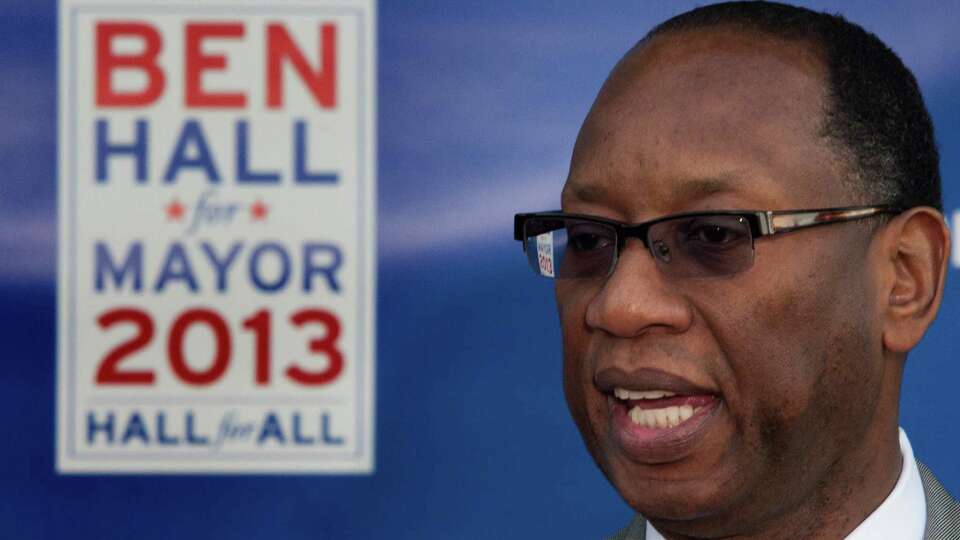
It's been several election cycles since we've seen crime become an election issue in a major Texas city, so it will be interesting to see how Houston mayoral candidate Ben Hall fares with his attacks on incumbent Mayor Annise Parker. He's put out a rather bizarre TV commercial telling voters, "we don't need more police, we need less criminals." To that end, says the 30-second spot, "I'll make their lives miserable -  cleaning the city, cutting weeds, just barely within the bounds of the Constitution," a line Hall delivered with a shit-eating grin. He also advocates expanding use of government surveillance cameras throughout the city because "criminals don't like to be caught." Here's the ad:


Charles Kuffner last month posted this analysis of Hall's "five point crime fighting plan."

I've never met the man, but it seems an open question whether this ad reflects pure, disingenuous demagoguery or mere simple-mindedness. Hall told Mike Morris from the Houston Chronicle (Sept. 10) that he doesn't want crime discussions to focus on the past, which is understandable given Houston's recent record of declining crime:
Data show crime has been falling nationally. In Houston, burglaries reached a recent peak of 29,279 in 2009, and have fallen each year since, with last year's total the lowest since 2003. Despite the increase in murders and robberies from 2011 to 2012, Houston's violent crime rate last year was its lowest since 1985, and last year's murder total of 217 is half what it was 20 years ago.

University of Houston-Downtown criminal justice professor Clete Snell dismissed both Hall and Parker's posturing. The shaky reliability of crime data is well known to researchers, he said.

"To take advantage of a decline in crime politically or to try to use an increase in crime politically, I think, indicates a lack of knowledge about how the statistics are developed," Snell said. "There's just many, many factors that can impact the rise or decline in crime."
So crime has declined during Mayor Parker's tenure, though I'd agree with Prof. Snell that, given the national crime decline and the wide variety of factors at play, one would be hard pressed to give any one local politician credit. Still, in context, it seems hard to justify assigning Mayor Parker blame.

The other suggestions reveal more about Mr. Hall's misunderstanding of the criminal-justice system than they do potential crime solutions. For example, does he fantasize that chain-gang crews cleaning the city or cutting weeds outside the jail won't need to be supervised by additional Sheriff's deputies? Or that the mayor has authority to make county government enact these schemes? Clearly he didn't check with the Sheriff's office about the idea. Morris' article had this to say on the subject:
As for Hall's plan to have inmates work off their sentences instead of sitting in their cells, Parker campaign spokeswoman Sue Davis said city inmates stay an average of 24 hours before being released or transferred to the county lockup, making it impractical to put them to work.

Hall said it is the same taxpayers footing the bill, regardless of the jail. He said he is interested in finding a way to put county or city inmates to work on behalf of the public.

"While we'd always want to work with the city to maximize that resource, there's not a lot of room for expansion," said Alan Bernstein, spokesman for Sheriff Adrian Garcia, who runs the county jail.

All low-level, nonviolent county jail inmates willing and eligible to participate in outside work already do so, Bernstein said. As of Monday, 196 inmates were approved for outside work, performing graffiti abatement, tree planting and beautification along bayous and other public rights of way, Bernstein said. That number is difficult to increase because more inmates - 793, on Monday - are needed inside the jail for chores the county otherwise would have to pay for, he said.
Next, to Hall's suggestion for expanding street-level surveillance tech instead of hiring more cops: Who would monitor all these new surveillance cameras? If it's police, wouldn't you need more cops to staff surveillance stations? And wouldn't that take more cops off the beat? If not police, then who would watch the monitors, who would pay for it, and what would prevent those surveillance resources from being misused? Responding to the ad, a Parker aide told the Chronicle that "there are many cameras downtown already and that a lack of manpower to monitor them makes it a more effective tool for gathering evidence after a crime occurs than in preventing it." Truth is, with limited exceptions, government surveillance cameras don't reduce crime and aren't even all that useful for investigating crime after the fact: After the Boston marathon bombings, one recalls, it wasn't city surveillance that captured the culprits, even though cameras were in place, but security video volunteered from nearby stores and cell-phone pics taken by bystanders. In more workaday settings, cameras can be vandalized or defeated by simple ploys like wearing hats, hoodies, or sunglasses. From a crime-fighting perspective, government surveillance cameras are a cost-benefit nightmare

So most of the ad is just foolish and ill-informed. Who knows if that's because Hall is ignorant about the issues or he (rightly) assumes the voters are. My bet would be the latter but you never can tell. Having worked for dozens of candidates over the years (Grits spent 14 years as a professional opposition researcher for candidates from both parties as well as non-partisan races like the Houston mayoral contest), I've long ago ceased to be surprised how ill-prepared many candidates are when they decide to run for office. It's entirely possible this fellow believes his own bullshit.

What gagged me most, though, was Hall's grinning, wink and a nod attitude toward diminishing constitutional rights. The Mayor takes an oath to uphold the Constitution so it's a bit surreal to see a candidate pledging to do all he can to circumvent it. Imagine his swearing in ceremony:
Judge: Do you pledge to uphold and defend the Constitution of the United States?

Mayor Hall: Just barely.
Grits found Hall's cloying demeanor in the ad, promising laughably inartful policies "just barely within the bounds of the Constitution," not just off putting but offensive. 

We'll find out in November, but I seriously doubt this strategy will succeed for Mr. Hall. A recently released Texas Lyceum poll (Q4) asked voters to list the most important issues facing the country and the number saying "crime and drugs" came in at less than one-half of one percent. The relative lack of concern about crime by voters combined with the ham-handed, unworkable solutions proposed by Mr. Hall to me indicate the challenger hasn't chosen a particularly strong campaign message.

MORE: See Kuff and Texpatriate for analyses of the horse-race polling, which presently favors the incumbent by a significant but (theoretically) not-insurmountable margin.

Thursday, October 03, 2013

Harris Co. public defender achieves much better outcomes than assigned counsel

Tony Fabelo and Carl Reynolds of the Council of State Governments Justice Center have produced a new report analyzing the work product of the Harris County Public Defenders Office, reported the Houston Chronicle yesterday. See a 2-page overview (pdf) and here's the full report (pdf). Summarized the newspaper:
In general, the report found that the public defender's office does more investigation, which leads to better results in court, advocates for the defense bar in community issues and offers free training, mentoring and advice that was not available before.

Those courtroom results include a greater proportion of dismissals, deferred sentences and acquittals. The report also pointed out that the office sees a smaller proportion of "guilty" verdicts than appointed lawyers. Overall, the public defender office secured acquittals at three times the rate of appointed or hired attorneys, according to the report.
The Chron's coverage quoted county GOP Chairman Jared Woodfill criticizing the higher cost per case at the PD compared to assigned counsel, but there are several mitigating factors behind those numbers that weren't fully clarified. First, HCPD enforces caseload caps consistent with American Bar Association guidelines while some assigned counsel far exceed those numbers. Plus, a disproportionate number of HCPD cases involve mentally ill defendants and are typically more complex than the average case. Finally, overhead costs are counted against the PD that are subsumed in judicial budgets for court coordinators, etc., for assigned counsel, making the comparison apples and oranges.

Otherwise, looking through the report, here are a few highlights that jumped out at me:

"[W]ith few exceptions, public defender attorneys delivered better defense results than assigned counsel attorneys."

In Harris County as a whole, "plea bargaining is even more prevalent than elsewhere and sentencing outcomes are more costly for the state, with Harris County overrepresented in prison and state jail commitments and under-represented in probation commitments."

For mentally ill offenders accused of misdemeanors, HCPD's mental health division "achieves significantly higher dismissal rates (38 percent versus 10 percent) and lower conviction rates (70 percent versus 92 percent) compared to assigned counsel."  "Dismissals were five times more likely for HCPD clients than for the match group" of assigned counsel, even though HCPD is assigned "more severe cases" than the typical assigned counsel.

"HCPD's total caseload is set at 5,075 while the total Harris County indigent caseload for FY 2012 was almost 72,000."

On felony cases, "Not only did HCPD clients have fewer findings of guilt than appointed attorneys, the office was far more likely to take its cases to trial than appointed counsel or retained counsel. And once at trial, HCPD clients were more likely to get acquittals for all changes, 22 percent of HCPD clients who were tried were found not guilty and did not face a new trial."

"HCPD and retained counsel are more likely to achieve dismissal of weak cases, where appointed counsel is more likely to plead them down."

"Competent and diligent representation demands more effort than minimal per-case or per-docket payment tends to support. Anecdotal reports suggest that in many court-appointed cases, particularly misdemeanors, counsel reads the offense report and takes a plea offer back to the client. Absent a glaring defect in the state’s case, the attorney recommends, and the client usually accepts, the prosecutor’s offer. Simply calling a witness, or doing some basic legal research, may make the difference between this result and a dismissal, further investigation, or a better plea offer. Small acts of due diligence in defending a case can dramatically change results." (Emphasis in original.)

Among cases processed through the county's "wheel" system, "the top 10 percent of attorneys were assigned over 452 cases annually (with an average of 632 cases and the highest at 952 cases). There were 32 attorneys who received more than 400 cases, 6 of whom received more than 400 in one court." About 45% of assigned cases are handled by attorneys whose caseloads exceed American Bar Association standards. By contrast, HCPD has established caseload caps consistent with ABA standards.

"[T]he public defender office can bring specific, targeted expertise to the table, such as representation of the mentally ill, successful appellate advocacy, advice to the criminal bar on issues such as a conviction's impact on immigration status, as well as the ability to help respond to systemic issues" such as the Jonathan Salvador debacle at the DPS-Houston crime lab.

Harris County pays assigned counsel "considerably less per case than other urban counties in the state," especially for misdemeanors where "the payout per case is about two-thirds of the large county average." Here's a chart depicting rates in Texas' five largest counties.


"Evaluation of assigned counsel is needed," declared the report. While "there has been a marked emphasis on evaluating public defenders, [there has been] very little focus on the workload or performance of the assigned counsel system." Given the preponderance of cases with assigned counsel, their "performance should be subjected to comparable or greater evaluation effort. As stated by Professor Lefstein (see text accompanying footnote 1), 'When adequate oversight of assigned counsel programs is lacking, the lawyers, in an effort to maximize their incomes, sometimes accept too many cases because they are poorly compensated on a per-case basis for their services.'"

"HCPD has presented a total of 63 accredited Continuing Legal Education (CLE) programs since its inception: 7 programs in 2011, 39 programs in 2012 and 17 programs so far in 2013. Total documented attendance at the programs was 1,868 attorneys at no cost to attendees."

Wednesday, October 02, 2013

'Show me your papers, comrade': DPS vehicle checkpoints further degrade Fourth Amendment

The Texas Department of Public Safety is now conducting roadblocks in the Rio Grande Valley in  which they're checking for drivers license and insurance, looking for evidence of DWI, and running warrant checks on drivers, DPS Col. Steve McCraw informed us in a column in the McAllen Monitor (Sept. 30):
This short-term effort was conceived as a response to various criminal activities and unsafe driving behaviors identified in South Texas. For example, in 2010, 2011 and 2012, the Rio Grande Valley’s Cameron, Hidalgo and Willacy counties led the state in the number of citations DPS issued to drivers for “no driver license.” The same area is second only to the Houston area for “no insurance” citations issued by DPS during the same time period. In fact, 15 percent of all DPS-issued “no driver license” citations in the state occurred in the same three counties in the Rio Grande Valley in 2012.

Some uninformed individuals have claimed that these checkpoints are illegal — which is false. A traffic regulatory checkpoint is an authorized law enforcement strategy that has been upheld by the U.S. Supreme Court (City of Indianapolis vs. Edmond, 531 U.S. 32, 2000) and by the Texas Court of Criminal Appeals (Lujan vs. State, 331 S. W. 3d 768, 2011). DPS conducts traffic regulatory checkpoints under its general authority to enforce the laws protecting public safety.

I want to reassure the public that these traffic regulatory checkpoints are used only for the purpose of determining compliance with specific regulatory traffic statutes, including failure to display a driver license, failure to maintain financial responsibility, as well as vehicle safety and registration requirements. As with any other traffic stop, if a violation is found, a citation or warning is issued, and warrant checks are conducted. Troopers also have the authority to address obvious criminal violations; such as, driving while intoxicated.
Whether or not these checkpoints result in immigration detentions, let's not kid ourselves. These are pure "pretext stops." McCraw's first justification given for the checkpoints was a response to "various criminal activity"; the rest are excuses, not reasons. The 2011 Texas case he cites overturned a lower court opinion out of El Paso forbidding the tactic. They upheld the checkpoint even though drug-sniffing dogs were deployed to check every car.

So basically, Texas law enforcement may use license and insurance checks as a fig leaf to justify a tactic that, in my youth, was associated in the public discourse mainly with totalitarian Communist states. Growing up, I can well remember my attorney father associating this practice with Communist Russia ("Show me your papers, comrade," was a running household joke) and proudly contrasting it with the "freedoms" enjoyed in America where, he naively believed, such disgraceful abuses by government would never be allowed.

Even the Texas Court of Criminal Appeals majority in 2011 granted that "A checkpoint to verify drivers' licenses and vehicle registration is permissible, but a checkpoint whose primary purpose is to detect evidence of ordinary criminal wrongdoing is not." But how to distinguish "primary" from secondary purposes? Here, responding to "various criminal activities" was McCraw's first justification, with the license and insurance checks offered up afterward more as an excuse than a reason. But under the CCA holding, they get to do it until some federal court calls them on it.

FWIW, the US Supreme Court case cited by McCraw (City of Indianapolis v. Edmond) actually ruled against, not for, using checkpoints for general crime control purposes. In a concurrence, Justice Clarence Thomas opined, "I rather doubt that the Framers of the Fourth Amendment would have considered 'reasonable' a program of indiscriminate stops of individuals not suspected of wrongdoing." That's certainly my view. Checkpoints are another example where court-created exceptions to the Fourth Amendment in practice have swallowed the rule.

Paging Radley Balko: New Dallas Sheriff vehicle a case study in militarization of US law enforcement

A quarter century ago when the Cold War ended, many politicians (perhaps naively) called for a "peace dividend" where the nation could reduce military spending once the Soviet Union no longer posed a credible threat to invade the rest of Europe.  Now that wars in Iraq and Afghanistan are winding down, it turns out our "peace dividend" this time around may amount to bringing the tools and tactics of military occupiers back to the United States for use against its own citizens. How else can one view the Dallas County Sheriff's acquisition of this monstrosity?


The blogs Unfair Park and Gin and Tacos have already covered the bases on this story, with UP's Eric Nicholson cutting to the chase thusly:
OK. Pretty cool. But let's back up for a moment. There's a very glaring, very fundamental question we haven't yet addressed: Why in holy hell does Dallas County need an armored military vehicle built to withstand a minor apocalypse?

The underlying reason seems to be that military trucks are fucking cool, but no one's actually saying that. The sheriff's office is touting it as a tool that will help them better serve warrants.
Which leads Grits to offer two predictions: Either 1) the vehicle will never be used outside parades because it's ill-suited for police use, probably gets around 3 mpg, and nobody will have the parts nor experience to perform routine maintenance, or 2) within the first dozen times the vehicle is used to serve warrants, DCSO will roll up on the wrong house.

For all that many in law enforcement dislike Radley Balko, or at least his caution against militarization of American policing, there sure are a lot of agencies who appear hell-bent on proving him right.