Now that the new Annual Statistical Report for the Texas judiciary is out, let's take a quick look at data on capital murder cases in Texas from FY 2017. (See p. 111 of the linked pdf from the Office of Court Administration.)
Texas prosecutors filed capital-murder charges in 446 cases last year, and gained capital convictions 249 times, including 162 by plea bargain and 74 by jury trial.*
Almost all of these resulted in LWOP sentences. The OCA reported that prosecutors announced plans to seek the death penalty in only three cases in 2017.
Six defendants were acquitted of capital murder at trial last year. Charges were dismissed in another 84 cases. (That'd be an interesting subset to review - that's a pretty high number.)
There were 897 capital murder cases pending statewide at the end of the year.
By comparison, there were 854 "regular" murder charges filed in 2017, with prosecutors generating 536 convictions. In addition, 31 murder defendants were acquitted at trial, with another 187 having charges dismissed.
One thought from these data: If prosecutors filed capital murder 446 times in 2017 and murder 854 times, then capital charges are not being reserved for the "worst of the worst." Not unless one believes one in three killers deserves that moniker. This overcharging is fueling an unnecessary shortage of capital-qualified trial attorneys statewide. While some have seen that shortage as a reason to reduce qualifications for capital-qualified attorneys, to me the better solution is for prosecutors to rein in this overcharging penchant and only use capital charges in truly exceptional cases.
*Obviously, these aren't all the same cases. Few capital murder cases are resolved within 12 months, and many if not most convictions were from cases filed in previous years. I'm analyzing overall patterns here, not claiming the cases in the "indicted" column are the same as those "convicted" in the same year.
Showing posts with label LWOP. Show all posts
Showing posts with label LWOP. Show all posts
Wednesday, May 02, 2018


Thursday, November 30, 2017
Police unions, the media, and me ... and other stories
Grits fell ill at the end of the holiday weekend, am only now really back on my feet, and find myself in a desperate need to clear my browser tabs. So, y'all get a roundup of all the stuff I don't have time to blog about right now.
Police officers indicted more often, but seldom convicted after shootings
More police officers in Texas are being charged after questionable shootings, but prosecutors who were able to convince grand juries to indict have been less successful at securing convictions at trial, reported Tasha Tsiaperas the Dallas Morning News (who has a really cool, bond-villain-type name!). In related news, Grits contributing writer Eva Ruth Moravec had a feature in the Houston Chronicle about a Freeport police officer acquitted by a Brazoria County jury for shooting his unarmed neighbor in the next apartment. It was as negligent a situation as one could imagine, so maybe civil court is still an option: The cop apparently slept with a loaded gun in his bed (and in this case, his finger on the trigger, safety off) and fired it through his headboard into the next door apartment. Attn: Texas Monthly, this is mandatory Bum Steer material.
Police unions, the media, and me
Most local media coverage of the Austin police contract has been dismissive of the push by the Austin Justice Coalition and their growing list of allies to get the city council to vote "no." This, despite opposition to the contract from hundreds of signators, more than a dozen groups, and even though, in a staunchly Democratic county, D precinct chairs unanimously voted for a resolution urging city council to kill the deal. Currently the vote is scheduled for December 14th. At the Texas Observer, Michael Barajas has a feature explaining more fully "How the expiration of Austin's police union contract could be a rare opportunity for reform." Former CLEAT mugwump and long-time police-union leader Ron DeLord, who was lead negotiator for the Austin Police Association on the contract, complained on Twitter that Barajas didn't talk to him. So I suggested DeLord do a podcast interview to air his views, and he agreed(!). I hope y'all are looking forward to that as much as I am. Mainly I want to talk to him about his books: See Grits' discussion of his latest one, and also the opening segment of our August Reasonably Suspicious podcast discussing his remarkably accurate prediction of Texas' police-pension crisis, which was a contentious legislative imbroglio this year resulting in outcomes with which no one is happy, but which brokered an uneasy, temporary truce among the parties. If the economy holds.
Evaluating police bodycams
Coupla items here: A new study found bodycams reduced use of force episodes at the Las Vegas PD while providing quality evidence that supported criminal convictions mostly of defendants, not cops. But many advocates, your correspondent included, believe the laws limiting transparency around footage reduce the accountability benefits. Supporting that claim, Nick Selby wrote on The Crime Report that, "In October of this year, the biggest-ever randomized study of body cameras showed no measurable reduction in complaints or use of force by officers in Washington, D.C." So the jury's still out on whether this will turn out to be an important accountability measure, as they were originally pitched in the hyped aftermath of the Ferguson protests.
With shortfall looming, a way to reduce DPS crime-lab volume
Plano PD is testing a device that can tell whether DNA exists on a piece of evidence before they send it to the lab instead of after. If this works as advertised, Governor Greg Abbott, his grants division, and DPS crime-lab folk should take heed. It might even be worth the Governor considering emergency grants to buy these for the biggest users of DPS DNA lab services to reduce the volume of cases. A lot of material sent has no DNA on it at all, and to screen that out up front would make a big difference on volume in a biennium when the Legislature told DPS to collect fees for part of their budget and the Governor has stopped them from doing it. That creates a shortfall unless they can find ways to reduce volume. This could be an important one.
Death penalty now mainly an LWOP plea-bargain chip
Texas will perform no more executions this year after the Court of Criminal Appeals issued a stay and halted Juan Castillo's planned trip to the death chamber. But expect life without parole sentences to keep stacking up as Christmas approaches. In 2016, according to the Texas Office of Court Administration, just three new death sentences were secured by Texas prosecutors, compared to 64 LWOP sentences. (A whopping 426 total capital cases were filed statewide last year, which was a ten percent increase from the year before, so many are called, but few are chosen.) These days, the death penalty is mostly a threat to get people to accept life without parole sentences in a plea bargain.
Harris judges sabotaging pretrial release order from feds
Harris County judges are sabotaging the pretrial release system mandated under a federal court order by refusing to release thousands of defendants who qualify, according to a report by the Texas Tribune (which doesn't use such strong language but supplies all the relevant details). Instead, the Sheriff has to release them outside of the purview of the Pretrial Services system, where they predictably have higher no-show rates. (One of the most important things pretrial services does to get them there are reminder calls and texts.) The key problem:
Defendants who are ordered for no-cost release by a judge or magistrate are entered into the county’s Pretrial Services department, which works to ensure those out on personal bonds know the date of their next court appearance and can provide additional conditions like drug testing, mental health services or GPS ankle bracelets. Those released by the sheriff aren’t monitored once they leave the jail.On judges as gatekeepers, redux
Here's a law review article by Stephanie Damon-Moore on a question Grits has thought about a lot: "why trial judges, who have an independent obligation to screen expert testimony presented in their courts, would routinely admit evidence devoid of scientific integrity."
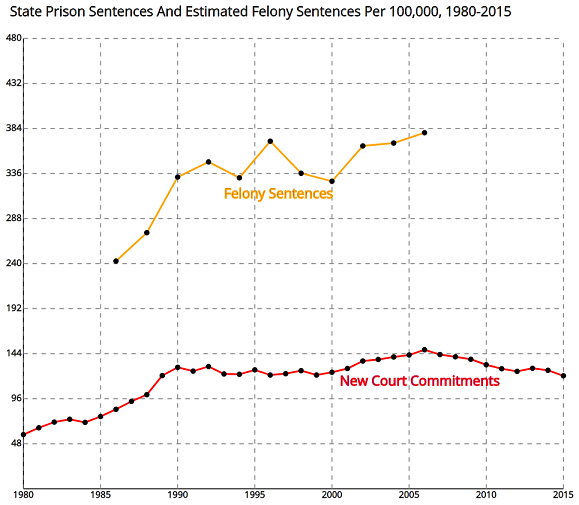
We've established that the War on Drugs contributed more to mass incarceration than critics like John Pfaff have claimed. But now the statistician who best proved that has come out with a new analysis demonstrating even deeper, more insidious aspects to the drug war's role. Compared to new prison sentences, which themselves skyrocketed, the number of total felony sentences (including probation, deferred adjudication, etc.) went up even faster! See here, and check out the whole analysis:
Wednesday, December 07, 2016
Roundup: Jean Valjean at Christmastime and other stories
Here are a few odds and ends which haven't made it into individual Grits posts during a busy week but which merit readers' attention:
Draconian enhancements based on decades-old offenses
 Thanks to "enhancements" based on felonies committed two decades ago, a Hays County man received a six-year sentence for stealing $45 worth of ground beef and toys for his children from a Walmart just before Christmas last year. The kicker: Texas Supreme Court Justice Jeff Brown was foreman of the jury who convicted this latter-day Jean Valjean. Les Miserables similes aside, there needs to be some statute of limitations on how long old convictions can be used to enhance new misdemeanors into lengthy prison sentences. Nothing about what this guy did 20 years ago predicts that he's a danger today; in fact, the nature of this latest trumped-up "felony" indicates his priorities have shifted. The fellow committed what otherwise would have been a Class C misdemeanor theft so he could give his kids a modest Christmas, and "To love another person is to see the face of God."
Judges call for independent crime lab
Travis County judges are calling on the city to separate its crime lab from the Austin Police Department, a move presaged by recommendations from the National Academy of Sciences in its landmark 2009 report. Grits agrees with that assessment, with one caveat: They should make the lab truly independent, as was done in Houston. What they shouldn't do is shift those functions to the county medical examiner, as some have suggested. Let's please do this right the first time. In related news, Sen. Cornyn is pushing legislation to reauthorize federal funding for crime labs and reducing rape kit backlogs.
Contempt of cop: A case study
This article from Meagan Flynn at the Houston Press depicts a class example of an arrest for "contempt of cop" by a Harris County Sheriff's deputy.
Can bureaucracy prevent jail suicides?
Despite this Texas Tribune story, Grits suspects that far too much credit is being given to a new intake form when it comes to reducing jail suicides. We'll have to see if reductions hold long-term. But it's just as likely that jails stepped up prevention efforts because the Commission on Jail Standards began making suicides a greater point of emphasis and Sheriffs didn't want to end up in the paper with the next Sandra-Blandesque death occurring in their facility. If that's the case, suicides will continue to fluctuate and may go back up as new incidents arise. I hope I'm wrong, but it seems hard to believe such a small bureaucratic change could make a huge dent in a problem rooted deep in the human psyche. My instincts say to look for a) alternative explanations and b) future increases.
Veterans courts are cool, but don't scale up
This Houston Chronicle article touts veterans courts as an intervention that works, and they do, but it's also true that they're resource intensive and don't scale up well given the volume and gaping needs of the target population. Reported the Chron, quoting the judge in charge of the project: "The common denominator of the veterans in his court is a 'very low sense of self-esteem and self-purpose,' along with self-hate." But couldn't you say that about defendants in every criminal courtroom in America? Strong probation methods work, but they require more resources than most county governments are willing to provide, and you can't place it all on the backs of defendants through expensive court fees. These courts are important experiments, but they are not yet scale-able solutions and are unavailable to most veterans who commit crimes.
Asset seizures skyrocketed since turn of century
Total assets seized by Texas law enforcement increased more than 150 percent from 2001 to 2013, according to Right on Crime. At this point, agencies have become reliant on the income in unhealthy and problematic ways. If the interdiction strategy were working, one wonders, wouldn't authorities seize LESS illicit assets over time?
LWOP for illegal immigrants makes no cost-benefit sense
Here's a legislative proposal that would cost a small fortune with little public safety benefit to show for it: Authorizing life without parole for first-degree felonies committed by illegal immigrants. Life without parole didn't exist in Texas until 2005, when death penalty abolitionists made a deal with the devil, creating the new punishment as the sole alternative available to their clients in death-penalty cases. IMO that legislation threw their clients under the bus. Since then, we've seen hundreds of people sentenced to LWOP while death sentnences dropped. But LWOP is also a death sentence, just in slow motion. Next we had people wanting LWOP for sex offenders, then for sex traffickers, and not for illegal immigrants. There's no public safety argument for this policy and the cost-benefit analysis cannot stand up to scrutiny. This is just pandering to nativist sentiments in a crass and ham-handed way. One hopes cooler, wiser, and more cost-conscious heads will prevail as the bill is considered at the Lege.
1033 program: Not as free as 'free' sounds
Lots of Texas agencies got "free" personnel carriers through the Pentagon's 1033 program, but the Texas Public Policy Foundation points out that that statement masks significant costs to locals from operating the vehicles.

CAN-DO Clemency
Grits was interested to learn of the CAN-DO Foundation, which stands for Clemency for All Nonviolent Drug Offenders. As folks push Obama to maximize his use of clemency on his way out the door, it's worth mentioning there's still time for him to posthumously pardon the writer O. Henry, as this blog along with Pete Ruckman has long advocated.
Locked up for the holidays
In an item titled, "Locked up for the holidays," the Pew Charitable Trusts' Stateline site examined the impact of the holiday season on inmates and their families and charity work aimed at supporting both.
Thanks to "enhancements" based on felonies committed two decades ago, a Hays County man received a six-year sentence for stealing $45 worth of ground beef and toys for his children from a Walmart just before Christmas last year. The kicker: Texas Supreme Court Justice Jeff Brown was foreman of the jury who convicted this latter-day Jean Valjean. Les Miserables similes aside, there needs to be some statute of limitations on how long old convictions can be used to enhance new misdemeanors into lengthy prison sentences. Nothing about what this guy did 20 years ago predicts that he's a danger today; in fact, the nature of this latest trumped-up "felony" indicates his priorities have shifted. The fellow committed what otherwise would have been a Class C misdemeanor theft so he could give his kids a modest Christmas, and "To love another person is to see the face of God."Judges call for independent crime lab
Travis County judges are calling on the city to separate its crime lab from the Austin Police Department, a move presaged by recommendations from the National Academy of Sciences in its landmark 2009 report. Grits agrees with that assessment, with one caveat: They should make the lab truly independent, as was done in Houston. What they shouldn't do is shift those functions to the county medical examiner, as some have suggested. Let's please do this right the first time. In related news, Sen. Cornyn is pushing legislation to reauthorize federal funding for crime labs and reducing rape kit backlogs.
Contempt of cop: A case study
This article from Meagan Flynn at the Houston Press depicts a class example of an arrest for "contempt of cop" by a Harris County Sheriff's deputy.
Can bureaucracy prevent jail suicides?
Despite this Texas Tribune story, Grits suspects that far too much credit is being given to a new intake form when it comes to reducing jail suicides. We'll have to see if reductions hold long-term. But it's just as likely that jails stepped up prevention efforts because the Commission on Jail Standards began making suicides a greater point of emphasis and Sheriffs didn't want to end up in the paper with the next Sandra-Blandesque death occurring in their facility. If that's the case, suicides will continue to fluctuate and may go back up as new incidents arise. I hope I'm wrong, but it seems hard to believe such a small bureaucratic change could make a huge dent in a problem rooted deep in the human psyche. My instincts say to look for a) alternative explanations and b) future increases.
Veterans courts are cool, but don't scale up
This Houston Chronicle article touts veterans courts as an intervention that works, and they do, but it's also true that they're resource intensive and don't scale up well given the volume and gaping needs of the target population. Reported the Chron, quoting the judge in charge of the project: "The common denominator of the veterans in his court is a 'very low sense of self-esteem and self-purpose,' along with self-hate." But couldn't you say that about defendants in every criminal courtroom in America? Strong probation methods work, but they require more resources than most county governments are willing to provide, and you can't place it all on the backs of defendants through expensive court fees. These courts are important experiments, but they are not yet scale-able solutions and are unavailable to most veterans who commit crimes.
Asset seizures skyrocketed since turn of century
Total assets seized by Texas law enforcement increased more than 150 percent from 2001 to 2013, according to Right on Crime. At this point, agencies have become reliant on the income in unhealthy and problematic ways. If the interdiction strategy were working, one wonders, wouldn't authorities seize LESS illicit assets over time?
LWOP for illegal immigrants makes no cost-benefit sense
Here's a legislative proposal that would cost a small fortune with little public safety benefit to show for it: Authorizing life without parole for first-degree felonies committed by illegal immigrants. Life without parole didn't exist in Texas until 2005, when death penalty abolitionists made a deal with the devil, creating the new punishment as the sole alternative available to their clients in death-penalty cases. IMO that legislation threw their clients under the bus. Since then, we've seen hundreds of people sentenced to LWOP while death sentnences dropped. But LWOP is also a death sentence, just in slow motion. Next we had people wanting LWOP for sex offenders, then for sex traffickers, and not for illegal immigrants. There's no public safety argument for this policy and the cost-benefit analysis cannot stand up to scrutiny. This is just pandering to nativist sentiments in a crass and ham-handed way. One hopes cooler, wiser, and more cost-conscious heads will prevail as the bill is considered at the Lege.
1033 program: Not as free as 'free' sounds
Lots of Texas agencies got "free" personnel carriers through the Pentagon's 1033 program, but the Texas Public Policy Foundation points out that that statement masks significant costs to locals from operating the vehicles.
CAN-DO Clemency
Grits was interested to learn of the CAN-DO Foundation, which stands for Clemency for All Nonviolent Drug Offenders. As folks push Obama to maximize his use of clemency on his way out the door, it's worth mentioning there's still time for him to posthumously pardon the writer O. Henry, as this blog along with Pete Ruckman has long advocated.
Locked up for the holidays
In an item titled, "Locked up for the holidays," the Pew Charitable Trusts' Stateline site examined the impact of the holiday season on inmates and their families and charity work aimed at supporting both.
Sunday, February 10, 2013
Texas high court to consider whether SCOTUS' Miller ruling on juvie LWOP is retroactive
The Texas Court of Criminal Appeals this week agreed to hear arguments in Ex Parte Terrell to determine whether the Supreme Court's Miller v. Alabama - a case which banned life without parole (LWOP) sentences for juveniles if lesser options weren't offered - applies retroactively in Texas. As I understand it, there were around 28 Texas prisoners convicted of capital murder at age 17 between 2005, when LWOP was made a sentencing option for adults, and 2009 when the Legislature eliminated life without parole for juveniles 16 and under. Currently, juveniles sentenced to capital life are eligible for parole after 40 years.
For 17-year olds, though, who are tried as adults, there is presently no legal sentence available under Texas law. A 2005 statute made the death penalty and LWOP the only available sentences for adults convicted of capital murder, and for purposes of trying to kill them or incarcerate them for life, at least, Texas treats 17 year olds as adults. Or it did until the Supreme Court said that, for the most extreme sentencing purposes, they belonged in the juvenile category. The SCOTUS ruling prompted state courts, now including Texas, to reconsider their old juvie LWOP sentences, and the results have been all over the map. In Texas, this will be a case of first impression.
Grits may try to carve out time to go hear oral arguments on this one, depending on when they are. I'm interested to hear how they handle this condundrum where Texas law and SCOTUS rulings have combined to leave no legal sentence available on the books for 17-year old capital murderers.
As noted before, state Sen. Joan Huffman has filed legislation to address this question in a way that maximizes the most punitive sentencing options. SB 187 would make the only two sentencing options for juveniles convicted of capital murder "life" or "life without parole." That gives prosecutors an incredible plea bargaining hammer, just as the Lege did in 2005 by making LWOP the only alternative to a death sentence in capital cases. But prosecutors already have plenty of leverage to secure convictions. While I agree the law must change, Huffman's suggested fix needlessly expands the already growing and increasingly expensive bubble of prisoners serving life and LWOP sentences at TDCJ, part of a trend of the Calfornication of Texas prison sentences.
Make me philosopher king and I'd just eliminate capital charges for both 17-year olds and juveniles charged as adults and see them all charged under regular murder statutes. Juries could still authorize a life sentence and decades down the line the parole board could assess their dangerousness. But eliminating the LWOP option would avoid the state having to revisit the statute again and again as SCOTUS fills out its Eighth Amendment jurisprudence on these questions. When SCOTUS eliminated all the available punishments for juveniles under Texas' capital statute, it should have made legislators reconsider these harsher-than-thou approaches. Life without parole for juveniles is inappropriately harsh and the cost-benefit analysis of lifetime incarceration beginning at 15, 16, or 17 makes no sense.
See related Grits posts:
See also a lengthy thread re: Miller v. Alabama on the Texas prosecutors' message board, and extensive coverage from Sentencing Law and Policy regarding litigation and legislation from other states related to Miller's retroactivity:
For 17-year olds, though, who are tried as adults, there is presently no legal sentence available under Texas law. A 2005 statute made the death penalty and LWOP the only available sentences for adults convicted of capital murder, and for purposes of trying to kill them or incarcerate them for life, at least, Texas treats 17 year olds as adults. Or it did until the Supreme Court said that, for the most extreme sentencing purposes, they belonged in the juvenile category. The SCOTUS ruling prompted state courts, now including Texas, to reconsider their old juvie LWOP sentences, and the results have been all over the map. In Texas, this will be a case of first impression.
Grits may try to carve out time to go hear oral arguments on this one, depending on when they are. I'm interested to hear how they handle this condundrum where Texas law and SCOTUS rulings have combined to leave no legal sentence available on the books for 17-year old capital murderers.
As noted before, state Sen. Joan Huffman has filed legislation to address this question in a way that maximizes the most punitive sentencing options. SB 187 would make the only two sentencing options for juveniles convicted of capital murder "life" or "life without parole." That gives prosecutors an incredible plea bargaining hammer, just as the Lege did in 2005 by making LWOP the only alternative to a death sentence in capital cases. But prosecutors already have plenty of leverage to secure convictions. While I agree the law must change, Huffman's suggested fix needlessly expands the already growing and increasingly expensive bubble of prisoners serving life and LWOP sentences at TDCJ, part of a trend of the Calfornication of Texas prison sentences.
Make me philosopher king and I'd just eliminate capital charges for both 17-year olds and juveniles charged as adults and see them all charged under regular murder statutes. Juries could still authorize a life sentence and decades down the line the parole board could assess their dangerousness. But eliminating the LWOP option would avoid the state having to revisit the statute again and again as SCOTUS fills out its Eighth Amendment jurisprudence on these questions. When SCOTUS eliminated all the available punishments for juveniles under Texas' capital statute, it should have made legislators reconsider these harsher-than-thou approaches. Life without parole for juveniles is inappropriately harsh and the cost-benefit analysis of lifetime incarceration beginning at 15, 16, or 17 makes no sense.
See related Grits posts:
- 17-year old capital defendant in legal limbo following SCOTUS rulings
- Adjusting juvenile law in light of SCOTUS rulings, scientific advancements
- SCOTUS ruling leaves 17 year old capital murderers in sentencing limbo
- Issue-spotting the mess sure to follow Miller's narrow (procedural?) ruling
- Basic mandatory juve LWOP head-count in light of Miller
- Data and resources to gear up for the coming Miller meshugas
- Pennsylvania Supreme Court hearing arguments on (first?) major Miller retroactivity cases
- Intermediate Florida appeals court decides Miller is not to apply retoractively
- Without fanfare, Louisiana Supreme Court gives retroactive effect to Miller via brief order
- Michigan appeals court decides Miller is not retroactive to final juve murder cases
- Reviewing at least some of the Miller meshugas in some states
- Does Miller also render presumptive juvie LWOP sentencing unconstitutional?
- Two distinct Illinois appellate panels find Miller retroactive on two separate groungs
- Intriguing Massachusetts development in response to SCOTUS Miller ruling
- 'Sentenced to confusion: Miller v. Alabama and the coming wave of Eighth Amendment cases'
Thursday, January 24, 2013
17-year old capital defendant in legal limbo following SCOTUS rulings
Readers may recall that a US Supreme Court decision last year banned life without parole for juveniles where juries do not have the option to impose other, lesser punishments, a decision which left sentencing in Texas in limbo for 17-year olds charged with capital crimes. As Grits earlier described the situation, "Texas had already eliminated both the death penalty and life without parole for juveniles by the time Miller v. Alabama
(pdf) was decided [in 2012], but in Texas offenders are charged
as adults once they're 17 years old. The US Supreme Court, though, has
now forbade both death penalty and mandatory life-without-parole sentences for
defendants under 18 years old. So for someone charged with a capital
offense at 17, there are presently no legal punishments available for
capital murder under Texas law."
An example of this scenario is playing out in Weatherford, Texas, where a judge has refused to rule whether a 17-year old capital murder defendant can be tried on charges for which there exist no punishments on the books that the Supreme Court considers constitutional. From the Weatherford Democrat ("Judge declines to rule on punishment question," Jan. 24):
The Supreme Court's ruling in Miller v. Alabama was unambiguous: The high court insisted "that sentencing authorities consider the characteristics of a defendant and the details of his offense," giving an option for a lesser sentence if the facts so warrant. The Miller court explicitly held that, "Life without parole 'forswears altogether the rehabilitative ideal' (citation omitted). It reflects 'an irrevocable judgment about [an offender’s] value and place in society,' at odds with a child’s capacity for change." One wonders, though, couldn't the same be said for a mandatory 40-year sentence? Grits recently mentioned a non-capital murder case where an adult defendant was sentenced to 20 years, so clearly for some killers, individual circumstances do matter at sentencing.
(As an aside, at least one legal commentator has speculated that SCOTUS' line of reasoning in Miller could result in further restrictions on mandatory minimum sentences in the future, especially where "a mandatory minimum sentence extends the term of the sentence beyond the life expectancy of the offender," or in "cases where consecutive sentences extend the term of the sentence beyond the life expectancy of the offender.")
Make me philosopher-king and I'd change Texas' capital statutes to provide both greater consistency and more sentencing options for juries. In general, recent jurisprudence from SCOTUS strongly implies that our capital statutes are more likely to be deemed constitutional when juries doing the sentencing have wider leeway to choose among punishments. That's why IMO there should be three sentencing options for adults charged with capital murder, not two: Life with the possibility of parole (as was the case prior to 2005), life without parole, and death. Limiting the option only to the latter two is what caused the conundrum Huffman's current bill seeks to fix. If they'd retained the third option back in 2005, there'd be no dilemma for the judge in the Weatherford case, nor any need for her bill.
An example of this scenario is playing out in Weatherford, Texas, where a judge has refused to rule whether a 17-year old capital murder defendant can be tried on charges for which there exist no punishments on the books that the Supreme Court considers constitutional. From the Weatherford Democrat ("Judge declines to rule on punishment question," Jan. 24):
Texas law currently provides two penalties for capital murder - death or life imprisonment without parole.Notably, state Sen. Joan Huffman has filed SB 187, ostensibly to clarify the law. Under Huffman's bill, "a sentence of life imprisonment is mandatory on conviction of the capital felony, if the individual committed the offense when younger than 18 years of age." In that scenario, a 17-year old convicted of capital murder theoretically could be paroled after 40 years, as is now the case for younger defendants, while at 18 they would be sentenced to either death or life without parole. (Even if Huffman's bill passes, cases charged before the law changes would not be affected.)
Because of a 2005 U.S. Supreme Court ruling that the death penalty for those under 18 years old at the time of the offense is unconstitutional and a 2012 U.S. Supreme Court ruling that a sentence of life without the possibility of parole for a defendant under the age of 18 at the time of the offense is unconstitutional, Moore argued that the state could not pursue a charge under which there is no lawful sentence.
The Supreme Court's ruling in Miller v. Alabama was unambiguous: The high court insisted "that sentencing authorities consider the characteristics of a defendant and the details of his offense," giving an option for a lesser sentence if the facts so warrant. The Miller court explicitly held that, "Life without parole 'forswears altogether the rehabilitative ideal' (citation omitted). It reflects 'an irrevocable judgment about [an offender’s] value and place in society,' at odds with a child’s capacity for change." One wonders, though, couldn't the same be said for a mandatory 40-year sentence? Grits recently mentioned a non-capital murder case where an adult defendant was sentenced to 20 years, so clearly for some killers, individual circumstances do matter at sentencing.
(As an aside, at least one legal commentator has speculated that SCOTUS' line of reasoning in Miller could result in further restrictions on mandatory minimum sentences in the future, especially where "a mandatory minimum sentence extends the term of the sentence beyond the life expectancy of the offender," or in "cases where consecutive sentences extend the term of the sentence beyond the life expectancy of the offender.")
Make me philosopher-king and I'd change Texas' capital statutes to provide both greater consistency and more sentencing options for juries. In general, recent jurisprudence from SCOTUS strongly implies that our capital statutes are more likely to be deemed constitutional when juries doing the sentencing have wider leeway to choose among punishments. That's why IMO there should be three sentencing options for adults charged with capital murder, not two: Life with the possibility of parole (as was the case prior to 2005), life without parole, and death. Limiting the option only to the latter two is what caused the conundrum Huffman's current bill seeks to fix. If they'd retained the third option back in 2005, there'd be no dilemma for the judge in the Weatherford case, nor any need for her bill.
Thursday, September 27, 2012
Adjusting juvenile law in light of SCOTUS rulings, scientific advancements
An item from the Juvenile Justice Information Exchange titled "Juvenile offenders in limbo under outdated state laws" describes a situation which, though our state is not mentioned, impacts 17 year olds in Texas sentenced after 2005 for capital murder, as well as those with pending capital murder charges. The story opens, "More than two years after U.S. Supreme Court decisions started throwing
out mandatory death and life sentences for minors, judges in Washington,
Illinois and dozens of other states still lack guidance on what to do
with juveniles past and present convicted of murder and some other
serious felonies."
Texas had already eliminated both the death penalty and life without parole for juveniles by the time Miller v. Alabama (pdf) was decided earlier this year, but in Texas offenders are charged as adults once they're 17 years old. The US Supreme Court, though, has now forbade both death penalty and life without parole sentences for defendants under 18 years old. So for someone charged with a capital offense at 17, there are presently no legal punishments available for capital murder under Texas law. In practice that shouldn't be a terrific dilemma for prosecutors. Seventeen-year-old defendants can still be charged and sentenced under regular murder statutes, and since both death sentences and LWOP are no longer options, there really isn't a substantive difference in the likely result. But Grits still expects the Legislature to take up the question next year to close the gap created in capital sentencing by the different definitions of "juvenile" under Texas and federal law.
Of course, that also raises a larger question the Legislature probably won't address next year, at least not comprehensively: Should 17 year olds be tried as adults in the first place? They have none of the rights of grown ups - can't vote, can't drink, etc. - but are held responsible as adults when they break Texas law. The issue is made more poignant by recent advances in neuroscience that have demonstrated how, as the ABA Journal put it not long ago, that:
MORE: See a fairly lengthy discussion string from the Texas District and County Attorneys Association on the implications of Miller v. Alabama for Texas.
Texas had already eliminated both the death penalty and life without parole for juveniles by the time Miller v. Alabama (pdf) was decided earlier this year, but in Texas offenders are charged as adults once they're 17 years old. The US Supreme Court, though, has now forbade both death penalty and life without parole sentences for defendants under 18 years old. So for someone charged with a capital offense at 17, there are presently no legal punishments available for capital murder under Texas law. In practice that shouldn't be a terrific dilemma for prosecutors. Seventeen-year-old defendants can still be charged and sentenced under regular murder statutes, and since both death sentences and LWOP are no longer options, there really isn't a substantive difference in the likely result. But Grits still expects the Legislature to take up the question next year to close the gap created in capital sentencing by the different definitions of "juvenile" under Texas and federal law.
Of course, that also raises a larger question the Legislature probably won't address next year, at least not comprehensively: Should 17 year olds be tried as adults in the first place? They have none of the rights of grown ups - can't vote, can't drink, etc. - but are held responsible as adults when they break Texas law. The issue is made more poignant by recent advances in neuroscience that have demonstrated how, as the ABA Journal put it not long ago, that:
While an individual’s cognitive abilities (thinking, reasoning) reach adult levels around the age of 16, studies show that psychosocial capabilities (impulse control, judgment, future orientation and resistance to peer pressure) continue to develop well into early adulthood.
Which answers the question so many parents have undoubtedly asked their teenage sons and daughters: How could somebody so smart do something so dumb?
Laurence Steinberg, a Temple University psychology professor who has been studying adolescent brain and behavioral development for 35 years, likens the teenage brain to a car with a powerful gas pedal and weak brakes. While the gas pedal responsible for things like emotional arousal and susceptibility to peer pressure is fully developed, the brakes that permit long-term thinking and resistance to peer pressure need work.
Steinberg says the latest research in developmental psychology confirms and strengthens the conclusion that juveniles as a group differ from adults in the salient ways the court identified in Roper [the SCOTUS case eliminating the death penalty for juveniles]. And emerging research in the field of neuroscience, not even mentioned in Roper, is helping to explain this biologically.
Such research shows, for instance, that adolescents exhibit more neural activity than adults or children in areas of the brain that promote risky and reward-based behavior. It also shows that the brain continues to mature well beyond adolescence in areas responsible for controlling thoughts, actions and emotions.At the Texas Tribune festival last weekend, state Rep. Paul Workman (R-Austin), who sits on the Corrections Committee, suggested the Texas Department of Criminal Justice should designate separate units for 17-23 year olds - facilities he referred to as a "middle campuses" - both for their own protection and as an acknowledgement of this growing body of scientific research on brain development. That suggestion makes even more sense after the Lege directed in 2007 that 19-20 year olds sentenced as juveniles be moved from youth prisons to TDCJ. Though the "middle campus" prospect wasn't discussed in much detail, Workman indicated such facilities could offer special programming unavailable in the regular adult system. I thought it was a fascinating and meritorious idea regarding a subject that's only beginning to gain traction as scientific developments begin to trickle down to influence court rulings and policy debates.
MORE: See a fairly lengthy discussion string from the Texas District and County Attorneys Association on the implications of Miller v. Alabama for Texas.
Monday, June 25, 2012
SCOTUS ruling leaves 17 year old capital murderers in sentencing limbo
The US Supreme Court today ruled that life without parole for juveniles is unconstitutional when the sentence is mandatory. (See initial coverage from SCOTUSBlog and from Sentencing Law & Policy here, here, here, and here.) At first blush, Grits thought the case might not affect Texas since we abolished life without parole (LWOP) for juveniles in 2009. But at the Texas District and County Attorneys User Forum, Shannon Edmonds raised a valid point: "since current Texas law eliminates death for 17-year-olds, leaving
LWOP as the only option, isn't it 'mandatory' under current law?"
The issue arises because the age of majority in Texas is 17, whereas the feds consider youth juveniles until they're 18. Edmonds suggested that as a result of today's ruling, "the Legislature will have to pass a life-with-parole carve-out for 17yo killers, as they previously did for capital murderers under 17yo back in 2009." A prosecutor from Hidalgo County concurred with Edmonds, but wondered what happens between now and then:
There's one other possible impact of today's ruling in Texas: After the state made life without parole the only alternative to the death penalty for capital murderers in 2005, a handful of juveniles were given that sentence after being tried as adults, a situation that ended when the Lege in 2009 made juvenile capital murderers parole eligible after 40 years. So the question arises, will those juveniles be eligible for re-sentencing, or will this be treated as a procedural change that is not retroactive? States around the country will face the same question in the coming weeks and months, some on a much larger scale than Texas, which has just a few such cases.
MORE (6/26): An editorial in the Austin Statesman gave these additional details about Texas juveniles sentenced to LWOP between 2005 and 2009:
The issue arises because the age of majority in Texas is 17, whereas the feds consider youth juveniles until they're 18. Edmonds suggested that as a result of today's ruling, "the Legislature will have to pass a life-with-parole carve-out for 17yo killers, as they previously did for capital murderers under 17yo back in 2009." A prosecutor from Hidalgo County concurred with Edmonds, but wondered what happens between now and then:
It appears that we now have a capital murder offense for which both punishments under the Penal Code, a death sentence and LWOP, have now been held unconstitutional when the defendant was 17 or younger at the time of offense commission. I don't think that it is possible to impose some other sentence for capital murder that is not authorized under the Penal Code. So my question becomes what are our options until the Legislature meets in January? Are we left with proceeding on a murder charge and trying to obtain a lengthy sentence as our only option at this point?Good question. I'm not a lawyer, but offhand it strikes me as correct that there are presently no constitutional sentences on the books in Texas for a 17-year old convicted of capital murder. They're not eligible for the juvenile max sentence (which makes them parole eligible after 40 years), and both the death penalty and life without parole have been taken off the table by the US Supreme Court. That leaves the only apparent option seeking a "life" sentence for "regular" murder, which in Texas makes one eligible for parole after 30 years. For the time being, at least until the Legislature meets again, that must suffice as justice.
There's one other possible impact of today's ruling in Texas: After the state made life without parole the only alternative to the death penalty for capital murderers in 2005, a handful of juveniles were given that sentence after being tried as adults, a situation that ended when the Lege in 2009 made juvenile capital murderers parole eligible after 40 years. So the question arises, will those juveniles be eligible for re-sentencing, or will this be treated as a procedural change that is not retroactive? States around the country will face the same question in the coming weeks and months, some on a much larger scale than Texas, which has just a few such cases.
MORE (6/26): An editorial in the Austin Statesman gave these additional details about Texas juveniles sentenced to LWOP between 2005 and 2009:
Thus, 27 juveniles who were convicted of capital murder as adults between 2005, when the U.S. Supreme Court banned the death penalty for juveniles, and the passage of the new 2009 law are sitting in prison without any chance for parole. Monday's ruling should lead to new punishment hearings for these individuals. ...AND MORE: The Texas Tribune speculates whether the Governor may commute sentences for the 27 Texas inmates sentenced to LWOP as juveniles:
In Texas, 10 inmates were younger than 16 at the time they committed their crimes.
After the Supreme Court in 2005 decided that the death penalty for juveniles was unconstitutional, Gov. Rick Perrycommuted the sentences for 28 17-year-olds on death row. All 28 were given life sentences with the possibility of parole in 40 years.
After Monday's ruling, the state is still determining what action to take. “The Governor’s Office is working with the Attorney General, the Board of Pardons and Paroles, prosecutors and the Texas Department of Criminal Justice to determine how many individuals may be affected by this ruling and what the appropriate steps will be for Texas going forward,” Josh Havens, a spokesman for the governor’s office, said in a statement.
Jason Clark of the Texas Department of Criminal Justice said his office began preparing soon after the court’s announcement, and identified the 27 convicts in anticipation of any requests from the attorney general or governor’s offices.
Saturday, December 17, 2011
LWOP created boomlet in TX capital cases along with death penalty decline
Several disparate, recent stories combine to paint an unlikely picture of capital murder sentencing in Texas. Since the state introduced the option of a life-without-parole (LWOP) sentence for capital murder in 2005 - simultaneously eliminating the possibility of parole for capital crimes - the number of capital cases filed has escalated, reports the Odessa American, while the number of new death sentences has plummeted (from 48 in Texas in 1999 to 8 this year). Meanwhile, of course, murder rates have continued to decline over the same period.
What does it all mean? For starters, that the increase in capital cases does not result from more heinous murders (there are actually fewer) but from changing prosecutorial charging decisions. Prosecutors are pursuing capital cases more often where they previously would have sought plain old murder charges because it provides a bigger stick to threaten defendants with (i.e., death) during the plea bargaining process. Even though more capital cases are getting charged, however, most prosecutors who're driven by pragmatic as opposed to political motives prefer not to pursue the death penalty, which can be so costly that smaller counties sometimes have had to raise taxes or issue bonds to pay for a single case. So we get this boomlet of "capital" cases, but nearly all of them result in LWOP instead of death sentences.
It's also pretty clear that - with murder rates declining in Texas while both the frequency of executions and new death sentences also declined - it'd be impossible to attribute the murder reduction to any supposed deterrence effect from capital punishment. If there's any correlation at all (notice I didn't say causation), the murder rate declined more or less in tandem with the declining use of the death penalty in Texas, and was much higher back in the '90s when it was exercised more frequently.
Other than that, it's hard to know what conclusions to draw from such counter-intuitive data except that prosecutorial discretion matters a lot more in what sentences defendants end up with than is frequently considered by those writing the laws. I'm not sure the LWOP bill would have passed if the Lege had known the result would be a much larger number of capital murder charges filed. Perhaps, but it certainly wasn't part of the terms of debate at the time.
RELATED: Rise of LWOP sentences contributes to Californication of Texas justice
What does it all mean? For starters, that the increase in capital cases does not result from more heinous murders (there are actually fewer) but from changing prosecutorial charging decisions. Prosecutors are pursuing capital cases more often where they previously would have sought plain old murder charges because it provides a bigger stick to threaten defendants with (i.e., death) during the plea bargaining process. Even though more capital cases are getting charged, however, most prosecutors who're driven by pragmatic as opposed to political motives prefer not to pursue the death penalty, which can be so costly that smaller counties sometimes have had to raise taxes or issue bonds to pay for a single case. So we get this boomlet of "capital" cases, but nearly all of them result in LWOP instead of death sentences.
It's also pretty clear that - with murder rates declining in Texas while both the frequency of executions and new death sentences also declined - it'd be impossible to attribute the murder reduction to any supposed deterrence effect from capital punishment. If there's any correlation at all (notice I didn't say causation), the murder rate declined more or less in tandem with the declining use of the death penalty in Texas, and was much higher back in the '90s when it was exercised more frequently.
Other than that, it's hard to know what conclusions to draw from such counter-intuitive data except that prosecutorial discretion matters a lot more in what sentences defendants end up with than is frequently considered by those writing the laws. I'm not sure the LWOP bill would have passed if the Lege had known the result would be a much larger number of capital murder charges filed. Perhaps, but it certainly wasn't part of the terms of debate at the time.
RELATED: Rise of LWOP sentences contributes to Californication of Texas justice
Thursday, December 01, 2011
Rise of LWOP sentences contributes to Californication of Texas justice
Regular readers will recall Grits has oft lamented the Legislature's unwise choice - abetted by prosecutors and death-penalty abolitionists back in 2005 - to add life-without-parole (LWOP) as a sentencing choice for capital murder but to simultaneously eliminate the option for juries to select life with parole (after 35-40 years, if memory serves).
I didn't like it for several reasons, not the least of which is needlessly filling up the prisons with old people that my granddaughter then must pay for. Anyway, LWOP gives too much power to prosecutors in their charging decisions (accept a plea or die) while making us little safer. And LWOP may encourage inmate misbehavior inside the prison by giving people nothing to lose. (A prison-guard commenter at TexasJustice.org noted that all five prisoners in the escape attempt at the Polunsky unit last year, including the three who were shot, were LWOP capital defendants.) Not to mention the growing costs of healthcare for the elderly in prison are so high that incarceration to the end of life, in the majority of cases, simply doesn't pass the cost-benefit test.
So this has never been my favorite Texas sentencing policy, even though observers say it's a partial contributor to Texas' recent decline in new death sentences. The latest report from the Houston Chronicle's Lise Olsen ("Nearly 400 capital murder convicts get life without parole," Nov. 29) confirms precisely Grits fears since the LWOP law was created:
Texas actually has far fewer "lifers" incarcerated in TDCJ compared to many other large states, both with and without the chance for parole - e.g., at last count, around 6% of Texas prisoners were serving life sentences, compared to about 20% in California.
Grits considers the expansion of LWOP sentences and life sentences generally, coupled with the failure to adequately fund prisoner healthcare, as part of a growing Californication of the Texas prison system, putting us on a track that, in the medium-to-long term, finds TDCJ butting heads with US Attorneys and federal judges, an experience corrections veterans in Texas will perhaps not entirely pleasantly recall from the days of Judge William Wayne Justice's rule over TDCJ from the federal bench. As old-timers at TDCJ or California's current prison mandarins would tell you, this is an outcome to be avoided at all costs, not blithely courted. It's an area where, when the state can't handle its own business, the feds eventually handle it for you, then pass on to the state a (much higher) bill.
Do I expect any current Texas leader to seek to reverse this trend? Probably not. The public may even support handing out more life sentences, in theory, even if in practice they don't favor paying for the costs of a bloated prison system. healthcare for elderly inmates, or for that matter passing those costs onto their grandkids 40 years from now. But as a Johnny-come-lately to the LWOP entourage, Texas still has the option of dissociating itself from this ill-conceived corrections fad before the nascent policy, as it has in California, gets seriously out of hand. With Corrections Chair Jerry Madden and several other reform-minded legislators headed out the door, I don't know who might emerge as a champion on that score. But the state could sure use one.
RELATED: From October, see "Bubble in expanding life sentences, LWOP driving TDCJ health costs for older inmates." ALSO: See a comprehensive report (pdf) from the Sentencing Project from 2009 on the explosion of life sentences nationwide.)
I didn't like it for several reasons, not the least of which is needlessly filling up the prisons with old people that my granddaughter then must pay for. Anyway, LWOP gives too much power to prosecutors in their charging decisions (accept a plea or die) while making us little safer. And LWOP may encourage inmate misbehavior inside the prison by giving people nothing to lose. (A prison-guard commenter at TexasJustice.org noted that all five prisoners in the escape attempt at the Polunsky unit last year, including the three who were shot, were LWOP capital defendants.) Not to mention the growing costs of healthcare for the elderly in prison are so high that incarceration to the end of life, in the majority of cases, simply doesn't pass the cost-benefit test.
So this has never been my favorite Texas sentencing policy, even though observers say it's a partial contributor to Texas' recent decline in new death sentences. The latest report from the Houston Chronicle's Lise Olsen ("Nearly 400 capital murder convicts get life without parole," Nov. 29) confirms precisely Grits fears since the LWOP law was created:
In six years, Texas has built a "lifer's row" filled with 398 prisoners who will never be released through parole - a fast-growing group that already has outpaced the number of inmates serving a death sentence in the Lone Star State, a Houston Chronicle analysis of prison records shows.She could have added that the Legislature this year, regrettably if perhaps predictably, began to tack on life without parole sentences for non-capital crimes as well.
Harris County prosecutors, who historically have led the state in seeking death sentences, have so far also been the most aggressive in pursuing capital murder charges and obtaining mandatory life without parole sentences in capital cases.
Texas became the last of the death penalty states to approve life without parole in September 2005, after Harris County prosecutors dropped their opposition to the change. The law applies only to offenders convicted of capital murder.
Texas actually has far fewer "lifers" incarcerated in TDCJ compared to many other large states, both with and without the chance for parole - e.g., at last count, around 6% of Texas prisoners were serving life sentences, compared to about 20% in California.
Grits considers the expansion of LWOP sentences and life sentences generally, coupled with the failure to adequately fund prisoner healthcare, as part of a growing Californication of the Texas prison system, putting us on a track that, in the medium-to-long term, finds TDCJ butting heads with US Attorneys and federal judges, an experience corrections veterans in Texas will perhaps not entirely pleasantly recall from the days of Judge William Wayne Justice's rule over TDCJ from the federal bench. As old-timers at TDCJ or California's current prison mandarins would tell you, this is an outcome to be avoided at all costs, not blithely courted. It's an area where, when the state can't handle its own business, the feds eventually handle it for you, then pass on to the state a (much higher) bill.
Do I expect any current Texas leader to seek to reverse this trend? Probably not. The public may even support handing out more life sentences, in theory, even if in practice they don't favor paying for the costs of a bloated prison system. healthcare for elderly inmates, or for that matter passing those costs onto their grandkids 40 years from now. But as a Johnny-come-lately to the LWOP entourage, Texas still has the option of dissociating itself from this ill-conceived corrections fad before the nascent policy, as it has in California, gets seriously out of hand. With Corrections Chair Jerry Madden and several other reform-minded legislators headed out the door, I don't know who might emerge as a champion on that score. But the state could sure use one.
RELATED: From October, see "Bubble in expanding life sentences, LWOP driving TDCJ health costs for older inmates." ALSO: See a comprehensive report (pdf) from the Sentencing Project from 2009 on the explosion of life sentences nationwide.)
Monday, October 24, 2011
'Bubble' in expanding life sentences, LWOP driving TDCJ health costs for older inmates
Sentencing Law & Policy points out an AP story addressing a trend toward greater use of live and life without parole sentences which - somewhat like the housing bubble - Texas came to late in the party but has embraced for the time being until either the bubble bursts or state leaders finally do the math and/or come to their senses. Reports AP:
In recent years, having made virtually everything a felony and pretty much maxxing out on possible sentence enhancements (hence all the absurd ones we get now like misrepresenting the size of a fish), the Texas Legislature has expanded use of mandatory-minimum sentences, introduced life-without-parole (which accounts for scores of new TDCJ admissions each year), and just this year for the first time began to expand use of life-without-parole to non-capital crimes. At last count, around 6% of Texas prisoners were serving life sentences, compared to about 20% in California. (Prisoners with life sentences, as well as sex offenders, are also ineligible for medical parole.)
Texas could avoid going California's route, i.e., paying through the nose to incarcerate prisoners who pose little threat to public safety so this or that elected official can boast they're "tuff on crime." But that's where the system is headed if the state continues down its current sentencing path. California's federal litigation over inadequate health-care funding shows what happens when this particular bubble bursts.
Nationally, nearly 10 percent of more than 2.3 million inmates were serving life sentences in 2008, including 41,095 people doing life without parole, up 22 percent in five years, according to The Sentencing Project, which advocates alternatives to prison. The increase resulted from lawmakers "dramatically" expanding the types and repeat offenses that carry potential life terms, research analyst Ashley Nellis said.
"The theme is we're protecting society, then the question is: From what?" said Soffiyah Elijah, executive director of the Correctional Association of New York, a watchdog group. She said with the cost of keeping a state inmate $55,000 a year — a cost that grows as they age and their medical needs increase — a financial analysis shows that parole and probation are far cheaper punishments that can also satisfy the public need for retribution.
Meanwhile, data show new crimes by convicted felons steadily declining from their teens through their dotage. "Most criminal behavior is tied with impulse control. The section of the brain that controls impulse control is the last section of the brain that becomes fully developed," Elijah said. There's a large drop-off in criminal behavior and recidivism after 40 or 45, she said, a point seldom made in public discussion "because it's not convenient. It doesn't dovetail with the kind of tough-on-crime mentality that results in votes."
Patricia Gioia, whose daughter was murdered 26 years ago in California and who runs the Albany chapter of Parents of Murdered Children, said killers should spend their lives locked up, contemplating what they did, the person whose life they took and the lifelong suffering of families and friends. "They should in effect be punished for this and should not enjoy the freedom that other people have to wander the world," she said.
A Stanford University study in September showed the recidivism rate was less than 1 percent among 860 murderers paroled in California since 1995. Five returned to prison for new felonies, none for similar life-term crimes. By contrast, nearly 49 percent of all released California inmates were recommitted for new crimes.
"Not only are most violent crimes committed by people under 30, but even the criminality that continues after that declines drastically after age 40 and even more so after age 50," the study found.Regular Grits readers have known for a long time that Texas faces a growing number of elderly and infirm prisoners in its prison system, many of them with extraordinarily high healthcare costs. These prisoner demographics are the main cost driver for prison healthcare during an era when the Legislature has slashed funding for that purpose.
In recent years, having made virtually everything a felony and pretty much maxxing out on possible sentence enhancements (hence all the absurd ones we get now like misrepresenting the size of a fish), the Texas Legislature has expanded use of mandatory-minimum sentences, introduced life-without-parole (which accounts for scores of new TDCJ admissions each year), and just this year for the first time began to expand use of life-without-parole to non-capital crimes. At last count, around 6% of Texas prisoners were serving life sentences, compared to about 20% in California. (Prisoners with life sentences, as well as sex offenders, are also ineligible for medical parole.)
Texas could avoid going California's route, i.e., paying through the nose to incarcerate prisoners who pose little threat to public safety so this or that elected official can boast they're "tuff on crime." But that's where the system is headed if the state continues down its current sentencing path. California's federal litigation over inadequate health-care funding shows what happens when this particular bubble bursts.
Monday, May 17, 2010
For once, Texas Lege ahead of SCOTUS curve: Juvie LWOP abolished
Several people have forwarded me stories about the US Supreme Court banning life without parole sentences for juveniles in non-murder cases. I might have more to add except that Texas already eliminated juvie LWOP last year in legislation carried by state Sen. Juan "Chuy" Hinojosa. Today's news confirms the wisdom of Chuy's legislation, which succeeded thanks to support from some unlikely allies.
Sunday, March 28, 2010
Texas "more liberal" than Massachusetts?
By one measure, Massachussetts criminal justice columnist James Alan Fox thinks Texas is more "liberal" than the home of Ted Kennedy and Michael Dukakis:
And it hasn't only been juvenile justice which witnessed reform. On drug policy under Rick Perry's watch, Texas increased its number of drug courts from 7 to 74, most of them with startup funds from the Governor's office. The state passed landmark legislation mandating probation instead of incarceration on the first offense for low-level drug crimes (less than a gram cases). He signed off on major investments in diversion programs that eliminated the need to build 17,000 new prison beds by 2012. And Perry shut down Texas' network of drug task forces after a series of high-profile scandals beginning with the Tulia debacle, eliminating jobs for hundreds of narcotics officers.
Can any Massachusetts pol say as much?
Does all that make Texas more "liberal" than Massachussetts? Not by a longshot. There are strong fiscal and social conservative arguments to be made for each of those positions. What's more, Governor Perry has vetoed a great deal of additional reform legislation that actually casts him on the obstructionist end of the spectrum compared to the GOP-controlled Texas Legislature. Despite the record described above, there's not much that's "liberal" about Texas' incumbent governor.
Years ago I quit applying such strict ideological labels on criminal justice politics. Excepting a handful of hot-button culture war issues, in practice, ideological predilections by both liberals and conservatives usually cut both directions. There are small government conservatives who promote scaling back incarceration and big government liberals who insist there's no social problem which criminal enforcement can't resolve. The whole "left-right" continuum hardly applies on these questions - people's real-world views simply don't conform to those artificial constructions on criminal justice politics.
What we've witnessed for most of my adult lifetime in Texas is a bipartisan "tuff on crime" consensus that both liberals and conservatives could support for different reasons. That's changing now to a certain extent, driven in equal parts by reactions to scandals and immediate budget needs. And if it makes folks in Massachusetts feel inferior, that's yet another good argument for continuing down a reformist path.
What a shocker! And for Massachusetts liberals like me who are proud of our state's tradition of social progressiveness, what an embarrassment! When it comes to punishing juveniles, Texas is apparently more enlightened than Massachusetts--Austin more liberal than Boston.
In case you missed it--and I admit that I did as well--the Lone Star State legislature voted last year to abolish life without parole (LWOP) for juveniles. Actually, the legislation passed with little attention, as Texas had rarely sentenced juvenile offenders in this way. Prior to the change in criminal code, only four Texas inmates were serving LWOP for offenses committed while under age 18.
If it's any consolation to folks from Massachussetts, we're kind of embarrassed by y'all, too. And I'll go Mr. Fox one better on his lamentations about losing the mantle of social progressivism on juvenile justice: Texas is in the process of depopulating our juvenile prisons: Under Governor Perry, the Texas Youth Commission reduced its inmate population by more than half in the wake of the sex-abuse scandal that broke in 2007; even more impressive, releasing the majority of Texas' youth inmates had no observable effect on juvenile crime rates. The state will close two juvie prison units in August.
Further, Texas has expanded investments in treatment and community corrections options for juveniles in recent years, created abuse hotlines at state and county lockups, and expanded investigative staff to handle abuse reports.And it hasn't only been juvenile justice which witnessed reform. On drug policy under Rick Perry's watch, Texas increased its number of drug courts from 7 to 74, most of them with startup funds from the Governor's office. The state passed landmark legislation mandating probation instead of incarceration on the first offense for low-level drug crimes (less than a gram cases). He signed off on major investments in diversion programs that eliminated the need to build 17,000 new prison beds by 2012. And Perry shut down Texas' network of drug task forces after a series of high-profile scandals beginning with the Tulia debacle, eliminating jobs for hundreds of narcotics officers.
Can any Massachusetts pol say as much?
Does all that make Texas more "liberal" than Massachussetts? Not by a longshot. There are strong fiscal and social conservative arguments to be made for each of those positions. What's more, Governor Perry has vetoed a great deal of additional reform legislation that actually casts him on the obstructionist end of the spectrum compared to the GOP-controlled Texas Legislature. Despite the record described above, there's not much that's "liberal" about Texas' incumbent governor.
Years ago I quit applying such strict ideological labels on criminal justice politics. Excepting a handful of hot-button culture war issues, in practice, ideological predilections by both liberals and conservatives usually cut both directions. There are small government conservatives who promote scaling back incarceration and big government liberals who insist there's no social problem which criminal enforcement can't resolve. The whole "left-right" continuum hardly applies on these questions - people's real-world views simply don't conform to those artificial constructions on criminal justice politics.
What we've witnessed for most of my adult lifetime in Texas is a bipartisan "tuff on crime" consensus that both liberals and conservatives could support for different reasons. That's changing now to a certain extent, driven in equal parts by reactions to scandals and immediate budget needs. And if it makes folks in Massachusetts feel inferior, that's yet another good argument for continuing down a reformist path.
Thursday, July 23, 2009
Expanding ranks of Texas lifers part of national trend
There's been lots of good discussion, some of it rounded up by Doc Berman here, of a new report from the Sentencing Project titled "No Exit: The Expanding Use of Life Sentences in America" (pdf), so I thought I'd pull out a few highlights and Texas specifics:
Texas has both life sentences which are eligible for parole (most of them) and also life without parole (LWOP). The latter in Texas is only a sentencing option in capital murder cases and as of 2008, just 71 Texans had received LWOP sentences, according to the report, while 8,558 offenders (6.1% of TDCJ's total inmate population) were serving life sentences in Texas adult prisons but will ultimately be eligible for parole. "However," as the Sentencing Project correctly notes, "eligibility does not equate to release and, owing to the reticence of review boards and governors, it has become increasingly difficult for persons serving a life sentence to be released on parole."
Six states and the federal government have only LWOP sentences, says the Sentencing Project. The total number of people nationally serving life sentences quadrupled in the last 25 years, with just 34,000 total prisoners serving life sentences in 1984 and more than 140,000 in 2008.
Among Texas lifers, 43.5% are black, according to the report, 33.8% are white, and 22.0% are Hispanic. There are 422 juveniles mixed into the totals for Texas lifers - about one in 20 out of all life sentences. Three of those juveniles are sentenced to life without parole, but going forward that penalty was abolished for juveniles by the 81st Texas Legislature. Out of those 422, thirteen juvenile girls are serving life sentences.
Notably, California uses life sentences much more liberally than Texas, particularly for juveniles but really for everybody. In a prison system just a little larger than ours (serving a population that's 60% greater, it should be added), a whopping 20% of all California prisoners are serving life sentences compared to just 6.1% in Texas. Of the more than 34,000 lifers in California, 10.8% are in for LWOP.
Does anyone wonder why California is cutting prisoners loose because it can't afford to incarcerate them all?
RELATED: Many states considering early release of prisoners.
MORE: Diane Jennings at the Dallas News Crime Blog offers up this helpful background:
Texas has both life sentences which are eligible for parole (most of them) and also life without parole (LWOP). The latter in Texas is only a sentencing option in capital murder cases and as of 2008, just 71 Texans had received LWOP sentences, according to the report, while 8,558 offenders (6.1% of TDCJ's total inmate population) were serving life sentences in Texas adult prisons but will ultimately be eligible for parole. "However," as the Sentencing Project correctly notes, "eligibility does not equate to release and, owing to the reticence of review boards and governors, it has become increasingly difficult for persons serving a life sentence to be released on parole."
Six states and the federal government have only LWOP sentences, says the Sentencing Project. The total number of people nationally serving life sentences quadrupled in the last 25 years, with just 34,000 total prisoners serving life sentences in 1984 and more than 140,000 in 2008.
Among Texas lifers, 43.5% are black, according to the report, 33.8% are white, and 22.0% are Hispanic. There are 422 juveniles mixed into the totals for Texas lifers - about one in 20 out of all life sentences. Three of those juveniles are sentenced to life without parole, but going forward that penalty was abolished for juveniles by the 81st Texas Legislature. Out of those 422, thirteen juvenile girls are serving life sentences.
Notably, California uses life sentences much more liberally than Texas, particularly for juveniles but really for everybody. In a prison system just a little larger than ours (serving a population that's 60% greater, it should be added), a whopping 20% of all California prisoners are serving life sentences compared to just 6.1% in Texas. Of the more than 34,000 lifers in California, 10.8% are in for LWOP.
Does anyone wonder why California is cutting prisoners loose because it can't afford to incarcerate them all?
RELATED: Many states considering early release of prisoners.
MORE: Diane Jennings at the Dallas News Crime Blog offers up this helpful background:
In 1998, after Texas got "tough on crime," mandating minimum sentences of 30 years before becoming eligible for parole on a life sentence, and 40 years in capital murder cases, my colleague Bruce Tomaso and I wondered how many inmates had actually done that much flat time. We were startled to learn that Texas and other states had little experience with long term incarceration: At that time, 11 Texas inmates, out of a prison population of 143,000, had actually served 30 years flat, but the state was then sending 400 new lifers a year to prison.
Friday, July 10, 2009
Oversight: Why so little MSM coverage after Texas abolished LWOP for juveniles?
Doug Berman at the Sentencing Law & Policy blog made an observation on Wednesday which hadn't occurred to me about the surprising lack of media coverage that resulted after Texas abolished "life without parole" for juveniles convicted of capital murder. (The bill was SB 839 by Hinojosa/McReynolds, signed into law by Gov. Perry on June 19.) Berman writes:
Doug's right, though, that there appears to have been little or no MSM coverage of this bill, even though, as I wrote here, it probably had "the most significant national implications" of all Texas' criminal justice reform legislation passed this session. (If you've seen coverage I'm unaware of, please provide the URL via email or the comments.)
Even among advocacy groups, like Doug I could find hardly anything published about SB 839 on the web except this written testimony (pdf) from the Texas Criminal Justice Coalition. At the committee hearings in both chambers, representatives from TCJC, ACLU and the Texas Criminal Defense Lawyers Association were the only speakers in favor. It seems like now that the death penalty has been off the table a few years for juveniles, all those who might normally show up to engage in "culture war" tinged shouting matches didn't bother anymore, one way or another.
IMO, the bill passed for two reasons: The legislative skill of its sponsors and a split among those who would typically be its strongest opponents. The Harris County DA's lobbyist spoke in opposition to SB 839 on the Senate side, but they backed off the bill in the House after Williamson County DA John Bradley endorsed Hinojosa's proposal. As I wrote in SL&P's comments, "the lack of strong DA opposition combined with unlikely support from a typically-tuff DA was what made the bill sail through. That seemed to be the interest group whose support was most critical for passage."
Once John Bradley gave legislators cover from their "tuff on crime" flank, they were free politically to vote their conscience and the vast majority didn't think LWOP for juveniles was the right thing to do. That wouldn't have been enough if there'd been anyone actively opposing the bill, but without any formal opposition, SB 839 never became the flashpoint of confrontation one might have expected. (The bill passed unanimously in the Senate and 101-37 in the House.) SB 839 also enjoyed just a bit of luck, since many other Senate bills died in the House when it melted down at the end of session over voter ID.
That explains why (I think) SB 839 passed, but it doesn't explain why the mainstream media hasn't covered the story with more vigor. Maybe it's because there was no conflict. Or perhaps the reason, simply, is the overall decline in the number of reporters covering the capitol. There are only about half as many as there were a couple of decades ago, many of those are part-tme, and a lot of stuff just doesn't get covered. Perhaps readers have other theories. With the Supreme Court poised to issue a national decision on the constitutionality of juvie LWOP, the story has implications that reverberate well beyond Texas' borders.
In any event, don't forget: You read it here first.
In addition to being quite pleased and impressed that Texas passed legislation to reduce sentences for certain juvenile killers, I was troubled that I had completely missed this interesting and important story about a change to Texas justice.I responded in the comments to add more background about the bill's passage, so check SL&P's post for more details. (I also gloated a bit that even if the MSM hadn't covered it, "Grits readers knew about it.")I then spent some time this morning looking for press reports about this new legislation and/or materials about this notable Texas reform from various public policy groups that focus on juvenile justice issues. Disappointingly and aggravatingly, I could not find ANY significant media coverage or materials from public policy groups about this reform to Texas justice. (Grits had a few helpful posts on bill here and here and here, but these posts only confirmed my sense that this Texas story deserves a lot more attention.)
The troublesome silence about the Texas reform is especially notable because many folks are now focused on juve LWOP issues because of the Supreme Court's decision to consider the constitutionality of two non-murder) juve LWOP cases from Florida. And, as death penalty fans know, state legislative developments are central to the Supreme Court's modern Eighth Amendment jurisprudence. I sure hope that folks writing briefs in the SCOTUS cases of Graham and Sullivan are aware of this recent important reform in Texas justice even though it has been overlooked and ignored by the media and public policy groups.
Doug's right, though, that there appears to have been little or no MSM coverage of this bill, even though, as I wrote here, it probably had "the most significant national implications" of all Texas' criminal justice reform legislation passed this session. (If you've seen coverage I'm unaware of, please provide the URL via email or the comments.)
Even among advocacy groups, like Doug I could find hardly anything published about SB 839 on the web except this written testimony (pdf) from the Texas Criminal Justice Coalition. At the committee hearings in both chambers, representatives from TCJC, ACLU and the Texas Criminal Defense Lawyers Association were the only speakers in favor. It seems like now that the death penalty has been off the table a few years for juveniles, all those who might normally show up to engage in "culture war" tinged shouting matches didn't bother anymore, one way or another.
IMO, the bill passed for two reasons: The legislative skill of its sponsors and a split among those who would typically be its strongest opponents. The Harris County DA's lobbyist spoke in opposition to SB 839 on the Senate side, but they backed off the bill in the House after Williamson County DA John Bradley endorsed Hinojosa's proposal. As I wrote in SL&P's comments, "the lack of strong DA opposition combined with unlikely support from a typically-tuff DA was what made the bill sail through. That seemed to be the interest group whose support was most critical for passage."
Once John Bradley gave legislators cover from their "tuff on crime" flank, they were free politically to vote their conscience and the vast majority didn't think LWOP for juveniles was the right thing to do. That wouldn't have been enough if there'd been anyone actively opposing the bill, but without any formal opposition, SB 839 never became the flashpoint of confrontation one might have expected. (The bill passed unanimously in the Senate and 101-37 in the House.) SB 839 also enjoyed just a bit of luck, since many other Senate bills died in the House when it melted down at the end of session over voter ID.
That explains why (I think) SB 839 passed, but it doesn't explain why the mainstream media hasn't covered the story with more vigor. Maybe it's because there was no conflict. Or perhaps the reason, simply, is the overall decline in the number of reporters covering the capitol. There are only about half as many as there were a couple of decades ago, many of those are part-tme, and a lot of stuff just doesn't get covered. Perhaps readers have other theories. With the Supreme Court poised to issue a national decision on the constitutionality of juvie LWOP, the story has implications that reverberate well beyond Texas' borders.
In any event, don't forget: You read it here first.
Monday, May 04, 2009
Texas considers eliminating LWOP for juvies, two steps ahead of SCOTUS
Amazingly, for once Texas appears to be ahead of the curve regarding reforms to capital sentencing, with the state Legislature poised to potentially eliminate life without parole entirely for juveniles, even as the US Supreme Court has decided to consider whether to ban the practice for juveniles in non-murder cases.
SCOTUS today agreed to hear two cases out of Florida that will determine the constitutionality of sentencing juveniles in non-murder cases to life without parole (LWOP), Reuters reports:
SCOTUSBlog has the relevant legal materials from the Florida cases.
SCOTUS today agreed to hear two cases out of Florida that will determine the constitutionality of sentencing juveniles in non-murder cases to life without parole (LWOP), Reuters reports:
The nation's high court agreed to hear two Florida cases, one involving a 13-year-old convicted of raping an elderly woman and the other involving a 17-year-old who took part in an armed home-invasion robbery while on probation for an earlier violent crime.
Their lawyers appealed to the Supreme Court and argued that life imprisonment, without the possibility of parole, for juveniles whose crimes did not involve murder violated the Constitution's ban on cruel and unusual punishment.
The Supreme Court in 2005 abolished the death penalty for juveniles.
The justices will consider in the two cases whether to extend that ruling to sentences of life without parole for juveniles convicted of crimes other than murder.
Doc Berman notes that in one of the cases before SCOTUS, a Florida youth sentenced to LWOP was actually sent to prison for a probation violation (!) after earlier committing armed robbery.
Meanwhile, Texas law only authorizes LWOP for juveniles in capital murder cases, but the Texas House Criminal Jurisprudence Committee on Wednesday will consider SB 839 by Hinojosa to eliminate LWOP for juveniles entirely and substitute a 40-year minimum sentence. Most observers believed clearing the Senate was this bill's biggest hurdle and the legislation has an excellent chance of making it through the process and becoming law, thanks in part to assistance from some unlikely supporters.
SCOTUSBlog has the relevant legal materials from the Florida cases.
Subscribe to:
Posts (Atom)


.jpg)


