Showing posts with label neuroscience. Show all posts

Sunday, November 19, 2017

Lege to study what 'gaps in services' contribute to recidivism of young offenders

The Texas House Corrections Committee received several "interim charges" recently, including one directing them to study:
current Texas criminal justice system policies and practices regarding 17- to 25-year-olds, specific to probation, parole, state jail confinement, and discharge from the Texas Department of Criminal Justice or county jail. Review any gaps in services that may be causing this population to recidivate. Make recommendations to improve the state's response to the needs of this population in order to lower revocation, re-arrest, and reincarceration rates.
As the Legislature considers "gaps in services" which may contribute to unmet "needs" of offenders age 17-25 that "may be causing this population to recidivate," it's worth pointing out that Amanda Marzullo of the Texas Defender Service and I did a segment on this topic in August, and another in the November episode of the Reasonably Suspicious podcast, the latter of which for convenience I've excerpted here:


In addition, I was interested to learn this week that England and Wales have special youth prisons carved out for 18-20 year olds, and reformers there have proposed extending that to age 25, although those facilities have a record of abuse toward inmates that rivals some of the recent Gainesville allegations. Their main problems, as with Texas youth prisons, derive from understaffing.

I'd like to dig into the debate in the U.K. a little more to digest the arguments being presented on both sides. I thought this was particularly effective messaging from the above-linked article:
Alex Hewson, of the Prison Reform Trust, said: “A justice system which throws young people off a cliff edge on their 18th birthday, and expects them to fend for themselves in the adult system when they are still maturing and often vulnerable, is not one that is set up to deliver for offenders, victims or local communities.
Instinctively, based on my own life experience, what I've witnessed of young people in the justice system, as well as what I've seen of the relevant brain science (which admittedly is all second and third hand), the idea that special systems or rules might need to be created for this group to generate best outcomes doesn't seem far-fetched. I'm really glad the Lege will be studying it.

Related:

Sunday, September 10, 2017

Natural experiment tests rehabilitation potential for teen killers

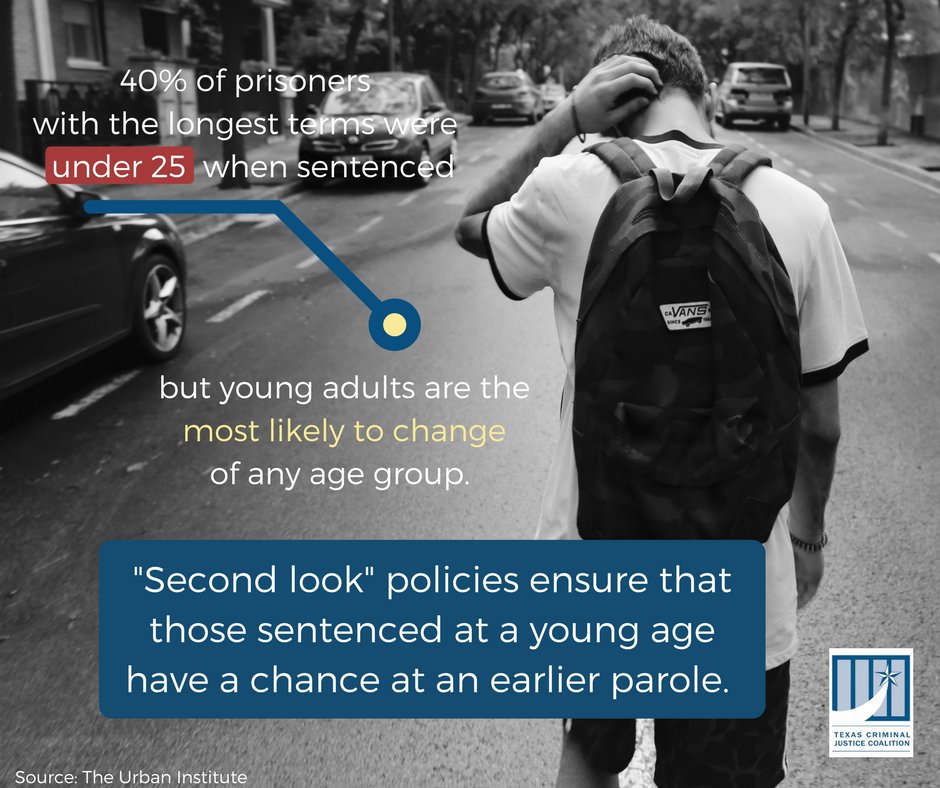
Source: TCJC Twitter feed.
Grits has been thinking a lot lately about the question of whether adult justice systems sufficiently address the needs or adequately assess the likelihood of rehabilitation for offenders in 17-25 years old range, particularly after our Reasonably Suspicious podcast segment on the topic last month.

During the 17-25 year old period, and particularly before age 21, neuroscientists now understand that young brains have yet to finish developing, especially as it relates to cognitive reasoning and impulse control. And some national experts have persuasively argued that the justice system needs to more effectively accommodate those differences in brain function.

So, in that vein, Grits was interested in this story out of the Phildadelphia Inquirer (9/7) detailing the fates of 70 released murderers who committed their crimes as young men and women. Like the defendant in Kentucky, they had served sentences for heinous crimes committed when they were teenagers. But they are now being released some two generations later. Here's how the story opened:
For the first time in a generation, Pennsylvania prisons are releasing convicted murderers by the dozen. 
In the last year, 70 men and women — all locked away as teens — have quietly returned to the community after decades behind bars. They're landing their first jobs, as grocery store cashiers and line cooks, addiction counselors and paralegals. They are, in their 50s and 60s, learning to drive, renting their first apartments, trying to establish credit, and navigating unfamiliar relationships. They're encountering the mismatch between long-held daydreams and the hard realities of daily life. 
These are the first of 517 juvenile lifers in Pennsylvania, the largest such contingent in the nation, to be resentenced and released on parole since the Supreme Court decided that mandatory life-without-parole sentences for minors are unconstitutional.
The struggles facing these parolees perhaps are to be expected. If you'd been incarcerated since Smokey and the Bandit was in theaters, you'd face difficulty adjusting to 21st century America, as well. Regardless, "So far, not one of the 70 has violated parole."

Perhaps that should be expected, too. As it happens, murderers have among the lowest recidivism rates. And the judge out of Kentucky whom we discussed in our podcast cited this study in his ruling to say that, "ninety (90) percent of serious juvenile offenders age out of crime and do not continue criminal behavior into adulthood."

This represents a lot of folks. This summer, the Urban Institute issued a study which, the Marshall Project reported, found that two out of five inmates serving very long sentences committed their crimes before age 25. (See Grits' earlier discussion.)

There are a few different ways one could take into account these differences in youthful brain chemistry, and likely more Grits hasn't considered yet. My old pal Vinnie Schiraldi has suggested creating a separate third system to deal with 18-25 year olds (it'd be 17-25 in Texas, where we have not yet raise the age of adult culpability to 18). Elsewhere, some states like Connecticut are considering expanding their juvenile justice system to cover offenders up to age 21. Alternatively, Schiraldi has privately suggested to Grits that perhaps certain enhancements, barriers to reentry, etc., could be eliminated or reduced for younger offenders since their likelihood of rehabilitation is so much higher.

I'm sure there are other ways to skin this cat. We're on the front end of a national conversation about these topics spurred by recent scientific advancements. The suggestions for how to accommodate this new information remain prefatory and barely formed. But over time, as scientists better understand the human brain - and as the justice system slowly but surely adapts that knowledge to inform its various functions - it's not difficult to imagine major implications for these observations about brain development in a justice system based on identifying and punishing bad decisions, even if we can't say for sure what they'll be yet.

That said, inevitably, someone's parole will be revoked among this Pennsylvania cohort. The road to reentry is too difficult (as this article effectively described) and the array of humanity caught up in the system is too diverse for it to never happen. But prisoners who've served decades until they're now old men (and to a less common extent, women), especially if they had good behavior records while inside, are remarkably safe release risks compared to many younger inmates convicted of less serious offenses.

Friday, August 18, 2017

Do brain-science advancements, death-penalty debates point to need for third path on young adults and crime?

Our latest "Reasonably Suspicious" podcast segment, Death and Texas, has sparked a number of lively, behind-the-scenes discussions, so I thought I'd pull it out as a stand-alone and provide links to a number of related, relevant resources. The topic: A ruling out of Kentucky finding that execution of defendants who committed their crimes before they were 21 years old violates the Eighth Amendment to the US Constitution, building on the holding in Roper v. Simmons. A majority of cases so situated come from Texas in recent years. You can listen to the full (5 minute) discussion here.

For context, here's the ruling by the Kentucky judge under discussion and some relevant media coverage.

Among states, Connecticut is considering extending the juvenile justice system all the way to age 21 because of similar considerations about youthful brain development.

In the podcast, I mentioned my pal Vincent Schiraldi's work suggesting the need for an alternative justice system for young adults. Here's what to my knowledge is sort of his "big paper" on the topic with Bruce Western and Kendra Bradner. See also this paper presaging the reform suggestions in Connecticut.

For more background: Here's a survey from last year of 10 state and local initiatives on these themes. And here's a law review article discussing the ideas of "extended adolescence" raised by Schiraldi's work and others.

Find a transcript of this excerpt below the jump:

Thursday, September 27, 2012

Adjusting juvenile law in light of SCOTUS rulings, scientific advancements

An item from the Juvenile Justice Information Exchange titled "Juvenile offenders in limbo under outdated state laws" describes a situation which, though our state is not mentioned, impacts 17 year olds in Texas sentenced after 2005 for capital murder, as well as those with pending capital murder charges. The story opens, "More than two years after U.S. Supreme Court decisions started throwing out mandatory death and life sentences for minors, judges in Washington, Illinois and dozens of other states still lack guidance on what to do with juveniles past and present convicted of murder and some other serious felonies."

Texas had already eliminated both the death penalty and life without parole for juveniles by the time Miller v. Alabama (pdf) was decided earlier this year, but in Texas offenders are charged as adults once they're 17 years old. The US Supreme Court, though, has now forbade both death penalty and life without parole sentences for defendants under 18 years old. So for someone charged with a capital offense at 17, there are presently no legal punishments available for capital murder under Texas law. In practice that shouldn't be a terrific dilemma for prosecutors. Seventeen-year-old defendants can still be charged and sentenced under regular murder statutes, and since both death sentences and LWOP are no longer options, there really isn't a substantive difference in the likely result. But Grits still expects the Legislature to take up the question next year to close the gap created in capital sentencing by the different definitions of "juvenile" under Texas and federal law.

Of course, that also raises a larger question the Legislature probably won't address next year, at least not comprehensively: Should 17 year olds be tried as adults in the first place? They have none of the rights of grown ups - can't vote, can't drink, etc. - but are held responsible as adults when they break Texas law. The issue is made more poignant by recent advances in neuroscience that have demonstrated how, as the ABA Journal put it not long ago, that:
While an individual’s cognitive abilities (thinking, reasoning) reach adult levels around the age of 16, studies show that psychosocial capabilities (impulse control, judgment, future orientation and resistance to peer pressure) continue to develop well into early adulthood.

Which answers the question so many parents have undoubtedly asked their teenage sons and daughters: How could somebody so smart do something so dumb?

Laurence Steinberg, a Temple University psychology professor who has been studying adolescent brain and behavioral development for 35 years, likens the teenage brain to a car with a powerful gas pedal and weak brakes. While the gas pedal responsible for things like emotional arousal and susceptibility to peer pressure is fully developed, the brakes that permit long-term thinking and resistance to peer pressure need work.
Steinberg says the latest research in developmental psychology confirms and strengthens the conclusion that juveniles as a group differ from adults in the salient ways the court identified in Roper [the SCOTUS case eliminating the death penalty for juveniles]. And emerging research in the field of neuroscience, not even mentioned in Roper, is helping to explain this biologically.
Such research shows, for instance, that adolescents exhibit more neural activity than adults or children in areas of the brain that promote risky and reward-based behavior. It also shows that the brain continues to mature well beyond adolescence in areas responsible for controlling thoughts, actions and emotions.
At the Texas Tribune festival last weekend, state Rep. Paul Workman (R-Austin), who sits on the Corrections Committee, suggested the Texas Department of Criminal Justice should designate separate units for 17-23 year olds - facilities he referred to as a "middle campuses" - both for their own protection and as an acknowledgement of this growing body of scientific research on brain development. That suggestion makes even more sense after the Lege directed in 2007 that 19-20 year olds sentenced as juveniles be moved from youth prisons to TDCJ.  Though the "middle campus" prospect wasn't discussed in much detail, Workman indicated such facilities could offer special programming unavailable in the regular adult system. I thought it was a fascinating and meritorious idea regarding a subject that's only beginning to gain traction as scientific developments begin to trickle down to influence court rulings and policy debates.

MORE: See a fairly lengthy discussion string from the Texas District and County Attorneys Association on the implications of Miller v. Alabama for Texas.

Saturday, August 20, 2011

Glucose levels affect parole board decisions

The New York Times this week had a story on decisionmaking that included a fascinating reference to a study of release decisions by the Israeli parole board, one that's almost certainly applicable here in Texas given the much vaster volume of cases considered:
There was a pattern to the parole board’s decisions, but it wasn’t related to the men’s ethnic backgrounds, crimes or sentences. It was all about timing, as researchers discovered by analyzing more than 1,100 decisions over the course of a year. Judges, who would hear the prisoners’ appeals and then get advice from the other members of the board, approved parole in about a third of the cases, but the probability of being paroled fluctuated wildly throughout the day. Prisoners who appeared early in the morning received parole about 70 percent of the time, while those who appeared late in the day were paroled less than 10 percent of the time. ...

The benefits of glucose were unmistakable in the study of the Israeli parole board. In midmorning, usually a little before 10:30, the parole board would take a break, and the judges would be served a sandwich and a piece of fruit. The prisoners who appeared just before the break had only about a 20 percent chance of getting parole, but the ones appearing right after had around a 65 percent chance. The odds dropped again as the morning wore on, and prisoners really didn’t want to appear just before lunch: the chance of getting parole at that time was only 10 percent. After lunch it soared up to 60 percent, but only briefly. Remember that Jewish Israeli prisoner who appeared at 3:10 p.m. and was denied parole from his sentence for assault? He had the misfortune of being the sixth case heard after lunch. But another Jewish Israeli prisoner serving the same sentence for the same crime was lucky enough to appear at 1:27 p.m., the first case after lunch, and he was rewarded with parole. It must have seemed to him like a fine example of the justice system at work, but it probably had more to do with the judge’s glucose levels.
There's plenty of debate over what criteria parole boards should use to make release decisions, but this study reminds us that rationality may not always be the main (or at least the only) driving factor behind who gets released, and when.

RELATED: Scott Medlock at the Texas Civil Rights Project emails to say, " If I recall correctly, there is an episode of The Simpsons where Marge bakes brownies for the parole board before they evaluate a prisoner she has taken a shine to, and, true to form, the board grants parole." Indeed he does recall correctly, though it was cookies, not brownies (macaroons, to be precise). Here's a synopsis of the relevant episode.

Monday, March 29, 2010

Science answers raise public policy questions on addiction

I've wondered in recent years if research by neuroscientists may eventually result in the conceptual uncoupling of addiction from criminality, forcing society to view it as a public health problem instead of reason for arrest and imprisonment. After all, nobody calls the cops when some tub of lard buys a grocery-cart full of junk food at the supermarket, but as it turns out a new study shows that:
high-fat, high-calorie foods affect the brain in much the same way as cocaine and heroin. When rats consume these foods in great enough quantities, it leads to compulsive eating habits that resemble drug addiction, the study found.

Doing drugs such as cocaine and eating too much junk food both gradually overload the so-called pleasure centers in the brain, according to Paul J. Kenny, Ph.D., an associate professor of molecular therapeutics at the Scripps Research Institute, in Jupiter, Florida. Eventually the pleasure centers "crash," and achieving the same pleasure--or even just feeling normal--requires increasing amounts of the drug or food, says Kenny, the lead author of the study.

"People know intuitively that there's more to [overeating] than just willpower," he says. "There's a system in the brain that's been turned on or over-activated, and that's driving [overeating] at some subconscious level."

So if addiction to cocaine and cheesecake relies on the same biological mechanism, will public policy eventually treat them similarly, and if so which path will we choose? Indeed, there are more similarities between junk food and controlled substances than first meets the eye, reports CNN:

The fact that junk food could provoke this response isn't entirely surprising, says Dr.Gene-Jack Wang, M.D., the chair of the medical department at the U.S. Department of Energy's Brookhaven National Laboratory, in Upton, New York.

"We make our food very similar to cocaine now," he says.

Coca leaves have been used since ancient times, he points out, but people learned to purify or alter cocaine to deliver it more efficiently to their brains (by injecting or smoking it, for instance). This made the drug more addictive.

According to Wang, food has evolved in a similar way. "We purify our food," he says. "Our ancestors ate whole grains, but we're eating white bread. American Indians ate corn; we eat corn syrup."

Obesity, like drug addiction, is both bad for the individual and costly for society. If both problems stem from the same source, will we change drug policy to treat controlled substances like we do fatty foods, where the emphasis is on personal freedom, tax policy and public education, or will we treat fatty foods like illegal drugs, policing individual consumption and enforcing penalties for producers and consumers of unhealthy products? Or are there distinctions besides brain chemistry that justify different legal approaches for heroin and Twinkies? What do you think?

Wednesday, August 19, 2009

'Can these puppets prevent juvenile crime?'


The title of this post is the headline of an interesting item from Change.org's Criminal Justice Blog, where Matt Kelley points to:
a video of a talk by Theodore Beauchaine, a psychology professor at the University of Washington, who says that brain science can predict criminal activity in some kids and should be a factor in targeting treatment. Treatment for kids with signs of hyperactivity, when it's delivered by age three, can decrease the chance they'll land in the juvenile justice system by 75 percent, he said. And one of the approaches that's working is - you guessed it - puppets.

The Incredible Years is a program for young kids that uses the puppets above - and other techniques - to train hyperactive and aggressive kids in social skills. The program was developed by another University of Washington professor, Carolyn Webster-Stratton, and it has been remarkably effective.

Kelley's piece turned me on to some interesting resources on the topic of juvenile justice, brain science and early childhood development. This afternoon I watched this video titled "Brain Science as a Means of Understanding Delinquency and Substance Abuse in Youth," and here's another hour-long video I want to view soon on the use of puppets as an early childhood intervention technique.

Prof. Beauchaine's talk was especially enlightening because he believes criminogenic risk factors can be identified in kids as young as age 3, while most interventions involving delinquent youth don't begin until, at the earliest, the middle school period. By that time, he said, evidence shows the most common interventions actually increase crime. If Beauchaine's diagnostic methods are sound, shifting more resources toward prevention in early childhood could be a promising approach, particularly since it's not nearly as resource intensive as later interventions by the justice system once kids start committing crimes. Interesting stuff.

Wednesday, July 29, 2009

Neuroscience and the law, now and going forward

Via The Situationist, check out this excellent 10-minute interview with Stanford law prof Hank Greely regarding an issue that's increasingly interested me as a result working as Policy Director for the Innocence Project of Texas: The intersection between law and modern neuroscience.


This is one of the best, brief discussions I've heard of the current status on how modern neuroscience is being used in modern criminal and civil courtrooms and what may be possible in the future.

Greely calls "reckless at this point" (at least) two companies which are already out selling "lie detection" services as potetial expert witnesses using fmri's. But the evidence, he says, at this point does not justify anyone buying such services or admitting it in court.

Along with "pain detection" and "bias detection," however, lie detection is an area where current research is fervently looking for practical applications in the courtroom. Modern neuroscience might also change how courts view insanity defenses, said Greely, though he emphasized that available technology and science doesn't yet necessarily disturb these issues.

If the science is ever perfected, which he emphasizes is a big "if," Greely predicts many other bothersome but interesting Fourth and Fifth Amendment questions facing the courts as a result of evolving neuroscience technology. Good stuff - worth a listen.

MORE: See more on the subject from Baylor Law School's program on Neuroscience and the Law.

Saturday, January 10, 2009

TV show depicts deception detection science as too exact

FOX TV is heavily running previews for a new mid-season drama called "Lie to Me" that purports to portray a scientist with perpetual five o'clock shadow and his hotter-than-thou research team who are experts in the "science of deception detection" - i.e., telling whether someone is lying.

Says a promo: "Dr. Cal Lightman and his team are effectively human polygraph machines, and no truth can be concealed from them." Of course, as human "polygraph" machines that would make their work discredited, pseudoscientific and too unreliable to use in court, but I'm sure that's not what the producers meant by that line.

The lead character is based on the work of behavioral scientist Paul Ekman whose landmark research cataloging and interpreting facial expressions has led him to create a lucrative consulting business teaching lie detection techniques to various official and corporate entities. FOX TV, naturally, has turned Ekman into a crime fighting detective type. Even more of a stretch, the show takes to absurdist extremes a concept from Ekman and Maureen O'Sullivan's work hypothesizing a small number of people are "truth wizards" who are exceptionally accurate at deciphering lies. In fact, the story goes so far as to pretend the lead character, Dr. Cal Lightman, himself enjoys such abilities.

Inarguably, deception detection using "microexpressions" is a big part of how humans identify deception in an interactive environment. But it can never be 100% accurate, or even close. In practice it's more art than science.

To use a Shakespearean analogy from Ekman himself at a recent MIT conference on security and human behavior,
Othello’s error was to read Desdemona’s fear correctly but to misunderstand its cause. We may indeed pick up on these cues, but that doesn't mean they will be interpreted correctly.

Reading micro-facial expressions to identify deception is a core method used in the "Reid technique" of police interrogtion, an approach that provides the basis for most police interrogation training in America. But with the possible exception of a handful of "wizards," there's little evidence police are better at detecting deception than the rest of us. According to the (highly recommended) recent book by Richard Leo, Police Interrogations and American Justice (pp. 98-99):
Numerous controlled studies have shown that people are not good intuitive judges of truth and deception, typically performing at no better than chance levels of accuracy. Controlled studies have also shown that even investigators and other supposed experts who routinely evaluate deceptive behavior are highly prone to error. Moreover, Kassin and Fong have shown that police interrogators and others specifically trained in the [Reid technique] not only fail to discriminate accurately between true and false statements much of th time, but also that behavior analysis training actually lowers the ability of police interrogators to discriminate accurately between true and false denials. Further, such training inflates their confidence in their judgments. (citations omitted)
Indeed, researcher Aldert Vrij thinks overreliance on Ekman-esque micro-expressions ignores more probative cues to deception and may lead to false accusations. According to this abstract from a recent paper:
deception research has revealed that many verbal cues are more diagnostic cues to deceit than nonverbal cues. Paying attention to nonverbal cues results in being less accurate in truth/lie discrimination, particularly when only visual nonverbal cues are taken into account. Also, paying attention to visual nonverbal cues leads to a stronger lie bias (i.e., indicating that someone is lying). The author recommends a change in police practice and argues that for lie detection purposes it may be better to listen carefully to what suspects say
"Lie to Me" premiers on Jan. 14 in FOX's sweet spot right after American Idol, and I'll be watching with interest if also a slightly jaundiced eye. Until then, for those interested in the actual science of deception detection, the always excellent (when the author gets around to posting!) Deception Blog supplied a superb end of the year roundup of deception-related research:

Saturday, September 06, 2008

Research on happiness examines effects of punishment

Just as cutting edge brain science research has begun to force reformulation of many core assumptions in the justice system, modern punishment theories could be radically altered by empirical research on happiness according to a new article which Doc Berman linked to recently, "Happiness and Punishment, by law and economics professors John Bronsteen, Christopher Buccafusco and Jonathan Masur out of the University of Chicago,.

These law profs say an increasingly mature field of research known as "hedonic psychology," or simply hedonics, has developed tools for longitudinal measurements of happiness and a consensus on the effect of punishment on people's happiness levels. Based on this research, their article examines "how and to what extent do fines and incarceration negatively affect happiness or well-being," then demonstrates how the results have major implications for utilitarian, retributivist, and mixed punishment theories.

Much early hedonics research focused on people with disabilities, resulting in the surprising discovery that their happiness levels adapted quite well to even radically changed physical circumstances. (An early study found little difference in happiness levels among groups of para/quadraplegics compared with lottery winners!) Within this relatively new subspecialty:
Among its most robust and consistent findings are two that are highly relevant to the study of punishment: 1) most life events, whether positive or negative, exert little lasting effect on an individual’s well-being because people adapt rapidly to them; and 2) people do not recognize or remember how quickly they adapt and thus make very poor estimates about the hedonic impact of future events. Studies have shown that, after immediate, short-term changes, people rapidly return to prior levels of well-being following experiences ranging from learning that they scored poorly on a personality test to becoming paraplegic.
Over the past three decades, researchers focused these new tools on both the subjects of incarceration and financial loss, with potentially profound implications for how most of us think about punishment. Here's a good summary of what they describe as a consensus among existing research on happiness and punishment:
Contrary to expectations, adjusting the size of a fine or the length of a prison sentence does not meaningfully adjust the amount of unhappiness that is ultimately experienced by the offender. Paying more money or staying in prison for a longer period are highly susceptible to adaptation. As a result, virtually any fine imposes only fleeting harm. On the other hand, virtually any term of imprisonment imposes large and lasting harm by causing disease, unemployment, and loss of social connection; but longer prison terms do not diminish happiness much more than do shorter ones. It is therefore impossible to tailor a punishment to fit the severity of a crime, given the penal options available.
There are major implications for this finding, which the authors accurately characterize as "depriving punishment of proportionality."

That said, humans adapt to some changes much better than others, it's just that incarceration and money fines aren't the big triggers. Researchers say the post-incarceration stigma and harm from severing family and societal ties is actually the greater "punishment," if punishment is defined as reducing "happiness."
While adaptation seems pervasive, further research has demonstrated its limits. Thus, people are less likely to adapt to some health-related stimuli like noise, chronic headaches, and certain degenerative diseases such as rheumatoid arthritis, multiple schlerosis, HIV/AIDS, and hepatitis C infection. Additionally, socially relevant stimuli such as divorce, the death of a spouse, and unemployment prove incredibly difficult to adapt to, with hedonic penalties lasting even after remarriage or reemployment.
The authors substantively discuss the major research backing up these findings, for those interested - I'm just hitting the highlights of a pretty substantial article. But it's a fascinating and counterintuitive notion that the portion of the punishment causing offenders the most unhappiness isn't prison but what happens to them when they get out. It makes sense, though, once you see the research about what does and doesn't affect happiness:
People who have spent any time in prison are significantly more likely to experience chronic, stress-related health impairments, unemployment, and the breakdown of psychologically vital social ties. Unlike fines and imprisonment itself, these post prison consequences of incarceration are likely to generate substantial and long-lasting hedonic penalties for ex-inmates regardless of the lengths of their sentences. (emphasis added)
That last bit is key - the worst punishments according to this view are applied uniformly, after incarceration, regardless of how long someone is locked up.

The rest of the article applies this analysis to various, currently popular punishment theories. In particular, the discovery argues against the so-called utilitarian assumption that "the deterrent 'punch' of punishment [is] equal to the pain that punishment inflict[s] upon an offender." Thus to maximize deterrence, according to this worldview, one must maximize prison sentence lengths:
Among utilitarians, the temptation to impose increasingly harsher penalties is strong and omnipresent. The optimal social frequency of most crimes is exactly zero; the country would likely be better off if there were no murders, no armed robberies, no assaults, and so forth. ... Rather, from a utilitarian perspective, the most significant check on the degree of punishment is the cost associated with the punishment itself.
However, if there's limited utility from deterrence due to longer punishments - i.e., if the punishment instituted is no harsher from the recipients' perspective when sentences are longer - then the only utilitarian purpose remaining for longer sentences would be cases where safety requires straight-up incapacitation. That's a significant group, to be sure, but only a small subset of those receiving years-long sentences now.

Research on happiness and punishment similarly throws a wrench in the gears of retributivist punishment theory, which holds that punishment should be based on what the offender deserves, not maximizing social happiness. If punishment must be based on deserts, though, then everyone receiving the same, harsh post-incarceration punishment is decidedly unjust, while the failure of longer incarceration lengths to punish more harshly calls into question whether they're justified based on desert alone.

Other "mixed" models of punishment similarly find their underlying assumptions challenged by hedonics, the authors show.

These research findings cast light on an obscure set of assumptions underlying how the criminal justice system assigns punishment. According to a hedonic analysis, "to some considerable extent, only two significant levels of punishment exist (any fine or any imprisonment)." Otherwise, say the authors, differences in punishments fail to impact the individual by reducing their happiness a greater amount. And the harshest punishments are applied across the board, even to the lowest level nonviolent offender.

I don't present this research to argue for any particular interpretation or punishment theory, nor do I fully understand yet all the implications for how this analysis might inform modern sentencing practices. I merely found the results interesting and probative, so I'm sharing them.

Questions raised by hedonics strike at core, first-order assumptions about the effects of punishment, some of which may turn out to be wholly incorrect. For the most part, they're questions about which no one had previously provided any evidence-based answers, so in that sense this research is quite exciting, cutting edge stuff.

Friday, July 25, 2008

Baylor studying neuroscience and the law

Having written a couple of posts recently on the intersection of cutting edge neuroscience and the law, I was pleased this afternoon to run across the website of the Baylor College of Medicine's Initiative on Neuroscience and the Law. Especially useful, they've posted their conference materials (pdf) and webcasts of each presentation from their conference in May.

Eyewitnesses and the 'feeling of knowing'

I'm increasingly convinced that recent advancements in neuroscience will, in a very few years, begin to revolutionize several fundamental sets of assumptions on which the criminal justice system is presently based - most immediately regarding eyewitness identification and the reliability generally of witness testimony.

In Dr. Ginger Campbell's Brain Science Podcast #42, she reviews a book by Dr. Robert Burton - On Being Certain: Believing you are right even when you are not - focusing on a question that comes up frequently in cases resulting in DNA exonerations involving erroneous eyewitness identifications: How is it that witnesses can believe to their core they are testifying accurately but identify alleged perpetrators who absolutely didn't do it?

How can one be certain, in other words, and at the same time utterly and profoundly wrong?

According to Dr. Burton, "certainty" is really the equivalent of an emotion - it's a feeling, not a conclusion, that has "involuntary neurological roots." We don't know what makes us feel certain because in a literal sense by the time we do, the information no longer exists. When our synapses fire, they release and extinguish all the information about why they fired in the first place - the conscious mind, OTOH, merely notes whether they did or they didn't. Those subterranean "hidden" impulses underlying our thoughts and behavior constitute what psychologists consider the subconscious or unconscious mind.

There is no physiological distinction between the processes in our brain that generate conscious or unconscious thought, says Burton. That distinction has a philosophical but not necessarily a biological basis; for the mind, conscious and unconscious thought are an intermingled process that simultaneously includes both types of brain activity. According to this view, the "feeling of knowing," i.e., certainty, is an unconscious impulse that attaches itself onto conscious ideas and makes us believe them.

From the research Burton cites, you get the sense that people's certainty in their beliefs routinely outdistance the accuracy of their memory, a notion which has important implications when evaluating eyewitness testimony. Burton detailed the results of a study performed following the Challenger space shuttle disaster, where an academic interviewed 106 students the day after the tragedy then again 2.5 years after the event about their memories of where they were, who told them, how they reacted, etc. Half the respondents made errors compared to their original recollection, and a quarter of the accounts were significantly different than students originally remembered. Fewer than 10% remembered all the details the same. Many students whose stories had changed, however, maintained a high degree of confidence in their later, false recollections ... even after being shown their original answers in their own handwriting.

This "feeling of knowing" is "not under conscious control." Citing the example of a baseball player who physically must begin to swing before the pitcher releases the ball but says later he reacted to the trajectory, Campbell says, "Our brain makes us think that it knows things that it can't really know." (Many optical illusions similarly rely on the brain's ability to force itself into such moments of cognitive dissonance, thinking it knows things that cannot be.)

Burton calls this sense of being right "thought's original yes-man." But what is the genetic benefit of a feeling of knowing that's sometimes actually false? Burton says the feeling stems from the brain's pleasure-reward system in the upper brain stem, using dopamine as its key neurotransmitter. The pleasure-reward mechanism activated by certainty, he says, connects to parts of the brain that manage both emotion and cognition.

This sense of certainty could be an evolutionary adaptation to confronting abstract choices that have no clear cut answers in the face of perilous threats, says Campbell. Without this internal reward system endorsing the correctness of our actions, we could be paralyzed by fears and uncertainty in the face of immediate danger. All the talk of evolutionary adaptations, she and Burton emphasize, are speculative explanations, but it's a reasonable hypothesis for why our biological reward system might be hardwired that way.

The brain dynamics involved with certainty are essentially similar to patterns of addiction, said Burton, with the brain getting satisfying rewards in the form of a dopamine boost that reinforce certainty just like addicts get a dopamine jolt from drugs through the same expectation-reward mechanism.

In other words, Drs. Campbell and Burton think people can be addicted to their own beliefs in the same way an addict might be hooked on heroin or meth. Burton wonders if humans may have an "addiction to the pleasure of the feeling of knowing." Burton thinks neuroscience should "let go of the myth of the autonomous, rational mind" able to overcome its own subconscious prejudices, insisting that "The feeling that a decision is right is not the same thing as providing evidence that it is right." Indeed, when the beliefs in question are memories, as evidenced by the Challenger experiment, they may be simultaneously quite mutable and firmly believed.

The feeling of knowing cannot be dismissed, says Campbell, just because it occurs in parts of the brain where its functions are obscured. However, Burton's findings dictate that a feeling of certainty should not be considered a substitute for corroboration. "In real life we constantly make decisions with incomplete information," she says in conclusion, "but we also seem to have a tendency to feel certain about these choices."

What are the implications of these findings for the raft of DNA exonerations that followed erroneous eyewitness identifications? For starters, perhaps juries would be less swayed by a witness testifying with "certainty" if it were widely understood that that's really an emotion instead of a conclusion? What's more, when a person feels "certain" they're more likely to overlook alternative explanations and less likely to question their own assumptions.

I'm sure there are many other implications for this research in the criminal justice arena - what else comes to mind?

Dr. Campbell's podcast was a bit on the long side (about an hour) but well worth listening to in its entirety. She does a great job of breaking the subject down for the non-expert listener, and Burton's book sounds interesting as well. I can't help but believe some of these ideas will percolate up from the hard sciences into the law and the courts before too very long.

Wednesday, July 02, 2008

How much do eyewitnesses really see?

How much of what an eyewitness "sees" represents inputs from the outside world, and how much of it is constructed by the brain?

My layman's grasp of new brain science currently revolutionizing views of human cognition remains spotty at best, but much of what's coming out on the topic appears to have implications for the criminal justice arena. Take, for example, the debate over the best procedures for gathering eyewitness identification, long considered the gold standard (or perhaps silver, after a confession) for gaining a conviction in court. Scientists are learning that to a great extent what we see is constructed by the brain from memory instead of reflecting an image of the outside world.

In an extensive article in the June 30 New Yorker on the brain and itching ("The Itch" - not online but see discussions here and here), surgeon and author Dr. Atul Gawande writes that:
[T]he more we examine the actual nerve transmissions we receive from the world outside, the more inadequate they seem.

One assumption had been that the sensory data we receive from our eyes, ears, nose, fingers, and so on contain all the information that we need for perception and that perception must work something like a radio. It's hard to conceive that a Boston Symphony Orchestra concert is a radio wave. But it is. So you might think that it's the same with the signals we receive - that if you hooked someone's nerves to a monitor you would watch what the person is experiencing as if it were a television show.

Yet, as scientists set about analyzing the signals, they found them to be radically impoverished. ...

The images in our mind are extraordinarily rich. We can tell if something is liquid or solid, heavy or light, dead or alive. But the information we work from is poor - a distorted, two-dimensional transmission with entire spots missing. So the mind fills in most of the picture. You can get a sense of this from brain anatomy studies. If visual sensations were primarily received rather than constructed by the brain, you'd expect that most of the fibres going to the brain's primary visual cortex would come from the retina. Instead, scientists have found that only twenty percent do; eighty percent come downward from regions of the brain governing functions like memory. Richard Gregory, a prominent British neuropsychologist, estimates that visual perception is more than ninety percent memory and less than ten percent sensory nerve signals.
So what we see in the heat of the moment is a "radically impoverished" version of reality and our minds fill in the blanks from memory. No wonder faulty eyewitness identifications turn out to be the single leading cause of wrongful convictions among DNA exonerees! This also helps explain why witnesses are more reliable identifying someone they knew before the crime - their memories have more data from which to construct the scene. It's when identifying strangers, primarily, that limitations on eyewitness identification come most starkly into play.

Wednesday, June 13, 2007

Lies and the Brain

With the Texas Legislature gone I've had time to poke around the blogosphere a little more and ran across these interesting links on the subject of lying. I wanted to record them for myself and perhaps they may also interest Grits readers:
On a related note, I've become increasingly interested in the last couple of years in recent advancements in brain science and the implications for crime, punishment and justice. (After all, some liars convince themselves they're telling the truth, while memory tricks even honest observers.) This afternoon I discovered several websites that at least tangentially address these topics:
Found via Corrections Sentencing