Somebody successfully launched a ransomware attack on the Texas appellate court system. State officials decided not to pay, so now it's impossible to access hand-down lists, opinions, orders, etc., online for the Court of Criminal Appeals, the Texas Supreme Court, or any of the 14 intermediate appellate courts. The OCA also operates computer systems for a slew of smaller agencies like the Texas Indigent Defense Commission, the Office of Capital and Forensic Writs, the Forensic Science Commission, and the State Prosecuting Attorney.
Readers will recall that, last year, Potter County (Amarillo) was struck with a ransomware attack. They also refused to pay and as of last fall, it was unclear if they would ever be able to cover many records from their courts and law-enforcement systems. As in this case, they called in "law enforcement and the Texas Department of Information Resources (DIR) to investigate the breach," but the perpetrators were never caught. This created huge disruptions that are still reverberating.
Grits understands the defiant impulse to not pay ransom. But Amarillo's experience shows that decision can end up cutting of one's nose to spite one's face. Potter County would have been better off paying and calling it the cost of an education, and I suspect, when all is said and done, the same will turn out to be true for the Texas Office of Court Administration.
Showing posts with label Judiciary. Show all posts
Showing posts with label Judiciary. Show all posts
Tuesday, May 12, 2020


Saturday, April 11, 2020
Judge ruled Abbott exceeded his authority on executive order limiting personal bonds, but the fight's not over
UPDATE: The Supreme Court of Texas on Saturday issued a temporary stay on Judge Livingston's Temporary Restraining Order, meaning Abbott's order for now is back in effect. The court has requested briefings on the subject, with responses from the litigants due on Monday. See coverage from the Texas Tribune.
ORIGINAL POST: Texas Governor Greg Abbott and Attorney General Ken Paxton took one on the chin yesterday when Travis County District Judge Lora Livingston issued a Temporary Restraining Order barring enforcement of the governor's executive order barring jail releases of people with current charges or past convictions involving violent offenses. See initial coverage from the Austin Statesman, and briefs from the plaintiffs and Abbott/Paxton's attorneys.
At another hearing scheduled for April 24, Judge Livingston will decide whether to turn the TRO into a full-blown injunction, if the Supreme Court of Texas doesn't beat her to the punch (see below). Here's Judge Livingston's letter explaining her decision.
Grits considered the executive order a barely disguised attack on bail reform efforts in Harris County and a warning shot aimed at other jurisdictions that might follow their lead. There was no obvious link between the order and protecting people from the coronavirus, and in fact, it increased risk of infections in Texas county jails. So I was glad to see Livingston's decision, though I also understand this is only the first step down a longer path.
ORIGINAL POST: Texas Governor Greg Abbott and Attorney General Ken Paxton took one on the chin yesterday when Travis County District Judge Lora Livingston issued a Temporary Restraining Order barring enforcement of the governor's executive order barring jail releases of people with current charges or past convictions involving violent offenses. See initial coverage from the Austin Statesman, and briefs from the plaintiffs and Abbott/Paxton's attorneys.
At another hearing scheduled for April 24, Judge Livingston will decide whether to turn the TRO into a full-blown injunction, if the Supreme Court of Texas doesn't beat her to the punch (see below). Here's Judge Livingston's letter explaining her decision.
Grits considered the executive order a barely disguised attack on bail reform efforts in Harris County and a warning shot aimed at other jurisdictions that might follow their lead. There was no obvious link between the order and protecting people from the coronavirus, and in fact, it increased risk of infections in Texas county jails. So I was glad to see Livingston's decision, though I also understand this is only the first step down a longer path.
Though I'm not a lawyer, when I read the government's response to the petition from the ACLU of Texas, the Fair Defense Project, and the Lawyers Committee for Human Rights, I suspected they would lose on the merits. Frankly, they didn't address most of the plaintiffs' arguments directly, sidestepping them with sweeping overstatements and absurd attacks that, if taken to their logical conclusion, would make Governor Abbott essentially an un-accountable dictator whenever he decided to declare a disaster.
In their brief, Abbott's lawyers accused judges of "misusing" their authority to grant personal bonds, but in the hearing yesterday, they could not identify a single example of such misuse, despite Livingston repeatedly pressing lead counsel Adam Biggs on the point. Not. A. Single. One.
Indeed, Biggs was unable to identify how the governor's executive order related to the coronavirus at all. The "disaster" to which he was responding, Livingston pointed out, had nothing to do with judges' authority to issue personal bonds, which predated the rise of the virus. In essence, the virus was an excuse for the action, not the reason.
They also blew past the central arguments by the plaintiffs without addressing them, arguing against positions never taken. Plaintiffs contended the Disaster Act only authorized the governor to override "regulatory" statutes governing state agencies, not the Code of Criminal Procedure or the Texas Constitution. But Biggs and Co. argued that, "According to Plaintiffs’ interpretation, the Governor would have to run to the Texas Legislature any time one of his COVID-19-related executive orders—like the recent restrictions on social distancing—touches upon just one of Texas’ numerous statutes." This ignored the "regulatory" distinction in the Disaster Act on which the plaintiffs' central argument hinged and made it easy for for Livingston to ignore their position and rule against them. It was simply non-responsive.
Maybe the oddest of the governor's lawyers' arguments was that the plaintiffs were encouraging "the deaths of tens of thousands of ... Texans" by contending that only the Legislature could suspend non-"regulatory" statutes.
Indeed, the argument that the Legislature convening would kill "tens of thousands" of people ignores the fact that the Texas Constitution includes a pandemic exception that allows the Legislature to convene outside of Austin if the capitol faces a "disease threat."
Maybe the oddest of the governor's lawyers' arguments was that the plaintiffs were encouraging "the deaths of tens of thousands of ... Texans" by contending that only the Legislature could suspend non-"regulatory" statutes.
Plaintiffs’ theory is that only the Legislature should have meaningful power to suspend laws that prevent the State’s response to this growing threat. Apart from the lack of a textual basis for Plaintiffs’ arguments, the following shows why this theory cannot be correct and would lead to disastrous results. To take legislative action, the Legislature would need to convene in person at some centralized place (the presumptive location is the State Capitol in Austin).
It would presumably take days, if not weeks, to assemble individual legislators in the State Capitol or anywhere else. There are 150 Texas House members and 31 Texas Senate members.193 Two-thirds of the members from each chamber (100 for the House and 21 for the Senate) would need to appear to have a “quorum to do business.”194 Plaintiffs’ theory thus raises the specter of 121 Texas legislators gathering on one central location in the midst of a highly infections deadly disease that can quickly ravage large groups of people in a closely-confined area. The problems continue.
Once the vote is done and the legislators go their separate ways, what happens when the COVID-19 threat quadruples in the following week (as we have seen is all too possible), which necessitates more severe action and thus the suspension of additional statutes? Well, the process would start all over again.
According to Plaintiffs, this Court is required to interpret § 418.016(a) in a way that could realistically result in the deaths of numerous Texas Legislators and, due to built-in delays in the process, the deaths of tens of thousands of other Texans.Frankly, that doesn't seem "realistic" at all, considering Texas has seen fewer that 12,000 cases overall and as of yesterday, 226 deaths. By contrast, the plaintiffs made solid arguments both in their brief and at the hearing that pretrial defendants in jail were at significantly greater risk of contracting the virus, an argument Abbott's lawyers simply ignored or downplayed. Judge Livingston, however, raised the point multiple times and considered it a reasonable thing for judges to take into account, especially since Biggs and Co. could identify no examples of judges "misusing" the authority, as their brief had claimed.
Indeed, the argument that the Legislature convening would kill "tens of thousands" of people ignores the fact that the Texas Constitution includes a pandemic exception that allows the Legislature to convene outside of Austin if the capitol faces a "disease threat."
Sec. 8. CONVENING LEGISLATURE ON EXTRAORDINARY OCCASIONS. (a) The Governor may, on extraordinary occasions, convene the Legislature at the seat of Government, or at a different place, in case that should be in possession of the public enemy or in case of the prevalence of disease threat. His proclamation therefor shall state specifically the purpose for which the Legislature is convened.
However far afield some of these debates seemed, they didn't play a major role in the judge's decision. From her commentary at the hearing (thanks to the Texas Observer's Michael Barajas for sharing a recording), Judge Livingston's central motivation appeared to be protecting the powers of the judiciary from infringement by the executive branch. This passage from her explanatory letter (linked above) made that clear:
many of the orders in Executive Order GA-13 strip away the discretion of the judiciary and potentially subject its judges to mandamus or criminal action with little or no rationale in coping with the current health crisis. Instead, the order appears to address an unsubstantiated fear that the judges of the state will abandon their legal obligation to balance the interests of the public, individuals accused, but not convicted of criminal offenses, and the victims of those alleged offenses. The judges of this state were required to balance these very interests every day prior to the disaster declaration, and they are required to do so every day once the disaster declaration ends. The exercise of judicial discretion falls squarely within the purview of the judicial branch of our government. To be clear, the judges of this State may not abandon their responsibility in this regard, but neither may it be taken away from them by executive order.
From this non-lawyer's perspective, the governor's attorneys made it awfully easy for Livingston to rule against them by ignoring central arguments from the plaintiffs and instead railing against straw men. They overstated their own case to a significant degree and downplayed plaintiffs' most important points to an even greater one. I was surprised their response wasn't stronger.
That said, it's possible the governor could prevail, anyway. As Grits was wrapping up this post, word came that Abbott's lawyers will file a mandamus action with the Supreme Court of Texas today, essentially performing an end run around the normal channels of judicial review.
Will the Supreme Court's loyalties lie more with the constitutional authority of the judicial branch or their partisan affiliations? Is Greg Abbott merely a governor whose powers are constrained by the constitution and state law, or a king who may do what he pleases so long as he declares a "disaster" first? Or will the Republican-led Supreme Court have the foresight to understand that their party won't always control Texas' statewide offices and enforce constitutional limits so that future governors won't also run amok?
Those are the big-picture questions before them, and though I think Judge Livingston was right on the facts and the law, Grits couldn't begin to guess what the final answers will be.
MORE: See Judge Elsa Alcala's analysis.
MORE: See Judge Elsa Alcala's analysis.
Wednesday, April 08, 2020
Litigation challenges Abbott's executive order on COVID-19 jail releases
The Texas Fair Defense Project, ACLU of Texas, and the Lawyers Committee for Civil Rights Under Law sued Governor Greg Abbott over his executive order (GA-13) related to pretrial jail releases in response to the coronavirus, as well as Attorney General Ken Paxton, who has vowed to aggressively enforce it. The Harris County Attorney's office has also signed onto the litigation, and 16 Harris County Criminal Court at Law judges number among the plaintiffs. It was filed in a Travis County district court.
In an email announcing the lawsuit, TFDP's Amanda Woog wrote that:
The lawsuit alleges Gov. Abbott's order spawned "turmoil and confusion in the courts by purporting to strip judges and magistrates of their authority to decide individual cases." As a result, "The judges are now caught between fulfilling their obligations to decide bail in individual cases as prescribed by the Constitution and Legislature, or obeying an Executive Order."
The petition argues that "The Disaster Act does not empower the Governor to modify or suspend the targeted sections of the Code of Criminal Procedure. This renders GA-13 unlawful in its entirety, and the Court should invalidate its provisions as ultra vires [ed. note: acting beyond one's legal authority] on this basis alone.
Also, "GA-13 violates Article I, Section 28 of the state Constitution, which prohibits non-legislative suspension of the laws of the State, and Article II, Section 1, which mandates separation of powers between co-equal branches of government. GA-13 is therefore unconstitutional on its face."
Both stances to me appear inarguable. The governor has the power to suspend administrative regulations, but not the friggin' Code of Criminal Procedure! Grits wrote the other day that Abbott had exceeded his authority, and this is precisely why.
Conservatives should be just as unhappy at this attempted gubernatorial coup vs. local judicial power as are the judges, criminal defense lawyers and civil-rights groups who are plaintiffs in the suit. After all, if in a few years Democrats find themselves in control of statewide offices, will conservatives really want some liberal governor to have the authority to suspend criminal-law statutes and override local judges every time a disaster is declared?
Observed the plaintiffs, "The Disaster Act has never been interpreted to empower the Governor to interfere with the power of the Judiciary. Until now, no Texas Governor has invoked the Disaster Act to purport to suspend provisions of the Code of Criminal Procedure and effect sweeping changes to criminal law." Indeed, "The Texas Constitution provides that 'No power of suspending the laws of this state shall be exercised, except by the Legislature.' Tex. Const. Art. I, § 28."
Grits is very glad to see this and hopes the courts act quickly to thwart the governor's attempted power grab. I don't think he and Paxton have a leg to stand on.
In an email announcing the lawsuit, TFDP's Amanda Woog wrote that:
Public health experts have been warning for weeks of the dangers of COVID-19 in jails: tight quarters, a particularly vulnerable population, and a revolving door of staff and detained people, make a jail a "hotspot" for a COVID-19 outbreak which would devastate the people within and outside the jail walls. The order sought to disrupt the incredible movement we've been seeing across Texas of local stakeholders working together to reduce their jail populations.
The executive order threatens public and community health, undermining efforts to reduce jail populations and avoid outbreak in jails and surrounding communities. Further, under the order, only the poor would stay in jail; people who can afford to pay cash bail are released, to the privilege of social distancing and other precautions we on the outside can take to avoid infection.
It disrupts the work of local communities in determining how to respond to this unprecedented crisis, and unconstitutionally usurps the authority of the legislature and the judiciary.The petition filed this morning can be found here, and the ACLU-TX press release here.
The lawsuit alleges Gov. Abbott's order spawned "turmoil and confusion in the courts by purporting to strip judges and magistrates of their authority to decide individual cases." As a result, "The judges are now caught between fulfilling their obligations to decide bail in individual cases as prescribed by the Constitution and Legislature, or obeying an Executive Order."
The petition argues that "The Disaster Act does not empower the Governor to modify or suspend the targeted sections of the Code of Criminal Procedure. This renders GA-13 unlawful in its entirety, and the Court should invalidate its provisions as ultra vires [ed. note: acting beyond one's legal authority] on this basis alone.
Also, "GA-13 violates Article I, Section 28 of the state Constitution, which prohibits non-legislative suspension of the laws of the State, and Article II, Section 1, which mandates separation of powers between co-equal branches of government. GA-13 is therefore unconstitutional on its face."
Both stances to me appear inarguable. The governor has the power to suspend administrative regulations, but not the friggin' Code of Criminal Procedure! Grits wrote the other day that Abbott had exceeded his authority, and this is precisely why.
Conservatives should be just as unhappy at this attempted gubernatorial coup vs. local judicial power as are the judges, criminal defense lawyers and civil-rights groups who are plaintiffs in the suit. After all, if in a few years Democrats find themselves in control of statewide offices, will conservatives really want some liberal governor to have the authority to suspend criminal-law statutes and override local judges every time a disaster is declared?
Observed the plaintiffs, "The Disaster Act has never been interpreted to empower the Governor to interfere with the power of the Judiciary. Until now, no Texas Governor has invoked the Disaster Act to purport to suspend provisions of the Code of Criminal Procedure and effect sweeping changes to criminal law." Indeed, "The Texas Constitution provides that 'No power of suspending the laws of this state shall be exercised, except by the Legislature.' Tex. Const. Art. I, § 28."
Grits is very glad to see this and hopes the courts act quickly to thwart the governor's attempted power grab. I don't think he and Paxton have a leg to stand on.
See initial coverage of the lawsuit from the Austin Statesman and the Texas Tribune.
UPDATE (4/10): Just before a hearing began on Friday considering the request for a temporary restraining order, attorneys for the Governor and Attorney General filed their response brief. For those interested, here's a copy. Here's the first media coverage on the topic from the Fort Worth Star-Telegram, and another article from the Austin Statesman. I'm listening to an audio file of the hearing now. Judge Lora Livingston sounds unconvinced by the Governor's lawyers' arguments.
UPDATE (4/10): Just before a hearing began on Friday considering the request for a temporary restraining order, attorneys for the Governor and Attorney General filed their response brief. For those interested, here's a copy. Here's the first media coverage on the topic from the Fort Worth Star-Telegram, and another article from the Austin Statesman. I'm listening to an audio file of the hearing now. Judge Lora Livingston sounds unconvinced by the Governor's lawyers' arguments.
Saturday, February 01, 2020
Drug War propping up Texas criminal caseloads in a time of declining crime
The new 2019 annual statistical report for the Texas Office of Court Administration provides these broad datapoints about the Texas criminal-justice system:
The number of new misdemeanor cases continued to decline last year in Texas, but felony cases continued to rise slightly.

Drug cases contributed to a huge amount of this volume, both for misdemeanors (mostly pot) and especially new felony filings:

FY 2019 data already showed a slight drop in marijuana caseloads, even though the Legislature didn't change the hemp law until the fiscal year was nearly over. But felony drug cases continued to rise, helping generate overall felony caseload increases even though reported crime rates have hovered around generational lows in recent years.

The number of new misdemeanor cases continued to decline last year in Texas, but felony cases continued to rise slightly.

Drug cases contributed to a huge amount of this volume, both for misdemeanors (mostly pot) and especially new felony filings:

FY 2019 data already showed a slight drop in marijuana caseloads, even though the Legislature didn't change the hemp law until the fiscal year was nearly over. But felony drug cases continued to rise, helping generate overall felony caseload increases even though reported crime rates have hovered around generational lows in recent years.

Friday, January 10, 2020
Should Texas switch to non-partisan judicial elections?
The Texas Judicial Selection Commission, created by the Legislature last year, says Lone-Star-State judges should be selected in non-partisan elections. The immediate concern is that experienced judges are being ousted by less experienced ones in partisan sweeps, leaving the state's judiciary bifurcated along party lines. With the state's larger counties and some appellate seats turning blue, the state's high courts and most appellate bodies are still controlled by Republicans.
Maybe it's true Texas is losing experienced judges. OTOH, for example, a partisan sweep enabled Harris County to settle its bail litigation, which the old judges had dragged out for years, spending many millions on unnecessary legal fees to oppose bail reform. Certainly, Harris County courts gained more diversity in 2018. And some of those ousted judges allegedly had suborned misconduct among the magistrate judges. So I'm not sure that particular round of turnover was something we really to truly lament.
And how many judges are we really talking about here? According to this chart from the commission's report, 19% of judicial races turned over in 2018.

Much of that volume was due to Harris County (plus Fort Bend and a handful of others); those seats likely won't turnover as much in the future. So there will be momentary upticks in judicial departures as various jurisdictions flip from red to blue, then the incumbent advantage will likely continue to hold going forward. In the meantime, let's keep in mind that 81 percent of appellate and district judges held onto their seats in 2018, so it's not exactly like the barn's on fire and all the experienced judges fled!
Also worth mentioning: Fewer than half of those who left the bench in 2018 lost an election; many left on their own or hit mandatory retirement.

Grits doesn't necessarily disdain non-partisan elections. In a vacuum, they're a better idea than partisan ones. Make Grits Philosopher King and I'd probably prefer some sort of nonpartisan nominating commission. So I consider non-partisan elections a step in the right direction.
But this isn't happening in a vacuum. It's being suggested to stave off future partisan transitions in urban counties like we witnessed in 2018. That doesn't make it a bad idea. But since Democratic judges have been more supportive of bail reform, in particular, the move could slow progress in that arena.
In the end, Grits would probably support non-partisan elections just to get Court of Criminal Appeals races out of the Republican primary sooner than later. But the timing of the suggestion is another reminder that hypocrisy is the tribute vice pays to virtue.
Maybe it's true Texas is losing experienced judges. OTOH, for example, a partisan sweep enabled Harris County to settle its bail litigation, which the old judges had dragged out for years, spending many millions on unnecessary legal fees to oppose bail reform. Certainly, Harris County courts gained more diversity in 2018. And some of those ousted judges allegedly had suborned misconduct among the magistrate judges. So I'm not sure that particular round of turnover was something we really to truly lament.
And how many judges are we really talking about here? According to this chart from the commission's report, 19% of judicial races turned over in 2018.

Much of that volume was due to Harris County (plus Fort Bend and a handful of others); those seats likely won't turnover as much in the future. So there will be momentary upticks in judicial departures as various jurisdictions flip from red to blue, then the incumbent advantage will likely continue to hold going forward. In the meantime, let's keep in mind that 81 percent of appellate and district judges held onto their seats in 2018, so it's not exactly like the barn's on fire and all the experienced judges fled!
Also worth mentioning: Fewer than half of those who left the bench in 2018 lost an election; many left on their own or hit mandatory retirement.

Grits doesn't necessarily disdain non-partisan elections. In a vacuum, they're a better idea than partisan ones. Make Grits Philosopher King and I'd probably prefer some sort of nonpartisan nominating commission. So I consider non-partisan elections a step in the right direction.
But this isn't happening in a vacuum. It's being suggested to stave off future partisan transitions in urban counties like we witnessed in 2018. That doesn't make it a bad idea. But since Democratic judges have been more supportive of bail reform, in particular, the move could slow progress in that arena.
In the end, Grits would probably support non-partisan elections just to get Court of Criminal Appeals races out of the Republican primary sooner than later. But the timing of the suggestion is another reminder that hypocrisy is the tribute vice pays to virtue.
Friday, November 29, 2019
Report cast dismal light on indigent defense in Amarillo
On the November episode of the Reasonably Suspicious podcast, my co-host Mandy Marzullo and I discussed a new, commissioned report by the Sixth Amendment Center (6AC) analyzing indigent defense systems in Potter and Armstrong Counties. Potter County contains most of Amarillo, while Armstrong is a nearby, very rural county with very few lawyers, an 8-bed jail, and no municipal police departments. I've excerpted our segment here, and below pulled some highlights from the (somewhat overwritten) 200+ page report.
Here are a few key items from the report, which frankly paints an awfully grim picture:
Bailing out the boat with a thimble
In Texas, decisions directly affecting whether indigent defendants receive counsel are made at the county level. The Texas Indigent Defense Commission cannot and does not enforce minimum indigent-defense standards in Texas, said the executive summary:
Potter County still reeling from ransomware attack
In April, Potter County was attacked by a malicious virus and refused to pay its creators ransom, freezing up all their computers and taking them months to develop paper-based systems while they recoup. As of this writing, "it is unclear whether the courts’ lost records can ever be recovered. The district courts had not been storing backups of their data, and they also had not been paying their software vendor to back-up their files." This is a big deal that's not been widely reported outside of Amarillo.
Consequences of a misdemeanor conviction
"More than 74% of all misdemeanor defendants in Potter County are estimated to be pro se (not having a lawyer," said the 6AC. Here's how the report described the consequences of misdemeanor pretrial incarceration.
The report cited two attorneys in particular who carry caseloads far in excess of TIDC guidelines for how many criminal cases attorneys should handle:
Ever, apparently:
Not surprising, but worth noting:
By design, because the judges say it would be a conflict of interest for them to "supervise" the attorneys they appoint:
For example, "the judges of Armstrong County and Potter County do not keep track of defendants between magistration and institution of prosecution." So people get stranded in jail waiting for something to happen.
Judges tolerate ineffective assistance
Grits was surprised, but also not surprised, if you know what I mean, to see the frank declaration that some "appointed private attorneys [in Potter and Armstrong Counties] do not provide effective assistance of counsel."
Flat fee gives lawyers incentive to work less on cases
This is a problem everywhere flat fees are used, which is nearly every Texas county, and is one of the best arguments for a public-defender office from both an incentives and efficiency perspective:
Apparently, uniformed deputies or bailiffs are the ones who inform defendants of their right to request a lawyer if they are indigent, but those folks actively try to dissuade people from doing so. As a result, the 6AC recommended the counties:
Counties should stop illegally billing indigent defendants for lawyers
The report declared this practice was instituted in Potter County after the 2008 financial crisis. On the podcast, Mandy said this is happening all over the state:
The 6AC's strongest recommendation was that local judges "cease" doing that because it's illegal.
Other recommendations a bit lame
The first recommendation was to call on the legislature to create a study committee. (Yawn. Been there, done that, still have the t-shirt.) The second was only slightly less useless:
MORE: From the Texas Observer.
Here are a few key items from the report, which frankly paints an awfully grim picture:
Bailing out the boat with a thimble
In Texas, decisions directly affecting whether indigent defendants receive counsel are made at the county level. The Texas Indigent Defense Commission cannot and does not enforce minimum indigent-defense standards in Texas, said the executive summary:
The state legislature enacted the Texas Fair Defense Act in 2002, creating what is today the Texas Indigent Defense Commission (TIDC). TIDC disseminates limited state funding through grants to counties, but TIDC does not provide direct representation to indigent defendants and it does not have the power to force counties or judges to comply with any law, rule, standard, or policy relating to the provision of indigent defense services. Even if TIDC did have the authority to enforce the State of Texas’ Sixth and Fourteenth Amendment right to counsel obligations, TIDC has extremely limited ability to do so. TIDC operates with just 11 full-time equivalent employees who are responsible for ensuring that each and every person facing the potential loss of liberty has an effective lawyer at every critical stage of a criminal prosecution in each of Texas’ well over 900 trial courts spread across 254 counties. (Emphasis added.)To be fair, TIDC understands this, it's just a difficult dynamic to overcome. Their main leverage for change comes from the threat of withholding grant money. That's not a lot compared to what counties spend, so there's little incentive to change practices. That their biggest-impact victories have involved transparency, not overt regulation. But Grits finds many state leaders don't fully comprehend the extent to which the agency is bailing out the boat with a thimble.
Potter County still reeling from ransomware attack
In April, Potter County was attacked by a malicious virus and refused to pay its creators ransom, freezing up all their computers and taking them months to develop paper-based systems while they recoup. As of this writing, "it is unclear whether the courts’ lost records can ever be recovered. The district courts had not been storing backups of their data, and they also had not been paying their software vendor to back-up their files." This is a big deal that's not been widely reported outside of Amarillo.
Consequences of a misdemeanor conviction
"More than 74% of all misdemeanor defendants in Potter County are estimated to be pro se (not having a lawyer," said the 6AC. Here's how the report described the consequences of misdemeanor pretrial incarceration.
Although a misdemeanor conviction carries less incarceration time than a felony, the collateral consequences can be just as severe. Going to jail for even a few days may result in a person losing professional licenses, being excluded from public housing and student loan eligibility, or even being deported. A misdemeanor conviction and jail term may contribute to the break-up of the family, the loss of a job, or other consequences that may increase the need for both government-sponsored social services and future court hearings (e.g., matters involving parental rights) at taxpayers’ expense.Some attorneys carry WAY too many cases
The report cited two attorneys in particular who carry caseloads far in excess of TIDC guidelines for how many criminal cases attorneys should handle:
- One attorney had 231 felony cases paid in FY2018, or a felony caseload nearing twice that of the 128 felony cases allowed by the summarized Texas guidelines. But this same attorney was also paid in 18 juvenile cases and 52 misdemeanors. The lawyer reported devoting 91% of his total practice time across all counties to indigent adult criminal defense appointments and 2% to indigent juvenile defense appointments. Thus, this attorney carried an indigent defense workload at 230% of the Texas caseload guidelines after adjusting for his reported practice time.
- A different attorney was paid for a caseload at 152% of the Texas caseload guidelines, but he spent only 18% of his time on that caseload. After accounting for the limited time available to his indigent clients, this attorney’s adjusted workload was 844% of the Texas caseload guidelines. Stated differently, this lawyer was carrying an indigent defense caseload in FY2018 that required more than eight full time attorneys under the Texas caseload guidelines.
Ever, apparently:
Attorneys appointed in both Armstrong and Potter counties widely acknowledge – and there is near universal agreement by judges, prosecutors, jailers, and community leaders – that they do not visit their in-custody clients in jail. Likewise, many attorneys do not meet with out of custody clients either.
Instead, most appointed attorneys meet with the defendants they are appointed to represent, both in-custody and out of custody, only at the courthouse before or after scheduled court proceedings.Almost nobody gets money for investigators
Not surprising, but worth noting:
According to judges in Armstrong and Potter counties, court appointed lawyers “never” use investigators in misdemeanor cases and rarely do so in felony cases. One lawyer who has been on the court appointed counsel list for 10 years says he has used an investigator in only four cases. A different lawyer says she has “never” used an investigator in her 10 years on the Potter County list. As the table on page 139 indicates, in five years Armstrong County appointed attorneys have only used $350 worth of investigative services and $0 expert assistance in the defense of their indigent clients. Over five years, appointed attorneys have only used $429 in investigative services and $1,400 in expert assistance in misdemeanor cases in Potter County.No oversight for attorney quality or caseloads
By design, because the judges say it would be a conflict of interest for them to "supervise" the attorneys they appoint:
there is no oversight of the attorneys appointed to represent indigent defendants in the two counties. The qualifications, training, and supervision required for appointed private attorneys in Armstrong County and Potter County are inadequate to ensure effective assistance of counsel to indigent defendants, and a significant number of those attorneys accept more appointed cases across Texas’ trial courts than national standards and the Texas Guidelines for Indigent Defense Caseloads say is acceptable.Nobody paying attention at critical junctures in the system
For example, "the judges of Armstrong County and Potter County do not keep track of defendants between magistration and institution of prosecution." So people get stranded in jail waiting for something to happen.
Judges tolerate ineffective assistance
Grits was surprised, but also not surprised, if you know what I mean, to see the frank declaration that some "appointed private attorneys [in Potter and Armstrong Counties] do not provide effective assistance of counsel."
Flat fee gives lawyers incentive to work less on cases
This is a problem everywhere flat fees are used, which is nearly every Texas county, and is one of the best arguments for a public-defender office from both an incentives and efficiency perspective:
Constructive denial of counsel in Armstrong and Potter counties is rooted in insufficient resources and low attorney compensation, as explained in chapter 8 (pages 144-154). Court-appointed attorneys in Armstrong and Potter counties are paid a single flat fee, in most cases, without regard to how much or how little time the attorney must devote to that case (e.g., $400-$500 for a misdemeanor or state jail felony). Although the indigent defense plan in Armstrong and Potter counties calls for “reasonable” attorney compensation as determined by the “time and effort expended” by the attorney, payment of a presumptive flat fee per case does just the opposite. Because attorneys are presumptively paid exactly the same amount no matter how few or how many hours they devote to a defendant’s case, it is in the attorney’s own financial interest to spend as little time as possible on each individual defendant’s case.Stop intimidating defendants into declining counsel
Apparently, uniformed deputies or bailiffs are the ones who inform defendants of their right to request a lawyer if they are indigent, but those folks actively try to dissuade people from doing so. As a result, the 6AC recommended the counties:
prohibit all communication between prosecutors & prosecution staff and unrepresented defendants, unless and until defendants have been informed of their right to appointed counsel by a judicial officer, a judge has conducted the legally required colloquy, and a defendant has executed a written waiver of the right to counsel. Law enforcement personnel should be prohibited from giving defendants advice about their right to counsel choices.Describing the arraignment process to unrepresented defendants, sheriff's deputies tell them they're going to "plea court." At arraignment:
all unrepresented misdemeanor defendants either plead guilty at arraignment, secure by hiring or appointment an attorney to represent them, or return unrepresented to court in two weeks for docket call. At that docket call, the exact same process that occurs at arraignment is repeated; again, giving unrepresented defendants the choice of negotiating a guilty plea with the prosecutor, securing by hiring or appointment an attorney to represent them, or returning unrepresented to court in another four weeks for trial.Indeed, sometimes poor people requesting counsel are told to ask the prosecutor! "Potter County jail personnel advise felony defendants to contact the District Attorney’s office if they want to request appointed counsel after bonding out of jail, and otherwise the jail personnel say that bondsmen will tell a defendant how to request appointed counsel."
Counties should stop illegally billing indigent defendants for lawyers
The report declared this practice was instituted in Potter County after the 2008 financial crisis. On the podcast, Mandy said this is happening all over the state:
Indigent defendants are routinely required to repay Armstrong County and Potter County for the cost of the Sixth Amendment representation provided to them, despite having been determined by a court to be indigent and without any hearing (or evidence) to show that they have the financial ability to pay these costs, in violation of state law.Remarkably, "Some appointed attorneys are unaware that every indigent defendant is entitled to an evidentiary hearing on ability to pay before the court can order the defendant to repay the county for the costs of indigent defense services." Regardless of whether the lawyers know this or not, "No such hearing is ever conducted."
The 6AC's strongest recommendation was that local judges "cease" doing that because it's illegal.
Other recommendations a bit lame
The first recommendation was to call on the legislature to create a study committee. (Yawn. Been there, done that, still have the t-shirt.) The second was only slightly less useless:
The trial court judges responsible under Texas law for providing and overseeing the Sixth Amendment right to counsel of indigent defendants in Armstrong County and Potter County should establish a non-partisan independent commission to oversee all aspects of indigent defense services, in order to eliminate the dangers of possible undue interference by the judicial and political branches of county government.Those two suggestions, plus the bits about not intimidating defendants or billing indigent defendants for their lawyers, were the only formal recommendations in the report.
MORE: From the Texas Observer.
Monday, August 19, 2019
Judges' 'unchecked power' to blame for high TX indigent defense caseloads
"Unchecked power" of and "conflict of interests" by local judges are the biggest barriers to reforming Texas' indigent defense system, reported Neena Satija, writing for the Texas Tribune and Texas Monthly. Go read the whole thing, excerpts won't do it justice.
Neena began this feature when working for the Trib, but was hired by the Washington Post in the meantime, so Grits had feared it might never come out. But it was worth the wait. Using Texas' database of attorney caseloads for defendants with appointed counsel, she explored how these high caseloads pressure attorneys to cut corners in ways that harm clients. She documented multiple instances of judges retaliating against defense attorneys for representing clients aggressively by refusing to appoint them in the future, or even handing off their cases to other lawyers.
Unstated in this story, but key to understanding the motivations at play: The two biggest sources of campaign contributions for local criminal-law judges are defense attorneys and the bail-bond industry. Lawyers give money hoping for appointments to cases and goodwill when they're in a judge's courtroom, while bail bondsmen want all sorts of little favors (like when judges make behind-the-scenes debt-forgiveness decisions about whether bond agents must pay up after someone absconds).
Two important justice reforms - creation of public defender offices and elimination of money bail - amount to indirect attacks on campaign contributions for judges. Without them, there is no incumbent advantage. That's the main, unspoken reason you see judges fighting both of those reforms.
For more background on the attorney-caseload issues at play in this story, see this interview with then-Texas-Fair-Defense-Project Executive Director Becky Bernhardt after the caseload recommendations came out in 2015.
To look up attorney caseloads in your own county, here's the link to the Texas Indigent Defense Commission database. No other state has data as good as Texas' on this topic, and Neena's story absolutely couldn't have been written without it.
Neena began this feature when working for the Trib, but was hired by the Washington Post in the meantime, so Grits had feared it might never come out. But it was worth the wait. Using Texas' database of attorney caseloads for defendants with appointed counsel, she explored how these high caseloads pressure attorneys to cut corners in ways that harm clients. She documented multiple instances of judges retaliating against defense attorneys for representing clients aggressively by refusing to appoint them in the future, or even handing off their cases to other lawyers.
Unstated in this story, but key to understanding the motivations at play: The two biggest sources of campaign contributions for local criminal-law judges are defense attorneys and the bail-bond industry. Lawyers give money hoping for appointments to cases and goodwill when they're in a judge's courtroom, while bail bondsmen want all sorts of little favors (like when judges make behind-the-scenes debt-forgiveness decisions about whether bond agents must pay up after someone absconds).
Two important justice reforms - creation of public defender offices and elimination of money bail - amount to indirect attacks on campaign contributions for judges. Without them, there is no incumbent advantage. That's the main, unspoken reason you see judges fighting both of those reforms.
For more background on the attorney-caseload issues at play in this story, see this interview with then-Texas-Fair-Defense-Project Executive Director Becky Bernhardt after the caseload recommendations came out in 2015.
To look up attorney caseloads in your own county, here's the link to the Texas Indigent Defense Commission database. No other state has data as good as Texas' on this topic, and Neena's story absolutely couldn't have been written without it.
Sunday, June 30, 2019
Judge abused discretion, violated due-process rights, by revoking probation w/o a hearing: Will he be sanctioned?
A misdemeanor DWI case out of San Antonio deserves broader attention, with interesting and important implications on several levels.
Wayne Christian - a Republican county-court-at-law judge in Bexar County first elected in 1996, who ran unopposed in the 2018 election - has routinely inserted himself on behalf of the state in lieu of county prosecutors in probation revocation cases, often refusing to allow testimony and deciding them with no evidence. But thanks to appellant Allison Jacobs, her attorneys, and perhaps most interestingly, new Bexar DA Joe Gonzalez, that practice will now be revisited.
According to columnist Josh Brodesky of the SA Express News, Judge Christian's court "leads all County Court-at-Law judges in what’s known as MTRs - motions to revoke probation. He also leads other judges in jail bed days."
In Jacobs' case, she'd been a model probationer but failed three urinalysis tests toward the end of her 14-month probation period. Her attorney wanted to argue that this was a false positive caused by a diet pill she'd been taking, which long-time readers know is not an implausible scenario, particularly in Bexar County.
But Judge Christian refused to hold a hearing and based his decision to revoke on a brief conversation with the court liaison from the probation department. This violated Jacobs' due process rights, which should have entitled her to challenge evidence against her in a hearing before she's revoked to jail. But Christian went even further. Reported Brodesky:
And it wasn't an isolated incident. Again from Brodesky: “There have been situations where our prosecutors have been placed in positions where they are not in agreement with going forward on a motion to revoke,” District Attorney Joe Gonzales said. “And they have made the decision to not sign off on the motions, and the judge has moved on them on his own.”
Let's delve into the secondary issue of denying the defendant bail while her appeal was litigated. The actions attributed to Judge Christian, who went out of his way to thwart the decision of a district judge in a habeas corpus writ, seem like extraordinary measures for a judge to take. The brief from Jacobs' attorney includes a footnote - which the DA's office corroborated (more on this later) - describing the remarkable sequence of events in more detail (citations to the record omitted):
All of this is remarkable, and more than a bit concerning. Judge Christian seems intent on ignoring the mandates of his job and substituting his own judgments for the process. In doing so, he's also increasing incarceration - keep in mind he has the highest numbers of all Bexar-county-court-at-law judges on both revocations and resulting jail-bed days.
Finally, Grits was interested in the Express-News' analysis that Christian leads all other Bexar judges in motions to revoke. How do we know? That's something tracked in state-level court data, but totals are only available in Office of Court Administration queries at the county-wide level.
So, to summarize, here are the implications and questions Grits would take away from this episode (feel free to suggest more in the comments):
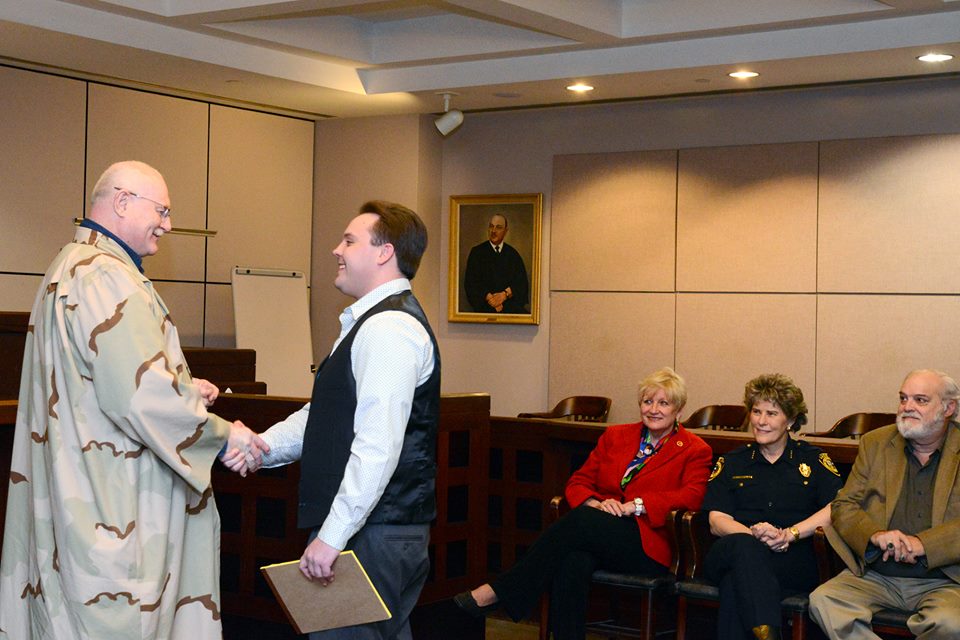 |
| Here's Judge Christian dressed in a camo robe. (source) |
In Jacobs' case, she'd been a model probationer but failed three urinalysis tests toward the end of her 14-month probation period. Her attorney wanted to argue that this was a false positive caused by a diet pill she'd been taking, which long-time readers know is not an implausible scenario, particularly in Bexar County.
But Judge Christian refused to hold a hearing and based his decision to revoke on a brief conversation with the court liaison from the probation department. This violated Jacobs' due process rights, which should have entitled her to challenge evidence against her in a hearing before she's revoked to jail. But Christian went even further. Reported Brodesky:
Not only did Christian sentence her [to jail], but court records show he also denied her appeal for reasonable bail. He then modified a district court judge’s order of bail for $1,600 to make conditions more onerous. Another district judge lessened those conditions, and when Jacobs was finally released from the Bexar County Adult Detention Center in November, Christian responded.
According to court filings: Upon release on bail, Jacobs was scheduled for a pretrial services orientation on Nov. 19, 2018. But Christian called pretrial services and had the orientation changed to Nov. 13, 2018. Pretrial services was unable to notify her about this change, so she missed the orientation. The next day Christian revoked her bail, issuing a warrant for an arrest.
What gives? This is a defendant who was two weeks away from completing 14 months of probation for a serious, but misdemeanor charge.
[Jacobs' attorney Jodi] Soyars said she likes Christian personally, and, obviously, has concerns about crossing him. She has other cases in his court. But she viewed this as representative of a broader issue and unfair to her client.
“He routinely denies defendants the right to due process,” she said.So the judge routinely disallows prosecutors from participating in revocation decisions, acting himself on behalf of the state. And he doesn't allow a defendant to present evidence of possible actual innocence, simply declaring the allegations "true" by fiat without, as Soyars said in her brief, a "scintilla of evidence."
And it wasn't an isolated incident. Again from Brodesky: “There have been situations where our prosecutors have been placed in positions where they are not in agreement with going forward on a motion to revoke,” District Attorney Joe Gonzales said. “And they have made the decision to not sign off on the motions, and the judge has moved on them on his own.”
Let's delve into the secondary issue of denying the defendant bail while her appeal was litigated. The actions attributed to Judge Christian, who went out of his way to thwart the decision of a district judge in a habeas corpus writ, seem like extraordinary measures for a judge to take. The brief from Jacobs' attorney includes a footnote - which the DA's office corroborated (more on this later) - describing the remarkable sequence of events in more detail (citations to the record omitted):
While the appeal and motion for new trial procedures were taking place, some additional procedural issues arose and were dealt with, which are evident in the clerk’s record. A brief explanation to make sense of the clerk’s record follows: After a Notice of Appeal was filed, a Motion for Reasonable Bail Pending Appeal was also filed. . This is a misdemeanor case and bail was required to be granted. Judge Wayne Christian denied bail. An Application for Writ of Habeas Corpus Seeking Setting of Reasonable Bail was then filed and heard by District Court Judge Melisa Skinner in the 290th District Court. Judge Skinner granted the Writ and ordered bail of $1,600 and SCRAM as a condition. . The same day, Judge Christian called his clerk and added full GPS, daily reporting, and daily UAs as conditions of release, effectively changing the order of a District Court judge. A second Application for Writ of Habeas Corpus was then filed, requesting reasonable release conditions. Judge Joey Contreras in the 187th District Court set this Writ for a hearing on October 17, 2018. At the hearing, Judge Contreras granted reasonable conditions. After several weeks passed with Jacobs unable to meet the bail requirements, Judge Contreras amended his bond order to allow Jacobs a way to be released pending the appeal. Jacobs was released from jail and given an orientation date of November 19, 2018 to report to pre-trial services. On November 13, 2018, Judge Christian called pre-trial services and ordered pre-trial services to require Jacobs to report on that date. Pre-trial services was unable to contact Jacobs and Jacobs had not yet had her orientation that would put her under the requirements of pre-trial supervision. Judge Christian then required pre-trial services to send over a violation report on November 14, 2018, whereupon Judge Christian revoked her bail and issued a warrant. Judge Contreras again intervened and reinstated Jacobs’ bail on November 16, 2018.This conduct to my mind, deserves public censure if not ouster by the State Commission on Judicial Conduct. And indeed, in its opinion, the 4th Court of Appeals called Christian's actions an example of "an unsuitable practice by a county court at law judge."
All of this is remarkable, and more than a bit concerning. Judge Christian seems intent on ignoring the mandates of his job and substituting his own judgments for the process. In doing so, he's also increasing incarceration - keep in mind he has the highest numbers of all Bexar-county-court-at-law judges on both revocations and resulting jail-bed days.
But perhaps the most remarkable aspect of the case was the fact that District Attorney Joe Gonzales joined with defense counsel to dispute Christian's "unsuitable" practices, which apparently had been tolerated by his predecessors without contest for many years.
One aspect of electing reform-minded prosecutors Grits had not fully considered (or perhaps more accurately, had not dared dream possible) is that they could challenge unconstitutional court practices from the inside, or join those challenges, as happened here. So kudos to Gonzalez for his stance here, that's a big deal!
Prosecutors' role should be to "seek justice." But too often, they see themselves as on a side, and it's the opposite side from the defendant. So when the judge plays prosecutor as well, as is the practice in Judge Christian's court, defendants without means to pay a phalanx of private lawyers have little chance.
Finally, Grits was interested in the Express-News' analysis that Christian leads all other Bexar judges in motions to revoke. How do we know? That's something tracked in state-level court data, but totals are only available in Office of Court Administration queries at the county-wide level.
Grits doesn't immediately know the data source from which Brodesky identified the number of probation revocations by court. (If any readers know how to access this data from public sources, please let us know in the comments.) But that's a useful figure because, as regular readers are aware, probation revocations are a significant cause of Texas prison admissions, and revoked misdemeanor probationers go to county jail, contributing to local costs.
So, to summarize, here are the implications and questions Grits would take away from this episode (feel free to suggest more in the comments):
- A judge for years felt free to ignore his duties to hold probation-revocation hearings and neither local defense attorneys nor the DA's office called him on it. Is this happening elsewhere?
- Will the State Commission on Judicial Conduct sanction Judge Christian?
- Does this flagrant disregard for judicial duties rise to the level of the state bar challenging Christian's licensure?
- Will media in other jurisdictions begin analyzing which judges have the most probation revocations and hold them accountable for successes/abuses?
- An under-examined aspect of evaluating "progressive" prosecutors will be how they respond to appeals challenging unconstitutional practices and other reform litigation. People have discussed this in the context of bail reform, but Jacobs case shows there are potentially many more areas where this could become important.
Thursday, March 28, 2019
Bail-reform blues: Can't please all parties when reforming pretrial-detention process
Governor Greg Abbott's endorsement of bail reform last year appeared to give the issue fresh life. But Abbott has now backed a bail-reform bill that eschews best practices and instead puts his office at the center of future decisions about pretrial reform.
The Houston Chronicle editorial board rightly opined that the move puts legislative reform efforts at extreme risk, but it's hardly just the governor. There's a swirl of backroom drama surrounding this topic with an array of competing interests and agendas, and no obvious way to navigate the morass. Here's an overview of interests framing the topic:
Never say never, but it's hard to see the path toward threading that needle. And if it were to occur, the resulting bill likely wouldn't resolve the issues at stake in the federal litigation, and we'd be back doing this again in 2021. After the federal litigation has finished, it will be much more clear what needs to be in the bill to ensure counties meet baseline constitutional standards, since they will have been outlined by the 5th Circuit.
In the end, the will may not yet exist to solve the problem through the political process. Certainly there is no consensus regarding what reform should look like and who should control it.
But much could change between now and 2021. If the Lege fails to act this year, odds are federal litigation presently pending in the 5th Circuit will reach its denouement between now and the next time they meet. That will create a new baseline for pretrial-detention rules and give the Legislature much more guidance, and possibly different priorities.
So look for the Texas Lege to revisit bail reform in 2021, whether or not a bill passes this time.
The Houston Chronicle editorial board rightly opined that the move puts legislative reform efforts at extreme risk, but it's hardly just the governor. There's a swirl of backroom drama surrounding this topic with an array of competing interests and agendas, and no obvious way to navigate the morass. Here's an overview of interests framing the topic:
- Federal court injunctions have mainly focused on representation of indigent defendants at bail hearings and eliminating discrimination based on ability to pay.
- Counties oppose requiring appointment of counsel for indigent defendants earlier in the process, considering this an "unfunded mandate."
- The Texas Judicial Council proposed using risk assessments to reduce incarceration of low-risk offenders (the Office of Court Administration developed an instrument based on work by the Laura and John Arnold Foundation to create a version counties could use for free).
- The bail industry opposes use of risk assessments with the heat of a thousand suns and is investing big money in lobbying and communications strategies to undermine bail reform efforts.
- After the death of a state trooper named Damon Allen, Governor Abbott weighed in to say his biggest priority was expanding the scope of preventive detention.
- The criminal defense bar adamantly opposes granting any additional preventive detention powers to the government.
- Criminal-justice reformers are split. In theory, all support reduced pretrial incarceration in county jails, but some oppose the use of risk-assessment algorithms which are viewed as racially biased.
Never say never, but it's hard to see the path toward threading that needle. And if it were to occur, the resulting bill likely wouldn't resolve the issues at stake in the federal litigation, and we'd be back doing this again in 2021. After the federal litigation has finished, it will be much more clear what needs to be in the bill to ensure counties meet baseline constitutional standards, since they will have been outlined by the 5th Circuit.
In the end, the will may not yet exist to solve the problem through the political process. Certainly there is no consensus regarding what reform should look like and who should control it.
But much could change between now and 2021. If the Lege fails to act this year, odds are federal litigation presently pending in the 5th Circuit will reach its denouement between now and the next time they meet. That will create a new baseline for pretrial-detention rules and give the Legislature much more guidance, and possibly different priorities.
So look for the Texas Lege to revisit bail reform in 2021, whether or not a bill passes this time.
Wednesday, November 07, 2018
Viewing the 2018 mid-terms through a Texas #cjreform lens
There are many lenses through which to view the 2018 mid-term elections. On this blog, your correspondent examines Texas politics and policy through the lens of a criminal-justice reformer, so let's think about the election in that vein for just a moment.
But outside of Harris County, from the perspective of criminal-justice reform in Texas, nothing major changed. Republicans still hold all the levers of control. Dems gained a little more influence in state government, but not yet real power. However, momentum for reform wasn't stifled, and on bail reform, in particular, a big obstacle was removed.
At the national level, the only viable criminal-justice reform proposal out there is the First-Step Act, with Sen. Chuck Grassley's sentencing-reform measures now amended onto it. Neither Dems taking the US House nor a few extra R senators should affect the ability of Majority Leader Mitch McConnell to muster 60 votes, given substantial Democratic support, so nothing should change on that front. It will pass, or not, during the lame-duck term. And there's no other significant federal #cjreform on the horizon, outside of whatever the President and Kim Kardashian may be cooking up.
At the Texas Legislature, changes were significant, but not seismic, and not entirely in reformers' favor. Two R senators lost their seats, including Republicans' most ardent criminal-justice reformer, Konni Burton. That's a blow. She's responsible for the most important if unheralded decarceration legislation (increasing property theft thresholds) that Texas ever passed.
The other R senator who lost, Don Huffines, supported abolishing the Driver Responsibility surcharge and eliminating red-light cameras, but otherwise shied away from criminal-justice reform issues and was never much help, though neither was he a hindrance. He was willing to be the fifth or sixth R vote in the Senate for a justice-reform measure; Konni was willing to be the first.
With Dan Patrick, John Whitmire, and Joan Huffman all returning, the senate will feel quite familiar on the #cjreform front. Those players' opinions and dynamics dominate all the major justice-related issues on the eastern side of the capitol and have not changed.
On the House side, Democrats picked up 12 seats. That exceeds (my) expectations and puts them within striking distance - nine seats - of taking control of the lower chamber in 2020 prior to redistricting. It also means that, if the Dems caucus together, any nine Republicans who want the lower chamber's top committee chairs could collaborate - as did Joe Straus and his lieutenants - and choose a Speaker of their own. That prospect was unthinkable when there were only 55 Democrats in the House. But I could imagine ten Republicans bailing on a Dennis-Bonnen speakership, for example, and deciding to place their own stamp on history. Time will tell.
Regardless, criminal-justice reform came out looking pretty good when one considers House elections. The Rs who were outspoken justice-reform supporters like James White or Matt Krause all came back. Indeed, Krause successfully fronted the topic as a wedge issue to blunt a challenger, Nancy Bean, who herself is a long-time justice-reform advocate, dating to the earliest days of the 21st century Texas reform movement.
Across the state, a number of Republicans in hot races turned to the Legislature's justice-reform record as evidence of bipartisanship and/or moderation, including Joan Huffman touting her support for correctional mental-health budgets. And R District Attorney candidates in both San Antonio and Dallas came off more sympathetic to reform than any Republican candidates for those offices in living memory.
Speaking of Dallas, even though national reformers opposed John Creuzot for DA in the primary, some of those same groups are now anointing him as America's next "progressive prosecutor." While that may be extreme - I don't expect Judge Creuzot suddenly to transform into Philadelphia's Larry Krasner - he did promise that within 90 days of taking office he would produce a plan for what the DA's office could do to reduce mass incarceration. Grits is very much looking forward to seeing that document.
Although no statewide elected officials were dethroned, judicial elections did reveal a chink in the Republicans' partisan armor: Democrats won 30 of 32 contested seats on the intermediate courts of appeal, including 19 previously held by Republicans. Reported the Texas Tribune, Democrats appeared to "flip four major appeals courts, taking back majorities in the judicial districts that serve Austin, Dallas and Houston. The 5th Court of Appeals, based in Dallas, has not elected a Democrat since 1992; on Tuesday, the 13-member court was set to elect eight Democrats, including a Democratic chief justice." As a result, seven of the fourteen intermediate courts of appeal in Texas now have Democratic majorities.
Further, Dems swept all 59 judicial seats at play in Harris County, including nineteen black women elected. All the misdemeanor court judges who opposed the civil-rights suit against the county over unconstitutional bail practices lost (as did one R who supported reform). And a new, 27-year old Democratic county judge was elected who wants to settle the bail suit, and boasts a legitimate #cjreform record (along with a poli-sci degree from Stanford and a law degree from Harvard). That may make the denouement of that complex drama unfold differently than it would have otherwise. The two sides will soon be briefing the 5th Circuit headed toward a final conclusion. At a minimum the contents of those briefs may now be quite different, and a settlement now seems more likely.
But outside of Harris County, from the perspective of criminal-justice reform in Texas, nothing major changed. Republicans still hold all the levers of control. Dems gained a little more influence in state government, but not yet real power. However, momentum for reform wasn't stifled, and on bail reform, in particular, a big obstacle was removed.
We're in a transitional moment in national and state-level politics, and yesterday's elections had the feel of a violent maelstrom. But in the center of it, there was a calm surrounding prospects for bipartisan justice reform. Momentum for #cjreform didn't improve by leaps and bounds, but neither was it drastically harmed. In 2018, Texas candidates in both parties tended to view justice reform as a popular crossover issue with legs. That's a big change from just a few years ago, and the import of that transformation shouldn't be underestimated.
RELATED: For those interested, compare this item with Grits' pre-election analysis.
RELATED: For those interested, compare this item with Grits' pre-election analysis.
Monday, September 10, 2018
TX Judicial Council recommendations on bail reform
Check out the Texas Judicial Council's legislative recommendations related to pretrial detention/bail reform, and the description of the risk assessment instrument they're recommending to legislators in committee hearings.
From the handout: "A recent study showed that defendants who spent three or more days in jail were more likely to lose employment, report serious financial difficulty, experience issues with residential stability and less likely to be able to support dependent children."
And a mere three days of pretrial detention, for many defendants, would be a welcome respite from the reality: "Nearly 20% of felony cases take more than a year to dispose and more than 50% percent of misdemeanors remain pending over six months – meaning individuals held in jail while awaiting trial stay for considerable amounts of time."
With Gov. Abbott having entered the mix over the summer, vowing to name bail-reform legislation after a dead state trooper whose killer he believes shouldn't have been released on bail, one of the shortest distances to passing bail reform would be if a meeting of the minds between Gov. Abbott, himself a former Texas Supreme Court Justice, and current TSC Chief Justice Nathan Hecht could form the basis for consensus among statewide elected officials. So the details of what the Judicial Council proposes on this score are important, and likely form the basis for bail-reform legislation next year.
Some of the things Gov. Abbott wants done regarding preventive detention would require a constitutional amendment, which requires a two-thirds legislative vote in both chambers, as opposed to a simple majority in the House and 3/5 in the Senate, as is required for regular legislation.
With Gov. Abbott's sudden interest, bail reform is shaping up to be a major #cjreform topic during the 86th Texas Legislature. However, even if something like SB 1338 from last session is able to pass this time - and given the motivated fervor and deep pockets of bail-industry opposition, that's not a sure thing - measures that require changing the constitution may still end up being hard-fought votes.
From the handout: "A recent study showed that defendants who spent three or more days in jail were more likely to lose employment, report serious financial difficulty, experience issues with residential stability and less likely to be able to support dependent children."
And a mere three days of pretrial detention, for many defendants, would be a welcome respite from the reality: "Nearly 20% of felony cases take more than a year to dispose and more than 50% percent of misdemeanors remain pending over six months – meaning individuals held in jail while awaiting trial stay for considerable amounts of time."
With Gov. Abbott having entered the mix over the summer, vowing to name bail-reform legislation after a dead state trooper whose killer he believes shouldn't have been released on bail, one of the shortest distances to passing bail reform would be if a meeting of the minds between Gov. Abbott, himself a former Texas Supreme Court Justice, and current TSC Chief Justice Nathan Hecht could form the basis for consensus among statewide elected officials. So the details of what the Judicial Council proposes on this score are important, and likely form the basis for bail-reform legislation next year.
Some of the things Gov. Abbott wants done regarding preventive detention would require a constitutional amendment, which requires a two-thirds legislative vote in both chambers, as opposed to a simple majority in the House and 3/5 in the Senate, as is required for regular legislation.
With Gov. Abbott's sudden interest, bail reform is shaping up to be a major #cjreform topic during the 86th Texas Legislature. However, even if something like SB 1338 from last session is able to pass this time - and given the motivated fervor and deep pockets of bail-industry opposition, that's not a sure thing - measures that require changing the constitution may still end up being hard-fought votes.
Sunday, July 29, 2018
What the judges want: Judicial Council recommendations to the #txlege
The Texas Judicial Council last month issued its recommendations to the Legislature on criminal-justice reform heading into the 86th session in 2019. Let's take a look at what judges are asking of the Texas Lege.
'Data! Data! Data! I cannot make bricks without clay'
Although listed under the heading for opioids, a recommendation to improve statewide collection of case-level court data deserved to be highlighted more prominently. The Council wants Texas to begin collecting:
Establish an Opioid Task force
Yawn. Outside of Houston, meth is the bigger problem in Texas. And solutions on overdose deaths are the same no matter which drugs we're talking about.
'Pretrial Decision Making Processes'
The Judicial Council recommended eight different items on bail reform, providing a comprehensive roadmap for the Legislature to shift from money bail to risk assessments when determining pretrial detention. The list includes both statutes and constitutional amendments necessary to implement the plan, with rulemaking at the Office of Court Administration to flesh out the details within a "sufficient transition period."
In the Judicial Council's vision, all defendants would be assessed for potential risk with a validated instrument developed by the Office of Court Administration. The state constitution would be amended to a) create a presumption that defendants will be released on personal bond and b) allow judges to detain defendants they deem to be a public safety risk regardless of their ability to pay.
They want the Legislature to help fund pretrial supervision as well as training for magistrates and others making bail decisions. They also want the Lege to require data collection on pretrial-release decisions as part of the reforms.
Getting the Governor Out of Specialty Court Oversight
This one is interesting. Under Gov. Rick Perry, specialty courts in Texas blossomed. Today, "Over 190 specialty court dockets operate across Texas, including DWI court, drug court, family drug court, veterans court, mental health court, and commercially sexually exploited persons court," with the Governor's Criminal Justice Division the largest funder. But this was the prior Governor's priority, not this one. So it's little surprise that the Judicial Council might suggest that "certification and oversight" of specialty court programs be shifted from the Governor's CJD to the Office of Court Administration, which answers more directly to the judiciary.
The Council noted that current practice in Texas is out of step with national norms; only one other state places oversight authority for specialty courts with the Governor.
Firearms
This was clearly their most tentative proposal. Of all the things judges might request to stop mass shootings, asking the Legislature to fund better data entry into the national background check system is one of the least controversial, least bold, and least-likely-to-make-a-big-difference reforms you might name. But it's the only thing they could come up with.
'Data! Data! Data! I cannot make bricks without clay'
Although listed under the heading for opioids, a recommendation to improve statewide collection of case-level court data deserved to be highlighted more prominently. The Council wants Texas to begin collecting:
relevant case level data from all court levels including magistrates, to generate more timely and detailed information to support policy, planning, management, and budget decisions for the justice system. The collection of the relevant case level data should be fully funded by the Legislature.This recommendation would have policy making implications well beyond the opioid crisis, and would benefit legislators themselves as much as anyone. As Grits mentioned earlier this week, you can't manage what you can't measure. And there are large swaths of the justice system that cannot be managed because it's impossible to talk with precision about exactly what's happening on the ground. Case-level data could help change that. (MORE: A helpful commenter pointed out the Council put out a separate set of recommendations specifically addressing data issues; see here.)
Establish an Opioid Task force
Yawn. Outside of Houston, meth is the bigger problem in Texas. And solutions on overdose deaths are the same no matter which drugs we're talking about.
'Pretrial Decision Making Processes'
The Judicial Council recommended eight different items on bail reform, providing a comprehensive roadmap for the Legislature to shift from money bail to risk assessments when determining pretrial detention. The list includes both statutes and constitutional amendments necessary to implement the plan, with rulemaking at the Office of Court Administration to flesh out the details within a "sufficient transition period."
In the Judicial Council's vision, all defendants would be assessed for potential risk with a validated instrument developed by the Office of Court Administration. The state constitution would be amended to a) create a presumption that defendants will be released on personal bond and b) allow judges to detain defendants they deem to be a public safety risk regardless of their ability to pay.
They want the Legislature to help fund pretrial supervision as well as training for magistrates and others making bail decisions. They also want the Lege to require data collection on pretrial-release decisions as part of the reforms.
Getting the Governor Out of Specialty Court Oversight
This one is interesting. Under Gov. Rick Perry, specialty courts in Texas blossomed. Today, "Over 190 specialty court dockets operate across Texas, including DWI court, drug court, family drug court, veterans court, mental health court, and commercially sexually exploited persons court," with the Governor's Criminal Justice Division the largest funder. But this was the prior Governor's priority, not this one. So it's little surprise that the Judicial Council might suggest that "certification and oversight" of specialty court programs be shifted from the Governor's CJD to the Office of Court Administration, which answers more directly to the judiciary.
The Council noted that current practice in Texas is out of step with national norms; only one other state places oversight authority for specialty courts with the Governor.
Firearms
This was clearly their most tentative proposal. Of all the things judges might request to stop mass shootings, asking the Legislature to fund better data entry into the national background check system is one of the least controversial, least bold, and least-likely-to-make-a-big-difference reforms you might name. But it's the only thing they could come up with.
No IAC Fix Suggested
One item Grits noticed was conspicuous by its absence. On the Court of Criminal Appeals, Judge Elsa Alcala has been calling for a legislative fix on ineffective assistance of counsel, which for the most part can only be challenged via habeas-corpus writs where defendants do not have access to an attorney. After four US Supreme Court justices raised the same issue in a recent dissent, Grits thought the subject might secure the Judicial Council's attention. I don't know whether they considered it or not, but clearly it didn't make the final cut.
Wednesday, May 02, 2018
One in three murder charges in TX a capital case
Now that the new Annual Statistical Report for the Texas judiciary is out, let's take a quick look at data on capital murder cases in Texas from FY 2017. (See p. 111 of the linked pdf from the Office of Court Administration.)
Texas prosecutors filed capital-murder charges in 446 cases last year, and gained capital convictions 249 times, including 162 by plea bargain and 74 by jury trial.*
Almost all of these resulted in LWOP sentences. The OCA reported that prosecutors announced plans to seek the death penalty in only three cases in 2017.
Six defendants were acquitted of capital murder at trial last year. Charges were dismissed in another 84 cases. (That'd be an interesting subset to review - that's a pretty high number.)
There were 897 capital murder cases pending statewide at the end of the year.
By comparison, there were 854 "regular" murder charges filed in 2017, with prosecutors generating 536 convictions. In addition, 31 murder defendants were acquitted at trial, with another 187 having charges dismissed.
One thought from these data: If prosecutors filed capital murder 446 times in 2017 and murder 854 times, then capital charges are not being reserved for the "worst of the worst." Not unless one believes one in three killers deserves that moniker. This overcharging is fueling an unnecessary shortage of capital-qualified trial attorneys statewide. While some have seen that shortage as a reason to reduce qualifications for capital-qualified attorneys, to me the better solution is for prosecutors to rein in this overcharging penchant and only use capital charges in truly exceptional cases.
*Obviously, these aren't all the same cases. Few capital murder cases are resolved within 12 months, and many if not most convictions were from cases filed in previous years. I'm analyzing overall patterns here, not claiming the cases in the "indicted" column are the same as those "convicted" in the same year.
Texas prosecutors filed capital-murder charges in 446 cases last year, and gained capital convictions 249 times, including 162 by plea bargain and 74 by jury trial.*
Almost all of these resulted in LWOP sentences. The OCA reported that prosecutors announced plans to seek the death penalty in only three cases in 2017.
Six defendants were acquitted of capital murder at trial last year. Charges were dismissed in another 84 cases. (That'd be an interesting subset to review - that's a pretty high number.)
There were 897 capital murder cases pending statewide at the end of the year.
By comparison, there were 854 "regular" murder charges filed in 2017, with prosecutors generating 536 convictions. In addition, 31 murder defendants were acquitted at trial, with another 187 having charges dismissed.
One thought from these data: If prosecutors filed capital murder 446 times in 2017 and murder 854 times, then capital charges are not being reserved for the "worst of the worst." Not unless one believes one in three killers deserves that moniker. This overcharging is fueling an unnecessary shortage of capital-qualified trial attorneys statewide. While some have seen that shortage as a reason to reduce qualifications for capital-qualified attorneys, to me the better solution is for prosecutors to rein in this overcharging penchant and only use capital charges in truly exceptional cases.
*Obviously, these aren't all the same cases. Few capital murder cases are resolved within 12 months, and many if not most convictions were from cases filed in previous years. I'm analyzing overall patterns here, not claiming the cases in the "indicted" column are the same as those "convicted" in the same year.
Sunday, April 01, 2018
NY Times story on Galveston indigent defense ripe for other reporters to localize
In the New York Times last week (March 29), former Austin Statesman editor Richard Oppell authored an article that could resonate throughout Texas indigent defense systems, as it describes a practice that's widespread, not remotely limited to the judge or attorney in Galveston at the center of the story. Here's the heart of the allegations:
A criminal defense lawyer in Galveston, Tex., says he was pulled off cases defending poor clients because he spent too much time on them and requested funds to have their charges investigated.
Needless to say, his clients were not the ones complaining. Instead, it was the judge, Jack Ewing, who appoints lawyers for those in his courtroom who cannot afford them. “You overwork cases,” Judge Ewing told the lawyer, Drew Willey, according to excerpts from a recorded conversation cited in the lawsuit.
Though an estimated four of every five criminal defendants in the United States use court-appointed lawyers or public defenders, many of the nation’s indigent defense systems have been criticized as desperately inadequate, leading to false guilty pleas and overincarceration.
Lawyers who represent the poor can be required to juggle hundreds of cases at a time, accept pay far lower than the market rate, or take cases for which they have little experience.
This new case, though, exposes another potential problem: Indigent defense lawyers often get their assignments from the judges in whose courtroom they appear. This discourages a robust defense, experts say, and leads to an emphasis on resolving cases quickly.
The tensions may be familiar to lawyers, but they are rarely so candidly aired as in this lawsuit, filed in federal court last week and bolstered by parts of a recorded conversation with the judge.Grits has heard similar stories from defense attorneys for as long as I've paid attention to the Texas justice system, including attorneys stiffed not just for time worked but also for investigators' fees or even forensic services.
Which brings me to this observation for Texas-based reporters: This is a national story which can be localized. This isn't the only Texas jurisdiction, by any stretch, in which judges reduced pay requests from lawyers as excessive when they tried to put on a zealous defense. There are also stories out there of lawyers losing out on appointments because judges considered them a tad too zealous. Attorneys who make a living representing indigent clients must routinely take on caseloads well beyond bar-association-recommended guidelines in order to pay for a mortgage, middle-class lifestyle, and law-school debts. This story explains why, and it's not just happening in Galveston.
So, for my reporter friends on the local courthouse beat: There's a courthouse paper trail on cases where judges reduce attorneys' fees, which a local attorney who takes indigent cases or the court coordinator can help you identify. Then, one simply calls up the attorneys to ask why they requested the additional pay. Follow up with calls to the judges in question to get their side of the story; the county judge so s/he can lodge a complaint about unfunded mandates from the state; then make a call to indigent defense experts like the Texas Fair Defense Project or Civil Rights Corps (the two nonprofits that sued over Harris County's unconstitutional bail practices), and you've just localized a national story.
Indeed, there's a small mountain of data, including lawyer-specific payment information, available from the Texas Indigent Defense Commission. Once you dig into these topics, there's a lot of material for an enterprising reporter with which to work.
So thanks, Richard Oppell, for exposing a statewide problem in the form of this Galveston anecdote. Now it's up to Texas reporters to pick up the baton and expose the same practices in their own jurisdictions. The story's there to be had, and "It would make some local judges mad" isn't a good enough reason not to report it.
Tuesday, February 27, 2018
On the institutional basis for ineffective assistance: Travis Jail Reduction Docket
Travis County will make unspecified changes to their "jail reduction docket" to counter criticisms that it operated as a plea mill coercing guilty pleas out of jailed misdemeanor defendants in exchange for their freedom. Misdemeanants who couldn't make bail would be herded into the courtroom in bunches, meet their lawyer for the first time sitting on a bench in the courtroom, and typically plea guilty in exchange for time served and their freedom. As Grits noted earlier, this has been going on for at least two decades.
In their defense, "Since 2014, there has been a 50 percent increase in defendants who have received a personal bond at Jail Reduction Docket." So use of personal bonds for misdemeanants has been increasing. Judge Elisabeth Earle said judges want to do more personal bonds but "Sometimes lawyers don’t want to present them." (Read: Sometimes Austin criminal defense lawyers provide ineffective assistance to their clients, and judges pretend there's nothing we can do.)
Otoh, there may be a practical reason lawyers aren't going the extra mile: The Statesman article noted that, "pay for attorneys who resolve cases in the jail reduction court was lowered in 2016 from $275 to $175," which hardly bodes well for quality representation but which likely does reflect (or even overstate) the amount of time presently spent on each case. Perhaps the problem is simply that nobody's getting paid enough to investigate a client's background even minimally to make the case for a personal bond?
Of course, just because there's a structural, institutional "nudge" embedded in the system encouraging ineffective assistance doesn't excuse it. Attorneys are professionals obliged to exhibit at least minimal levels of competence at their craft. However, the Jail Reduction Docket seems to rely and thrive on underpaid attorneys not putting up much of a fuss.
All of which to me constitutes further evidence that Travis County needs a public defender if the commissioners court wants competent representation for the indigent. The private bar has, for too long, controlled that process and their clients' interests - not to mention the taxpayers' interest, and the interests of justice - have suffered as a result.
See prior coverage at the Austin Chronicle for more detail.
In their defense, "Since 2014, there has been a 50 percent increase in defendants who have received a personal bond at Jail Reduction Docket." So use of personal bonds for misdemeanants has been increasing. Judge Elisabeth Earle said judges want to do more personal bonds but "Sometimes lawyers don’t want to present them." (Read: Sometimes Austin criminal defense lawyers provide ineffective assistance to their clients, and judges pretend there's nothing we can do.)
Otoh, there may be a practical reason lawyers aren't going the extra mile: The Statesman article noted that, "pay for attorneys who resolve cases in the jail reduction court was lowered in 2016 from $275 to $175," which hardly bodes well for quality representation but which likely does reflect (or even overstate) the amount of time presently spent on each case. Perhaps the problem is simply that nobody's getting paid enough to investigate a client's background even minimally to make the case for a personal bond?
Of course, just because there's a structural, institutional "nudge" embedded in the system encouraging ineffective assistance doesn't excuse it. Attorneys are professionals obliged to exhibit at least minimal levels of competence at their craft. However, the Jail Reduction Docket seems to rely and thrive on underpaid attorneys not putting up much of a fuss.
All of which to me constitutes further evidence that Travis County needs a public defender if the commissioners court wants competent representation for the indigent. The private bar has, for too long, controlled that process and their clients' interests - not to mention the taxpayers' interest, and the interests of justice - have suffered as a result.
See prior coverage at the Austin Chronicle for more detail.
Saturday, September 23, 2017
Public defender for appeals would reduce waste, increase efficiency, protect rights
Lots of appeals in Texas' criminal-court system are filed pro se by people who lack representation, and often they make procedural errors that prevent the courts from ever considering the merits of their case. Here's an example.
My podcast partner, Mandy Marzullo at the Texas Defender Service, has been promoting the idea of a capital public defender for direct appeals (see a related report from TDS), and the chairman of the House Corrections Committee filed legislation to create one (see here for an interview with him that includes a discussion of this topic).
But at least capital defendants all have lawyers of some sort, even if they're too often deficient. The guy in this case had no lawyer at all. He filed his appeal in time, but with the wrong bureaucrat, in the wrong court - an error even the lamest practicing attorney wouldn't have made - and so the merits were never considered. But that's not the end of it: inevitably, the guy ends up filing a habeas corpus petition on the back end - meaning courts have to process his claims twice - all because the defendant had no access to legal counsel for an appeal.
If that seems wasteful, the waste serves a self-interested purpose for some actors in the system: A lot of error, ineffective lawyering, unrecognized rights, and wrongful convictions get swept under the rug that way.
States with appellate divisions at statewide public defenders avoid some of these problems, resulting in a more efficient process where the courts' focus is on the underlying issues at stake, not procedural correctness. But in Texas, if an indigent defendant cannot pay for an attorney to file an appeal - and they are not accused of capital murder - the government does not pay for a lawyer to file anything beyond an initial, pro forma appeal, and too often, as in this case defendants don't even get that much help.* There's a penny-wise-and-pound-foolish aspect to this structure, which too often appears as though it were devised to serve the interests of entrepreneur-attorneys over the goal of defending the constitutional rights of defendants.
RELATED: From Raw Story, "Every year millions try to navigate US courts without a lawyer."
*An earlier version of this post incorrectly stated when the government will pay for indigent appeals. Thanks to a commenter for correcting my error.
My podcast partner, Mandy Marzullo at the Texas Defender Service, has been promoting the idea of a capital public defender for direct appeals (see a related report from TDS), and the chairman of the House Corrections Committee filed legislation to create one (see here for an interview with him that includes a discussion of this topic).
But at least capital defendants all have lawyers of some sort, even if they're too often deficient. The guy in this case had no lawyer at all. He filed his appeal in time, but with the wrong bureaucrat, in the wrong court - an error even the lamest practicing attorney wouldn't have made - and so the merits were never considered. But that's not the end of it: inevitably, the guy ends up filing a habeas corpus petition on the back end - meaning courts have to process his claims twice - all because the defendant had no access to legal counsel for an appeal.
If that seems wasteful, the waste serves a self-interested purpose for some actors in the system: A lot of error, ineffective lawyering, unrecognized rights, and wrongful convictions get swept under the rug that way.
States with appellate divisions at statewide public defenders avoid some of these problems, resulting in a more efficient process where the courts' focus is on the underlying issues at stake, not procedural correctness. But in Texas, if an indigent defendant cannot pay for an attorney to file an appeal - and they are not accused of capital murder - the government does not pay for a lawyer to file anything beyond an initial, pro forma appeal, and too often, as in this case defendants don't even get that much help.* There's a penny-wise-and-pound-foolish aspect to this structure, which too often appears as though it were devised to serve the interests of entrepreneur-attorneys over the goal of defending the constitutional rights of defendants.
RELATED: From Raw Story, "Every year millions try to navigate US courts without a lawyer."
*An earlier version of this post incorrectly stated when the government will pay for indigent appeals. Thanks to a commenter for correcting my error.
Sunday, March 12, 2017
Criminal justice job security in an era of declining crime
Despite crime near recorded lows in many areas, Texas cops, prosecutors and courts continue to treat the drug war as a growth industry. Here are a few tidbits from David Slayton's introduction to the FY 2016 Annual Statistical Report for the Texas Judiciary:
- The number of traffic and parking cases fell 37 percent from its peak in 2006 and is at the lowest level in more than 30 years – traffic and parking cases make up over 80 percent of the fine-only misdemeanor cases in the state;
- The number of truancy cases fell 91 percent and parent contributing to nonattendance fell 71 percent on the heels of truancy reforms that went into effect at the beginning of the fiscal year;
- The number of capital murder convictions (3) and death sentences (3) dropped to an all-time low;
- Despite the fact that new misdemeanor cases have fallen 29 percent in the last ten years and is at the lowest rate since 1992, new misdemeanor drug cases increased 9 percent to a new peak;
- Felony drug possession cases increased 7 percent and is up 28 percent in the last five years;
- The number of misdemeanor and felony theft cases dropped 32 percent and 14 percent, respectively, with the misdemeanor thefts marking the lowest number in at least 30 years; (emphasis added)
Notably, DWI cases "were at the lowest number in at least 30 years and was nearly half of the number filed in 1985." This is mainly because of prosecutors and judges diverting DWI cases to offenses which don't include the Driver Responsibility surcharge.
Grits has discussed before how convictions continued to rise in Texas even as crime and arrests waned in recent years. These fact-bites demonstrate how. When crimes with victims aren't available to prosecute, you go after crimes without them, like drug possession. Job security, baby!
That's especially true for felony cases. "The number of new felony cases filed was 6 percent lower than the peak rate in 2007, but it has increased slightly each of the last four years." However, "Drug cases accounted for nearly a third of new felony cases filed in 2016." So the drug war is the principle source of growth in felony filings.
In related news, civil cases are dropping, but "civil related to criminal" - e.g., bond forfeitures, nondisclosure, occupational licenses, etc. - rose significantly over the last five years.
Another notable judicial trend mentioned in the introduction: "The number of opinions issued by the Court of Criminal Appeals increased 64 percent, pushing the time to process petitions for discretionary review slightly upward." This has a lot to do with Presiding Judge Sharon Keller. She was on the losing end of more decisions than usual in FY 2016 and typically had something to say about it in a slew of dissents. Judge Elsa Alcala also contributed to that number.
Grits has discussed before how convictions continued to rise in Texas even as crime and arrests waned in recent years. These fact-bites demonstrate how. When crimes with victims aren't available to prosecute, you go after crimes without them, like drug possession. Job security, baby!
That's especially true for felony cases. "The number of new felony cases filed was 6 percent lower than the peak rate in 2007, but it has increased slightly each of the last four years." However, "Drug cases accounted for nearly a third of new felony cases filed in 2016." So the drug war is the principle source of growth in felony filings.
In related news, civil cases are dropping, but "civil related to criminal" - e.g., bond forfeitures, nondisclosure, occupational licenses, etc. - rose significantly over the last five years.
Another notable judicial trend mentioned in the introduction: "The number of opinions issued by the Court of Criminal Appeals increased 64 percent, pushing the time to process petitions for discretionary review slightly upward." This has a lot to do with Presiding Judge Sharon Keller. She was on the losing end of more decisions than usual in FY 2016 and typically had something to say about it in a slew of dissents. Judge Elsa Alcala also contributed to that number.
Monday, February 27, 2017
States' rights Trumped: An ode to forgotten federalism
Okay, we've heard a lot about federalism and states' rights from Governor Greg Abbott over the years. So will we now hear an outcry from the governor after ICE agents showed up at a Texas state district court and arrested an undocumented domestic violence victim who'd just received a protective order from an elected Texas judge? See the details here.
Nine percent of Texas' workforce are illegal immigrants. That's a lot of people, and a lot of women and kids, to boot. Will other undocumented domestic violence victims now resist reporting their abusers to authorities because petitioning a Texas court for protection could mean they'll be arrested? Won't kids who are physically or sexually abused face the same hesitation to report serious crimes? Think about it: Is that a good idea?
Having ICE agents show up at Texas state courts is a slap in the face to the state from a President for whom it voted overwhelmingly. It's just plain disrespectful of state court processes and the concept of federalism for the feds to arrest someone the moment after a Texas state court gave out a protective order.
Grits won't hold my breath for Governor Abbott to stand up and defend states rights in this context. His endorsement of those principles has always seemed opportunistic and I don't expect him to stand on them when they fly in the face of a Republican president's policies. Party seems to matter a lot more than principle in politics these days. But a true protector of state's rights would have something to say about the feds undermining the state of Texas' ability to effectively fight crime by driving crime victims into the shadows. Maybe one day Texas will elect one.
Nine percent of Texas' workforce are illegal immigrants. That's a lot of people, and a lot of women and kids, to boot. Will other undocumented domestic violence victims now resist reporting their abusers to authorities because petitioning a Texas court for protection could mean they'll be arrested? Won't kids who are physically or sexually abused face the same hesitation to report serious crimes? Think about it: Is that a good idea?
Having ICE agents show up at Texas state courts is a slap in the face to the state from a President for whom it voted overwhelmingly. It's just plain disrespectful of state court processes and the concept of federalism for the feds to arrest someone the moment after a Texas state court gave out a protective order.
Grits won't hold my breath for Governor Abbott to stand up and defend states rights in this context. His endorsement of those principles has always seemed opportunistic and I don't expect him to stand on them when they fly in the face of a Republican president's policies. Party seems to matter a lot more than principle in politics these days. But a true protector of state's rights would have something to say about the feds undermining the state of Texas' ability to effectively fight crime by driving crime victims into the shadows. Maybe one day Texas will elect one.
Monday, January 09, 2017
Texas' top judges hold summit to address trust in criminal justice system
Thanks to Grits contributing writer Eva Ruth Moravec for attending this event in Dallas. Grits had wanted to go but ended up at the dentist instead, so I appreciate her writing it up.
"But we're different here in Texas," said Nathan Hecht, chief justice of the Supreme Court of Texas at the December summit in Dallas. "We decided instead just to invite all the judges."
Personal invitations from Hecht and Sharon Keller, presiding judge of the Texas Court of Criminal Appeals, were enough to summon 50 Texas judges out of their courtrooms on a weekday and into a heavily secured auditorium at Paul Quinn College. Total attendance at the summit was about 200.
The need for the curriculum - whether in televised shorts or taught live - arose in the wake of the fatal shooting of Michael Brown and riots that followed in Ferguson, Missouri, in 2014, Hecht said. Over the past 12 months, he said, the Conference of Chief Justices has been working on how to keep the community from distrusting courts.
"We need to be proactive about trust issues and to enhance trust," Hecht said. "We're concerned about how courts are affected by mistrust."
He opened the summit with a montage of news footage from high-profile shootings by and of police, then asked attendees to reflect quietly. Otherwise, the day was completely packed by the summit's planners, including state supreme court Justice Eva Guzman - the wife of a Houston police sergeant and daughter of immigrants - with interesting speakers.
"A single day is certainly not enough time to restore complete trust in the justice system," Guzman said, adding she hoped attendees realize how their life experiences affect how they handle things.
Keynote speaker Houston Police Chief Art Acevedo implored attendees to be courageous, bold and to "put away broad brushes. Don't be afraid to lose your job."
The theme of courage united several of the day's diverse speakers and panel participants, like Emily Thompson, a Dallas Area Rapid Transit officer who is back to work after her husband was killed in an ambush attack along with four others officers last summer.
Arielle Clarkson, a Paul Quinn student, said the strangulation of her brother by a police officer 10 years ago "shattered my understanding of what it meant to be protected by the police." She hopes to become a lawyer to address injustices.
At St. Paul United Methodist Church in Dallas, a program called Together We Learn tries to bring the community and law enforcement together for things like basketball games so their interactions aren't always negative.
"The harsh reality is, people of color, when we see the police, we think something's wrong," Senior Pastor Richie Butler said. "We have to change perceptions and see people for who they really are - humans."
Cornell Law School professor Jeffrey Rachlinski said even the well-intended have biases and lectured on human beings' decision-making processes. He advised judges to start recording demographics and outcomes of their cases so they are more aware of disparities.
(Rachlinski's suggestion was one of two I heard throughout the day on how to improve trust in the courts; the other was an idea from Hecht for trial judges to explain their rulings.)
To demonstrate how underlying biases may affect juvenile justice, former state judge and professor F. Scott McCown moderated a panel of experts who told the audience what would happen to a hypothetical foster child who got in trouble at a new school. Sadly, most panelists concluded the youngster would eventually end up in jail.
"We have to get past race," said criminal defense attorney Carmen Roe of Houston, a panelist whose pretend-task it was to defend the troubled foster child.
"How do we make changes? One person at a time," said Dr. Griselda Villalobos, a licensed clinical social worker in El Paso who regularly works with children in and out of the system.
Although most of the day's dialogue pointed out problems that lacked solutions, attendees seemed pleased they were there. As the summit closed with remarks from Oak Cliff Bible Fellowship's Senior Pastor Tony Evans, sunlight streamed through the oatmeal-colored floor-to-ceiling drapes that had separated the day's events from the campus and surrounding deprived neighborhood.
"We are looking at a fraying society," said Evans, analogizing that high-profile shootings are like cracks in the walls of a home with a failing foundation. "If we get the one thing right, it can solve many things."
Subscribe to:
Posts (Atom)


.jpg)

