Showing posts with label Juries. Show all posts

Saturday, March 26, 2022

Custodians of History: Old prosecutor files include marginalized voices usually excluded from public media and discourse

Conversations about crime data and police and prosecutor files most frequently pertain to the news of the moment: Did bail reform cause crime to increase? Was this or that police officer held accountable? Are black folks disproportionately stopped for traffic offenses?

But lately your correspondent has undertaken a research project reminding me that these records have much greater value than just informing policy debates of the moment. In many cases, they're the only records available involving important historical people and events. District Attorney and police agencies are among the earliest, continuously operating government departments, and case files are a rich source of detailed, local information.

This is especially important when mainstream information sources about marginalized people are scarce. For example, in New York City, prosecutor records were used to document the early 20th century exploits of an undercover policewoman investigating abortion doctors. Wrote one of the authors of that investigation:
These files record the lives of marginalized populations, often silenced in the historical record. Poor New Yorkers, women, immigrants, queer residents, and people of color, whose lives might have evaded contemporary published material but whose voices appear -- albeit refracted through the justice system -- in these archives.
We're finding that's true in the historical stories I'm researching centered in East Austin. Researching black history in Texas from the 1920s and '30s is a tremendous slog: only a few editions of the main black newspapers remain, and the white press largely ignored black news, sports, and culture. But many of these same people interacted all too frequently with the justice system. To the extent their voices can still be discovered at all, often it's only "refracted" through that ignominious but invaluable lens.

After 75 years, Texas state law eliminates most confidentiality restrictions and discretionary authority to withhold release on criminal records, making them technically public. But most DA's offices don't treat them that way. Here in Travis County, my wife and I recently filed an open records request for files from the early 1940s. The Travis County DAO initially replied that they intended to deny disclosure under all the "discretionary" exceptions they could identify. 

We appealed the matter, pointing out that the Public Information Act doesn't afford them any of those discretionary exceptions. The DA agreed, and supposedly we'll get those records soon. But what's really needed is for prosecutors to develop written policies about record retention and release, then to migrate files to local archivists better trained to handle and preserve them. 

What kind of records are we talking about? Certainly, it differs case by case. But we have lots of examples because, in 2009, then-Travis-County-District-Attorney Ronnie Earle transferred 35 boxes of records, mostly from the 1940s and 1970s, to the Travis County Archivist, which also retains old records for the constables offices, the probation department, and other county law enforcement agencies.

The transfer of these 35 boxes appears to have been a one off. The archivist said there was something in the database about concerns that the files were deteriorating wherever the DAO stored them before. Regardless, they're now all sitting on a shelf at the archivist's office on Airport Blvd.

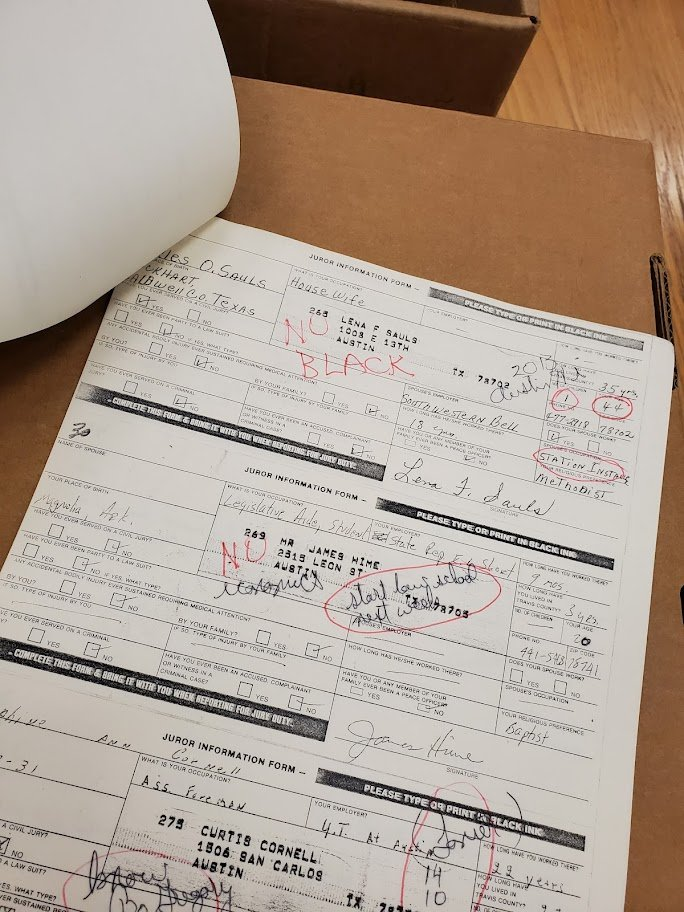
Kathy and I went to review several of these boxes to see if they contained files related to the now-long-deceased people I was researching. They did not. But Kathy noticed these documents in an unrelated case in which prosecutors adamantly struck black jurors in red pen:

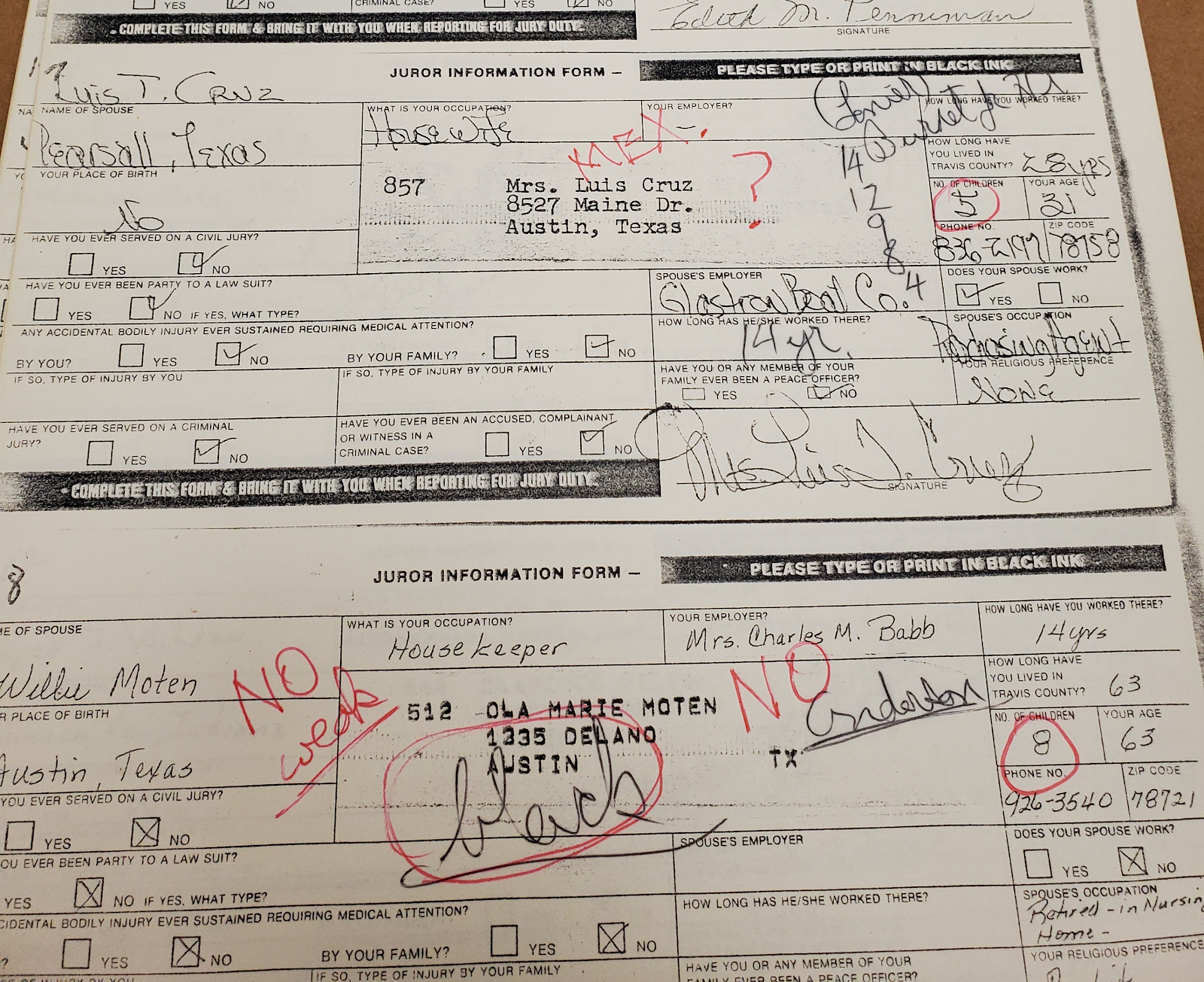
Here's another example:


I'm not a lawyer, but I'm pretty sure these aren't Batson-approved jury-selection practices. After I posted these photos on Twitter, I got an email from the Travis County DA's first assistant saying she'd referred it to their Conviction Integrity Unit! Bully for them.

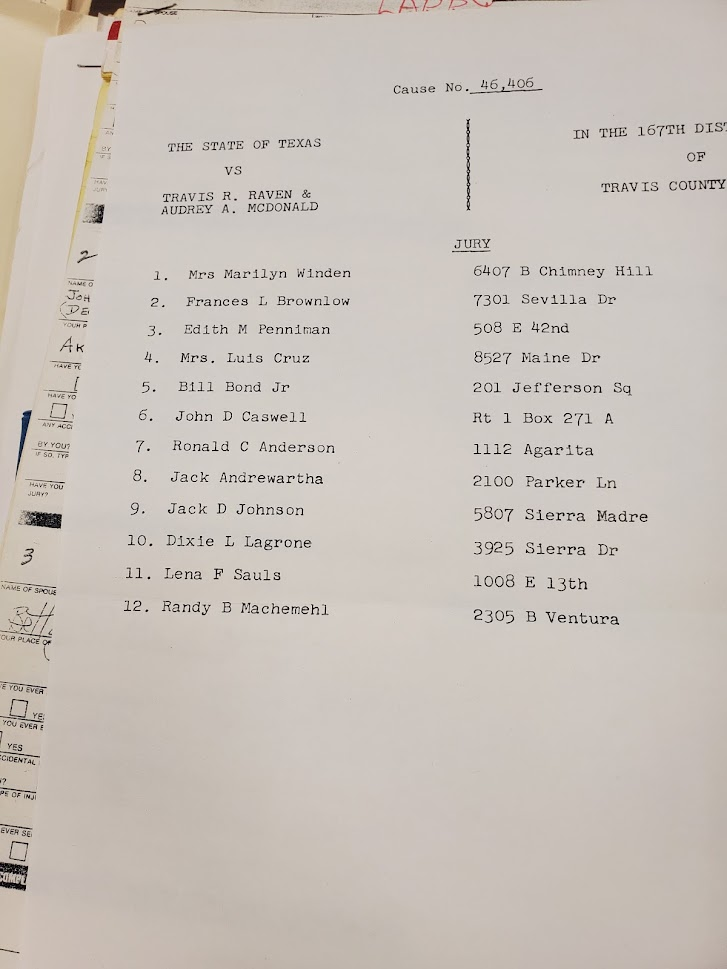
This naturally spurred my curiosity. This was a case I was neither looking for nor familiar with, but I'd snapped a photo of the caption and cause number:


It turned out to involve a man named Arthur Raven and a codefendant, Audrey McDonald, and would have been an extremely high-profile case. (Long-time readers will recognize a pattern: the higher-profile the case, the more likely somebody cuts corners to secure a conviction, as with this jury-selection process.)

Raven, a white man, was the first football coach at Reagan High School when it opened in 1965 and from the beginning was highly successful, winning three 4A state championships in 1967, '68, and '70. Reagan was a predominantly black high school, built to replace the old L.C. Anderson HS, which closed in 1971. After his third state title, Austin ISD elevated Raven to become athletic director district-wide.

His son, Arthur Jr., was a Texas Department of Public Safety trooper. In 1972, he  attempted to capitalize on name recognition from his father's success to run for Sheriff against 20-year incumbent T.O. Lang. Lang was a "Shivercrat," a conservative Democrat who'd spent World War II as Austin PD's liaison with the FBI hunting subversives. After the war in the late '40s, he was an APD homicide detective before running for office.

To this day, no one ever held that position longer and, after two decades, lots of people thought it was someone else's turn.

Also running against Lang in 1972 was Raymond Frank, a leftie reformer attempting to capitalize on the same momentum that ousted a wave of right-wing Texas Democrats at the Legislature following the Sharpstown banking scandal. Insiders blamed Raven, Jr., when he split the traditional law-enforcement vote, allowing Frank to push Lang into a runoff. Lang lost. And his allies were furious.

Once in office, District Attorney Robert O. Smith almost immediately turned his sights on Frank. A grand jury under his direction issued a report critical of the new Sheriff. Frank turned around and accused Smith of corruption and manipulating the grand jury.

Arthur Raven, Sr., was accused of coercing prostitution while all this was going on, but convicted of a lesser, misdemeanor charge while the jury acquitted his codefendant. We didn't read the whole prosecutor's file, just this portion concerning jury selection. But news accounts say Raven took the stand in his own defense, testifying most of the day as the defense's only witness. Your correspondent hasn't done enough research to form an independent opinion, but Raven certainly thought he was being railroaded.

Was Smith retaliating against the old ball coach because his son's campaign helped the DA's nemesis get into power? Grits has no first-hand knowledge. But I bet I'm not the first person to imagine so.

To be clear: I haven't read the file and just snapped a few photos and read a few news clips. I don't know who was in the right in these controversies, whether Arthur Raven, Sr., was guilty, or if his prosecution was politically motivated. But this glimpse into the historical record shows how important these old files can be to interpreting past events. Knowing prosecutors went to unethical lengths to exclude black people from Raven's jury is an important part of that story that would remain hidden if one relied only on news accounts.

In 2009, Ronnie Earle (God rest his soul) thought it was fine to make records from the 1970s public at the Travis County Archivist. That policy should be formalized. It's a waste of scarce resources at the District Attorney's office for lawyers to review every request. Better to pass that task along to library-science professionals employed precisely to perform these tasks.

I'm looking forward to receiving the records we requested, which I have no doubt will answer a long list of nagging questions surrounding the historical research Grits has been working on.

Once we get them, the next step is for the DA's office -- eventually, for every DA's office -- to develop written policies for retention and release of historical records. We hear a lot about police and prosecutors as custodians of public safety. They should also be recognized as custodians of history, and behave as such.

Tuesday, February 04, 2020

No R-E-S-P-E-C-T: Jury trials not only place for Texas criminal-defense lawyers to shed Rodney-Dangerfield image

"Want to earn a prosecutor's respect?," asked the Texas Criminal Defense Lawyers Association on Twitter. "Beat them in a jury trial."

So how much respect are Texas criminal-defense lawyers earning?

From the 2019 annual statistical report of the Texas Office of Court Administration, here are a few data points on trials I wanted to record for my own purposes. Maybe some Grits readers will also find them interesting.

Overall, reports the OCA, attorneys in Texas are taking about 5% of felony cases to trial. That's more than I would have expected, and as I'll discuss below, may be overstated.

Felony cases go to trial more often than misdemeanor cases, but acquittals in felony cases are rare:

Not as rare as in misdemeanor cases, though.

To be sure, many more cases receive dismissals than acquittals. Indeed, more misdemeanor cases are dismissed across the state than end up with a formal conviction. But apparently, securing dismissals doesn't earn prosecutors' "respect."

As an aside, what does it say about the quality of misdemeanor arrests being made if 43% of the cases are being dismissed?

Notably, when misdemeanor cases do go to trial, several categories of offenses have high acquittal rates:


But it just doesn't happen that often. Juries were selected in only 4,107 criminal cases in Texas during FY 2019: 2,701 in felony cases and 1,406 in misdemeanor cases. That's out of nearly 600,000 total criminal-case dispositions last year. (This is why I question the graphic above that said 2% of felony cases went before a jury; the juries-picked data in the same report comes in at 1.2% of felony cases.)

Regardless, for years I've heard complaints from thoughtful criminal-defense lawyers that TCDLA training and programming too overwhelmingly focuses on trial preparation and execution, even though that's a rather small part of what most criminal-defense lawyers do with their days. This Twitter tip seems indicative of that same attitude.

Grits would suggest to criminal-defense attorneys their higher priority isn't to seek "respect" from prosecutors so much as the best result for their client. Feeling personally disrespected is seldom a good reason to alter one's strategy when dealing with the government, and that goes double for attorneys in criminal court. It's just not about you!

Defendants receiving dismissals are better off than those who must go through a trial to get an acquittal. For my money, their lawyers deserve "respect," too," but apparently they must look for it somewhere besides their professional association.

Sunday, April 09, 2017

Paltry Grits posting rate masks busy time at #txlege

For readers disappointed with the paltry recent posting rate here on Grits, I should mention that most of my writing these days is happening on Just Liberty emails and action alerts. If you haven't signed on to our advocacy list, please do so. Otherwise, here are a few odds and ends which merit readers' attention.

Good Samaritan bill up in House committee
Rep. Ryan Guillen's Good Samaritan legislation (HB 73) is up on Monday in the House Criminal Jurisprudence Committee, but the biggest threat to its passage remains uncertainty about Gov. Abbott, who vetoed the bill last year and is now moving the goal posts regarding his concerns. This is a major public health concern. Overdose deaths are now twice as common in Texas as murders. Go here if you'd like to send a message to Gov. Abbott asking him to support Texas' Good Samaritan legislation.

Debtors prisons and deconstruction of the administrative state
On the same Criminal Jurisprudence agenda Monday, Rep. James White has a great little bill, HB 3279, limiting various debtors-prison practices. Hope to see this one get some traction. Anyone truly concerned with "deconstruction of the administrative state" will want to begin here. See a fact sheet on the bill from Texas Appleseed and the Texas Fair Defense Project.

Sandra Bland Act, DRP, up on Tuesday
Big day in the Homeland Security and Public Safety Committee Tuesday morning, with the Sandra Bland Act (HB 2702) and the most likely vehicle for Driver Responsibility Program repeal (HB 2068) both on the committee's agenda.

Halted execution implicates pair of capital bills
The Court of Criminal Appeals halted Paul Storey's execution last week in a move which implicates a couple of pieces of pending legislation. Prosecutors told the jury in the death-penalty phase of Storey's case that the victim's family wanted the death penalty, which turned out not to be true. Jurors were given faulty jury instructions which HB 3054 by Herrero/Smithee aims to fix. That bill was heard last week in the House Criminal Jurisprudence Committee and may get a vote as early as Monday. Meanwhile, the remaining issues in Storey's case reportedly regard whether Storey's appeals attorney could have reasonably discovered the true feelings of the victim's family about the death penalty. In other words, once again the quality of direct capital appeals are being called into question, which brings us to Corrections Committee Chairman James White's HB 1676 creating a new capital public defender for direct appeals (it'll need a catchier name than that). Maybe it'll turn out Storey's attorney couldn't have known the family's views, or maybe he just didn't ask them. But minimalist investigation and slipshod work product on direct appeal, along with cost effectiveness, are exactly the recurring problems that prompted the East Texas Republican to propose this new office. The appellate process should have vetted these subjects long before now. Storey's case could be a poster child for why these bills are needed.

When innocent SWAT raid victims defend themselves
A Corpus Christi man has sued the police department after a wrong-house SWAT raid in which he shot three officers. He was jailed for two years before being acquitted by a jury. Noted the Caller Times' Krista Torralva, "Police use of no-knock raids have recently come under public scrutiny and Rosas’ case has been included in national conversations. The Washington Post and New York Times wrote about Rosas’ case after his acquittal."

The End of Local Laws
Governing magazine says Gov. Greg Abbott wants to end local laws.

Richard Dreyfuss on Kerry Cook
Actor Richard Dreyfuss discusses Kerry Max Cook with Texas Monthly's Michael Hall. Grits couldn't agree more with Dreyfuss' answer to Mike's final question.

You gotta start somewhere
The Texas Tribune has published a couple of good primers on testifying at the capitol and making your voice heard by lawmakers. Nicely done.

Progress, slow but broad
While some folks understandably express impatience at the slow pace of criminal justice reform, it's easy to underestimate how difficult it was just to stop the upward trajectory of mass incarceration and begin to turn the curve downward. Pew's Adam Gelb describes the baby-step progress made on that front at the state level.

Thursday, March 30, 2017

Three good bills in CrimJur committee Monday

Looking at the agenda for Monday's Texas House Criminal Jurisprudence Committee, here are three items which merit Grits readers attention. (Not that there aren't other important bills up that day, these just jumped out at me as particularly noteworthy.)

First, the big innocence-related bill of the year:

HB 34 (Smithee) Relating to measures to prevent wrongful convictions. This bill came out of the Timothy Cole Exoneration Review Commission recommendations and is being carried by that group's chair. It requires tracking and disclosure of confidential informant arrangements, recording of custodial interrogations, and requires law enforcement agencies to adopt the model eyewitness ID policy created by Sam Houston State's Law Enforcement Management Institute of Texas (LEMIT) instead of each coming up with their own. These are modest but important reforms, the most obvious next steps in the Legislature's decade-long, bipartisan effort to prevent false convictions.

Grits is also a big fan of another bill on the agenda Monday, HB 1465 (Moody) which tells judges to waive court costs if they determine a defendant is indigent. This makes loads of sense. If they're indigent, after all, they cannot pay.

One passing thought, though: On the House floor, Rep. Andrew Murr included an amendment to HB 351 (Canales), which earlier passed out of the same committee, to say courts could charge a "reasonable" fee if they assign an indigent person community service. Language in those two bills may need to be reconciled if both make it all the way through the process.

Finally, this blog doesn't generally follow capital issues, but I'm interested in HB 3054 by Herrero/Smithee requiring unanimity changing faulty jury instructions for imposing the death penalty in capital cases and allowing lawyers to inform the jury of the implications if they can't agree. (Presently, that's not allowed.) As it happens, yesterday Grits met a gentleman who announced he's from the "Fully Informed Jury Association." He was a conservative at the capitol for the asset-forfeiture subcommittee hearing. I know next to nothing about his group, much less if they're even aware of HB 3054, but it's almost like informing jurors about the power they wield is a theme in the air this week. I'm looking forward to hearing debate on this bill Monday.

Tuesday, August 09, 2016

Civil suit may force Reyna recusal on Twin Peaks, and other stories

Here are a few odds and ends which merit Grits readers' attention:
 

Saturday, March 26, 2016

Prosecutor elections, the limits of reasonable suspicion, and other stories

If only to clear my browser tabs, here are a few odds and ends that may interest Grits readers:

TX prosecutor election outcomes
By TDCAA's calculations, there will be at least 20 new elected prosecutors across Texas by the time the 2016 election season ends. See details here.

Dallas cops still can't ticket for marijuana
Despite urging from the county, which must pay to jail pot smokers arrested by Dallas PD, the Dallas City Council declined to allow its officers to issue citations instead of making arrests for low-level marijuana possession. The vote was 10-5. That sounds like a dandy issue to campaign on in a local election, don't you think? What a waste of officers' time and county jail resources!

Austin extends "ban the box" to private sector
The Austin City Council made it easier for ex-offenders to get a job, requiring larger employers to ban-the-box. I've been grumpy at them lately on non-criminal justice topics, but must give credit where it's due: This was an important and encouraging step. Here's coverage from KUT. Reported the Statesman, "The Austin City Council voted 8-2 Thursday night to pass the “fair chance hiring” ordinance championed by Council Member Greg Casar, which prevents companies from asking applicants to check a box on a job application if they have a criminal history. ... The ordinance applies to employers with at least 15 workers." See Amanda Woog's writeup of the hearing.

Strike the black jurors?
Prosecutor Nathan Wood from Wharton this week accused his boss, the elected DA Ross Kurtz, of advising attorneys in the office to avoid black jurors as a matter of strategy.
The issue emerged during a black woman's trial that began in February with Wood and another prosecutor striking the only three blacks on a jury panel. Defense attorney Mark Racer objected, forcing the prosecutors to give race-neutral explanations for their actions.

"This is just a win-at-all costs mentality that shouldn't be there," Racer said this week. "And clearly one of the prosecutors was uncomfortable with it."
The limits of 'reasonable suspicion'
The Texas Court of Criminal Appeals issued a pro-defense opinion in a case which raised the question "whether an officer has reasonable suspicion to detain a suspect based on observing the suspect walking with another person at 2 a.m. in an area known for narcotics activity and based upon the officer's unsubstantiated belief that the suspect is a 'known criminal.'" In an opinion by Judge Larry Meyers, a unanimous court said that was not enough to justify a detention. Commentary at TDCAA advised that, "Reasonable suspicion is a low threshold, but not quite this low. The Court is typically deferential to the officer on the street, but this officer perhaps could have talked with the suspect awhile longer before detaining him. By doing so, he might have discovered other suspicious facts to support a detention."

License plate readers and roadside debt collection
The Southeast Texas Examiner took a deep dive into the issue of law enforcement's use of license plate readers now that the Lege has okayed roadside collections via credit card.

Pepper spray abuses
A couple of blatant misuses of pepper spray caught Grits' eye recently. In Fort Worth, a police officer sprayed motorcycle club members as a line of bikes passed him on the highway. In Austin, the Peaceful Streets Project caught an officer on video pepper spraying a handcuffed man in a police van; the officer opened the van door, sprayed the guy, then shut it again while the guy writhed around in pain inside. Both those cops should be fired.

Targeting union-dues paycheck deductions
GOP voters in the Republican primary voted by an 83-17 margin to eliminate public employee unions' ability to deduct dues from members' paychecks and Empower Texas is promoting a petition urging the Legislature to do away with the practice. Grits might be more interested in that idea except that the bill they pushed last time gave a pass to dues deductions for local police associations, who arguably are the most powerful labor interest in the state. If this is about principle, apply the principle across the board. Besides, they're mainly doing this to attack Texas House Speaker Joe Straus and it was police unions who came to his ardent defense when the Speaker was attacked during the primary. If they're going to do this, police associations must be included or the proposal comes off as two-faced.

Toward police accountability
Several additional items related to police reform merit readers' attention:
House Speaker Paul Ryan backs criminal-justice reform
U.S. House Speaker Paul Ryan announced this week he'll move federal sentencing reform legislation in the House and explained the reasons behind his own, personal transition from tuff-on-crime maven to reform advocate. For example, "I didn't necessarily know this before, but redemption is a beautiful thing. It's a great thing," he declared. "Redemption is what makes this place work. We need to honor redemption. We need to make redemption something that is valued in our culture and our society and in our laws."

Tuesday, February 10, 2015

What jurors need to know during sentencing

Recently retired Texas Court of Criminal Appeals Judge Cathy Cochran told Texas Monthly that jurors should be informed how much prison sentences would cost taxpayers, Grits noted yesterday. That got me thinking about what else jurors might be usefully told to better inform their decision making during the punishment phase.

To me, perhaps even more probative than the cost of a prison sentence (which in the context of government budgets is a bit of an abstraction, anyway), jurors should be informed of the lowest plea bargain offered by the prosecution to the defense pretrial, giving them a baseline to consider for the low end of the punishment range.

That simple improvement would substantially mitigate the "trial penalty" which has radically driven up plea bargain rates in the modern era. If jurors knew that the prosecutor before trial believed that penalty X was sufficient, the temptation to punish a defendant with 6X might be more easily avoided.

Wednesday, January 08, 2014

No right answers: Questioning capital jurors

At the Austin Statesman, editorialist Ken Herman has a column (Jan. 6) describing the questionnaire presented on Monday to the jury pool for the capital murder trial of Brandon Daniel, who stands accused of killing Austin police officer Jaime Padron back in 2012. Here's the portion of the article describing the questions asked:
The potential jurors were assured their answers would be seen only by attorneys in the case. The questionnaire prodded them about a variety of topics, some quite personal, including their religion, hobbies, mental health, medications, substance addictions, criminal record, ACLU membership and “your personal view of psychiatrists and psychologists.”

There also were questions that could foreshadow possible defense strategies, including whether “you, a family member or a friend (has) ever been the victim of physical or sexual abuse” or “emotional or mental abuse as a child.”

“If yes,” it said, “please describe.”

And there were questions with questionable relevance, such as “What type of car(s) do you drive?”
There were 11 death penalty related questions, starting with “Do you believe in the death penalty? If yes, why?”

That was followed by more nuanced queries, including one seeking the “statement which best summarizes your general views” about the death penalty. One possible answer was “I am generally opposed to capital punishment except in those very few cases of an unusually brutal, bizarre or extreme nature.”

Question 24 asked if life without parole could be “more appropriate” in some capital murder cases. Question 25 asked if death could me [sic] “more appropriate” in some capital murder cases. Question 26 asked if answers to questions 24 and 25 would change in “the intentional killing of a police officer.”
Question 19 asked “Have your views on the death penalty changed over the years?”
Some years ago in a past life, my old firm Paper Trail Research Services performed a service for attorneys in civil cases evaluating potential juror pools overnight using public records and web-based databases, supplementing (and occasionally, contradicting) data listed in the juror questionnaires. Today, in the era of Facebook, Twitter and other social media, I imagine that sort of supplementary data would be even more robust and readily available. Given that some of the questions can indeed be quite personal, it's little wonder not everyone is completely honest when answering them.

Capital murder juries must be "death qualified," meaning anyone who fundamentally disagrees with the death penalty cannot serve. You get a jury of your peers as long as those peers all agree it's okay for the government to kill you.

My personal view of the death penalty amounts to agnosticism. Do I "believe in the death penalty"? I'd have to say "yes," in the sense that, yes, it exists. (I also believe in evolution, and that the earth revolves around the sun.) And I'd have to answer question 19 - whether my views on the topic have changed over time - as "yes." Over the years, I've tried on varying death-penalty positions, pro and con, like so many ill-fitting suits. Neither abolitionism nor overt support seem to fit my own personal sensibilities. If pressed, my answer to nearly every such query on the subject would likely be "it depends," which I doubt would satisfy either side in such a case. Grits actually believes life without parole is a "worse" punishment than death. Everyone dies, but not everyone is locked up in a cage for decades on end with no hope of redemption.

Anyway, I consider one's theoretical views on the topic to have little value as it relates to any particular episode: The question in any given case is not theoretical, it's "should the state kill this guy?" There's also a subtext to that question: "Do you trust the government with life and death decisions?" A lot of people may believe in the death penalty but may also believe the government couldn't find its ass with both hands and a flashlight.

There may be people in the world you think need killing. But with trust in government near all-time lows, that doesn't mean one necessarily trusts the prosecutors or the judge, the competence of defense counsel, or for that matter the legislators who set the parameters for who will die and how those decisions get made, much less the appellate courts reviewing the cases for error. Nor can one necessarily trust that the governor will step in to fix any problems via clemency if and when those folks inevitably screw up.

All that to say: I'm glad I wasn't called for that jury.

Friday, November 22, 2013

Judge who berated jurors could have violated judicial canons

Texas Lawyer's John Council has a feature (Nov. 21) on the story (covered here on Grits) of a visiting judge in Tarrant County berating jurors for issuing a verdict with which he disagreed in a DWI case. The conclusion of the story suggests the judge may have even violated canons of judicial ethics:
There's a reason why judges are well advised to keep their thoughts about a jury's verdict to themselves, said George Gallagher, judge of the 396th District Court in Tarrant County.
"The Code of Judicial Conduct is the first thing, to start out with. And then you have, on top of that, the Texas ethics rules—the rules that lawyers and judges have to follow. And both of those codes emphasize that, whether you're a judge or a lawyer, you should take no action that can contaminate jurors," Gallagher said. 
Those same jurors may be called back for service years later, Gallagher noted, and it could become problematic if during voir dire they detail their prior bad experience with a judge. 
"And then you've got 45 other people that say, 'Yeah we agree with them,' " Gallagher says. 
Judges normally refrain from publicly disagreeing with jurors because of Canon 3 of the Code of Judicial Conduct, according to Lillian Hardwick, an Austin lawyer who consults on judicial ethics issues and is co-author of "The Handbook on Texas Lawyer and Judicial Ethics.'

She points to Canon 3 B (4), which requires that a judge "shall be patient, dignified and courteous to litigants, jurors, witnesses, lawyers and others with whom the judge deals in an official capacity ... " and Canon 3B (5) which requires that a judge "shall perform judicial duties without bias or prejudice."
Another reason judges usually refrain from publicly disagreeing with jurors is it may create recusal issues for the jurist later, Hardwick said.

Monday, November 18, 2013

Judge blasted jury because they disagreed with him

Via the blog Liberally Lean in the Land of Dairy Queen comes word of an outburst by a visiting judge in Tarrant County berating a jury for a not guilty verdict in a DWI case. See the brief transcript of his comments, in which he told the defendant he "absolutely [was] legally guilty of this offense" before declaring him "not guilty." Speaking directly to the jury, he compared their unanimous decision to the O.J. Simpson verdict, accused them of ignoring the law and their oath, and chastised them for engaging in "jury nullification," though he then acknowledged that even if that was the case, "you have a right to do that." Barry Green, author of LLLDQ, pointed out that:
The jury has an absolute right to disregard an Intoxilyzer result if they have a reasonable doubt about its accuracy. It's not jury nullification, it is following their oath and the law. How he doesn't know that is beyond shocking.

It was visiting judge Jerry Ray who retired last year as district judge in Palo Pinto County. Before being judge, he was the elected District Attorney.
MORE: From Texas Monthly's Daily Post blog.

Friday, August 30, 2013

Cognitive bias and forensics: Expert psych testimony may change depending on which side calls them

Among randomly chosen forensic psychologists, found a new study from researchers in Texas and Virginia, "experts who believed they were working for prosecutors tended to rate sexually violent offenders as being at greater risk of re-offending than did experts who thought they were working for the defense." Reported the magazine Popular Science ("Researchers expose troubling bias in forensic psychology," 8/28):
It's already known, of course, that lawyers may choose to call only experts who support their cases. So there's probably a biased sample of psychologists going on the stand in the U.S., anyway. But four psychologists from the University of Virginia and Sam Houston State University wanted to see if a large sample of psychologists, chosen without a side in mind, might also be vulnerable to bias.

he researchers recruited 99 forensic psychologists and psychiatrists, pretending that they wanted help with real cases. (Well, the cases files were real, but the forensic psychologists' evaluations wouldn't have an effect on the real defendants' trials.) The researchers gave each of the forensic experts the same four case files, but told half of them that the defense had hired them, while telling the other half that the prosecution was paying the bills. The cases the experts examined were for violent sexual offenders, whose sentences depend heavily on their perceived likelihood of reoffending.

On average, in most measures, the defense-hired experts came to significantly different conclusions than the prosecution-hired ones. This was using surveys that previous studies have shown work well—that is, a bunch of psychologists assessing someone using the surveys will generally come to the same conclusions—when they're not used in court.

"Most expert witnesses believe they perform their job objectively. These findings suggest this may not be the case," one of the researchers, Daniel Murrie of the University of Virginia, said in a statement. He and his colleagues' work points to a need for scientists to develop ways to reduce this bias, they wrote in a paper they published last week in the journal Psychological Science.
It's unlikely that only forensic psychology suffers in this regard. The results remind me of studies of fingerprint examiners who said the same set of fingerprints were a match in one context and, given a different set of fact circumstances, said they were not. And of course, both sides gravitate toward their favorite experts who are more likely to support the state's or the defendant's point of view. The state, though, is more likely to have money to hire them.

If who hires forensic psychologists matters significantly, that helps explain findings in a study released earlier this year by the same research team, described here by Dr. Karen Franklin, showing that Montgomery County jurors in civil commitment cases paid little attention to risk assessment scores, which they didn't trust nor understand. "What did make a difference to jurors was whether the defense called at least one witness, and in particular an expert witness," wrote Franklin. "Overall, there was a huge imbalance in expert testimony, with almost all of the trials featuring two state experts, but only seven of 26 including even one expert called by the defense." Now that this followup study suggests who hires a forensic psychologist can substantively influence their testimony, the question becomes, to what extent has that imbalance has significantly affected real-world outcomes?

Wednesday, June 12, 2013

Forensic follies, Williamson County jury pools, COINTELPRO, and other stories

Grits noticed several items this week that didn't make it into full posts but deserve readers' attention:

Lawsuit over constitutionality of truancy charges
Texas Appleseed is taking Dallas ISD to court. See a lengthier account from the Dallas Morning News, but it's behind their paywall. More from Alternet.

The Michael Morton case and Williamson County jury pools
Because of hometown publicity, a capital murder case was moved from Waco to Williamson County, only to find during voir dire that "About 10 prospective jurors out of 55 questioned so far either were disqualified or excused by agreement because of their feelings of distrust for the criminal justice system spawned by Morton’s 
exoneration," reported the Waco Tribune Herald. That's a pretty remarkable development among Williamson County juries.

Art in public spaces - like utility boxes
Grits has advocated allowing invited, artistic graffiti in blank public spaces from utility boxes to the backs of street signs to highway facades. That seems to be the idea behind what's going on here, with the twist that the artist is a Buddhist monk.

Ellis County may privatize jail
The Ellis County (Waxahachie) commissioners issued an RFP to privatize their county jail, we learn from Texas Prison Bidness. More background here.

Most TDCJ volunteers are faith based
Reported the Conroe Courier, discussing a bill by rookie state Rep. Steve Toth, "TDCJ currently has 20,047 volunteers, including 18,111 who are faith-based volunteers providing religious and other services in jails and prisons statewide"

'Breathprint' as biometric?
Interesting concept. Probably needs more confirming research and field testing before it's ready for use as a practical, reliable, court-worthy forensic method. Despite the statement in the linked article, I'm not yet sure I believe claims that breathprints can be uniquely identified. My understanding is it hasn't even been proven fingerprints are unique in the world, much less "breathprints."

Allegedly fake certifications may compromise 1,200+ DWI cases
Even if "breathprint" biometrics are legit, the technical application of breath forensics must be also be valid. A DPS supervisor in Conroe, "Glenn Merkord was suspended for 30 days this month for renewing certifications for machine operators who had not fulfilled all of the requirements for certification, according to a letter the Department of Public Safety sent Merkord notifying him of his punishment," reported the Houston Chronicle. Up to 1,200 cases could be affected.

Salvador cases keep coming
Nuther case overturned today by the Court of Criminal Appeals based on the Jonathan Salvador case, this one an eight year sentence. By my count, that brings the total to 20, totaling 159.5 years so far. Now that the Coty case has been decided, one suspects we may see many more, similar cases on the weekly hand down lists in the very near future. Salvador worked on nearly 5,000 drug cases.

From the COINTELPRO files
Interesting, timely history lesson from the Austin Chronicle about a time just a few decades ago when the American intelligence apparatus was turned on domestic political dissidents, focusing on events at UT-Austin.

Edward Snowden, NSA phone spying scandal and cell-phone location data
Bruce Schneier lists questions that need to be answered before anyone prosecutes Edward Snowden. Ed Hubbard, writing at Big Jolly Politics, has questions of his own. Interesting post from Fabius Maximus on the meaning of government and corporate protestations the NSA does not have "direct access" to private systems. The telecom providers like ATT and Verizon, incidentally, have issued no such denials. Finally, somebody started a petition at whitehouse.gov asking President Obama to pardon Edward Snowden. Go sign if you support it. If the petition gets 100,000 online "signatures" in 30 days, the White House will formally respond. As of this writing, it had reached 68,435 in just four days.

It should be noted, the issue of cell-phone "metadata" relates directly to the location-tracking legislation proposed by Rep. Bryan Hughes, Sen. Juan "Chuy" Hinonosa and Sen. Craig Estes during the 83rd regular session. In particular, as Grits reported from the conference at the Yale Law School on location tracking and biometrics, Verizon and Sprint use GPS coordinates instead of triangulation (like, say, ATT and T-Moble). The Wall Street Journal reports the NSA is gathering credit card data, too. That's an even greater invasion of privacy IMO than the pen-register/trap-and-trace data (phone numbers in and out) that's been more widely publicized.

Thursday, September 15, 2011

Vast majority of Midlanders skipping jury duty

I'm not sure I've ever heard of a county with such a radical problem getting people to show up for jury duty as in Midland, and wonder how the figures in this TV new story jibe with those from other counties:
Midland County Sheriff Gary Painter is shocked and dismayed to hear jury duty has fallen to the wayside for Midlanders.

Thousands of residents are skipping out on jury service and it's costing the county big.

Midland County admits they haven't implemented consequences for not showing up for jury duty in a few years, but now they're serious if you don't respond, you could end up at the county courthouse anyway.

"This is the worst problem with jurors not showing up for jury summons that I have ever seen in 25 years," said Midland Co. District Attorney Teresa Clingman.

This week alone, of 750 summons sent out only 149 people reported to the Midland County Courthouse Monday morning.

"75 percent of people fail to show up for jury duty, that is a constitutional right," said Sheriff Painter.
District judges said they will send a warning letter to those who didn't show up, but if that didn't work Sheriff Painter said "we will take summons in hand and we will go to every person's house that had a summons issued, go to their place of business, we'll snatch them up and we'll go to court."

What does it say about the system that so few folks show up for jury duty? Have attitudes changed since the rates were higher, and if so, how? Do Midlanders take the obligations of citizenship more lightly than in the past? Do folks think high conviction rates mean it doesn't matter whether they participate or not? Does there need to be more notice than a single letter mailed to prospective jurors? (Open rates for direct mail are notoriously low.) Is the low rate for juror pay a factor for people who lose wages when not at work? I find this datapoint particularly curious and surprising. What do you think is causing it? What strategies might fix it?

Imagine if 98+% of cases didn't result in plea bargains: The whole system would break down if defendants demanded jury trials at all more frequently.

UPDATE: From Texas Watchdog, "Jury duty stipends cut from $40 to $28 per day, $1.7 million savings for state of Texas." Further, "Letters from the state Comptroller went out in August reminding county courts that the robust $6 reimbursement for the first day of jury duty would not change."

Friday, April 29, 2011

Lege diverting 'dedicated' criminal justice fees to balance budget

One regrettable trend emerging in the 82nd Texas Legislature is to divert funds from dedicated fees - both in the criminal justice arena and elsewhere - to help certify the budget. State Sen. Rodney Ellis has criticized SB 1582, which raids money designated for juror pay and withholds grants from the Task Force on Indigent Defense to counties. The bill passed out of the Texas Senate yesterday. According to Ellis' press release:
In 2005, Texas ranked dead last in the nation in what it paid jurors, who had not received a pay raise since 1954.  To boost jury participation, the legislature added an additional $4 fee on criminal convictions, and used the fee to provide Texas counties funds to raise jury pay to $40 a day.  In addition, any money raised above the level to fund the jury pay raise was dedicated to the Texas Fair Defense Fund to provide indigent criminal defense.
 
SB 1582 essentially eliminates the juror pay raise and uses that money to certify the budget.  SB 1582 also takes the millions in the Fair Defense Account and uses it to balance the budget.
 
"This is a rip-off," said Ellis.  "It took years to force this state to make these small but vital justice reforms and now, in one fell swoop, we are destroying any progress we've made."
 
Furthermore, in CSHB 1, the Task Force on Indigent Defense is now granted a "sum certain appropriation" rather than "estimated budget authority."  This seemingly minor change significantly reduces the amount of money available for indigent defense grants to Texas counties. It is estimated that $16.6 million will accrue in the Fair Defense Account over the coming biennium to balance the budget rather than be spent on grants to the counties for indigent defense, even though the Account is funded through a series of court-related fees specifically put in place solely to fund indigent defense.
 
"This is yet another example of this legislature taking money from those at the bottom while protecting those at the top," said Ellis.  "We used the exact same fee we are going to raid under this bill--this $4 fee on convictions--to give judges a pay raise that same session.   Are we going to reduce the salaries of our judges this session? No." 
 
"At some point we must stop the smoke and mirrors, stop robbing Peter to pay Paul and address the structural challenges facing this state," Ellis said.
Peggy Fikac at the Houston Chronicle has a story about the bill, quoting state Sen. Kirk Watson criticizing the practice of gather fees under a pretext that they're designated for a specific purpose, only to divert funds after the fact:
Sen. Kirk Watson, D-Austin, also questioned the practice of keeping large unspent balances from fees to help balance the budget. If the revenue is not allocated for a fee's intended purpose, it can be used instead to allow more spending elsewhere.

An estimated $3.7 billion in balances is used in this way in the current budget, and Watson said that would rise to an estimated $4 billion or more in the budget proposal.

He called it "a growing bad practice of financial management, which is that we tell the public we're raising a fee or a tax for a specific purpose, but it gets used to balance the budget in other ways."
Another great example of what he's talking about may be found in the plan to cut funding for local 911 emergency lines while keeping the dedicated fee on cell phones and landlines that pay for it. And of course, on a much larger scale, it's why Texas hospitals aren't getting most of the money "dedicated" for trauma centers from the Driver Responsibility surcharge.

The same thing is happening with the Texas Auto Burglary Theft and Prevention Authority, which is funded by a $1 fee on every insurance policy. The Corpus Christi Caller Times reports on plans for "keeping the $1 charge but doing away with the task forces statewide. The state would use the money to help plug a budget shortfall of billions of dollars." As Grits has argued previously, cutting grants for investigating auto thefts and burglaries is especially absurd in combination with a proposed penalty enhancement to the crime of burglary of a vehicle. Clearance rates for vehicle burglaries are already minuscule, so it makes no sense at all to slash investigative resources but INCREASE spending on punishment of the handful of offenders caught. Adding insult to injury, SB 9, which just passed the Senate yesterday, would double that theft prevention fee and divert half the increase to other priorities. 

These fees and surcharges were all created for one reason: The Legislature wanted to pay for this or that program but was unwilling to raise taxes. So they created supposedly "dedicated" fees to generate cash that they pretend are not tax increases. But now that dedicated money is becoming just another General Revenue source, making the fig leaf that fees aren't taxes that much more implausible. At this point, it's become a distinction without a difference.

Sunday, March 13, 2011

Dog on Dog Open-Government Action, the Fiction of the Consensual Police Encounter, and other stories

Here are a few items I ran across recently that deserve Grits readers' attention:

Backstory on breaking Austin open government scandal
Get the full background on the Austin City Council Open Government Scandal when the Jennifer Peebles at the Texas Watchdog interviews Ken Martin at the Austin Bulldog in a TW podcast. That's a lot of dog on dog action. Interesting stuff; Martin dishes a lot of juicy details about who concealed what and how the story was broken. They've stopped the illegal meetings, says Martin, but the City is still concealing emails where City Councilmembers performed city business on their personal email accounts, a clear violation of years of precedent from the Texas Attorney General. Which is probably why, also in violation of the law, the City of Austin did not request an opinion from the Attorney General. They just said "no," like Melville's Bartleby the Scrivener declaring, "I would prefer not to." With no other recourse, Martin has been forced into court for the documents. Honestly, County Attorney David Escamilla is the only one who can crack this nut by bringing charges against those politicians who by all appearances conspired to violate the open records and open meetings acts.

'Perpetuating the Fiction of the Consensual Police Encounter'
The subhed is the title of a post from Liberty and Justice for Y'all criticizing a Texas Court of Criminal Appeals decision that placed the subject of a police encounter in a no-win position. If the defendant had not complied with a police command, writes blogger B.W. Barnett, "there is no doubt the court would now be using his noncompliance to justify a more intrusive search. There is absolutely no way for the defendant to win here."

Latest poster boy for asset forfeiture reform
As if he needed another one after the 2009 Tenaha Scandal, Jim Wells County has offered up a poster boy for Senate Criminal Justice Committee Chairman John Whitmire's asset forfeiture reform bill this session. According to the SA Express News, last week "four-term Jim Wells County district attorney pleaded guilty Monday to a felony count of misappropriating more than $2 million in asset forfeiture funds."

Attitudes toward gays fair game in sex offender voir dire
Attorney Bill Habern pointed out to me an interesting civil ruling from the Texas Supreme Court involving voir dire during civil commitment trials of sex offenders, on a couple of points: Where the case will include evidence that the target is gay, it's permissible to question jurors whether or not they can be fair to a gay person. Also, where a case requires proof of two prior sex-offense convictions, the defense may question whether or not the jurors will require more evidence than the mere fact of conviction in the two cases to determine whether the civil commitment target is "likely to reoffend." The SCOTX held that the judge unfairly limited the defendant's ability to eliminate biased jurors who would not consider the evidence. MORE: From the Supreme Court of Texas blog.

Making (some) sense of Indictment-Fest 2010 in Collin County
I've got to admit, I've never understood the whole brouhaha up in Collin County where the outgoing DA and judges spent their final months in office taking turns getting one another indicted, but several items I read today helped somewhat clear up the bizarre and murky picture. Here's Ed Housewright at the Dallas News framing the story with a journalist's faux balance. More probative, IMO, were attorney Hunter Biederman's excellent offerings at the blog Collin County Observer and on Biederman's own blog, Frisco DWI Lawyer, including juicy links to primary documents. MORE: From the Dallas Observer.

Why don't MSM sites link to primary documents?
Speaking of which, why don't MSM newspaper reporters and editors link to their primary sources in online reporting? I've never understood that. They have access to them, reference, them, quote them. Often they're already available online and only need a link, or are easily uploaded online either onto the media outlets own server or a variety of free alternatives (Google Documents, etc.). I thought about this today reading Brandi Grissom's piece in the New York Times where she quoted Dr. Tony Fabelo from a recent presentation to the Senate Criminal Justice Committee. Grits has quoted the same report, but I linked to a copy [pdf]. It'd pretty much put blogs like Grits out of business if the MSM would do that themselves. Quite often, the main value Grits adds is linking to primary sources for those who want more information (and, having read them for myself, raising any issues the MSM didn't pick up on). The idea of journalists as information gatekeepers is a myth that's been blown sky-high in the internet age. Today the best journalists are information conduits, summarizing the topline, takeaway issues for the masses but also providing access to more detailed information for opinion leaders and others with specialized interests. There's no reason they can't do both and it would make their product more valuable.

Wednesday, February 23, 2011

Ex-cop swayed jury deliberations in TYC sex abuse trial

Puzzled by the verdict, I was hoping some reporter would do juror interviews following John Paul Hernandez's acquittal this week following the TYC sex abuse trial in Lubbock, and Betsy Blaney from AP obliges with new insight into how a former police officer swayed jurors who at first considered Hernandez guilty ("Juror: Ex-cop swayed deliberations in Texas boys' prison sex case," Feb. 23). The story opens:
A juror in the trial of a former juvenile prison principal acquitted of sexually abusing inmates said Tuesday that a former police officer on the jury helped sway many who initially believed the ex-administrator was guilty.
Nancy Gray told The Associated Press that the officer "did a lot of talking" about reasonable doubt to the eight who believed John Paul Hernandez was guilty when deliberations started.

"A lot of people changed their minds because he kept saying, pressing the point, that he had to be guilty beyond a reasonable doubt," said Gray, who was the last to agree to the not guilty verdicts. "I was the holdout, all the way through. It was hard. That's why it was very emotional for me."

Hernandez, 45, was accused of sexually abusing five inmates at the West Texas State School in Pyote in 2004 and 2005. He was found not guilty on 14 counts in 11 indictments, including sexual assault, and had faced up to 20 years in prison.

Attempts to reach the former police officer were unsuccessful Tuesday. Several other jurors did not immediately return phone messages.

Gray said jurors "absolutely" would have thought differently had there been physical evidence. Prosecutors presented no DNA, no fingerprints and no hair samples to back up the former inmates' stories, though the jury believed each man had testified truthfully about having been abused by Hernandez.

Gray said deliberations grew testy at times and she unloaded her sentiments on the other jurors.
She said she told them: "'You know this bastard is guilty' and I was bawling. These boys are going to live with this the rest of their lives. Maybe they've done some bad things, but they didn't deserve what happened to them."
It's funny how police officers can be such sticklers for "reasonable doubt" when somebody with a badge is accused as opposed to all the cases of Texas DNA exonerees whose alibi witnesses were ignored and obvious doubt was cast aside in deference to a convict-at-any-cost mentality. I didn't sit through the testimony and have no concrete basis for second guessing the outcome, but this juror's comments make me wonder if the result could have been different if the jurors had all been average citizens and an ex-cop (with all the anti-prisoner biases that potentially entails) hadn't dominated the deliberations. Sometimes such cases are won or lost at the jury selection phase, and that may well be what happened here.

Sunday, December 12, 2010

Stuff to Read: Prosecutorial misconduct, mass incarceration, and how the black man became schizophrenic

Several excellent recent blog posts may be found on Karen Franklin's blog, In the News: Forensic Psychology, Criminology and Psychology-Law, which may interest Grits readers:
The third of those posts contained a link to an excellent academic article titled, "Police Deception during Interrogation and Its Surprising Influence on Jurors' Perceptions of Confession Evidence" that's well worth a read.

Also, check out a couple of notable items related to prosecutorial misconduct, including this USA Today article describing how rarely federal prosecutors are disciplined by state bar associations, and this post from Change.org describing the scope of prosecutorial misconduct in California.

Meanwhile, The American Prospect will publish a special issue early next year, with previews available here, on the subject of "Mass Incarceration in America" that may interest Grits readers.

Sunday, December 05, 2010

Question not 'Is death penalty unconstitutional' but 'Is common evidence unreliable?'

The big news story next week in the Texas criminal justice world will be the hearing to begin mañana in Judge Kevin Fine's court in Houston to determine whether the death penalty as practiced in Texas is unconstitutional. The hearing will be heavily covered in the MSM and I probably won't be tracking the blow-by-blow on Grits, but Mark Bennett will be there and has provided the pleadings and expert witness list from the defense. See also various MSM coverage here, here, here, and here. Getting to the heart of the matter, Andrea Keilen of the Texas Defender Service had a guest blog post at the Dallas News laying out the top six arguments against the death penalty, several of which are implicated at the hearing. They are:
  • First, Texas has no standards to ensure that eyewitness testimony is obtained in ways that protect against the risk of mistaken identification. 
  • Second, Texas allows the introduction of confessions that have been obtained without safeguards to protect against false confessions.
  • Third, use of informant testimony is largely unregulated in Texas.
  • Fourth, pervasive flaws have been identified in the analysis of presentation of forensic evidence that result in unreliable results.
  • Fifth, pretrial  discovery procedures are inadequate to safeguard against the prosecution's suppression of evidence favorable to the accused.
  • Sixth, Texas prosecutors in Harris County and elsewhere have a shameful history of excluding African Americans from juries.
Most notable to me about the debate to take place in Fine's courtroom is that, despite the fact that the Culture Warriors on both sides will be out in force flaming one another over whether the death penalty is justified, none of these arguments actually have anything to do with the death penalty per se, except that the death penalty happens to be in play as a potential punishment in this particular case. Instead, these are debates about the quality of evidence used to convict defendants throughout the justice system and whether, given the present lack of safeguards, such evidence and procedures may be trusted to sustain a conviction beyond a reasonable doubt.

Eyewitness testimony is vulnerable to error in all types of cases when the witness didn't previously know the defendant, not just capital murder. Texas does not require recording police interrogations, and confessions needn't be corroborated as they must be, for example, in federal and military courts. Very few limits exist on incentivized informant testimony. The same forensics that are flawed in capital cases have been questioned in more mundane settings. And neither pretrial discovery nor racial skewing of jury selection are procedural  matters that only arise for capital defendants.

So in a real sense, this is not a debate over "Death Penalty: Pro or Con?," though you can be sure that's how the loudest arguments will be framed. The only thing that makes these issues especially problematic regarding death penalty cases is the irreversibility of error, not its sources, which are common in many types of cases.

Tuesday, November 16, 2010

CCA: Jurors must be willing to consider minimum punishments

Liberty and Justice for Y'all brings word of an important new case from the Texas Court of Criminal Appeals (Cardenas v. State), holding that jurors must be excluded if they say they cannot consider the full range of punishments available under the law.

In a case of aggravated sexual assault of a child, a defense attorney asked potential jurors whether they could consider the minimum punishment if the defendant were found guilty, then moved to strike the 50+ people who said they wouldn't consider probation or the minimum confinement period. The judge said "no," seating several of the jurors anyway. But the Second Court of Appeals agreed the jurors were seated improperly and the CCA affirmed, declaring the trial judge abused his discretion: "Jurors must be able to consider both a situation in which the minimum penalty would be appropriate and…a situation in which the maximum penalty would be appropriate," wrote Judge Cochran. "A question committing a juror to consider the minimum punishment is both proper and permissible."

The takeaway, says LJ4Y: "Questions like the one asked in this case should be common for defense attorneys.  If a venire member cannot consider the minimum punishment, the trial court should ALWAYS exclude them from the panel.  Period."

Monday, November 01, 2010

'Bad Jurors': No disclosure

From the Fort Worth Star-Telegram ("Tarrant 'bad-juror list' can be kept private, attorney general says," Oct. 22):
The Tarrant County district attorney's office can keep its "bad-juror list" private, the Texas attorney general's office has decided.

Assistant Attorney General James Morris agreed with the district attorney's office that the document should be exempt from disclosure because it contains prosecutors' subjective impressions and is used in preparation for trials.
 Do other counties compile Bad Juror lists? Probably. Prosecutors add data to Tarrant's master list after criminal trials, according arguments submitted to the Texas Attorney General who allowed them to withhold the data.
 
In light of the US Supreme Court's decision in Batson, I wonder what is the racial makeup of Tarrant County's Bad Juror list?

One also wonders if they keep a "Good Juror" list?